Mind-Numbing

According to those in the know
The BBB’s ready to go
The vote is this morning
So, this is your warning
That President Trump will soon crow
 
As well, ere the Fourth of July
The NFP may quantify
If rate cuts are coming
(A subject, mind-numbing)
Or whether Fed funds will stay high


Perhaps this will be the last day we hear about the Big Beautiful Bill, or at least the last day it leads the news, as it appears that by the time you read this, the House will have voted on the changes and by all accounts it is set to pass.  If so, the President will sign it tomorrow amidst great fanfare and then it will just be a secondary story when somebody complains about something that was in the bill.  However, the drama over passage will have finally ended.  

(I guess what has really led the news was that Diddy was found not guilty of the RICO charges and Kohburger in Idaho got a plea deal avoiding the death penalty, but neither of those are market related.)

At any rate, the question now to be asked is will the BBB perform as advertised by either side of the aisle?  Experience tells us that while the economy will not take off rapidly while inflation collpases, neither will there be people dropping in the streets because of the changes in Medicare, although if you listened to the pundits on both sides of the aisle, that is what you might expect.  While this is not quite as bad as Nancy Pelosi’s immortal words, “we have to pass the bill to find out what’s inside it”, the fact that it approaches 1000 pages in length implies there is a lot inside it.

From what I have read, and it has not been extensive, it appears that there is some stimulus in the bill in the form of tax relief on tips and overtime as well as reductions for seniors, and spending on defense and the border.  It also appears there have been several previous subsidies, notably for wind and solar, that are being removed.  The fact that the CBO is claiming it will increase the budget deficit by $1.5 trillion, and given the fact that Jim Cramer is the only one with a worse track record than the CBO, tells me it will have limited impact on the nation’s fiscal stance initially, although if growth does pick up, that will clearly help things.

Which takes us to the other story this morning, the payroll report.  Here are the current median forecasts by economists for the results, as well as the rest of the data to be released:

Nonfarm Payrolls110K
Private Payrolls105K
Manufacturing Payrolls-5K
Unemployment Rate4.3%
Average Hourly Earnings0.3% (3.9% Y/Y)
Average Weekly Hours34.3
Participation Rate62.3%
Initial Claims240K
Continuing Claims1960K
ISM Services50.5
Factory Orders8.2%
-ex Transport0.9%

Source: tradingeconomics.com

Some will point to yesterday’s ADP Employment report which showed a decline of -33K, the first decline in more than 2 years, as a harbinger of a bad number, but as you can see from the chart below, there has been a pretty big difference between ADP (grey bars) and NFP (blue bars) for a while now.

Source: tradingeconomics.com

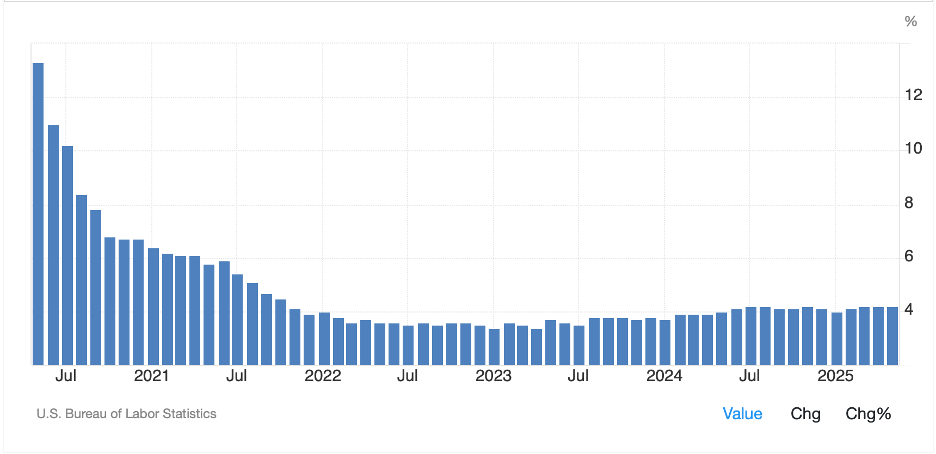
Perhaps of more concern is the Unemployment Rate, which is forecast to rise a tick to 4.3%, which would be its highest print since October 2021 and if I look at the chart below, it is not hard to see a very gradual trend rising higher here.  While markets really focus on NFP, I learned a long time ago from a very smart economist, Larry Kantor, that the Unemployment Rate was the best single indicator of economic activity in the US, and that when it is rising, that bodes ill for the future.  
Source: tradingeconomics.com

You may recall there was a great deal of discussion about a year ago regarding the Sahm Rule, which hypothesized that when the Unemployment Rate rose more than 0.5% above its cycle average within 12 months, the US was already in a recession.  The discussion centered on whether it had been triggered although the final claim was it hadn’t when extending the readings out to the second decimal place.  Now, for the past year, the Unemployment Rate has hovered between 3.9% and 4.2%, so there doesn’t seem to be any chance of a trigger here, although if it does rise, you can be sure you will hear about it.

And that’s what is on tap ahead of the long holiday weekend.  With that in mind, let’s look at the market action overnight. Excitement is clearly lacking in the equity markets these days as the summer doldrums are universal.  Yesterday’s new closing highs in the S&P 500 seem like they should be exciting but were anything but amid low volume.  As to Asia, Japan was flat, China (+0.6%) and Hong Kong (-0.6%) offset each other and in the rest of the region, other than Korea (+1.3%) which is starting to see a steady stream of foreign investment on the premise that the country is set to improve the regulatory structure for equities there, things were +/- a bit.

Meanwhile, in Europe, there is little net movement on the continent but the UK (+0.4%) is bouncing off recent lows after PM Starmer reiterated his support for Chancellor Reeves.  A story I missed yesterday was that when she was trying to make a case in parliament for spending cuts, the back bench liberals revolted, literally bringing her to tears.  The market response was that the UK would blow up its fiscal situation which saw Gilts tumble and yields rise 15bps yesterday at one point, while stocks fell.  But that problem has been addressed for now.  However, looking at the statement Starmer made, it reminded me of a baseball GM’s comments supporting his manager right before he fires him.

In the bond market, yields are declining, led by Gilts (-9bps) which are retracing yesterday’s gains on the above story.  But Treasury yields are down (-2bps) and European sovereigns are all seeing yields lower by between -4bps and -5bps.  In Japan, JGB yields are unchanged as PM Ishiba grapples with a trade deal where the US is keen to be able to export rice to the nation and Japan has a rice shortage with prices rising sharply but doesn’t want to accept imports.  Go figure.

In the commodity markets, oil (-0.2%) is slipping slightly after a solid rally over the past seven sessions where it rose over $3.50/bbl.  Gold (-0.3%) continues to trade around its pivot level of $3350/oz while silver (+1.0%) continues its longer run rally.

Finally, the dollar, which fell during yesterday’s session after I wrote, is effectively unchanged net this morning ahead of the data with very modest moves of +/-0.2% or less almost universal.  KRW (+0.4%) is the outlier here and based on equity inflows discussed above, that makes sense.

So, that’s where we stand heading into the payroll report and the long weekend.  If pressed on the NFP outcome, I expect a weak outcome, 50K or so, as the birth/death model continues to be revised.  But remember, the error bars on this number are huge.  However, if it is weak, look for the probability of a July rate cut (currently 25.3%) to rise and the equity market to follow that higher.  As to the dollar, I think for now, lower is still the trend.

Good luck and have a wonderful long weekend

Adf

Savants Disagree

The Senate completed their vote
And so, BBB, though there’s bloat
Will soon become law
As Dems say pshaw
While lacking a doctrine, keynote
 
So, eyes now turn to NFP
The key for the FOMC
The JOLTs showed that gobs
Of ‘vailable jobs
Exist, though savants disagree


Market activity continues to demonstrate lower volumes and despite several competing political narratives, price action remains muted overall.  The biggest news of late is the Senate passed their version of President Trump’s BBB last night and now it goes to committee for reconciliation before getting to the president for signing.  Of course, given the mainstream media’s complete antagonism toward the president, the headlines this morning refer to the problems the Republicans will have agreeing terms between the two houses, and I’m sure it will be difficult.  However, based on everything that President Trump has done to date, I expect it will get completed.  While perhaps not by Friday, probably by next week.

This matters to markets because it will help set the tone for government spending and the potential companies that will benefit, as well as those that will be negatively impacted, based on the change in focus from that of the Biden administration.  

At this point, it is impossible to forecast with any certainty how things will evolve, especially with respect to issues like the budget deficit and debt issuance.  While yesterday, Treasury Secretary Bessent did explain that they were going to continue to focus on short-term issuance, if (and it’s a big if) the bill does goose economic activity in the US, it is quite possible that faster GDP growth increases tax collections and reduces net government spending and the deficit.  I would estimate that view is not discounted at all in markets at this time given the constant messaging from media and the punditry that not only are people going to starve to death and lose their medical care because of this bill, but that it is unaffordable and will bankrupt the country.  Something tells me the results will be slow acting, although if the government does continue its deportations and stops subsidizing too-expensive green energy projects, we could see less government spending.  We shall see.

But markets need a focus and tomorrow’s NFP is as good as it gets.  Chairman Powell has been attending the ECB’s summer symposium and, in his speech, yesterday he essentially reiterated his views that the Fed will continue to watch and wait on rates as there is still concern that tariffs may drive inflation higher.  As to jobs, they are watching the situation closely, but thus far, the labor market has held up.  Proof of that idea was evident in yesterday’s JOLTs Job Openings data which showed a surprising jump of more than 300K new job listings available.  I haven’t seen a rationale yet, but perhaps it is related to the self-deportations by illegal immigrants who have left businesses with numerous vacancies.  The weekly claims data, while above its lowest levels lately, continues to run at very modest numbers on a long-term perspective as can be seen in the chart below with data from the Department of Labor.  If the job market holds up, I don’t see the Fed cutting rates despite President Trump’s ire.

Also, at Sintra was BOJ Governor Ueda who explained that Japanese policy rates were substantially lower than neutral and that inflation would likely continue creeping higher over time.  I guess we cannot be surprised that the yen (-0.5%) has slipped in the wake of those comments.  The final noteworthy comments from Sintra were from BOE governor Bailey who explained that despite sticky inflation, more rate cuts were on the way, helping to undermine the pound (-0.4%) this morning.

But there is one final thing to discuss regarding the Sintra meeting, and that is how many central bankers were suddenly concerned that their currencies were getting “too strong”!  We have been hearing about the dollar’s decline in the first half of the year as though it was a signal the US was in permanent decline.  Of course, given the nature of FX trading, a weaker dollar can also be seen as strength in other currencies. (To be clear, all fiat currencies continue to weaken vs. stuff as evidenced by the fact that inflation continues to be positive everywhere in the world, except perhaps Switzerland and China right now.)  However, I could not help but laugh at the ECB comments from several board members, that if the euro were to rise any further it could become a problem for the Eurozone economies.  All their models show that if a major export destination raises tariffs, their own currencies should decline to offset those tariffs.  Alas, once again, their models are not giving them answers that reflect the reality in markets.  And given Europe has built their economies on export reliance, a strong currency is a problem.

We must distinguish between a stronger exchange rate and a strong case to own a currency, especially as a reserve asset, but the two have historically been highly correlated.  As I have repeatedly explained, the dollar’s decline this year is neither anomalous nor particularly large in the broad scheme of things.  As well, it is exactly what the administration is seeking as it helps the competitiveness of US companies on the world stage.  However, my take is that at some point soon, the dollar will find a bottom.  I indicated a move to 90 on the DXY would be possible, and I think that is probably still true, although given the growing net short positions in USD vs. other currencies, the short squeeze will be spectacular when it arrives!

Ok, let’s see if we can get through the overnight activity without falling asleep.  Yesterday’s mixed US session was followed by a mixed session in Asia (Nikkei -0.6%, Hang Seng +0.6%, CSI 300 0.0%) with a mixture of modest gains and losses across the rest of the region, all on low volumes.  In Europe this morning, bourses are firmer led by the CAC (+1.1%) and Spain’s IBEX (+0.75%) as hopes for further rate cuts from the ECB dominate discussions.  As to US futures, they are modestly higher at this hour (7:30), about 0.15%.

In the bond market, after stronger than expected JOLTs data and ISM data, yields are backing up with Treasuries (+4bps) leading the way although both Germany (+5bps) and the UK (+6bps) are seeing selling pressure as well.  However, the rest of European sovereigns have only seen yields edge 1bp higher.  The only noteworthy comments I saw were from the Italian FinMin who explained Italy would be maintaining its fiscal prudence.  Not surprisingly, given Ueda-san’s comments, JGB yields rose 4bps overnight as well.

In the commodity space, oil (+1.25%) continues to drift higher as it tries to fill the gap seen last week.

Source: tradingeconomics.com

Apparently, the fact that supply seems to be rising rapidly has not dissuaded traders from the view that the ‘proper’ price range is $65-$75 rather than my belief of $50-$60.  But right now, they are looking smart.  In the metals markets, we continue to see support as the entire decline in the gold price at the end of June has been recouped and we are modestly higher this morning across all the metals (Au +0.1%, Ag +0.6%, Cu +0.4%, Pt +2.2%) with platinum merely showing its volatility due to lack of liquidity.

Finally, the dollar is firmer this morning against every one of its G10 and major EMG counterparts with the euro and pound (both -0.4% now) setting the tone.  Perhaps the best performer this morning is INR (-0.1%) which seems to be benefitting from the news that a trade deal is almost complete there.  As to trade with the Eurozone, that deal seems a bit further away, although I did see something about a European recognition that US tariffs would be, at a minimum, 10%.  At least for today, I haven’t read anything about the dollar’s ultimate demise!

On the data front, today brings ADP Employment (exp 95K) and then the EIA oil inventory data.  There are no Fed speakers either, so quite frankly, absent something newsworthy from DC, I suspect this will be a quiet session ahead of tomorrow’s NFP.  I guess the dollar is not dead yet.

Good luck

Adf

The Perfect Riposte

Attention right now’s being paid
To Congress on taxes and trade
The One BBB
Is seen as the key
To growth in the coming decade
 
Meanwhile, Sintra right now’s the host
To Powell, Lagarde and almost
All central bankers
Each one of whom hankers
To nurture the perfect riposte


The headlines this morning highlight that Congress put in an all-nighter last night as they try to get the BBB over the line and on the president’s desk by Friday.  My take is they were seeking sympathy for all the hard work they must do and trying to make it seem like they are slaving away on their constituents’ behalf.  Yet it appears that since the president’s inauguration on January 20, 161 days ago, Congress has been in session for somewhere between 40 and 50 days (according to Grok), about one-quarter of the time.  I have seen these estimates elsewhere as well, and quite frankly, it doesn’t speak well of Congressional leadership.  

In the end, though, I continue to expect the BBB to get passed by both houses and sent to the president.  I’m certain there are still a lot of things in the bill that many fiscal conservatives will not like, but I’m also confident that the fact that not a single Democratic representative or senator is going to vote for the bill is likely a sign that it does more good than harm.  I am completely aware of the debt and deficit issues and questions of their long-term sustainability, and I am not ignoring that.  But politics is the art of the possible, not the perfect, and my take is this is possible.  Consider for a moment the Orwellian-named Inflation Reduction Act from 2022, which passed the Senate on a tiebreaker vote by VP Harris.  That was a much more harmful piece of legislation from a fiscal perspective than this.  In fact, I would say this is the very definition of politics.

Through a market lens, if (when) this is passed, while there may be an initial ‘sell the news’ move, I suspect that the stimulus it entails will be a net benefit for risk assets overall.  And the only reason there would be a sell the news event is that the market is already pricing in a great future as evidenced by yesterday’s quarterly close at new all-time highs for the S&P 500, above 6200.

Turning to the other noteworthy news, the ECB is holding their faux Jackson Hole event this week in Sintra, Portugal where all the heads of major central banks are currently gathered along with academics and journalists who are there to spread the good word.  Chairman Powell speaks today, but this is the Powell story of the day.  Apparently, President Trump had this hand-written note delivered to the Fed Chair.  Are we not entertained?

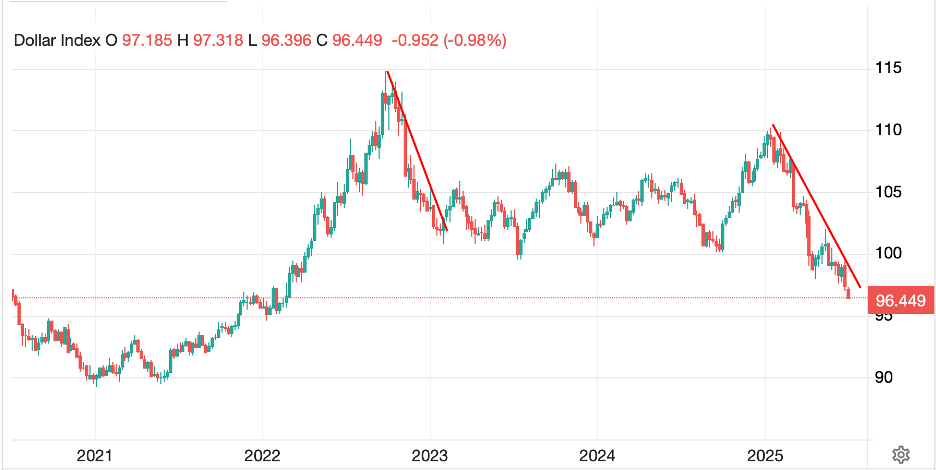
But ignoring for a moment the president’s desires, let us consider the dollar and its potential future direction.  The predominant current thinking is that it has further to slide as the trend is clearly lower and the rising anticipation of a recession in the US forcing the Fed to cut rates further will undermine the greenback.  Let’s break that down for a moment.  There is no question the dollar is currently in a downtrend as evidenced by the chart below.  A look at the red line on the right shows the slope of the decline thus far this year, which totals about 11%.

Source: tradingeconomics.com

In fact, much has been made of the decline thus far this year as to its speed and how it is a harbinger of both a recession and the end of the dollar’s hegemony.  Yet, we don’t have to go very far back in time, late 2022-early 2023 to see a virtually identical decline in the dollar over a slightly shorter period, hence the steeper slope of the line in the center of the chart, and I cannot find a single descrying of the end of the dollar at that time. Too, I remember being certain a recession was on the way then, when it never arrived.  According to JPMorgan, it seems the recession probability for 2025 is now 40%.  I have seen estimates ranging from 25% to 80% over the past few months which mostly tells me nobody has any idea.

We also don’t have to go very far back in time to see when the dollar was substantially weaker than its current levels.  I’m not sure why this time the dollar’s recent trend means the world is ending when that was not the case back in 2023 or any of the myriad times we have seen movement like this in the past.

But one other thing to consider regarding the dollar is that the BBB is going to provide significant stimulus to the economy.  Combining this with President Trump’s trade policies which are designed to draw investment into the US, and seemingly are working, and I think that despite his desire for lower interest rates, the Fed will have little reason to cut amid stronger growth in the economy.  I do not believe you can rule out a turn in the dollar higher once the legislation is passed as it is going to matter a great deal.  While spending priorities are going to change, it appears that investment is going to rise and that will help the buck.  Be wary of the dollar is dying thesis.

Ok, yesterday’s market activity, while reaching record highs in the equity markets, was actually incredibly slow with volumes shrinking.  My sense is folks are on holiday this week and those who aren’t are waiting for Thursday’s NFP data, so they can then run out of the office and go for their long weekend.  But the rest of the world doesn’t have the holiday Friday and are all trying to solve their trade situation with the US.  That led the Nikkei (-1.25%) lower yesterday as there appears to be a timing mismatch from a political perspective.  Ishiba doesn’t want to agree to open Japan’s market to US rice ahead of the election on July 20th as that will be a major political problem, but July 9th is approaching quickly, and Trump has said that is the date.  But aside from Japan and Hong Kong (-0.9%) the rest of the region had a pretty solid session led by Thailand (+2.1%) and Taiwan (+1.3%).  In Europe, though, PMI data was less than stellar, and bourses are modestly softer (DAX -0.5%, CAC -0.4%, FTSE 100 -0.3%) although Spain’s IBEX (+0.2%) has managed a gain as they had the best PMI outcome of the lot.  

In the bond market, yields continue to slide everywhere with Treasuries (-4bps) actually lagging the Eurozone which has seen declines of -6bps virtually across the board.  Madame Lagarde, in her Sintra opening speech, explained that the ECB would be altering their communication strategy to try to take account of the uncertainty in their forecasts, so not promise as much, but I have a feeling the movement is more a result of the softer PMI data as well as the Eurozone inflation release at 2.0% which has ECB members explaining things are under control.  Japan is a bit more confusing as JGB yields (-4bps) slipped despite what I would consider a strong Tankan report and a rise in their PMI data.  However, the newest BOJ board member did explain there was no reason to raise rates anytime soon, so perhaps that is the driver.

In the commodity markets, oil (+0.8%) continues to creep higher, perhaps a harbinger of stronger future economic activity around the world, or perhaps more short covering.  Gold (+1.4%) has completely erased the dip at the end of last week and is back at its recent pivot point of $3350 or so.  This has brought silver (+1.1%) and copper (+0.7%) along for the ride.

Finally, the dollar is clearly softer this morning with JPY (+0.6%) the leader in the G10 while ZAR (+0.9%) is the leading gainer in the EMG bloc as it follows precious metals prices higher.  Net, I would suggest that the average move here is about 0.25% strength in currencies.

On the data front, we get ISM Manufacturing (exp 48.8) and Prices Paid (69.0) and we get the JOLTs Job openings (7.3M) this morning.  Too, at 9:30, Chairman Powell speaks so it will be interesting to see if there is any change in his tune.

I see no reason for the dollar to turn higher right now but watch for the BBB.  Its passage could well change the dollar’s direction.

Good luck

Adf