One, Two, Three

On Monday, no one could agree
So, Powell unleashed; one, two, three
At least with respect
To how they dissect
The prospect for rate cuts they see
 
For Bostic, he sees only one
Before the committee is done
While Cook thinks that two
Are likely to do
And Goolsbee said three need be spun


During a session with very little new news, and ultimately, very little in the way of net market movement, it was quite interesting to hear from three different Fed speakers with somewhat different views of what the future holds.

In order of their views, as opposed to the timing of their comments, Atlanta Fed President Raphael Bostic reiterated his view from Friday in a different venue.  He explained that given the resilience of the economy, he sees little reason for any rate cuts in the near term and that his ‘dot’ was for just one cut this year, later in the year.  The thing about Bostic is he has proven to be flexible, arguably adhering to the Keynesian concept of, when the facts change, he changes his mind.  While it is not clear to me that the facts have actually changed, his perception of them certainly has.  At this point, it appears that he has become one of the more hawkish FOMC members and he is a current voter on the FOMC.

One step further toward the median we found Governor Lisa Cook, who explained that “the path of disinflation, as expected, has been bumpy and uneven, but a careful approach to further policy adjustments can ensure that inflation will return sustainably to 2% while striving to maintain the strong labor market.”  In other words, we have been surprised by the two consecutive hotter than expected CPI reports and so despite our fervent desire to cut rates as quickly as possible, if we were to do so, whatever credibility we still have would be thrown away.  At least, that is how I read her comments as she is a clear dove and desperate to cut.  To her credit, as a governor, she is making the effort to be a bit more restrained.

Lastly, we heard from Chicago Fed President, Austan Goolsbee, who during his interview (at Yahoo! Finance) quickly highlighted that his ‘dot’ was for three cuts this year.  He further explained that housing was the problem, at least with respect to their forecasts, and why they had expected inflation to decline more rapidly. Now, based on the housing data we continue to see, at least the price data, inflation is unlikely to decline much further at all.  Add in the fact that commodity prices, notably energy prices, have been rebounding for the past month and any hopes for another leg lower in either CPI or PCE are slipping away.  Also, Goolsbee is not a current voter, so many take his views a bit less seriously.

Now, let me ask, do you feel more enlightened?  Me neither.  If I were to assess the current situation, my read is that the majority of the FOMC really does want to cut rates as they believe they have done enough regarding inflation.  Frighteningly, there was an article in the FT this morning from Mohamed El-Erian, claiming that the time is ripe for allowing inflation to run hotter in order to support nominal growth.  We know that is every FinMin’s wet dream, but historically central bankers pushed back on that thesis.  However, El-Arian now claims that the central banks are on board as well.  If this is true, the only conclusion is that all fiat currencies are going to decline in value vs. stuff.  The relative pace of these declines will ebb and flow based on interest rate differentials and other circumstances, but it is not a net positive for the ordinary consumer.

Ok, let’s turn our attention to the overnight session and how markets are behaving.  The bulls have to be disappointed that the recent Fed speakers have not been more dovish, and we have seen that in another lackluster equity session in the US yesterday, with all three major indices lower by about -0.3%.  In Asia, while Japanese shares were essentially unchanged, we saw some strength in China and Hong Kong with the noteworthy story being President Xi’s invitation to keep several US CEOs currently visiting there, in country with the promise of a meeting with him.  The read is he is open to deeper business relationships.  As to the rest of the region, equity markets were mixed with some gainers and some laggards and no large movers.  As to Europe this morning, the color on the screen is green, with a few gains of 0.5% (Germany and Spain) and the rest much more subdued.  US futures are pointing higher at this hour (7:00), by about 0.5%, so the bulls are back.

In the bond market, yields have backed off a bit with Treasuries lower by 2bps and European sovereigns falling between 3bps (Germany) and 6bps (Italy) as the ECB speak continues to point to rate cuts clearly coming, with more hope for April making its way into the market, at least according to Italy’s Panetta.  In what cannot be a huge surprise, 10-year JGB yields remain unchanged as the idea of a tightening cycle there is slowly ebbing from traders’ minds.

In the commodity markets, oil (+0.2%) is creeping higher again as Russia has indicated it is going to restrict production alongside the lost output from refinery damage caused by Ukraine.  As well, after the UN Security Council vote yesterday, it appears that concerns are rising that there is no chance of a ceasefire anytime soon.  Meanwhile, gold (+1.2%) is screaming higher this morning and once again approaching $2200 as what appears to be a combination of growing geopolitical jitters combines with the growing awareness by market participants that inflation is not going to be addressed has investors seeking alternatives to fiat currencies.  Base metals, though, are not seeing the same boost, although are a touch higher overall.

Finally, the dollar is under some pressure this morning with most G10 currencies firmer, although the Swiss franc (-0.2%) is suffering a bit.  In fact, the biggest winner is NZD (+0.45%) but there is precious little to explain this movement.  One currency that is not gaining is the yen, which is unchanged on the session while the dollar remains just below its multi-decade highs set back in October 2022.  In the EMG bloc, the story is more mixed with some gainers (CZK +0.2%, HUF +0.3%) and some laggards (ZAR -0.3%, TWD -0.2%), but as you can see, the movement has been muted.

On the data front, this morning brings Durable Goods (exp 1.1%, 0.4% ex-transport) and Case Shiller Home Prices (6.7%). We also see Consumer Confidence (107.0) at 10:00.  There are no Fed speakers scheduled, but do not be surprised if there is an interview or two from a news source as they continue to try to tweak their message.

To me, the big picture is that there has been a clear relaxation by the Fed, and other central banks, in their attitude toward inflation.  As such, I expect to see risk assets perform and bonds lag.  However, regarding FX, it is all about the timing of the changes that are announced, or guided, rather than the absolute destruction in their value over time.  For now, though, the Fed remains the tightest policy around and the dollar should benefit because of that.

Good luck

Adf
Threw in the Towel

There once was a banker named Powell
Who fought, prices, high with a growl
Then going got tough
So he said, “enough”
And basically, threw in the towel
 
His problem’s inflation’s alive
And truthfully, starting to thrive
The worry is he
Will soon say that three
Percent’s the rate for which he’ll strive


With several days to digest the latest FOMC meeting results, and more importantly, the Powell press conference, my take is the Chairman recognizes that to get to 2.0% is going to be extremely painful, too painful politically during this fraught election cycle.  And so, while he tried very hard to convince us all that the Fed was going to get to 2.0%, he stressed it will “take time”.  The subtext of that is, it’s not going to happen in the next several years, at least, and this poet’s view is it may not happen again for decades.  The key to recognizing this subtle shift is to understand that despite increased forecasts for both growth and inflation, the Fed remains hell-bent on cutting interest rates.  Even the neo-Keynesian views which the Fed follows would not prescribe rate cuts in the current economic situation.  But rate cuts are clearly on the table, at least for now.

This begs the question, why is he so determined to cut interest rates with the economy growing above trend?  At this stage, the explanation that makes the most sense to me is…too much debt that needs to be refinanced in the coming years.

Consider, current estimates for total debt around the world are on the order of $350 trillion.  That compares to global GDP of just under $100 trillion.  Many estimates indicate that the average maturity of that debt is about 5 years which means that something on the order of $70 trillion of debt needs to be refinanced each year.  Now, the US portion of that debt is estimated at about $100 trillion, of which ~$34.5 trillion is Treasury debt, and the rest is made up of corporate, mortgage, municipal and private debt.  Remember, too, that total US GDP is currently about $28 trillion as of the end of February (according to the FRED database from the St Louis Fed), so the ratio here is similar to the global ratio.  [Note, this does not include unfunded mandates like Social Security and Medicare, just loans and bonds outstanding.]

Here’s the problem, we have all heard about the fact that the US debt service has climbed above $1 trillion per annum and given the underlying principle is growing, that debt service is growing as well.  In addition, on the private side, there is a huge proportion of corporate debt that has become a serious problem for banks and investors, notably the loans made for commercial real estate, but personal and credit card debt as well.  The Fed cannot look at this situation and conclude that higher rates, or even higher for longer, is going to help all the debtors.  And if the debtors default…that is going to be an economic disaster of epic proportions.Add it up and the only logical answer is Powell is going to gaslight everyone with the idea that the Fed is going to remain vigilant regarding inflation.  And they will right up until the time when the pain becomes too great, or too imminent and they cut.  I think that we are seeing the first signals from markets this is going to be the case from both gold and bitcoin.  But if I am correct, and the Fed cuts despite still elevated inflation readings, look for the dollar to decline sharply, at least initially until other central banks cut as well, look for bonds to fall sharply and look for hard assets to rally.  As to stocks, I expect that initially it will be seen as a positive and juice the rally, but that over time, stocks will begin to lag hard assets.  Quite frankly, this looks like it is a 2024 event, so perhaps if that first cut really comes in June, the summer is going to be far more interesting than anybody at the Fed would like to see.

Kanda told us all
“We are always prepared” to
Prevent yen weakness
 
Meanwhile in Beijing
The central bank responded
Nothing to see here


“The current weakening of the yen is not in line with fundamentals and is clearly driven by speculation. We will take appropriate action against excessive fluctuations, without ruling out any options.”  So said Masato Kanda, the current Mr Yen at the MOF.  It seems possible, if not likely, the yen’s decline in the wake of the BOJ move last week came as a bit of a surprise.  This morning, the yen (+0.1%) has edged away from its lows from last week, but USDJPY remains above the 151 level and very close to the level when the MOF/BOJ intervened in October 2022.  Adding to the pressure was Friday’s very surprising sharp decline in the CNY, which many in the market took to mean the PBOC was comfortable with a weaker yuan. 

Economically, a weaker yuan seems to make sense, but the PBOC’s concern is that it could lead to increased capital outflows, something which they are desperate to prevent.  As such, last night, the CNY fixing was nearly 1200 points stronger than expected, with the dollar rate below 7.10, and we saw significant dollar selling by the large Chinese banks.  Apparently, Friday’s movement was a bit too much.  I suspect that these two currencies will continue to track each other at this point with both currently at levels which, in the past, have been demarcation lines for intervention.   

Here’s a conspiratorial thought, perhaps the Fed’s dovishness is a response to the weakness in the yen and Powell’s best effort to help the BOJ avoid having to intervene again.  The thing about intervention is it, by definition, represents a failure of monetary policy, at least in the market’s eyes.  And in the end, all G10 central banks are in constant communication.

Ok, let’s survey the markets overnight.  All the currency activity seemed to put a damper on equity investors as Asia saw weakness across the board with Japan (Nikkei -1.2%) falling, although still above 40K, and both Hong Kong and mainland shares in the red.  In Europe this morning, red is also the predominant color, although the declines are more muted, ranging from -0.1% (DAX) to -0.4% (CAC).  Finally, US futures, at this hour (7:00) are also slipping lower, down 0.25% on average.

In the bond market, Treasury yields are backing up 3bps this morning, bouncing off the critical 4.20% technical level again.  As well, in Europe, sovereign yields are rising between 2bps and 3bps across the board.  There has been no data of note, but we have heard a bit more from ECB bankers with a surprising comment from Austria’s Holtzmann that he saw no reason for rate cuts at all.  That is an outlier view!  And despite what is happening in the FX markets, JGB yields remain unchanged yet again.

Turning to commodities, oil (+0.3%) is edging higher this morning as, after a strong rally early in the month and a small correction, it appears that $80/bbl is a new floor for the price.  In the metals markets, after last week’s pressure lower, this morning both precious (gold +0.3%) and base (copper +0.1%) metals are edging higher.  There has not been much in the way of news driving things in this session.

Finally, the dollar is a touch softer this morning, but that is after a strong week last week.  We’ve already touched on the Asian currencies, and it is true the entire bloc, which had been under pressure, is a bit stronger this morning.  But we are seeing strength across the board with G10 currencies higher on the order of 0.2% and most EMG currencies firmer by between 0.1% and 0.2%.  So, while the movement is broad, it is not very deep.  I maintain this is all about US yields and the fact that despite Powell’s newfound dovishness, the Fed remains the tightest of the bunch.

On the data front, there is a lot of information to be released, but I suspect all eyes will be on Friday’s PCE data.  

TodayChicago Fed Nat’l Activity-0.9
 New Home Sales680K
TuesDurable Goods1.0%
 -ex Transport0.4%
 Case Shiller Home Prices6.8%
 Consumer Confidence106.7
ThursdayInitial Claims215K
 Continuing Claims1808K
 Q4 GDP3.2%
 Chicago PMI46.0
 Michigan Sentiment76.5
FridayPersonal Income0.4%
 Personal Spending0.4%
 PCE0.4% (2.4% Y/Y)
 Core PCE0.3% (2.8% Y/Y)
Source: tradingeconomics.com

In addition to that menu, Fed speakers will be about with five scheduled including Chairman Powell on Friday morning.  Remember, too, that Friday is a holiday, Good Friday, with market liquidity likely to be somewhat impaired as Europe will be skeleton staffed.  As well, it is month end, so my take is if Powell veers from the script, or perhaps reinforces the dovish theme, we could see an outsized move.  Just beware.

Recent activities by the BOJ and PBOC indicate that the market has found a sore spot for the central banks.  If the data this week doesn’t cooperate, meaning it remains stronger than forecast, it will be very interesting to hear what Chairman Powell has to say on Friday.  Cagily, he speaks after the PCE data, so he will be able to respond.  But especially if that data comes in hot, we are likely to see more volatile markets going forward.  However, today, it is hard to get too excited.

Good luck

Adf

The Dollar is King

The Old Lady left rates on hold
But two members changed views when polled
No longer did they
See hikes as the way
The outcome was pounds were then sold

In fact, the most noteworthy thing
Is watching the dollar’s upswing
Against all its foes
Its value has rose
And once more the dollar is king

Finalizing the commentary on central bank activity this week, while the BOE did not adjust its rates, as was universally expected, the excitement came when the votes were tallied up.  As I had mentioned on Monday, at the last meeting, the split was 1/6/2 for a cut, holding steady and a hike respectively.  It remains amazing to me that members of the committee could have viewed the data and come to completely opposite conclusions in the past.  But the big change was that the two members who had been consistently voting for a hike adjusted their view to holding steady with the outcome a single vote for a cut and the rest of the committee voting to keep policy unchanged.  Of course, in the world in which we live today, that was tantamount to a rate cut and seen as quite dovish with the result being the pound underperformed its peers and continues to do so this morning, falling another -0.6%.  The developing narrative here is that a rate cut is coming soon to the UK, certainly by the June meeting, even though inflation remains far above the BOE’s target.  Yes, the inflation readings earlier this week were a bit softer than forecast, but they are still running at 4.5% at the core level.

Arguably, the more amazing thing is that the narrative around the US seems to have subtly shifted despite Powell’s quite dovish tone at the press conference.  I have seen several analyses that indicate expectations are growing for other central banks to ease policy before the Fed.  Perhaps it was the SNB’s bold action yesterday that got people thinking the rest of the world wouldn’t wait for Powell.  Or perhaps, the punditry who push the narrative are finally considering the fact that the US economy continues to be the best performing one around with the least need for further stimulus.  For instance, yesterday’s US data showed softer than expected Unemployment Claims, higher than expected Home Sales with a huge jump in the average price, better than expected Philly Fed and better than expected Flash PMI data.

Whatever the driver, analysts all over are discussing the relative hawkishness of Powell vs. his central bank brethren.  The good news is that we will get to hear from the man himself again this morning at 9:00am so perhaps he will clarify the situation.

FWIW, which is probably not that much, I remain incredulous that the Fed can even consider cutting rates in the near future.  The data are certainly indicating that economic activity remains strong, and we have seen an increase in pricing pressures discussed in a number of the surveys, like yesterday’s Philly Fed and PMI.  As long as unemployment remains quiescent, and we don’t have a major banking catastrophe it is unclear what the motivation behind cutting rates would be on an economic basis.  And consider for a moment that home prices yesterday rose 5.7%, another dagger in the heart of the idea that the shelter component of inflation measures is going to decline.  Let’s see what he says.

Until then, a look at the overnight session shows a mixed picture after yet another record setting day in US equity markets yesterday.  Japan is keeping pace, holding on to its recent gains and drifting higher but Chinese shares had a very tough time, with the Hang Seng (-2.2%) leading the way lower while mainland shares (CSI 300-1.0%) fell as well.  Throughout the rest of the region, the tale was an amalgam of gainers (India, Taiwan, New Zealand) and losers (South Korea, Australia).  In Europe, the UK (+0.8%) is the best of the bunch after posting stronger than expected Retail Sales data, although the Y/Y numbers there are still negative.  But the change was good.  However, on the continent, it is also an amalgam of gainers (Italy, Spain, Germany) and losers (France, Greece) as despite comments from Bundesbank president Nagel that a cut was coming in June, excitement remains lacking.  US futures at this hour (7:30) are essentially unchanged.

The bond market has been a bit more positive with yields sliding across the US (2bps) and all of Europe (between 1bp and 4bps) as investors prepare for the initial move by the ECB.  JGB yields are unchanged as any idea that the BOJ’s recent action was the starting signal for a rush higher in interest rates have been completely quashed.  Perhaps the one area where there is more anticipation is in China, which has seen a very consistent decline in yields for the past year with the 10-year there now sitting at 2.3%, a historic low.  However, despite that, there are many analysts looking for further policy ease by the PBOC and the potential for yields to decline even further.

Oil prices (+0.1%) while essentially unchanged this morning are consolidating losses from the past three sessions which were driven by an increase in chatter about a ceasefire in Gaza.  At the same time, we continue to see net drawdowns of inventories as reported by the EIA which is typically a sign of future strength in the price.  After a great run, gold (-0.6%) and copper (-1.0%) are both under pressure this morning, a situation I attribute entirely to the dollar’s broad strength.

Finally, turning to the dollar, OMG it is ripping higher today.  Versus its G10 counterparts, it is nearly universal with the euro (-0.4%), AUD (-0.8%) and the Scandies (SEK -0.9%, NOK -0.95%) all under pressure.  The only currency not declining is JPY, which is flat on the day but remains at its recent lows (dollar highs) well above 151.50.  in the EMG space, ZAR (-1.15%) is leading the way lower, but the real surprise is CNY (-0.8%) a huge move for a currency with 5% volatility, as it appears the PBOC has stepped away from its efforts to support the currency.  Given the huge rate differential with the dollar, by rights, we would expect USDCNY to be closer to 7.50 than its current level of 7.28, and I expect it will continue to move in that direction.  Watch carefully, especially if/when the PBOC reduces the Reserve Ratio Requirement again in the next several months.

At any rate, you get the idea that the dollar is top of the charts today, ultimately on this renewed narrative of a relatively hawkish Fed versus relatively dovish central banks elsewhere.

There is no hard (or soft) data from the US today, all the new information comes from the speakers, with Powell leading off, and then, Jefferson, Barr and Bostic.  I guess everything will depend on Powell.  Will he try to walk back some of the dovishness that was seen in the press conference or will he double down.  It appears the market expects a less dovish voice.  As such, if he doubles down on the idea rate cuts are coming soon, despite all the data, I would look for the dollar to reverse course.  However, if he tries to but the dove back into its cage, I expect risk assets to be under some pressure and the dollar to hold its gains.

Good luck and good weekend
Adf

Cooed Like Doves

Well, Jay and the Fed cooed like doves
And treated the bulls with kid gloves
But under the hood
Was it quite so good?
It’s clear number up’s what he loves!
 
The upshot is stocks really soared
As everyone’s sure Jay’s on board
To cut first in June
And thrice when Cold Moon
Is seen, near the birth of our Lord


Whatever the pundits thought about the hottish inflation readings in January and February, they clearly did not read the room properly, at least not the room in the Eccles Building.  Despite raising their 2024 forecasts for GDP growth (2.1% from 1.4%) and Core PCE (2.6% from 2.4%), as well as maintaining their forecast for the Unemployment Rate to remain quiescent (4.0% to 4.1%), they are hell-bent on cutting rates this year, with June still the most likely starting point.  I created a little table to show, however, that perhaps the consensus is not quite what the headlines would have you believe.

 DecMar
 MedianAvgMedianAvg
20244.6254.7044.6254.809
20253.6253.6123.8753.783
20262.8752.9473.1253.066
Longer Term2.5002.5862.6252.813

Source: Data FRB, calculations @fx_poet

The highlighted points show that while the median for 2024 remained the same, the average was nearly a full cut less.  In fact, if one more member had adjusted their forecast higher, the median would have come out for just 2 cuts this year.  But as I wrote yesterday, perhaps of more importance is the Longer Term view, where not only did the median rise by 12.5bps, but the average is substantially higher, a full 25bps higher than the December views.  

However, the market has ignored this wonkish number crunching and accepted the numbers at face value; three cuts this year and three more next year helping drive equity prices to yet another set of new all-time highs.

Regarding the tapering of the balance sheet, Powell explained at the press conference that they had, indeed, discussed the topic as they were trying to determine the best way to continue the process without any untoward events, but that is not the issue.  The issue is…BUY STONKS!!!

I would estimate that Chairman Powell is pretty happy with the outcome and am certain that Secretary Yellen is very happy with the outcome.  After all, the equity rally continued while bond yields managed to drift lower by a couple of basis points.  But the really happy campers are the holders of gold which rallied more than 1% and traded above $2200/oz for the first time ever.  The market has reviewed this outcome and decided that the biggest risk going forward is a further devaluation of the dollar vs. stuff, although vs. other fiat currencies it is likely to hold its own.  In other words, inflation ain’t dead.  I expect the bond market to determine this is the case over the next several weeks and see yields rising further, especially if the PCE data next week is hot again.

While Jay may have had the most press
In Switzerland, Tom did aggress
He cut twenty-five
In order to drive
Their growth with a bit more largesse


This morning, we have seen three more G10 central banks and the only surprise comes from Switzerland, where soon-to-retire President, Thomas Jordan, cut their base rate by 25bps to 1.50%.  While there were several analysts who had suggested this might be the case (including this poet on Monday), the bulk of the market was in the no change camp.  However, cut they did, and the result was an immediate 1.1% decline in the Swiss franc, arguably a key part of their goal.  In the statement, they explained that inflation had been well within their target range, and they would have the tool of further currency intervention if they felt the franc was weakening too much.

One theory on the surprise cut is that the SNB wanted to get ahead of the pack as they only meet 4 times each year and their next meeting is after the June Fed and ECB meetings.  As well, many pundits are now saying this is the “proof” that the Fed and ECB are going to cut in June.  My take is that while I agree the ECB is a done deal come June, I think the Fed may have a tougher time as there is still no evidence that inflation is heading back to their 2% target.  We have two more CPI and PCE reports before the June meeting, and if the recent price activity continues (and given energy prices remain buoyant I expect they will), it will be very difficult for Chair Powell to explain the need to cut rates unless Unemployment is surging.  Perhaps that will be the case, but right now, the data does not indicate things are collapsing.  The next three months should be quite interesting.

Ok, let’s see how other markets have responded to Powell and the SNB surprise.  Equity markets are in a happy place right now after records fell in the US yesterday.  The Nikkei (+2.0%) also set a new record and the Hang Seng (+1.9%) continued its recent rebound.  In fact, only mainland Chinese stocks couldn’t muster a rally last night, with every other nation in APAC in the green, often by more than 1%.  In Europe, though, the picture is a bit more mixed with more gainers than losers, but still several nations seeing modest pressure on their equity indices.  It should be no surprise that Swiss stock markets are higher, but France and Denmark are suffering somewhat today.  The best performer is the UK (+0.9%) which seems to be benefitting from a solid uptick in its Flash Manufacturing PMI (49.9, exp 47.8).  Lastly, in what should not be a surprise at all, US futures are pointing higher across the board.

In the bond market, all is right with the world this morning as there are bids everywhere with yields declining correspondingly.  Treasury yields slipped another 4bps overnight and throughout Europe, we are seeing declines between 3bps and 5bps with Swiss bonds lower by 7bps.  In fact, Asia is where things were modestly different as JGB’s remain unchanged (tighter policy remains an idea not a reality yet) and Australian yields rose after much stronger than expected employment data was released last night.

In the commodity space, oil (-0.25%) is a touch softer after a decline of more than 1% during yesterday’s session.  With all the focus on the Fed, there was not a lot of news driving things here specifically.  But the real winner in the commodity space is gold (+1.0%) as the market appears to be calling BS on the Fed’s inflation and QT forecasts.  The thing to remember about gold is it is not so much a good hedge for consumer inflation, but it is a very good hedge for monetary inflation (i.e. the excess printing of money).  While those two inflations tend to be correlated, they are not tick for tick, so gold seems to be amiss at times.  But the very idea that despite ongoing inflationary pressures, and the continued supplying of liquidity by the global central banking cast, is the right time to cut interest rates is a step too far for gold markets.  I believe this has room to run higher.  As well, copper (+0.7%) is also rebounding, and I expect that we will see most commodities continue to perform well going forward in this environment.

Finally, the dollar is under some pressure this morning, adding to yesterday’s declines in the wake of the Fed meeting.  Recall, the dollar had rallied the first half of the week as the punditry was looking for the Fed to seem more hawkish.  But that was not to be and this morning it is broadly, though not universally lower.  AUD (+0.3%) and JPY (+0.2%) are the biggest gainers in the G10 while CHF (-0.65%) is the laggard after the rate cut, although has rebounded from its worst levels.  In the EMG space, PHP (+0.4%), MYR (+0.5%) and IDR (+0.4%) are the leading gainers although we are seeing weakness in EEMEA with ZAR (-0.3%) and CZK (-0.3%) lagging.  

On the data front, as it is Thursday, we see Initial (exp 215K) and Continuing (1815K) Claims as well as the Current Account deficit (-$209B) and Philly Fed (-2.3) all at 8:30.  Then as the morning progresses, we see the Flash PMI data (51.7 Manufacturing, 52.0 Services), Existing Home Sales (3.94M) and Leading Indicators (-0.2%).  As well, we get our first Fed speaker post the meeting, vice-chairman for regulation Michael Barr, this afternoon, but given my assessment that the Fed is happy with the market response, I don’t imagine he will say anything new.

Overall, the bulls and doves are walking hand in hand (what a terrible metaphor, sorry) and that means that risk assets are likely to continue to perform well for now and the dollar seems likely to come under a bit more pressure.  I maintain that the bond market is going to figure out the inflation story is not great and react, but that is not today’s story.

Good luck

Adf

Still Inchoate

The Fed is the talk of the town
Are dots set to move up, or down?
At this point it seems
Those with dovish dreams
Will finish the day with a frown

The other discussion of note
Is balance sheet size and its bloat
Will QT soon end?
Or will it extend?
It seems this idea’s still inchoate

Yesterday I offered my view that the most important potential changes in today’s FOMC statement and releases was the Longer Run median interest rate estimate.  Any change there will imply that the framework in which the Fed has been working is changing.  And one thing we know about changes in frameworks is they bring volatility.  But there is another issue I did not discuss yesterday, QT.  Currently, the Fed is allowing up to $60 billion/month of Treasury securities to mature from their balance sheet without being replaced and up to $35 billion in mortgage-backed securities.  This process has seen their balance sheet decline in size from a shade under $9 trillion in March 2022 to a shade over $7.5 trillion as of last week.

Doing the math, if the balance sheet had declined in size each month by their capped amounts, the current size would have been ~$6.7 trillion, so they have not kept up their desired pace.  The reason is that their mortgage portfolio is not rolling off very quickly since mortgages are not being prepaid at anywhere near the previous rates.  This is due to the impact of the Fed’s actions on the housing market.  Mortgage-backed securities get prepaid when the mortgages underlying are paid off.  That happens in one of two situations, either the house is sold or the homeowner refinances.  With so many homeowners having refinanced when rates were much lower, they have no incentive to do so now, so that channel has been essentially closed.  At the same time, given the dramatic slowdown in the sales of existing homes, that channel is moving at a much slower pace as well.

Prior to the quiet period, Governor Chris Waller gave a speech where he discussed the idea that he would like to see all the mortgages off the Fed’s balance sheet, and the balance sheet hold a far larger percentage of T-bills rather than the current construction of mostly longer-dated coupons.  If this is the consensus view at the FOMC, that means they have a lot of work left to do.  As well, many have questioned whether they can continue to shrink the balance sheet at the same time they are cutting interest rates.  When any FOMC member has been asked that question, they maintain the two issues are separate.  However, I would contend if they do operate in that manner, the results may not be what they want.  It would be a classic pressing on the accelerator and the brake at the same time type of situation.  Another framework change and the chance for more volatility.

It is not clear if the Fed will even discuss the end of QT in their statement although I suspect Powell will have to address the question in the press conference regardless.  But as I look at today’s potential outcomes, the thing that jumps out at me is the chance for several of their decisions to lead to more volatile markets going forward.  And that is across asset classes, so stocks, bonds and the dollar.  It is for times like these that hedging policies are important.  Properly constructed hedges can be very effective at reducing market driven volatility of results, whether corporate or trading profits.

Ok, let’s turn to the overnight session to see how things are shaping up heading into the meeting today.  Equity markets in Asia were generally positive with the Nikkei (+0.65%) recapturing the 40K level.  Chinese markets were ever so slightly firmer despite the fact that the PBOC left the Loan Prime Rate unchanged.  There seemed to be a lot more hope for a change than evidence the PBOC would act.  Europe, on the other hand is having a little more trouble this morning with most markets softer led by the CAC (-0.6%). The outlier here is the DAX (+0.2%) which seems to be responding to a larger than expected decline in German PPI to -4.1% Y/Y.  The implication is German corporate margins may improve.  As to the US, at this hour (7:15), futures are edging higher by about 0.1% across the board after another solid session yesterday.

In the bond market, Treasury yields have edged down 1bp in the 10yr with similar movement across the curve.  In Europe, yields have fallen a bit more, between 3bps and 5bps with UK Gilts (-5bps) leading the way after CPI data this morning printed at a softer than expected 3.4% headline, 4.5% core.  With the BOE on tap tomorrow, investors believe this improves the odds of a more dovish outcome, although no rate cuts are likely at all.

As to the continent, Madame Lagarde regaled us this morning with the following: “Our decisions will have to remain data dependent and meeting-by-meeting, responding to new information as it comes in. This implies that, even after the first rate cut, we cannot pre-commit to a particular rate path.”  In other words, she continues to sing from the same hymnal that all the G10 central bankers are using.  Once again, I don’t understand why anyone would believe that the central banks will be able to pivot on a timely basis if/when recession is coming.  By maintaining their data dependence, they are assured that they will be reactive, not proactive, since all data is backward looking.  And one more thing, JGB yields have been unchanged since the BOJ policy change.  Tighter policy is not in the cards here either.

In the commodity market, everything is under a bit of pressure this morning with oil (-0.8%) slipping back a bit on what seems more like a trading response than a fundamental change in anything.  EIA data later today can certainly have an impact if the recent drawdown in inventories continues because production does not appear to be increasing anywhere.  In the metals markets, gold is a hair softer, although remains within spitting distance of its recently traded all-time highs while copper (-1.0%) has been slipping the past several sessions and is basically right back at $4.00/lb.  This market remains beholden to the growth story overall, and China’s lack of activity last night is probably weighing on the red metal here.

Finally, the dollar is still kicking butt and taking names with the DXY back above 104 this morning.  The yen has not found its footing yet, trading to 151.65, down another -0.5%, and really getting hammered on the crosses vs. the euro and the pound, at all-time lows there.  But really, this remains a dollar strength story as hopes continue to recede for the Fed to start easing policy very soon.  On a relative basis, the US economy continues to be the best performing major economy (7% budget deficits will do that for you), but the reality is reasons for the Fed to start cutting rates remain scarce.  Until those change, the dollar should continue to perform well.  And remember, when that does change, we are likely to see every G10 nation cutting rates aggressively, so the dollar should still hold up well.

And that is it.  There is no data ahead of the Fed so I imagine we will all collectively hold our breath until the statement at 2:00 and Powell’s presser at 2:30. Until then, I foresee little in the way of movement.  After that, it all depends on what he does and says.

Good luck
Adf

Just a Memory

The doves are in flight
Alongside Dollar / Yen. NIRP
Just a memory


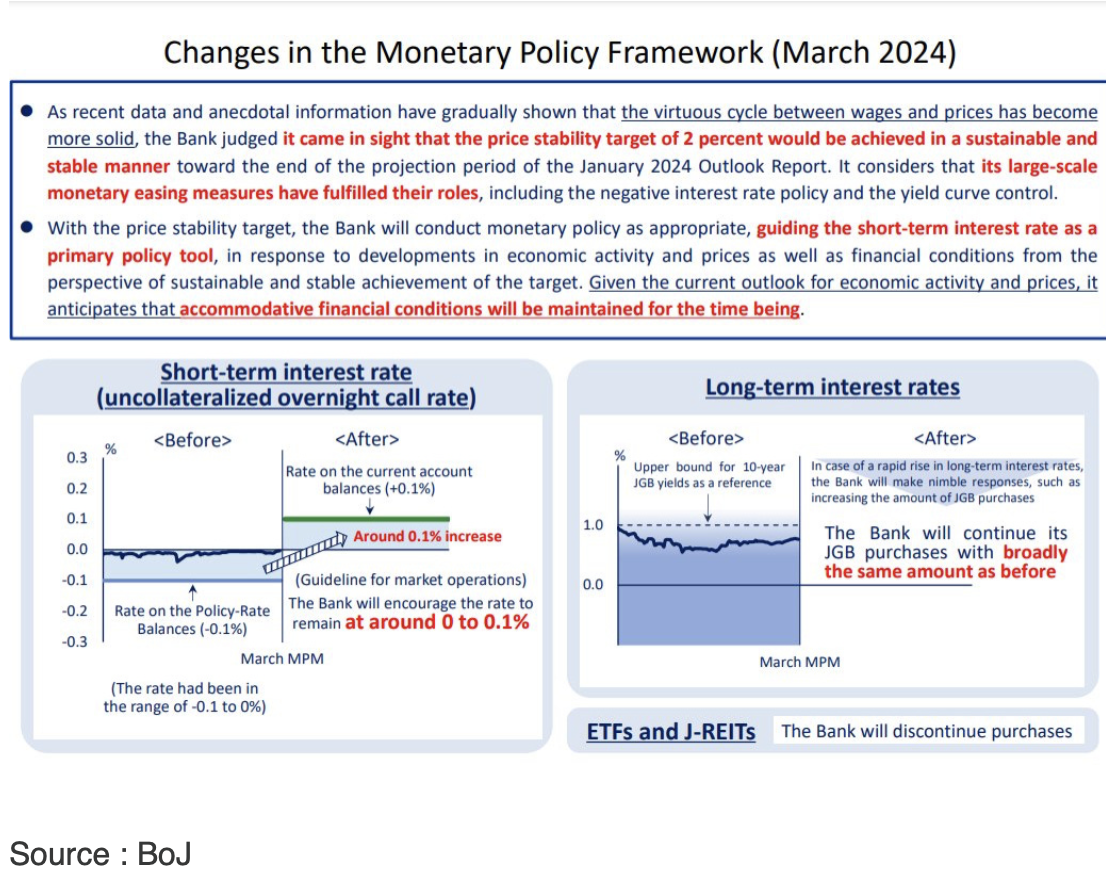
As many had been forecasting, notably the Nikkei News who as I mentioned yesterday have a perfect forecasting record, the BOJ ended NIRP by raising their overnight call rate to a range of 0.00% – 0.10%.  Thus ends one of the longest policy experiments in history.  I continue to believe when future historians look back at this time they will ask, what were they thinking?  At any rate, here is what they offered up to the world:

Summarizing the key changes, there is now a range for the short-term rate, like the Fed’s range, which is a new feature, although they maintain they will seek to keep the rate close to the ceiling.  As well, YCC is gone for good with no targets of any sort.  However, they committed to continuing to purchase JGBs in roughly the current amounts and retain the flexibility to increase that amount at any time as they see fit.  Regarding equities, REITs, and corporate bonds, they have officially declared those programs to be over, although in practice that has been the case for the past several months.

The market response was a classic ‘sell the news’.  The yen has fallen 0.9% and is firmly back above 150 this morning while JGB yields edged lower yet again, down 3bps and trading at 0.73%.  In the press conference, Ueda-san explained, “We judged that achieving the goal of sustainable 2% inflation has come within view. The large-scale monetary easing policy served its purpose.”  However, he was clear that this was not the beginning of a massive tightening of policy a la the Fed or other G10 central banks.  At the same time, PM Kishida said, “[The government] believes it is appropriate that the accommodative financial environment will be maintained from the perspective of taking a new step forward in light of the current situation and further ensuring positive economic developments.”

Summing everything up I would say that while this policy is marginally tighter than previous policy, there is no evidence that the BOJ is hawkish in any sense of the word.  They will still be buying JGBs regularly, ergo monetizing government debt, and they will respond ‘nimbly’ as they see fit if something changes.  My take on the impact is that the yen will be beholden to the Fed now and if the recent more hawkish narrative continues to evolve, look for USDJPY to continue to rise.  JGB yields are likely to drift higher alongside yields elsewhere is the world while the Nikkei has room to run.

It’s time now to turn to the Fed
With pundits now starting to dread
The idea rate cuts
Are now seeming nuts
An idea to which they were wed
 
So, while we know rates will remain
Unchanged, we’ve got dots on the brain
Are three cuts in store?
Or fewer called for?
That outcome is what’s most germane


Interestingly, given how much has been written by analysts and pundits, as well as this poet, already on the topic of the FOMC meeting that starts at 9:00 this morning and culminates in their statement at 2:00pm tomorrow, I feel like all that is necessary here is a recap.

As I type this morning, the Fed funds futures market is now pricing just 72bps of rate cuts for all of 2024 and 139bps of cuts through September of 2025.  While I had started discussing the concept of the dot plot pointing to a median of only two cuts this year several weeks ago, before the quiet period began and we started hearing more hawkish language from several FOMC members, that has become a mainstream discussion now.  In fact, I suspect that is the default setting for most analysts, although the dovish acolytes will still be arguing for at least three cuts.  Perhaps of more interest will be where the longer-term dots are printed.  

Remember, the dot plot shows each members forecasts for the next three years individually as well as the ‘Longer Run’.  In December, the Longer Run had a median of 2.50% and that has been the case for a very long time.  The implication is that the Fed’s broad view of their policy is that the infamous r*, or neutral interest rate, is 2.5% which consists of a 2% inflation target and a 0.5% real interest rate.  However, there has been a significant increase in the discussion amongst the analyst community about how that might change.  If we consider that the nature of the economy post-pandemic, has changed in two key areas, the size of the workforce has shrunk and the efforts at reshoring or nearshoring productive capacity has expanded greatly, both of those things would lead one to expect a higher level of inflation and correspondingly higher interest rates.  So, while a change in the Fed’s target rate is not likely anytime soon, a change in the Fed’s thinking of the appropriate r* is very possible.  

Do not be surprised to see that median rise to 2.75% as members increasingly accept that the current state no longer resembles the previous, pre-pandemic, state.  And that, I believe, is where there is more potential for market reaction than anywhere else.  A rise in the longer run median forecast implies that Treasury yields, and in fact, the entire yield curve, should be permanently higher.  While there has been some discussion of this idea, I would contend that is nowhere near the consensus view, and certainly not the current market narrative.  But that would imply a pretty sharp sell-off in bonds with a corresponding rise in yields.  Initially, I do not believe that would be a net positive for risk assets, although ultimately, I believe equity markets will absorb the news as companies adjust to the change.  But it could get messy during that adjustment.  This is where my eyes will be tomorrow.

Ok, let’s recap the overnight session.  After a solid day in the States yesterday to start the week, the Nikkei (+0.65%) managed to recapture the 40K level amid a weaker yen and the new understanding that policy is not going to ratchet much tighter.  China, on the other hand saw equity weakness in both Hong Kong (-1.25%) and on the mainland (-0.7%) as traders await the news tonight as to whether the PBOC is going to reduce the Loan Prime Rate again as they did last month.  Clearly, there is not much hope right now!  In Europe, markets are mostly a touch higher, but movement is very modest, +/-0.2% basically, as all eyes there are also on the FOMC tomorrow.  As to US futures, they are modestly weaker this morning at this hour (7:30), down -0.4% on average.

In the bond market, Treasury yields are unchanged this morning after having drifted another 2bps higher yesterday.  In Europe, it is a mixed picture with UK Gilt yields sliding 3bps, while the continent is seeing either no movement or a 1bp rise.  The only data of note was German ZEW sentiment which rose significantly, to 31.7, back to its highest level in two years.  We also continue to hear from ECB speakers that they are not yet ready to cut rates and remain data, not Fed, dependent!

Oil (+0.1%) continues to power higher on the back of softer supply data, increased success by Ukraine in attacking Russian refineries and a new situation, Iraq promising to abide by the OPEC+ production cuts.  WTI is firmly above the $80/bbl level and looks like it wants to try for a move toward $90/bbl, at least on a technical basis.  That cannot be helping central bank efforts at reducing inflation.  As to the metals markets, they are softer this morning with gold (-0.2%) still holding up quite well given the dollar’s rebound, and copper (-1.1%) also under pressure today, but also holding the bulk of its recent gains.

Finally, the dollar is in the ascendancy today as not only is the yen under pressure, but too, the Aussie dollar (-0.6%) and its little brother NZD (-0.5%) after the RBA left rates on hold last night, as universally anticipated, but adopted modestly more dovish language in their statement and Governor Bullock was unable to convince the market in her press conference that they could still raise rates if inflation reappeared.  But the dollar is higher vs. essentially all its counterparts, both G10 and EMG, with the CHF (0.0%) the best performer of the bunch.  There is no need to seek other idiosyncratic stories for this move.

As to the data today, Housing Starts (exp 1.425M) and Building Permits (1.495M) are all we’ve got.  Keep an eye on Canadian CPI (exp 3.1%) as that would represent an uptick from last month akin to what we are seeing elsewhere in the G10.  Inflation is not dead my friends.

And that’s really it for today.  It is hard to see the data having a substantive impact and that means that traders will spend the day adjusting their positions to prepare for tomorrow afternoon’s excitement.  I imagine we could see the dollar drift off a bit today given how far it’s come, but nothing of note seems likely.

Good luck

Adf

Some Regrets

Six central bank meetings this week
Will give us a new inside peak
At their dedication
To wipe out inflation
And just how much havoc they’ll wreak
 
Investors have made all their bets
And so far, today, risk assets
Show green on the screen
Ere any convene
Methinks, though, there’ll be some regrets


It is central bank week as we hear from more than half of the G10 between tomorrow and Thursday.  The BOJ kicks things off followed by the RBA, FOMC, Norgesbank, the SNB and finally the BOE.  A great deal of stock has been put into these meetings by both traders and investors as everyone is seeking clues for the future. Alas, looking for central banks, whose crystal balls are cloudier than most, to give solid clues is probably not the best idea.  But let’s take a quick look at each meeting and expectations:

BOJ – next to the Fed, this is the meeting that has gotten the most press both because Japan is the largest of the other economies, but also because there is much talk that they are going to raise their base rate for the first time in 17 years!  At this point, despite the most recent dovish comments from Ueda-san two weeks’ ago, the best indicator seems to be Nikkei News, which has had several articles (courtesy of Weston Nakamura’s Across the Spread substack) declaring that rate hike is coming.  Apparently, they have a perfect record in these forecasts, so it looks a done deal.

Arguably, the question is will they do anything else beyond moving from NIRP to ZIRP?  There are several analysts who believe they will adjust YCC as well, either eliminating it completely, or changing the terms to buy a fixed amount each period rather than responding to market conditions.  As well, they continue to buy equity ETFs and REITs so it is quite possible they end those programs.

The funny thing is so many believed that when the BOJ finally started their tightening cycle that would be the signal for selling JGBs and buying yen.  Well, if that has been your strategy going into the meeting, it has not worked out that well.  JGB yields (-3bps) have been consolidating around the 0.75% level virtually all year while the yen, which did have a little pop higher at the beginning of the month, is now back close to 150 again.  Regarding the yen, the driver in the currency continues to be US interest rates and the incremental adjustment by the BOJ is just not enough to move the needle absent a firm commitment by Ueda-san to hike regularly going forward.  And there is no evidence of that.  As to JGB yields, a slow grind higher seems possible, but a run up above 1.0% seems highly unlikely, especially given the economic cycle has just turned down with two consecutive quarters of negative real GDP activity.

RBA – there is no policy movement anticipated here for this meeting as both growth and inflation remain above targets but have not been relatively stable.  In fact, there is a minority looking for a cut, but that seems unlikely right now simply based on the inflation data.  Generically, I find it extremely difficult to believe that any central bank will be able to cut their rates with inflation running well above the target and, in most places, looking like it has found a bottom.  I realize there is a significant desire to cut rates by virtually all central bankers, but given the current economic situation, if they want to salvage whatever credibility they may have left, it is a hard case to make to cut right now.  

One other thing to remember is that Australia is more dependent on China than any other G10 nation and China last night published better than expected economic data with IP jumping to 7.0%, far better than expected and its fastest pace in two years.  If China is starting to pick up again, that will be a net benefit for Australia and put upward pressure on commodity prices and prices in general Down Under.  I think they remain on hold for a while yet.

FOMC – suffice to say no change in rate policy but we will discuss the other features tomorrow regarding the dot plot and potential guidance.

SNB – The Swiss may be the other central bank to move this time as inflation there has fallen to 1.2%, well below the ceiling of their 0% – 2% target range.  While the market consensus remains no change and the franc has softened nearly 4% vs. the euro so far this year, we cannot forget that it remains far stronger than its historic levels and the opportunity to weaken the currency a bit to help its export industries while inflation remains quiescent is something that may appeal to SNB President Jordan.  Keep an eye out here.

Norgesbank – No change here as inflation remains far too firm, ~5%, while oil’s recent rebound has helped the currency rebound.  I don’t think there is anything to be learned from this outcome.

BOE – Here, too, no change is expected and there is no press conference.  As such, the most interesting question will be the vote split.  Last time, the split was 1-6-2 for a cut, hold and hike respectively.  (Talk about not seeing things the same way!  How is it possible that two committee members can look at the same data and believe opposite conclusions?  Seems there is some ideology in play there.). At any rate, a change in the vote count will be a signal.  Recent data has shown that wages are still hot, but slowing down, while inflation is similarly hot but slowing.  The latest CPI data will be released on Wednesday so the BOE will have that to account for as well as everything else.  At this point, I’m in the no move camp with the same split of votes the outcome.

With that recap, let’s look at the overnight session briefly.  As mentioned above, equities are green everywhere with the Nikkei (+2.7%) leading the way around the world and pushing back close to the key 40K level.  But there was strength in every market in Asia.  Europe, too, is all green, albeit less impressively, with gains on the order of 0.25% while US futures are looking good at this hour (7:45) with the NASDAQ leading the way, up 1.0%.  (Here, many are counting on more amazing news from Nvidia as they have a weeklong conference starting today.)

After last week’s rush higher in yields on the strength of the hotter inflation prints from the US, this morning is seeing very little movement overall ahead of the central bank meetings this week.  Basically, every market is within 1bp of Friday’s closing levels, with a few higher and others lower.  One other thing I failed to mention was the PBOC will be revealing their 5-year Loan Prime Rate on Tuesday night, and while no change is forecast, it was last month when they cut this to help the property market that kicked off the idea more stimulus was coming.

Oil prices continue to perform well on the back of several different factors.  First, we have seen inventory draws much greater than expected in the US.  At the same time, Ukraine has damaged several Russian refineries thus reducing the supply of products and we still have OPEC+ maintaining their production restrictions.  Add to this China’s apparent rebounding growth supporting demand and that is a recipe for higher prices.  As to the metals markets, despite the dollar’s recent rebound, gold continues to hold its own and copper is still rising consistently.  In fact, the red metal is higher by 5% in the past week, a potential harbinger of better global growth.

Finally, the dollar is a touch softer this morning, but only a touch.  The biggest mover is ZAR (-0.6%) which is opposite the broader trend of very slight dollar weakness.  While South African equities have been drifting lower of late, today’s move feels more like an order in the market than a fundamental change.  Away from that, though, no currency of note has moved more than 0.2% on the day as traders await the onslaught of central bank news.

Speaking of news, we have other things beyond the central banks as follows:

TuesdayHousing Starts1.43M
 Building Permits1.50M
ThursdayInitial Claims216K
 Continuing Claims1815K
 Philly Fed-2.5
 Current Account-$209.5B
 Existing Home Sales3.95M
 Flash PMI Manufacturing51.7
 Flash PMI Services52.0
Source: tradingeconomics.com

In addition, starting Thursday, the first Fed speakers will be back on the tape to reinforce whatever message Chair Powell articulates on Wednesday.

From my vantage point, it appears that the BOJ’s rate hike has been accepted and priced in already, while the biggest surprise could be Switzerland.  However, the fate of the dollar lies in the hands of Powell, and that is an open question we will discuss tomorrow.  For today, don’t look for too much of anything in any market.

Good luck

Adf

Offsides

The PPI data revealed
Inflation has clearly not healed
Will Jay and the Fed,
When looking ahead
Now tell us one cut’s been repealed?

So, now here we are at the Ides
Of March, as opinion divides
Some still say a cut
Will come in June, but
Some others think, no that’s offsides

Once again, the inflation data did nothing to help the case for a rate cut anytime soon in the US.  This time the PPI data showed that prices rose far more than expected in February, 0.6% at the headline level and 0.3% at the core level.  The rises, when broken down, were across the spectrum of goods and services.  The point is despite what appears to be an overriding desire to cut rates by June, the data is not cooperating for Jay and his friends.  Will this be enough to dissuade them?  We still have 3 more months before the critical time and the market, despite itself, is now putting all its eggs in the June basket, having reduced the May probability to just 7%.  Clearly, it remains highly dependent on how the data progresses, and not just the inflation data, but also the employment data, but for now, I find it hard to make the case that the Fed should be cutting rates anytime soon.

Of course, there remains a large contingent of analysts, economists and pundits who believe that the Fed should cut next week, or May at the latest, as they are already doing grave damage to the economy.  You may recall the immediate response by the Nick Timiraos article to the hotter than expected CPI data.  Well, this morning, we have Bloomberg with an article that claims a solid majority of the forty-nine economists they surveyed continue to look for the first cut in June and three cuts this year.  It certainly appears there is a great effort to convince us that those rate cuts are coming, although as I have maintained, if the Fed is truly data dependent, the data is not pointing to cutting rates as the appropriate move at this time.  This argument discussion will continue for the foreseeable future, that is the only certainty.

Wages have blossomed
Will Ueda-san enjoy
The view, and end NIRP?

The preliminary indication from the Shunto wage negotiations shows that the average wage increases in Japan this year will be 5.28%, the largest rise in decades.  Apparently, Toyota accepted the union’s demands fully and didn’t even offer a counter!  When comparing this outcome to the most recent CPI readings in Japan, which showed a headline rate of 2.2% and a Core of 2.0%, it certainly appears that there could be some wage driven price increases upcoming.  As has been mentioned repeatedly, this was seen as a key issue for the BOJ ahead of their meeting this coming Monday night (Tuesday in Japan) in terms of being a sufficient catalyst for the BOJ to finally raise their overnight interest rate from its current -0.10%.

Now, while Ueda-san’s own words have seemed more circumspect, the growing consensus amongst the analyst community in Tokyo is that the move will happen next week with no need to wait until the April meeting.  But a funny thing has been ongoing in markets while this consensus has been building, the yen has been falling.  While there was essentially no movement overnight, since Monday, when the discussion began to heat up, the yen has declined more than 1.5% in value, almost as though the market is selling the news ahead of the news.  Perhaps of more interest is the fact that 2-year JGB yields have fallen this week by 2bps, which while not a great deal overall, represents a reversal of the gradual increase that has ostensibly been driven by the upcoming BOJ policy tightening.  I have a funny feeling that while NIRP may well turn into ZIRP next week, as the market looks ahead, there is much less tightening perceived in the future.  I have maintained that a move beyond +0.2% would be highly unlikely this year, and possibly next year.  As such, when considering the FX rate, USDJPY remains far more beholden to the Fed and US interest rates than to whatever the BOJ does at the margins.  Let’s face it, if the BOJ hikes rates to 0.2% by December, but Fed funds remains at 5.5%, it is still a very difficult case to buy yen.

And those have been the key stories driving things since I last wrote.  A look at the overnight session shows that Asian equity markets were mixed with the Nikkei sliding a bit, while the Hang Seng fell sharply (-1.4%), perhaps on fears of increased tech stress between China and the US.  However, the CSI 300 managed a small gain despite weak Loan data and the rest of the bloc saw a lot of red on the screen, following the US session losses yesterday.  In Europe this morning, it is the opposite reaction with green across the screen led by Spain (+1.1%) but modest strength everywhere as inflation data from Italy and France seemed to show more moderation.  Meanwhile, at this hour (7:30), US futures are edging higher by 0.3%, essentially unwinding yesterday’s losses.

In the bond market, yesterday’s PPI data saw bonds sell off aggressively in the US with yields across the entire curve rising 10bps.  This morning, Treasury yields have backed off 2bps, but remain at 4.27%, above what is perceived to be a trading pivot level of 4.20%.   European yields also rose yesterday, albeit not quite as aggressively as US yields, and this morning they are essentially unchanged.

In the commodity markets, oil (-0.5%) is giving back a bit of its recent gains but WTI remains above $80/bbl and Brent crude above $85/bbl.  Apparently, the IEA has revised its global oil demand figures higher by more than 1 million bbl/day and despite the fact that there is ample spare capacity in OPEC, the market is tightening right now.  Gold, which sold off yesterday on the rising rates / higher dollar situation, is rebounding a bit this morning, +0.3%.  Interestingly, copper (+1.3%) did not sell off on the interest rate or dollar story and is now back at its highest levels in nearly a year and firmly above $4.00/Lb.  Something is going on here which seems to be a positive hint for growth.

Finally, the dollar, which rocked yesterday, rising almost 0.65% across the board with some significant gains vs. specific currencies, is essentially unchanged overall this morning, holding onto those gains.  In fact, there are a few currencies that are still feeling pressure like KRW (-0.5%) and NZD (-0.5%) but there has been a modest bounce in ZAR (+0.4%) on the back of the strong metals complex.  Net, the DXY is unchanged on the day, back above the 103 level.

We finish the week with some more secondary data as follows:  Empire State Manufacturing (exp -7.0), IP (0.0%), Capacity Utilization (78.5%) and Michigan Sentiment (76.9).  Now, we have seen secondary data have an impact recently, and given the quiet period prevents any Fedspeak, market participants are looking for any clues they can find.  It will be very interesting to see if today’s data indicates that the economy is continuing at its above trend growth rate or implies things are fading.  My observation is manufacturing continues to struggle overall, and sentiment on the economy isn’t great, so I would look for weakness rather than strength.  In that case, perhaps bonds rally further, and the dollar unwinds some of yesterday’s gains.

Good luck and good weekend
Adf

He’s Got Spine

The market’s now certain that June
Is when Jay, the funds rate, will prune
Inflation don’t matter
Despite all the chatter
They don’t want to cut rates too soon
 
But what if inflation keeps rising?
And data continues surprising?
Can he hold the line?
And show he’s got spine
Despite all the doves’ vocalizing?


It’s funny.  So much was made about the CPI number on Tuesday and the lines seemed to have been drawn quite clearly; soft or as expected data would cement a June cut while hot data would call that into question.  And yet, here we are two days later, with the only information in the interim showing that oil and product inventories have fallen further driving oil prices higher, and the probability of a June cut has risen above 90%.  In fact, amid a day with limited new information, and during the Fed’s quiet period, perhaps the most interesting comments came from Treasury Secretary Yellen.  Not only did she indicate she regretted her use of the word ‘transitory’ at the beginning of the inflation episode, but more importantly, it appears that Treasury is now assuming much higher interest rates in their forecasts than before.  In other words, she no longer believes that interest rates are going to head back down to 2%.  Personally, I think that is a huge step in the right direction.  Alas, that concept certainly did nothing to constrain their spending plans, so it is not clear it really matters.

But the reality as that even though we get some more Tier 1 data this morning, it has become quite clear, to me at least, that the market is uninterested in anything other than the FOMC statement, the dot plots and Powell’s press conference coming on Wednesday next week.  You can see this in the equity markets which are now trading in ranges after their recent sharp rises, and you can see this in the FX market given the dollar’s virtual complete lack of volatility.  In fact, the only place that is demonstrating some concern is the bond market, where yields continue to edge higher very slowly.

Let’s start by taking a quick look at this morning’s data.  Retail Sales (exp 0.8%, 0.5% ex-autos) is set to rebound from last month’s terrible -0.8% print.  Many have looked past that number as a combination of bad seasonal adjustments and heavy discounting and continue to see strength in the economy.  We also see PPI (0.3%, 1.1% Y/Y) and Core (0.2%, 1.9% Y/Y) which seems to have bottomed, not dissimilar to CPI, but which will be a problem for those who believe that inflation is still trending lower.  Finally, as it is Thursday, we see Initial (218K) and Continuing (1900K) Claims, both in line with recent outcomes signaling the labor market remains in solid shape.

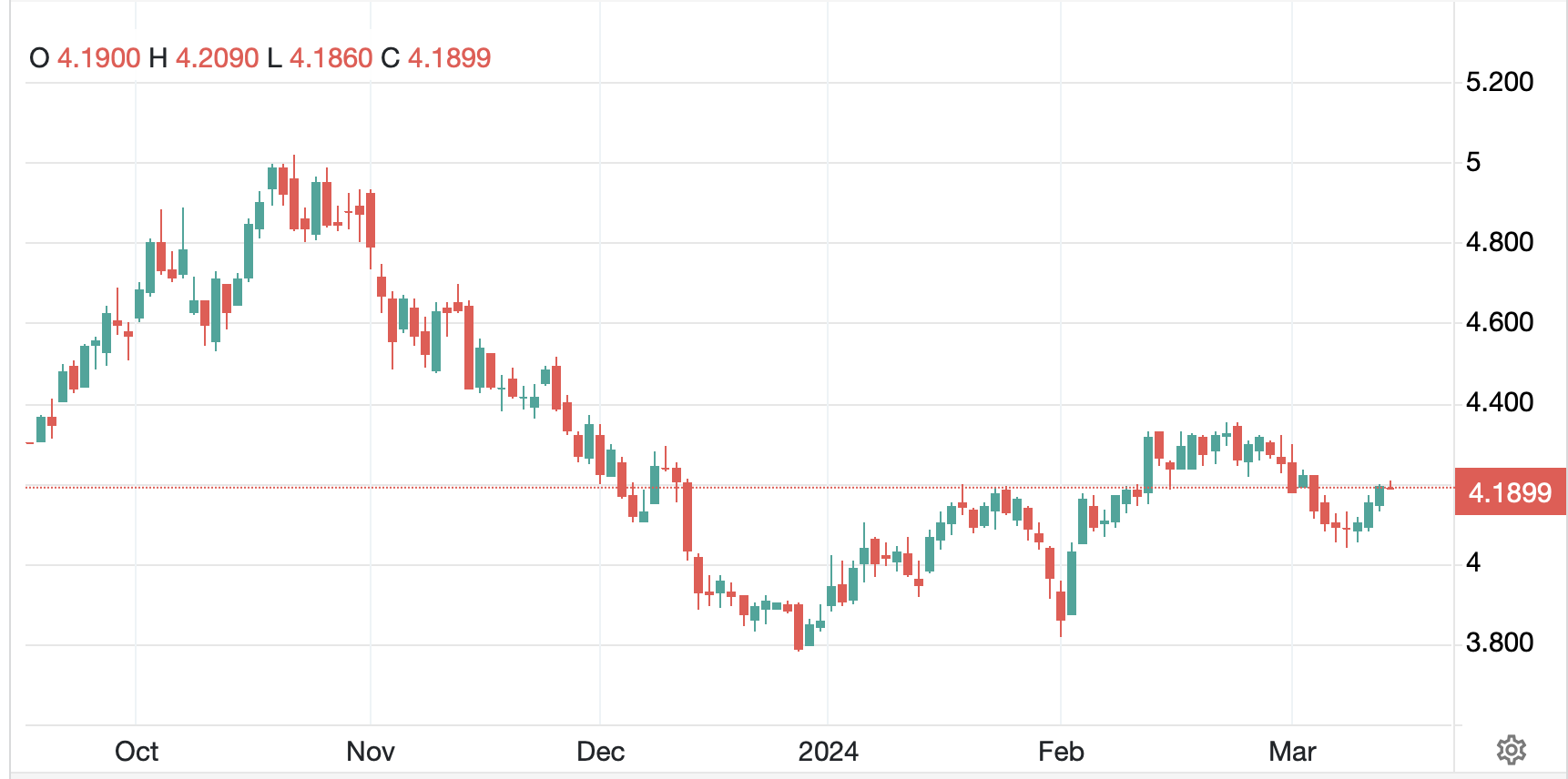
Now, you all know my view that inflation is not dead and that the market will need to continue to adjust interest rates higher over time to account for that fact.  Since the beginning of the year, as you can see from the chart below courtesy of tradingeconomics.com, while there have been several cycles, it seems clear that the trend in yields remains higher.

I think this makes a lot of sense and expect it to continue.  In fact, the question I have is how can the Fed truly consider it will be appropriate to cut the Fed funds rate given the economic signals are showing continued solid growth, a solid labor market and indications that inflation is heading higher?  Many make the political argument that since they are hell-bent on cutting, they need to get started before it gets too close to the election.  But I am going to go out on a limb here and say that I think Powell has shown he is made of sterner stuff and if the data remains where it has been, let alone inflation ticks higher between now and June, there will be no rate cuts.  If I am correct, risk assets are going to rerate, trust me.  And that is really the only question that needs to be answered at this point.

And so, other than bonds which seem to be sussing out the potential for rates to continue at their higher-for-longer pace, a look at other asset class markets shows not much overall movement.  After yesterday’s mixed US session, Asia, too, was mixed with Japan slightly firmer while Chinese shares slid as there appears to be no real help in sight there.  European bourses are also mixed with the UK lagging and slightly softer on the day and the bulk of the movement higher quite modest.  The only exception is the CAC in Paris higher by 0.9%, on the back of continued strong performance of the luxury goods sector.  (As an aside, why would central bankers think that the economy is going to tank if luxury goods remain hot?). US futures, though, are firmer at this hour (7:30) with all three indices higher by 0.5%.

In the bond market, while US yields have been dragging the global structure higher, they are unchanged on the morning and European sovereigns are actually a touch softer, between 1bp and 2bps today.  That is likely on the back of comments by Greek ECB member Stournaras that they need to quickly make two rate cuts to manage things properly.  While that seems excessive, I maintain the ECB cuts before the Fed.  As to Japan, JGB yields have edged higher by one more basis point overnight, though remain at just 0.77%.  Ueda-san, when he speaks, sounds far less hawkish than many of the analysts in Tokyo, or the other members of the BOJ from whom we have recently heard.  I am still in the April camp for the first rate hike, and very few afterwards.

Oil is the big mover of the day, up 0.9% with WTI back over $80/bbl for the first time since early November.  Yesterday’s EIA Inventory data showed drawdowns in crude and gasoline stocks that were much greater than expected.  You may have noticed at the pump that gas prices are rising, and it seems the market is figuring that out as well.  Remember, though, that OPEC+ has reduced production so has significant spare capacity at this stage, probably 2mm – 3mm bbl/day that they can restart at any time, so I don’t expect prices here to skyrocket.  Gold, which rallied nicely yesterday, is slightly softer this morning, as is copper, although the red metal remains above $4.00/Lb.  It strikes me that the commodity markets are not anticipating a significant economic slowdown right now.

Lastly, the dollar is very little changed overall this morning, with the largest moves NZD (+0.25%) and PLN (-0.25%) and every other major currency seeing less movement than that.  USDJPY is pushing back toward 148.00 slowly and seems likely to be the next big mover based on Monday night’s BOJ meeting.  Otherwise, this space is dead.

And that’s really what we have for the day.  If the data is hot, look for yields to continue their recent climb and for the dollar to take on a bid tone.  As to stocks, demand remains strong regardless of the economics.  If the data is soft, then a weak dollar should accompany strength in both stocks and bond prices.

Good luck

Adf

Not Fading Away

The first thing to mention today
Inflation’s not fading away
Instead, CPI
Was one again high
Though risk assets still made some hay

This raises the question again
Of if the Fed will, not of when,
Begin cutting rates
And foster debates
If Powell’s in charge…or Yel-len

Well, the CPI data was hotter than forecast with both headline and core printing at 0.4% and the Y/Y numbers both coming a tick higher than forecast at 3.2% and 3.8% respectively.  While serious analysts are revisiting their thoughts on whether the Fed is anywhere near a position to consider cutting rates, as I predicted yesterday, the Fed Whisperer, Nick Timiraos of the WSJ, was out before noon (at 11:25am to be precise) with his article explaining that the hot CPI print didn’t matter, and the Fed would still be cutting rates come June.

And maybe that is all we need to know.  As the working assumption is he is speaking directly to Chairman Powell, and that was the message he was instructed to convey, then maybe they will be cutting rates then.  But to take the doves’ favorite metric from December, the 3-month running average on an annualized basis, it is now running at 4.3%.  That feels a touch high for the Fed to consider cutting, but in fairness, we are still three months away from that June meeting so many things could change in the interim.

As it happens, the equity markets didn’t wait for the WSJ article to decide that rate cuts are still coming on schedule, as the futures rallied instantly, and stocks were higher all day.  At this point, it is very difficult to see what will derail the current rally as clearly there is no fear of the current rate structure remaining in place.  While trees don’t grow to the sky, apparently, they can get pretty tall!  It is a fool’s errand to try to determine the top ahead of time, and I believe the market, and the economy as a whole, needs to find a non-speculative clearing price (i.e. retreat sharply), but it doesn’t seem like that is a near-term scenario.  In other words, I guess it’s ‘party on!’

The first hints of Spring
Have seen wages in full bloom
Is ZIRP on its way?

Turning to Japan and the Spring wage negotiations there, headlines out of Tokyo this morning show that wages are going to be substantially higher in 2024 than they were in 2023.  Key results that have been announced include Nippon Steel, Nissan, Panasonic, and Toyota, which said its wages would be rising the most in 25 years.  These wage hikes are seen as a precondition for the BOJ to exit NIRP, although it is not clear if it is a sufficient condition.  While the politicians are crowing as higher wages are obviously welcome to the people there, the market is hardly behaving as though these numbers are going to do the job.  For instance, the yen (-0.2%) is a touch softer this morning, 10-year JGB yields didn’t budge while 2-year JGB’s saw yields tick down a bit, and Japanese stocks barely edged lower, down about -0.3%.  My point is the market behavior is not necessarily consistent with the view that Japanese rates are about to move.   The totality of the wage negotiations will be published on Friday, so perhaps that will offer more clarity.

However, at least with respect to USDJPY, given what we just learned about US inflation and the prospects for US rate cuts (which are diminishing in my view), that 10bp rate hike by the BOJ does not feel like it will be sufficient to cause a major adjustment.  We will need to hear Ueda-san explain that any move is the beginning of a new cycle, and rates are heading higher, full stop.  And I don’t see that happening.

And those are really the key stories for the morning, risk is still on, and Japan appears to be edging closer to exiting their negative rate policy.  So, let’s see how markets have behaved overall.

Despite the US rally, there were many more laggards than gainers in the Asia session with China, Hong Kong and India all seeing equity markets under pressure.  As well, the gainers showed only very modest gains (Australia +0.2%, South Korea +0.3%) so generally it was a negative session.  However, in Europe this morning, the screens are green with a mix of very marginal gains (UK, Germany) and strong performances (CAC +0.5%, IBEX +1.5%) with the Spanish and Italian markets making new multi-year highs.  As to US futures, at this hour (7:45) they are very slightly firmer, 0.15%.

The bond market did respond as one would expect on the back of the CPI data, with Treasury yields rising 6bps yesterday.  As well, there was a 10-year Auction which was a bit sloppy with a 0.9bp tail and settlement price of 4.166%.  European yields rose in the wake of Treasuries yesterday but are essentially unchanged this morning, as are Treasury yields.  As long as the inflation story remains on the hot side, it is difficult to see yields declining from these levels.

In the commodity markets, the one thing that really reacted to the CPI data was gold, which fell 1.1% yesterday, although given the recent remarkable run higher, it can be no surprise there was some profit-taking.  And this morning, it has bounced 0.25% so far.  As to oil (+1.6%) it is rallying this morning but that is simply offsetting yesterday’s declines and it remains in the middle of that $75-$80 range.  A quick word about copper (+2.0%) which has traded above $4.00/Lb for the first time in almost a year and looks to be making a strong move higher.  Whether that is on growing economic optimism in China or elsewhere is not clear, but that is the price action.

Finally, the dollar is surprisingly little changed overall.  In the immediate wake of the CPI print yesterday, it did rally nicely, but it has since ceded those gains and is largely unchanged from then.  In fact, net from yesterday’s closing levels, it is softer by about 0.2% against almost all its major counterpart currencies.  I am quite surprised at this price action as I would have expected the dollar to benefit, but not much as of yet.

The only data released today is the EIA oil and product inventories for the week, something which will impact the oil market but not much else.  When looking at the totality of the data, there is no indication to me that inflation is going to be declining soon.  It is very hard for me to look at what is happening and conclude that the Fed is compelled to cut interest rates to prevent a problem.  Until we see a more substantial decline in economic activity, I have to believe that they will stand pat, regardless of the politics.  If they don’t, I would expect the dollar will fall sharply as inflation reignites in the US.  And that doesn’t seem like the conditions they want if they truly want to prevent a change in the White House come November.

For today, and likely through the FOMC meeting in one week’s time, I suspect risk assets will perform well.  But it also feels like more risks are building that can have a negative result.

Good luck
Adf