Seek the Abyss

As so often has been the case
The market is in Trump’s embrace
Will he make a deal
And sell it with zeal
Or will Putin spit in his face
 
Because of the focus on this
Though PPI data did miss
Most markets held tight
With highs still in sight
As naysayers seek the abyss


Based on the fact that equity markets in the US were all essentially unchanged yesterday, I think it is reasonable to assume that investors are waiting to see the outcome of today’s Trump-Putin meeting in Alaska.  I have no opinion on how things will work out, although I am certainly rooting for a result that includes a ceasefire and the next steps toward a lasting peace.  From a direct market perspective, arguably oil (-0.75% this morning) is the one place where the outcome will have an impact.  Any type of deal that results in the promised end to sanctions on Russian oil seem likely to push prices lower.  In this vein, we continue to see the IEA and EIA reduce their demand forecasts (although some of this is because they keep expecting BEVs to replace ICE engines and that is not happening at the pace they would like to see). However, away from oil, I expect that this will be much more important to overall sentiment than anything else.

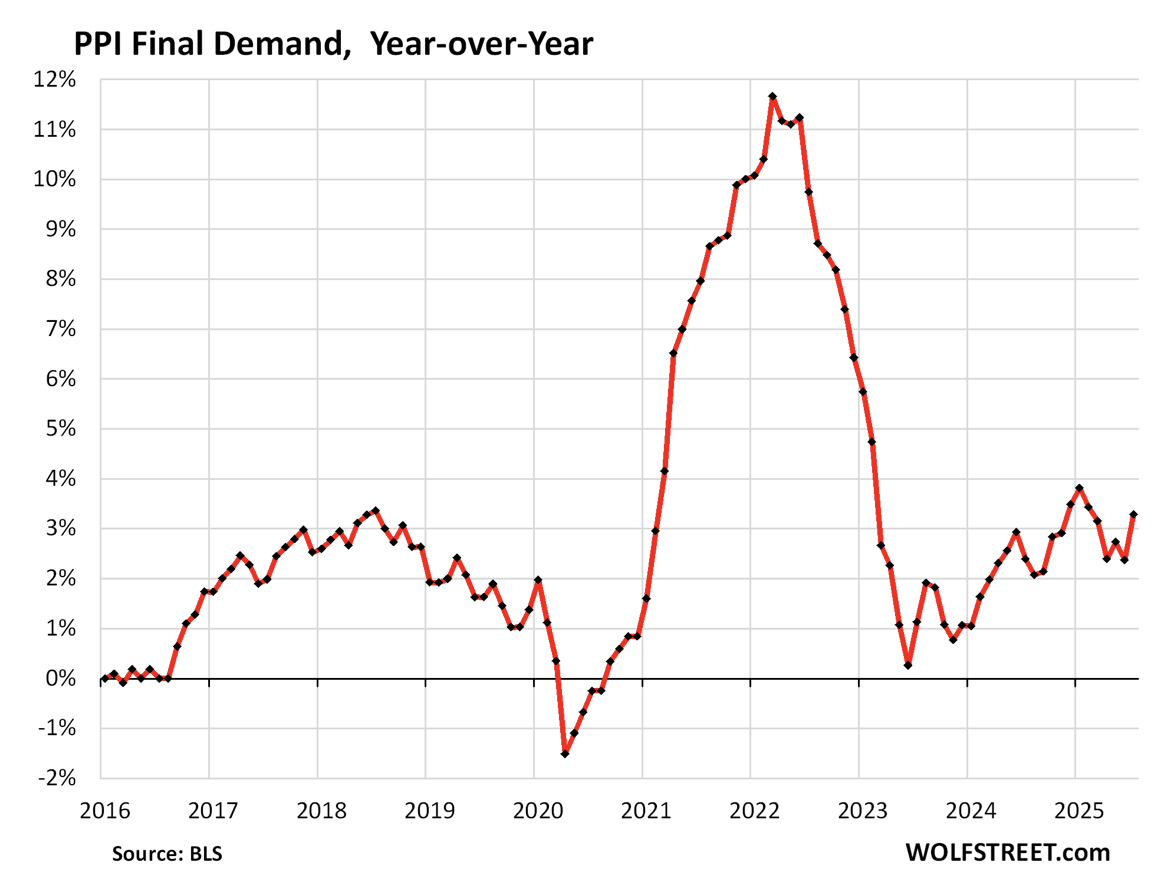
But sentiment matters a lot.  As does the attention span of traders, which as we already know, approximates the life of a fruit fly.  For instance, yesterday’s PPI data was unambiguously hotter than expected, with both headline and core monthly jumps of 0.9%.  Surprisingly for many economists, it was not goods prices that rose so much, but rather the price of services.  For the narrative, it is much harder to blame service price hikes on tariffs, than goods price hikes, but not to worry, economists are working hard to make that case.  As well, the near universal claim is that CPI is going to rise much more quickly going forward as evidenced by this rise in PPI.  A quick look at the chart below of annualized PPI shows that we are starting to rise above levels last seen in 2018, but if you recall, CPI then was very low, sub 2.0%. The relationship between the two, CPI and PPI, is not as strong as you might expect.
The contra argument here is that corporations, which were able to raise prices rapidly during the pandemic response are finding it more difficult to do so now.  We have discussed several times how corporate profit margins remain extremely high relative to history and what we may be seeing is the beginnings of those margins starting to compress as companies absorb more of the costs, be they tariffs or labor.  I also couldn’t help but notice the article in the WSJ this morning working to explain why tariffs haven’t boosted inflation as much as many economists expected.  Their answer at least according to this research, is that the many exemptions have resulted in tariffs being collected on only about half of imports, which despite all the headlines touting tariffs are now, on average, somewhere near 18%, makes the effective rate below 10%, higher than in the past, but not devastatingly so.  And remember, imports represent about 14% of GDP.  Let’s do that math.  If half of imports are excluded and the average tariff is more like 9%, we’re looking at 60 basis points of price increases, of which corporates are absorbing a great deal.  

One other thing in the article was how it highlighted the exact result that President Trump is seeking when explaining that more companies are searching for alternative sources of goods in the US.

The tariffs, are however, impacting other nations with China last night reporting a much weaker batch of data as per the below:

                                                                                                              Actual          Previous            Forecast

The property market there continues to drag on the economy, but government efforts to prop up consumption seem to be failing and clearly tariffs are impacting IP as less orders from the US result in less production.  Arguably, though, President Xi’s greatest worry is the rise in Unemployment as the one thing he REALLY doesn’t want is a lot of unemployed young males as that is what foments a revolution.  The interesting thing about the market response here is that while the Hang Seng (-1.0%) fell sharply, the CSI 300 (+0.7%) rallied, seemingly on hopes of additional stimulus being necessary and implemented.  One other thing to note about Chinese markets is that yesterday, 40-year Chinese government yields fell below 30-year Japanese yields for the first time ever, a sign that expectations of future Chinese activity are waning.  With this in mind, even though the renminbi has been gradually appreciating this year (even if we ignore the April Liberation Day spike), the Chinese playbook remains mercantilist at its heart.  I would look for a weaker CNY going forward, although the overnight move was just -0.1%.

Source: tradingeconomics.com

Ok, let’s look at the rest of markets ahead of the Alaska summit and today’s data.  Tokyo (+1.7%) had a strong session as GDP data from Japan was stronger than expected allaying worries that the tariffs would crush the economy there and bringing rate hikes back onto the table.  Australia (+0.7%), too, had a good session on solid corporate and bank earnings but the rest of the region was pretty nondescript with marginal moves in both directions.  In Europe, gains are the order of the day on the continent (DAX +0.3%, CAC 0.65%, IBEX +0.35%, FTSE MIB +1.1%) as hopes for a formalized trade deal being finalized grow.  However, UK stocks are unchanged on the session as investors here seem to be biding their time ahead of the Trump-Putin summit.  US futures are higher led by DJIA (+0.7%) although that appears to be on news that Berkshire Hathaway has taken a stake in United Health after the stock’s recent beatdown.

In the bond markets, Treasury yields are unchanged this morning although they reversed course yesterday, closing higher by 5bps rather than the -3bp opening, pre-PPI, levels.  But that rebound in yields has been seen throughout Europe where sovereigns on the continent are higher by between 3bps and 4bps and JGB yields (+2bps) rose overnight after the stronger than expected GDP data.

Away from oil, metals markets are doing very little this morning as it appears much of the activity has to do with option expirations in the ETFs SLV and GLD, so price action is likely to be choppy, but not instructive.

Finally, the dollar is softer this morning despite the higher Treasury yields.  One of the interesting things is that despite the hotter PPI data, the probability for a September cut, while falling from a chance of 50bps, to a 92.6% probability of a 25bp cut, is still pricing in an almost certain cut.  Remember, we are still a month away from that meeting and we have Jackson Hole in between as well as another NFP and CPI report so lots of potential drivers to change views.  And there is still a lot of talk of a 50bp cut, although for the life of me, I don’t understand the economic rationale there.  But softer the dollar is, falling against all its G10 brethren, on the order of 0.25% or so, and most EMG counterparts, with many having gained 0.4% or so.  But this is a dollar story today.

On the data front, ahead of the summit, which I believe starts at 2:30pm Eastern time, we see Retail Sales (exp 0.5%, 0.3% -ex autos, 0.4% Control Group) and Empire State Mfg (0.0) at 8:30, as well as IP (0.0%), Capacity Utilization (77.5%) at 9:15 and then Michigan Sentiment (62.0) at 10:00.  Retail Sales should matter most as a strong number there will encourage the equity bulls while a weak number will surely bring out the naysayers.  I still have a bad feeling about markets here, but that is my gut, not based on the data right now.  As to the dollar, there are still huge short positions out there and if rate cuts become further priced in, it can certainly decline further.

Good luck and good weekend

Adf

Recalibration


All week we had heard many clues
That fifty is what Jay would choose
And that’s what he cut
With only one but
From Bowman, who shuns interviews
 
The key is now recalibration
In order to tackle inflation
Without driving higher
The joblessness spire
So, trust us, it’s all celebration


Recent indicators suggest that economic activity has continued to expand at a solid pace. Job gains have slowed, and the unemployment rate has moved up but remains lowInflation has made further progress toward the Committee’s 2 percent objective but remains somewhat elevated.” [emphasis added]

Reading the opening paragraph of the FOMC Statement, it might be confusing as to why they needed to cut rates 50bps.  After all, the economy is expanding at a solid pace (In fact, after the Retail Sales data on Tuesday, the Atlanta Fed’s GDPNow reading for Q3 is up to 3.0%!)  unemployment remains low and inflation is still somewhat elevated.  I know I am a simple poet, but the plain meaning of those words just doesn’t lead my thinking to, damn, we better cut 50 to get started.  But I guess that is just another reason I am not a member of the FOMC.

Perhaps the more interesting thing was the Summary of Economic Projections and the dot plot which showed that while expectations were for rates to fall far more dramatically than in June, the longer run expectations continue to rise.  In fact, Chairman Powell specifically addressed the SEP in the press conference, “If you look at the SEP you’ll see that it’s a process of recalibrating our policy stance away from where we had it a year ago when inflation was high and unemployment low to a place that’s more appropriate, given where we are now and where we expect to be, and that process will take place over time.” [emphasis added] In fact, there was a lot of recalibrating going on as that appears to be the Chairman’s new favorite word, using it 8 times in the press conference.

Source: federalreserve.cgov

Notice that their current forecasts are for GDP to slow to 2.0% with Unemployment edging only slightly higher while PCE inflation magically returns to their 2.0% target.  And take a look at the last two lines, with the Fed funds rate projections falling substantially for the next three years, far more quickly than their previous views, although they think the long-run level will be higher.  

I wonder about that last issue.  Historically, the thought was that the long run Fed funds rate would be inflation (2.0%) + real interest rate (0.5%) and they pegged it at 2.5% for years.  Now that they see it at 2.9%, is that because they think inflation is going to be higher (not according to their projections) which means that for some reason they think real interest rates are going to be higher.  However, when asked, Chairman Powell and every member of the board has been unable to explain this change.

But what really matters is how have markets responded to this earth-shattering news?  The initial movement was as expected, with stocks rallying sharply (see chart below) and yields sliding along with the dollar while commodities rallied.

Source: Bloomberg.com

But a funny thing happened on the way to the close, as can be seen in the chart.  Stocks gave back all their gains and then some, with all three major indices lower on the session while 10yr Treasury yields backed up 7bps and the dollar rebounded.  Arguably, this was a sell the news response, but we need to be careful.  Remember, there are many analysts who believe the economy is in deep trouble already and by starting off with a big cut, those with paranoia may be wondering what the Fed knows that the data, at least the headline data, is not really showing.

So much for yesterday, now let’s look at markets this morning beyond the initial knee-jerk responses.  Absent any other major news or data (Norgesbank leaving rates on hold doesn’t count as major), markets have played out far more along the lines of what would have been expected in the wake of a 50bp cut.  In other words, the dollar has fallen sharply against almost all its counterparts, equity markets have rallied around the world, commodity prices have rallied sharply, and bond yields are…unchanged? 

Which brings us to the question that has yet to be answered.  Which market is right, stocks or bonds?  They appear to be telling us different stories with stocks pushing to new highs amid rising multiples and rising profit growth expectations while bonds are pricing in another 200bps of rate cuts by the end of 2025, an outcome that would only seem to make sense in the event the economy fell into a recession.  But if we are in a recession, corporate earnings seem highly unlikely to rise as much as currently forecast and typically, P/E multiples contract.  Meanwhile, if the economy is humming along such that current equity pricing is warranted, what will be the driver for the Fed to cut rates as that will almost certainly reignite inflation.  

History has shown that the bond market tends to get these big questions right when they are pointing in different directions, but that doesn’t mean that risk assets will stop rallying right away.  In fact, this will likely take quite a while to play out.

Ok, so let’s put a little more detail on the market activity overnight.  Tokyo rocked (+2.0%) as did Hong Kong (+2.0%), Taiwan (+1.7%), Singapore (+1.1%) and even mainland China (+0.8%) managed to rally some.  It appears that investors around the world believe the Fed has opened the floodgates for a much lower interest rate environment everywhere.  European bourses, too, are sharply higher led by the CAC (+2.1%) but with strength across the board (DAX +1.5%, FTSE 100 +1.3%).  And US futures have shaken off the late selloff yesterday and are firmly higher this morning led by the NASDAQ (+2.2%).

Bond yields, though, are largely unchanged on the day, with yesterday’s backup in Treasury yields maintained and European sovereigns all within 1bp of yesterday’s close.  It appears that bond investors are less confident in a soft landing than equity investors.  Interestingly, JGB yields rose 2bps last night as Japanese markets prepare for the BOJ meeting tonight.

In the commodity markets, oil (0.75%) is continuing its recent rebound after another massive inventory draw was revealed by the EIA yesterday prior to the Fed meeting.  There is a growing concern that inventories in Cushing, Oklahoma are falling to a point where products like gasoline and diesel will not be able to be produced.  As an example, gasoline futures have risen far more than crude futures this week on that fear.  As to the metals markets, gold briefly touched $2600/oz yesterday immediately in the wake of the FOMC but sold off hard afterwards.  This morning, however, it is back pushing up to that level again and the entire metals complex is rising nicely.

Finally, the dollar, has been a whipsaw of late.  Post the FOMC, it fell sharply across the board, and then into yesterday’s close it rebounded to close higher on the day.  However, this morning it has given back all those late gains and then some, and is now sitting at its lowest level, at least per the DXY, since April 2022.  This morning, in the G10, we are seeing many currencies rally between 0.5% (EUR) and 1.3% (NOK) vs the dollar and everywhere in between.  The one exception to that is the yen (-0.2%) which is biding its time ahead of the BOJ meeting.  The working assumption is that the BOJ will do nothing tonight, but now that the Fed has cut 50bps, and given Ueda-san’s history of actively trying to surprise markets to achieve outcomes he wants, we cannot rule out another rate hike in Japan.  Monday morning, USDJPY fell below 140 for the first time in 18 months.  My take is Ueda-san is quite comfortable with it heading back to the 130 level, if not the 120 level.  If he were to surprise markets and raise the base rate by even 10bps tonight, I think we would see a sea change in sentiment and a much lower dollar.  And given inflation in Japan seems to have stalled at 2.8%, well above their 2.0% target, he has a built-in excuse.

Too, watch the CNY (+0.45%) as it is now trading at its highest level (weakest dollar) in more than a year, and is approaching the big, round number of 7.00.  the linkage between JPY and CNY is tight as they constantly compete in markets, especially now in autos and electronics.  If the Fed is really going to cut as much as markets are pricing, both these currencies should strengthen much further.

It is almost anticlimactic to discuss the data today but here goes.  First, the BOE left rates on hold, as expected and the market impact was limited.  Expectations are they will cut next in November.  As to data, we see Initial (exp 230K) and Continuing (1850K) Claims, Philly Fed (-1.0) and Existing Home Sales (3.90M).  None of that is likely to change any views.  Prior to the BOJ meeting, at 7:30 this evening we see Japanese CPI, which may change views there.

For now, the dollar is very likely to remain on its back foot as enthusiasm builds for multiple rate cuts by the Fed going forward.  However, if the data continues to impress like it has lately, that enthusiasm will need to be tempered.

Good luck

Adf

More Than a Pen

Twas just about two months ago
When President Trump was laid low
As bullets were flying
With somebody trying
To end his campaign in one blow
 
And now, yesterday, once again
A shooter used more than a pen
To try to rewrite
The vote that’s so tight
Enthused to act by CNN
 
By now, you are all aware of the second assassination attempt on former president Donald Trump’s life, this time while he was playing golf at his course in Palm Beach.  The difference, this time, is the alleged shooter was caught alive, so it will be very interesting to hear what he says under questioning and as this situation progresses.  While this is obviously newsworthy, it did not have a major market impact as investors are far more focused on the Fed coming Wednesday and then the BOJ on Friday.  As such, as I write (6:20) US equity futures are mixed with modest movements of +/-0.2%.
 
In China, poor President Xi
Is finding that his ‘conomy
Is not really growing
In fact, it is slowing
Much faster than he’d like to see

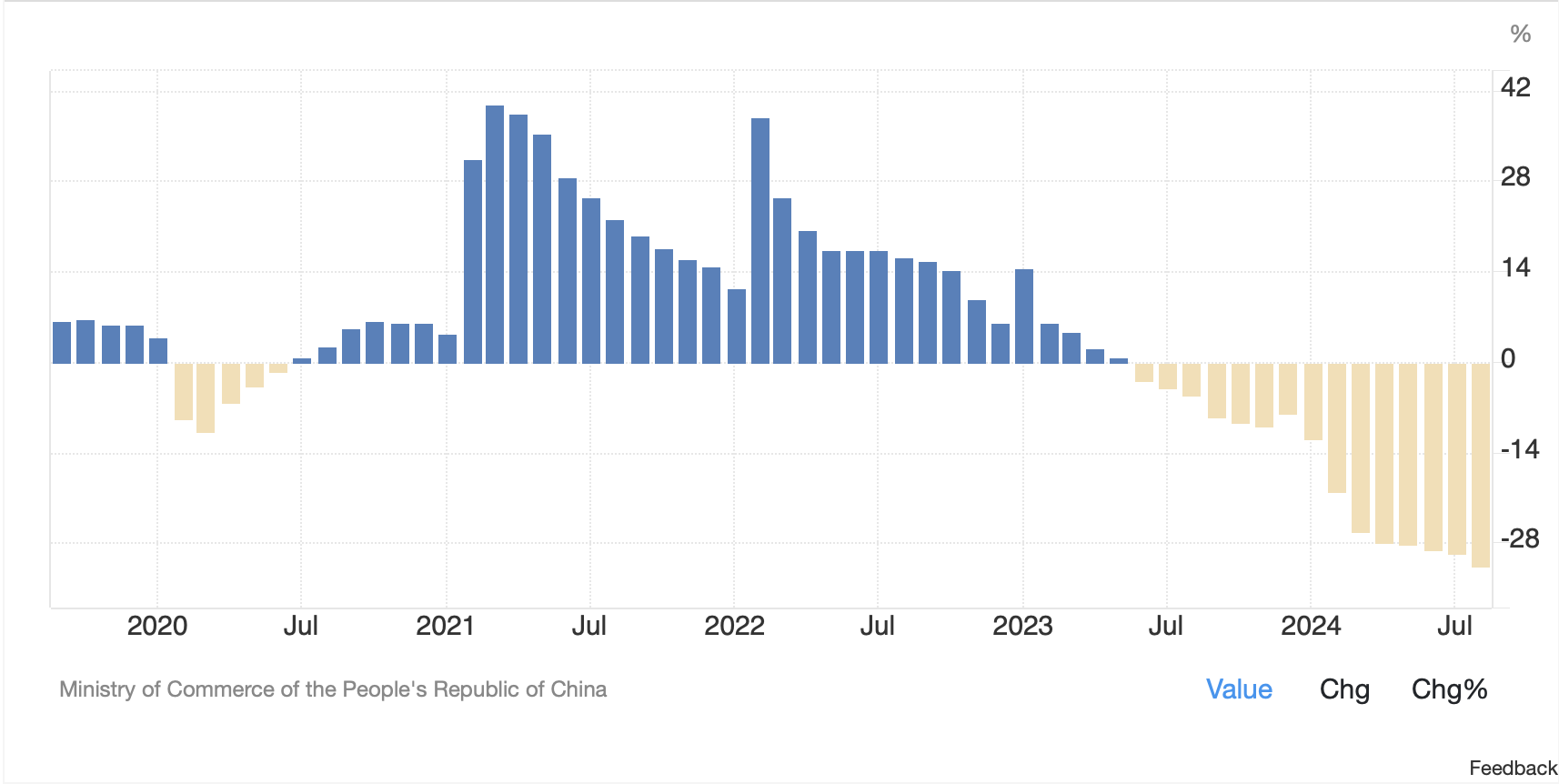
While last night there were different holidays in China, Japan and South Korea, causing all three markets to be closed, Saturday morning, the Chinese released their monthly data drop regarding IP (4.5%), Retail Sales (2.1%) and Fixed Asset Investment (3.4%) along with the Unemployment Rate (5.3%).  Then on Saturday evening here, they released their Foreign Direct Investment (-31.5%) with every one of those figures worse than the previous reading and worse than forecasts.  The evidence continues to show that the Chinese economy is slowing and seems to be slowing more quickly than previously anticipated.  In truth, from my perspective, the biggest concern Xi has is the FDI decline, which as can be seen below, has been falling (net, foreign investors are exiting China) for the past 15 months, and at an accelerating rate. 

Source: tradingeconomics.com

This bodes ill for President Xi’s 5.0% GDP growth target for 2024 and the working assumption amongst the market punditry is that he will soon announce fiscal stimulus in order to get things back on track.  Of course, one of the key problems is that not only are economies elsewhere in the world slowing down, thus reducing demand for Chinese exports, but as well, the expansion of tariffs on Chinese goods by the West continues apace, slowing that data even further.  I saw an estimate this morning that Chinese families have seen $18 trillion of wealth evaporate as the property market in China continues to decline which undoubtedly weighs on consumer sentiment and activity.  But Xi is going to have to do something to prevent a revolution, because remember, the basic Chinese Communist Party contract with the people is we will bring you economic betterment and you let us rule.  If they don’t achieve better economic growth, the population, especially the millions of unemployed young men, may get restless.  While I am not forecasting a revolution, this is typically a precursor to the process.

On Wednesday, the time will arrive
When Jay and his minions contrive
To try to explain
Their easing campaign
And hope stocks don’t take a swan dive

Now to the most important market story this week, will the Fed cut rates by 25bps or 50bps?  It’s funny, if you read independent economic analysis, both sides make their case, and not surprisingly, given the mixed data we have received over the past several months, each case makes some sense.  But…that is not the information you get when reading the press.  The WSJ, inparticular, is really banging the drum for a 50bp cut and many more to follow.  You will recall that Friday, the Fed whisperer was out with his latest piece discussing the merits of a 50bp cut.  Well, this morning there are two more articles, one by pundit Greg Ip basically begging for a 50bp cut, and one by a trio of authors laying out the case and coming down strongly on the side of 50bps.  

All this has helped push Fed funds futures to a 59% probability of a 50bp cut as of this morning.  As some have pointed out on X(fka Twitter), in the past, when there was uncertainty about a Fed move, they managed to get the word out as to what they wanted to do during the quiet period via articles like the ones above and sway markets to their preferred outcome.  As such, at this point I assume we are going to see a 50bp cut on Wednesday.

I guess the real question is what will the impact on markets be?  This morning, we are already seeing the impact in the FX market, with the dollar under pressure across the board.  Versus its G10 counterparts, it has declined by between 0.4% and 0.6% against all except CAD, which remains very tightly linked to the dollar and has gained just 0.1% this morning.  But this movement seems entirely a result of the belief that 50bps is coming.  In the EMG bloc, though, the picture is more mixed with some significant gainers (KRW +0.8%, CE4 +0.5%, ZAR +0.6%) but most other currencies little changed overall.  Nevertheless, the market is clearly pricing for 50bps across the board now and I expect that by Wednesday morning, the Fed funds futures market will reflect that as well.

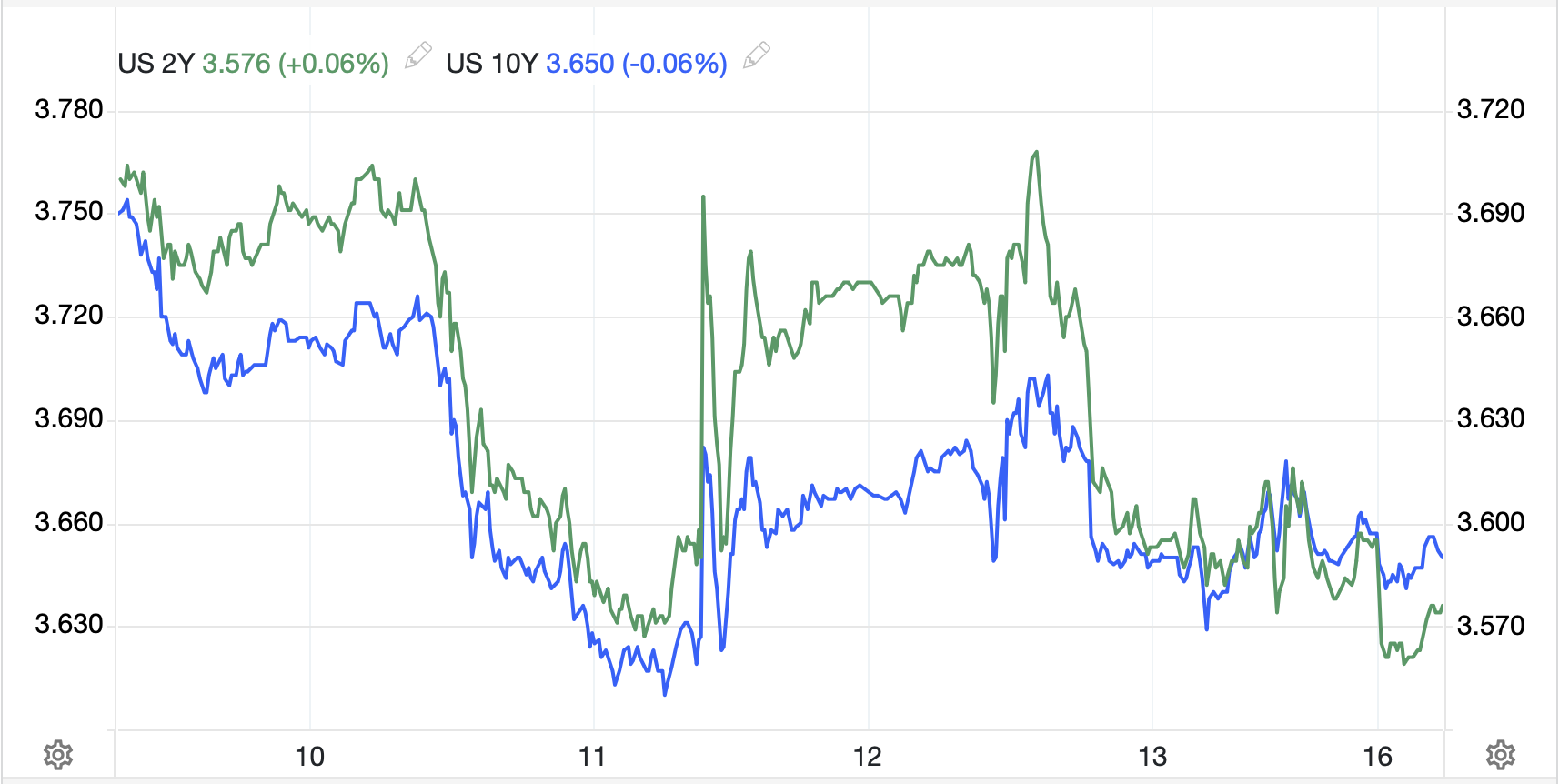
But a weaker dollar is probably not the Fed’s goal.  After all, dollar weakness can help reignite inflation, so they will be wary.  Of more interest to them is the bond market which also appears to be in agreement as the 2yr yield has now fallen to 3.56%, 10bps below the 10yr yield and a clearer sign that the two plus year inversion is behind us.  Of course, as I pointed out Friday, with 2yr yields nearly 200bps below Fed funds, it can be interpreted that the market is anticipating a recession, something I’m pretty sure the Fed wants to avoid if it can.  Perhaps you can see in the chart below how the 2yr yield (in green) fell sharply this morning, almost exactly when those WSJ articles were published.  Go figure!

Source: tradingeconomics.com

At any rate, that is the current zeitgeist, the Fed has leaked they want 50bps and are pushing the levers so when they cut 50bps on Wednesday afternoon, nobody is surprised.  The Fed hates surprises.  It will, however, be very interesting to hear Chairman Powell’s comments given that economic data remains pretty strong overall.

As to the other markets beyond bonds and FX, equity markets, after Friday’s US strength, were generally positive in those countries in Asia not celebrating a holiday (Hong Kong +0.3%, Australia +0.3%, Taiwan +0.4%).  In Europe, though, the picture is more mixed with the DAX (-0.3%) lagging while Spain’s IBEX (+0.3%) is higher although other major markets are virtually unchanged on the session.

Finally, in the commodity markets, oil prices (+0.4%) are edging higher this morning as Libya’s production has been completely shut in due to ongoing internal military conflict.  In the metals markets, gold (+0.2%) remains the biggest beneficiary of the global central bank rate cutting theme as it continues to trade at new all-time highs virtually every day.  Silver (+0.7%) is getting dragged along for the ride with many pundits calling for a much more substantial rally there and copper (+0.4%) is responding to a combination of lower rates and lower inventories in exchange warehouses raising the specter of supply shortages.

On the data front, this week is mostly about central banks, but we do get some other important numbers.

TodayEmpire State Manufacturing-3.9
TuesdayRetail Sales0.2%
 -ex autos0.3%
 IP0.0%
 Capacity Utilization77.9%
WednesdayHousing Starts1.25M
 Building Permits1.41M
 FOMC rate decision5.25% (-0.25% still median)
 Brazil interest rate decision10.75% (+0.25%!)
ThursdayBOE rate decision5.0% (no change)
 Initial Claims230K
 Continuing Claims1851K
 Philly Fed2.4
 Existing Home Sales3.85M
FridayBOJ rate decision0.25% (unchanged)

Source: tradingeconomics.com

Clearly Retail Sales will be closely scrutinized as evidence that the economy is still growing.  I would estimate that a weak number there would insure a 50bp cut, while a strong number may give some pause to those on the fence.  The other very interesting aspect of this week will be the BOJ’s communication in the wake of their meeting Friday.  They went from tough talk to just kidding in less than a week back in August.  What will Ueda-san try this time?  Japanese inflation data is released just hours before their announcement, and it remains well above the 2% target.  My sense here is they want to raise rates, they just need to prepare the market more effectively before doing so.

The dollar is already pricing a bunch of cuts as is the bond market.  If the Fed truly gets aggressive, I believe it can fall further, but if the Fed gets aggressive, you can be certain that so will the BOE, ECB and BOC at the very least.  When they start to catch up, the dollar’s decline will slow to a crawl at most.

Good luck

Adf