
No Retreating

The virtue of patience remains
The key to our policy gains
Though tariffs and trade
May one day, soon, fade
It’s still ‘nuff to scramble our brains


In a bit of a surprise, Chairman Powell resurrected the term ‘transitory’ in his press conference yesterday with respect to the potential impact on prices from President Trump’s tariff policies.  He explained, “We now have inflation coming in from an exogenous source, but the underlying inflationary picture before that was basically 2½% inflation, 2% growth and 4% unemployment.”  In addition, he said, “It’s still the truth if there’s an inflationary impulse that’s going to go away on its own, it’s not the right policy to tighten policy because by the time you have your effect, you’re in effect, by design, you are lowering economic activity and employment.”  It is this mindset that returned ‘transitory’ to the discussion.  Now, while mainstream economics would agree to that characterization, with the idea being it is a one-off price rise, not the beginning of a trend, given the Fed’s history of using the word to describe the impact of monetary and fiscal policies in the wake of the pandemic, it caught most observers off guard.

But in the end, the Fed’s only policy change was a reduction in the pace of runoff of Treasuries from the Balance Sheet on a temporary basis.  Previously, they had been allowing $25B per month to run off without being replaced and starting April 1, that will be reduced to $5B per month.  The runoff of Mortgage-backed assets will continue as before.  This has been a widely discussed idea as the Fed approaches their target of “ample” reserves on the balance sheet, an amount they still characterize as “abundant”.

As to changes in the dot plot and SEP forecasts, they were, at the margin, modest, with the median dot plot ‘forecast’ continuing to call for 2 rate cuts this year.  Fed fund futures are now pricing in 65bps of cuts, so marginally tighter than the 75bps seen last week.  The SEP also showed slightly different forecasts for growth, inflation and unemployment, but just a tick or two different, hardly enough about which to get excited.  

Certainly, Mr Powell said nothing to upset equity markets as the response was a continuation of the modest rally that began in the morning.  As well, bond yields slid almost 9bps from their level just before the Statement was released.  Net, I expect the only people who are unhappy with the Fed’s performance are the hundreds of millions of Americans who have seen the inflation rate remain above the 2.0% target for the past 48 months (see chart below), but then Powell doesn’t really respond to them directly, now does he?

Source: tradingeconomics.com

Oh yeah, President Trump also published a little note on Truth Social that Powell should cut rates, but I don’t think that had any impact at all.  For now, Trump’s attention is elsewhere, and if 10-year yields continue to slide, I suspect he will be fine, certainly Secretary Bessent will be.

In Europe, the leaders are meeting
Again, as they keep on repeating
They need to spend more
To maintain the war
In Ukraine, ‘cause there’s no retreating

Back in the real world, the diverging points of view between President Trump, and his attempts to end the Ukraine War, and the EU, which seems hell-bent on continuing it ad infinitum were highlighted again today as yet another summit meeting is being held in Brussels to discuss the process and progress on rearming the continent as well as how they envision the future of Ukraine.  This matters to markets as the continuous calls for more fiscal military spending is going to be a driver of equity prices in Europe, and given it is going to be funded by issuing more debt, on both a national and supranational basis, yields are likely to rise as well over time.  

There has been much talk lately of the end of US exceptionalism, and certainly there has been a shift of investment into European shares, especially defense firms, and out of US tech shares.  This has helped support the single currency, which while it has slipped the past two days, remains higher by 4.5% since the beginning of the month.  Ex ante, there is no way to know how this situation will evolve, but if history is a guide at all, the US continues to hold all the defense cards in the deck, and so even with European protests, I suspect the war will come to an end.

But here’s a thought, perhaps even if the war ends, the pre-war energy flows may not resume.  This would not be because Europe doesn’t want cheap Russian gas, but perhaps because Russia doesn’t want to sell it to those who will use it to build armaments that can be used against Russia.  The world has moved to a different place both politically and economically, than where it was pre-Covid.  My sense is many old models may no longer work as proxies for reality, which takes me back to my favorite theme, the one thing on which we can count is more volatility!

Ok, let’s take a turn through markets overnight.  After the US rally, Asia was far more mixed with the Nikkei (-0.25%) slipping a bit and both China (-0.9%) and Hong Kong (-2.2%) falling more substantially on fears that US tariffs could slow growth there more than previously feared.  But elsewhere in the region there were far more gains (Korea, Australia, India, Taiwan) than losses (Malaysia, Thailand). 

Europe, though, is having a tougher session with losses across the board.  The continent is particularly hard hit (Germany -1.7%, France -1.2%, Spain -1.2%) although the UK (-0.3%) is holding up better after decent employment data was released.  We did see the Swiss National Bank cut its base rate by 25bps, as expected, while Sweden’s Riksbank left rates on hold, also as expected.  In fairness, European stocks have had quite a good run, so a pullback should not be a surprise, but it is disappointing, nonetheless.  As to US futures, at this hour (7:10), they are pointing lower by -0.5% or so.

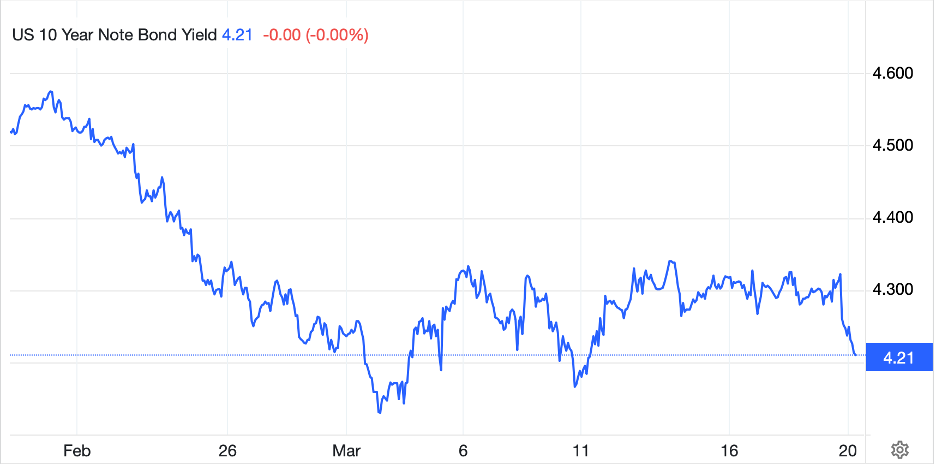
In the bond market, Treasury yields are lower by a further -4bps this morning and down to 4.20%, still well within the recent trading range (see chart below).  As to European sovereigns, they too are lower by between -3bps and -5bps, as despite concerns over potential new issuance, fear seems to be today’s theme.  Oh yeah, JGB yields are still pegged at 1.50%.
Source: tradingeconomics.com

In the commodity bloc, oil is little changed this morning, and net, on the week little changed as well.  It is difficult to see short-term drivers although I continue to believe we will see it drift lower over time as supply continues apace while demand, especially in a slowing growth scenario, is likely to ebb.  Gold (-0.6%) is having its worst day in more than a week, but the trend remains strongly higher.  Arguably a bit of profit taking is visible today.  This is dragging silver (-1.8%) along for the ride although copper (+0.1%) is sitting this move out.

Finally, the dollar is firmer again this morning, higher by 0.5% according to the DXY, with the biggest currency laggards the AUD (-1.1%), SEK (-0.8%) and ZAR (-0.75%).  But the dollar’s strength is universal this morning.  One possibility is that traders have decided Powell is not going to cut rates, hence more pressure on US equities, and more support for the dollar.  I don’t agree with that thesis, as I believe Powell really wants to cut rates, but for now, the other argument has the votes.

On the data front, we get the weekly Initial (exp 224K) and Continuing (1890K) Claims as well as the Philly Fed (8.5) all at 8:30.  Then at 10:00 we see Existing Home Sales (3.95M) and Leading Indicators (-0.2%).  Also, at 8:00 we will get the BOE rate decision, with no change expected.  However, as I have been explaining, central bank stories are just not that important, I believe.  Investors in the UK are far more worried about the Starmer fiscal disaster than the BOE.

There are no Fed speakers on the schedule today, so, I suspect it will be headline bingo.  While the dollar has outperformed for the past two sessions, I continue to believe the trend is lower for the buck and higher for commodities.  Perhaps today is a good day to take advantage of some dollar strength for payables hedgers.

Good luck

Adf

Still Inchoate

The Fed is the talk of the town
Are dots set to move up, or down?
At this point it seems
Those with dovish dreams
Will finish the day with a frown

The other discussion of note
Is balance sheet size and its bloat
Will QT soon end?
Or will it extend?
It seems this idea’s still inchoate

Yesterday I offered my view that the most important potential changes in today’s FOMC statement and releases was the Longer Run median interest rate estimate.  Any change there will imply that the framework in which the Fed has been working is changing.  And one thing we know about changes in frameworks is they bring volatility.  But there is another issue I did not discuss yesterday, QT.  Currently, the Fed is allowing up to $60 billion/month of Treasury securities to mature from their balance sheet without being replaced and up to $35 billion in mortgage-backed securities.  This process has seen their balance sheet decline in size from a shade under $9 trillion in March 2022 to a shade over $7.5 trillion as of last week.

Doing the math, if the balance sheet had declined in size each month by their capped amounts, the current size would have been ~$6.7 trillion, so they have not kept up their desired pace.  The reason is that their mortgage portfolio is not rolling off very quickly since mortgages are not being prepaid at anywhere near the previous rates.  This is due to the impact of the Fed’s actions on the housing market.  Mortgage-backed securities get prepaid when the mortgages underlying are paid off.  That happens in one of two situations, either the house is sold or the homeowner refinances.  With so many homeowners having refinanced when rates were much lower, they have no incentive to do so now, so that channel has been essentially closed.  At the same time, given the dramatic slowdown in the sales of existing homes, that channel is moving at a much slower pace as well.

Prior to the quiet period, Governor Chris Waller gave a speech where he discussed the idea that he would like to see all the mortgages off the Fed’s balance sheet, and the balance sheet hold a far larger percentage of T-bills rather than the current construction of mostly longer-dated coupons.  If this is the consensus view at the FOMC, that means they have a lot of work left to do.  As well, many have questioned whether they can continue to shrink the balance sheet at the same time they are cutting interest rates.  When any FOMC member has been asked that question, they maintain the two issues are separate.  However, I would contend if they do operate in that manner, the results may not be what they want.  It would be a classic pressing on the accelerator and the brake at the same time type of situation.  Another framework change and the chance for more volatility.

It is not clear if the Fed will even discuss the end of QT in their statement although I suspect Powell will have to address the question in the press conference regardless.  But as I look at today’s potential outcomes, the thing that jumps out at me is the chance for several of their decisions to lead to more volatile markets going forward.  And that is across asset classes, so stocks, bonds and the dollar.  It is for times like these that hedging policies are important.  Properly constructed hedges can be very effective at reducing market driven volatility of results, whether corporate or trading profits.

Ok, let’s turn to the overnight session to see how things are shaping up heading into the meeting today.  Equity markets in Asia were generally positive with the Nikkei (+0.65%) recapturing the 40K level.  Chinese markets were ever so slightly firmer despite the fact that the PBOC left the Loan Prime Rate unchanged.  There seemed to be a lot more hope for a change than evidence the PBOC would act.  Europe, on the other hand is having a little more trouble this morning with most markets softer led by the CAC (-0.6%). The outlier here is the DAX (+0.2%) which seems to be responding to a larger than expected decline in German PPI to -4.1% Y/Y.  The implication is German corporate margins may improve.  As to the US, at this hour (7:15), futures are edging higher by about 0.1% across the board after another solid session yesterday.

In the bond market, Treasury yields have edged down 1bp in the 10yr with similar movement across the curve.  In Europe, yields have fallen a bit more, between 3bps and 5bps with UK Gilts (-5bps) leading the way after CPI data this morning printed at a softer than expected 3.4% headline, 4.5% core.  With the BOE on tap tomorrow, investors believe this improves the odds of a more dovish outcome, although no rate cuts are likely at all.

As to the continent, Madame Lagarde regaled us this morning with the following: “Our decisions will have to remain data dependent and meeting-by-meeting, responding to new information as it comes in. This implies that, even after the first rate cut, we cannot pre-commit to a particular rate path.”  In other words, she continues to sing from the same hymnal that all the G10 central bankers are using.  Once again, I don’t understand why anyone would believe that the central banks will be able to pivot on a timely basis if/when recession is coming.  By maintaining their data dependence, they are assured that they will be reactive, not proactive, since all data is backward looking.  And one more thing, JGB yields have been unchanged since the BOJ policy change.  Tighter policy is not in the cards here either.

In the commodity market, everything is under a bit of pressure this morning with oil (-0.8%) slipping back a bit on what seems more like a trading response than a fundamental change in anything.  EIA data later today can certainly have an impact if the recent drawdown in inventories continues because production does not appear to be increasing anywhere.  In the metals markets, gold is a hair softer, although remains within spitting distance of its recently traded all-time highs while copper (-1.0%) has been slipping the past several sessions and is basically right back at $4.00/lb.  This market remains beholden to the growth story overall, and China’s lack of activity last night is probably weighing on the red metal here.

Finally, the dollar is still kicking butt and taking names with the DXY back above 104 this morning.  The yen has not found its footing yet, trading to 151.65, down another -0.5%, and really getting hammered on the crosses vs. the euro and the pound, at all-time lows there.  But really, this remains a dollar strength story as hopes continue to recede for the Fed to start easing policy very soon.  On a relative basis, the US economy continues to be the best performing major economy (7% budget deficits will do that for you), but the reality is reasons for the Fed to start cutting rates remain scarce.  Until those change, the dollar should continue to perform well.  And remember, when that does change, we are likely to see every G10 nation cutting rates aggressively, so the dollar should still hold up well.

And that is it.  There is no data ahead of the Fed so I imagine we will all collectively hold our breath until the statement at 2:00 and Powell’s presser at 2:30. Until then, I foresee little in the way of movement.  After that, it all depends on what he does and says.

Good luck
Adf

FOMC Tryst

While problems in China persist
And risk is still on the blacklist
More talk is now turning
To Powell concerning
Tomorrow’s FOMC tryst

The coronavirus remains the primary topic of conversation amongst the economic and financial community as analysts and pundits everywhere are trying to estimate how large the impact of this spreading disease will be on economic output and growth. The statistics on the ground continue to worsen with more than 100 confirmed deaths from a population of over 4500 confirmed cases. I fear these numbers will get much worse before they plateau. And while I know that science and technology are remarkable these days, the idea that a treatment can be found in a matter of weeks seems extremely improbable. Ultimately, this is going to run its course before there is any medication available to address the virus. It is this last idea which highlights the importance of China’s actions to prevent travel in the population thus reducing the probability of spreading. Unfortunately, the fact that some 5 million people left the epicenter in the past weeks, before the problem became clear, is going to make it extremely difficult to really stop its spread. Today’s news highlights how Hong Kong and Macau are closing their borders with China, and that there are now confirmed cases in France, Germany, Canada, Australia and the US as well as many Asian nations.

With this ongoing, it is no surprise that risk appetite, in general, remains limited. So the Asian stock markets that were open last night, Nikkei (-0.6%), KOSPI (-3.1%), ASX 200 (-1.35%) all suffered. However, European markets, having sold off sharply yesterday, have found some short term stability with the DAX unchanged, CAC +0.15% and FTSE 100 +0.2%. As to US futures, they are pointing higher at this hour, looking at 0.2%ish gains across the three main indices.

Of more interest is the ongoing rush into Treasury bonds with the 10-year yield now down to 1.57%, a further 3bp decline after yesterday’s 7bp decline. In fact, since the beginning of the year, the US 10-year yield has declined by nearly 40bps. That is hardly the sign of strong growth in the underlying economy. Rather, it has forced many analysts to continue to look under the rocks to determine what is wrong in the economy. It is also a key feature in the equity market rally that we have seen year-to-date, as lower yields continue to be seen as a driver of the TINA mentality.

But as I alluded to in my opening, tomorrow’s FOMC meeting is beginning to garner a great deal of attention. The first thing to note is that the futures market is now pricing in a full 25bp rate cut by September, in from November earlier this month, with the rationale seeming to be the slowing growth as a result of the coronavirus’s spread will require further monetary stimulus. But what really has tongues wagging is the comments that may come out regarding the Fed’s review of policy and how they may adjust their policy toolkit going forward in a world of permanently lower interest rates and inflation.

One interesting hint is that seven of the seventeen FOMC members have forecast higher than target inflation in two years’ time, with even the most hawkish member, Loretta Mester, admitting that her concerns over incipient inflation on the back of a tight labor market may have been misplaced, and that she is willing to let things run hotter for longer. If Mester has turned dovish, the end is nigh! The other topic that is likely to continue to get a lot of press is the balance sheet, as the Fed continues to insist that purchasing $60 billion / month of T-bills and expanding the balance sheet is not QE. The problem they have is that whatever they want to call it, the market writ large considers balance sheet expansion to be QE. This is evident in the virtual direct relationship between the growth in the size of the balance sheet and the rally in the equity markets, as well as the fact that the Fed feels compelled to keep explaining that it is not QE. (For my money, it is having the exact same impact as QE, therefore it is QE.) In the end, we will learn more tomorrow afternoon at the press conference.

Turning to the FX markets this morning, the dollar continues to be the top overall performer, albeit with today’s movement not quite as substantial as what we saw yesterday. The pound is the weakest currency in the G10 space after CBI Retailing Reported Sales disappointed with a zero reading and reignited discussion as to whether Governor Carney will cut rates at his last meeting on Thursday. My view remains that they stay on the sidelines as aside from this data point, the recent numbers have been pretty positive, and given the current level of the base rate at 0.75%, the BOE just doesn’t have much room to move. But that was actually the only piece of data we saw overnight.

Beyond the pound, the rest of the G10 is very little changed vs. the dollar overnight. In the EMG bloc, we saw some weakness in APAC currencies last night with both KRW and MYR falling 0.5%, completely in sync with the equity weakness in the region. On the positive side this morning, both CLP and RUB have rallied 0.5%, with the latter benefitting on expectations Retail Sales there rose while the Chilean peso appears to be seeing some profit taking after a gap weakening yesterday morning.

Yesterday’s New Home Sales data was disappointing, falling back below 700K despite falling mortgage rates. This morning we see Durable Goods (exp 0.4%, -ex Transport 0.3%), Case Shiller Home Prices (2.40%) and Consumer Confidence (128.0). At this stage of the economic cycle, I think the confidence number will have more to tell us than Durable Goods. Remarkably, Confidence remains quite close to the all-time highs seen during the tech bubble. But it bodes well for the idea that any slowdown in growth in the US economy is likely to be muted. In the end, while the US economy continues to motor along reasonably well, nothing has changed my view that not-QE is going to undermine the value of the dollar as the year progresses.

Good luck
Adf

Doublespeak

The sitting Prime Minister, May
Heard terrible news yesterday
Her plan to promote
A Brexit deal vote
Was halted much to her dismay

This forces her, later this week
A longer extension to seek
But still the EU
Seems unlikely to
Do more than add new doublespeak

In yet another twist to the Brexit saga, the Speaker of the House of Commons, John Bercow, refused to allow another vote on PM May’s deal this week. He explained that Parliamentary rules since 1604 have existed to prevent a second vote on a bill that has already been rejected unless there have been substantial changes to the bill. In this case there were no changes and PM May was simply trying to force approval based on the idea that the clock was running out of time. The pound reacted to the news yesterday by quickly dropping 0.5%, although it has since recouped 0.2% this morning.

This has put the PM in a difficult spot as she prepares to travel to the EU council meeting in Brussels later this week. Given that there is still no clarity on how the UK wants to handle things, or at least how Parliament wants to handle things, she will need to seek an extension in order to avoid a no-deal Brexit. However, the comments from several EU members, notably Germany and France, have indicated they need some sense of direction as to what the UK wants before they will agree to that extension. Remember, too, it requires a unanimous vote by the other 27 members of the EU to grant any extension. At this stage, the market is virtually certain an extension will be granted, at least based on the fact that the pound remains little changed on the day and has been able to maintain its modest gains this year. And it is probably a fair bet that an extension will be granted. But the real question is what the UK will do with the time. As of now, there is no clarity on that at all. Unless the EU is willing to change the deal, which seems unlikely, then we are probably heading for either a new general election or a new Brexit referendum, or both. Neither of these will add certainty, although the predominant view is that a new referendum will result in a decision to stay. Do not, however, ignore the risk that through Parliamentary incompetence, next week the UK exits without a deal. That risk remains very real.

One side note on the UK is that employment data released this morning continues to beat all estimates. Wages continue to rise (+3.4%) and the Unemployment Rate fell further to 3.9%. Despite a slowing economy overall, that has been one consistent positive. It has been data like this that has helped the pound maintain those gains this year.

Elsewhere the global growth story continues to suffer overall, as both China and the Eurozone continue to lag. While there was no new data from China, we did see the German ZEW survey (-3.6 up from -13.4) and the Eurozone version as well (-2.5 up from -16.6). However, at the same time, the Bundesbank just reduced their forecast for German GDP in 2019 to 0.6%, although they see a rebound to 1.7% in 2020. My point is that though things may have stopped deteriorating rapidly, they have not yet started to show a significant rebound. And it is this dearth of economic strength that will continue to prevent the ECB from tightening policy at all for quite a while to come.

A quick glance Down Under shows that optimism in the lucky country is starting to wane. Three-year Australian government bonds have seen their yield fall to 1.495%, just below the overnight rate and inverting the front of the curve there. This calls into question the RBA’s insistence that the next move will be an eventual rate hike. Rather, the market is now pricing in almost two full rate cuts this year as Australia continues to suffer from the slowing growth in China, and the world overall. While the FX impact today has been muted, just a -0.1% decline, Aussie continues to lag vs. other currencies against a dollar that has been on its back foot lately.

Speaking of the dollar, tomorrow, of course, we hear from the Fed, with a new set of economic projections and a new Dot Plot. Since there is no chance they move rates, I continue to expect the market to be focused on the balance sheet discussion. This discussion is not merely about the size of the balance sheet, and when they stop shrinking it, but also the composition and general tenor of the assets they hold. Remember, prior to the financial crisis and the utilization of QE, the Fed generally owned just short-term T-bills and maybe T-notes out to three years. But as part of their monetary policy experiment, they extended the maturities of their holdings with the average maturity now nine years. This compares to the six-year average maturity of the entire government bond issuance. The longer this average tenor, the more monetary ease they are providing to the market, so the question they need to answer is do they want to maintain that ease now or try to shorten the current maturity, so they have the opportunity to use that policy in a time of greater need. While this remains up in the air right now, whatever decision is made it will give a strong clue into the Fed’s view of the current situation and just how strongly the economy is actually performing.

This morning’s Factory Orders data (exp 0.3%) is unlikely to have a market impact of any sort. Equity markets have been muted with US futures pointing to essentially an unchanged opening. Yesterday saw limited price action, with both the dollar and equities barely changed. My sense is today will shape up the same way. Tomorrow, however, will be a different story, of that you can be sure.

Good luck
Adf

Carefully Looking Ahead

The Minutes explained that the Fed
Was carefully looking ahead
But so far it seems
The hawks’ fondest dreams
Of hiking again might be dead

As well, when it comes to the size
Of the Fed’s balance sheet, in their eyes
It’s likely to stay
Quite large like today
Not shrink while they, debt, monetize

Markets are little changed this morning after a lackluster session yesterday when the Fed released their Minutes from the January meeting. Overall, the tone of the Minutes seemed to be slightly less dovish than the tone of the Powell press conference that followed the meeting, as well as much of the commentary we have heard since then. Apparently, Cleveland’s Loretta Mester is not the only one who believes rates will need to be raised further this year, as the Minutes spoke of “several’ members with the same opinion. Of course, that was offset by “several” members who had the opposite view and felt that there was no urgency at all to consider raising rates further this year. Patience continues to be the watchword at the Mariner Eccles building, and I expect that as long as the economic data does not differ dramatically from forecasts, the Fed will be quite happy to leave rates on hold. They specifically mentioned the potential problems that could derail things like slowing global growth, a poor outcome in the US-China trade talks or a disruptive Brexit. But for now, it appears they are comfortable with the rate setting.

The balance sheet story was of even more interest to many market participants as the gradual running off of maturing securities has seemingly started to take a bite out of available liquidity in markets. And in fact, this seems to be where the Fed minutes indicated a more dovish stance in my eyes. While there is still a thought that rates might be raised later this year, it was virtually unanimous that shrinking the balance sheet will end this year, leaving the Fed with a much larger balance sheet (~$3.5-$4.0 trillion) than many had expected. Recall, prior to the financial crisis the Fed’s balance sheet was roughly $900 billion in size. To many, this is effectively a permanent injection of money into the economy and so should support both growth and inflation going forward. However, the risk is that when the next downturn arrives (and make no mistake, it Will arrive), the Fed will have less room to act to support the economy at that time. This is especially true since even with another one or two rate hikes, Fed Funds will have topped out at a much lower level than it has historically, and therefore there will be less rate cutting available as a policy tool.

Adding it up, it seems rate guidance was mildly hawkish and balance sheet guidance was mildly dovish thus leaving things largely as expected. It is no surprise market activity was muted.

This morning, as the market awaits the ECB Minutes, we see the dollar little changed overall, although there have been some individual currency movements. For example, AUD has fallen 0.7% (and dragged NZD down -0.5%) after a well-respected local economist changed his rate view to two RBA rate cuts later this year due to the rapidly weakening housing market. Prior to this, the market had anticipated no rate movement for at least another 18 months, so this served as quite a change. And all this came despite strong Australian employment data with the Unemployment rate remaining at 5.0% and job growth jumping by 39K.

Meanwhile, mixed data from Europe has leaned slightly bullish as surprisingly strong French Composite PMI data (49.9 vs 49.0 expected) offset surprisingly weak German Manufacturing PMI data (47.6 vs 49.7 expected). I guess the market already knows that Germany is slowing more rapidly than other nations in the Eurozone (except for Italy) due to the ongoing trade friction between the US and China. But despite the ongoing Gilets Jaune protests, the French economy managed to find some strength. At any rate, the euro has edged higher by 0.15% after the reports. At the same time, the pound has also rallied 0.15% after releasing the largest budget surplus on record (since 1993), and perhaps more importantly, on some apparent movement by the EU on Brexit. PM May is hinting that she may be able to get a legally binding way to end the backstop in a codicil to the Brexit negotiations, which if she can, may allow cover for the more euro skeptical members of her party to support the deal. There is no question the pound remains completely beholden to the Brexit story and will continue to do so for at least another month.

Pivoting to the trade talks, there are several stories this morning about how negotiators are preparing a number of memos on separate issues with the idea they will be brought together at the Trump-Xi meeting to be held in the next several weeks. There is no question that the market continues to view the probability of a deal as to be quite high, but I keep looking at the key issues at stake, specifically with regards to IP and the coercion alleged by US companies, and I remain skeptical that China will back away from that tactic. The Chinese do not view the world through the same eyes as the US, or the Western World at large. As per an article in the WSJ this morning, “We must never follow the Western path of constitutionalism, separation of powers and judicial independence,” Mr. Xi said in an August speech. That comment does not strike me as a basis for compromise nor enforcement of any deal that relies on those issues. But for now, the market continues to believe.

And that’s pretty much the stuff that matters today. We do get most of our data for the week this morning with Initial Claims (exp 229K), Durable Goods (1.5%, 0.3% ex transport), Philly Fed (14.0) and Existing Home Sales (5.00M). While individually, none of them have a huge impact, the suite of information if consistently strong or weak, could well lead to some movement given the broad sweep of the economy covered. There are no Fed speakers on the docket today, and so it doesn’t appear that there is much reason to expect real movement today. Equity markets around the world have seen limited movement and US futures are flat to slightly lower. Treasury yields are slightly firmer but remain at the bottom end of their recent trading range. Overall, it seems like a dull day ahead.

Good luck
Adf


Two Countries that Fought

There once were two countries that fought
‘bout trade as each one of them thought
The other was cheating
Preventing competing
By champions both of them sought

They sat down to seek a solution
So both could avoid retribution
But talks have been tough
And not yet enough
To get a deal for execution

The US-China trade talks continued overnight, and though progress in some areas has been made, clearly it has not yet been enough to bring in the leadership. The good news is that the talks are set to continue next week back in Washington. The bad news is that the information coming out shows that two of the key issues President Trump has highlighted, forced technology transfer and subsidies for SOE’s, are nowhere near agreement. The problem continues to be that those are pillars of the Chinese economic model, and they are going to be loath to cede them. As of this morning, increased tariffs are still on the docket for midnight, March 2, but perhaps next week enough progress will be made to support a delay.

Equity markets around the world seemed to notice that a deal wasn’t a slam dunk, and have sold off, starting with a dull session in the US yesterday, followed by weakness throughout Asia (Nikkei -1.1%, Shanghai -1.4%). Interestingly, the European markets have taken a different view of things this morning, apparently attaching their hopes to the fact that talks will continue next week, and equity markets there are quite strong (DAX +1/0%, FTSE +0.4%). And the dollar? Modestly higher at this time, but overall movement has been muted.

Asian markets also felt the impact of Chinese inflation data showing CPI fell to 1.7% last month, below expectations and another indication that growth is slowing there. However, the loan data from China showed that the PBOC is certainly making every effort to add liquidity to the economy, although it has not yet had the desired impact. As to the renminbi, it really hasn’t done anything for the past month, and it appears that traders are biding their time as they wait for some resolution on the trade situation. One would expect that a trade deal could lead to modest CNY strength, but if the talks fall apart, and tariffs are raised further, look for CNY to fall pretty aggressively.

As to Europe, the biggest news from the continent was political, not economic, as Spain’s PM was forced to call a snap election after he lost support of the Catalan separatists. This will be the nation’s third vote in the past four years, and there is no obvious coalition, based on the current polls, that would be able to form. In other words, Spain, which has been one of the brighter lights in the Eurozone economically, may see some political, and by extension, economic ructions coming up.

Something else to consider on this issue is how it will impact the Brexit negotiations, which have made no headway at all. PM May lost yet another Parliamentary vote to get the right to go back and try to renegotiate terms, so is weakened further. The EU does not want a hard Brexit but feels they cannot even respond to the UK as the UK has not put forth any new ideas. At this point, I would argue the market is expecting a delay in the process and an eventual deal of some sort. But a delay requires the assent of all 27 members that are remaining in the bloc. With Spain now in political flux, and the subject of the future of Gibraltar a political opportunity for domestic politics, perhaps a delay will not be so easy to obtain. All I know is that I continue to see a non-zero probability for a policy blunder on one or both sides, and a hard Brexit.

A quick look at the currency markets here shows the euro slipping 0.2% while the pound has edged higher by 0.1% this morning. Arguably, despite the Brexit mess, the pound has been the beneficiary of much stronger than expected Retail Sales data (+1.0% vs. exp +0.2%), but in the end, the pound is still all about Brexit. The sum total of the new economic information received in the past 24 hours reaffirms that global growth is slowing. Not only are inflation pressures easing in China, but US Retail Sales data was shockingly awful, with December numbers falling -1.2%. This is certainly at odds with the tune most retail companies have been singing in their earnings reports, and given the data was delayed by the shutdown, many are wondering if the data is mistaken. But for the doves on the Fed, it is simply another point in their favor to maintain the status quo.

Recapping, we see trade talks dragging on with marginal progress, political pressure growing in Spain, mixed economic data, but more bad news than good news, and most importantly, a slow shift in the narrative to a story of slowing growth will beget the end of monetary tightening and could well presage monetary ease in the not too distant future. After all, markets are pricing in rate cuts by the Fed this year and no rate movement in the ECB (as opposed to Draghi’s mooted rate hikes later this year) until at least 2020. The obvious response to this is…add risk!

A quick look at today’s data shows Empire State Manufacturing (exp 7.0), IP (0.1%), Capacity Utilization (78.7%) and Michigan Sentiment (94.5). We also have one last Fed speaker, Raphael Bostic from Atlanta. Virtually all the recent Fed talk has been about when to stop the balance sheet runoff, with Brainerd and Mester the latest to discuss the idea that it should stop soon. And my guess is it will do just that. I would be surprised if they continue running down the balance sheet come summer. The changes going forward will be to the composition, less mortgages and more Treasuries, but not the size. And while some might suggest that will remove a dollar support, I assure you, if the Fed has stopped tightening, no other nation is going to continue. Ironically, this is not going to be a dollar negative, either today or going forward.

Good luck and good weekend
Adf