Simply a Bummer

As tiresome as it may be
To talk about China and Xi
The doldrums of summer
Are simply a bummer
With nothing else worthy to see

However, come Friday we’ll turn
To Jackson Hole where we should learn
If Jay and the Fed,
When looking ahead,
Decide rate hikes soon can adjourn

The biggest news overnight was that the PBOC cut interest rates again, but this time somewhat less than expected.  You may recall that last week, they cut the 1-yr Lending Facility rate by 15bps in a surprising move.  In fact, this is what started the entire chain of events last week that resulted in China dominating the macroeconomic news.  Well, last night they cut the 1yr Loan Prime rate by a less than expected 10bps with the market looking for a 15bp cut.  And they left the 5yr Loan Prime rate, the rate at which most mortgages in China are priced, unchanged at 4.20% rather than implementing the 15bp cut that the market had anticipated.  The result is that so far, Chinese support for their economy remains tepid at best.

At the same time, there continues to be a grave concern in Beijing regarding the exchange rate as, once again, the daily fixing was far below the market rate, and once again, the renminbi fell anyway.  It has become abundantly clear that the PBOC is quite concerned over a ‘too weak’ renminbi, hence the maintenance of the 5yr interest rate.  As well, it was widely reported that Chinese state-owned banks were actively selling USDCNY in the market to prevent further weakness in their currency.  

Perhaps this is a good time to briefly discuss the concept of the end of the dollar again, a topic that continues to make headlines.  One of the key pillars of this thesis is that the PBOC has reduced the number of dollars on its balance sheet substantially over the past several years which is seen as an indication that they are preparing to support some new reserve asset.  However, as last night’s price action indicated, it is quite possible, if not likely, that the only change has been one of location, rather than amount.  As the PBOC reduced the dollars on its balance sheet, the big state-owned banks all increased the amount on their balance sheets.  So now, the PBOC can direct those banks to intervene on their behalf whenever they want to do something.  At the same time, the PBOC has the appearance of decoupling, something they are clearly trying to demonstrate.  

This week is the big BRICS meeting where the stories are that they are going to unveil a new BRICS currency, allegedly to be gold-backed, as these nations try to undermine US power as well as offer an alternative to non-aligned nations.  The thing to remember about this group of widely disparate nations is that it has never been a cohesive bloc, it was simply an acronym created by a Goldman Sachs analyst in 2001 to describe a group of fast-growing emerging markets.  However, other than China and Russia, which have become closer since Russia’s invasion of Ukraine, they really have very little in common.  They are geographically widely diverse, have very different governing structures as well as very different financial and monetary policies.  In other words, there is nothing to suggest they can act as a cohesive group for any major decision.  While I am certain there will be some announcement of some sort at the end of the conference, an alternative to the dollar will not be coming anytime soon.

As to Jackson Hole, since Powell’s speech isn’t until Friday morning, we have plenty of time to touch on that topic later in the week.  In the meantime, risk is arguably in modest demand this morning.  While Chinese shares suffered significantly overnight on the disappointing rate news, European bourses are all nicely higher, generally between 0.75% and 1.00%.  Too, US futures are firmer this morning by about 0.5% after a late day rally Friday brought the major indices back near unchanged on the day from earlier lows in the session.

At the same time, bond yields continue to rally with 10-year Treasury yields back at 4.30%, up 4bps this morning, while European sovereign yields are all higher by between 4bps and 5bps.  It seems the bond market is not completely on board with the soft-landing narrative even though an increasing number of analysts are coming around to that view.  I think what we have learned thus far is that the US economy is not nearly as interest rate sensitive as it used to be.  The post-Covid period of QE and ZIRP saw a massive refinancing of debt, both mortgage and corporate, into longer-dated, low fixed rates.  With yields higher, there is much less need for refinancing, at least not yet, and so many of the problems that have been widely expected just have not happened yet.  At some point, when debt needs to be refinanced, if rates are still at current levels, it is likely to prove problematic for the companies and the economy writ large.  But that could still be some time from now.  In the meantime, I continue believe the yield curve inversion, which is now down to -67bps, could disappear completely by 10yr yields continuing to rise.  That is clearly not the consensus view.

Turning to commodities, they are generally looking good today led by oil (+1.2%) which has rebounded over the past several sessions and is back above $82/bbl.  The metals, too, are looking good with gold up at the margin, although hovering just below $1900/oz, while copper also has a bit of support today, up 0.3%.  For the industrial metals, China remains a key question mark.  If the Chinese economy continues to slow, then demand for these commodities is likely to be disappointing and prices seem likely to come under short-term pressure.  But remember, the long-term story remains one where many of these are essential for the mooted energy transition, and there simply is not enough of the stuff to satisfy the demand.  Longer term, prices still have room to rise.

Finally, the dollar is starting to slide as I type.  An earlier mixed picture has seen buyers of NOK (+0.75%) as oil continues to rebound, but also in essentially all of the G10 with only the yen (-0.3%) lagging.  In fairness, this is classic risk-on price action.  Turning to emerging market currencies, Asian currencies were mostly under pressure last night after the China rate news, but this morning EEMEA currencies are looking much better as they follow the euro (+0.3%) higher.  It appears that fear is taking a day off today.

On the data front, there is not much of real interest this week:

TuesdayExisting Home Sales4.15M
WednesdayFlash Manufacturing PMI49.0
 Flash Services PMI52.0
 New Home Sales704K
ThursdayInitial Claims240K
 Continuing Claims1700K
 Chicago Fed Nat’l Index-0.20
 Durable Goods-4.0%
 -ex transports0.2%
FridayMichigan Sentiment71.2
 Powell Speech 

Source: Bloomberg

Given the number of market participants on summer holiday, I suspect that there will be very little activity this week until we hear from Chairman Powell.  I would look for a little bit of choppiness, but no real directional moves until we know the Fed’s latest views.  And there is a real chance that he doesn’t tell us anything new, which means that we would then be waiting for NFP a week from Friday.  Net, until the Fed’s hawkishness breaks, I still like the dollar best.

Good luck

Adf

Problems Galore

The story continues to be
The China of President Xi
Has problems galore
With more still in store
So, traders, as such, want to flee

The issue for markets elsewhere
Is knock-on effects aren’t rare
Protecting the yuan
Means it is foregone
Bond sales will send yields on a tear

For yet another day, China is offering the biggest market stories.  In no particular order we have seen the following overnight; China Evergrande filed for Chapter 15 bankruptcy, a process by which foreign entities can access the US bankruptcy court system, regarding $19 billion of their offshore debt; the PBOC set their CFETS fixing more than 1000 pips lower than market expectations, the largest gap since the process began in 2018, in their effort to arrest the yuan’s consistent decline; and Chinese police visited the homes of the protesters who were complaining about Zhongzhi’s missed payments (I wrote about these Monday in Risks Were Inbred).  And this doesn’t include the fact that Country Garden, the largest property developer in China is losing money quite rapidly and may also be on the brink of bankruptcy.  It seems the Chinese property bubble is deflating.

Ultimately, there appear to be two main impacts of the gathering storm in China, market participants are increasingly leery of taking on risk in general, and the PBOC’s efforts to stem the decline of the yuan means they must sell their holdings of Treasuries to generate the dollars to deliver into the FX market thus adding downward pressure to the bond market.  Of course, one of the typical outcomes of a risk-off attitude is that bond markets rally as investors exit equities and run to bonds.  This stands at odds to the recent bond market behavior, although it is quite evident this morning.  In fact, after touching yields above 4.30% in the 10yr Treasury yesterday, this morning we have seen a half-point rally with yields declining about 5bps in the US.  In Europe, the yield declines have been even greater, mostly around -10bps, so this is a real reprieve for bond markets everywhere.

The key question here is whether we have seen the worst, or if other potential selling catalysts will appear.  Consider for a moment the fact that between China and Japan, they represent >26% of foreign owned US Treasury debt, and that both of these nations are dealing with rapidly weakening currencies.  Not only that, but both have demonstrated they are quite willing to intervene in FX markets to arrest those declines, and as mentioned above, that typically requires selling Treasuries.  It’s a self-reinforcing cycle as higher yields beget currency sales which beget Treasury sales to intervene, which results in higher yields starting the cycle all over.  

With this in mind, we need to consider, what can break the cycle?  Well, if the Fed were to turn dovish and indicate they agreed with the futures markets that rate cuts are coming early next year, I suspect the dollar would fall against most currencies, especially these two, and the cycle would break.  Alternatively, China could step up and guarantee the debt of Countrywide and Evergrande thus removing the investor risk and reduce pressure dramatically.  Finally, I suppose the Fed could make a deal with the BOJ and PBOC and directly absorb their bond sales, so they never hit the market while restarting QE.  That, too, would likely end the cycle.  It is possible there are other ways to break the cycle, but I doubt we will see any of these occurring anytime soon and so the cycle will have to wear out naturally.  That will occur when either or both of the currencies decline far enough so the market believes the trade has ended and unwinds their short positions.  In other words, none of this has changed my view that 7.50 is on the cards for USDCNY as the year progresses, very possibly with 10yr yields getting to 4.5% or more.  And don’t be surprised if we see another move to 150.00 in USDJPY.

But, away from the China connection, things are very much in the summer doldrums.  Equity markets have been treading fearfully and continue to do so this morning.  However, while we have seen several days of declines, there has been no panic selling of note.  So, yesterday’s US weakness was followed by selling throughout Asia and this morning in Europe with most markets down about -1.0%.  US futures, too, are softer, down about -0.5% at this hour (8:00).

Oil prices (-0.85%) which stabilized yesterday, are back under a bit of pressure on the overall negative risk sentiment as they continue to trade either side of $80/bbl.  Metals prices, meanwhile, are mixed with precious metals finding a bit of support while base metals suffer today.  The most interesting story here I saw today was that CODELCO, the world’s largest copper miner in Chile, may be going bankrupt as previous projects didn’t pan out.  That strikes me as a very large potential problem, but one for the future.  

Finally, the dollar is mixed this morning.  It had been softer overall in the overnight session, but as risk is getting marked down, the dollar is gaining strength.  The biggest mover has been PHP (+1.1%) which rallied after the central bank indicated they were going to put a floor under the currency and adjust rates accordingly.  After that, the EMG bloc has not done very much, +/- 0.25% type activity.  However, just recently, G10 currencies started to slide with NOK (-0.8%) the laggard as oil slides, but the entire bloc now coming under pressure.  This is all about risk off.  

There is no US data today nor are there any Fed speakers.  As such, the dollar will take its cues from the equity markets, and the bond market to some extent.  Right now, equity weakness is driving the risk attitude and that means the dollar is likely to remain bid into the weekend.  Next week brings the Fed’s Jackson Hole meeting where everybody will be looking for any policy hints by Chairman Powell on Friday morning.  But for now, the dollar is on top of the mountain.

Good luck and good weekend

Adf

A Raw Deal

The Minutes according to Jay
Explained more rate hikes are in play
At least that’s the spin
From media kin
But could that lead us all astray?

Yesterday’s key news was the release of the FOMC Minutes.  The market read, at least the headline read, was that they were hawkish which played a key role in the equity market decline in the afternoon, as well as the bond market decline leading to the highest 10yr yields since 2008.  Below is what I believe is the key paragraph from the Minutes with my emphasis.

“With inflation still well above the Committee’s longer-run goal and the labor market remaining tight, most participants continued to see significant upside risks to inflation, which could require further tightening of monetary policy. Some participants commented that even though economic activity had been resilient and the labor market had remained strong, there continued to be downside risks to economic activity and upside risks to the unemployment rate; these included the possibility that the macroeconomic effects of the tightening in financial conditions since the beginning of last year could prove more substantial than anticipated. A number of participants judged that, with the stance of monetary policy in restrictive territory, risks to the achievement of the Committee’s goals had become more two sided, and it was important that the Committee’s decisions balance the risk of an inadvertent overtightening of policy against the cost of an insufficient tightening.” 

It strikes me that based on the fact we have already heard from two FOMC voting members, Harker and Williams, that rate cuts are on their mind for 2024, and the lines I have highlighted above, the once unanimous view of a hawkish Fed is beginning to fall apart.  Now, if the data continues to outperform expectations like it has recently (consider the Retail Sales data from Tuesday) I expect the FOMC to maintain their hawkishness.  The Atlanta Fed’s GDPNow forecast has just risen to 5.75%, far above trend growth and certainly no implication for the end of tightening.  But remember, that is a volatile series, and we are a long way from the end of Q3.  Ultimately, I suspect that a growing number of FOMC members are starting to get queasy over the higher for longer mantra given the equity market’s recent shudders.  We shall see.

The Chinese are starting to feel
That Xi’s given them a raw deal
The yuan keeps on falling
While growth there is stalling
And values of homes are unreal

The PBOC was pretty vocal last night as they explained all the things they are going to do to manage a clearly deteriorating situation in China.  Here are some of the comments they released:

PBOC: TO MAKE CREDIT GROWTH MORE STABLE, SUSTAINABLE

PBOC: TO USE VARIOUS TOOLS TO KEEP REASONABLY AMPLE LIQUIDITY

PBOC: TO RESOLUTELY PREVENT OVER-ADJUSTMENT IN EXCHANGE RATE

PBOC: TO OPTIMIZE PROPERTY POLICIES AT APPROPRIATE TIME

PBOC: CHINA IS NOT IN DEFLATION RIGHT NOW

PBOC: LOCAL FISCAL BALANCE PRESSURE INCREASING

PBOC: HAS EXPERIENCES, TOOLS TO SAFGUARD STABLE FOREX MARKET

Which was followed by the following headline, CHINA TOLD STATE BANKS TO ESCALATE YUAN INTERVENTION THIS WEEK.

Add it all up and the Chinese are getting increasingly worried.  There is a great chart in Bloomberg today that shows the change in house prices across China, which puts paid to the official narrative that prices have fallen just 2.4% from the August 2021 highs.  They have clearly fallen a lot more as evidenced by this chart and the comments above.

In the end, the Chinese have a lot of work to do to keep their economy going.  While they remain concerned over the weakening CNY, it is clearly one of the best relief valves they have, and it will slowly weaken further.  Money is leaving the country.

An attitude change
Is becoming apparent
No JGBs please!

And finally last night the BOJ auctioned off some 20yr JGBs and the auction results were awful.  The tail was the widest, at nearly 8bps, since 1987, while the spread between 10yr and 20yr bonds widened by nearly 5bps.  It seems that demand was not nearly as robust as had been expected.  Given that nominal yields in the 20yr are 1.35% and CPI is 3.2% core, it is not that surprising.  Bonds everywhere are losing their luster, at least longer duration bonds, and I see no reason for that trend to end until economic activity is clearly declining.  China’s woes have not yet bled to either the US or Japan, while inflation remains sticky.  Today, globally yields are higher by between 4bps and 6bps.  This process still has more to go in my estimation.

Which brings us to the rest of the overnight session, where after another weak equity performance in the US, we saw Japan and non-China Asia soften, although Chinese markets held in on the back of the PBOC comments and promises of more support for the economy there.  European bourses are somewhat softer this morning but nothing dramatic and at this hour (7:30) US futures are higher by about 0.25% across the board.

Oil prices (+0.9%) have rebounded and after a brief foray below $80/bbl have recaptured that key level.  Metals prices are also firmer this morning across the board as both base and precious varieties see demand.  This seems largely in line with the fact the dollar is under modest pressure this morning.

And the dollar is under modest pressure this morning, at least vs. the G10, where every currency is firmer, but the moves are very small.  NOK (+0.4%) is the leader on the back of the oil move, but everything else is higher by between 0.1% and 0.25%.  In the emerging markets, the picture is a bit more mixed, with some gainers (ZAR +0.45%, HUF +0.35%) and some laggards (MYR -0.55%, PHP -0.5%) with both those currencies feeling pressure from concerns their respective central banks will not maintain the inflation fight.

On the data front, we see Initial (exp 240K) and Continuing (1700K) Claims as well as Philly Fed (-10.4) and Leading Indicators (-0.4%).  The data continues to have both highs and lows with yesterday’s IP jumping 1.0%, much better than expected, but the Empire Mfg data on Tuesday a very weak -19.  There are no Fed speakers today so I expect much will depend on whether or not dip buyers emerge in the equity markets.  It feels like we are teetering on the edge of a bigger risk-off move with another 10% down in equities entirely possible.  In that event, I do like the dollar to show resolve.

Good luck

Adf

Angina

This week all the problems in China
Have given the markets angina
Last night, we are told
Stocks oughtn’t be sold
While Xi tries to hold a hard line-a

For the third day in a row, China is the story du jour.  Two stories from last night illustrate the problems in the Chinese economy are either spreading more widely or simply becoming more widely known outside China.  The litany of issues are as follows: Chinese authorities requested that investment funds not be net sellers of equities this week; the PBOC added the most cash to the economy via reverse repos in six months; investors who have not been repaid by Zhongrong International Trust were seen outside the company’s Beijing HQ protesting openly; and the yuan continues to slide despite PBOC efforts to moderate the currency’s decline.

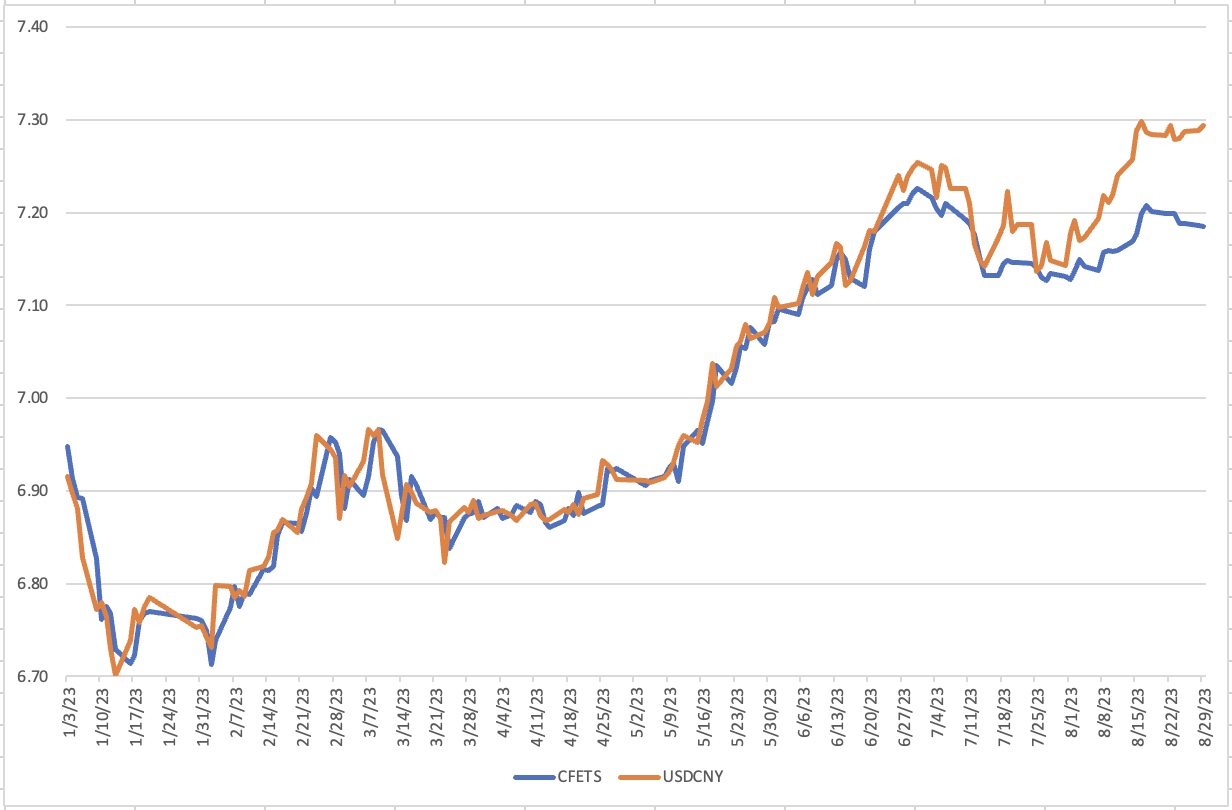
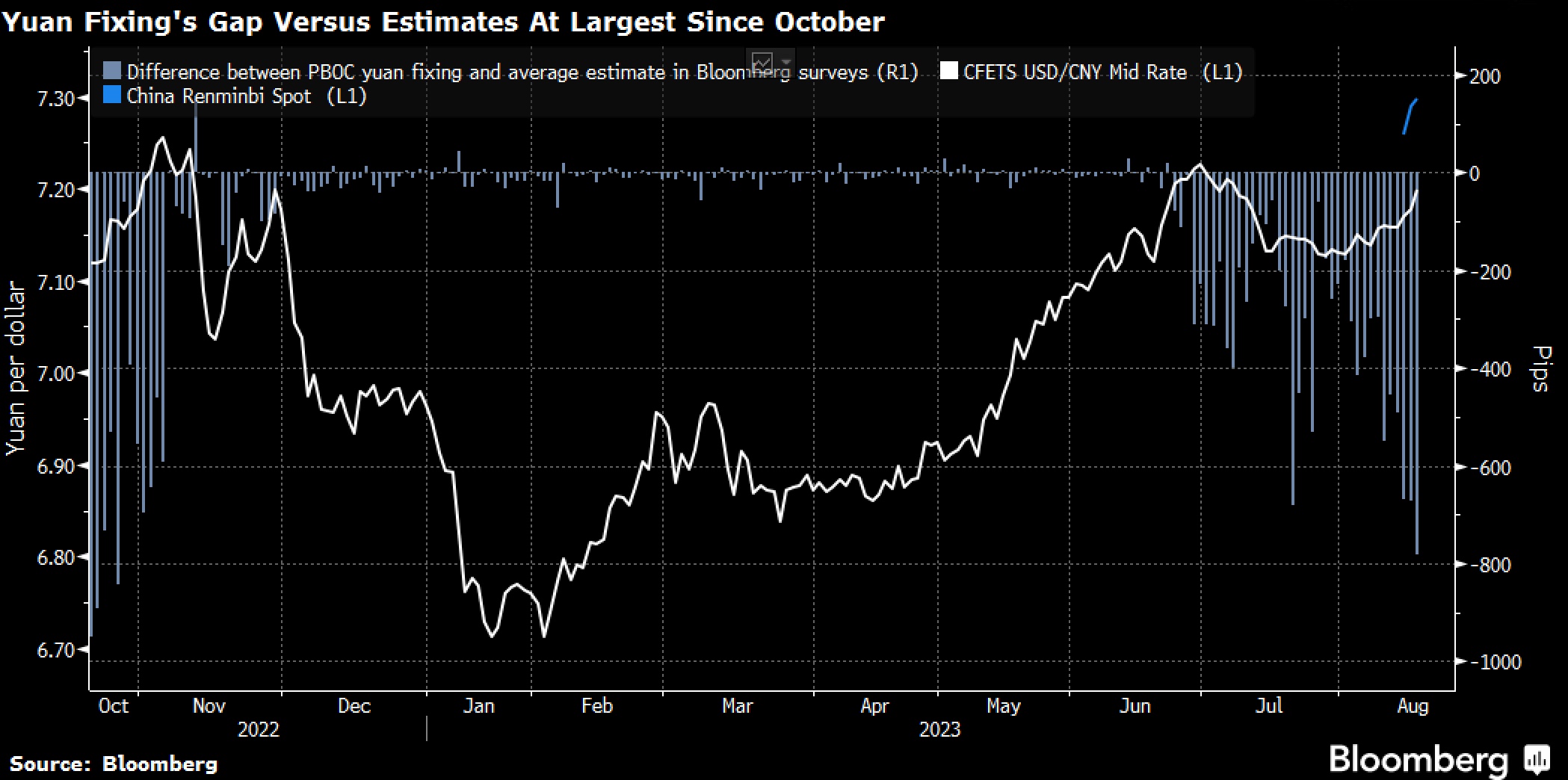
A brief recap of the process in the onshore CNY market shows that each morning the PBOC sets a central rate for the day (the CFETS rate), ostensibly based on a basket of currencies they follow, and when the market starts trading, it must remain within a +/- 2% band around that central rate.  Historically, when the PBOC wanted to signal that the currency was getting too strong or too weak, that CFETS rate would be set further in their desired direction than the model implied to help guide the market.  Well, lately, the PBOC has been setting the CFETS rate for a much stronger than expected CNY, but the market has largely been ignoring that. Bloomberg has an excellent chart showing the rising discrepancy that I have reprinted below.

The bars on the chart represent the difference, in pips on the RHS axis, between the actual CFETS fix and the estimates from analysts’ models.  Notice that from November 2022 through the beginning of July, that difference was virtually nil.  The point is the models have proven themselves over time to be accurate, so these big discrepancies are policy choices.

As the PBOC watches the currency of its closest ally, Russia, collapse in slow-motion, it is clearly concerned about its own situation.  The added pressure of slowing growth and the problems in the investment sector are making things more difficult.  The fact that China is on a monetary easing path while the rest of the world is still tightening is naturally going to undermine the value of the renminbi, but the great fear in China is a rapid devaluation.  

The biggest problem the PBOC has is that unlike the situation with youth unemployment, where they simply decided to stop publishing the data, they don’t really have that choice in this situation.  They cannot hide what they are doing and expect that the FX market will be able to function realistically.  And China needs an FX market because of the huge portion of their economy that is reliant on international trade.  

There is no easy answer for the Chinese here.  If they seek to support the domestic economy with easier monetary policy, the renminbi is very likely to continue to fall as locals seek to get their money out of the country and invest in higher yielding assets.  The fact that the Chinese equity markets have been slumping simply adds more pressure to the situation.  There is a well-known idea in international finance called the impossible trilemma which states that no country can have the following three things simultaneously:

  1. A fixed foreign exchange rate 
  2. Free capital movement
  3. Independent monetary policy

China’s situation is that while the FX rate is not actually fixed, it is carefully and closely managed; while there are significant capital controls, there is still a steady flow of funds leaving the country, often via international real estate investments, so there is some freedom of flows; although of course, there is no attempt at independence by the central bank.  However, what we can readily observe is that even maintaining control of the currency while there is any ability to move capital offshore is virtually impossible these days.  Nothing has changed my view that we are headed to 7.50 and beyond over time.  And, to think, I didn’t even have to discuss weak earnings from Tencent or further concerns about Country Garden going bankrupt.

With that as our backdrop, it cannot be surprising that risk is under some pressure.  After all, the Chinese economy remains the second largest in the world.  The big change for markets is that after two decades of China being the fastest growing major economy in the world, now it is much slower than both Japan and the US (Europe is still in the dumps) and portfolio adjustments are still being made.

Looking at the overnight session, after a weak US market, with all three major indices lower by more than -1.0%, Asia followed suit completely, with markets there also under significant pressure, falling by -1.0% or more pretty much throughout the time zone.  European bourses, though, have edged higher after a weak performance yesterday, but the gains are di minimis, and in the UK, after inflation data showed the BOE’s job is not nearly done, the FTSE is a bit softer.  US futures are little changed this morning as the market awaits the FOMC Minutes this afternoon.

Treasury yields have backed off a bit, down about 2bps, and we are seeing similar movements in Europe. However, 10yr Treasury yields remain well above 4.0% and certainly seem like they are trending higher.  In the wake of the much stronger than expected Retail Sales data yesterday morning, 10yr yields spiked to 4.26%, their highest level since last October, and tantalizingly close to the highest levels seen in more than 15 years.

Oil prices (+0.3%) which have been sliding for the past week, consolidating their strong move over the past two months, seem to be stabilizing above $80/bbl for now.  We are also seeing modest strength in the metals complex today, although the movement has been very tiny.  Gold has managed to hold the $1900/oz level, but its future performance will depend on the dollar writ large I think.

And finally, the dollar, which has been quite strong overall lately, is softening a touch this morning, with only two weaker currencies in the EMG bloc, KRW (-0.5%) and CNY (-0.1%) as both respond to the problems mentioned above.  But elsewhere, this seems to be a bit of a relief rally with the dollar sagging broadly.  The G10 space is seeing similar price action with only CHF (-0.2%) and JPY (-0.1%) lagging slightly, while the rest of the bloc edges higher.  But movement of this tiny magnitude tends to mean very little.

On the data front, Housing Starts (exp 1450K) and Building Permits (1463K) come first thing with IP (0.3%) and Capacity Utilization (79.1%) at 9:15.  Finally, at 2:00 the Minutes from the July FOMC meeting will be released and given the change in tone we have heard from several members lately, with cuts now on the table for next year, it will be interesting to see how that plays out.

Today feels like a consolidation day, without any significant catalysts, so I expect a quiet session overall.  Unless the Minutes change everyone’s views regarding the next steps by the Fed, I maintain my view of dollar strength over time.  At least until the Fed actually turns things around.

Good luck

Adf

Growth Will, Fall, Free

In China when data is weak
And nothing implies there’s a peak
The answer is to
Remove it from view
And henceforth, no more of it speak

But just because President Xi
Decided there’s nothing to see
That will not prevent
The wid’ning extent
Of views China’s growth will, fall, free

Last night China released their monthly series of economic statistics, all of which were lousy.  Briefly, Retail Sales (2.5%), IP (3.7%), Fixed Asset Investment (3.4%), Property Investment (-8.5%) and Unemployment (5.3%) all missed the mark with respect to economists’ forecasts and all indicated much weaker growth than previously expected.  Conspicuously there was one data point that was missing, youth unemployment, which had been rising rapidly over the past months and in June reached a record high of 21.3%.  However, given the amount of negative press coverage that particular data point was receiving, especially in the West, it seems that President Xi decided it was no longer relevant and it will not be published going forward.  Given the broad-based weakness in all the other data, as well as the fact that there are many new graduates who would have just entered the workforce, one can only assume the number was pretty substantially higher than 21.3%.

The other news from China was that the PBOC cut their 1yr Medium-Term Lending Facility rate by 15bps in a complete surprise to the market.  As well, the 1wk repo rate was also cut by 10bps as the government there tries to address the very evident weakening economic picture without blanket fiscal stimulus.  One cannot be surprised that the renminbi weakened further, falling another -0.4% onshore with the offshore version currently -0.5% on the session.  One also cannot be surprised that Chinese equity markets were all under pressure as prospects for near-term growth continue to erode.  FYI, the renminbi is within pips of its weakest point in more than 15 years and, quite frankly, there is no indication it is going to stop sliding anytime soon.  I continue to look for 7.50 before things really slow down.

As growth increases
And inflation remains high
Can QE remain?

In contrast to the Chinese economic data, we also saw Japanese data overnight and it was a completely different story.  Q2 GDP was estimated at 6.0% on an annual basis, much higher than expected and an indication that Japan is finally benefitting from its policy stance.  While inflation data will not be released until Thursday, the current forecasts are for little change from last month’s readings.  However, remember every inflation indicator in Japan is above the BOJ’s 2% target so the question remains at what point is QE going to end?  For the FX market this matters a great deal as USDJPY is back above 145 again, and if you recall the activities last October, when USDJPY spiked above 150 briefly and the BOJ/MOF felt forced to respond with significant intervention, we could be headed for some more fireworks.  However, despite the BOJ’s YCC policy adjustment at the last BOJ meeting in July, the JGB market has remained fairly well-behaved, so it doesn’t appear there is great internal pressure to do anything yet.  The flipside of that is the US treasury market, where 10yr yields are back above 4.20% and that spread to JGBs keeps widening.  As the Bloomberg chart below demonstrates, the relationship between 10yr Treasury yields and USDJPY remains pretty tight.  Given there is no indication 10yr yields are peaking, I suspect USDJPY has further to rise.

All this, and we haven’t even touched on Europe or the UK, where UK employment data showed higher wages and a higher Unemployment Rate, a somewhat incongruous outcome.  The Gilt market has sold off on the news, with yields climbing about 6bps, but the rest of the European sovereign market is much worse off, with yields rising between 8bps and 12bps.  Treasuries are the veritable winner with yields this morning only higher by 3.5bps.

What about equities, you may ask, after yesterday’s positive US performance.  The disconnect between the NASDAQ’s ongoing strength in the face of rising US yields remains confusing to many, this poet included, as the NASDAQ, with all its tech led growth names, seems to be an extremely long duration asset.  But, another 1% rally was seen yesterday, ostensibly on the strength of Nvidia which rallied after a number of analysts raised their price target on the company amid news that Saudi Arabia and the UAE both have been buying up the fastest processors the company makes.  Well, while Japanese equities managed gains after the strong data, all of Europe is in the red, all by more than 1% and US futures are currently (7:30) lower by about -0.5%.  If US yields continue to rise, and there is no indication they are going to stop doing so in the near future, I find it harder and harder to see equity prices continue to rise as well.  Something’s gotta give.

Interestingly, the commodity space seems to be out of step with the securities markets.  Or perhaps not.  Oil (-1.0%) is down for the third day in four, hardly the sign of economic strength, as arguably the combination of rising interest rates and slowing growth in China would seem to weigh on demand.  And yet, the soft-landing narrative remains the highest conviction case among so many analysts.  So, which is it?  Soft landing with continued growth and energy demand?  Or a hard landing with energy demand falling sharply?  My money is on a harder landing, although I think energy demand will surprise on the high side regardless.  Meanwhile, both base and precious metals are under pressure today with copper (-1.6%) the laggard of the group.  Remarkably, despite ongoing USD strength, gold is still above $1900/oz, but at this point, just barely.

Speaking of the dollar, today is a perfect indication of why the dollar index (DXY) is not a very good estimator of the overall trend.  As I type, DXY is lower by about -0.2%, yet the dollar has risen against virtually every APAC currency and the entire commodity bloc in the G10.  In fact, the only currencies rising today are the euro and pound, both higher by about 0.2%.  At any rate, there is no indication that the dollar’s rebound is ending either.  This is especially true for as long as US yields continue to climb.  Think of it this way, global investors need to buy dollars in order to buy the high yielding Treasuries we now have, so demand is likely to remain robust for now.  

On the data front, Retail Sales (exp 0.4%, 0.4% ex autos) is the big number but we also see Empire Manufacturing (-1.0) and the Import and Export Price Indices.  In addition, we hear from Minneapolis Fed President Kashkari at 11:00, which is likely to have taken on more importance now that we have seen the first split on the concept of higher for longer.  Which camp will he fall into and how vocal will he be regarding the potential to cut rates next year?

But, putting it all together right now, risk is under pressure, and I see no reason for that to change today.  I guess a blowout Retail Sales number, something like 1.0% could get the bulls juices flowing, but that would likely push yields even higher and that is going to be a drag.  Either way, I like the dollar to continue to perform well here overall, especially against EMG currencies.

Good luck

Adf

Risk Were Inbred

In China, the problems have spread
From property company dread
To shadow finance
Where folks took a chance
To earn more though risks were inbred

And elsewhere, the Argentine voters
Surprised governmental promoters
By choosing a man
Whose primary plan
Is ousting Peronist freeloaders

While the goal of this commentary is to remain apolitical, there are times when the politics impacts the markets and expectations for future movement so it must be addressed, though not promoted on either side.  Today, amid general summer doldrums, it seems there are more political stories around that are either having or have the potential to impact financial markets.

But first, a quick look in China where the latest problem to bubble to the surface comes from Zhongzhi Enterprise Group Company, one of the many shadow banking companies in the country.  These firms are conduits for investment by wealthier individuals and corporations who offer structured products and investments promising higher returns than the banking sector.  And they are quite large, with an estimated $2.9 trillion invested in the sector.  Well, Zhongzhi has roughly $138 billion under management and last week they apparently missed some coupon payments on several of these high-yielding investments.  While this is the first that we have heard of problems in the sector, given the terrible performance of the Chinese equity market as well as the ongoing collapse of the Chinese property market, my guess is this won’t be the last firm with a problem.  As has often been said, there is never just one cockroach when you turn on the lights.

As proof positive that there is really no difference between the Chinese and US governments, the first response by the Chinese was to set up a task force to investigate the risks at Zhongzhi and its brethren shadow banks.  That sounds an awful lot like what would happen here, no?  Anyway, depending on who is invested in Zhongzhi and whether they are politically important enough to bail out, I suspect that there will be government intervention of some sort.  Do not be surprised to hear about Chinese banks making extraordinary loans to the sector or guarantees of some kind put in place.  The last thing President Xi can afford at this time is a meltdown in a different sector of the financial space.

It can be no surprise that Chinese equity markets were under pressure again last night, with both the Hang Seng and CSI 300 falling sharply, nor that the renminbi has fallen to its weakest levels since the dollar’s overall peak last October.  I maintain that 7.50 is in the cards here and that it is simply a matter of time before we get there.  In the end, a weaker CNY is the least painful way for China to support its economy, especially since it is a big help to its export industries which remain the most important segment of the economy.  Later this week we will see the monthly Chinese data on investment and activity so it will be interesting to see how things are ostensibly progressing there.  However, this data must always be consumed with an appropriate measure of salt (or something stronger) as there is no independent way to determine its veracity.

Meanwhile, on the other side of the world, a presidential primary in Argentina resulted in a huge surprise with Javier Milei, a complete outsider and ostensible free market advocate, winning the most votes, more than 30%.  The election comes in October and the ruling Peronist party is at risk of being eliminated in the first round.  What struck a chord in the country was his plan to dollarize the economy and close the central bank as well as to shut down numerous government agencies.  Inflation there remains above 115% so it can be no surprise that someone who promised to change the process garnered a lot of support.

I raise this issue because in Germany, the AfD (Alternative für Deutschland) party is currently polling at >21%, the second largest party in the country, and that has a lot of people very concerned.  Like Senor Milei, the AfD’s platform is based on destruction of much of the current government setup.  Because this party is on the right, and given Germany’s dark history with the far right, the latest idea mooted has been to ban the party completely.  Now, certainly the idea of a resurrection of the Nazi party is abhorrent to everyone except some true extremists, but simply banning the party seems a ridiculous idea.  After all, the members will either create a new party with the same support or take over a smaller existing party and drive the platform in the desired direction.  

Support for Marine LePen in France continues to grow, as does support for right of center parties throughout Europe, especially Eastern Europe.  And of course, here in the US, the upcoming election has fostered even more polarization along partisan lines with the Republican party seeming to gain a lot of support of late.  All this implies that there is a chance of some real changes in the financial world that will accompany these political changes.  At this point, it is too early to determine how things will play out, but as we are currently in the Fourth Turning, as defined by historian Neil Howe, the part of civilization’s cycle when there is great unrest, I expect there will be a lot more change coming.  Food for thought.  And it is for this reason that hedging exposures is so critical.

Ok, last week’s inflation readings were mixed, with CPI a bit softer than forecast while PPI was a bit firmer.  But the one consistency was that Treasury yields rose regardless of the situation.  After a further 5bp rise on Friday, 10yr yields are unchanged at 4.15% this morning, an indication that inflation concerns remain front of mind for most investors.  I expect that the peak yields seen back in October will be tested again soon.  As to European sovereigns, while yields there are down a tick this morning, the trend there remains higher as well.

Equity markets, too, have had some trouble of late, sliding a few percent over the past several weeks.  While the move lower has been modest so far, there is clearly concern over a technical break lower should the indices break below their 50-day moving averages.  With yields heading higher, I fear that is the path of least resistance for now.

Oil prices are a touch softer this morning but remain well above $80/bbl and appear to be consolidating before their next leg higher.  Supply is still a consideration and given economic activity continues to outperform, I suspect higher is still the path going forward.  Metals prices are little changed this morning despite some incipient dollar strength, so keep that in mind as well.

Finally, the dollar is much stronger against its Asian counterparts and modestly stronger against most others this morning.  Continuing rises in US yields offer support for the greenback and increased turmoil elsewhere, along with the US economy seemingly outperforming all others have been the hallmarks of the dollar’s strength.  I don’t see that changing soon.

Data this week brings the following:

TuesdayRetail Sales0.4%
 -ex autos0.4%
 Empire Manufacturing-0.7
 Business Inventories0.1%
WednesdayHousing Starts1445K
 Building Permits1468K
 IP0.3%
 Capacity Utilization79.1%
 FOMC Minutes 
ThursdayInitial Claims240K
 Continuing Claims1700K
 Philly Fed-10.5

Source: Bloomberg

While Retail Sales will be watched for their economic portents, I think the Minutes will be the most interesting part of the week, especially as we have now had at least two FOMC voters, Harker and Williams, talk about cutting rates next year.  

For today, while US equity futures have edged higher so far, I feel like the dollar has legs for now.  This will be confirmed if yields continue to rise.

Good luck

Adf

Xi Jinping’s Dreams

The 30-year bond was a flop
Which helped cause an interest rate pop
Though CPI rose
A bit less than pros
Expected, risk prices did drop

Then early this morning we learned
That lending in China’s been spurned
It certainly seems
That Xi Jinping’s dreams
Of rebounds might soon be o’erturned

For all the bulls out there, yesterday must be just a bit disconcerting.  First, the highly anticipated July CPI data was released at a slightly lower than expected 3.2% headline number with core falling 0.1% to 4.7%, as expected.  As always when it comes to CPI data, there were two immediate takes on the result.  On one side, inflationistas pointed out that the future will be filled with higher numbers going forward as base effects for the rest of 2024 kick in with very low comparables in 2022.  They also point to the medical care issue, a detail I have not discussed, but which has to do with a change made by the BLS that has been indicating medical care prices have fallen all year, but which will fall out of the mix starting in September, thus reversing one of the drags we have seen on CPI.  And finally, the rebound in energy prices is continuing (oil +0.4% today) and will be a much bigger part of future readings.  This story was underpinned today by the IEA reporting a new record demand for oil in July of 103 million bbl/day.  Demand continues to support prices here.

Meanwhile, the deflationistas point to the recent trend in prices, which shows that on a 3-month basis, or a 6-month basis, if annualized, CPI is really only running at 2.4% or 2.9% or something like that.  The implication is because we have seen a reduction in the monthly number lately, that will continue.  As well, they make the case that China’s deflation is a precursor to lower US inflation with, I believe, a roughly 6-month lag.  Perhaps the most interesting take I saw was that the Fed has now achieved their goal of an average PCE of 2% if you take the last 14 years of data.  The idea is that Average Inflation Targeting was designed to have the economy run hot for a while to make up for the ‘too low’ inflation that has been published since the GFC.  And now, that average is 2.07% for the past 14 years.  (To me, the last idea is a chart crime, but I digress.)

The problem, though, for the bulls, is that the market’s behavior was not very bullish.  Although the initial move in Treasury yields was lower, with the 10-year yield falling 6bps right after the release, the 30-year Treasury auction that came later in the day was not nearly as well-received as the shorter dated paper seen earlier in the week.  The bid/cover ratio was only 2.42 and it seems that the market may be feeling a little indigestion from all the new paper just issued, as well as the prospects for the additional nearly $1.5 trillion left to come in 2023.  It is not hard to believe that longer end yields could rise further as the year progresses.  The upshot was 10-year yields rose 10bps on the day and are unchanged from there this morning.

Similarly, in the equity markets, the initial surge on the back of the slightly softer CPI was unwound throughout the day and though all three major indices ended the day in the green, the gains were on the order of 0.1% or less, so effectively unchanged.  Looking at futures there today, all three indices are unchanged from the close as investors and traders look for their next inspiration.  Meanwhile, I cannot ignore that overnight, Asian equity markets all fell, with the CSI 300, China’s main index, down -2.30%.  As well, European bourses are all lower this morning, mostly on the order of -1.0%.  Overall, this is not a positive risk day.

One of the things adding to the gloom is the financing data from China released early this morning.  New CNY Loans fell to CNY 345.9 billion, less than half the expected amount and down from >CNY 3 trillion in June.  M2 Money Supply there also grew more slowly than expected at just 10.7% as it seems that China’s debt woes are increasing.  China Evergrande was the first Chinese property company that gained notoriety for its problems, but Country Garden was actually the largest property company in China and now that looks to be heading toward bankruptcy.  

A quick tour of China shows it has a number of very big problems with which to contend.  Probably the biggest problem is demographics as the population begins to shrink.  However, two other critical issues are the massive amount of debt that is outstanding there (not dissimilar to the US situation) but much of it is more opaque sitting on the balance sheet of local government funding vehicles.  Just like in the West, this debt will not be repaid in full.  The question is, who is going to take the losses?  In China, the central government is trying to foist those losses on the local governments, but that will be a long-term power struggle despite President Xi’s ostensible powers.  Finally, the massive youth unemployment situation is simply dry tinder added to a very flammable mixture already.  This is not a forecast that China is going to implode, just that the claims that it is set to ascend to global superpower status may be a bit premature.

(By the way, for all of you who think a BRICS gold backed currency is on the way, ask yourself this question.  Why would India and Brazil want to link up with a nation with awful demographics and a gargantuan debt problem and link their currency to that?)

Finishing up, we have a bit more data this morning led by PPI (exp 0.7% Y/Y, 2.3% Y/Y ex food & energy) and then Michigan Sentiment (71.3) at 10:00.  With CPI already released, PPI would need to be dramatically different from expectations to have much of an impact at all.  There are no Fed speakers today, but yesterday we heard that there is still more to do by the Fed from both Daly and Bostic, and Harker did not repeat his idea that cuts were coming soon.

The dollar is mixed today, with Asian currencies under pressure, EEMEA and LATAM currencies performing well and the G10 all seeming in pretty good shape, although NOK (-0.7%) is under pressure after a much softer than expected CPI number yesterday has traders unwinding some future interest rate hikes.

Speaking of future interest rate hikes, the Fed funds futures market is down to a 10% chance of a September rate hike by the Fed, although there is still a ton of data yet to come, so that is likely to change a lot going forward.  My sense is that a little bit of fear is building in risk assets as despite some ostensible good news, with lower inflation and less chance of a Fed rate hike, risk is under pressure.  One truism is if a market cannot rally on good news, then it is likely to fall, especially if something negative shows up.  In that case, I suspect that we could see weakness in equities today, weakness in bonds and strength in the dollar before it is all over for the week.

Good luck and good weekend

Adf

Failed to Inspire

Consider poor President Xi
Whose efforts in his ‘conomy
Have failed to inspire
The quickening fire
Of growth for his people to see

It seems that the latest reports
Show signs of collapsing exports
Implying that growth
In China is sloth
And helping inspire yuan shorts

Chinese exports fell 14.5% Y/Y in July.  Imports also underperformed, falling -12.4%.  Perhaps of greater concern to President Xi is that they fell 23.1% to the US and 20.3% to the EU.  Now, they did rise aggressively to one place, Russia, where the increase was 52% Y/Y.  Alas for the Chinese, their business with Russia was always a fraction of that with the West, so, net, things are not looking too good on the mainland.  Ultimately, the problem for Xi is that despite years of effort to change the nature of the Chinese economy from a mercantilist model focused on export growth to a domestic consumption led model, they have not yet achieved that adjustment.  This has resulted in some very difficult decisions for President Xi which have yet to be made.

Consider that the Chinese growth miracle was built on three pillars, cheap labor, massive infrastructure spending and residential property investment.  For 18 years following the entry of China into the WTO this model was killer with average GDP growth over 10%.  It was remarkable in its ability to lift hundreds of millions of people out of poverty, a true humanitarian good.  But transition is always difficult, and China has now grown to the point where the old model is no longer effective and a new one needs to be implemented for the country’s future.

The first problem is the price of labor has risen in China to the point where it is no longer the cheapest place to manufacture goods as both India and Vietnam offer better value on this score.  Add to that the current tensions between China and the West and the efforts of western nations to reshore or friendshore manufacturing, and it seems unlikely that China is going to see a big boost in manufacturing for export anytime soon.

The second and third legs are intertwined in the following manner.  Historically, infrastructure spending has actually been financed by local governments, not by the national government except in some specific situations.  Those local governments would borrow money in the local bond markets and would use land sales as a means of repaying that debt over time.  So, as long as the property market was rising, these entities had access to additional investment funds.  When Beijing wanted to increase economic activity, they would simply instruct the local governments to pick up the pace of activity.

But now that the Chinese property market has been sinking for the past two years, which came to light with the problems at China Evergrande, but continue to this day, the Chinese people are not keen to continue to buy property as an investment vehicle, and in fact, many are looking to sell.  This has dramatically reduced the funds available for investment by local government entities and is weighing on economic activity.  This has hit both infrastructure and property investment and can be seen in the declining numbers for both Fixed Asset and Property investment that are released each month.

Thus, President Xi has very few levers to rekindle growth, especially if the west is heading into a recession.  Adding to his woes is the unemployment rate of the 16-24 set, which is currently > 21%.  In the end, China has only a limited ability to generate activity domestically at this point, and if things are slow elsewhere, they will remain slow there.

There are likely to be several direct impacts of this situation.  First, slowing growth in China is going to weigh on commodity prices as China has, for the past 20 years, been the largest consumer of commodities around.  As well, this will clearly be a deflationary impulse and weigh on price pressures, at least for certain parts of the economy going forward.  While I expect manufactured products will not rise much in price, it will probably not have much of an impact on services prices in the west, so don’t look for a collapse in inflation just yet.  And finally, a very common tactic for governments facing domestic difficulties is to try to distract their population with foreign issues.  I fear this elevates the chance for bigger problems in Asia, either with Taiwan or perhaps the South China Sea.  Xi needs to demonstrate he is still in charge so be wary.

As to the market response to this data, it was pretty negative all around.  Yesterday’s US equity rally had no real follow through with just the Nikkei managing a small gain overnight.  Not surprisingly, Chinese markets were lower along with the Hang Seng (-1.8%).  European bourses are all in the red this morning led by Italy’s FTSE MIB (-2.5%) after the Italian government imposed a 40% windfall profit tax on Italian banks.  Banks are in the firing line in Germany as well as the interest paid on reserves by the Bundesbank has been cut to 0.0%.  Do not be surprised to see this type of behavior in the US going forward, especially as the budget deficit swells.  US futures are also under pressure, down around -0.75% across the board at this hour (8:00).

In classic risk-off fashion, bond yields are falling aggressively this morning as the weak Chinese data has the recession talk back on top again.  10-year Treasury yields are lower by 10bps and now trading at 3.99%.  yield declines throughout Europe are much larger, on the order of 15bps and even JGB yields fell 3bps overnight. Suddenly there is real fear in the markets.

In keeping with the risk-off theme, commodity prices are under pressure with oil (-2.5%) leading the way and just now edging below $80/bbl.  Metals markets are also soft with copper (-2.7%) really feeling the heat although gold and aluminum are both under pressure as well.

Finally, the dollar is king of the hill this morning, rallying against all its G10 and EMG counterparts.  NOK (-1.5%) is the G10 laggard on the back of oil, but all the commodity currencies are lower by at least 1% and even the yen is softer by -0.4%.  As to the EMG bloc, again all the currencies are under pressure with the commodity bloc softest here as well.  This is a unified risk-off so buy dollars story today.

On the data front, NFIB Small Business Optimism was released at 91.9, slightly better than expected and now we await the Trade Balance (exp -$65.0B) at 8:30.  We have two speakers this morning, Philadelphia’s Harker and Richmond’s Barkin so continue to look for subtle changes in message.  Yesterday we heard from Bowman and Bostic, both indicating that more hikes might be needed to quell inflation.  I don’t believe we have seen a change there yet.

While the dollar has rallied a lot today, if equities start to retreat more aggressively, do not be surprised if this move continues.  It seems pretty clear that there is a growing concern over risk assets and, at the very least, a correction there.  That should help the dollar for now.

Good luck

Adf

Finding a Cure

Apparently President Xi
Is keen to continue to be
The story du jour
While finding a cure
For China and its ‘conomy

But elsewhere, the market’s fixation
Is central bank communication
Tomorrow, Chair Jay
Seems likely to say
They’ve not yet defeated inflation

The story in China continues to be one of weakening economic activity and a government that is increasingly desperate to address the situation while maintaining their iron grip on everything that occurs in the country.  Of course, the problem with this thesis is that economic activity works far better without government interference, but that is the bed they have made.  At any rate, the word out of the CCP’s Politburo is that more support is coming with expectations now for lower interest rates as well as still looser property investment policies.  While it seems they don’t want to make direct cash injections into the economy yet, that appears to be the next step.

However, the announcements last night were sufficient for a bullish slant on everything China along with positive knock-on effects for those nations that are heavily reliant on a strong China for their own economic progress.  The result is that we saw dramatic strength in Chinese equity markets with the Hang Seng (+4.1%) and CSI (+2.9%) both having their best days in months.  Even with these moves, though, the Hang Seng remains more than 37% below its 2021 highs while the CSI is about 34% off those levels.  The point is that while last night’s session was quite positive, belief in the Chinese economic story remains a bit suspect yet.

Elsewhere, however, the PBOC is doing its level best to prevent the renminbi from declining sharply as they set the fix nearly 1% stronger than expected based on analysts’ models, and ultimately, the currency closed 0.6% stronger on the session.  Now, it remains well above the 7.00 level, but it seems quite clear that Pan Gongsheng, the freshly appointed PBOC governor, is making a statement that the renminbi should not fall dramatically.  I suspect that if the Chinese economy continues to flounder, that attitude may change, but for now, that is the party line.  As such, it should be no surprise that the rest of the APAC currency bloc performed well last night, along with AUD (+0.3%) the best G10 performer.

But away from that story, the market’s attention is turning almost entirely to the trio of central bank meetings that are starting with announcements due tomorrow afternoon (Fed), Thursday morning (ECB), and Thursday night late (BOJ).  Let us begin with the Fed, where the meeting commences shortly, and they are set to discuss the current situation in the economy as well as how things have changed since their June meeting and what their forecasts for the future look like.  

One area that is worth discussing is the Fed’s Reverse Repurchase Program (RRP or reverse repo) which serves as a low-risk investment outlet for excess funds in the system.  Prior to the debt ceiling crisis, there was a great deal of concern that when the Treasury started to issue T-bills to refill the Treasury General Account, the government’s checking account, the liquidity to buy those bills might come out of the stock market and undermine the stock market rally.  But there was another potential source, the RRP program, which prior to the debt deal had more than $2.3 trillion parked, mostly cash held by Money market funds.  However, since the TGA bottomed at the end of May, and the Treasury has been issuing T-bills at a record rate, it turns out that the entire TGA balance has been filled by a reduction in RRP.  In other words, there has been no liquidity drain from the markets, writ large, hence the equity markets continued ability to rally.  That amount has been approximately $500 Billion.  (See chart below with data from Bloomberg and the poet’s calculations)

Of course, there is a cost to this, and that is that the Treasury has been paying a higher yield on T-bills than those money market funds could get in the RRP market, and that, my friends, is adding to the already gargantuan budget deficit.  Since the start of this process, 3mo T-bill yields have risen 50bps, right alongside the Fed funds rate.  In essence, the Treasury is paying to keep the stock market higher.  

There is another short-dated money issue and that is Interest on Reserves, the rate the Fed pays banks for excess reserves that are held at the Fed.  That is currently set at 5.15%, between the Fed’s 5.00% to 5.25% band for Fed funds.  One subtle tweak the Fed could make is to alter that relative level when they raise rates tomorrow in an attempt to adjust the amount that is held there.  After all, other uses for those funds could be satisfying loan demand assuming that existed.  Arguably, a lowering of that rate would imply the Fed is seeking fewer excess reserves in the system, somewhat of a tightening exercise.  

At this stage, the 25bp rate hike is baked in the cake and is assumed by virtually every analyst with just 5 of the 108 analysts surveyed by Bloomberg calling for no hike.  Futures markets are pricing a 97% probability as well, so the reality is that all the action will be in the press conference as well as any new tweaks to the statement.  In my view, there has not yet been enough evidence of a considered slowing in inflation for the Fed to change its tune, but by the September meeting, we will have seen a lot more data and depending on how that plays out, things could be different.  But not this month.

Heading into this morning’s session, that Chinese stock rally was not really widely followed elsewhere as the Nikkei was unchanged and most of Europe is higher by just basis points.  That minimal movement is true in US futures as well.

Bond yields are a touch firmer, about 2bps across Treasuries and virtually the entire European space with only Italy (+4bps) an outlier.  The only data of note was the German IFO report, which was on the soft side, but not dramatically so.  I suspect that the yield move is in anticipation of the coming central bank activities.

In the commodity space, after another rally yesterday, oil is essentially unchanged and consolidating its recent gains.  However, the base metals have rallied sharply on the back of the China news with copper higher by almost 2% and aluminum by 1%.  Meanwhile, gold continues to trade in a very narrow range just below $2000/oz.

Finally, the dollar is slightly firmer this morning overall as the China story did not bleed over into any other areas and traders seem to be adjusting positions ahead of the Fed meeting.  Surprisingly, NOK (-0.6%) is the worst performer despite oil’s recent gains, but elsewhere, in both the G10 and EMG, it is modest dollar strength around.

This morning we see Case Shiller Home Prices (exp -2.35%) and then the Consumer Confidence reading (112.0) although typically, these do not move markets.  With no Fed speakers, the ongoing earnings calendar is likely to be the key driver of markets, although it is not until later this week when we hear from some of the Megacap names that people are getting excited.  I suspect there will be little net movement today ahead of tomorrow’s FOMC announcements.

Good luck

Adf

Quite a Surprise

While many are looking ahead
To Europe, Japan and the Fed
Today’s PMI’s
Were quite a surprise
As weakness was truly widespread

Meanwhile, from Beijing, what we heard
Was policies they now preferred
Included support
For housing to thwart
The story that weakness occurred

While most market participants are anxiously awaiting this week’s central bank meetings for the next steps in monetary policy by the big 3 (Fed, ECB & BOJ), we did see a bit of surprising news from two sources this morning which has led to some market reactions.  The first thing to note was that the Chinese remain very disappointed that they cannot will their economy to grow faster in isolation and so have announced yet another round of policies intended to foster economic growth.  

The key plank of this policy is to further relax property investment rules, the so-called three red lines from several years ago, in order to encourage people to start buying houses again.  The property slump in China was first recognized when China Evergrande, one of the largest property development companies in the country, started down its road to bankruptcy nearly 2 years ago.  Since then, it has been a slow-motion train wreck with many more firms needing to halt debt payments, restructure debt and even go out of business.  Naturally, this didn’t sit well with the Chinese government, especially since property was a key part of the social safety net.  (Chinese families bought property as a nest egg investment since price appreciation had been so strong for so long.  Price declines have scared new investment away at the same time that many families need to cash in on their investment, adding further downward pressure to the housing market.)

The other main plank of this policy change was a renewed effort to deal with local government debt.  Historically, local governments would issue debt to fund economic investment and would repay that debt by selling property to investors and home buyers.  But with the property market in such a slump, these local governments no longer have the cash flow available to stay current on the debt, let alone repay it.  As such, the Chinese government is going to step into the market and restructure the debt in some manner with simple restructuring on the table as well as debt-swaps, where I assume debt holders will wind up with equity ownership of some extremely illiquid assets.  Neither of these things points to economic strength in China so I would continue to look for further measures as well as more direct fiscal support as we go forward.  As well, although CNY is little changed today, do not be surprised to see it continue its weakening trend.

The other major news this morning came from the Flash PMI data across Europe, which was, in a word, putrid.  While the initial data overnight from Australia and Japan was a bit soft, the continent redefined weakness.  Manufacturing remains mired in a serious recession in Europe as evidenced by Germany’s 38.8 reading, far below expectations and the second lowest print in the series, exceeded only by the Covid lows in April 2020.  But the weakness was widespread with France (44.5) underperforming expectations and the Eurozone as a whole (42.7) even worse.  Services data, while better than Manufacturing is also softening, and the Composite readings show are sub 50 across the board.  UK data was also soft, just not quite as awful, but the general takeaway is growth is slowing in the Eurozone and the UK.

Later this morning we see the US numbers (exp 46.2 Mfg, 54.0 Sevices) as well as the Chicago Fed National Activity Index (exp -0.13), which will help flesh out the story of US economic activity as well.  But the big picture remains that economic activity around the world is suffering, of that we can be sure.

And yet, despite this weakening growth story, expectations for rate hikes by both the Fed and ECB remain a virtual lock although the BOJ seems likely to remain on hold for a while yet.  We will delve into the central banking story tomorrow though.  For today, markets continue to respond to the PMI data as well as the China story.

And how have they reacted you may ask?  Well, starting in Asia, Chinese shares did not seem to like the announcements coming from Beijing as both the Hang Seng (-2.1%) and CSI (-0.45%) suffered although the Nikkei (+1.25%) embraced the idea that the BOJ was going to continue to print as much money as possible.  It should be no surprise that European bourses are in the red after that data with a particular note for Spain (-0.8%) which is also dealing with an election outcome that seems destined to result in another hung parliament.  But don’t worry, US futures continue to point to modest gains at this hour (8:00) although that remains highly earnings dependent I believe.

In the bond market, yields are lower across the board with Treasuries (-3.3bps) that laggard as virtually all the European sovereigns have seen yields slide by 6bps or so.  Apparently, the European investment community is not willing to believe the ECB will continue to raise interest rates into a very obvious recession on the continent.  We shall see if they do so.  As to JGB’s, they saw yields rise 2.4bps, but are still not too close to the YCC cap.  I expect that we will see a little more volatility in the JGB market ahead of Friday’s BOJ announcement as speculators try to get ahead of any potential policy change.

In the commodity space, oil (+0.75%) continues its recent winning ways and is up more than 11% in the past month.  Given the economic news, this has to be a supply driven story.  I have written many times about the structural deficit in oil that we are likely to face given the ESG movement’s systematic underinvestment in oil production.  The problem is that even with a recession, oil demand continues to grow and even the IEA, a complete convert to ESG and net-zero ideas, admits that oil demand will grow to a new record this year in excess of 102 million bbl/day globally.  Rising demand and static or falling supply will drive prices higher, that much is clear.  The base metals are under a bit of pressure, though, this morning, responding as would be expected to the weaker economic story and gold (+0.3%) continues to find support, arguably today on the basis of lower yields around the world.

Finally, the dollar is mixed, although I would argue leaning slightly stronger today.  The worst performer is CZK (-0.8%) which is suffering from weakness in its largest export market, Germany, as well as continuing to respond to central bank comments from late last week about policy ease.  On the flip side, ZAR (+0.7%) as there is a growing influx of investment into rand bonds given the huge yield advantage.  In the G10, JPY (+0.45%) is today’s leader, although if the BOJ stands pat, I have to believe that further weakness is in the future.  Meanwhile, EUR (-0.3%) is the laggard on the back of that terrible PMI data.

There is a lot of data out there this week in addition to the 3 big central bank meetings.

Today	Chicago Fed National Activity	-0.13
Tuesday	Case Shiller Home Prices	-2.40%
	Consumer Confidence	112.0
	Richmond Fed	-10
Wednesday	New Home Sales	725K
	FOMC Decision	5.50% (current 5.25%)
Thursday	ECB Decision	3.75% (current 3.50%)
	Initial Claims	235K
	Continuing Claims	1750K
	GDP Q2 (2nd look)	1.8%
	Durable Goods	1.0%
	-ex Transport	0.1%
Friday	BOJ Decision	-0.1% (current -0.1%)
	Personal Income	0.5%
	Personal Spending	0.4%
	Core PCE Deflator	0.2% (4.2% Y/Y)
	Michigan Sentiment	72.6
Source: Bloomberg

Obviously, there is plenty of information to be gleaned this week, although there are no scheduled Fed speakers after the meeting and press conference on Wednesday.  I guess they are all going on vacation!  

My read on the current situation is that economic activity continues to slow, although perhaps not yet to a recessionary level.  As well, I fear that inflationary pressures will remain stickier than we would like and that for now, the Fed is not feeling any pressure to end their current higher for longer policy.  In fact, it will be next week’s NFP data that is the first really critical release, as a weak number there will start to give weight to the idea that the terminal rate has been reached.  However, if we see strength in job growth, pencil in at least one more hike past Wednesday.  As to the dollar, I am confident that if the US is ending their tightening cycle, the other major central banks will be ending theirs soon as well.  I see no dollar collapse, nor even significant weakness for quite a while yet.

Good luck
Adf