Problems Galore

The story continues to be
The China of President Xi
Has problems galore
With more still in store
So, traders, as such, want to flee

The issue for markets elsewhere
Is knock-on effects aren’t rare
Protecting the yuan
Means it is foregone
Bond sales will send yields on a tear

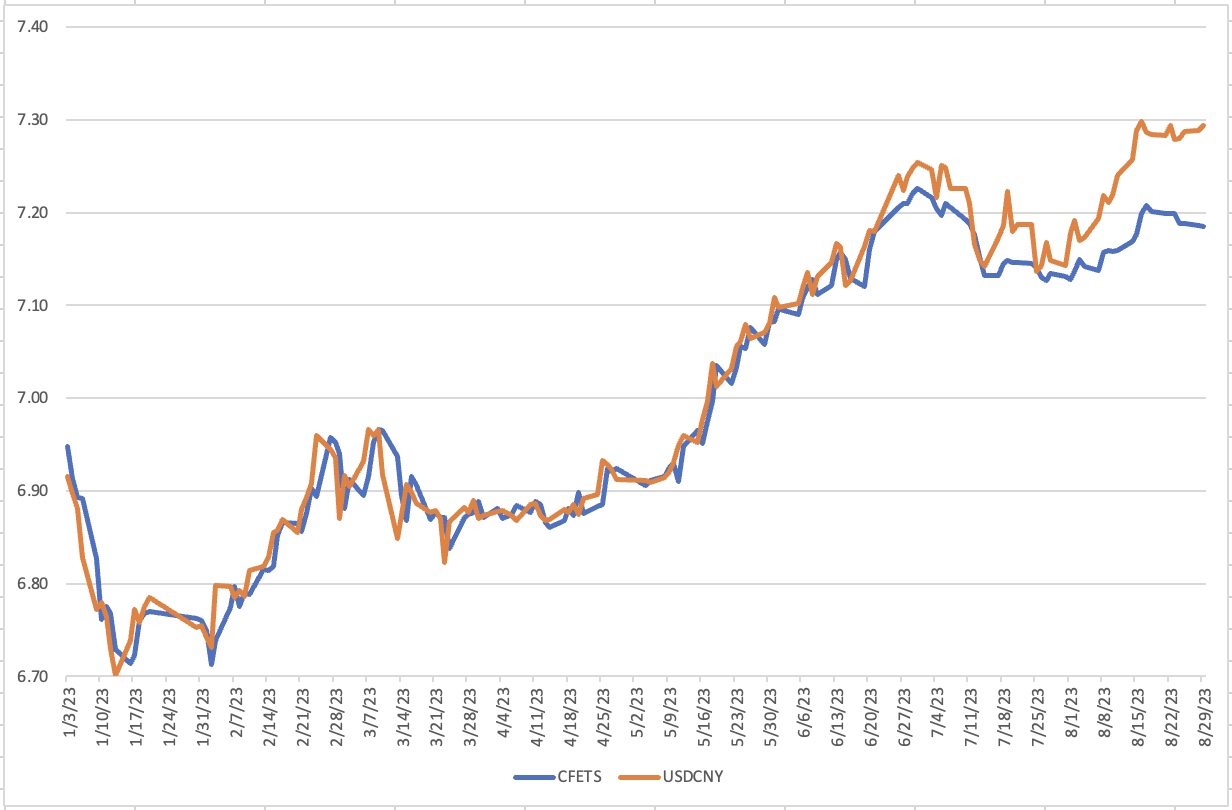
For yet another day, China is offering the biggest market stories.  In no particular order we have seen the following overnight; China Evergrande filed for Chapter 15 bankruptcy, a process by which foreign entities can access the US bankruptcy court system, regarding $19 billion of their offshore debt; the PBOC set their CFETS fixing more than 1000 pips lower than market expectations, the largest gap since the process began in 2018, in their effort to arrest the yuan’s consistent decline; and Chinese police visited the homes of the protesters who were complaining about Zhongzhi’s missed payments (I wrote about these Monday in Risks Were Inbred).  And this doesn’t include the fact that Country Garden, the largest property developer in China is losing money quite rapidly and may also be on the brink of bankruptcy.  It seems the Chinese property bubble is deflating.

Ultimately, there appear to be two main impacts of the gathering storm in China, market participants are increasingly leery of taking on risk in general, and the PBOC’s efforts to stem the decline of the yuan means they must sell their holdings of Treasuries to generate the dollars to deliver into the FX market thus adding downward pressure to the bond market.  Of course, one of the typical outcomes of a risk-off attitude is that bond markets rally as investors exit equities and run to bonds.  This stands at odds to the recent bond market behavior, although it is quite evident this morning.  In fact, after touching yields above 4.30% in the 10yr Treasury yesterday, this morning we have seen a half-point rally with yields declining about 5bps in the US.  In Europe, the yield declines have been even greater, mostly around -10bps, so this is a real reprieve for bond markets everywhere.

The key question here is whether we have seen the worst, or if other potential selling catalysts will appear.  Consider for a moment the fact that between China and Japan, they represent >26% of foreign owned US Treasury debt, and that both of these nations are dealing with rapidly weakening currencies.  Not only that, but both have demonstrated they are quite willing to intervene in FX markets to arrest those declines, and as mentioned above, that typically requires selling Treasuries.  It’s a self-reinforcing cycle as higher yields beget currency sales which beget Treasury sales to intervene, which results in higher yields starting the cycle all over.  

With this in mind, we need to consider, what can break the cycle?  Well, if the Fed were to turn dovish and indicate they agreed with the futures markets that rate cuts are coming early next year, I suspect the dollar would fall against most currencies, especially these two, and the cycle would break.  Alternatively, China could step up and guarantee the debt of Countrywide and Evergrande thus removing the investor risk and reduce pressure dramatically.  Finally, I suppose the Fed could make a deal with the BOJ and PBOC and directly absorb their bond sales, so they never hit the market while restarting QE.  That, too, would likely end the cycle.  It is possible there are other ways to break the cycle, but I doubt we will see any of these occurring anytime soon and so the cycle will have to wear out naturally.  That will occur when either or both of the currencies decline far enough so the market believes the trade has ended and unwinds their short positions.  In other words, none of this has changed my view that 7.50 is on the cards for USDCNY as the year progresses, very possibly with 10yr yields getting to 4.5% or more.  And don’t be surprised if we see another move to 150.00 in USDJPY.

But, away from the China connection, things are very much in the summer doldrums.  Equity markets have been treading fearfully and continue to do so this morning.  However, while we have seen several days of declines, there has been no panic selling of note.  So, yesterday’s US weakness was followed by selling throughout Asia and this morning in Europe with most markets down about -1.0%.  US futures, too, are softer, down about -0.5% at this hour (8:00).

Oil prices (-0.85%) which stabilized yesterday, are back under a bit of pressure on the overall negative risk sentiment as they continue to trade either side of $80/bbl.  Metals prices, meanwhile, are mixed with precious metals finding a bit of support while base metals suffer today.  The most interesting story here I saw today was that CODELCO, the world’s largest copper miner in Chile, may be going bankrupt as previous projects didn’t pan out.  That strikes me as a very large potential problem, but one for the future.  

Finally, the dollar is mixed this morning.  It had been softer overall in the overnight session, but as risk is getting marked down, the dollar is gaining strength.  The biggest mover has been PHP (+1.1%) which rallied after the central bank indicated they were going to put a floor under the currency and adjust rates accordingly.  After that, the EMG bloc has not done very much, +/- 0.25% type activity.  However, just recently, G10 currencies started to slide with NOK (-0.8%) the laggard as oil slides, but the entire bloc now coming under pressure.  This is all about risk off.  

There is no US data today nor are there any Fed speakers.  As such, the dollar will take its cues from the equity markets, and the bond market to some extent.  Right now, equity weakness is driving the risk attitude and that means the dollar is likely to remain bid into the weekend.  Next week brings the Fed’s Jackson Hole meeting where everybody will be looking for any policy hints by Chairman Powell on Friday morning.  But for now, the dollar is on top of the mountain.

Good luck and good weekend

Adf

A Raw Deal

The Minutes according to Jay
Explained more rate hikes are in play
At least that’s the spin
From media kin
But could that lead us all astray?

Yesterday’s key news was the release of the FOMC Minutes.  The market read, at least the headline read, was that they were hawkish which played a key role in the equity market decline in the afternoon, as well as the bond market decline leading to the highest 10yr yields since 2008.  Below is what I believe is the key paragraph from the Minutes with my emphasis.

“With inflation still well above the Committee’s longer-run goal and the labor market remaining tight, most participants continued to see significant upside risks to inflation, which could require further tightening of monetary policy. Some participants commented that even though economic activity had been resilient and the labor market had remained strong, there continued to be downside risks to economic activity and upside risks to the unemployment rate; these included the possibility that the macroeconomic effects of the tightening in financial conditions since the beginning of last year could prove more substantial than anticipated. A number of participants judged that, with the stance of monetary policy in restrictive territory, risks to the achievement of the Committee’s goals had become more two sided, and it was important that the Committee’s decisions balance the risk of an inadvertent overtightening of policy against the cost of an insufficient tightening.” 

It strikes me that based on the fact we have already heard from two FOMC voting members, Harker and Williams, that rate cuts are on their mind for 2024, and the lines I have highlighted above, the once unanimous view of a hawkish Fed is beginning to fall apart.  Now, if the data continues to outperform expectations like it has recently (consider the Retail Sales data from Tuesday) I expect the FOMC to maintain their hawkishness.  The Atlanta Fed’s GDPNow forecast has just risen to 5.75%, far above trend growth and certainly no implication for the end of tightening.  But remember, that is a volatile series, and we are a long way from the end of Q3.  Ultimately, I suspect that a growing number of FOMC members are starting to get queasy over the higher for longer mantra given the equity market’s recent shudders.  We shall see.

The Chinese are starting to feel
That Xi’s given them a raw deal
The yuan keeps on falling
While growth there is stalling
And values of homes are unreal

The PBOC was pretty vocal last night as they explained all the things they are going to do to manage a clearly deteriorating situation in China.  Here are some of the comments they released:

PBOC: TO MAKE CREDIT GROWTH MORE STABLE, SUSTAINABLE

PBOC: TO USE VARIOUS TOOLS TO KEEP REASONABLY AMPLE LIQUIDITY

PBOC: TO RESOLUTELY PREVENT OVER-ADJUSTMENT IN EXCHANGE RATE

PBOC: TO OPTIMIZE PROPERTY POLICIES AT APPROPRIATE TIME

PBOC: CHINA IS NOT IN DEFLATION RIGHT NOW

PBOC: LOCAL FISCAL BALANCE PRESSURE INCREASING

PBOC: HAS EXPERIENCES, TOOLS TO SAFGUARD STABLE FOREX MARKET

Which was followed by the following headline, CHINA TOLD STATE BANKS TO ESCALATE YUAN INTERVENTION THIS WEEK.

Add it all up and the Chinese are getting increasingly worried.  There is a great chart in Bloomberg today that shows the change in house prices across China, which puts paid to the official narrative that prices have fallen just 2.4% from the August 2021 highs.  They have clearly fallen a lot more as evidenced by this chart and the comments above.

In the end, the Chinese have a lot of work to do to keep their economy going.  While they remain concerned over the weakening CNY, it is clearly one of the best relief valves they have, and it will slowly weaken further.  Money is leaving the country.

An attitude change
Is becoming apparent
No JGBs please!

And finally last night the BOJ auctioned off some 20yr JGBs and the auction results were awful.  The tail was the widest, at nearly 8bps, since 1987, while the spread between 10yr and 20yr bonds widened by nearly 5bps.  It seems that demand was not nearly as robust as had been expected.  Given that nominal yields in the 20yr are 1.35% and CPI is 3.2% core, it is not that surprising.  Bonds everywhere are losing their luster, at least longer duration bonds, and I see no reason for that trend to end until economic activity is clearly declining.  China’s woes have not yet bled to either the US or Japan, while inflation remains sticky.  Today, globally yields are higher by between 4bps and 6bps.  This process still has more to go in my estimation.

Which brings us to the rest of the overnight session, where after another weak equity performance in the US, we saw Japan and non-China Asia soften, although Chinese markets held in on the back of the PBOC comments and promises of more support for the economy there.  European bourses are somewhat softer this morning but nothing dramatic and at this hour (7:30) US futures are higher by about 0.25% across the board.

Oil prices (+0.9%) have rebounded and after a brief foray below $80/bbl have recaptured that key level.  Metals prices are also firmer this morning across the board as both base and precious varieties see demand.  This seems largely in line with the fact the dollar is under modest pressure this morning.

And the dollar is under modest pressure this morning, at least vs. the G10, where every currency is firmer, but the moves are very small.  NOK (+0.4%) is the leader on the back of the oil move, but everything else is higher by between 0.1% and 0.25%.  In the emerging markets, the picture is a bit more mixed, with some gainers (ZAR +0.45%, HUF +0.35%) and some laggards (MYR -0.55%, PHP -0.5%) with both those currencies feeling pressure from concerns their respective central banks will not maintain the inflation fight.

On the data front, we see Initial (exp 240K) and Continuing (1700K) Claims as well as Philly Fed (-10.4) and Leading Indicators (-0.4%).  The data continues to have both highs and lows with yesterday’s IP jumping 1.0%, much better than expected, but the Empire Mfg data on Tuesday a very weak -19.  There are no Fed speakers today so I expect much will depend on whether or not dip buyers emerge in the equity markets.  It feels like we are teetering on the edge of a bigger risk-off move with another 10% down in equities entirely possible.  In that event, I do like the dollar to show resolve.

Good luck

Adf

Despite Cash

In China the stock market sank
Despite cash from its central bank
But elsewhere it seems
The narrative deems
Investors, the Kool-Aid, have drank

So, it can be no surprise that after a one and a half week hiatus, the Chinese equity markets sold off dramatically (Shanghai -7.8%) when they reopened last night. After all, equity markets elsewhere in the world had all been under pressure for the entire time as the novel coronavirus spread seemed to accelerate. Of course, since Chinese markets closed for the Lunar New Year holiday, major global markets in the west had fallen only between 3.5% and 4.0%. But given China is the country whose economy will be most impacted, the ratio doesn’t seem wrong.

What we learned over the weekend, though, is that the acceleration has not yet begun to slow down. The latest data shows over 17,000 infected and over 300 deaths are now attributable to this illness. Most epidemiological models indicate that we have not reached the peak, and that it would not be surprising to see upwards of a quarter of a million cases within the next month or two. Remember too, this assumes that the information coming from China is accurate, which given the global reaction to the situation, may be a big ask. After all, I’m pretty sure President Xi Jinping does not want to be remembered as the leader of China when it unleashed a global pandemic. You can be sure that there will be a lot of finger-pointing in China for the rest of 2020, as some heads will need to roll in order to placate the masses, or at least to placate Xi.

But in what has been a classic case of ‘sell the rumor, buy the news’, equity markets in the rest of the world seem to have gotten over their collective fears as we see modest strength throughout Europe (DAX +0.2%, CAC +0.2% FTSE +0.4%) and US futures are all pointing higher as well. So at this point in time, it appears that the market’s modest correction last week is seen as sufficient to adjust for what will certainly be weaker growth globally, at least in Q1 2020. Something tells me that there is further repricing to be seen, but for now, the default belief is that the Fed and other central banks will do “whatever it takes” as Signor Draghi once said, to prevent an equity market collapse. And that means that selling risk would be a mistake.

With that as prelude, let’s turn our attention to what is happening away from the virus. The biggest FX mover overnight has been the pound, which has fallen 1.1% after tough talk from both PM Boris Johnson and EU Brexit negotiator Michel Barnier. The market’s concern seems to be that there will be no agreement reached and thus come December, we will have a Brexit redux. I am strongly in the camp that this is just posturing and that come June, when the decision for an extension must be made, it will be done under the guise of technical aspects, and that a deal will be reached. Neither side can afford to not reach a deal. In fact, one of the key discussion points in Europe this morning is the fact that the EU now has a €6 billion hole in its budget and there is nobody able to fill the gap.

On the data front, Eurozone Manufacturing PMI data was modestly better than forecast, with the bloc-wide number at 47.9, still contractionary, but Italy, France and Germany all edging higher by a tenth or two. However, despite the modestly better data and the modest uptick in equity markets, the single currency is under some pressure this morning, down 0.25%, as the market adjusts its outlook for Fed activity. It remains pretty clear that the ECB is already doing everything it can, so the question becomes will the Fed ease more aggressively as we go forward, especially if we start to see weaker data on the back of the coronavirus situation. Friday’s market activity saw futures traders reprice their expectations for Fed rate cuts, with the first cut now priced for July and a second for December. And that rate change was what undermined the dollar during Friday’s session, as it suddenly appeared that the US would be stepping on the monetary accelerator. In fairness, if the quarantine in China continues through the end of Q1, a quick Fed rate cut seems pretty likely. We shall see how things evolve. However, this morning sees a bit less fear all over, and so less need for Fed action.

The other main mover in the G10 was NOK (-0.7%), which given how much oil prices have suffered, seems quite reasonable. There is a story that Chinese oil demand has fallen 20% since the outbreak, as the combination of factory closures and quarantines reducing vehicle traffic has taken its toll. In fact, OPEC is openly discussing a significant production cut to try to rebalance markets, although other than the Saudis, it seems unlikely other producers will join in. But away from those currencies, the G10 space is in observation mode.

In the emerging markets, it should be no surprise that CNY is much weaker, falling 1.1% on-shore (catching up to the offshore CNH) and trading below (dollar above) 7.00. Again, that seems pretty appropriate given the situation, and its future will depend on just how big a hit the economy there takes. Surprisingly, the big winner today is ZAR, which has rebounded 1.0% after Friday’s sharp decline which took the currency through the 15.0 level for the first time since October. In truth, this feels more like a simple reaction to Friday’s movement than to something new. If anything, this morning’s PMI data from South Africa was much worse than expected at 45.2, which would have seemingly undermined the currency, not bolstered it.

On the data front, this week will be quite active as we see the latest payroll data on Friday, and a significant amount of new data between now and then.

Today ISM Manufacturing 48.5
  ISM Prices Paid 51.5
  Construction Spending 0.5%
Tuesday Factory Orders 1.2%
Wednesday ADP Employment 158K
  Trade Balance -$48.2B
  ISM Non-Manufacturing 55.1
Thursday Initial Claims 215K
  Unit Labor Costs 1.2%
  Nonfarm Productivity 1.6%
Friday Nonfarm Payrolls 160K
  Private Payrolls 150K
  Manufacturing Payrolls -4K
  Unemployment Rate 3.5%
  Average Hourly Earnings 0.3% (3.0% Y/Y)
  Average Weekly Hours 34.3
  Participation Rate 63.2%
  Consumer Credit $15.0B

Source: Bloomberg

Obviously, all eyes will be on the payrolls on Friday, although the ISM data will garner a great deal of attention as well. Last Friday’s core PCE data was right on the screws, so the Friday rate movement was all about coronavirus. With the FOMC meeting behind us, we get back to a number of Fed speakers, although this week only brings four. Something tells me there will be a lot of discussion regarding how they will respond to scenarios regarding China and the virus.

In the end, short term price action is going to be all about the virus and its perceived impact on the global economy. Any indication that the outbreak is slowing down will result in an immediate risk grab-a-thon. If it gets worse, look for havens to get bid up quickly.

Good luck
Adf

Weakness They’d Block

The PBOC’s taken stock
Of how their maneuvers did rock
Most markets worldwide
Which helped them decide
More currency weakness they’d block

The Chinese renminbi remains the number one story and concern in all financial markets as investors and traders try to decipher the meaning of yesterday’s move to allow a much weaker currency, but more importantly how those actions will help drive future activities.

As always, there are two sides to every coin, in this case both figuratively and literally. From the perspective of China’s manufacturing and production capabilities it is very clear that a weaker renminbi is a benefit for its exporters. Chinese goods are that much cheaper this morning than they were Friday afternoon. This, of course, is why there is so much concern over any nation weakening their currency purposely in order to gain an advantage in trade. This is the ‘beggar thy neighbor’ policy that is decried in both textbooks and political circles. It is this idea that animates President Trump’s complaints about a too strong dollar hindering US manufacturing exports, and it is true, as far as it goes.

But it is not the whole story by a long shot. There are two potentially significant negative consequences to having a weaker currency, both of which can have significant political as well as economic impacts. The first, and most widely considered is rising inflation. Remember, if a nation’s currency weakens then all its imports are, relatively speaking, more expensive for its citizens. While small fluctuations in price may be absorbed by businesses, ultimately a steadily weakening currency will result in rising prices and increases in measured inflation. This is one of the key things that BOE Governor Carney worries about in the event of a hard Brexit, and the only reason he tries to make the case that interest rates may need to rise after Brexit. (p.s., they won’t!)

However, the other issue is generally less considered but often far more destructive to a nation. This is the problem of repayment of foreign currency debt. Remember, the US capital markets are far and away the largest, deepest and most liquid in the world, and thus companies and countries around the world all raise funding in USD. Even though US rates are high relative to the rest of the G10, that available liquidity is something that is not replicable anywhere else in the world and offers real value for borrowers. And of course, compared to many emerging markets, US rates are lower to begin with, making borrowing in dollars that much more attractive. But when another country’s currency weakens, that puts additional pressure on all the businesses that have borrowed in USD to fund themselves (and the country itself if it has borrowed in USD).

For example, according to the BIS, Chinese companies had outstanding USD debt totaling more than $1 trillion as of the end of 2018, and that number has only grown. As the renminbi weakens, that means it takes that much more local currency to repay those dollars. China has already seen a significant uptick in local bankruptcies this year, with CNY bond defaults totaling nearly $6 billion equivalent and the pace increasing. And that is in the local currency. When it comes to repaying USD debt, a weaker CNY will just exacerbate the situation. The PBOC is well aware of this problem. In fact, this issue is what will prevent the PBOC from allowing the renminbi to simply fall and find a new market clearing price. Instead, they will continue to carefully manage any further devaluation to the best of their ability. The problem they have is that despite their seemingly tight control of the market, they have created an offshore version, the quickly growing CNH market, which is far more costly to manage. In other words, there is a real opportunity for leakage of funds from China and an uncontrolled decline in the currency, or at least a much larger decline than planned. We are only beginning to see the impact of this move by the PBOC and do not be surprise if things get more volatile going forward.

But this morning, the PBOC remains in control. They fixed the onshore CNY at 6.9683, stronger than expected and in the FX market CNY has regained about 0.3% of yesterday’s losses. This stabilization has allowed a respite in yesterday’s panic and the result was that Asian equity markets rebounded in the afternoon sessions, still closing lower but well off session lows. And in Europe, the main markets are all marginally higher as I type. It should be no surprise that US futures are pointing to a modest uptick on the opening as well.

In the bond markets, Treasury prices have fallen slightly, with yields backing up 2bps. The same movement has been seen in Japan, with JGB’s 2bps higher, but actually, in Germany, yields continue to decline, down a further 3bps to yet another new record low of -0.54% as German data continues to exhibit weakness implying the Eurozone is going to fall into a recession sooner rather than later.

Finally, in the rest of the FX market, we are seeing a modest reversal of some of yesterday’s significant moves. For example, USDMXN is softer by 0.2% this morning after the peso fell nearly 2.0% yesterday. We are seeing similar activity in USDBRL, and USDKRW. These examples are just that, indications that an uncontrolled collapse is not in the cards, but that this process has not yet played itself out. In the G10 space, the RBA left rates on hold at 1.00% last night, as universally expected, and Aussie has rallied 0.4% this morning. Interestingly, one of the reasons they felt able to pause was the fact that the AUD had fallen more than 3% in the past month, easing financial conditions slightly and helping in their quest to push inflation back to their target. The other reversal this morning has been USDJPY which is higher by 0.4% after having traded to its lowest level (strongest JPY) yesterday since March 2018. As yen remains a key haven asset, it remains an excellent proxy for risk appetite, which today is recovering.

There were actually a few Fed speakers yesterday with both SF President Daly and Governor Brainerd expressing a wait and see attitude as to the impact of the escalation of trade tensions, although a clear bias in both cases to cut rates. Meanwhile, the futures market is pricing in a 100% chance of a 25bp cut in September and a 40% chance of a 50bp cut. It seems like the Fed has a lot of work to do in order to clarify their message.

With no data of note today, the FX market is likely to continue to consolidate yesterday’s moves, and awaits comments from James Bullard, St Louis Fed President and noted dove. In the end, my sense is that the Fed has lost control of the situation and that we are going to see more rate cuts than they had anticipated going forward. The question is more the timing than the actuality. In the meantime, the dollar is likely to be dichotomous, continuing to rise vs. the EMG bloc, but faring less well vs. much of the G10.

Good luck
Adf

So Distorted

Said Draghi, if things get much worse
Then more money, I will disburse
And negative rates
Which everyone hates
Will never go into reverse!

This morning, the Germans reported
That IP there’s lately been thwarted
Now markets are waiting
For payrolls, debating
Why everything seems so distorted

India. Malaysia. New Zealand. Philippines. Australia. India (again). Federal Reserve (?). ECB (?).

These are the major nations that have cut policy rates in the past two months, as well as, of course, the current forecasts for the two biggest central banks. Tuesday and Wednesday we heard from a number of Fed speakers, notably Chairman Powell, that if the economy starts to weaken, a rate cut is available and the Fed won’t hesitate to act. At this point, the futures market has a 25% probability priced in for them to cut rates in two weeks’ time, with virtual certainty they will cut by the late July meeting.

Then yesterday, Signor Draghi guided us further out the calendar indicating that interest rates in the ECB will not change until at least the middle of 2020. Remember, when this forward guidance started it talked about “through the summer” of 2019, then was extended to the end of 2019, and now it has been pushed a further six months forward. But of even more interest to the markets was that at his press conference, he mentioned how further rate cuts were discussed at the meeting as well as restarting QE. Meanwhile, the newest batch of TLTRO’s will be available at rates from -0.3% to 0.10%, slightly lower than had previously been expected, but certainly within the range anticipated. And yet, despite this seeming dovishness, the market had been looking for even more. In the end, the euro rallied yesterday, and has essentially maintained its recent gains despite Draghi’s best efforts. After all, when comparing the policy room available to the Fed and the ECB, the Fed has the ability to be far more accommodative in the near term, and markets seem to be responding to that. In the wake of the ECB meeting, the euro rallied a solid 0.5%, and has only ceded 0.1% of that since. But despite all the angst, the euro has not even gained 1.0% this week, although with the payroll report due shortly, that is certainly subject to change.

Which takes us to the payroll report. Wednesday’s ADP data was terrible, just 27K although the median forecast was for 180K, which has a number of analysts quite nervous.

Nonfarm Payrolls 185K
Private Payrolls 175K
Manufacturing Payrolls 5K
Unemployment Rate 3.6%
Participation Rate 62.9%
Average Hourly Earnings 0.3% (3.2% Y/Y)
Average Weekly Hours 34.5

Given the way this market is behaving, if NFP follows ADP, look for the dollar to fall sharply along with a big bond market rally, and arguably a stock market rally as well. This will all be based on the idea that the Fed will be forced to cut rates at the June meeting, something which they are unwilling to admit at this point. Interestingly, a strong print could well see stocks fall on the idea that the Fed will not cut rates further, at least in the near future, but it should help the dollar nicely.

Before I leave for the weekend, there are two other notable moves in the FX markets, CNY and ZAR. In China, an interview with PBoC Governor Yi Gang indicated that they have significant room to ease policy further if necessary, and that there is no red line when it comes to USDCNY trading through 7.00. Those comments were enough to weaken the renminbi by 0.3%, above 6.95, and back to its weakest level since November. Confirmation that 7.00 is not seen as a crucial level implies that we are going to see a weaker CNY going forward.

As to ZAR, it has fallen through 15.00 to the dollar, down 0.5% on the day and 3.4% on the week, as concerns grow over South Africa’s ability to manage their way through the current economic slump. Two key national companies, Eskom, the electric utility, and South African Airways are both struggling to stay afloat, with Eskom so large, the government probably can’t rescue them even if they want to. Slowing global growth is just adding fuel to the fire, and it appears there is further room for the rand to decline.

In sum, the global economic outlook continues to weaken (as evidenced by today’s German IP print at -1.9% and the Bundesbank’s reduction in GDP forecast for 2019 to just 0.6%) and so easier monetary policy appears the default projection. For now, that translates into a weaker dollar (more room to move than other countries) and stronger stocks (because, well lower rates are always good, regardless of the reason), while Treasuries and Bunds should continue to see significant inflows driving yields there lower.

Good luck and good weekend
Adf