
Goldilocks Dream

It seems many thought the word ‘could’
Was feeble when posed against ‘would’
The fact Chairman Jay
Had phrased things that way
Last month, for the bulls, is all good

And so, the new narrative theme
Is Jay is convincing his team
No more hikes are needed
And they have succeeded
In reaching the Goldilocks dream

The following quote from a weekend WSJ article by Fed whisperer Nick Timiraos is almost laughable in my mind.  

            This is apparent from how Fed Chair Jerome Powell recently described the risk that firmer-than-expected economic activity would slow recent progress on inflation. Last month, he twice used the word “could” instead of the more muscular “would” to describe whether the Fed would tighten again.Evidence of stronger growth “could put further progress at risk and could warrant further tightening of monetary policy,” he said in Jackson Hole, Wyo.

Talk about parsing language to the nth degree!  I bolded the line that I found the most ridiculous, but as we all know, my view does not drive the markets nor policy.  However, as I had written last week, we have definitely seen a shift amongst some of the FOMC members with respect to the idea of another rate hike this year.  Timiraos is widely believed to have the inside track to Chairman Powell, and now that the FOMC is in their quiet period ahead of the September 20th meeting, this will be the mode of communication.  

I guess the big risk of going all in on the Fed is done is we are still awaiting CPI Wednesday morning and with energy prices continuing to climb, I fear the opportunity for a high surprise is very real.  Literally every story that is written in the mainstream media these days tries to talk up the prospects of the economy and, correspondingly, for further equity market gains.  To me, there is a lot of whistling past the graveyard here, but so far, equities have held in despite some weaker data.  The one thing I would highlight is the market feels quite complacent with implied volatility across numerous markets, stocks, bonds, commodities and FX, all quite low.  Hedge protection is cheap here, if you need to hedge something, don’t wait for the move.

Ueda explained
We may soon understand if
Inflation is back

If we judge that Japan can achieve its inflation target even after ending negative rates, we’ll do so,” said Ueda.  This was the key sentence in a weekend interview published last night.  The market response was immediate with the yen jumping more than 1% in the early hours of Asian trading before ceding a large portion of those gains when Europe walked in the door.  However, regardless of today’s price action, there is a longer-term signal here that is important to understand.  It has become clear that the BOJ is becoming somewhat uncomfortable with the speed of the yen’s decline.  Prior to last night’s session, the yen had fallen 7.75% from July’s levels, which is a pretty big move for less than 2 months.  There is no secret to why the yen continues to decline, the vast policy differences between the US and Japan are sufficient reason.  While Ueda-san made no promises, this was very clearly a signal that a change is coming soon.  In the near-term, hedgers need to be very careful and those who are hedging JPY assets or revenues should really consider buying JPY puts outright or via collars as there is every reason to believe that further yen strength is coming by the end of the year.

Meanwhile, on the western edge of the Yellow Sea, the PBOC was quite vocal last night as well.  On the back of Chinese monetary data that showed a larger rebound than forecast in New Loan data as well as Aggregate Financing data, the PBOC issued the following statement, “Participants of the foreign exchange market should voluntarily maintain a stable market.  They should resolutely avoid behaviors that disturb market orders such as conducting speculative trades.”  That is very clear language that the PBOC is unhappy with the recent CNY performance.  In addition, the PBOC issued new regulations regarding large purchases of dollars telling banks that any corporate client that wants to purchase more than $50 million will need to get approval to do so, and that approval will take quite some time to be forthcoming.

It should be no surprise that the renminbi is stronger this morning, having rallied 0.65% and thus closing the gap with the CFETS fix for the first time in months.  Of course, given the double whammy of Japanese and Chinese policy implications, it should be no surprise that the dollar is softer overall.  Especially when considering the WSJ article explaining that the Fed may be finished hiking rates.  So, we have seen the dollar fall against all its counterparts in the G10 and most in the EMG blocs.  Aside from the yen (+0.65%), we have seen the most strength in AUD (+0.8%) which has benefitted from the overall Chinese story, both the currency issues and the better data, as well as the rise in commodity prices.  Kiwi (+0.55%) and SEK (+0.45%) are next on the list as there is broad-based dollar weakness today after an eight-week run higher.

In the emerging markets, ZAR (+1.1%) is actually the best performer on the commodity story as well as the general dollar weakness, but after that and CNY, HUF (+0.6%) is the only other currency in the bloc with substantial gains.  The story here is what appears to be a shift from zloty to forint as the market continues to punish PLN (-0.35%) after the surprisingly large rate cut last week by the central bank there.  Net, however, the dollar is clearly under pressure this morning.

If we turn to other markets, though, things don’t seem to make as much sense.  For instance, oil prices (-0.4%) are a bit softer while metals prices (AU +0.4%, CU +1.7%, AL +1.0%) are all firmer.  Now, the metals seem to be behaving well on the back of the dollar’s weakness, but oil’s decline is not consistent with that view.

In the equity markets, last night saw a mixed picture in Asia with the Nikkei (-0.4%) and Hang Seng (-0.6%) both under pressure while the CSI 300 (+0.75%) and ASX 200 (+0.5%) both responded well to the news.  For the Nikkei, the combination of prospects of higher rates and a stronger yen are both negative for Japanese stocks, while much of the rest of APAC benefitted from the Chinese story.  In Europe, the bourses are all green, averaging about +0.5% as investors continue to believe the ECB is done hiking rates with the market now pricing less than a 40% probability of a hike this week and not even one full hike priced into the curve over time.  US futures are also green as investors embrace the WSJ article’s hints that the Fed is done.

Finally, the big conundrum is the bond market, which is selling off across the board.  Or perhaps it is not such a conundrum.  If both the Fed and ECB are done hiking despite inflation continuing at a pace far above target, then the attractiveness of holding duration wanes dramatically.  Add to that the gargantuan amount of debt yet to be issued and the fact that the biggest buyers of the past decades, China and Japan, seem to be backing away from the market, and it will require much higher yields for these issues to clear.  Of course, one could also look at this as a risk-on session with stocks higher and bonds getting sold along with the dollar, so perhaps that is today’s explanation.  Just beware the movement here.  10-Year Treasury yields (+3bps) are back to 4.30%, and if the story is no more Fed tightening thus higher inflation, that is unlikely to be a long-term positive for equities.  At least that’s what history has shown.

On the data front, the back half of the week brings the interesting stuff.

TuesdayNFIB Small Biz Optimism91.5
WednesdayCPI0.6% (3.6% Y/Y)
 -ex food & energy0.2% (4.3% Y/Y)
ThursdayECB Rate Decision3.75% (current 3.75%)
 Initial Claims227K
 Continuing Claims1695K
 Retail Sales0.1%
 -ex autos0.4%
 PPI0.4% (1.3% Y/Y)
 -ex food & energy0.2% (2.2% Y/Y)
FridayEmpire Manufacturing-10.0
 IP0.1%
 Capacity Utilization79.3%
 Michigan Sentiment69.2

Source: Bloomberg

As we are in the Fed quiet period, there will be no Fedspeak, so it is all about the data this week.  Beware a hot CPI print as that will pressure the narrative of the soft landing.  This poet’s view is no soft landing is coming, rather a much harder one is in our future, but at this point, probably not until early next year.  Until then, and despite today’s news cycle, I still think the dollar is best placed to rally not fall.

Good luck

Adf
Weakness is Fate

The punditry’s all of a piece
That growth in the future will cease
But ‘flation still reigns
And Jay’s been at pains
To force prices, soon, to decrease

There is a website, Seeking Alpha, that publishes a great deal of macroeconomic and market commentary on a daily basis.  Yesterday morning’s top headlines under the Economy section included the following list.

  1. Is Recent GDP Data Overestimating U.S. Growth?
  2. U.S. Stagflation Risks Rise as Service Sector Falters Alongside Manufacturing Downturn
  3. Global PMI Shows Recovery Fading Further in August as Developed World Output Falls
  4. The Unemployment Rate Just Signaled that a Recession May Occur Within the Next 6 Months
  5. German Industrial Production Goes from Bad to Worse
  6. The Economy is Not ‘Running Hot’
  7. U.S Labor Market Activity: Slowing, Not Weakening

The authors ranged from Investment firms like Neuberger Berman and ING to individuals with decent reputations and large numbers of followers (for whatever that is worth.)  My point is there is a lot of negativity in the analyst community regarding the near-term future of economic activity.  My question is, are people really concerned about the growth trajectory?  Or are they just trying to make the case that the Fed will consider cutting interest rates sooner rather than later in an effort to support the equity market?  

While I understand the negativity based on anecdotal evidence, the headline data continues to print at better than expected levels.  For instance, yesterday’s Initial and Continuing Claims data both fell sharply during the most recent week, indicating that the labor market remains quite robust.  It remains very difficult for me to see a case for the Fed to even consider cutting anytime soon.  Rather, the case for another rate hike seems to be growing, and if next week’s CPI print is at all hot, look for that to be the market discussion going forward.  

Of course, my opinions don’t sway markets.  The important voices are those of the Fed members themselves and yesterday, we heard from several of them that a pause is in the offing.  Based on the comments from John Williams (voter), Lorrie Logan (voter), Raphael Bostic (non-voter) and Austan Goolsbee (voter), it seems that the market pricing of < 7% probability of a hike on September 20th is appropriate.  However, the views of Fed actions in the ensuing meetings are beginning to diverge.  There are those (Logan, Bowman and Waller) who have been clear that further rate hikes past September may still be appropriate depending on the totality of the data.  Meanwhile, there are others who are quite ready to call the top and one (Harker) who is already calling for cuts in 2024.  In the end, though, Chairman Powell’s views remain the most important and the last we heard from him was that higher for longer remains the story and more hikes are possible.

The pressure’s been simply too great
For Xi’s central bank to dictate
The yuan shouldn’t sink
Which led them to blink
And now further weakness is fate

The PBOC cried uncle last night when they fixed the renminbi at its weakest level since early July as the pressures had simply grown too great to withstand.  The onshore yuan fell further and the spread between the fix and the spot rate there remains just below 2%.  The offshore market shows an even weaker CNY and looks like it will soon be trading more than 2% weaker.  As well, the CNY lows (dollar highs) seen in October 2022 are in jeopardy of being breeched quite soon.  Clearly, there is a steady flow of capital out of China at the current time and given the lackluster economic performance there along with the structural problems in the property market, it is hard to make a case that China is a good spot for investment right now.  And just think, this is all happening while the market belief is the Fed is finished raising rates.  What happens if we do see hotter inflation data and the Fed decides another hike is appropriate?  As I have maintained for quite a while, I expect the renminbi to continue to slide and a move to 7.50 or beyond to occur over the rest of 2023.  In fact, today I saw the first analyst say 8.00 is in the cards before this move is over.  Hedgers beware.

So, what comes next?  Well, on a day with no noteworthy economic data and no Fed speakers scheduled, with the FOMC set to enter their quiet period, market participants will be forced to look elsewhere for catalysts.  My take on the current zeitgeist is that the negativity seen in those headlines listed above is seeping into risk attitudes overall.  Not only that, but that there is nothing in the near-term that will serve to change that viewpoint.  We will need to see a very cool CPI print next Wednesday to get people excited and given the combination of base effects and oil’s recent price trajectory, that seems unlikely.  Anyway, let’s look at the overnight sessions results.

Equities continue to perform poorly overall as yesterday’s broad weakness in the US was followed by weakness in Asia across the board while European bourses are also all in the red.  In fairness, the European session, while uniform in direction, has not seen significant declines.  Rather, markets are down by -0.25% or so on average.  Alas, US futures are still under pressure at this hour (7:30), but here, too, the losses are modest so far.

Bond markets are not doing very much this morning as yields in the US and Europe are within 1 basis point of yesterday’s closing levels.  Yesterday we did see 10yr Treasury yields slide 4bps, but we remain at 4.25%, a level that is not indicative of expectations of rapidly declining inflation.  The odd thing about this is that if you look at inflation expectation metrics, they almost all are looking at inflation heading back to the 2% level within a year or two.  Something seems amiss here although exactly what is not clear.

Oil prices are rebounding this morning as the recent uptrend resumes.  If we continue to see better than expected US data and the soft landing or no landing thesis remains in play, it is hard to accept the idea that oil demand will decline very much.  Add to that the very clear efforts by OPEC+ to push prices higher and it seems there is further room to rise here.  But once again, the rest of the commodity space is telling a different story with base metals softer along with agricultural prices in general.  That is much more of a recession story than a growth one.  This is just another of the many conundra in markets these days.

Lastly, the dollar is softer this morning overall, although not dramatically so, at least not against its major counterparts.  The biggest gainer today is MXN (+0.7%) which is benefitting from one thing, the highest real yields available for investment at 5.5%, while overcoming another, comments from the opposition presidential candidate, Xochitl Galvez, that the peso is too strong and is hurting exports.   (There is a presidential election next year in Mexico and AMLO is prohibited from running as they have a one-term limit in place there.)  Regarding the peso, unless Banxico starts to cut rates aggressively, of which there is no sign, I expect it will continue to perform well.  As to the rest of the EMG bloc, there are more gainers than losers, but the movements have not been substantial.  In the G10, it is no surprise that NOK (+0.4%) is higher on the back of the rise in oil prices, and we have also seen NZD (+0.5%) rally, although that looks more like a trading rebound than a fundamental move.  Given the dollar’s relative strength over the past several sessions, it is no surprise to see it drift back at the end of the week.

There is no data of consequence on the docket and no Fed speakers.  This implies that the FX market will be looking for its catalysts elsewhere and that usually means the stock market.  If we continue to see weakness in equities, I suspect the dollar will regain a little ground, but in truth, ahead of next week’s key CPI data, I don’t anticipate very much activity at all today.

Good luck and good weekend

Adf

Singing the Blues

For Jay and his friends at the Fed
What they’ve overwhelmingly said
Is weakened employment
Will give them enjoyment
While helping inflation get dead

So, yesterday’s JOLTS data news
Which fell more than ‘conomists’ views
Was warmly received,
Though bears were aggrieved,
By bulls who’d been singing the blues

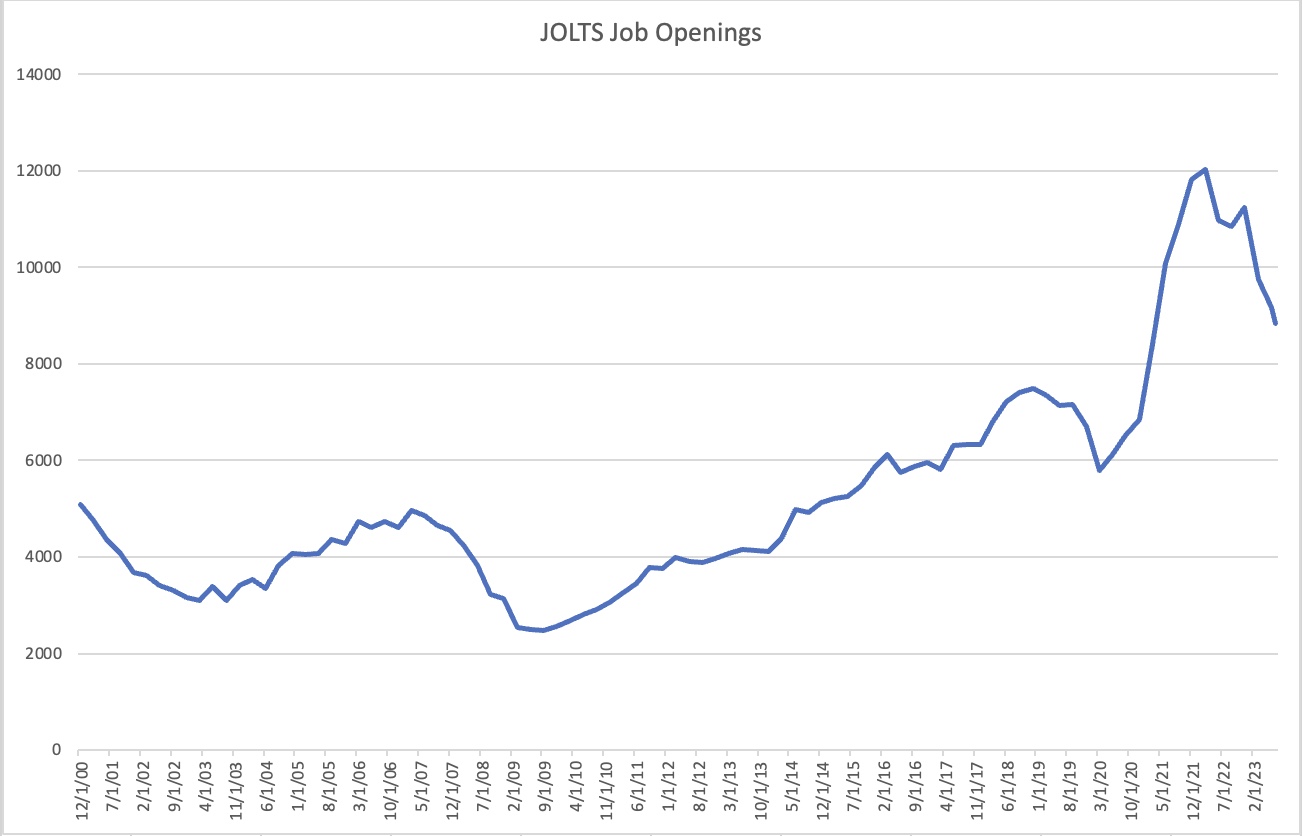
In fairness, Chairman Powell never actually said he would revel in a weaker employment picture, but he did discuss it regularly as a critical part of the Fed’s effort to drive inflation back to their 2% target.  And, in this case, more importantly, he had specifically mentioned the JOLTS data as a key indicator as an indication of the still very tight labor market.  With this in mind, it should be no surprise that when yesterday’s number came in much lower than expected, at ~8.8 million, down from a revised 9.2 million (the original print last month had been ~9.6 million), risk assets embraced the news as evidence that the Fed is, in fact, done raising rates.  Now, tomorrow and Friday’s data releases are still critical with both PCE and NFP on the calendar, so there is still plenty of opportunity for changes in opinions.  However, there is no question that the risk bulls have made up their minds and decided the Fed is done.

There is, however, a seeming inconsistency in this bullish thesis.  If the US economy is set to weaken, or perhaps is already weakening, with the jobs data starting to roll over, exactly what is there to be bullish about?  After all, China is clearly in the dumps, as is most of Europe.  While short-term interest rates are certainly likely to fall amid a recession, so too are earnings.  And if earnings are falling, explain to me again why one needs to be bullish on stocks.  I assume that the goldilocks scenario of the soft landing is the current driving force in markets, but that still remains a very low probability in my mind.  

History has shown that since they started compiling this particular labor market indicator in December 2000, peak-to-trough decline, has occurred leading directly to a recession.  This was true in 2001-02 (39% decline), 2008-09 (49% decline), 2020 (23% decline) as can be seen in the chart below, and now we are at the next sharp decline.  Thus far, the decline from the peak in March 2022 has been 27%, so there is ample room for it to fall further.  I merely suggest that if that is the case, things are probably not that great in the US economy, and therefore, are likely to have a negative impact on risk assets.  Keep that in mind as you consider potential future outcomes.

Source data: Bloomberg

The other data yesterday, Case Shiller House Prices and Consumer Confidence did little to enhance a bullish view.  Confidence fell sharply, by nearly 11 points and is not showing any trend higher.  Meanwhile, house prices fell less than expected, only about -1.2%, which has implications for the inflation picture.  After all, housing remains more than one-third of the CPI calculation, and if the widely assumed decline in house prices has ended, that doesn’t bode well for the idea inflation is going to fall further.  

Remember, Chairman Powell was quite clear that one data point would not be enough to change the Fed’s views, and while he is no doubt relieved that some of the job market pressure seems to be receding, he was also quite clear in his belief that rates needed to remain at least at current levels for quite some time to ensure success in their goal to reduce inflation.  The futures markets have reduced the probability of a September rate hike to 13% this morning, from nearly 25% before the data.  There is about a 50% chance of a hike at the November meeting.  It seems premature to determine that inflation is dead, and the Fed is getting set to cut soon, at least to my eyes.  Beware the hype.

As to the overnight session, after a strong US equity day, which saw the NASDAQ rally nearly 2% and the Dow nearly 1%, Asia had trouble following through. At least China had trouble, with virtually no movement there.  Australia rallied nicely, 1.2%, but otherwise, not much action in APAC.  In Europe this morning, there are far more losers than gainers, but the losses are on the order of -0.2%, so not substantial, but certainly not bullish.  The data out of Europe today showed inflation in Germany remains higher than desired, and confidence across the continent, whether consumer, economic or industrial, is sliding.  Not exactly bullish news.  As to US futures, they are ever so slightly softer this morning, down about -0.1% across the board.

In the bond market, it should be no surprise that bonds rallied and yields fell yesterday after the JOLTS data, with the 10yr yield falling 8bps.  However, this morning, it has bounced 3bps and European sovereign yields are higher by between 6bps and 7bps on the back of that higher than expected German inflation data.  The market is still pricing about a 50% probability of an ECB hike in September, but whether it happens in September or October, it is seen as the last one coming.

In the commodity space, oil (+0.5%) continues to hold its own, perhaps seeing support after OPEC member Gabon saw a coup yesterday, potentially reducing supply.  At the same time, we have seen several large drawdowns in inventories as well, so there seem to be some fundamentals at play.  Now, a recession is likely to dampen demand, but right now, the technicals seem to be winning out.  As to the metals markets, gold had a big rally yesterday on the back of declining real interest rates and is retaining those gains this morning.  The base metals are mixed this morning, but essentially unchanged over the past two sessions as the questions about growth vs. supply continue to be probed.

Finally, the dollar is modestly stronger this morning, but that is after a sharp decline yesterday.  With yields falling in the US it was no surprise to see the dollar under pressure.  With yields backing up, so is the dollar.  USDJPY is back above 146 again, having fallen below yesterday, but today’s movements are far more muted than yesterday’s.  As to the EMG bloc, the picture today is mixed with some gainers and some laggards, but aside from TRY and RUB, which are hyper volatile and illiquid, the gains and losses have been smaller.  One exception is ZAR (-0.5%), which fell after news the government ran a record budget deficit in July was released.

ADP Employment (exp 195K) headlines the data today, although we also see a revision of Q2 GDP (2.4%, unchanged) and the Advanced Goods Trade Balance (-$90.0B).  There are no Fed speakers on the calendar, so that ADP data will likely be the key for the day.  A weak print there will reinvigorate the Fed has finished debate, while a stronger than expected print may well see much of yesterday’s movement reversed.  With that in mind, remember that the past two months have seen very strong ADP numbers that were not matched by the NFP data, so this is likely to be taken with a little dash of salt.

We are clearly in a data dependent market right now as all eyes focus on this week’s news.  I need to see consistently weak data to alter my view that the Fed is going to step off the brakes, and it just has not yet appeared.  Until then, I still like the dollar.  

***Flash, ADP just released at 177K, with revision higher to last month’s number.  Initial move in equity futures is +0.2%, but there is a long time between now and the close.

Good luck

Adf

Small Beer

The market has made it quite clear
That over the course of next year
The interest rate Jay
Is willing to pay
On Fed funds will soon be small beer

The key to this view is the thought
Inflation will soon fall to naught
But if that is wrong
It will not be long
Ere stocks will be sold and not bought

As the market braces for today’s CPI data, investors and traders continue to home in on the view that the soft-landing scenario is the most likely.  While US equity markets sold off yesterday afternoon, futures this morning are higher across the board by about 0.5% and European bourses are also all higher.  In other words, fear is not in today’s lexicon as concerns over continuing gains in inflation quickly dissipate and the narrative focuses on said soft-landing.

A quick look at today’s data expectations shows the following according to Bloomberg:

Initial Claims230K
Continuing Claims1707K
CPI0.2% (3.3% Y/Y)
-ex food & energy0.2% (4.7% Y/Y)

I’m sure you all remember that last month’s CPI reading was 3.0%, which was widely touted as a sign the Fed has been successful in their efforts to slow price increases.  Of course, the reason the headline number fell so far was the base effect as in 2022, June’s monthly reading was +1.2% which drove the Y/Y number then to the cyclical high of 9.1%.  With that data point falling out of the mix, the comparison changed dramatically.  Here’s the thing, July 2022’s monthly print was 0.0%, so those same base effects are going to push the headline number higher. 

Now, if you annualize 0.2% it comes to a bit more than 2.4% inflation, so if the monthly number can maintain this level, the Fed will truly have achieved their goal.  Alas, oil (+15.8%) and gasoline (+11.2%) both rose sharply in the month of July and so that headline number seems likely to be higher.  The Cleveland Fed’s CPI Nowcast (similar to the Atlanta Fed’s GDP Nowcast) is pointing to a monthly CPI increase of 0.41%.  My suspicion is that we are going to see a hotter CPI number today and that is likely to be met with a little bit of concern, especially by risk assets that are counting on that soft-landing.

As long as the narrative continues to look for that soft-landing success, it opens up the risk of a significant repricing.  While Philly Fed president Harker was the first to talk about rate cuts next year, the futures market has been all-in on that view for quite a while.  A firm number today will bolster Powell’s ‘higher for longer’ narrative at the expense of those rosy views.  Be prepared for some market volatility today, especially in the bond market.

Speaking of the bond market, yesterday’s 10-year auction went pretty well as the clearing yield was (barely) below 4.00% at 3.999%.  The bid/cover ratio was a healthy 2.56, meaning there were bids for slightly more than $97 billion for the auction of $38 billion in new paper.  Today brings the final leg of the quarterly refunding with $23 billion of 30-year bonds to be auctioned.  At this hour (7:00) the 30yr yield is 4.17% with the 10yr yield at 4.00%.  A high CPI print could wind up costing the US government a bit more if yields move higher on the news, just another reason this CPI print will be so closely watched.  Meanwhile, European sovereigns are all softer this morning with yields edging higher by roughly 2.5 basis points across the board, and we saw higher yields across Asia as well, with JGBs rising 2bps, although still below the 0.6% level.  So far, Ueda-san has not had too much difficulty managing the yield there.

Turning back to the commodity markets, oil is little changed this morning, consolidating its recent gains, but certainly not showing any signs of reversing course.  Despite China’s lackluster economic performance, the supply situation continues to underpin oil prices.  Remarkably, despite all the focus on the need to reduce the use of fossil fuels, and the weaker than forecast Chinese economy, demand for oil continues to increase with the IEA raising its forecast for the next several years.  At the same time, oil companies are feeling only modest pressure to drill more, and instead are enjoying the fruits of their current production by repurchasing shares and paying large dividends to their shareholders.  In other words, it seems that supply is unlikely to ramp up to meet this increased demand and that can only lead to even higher oil prices over time.  $100/bbl seems quite realistic within the next 12 months, and that doesn’t assume any additional price shocks like we saw in the Russian invasion of Ukraine.  But while oil is on hold today, the metals markets are feeling a bit better with both precious and base metals rising nicely on the session.

Finally, the dollar is softer pretty much across the board this morning with AUD (+0.6%) the leading G10 gainer although virtually the entire bloc is higher by between 0.3% and 0.5%.  The exception to this is JPY, which is unchanged on the day.  The yen continues to chart its own course lately as uncertainty about the ultimate outcome in the JGB market and any further monetary policy changes has traders and investors treading fearfully.  It remains the favored funding currency given its still lowest rates in the world, but the prospect of that changing has many traders on constant edge.

As to the emerging markets, they too are seeing strength virtually across the board with HUF (+1.3%) and ZAR (+1.2%) the leaders as both are benefitting from their high nominal interest rate carry.  After that there is a long list of currencies that are firmer by between 0.25% and 0.5% and only one laggard, THB (-0.5%) which continues to suffer from political uncertainties over the ability to establish a government there after the recent election.

And that is really the story today.  We hear from three more Fed speakers; Daly, Bostic, and Harker, so it will be interesting to see if either of Daly or Bostic hint at rate cuts next year.  All three are scheduled to speak after the CPI release, which if firm is likely to quash any hopes for that.  My take is that a hot CPI number will help to reverse some of the dollar’s losses, but a soft number could easily see the dollar slide further.

Good luck

Adf

A Rate Hike Boycott

Said Yellen, the job market’s cooling
Not faltering, but it’s stopped fueling
Inflation, and so
You all need to know
More rainbows are coming, no fooling!

Meanwhile, from the EU, Herr Knot
Was strangely less hawkish than thought
Inflation’s plateaued
Which opens the road
To starting a rate hike boycott

As we await today’s US Retail Sales data, and far more importantly, next week’s FOMC and ECB meetings, it seems that there is a concerted effort to talk inflation down by both the US and European governments.  For instance, yesterday, Treasury Secretary Yellen was explaining how, “the intensity of hiring demands on the part of firms has subsided.  The labor market’s cooling without there being any real distress associated with it.”  Now, I have no doubt that Secretary Yellen would dearly love that to be the case, although her proof on the subject remains scant.  Perhaps she is correct and that is the situation but given her track record regarding forecasting economic activity (abysmal while at the Fed and in her current role), I remain skeptical.  Certainly, while last month’s NFP data was slightly softer than forecast, it did not speak to a significant change in the labor market situation.

She proceeded to add how inflation was clearly coming down, although was careful to warn against reading too much into one month’s numbers, kind of like she was doing.  One thing she was not discussing was how the ongoing surge in deficit spending by the government, which she was personally overseeing, was having any impact on inflation.  Alas, history shows that there is a strong link between large deficits and rising inflation.  Maybe this time is different, but I doubt it.

But as I said, there seems to be a concerted effort to start to talk down inflation, especially as the efforts to actually address it are increasingly politically painful.  The next example comes from the Eurozone, where Klaas Knot, Dutch central bank chief and number one hawk on the ECB Governing Council suddenly changed his tune regarding a rate hike in September.  It was just a month ago, in the wake of the ECB’s last rate hike, when Madame Lagarde essentially promised a July hike, that he was on the tape explaining that a September hike was also critical and certain.  But now, his tone has changed dramatically, with comments like “[it] looks like core inflation has plateaued,” and he’s “optimistic to see inflation hitting 2% in 2024.”  

Again, maybe that outlook is correct and inflation in the Eurozone is going to come crashing down (remember, it is currently 5.4% on a core basis, far above the 2% target), but this also seems unlikely.  For instance, this morning’s headline, FRANCE TO RASE REGULATED ELECTRCITY PRICES BY 10%, would seem to be working against the idea that inflation is going to fall sharply.  In fact, one of the key reasons inflation ‘only’ rose as high as it did in the Eurozone, peaking at 10.6% last year, was that virtually every government subsidized skyrocketing energy prices for their citizens much to their national fiscal detriment.  Now that energy prices have come off the boil, they are ending those subsidies and hence, prices are rising to reflect the current reality.  So, the inflation they prevented last year will simply bleed into the statistics this year.

Politically, what makes inflation so difficult for governments is the fact that regardless of how they try to spin the situation, the population sees rising prices in their everyday lives and are unlikely to believe the spin.  However, that will not stop governments from doing their best to change attitudes via words rather than deeds.  Of course, given the prevailing Keynesian view that there is a direct tradeoff between employment and inflation, that puts politicians in a very difficult spot.  No politician is going to encourage rising unemployment just to get inflation down hence the ongoing attempts to jawbone inflation lower.  Ultimately, nothing has changed my view that inflation, as measured by CPI or PCE, is going to find a base in the 3.5%-4% area and be extremely difficult to push past those levels absent a catastrophic event.  And I certainly don’t wish for that!

But let’s take a look at how markets are responding to the renewed attempts to talk inflation lower, rather than actually push it lower.  Certainly, yesterday’s US equity performance showed no concerns over mundane issues like inflation as all 3 major indices continued to rally to new highs for the year.  Alas, there is less joy elsewhere in the world as Chinese stocks suffered along with most of Asia, although the Nikkei did eke out a small gain.  In Europe this morning, while the screen is virtually all red, the movements have been infinitesimal, on the order of -0.1% across the board.  And US futures at this hour (7:45) are showing similarly sized tiny declines.

The real news is in the bond market, which has taken this new government push to heart, and we now see yields falling across the board, in some cases quite sharply.  Treasury yields are down -4.5bps, but that pales in comparison to European sovereigns, all of which are lower by at least 7bps with Italian yields tumbling 12.5bps.  This newfound ECB dovishness is clearly a welcome relief for European governments, French electricity prices be damned.

In the commodity space, the base metals continue to signal a recession is on its way as both copper and aluminum continue to slide, but oil seems to have found a base for now, and is still higher on the month.  As to gold, it should be no surprise that it is rallying this morning, pushing back above $1960/oz as the combination of lower yields and a lower dollar are both tail winds for the barbarous relic.

Turning to the dollar, excluding the Turkish lira, which has tumbled 2.5% in anticipation of another underwhelming monetary policy response this week when the central bank meets, the rest of the EMG bloc is firmer, led by THB (+1.2%) on the combination of a broadly weaker dollar and hopes that the political stalemate in the wake of the recent election there is soon to be solved with a new candidate coming forward.  But the strength is broad-based across all 3 regions.  In the G10, NZD (-0.7%) is the only real laggard as market participants position themselves for tonight’s CPI release there with growing concerns that the central bank is not doing enough to support the currency and economy.  Otherwise, the bloc is generally firmer, albeit not dramatically so.

On the data front, Retail Sales (exp 0.5%, 0.3% ex autos) leads the way followed by IP (0.0%) and Capacity Utilization (79.5%) at 9:15.  There are still no Fed speakers, so while a big miss in Retail Sales could have an impact, I continue to expect that the equity earnings schedule is going to be the driving force in markets until the Fed meets next week.  So far, the first sets of numbers have been positive, but there is a long way to go.  

For now, the dollar remains on its heels, and I suspect that is where it will stay until next Wednesday at least.

Good luck
Adf

Just a Dream

Inflation is clearly passé
As traders and markets display
Remarkable trust
The Fed will adjust
The path of rate hikes come what may

The upshot is there’s a new meme
A landing so soft it would seem
No jobs will be lost
And there is no cost
Alas I fear it’s just a dream

I’m not sure if you saw the announcement yesterday, but everything is beautiful!  Inflation is a thing of the past, the economy continues to tick over quite nicely with employment remaining robust and the idea of recession is just a figment of the permabears’ imagination.  At least that’s what it seems like based on market movements of late.

Yes, PPI printed lower than forecast, which after the somewhat softer CPI and the known base effects, was not hugely surprising.  Perhaps a bit more surprising was that the Claims data, both on an Initial and Continuing basis, printed lower than expected.  The implication here is that the labor market remains quite robust with those folks who have been laid off able to find new employment quite rapidly.  While there is still plenty of data pointing to a manufacturing recession (ISM, IP, Factory Orders), the Services situation remains far better with increased activity and rising wages still apparent.  So, perhaps the optimists have it nailed, and believe Chairman Powell has managed to create a soft landing, where inflation comes back to target without having to cause a recession.

However, it feels like it is still a little early to take that victory lap.  After all, the inflation data was literally one data point driven largely by base effects and regardless of your view, one data point does not a trend make.  Certainly, the equity market is all-in on the soft-landing scenario.  The Treasury market, at least since the CPI print on Wednesday has rallied dramatically (another 10bps yesterday) and is now 29bps lower over the past week.  In fact, the 2yr Treasury has rallied even further, with yields there falling by 35bps over the same period.  To say that the market has adjusted its views on the Fed’s future activities would be an understatement.   There is still a 91% probability priced into a 25bp rate hike this month, but there are no more hikes after that priced at this stage and the first cut is seen in either March or May next year, at least according to the Fed funds futures market.

And what of the dollar?  While it is bouncing a little today, that is clearly modest position adjustment amid profit-taking as it is sharply lower on the week against all its G10 counterparts and almost all its EMG brethren.  

There is, of course, one fly in the ointment, oil prices, and commodities in general.  One of the key features of markets over time is that they tend to be self-correcting.  The saying, the solution to high prices is high prices is trying to explain the idea that high prices result in additional supply coming to market (to take advantage of those high prices) which results in prices falling back to earlier, lower levels.  The same process occurs with low prices as well, where low prices inspire increased demand and reduced supply thus driving prices higher again.  

Well, oil is exhibit A for this process.  Since oil continues to be priced and traded largely in dollars, when the dollar is strong, non-dollar countries (basically everybody else) finds that oil is expensive and so demand wanes a bit resulting in softening oil prices.  However, when the dollar declines, as we have seen in the past week, that opens the door for oil, and most commodities which are priced in dollars, to rally sharply.  Of course, if you are the Fed and continue to try to dampen price pressures, the last thing you want is a weak dollar and high commodity prices as both lead directly to rising inflation.  In fact, one reason that US inflation did not reach the levels seen in Europe and the UK is that the dollar remained quite strong throughout this period thus reducing inflationary pressures.  But right now, that dynamic is reversing with the dollar under pressure and commodity prices rising.  That bodes ill for continued declines in CPI and PPI which is certainly not part of the new narrative.  

(As an aside, it is this very feature that drives the de-dollarization narrative as you can easily understand why China, who is the largest importer of oil in the world, would like to see the dollar dethroned so they can pay for their imports with their own currency (printed as necessary) rather than have to earn dollars elsewhere to pay for their oil and other commodity imports.)

At any rate, I feel it is very important for everyone to remember that it is never the case when all signals point in the same direction.  It is only the case that the market responds to a group of signals that reinforce their underlying view, happily ignoring the rest.  As another saying accurately makes clear, nothing matters until it matters.

Ok, as we head into the weekend with a week’s worth of euphoria behind us, what is today shaping up to be?  Well, equity markets are muddling about with most ever so slightly higher but some sliding after the previous two days’ strong rallies.  US futures are also lackluster at this hour (8:00) barely higher as traders prepare for another summer weekend.  

Bond markets, too, are quiet after a raucous week, with yields little changed on the day in the US and throughout Europe and in Japan.  One cannot be surprised by the market response to the CPI data and now that this new narrative of rainbows, unicorns and lollipops is making its way around to every corner of the market, there is no reason to think that much will change in the near term.  Arguably, even if inflation is beaten and is heading back to 2%, a big IF, there is precious little reason for 10-year yields to fall very far as they would currently be offering a 1.75% real yield, a very normal situation throughout history.  Although, there would certainly be cause to believe the 2yr is set to see yields decline further and the yield curve normalize.  But again, I believe it is very early to take that as gospel.

Commodity markets are following the same pattern here, consolidation after a week of strong rallies in all the major commodities so the question is, will those rallies continue next week?  Or have we reached the end.  This story is true of the dollar as well, which is intimately linked to the commodity story.

Will today’s Michigan Sentiment (exp 65.5) change any views?  I doubt it although if the reading is quite strong, and given the growing bullish zeitgeist, it could certainly pump risk assets further.  However, a soft reading seems unlikely to derail the current risk attitude at this point.  With the Fed commentary under wraps until the FOMC meeting, today is likely to be entirely equity focused.  To that end, the big banks have been reporting Q2 earnings this morning and so far, they have all beaten (dramatically reduced) forecasts.  I expect that is all that is needed for risk to retain its luster, so do not be surprised to see the dollar continue its recent slide and stocks and commodities finish higher on the day.

Good luck and good weekend
adf

More Woe

It wasn’t all that long ago
When everyone forecast more woe
As long as the Fed
Kept moving ahead
And, higher rates, still did bestow

But now that is all in the past
As CPI fell, at long last
Below current rates
So everyone waits
For Jay’s monetary recast

I am old enough to remember when the market was pricing in two more Fed funds rate hikes and an extended period of time at those higher interest rates as the default position.  After all, the Fed has been harping on about higher for longer quite a while and at their June meeting, they explicitly published their collective forecasts that showed a median expectation of an additional 50bps of tightening and then no real decline for at least a year.  That view, however, is so 24 hours old!  The new theme is…BUY STONKS!  This was a remarkably fast turn of opinions, even for markets that produce whiplash on a regular basis.

By now, you are certainly aware that the CPI data printed a bit lower than the median forecasts with the headline at 3.0% and the core at 4.8%.  These are the lowest levels since March 2021 and October 2021 respectively and are certainly encouraging news.  However, we all knew that the base effects were a key part of the puzzle as to why the year over year numbers fell so much.  But, in fairness to the bulls, the monthly increases were also quite low, 0.2% in both cases, and it remains to be seen if that monthly trend can continue.

As I suggested yesterday, the lower-than-expected readings led to an immediate explosion higher in risk appetite with equity markets in the US having a great day which was followed by strength throughout Asia and Europe this morning.  And Europe had a good day yesterday as well.  Meanwhile, US futures continue to bathe in the glow of declining inflation, rising further as I type (7:00am) with NASDAQ futures up more than 1.2% at this hour.  Risk is back, baby!

Perhaps a better indicator of the market’s renewed vigor is the bond market, where 10-year Treasury yields are lower today by a further 4.3bps and have fallen 25bps since Friday’s close.  All those fears that a 4.0% 10-year yield could lead to further economic breakage are now merely bad dreams, with no seeming basis in the new, current reality.  As to European sovereigns, they have fallen even further since yesterday, with declines on the order of 10bps nearly across the board on the continent and 7bps in the UK.  Granted, part of the European movement seems to be on the back of comments by uberdove Yannis Stournaras, the Greek central bank head and ECB council member, who explained this morning that they never promised a July rate hike and now that the data is softening, a pause may well be appropriate.  

As to yesterday’s Fed speakers, Barkin was first up and his comments, right at 8:30 when the CPI data was released, got lost in the news.  So, the fact that he said inflation remains too high and they still need to do more was completely ignored.  Governor Barr was entirely focused on bank capital plans, indicating that the Fed would look to tighten capital requirements going forward as the best way to improve bank solidity.  In other words, nobody cared what they said from a market’s perspective.

Overnight we saw some Chinese data that also spoke to slowing overall demand and economic activity, thus implying slowing inflationary pressures, as the Chinese trade data, while growing their surplus to $70.6B, exposed a much weaker export performance, with exports there falling -12.4% Y/Y.  That is a strong indication of slowing global growth, hence a view that also bodes well for future inflation declines.

Alas, there is one area that might have a detrimental impact on all this falling inflation euphoria, oil prices.  The black sticky stuff rallied again yesterday and is higher yet again this morning, albeit just by 0.3% right now, but has risen >4% in just the pat 3 days with WTI firmly above $75/bbl while Brent crude is now above >$80/bbl.  While I am no market technician, I do know that there is a huge amount of focus on the 200-day moving average and a potential break above that level which currently sits at $77.34/bbl.  If one looks at the ongoing production cuts by the Saudis as the short-term impetus and combines that with the structural shortage from the lack of drilling and exploration over the past decade due to ESG focused policies, it is easy to understand the bullish case.  One other thing that has not seemed to have received much press is that the Biden administration is apparently trying to refill the SPR to some extent, and so are a bid in the market as well.  

The one thing that we all know well is that higher oil prices tend to lead to higher gasoline prices which are a critical part of both inflation and inflation expectations.  This could well throw a spanner in the works for the collapsing inflation story, as well as the Fed is finished story.  It is certainly too early to draw that conclusion, but if WTI pushes above that moving average and to $80/bbl or more, just watch how quickly opinions shift.    

Ironically, despite concerns over slowing growth, both base and precious metals have been rallying as well, almost entirely on the back of a weaker dollar.  Now, it is a chicken and egg question here as to whether the weaker dollar is driving commodity (and stock) prices higher, or whether the rally in those markets is driving the dollar down, but whichever way the causality runs, that is the current price action.

Actually, it makes sense.  If the declining inflation story is taken at face value, and the market has removed further rate hikes by the Fed and is actually bringing the first rate cuts closer in time, then the dollar’s attractiveness as an asset is going to be reduced.  And that is exactly what has happened.  The buck is down against virtually all its counterparts, both G10 and EMG and the only thing that is likely to change that trajectory is data showing inflation is rebounding in the US and the Fed will be called on for more aggressive tightening.  Today’s PPI data seems highly unlikely to provide any information of that sort, so while the market continues to price in a strong likelihood of a 25bp rate hike in a few weeks, the strong belief is that will be the last.

Yesterday I posited that the one scenario that was not getting much love was that a recession was imminent, rather than either being delayed into 2024 or not even showing up.  But even the inflation data is somewhat indicative of reduced demand.  A little mentioned outcome regarding Consumer Credit on Monday showed growth of ‘just’ $7.24B, the lowest number since coming out of the pandemic in October 2020, and, perhaps, an indication that things are not as rosy as some would have us believe.  And while confirmation of weaker US economic activity is likely to weigh on the dollar and US yields, it is also likely to weigh on US equity prices, so do not forget that connection.

While I don’t believe today’s PPI data will be that impactful, keep an eye on the Claims data (exp 250K Initial, 1720K Continuing) as if those numbers keep edging higher, that too will play into the Fed’s thinking.  I have maintained for many months that employment is the key, not inflation per se.  Rising unemployment will lead to a quick reversal of Fed policy but will also be a harbinger of much weaker economic activity and just maybe that most anticipated recession in history will finally arrive.

Lastly, we have two more Fed speakers today, Daly and Waller, which are the last before the quiet period begins.  Given the sudden shift in narrative and the softer CPI data, it will be very interesting to hear if they are going to fight the new narrative or adjust their tone.  Daly is first at 11:10 this morning on CNBC, so all eyes will be there.

I would not fight this current trend for a lower dollar and frankly, with the euro back above 1.11 for the first time since March 2022, and the pound back above 1.30, the dollar bears are firmly in control.  If this dollar weakness persists for another 1%-2% I believe it could open up a much further decline, so consider what it takes to manage that kind of movement.  An additional 10% is quite easy to believe on that break.

Good luck
Adf

Worries Now Past

With debt default worries now past

And jobs data set for broadcast

Risk preference has grown

As folks want to own

The highest of flyers, and fast


Meanwhile, the idea that the Fed

Will raise rates this month is now dead

Inflation is sliding

And pundits are chiding

Those who think price gains are widespread


In what can only be surprising to those who traffic in fear porn, the Senate passed the debt ceiling bill, and it heads to President Biden’s desk today for his signature and enactment.  This outcome was always going to be the case, especially once the House passed its debt ceiling increase bill.  All the histrionics about the president’s unwillingness to negotiate were simply part of the theater that goes with the current form of politics.  However, there were enough people who bought into the drama and created hedges so that this outcome has had a market impact.  You may recall that there were fears of a US debt default and if that were to occur, equity markets would sell off sharply.  And that is likely very true, if the US were to default on its debt, that is what would happen.  However, as I wrote from the beginning, that was a highly unlikely outcome.  Nonetheless, yesterday did see a rally in equity markets in the US with the rest of the world following suit overnight.  Risk is back baby!


Meanwhile, we got further confirmation that the Fed is going to pause skip a rate hike this meeting and the Fed funds futures market has now fallen to a 25% probability of any movement.  One of the interesting things about this ongoing repricing is that the data is not showing any signs of a slowdown that would help reduce inflationary pressures.  For instance, yesterday’s ADP Employment data was a much stronger than expected 278K, beating forecasts by more than 100K, while Initial Claims data continue to slide from their recent peak in March.  In other words, as we await today’s NFP data, the latest data points show continued strength in the US labor market.  Helping that story was the employment sub index of the ISM report, which while the headline remains weak at 46.9, saw the employment index rise to 51.4.  In other words, companies, at least manufacturing companies, are still looking for employees.


So, what is on the cards for today?  Here are the latest median forecasts according to Bloomberg:


Nonfarm Payrolls

195K

Private Payrolls

165K

Manufacturing Payrolls

5K

Unemployment Rate

3.5%

Average Hourly Earnings

0.3% (4.4% Y/Y)

Average Weekly Hours

34.4

Participation Rate

62.6%


Certainly, none of this data is vaguely representative of a recession, at least in the traditional definition, where growth turns negative, and Unemployment rises sharply.  While Powell and company may skip a hike this meeting, looking at this data, as well as at the fact that the inflation data, whether CPI or PCE, continues to run well above their target, even if that target is an average, certainly does not indicate the Fed is done hiking.  And remember, while we had all gotten quite used to the idea that interest rates at 0% or 1% were the norm, that is not the long-term reality.  Going back to 1970 (all the data I have), the average Fed funds rate has been 4.92%, essentially where we are today, with a peak of 20.0% in March 1980 and of course a floor of 0.0%, which was the level until the recent hiking cycle for the bulk of the previous 13 years. 


My point is that anticipation of the Fed stopping because Fed funds are so much higher than they were for the last decade is a serious mistake.  Rates can go much higher, and at this point, as long as the Unemployment rate remains at or near its current level, all the evidence of this Fed points to higher rates in the future.  In fact, it has been this thesis that drives my dollar expectations for continued strength because I believe the US economy is far better placed to handle higher rates than are most others, and these high rates will continue to support the greenback.  Once again, this is why I continue to believe the NFP data is far more important than CPI, as NFP will be the trigger for a policy change, not CPI (or PCE).


As we await the data, the market is clearly in a good mood.  As mentioned above, equity markets worldwide have rallied nicely with every virtually every major market higher by 1% or more (the Hang Seng jumped 4% last night on rumors of further Chinese government support for its still faltering economy.)  Naturally, US futures are also pointing higher this morning as well, with all three major indices up at least 0.5%.


Meanwhile, bond yields have edged higher this morning with Treasury yields up less than 1bp while European sovereigns are seeing yields creep up 2bp-3bps.  This has all the feel of a risk-on move with investors moving from fixed income to equity investments at the margin.  After all, no US default combined with a Fed pause skip is as good as it gets!


In a reversal of recent moves, commodity prices are feeling quite frisky this morning with oil (+1.5%) and copper (+1.5%) both benefitting from the same story that helped the Hang Seng, further Chinese stimulus on the way.  Meanwhile, gold (+0.1%) is holding onto yesterday’s sharp gains as the dollar is under pressure this morning.


Speaking of the dollar, despite my medium-term view of pending strength, it is definitely on its back foot this morning. The bulk of the G10 is firmer, with the highest beta currencies leading the way (SEK +0.85%, AUD +0.75%, NOK +0.6%) as commodity strength feeds through the market.  In addition, there is a growing belief that the RBA may have one more hike in them if data continues to show strength.  In the emerging markets, the story has largely been the same with almost the entire bloc firmer vs. the dollar led by KRW (+1.25%) and ZAR (+1.0%).  The rand story is clearly a commodity one, while the won story is in sync with the Chinese stimulus idea given how dependent South Korea is on Chinese growth.  I should note the renminbi has also rallied about 0.5% this morning on that very same story.


And that’s really it.  At this point, all we can do is wait for the labor market data to be released.  Until then, don’t look for any movement of note.  If we see another strong NFP print, something like last month’s 253K, I expect that the dollar should benefit and reverse some of its overnight losses, although equities may very well remain supported on the soft landing scenario that continues to reappear.  FWIW, this poet sees continued NFP strength for now, but we shall see shortly.


Good luck and good weekend

Adf


Confidence Wilts

As central banks worldwide prepare
To raise rates investors don’t dare
Buy bonds, bunds or gilts
While confidence wilts
Defining Jay Powell’s nightmare

The upshot is negative rates
Are no longer apt for long dates
But we’re still a ways
From NIRP’s end of days
While Christine and friends have debates

Whatever else you thought mattered to markets (e.g. Russia/Ukraine, oil prices, omicron) you were wrong.  Right now, there is a single issue that has every pundit’s tongue wagging; the speed at which the Fed tightens policy.  Don’t get me wrong, oil’s impressive ongoing rally feeds into that discussion, but is clearly not the driver.  So too, omicron’s impact as it spreads rapidly, but seems clearly to be far less dangerous to the vast majority of people who contract the disease.  As to Russia and the widespread concerns that it will invade the Ukraine shortly, that would certainly have a short-term market impact, with risk appetite likely reduced, but it won’t have the staying power of the Fed tightening discussion.

So, coming full circle, let’s get back to the Fed.  The last official news we had was that tapering of asset purchases was due to end in March with the Fed funds rate beginning to rise sometime after that.  Based on the dot plot, expectations at the Eccles Building were for three 0.25% rate increases this year (Jun, Sep and Dec).  Finally, regarding the balance sheet, expectations were that process would begin at a modest level before the end of 2022 and its impact would be minimal, you remember, as exciting as watching paint dry.  However, while the cat’s away (Fed quiet period) the mice will play (punditry usurp the narrative).

As of this morning, the best I can figure is that current market expectations are something along the following lines: QE will still end in March but the first of at least four 0.25% rate hikes will occur at the March FOMC meeting as well.  In fact, at this point, the futures market is pricing in a 12.5% probability that the Fed will raise rates by 0.50% in March!  In addition, regarding the balance sheet, you may recall that in 2017, the last time the Fed tried to reduce the size of the balance sheet, they started at $10 billion/month and slowly expanded that to $50 billion/month right up until the stock market tanked and they reversed course.  This time, the punditry has interpreted Powell’s comments that the runoff will be happening more quickly than in 2017 as a starting point of between $40 billion and $50 billion per month and rising quickly to $100 billion/month as they strive to reach their target size, whatever that may be.

The arguments for this type of action are the economy is much stronger now than it was in 2017 and, more importantly, inflation is MUCH higher than it was in 2017, as well as the fact that the balance sheet is more than twice the size, so bigger steps are needed.  Now, don’t get me wrong, I am a strong proponent of the Fed disentangling itself as much as possible from the markets and economy, however, I can’t help but wonder if the Fed moves according to the evolving Street narrative, just how big an impact that will have on asset markets.  Consider that since the S&P 500 traded to its most recent high on January 4th, just 2 weeks ago, it has fallen 5.0%.  The NASDAQ 100 has fallen 10.5% from its pre-Thanksgiving high and 8.5% from its level on January 4th.  Ask yourself if you believe that Jay Powell will sit by and watch as a much deeper correction unfolds in equity markets.  I cannot help but feel that the narrative has run well ahead of reality, and that next week’s FOMC meeting is going to be significantly more dovish than currently considered.  We have seen quite substantial market movement in the past several weeks, and if there is one thing that we know for sure it is that central banks abhor sharp, quick movement in markets, whether higher (irrational exuberance anyone?) or lower (Powell pivot, “whatever it takes”.)

The argument for higher interest rates is clear with inflation around the world (ex Japan) soaring, but central bankers are unlikely, in my view, to tighten as rapidly as the market now seems to believe.  They simply cannot stand the pain and more importantly, fear the onset of a recession for which they will be blamed.  For now, though, this is the only story that matters, so we have another week of speculation until the FOMC reveals their latest moves.

Ok, so yesterday was a massive risk-off day, with equities getting clobbered while bonds sold off sharply on fears of central bank actions.  In fact, the only things that performed well were oil, which rose 2.7% (and another 1.5% this morning) and the dollar, which rallied against virtually all its G10 and EMG counterparts.  Overnight saw the Nikkei (-2.8%) follow in the footsteps of the US markets although the Hang Seng (+0.1%) and Shanghai (-0.3%) were far more sanguine.  Interestingly, European bourses are mostly green today (DAX +0.25%, CAC +0.55%, FTSE 100 +0.25%) despite further data showing inflation is showing no sign of abating either on the continent (German CPI 5.7%) or in the UK (CPI 5.4%, RPI 7.5%).  As to US futures, +0.2% describes them well at this hour.

Bond markets remain under severe pressure with yields higher everywhere except China and South Korea.  Treasuries (+1.4bps) continue their breakout and seem likely to trade to 2.0% sooner rather than later.  Bunds (+2.6bps and yielding +0.003%) have traded back to a positive yield for the first time since May 2019.  Of course, with inflation running at 5.7%, that seems small consolation.  OATs (+2.4bps) and the rest of the continental bonds are showing similar yield rises while Gilts (+5.2bps) are leading the way lower in price as investors respond to the higher than already high expectations for inflation this morning.  Remember, the BOE is tipped to raise the base rate as well next week, but the global impact will be far less than whatever the Fed does.

Oil prices continue to soar as the supply/demand situation continues to indicate insufficient supply for growing demand.  This morning, the IEA released an update showing they expect demand to grow by an additional 200K barrels/day in 2022 while OPEC+ members have been unable to meet their pumping quotas and are actually short by over 700K barrels/day.  I don’t believe it is a question of IF oil is going to trade back over $100/bbl, it is a question of HOW SOON.  Remember, with NatGas (-0.5% today) still incredibly expensive in Europe, utilities there are now substituting oil for gas as they try to generate electricity, adding more demand to the oil market.  And remember, none of this pricing includes the potential ramifications if Russia does invade the Ukraine and the pipelines that run through Ukraine get shut down.

Finally, the dollar is retracing some of yesterday’s substantial rally, falling against all its G10 brethren (NOK +0.45%, AUD +0.4%, CAD +0.3%) led by the commodity currencies, and falling against most of its EMG counterparts with RUB (+1.4%) and ZAR (+1.05%) leading the way.  The former is clearly benefitting from oil’s sharp rally, but also from rising interest rates there.  Meanwhile, a higher than expected CPI print in South Africa, (5.9%) has analysts calling for more rate hikes there this year and next with as much as 250bps expected now.

On the data front, yesterday saw a horrific Empire Manufacturing outcome (-0.7 vs. exp 25.0), clearly not a positive sign for the economic outlook.  This morning brings only Housing Starts (exp 1650K) and Building Permits (1703K), neither of which seem likely to move the needle.

With the Fed silent, the narrative continues to run amok (an interesting visual) but that is what is driving markets right now.  This is beginning to feel like an over reaction to the news we have seen, so I would be wary of expecting a continuation of yesterday’s risk-off sentiment.  While we will almost certainly see some more volatility before the FOMC announcements next week, it seems to me that we are likely to remain within recent trading ranges in the dollar rather than break out for now.

Good luck and stay safe
Adf

Policy, Tighter

Apparently, seven percent
Defined for Chair Jay the extent
Of just how high prices
Can rise in this crisis
Ere hawkishness starts to foment

But is it too little too late?
As he’s not yet out of the gate
Toward, policy, tighter
Despite a speechwriter
That claims he won’t fail his mandate

There is no shame in being confused by the current market situation because, damn, it is really confusing!  On the one hand we see inflation not merely rising, but fairly streaking higher as yesterday’s 7.04% Y/Y CPI reading was the highest since June 1982.  With that as a backdrop, and harking back to our Economics 101 textbooks, arguably we would expect to see interest rates at much higher levels than we are currently experiencing.  After all, in its simplest form, real interest rates, which are what drive investment decisions, are simply the nominal interest rate less inflation. As of today, with effective Fed Funds at +0.08% and the 10-year Treasury at 1.75%, the calculated real interest rates are -6.96% in the front end and -5.29% in the 10-year, both of which are the lowest levels in the post WWII era.  The conclusion would be that investment should be climbing rapidly to take advantage.  Alas, most of the investment we have seen has been funneled into share repurchases rather than capacity expansion.

With this in mind, it makes sense that dollar priced assets are rising in value, so stocks and commodities would be expected to climb, as would the value of other currencies with respect to the dollar.  However, the confusion comes when looking at the bond market, where not only are real yields at historically depressed levels, but there is no indication that investors are selling bonds and seeking to exit the space.

Our economics textbook would have us believe that negative real yields of this magnitude are unsustainable with two possible pathways to adjustment.  The first pathway would be nominal yields climbing as investors would no longer be willing to hold paper with such a steep negative yield.  Back in the 1990’s, the term bond vigilantes was coined to describe how the bond market would not tolerate this type of activity and investors would sell bonds aggressively thus raising the cost of debt for the government.  So far, that has not been evident.  The second pathway is that the inflation would lead to significant demand destruction and ultimately a recession which would slow inflation and allow bondholders to get back to a positive real yield outcome.  Not only would that be hugely painful for the economy, it will take quite a while to complete.

The problem is, neither of those situations appear to be manifest.  The question of note is, is the bond market looking at the current situation and pricing in much slower growth ahead?  Certainly, the punditry is not looking for that type of outcome, but then, the punditry is often wrong.  Neither is the Fed looking for that type of outcome, at least not based on their latest economic projections which are looking for GDP growth of 3.6%-4.5% this year and 2.0%-2.5% next with nary a recession in sight in the long run.

This brings us back to the $64 trillion question, why aren’t bonds selling off more aggressively?  And the answer is…nobody really knows.  It is possible that investors are still willing to believe that this inflationary spike is temporary, and we will soon see CPI readings falling and the Fed declaring victory, so bond ownership remains logical.  It is also possible that given the fact that the BBB bill was pulled and seems unlikely to pass into legislation, that Treasury issuance this year will decline such that the fact the Fed will no longer be purchasing new debt will not upset the supply/demand balance and upward pressure on yields will remain absent.  At least from a supply perspective.  The problem with this idea is that pesky inflation reading, which, not only remains at extremely high levels, but is unlikely to decline very much at all going forward.

Ultimately, something seems amiss in the bond market which is disconcerting as bond investors are typically the segment that pays closest attention to the reality on the ground.  While the hawkish cries from Fed members are increasing in number and tone (just yesterday both Harker and Daly said they expected raising rates in March made sense and 4 rate hikes this year would be appropriate), that implies Fed Funds will be 1.0% at the end of the year, still far below inflation and not nearly sufficient to slow those rising prices.

It seems to me there are three possible outcomes here; 1) bond investors get wise and sell long-dated Treasuries steepening the yield curve significantly; 2) the Fed gets far more aggressive, raising rates more than 100 basis points this year and pushes to invert the yield curve and drive a recession; or 3) as option 1) starts to play out, and both stocks and bonds start to decline sharply, the Fed decides that YCC is the proper course of action and caps Treasury yields while letting inflation run much hotter.  My greatest fear is that 3) is the answer at which they will arrive.

With all that cheeriness to consider, let’s look at how markets are behaving today.  Despite a modest equity rally in the US yesterday, risk has been less in demand since.  Asia (Nikkei -1.0%, Shanghai -1.2%, Hang Seng +0.1%) was generally lower and Europe (DAX 0.0%, CAC -0.5%, FTSE 100 -0.1%) is also uninspiring.  There has been virtually no data in either time zone, so this price action is likely based on growing concerns over the inflationary outlook.  US futures at this hour are basically unchanged.

As to the bond market, no major market has seen a move of even 0.5 basis points today with inflation concerns seeming to balance risk mitigation for now.

Commodity markets are mixed with oil (-0.1%) edging lower albeit still at its highest levels since 2014, while NatGas (-4.5%) has fallen as temperatures in the NorthEast have reverted back to seasonal norms.  Gold (-0.1%) has held most of its recent gains while copper (-0.7%) seems to have found a short-term ceiling after a nice rally over the past few sessions.

Finally, turning to the dollar, it is somewhat softer vs. most of its G10 brethren with NZD (+0.35%) leading the way, followed by CHF (+0.3%) and CAD (+0.2%) as demand for any other currency than the dollar begins to show up.  In EMG currencies, excluding TRY (-2.5%) which remains in its own policy driven world, the picture is more mixed.  RUB (-0.75%) has fallen in the wake of the news from Geneva that there was no progress between Russia, the US and NATO regarding the escalating situation in the Ukraine with the threat of economic sanctions growing.  BRL (-0.55%) is also under some pressure although this looks more like profit taking after a nearly 3% rally in the past two sessions.  On the plus side, THB (+0.5%) and PHP (+0.3%) are leading the way as they respond to the broadly weaker dollar sentiment.

Data today brings Initial (exp 200K) and Continuing (1733K) Claims as well as PPI (9.8%, 8.0% ex food & energy), but the latter would have to be much higher than expected to increase the pressure on the inflation narrative at this point. From the Fed we hear from Governor Brainerd as she testifies in her vice-chair nomination hearing, as well as from Barkin and Evans.  Given the commentary we have been getting, I expect that the idea of 4 rate hikes this year is really going to be cemented.

The dollar has really underperformed lately and quite frankly, it feels like it is getting overdone for now.  While I had always looked for the dollar to eventually decline this year, I did expect strength in Q1 at least.  However, given positioning seemed to be overloaded dollar longs, and with the Treasury market not participating in terms of driving yields higher, it is beginning to feel like a modest correction higher in the dollar is viable, but that the downtrend has begun.

Good luck and stay safe
Adf