
Active De-Bonding

Up north is a nation quite vast
Whose money, of late’s been, out, cast
But word that Trudeau
Is soon set to go
Has seen Loonies quickly amassed
 

One of the biggest stories over the weekend has been the sudden upsurge in articles and discussion regarding the remaining tenure for Canadian PM Justin Trudeau.  For the past several weeks, since his FinMin Krystia Freeland resigned and published a scathing resignation letter, pressure on Trudeau has increased dramatically.  It appears that it is coming to a head with articles from both Canadian and international sources indicating he may step down as soon as this week.  As well, his main political rival, conservative party leader Pierre Poilievre, is touted, according to the betting websites, as an 89% probability to be the next PM.
 
Now, we all know the dollar has been strong in its own right lately, and I suspect that while there will be bumps along the road, it will get stronger still over the year absent some major Fed rate cutting.  As such, USDCAD is higher along with everything else.  However, you can see in the chart below (the green line rising faster than the blue line since December) that it has been an underperformer for the past month, since that Freeland resignation, as investors have been shying away from Canada, given the combination of concerns over the incoming Trump administration imposing tariffs and no political leadership to address these issues.


Source: tradingeconomics.com

While no sitting politician is ever willing to cede power easily, and there are indications that Trudeau is going to go down kicking and screaming, ultimately, I expect that Poilievre will be the PM and will develop a strong relationship with the US.  As that becomes clearer, I expect to see the CAD appreciate modestly vs. the dollar, but much more so against other G10 currencies.

Once more, what the Chinese have said
Is stimulus is straight ahead
But so far, its talk
They ain’t walked the walk
So, bulls need take care where they tread

Another tidbit this morning comes from Beijing, where the economic planning agency there has indicated that they will expand subsidies for consumer purchases of electronic goods like cellphones, tablets and smart watches, as President Xi continues to watch his nation’s economy grind along far more slowly than he really needs to happen.  There was an excellent thread on X this morning by Michael Pettis, one of the best China analysts around, describing the fundamental problem that Xi has and why the slow motion collapse of the property market portends weakness for a long time going forward.  As is almost always the case, while tearing the proverbial band aid off quickly can hurt more at the instant, the pain dissipates more quickly.  President Xi believes he cannot afford to inflict that much pain, so their problems, which stem from decades of malinvestment in property that inflated a massive bubble, are going to last for a long time.  While CNY (+0.4%) is modestly firmer this morning, that is only because the dollar is weaker across the board, and in fact, it is significantly underperforming.

This week, the US Treasury’s Yellen
Much debt, will look forward to sellin’
The market’s responding
By active “de-bonding”
With dollars and bonds both rebellin’

The last big story of the day is clearly the upcoming Treasury auctions this week, where the US is set to sell $119 billion of debt, starting with $58 billions of 3-year notes today.  Arguably, market participants have been aware that this was going to be a necessary outcome given the massive deficits that continue to be run by the US.  Adding to the broad concept of deficits, the Biden administration appears to be trying to spend every appropriated dollar in the last two weeks in office and that requires actual cash, hence the auctions to raise that cash.  In addition, the debt ceiling comes back into force shortly, so they want to get this done before that serves to prevent further issuance.

Now, the yield curve has reverted back to a normal slope with the 2yr-10-yr spread at 34bps and 30yr bonds trading another 22bps higher than 10yr at 4.81% and bringing 5% into view.  Here’s the thing about the relationship between the dollar and yields; the dollar is typically far more correlated to short-term yield differentials, not long-term yields.  So rising 30yr bond yields is not likely to be a dollar benefit.  In fact, just the opposite as international investors will not want to suffer the pain of those bonds declining in price rapidly.  

And this is what we are witnessing this morning as the dollar, which rallied sharply at the end of last week, is correcting in a hurry today.  As mentioned above, CNY is the laggard with the euro, pound, Aussie, Kiwi and Loonie all firmer by 1% or more this morning and similar gains seen across the emerging markets, with some extending those gains as far as 1.35% or so.  Is this the end of the dollar?  I would argue absolutely not.  However, that doesn’t mean that we won’t see a further decline in the buck before it heads higher again.  A quick look at the chart below, which shows the Dollar Index, while it has just touched the steep trend line higher, it remains far above its 50-day and 100-day moving averages.  Howe er, it seems that the big story here comes from a report from the Washington Post that Trump is considering much less widespread tariff impositions with only some critical imports to be addressed.  As such, given the tariffs = higher dollar consensus, if this is true, you can understand the dollar’s retreat.
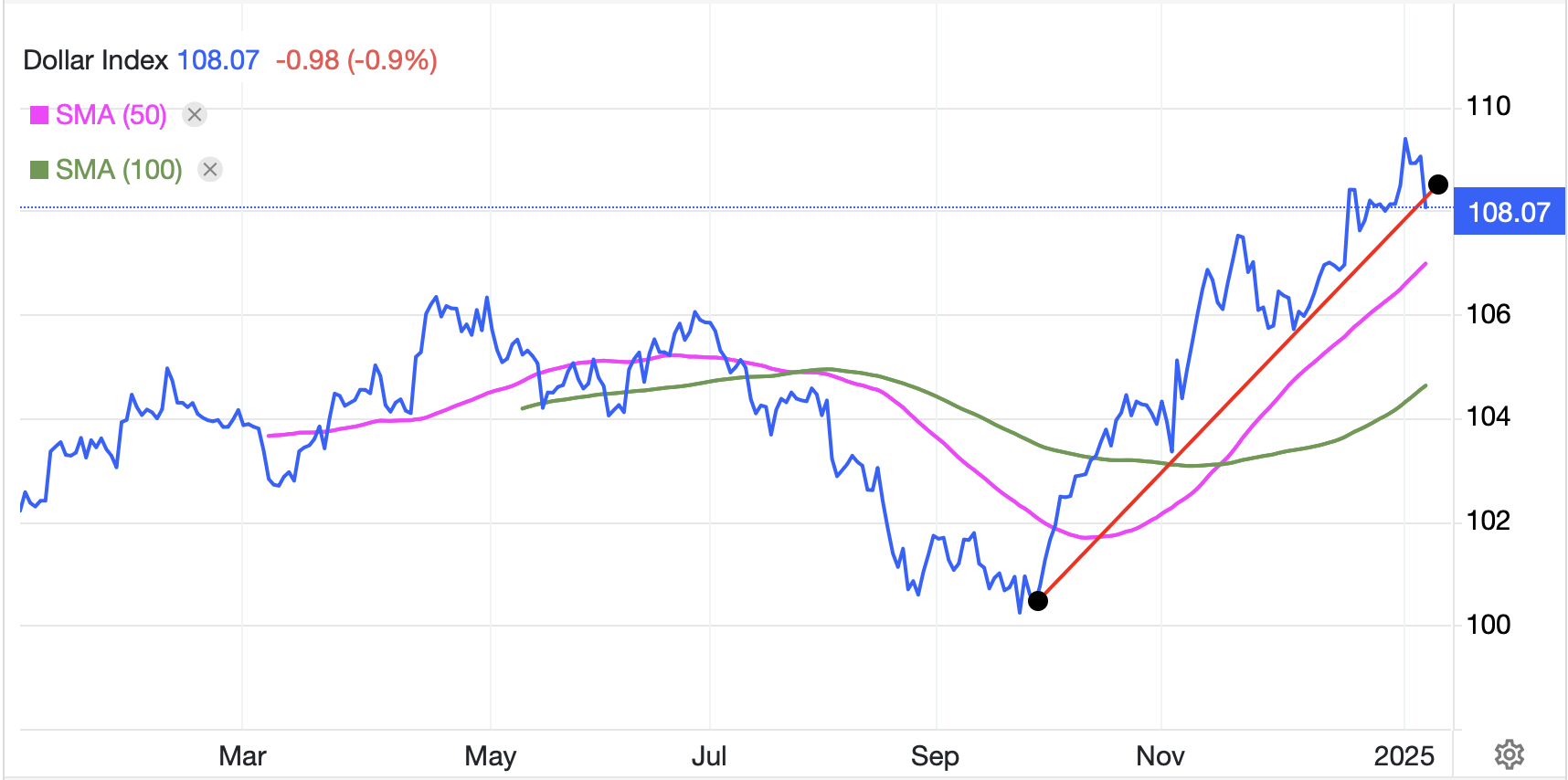
Source: tradingeconomics.com

However, today’s story is that of a weak dollar and strong equity markets, well at least in some places. Friday’s US equity rally was not followed by similar enthusiasm in Asia with the Nikkei (-1.5%) leading the way lower while both the Hang Seng (-0.4%) and China (-0.2%) also lagged.  Perhaps the mooted China stimulus helped those markets on a relative basis.  Europe, however, is in fine fettle (CAC +2.3%, DAX +1.4%, IBEX +0.9%) as PMI data released this morning was solid, if not spectacular, and the weaker dollar seems to be having a net positive impact.  US futures are also firmer, with NASDAQ (+1.1%) leading the way.

In the bond market, the big movement was in Asia overnight as JGBs (+4bps) sold off alongside virtually every other Asian bond market except China, which saw yields edge lower by 1bp to a new record low of 1.59%.  In Europe, there has been very little movement with yields +/- 1bp at most and Treasury yields, which had been firmer earlier in the overnight session, have actually slipped back at this hour and are lower by 2bps to 4.58%.

In the commodity markets, the weak dollar has helped support prices here with oil (+1.0%) continuing its rally (+9% in the past month) as the combination of Chinese stimulus hopes and cold weather seem to be providing support.  Speaking of cold weather, NatGas (+7.4%) is also in demand this morning as winter storm Barrie makes its way across the country.  In the metals markets, gold (+0.3%) is the laggard this morning with both silver (+2.3%) and copper (+2.4%) really taking advantage of the dollar’s weakness.

On the data front, there is a ton of stuff this week, culminating in NFP on Friday.

TodayPMI Services58.5
 PMI composite56.6
 Factory Orders-0.3%
TuesdayTrade Balance-$78.0B
 ISM Services53.0
 JOLTS Job Openings7.70M
WednesdayADP Employment139K
 Initial Claims217K
 Continuing Claims1848K
 Consumer Credit$12.0B
 FOMC Minutes 
FridayNonfarm Payrolls160K
 Private Payrolls134K
 Manufacturing Payrolls10K
 Unemployment Rate4.2%
 Average Hourly Earnings0.3% (4.0% Y/Y0
 Average Weekly Hours34.3
 Participation Rate62.8%
 Michigan Sentiment73.9

Source: tradingeconomics.com

In addition to all this, we hear from six more Fed speakers over seven venues with Governor Waller likely the most impactful.  Over the weekend, we heard from Governor Kugler and SF President Daly, both explaining that they needed to see more progress on inflation before becoming comfortable that things were ok.

Clearly, the tariff story is the current market driver in the dollar.  As I never saw tariffs as the medium-term driver of dollar strength, I don’t think it has as much importance.  Plus, this is a report from the Washington Post.  There are still two weeks before inauguration and many things can happen between now and then.  Nothing has changed my longer-term view that the dollar will be supported as the Fed, which is not tipped to cut rates this month and is seen only to be cutting about 40bps all year will ultimately raise rates as inflation proves far more stubborn than desired.  But that is the future.  Today, pick spots to establish dollar buys and leave orders.

Good luck

Adf

Bears’ Great Dismay

Their confidence clearly was lacking
So, now on rate cuts they’re backtracking
As well, they’re concerned
Some banks have not learned
To manage their risk and need smacking
 
But really the news of the day
Is AI remains the key play
NVIDIA beat
And all of Wall Street
Is buying to bears’ great dismay
 
Starting with the FOMC Minutes, the two things that stood out to me were these two lines, “The staff provided an update on its assessment of the stability of the U.S. financial system and, on balance, characterized the system’s financial vulnerabilities as notable. The staff judged that asset valuation pressures remained notable, as valuations across a range of markets appeared high relative to fundamentals.”  Arguably, this was why the Fed removed the line from the statement about “The U.S. banking system is sound and resilient,” which had been included since the Silicon Valley Bank debacle.  Perhaps they see something amiss.  As well, there was discussion regarding the timing of the end of QT with July seeming to be the latest thinking for its initial reduction.  But otherwise, as evidenced by the fact that virtually every Fed speaker has indicated they lack confidence inflation is dead, and that while policy is currently restrictive, it is still too soon to think about cutting rates, was clearly the broad theme of the meeting.  Next week we see the PCE data so perhaps that can change some opinions, but right now, given what we have just seen from CPI/PPI, they cannot have gained confidence it is time to cut.
 
As to NVIDIA, huge results, beating expectations and the word from the CEO is that demand will outstrip supply at least through the end of the year.  The market response here has been as one would expect; a big rally in stocks, especially tech.  ‘Nuff said.
 
Nikkei all-time high
Thirty-four years in waiting
Has finally come

Under the heading a picture is worth 1000 words, behold the relationship between NVIDIA and Nikkei 225 (chart from Weston Nakamura’s Across the Spread substack):

Pretty tight correlation, no?  Arguably, the question is which is driving which?  Does a stronger Nikkei drive NVIDIA’s performance or the other way around?  The first thing to note is that breaking down the Nikkei’s performance, similar to the NASDAQ, there are a handful of AI related stocks that have been the drivers of the move.  If you read Nakamura-san’s take, he believes that it is the Nikkei which is driving things, but I would argue while the Nikkei’s move happens earlier in the global day, the reality is that everything is an echo of the current AI craze which NVIDIA started.  

The next question is, just how long can this continue?  Remember two things here; first, trees don’t grow to the sky, and neither will NVIDIA’s stock; and second, new technologies take MUCH longer to assimilate than the initial hype would have you believe.  We are already seeing issues with Google’s Gemini AI with respect to drawing remotely accurate historical images of US presidents, as an example.  We are still in the very early innings of the AI phenomenon and there will be more hiccups along the way.  One last thing regarding AI is its power consumption, which is off the charts high.  If the world is going to be run by AI, we need a lot more electricity than is currently being produced and that alone will slow its incorporation into things.

Ok, on to more macro views, last night and this morning saw the release of the Flash PMI data all around the world.  Of the seven major releases thus far, only India is in expansion with it continuing to motor along in the low 60’s.  Otherwise, everything else (Australia, Japan, Germany, France, the Eurozone and the UK) are all in contraction in manufacturing.  Services is more mixed with several slightly above the 50 boom/bust line, but overall, while things might be seen as slightly improving, they are still pointing to recessions in Europe, Japan and the UK.

Despite this weakening data, virtually every one of these nations’ currencies is stronger vs. the dollar this morning.  In fact, the dollar is having a pretty rough session, down between 0.3% and 0.5% against most G10 counterparts with a slightly smaller decline vs. its EMG counterparts.  One of the odd things about this is that US yields have not really fallen much (Treasuries -1bp) which is right in line with the price action in European sovereigns and what we saw overnight in Asia across the board.

Add to the bond story the message from the Fed of higher for longer and it doesn’t appear that interest rates are today’s driver of the markets.  We already have seen that equity markets are rocking with the Nikkei (+2.2%), Hang Seng (+1.5%), CSI 300 (+0.9%), and most of Europe higher by 0.9% or more.  US futures, of course, are really flying with the NASDAQ (+2.2%) leading the way, but everything in the green.  I grant that a typical risk-on reaction is a weaker dollar but given the amount of funds that are flowing into the US equity markets, it is very hard to understand why the dollar is under pressure.  Something seems amiss.

If we look at the commodity markets, energy is softer across the board with oil (-0.2%) edging lower and basically unchanged on the week, while NatGas (-2.7%) is suffering as well.  As to the metals markets, gold (+0.2%) is edging higher on the back of the weaker dollar but both copper and aluminum are little changed on the day, less than 0.1% different from yesterday’s closing levels.  

Perhaps this is the new risk-on look, strong equity markets, a weak dollar and nobody cares about bonds.  But bonds have been far too important a driver of market activity to suddenly be ignored.  Now, yesterday, the Treasury auctioned some 20-year bonds and it did not go well, with a tail of 3.3bps, implying demand for the long-end remains tepid.  Given my personal view on inflation, that makes perfect sense, but arguably, the longest duration assets around are tech stocks and the divergence between bonds and those stocks is hard to reconcile.  I guess we will learn more as time progresses, but for now, I would be at least a little wary.  Absent a change in the inflation narrative back to the Fed has won, it does feel like there is still some risk to be seen.

On the data front, this morning brings the Chicago Fed National Activity Index (exp -0.15) which is a comprehensive view of financial conditions around the country and closely followed by the Fed.  As well we get Initial (218K) and Continuing (1885K) Claims and the Flash PMI’s (50.5 Manufacturing, 52.0 Services).  We close with Existing Home Sales (3.97M) and the oil inventory data and throughout the day we hear from four different Fed speakers, Jefferson, Harker, Cook and Kashkari.  Will any of this data matter?  I doubt it.  Can we expect anything new from the Fed speakers?  I kind of doubt that as well as there has been exactly zero evidence that the economy is slowing and dragging inflation lower since last week’s CPI and PPI data.   So, look for that lack of confidence in the demise of inflation to be widespread.

As to the dollar, something doesn’t smell right today.  I feel like it should be better bid and expect that by the end of the day, it will see that type of movement.

Good luck

Adf

No Matter What

The story that’s got the most press

Is CPI’s sure to regress
So, Jay and the Fed
Without any dread
Can start cutting rates with success

But what if instead of a nought
The data is higher than thought?
Will markets adjust?
Or will folks still trust
That rate cuts come no matter what?

While all eyes truly remain on the FOMC meeting announcement tomorrow afternoon, and of course, the ensuing press conference by Chairman Powell, this morning brings the November CPI report, which could well have an impact on tomorrow’s outcome.  Current median expectations are for a M/M headline release of 0.0% leading to a Y/Y result of 3.1%.  As to the core (ex food & energy) result, M/M is forecast to be 0.3% with the Y/Y result being unchanged at 4.0%.

Lately, the inflation bulls, aka the deflationistas, have been harping on the fact that if you annualize the past 3 months’ worth of data or the past 6 months’ worth of data, the annualized outcome is 2.5% or lower, and so the Fed has basically done their job and returned inflation back to their target.  In the very next breath, they explain that with inflation back at target, they can start to cut rates because otherwise they will choke off the economy.

Even if I grant the first part of this thesis, of which I am suspect, it is the corollary rate cuts that make no sense at all.  Thus far, the bulk of the data that we have been observing has shown that the economy has held up extremely well despite 525 basis points of rate hikes over the course of less than two years.  This was made evident by Friday’s payroll report as well as the Q3 GDP report and much of the hard data that abounds.  Given the economy’s clear resilience to this higher rate structure, I can see no good case for the Fed to cut.

In fact, I think the key for the entire macroeconomic outlook revolves around just how long the US economy can maintain its growth trajectory with interest rates at their current levels.  The one thing of which we can be certain is that the Fed is not going to pre-emptively cut rates because they think a recession might show up, at least not now while inflation remains well above their target.  If the US economy continues to perform, meaning grow at 2%-2.5% over time while the Unemployment Rate stays below 4.5%, I would argue there is no incentive for the Fed to cut, at least not on a macro basis.  (There may be political reasons for them to cut, but that’s a different story.)  Now, if growth continues apace, will that be bullish or bearish for stocks?  For bonds?  For the dollar?  For commodities?  I would say that these are the questions we need to answer and are why the Fed remains such an important part of the discussion.  Do not discount a world where 10-year yields are 5.5%, Fed funds are 5.25% and GDP is 2.0% while inflation runs at 3.0%.  This could well be the near future.  It would also likely be quite a negative for risk assets.

My point is there continues to be a great dichotomy of thought as to how the future will unfold as we all are looking for the next clue to support our thesis.  While I continue to believe that a slowdown is coming, to date, there has been no clear evidence that is the case.  In fact, Friday’s Michigan Sentiment data was substantially better than anticipated while inflation expectations fell alongside the price of gasoline.  In fact, a marginally stronger than anticipated print this morning will simply be more proof that the market’s current anticipation for rate cuts in 2024, which sit between 4 and 5 cuts, will need to be repriced.  If risk assets have rallied on the basis of future Fed rate cuts, that could be a problem.  Just sayin’!

Ok, ahead of the data, this is what we have seen.  Yesterday’s modest US equity rally was followed by generally modest strength in Asia with the best performer being the Hang Seng (+1.1%).  Last night, China’s government made a series of announcements describing all the sectors of the economy that they would be supporting going forward with fiscal policy, although there were no numbers attached to any of it, it was all cheerleading.  Saturday night, Chinese CPI data was released at -0.5% both M/M and Y/Y, while PPI there fell to -3.0%.  The implication is that economic activity is not going very well.  In fact, it might be appropriate to define it as a recession, although I’m sure that won’t be the case.  However, looking for China to be the world’s growth engine may be a bad call for the time being.  As to Europe, it is a mixed picture there, with both modest gainers and modest laggards and no real direction overall.  US futures are higher by 0.2% at this hour (7:30) but are obviously keenly focused on the data release.

Yesterday’s bond market price action, where yields backed up, has been completely reversed this morning with 10-year Treasury yields lower by 5bps and European sovereign yields lower by even more, 6bps-7bps while UK gilts have really rallied, with yields there down by 12bps after the employment data showed wage pressures declining far more than anticipated.

On the commodity front, oil is drifting lower again this morning, down -0.6%, although the metals complex is showing strength with gains in gold (0.4%) and copper (0.3%), which seem to be rising on the back of a weaker dollar and lower US rates.  But a quick aside on oil and the commodities space in general.  I have made the point that the commodity markets are the only ones that are pricing in a recession.  And I would contend that is still the case.  Perhaps, though, I have been looking in the wrong place for that economic weakness.  Consider that China is the largest consumer of raw commodities in the world, by a wide margin.  Consider also that the Chinese economy is having all kinds of difficulty as the dash for growth seems to have reached its apex and is now sliding lower.  As I mentioned above, the idea that China is in a recession may not be absurd, and perhaps the fact that the commodity markets, in general, have been so soft is simply a recognition of that fact.  If this is the case, we need to watch Chinese economic activity closely in order to get a sense of the trend in commodities.  Or perhaps, we need to watch the trend in commodities to better understand the Chinese economy.  When base metals turn higher, look for Chinese stocks to do the same.

Finally, the dollar, as mentioned above, is under pressure this morning, down -0.3% when measured by the DXY.  The biggest mover is JPY (+0.7%) but we are seeing all the G10 bloc as well as the bulk of the EMG bloc rallying against the greenback.  Speaking of Japan, last night there was further commentary pushing back on the idea of any movement by the BOJ next Monday regarding the normalization of monetary policy in the near future.  I maintain that nothing will happen before they see the wage negotiation outcomes in March and, in the meantime, they are praying quite hard for the recent global inflation trend to remain downward as this will allow them to maintain their QE and fund the government.

And that’s really it for the day, as the CPI is the only news to be released.  Unless it is significantly different than the current expectations, I suspect that things will be quiet today, modest continued equity and bond rally as everybody places their bets that the Fed is getting ready to start to cut rates.  I’m not holding my breath.

Good luck

Adf

Bulls’ Fondest Dreams

While everyone focused on Jay
The earlier news of the day
Showed Janet would not
The long bond, allot,
Too much, thus yields faded away

Combining that news with the Fed
And all of the things that Jay said
It certainly seems
The bulls’ fondest dreams
Are likely to still be ahead

While most of the headlines yesterday afternoon and this morning revolve around the FOMC meeting and, more importantly, Powell’s press conference, I would argue that as I discussed yesterday, the biggest story was the QRA early in the morning.  Historically, the Treasury has tried to keep T-Bill issuance between 15% and 20% of total Treasury issuance.  However, a look at the current mix shows that Secretary Yellen already has that ratio up to 22.6%.  One of the big questions was how that would play out going forward.

Recall, one of the narratives that has been invoked for the Treasury bond sell-off with corresponding rising yields, has been the supply story.  You know, the US is running massive budget deficits and needs to issue more debt to fund it, so there is a lot more supply coming.  A key assumption in this story was that the mix of debt, which already favored T-Bills, would not change much so the new debt would be forced into the back end of the curve.  Well, that’s not how things worked.  The QRA indicated that the Treasury was going to issue a lot more T-Bills, a total of $1.1 trillion over the next two quarters, raising the proportion of T-Bills to 23.2%, even further above the old ceiling.  Of course, the result is much less issuance in the 5yr and longer space, thus undercutting the excess supply argument.

The results cannot be surprising as even before Powell started speaking, 10-year yields had fallen 11bps although they continued to decline afterwards as well, finishing the day lower by 16bps or so.  All in all, an impressive bond rally.  But let’s consider for a moment a different consequence of yesterday’s announcements, the shape of the yield curve.  Prior to the QRA and the Fed, the yield curve, as measured by the 2yr-10yr spread had fallen from a low of -108bps to just -15bps and it seemed almost certain that it would normalize soon.  However, now that the QRA has shown there will be more issuance out to 2yrs and less beyond, the immediate impact is the curve is going to go back to inverting further, (it is already back to -22bps) at least until such time as the Fed actually does cut rates.  I have a feeling that we are going to hear a lot more about recession again even though Powell explicitly said the Fed was not expecting one.  In fact, Powell and the Fed may be the only people not expecting a recession at this point!

A quick look at the Fed funds futures market shows that for the December FOMC meeting, the market is currently pricing a 20% probability of a 25bp rate hike.  That is slightly lower than before the FOMC meeting yesterday, but within the margin of error.  However, at this point, the market has a 43% probability of a rate cut in May, with that probability growing as you head out further in time.  One of the things Powell reiterated yesterday is that the committee is not even discussing the idea of a rate cut.  Of course, he also said that they don’t believe a recession is coming so it is not surprising the market has a different rate view than the Fed.

In the end, I think this is a seminal shift in policy with the combination of Treasury and Fed actions indicative of a much easier policy stance going forward.  I have built my views based on the Fed maintaining its higher for longer stance and continuing to stress the system which remains massively leveraged.  However, if he is no longer going to follow that path, and I think we learned yesterday that the inflection point is here, then we need to rethink the future.  One consequence of this policy change, though, is that inflation, which I have maintained is going to remain far stickier than many anticipate, is going to become an even bigger problem down the road.  I just don’t know how far down the road that will be.  But for now, I think we are going to continue to see equities rebound into year end, bond yields fall, the dollar fall, and commodity prices rebound.  This is going to be a classic risk-on scenario through the end of the year in my view.

And despite, or perhaps because of, continued weaker data, that is what we are seeing in markets around the world.  Yesterday’s ISM Manufacturing data was quite soft at 46.7, and this morning the PMI data from the rest of the world was generally awful with all European readings between 40 and 45.  Yesterday’s ADP Employment data was soft, at 113K which just added fuel to the policy easing fire and though the JOLTS Job Openings data was still strong, the net perception is slower times are ahead, and with them, lower interest rates.

A look around markets shows that after yesterday’s US rally, with the NASDAQ leading the way higher by 1.6%, Asian shares rallied (Nikkei +1.1%, Hang Seng +0.75%) and we are seeing strength across the board in Europe with all major indices higher by at least 1.25%.  And don’t worry, US futures are pushing higher again, up about 0.5% at this hour (7:15).

It is, of course, no surprise that bond yields around the world are lower with European sovereigns declining by between 7bps and 12bps after both Australia and New Zealand saw yields tumble 16pbs and 25bps respectively.  Even JGB yields are softer by 3bps.  In fact, Dutch central bank president Klaas Knot, one of the most hawkish ECB members, is on the tape this morning with the following quote, “We should be a little patient and not raise rates too much.”  That may be the most dovish thing he has ever said.  The point here is that until such time as inflation really comes roaring back (and I fear that day will come), the direction of travel in interest rates is lower.

Oil prices, which remained under some pressure in the past week, have bounced 1.4% this morning with the movement seeming to be a response to the policy changes while gold (+0.3%) is also climbing, although a bit slower than I might have expected.  But we are seeing strength throughout the commodity complex on the lower rate story with copper (+0.5%) rallying despite the prospects of a recession.

Finally, the dollar is under pressure across the board with the DXY down -0.7% led by the euro (+0.6%), AUD (+0.7%) and NZD (+0.95%).  The yen (+0.4%) is a bit of a laggard today, though remains above the 150 level, but I suspect that we are going to see dollar weakness continue going forward.  Against EMG currencies, we are also looking at a weaker greenback with KRW (+1.0%) leading the way, but strength through APAC and EEMEA and MXN (+0.6%) firmer as the only representative of LATAM that is trading at this hour.  Yesterday Banco Central do Brazil cut their SELIC rate by 50bps to 12.25% as widely expected and BRL rallied 2% on the day.  Again, the theme is now a weaker dollar going forward.

To show how big a deal yesterday was, the BOE meets this morning, and nobody is even discussing it.  Expectations are for no policy change, although perhaps given the sudden dovishness breaking out worldwide, they will consider a cut!  We also see a bunch of US data as follows: Initial Claims (exp 210K), Continuing Claims (1800K), Nonfarm Productivity (4.1%), Unit Labor Costs (0.7%) and Factory Orders (2.4%).   There are no Fed speakers on the schedule today, but they get started again tomorrow.  Remember, tomorrow we also see NFP, so still some fireworks potentially.

For now, though, the new trend is risk on, dollar down.  

Good luck

Adf