Left For Dead

Takaichi’s learned
Her chalice contained poison
Thus, her yen weakens


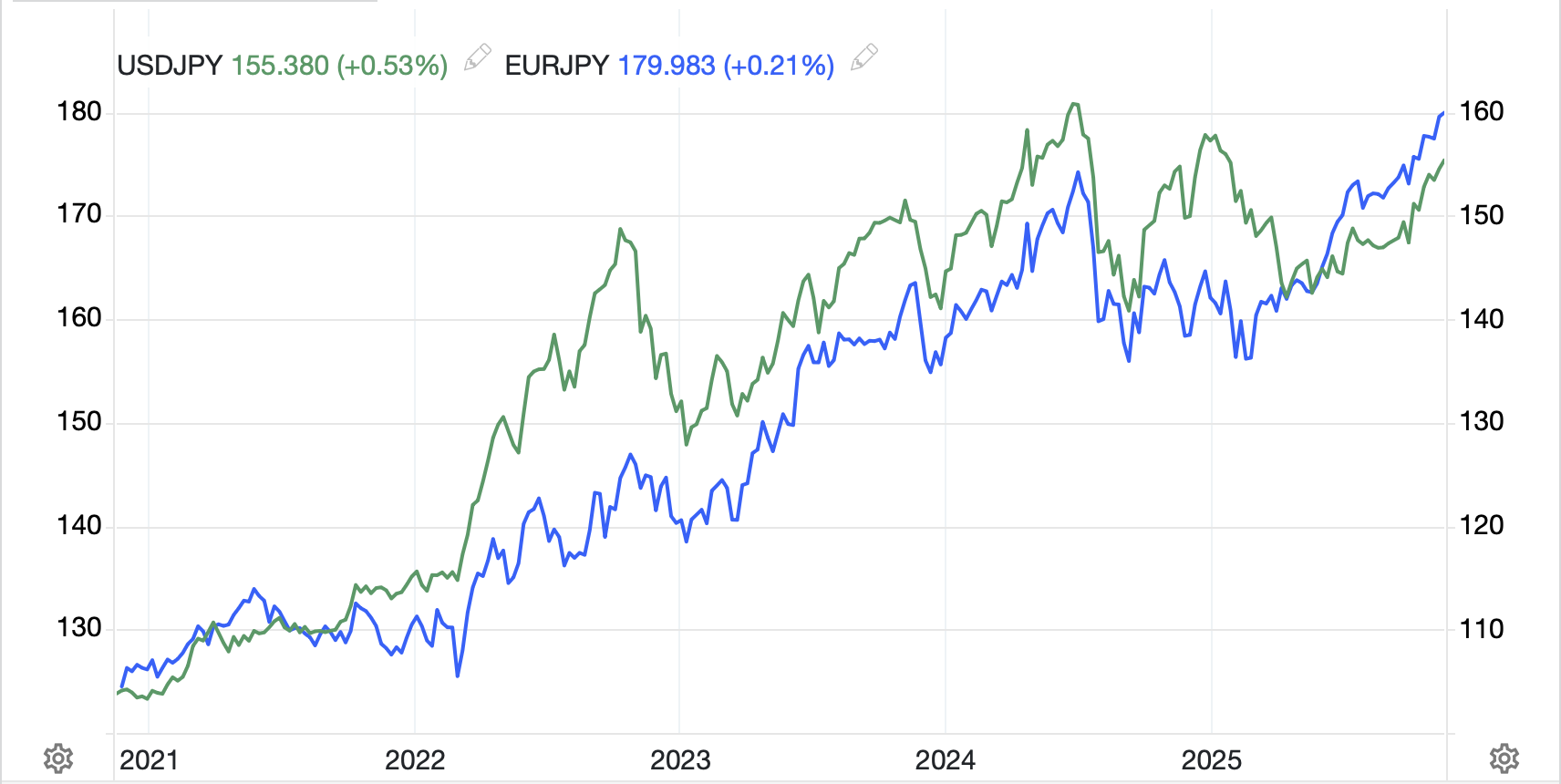
If one needed proof that interest rates are not the only determining factor in FX markets, look no further than Japan these days where JGB yields across the board, from 2yr to 40yr are trading at decade plus highs while the yen continues to decline on a regular basis.  This morning, the yen has traded through 155.00 vs. the dollar, and through 180.00 vs. the euro with the latter being a record low for the yen vs. the single currency since the euro was formed in 1999.

Source: tradingeconomics.com

Meanwhile, JGB yields continue to rise unabated on the back of growing concerns that Takaichi-san’s government is going to be issuing still more unfunded debt to pay for a massive new supplementary fiscal package rumored to be ¥17 trillion (~$109 billion).  While we may have many fiscal problems in the US, it is clear Japan should not be our fiscal role model.

Source: tradingeconomics.com

This market movement has led to the second step of the seven-step program of verbal intervention by Japanese FinMins and their subordinates.  Last night, FinMin Satsuki Katayama explained [emphasis added], “I’m seeing extremely one-sided and rapid movements in the currency market. I’m deeply concerned about the situation.”  Rapid and one-sided are the key words to note here.  History has shown the Japanese are not yet ready to intervene, but they are warming to the task.  My sense is we will need to see 160 trade again before they enter the market.  However, while that will have a short-term impact, it will not change the relative fiscal realities between the US and Japan, so any retreat is likely to be a dollar (or euro) buying opportunity.

As to the BOJ, after a highly anticipated meeting between Takaichi-san and Ueda-san, the BOJ Governor told a press conference, “The mechanism for inflation and wages to grow together is recovering. Given this, I told the prime minister that we are in the process of making gradual adjustments to the degree of monetary easing.”   Alas for the yen, I don’t think it will be enough to halt the slide.  That is a fiscal issue, and one not likely to be addressed anytime soon.

The screens everywhere have turned red
As folks have lost faith that the Fed,
Next month, will cut rates
Thus, leave to the fates
A stock market now left for dead

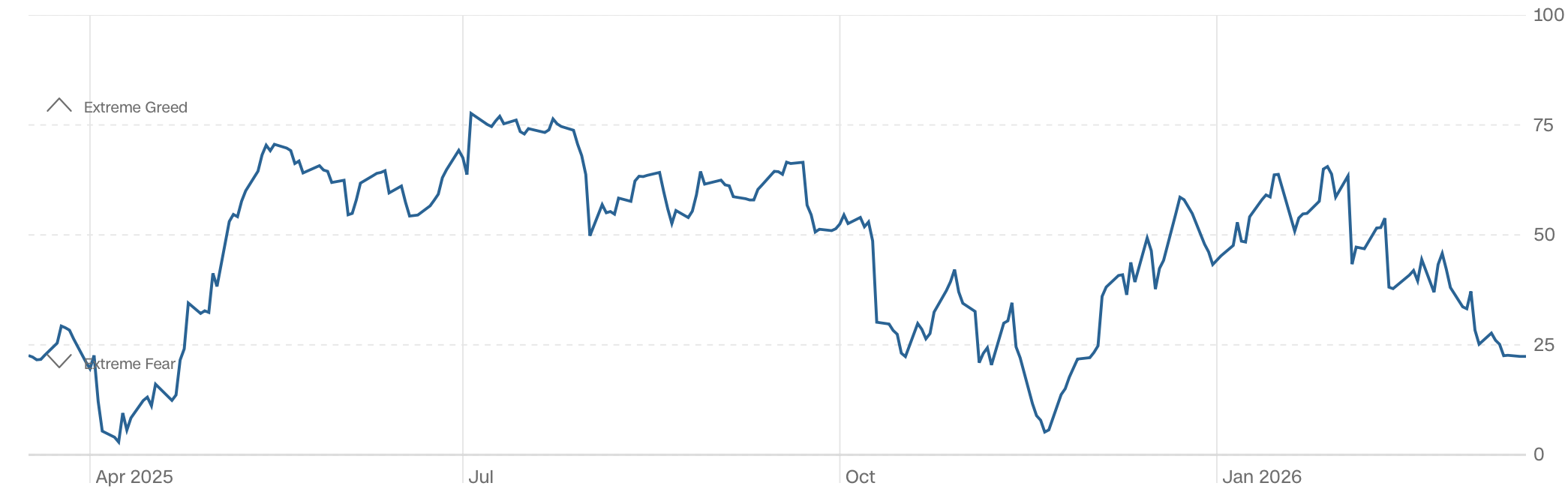
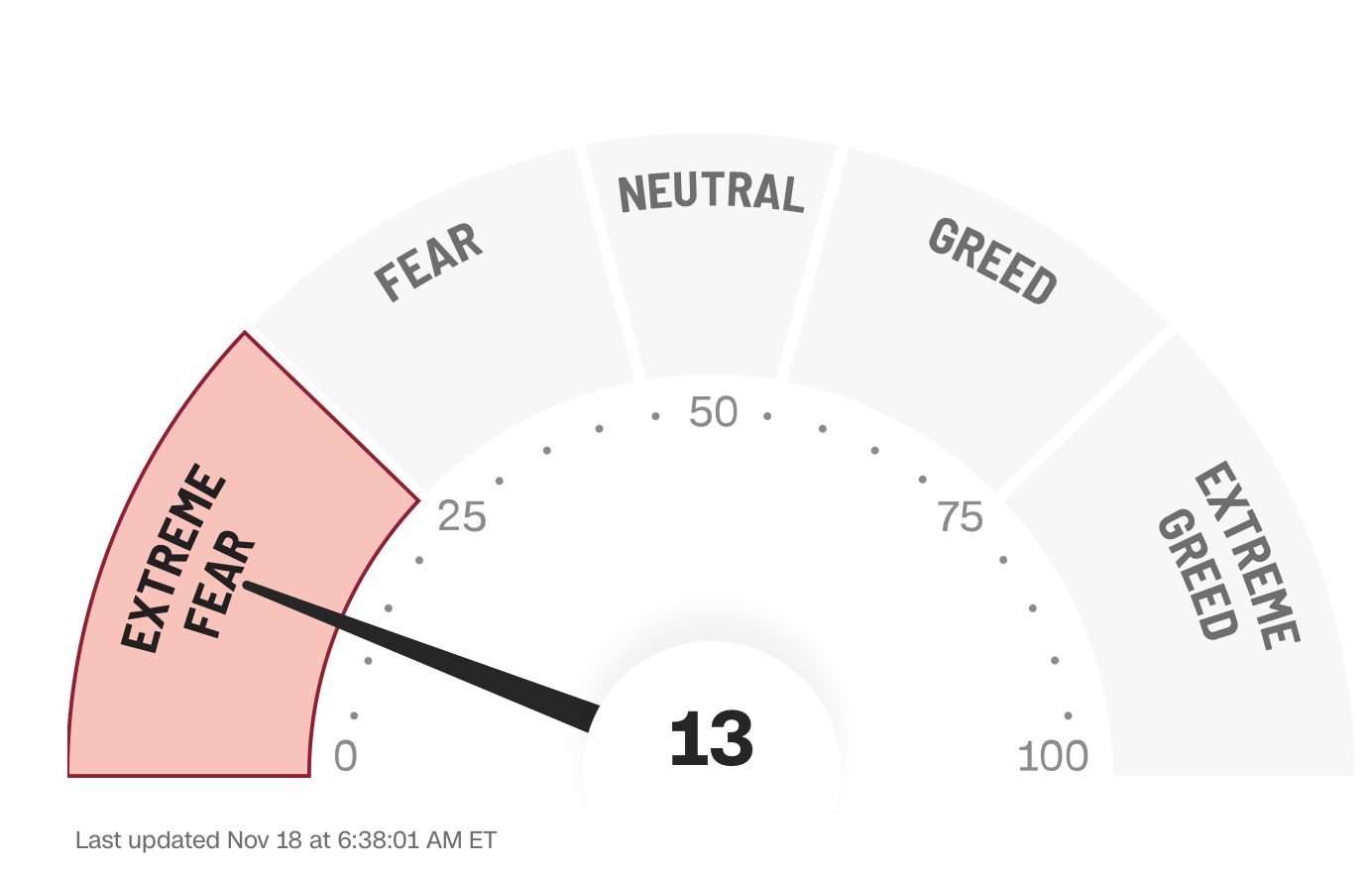
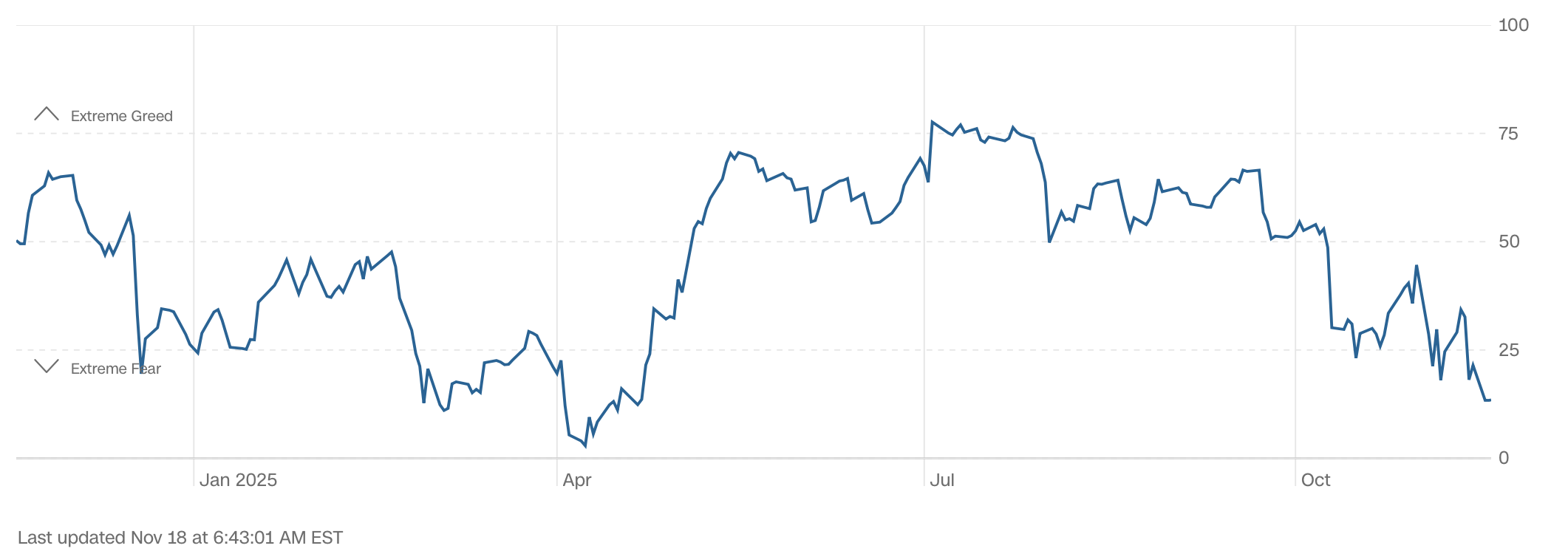
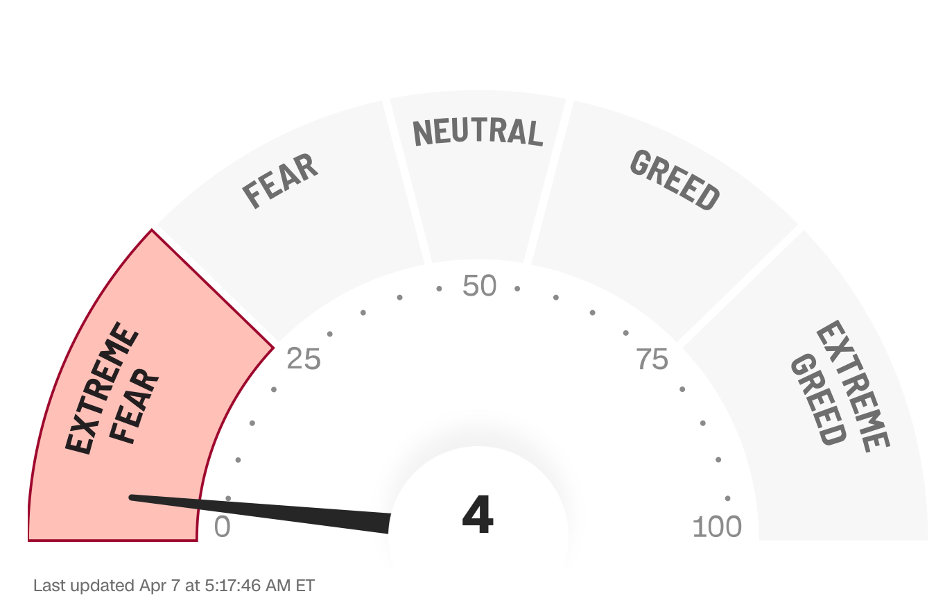
Yesterday, I showed the Fear & Greed Index and marveled at how it was pointing to so much fear despite equity markets trading within a few percentage points of all time highs.  Well, today it’s even worse!  This morning the index has fallen from 22 to 13 and is now pushing toward the lows seen last April when it reached 4 just ahead of Liberation Day.

In fact, it is worthwhile looking at a history of this index over the past year and remembering what happened in the wake of that all-time low reading.

Source: cnn.com

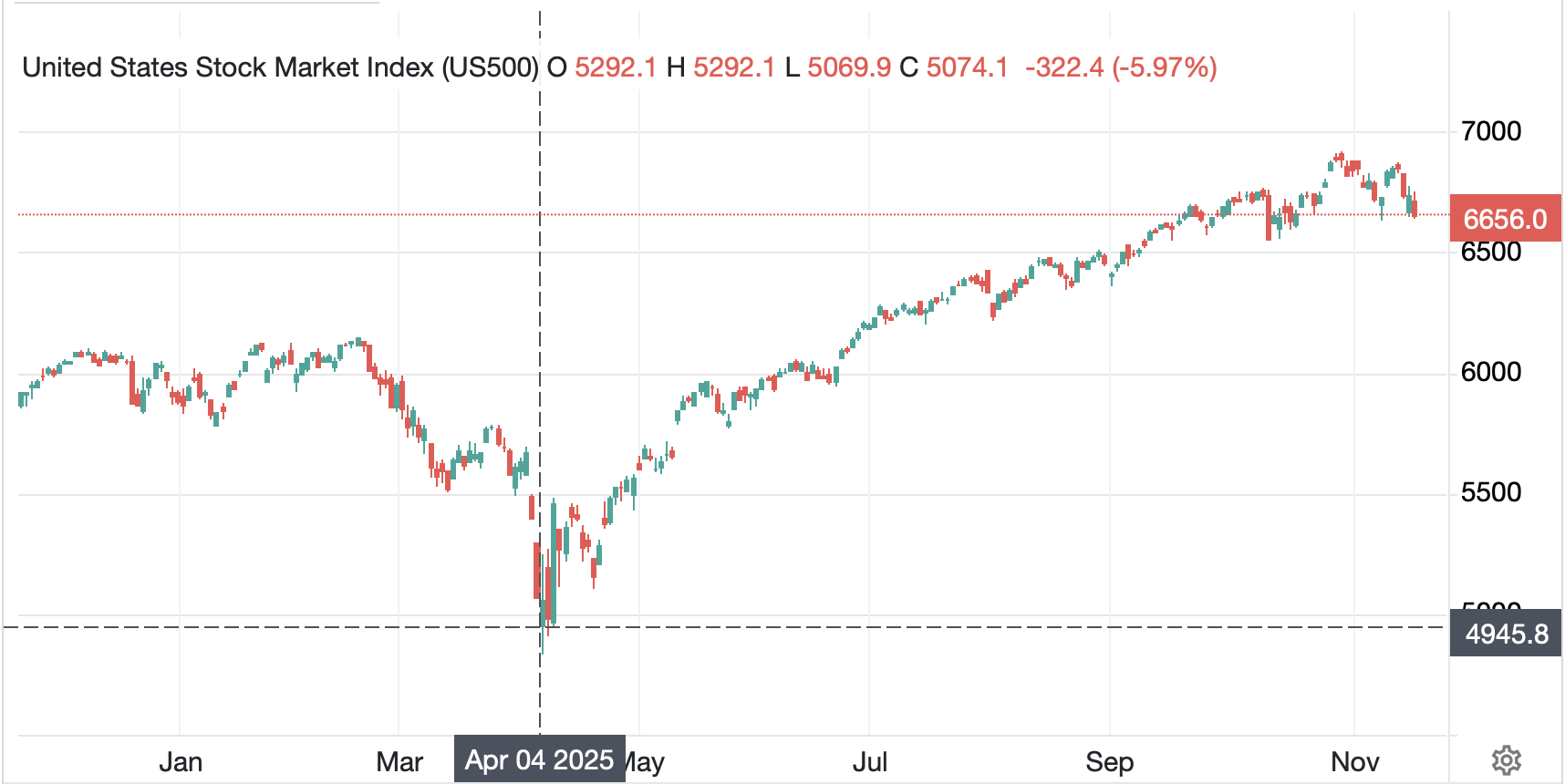
Now look at the S&P500 over the same timeline and see if you notice any similarities.

Source: tradingeconomics.com

It is certainly not a perfect match, but the dramatic rise in both indices from the bottom and through June is no coincidence.  The other interesting thing is that the fear index managed to decline so sharply despite the current pretty modest equity market decline.  After all, from the top, even after yesterday’s decline, we are less than 4% from record highs in the S&P 500.

Analysts discuss the ‘wall of worry’ when equity markets rise despite negative narratives.  Too, historically, when the fear index falls to current levels, it tends to presage a rally.  Yet, if we have only fallen 4% from the peak, it would appear that positions remain relatively robust in sizing.  In fact, BoA indicated that cash positions by investors have fallen to just 3.7%, the lowest level in the past 15 years.  So, everyone is fully invested, yet everyone is terrified.  Something’s gotta give!  In this poet’s eyes, the likely direction of travel in the short run is lower for equities, and a correction of 10% or so in total makes sense.  But at that point, especially if bonds are under pressure as well, I would look for the Fed to step in and not only cut rates but start expanding its balance sheet once again.  QT was nice while it lasted, but its time has passed.  One poet’s view.

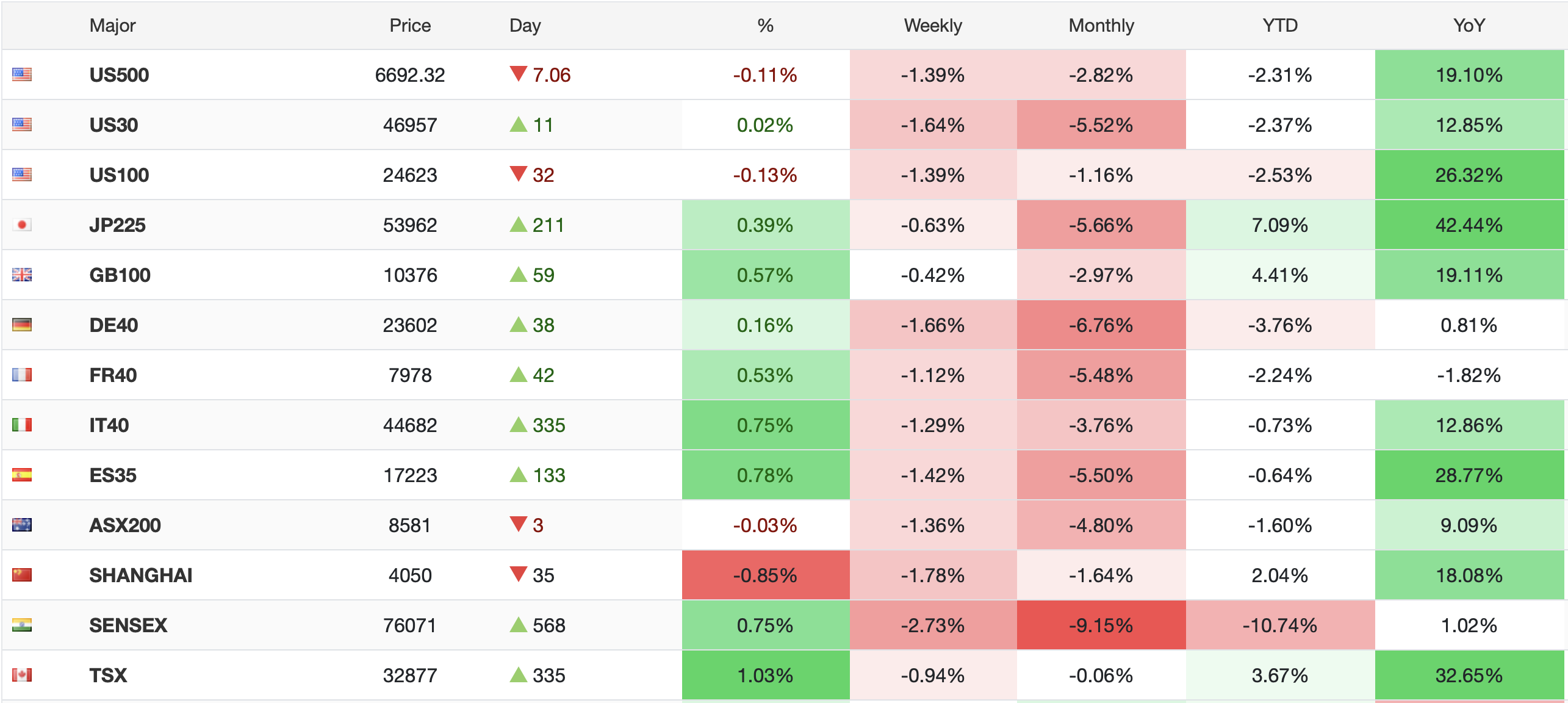
Ok, following the sharp decline in US equity markets yesterday on weak tech shares, the bottom really fell out in Asia and Europe.  Japan (-3.2%) got crushed between worries about fiscal profligacy discussed above and the tech selloff.  China (-0.65%) and HK (-1.7%) followed suit as did every market in Asia (Korea -3.3%, Taiwan -2.5%, India -0.3%, Australia -1.9%).  You get the idea.  In Europe, the picture is no brighter, although the damage is less dramatic given the complete lack of tech companies based on the continent.  But Germany (-1.2%), France (-1.3%), Spain (-1.6%), Italy (-1.7%) and the UK (-1.3%) have led the way lower where all indices are in the red.  US futures, at this hour (7:15) are also pointing lower, although on the order of -0.5% right now.

In the bond market, Treasury yields, after edging higher yesterday are lower by -4bps this morning, and back at 4.10%, their ‘home’ for the past two months as per the below chart from tradingeconomics.com.

As to European sovereigns, they are not getting quite as much love with some yields unchanged (UK, Italy) and some slipping slightly, down -2bps (Germany, Netherlands), and that covers the entire movement today.  We’ve already discussed JGBs above.

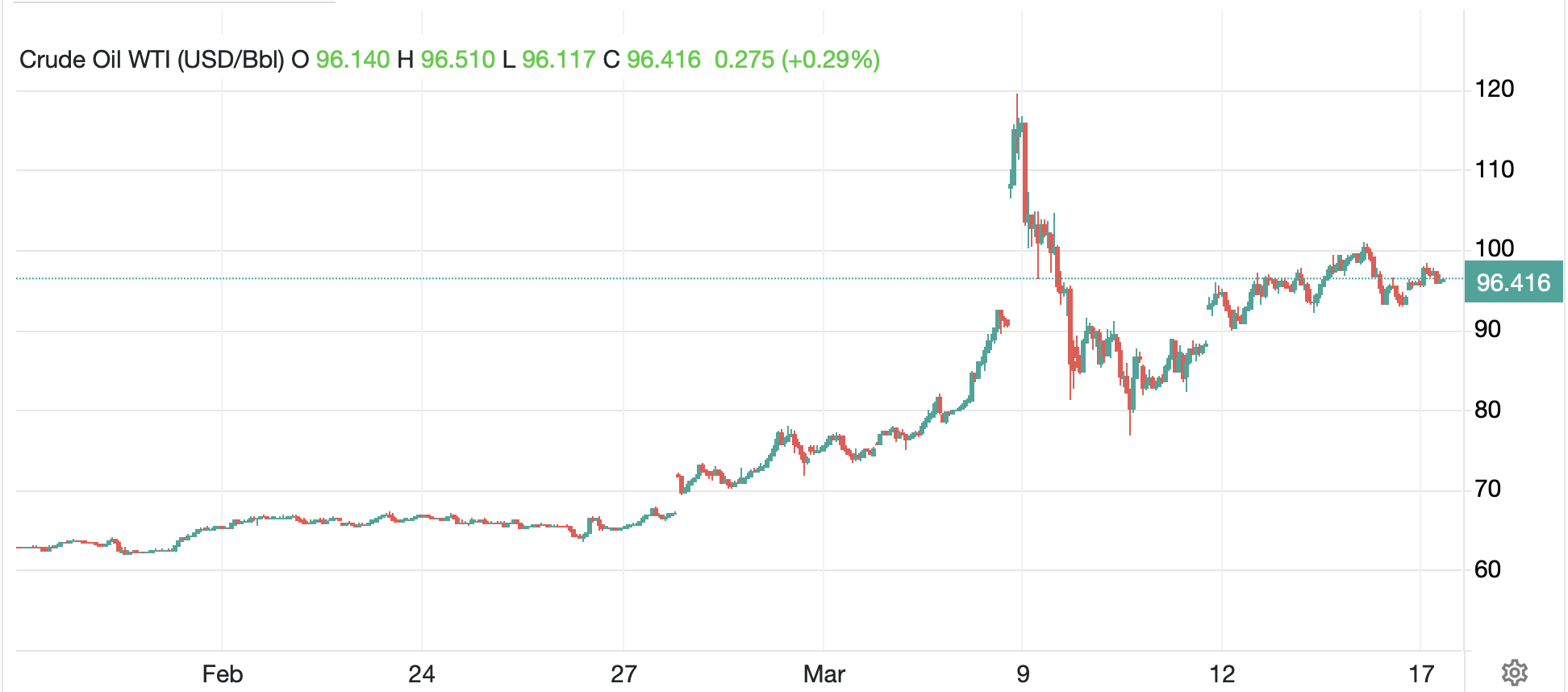
In the commodity space, oil (-0.2%) continues to trade either side of $60/bbl and it remains unclear what type of catalyst is required to move us away from this level.  Interestingly, precious metals have lost a bit of their luster despite the fear with gold (-0.25%), silver (-0.2%) and platinum (-0.2%) all treading water rather than being the recipient of flows based on fear.  Granted, compared to the crypto realm, where BTC (-1.0%, -16% in the past month) has suffered far more dramatically, this isn’t too bad.  But you have to ask, if investors are bailing on risk assets like equities, and bonds are not rallying sharply, while gold is slipping a bit, where is the money going?

Perhaps a look at the currency market will help us answer that question.  Alas, I don’t think that is the case as while the dollar had a good day yesterday, and is holding those gains this morning, if investors around the world are buying dollars, where are they putting them?  I suppose money market funds are going to be the main recipient of the funds taken out of longer-term investments.  One thing we have learned, though, is that the yen appears to have lost its haven status given its continued weakening (-3.0% in the past month) despite growing fears around the world.  

On the data front, yesterday saw Empire State Manufacturing print a very solid 18.7 and, weirdly, this morning at 5am the BLS released the Initial Claims data from October 18th at 232K, although there is not much context for that given the absence of other weeks’ data around it.  Later this morning we are due the ADP Weekly number, Factory Orders (exp 1.4%) and another Fed speaker, Governor Barr.  Yesterday’s Fed speakers left us with several calling for a cut in December, and several calling for no move with the former (Waller, Bowman and Miran) focused on the tenuous employment situation while the latter (Williams, Jeffereson, Kashkari and Logan) worried about inflation.  Personally, I’m with the latter group as the correct policy, but futures are still a coin toss and there is too much time before the next meeting to take a strong stand in either direction.

The world appears more confusing than usual right now, perhaps why that Fear index is so low.  With that in mind, regarding the dollar, despite all the troubles extant in the US, it is hard to look around and find someplace else with better prospects right now.  I still like it in the medium and long term.

Good luck

Adf

Hair All on Fire

There once was a group of old men
Who spoke via paper and pen
Last week, this odd choir
With hair all on fire
Explained that the world would soon end
 
I wonder if this week we’ll learn
This group now has nought left to burn
If so, we may find
That all of mankind
Could yet weather any downturn


I have no idea how this is going to play out and truthfully neither does anybody else.  While I am happy to admit that fact, my sense is others will not be so forthcoming.  President Trump made clear that he wanted to change the way things are done.  He was explicit in his efforts to rearrange the global trading system, and by extension the global economy, so that it was less punitive to American businesses.  At least in his mind.  

I think the other thing to remember is he was elected by Main Street, not Wall Street.  The MAGA movement was originally composed of small-town folks who had not benefitted from the financialization of the economy that really accelerated with the GFC.  And most of these folks don’t look at the stock market every day, nor the bond market nor the value of the dollar in the FX market.  They do see the price of gasoline at the pump, and the price of groceries in the store, but otherwise, market activity is not a primary focus.

I mention this because I think it is critical to remember Trump’s primary audience if we are to understand why he is doing what he is doing.  Bill Ackman screaming on X is not the president’s concern.  Redeveloping the US manufacturing base is his goal.

Now, will his actions lead to that outcome?  There are many naysayers and most of them write for major news outlets or are politically motivated (isn’t that the same thing?).  But remember, Trump doesn’t have to run for office again.  I suspect the fact that the Senate passed their version of the “big, beautiful bill” for taxes and the budget last week was of far more interest to the President than the fact that Senator Chuck Schumer is calling his actions reckless.  

My point here is to highlight that all those who believe that President Trump will succumb and change his stance because equity prices have fallen are still not listening to the man.

Speaking of prices at the pump, there was news last week that was missed by many, if not most, people, and that is likely to have a significant impact on oil prices.  It turns out, that in the wake of the tariff announcements, OPEC explained they would be increasing production by 411K bbl/day beginning in May with potentially larger increases going forward.  It appears that the loss of market share is becoming untenable in their eyes, and so they are on their way to regaining that, even if prices are to decline further.  

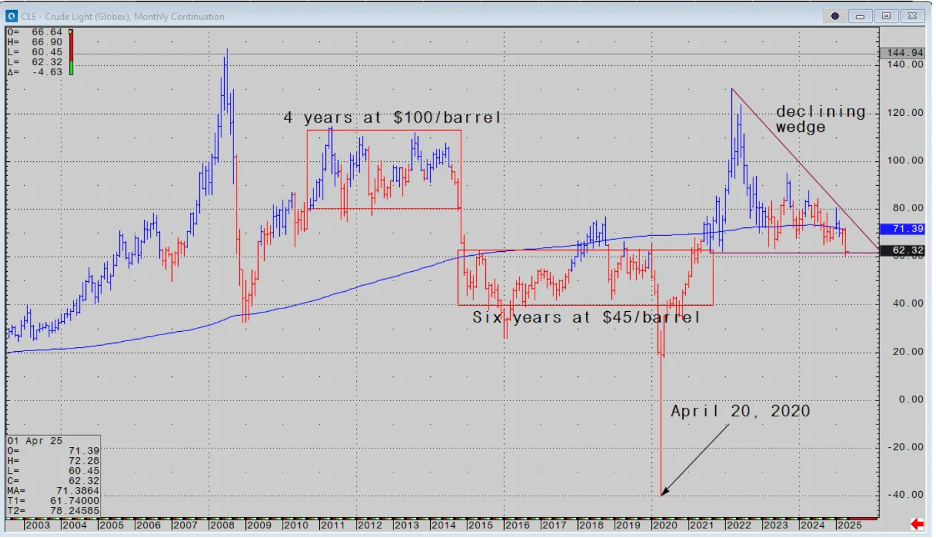
There are some who speak of a deal with President Trump, who you may recall has been seeking to lower oil prices, and I suppose that is quite possible.  But, regardless of the driving force behind the action, as my friend Alyosha on Substack explains eloquently, it is quite possible that we are entering a new regime in oil prices.  This chart from his most recent Substack posting is instructive.  

In essence, his theory, which this chart describes, is we may well be heading into a new long-term range of oil prices that is far below what we have been used to, especially since the Russian invasion of Ukraine.  Remember, if energy prices decline, that reduces cost pressures for the entire economy.  And here we are this morning with oil (-4.0%) breaking below $60/bbl and down -10% in the past month.  Despite all the headlines that tariffs are going to raise prices, this is something that will clearly offset any general rise in price pressures.

But markets are still digesting the tariff news and are not happy about it.  Apparently, several nations have reached out to the president to discuss what can be done to address this change in tariff behavior, including the UK, Japan and Taiwan.  As a negotiating tactic, it strikes me that Trump will not want to waver if he is to achieve better trade deals for the US.  And while he may be subject to the slings and arrows of a negative press in the US, there is nobody on the planet who is more capable of absorbing those and continuing on his merry way.

Ok, let’s see the damage wrought in the overnight markets, where adjustments are still being made.  Before we start, though, remember, US share prices were at extremely high valuations prior to all this with just seven companies representing nearly one-third of the value of the S&P 500.  The common refrain was that these conditions could not be maintained forever.  That refrain was correct, but the speed of the adjustment has clearly been more rapid than many had hoped expected.  The below reading of the Fear and Greed Index speaks for itself.  But remember, this is seen as a contra-indicator, where extreme fear is seen as a buying opportunity.

Source: cnn.com

Ok, now to markets.  The nearly -6% declines across the board in the US on Friday have been followed by even large declines in Asia, with the Nikkei (-7.8%), Hang Seng (-13.2%) and CSI 300 (-7.1%) all suffering greatly.  Taiwan (-9.7%) and Singapore (-7.6%) were the other largest movers with the rest of the region declining on the order of -4.0% give or take a bit.  In Europe, the losses are not quite as severe, with declines on the continent averaging -6.2% or so and UK shares slipping “just” -4.8%.  interestingly, US futures, which had been down as much as a further -6.0% in the early part of the overnight session, have rebounded slightly and now (5:40) sit lower by around -3.4% or so.  It appears we are seeing the first nibbles of value buyers.

Bond yields continue to decline as the flight to the relative safety of government debt is rampant.  While Treasury yields (-4bps) are only a bit lower, in Europe, German bunds (-12bps) and French OATs (-8bps) are leading the way.  Recession concerns have risen everywhere, with the punditry now highly convinced a recession is a given and the only question is whether or not this will turn into a depression.  That feels premature to me, but I’m just a poet.  As to JGB yields, they, too, have tumbled further as funds flow back to Japan, and are down a further -8bps this morning, now yielding just 1.09%, a far cry from the 1.60% level just two weeks ago.

I’ve already discussed oil so a look at metals shows gold (-0.3%) consolidating last week’s declines and still above $3000/oz.  My take is gold’s decline was a result of equity losses and margin calls being covered by gold positions.  I do not believe the barbarous relic has seen its highs.  As to the other metals, silver (+2.3%) is bouncing this morning, although it did fall more than 10% in the past week, and copper (-1.4%) is under increasing pressure on the weakening economic growth story.

Finally, the dollar is all over the map, showing net strength this morning, but weaker vs. the two main havens, JPY (+0.55%) and CHF (+0.9%).  Interestingly, the euro is unchanged on the day as it appears traders cannot decide who will be more greatly impacted, the US or Europe.  But otherwise, the dollar is generally firmer with NOK (-1.75%) suffering alongside oil, MXN (-1.5%), ZAR (-1.3%) and CLP (-1.7%) all feeling the pressure from the tariffs.  Other G10 currencies are softer, but not as dramatically, with AUD and NZDZ (both -0.5%) and CAD (-0.3%) moving more in line with a normal session.  While we have gotten used to the idea that the dollar rallies on a risk-off thesis, given the nature of this particular version of risk-off, I have a feeling the dollar’s gains may be capped.  However, my previous thesis on the declining dollar is much harder to discern given the changing nature of economic outcomes.

As an aside, the Fed funds futures market is now pricing a 50% probability of a Fed cut in May and a total of 113bps of cuts by the end of 2026.  However, this will all depend on the evolution of things going forward, and, similar to the fear and greed index above, may represent an extreme view right now.

On the data front, Friday’s better than expected NFP data was lost in the shuffle.  The front of this week doesn’t have much although we do get CPI on Thursday.

TodayConsumer Credit$15.2B
TuesdayNFIB Small Biz Optimism101.3
WednesdayFOMC Minutes 
ThursdayInitial Claims224K
 Continuing Claims1915K
 CPI0.2% (2.6% Y/Y)
 Ex food & energy0.3% (3.0% Y/Y)
FridayPPI0.1% (3.3% Y/Y)
 Ex food & energy0.3% (3.6% Y/Y)
 Michigan Confidence54.7

Source: tradingeconomics.com

It’s hard for me to believe the FOMC Minutes will matter much given all that has transpired since then.  We do hear from seven more Fed speakers this week, but their comments have been swallowed by the ether as none of them, Chairman Powell included, has any inside track as to how things will evolve going forward.  

My experience is that markets have a great deal of difficulty remaining in max fear mode for very long as it is simply too tiring for market participants.  I don’t ever recall seeing the fear and greed index at 4, even during Covid (it is only about 12 years old), but my take is we are likely to see at least a respite here, before any significant further declines in risk assets.  As to the dollar, if that is the case, I expect it will cede some of its recent gains, at least vs. the EMG bloc.  

Good luck (we all need it!)

Adf

Fear and Greed

The two things most traders concede
That drive markets are fear and greed
So lately there’s fear
That trouble is near
But too, FOMO, bulls do still heed

Another day of waiting as the market sharpens its focus on the Trump-Xi meeting to take place on Saturday during the G20 meetings in Osaka, Japan. Yesterday saw extremely limited activity in equity markets in the US, albeit with a negative bias, and we have seen similar price action overnight. Data releases remain sparse (French Business Confidence fell to 102, but that was all there was), which means that investors and traders have time to become contemplative.

On that note, it is a truism that fear and greed are the two most powerful human emotions when discussing financial markets, and both have a history of forcing bad decisions. However, in the classic telling of the story, fear is when investors flee for safety (generally Treasuries, yen, the dollar and gold) while greed is apparent when equity markets rally, corporate credit spreads compress, and high yield bonds outperform everything. I guess we need to throw in EMG excitement as well.

But lately fear has become the descriptor of both bulls and bears, with bulls now driven by FOMO while bears have the old-fashioned sense of fear. The thing that has been remarkable about markets lately is that both types of fear are in full bloom! I challenge anyone to highlight another time when there was so much angst over the current situation while simultaneously there was so much willingness to add risk to portfolios. How can it be that both the safest and riskiest assets are in such demand?

While I am very interested in hearing opinions (please respond) I will offer my own view up front. Global monetary policy in the wake of the financial crisis in 2008-9 has completely altered both the macroeconomic framework as well as how financial markets respond to signals from the economy. The biggest change, in my view, has been the financialization of every major economy, especially the US, where corporate debt issuance has been utilized primarily for financial engineering (either share repurchases or M&A) with only a secondary concern over the development of new, productive assets. This has resulted in a much weaker growth impulse (weakening productivity) with the concurrent effect of having changed the coefficients on all the econometric models in use. It is the latter outcome that has led central banks to become completely incapable of enacting policies that achieve their stated goals. Their reaction functions are based on faulty equipment (models) and so will rarely, if ever, give the right answer. But they are so invested in the current process, the idea of changing it is too far outside the box to even be considered.

Anyway, on a quiet day, I would love to hear other views on the subject.

In the meantime, a look at the markets shows that nothing is going on. The dollar is slightly higher this morning, but then it was slightly lower yesterday. Equity markets are drifting aimlessly (Nikkei -0.5%, FTSE -0.1%, DAX flat, S&P futures -0.1%) as everyone holds their collective breath for Saturday’s Trump-Xi meeting, and haven assets continue to perform well (Treasuries -1bp, Bunds -1bp and within 1bp of historic lows). Well, it is not completely true that nothing is going on, there is one market that has been on fire: gold.

That ‘barbarous relic’ called gold
Has seen its demand rise threefold
To some it is clear
That risks are severe
Although stocks have yet to be sold

Gold ($1432, +1.0% and + 10% this year) has broken out to levels last seen in 2013, when it was on its way down from the historic run-up in the wake of the financial crisis. This is simply the latest evidence of the ongoing conundrum I highlighted above. But beyond this, it has been remarkably quiet. Later this morning we see Case-Shiller Home Price data (exp 2.6%) and New Home Sales (680K) and we hear from NY Fed President John Williams. Yesterday, Dallas Fed prez Kaplan explained that he was concerned over the current situation, but not yet ready to pull the trigger. However, my gut tells me he was one of the ‘dots’ in the plot calling for two cuts by the end of the year. We will see what Mr Williams has to say later.

There is no reason to think that we are going to break out of the doldrums today, or this week at all, as catalysts are few and far between. So look for another quiet day in all markets.

Good luck
Adf