
Jay Was Thinking

If anyone thought Jay was thinking
‘Bout raising rates while growth was sinking
The chairman was clear
That long past next year
Their balance sheet will not be shrinking

The money quote: “We’re not thinking about raising rates. We’re not even thinking about thinking about raising rates,” said Mr. Powell.  And this pretty much sums up the Fed stance for the time being.  While there are those who are disappointed that the Fed did not add to any programs or announce something like YCC or, perhaps, more targeted forward guidance, arguably the above quote is even more powerful than one of those choices.  Frequently it is the uncertainty over a policy’s duration that is useful, not the policy itself.  Uncertainty prevents investors from anticipating a change and moving markets contrary to policymakers’ goals.  So, for now, there is no realistic way to anticipate the timing of the next rate hike.  Perhaps the proper question is as follows: is timing the next hike impossible because of the lack of clear targets?  Or is it impossible because there will never be another rate hike?

What the Fed did tell us (via the dot plot) is that only two of the seventeen FOMC members believe interest rates will be above 0.0% in 2022 (my money is on Esther and Mester, the two most hawkish members), but mercifully, not a single dot in the dot plot was in negative territory.  They also expressed a pretty dour view of the economy as follows:


  2020 2021 2022
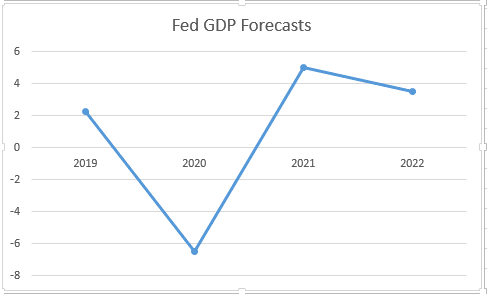
Real GDP -6.5% 5.0% 3.5%
Core PCE 1.0% 1.5% 1.7%
Unemployment 9.3% 6.5% 5.5%

Source: Bloomberg

It is, of course, the 11.5% gain from 2020 to 2021 that encourages the concept of the V-shaped recovery as evidenced by simply plotting the numbers (including 2019’s 2.3% to start).

Screen Shot 2020-06-11 at 9.30.05 AM

So, perhaps the bulls are correct, perhaps the stock market is a screaming buy as growth will soon return and interest rates will remain zero for as far as the eye can see.  There is, however, a caveat to this view, the fact that the Fed is notoriously bad at forecasting GDP growth over time.  In fact, they are amongst the worst when compared with Wall Street in general.  But hey, at least we understand the thesis.

Another interesting outcome of the meeting was the tone of the press conference, where Chairman Jay sounded anything but ebullient over the current economic situation, especially the employment situation.  And it is this takeaway that had the biggest market impact.  After the press conference, equity markets in the US sold off from earlier highs (the NASDAQ set another all-time high intraday) and Treasuries rallied with yields falling again.  In other words, despite the prospect of Forever ZIRP (FZ), equity investors seemed to lose a bit of their bullishness.  This price action has been in place ever since with Asian equity markets all falling (Nikkei -2.8%, Hang Seng -2.3%, Shanghai – 0.8%) and Europe definitely under pressure (DAX -2.1%, CAC -2.2%, FTSE 100 -2.0%).  US futures are also lower with the Dow (-1.9%) currently the laggard, but even NASDAQ futures are lower by 1.1% at this hour.

It should be no surprise that bond markets around the world are rallying in sync with these equity declines as the combination of risk-off and the prospect for FZ lead to the inevitable conclusion that lower long term rates are in our future.  This also highlights the fact that the Fed’s concern over the second part of its mandate, stable prices, has essentially been set aside for another era.  The belief that inflation will remain extremely low forever is clearly a part of the current mindset.  Yesterday’s CPI (0.1%, 1.2% core) was simply further evidence that the Fed will ignore prices going forward.  So, 10-year Treasury yields are back to 0.7% this morning, 20 basis points below last Friday’s closing levels.  In other words, the impact of last Friday’s NFP number has been erased in four sessions.  But we are seeing investors rotate from stocks to bonds around the world, perhaps getting a bit nervous about the frothiness of the recent rallies.  (Even Hertz, the darling of the Robinhooders, is looking like Icarus.)

With risk clearly being jettisoned around the world, it should be no surprise that the dollar has stopped falling, and in fact is beginning to rally against almost all its counterparts.  While haven assets like CHF (+0.2%) and JPY (+0.1%) are modestly higher, NOK (-0.9%) and AUD (-0.85%) are leading the bulk of the G10 lower.  Norway is suffering on, not only broad dollar strength, but oil’s weakness this morning, with WTI -3.1% on the session.  As to Aussie, the combination of weaker commodity prices, the strong dollar, and market technicals as it once again failed to hold the 0.70 level, have led to today’s decline.

Emerging market activity is also what you would expect in a risk-off session, with MXN (-1.6%), ZAR (-1.1%) and RUB (-0.7%) leading the way lower.  Obviously, oil is driving both MXN and RUB, while ZAR is suffering from the weakness in the rest of the commodity complex.  I think the reason that the peso has fallen so much further than the ruble is that MXN has seen remarkable gains over the past month, more than 13% at its peak, and so seems overdue for a correction.  One notable exception to this price action today is THB, which is higher by 0.65% on a combination of reports of a fourth stimulus package and a breach of the 200-day moving average which got technicians excited.

This morning’s data brings the latest Initial Claims data (exp 1.55M), as well as Continuing Claims (20.0M) and PPI (-1.2%, 0.4% core).  While nobody will care about the latter, there will be ongoing intense scrutiny on the former as Chairman Jay made it abundantly clear that employment is the only thing the Fed is focused on for now.  With the FOMC meeting behind us, we can expect to start to hear from its members again, but on the schedule, nothing happens until next week.

It is not hard to make the case that both the euro and pound have been a bit toppish at recent levels, and with risk decidedly off today, further declines there seem quite viable.


Good luck and stay safe

Adf

Unless Lowered Instead

All eyes have now turned to the Fed
As pundits expect Jay will spread
The message that rates,
Until future dates,
Are fixed, unless lowered instead

Most market activity is muted this morning as traders and investors await the latest words of wisdom from Chairman Jay and his compadres. The key questions in the air are:

1. What will the Fed’s new forecasts describe?
2. What will the dot plot (remember that?) look like?
3. Will there be any change in current forward guidance?
4. Will there be any mention of yield curve control (YCC)?

Let’s quickly try to unpack these and see what they mean.

1. The Fed ordinarily updates its economic forecasts quarterly, but wisely, in my view, skipped March’s update given the incredible uncertainty that existed due to the beginnings of the Covid-19 impact. Three months later, the breadth of economic destruction has become clearer, but it will be interesting to learn their current views on the topic. For comparison, last week the ECB forecast a central scenario of Eurozone GDP as follows: 2020 -8.7%, 2021 +5.2%, 2022 +3.3%. The OECD forecast global GDP at -6.0% this year and US GDP at -7.3% this year assuming no second wave of infections. Those numbers fall to -7.6% and -8.5% respectively if there is a second wave of Covid infections. No matter how you slice it, 2020 is set to report negative GDP growth, but the question is, will the Fed demonstrate relative optimism or not?

2. The dot plot, as you may recall, was the biggest issue for a long time, as it was the Fed’s non-verbal way of offering forward guidance. The idea was that each FOMC member would offer his/her own views of the future level of rates and the median forecast was seen as a proxy of the Fed’s views. While it is abundantly clear that the view for 2020 will remain 0.00%, the real question is what the timeline anticipated by the FOMC will be as to when rates can start to rise again. It strikes me that while there will be some divergence, as always, we are likely to see only very gradual increases expressed, with a real possibility that 2021’s median will also be 0.00% and rates only beginning to rise in 2022. This begs the question…

3. How will they proffer their forward guidance? Current language is as follows: “The Committee expects to maintain this target (0.00%-0.25%) until it is confident that the economy has weathered recent events and is on track to achieve its maximum employment and price stability goals.” Current thoughts are they could become more specific with respect to the timeline, (e.g. saying rates would remain at current levels until the end of 2022) or with respect to data (e.g. until Unemployment is at 5.0% and Inflation is back to 2.0%). Of course, the lesson from Chairman Bernanke is that if they go the latter route, they can easily change the level as they see fit. But for now, the longer the timeline, the more confidence that would seem to be imparted. At least, that’s the theory.

4. Finally, there has been a great deal of discussion regarding YCC and whether the Fed will announce a program akin to the BOJ (10-year) or RBA (3-year) where they target a rate on a specific maturity of the Treasury curve. Most analysts, as well as Cleveland Fed President Mester, believe it is too early to make a pronouncement on this subject, but there are those who believe that despite the equity market’s recent frothiness, they may want to step harder on the gas pedal to make sure they keep up what little momentum seems to have started. To me, this is the biggest story of the afternoon, and the one with the opportunity for the most market impact. It is not fully priced in, by any means, and so would likely see a huge rally in both bonds and stocks as the dollar fell sharply if they were to announce a program like this. I like gold on this move as well.

So, plenty to look forward to this afternoon, which explains why market activity has been so limited overall so far today. Equity markets in Asia were barely changed, although in the past few hours we have seen European bourses start to decline from early modest gains. At this point the DAX (-0.8% and CAC (-0.6%) are fully representative of the entire Eurozone space. At the same time, US futures have turned mixed from earlier modest gains with Dow e-minis down 0.3% although NASAAQ futures are actually higher by a similar amount.

Bond markets are generally anticipating something from the Fed as the 10-year has rallied and yields declined a further 3bps which now takes the decline since Friday’s close to 10bps. Bunds and Gilts are both firmer as well, with modestly lower yields while the PIGS are mixed as Greek yields have tumbled 9bps while Spain (+3bps) and Portugal (+4.5bps) see rising yields instead.

And finally, the dollar is definitely on its back foot this morning. In fact, it is lower vs. the entire G10 bloc with Aussie and Kiwi leading the way with 0.5% gains. Right now, the Aussie story looks more technical than fundamental, as it approaches, but cannot really hold 0.70, its highest point in almost a year. But overall, what is interesting about this movement is that despite yesterday’s desultory equity performance and this morning’s modest one as well, the dollar is behaving in a risk-on manner. Something else is afoot, but I have not yet been able to suss it out. I will though!

In the EMG space, the dollar is lower against virtually all its counterparts with IDR as the major exception. The rupiah fell 0.65% last night, actually recouping larger earlier losses at the end of the session, after the central bank explained they would be capping any strength in an effort to help Indonesian exporters. On the plus side is a range of currencies from all three blocs, which is evidence of pure dollar weakness rather than specific positive currency stories.

On the data front, overnight we learned that Chinese PPI was weaker than expected, reflecting weakness in its export markets and not boding well for that elusive V-shaped recovery. We also saw horrific April French IP data (-34.2% Y/Y), but that was pretty much as expected. This morning we get the latest CPI data from the US (exp 0.3%, 1.3% ex food & energy), but inflation remains a secondary concern to the Fed for now. Rather, there is far more focus on the employment data at the Mariner Eccles Building, so really, for now it is all about waiting for the Fed. If pressed, I think they will be more likely to offer some new, more dovish, guidance as it appears they will not want to lose any positive momentum. That means the dollar should remain under pressure for a little while longer.

Good luck and stay safe
Adf

Enough Wherewithal

The Chairman explained to us all
The Fed has enough wherewithal
To counter the outbreak
But, too, Congress must take
More actions to halt the shortfall

The US equity markets led global stocks lower after selling off in the wake of comments from Chairman Powell yesterday morning. In what was a surprisingly realistic, and therefore, downbeat assessment, he explained that while the Fed still had plenty of monetary ammunition, further fiscal spending was necessary to prevent an even worse economic and humanitarian crisis. He also explained that any recovery would take time, and that the greatest risk was the erosion of skills that would occur as a huge swathe of the population is out of work. It cannot be a surprise that the equity markets sold off in the wake of those comments, with a weak session ending on its lows. It is also not surprising that Asian markets overnight followed US indices lower (Nikkei -1.75%, Hang Seng -1.45%, Shanghai -1.0%), nor that European markets are all in the red this morning (DAX -1.6%, CAC -1.7%, FTSE 100 -2.2%). What is a bit surprising is that US futures, at least as I type, are mixed, with the NASDAQ actually a touch higher, while both the Dow and S&P 500 see losses of just 0.2%. However, overall, risk is definitely on its back foot this morning.

But the Chairman raised excellent points regarding the timeline for any recovery and the potential negative impacts on economic activity going forward. The inherent conflict between the strategy of social distance and shelter in place vs. the required social interactions of so much economic activity is not a problem easily solved. At what point do government rules preventing businesses from operating have a greater negative impact than the marginal next case of Covid-19? What we have learned since January, when this all began in Wuhan, China, is that the greater the ability of a government to control the movement of its population, the more success that government has had preventing the spread of the disease. Alas, from that perspective, the inherent freedoms built into the US, and much of the Western World, are at extreme odds with those government controls/demands. As I have mentioned in the past, I do not envy policymakers their current role, as no matter the decision, it will be called into question by a large segment of the population.

What, though, are we now to discern about the future? Despite significant fiscal stimulus already enacted by many nations around the world, it is clearly insufficient to replace the breadth of lost activity. Central banks remain the most efficient way to add stimulus, alas they have demonstrated a great deal of difficulty applying it to those most in need. And so, despite marginally positive news regarding the slowing growth rate of infections, the global economy is not merely distraught, but seems unlikely to rebound in a sharp fashion in the near future. Q2 has already been written off by analysts, and markets, but the question that seems to be open is what will happen in Q3 and beyond. While we have seen equity weakness over the past two sessions, broadly speaking equity markets are telling us that things are going to be improving greatly while bond markets continue to point to a virtual lack of growth. Reading between the lines of the Chairman’s comments, he seems to be siding with the bond market for now.

Into this mix, we must now look at the dollar, and its behavior of late. This morning had seen modest movement until about 6:30, when the dollar started to rally vs. most of its G10 counterparts. As I type, NOK, SEK and AUD are all lower by 0.5% or so. The Aussie story is quite straightforward as the employment report saw the loss of nearly 600K jobs, a larger number than expected, with the consequences for the economy seen as potentially dire. While restrictions are beginning to be eased there, the situation remains one of a largely closed economy relying on central bank and government largesse for any semblance of economic activity. As to the Nordic currencies, SEK fell after a weaker than expected CPI report encouraged investors to believe that the Riksbank, which had fought so hard to get their financing rate back to 0.00% from several years in negative territory, may be forced back below zero. NOK, however, is a bit more confusing as there was no data to see, no comments of note, and the other big key, oil, is actually higher this morning by more than 4%. Sometimes, however, FX movement is not easily explained on the surface. It is entirely possible that we are seeing a large order go through the market. Remember, too, that while the krone is the worst performing G10 currency thus far in 2020, it has managed to rally more than 7% since late April, and so we are more likely seeing some ordinary back and forth in the markets.

One other comment of note in the G10 space was from BOE Governor Andrew Bailey, who reiterated that negative interest rates currently have no place in the BOE toolkit and are not necessary. While the comments didn’t impact the pound, which is lower by 0.25% as I type, it continues to be an important distinction as along with Chairman Powell, the US and the UK are the only two G10 nations that refuse to countenance the idea of NIRP, at least so far.

In the emerging markets, what had been a mixed and quiet session earlier has turned into a pretty strong USD performance overall. The worst performer is ZAR, currently down 0.9% the South African yield curve bear-steepens amid continued unloading of 10-year bonds by investors. But it is not just the rand falling this morning, we are seeing weakness in the CE4 (CZK -0.7%, HUF -0.5%, PLN -0.4%) and once again the Mexican peso is finding itself under strain. While the CE4 appear to simply be following the lead of the euro (-0.35%), perhaps with a bit more exuberance, I think the peso continues to be one of the more interesting stories out there.

Both MXN and BRL have been dire performers all year, with the two currencies being the worst two performers in the past three months and having fallen more than 20% each. Both currencies continue to be extremely volatile, with daily ranges averaging in excess of 2% for the past two months. The biggest difference is that BRL has seen a significant amount of direct intervention by the BCB to prevent further weakness, while MXN continues to be a 100% free float. The other thing to recall is that MXN is frequently seen as a proxy for all LATAM because of its relatively better liquidity and availability. The point is, further problems in Brazil (and they are legion as President Bolsonaro struggles to rule amid political fractures and Covid-19) may well result in a much weaker Mexican peso. This is so even if oil prices rebound substantially.

Turning to data, we see the weekly Initial Claims number (exp 2.5M) and Continuing Claims (25.12M), but otherwise that’s really it. While we have three more Fed speakers, Kashkari, Bostic and Kaplan, on the calendar, I think after yesterday’s Powell comments, the market may be happier not to hear their views. All the evidence points to an overbought risk atmosphere that needs to correct at some point. As that occurs, the dollar should retain its bid overall.

Good luck and stay safe
Adf

Make Hay

The Fed, today’s, finally set
To start to buy corporate debt
Meanwhile the UK
Did start to make hay
With its largest Gilt issue yet

While markets are fairly docile this morning, there are four interesting stories to note, all of which are likely to have bigger impacts down the road.

The first of these emanates from the Mariner Eccles Building in Washington, where the FOMC will begin to implement its Secondary Market Corporate Credit Facility (SMCCF), purchasing its first investment grade bond ETF’s. Ironically, in their effort to stabilize corporate credit markets that are suffering a hangover of excess issuance prior to the Covid-19 crisis, the Fed is going to ramp up margin debt for the purchases. A little ‘hair of the dog’ it seems is the best idea they have. Consider, the process of these purchases is that the Treasury has deposited $37.5 billion into an SPV account which will serve as collateral for that SPV to purchase up to 10x that amount in securities. Talk about speculative! If the SPV purchases its full allotment, then the Fed will effectively be increasing the total amount of margin debt outstanding by nearly 80%. Granted, there is no concern about the Fed being able to pay for these securities in actuality, it’s just the legal questions that may arise if they fall in price by more than 10% and the Fed has actual losses on its balance sheet. Naturally, the idea is that with the Fed buying, there is almost no possibility that prices could fall. However, do not believe that for a moment, just as we have seen in the Treasury market, despite the Fed buying $ trillions worth, bond prices still decline all the time. And don’t forget what we saw in March, when yields rocketed higher for a period of time. Perhaps the most surprising aspect is that US equity futures have been trading either side of flat despite this new money entering the market.

The second interesting story comes from across the pond, where the UK issued gilts via a syndicate for the first time, offering a new 10-year bond and garnering £65 billion pounds of demand, a record amount of attraction. It seems that one of the things that got buyers excited was a comment by BOE Deputy Governor Broadbent hinting that negative rates are not out of the question as the Old Lady seeks to insure sufficient policy support for the economy.

While on the subject of negative rates, it is worth noting that two Fed regional presidents, Bostic and Evans, were both circumspect as to the need for the Fed to ever go down that road. That is certainly good news, but one cannot forget the language change made in September of last year when the Fed stopped referring to the “zero lower bound” and began calling it the “effective lower bound”. Observers far more prescient than this one have noted that the change clearly opens the door for negative rates in the future. There is certainly no indication that is on the cards right now, but it is not an impossibility. Keep that in mind.

From Austria, Herr PM Kurz
Admitted that fiscal transfers
Are what are required
Lest Rome is inspired
To exit, which no one prefers

Another interesting headline this morning comes from Vienna, where Austrian PM Sebastian Kurz explained that the only way Italy can survive is via debt mutualization by the EU, as there is no way they will ever be able to repay their debt. While it is refreshing to hear some truth, it is also disconcerting that in the very next comment, PM Kurz explained there was no way that Austria was comfortable with that course of action. While Austria stood ready to support Italy, they would not take on their obligations. Of course, this is the fatal flaw in the EU, the fact that the Teutonic trio of Germany, Austria and the Netherlands are the only nations that can truly help fund the crisis but are completely unwilling to do so. I once again point to the German Constitutional Court ruling last week as a sign that the euro is likely to remain under pressure for a time to come. While this morning it is now higher by 0.2%, it remains near the bottom of its recent range with ample opportunity to decline further. Beware the ides of August, by which time the ECB will have responded to the court.

And finally, it must be noted that it is raining in Norway. By this I mean that the Government Pension Fund of Norway, the world’s largest wealth fund, is going to be selling as much as $41 billion in assets in order to fund the Norwegian government and its response to the crisis. This is exactly what a rainy-day fund is meant for, so no qualms there. But it does mean that we are going to see some real selling pressure on financial assets as they liquidate that amount of holdings, many of which are in US stocks. NOK, however, has been the beneficiary, rallying 0.8% this morning on the news. Given the krone has been the worst performing G10 currency this year, it has plenty of room to rally further without having any negative economic impacts.

Those are the most interesting headlines of the day, and the ones most likely to have a market impact. However, today, for the first time in a while, there is not much market impact in any markets. Equity prices in Asia were modestly softer, while those in Europe are mixed but edging higher. Bond prices are within a tick or two of yesterday’s closing levels, and the dollar is having a mixed session, although I would estimate that on net it is slightly weaker.

On the data front, it has been extremely quiet overnight with a few Sentiment indicators in France and Japan, as well as the NFIB here in the US, all printing terrible numbers, but none quite as terrible as the median forecasts. My observation is that analysts are now expanding their view of just how bad things are and beginning to overstate the case. As for this morning, we have CPI on the docket, with expectations of a 0.4% headline print and 1.7% core print. While inflation may well be in our future given the combination of monetary and fiscal policy response, it is not in the near future.

Barring some other news story, markets seem pretty happy to consolidate for a change, and I expect that is what we will see today. However, nothing has changed my view that a substantial repricing of risk is still in our future, and with it, a stronger dollar. While we don’t know what the catalyst will be, I have my eye on the ECB response to the German Constitutional Court ruling.

Good luck and stay safe
Adf

The Real Threat

Around the world, government’s fret
Is it safe to reopen yet?
As growth worldwide slows
Each government knows
Elections are now the real threat

The common theme in markets today, the one that is driving asset prices higher, is that we are beginning to see a number of countries, and in the US, states, schedule the easing of restrictions on activity. Notably, in Italy, the European epicenter of the virus, PM Conte is trying to reschedule the return to some sense of normality with the first relief to occur one week from today in the manufacturing and construction industries, followed by retailers two weeks later. Personal services and restaurants, alas, must wait until June 1 at the earliest. While that hardly seems like an aggressive schedule, the forces arrayed on both sides of the argument grow louder with each passing day, neither of which has been able to convince the other side. (This sounds like the Democrats and Republicans in Congress.) But the reality is, there is no true playbook as to the “right” way to do this as we still know remarkably little about the disease, and its true infectiousness. Of course, collapsing the global economy in fear is likely to result in just as many, if not more, victims.

But it’s not just Italy that is starting. In the US, Georgia is under close scrutiny as it begins easing restrictions as of today. New York’s Governor Cuomo is now talking about a phased in reopening of certain areas, mostly upstate NY, beginning on May 15. And the truth is that many states in the US are preparing to reopen sections of their respective economies. The same is true throughout Europe and Asia, as the rolling lockdowns globally have essentially inflicted as much pain as governments can tolerate.

Of course, the real question is, what exactly does it mean to reopen the economy? I think it is fair to say that the immediate future will not at all resemble the pre-virus situation. Even assuming that most personal financial situations were not completely disrupted (and they truly were), how many people are going to rush out to sit in a movie theater with 200 strangers? How many people are going to jump on an enclosed metal tube with recirculated air for a quick weekend getaway? In fact, how many are going to be willing to go out to their favorite restaurant, assuming it reopens? After all, you cannot eat dinner while wearing an N95 mask!

My point is, the upcoming recovery of this extraordinary economic disruption is likely to be very slow. In fact, history has shown that traumatic events of this nature (think the Depression in the 1930’s) result in significant behavioral changes, especially regarding personal financial habits. The virus has highlighted the fragility of many job situations. It has exposed just how many people worldwide live close to the edge with almost no ability to handle a situation that interrupts their employment cashflow. And these lessons are the type that stick. They will almost certainly result in reduced consumption and increased personal savings. And that is almost the exact opposite of what built the global economy since the end of WWII.

With this in mind, it strikes me that the dichotomy we continue to see in markets, where equity investors are remarkably bullish, while bond and commodity investors seem to be planning for a very long period of slow/negative growth, is going to ultimately be resolved in favor of the bond market. No matter how I consider the next several months, no scenario results in that fabled V-shaped recovery.

But perhaps I am just a doom monger who only sees the negatives. After all, a quick look at markets today shows that the bulls are ascendant. Equity markets around the world are firmer this morning as the combination of prospective reopening of economies and additional central bank stimulus have convinced investors that the worst is behind us. Last night, the BOJ, as widely expected, promised unlimited JGB buying going forward. In addition, they increased their corporate bond buying to ¥20 trillion, essentially following in the Fed’s footsteps from two weeks ago. If their goal was to prop up the stock market, then it worked as the Nikkei closed higher by 2.7% helping the rest of Asia (Hang Seng +1.9%, Australia +1.5%) as well. Europe took the baton, and with more policy ease expected from the ECB on Thursday, has seen markets rise between 1.4% (FTSE 100) and 2.4% (DAX). Meanwhile, the euphoria continues to seep westward as US futures are all higher by roughly 1% this morning.

Bond markets, too, are feeling a bit better with Treasuries and bunds both seeing yields edge higher, 2bp and 1bp respectively, while the risky bonds from the PIGS, all see yields fall sharply. Interestingly, commodity markets don’t seem to get the joke, as oil (-15.8%) is under significant pressure. Finally, the dollar is under pressure across the board, falling against all its G10 counterparts with AUD (+1.4%) leading the way on a combination of today’s positivity and some short-term positive technicals. Even NOK (+0.75%) is firmer today despite oil’s sharp decline, showing just how much the big picture is overwhelming market idiosyncrasies.

In EMG space, pretty much the entire bloc is firmer vs. the dollar with ZAR (+1.15%) and HUF (+0.85%) on top of the list. The rand seems to be the beneficiary of the idea that South Africa is set to receive $5 billion from the IMF and World Bank to help them cope with Covid-19 related disruptions. Meanwhile, the forint is seeing demand driven by expectations of the country easing its lockdown restrictions this week. One quick word about BRL, which has not opened as yet. Last week saw some spectacular movement with the real having fallen nearly 10% at its worst point early Friday afternoon as President Bolsonaro’s most important ally, Justice Minister Moro, resigned amid allegations that Bolsonaro was interfering with a corruption investigation into his own son. The central bank stepped in to stem the tide, and successfully pushed the real higher by nearly 3%, but the situation remains tenuous and as Bolsonaro’s popularity wanes, it seems like there is a lot of room for further declines.

On the data front this week, the first look at Q1 GDP will be closely scrutinized, as well as the FOMC meeting on Wednesday and Thursday’s Claims data.

Tuesday Case Shiller Home Prices 3.13%
  Consumer Confidence 87.9
Wednesday Q1 GDP -3.9%
  FOMC Rate Decision 0.00% – 0.25%
Thursday Initial Claims 3.5M
  Continuing Claims 19.0M
  Personal Income -1.6%
  Personal Spending -5.0%
  Core PCE -0.1% (1.6% Y/Y)
  Chicago PMI 38.2
Friday ISM Manufacturing 36.7
  ISM Prices Paid 28.9

Source: Bloomberg

Obviously, the data will be nothing like any of us have ever seen before, but the real question is just how much negativity is priced into the market. In addition, while the Fed is not expected to change any more policies, you cannot rule out something new to goose things further.

In the end, there is no economic evidence yet that the situation is improving anywhere in the world. And while measured cases of Covid-19 infections may be dropping in places, human behaviors are likely permanently altered. This crisis is not close to over, regardless of what the stock markets are trying to indicate. My money is on the bond market view that things are going to be very slow for a long time to come. And that implies the dollar is going to retain its bid as well.

Good luck and stay safe
Adf

Infinite Buying

Is infinite buying
Kuroda-san’s new mantra
If so, will it help?

An interesting lesson was learned, for those paying attention, yesterday after a headline hit the tape about the BOJ. The headline, BOJ Considering Unlimited JGB Purchases, had an immediate impact on the yen’s value, driving it lower by 0.7% in minutes. After all, logic dictates that a central bank that will buy all the government debt available will drive rates, no matter where they are, even lower, and that the currency would suffer on the back of the news. But, as is often the case, upon further reflection, the market realized that there was much less here than met the eye, and the yen recouped all those losses by early afternoon. In fact, over the past two sessions, the yen is essentially unchanged overall.

But why, you may ask, would that headline have been misleading. The key is to recognize that the BOJ’s current policy describes their QQE (Qualitative and Quantitative Easing) as targeting ¥80 trillion per year, equivalent in today’s market to approximately $740 billion. But they haven’t come close to achieving that target since 2017, actually only purchasing about ¥15 trillion last year. That’s a pretty big miss, but a year after they created that target, they began Yield-Curve Control (YCC), which states that 10-year JGB’s will be kept at around a 0.0% yield, +/-0.2%. Now, given that the BOJ already owns nearly 50% of all JGB’s outstanding, there is very little actual trading ongoing in the JGB market, so it doesn’t really move very much. The point is, the BOJ doesn’t need to buy many JGB’s to keep yields around 0.0%. However, they have been concerned over the optics of reducing that ¥80 trillion target, as reducing it might seem a signal that the BOJ was tightening policy. But now, in the wake of the Fed’s announcement that they will be executing unlimited QE, the BOJ has the perfect answer. They can get rid of a target that no longer means anything, while seeming to expand their program. At the same time, when pressed, they will point to their successful YCC and claim they are purchasing everything necessary to keep rates low. And in fairness, they will be right.

Next week it’s the central bank three
Who meet and they’ll try to agree
On proper next steps
(Increasing the PEPP?)
And printing cash like it was free

This was merely a prelude to what the next several days are going to hold, anticipation of the next central bank actions as the three major central banks, BOJ, Fed and ECB, all meet next week. At this point, we have already seen all the excitement regarding the BOJ, and as to the Fed, while they may well announce more details on their efforts to get funds flowing to SME’s, they are already at unlimited QE (and they are active, buying $75 billion/day) and so it seems unlikely that there will be anything else new to be learned.

The ECB, however, is the place where all the action is going to be. Remember, Madame Lagarde was a little slow off the mark, when back in March she stated that the ECB’s job was not to worry about spreads in the government bond market. Granted, within two weeks, after the market crushed Italian BTP’s and called into question Italy’s ability to fund its Covid-19 response, she realized that was, in fact, her only role. And so subsequently we got a €750 billion PEPP program that included Greek debt for the first time. But clearly, based on the recent PMI data, as well as things like this morning’s Ifo Expectations Survey (69.4 vs. exp 75.0), more is needed. So, speculation is now rampant that PEPP will be increased by €250 billion, and that the Capital Key will be explicitly scrapped. The latter is important because that is the driver of which nation’s debt they purchase and is based on the relative size of each economy. But the main problem is Italy, and so you can be sure that the ECB is going to wind up with a lot more Italian debt than would be allowed under the old rules.

Turning back to this week, though, we still have a whole day to traverse before the weekend arrives. Overall, markets are beginning to quiet down, with actual volatility a bit softer than we had seen recently. For example, though equity markets in Europe are lower, the declines are between 0.7% (FTSE 100) and 1.1% (Spain’s IBEX), with the CAC and DAX in between. If you recall, we were seeing daily movement on the order of 2%-5% not that long ago. The same was true overnight, with the Nikkei (-0.9%), Hang Seng (-0.6%) and Shanghai (-1.1%) all softer but by less dramatic amounts. As to US futures, while they were negative earlier, they are actually currently higher by about 0.5%, although we have a long way to go before the opening.

Bond markets are uninspiring, with Treasuries basically unchanged. European markets are a bit firmer (yields lower) across the board as investors try to anticipate the mooted increase in PEPP. And JGB’s are yielding -0.026%, right where the BOJ wants them.

The dollar this morning is now ever so slightly softer, with CAD actually the leading gainer up 0.2%, while the rest of the G10 is +/-0.1%. The Ifo data was the only release of note, although we have seen oil prices rebound slightly, currently higher by about 1.0% helping both CAD and NOK. In the EMG bloc, the story is a bit more mixed, although gainers have had a better day than losers. By that I mean, CZK (+1.35%), HUF (+1.1%) and RUB (+1.0%) have seen stronger gains than the worst performers (INR and KRW both -0.5%). As always, there are idiosyncratic drivers, with CZK seeming to benefit from word that lockdowns are about to ease, while HUF is gaining on the imminent beginning of QE purchases by the central bank. As to RUB, the combination of oil’s continuing rally off its worst levels earlier this week, and the Bank of Russia’s 50bp rate cut, to 5.50%, has investors looking for better times ahead. Ironically, that stronger oil seems to be weighing on the rupee, while the won fell as foreign equity selling dominated the market narrative.

Yesterday’s Claims data was pretty much as expected, granted that was 4.4M, still horrific, but the market absorbed the news easily. This morning brings Durable Goods (exp -12.0%, -6.5% ex transport) and then at 10:00 Michigan Sentiment (68.0). Not surprisingly, expectations are for some of the worst readings in history, but the way the market has been behaving, I think the risk is actually for a less negative data print and a sharp risk rally. Eventually, unless there really is a V-shaped recovery, I do see risk being shed, but it doesn’t seem like today is the day to get started.

Good luck, good weekend and stay safe
Adf
 

Until Covid-19 Is Dead

To those who had thought that the Fed
Was finished, Chair Powell just said
There’s nothing that we
Won’t do by decree
Until Covid-19 is dead

Small Caps? Check. Munis? Check. Junk bonds Fallen angels? Check. These are the latest segments in the credit market where the Fed has created new support based on yesterday’s stunning announcements. All told, the Fed has committed up to $2.3 trillion to support these areas, as well as the trillions of dollars they had already spent and committed to support the Treasury market, mortgage market, and ensure that bank finances remained sufficient for their continued operation and provision of loans and services to the economy.

While the breadth of programs the Fed has announced and implemented thus far is stunning, based on the CARES act passed last week, there is still plenty more ammunition available for the Fed to continue to be creative. Of course, the market reaction was highly positive to these announcements and served to cap off a week where the S&P 500 rose more than 12% from last Friday’s closing levels. In fact, a cynic might suggest that the Fed’s sole purpose is to prop up the equity market, but given the extraordinary events ongoing, I suppose that is merely a happy side effect. At any rate, there is no doubt that the Fed has taken its role as the world’s central bank seriously. Between swap lines and repo facilities for other central banks and purchase programs for virtually every type of domestic asset, Chairman Powell will never be able to be accused of fiddling while the economy burned. And while government programs are notoriously difficult to remove once enacted, based on the ongoing economic indicators, like yesterday’s second consecutive 6.6 million print in the Initial Claims data, it is evident that the Fed is being as aggressive as possible.

There will almost certainly be numerous longer-term negative consequences of all this activity and books will be written about all the ways the Fed overstepped its bounds, but right now, the vast majority of people around the world are hugely in favor of their actions. Anything that supports the economy and population through this period of mandated shutdown is appreciated. While they don’t run polls for popularity of central bank chiefs, I’m pretty confident Chairman Jay would be riding high these days.

In the meantime, there were two other noteworthy stories in the past 24 hours with market impact. The first was that the OPEC+ meeting did not come to agreement yesterday for production cuts totaling 10 million bbl/day as Mexico was the lone holdout, insisting that it would only cut 100,000 bbl/day of production, not the 400,000 bbl/day needed. After 16 hours of video conferencing, the energy leaders postponed any decision and decided to allow today’s G20 FinMin video conference to go forward and help try to break the impasse. It strikes me that Mexico will cave soon on this issue, but for now, nothing is agreed. It is hard to determine how oil markets have responded given essentially all cash and futures markets are closed today for the Good Friday holiday. However, oil futures had not fallen on Thursday afternoon which indicates they, too, believe a deal will be done.

And finally, the EU finally came up with a financing package to address the economic impact of the virus on its members. As was to be expected, it was significantly less than initially mooted and the construct of the deal indicates that there has not yet been any agreement by the Teutonic trio of Germany, Austria and the Netherlands to fund the PIGS. A brief overview of the deal shows the headline figure to be €540 billion made up of three pieces; a joint employment insurance fund (€100B), an EIB supported package designed to provide liquidity to impacted companies (€200B) and a ESM credit line (€240B) to backstop national spending. The problem with the latter is that the European Stability Mechanism is anathema to those nations that need it most like Spain and Italy, because it imposes fiscal conditions on the use of the funds. It is an ECB creation from the Eurobond crisis years by Mario Draghi, but it has never been used. Essentially, the rest of Europe has said to Germany, we may need your money, but we will not become your vassal. And this is exactly why the EU, and its subgroup the Eurozone, will remain dysfunctional going forward.

Thus, when compiling the newest information, the one thing that becomes clear is that the US continues to be the nation most willing to increase spending and liquidity to support its economy. And in the end, it cannot be surprising that the dollar will suffer in that scenario. Back in January, my view was the dollar would decline this year as the US was the economy with the most room to ease policy and that eventually, those much easier conditions would result in a weaker dollar. Well, that is exactly what we are seeing occur right now, as the Fed has upped the ante regarding monetary policy easing relative to the rest of the world at the same time that the broad narrative seems to be evolving into ‘the infection peak has passed and things are going to be better in the future than in the recent past’. Hence, the need to hold dollars as a haven has diminished, and the dollar has responded. For instance, this week AUD has rallied 5.7% while NOK is higher by 3.9%. Clearly both have been buoyed by the rise in oil prices as well as the generally better tone on risk. But the entire G10 bloc is higher, although the yen has gained just 0.1% on the week.

In the EMG space, we see a similar picture with MXN the leader, rallying 6.3%, followed closely by ZAR (5.6%) and HUF (5.2%) as virtually the entire bloc has gained vs. the dollar this week. And the story is identical throughout, a better risk tone and more available USD liquidity relieving pressure on USD borrowers throughout the world.

For the time being, this is very likely to remain the trend, but do not dismiss the fact that the global economy is currently in a very severe recession, and that it will take a long time to recover. During the Great Depression in 1929-1932, after a very sharp initial fall in equity markets, there was a powerful rally that ultimately gave way to a nearly 90% decline. We are currently witnessing a powerful rally, but another decline seems likely given the economic damage that will take years to fix. Meanwhile, the dollar, while under pressure right now, is likely to see renewed demand in the next wave.

Good luck, stay safe and have a good holiday weekend
Adf

PS. FX Poetry will return on Wednesday, April 15.

Outrageous

The ECB’s fin’lly decided
That limits were badly misguided
So, starting today
All bonds are in play
To purchase, Lagarde has confided

As well, in the Senate, at last
The stimulus bill has been passed
Amidst all its pages
The Fed got outrageous
New powers, and hawks were aghast

Recent price action in risk assets demonstrated the classic, ‘buy the rumor, sell the news’ concept as equity market activity in the past two sessions had been strongly positive on the back of the anticipated passage of a huge stimulus bill in the US. And last night, the Senate finally got over their procedural bickering and hurdles and did just that. As such, it should be no great surprise that risk assets are under pressure today, with only much less positive news on the horizon. Instead, we can now look forward to death tolls and bickering about government responses to the quickly evolving crisis. If that’s not a reason to sell stocks, I don’t know what is!

But taking a break from descriptions of market activity, I think it is worthwhile to discuss two other features of the total government response to this crisis. And remember, once government powers are enacted, it is extremely difficult to remove them.

The first is from the US stimulus bill, where there is a $500 billion portion of the bill that is earmarked for support of the business community. $75 billion is to go to shore up airlines and the aerospace infrastructure, but the other $425 billion is added to the Treasury’s reserve fund which they can use to backstop, at a 10:1 leverage ratio, Fed lending. In other words, all of the programs about which we have been hearing, including the CP backstop, the primary dealer backstop, and discussion of purchases of municipal and corporate bonds as well as even equities, will now have the funding in place to the tune of $4.25 trillion. This means that we can expect the Fed balance sheet to balloon toward at least $9 trillion before long, perhaps as quickly as the end of the year. Interestingly, just last year we consistently heard from mainstream economists as well as Chairman Powell and Secretary Mnuchin, how Modern Monetary Theory (MMT) was a crock and a mistake to consider. And yet, here we are at a point where it is now the best option available and about to effectively be enshrined in law. It seems this crisis will indeed be quite transformational with the death of the Austrian School of economics complete, and the new math of MMT at the forefront of the dismal science.

Meanwhile, Madame Lagarde could not tolerate for Europe to be left behind in this monetary expansion and so the ECB scrapped their own eligibility rules regarding purchases of assets to help support the Eurozone member economies. This means that the capital key, the guideline the ECB used to make sure they didn’t favor one nation over another, but rather executed their previous QE on a proportional basis relative to the size of each economy, is dead. This morning the ECB announced that they can buy whatever they please and they will do so in size, at least €750 billion, for the rest of this year and beyond if they deem it necessary. This goes hand in hand with the recent German repudiation of their fiscal prudence, as no measure is deemed unreasonable in an effort to fight Covid-19. In addition to this, the OMT program (Outright Monetary Transactions) which was created by Signor Draghi in the wake of the Eurozone bond crisis in 2012 but never utilized, may have a new lease on life. The problem had been that in order for a country (Italy) to avail themselves of the ECB hoovering up their debt, the country needed to sign up for specific programs aimed at addressing underlying structural problems in said country. But it seems that wrinkle is about to be ironed out as well, and that OMT will finally be utilized, most likely for Italian bonds.

While neither the Fed nor ECB will be purchasing bonds in the primary market, you can be sure that is not even remotely a hindrance. In fact, buying through the secondary market ensures that the bank intermediaries make a profit as well, another little considered, but important benefit of these programs.

The upshot is that when this crisis passes, and it will do so at some point, governments and central banks will have even more impact and control on all decisions made, whether business or personal. Remember what we learned from Milton Friedman, “nothing is so permanent as a temporary government program.”

Now back to market behavior today. It is certainly fair to describe the session as a risk-off day, with equity markets have been under pressure since the beginning of trading. Asia was lower (Nikkei -4.5%, Hang Seng -0.75%), Europe has been declining (DAX -2.3%, CAC -1.8%, FTSE 100 -2.1%) and US futures are lower (SPU’s -1.4%, Dow -1.0%). Meanwhile, Treasury yields have fallen 6bps, and European government bonds are all rallying on the back of the ECB announcement. After all, the only price insensitive buyer has just said they are coming back in SIZE. Commodity prices are soft, with WTI falling 2%, and agriculturals softer across the board although the price of gold continues to be a star, as it is little changed this morning but that means it is holding onto its recent 11% gain.

And finally, in the FX markets, while G10 currencies are all looking robust vs. the dollar, led by the yen’s 1.2% gain and Norway’s continued benefit from recent intervention helping it to rally a further 0.75%, EMG currencies are more mixed. ZAR is the worst of the day, down 0.9% as an impending lockdown in the country to fight Covid-19, is combining with its looming credit rating cut to junk by Moody’s to discourage buying of the currency. We’ve also seen weakness in an eclectic mix of EMG currencies with HUF (-0.35%), KRW (-0.25%) and MXN (-0.2%) all softer this morning. In fairness, the peso had a gangbusters rally yesterday, jumping nearly 3.5%, so a little weakness is hardly concerning. On the plus side, APAC currencies are the leaders with MYR, IDR and INR all firmer by 1.2% on the strength of their own stimulus (India’s $22.6 billiion package) or optimism over the impact of the US stimulus.

Perhaps the biggest thing on the docket this morning is Initial Claims (exp 1.64M) which would be a record number. But so you understand how uncertain this forecast is, the range of forecasts is from 360K to 4.40M, so nobody really has any idea how bad it will be. My fear is we will be worse than the median, but perhaps not as high as the 4.4M guess. And really, that’s the only data that matters. The rest of it is backward looking and will not inform any views of the near future.

We have seen two consecutive days of a risk rally, the first two consecutive equity rallies in more than a month, but I expect that there are many more down days in our future. The dollar’s weakness in the past two sessions is temporary in my view, so if you have short term receivables to hedge, now is a good time. One other thing to remember is that bid-ask spreads continue to be much wider than we are used to, so do not be shocked when you begin your month-end balance sheet activity today.

Good luck and stay safe
Adf


Truly a Beast

The PMI data released
Showed just how fast growth has decreased
Tis services that
Have fallen so flat
This virus is truly a beast

But yesterday two bits of news
May help prevent any more blues
The Fed started things
By spreading their wings
And buying all debt that accrues

As well, in a break from the past
The Germans decided at last
To open the taps
As well as, perhaps
Support debt Italians amassed

And finally, where it began
The virus, that is, in Wuhan
Two months from their dawn
Restrictions are gone
Defining the lockdown’s lifespan

Markets have a much better tone this morning as traders and investors react to two very important responses to the ongoing Covid-19 crisis. The first thing that is getting a positive, albeit delayed, response is the Fed’s enactment of a series of new programs including support for CP, mortgage-backed securities, primary dealers and money market funds as well as embarking on QE Infinity, buying $75 billion of Treasuries and $50 billion of mortgage-backed securities every day this week, and then on into the future. Previous concerns about the size of the Fed’s balance sheet relative to the US economy have been completely dismissed, and you can bet that we will soon see a Fed balance sheet with $10 trillion in assets, nearly 50% as large as the economy. But the announcement, while at first not getting quite the positive impact desired, seems to be filtering through into analysis and is definitely seen in a more positive light this morning than yesterday at this time.

The second piece of news was that not only is Germany going to embark on a €750 billion spending program to help the economy, but, more importantly, they are willing to support Italy via European wide programs like the European Stability Mechanism, and even jointly issued coronaviru bonds, to prevent a further catastrophe there. In truth, that seems to be a bigger deal than the Fed, as the long-term implications are much greater and point to a real chance that the European experiment of integration could eventually work. If they move down the path to jointly issue and support debt available to all members, that is a massive change, and likely a long term positive for the single currency. We have to see if they will actually go forward, but it is the most promising structural comment in Europe in years, perhaps even since the euro was formed.

However, we cannot forget that the current reality remains harsh, and were reminded of such by this morning’s Flash PMI data, which, unsurprisingly, fell to record lows throughout Europe and the UK. Services were hit much harder than Manufacturing with readings of 29.0 in France, 34.5 in Germany, 31.4 in the Eurozone and 35.7 in the UK. Japan also released their data, which was equally dismal at 32.7 for Services PMI there. And they added to the story by releasing Department Store Sales, which fell a healthy 12.2%. Of course, everyone knows that the data is going to be awful for the time being, and since we saw China’s PMI data last month, this was expected. Granted, analysts had penciled in slightly higher numbers, but let’s face it, everybody was simply guessing. Let’s put it this way, we are going to see horrific data for at least the next month, so it will have to be extraordinarily bad to really garner a negative market reaction. This is already built into the price structure. While the US has historically looked far more closely at ISM data, to be released next week, than PMI data, we do see the US numbers later this morning, with forecasts at 42.0 for Services and 43.5 for Manufacturing.

So the data is not the driver today, which has seen a more classic risk-on framework, rather I think it is not only the absorption of the Fed and German actions, but also, perhaps, the news from Wuhan that the restrictions on travel, imposed on January 23, are being lifted, nearly two months to the day after imposition. Arguably, that defines the maximum lockdown period, although yesterday President Trump hinted that the US period will be much shorter, with 14 or 15 days mooted. If that is the case, and I would place the start date as this week, we are looking at heading back to our offices come April 6. If the Fed is successful in preventing financial institution collapse, and Congress finally passes a stimulus bill to address the massive income dislocation that is ongoing, (which they will almost certainly do in the next two days), there is every chance that while Q2 GDP will be hit hard, the panic inducing numbers of -30% GDP growth (Morgan Stanley’s forecast) or -50% GDP growth (St Louis Fed President Bullard’s forecast), will be referred to as the height of the panic. We shall see.

But taking a look at markets this morning, we see the dollar under pressure across the board, with the Norwegian krone today’s champion, rallying 5.4% as a follow on to yesterday’s reversal and ultimate 1.2% gain. But the pound has bounced 2.0% this morning along with SEK and AUD is higher by 1.7%. It is entirely possible that what we are seeing is a relief in the funding markets as the Fed’s actions have made USD available more widely around the world and reduced some of that pressure.

EMG markets are seeing similar strength in their currencies, led by MXN (+2.6%) and HUF (+2.3%), but every currency in both blocs is higher vs. the greenback today. Equity markets are all green as well, with major rallies in Asia (Nikkei +7.1%, Hang Seng +4.5%, Shanghai +2.7%) and Europe (DAX +6.25%, CAC +5.25%, FTSE 100 +4.0%) with US equity futures limit up in all three indices. Bonds, meanwhile, have sold off slightly, with yields higher in both the US and Germany by 2bps. I think given the overall backdrop, bonds are unlikely to sell off sharply anytime soon, especially given the central bank promises to buy unlimited quantities of them.

And I would be remiss if I didn’t mention gold, which is up 2.5% today and 6.2% since Friday’s close as investors realize that all the money printing and fiscal stimulus is likely to lead to a much different view on inflation, namely that it is going to rise in the future.

Volatility remains the watchword as 5% daily moves in the equity market, even when they are up moves, remain extremely taxing on all trading activities. Market liquidity remains suspect in most markets, with bid-ask spreads still far wider than we’ve come to expect. Forward FX spreads of 5-10 pips for dates under 1 year are not uncommon in the majors, let alone in things like MXN or BRL. Keep that in mind as you prepare for your balance sheet rolling programs later this week.

Good luck and stay safe
Adf

Has Panic Subsided?

This morning a look at the screen
Shows everything coming up green
Has panic subsided?
Or is it misguided
To think that a bottom’s been seen?

It certainly feels less frightening in markets this morning as assets of all nature, equity, commodity and fixed income, are rallying nicely and the panic buying of dollars seems to have ended for the time being. Of course, this is an interesting outcome if one reads the news, given that virus stories have not only continued apace, but the statistics and government responses are getting more draconian. Arguably, the biggest story is that the entire state of California, with its population of 40 million, has been put on lockdown, with stay-at-home restrictions imposed by the Governor. By itself, California is, famously, the fifth largest economy in the world, just ahead of the UK, so the idea that economic activity there is going to come screeching to a halt cannot be seen as a positive. At least not in the short term. In addition, virus related deaths in Italy have now surpassed those from China, and further personal restrictions are being contemplated by PM Conte in order to get a handle on the situation. Thus, the fact remains that Italy is in dire straits from an economic perspective, again at least in the short term. Yet the FTSE MIB (the main Italian stock market index) is higher by 3.8% as I type this morning.

This all begs the question, why are markets reversing course from what has been several hellacious weeks of price declines? Let’s consider a few possible reasons:

It could be that the combination of expanded central bank and government activity around the world has finally achieved a point where investors believe that apocalyptic scenarios overstate the case.

While this is possible, it seems a bit far-fetched to believe that in the course of 36 hours, investors have suddenly decided to accept all the actions, and there have been many, have done the job.

A recap of the major actions shows:
• ECB creates €750 billion PEPP as additional QE measures
• Fed extends USD swap lines to 9 additional central banks to allow USD liquidity to reach all G10 nations and several more developed EMG nations like South Korea
• Fed creates money market fund liquidity backstop to insure that CP issuance by US corporates is able to continue and companies are able to fund operations
• BOJ added ¥5.3 trillion in liquidity to markets while snapping up ¥201 billion of new ETF’s
• RBA cut rates by 0.25%, added new liquidity to markets and started a QE program to control the 3-year AGB at a rate of 0.25%

There is no question that this is an impressive list of actions put into place in very short order which demonstrates just how seriously governments are taking the Covid-19 outbreak. And this doesn’t include any of the fiscal stimulus packages which either have been enacted or are on the cusp of being so. In fact, a total of 31 central banks around the world have cut rates, added liquidity or started QE programs in the past week in order to stem the tide. (I have to add that the Danish central bank actually raised its base rate by 0.15%, to -0.60%, yesterday morning in a truly shocking move. Apparently there was growing concern that with the ongoing problems in Italy, investors were flocking to DKK from EUR and driving that cross, which the central bank uses as its monetary benchmark, strongly in favor of the krona. In this instance, strongly represents a 3.5 basis point move, which has since been reversed.) And perhaps the market is telling us, they’ve done enough. But I doubt it.

Remember, the problem is not financial at its heart, it is a medical issue and efforts to contain the virus remain only partially effective thus far. The medical news, however, continues to get worse, at least in Europe and the US, as the caseload continues to increase rapidly, as well as the death toll, and governments are imposing stricter and stricter regulations on the population. So along with California’s action, New York has mandated that no more than 25% of a company’s workforce is allowed to work at the office (at SMBC we are below 15%), while New Jersey has closed all personal service businesses, like hair salons, exercise facilities and tattoo parlors. And these are just the most recent ones that I have seen because of where I live and work. I know there are countless measures throughout the US and Europe. And all of those measures inflict significant pain on the economy.

Yesterday’s Initial Claims number jumped to 281K, significantly higher than model forecasts, but just a fraction of what we are likely to see going forward as small service businesses like restaurants and hair salons and so many others are forced to close for now and cannot afford to continue paying their staff. Hence I’ve seen estimates that we could see those numbers jump as high as 2 million! So while it is not an economic or financial condition at its heart, it is certainly having that impact.

A second thought, one which I think has more substance to it is that during the past three weeks we have seen a substantial amount of position liquidation by highly leveraged fund managers who were forced to sell assets (or cover shorts) at ANY price due to margin calls. The only way to get market movements of 5%-10% or more is to have market participants be price insensitive. In other words, sales (short covers) were mandated, not by choice. However, once those positions are closed, and the evidence is that most have been so, markets revert to price discovery in the normal fashion, with buyers and sellers putting their money to work based on views of the asset. So while there is still significant trepidation by investors, my gut tells me that we have seen the worst of the financial market activity and volatility. It will still be quite a while before things truly settle down, and there is every chance that as the economic data comes over the next weeks and months and shows just how badly things were impacted, we will see sharp market downdrafts. So I am not calling a bottom per se, but think that going forward it will be less dramatic than we have seen during the first three weeks of March.

A quick recap of this morning’s markets shows equity markets around the world higher, with many substantially so (CAC +5.1%, DAX +4.2%, Hang Seng +5.0%); government bond markets also rallying nicely with yields almost everywhere falling (Treasuries -14bps, Gilts -14bps, Bunds -9bps); commodity prices rallying virtually across the board (WTI +2.4%,Copper +1.7%, Gold +2.3%); and finally, the dollar selling off virtually universally, with some of the worst recent performers regaining the most. So KRW (+3.0%), AUD (+2.6%) and GBP (+2.3%) are all unwinding some of the excess movement we saw in the past weeks. If I am correct and the worst has passed, I expect the dollar will cede more of its recent gains. However, given my timeline of May, I expect it will be another month before we see that in any material way. So, if you are a payables hedger, these are likely to be some of the best opportunities you are going to see for quite a while. Don’t miss out!

Good luck, good weekend and please all stay safe and socially distant
Adf