
You Need to Squint

While data continues to print
It doesn’t give much of a hint
To where things are going
Unless you’re all-knowing
And even then, you need to squint
 
The reason for this situation
Is passive flows constant inflation
No matter the news
Or anyone’s views
The target funds need their proration


The hardest thing about macroeconomic analysis is trying to discern whether it has any impact on market movement.  For the bulk of my career, my observation was that while there were always periods when flows dominated fundamentals, they were short-lived periods and eventually those fundamentals returned to dominance in price action.  This was true in equity markets, where earnings were the long-term driver, outlasting short-term bouts or particular manias and this was true in FX markets, where economic performance and the ensuing interest rate differentials were the key long-term driver of exchange rates.  Bond markets were virtually always a reflection of inflation expectations, at least government bond markets and commodities were simple products of supply and demand of the physical stuff.

Alas, since the GFC, and more importantly, the global central bank response to the GFC, flooding financial markets with massive amounts of liquidity, G10 economies have become increasingly finanicialized to the point where the underlying fundamentals have less and less impact and funds flows are the driving force.  The below chart I have created from FRED data shows the ratio of M2 relative to GDP.  For decades, this ratio hovered between 53% and 60%, chopping back and forth with the ebbs and flows of the economy during recessions and expansions.  But the GFC changed things dramatically and then the pandemic and its ensuing response put financialization on steroids.
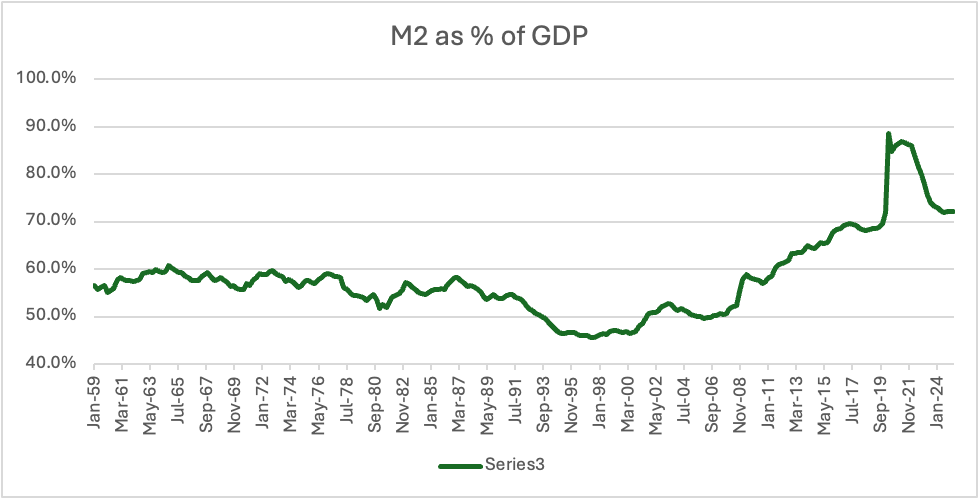
By 2011, this ratio hit 60% for the first time since 1965, and it has never looked back.  The result is that there is ever more money sloshing around the economy looking for a home with the best return.  This is part and parcel as to why we have seen both massive asset price inflation as well as consumer price inflation, too much money chasing too few goods.  And this is the underlying facet in why funds flows, whether between asset classes or between nations, are the new driving force of market price action.  Michael Green (@profplum99 on X) has done the most, and most impressive, work on the rise of passive investing, which is a direct consequence of this financialization.  The upshot is, as long as money comes into the system (your semi-monthly 401K flows are the largest) they continue to buy stocks regardless of anything fundamental.  And as almost all of it is capitalization weighted, they buy the Mag7 and maybe some other bits and bobs.  It doesn’t matter about fundamentals; it only matters how much they have to buy.

So, with that caveat as to why fundamental macro analysis has been doing so poorly lately, a look at the data tells us…nothing really.  As I wrote yesterday, the two main blocs of the economy, goods production and services production, are out of sync, with marginal strength in services outweighing marginal weakness in goods production and resulting in slow growth.  Whether you look at the employment situation, the ISM data or the inflation data, none of it points in a consistent and strong direction.

For instance, yesterday’s productivity and Labor cost data were better than expected, far better than last quarter’s and pointing to an improved growth outcome.  However, if we look at the past five years of this data, we can see that labor costs have grown dramatically faster than productivity as per the below chart (ULC in grey, Productivity in blue).

Source: tradingeconomics.com

Looking at this, it is no surprise that price inflation has risen so much, given labor’s impact on prices.  But, again, this is merely another impact of the massive flow of money into the economy over the past 15 years. 

Virtually every piece of data we get has been significantly impacted by this financialization which is one reason that previous econometric models, built prior to the GFC, no longer offer effective analysis.  The system is very different.  I continue to believe that over time, fundamentals will reassert themselves, but that belief structure is under increased pressure.  Perhaps YOLO and BTFD are the future, at least until our AI overlords come into their own and enslave the human population.

In the meantime, let’s look at what happened overnight.  Yesterday’s mixed, and relatively dull, US session was followed by a mixed session in Asia with Tokyo (+1.85%) soaring on news that there were going to be adjustments, in Japan’s favor as well as rebates, to the tariff schedule.  However, both the Hang Seng (-0.9%) and CSI 300 (-0.3%) saw no such love from either the Trump administration or investors.  As to the rest of the region, red (Korea, Australia, India, Thailand, Singapore) was more common than green (Malaysia).  Apparently, tariff adjustments are not universal.  In Europe, both Spain (+0.8%) and Italy (+0.8%) are having solid sessions but they are alone in that with the other major bourses (DAX 0.0%, FTSE 100 0.0%, CAC +0.2%) not taking part in the fun.  US futures, at this hour (7:30) are higher by about 0.4%.

Bond markets, meanwhile, are sleeping through the final day of the week, with Treasury yields unchanged on the day and European sovereign yields having edged higher by just 1bp across the board.  It seems, nobody cares right now.  After all, it is August and most of Europe is on vacation anyway.

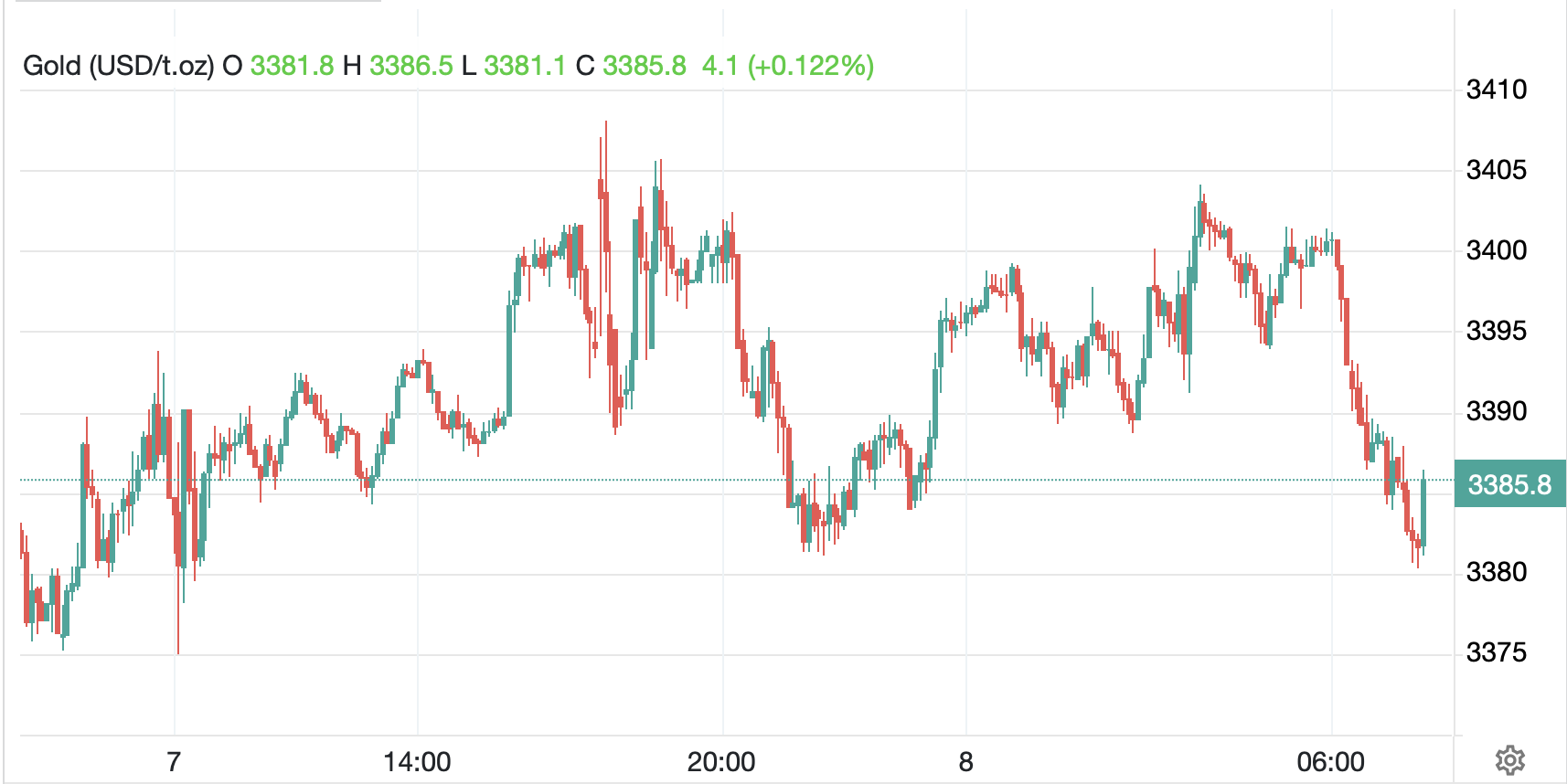
Commodity markets are showing oil (+0.6%) bouncing off its recent lows, but this seems more about trading activity than fundamental changes.  Perhaps there will be a Russia-Ukraine peace, but it is certainly not clear.  Trump’s tariffs on India for continuing to buy Russian oil are also having an impact, but as I showed yesterday, I believe the trend remains modestly lower.  Gold (-0.3%) is currently lower but has been extremely choppy as you can see from the 5-minute chart below
Source: tradingeconomics.com

This is a market where supply and demand dynamics have been impacted by both tariffs and the interplay between financialized markets (i.e. paper gold or futures) and the actual metal.  There are many theories as to different players trying to manipulate the price either higher (the Trump administration in order to revalue Ft Knox holdings) or lower (the ‘cabal’ of banks that have ostensibly been preventing the price from rising according to the gold bug conspiracy theorists).  Recently, there has apparently been less central bank demand, but that can return at any time based on political decisions.  I continue to believe that it is an important part of any portfolio, but it should be tucked away and forgotten in that vein.  As to the other metals, they are little changed this morning.

Finally, the dollar is stronger this morning, as the euro (-0.3%) and yen (-0.65%) are both under pressure and leading the way.  In fact, virtually every G10 currency is weaker (CAD is unchanged) and yet the DXY seems to be weaker as well. Something is amiss there.  Meanwhile, EMG currencies are mostly down on the session with KRW (-0.5%) the laggard, but weakness in INR (-0.2%), PLN (-0.25%) and CZK (-0.25%). 

On the data front, there is none today.  Yesterday, Atlanta Fed president Bostic explained his view that only one rate cut was likely this year, which is not what we have been hearing from other FOMC members.  Obviously, there is still uncertainty at the Fed, but they also have more than a month to decide.  Today, we hear from KC Fed president Alberto Musalem, one of the more hawkish members, so it will be interesting to see if he has changed his tune.

I would contend that confusion is the driving force in markets because data markers are not pointing in one direction nor are Fed speakers.  But it is a Friday in August so I suspect it will be a quieter day as traders look to escape to the beach for the weekend.  This morning’s trends, a higher dollar and higher stock prices, seem likely to prevail for the day.

Good luck and good weekend

Adf

Faded Away

It started when Trump hinted that
The capital gains tax was at
A rate much too high
And cuts were close by
His words, thus, a rally begat

Then Germany joined in the fray
As data from their ZEW survey
Exploded much higher
Now stocks are on fire
While havens have faded away

It used to be that you could determine the nature of a nation’s government by their response time to major events. So, autocratic nations were able to respond extremely quickly to negative events because a single man (and it was always a man) made the decisions and those who didn’t follow orders found themselves removed from the situation. Conscientious objection was not a viable alternative. Meanwhile, democratically elected governments always took more time to react because the inherent nature of democratic debate was slow and messy, with everyone needing to make their case, and then a majority formed to move forward.

This broad view of government decision-making was generally true for as long as economies were based on the production of real goods and services. However, that economic model has been essentially retired and replaced by the new concept of financialization. This is the process by which private actors recognize there is more value to be obtained (and with less risk!) if they spend their time and effort re-engineering their balance sheet rather than investing in their underlying business.

The upshot of the financialization of economies is that government response times to crises have been shortened remarkably. (It is important to understand that in this context, central banks, despite their “independence”, are part of the government). So, now even democratically elected governments can respond with alacrity to ongoing crises. This begs the question of whether democratically elected governments have become more autocratic (lockdowns anyone?), or whether this is simply the natural evolution of the democratic process when combined with media tools like Facebook and Twitter, where responses can be formulated and disseminated in minutes.

At any rate, the key observation is that government officials everywhere have taken the combination of financialization and high-speed response quite seriously, and we now get policies floated and implemented in a fraction of the time it used to take. The main reason this can be done is because policies that address financial questions are much easier to implement than policies that address production bottlenecks. After all, it is a lot easier for the Fed to decide to buy Fallen Angels than it is for 535 people, many of whom hate each other, to agree on a package of policies that might help support small businesses and shop owners.

This has been a build-up to help understand the key theme today: risk is back!! Or perhaps, the proper statement is risk-on is back. Last evening, President Trump floated the idea that a capital gains tax cut was just the remedy to help the US economy get back on its feet. But the reality is that the only thing a capital gains tax cut will accomplish is to help boost the stock market further. After all, the S&P 500, after yesterday’s modest 0.3% rally, is still 1.0% below its all-time high. Such lagging performance cannot be tolerated apparently, hence the genesis of this idea. But it was enough to achieve its goal, a further boost in equity markets worldwide.

A quick look at markets overnight shows the Nikkei (+1.9%) and Hang Seng (+2.1%) followed the bullish sentiment, although surprisingly, Shanghai (-1.1%) could not hold onto early gains. Even with that decline, the Shanghai Composite is up more than 5% in the past two weeks, hardly a true laggard. Meanwhile, Europe has really taken the bit in its teeth and is flying this morning, getting a good start from the Asian movement and then responding extremely positively to the German ZEW survey results where the Expectations component printed at 71.5, its highest level since December 2003. So, despite the growth in Covid cases in Germany, the business community is looking forward to robust times in the near future. This was all equity traders and investors needed to see to get going and virtually every European bourse is higher by more than 2.2% this morning. Of course, it would not be a successful outcome if US markets didn’t rise as well, and futures this morning are all green, pointing to between 0.5% (NASDAQ) and 1.0% (DJIA) gains on the opening.

Naturally, the risk on environment has resulted in Treasury bond sales. After all, there is no need to own something as pedantic as a bond when not only are stocks available, but the tax rate on your gains is going to be reduced! And so, 10-year Treasury yields have risen 3bps this morning, and are back at 0.60%, 10bps higher than the new lows seen just one week ago today. And that price behavior is common amongst all European government bond markets, with German bund yields higher by 3.3bps and UK gilts nearly 4bps higher.

But the biggest victim of this move has clearly been gold, which has tumbled 2% this morning and is back below $2000/oz for the first time in a week. There is no question that precious metals markets have been getting a bit frothy, so this pullback is likely simple profit taking and not a change in any trend.

Finally, as we turn to the dollar, the risk-on attitude is playing out in its traditional fashion this morning, with the buck falling against 9 of its G10 counterparts with only the yen weaker versus the dollar. NOK (+0.8%) is the big gainer, rallying on the back of the ongoing rally in oil prices (WTI +2.5%), but we are seeing solid gains of roughly 0.4% across most of the rest of the bloc. The one laggard, aside form JPY (-0.14%), is the pound where the UK released employment data today that simply demonstrated how difficult things are there. This seems to have held the pound back as it is only higher by 0.2% this morning.

In the EMG space, RUB and ZAR (both +0.8%) are the leaders with the former clearly an oil beneficiary, while the latter, despite gold’s decline, has been the beneficiary of the hunt for yield as South Africa continues to have amongst the highest real yields in the world. But pretty much the whole bloc is in the green today as the simple concept of risk-on is the driver.

On the data front, the NFIB Small Business Index disappointed at 98.8, a clear indication that a capital gains tax cut does not seem to be the best solution for the economy. At 8:30 we get PPI (exp -0.7% Y/Y, +0.1% Y/Y core) but not only is this data backwards looking, the Fed has basically told us they don’t care about inflation at all anymore. We also hear from two Fed speakers, Barkin and Daly, but again, there is very little new that is likely to come from their comments.

Today is a risk-on day and after a brief consolidation, the dollar feels like it has further room to decline. Versus the euro, I imagine a test of 1.20 is coming soon, but it is not clear to me how much further we can go from there. As such, for receivables hedgers, adding a little to the mix at current levels is likely to be a good strategy.

Good luck and stay safe
Adf

Values Debase

It used to be bonds were so boring
That talk induced yawning and snoring
But Covid-19
Is now on the scene
And bonds are the asset that’s soaring

Meanwhile in the equity space
Investors are having a race
To see who has sold
Their stocks and bought gold
As equity values debase

It’s important to understand that Covid-19 is not the cause of the current hysteria in financial markets, it is merely the catalyst that revealed the underlying problems. Arguably, the most critical of these problems, excess leverage, has been building since the financial crisis response in 2009. In fact, it was an explicit part of the response package, cut rates to zero to encourage more borrowing. The unseen, at the time, problem with this strategy, however, is that the vicious cycle virtuous circle that resulted, where investors chasing yield moved up the risk ladder thus encouraging the issuance of more and more risky securities, seems to be reaching its denouement. Welcome to today’s volatility!

Briefly, financialization of the economy has been growing aggressively since the financial crisis. This is the process whereby the corporate sector spends more time and money on managing the balance sheet than on delivering products or services. Thus, banking and financial services grow relative to total economic output. In essence, we produce less stuff but pay more for it. And yes, that is the definition of inflation, which is exactly what we have seen in financial markets. It has just not (yet) appeared in measured inflation indices, as they don’t include stock prices. Financialization has manifested itself in the massive equity repurchase programs, funded by record-breaking issuance of corporate debt, which has been instrumental in driving equity markets to record highs. But when more money is spent on equity repurchase than on R&D, it bodes ill for the longer term. Perhaps Covid-19 is the catalyst that will help us understand the long term has arrived.

As the global economy now is trying to address both a supply and demand shock to the system simultaneously, investors have collectively decided that risk is not as tasty as it was just a few weeks ago. And while many have warned that when this market turned, it would be dramatic, I don’t believe the type of movements possible were well understood. I’m guessing they are a little better understood today.

This process has further to run, regardless of what the central banks or government leaders do or say. Markets that have rallied for ten years do not correct in ten days. It will take much longer and there will be many unforeseen movements by different asset classes going forward.

In fact, the dollar is going to be quite interesting throughout this process. I maintain that its current decline is entirely a result of the market repricing the US rate outlook. Futures markets are currently pricing in another 50bp rate cut by the Fed a week from Wednesday, with a further 37bps by the end of the summer. That is significantly more cutting than is being priced for the ECB (just 10bps) and the BOJ (also 10bps). In other words, as interest rate spreads between the dollar and other G10 economies compress, it is no surprise to see the dollar decline. In fact, this was the genesis of my views at the beginning of the year and what underpinned my calls for the euro to trade to 1.17, the yen to 95 and the pound to 1.40. Of course, I didn’t anticipate anything like this, rather a much more gradual approach.

However, the dollar is also still seen as one of the safest places to be, with Treasury bonds the ultimate safe haven today and one needs dollars to buy Treasuries. The rally in the bond market has been extraordinary with the 10-year falling another 15bps today to yet another new record low. It actually traded below 0.70% briefly this morning but sits at 0.76% as I type. And that is true across the Treasury curve. While other bond markets globally have seen rates decline, nothing has matched the Treasury performance. (And for those of you who did not understand how Greek 10-year yields could trade below US yields, that is no longer the case!)

Meanwhile, havens like the yen (+0.9% today, +6.1% in the past two weeks) and CHF (+1.05% today, 4.9% in two weeks) are the stars of the FX markets. In fact, this bout of risk aversion is beginning to approach what we saw in 2008 and 2009. Today, the dollar is the total underperformer in the G10 space, but that is not the case in the EMG space. There, MXN is the disaster du jour, down 2.1% as it is impacted by the collapse in oil prices, the uptick in coronavirus cases and its reliance on the US, which appears to be heading toward much slower growth, if not a recession. But BRL is lower by 1.0%, and we are seeing most of the APAC and LATAM currencies falling this morning. CE4 currencies are benefitting from their proximity to the euro, but I expect that will change as time passes.

Into all this excitement, we bring this morning’s payroll report with the following expectations:

Nonfarm Payrolls 175K
Private Payrolls 160K
Manufacturing Payrolls -3K
Unemployment Rate 3.6%
Average Hourly Earnings 0.3% (3.0% y/Y)
Average Weekly Hours 34.3
Participation Rate 63.4%
Trade Balance -$46.1B

Source: Bloomberg

The thing is, all this took place before Covid-19, so all it can do is give us a final benchmark as to how things were prior to the virus spreading. If we get a bad number, that will be a real problem.

It is hard to overstate just how fragile this market is right now, with liquidity significantly impaired, bid-ask spreads widening and options volatilities rising sharply. Patience is a true virtue in these conditions and leaving orders at levels can be very effective. I maintain that the dollar’s weakness will not be a permanent feature, but rather a transient situation until the rate situation stabilizes. So, receivables hedgers, leave orders to layer into your strategies, it will pay off over time.

Good luck and good weekend
Adf

Just Look What You’ve Wrought!

On Monday it seems we all thought
That crises were sold and not bought
On Tuesday we learned
Those sellers got burned
Chair Powell; just look what you’ve wrought!

hubris: noun
hu·bris | \’hyü-brƏs \
Definition of hubris : exaggerated pride or self-confidence
Example of hubris in a sentence
//It takes remarkable hubris to survey the ongoing situation regarding the 2019-nCoV virus and decide that Monday’s 1.5% decline in the S&P 500 was a buy signal.

I saw a note on Twitter this morning that really crystalized the current market condition. All prices are based on flow, not value. It is a fool’s errand to try to determine what the underlying value of any financial asset is these days, as it has no relevance regarding the price of that asset. This is most evident in the equity markets, but is equally true in the currency markets as well. So for all of us who are trying to determine what possible future paths are for market movements, the primary focus should be on how favored they are, for whatever reason, compared to the rest of the investment universe. In fact, this is the key outcome of the financialization of the global economy. And while this is just fine, maybe even great, when flows are driving equity prices, and other assets, higher, it will be orders of magnitude worse going the other way.

But the bigger issue is the financialization of the economy. Prior to the financial crisis and recession of 2008-2009, there seemed to be a reasonable balance between finance and production within the global economy. In other words, financial questions represented a minority of the impact on how companies were managed and on how much of anything was produced. This balance, which I would have put at 80% production / 20% finance, give or take a nickel, was what underpinned the entire economics profession. Finance was simply a relatively small part of every productive endeavor with the goal of insuring production could continue.

But in the wake of that recession, the fear of allowing massively overpriced markets to actually clear resulted in central banks stepping in and essentially taking over. The initial corporate reaction was to take advantage of the remarkably low interest rates and refinance their businesses completely. The problem was that since markets never cleared, there was still a dearth of demand on an overall basis. This is what led to a decade of subpar growth. Remember, the average annual GDP growth in the decade following the GFC was about 1.5%, well below the previous decade’s 3.0%. At the same time, the ongoing shortening of attention spans, especially for investors, forced corporate management to figure out how to make more money. Unfortunately, the fact that slow GDP growth prevented an actual increase in profits forced senior management to look elsewhere. And this is when it quickly became clear that levering up corporate balance sheets, while ZIRP and NIRP were official policy, made a great deal of sense. If a company couldn’t actually make more money, it sure could make it seem that way by issuing debt and buying back stock, thus reducing the denominator in the key metric, EPS.

And that is where we are today, in an economy that continues to grow at a much slower pace than prior to the financial crisis, but at the same time allows ongoing growth in a key metric, EPS, through financial engineering.

Which brings me back to the idea of flow. It is financial flows that determine the future paths of all assets, so the more money that is made available by the central banking community (currently about $100 billion per month of new cash), the higher the price assets will fetch. Let me say that they better not stop providing that new cash anytime soon.

With that as a (rather long) preamble, today’s market discussion is all about the Fed. This afternoon at 2:00 we will get the latest communique and then Chairman Powell will meet the press at 2:30. Current expectations are for no policy changes although there seems to be a growing view that the ongoing coronavirus situation, and its likely negative impact on Chinese/global GDP growth, will force a more dovish hue to both the statement and the press conference. Remember, the Fed is currently going through a major policy review, similar to that of the ECB, as they try to determine what tools are best to manage the economy achieve their mandated goals going forward. Given that ongoing policy review, it would take a remarkable catalyst to drive a near-term policy change, and apparently a global pandemic doesn’t rise to that standard.

Oh yeah, what about that coronavirus? Well, the death toll is now above 130, and the number of cases is touching 10,000, far more than seen in the SARS outbreak of 2003. (And I ask, if so many are skeptical of Chinese economic data, why would we believe that this data is accurate, especially as it would not reflect China in a positive light?) At any rate, while the Hang Seng fell sharply last night, its first session back since last week, the rest of the global equity market seems pretty comfortable. And hey, Apple earnings beat big time (congrats), so all is right with the world!!

What will this do to flows in the FX market? Broadly speaking, the dollar continues to see small gains vs. its G10 brethren as US rates remain the highest around. Granted Canadian rates are in the same place, but with oil’s recent decline, and growing concern over the housing bubble in Canada’s main cities, it seems like the dollar is safer to earn those rates. At the same time, many emerging markets currently carry rates that are far higher than in the US, and what we saw yesterday was significant interest in owning those currencies, especially MXN, RUB, BRL and COP, all of which gained between 0.5% and 1.0% in yesterday’s session. While those currencies have edged lower this morning, the flow story remains the key driver, and if markets maintain their hubris, the carry trade will quickly return.

On the data front, yesterday’s US Consumer Confidence number was much better than expected at 131.6. This morning we saw slightly better than expected GfK Consumer Confidence in Germany (9.9 vs. 9.6 exp) and better than expected French Consumer Confidence (104 vs 102). That is certainly a positive, but it remains to be seen if the spread of the coronavirus ultimately has a negative impact here. Ahead of the Fed, there is no important US data, so we are really in thrall to the ongoing earnings parade until Chairman Powell steps up to the mic. As to the dollar, it continues to perform well, and until the Fed, that seems likely to continue.

Good luck
Adf