
The world now awaits the response
Of Israel, which at the nonce
Has traders concerned
Restraint will be spurned
While mullahs pray for impuissance
Thus, oil continues to rise
And it oughtn’t be a surprise
The talk that inflation
Achieved its cessation
Has slowed while concerns crystalize
The most important market story this morning, I would contend, is the potential response by Israel after Iran’s missile attacks yesterday. While only a handful of the approximately 180 missiles breached the Israeli aerial defenses, some damage was inflicted. Israel has promised a response at their leisure and history has shown they have been effective in inflicting greater damage than they receive.
The major market concern is that Israel will attack Iran’s oil production capability, something which would certainly drive oil prices, which have spiked more than 8% in the past two sessions, higher still. Currently, Iran is producing about 3.27 mm barrels/day, a solid 3% of global production and consumption. Given the highly inelastic nature of the oil price, any attack there would have a substantial impact, at least in the short term. Remember, though, that the Saudis have something along the lines of 3mm barrels/day of production shut in as OPEC+ has tried to support the price. I expect that they would be able to bring that online quite quickly, so any price move would be short-lived. The downside, though, is that it would use up the available spare capacity so any other event, say another hurricane which shuts in Gulf of Mexico production, would have an outsized impact. Net, a response of that nature may only have a short-term impact on the price but would lead to more fragility overall.
As well, I am confident that the Biden administration is really working to convince Israel to leave the oil assets alone as during the campaign, a spike in oil, and by extension gasoline, prices will not be a welcome turn of events. However, from Israel’s point of view, the destruction of Iran’s oil production capacity would result in a much weaker Iran, one that would have far more difficulty promoting their attacks on Israel. At this point, we can only wait and see.
Away from that news, yesterday saw the PMI and ISM data releases which simply confirmed that global manufacturing activity remains in a slump. The US report, printing at a weaker than expected 47.2, the 22ndmonth in the last 23 that the reading has been below the boom/bust line of 50.0, continues to drive concerns about economic weakness in the US. Of course, manufacturing represents less than 25% of the economy directly, although many service jobs are dependent on the manufacturing sector.
Arguably, the perception of economic weakness that remains prevalent in the US stems from this situation, where manufacturing remains weak, and the ancillary activity typically driven by it remains weak as well. These are the traditional blue-collar jobs, and it is those people who seem to be feeling the current economic malaise most severely. In fact, this is as good an explanation as I can find for why despite some decent top line economic data, there are still so many people in the US who are highly stressed and living paycheck to paycheck. While this is a macroeconomic discussion, it is also a key political discussion as it will highly likely be an important driver of voters come November.
As to the other topic that has traders engaged, central bank policy, the plethora of Fed speakers yesterday did nothing to alter any views on their next steps. Currently, the Fed funds futures market is pricing a 35% probability of a 50bp cut in November, but still pricing an 85% probability that there will be 75bps of cuts by year end. Now, this is less cutting than had been priced just a week ago, but that move was driven by Powell on Monday. Given the amount of data that we will be receiving between now and the November meeting, including two NFP reports as well as a CPI and PCE report this month, and the first look at Q3 GDP, many views can change.
And that’s kind of it this morning. Last night’s VP debate had no market impact, nor would I have expected it to do so. Worries about the Middle East and questions about central bank policy are the current market drivers.
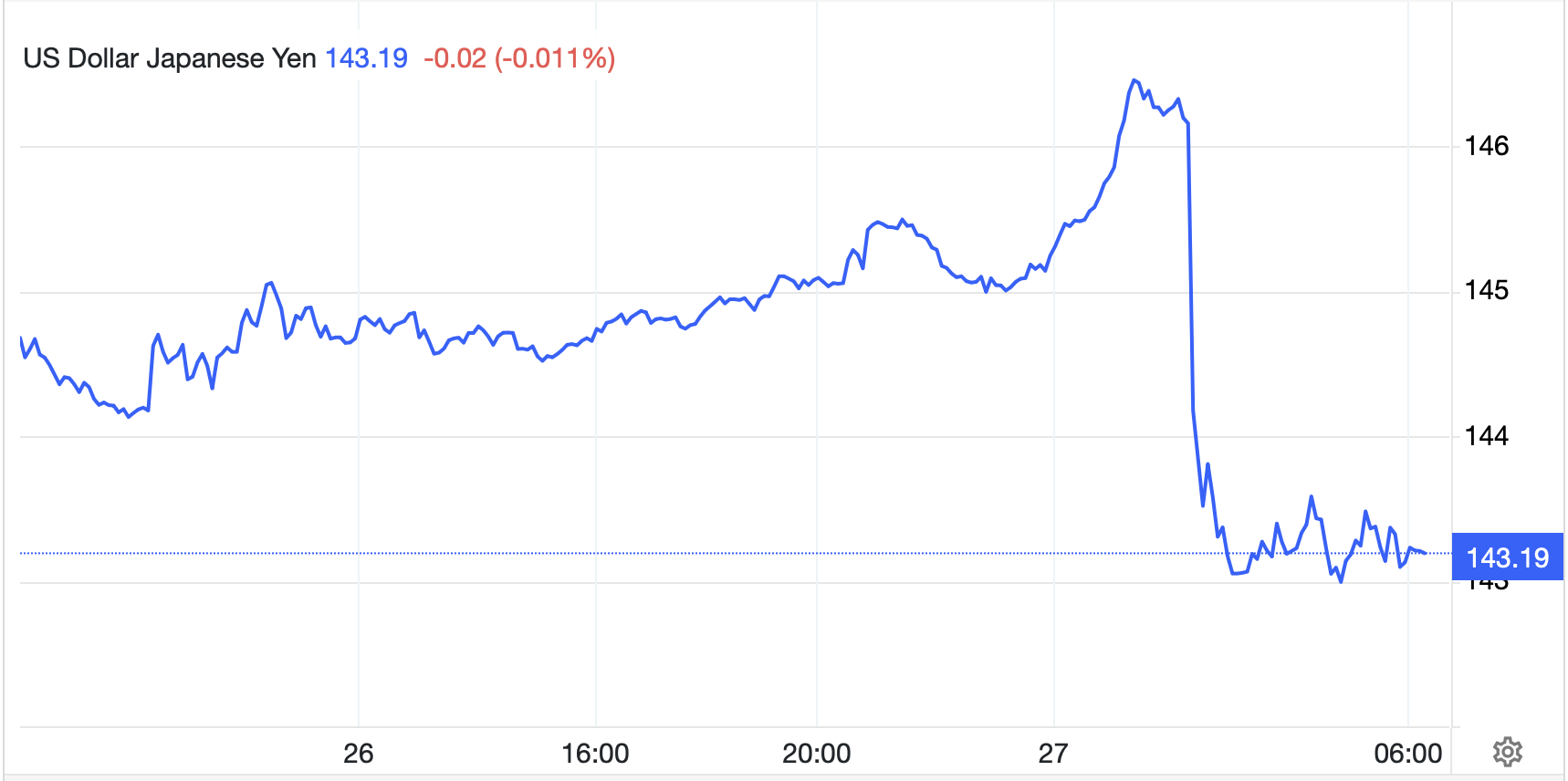
With that in mind, let’s see how things played out overnight after yesterday’s weak showing in US markets. In Japan, the Nikkei (-2.2%) gave back Tuesday’s gains as the market tries to determine exactly how new PM Ishiba is viewing the economy and central bank. In a statement, he indicated the government would work with the BOJ to achieve joint goals, and his initial hawkish perception has been walked back. In fact, it is odd that Japanese stocks fell given JGB yields (-2bps) also declined alongside the yen (-0.7%) on those comments. As to the rest of Asia, the Hang Seng (+6.2%) rocketed higher on the Chinese stimulus story (mainland markets are still closed for their holiday), but the other Asian markets that were open, including Korea, Malaysia and Indonesia, all saw selling pressure with declines on the order of -1.0%.
In Europe, continental bourses are all lower led by the DAX (-0.6%) and IBEX (-0.6%) although the FTSE 100 (+0.2%) has managed a small gain. The UK move has been driven by energy stocks rallying on the Middle East story while the lack of energy stocks on the continent seems to be the key to losses as investors turn cautious. As to US futures, at this hour (7:30), they are lower by between -0.2% and -0.4%.
Bond yields are lower this morning with Treasuries down -2bps while European sovereign yields have all fallen between -5bps and -6bps. The weak PMI data there has increased the discussion about more aggressive policy ease from the central bank and the likelihood that inflation stays quiescent.
We have already discussed oil but a look at the metals markets shows that after a 1% rally yesterday, gold (-0.3%) is consolidating near its all-time highs, while both silver (+0.3%) and copper (+0.8%) continue to move higher. For the latter two, everything I read is about how both metals are critical for building out the energy transition infrastructure and both metals are in structural shortage with stockpiles being utilized as mining output lags demand and getting new mines up and running is a decade long affair. My take is both have further to rise.
Finally, the dollar is net little changed this morning after a very solid two-day rally. Remember it was just Monday that I was discussing key technical levels in the DXY (100.00), EUR (1.1200) and GBP (1.3500). Well, we have moved well away from all those levels as the dollar weakness story takes a break. When Chairman Powell explained he was in no hurry to cut rates rapidly, that part of the narrative needed to change quickly…and it did. So, this morning, aside from the yen’s weakness mentioned above, the other large mover is NOK (+0.7%) which is simply responding to the oil rally. In fact, the commodity currencies are doing exactly what they are supposed to be doing with CLP (+0.5%) tracking copper and MXN (+0.4%) tracking both silver and oil. ZAR (unchanged) is actually the surprise here although it has been rallying steadily since April on a combination of the strong metals markets and continued belief in a better economic situation based on the new government’s business friendly policies.
On the data front, this morning brings only ADP Employment (exp 120K) and the EIA oil inventories where further inventory drawdowns are anticipated. We also hear from four more Fed speakers although given Powell’s lack of concern regarding the speed of cuts, it will be hard for these speakers to change the market perception in my view. This leaves us with the big picture. Right now, employment remains the most important data for the Fed and their policy views. As such, this morning’s ADP is likely to have more importance than it ordinarily would, despite the limited correlation between this data and the NFP to be released on Friday.
It seems that there are some subtle changes in central bank views with market perceptions of FX moves impacted. The Fed is now seen as not quite as dovish, while the BOJ and ECB are seen as a touch more dovish, hence the dollar’s gains against both the yen and euro. However, I think the central bankers realize they are still feeling their way in the dark and will be slow to respond to outlier data, so this vibe seems likely to hold in the near term.
Good luck
Adf

 fxpoetry