Stagflation

Call rates will remain
Zero to Point-one percent
We’ll still purchase bonds


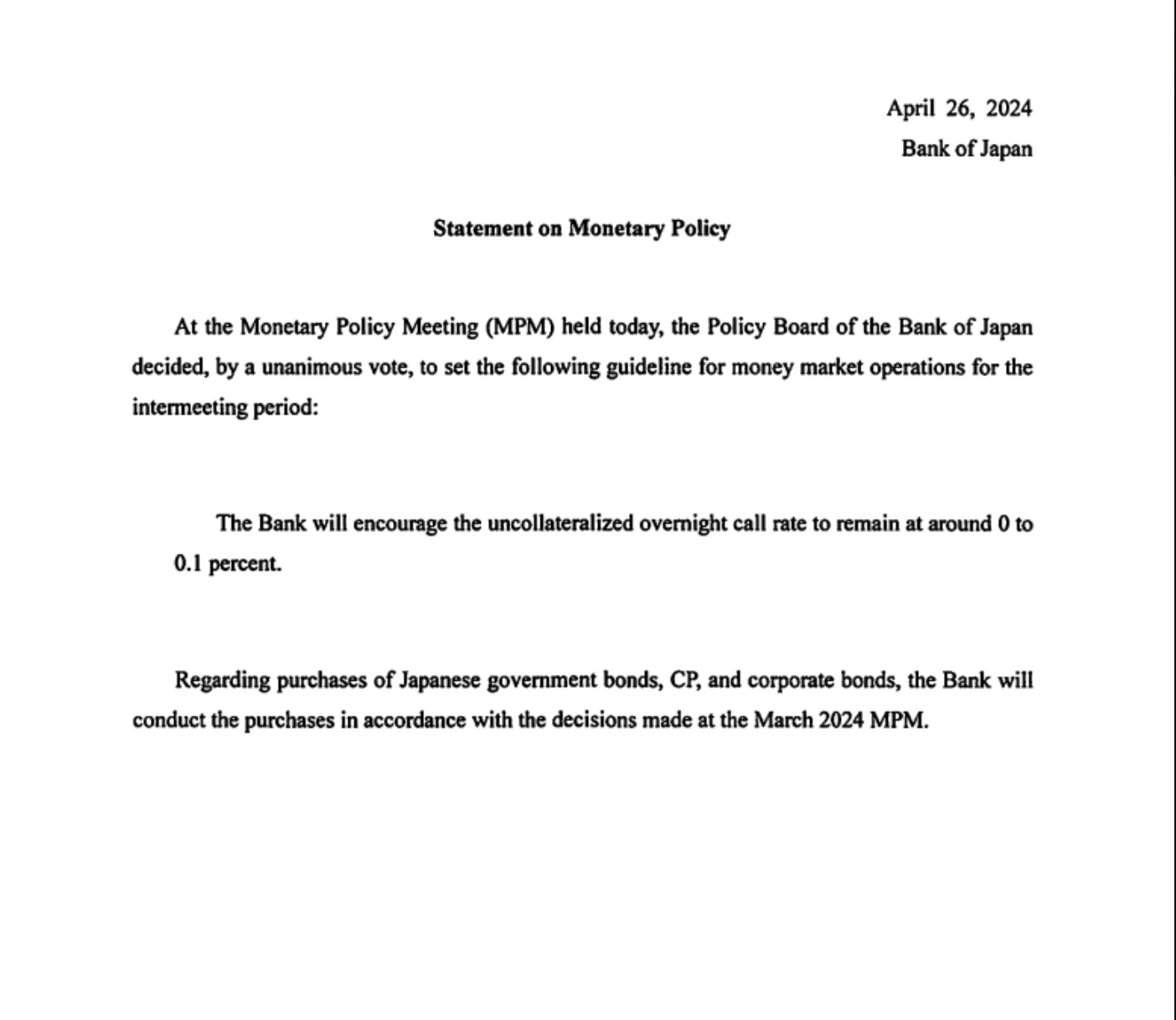
In a move that clearly captured my heart, the BOJ left policy on hold last night, as widely expected.  But the key is that the policy statement, in its entirety, is as follows:

I would contend they could have used my haiku above and completely gotten the message across!  This is the best central bank move I have seen in forever, an economy of words with limited discussion about their views of the future.  But that the Fed would be so terse in their statements.  By forcing investors and traders to consider all the issues and the best, or at least possible, ways in which the central bank can achieve their stated goals, positioning would be substantially reduced because nobody would think the central bank ‘had their back’.  This would prevent another SVB-type collapse, and probably go a long way to reducing the massive wealth inequalities that central banks have fostered since the GFC.  Just sayin’!

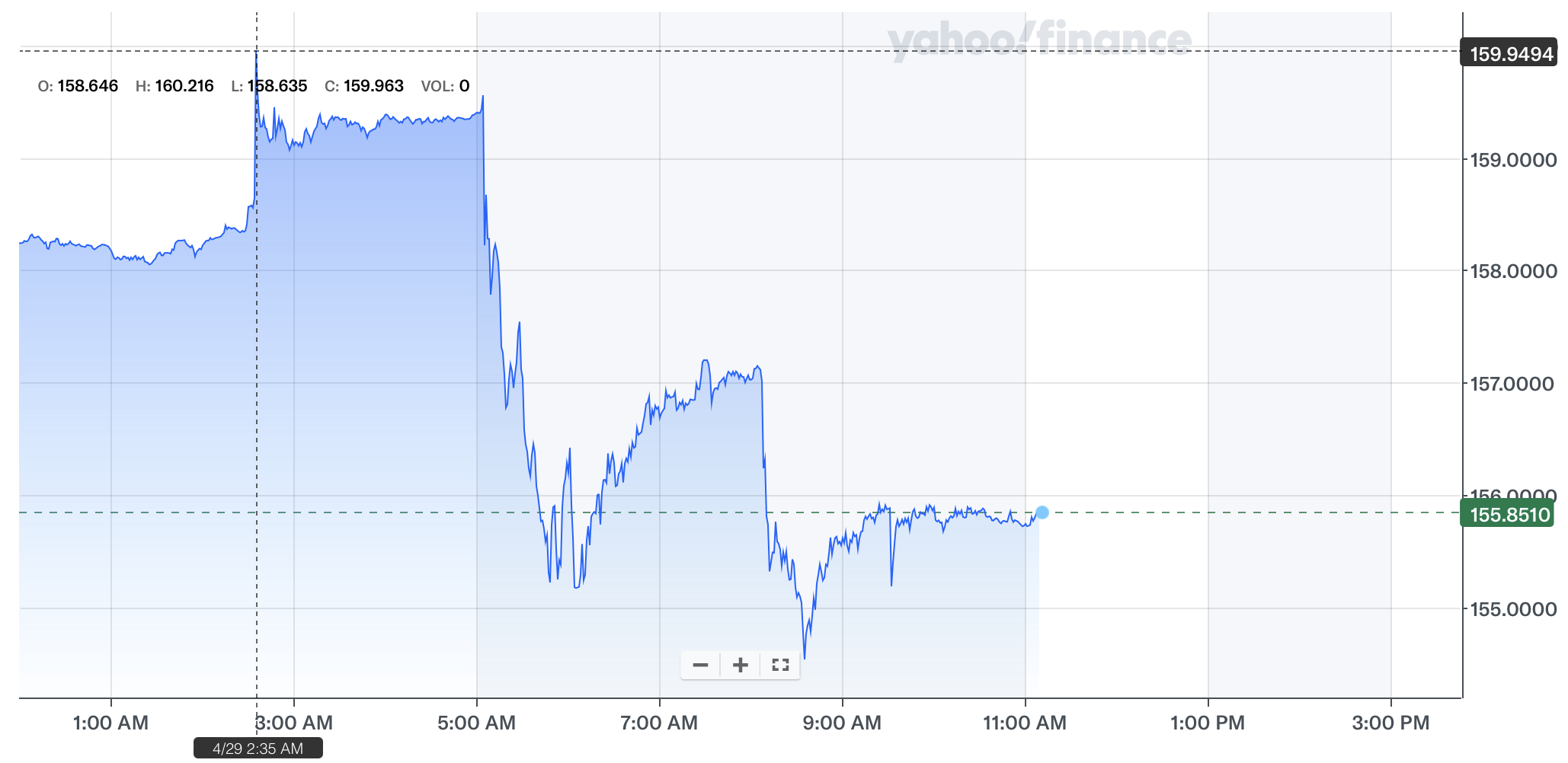
The market response to this, and the subsequent Ueda press conference was to sell the yen even more aggressively, with USDJPY touching yet further new 34-year highs at 156.80, higher by more than one full yen (0.7%) and JGB yields climbed to 0.92%, slowly approaching the big round number of 1.00%.  FinMin Suzuki was out trying to talk the yen higher (dollar lower) with the following comments, “the weak yen has both positive and negative impacts, but we are more concerned about the negative effects right now.”  Those comments were sufficient to drive USDJPY down about 90 pips in a few minutes, but as of right now (6:20), the dollar is back to its highs.  As long as the Fed and the BOJ remain on different wavelengths, the yen will not be able to rally, trust me.

The GDP data surprised
By showing less strength than surmised
But really, for Jay
The prob yesterday
Was PCE so energized

This brings us to the GDP data yesterday, which missed badly at 1.6%.  However, that was not the worst part of the report.  Alongside the GDP data, there is a PCE calculation, that while not the one on which the Fed focuses, is still a harbinger of how things are going.  That number was higher than expected with the Core rising 3.7% Q/Q, up from 2.0% in Q4.  The upshot of this data was that growth is slowing and inflation is rising, exactly the opposite of the Fed’s (and the administration’s) goals and moving toward the concept of stagflation.

While quoting oneself is not the best etiquette, I think it makes some sense here as I described this exact situation back in January as follows:

Stagflation is an awful word as it describes a state
Where prices rise too fast while growth just cannot germinate.
And this, dear friends, is what I fear will come to pass this year
By Christmas, bonds and stocks will fall while metals hit high gear.

It should be no surprise that both bonds and stocks fell yesterday as market participants are growing concerned that the Fed has lost control of the narrative.  After all, the last time we had stagflation, Chairman Volcker chose to fight inflation first by raising the Fed funds rate to 21% and driving the economy into a double-dip recession from 1980-1982.  But the debt/GDP ratio at the time was just 30% or so and the government could afford it.  That is not the case today, and quite frankly, there are exactly zero politicians on either side of the aisle who can tolerate a recession of any type, let alone a double dip.  My guess is that all hands will be pushing to increase the rate of growth and let inflation rip because given the current drivers of inflation (commodity prices, near-shoring and demographics), it is not clear the Fed can do anything about it anyway.  Don’t you feel better now?

All this leads us to this morning’s PCE data (exp 0.3% M/M for both headline and core, 2.6% Y/Y for both readings) as well as Personal Income (0.5%) and Personal Spending (0.6%).  Given yesterday’s outcomes and the fact that the Bureau of Economic Analysis produces both sets of numbers, the whisper number is clearly higher.  If that should manifest, I suspect that the price action from yesterday, lower stocks and bonds, is very likely to continue despite the after-market rally of both Google and Microsoft on better-than-expected earnings data.  I also suspect that before noon, the Fed whisperer, Nick Timiraos, will have an article out in the WSJ to give some Fed perspective as they are currently muzzled in their quiet period.            

I don’t think there’s anything else to say about this, so let me recap the overnight session, at least the parts I have not yet discussed.  While the US equity session did not finish on its lows, all three major indices were lower by at least -0.5% on the day.  However, the same was not true in Asia with the Nikkei (+0.8%) responding positively to the fact that tighter monetary policy was not on its way, while Chinese (+1.5%) and Hong Kong (+2.1%) shares positively ripped on the back of the strong tech earnings in the US.  As to European bourses, they are all in the green this morning, with Spain (+1.1%) leading the way but all higher by at least +0.5%.  Lastly, US futures are pointing higher as well after the strong earnings numbers overnight, up by +1.0% or so at this hour (7:20).

After jumping 8bps in the wake of the GDP data yesterday, 10-year Treasury yields slid a bit and finished the day up 5bps.  This morning, they have given back two more basis points, but still trade right at 4.70%.  If this morning’s data is 0.4%, watch for another sharp move higher in yields today.  European yields pretty much followed the US yesterday, all closing higher by between 4bps and 6bps, and this morning they are lower by similar amounts, right back to where they started.

Oil prices (+0.5%) are climbing higher again, seeming to have found a recent bottom and looking like they are set to push back toward $90/bbl by summer.  While the real GDP data was softer, nominal remains solid and that is what drives demand.  In the metals markets, they all jumped on the data release and this morning are continuing higher (Au +0.7%, Ag +0.8%, Cu +0.8%, Al +0.9%).  In the industrial metals, inventories are dropping while the precious space is clearly responding to the inflation fears.

Finally, the dollar is little changed overall this morning.  while it has rallied sharply vs. the yen, ZAR (+0.85%) is gaining on metal market strength as an offset and pretty much everything else is +/- 0.25% or less.  My take is everyone is waiting for this morning’s data to determine if the Fed is going to become even more hawkish, or if there will be a reprieve. 

In addition to the PCE data, we get Michigan Sentiment at 10:00 (exp 77.8, down from 79.4).  Right now, players are holding their collective breath for the numbers.  After the release, it’s all about the results.  Given that every recent inflation print has been on the high side, I expect this to be no different.  Bonds should suffer, commodities should outperform, and I expect the dollar to do well.

Good luck and good weekend

Adf

Piffling

The topic du jour
Is, will Japan intervene?
And will it matter?

History has shown
Until policy changes
All else is piffling

The next 30 hours have the chance to be quite meaningful for markets as we will learn a great deal about several very key issues.  While this morning’s Q1 US GDP data will be mildly interesting, I believe the real keys will be the following in order of their release: 1) earnings from Alphabet Google, Intel and Microsoft; 2) BOJ meeting and Ueda press conference; and 3) US Core PCE.

Let’s unpack them in order.

1)    Earnings for three key tech stocks are a critical data point to determine whether the current equity mulitples still make sense.  Already this week we saw Tesla miss estimates but give positive guidance and rally sharply on Tuesday, then Meta Facebook beat earnings nicely but gave negative guidance (they said costs were rising because of all the AI spending but revenues would not show a bump anytime soon on the back of that spending) and the stock fell sharply overnight and is called down -13% to open this morning.  Just remember, if the generals of the stock market rally are slipping, typically the market can follow lower.

2)    Now that USDJPY has breached the 155 level and has not even consolidated, but continues marching higher, all eyes are on Ueda-san to see if he will adjust policy to help mitigate the yen’s declines.  Of course, the BOJ is not in charge of yen policy, that is an MOF issue, but I assure you the two entities work closely together.  Ueda’s problem is that no matter what he does, it will not have enough of an impact to make a difference.  While no policy change is expected, even if the BOJ hikes rates 25bps, it would only have a very short-term effect because the interest rate differential remains huge and would still be in excess of 500 basis points.  While there are reasons for Ueda to consider a hike (rising wages, higher energy prices and the weak yen all can lead to further inflation), given they hiked at the last meeting and explicitly said they would be maintaining easy policy, it seems hard to believe anything will change.  (As an aside, the very fact that nobody is expecting a move would allow a disproportionate pop in the yen, although I believe it would be quite short-lived.)

3)    Finally, the release of the PCE data tomorrow morning will update both market participants and policymakers on the likelihood that the Fed is going to achieve their inflation target anytime soon.  Recall, we have seen three consecutive hotter than expected CPI monthly reports and the last two PCE reports were similarly hotter than expected.  If this one follows that pattern, any idea that a cut is coming before the election will dissipate even further.  As of this morning, the Fed funds futures market is pricing just 42bps of cuts for all of 2024 with the first cut not expected until September.  The options market is now pricing a 20% probability of a rate hike in the next twelve months.  I believe tomorrow’s data matters a great deal.

It is part 3 of my little exercise that is the key for USDJPY going forward.  Just like the ECB (and BOE and BOC), the BOJ was counting on the Fed to begin their rate cutting cycle initially by March, but certainly by June, and expecting quite a few rate cuts.  That would have been crucial to reduce the US yield advantage over the yen and likely would have seen the dollar slide against most currencies.  But it appears that the US economy, which continues to be propped up by massive deficit government spending, is not going to allow the Fed any leeway to reduce rates.  If that continues to be the case, and I see no reason for that to change ahead of the election, then the dollar is going to retain its bid.  In fact, this is exactly why yesterday I highlighted the conversations that are apparently ongoing within the Trump camp regarding ways to weaken the dollar.  Right now, it is not going to fall on its own.

So that’s how things stand as we head into a crucial period with disparate but important information.  In the meantime, let’s look at the overnight activity.

Yesterday’s US session was a wash as early declines were recovered into the close, but the Meta earnings have US futures pointing lower by about 0.7% at this hour (6:45).  Those earnings also seemed to impact Tokyo, which saw a sharp decline of -2.2% although Chinese and Hong Kong shares managed to rally on the session a bit, about 0.5%.  The rest of the time zone was mixed with some gainers (India, New Zealand, Thailand) and some laggards (South Korea, Taiwan).  The picture in Europe is also mixed with the FTSE 100 (+0.6%) having a solid session on the strength of an M&A deal regarding Anglo American, the mining giant receiving an unsolicited buyout offer from BHP Billiton.  However, pretty much the entire continent is under water this morning, sagging by 0.65% or so across the board.

In the bond market, Treasury yields are unchanged this morning, but 10yr still sit at 4.64%.  I expect that the data today and tomorrow will have quite an impact there.  European sovereign yields are all slipping 2bps this morning, as what little data that has been released, German GfK Confidence and French Business Confidence) have been on the soft side with a few comments that the June rate cut remains the favorite. Perhaps of more interest is that 10yr JGB yields rose 3bps overnight and are now at 0.89%, their highest level since November in the wake of the ostensible end of YCC.  Perhaps traders here are starting to bet on a BOJ move.

In the commodity space, oil (+0.3%) is bouncing from its worst levels recently, but in truth, remains in the middle of its trading range for the past week near $83/bbl.  Yesterday’s EIA data showed a very large net draw of inventories which has helped support the black sticky stuff.  As to the metals markets, it appears that the correction may be over with all the main players higher this morning (Au +0.5%, Ag +0.6%, Cu +1.7%, Al +0.2%).  Remember, if tomorrow’s PCE is hot, the metals should continue to rally.

Finally, the dollar is under a little pressure overall this morning, although it remains near its recent highs.  ZAR (+1.15%) is the leading gainer on the back of that metals strength, but we are seeing strength in AUD (+0.45%) and CLP (+0.6%) also helped by the metals markets.  However, it is not just that story as the euro (+0.2%) and pound (+0.4%) are both firmer and dragging their CE4 acolytes along for the ride as well.  The one exception remains the yen (-0.2%), which is above 155.50 as I type.  Of course, that story is told above.

Today’s data is as follows: Initial (exp 214K) and Continuing (1810K) Claims as well as Q1 GDP (2.5%) with its subsets of Real Consumer Spending (2.8%) and its measure of PCE (3.4%).  It is important to note that this PCE data is not the one the Fed tracks closely, although I am certain they pay attention.  FWIW, the Atlanta Fed’s GDPNow number is currently 2.7%.

Now we wait for the data to come.  When the dust settles, we should have a somewhat better idea of how things may play out, but right now there is a great deal of uncertainty.  In the end, nothing has altered the fact that the dollar continues to benefit from the relative tightness of the Fed vs. other nations, and that should continue to support the dollar.

Good luck
Adf

Dripping Lower

Like rain off a roof
The yen keeps dripping lower
Can it fall further?


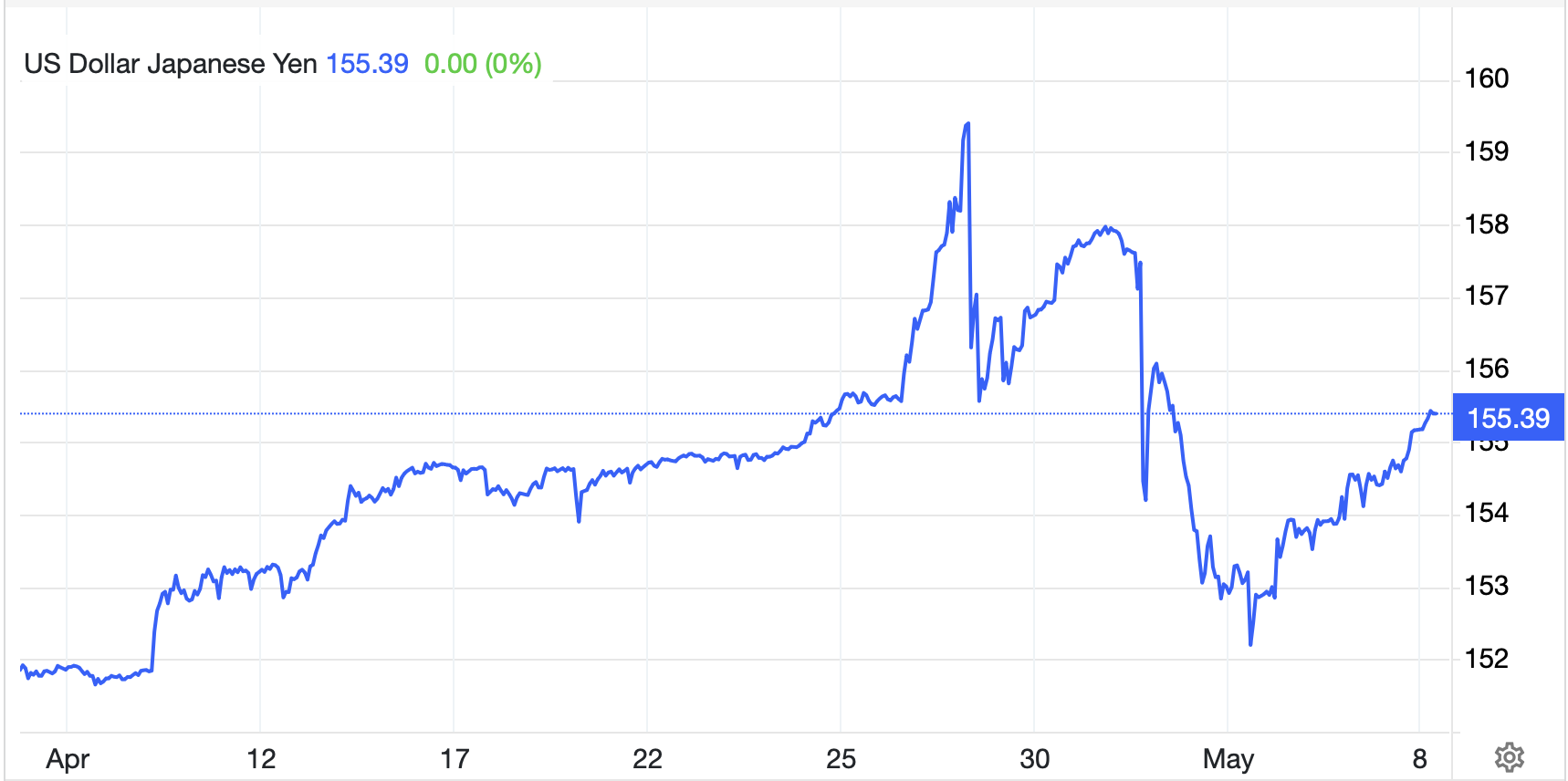
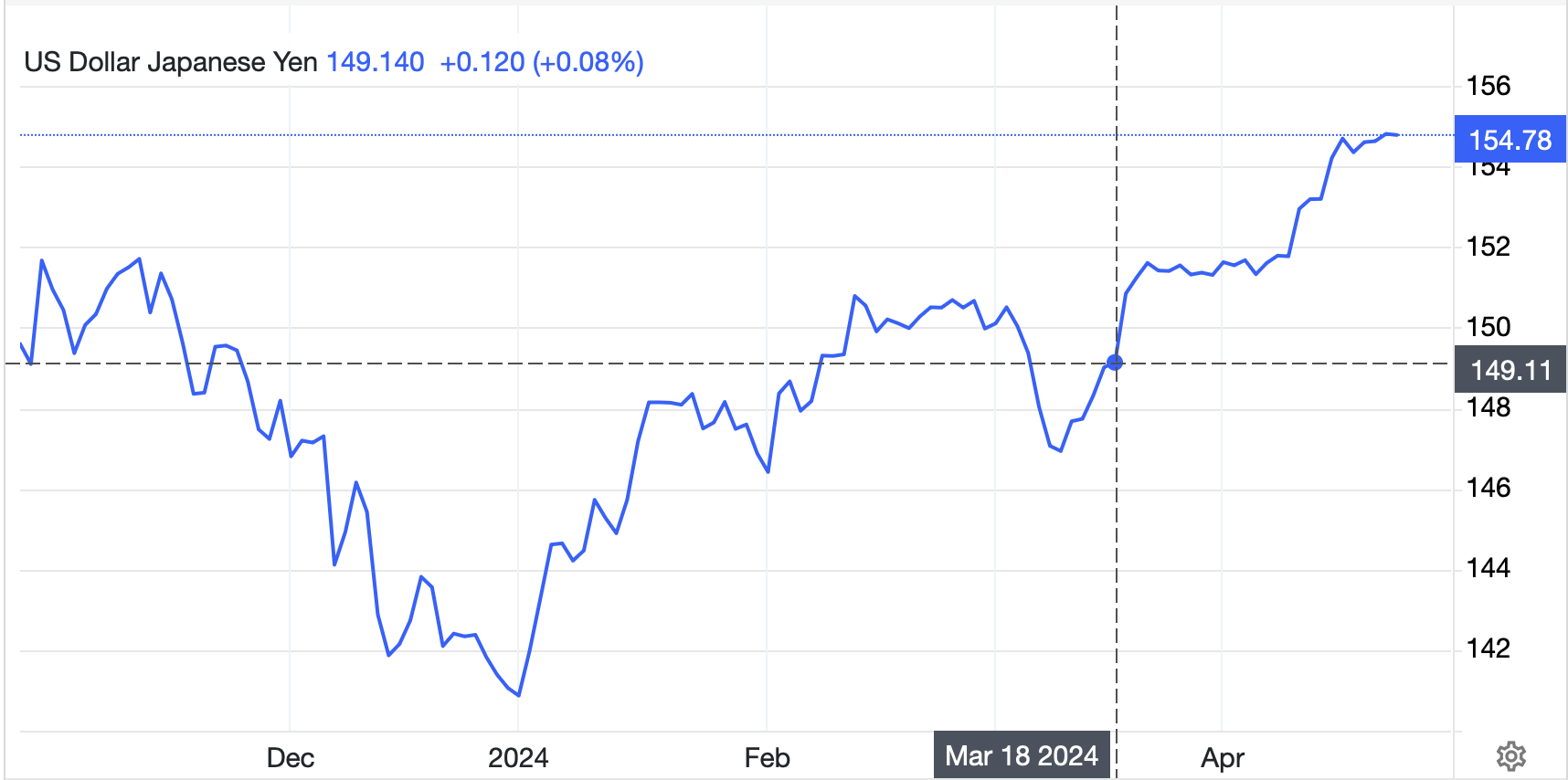
On a quiet morning after a welcome rebound in equity markets around the world, there has been an uptick in discussion regarding the yen, BOJ Governor Ueda and the upcoming BOJ meeting this Friday.  One of the things that seems to have Ueda-san and the rest of the BOJ confused is that after their last meeting on March 18, where they raised interest rates for the first time in forever, the yen has continued to weaken.  A quick look at the chart below shows the relatively steady decline in the currency since that date.

Source: tradingeconomics.com

Perhaps this is a sign that Japan’s monetary policy, at least given the enormous interest rate differentials with the US, just doesn’t really matter to the traders in the FX market.  A look at relative interest rate movements in the respective 10-year bonds shows that Treasury yields have rallied about 30bps while JGB yields have risen just half that amount since that BOJ meeting.  One thing that is becoming clearer is that the pressure on Ueda-san and FinMin Suzuki to do something about the weakening yen is growing.  It seems they have finally figured out that a weak yen has a direct link to rising yen prices of energy for both home and autos, and that the people in Japan are running out of patience with those rises.

Perhaps this explains the increase in the comments by these two critical players, with both threatening action if things get out of hand.  For instance, Suzuki explained, “I think it’s fair to assume that the environment for taking appropriate action on forex is in place, though I won’t say what the action is,” when speaking to Parliament last night.  His problem is he knows that intervention by Japan only will have no long-term impact and merely allow traders a better entry point to continue to pressure the yen lower. 

Meanwhile, Ueda-san was absolutely loquacious in his comments to Parliament, explaining, “we will set our short-term interest rate target at a level deemed appropriate to sustainably and stably achieve our 2% inflation target.  If underlying inflation rises toward 2% in line with our projections, we will adjust a degree of monetary easing. In that case, we will likely raise short-term interest rates.”  

Now, does this mean that they are going to do something at their meeting this week?  I think the probability of a policy change is vanishingly small.  Quite frankly, they are very aware that their current toolkit is not fit for the purpose of strengthening the yen and so jawboning is pretty much all they have.  In fact, to the extent that they would like to see the yen strengthen, their best bet is to call Chairman Powell and plead their case that the US should cut rates, and by a lot, or the world will end.  I don’t see that happening either.

Something worth noting is that Powell is facing pressure from multiple directions as foreign central bankers are desperate for the Fed to cut so they can too, and from the administration which believes that lower rates will help them in their quest to be reelected.  But, in the end, there is no evidence that the Fed is going to reverse their recent comments and turn dovish.  As long as that is the case, the trend higher in USDJPY remains quite clear and I see no reason to expect anything other than minor pullbacks in the near future.  However, if the Fed does cut rates despite the ongoing inflation pressures in the US, look for the dollar to fall sharply while risk assets explode higher.

So, while we all await both the BOJ and the PCE data on Friday, let’s recap the overnight session.  While green was the predominant color on screens overnight with Japan (+0.3%) and Hong Kong (+1.9%) leading the way, mainland Chinese stocks continue to suffer (-0.7%) dragging down Korean shares (-0.25%).  But otherwise, India, Taiwan, Australia, Singapore, etc., were all in the green.  In Europe, there is no question that things are looking up as every market is higher, most by 1% or more after the Flash PMI data was released showing that economic activity was picking up across the continent.  While manufacturing remains in contraction, and is hardly improving, the services sector is definitely stronger.  Meanwhile, at this hour (7:30) US futures are firmer by about 0.25%.

In the bond markets, price activity has been far more muted with Treasury yields recouping the 2bps they lost yesterday, while European sovereigns are higher by 1bp across the board.  The ECB commentary continue to highlight a June hike with the most dovish acolytes calling for 100bps of cuts this year (Portugal’s Centeno) while Spain’s de Guindos reminded everyone that the Fed was still driving the bus and they need to think about the whole world, not just the US.  As you can see, Powell faces pressure from all over.

On the commodity front, the retracement from the massive bull rally in metals prices is continuing apace with gold (-1.4%), silver (-1.4%) and copper (-1.1%) all under more pressure today after having fallen sharply for the past two sessions already.  My take is that this is an overdue correction from a remarkable move higher, but that the underlying story remains intact.  Certainly, the apparent lessening of tensions in the Israel-Iran issue has helped this movement as well as its impact on the price of oil (-0.75% today, -4.65% in past week).  However, the inflation story remains front and center when it comes to pricing commodities and there is no evidence whatsoever that prices are slipping back.  As we head toward summer, I do anticipate that metals demand will return, especially if the economy continues to perform at its current levels.

Finally, the dollar is slightly softer this morning but remains above 106 on the DXY.  We have already discussed the yen, which cannot find a bid anywhere, but the pound (+0.25%) is rebounding after PMI data in the UK was also a bit better.  However, overall, there are gainers and losers in both the G10 and EMG blocs, the largest of which is the ZAR (-0.3%) which is clearly suffering alongside the slide in metals prices.  Not surprisingly, NOK (-0.2%) is feeling pressure from oil’s decline.  But the euro has edged higher, and it has taken its CE4 counterparts higher while LATAM currencies seem to be taking the day off entirely.  We need real news to change the story here.

On the data front, we see the Flash PMI data (exp Manufacturing 52.0, Services 52.0) and New Home Sales (662K) and that’s really it.  With no Fed speakers, once again the market will take its cues from earnings releases with today’s biggest likely to be Google Alphabet and Tesla.  The dollar has been on a roll lately, so it would be no surprise to see a bit of a pullback, but as long as the Fed is seen as maintaining its current tightness, it will be hard-pressed to decline very much.

Good luck

Adf

Vexation

The ‘conomy just keeps on humming
So, confidence, not yet is coming
How long will rates stay
Where they are today?
And will stocks keep getting a drumming?
 
The problem remains that inflation
Is causing Chair Powell vexation
It’s sticky and hot
Which really is not
What he needs to get his ovation


Boy, I go away for a few days and look what you’ve done to the markets!  When last I wrote, while there was a sense of shakiness in risk assets, it hardly appeared terminal.  But now…. The bears are out in force it seems, fear is rising rapidly amid investors while greed is running for its life.

I tried to ignore market goings on while I was away for the back half of last week, but the news was overwhelming.  My brief recap is simply, lots more Fed speakers have figured out that measured inflation is not heading lower, and that the decline during the second half of last year is turning into the aberration, not the rebound so far in 2024.  This week we will see the PCE report on Friday, and while that is typically between 0.5% and 1.0% lower than CPI, it is not going to come close to their target.  

As I wrote several weeks ago, following Powell’s press conference and subsequent speeches, regardless of the fact that there is no indication price pressures are abating, he is still keen to cut rates.  However, the weight of the recent data has caused many of his colleagues on the FOMC to change their tune.  The most recent was NY Fed President Williams who also indicated that a rate hike in the future cannot be ruled out.  Remember, Governor Bowman discussed that idea the week before last.  Going back to my prognostications at the beginning of the year, I had anticipated one cut at most during the first half of the year, but that rates, and bond yields, would be higher by Christmas.  I still like that call, although I am losing my enthusiasm for the cut.  And so is everybody else!

If rates simply stay where they are, I suspect that the recent equity selloff will moderate as it is clearly more fully priced into markets given the consistency with which we have heard that story in the past several weeks.  However, beware if the next step is higher.

Meanwhile, the week is off to quite a slow start with most equity markets rebounding from last week’s declines as fears of further escalation in the middle east abate.  The Israeli response to the Iranian response was muted and market participants have turned their attention elsewhere.  This can best be seen in the commodities markets as both oil (-0.5% today, -4.2% in the past week) and gold (-1.3% today, -1.0% in the past week) are retreating from their recent highs.  However, all is not completely well as we continue to see US Treasury yields on the high side and climbing (10yr +3bps) as more and more investors demonstrate concerns over inflation’s stickiness.

There was virtually no economic news overnight and a remarkably, though welcome, minimum of central bank speakers.  Remember, the Fed is in their quiet period this week up until their meeting next Wednesday, so everyone needs to make up their mind on their own.  With that in mind, here’s what we saw last night.

Equity markets in Asia rebounded nicely with the Nikkei (+1.0%) and Hang Seng (+1.75%) both performing well although shares on the mainland (CSI 300 -0.3%) didn’t join the party.  Elsewhere in the region, only Taiwan was in the red with every other nation enjoying the bounce.  As to Europe, this morning, the screen is green with gains ranging from the CAC (+0.35%) to the FTSE 100 (+1.45%) and everything in between.  Again, this certainly feels like a relief rally given the absence of new information.  Finally, the US futures markets are all higher this morning on the order of 0.5%, something I’m sure we are all happy to see.

In the bond markets, Treasury yields are leading the way with European sovereigns also higher by between 2bps and 4bps, clearly being dragged by Treasuries.  We did hear from Banque de France president, and ECB member, Villeroy, that he felt a June cut was certain and he was looking for more afterwards.  Interestingly, he made the argument that the ECB’s job was to ensure economic activity was helped as much as possible while targeting inflation.  That is a different take than I’ve heard any ECB member discuss before, although I am sure it is what many are thinking.  

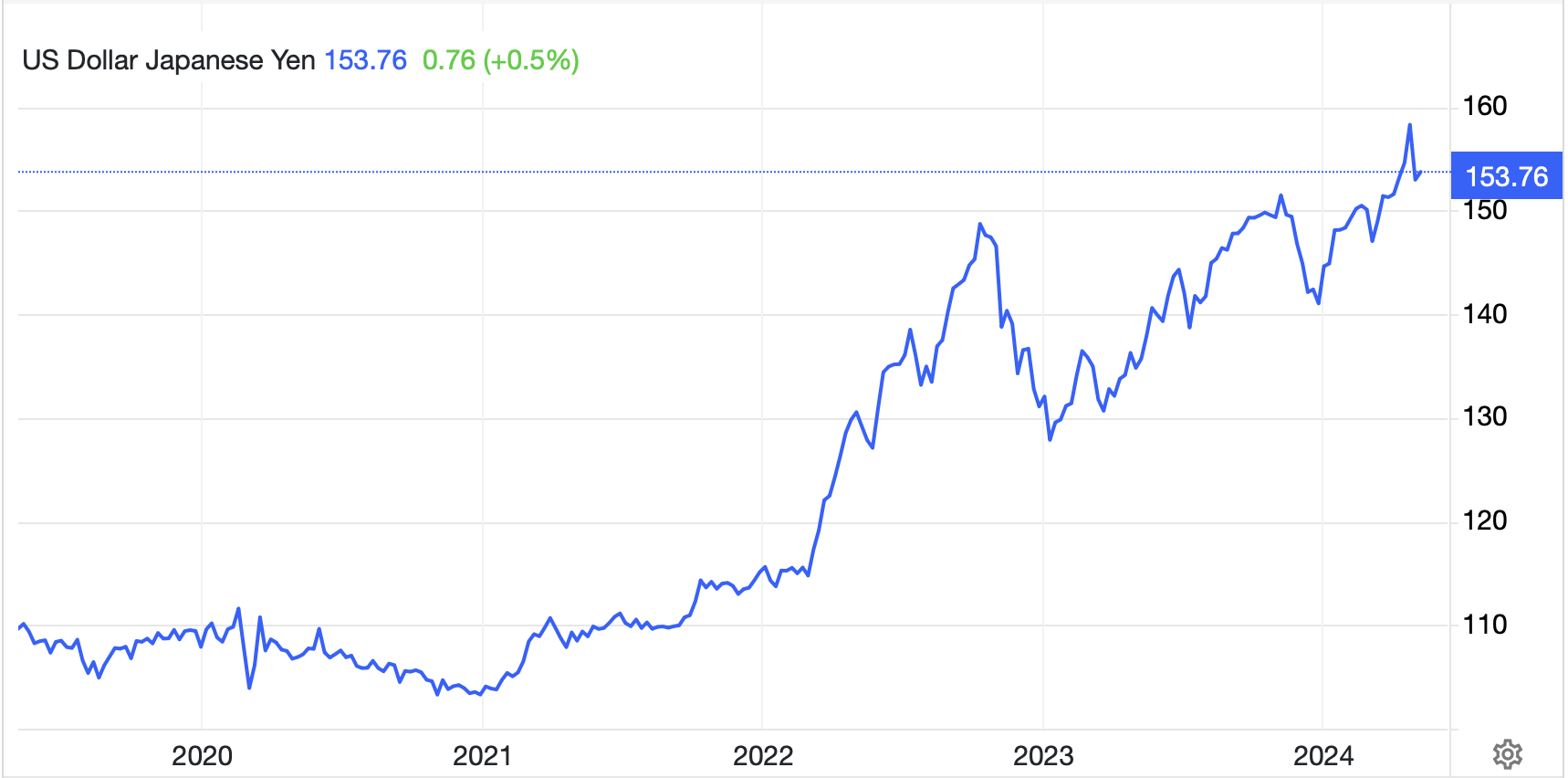
Perhaps the most interesting move last night was JGB yields climbing 4bps and moving up to 0.88%.  This is their highest level since November when they flirted with the 1.0% “cap” that required a massive bond buying exercise by the BOJ.  With USDJPY grinding ever so slowly toward 155.00, there is a school of thought that the BOJ will seek higher yields to defend the yen.  However, my take is any yen defense will be in the form of intervention and be described as a smoothing activity.  The current Mr Yen, Masato Kanda, has discussed the idea of a rise in USDJPY of 10 yen in a month as being too quick and worthy of a response.  Granted, since its recent nadir of 146.85 on March 11, that milestone has almost been reached, but that low was a very short-term dip and while the yen has declined consistently all year, as you can see from the chart below, the pace has not nearly been that quick.  In fact, I would argue the pace has been steady all year, and virtually identical to that of the dollar index which indicates this is not a yen problem, it is a dollar problem.

Source: tradingeconomics.com

Turning to the dollar, it is modestly higher overall this morning with the noteworthy mover the pound (-0.5%) after we heard from BOE member Ramsden explaining that he saw the risks of inflation remaining high were diminishing and that rate cuts were coming soon.  While one of his colleagues, Megan Greene, gave the opposite spin, apparently in a misogynistic response, the market took Mr Ramsden as the more important voice on the matter.  As well as the pound, we have seen the euro (-0.2%) and its EEMEA acolytes (PLN -0.5%, CZK -0.6%) slide.  Otherwise, there is a mixture of lesser movements with a few currencies managing to gain strength, notably AUD (+0.3%), NZD (+0.3%) and CAD (+0.2%).  Summing up the currency markets, for the time being, with the Fed sounding increasingly hawkish and other central banks turning dovish, it seems like it is hard to bet against the greenback.  That doesn’t mean we will not see a short-term selloff, just that the trend, as you can see in the chart above, remains firmly higher for the buck.

On the data front, there is not a great volume of information, but PCE will certainly keep us all riveted to the screen Friday morning.

TodayChicago Fed Nat’l Activity0.09
TuesdayFlash Manufacturing PMI52.0
 Flash Services PMI52.0
 New Home Sales668K
WednesdayDurable Goods2.5%
 -ex Transport0.3%
ThursdayInitial Claims215K
 Continuing Claims1814K
 Q1 GDP2.5%
 Q1 Real Consumer Spending2.8%
FridayPCE0.3% (2.6% Y/Y)
 -ex food & energy0.3% (2.6% Y/Y)
 Michigan Sentiment77.8

Source: tradingeconomics.com

With the absence of Fed speakers, a blessing in my view, market participants will likely be taking their cues from earnings as well as activities elsewhere.  In the end, nothing has changed my view on the dollar where higher for longer suits both the rate and dollar outcome.

Good luck

Adf

Crying Again

The boy who cried wolf
Better known as, Mr Yen
Is crying again


Masato Kanda, the vice finance minister for international affairs, also known as ‘Mr Yen’ was interviewed last night regarding the recent yen’s recent weakness.  “I strongly feel the recent sharp depreciation of the yen is unusual, given fundamentals such as the inflation trend and outlook, as well as the direction of monetary policy and yields in Japan and the US.  Many people think the yen is now moving in the opposite direction of where it should be going.  We are currently monitoring developments in the foreign exchange market with a high sense of urgency. We will take appropriate measures against excessive foreign exchange moves without ruling out any options.

His comments [emphasis added] are consistent with what we have heard from FinMin Suzuki, PM Kishida and from him previously.  What makes this so interesting is that USDJPY is essentially unchanged from its level 10 days ago, immediately in the wake of the BOJ meeting.  While we did touch a new yen low (dollar high) earlier this week, that level was just a single pip weaker than the level seen back in 2022 (grey line) that seemed to be the intervention trigger at the time.  And consider, much has passed between then and now, with inflation in Japan (blue shaded area) having fallen back to levels last seen at that time, but now trending in the opposite direction.  

Source: tradingeconomics.com

It is abundantly clear that the MOF is concerned over a sharp decline in the yen.  It is also clear that the monetary policy differences between the US and Japan are such that there is very little reason for the yen to appreciate at the current time.  This is especially true since the US commentary we have heard lately, with Waller’s comments on Wednesday the most recent, indicate that the long-awaited Fed pivot continues to be a distant prospect, while Ueda-san made it clear that the BOJ was going to maintain easy money conditions despite having exited NIRP. 

FWIW, absent a sudden sharp move above 153, my take is the MOF/BOJ simply continue to jawbone the market.  However, if something changes and we rip higher in USDJPY, that would change my views.  

Though holiday markets abound
The info today could astound
At first, PCE
With fears it’s o’er three
Then Powell with words quite profound

And what, you might ask, could cause such a move in the FX markets?  Well, despite the fact that all of Europe and Canada are closed as well as both equity and futures exchanges in the US in observance of the Good Friday holiday, this morning we have critical US economic data being released at 8:30 as well as a speech by Chairman Powell at 11:30.  Liquidity is abysmal, which means that if the data is a surprise in either direction, we could see an outsized move in the dollar.  And then, Powell’s timing is such that even the skeleton staffs at European banks are likely to have gone home by the time he speaks. 

Given the recent commentary we have heard from other FOMC members, it is almost a certainty that there will be some movement.  Consider, if Powell pushes back and sounds dovish, that will change attitudes that have been adjusting to a more hawkish view.  At the same time, if he comes across as hawkish, that will be seen as confirmation that the Fed is on hold for much longer, and markets will continue to price out rate cuts.  Do not be surprised to see different prices on your screen when you come in on Monday.  Recognize, too, that Easter Monday is a holiday in many Eurozone countries as well, so liquidity will still not be back to normal.  It is for these situations that a consistent hedging program is needed.

Ok, that pretty much sums up the overnight session as well as a peek at what’s in store.  Asian equity markets were firmer overnight as the weak yen continues to support the Nikkei, while Chinese shares have benefitted from a story making the rounds that Xi Jinpeng, in an unpublished speech from last October, explained he thought the PBOC needed to consider QE, at least that’s the context.  He didn’t actually use the term QE.  But if that is the case, that is a huge consideration for Chinese asset prices.  We shall see.  Meanwhile, European bourses are all closed as are US futures markets.

Not surprisingly, bond markets have also been closed in Europe but it is noteworthy that Chinese 10-year yields fell to 2.20%, a new all-time low, on the back of the QE story.

Commodity markets are also shut, but I must explain that yesterday, gold rose 1.75% to yet another new high price at $2232/oz.  I believe its performance is quite a condemnation of the current monetary and fiscal policy stances around the world as investors, both public and private, are growing increasingly concerned that there is going to be a comeuppance in the future.

Finally, the FX markets are really the only ones that are open, and the dollar has continued to edge higher overall.  The euro is below 1.08, its lowest level in a month while USDJPY hovers just below its recent highs and USDCNY similarly hovers below its recent highs with both longer term trends clearly higher.  I repeat, this is all policy driven and until policies change, neither will these trends.

Let’s look at what the consensus views are for this morning’s data.  

Personal Income0.4%
Personal Spending0.5%
PCE0.4% (2.5% Y/Y)
Core PCE0.3% (2.8% Y/Y)
Source: tradingeconomics.com

While those Y/Y numbers are not terribly high, the problem is they have stopped trending lower.  Based on the CPI data from earlier in the month, another 0.4% print in the headline will more convincingly turn that trend back higher and that is exactly what frightens the Fed.  And if it’s a tick higher, heads will explode as their confidence in achieving their mooted goal of 2% will take a major hit.  I think the response here will be completely as one would expect; hot print means stronger dollar; cool print means weaker dollar, in-line print means no movement ahead of Powell’s speech.  Let’s see what happens!

Good luck and good weekend

Adf

Top of Mind

Will they or won’t they?
The intervention question
Is now top of mind


As we approach Japanese Fiscal Year end, and while we all await Friday’s PCE data, the FX markets have taken on more importance, at least for now.  The big question is, will there be intervention by the Japanese?  Late last night, USDJPY traded to a new thirty-four year high of 151.96, one pip higher than the level touched in September 2022 which catalyzed the last intervention by the BOJ/MOF.  Recall, last week the BOJ “tightened” monetary policy by exiting their 8-year experiment with negative interest rates and ‘promised’ that they were just getting started.  Granted, they didn’t indicate things would move quickly in this direction and they also explained they would remain accommodative, but they did seem confident that this would change a lot of opinions.  Remember, too, that the market response to that policy shift was to weaken the currency further while JGB yields actually drifted lower.

So, here we are a bit more than a week later and the yen has fallen to new lows.  What’s a country to do?  In the timeless fashion of governments everywhere with respect to currency moves, they immediately started jawboning.  Last night we heard from BOJ Board member Naoki Tamura as follows, “The handling of monetary policy is extremely important from here on for slow but steady progress in normalization to fold back the extraordinarily large-scale monetary easing.  The continuation of an easy financial environment doesn’t mean there won’t be any more rate hikes at all.”  Traders did not exactly quake in fear that the BOJ was suddenly going to tighten aggressively, let’s put it that way, and so nothing has really changed.  One other thing to note is that Tamura-san is seen as the most hawkish member of the current BOJ, at least per Bloomberg Intelligence’s analysts.  Take a look at their views below.

But wait, there’s more!  We also heard from Japanese FinMin, Shunichi Suzuki, that the government would take “decisive steps” if they deemed it necessary to respond to recent currency movement.  And the, the coup de grace, an emergency meeting between the MOF, the BOJ and the Financial Services Agency (FSA) is ongoing as I type (6:30) to help come up with a plan.  

Does this mean intervention is coming soon to a screen near you?  While it is certainly possible, the ultimate issue remains that the relative monetary policy settings between the US (higher for longer) and Japan (still at ZIRP with a hike expected in…October) remain such that the yen is very likely to remain under pressure.  Remember, too, that Japan is in the midst of a technical recession, so tightening monetary policy is not likely to be appreciated by Mr and Mrs Watanabe.  At the end of the day, the politics of inflation are very different in the US and Japan, and I would contend that in Japan, it is still not the type of existential problem for the government that it appears to be in the US.

FWIW, which is probably not much, I expect the MOF to follow their playbook, talk tougher, check rates and ultimately intervene over the next several days.  They will take advantage of the upcoming Easter holiday weekend and the reduced liquidity in markets to seek an outsized impact for the least amount of money possible.  But I do not see them changing their monetary policy before the autumn and so I look for continued yen weakness over time.  Be careful in the short run, but the direction of travel is still the same, USDJPY will rise.

For China, the fact the yen’s weak
Has Xi and his staff set to freak
They’re all quite dismayed
‘Cause Japanese trade
Has lately been on a hot streak
 

The other story in markets has been the ongoing ructions in the Chinese renminbi market.  It is key to understand that this is directly related to the yen story above as China and Japan are fierce competitors in many of their export activities.  But of even more concern to Xi and his gang is that Japanese exports to China are growing so rapidly and Japan ran a trade surplus with China in December (the last month with data released).  When you are a mercantilist nation like China, having a key competitor, like Japan, allow its currency to weaken dramatically against your own is a major problem.  Last week I highlighted the dramatic decline of the yen vs. the renminbi, and that has not changed.  Below is a chart from tradingeconomics.com showing Japanese exports to China ($billions) showing just how much this trend has changed and continues to do so.

Ultimately, both of these countries rely on exports as a critical part of their economic growth and activity, and in both cases, exports to the US and Europe are crucial markets.  If the Japanese continue to allow the yen to weaken, China has a problem.  Remember, Japan does not have capital controls, so while they don’t want the yen to collapse, they are perfectly comfortable with capital outflows in general.  China, on the other hand, is terrified of massive outflows if they were to even consider relaxing capital controls.  The fact is both companies and individuals work very hard to get their money out of the country.  This is one reason that gold is favored there by the population, and the reason that the government banned bitcoin as it was an open channel for funds to leave the country. 

This battle has just begun and seems likely to last for quite a while going forward.  The Chinese are caught between wanting to devalue the renminbi to compete more effectively and maintaining a stable exchange rate to demonstrate there are no fiscal or economic problems in the country.  Alas for Xi and the PBOC, never the twain shall meet.  I would look for a continuation of the recent market volatility here as they will use that uncertainty to discourage large position taking by speculators.  But, as I have maintained for a long time, I expect that USDCNY will trade to 7.50 and beyond as time progresses.

And that’s really it for today.  Ultimately, very little happened in markets overnight, certainly there were no changes in the recent data trajectory nor in any commentary from speakers (other than that mentioned above).  It is a holiday week and a key piece of data, PCE, is set to be released on a broad market holiday this Friday.  Do not look for large moves before then.

There is no US data due today but we do hear from Fed Governor Christopher Waller this afternoon so there is an opportunity for some market movement then.  But for now, consolidation seems the most likely outcome.

Good luck

Adf

Threw in the Towel

There once was a banker named Powell
Who fought, prices, high with a growl
Then going got tough
So he said, “enough”
And basically, threw in the towel
 
His problem’s inflation’s alive
And truthfully, starting to thrive
The worry is he
Will soon say that three
Percent’s the rate for which he’ll strive


With several days to digest the latest FOMC meeting results, and more importantly, the Powell press conference, my take is the Chairman recognizes that to get to 2.0% is going to be extremely painful, too painful politically during this fraught election cycle.  And so, while he tried very hard to convince us all that the Fed was going to get to 2.0%, he stressed it will “take time”.  The subtext of that is, it’s not going to happen in the next several years, at least, and this poet’s view is it may not happen again for decades.  The key to recognizing this subtle shift is to understand that despite increased forecasts for both growth and inflation, the Fed remains hell-bent on cutting interest rates.  Even the neo-Keynesian views which the Fed follows would not prescribe rate cuts in the current economic situation.  But rate cuts are clearly on the table, at least for now.

This begs the question, why is he so determined to cut interest rates with the economy growing above trend?  At this stage, the explanation that makes the most sense to me is…too much debt that needs to be refinanced in the coming years.

Consider, current estimates for total debt around the world are on the order of $350 trillion.  That compares to global GDP of just under $100 trillion.  Many estimates indicate that the average maturity of that debt is about 5 years which means that something on the order of $70 trillion of debt needs to be refinanced each year.  Now, the US portion of that debt is estimated at about $100 trillion, of which ~$34.5 trillion is Treasury debt, and the rest is made up of corporate, mortgage, municipal and private debt.  Remember, too, that total US GDP is currently about $28 trillion as of the end of February (according to the FRED database from the St Louis Fed), so the ratio here is similar to the global ratio.  [Note, this does not include unfunded mandates like Social Security and Medicare, just loans and bonds outstanding.]

Here’s the problem, we have all heard about the fact that the US debt service has climbed above $1 trillion per annum and given the underlying principle is growing, that debt service is growing as well.  In addition, on the private side, there is a huge proportion of corporate debt that has become a serious problem for banks and investors, notably the loans made for commercial real estate, but personal and credit card debt as well.  The Fed cannot look at this situation and conclude that higher rates, or even higher for longer, is going to help all the debtors.  And if the debtors default…that is going to be an economic disaster of epic proportions.Add it up and the only logical answer is Powell is going to gaslight everyone with the idea that the Fed is going to remain vigilant regarding inflation.  And they will right up until the time when the pain becomes too great, or too imminent and they cut.  I think that we are seeing the first signals from markets this is going to be the case from both gold and bitcoin.  But if I am correct, and the Fed cuts despite still elevated inflation readings, look for the dollar to decline sharply, at least initially until other central banks cut as well, look for bonds to fall sharply and look for hard assets to rally.  As to stocks, I expect that initially it will be seen as a positive and juice the rally, but that over time, stocks will begin to lag hard assets.  Quite frankly, this looks like it is a 2024 event, so perhaps if that first cut really comes in June, the summer is going to be far more interesting than anybody at the Fed would like to see.

Kanda told us all
“We are always prepared” to
Prevent yen weakness
 
Meanwhile in Beijing
The central bank responded
Nothing to see here


“The current weakening of the yen is not in line with fundamentals and is clearly driven by speculation. We will take appropriate action against excessive fluctuations, without ruling out any options.”  So said Masato Kanda, the current Mr Yen at the MOF.  It seems possible, if not likely, the yen’s decline in the wake of the BOJ move last week came as a bit of a surprise.  This morning, the yen (+0.1%) has edged away from its lows from last week, but USDJPY remains above the 151 level and very close to the level when the MOF/BOJ intervened in October 2022.  Adding to the pressure was Friday’s very surprising sharp decline in the CNY, which many in the market took to mean the PBOC was comfortable with a weaker yuan. 

Economically, a weaker yuan seems to make sense, but the PBOC’s concern is that it could lead to increased capital outflows, something which they are desperate to prevent.  As such, last night, the CNY fixing was nearly 1200 points stronger than expected, with the dollar rate below 7.10, and we saw significant dollar selling by the large Chinese banks.  Apparently, Friday’s movement was a bit too much.  I suspect that these two currencies will continue to track each other at this point with both currently at levels which, in the past, have been demarcation lines for intervention.   

Here’s a conspiratorial thought, perhaps the Fed’s dovishness is a response to the weakness in the yen and Powell’s best effort to help the BOJ avoid having to intervene again.  The thing about intervention is it, by definition, represents a failure of monetary policy, at least in the market’s eyes.  And in the end, all G10 central banks are in constant communication.

Ok, let’s survey the markets overnight.  All the currency activity seemed to put a damper on equity investors as Asia saw weakness across the board with Japan (Nikkei -1.2%) falling, although still above 40K, and both Hong Kong and mainland shares in the red.  In Europe this morning, red is also the predominant color, although the declines are more muted, ranging from -0.1% (DAX) to -0.4% (CAC).  Finally, US futures, at this hour (7:00) are also slipping lower, down 0.25% on average.

In the bond market, Treasury yields are backing up 3bps this morning, bouncing off the critical 4.20% technical level again.  As well, in Europe, sovereign yields are rising between 2bps and 3bps across the board.  There has been no data of note, but we have heard a bit more from ECB bankers with a surprising comment from Austria’s Holtzmann that he saw no reason for rate cuts at all.  That is an outlier view!  And despite what is happening in the FX markets, JGB yields remain unchanged yet again.

Turning to commodities, oil (+0.3%) is edging higher this morning as, after a strong rally early in the month and a small correction, it appears that $80/bbl is a new floor for the price.  In the metals markets, after last week’s pressure lower, this morning both precious (gold +0.3%) and base (copper +0.1%) metals are edging higher.  There has not been much in the way of news driving things in this session.

Finally, the dollar is a touch softer this morning, but that is after a strong week last week.  We’ve already touched on the Asian currencies, and it is true the entire bloc, which had been under pressure, is a bit stronger this morning.  But we are seeing strength across the board with G10 currencies higher on the order of 0.2% and most EMG currencies firmer by between 0.1% and 0.2%.  So, while the movement is broad, it is not very deep.  I maintain this is all about US yields and the fact that despite Powell’s newfound dovishness, the Fed remains the tightest of the bunch.

On the data front, there is a lot of information to be released, but I suspect all eyes will be on Friday’s PCE data.  

TodayChicago Fed Nat’l Activity-0.9
 New Home Sales680K
TuesDurable Goods1.0%
 -ex Transport0.4%
 Case Shiller Home Prices6.8%
 Consumer Confidence106.7
ThursdayInitial Claims215K
 Continuing Claims1808K
 Q4 GDP3.2%
 Chicago PMI46.0
 Michigan Sentiment76.5
FridayPersonal Income0.4%
 Personal Spending0.4%
 PCE0.4% (2.4% Y/Y)
 Core PCE0.3% (2.8% Y/Y)
Source: tradingeconomics.com

In addition to that menu, Fed speakers will be about with five scheduled including Chairman Powell on Friday morning.  Remember, too, that Friday is a holiday, Good Friday, with market liquidity likely to be somewhat impaired as Europe will be skeleton staffed.  As well, it is month end, so my take is if Powell veers from the script, or perhaps reinforces the dovish theme, we could see an outsized move.  Just beware.

Recent activities by the BOJ and PBOC indicate that the market has found a sore spot for the central banks.  If the data this week doesn’t cooperate, meaning it remains stronger than forecast, it will be very interesting to hear what Chairman Powell has to say on Friday.  Cagily, he speaks after the PCE data, so he will be able to respond.  But especially if that data comes in hot, we are likely to see more volatile markets going forward.  However, today, it is hard to get too excited.

Good luck

Adf

No Confidence

So far, we’ve no confidence that
Inflation is down on the mat
Thus, rates won’t be sinking
Til prices are shrinking
Said Jay in his Wednesday House chat

But also, it seemed clear to all
No rate hikes were likely on call
With that set aside
He then did confide
That Basel III cap rules may fall

It can be no surprise that Chairman Powell’s testimony yesterday explained that the Fed is still not yet confident that inflation is going to achieve their 2% target on a sustainable basis.  While he was clear that most of them thought that would eventually be the case, the proof is not nearly conclusive at this stage.  Of course, this is exactly what he told us last month and essentially what every Fed speaker since has repeated.  He did appear to rule out any further rate hikes at this time, but quite frankly, if inflation readings start to head higher, you cannot take those off the table.  At the very least, the current Fed funds futures pricing for cuts (3% in March, 20% for May and 87% for June show the market has really decided the first cut is a summer event.  Remember, though, between now and the June 12 meeting, we will see three more CPI and PCE reports as well as three more NFP reports.  It would not be impossible for these ideas to change between now and then.

One other thing to note is we have heard several FOMC members now discuss needing only two rate cuts this year.  Do not be surprised if the March dot plot has that as the median forecast and that would be a significant change to market perceptions.

The essence of the questions by the Congressmen and women revolved around two things; the fact that high rates were hurting people trying to buy houses and how proposed capital increases due to the Basel III regulations were going to kill the banking community.  While Powell empathized with the housing issue, he reminded them all that inflation hurts everyone.  But the big surprise was Jay indicated that he may overrule Regulation vice-chair Barr and look to reduce some of those capital requirements.  Not surprisingly, the GSIB bank stocks rallied on the news!

And in fact, so did the overall stock market.  The combination of what seemed to be a promise to avoid further rate hikes and relaxing capital requirements was just what the doctor ordered to alleviate Tuesday’s pain.

Is the table set
For a March policy change?
A new wind’s blowing

The yen (+1.1%) is on the move this morning after a combination of news that Rengo, the Japanese Trade Union Confederation, is asking for wage increases of 5.8% this year, the highest request in 30 years.  While they will likely not get the full amount, certainly wages are set to rise more substantially than in a long time there.  This is music to PM Kishida-san’s ears as he wants to see more spending, and apparently, this is AOK with Ueda-san who now believes that their 2% price target has a greater chance of being sustainable.  Alongside the yen’s rally, the OIS market has bumped up the probability of a March rate hike to above 50% and several analysts in Tokyo are making that their new call.

Thinking about the situation here, the BOJ meets a week from Monday, 2 days prior to the FOMC.  It strikes me that we have the opportunity for some real volatility as if Ueda-san does raise their base rate to 0.00%, I expect the market will be looking at this being the beginning of a series of hikes and start to move the entire Japanese interest rate curve higher.  That will be bullish for the yen.  But…if the Fed’s dot plot comes in at only 2 cuts, or possibly even 1 cut this year, that is also quite hawkish for the US rate situation, will likely see the yield curve back up and should support the dollar.  The reason we hedge is to prevent movement of this nature from having too great an impact on results.  Keep that in mind.

Interestingly, I believe those two stories are far more important to markets than the ECB meeting this morning.  There is virtually no chance of any policy change, so the real question is how the statement addresses the situation for the first rate cut and its potential timing.  The commentary that we have heard to date, at least to my ears, has been a split between April and June, with a slight nod toward the latter.  One key clue will be the updated economic and inflation forecasts with some analysts looking for lower outcomes there.  If that is the case, I expect that April will get a lot more press.

But ahead of the meeting, I would argue that the narrative is shifting as follows:  the Fed has indicated that the peak has been reached and it’s simply a matter of time before they start to cut rates while the ECB has been trying to hold out their hawkish bona fides.  As such, it should be no surprise that the dollar is under some pressure and the euro has rebounded to 1.09 for the first time since mid-January.  However, there is still a lot of new information on the horizon, specifically tomorrow’s NFP and next week’s CPI which can quickly alter the Fed narrative and with it, the dollar narrative.  Be careful.

Ok, let’s look at the overnight session where, not surprisingly, the Nikkei (-1.2%) fell on the back of the hawkish sentiment and stronger yen.  It has fallen back below the 40K level, so it remains to be seen if this is temporary or if, after 40 years, the new top was just barely above the old one.  Chinese shares were also weak despite a very strong Trade Balance, although the rest of Asia followed the US higher.  In Europe this morning, Spain’s IBEX (+0.6%) is once again leading the way higher although the major markets, FTSE 100, DAX and CAC are all little changed on the day.  Finally, at this hour (7:15), US futures are edging higher by about 0.25%.

In the bond market, yesterday saw Treasury yields fall 4bps and they are down a further 1bp this morning.  Market participants are going all-in on the idea that Fed funds are going to get cut soon.  I am not comfortable with that viewpoint at all.  As to European sovereigns, they too, have seen yields slide a bit, down 2bps-3bps this morning.  All this is in contrast to JGB yields, which backed up 2bps overnight on the new hawkish take.

In the commodity markets, oil (-0.75%) is softer this morning, unwinding yesterday’s modest rally.  For now, there has been much less focus on energy than on the interest rate story although I suspect that will change again going forward.  Gold (+0.4%) continues to be the absolute star of the commodity space, rallying for the 7th consecutive session and extending its all-time high levels.  My take is there is much more room on the upside here as it is not a widely held trade and if it continues, the momentum guys are going to want to get in.  But we are also seeing strength in the base metals with both copper (+1.3%) and aluminum (+0.9%) having strong sessions.  As long as the narrative is looking for US rate cuts, these metals have further to climb.

Finally, the dollar is under pressure everywhere, not just in Japan.  Both Aussie (+0.65%) and Kiwi (+0.5%) are strong on the back of commodity strength, and we are even seeing NOK (+0.2%) rise despite oil’s decline.  If you needed proof this is a broad dollar selling environment, that’s it.  Interestingly, in the EMG bloc, while almost every currency is firmer, the movement has been quite small, with nothing more than +0.2%.  So, this seems to be a comment on the ostensibly dovish Powell testimony that has bolstered the US stock market.

On the data front today, after the ECB leaves rates on hold at 4.5% we see Initial (exp 215K) and Continuing (1889K) Claims leading the way as they do every Thursday.  We also see the Trade Balance (-$63.5B), Nonfarm Productivity (3.1%) and Unit Labor Costs (0.6%) at 8:30.  Powell starts up again in front of the Senate at 10:00 and then this afternoon, Consumer Credit ($9.25B) is released.  In addition to Powell, we hear from Loretta Mester of the Cleveland Fed.  It will be quite interesting if she hints at only two cuts this year, following Goolsbee and Barkin.  I have a feeling that is the current direction and that is not in the pricing right now.

For now, the dollar remains under pressure, so unless Powell is perceived to be more hawkish this morning, I suspect the dollar can slide a bit more before it’s all over.

Good luck
Adf

Thought-Provoking

My sight is clearing
I now see the price target
Closer than you think

With monetary easing continuing, I believe we have reached a point where attainment of the 2% price stability target is finally in sight, despite uncertainty over the Japanese economy.  It is necessary to consider shifting gears from extremely powerful monetary easing … and how we should respond nimbly and flexibly toward an exit.”  So said BOJ member Hajime Takata last night at a meeting with business leaders in western Japan.  These are the strongest words we have heard, I would argue, and the market did respond with the yen strengthening (+0.5%) and now right on the 150.00 level, while 2yr JGB yields rose another basis point, up to 0.18%, and its highest level since 2011.  I always find the BOJ wording to be odd as they try to be nimble and flexible in something that doesn’t appear to offer opportunities to behave in that manner.

Regardless, this has encouraged a more hawkish take on Japan with the probability of their first rate hike occurring in March rising to 26% from a previous level in single digits.  But despite these comments, we must remember this is from a single BOJ speaker.  Unless and until we hear this tone from multiple BOJ board members, I maintain that while an April move to 0.00% is possible, movement much beyond that seems very premature.  After all, last night saw IP in Japan fall -7.5% in January which takes the Y/Y number to -1.5%.  Recall, too, that Japan is in the midst of a technical recession.  It just doesn’t seem like tightening monetary policy is the prescription for what ails that nation.

However, the Japanese story is for the future as we have already seen the initial knee-jerk reaction.  And that means that all eyes are going to be on the US data at 8:30.

So, what if Core PCE’s smoking?
It seems that might be thought-provoking
If that is the case
We’d all best embrace
The idea the bulls will start choking

The flipside’s a cool PCE
Which winds up at zero point three
If that’s the result
The stock-buying cult
Will take every offer they see

As the market awaits this morning’s PCE data, a quick recap of yesterday seems in order.  I think you can argue that the data indicated economic activity remains at quite a high pace.  While the second look at Q4 GDP was revised down a tick, it is still at 3.2%.  The sub-indices showed that prices rose a bit more than expected and that Real Consumer spending rose a better than expected 3.0%.  The other data point was the Goods Trade Balance which showed a larger than expected deficit, a sign that imports are growing faster than exports.  This is typically a growth scenario, not a recessionary one, so nothing about the data hinted at a slowdown in things.

As well, we heard from three different Fed speakers and to a (wo)man they all explained that they remain data dependent and that the total economic situation was what they were following, not simply the inflation rate.  My point is that there is no indication that they are anywhere near ready to cut rates.

Turning to this morning’s release, expectations are as follows: Headline (0.3%, 2.4% Y/Y) and Core (0.4%, 2.8% Y/Y).  As well, we do see some other important data with Personal Income (exp 0.4%), Personal Spending (0.2%), Initial Claims (210K), Continuing Claims (1874K) and Chicago PMI (48.0).  But really, it is all about PCE.

My take is things are quite binary for a miss from expectations.  A hot print, 0.5% or more, will result in a sharp risk-off session as market participants will reduce the probability of future rate cuts.  This should see both stocks and bonds sell off, while the dollar rallies.  In contrast, a 0.3% or lower print for Core PCE will see the opposite outcome with a massive equity rally along with a huge bond rally, especially the front of the curve, and I suspect that futures markets will juice the odds of a May cut again (March is off the table no matter what.)

Of course, the last choice is a release right at the consensus view.  In that case, both sides of this argument will continue to argue their points, but my take is, based on yesterday’s price action, that equities may have a bit further to correct on the downside absent some other news that encourages the idea of stronger real growth, or an increased probability of a Fed cut.  One other thing to remember is we get four more Fed speeches today and this evening, so regardless of the outcome, there will be a lot of opportunity to reinforce their views.

Heading into the data release, a quick look at the overnight session shows us that the Asian market was quite mixed with Japan very little changed, a small decline in Hong Kong, but mainland Chinese shares rose sharply (CS! 300 +1.9%) as traders are looking for the government to announce a new fiscal stimulus package after they meet next week and roll out their growth targets for the coming year.  it strikes me there is ample opportunity for disappointment here given how unwilling Xi has been to do just that.  The European picture is equally mixed with some gainers (UK and Germany) and some laggards (France and Spain) although not a huge amount of movement in either direction.  There was a lot of Eurozone data released this morning with weak German Retail Sales, slowing growth in Scandinavia, and inflation throughout the continent coming in just a touch hotter than forecasts, although still trending lower.  And, after a lackluster day yesterday, US futures are softer by -0.2% at this hour (7:00).

In the bond market, yields are rising this morning with Treasuries (+4bps) back above 4.30% and all European sovereigns rising by at least that much.  In fact, UK Gilts (+7bps) are leading the way after some slightly better than expected housing data.  10-year JGB yields also edged up by 1bp after the Takata comments, but remain far below the 1.00% level that is still seen as a YCC cap.

Oil prices are a touch softer this morning, -0.4%, after a modest gain yesterday.  The big story remains the rumors of OPEC+ continuing to restrict their production.  In the metals markets, precious metals are under modest pressure this morning, but base metals are holding their own, with aluminum leading the way higher by 0.6%.

Finally, the dollar, away from the yen, has really done very little overall.  Looking at my screen, the only currency that has moved more than 0.2% in either direction is NZD (-0.25%) which seems to be continuing yesterday’s price action after the less hawkish RBNZ meeting outcome.  Otherwise, nada.

As we await the PCE data, and the Fedspeak later in the day, the one thing to remember is that if we see a soft number and the equity market cannot hold its early gains, that would be quite a negative signal for risk assets in the near term.  There are many who believe we are in a bubble market, especially the tech sector, and certainly there are many frothy valuations there.  It would not be hard to imagine a correction happening just because.  But if a market falls on ostensibly bullish news, that correction could have a little more oomph than most would like to see.  I’m not saying this is my expectation, just that it is something to keep in mind.  As to the dollar, that remains beholden to the monetary policy choices and so far, they haven’t changed.

Good luck
Adf

Good…or Bad

FinMin Suzuki
Noted that a weaker yen
Might be good…or bad

One of the great things about finance and central bank officials is their ability to twist language into pretzels while trying to make their case in any given situation.  Last night offered another great example from Japanese FinMin Shun’ichi Suzuki with this being the money quote, “From that standpoint, I’m closely watching market moves with a strong sense of urgency.”  It is not clear how you watch something with urgency, but if you are the MOF official in charge of explaining why your currency has been declining so rapidly, I guess you have to say something.  (As an aside, I might simply point out that the interest rate differential between the US and Japan is now 5.5%, having risen from 0.35% over the past two years and that might have something to do with the FX move.)

As previously mentioned, the MOF is moving up its ladder of pre-intervention activities as detailed on Wednesday, arguably now somewhere between numbers 2 and 3.  The biggest problem Japan has is that there is a quickly declining probability that the US is going to be easing policy as soon as had been previously thought, and so the incentive to own yen remains diminished.  The second biggest problem they have is their economy has slipped into recession and so the urgency for Ueda-san to tighten policy is also diminished.  While USDJPY has been hovering just above 150 for a few days, I expect that it is going to grind higher still and force Suzuki-san to continue to climb that numeric ladder.  The one saving grace for Suzuki is that as we approach fiscal year-end in Japan, there is likely to be a seasonal flow of funds back home for dressing up balance sheets.  That could well keep things in check until sometime in April, but all signs are that the market is going to test him again before too long.

On Tuesday, the data was hot
On Thursday, it really was not
So, which one describes
The ‘conomy’s vibes?
Or have, now, stagflation, they wrought?

The CPI data on Tuesday certainly opened a rift between the narrative of smoothly declining inflation leading to numerous Fed rate cuts this year and what appears to be a more realistic situation where any further decline in inflation comes in fits and starts if it comes at all.  The narrative explanation for the sticky inflation was that economic activity was so strong that it should be expected.  But if the economy is truly that strong, someone needs to explain how Retail Sales can decline -0.8% in January, why Industrial Production would decline -0.1% and why Capacity Utilization would fall back to 78.5% despite all the government support for reshoring activity.  In an ironic twist, the other two releases yesterday, Philly Fed and Empire State Manufacturing, were both better than forecast.  This is a complete reversal of the pattern we have seen for the past 2 years where survey data is lousy but hard numbers remained strong.

In the end, it appears that market participants have given up on the macro data and are back to buying any dip with abandon.  I will be the first to explain that the economic outlook remains very cloudy.  To date, it appears that the excessive deficit spending has been successful in maintaining steady GDP growth.  Of course, excessive deficit spending is not something that can continue forever.  As Herbert Stein explained in 1985, “if something can’t go on forever, it will stop.”

This leads to the question; how long until forever?  If we have learned nothing else in the past decades it is that when governments involve themselves directly in economic activity and financial markets, forever is delayed. Things take MUCH more time than we expect for them to play out.  Simply consider how long Japan has been running massive budget deficits, NIRP and QE without destroying their economy.  (30 years.)

Of course, forever in the economy and forever in the markets are two very different things and while the government may be able to delay a reckoning in economic activity, we must be very careful around how markets behave with the same catalysts and inputs.  My point is any risk-off outcome will be important for your investing and hedging decisions, but not necessarily change the trajectory of GDP.  After all, there is always more money to be printed.  In fact, it is this issue that drives my longer-term inflation thesis.  Every government will do whatever they think they need to prevent a serious economic contraction and high on the list of actions will be much easier monetary policy.  Watch closely for things like QT to end or another BTFP-like program to continue to force liquidity into markets.

Ok, let’s look at how things finished the week.  As I said, the market no longer cares about bad data and simply continued to add to risk assets.  Yesterday saw gains in the major indices in the US which was followed by gains throughout Asia and most of Europe, all of them pretty substantial.  In fact, the only red numbers on my screen are in Spain’s IBEX which is suffering on the back of Spanish central banker Pablo Hernandez de Cos explained that several Spanish banks may suffer due to the ongoing drought in Spain and its negative impact on the economy there.  US futures are basically pointing higher again this morning as well.

In the bond market, though, yields are edging higher around the world.  Treasury yields are up 4bps today and pushing back to that peak seen immediately following the CPI print on Tuesday.  European sovereign yields are all higher by between 3bps and 4bps although JGB yields are unchanged on the day.  Ultimately, I continue to see the case for yields to climb from these levels as there is no indication that inflation is truly ending.

Oil markets powered higher yesterday, rising nearly 2% despite the huge build in inventories as concerns over supply being unable to keep up with ever growing demand have reemerged.  As well, the fact that any cease fire in the Israel-Hamas war seems to be a distant memory has some on edge that things can get worse in the Middle East overall.  As to the metals markets, gold managed to regain the $2000/oz level yesterday and is hanging right there this morning.  On a brighter note, both copper (+1.5%) and aluminum (+0.5%) are firmer this morning, perhaps in anticipation of China’s reopening next week, or perhaps because the dollar has stopped rising.

Speaking of the dollar, it is mixed this morning with the yen (-0.3%) and KRW (-0.3%) the laggards while ZAR (+0.3%) seems to be benefitting from the metals price action.  Broadly speaking, I still like the greenback for as long as the US maintains the tightest policy around.

On the data front, to finish the week we see PPI (exp 0.6% headline, 1.6% ex food & energy) as well as housing data with Starts (1.46M) and Building Permits (1.509M).  Finally, at 10:00 we see Michigan Sentiment (80.0).  We also hear from two more Fed speakers, Governor Michael Barr and SF President Mary Daly.  Yesterday, Atlanta Fed president Bostic explained he was not worried by Tuesday’s CPI print, but not yet convinced they had beaten inflation.  I have a feeling we will hear a lot of that sentiment for the time being.

Heading into the weekend, despite Tuesday’s shocking data, risk assets have performed well overall, with the S&P 500 making its 11th new all-time high this year yesterday.  I don’t know what will derail this train, and for now, there is nothing obvious to do so.  As such, I would keep with the trend overall, that means modestly higher stocks, yields grinding higher and the dollar edging higher as well.  I know that doesn’t seem to make much sense, but that’s what we’ve got.

Good luck and good weekend
Adf