Less Stout

Suzuki-san and
Ueda-san are clearly
Flocking together

Events continue to unfold in Japan that appear to point to a more concerted effort to address the still weakening yen.  The problem, thus far, is that it hasn’t yet really worked, absent the direct intervention we saw at the beginning of the month.  For instance, last night, 10-yr JGB yields rose to their highest level since June 2012, trading up to 0.969% and finally looking like they are going to breech that 1.00% level that had so much focus back in October.  At the same time, the two key players in this drama, FinMin Suzuki and BOJ Governor Ueda are actively speaking to each other as they try to coordinate policy.  The problem for Suzuki-san is that Q1 GDP fell back into negative territory again, thus bringing two of the past three quarters down below zero.  While that is not the technical definition of a recession, it certainly doesn’t look very good.

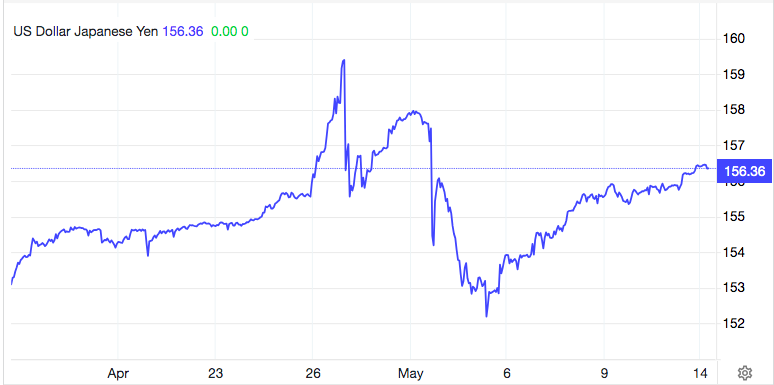
And yet, the yen remains under pressure, slipping another 0.1% last night, and as can be seen from the chart below, continuing its steady decline (dollar rise) from the levels seen immediately in the wake of the intervention.

Source: tradingeconomics.com

Another interesting thing is that our esteemed Treasury Secretary, Janet Yellen, seems to be concerned over any intervention carried out by the Japanese, at least based on comments she recently made in a Bloomberg interview, “It’s possible for countries to intervene.  It doesn’t always work without more fundamental changes in policy, but we believe that it should happen very rarely and be communicated to trade partners if it does.” 

There have been several analysts of late who have made the case that Yellen’s trip to Asia last month included a ‘secret’ Plaza Accord II type arrangement, where there was widespread agreement that the dollar needed to come down in value.  First off, secrets like that are extremely difficult to keep secret, and history shows that doesn’t happen very frequently.  But more importantly, based on the fact that inflation is one of the biggest problems that her boss has leading up to the election, a weaker dollar is the last thing she would want.  I suspect if we continue to see the yen decline, the BOJ/MOF will be back at the intervention game again, but the US will not be helping.  Keep in mind, though, Japanese yields.  If the BOJ is truly going to allow yields to rise in Japan, that would have a significant impact on the yen’s value in the FX markets.  While 1.00% is a big round number, I think we will need to see the BOJ demonstrate a more aggressive stance overall…or we need to see the data turn softer in the US to allow the Fed to get on with their much-desired rate cuts.  We will need to watch this closely going forward.

While everyone’s waiting to see
How high CPI just might be
One cannot rule out
An outcome less stout
Where bond and stock bulls are set free

Which brings us to the inflation story.  By this time, everyone is aware that tomorrow’s CPI data is seen as a critical piece of the puzzle.  I continue to read coherent arguments on both sides of the debate regarding the trend going forward.  (Let’s face it, the error bars are far too wide to be confident in a specific forecast.)  For the inflationistas, they continue to look at things like the housing market, which while frequently expected to see declining price pressures, has maintained an upward trend for the past several years.  As well, things like the dramatic rise in certain commodity prices (coffee comes to mind) and the substantial rise in the price of insurance (something of which I speak from personal experience!), there is ample evidence that prices continue to climb. 

Part of this puzzle may be the result of the fact that companies continue to successfully raise prices, or at least had been doing so for the past two years, as evidenced by the continued strong earnings, and more importantly, still high gross margins they are able to achieve.  So, as input prices have risen, they have passed those costs along to the consumer quite successfully.  Now, the comments from Starbucks and McDonalds at their earnings reports indicating business is slowing down and attributing that slowdown to rising prices may well be a harbinger that companies have lost the ability to keep this up.  But two companies, even large ones, are not nearly the whole economy.  As well, much has been made, lately, of the K-shaped economy, where the haves continue to benefit from the rise in asset prices and are far less impacted by rising prices as they can afford them.  This has led to continued strong demand for luxury goods, which while a smaller sector of the economy, remain highly visible. Meanwhile, the less fortunate lower 90% of the population find themselves struggling to make ends meet as real wages remain stagnant and there continues to be a switch from full-time to part-time employment ongoing as companies adjust their staffing needs.  PS, those part time jobs don’t pay as well and generally don’t have benefits, so any price increases are very tough to swallow.  In the end, it appears that housing, insurance services and food remain in upward price trends.

On the flipside, there are many who see that while Q1’s inflation data was sticky on the high side, things should begin to improve going forward.  They point to things like M2, which has fallen dramatically over the past two years, although has recently inflected higher again.  However, the argument is that the lag between the movement in M2 and inflation is somewhere in the 16-24-month period, and we are now due to see prices decline.  In addition, they point to things like loan impairments and credit card delinquencies rising as signs that companies have lost their pricing power and prices will reflect that by slowing their ascent.

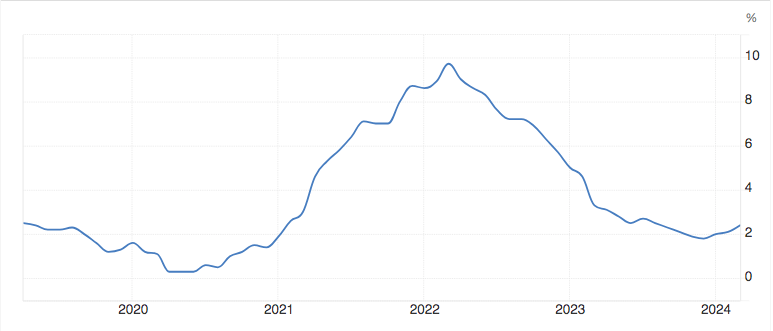
Now, today we see the PPI, which may give clues as to tomorrow’s outcome and the following are the median expectations:  headline 0.3% M/M, 2.2% Y/Y; core 0.2% M/M, 2.4% Y/Y.  Looking at the chart, it certainly appears that this statistic has bottomed out just like CPI.

Source: tradingeconomics.com

But here’s the thing…I have a feeling that regardless of the outcome, the market is going to rally in both stocks and bonds.  Certainly, if it is a softer than forecast number, the rate cut narrative is going to be going gangbusters and stocks will rocket while yields fall.  If it is on the money, my sense is the market is still in the camp that despite what we continue to hear, especially with Powell having removed the possibility of a rate hike, that the view will turn to rate cuts are coming as the Fed’s underlying dovishness will prevail.  But if the numbers are hot, while the initial reaction will almost certainly be a decline in risk asset prices, I have a feeling it will be short-lived.  Positioning is not overly long here, at least according to the fear/greed indicators, and the theme that the administration will do all it can to get re-elected, meaning lots more fiscal support, is going to work in favor of risk assets.  One other thing, if there is some trouble in the bond market, the one thing we know for sure is that Powell will come to the rescue and support the whole structure.

Net, while the timing of each outcome may differ, I sense the end result will be the same.  As to the dollar, I remain in the camp that international investors will continue to buy dollars to buy the S&P.  As well, given it seems very clear that both the ECB and BOE are going to cut rates in June while the Fed remains a much lower probability to do so, that should prevent any sharp dollar decline, although it may not push it any higher.

Overnight, basically nothing happened as everybody is holding their collective breath for tomorrow.  Maybe today will be a harbinger, but I expect a generally slow session overall absent a HUGE surprise in PPI.

Good luck

adf

Tortured

Intervention is
The last bastion of tortured
Finance ministers


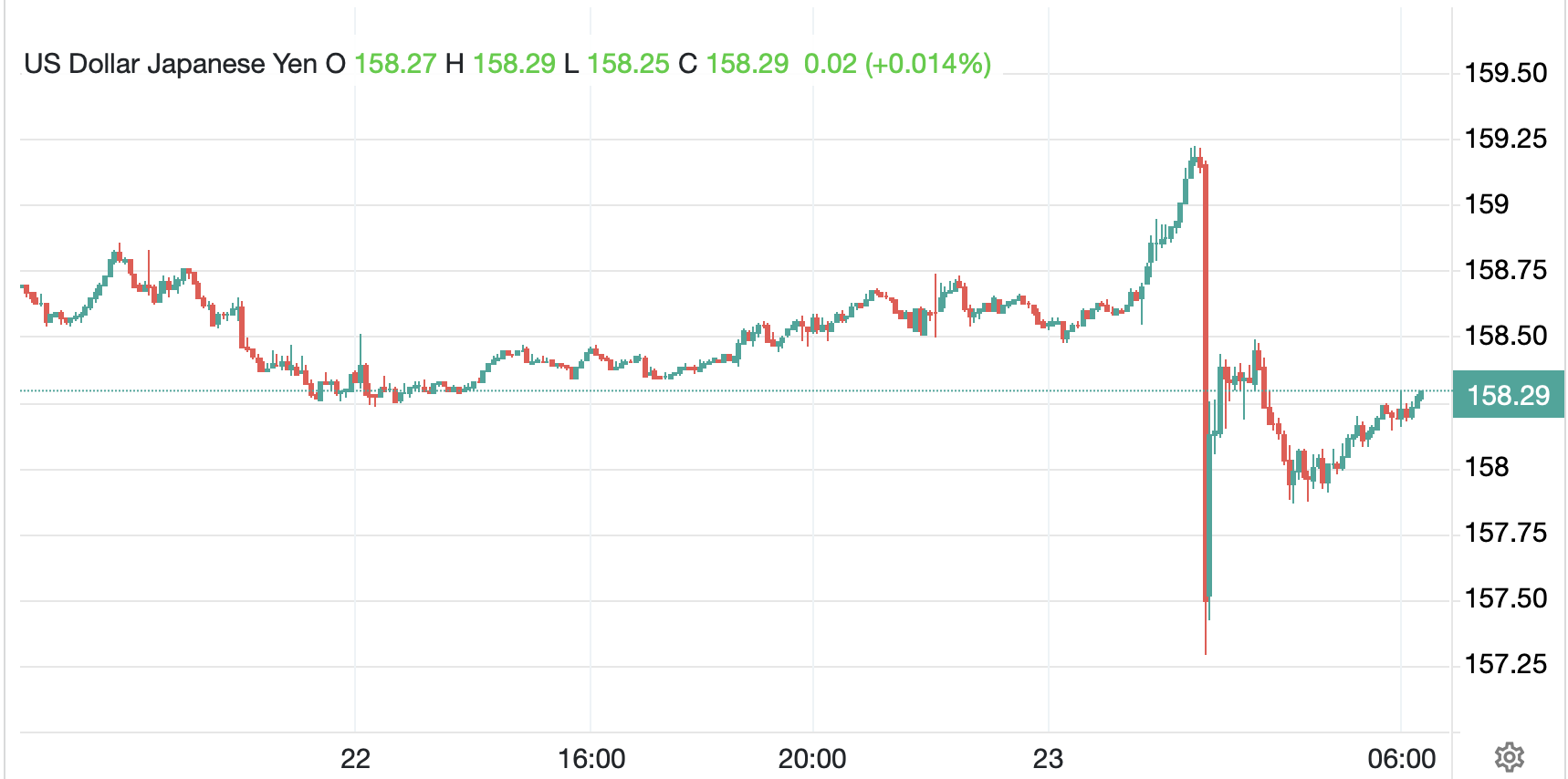
Apparently, Japanese FinMin Suzuki did not want the spotlight to remain on Chairman Powell and the Fed so last night, in what was surprising timing given the absence of additional jawboning ahead of the move, it appears there was a second round of intervention orchestrated by the MOF and executed by the BOJ.  Looking at the chart below, courtesy of tradingeconomics.com, it is pretty clear as to the activity and timing, although as is often the case, 50% of the move has already been retraced.

According to Bloomberg’s calculations, they spent an additional ¥3.5 (~$22B) in the effort, so smaller than last time, but still a pretty decent amount of cash.  As of yet, there has been no affirmation by the MOF that they did intervene, although the price chart alone is strong evidence of the action.  Will it matter?  In the long run, not at all.  The only thing that will change the ultimate trajectory of the yen’s exchange rate is a policy change and based on last week’s BOJ meeting, there is no evidence a monetary policy change is in the offing.  Therefore, we need to see a US policy change and based on yesterday’s FOMC meeting and the following press conference, that doesn’t seem to be coming anytime soon either.  To my eye, the yen will continue to weaken until something changes.  This could take a few more years and USDJPY could wind up a lot higher than 160.

Said Jay, it is, frankly, absurd
A rate hike will soon be preferred
But neither will we
Soon cut, we agree
While ‘flation’s decline is deferred

To me, the encapsulation of the entire FOMC statement and Powell press conference can be summed up in the following two quotes from the Chairman while answering questions.  “I think it’s unlikely that the next policy rate move will be a hike,” and “inflation has shown a lack of further progress… and gaining confidence to cut will take longer than thought.”  In other words, we are not likely to change policy anytime soon absent a complete black swan event.

Since the press conference ended, there has been an enormous amount of speculation regarding what message Powell was trying to send.  I would argue the consensus is that he wants to cut but the data is just not in a place that would allow the Fed to go down that path without destroying what’s left of their credibility.  To me, the question is, why is he so anxious to cut rates?  Arguably, an unbiased Fed chair would simply ‘want’ to follow whatever is the appropriate course to achieve the mandate.  

One of the popular views is that there is substantial pressure from the White House to cut as the Biden administration believes lower rates will help Biden’s reelection bid, however Powell, when asked about the political issue, was explicit in rejecting that hypothesis and claiming that politics is never even part of the conversation, let alone the decision.  I accept that at face value, although certainly all 17 members of the FOMC have political biases that drive their actions.  But here is a take I have not heard elsewhere.  Perhaps Powell is keen to cut because it will help the private equity sphere, the place where he not only made his fortune, but where he also maintains a large social circle and he simply wants to help his friends.  There is no doubt that lower rates help the PE space!  Regardless of why, I have to agree that it appears he is leaning in that direction.

There was one other thing that was a minor surprise and that had to do with the balance sheet program.  As expected, the Fed explained they would be reducing the pace of QT starting in June, but they would be doing so by more than anticipated, slowing the runoff to $25 billion/month of Treasuries before reinvesting, down from the current level of $60 billion/month.  For MBS, the runoff remains at $35 billion/month, although if that number is exceeded, they would replace the MBS with Treasuries so allow the MBS portion of the portfolio (currently $2.38 trillion) to slowly disappear.  The operative word here, though, is slowly, as they have not come close to seeing that $35 billion since the program started.  After all, nobody is refinancing their mortgage with current rates thus reducing the churn in that part of the portfolio.  At any rate, that was very mildly dovish, I believe.

The market response to the entire show was quite positive with equity investors taking the dovish message to heart and equities and bonds both rallied in the immediate wake of the meeting, although the equity markets sold off on the close and wound up slightly lower for the session.  Not so bonds, where yields fell and continue at those levels, down about 5bps on the day.

So how have things fared overnight since the Fed?  Well, the Hang Seng (+2.5%) was the big winner as investors there took Powell’s dovishness to heart and that combined with confirmation that the Chinese Plenary meeting would be occurring in July, thus a chance for more stimulus to come, got investors excited.  However, the mainland was closed.  Japanese shares were basically unchanged after the intervention and the story throughout the rest of the region was mixed with some gainers (Australia, India) and some laggards (South Korea, Indonesia).  

In Europe, it is also a mixed picture as investors respond to the PMI data releases, which were also a mixed bag.  For instance, Spain saw a jump in PMI and the IBEX is firmer by 0.3% while France saw a 1-point decline in the index and the CAC is down by -0.7%.  Looking at the overall mix of data, it appears that European economic activity is bumping along the bottom, although not yet clearly turning higher.  Arguably that is a big reason the ECB has penciled in that June rate cut.  Finally, US futures are pointing higher at this hour (7:00) between 0.5% and 1.0%, so quite solidly so.

In the bond market, the doves are still in charge as Treasury yields have drifted lower by another 2bps and are back to 4.60%.  but in Europe, the story is even better with yields down between 4bps and 7bps as the modest growth outturn added to oil’s recent price declines has investors gaining confidence that inflation there, at least, is truly on its way back to target.  As to JGB’s, a 1bp rise overnight has yields back to 0.90%, obviously much closer to the previous limit at 1.0%, but still not moving there rapidly.

Going back to oil prices, while they have bounced 0.5% this morning, they are down more than 5.2% in the past week as rising inventories and growing hopes of a ceasefire in Gaza have been enough to get the CTAs and hedge funds to close their positions.  In something of a surprise to me based on the ostensible dovish tone of the Fed, metals markets are back under pressure after yesterday’s bounce so all of them, both precious and industrial, are lower by about -1.0% this morning.

Finally, the dollar, aside from the yen, is edging higher this morning, although edging is the key term here.  Against most majors it is firmer by just a bit, 0.15% or so, although in the G10 there are two outliers, CHF (+0.45%) which rallied after their CPI release this morning was much hotter than expected at 0.3% M/M indicating the SNB may be holding off on its next rate cut, and NOK (-0.6%) which is continuing to suffer from the oil decline in the past week.  It should also be no surprise that ZAR (-0.5%) is under pressure given the metals movement.  But elsewhere, things are far less interesting with modest dollar gains the rule today.  This seems at odds with the ostensible dovish Fed tone, but there you have it.

On the data front, we see Initial (exp 212K) and Continuing (1800K) Claims as always on a Thursday, as well as the Trade Balance (-$69.1B) and then Nonfarm Productivity (0.8%) and Unit Labor Costs (3.3%) all at 8:30 with Factory Orders (1.6%) coming at 10:00.  As of now, there are no Fed speakers on the docket, but I would not be surprised to see an interview pop up.  The Fed will be closely watching the productivity data as that is an important part of the macro equation regarding sustainable growth and inflation.  Certainly, the expectations do not bode well for a dovish stance.

Explain to me that policy has changed, and I will accept that it is time to change my view.  However, at this point, the dollar still gets the benefit of the doubt.

Good luck

Adf

Dismay

The data continues to show
The US is able to grow
If this is the case
Seems foolish to chase
The idea rate cuts are a go
 
Instead, I expect Powell’s way
Is higher for longer will stay
If rates, thus, stay high
Can risk assets fly?
Or will those high rates cause dismay?


The case for the Fed to cut rates continues to fade as not only have Powell and his team been cautioning patience, the data continue to show that economic activity is not slowing down.  The latest exhibit comes from yesterday’s ISM Manufacturing data which printed at a much better-than-expected 50.3, its first print above 50 in 16 months.  Not only that, but the New Orders and Prices Paid sub-indices both printed much higher than last month indicating business is picking up and so are prices.  Certainly, the chart below from tradingeconomics.com indicates that a clear trend is forming for better growth ahead.

The Prices Paid chart looks almost identical.  It strikes me that the recession call continues to get harder to make.  Certainly, things can change, but as of right now, I cannot look at the menu of data and conclude growth is set to slow rapidly.  Given this as background, it becomes increasingly difficult to make the case that the Fed is going to cut rates at all, at least based on the data.  This is a big problem for Powell if he remains insistent on making those cuts because it will call into question the rationale and really push the politics front and center.

As it happens, I am not the only one concluding that rate cuts are less likely, the CME’s Fed funds futures contract is slowly pricing cuts out of the mix as well.  This morning not only has the probability of a June cut fallen slightly to 58.8%, but the market is now pricing in just 66bps of cuts by the December meeting, less than the three full 25bp moves that the median dot indicated.  There is a ton of Fedspeak this week, starting with 4 speeches today from Bowman, Williams Mester, and Daly.  Chairman Powell speaks tomorrow and there are a dozen more after that, so it will be very interesting to see if the tone has changed to even more caution and patience.  With this as a backdrop, perhaps longer duration assets, like bonds and high growth companies (i.e., tech) could well feel some pressure.  We shall see how things play out.

Cooperation
Is not what the market gives
Instead look for pain


While the US story continues to be about stronger economic activity and a reduced probability of lower rates, in Japan, the story remains entirely focused on the yen’s weakness and whether the MOF/BOJ are going to respond.  First, remember that in Japan, like here in the US, the MOF is responsible for the currency, not the BOJ, meaning any intervention is directed by the MOF although it is executed by the BOJ.  This is why we need to focus on the FinMin and his minions regarding any actions.  In this vein, last night as USDJPY once again approached 152.00, FinMin Suzuki was back in front of reporters explaining, “Language aside, we’re now watching markets with a strong sense of urgency.  We are carefully watching daily market moves.”  He added, “All we can say is that we will take appropriate action against excessive volatility, without ruling out any options.”  

So, the MOF continues to threaten intervention with their urgent watching of markets (I feel like that is a very poor translation of whatever he is actually saying, although I suppose it gets the message across.). In one way, it was surprising they didn’t take advantage of illiquid markets yesterday to push the dollar lower as every dollar spent would have been far more effective, but a look at the recent price activity shows that while the yen has weakened appreciably since the beginning of the year, thus far their words have been sufficient to prevent further damage as the currency hasn’t budged in two weeks.  

The problem they have is that the US seems less and less likely to begin easing monetary policy and so the underlying fundamental driver of the exchange rate, interest rate differentials, is going to continue to weigh on the yen (and every other currency).  I also see no reason for Secretary Yellen to consider that a weaker dollar is a help for the US right now, so concerted intervention, a redux of the Plaza Accord of 1985 seems highly unlikely.  While at some point I do expect the MOF to act on their own, as is always the case, it will only have a short-lived impact on markets and likely be used as an entry point for speculators to extend their short yen trade.  The only solution is a change in policies and the BOJ blew that last month.

Ok, now that markets are back open again, let’s see what’s happening.  In Asia, the big mover was the Hang Seng (+2.35%) which was catching up to the news that China seemed ready to implement further stimulus that we heard on Friday.  But there was no consistency throughout the rest of Asia with both gainers and losers around the continent.  Europe is a similar mixed bag, with some markets higher and others lower despite what I would characterize as mildly better than expected PMI data released this morning across the entire continent.  While it wasn’t showing growth, the data improved on the flash numbers of last week.  US futures, however, are softer this morning by about -0.5% after yesterday’s lackluster session.  Certainly, continued hopes for rate cuts are diminishing and that seems to be weighing on stocks at least a bit.

In the bond market, yesterday’s US data set the tone as Treasury yields jumped 12bps yesterday after the strong ISM data and are up another 5bps this morning.  This has dragged European yields higher across the board with gains between 9bps (Germany) and 14bps (Italy).  Of course, the mildly better PMI data in Europe is adding to that mix.  Even JGB yields managed to edge higher by 1bp overnight, although they remain below 0.75%.

Oil prices have been flying, up another 1.1% this morning and now nearly 9% in the past month.  It seems that the escalation of events in the Middle East is having an impact at the same time that OPEC+ is holding firm on their production cuts.  There are rumors of some big Middle East settlement deal to end the war as well as get Saudi Arabia to recognize Israel, but the market does not yet believe that, clearly.  Considering that growth is making a comeback, that China seems ready to stimulate further and that production is not growing, it seems there is a pretty good chance that oil prices continue to rally.  Meanwhile, metals remain the flavor of the day with gold (+0.3%), silver (+1.7%), copper (+0.6%) and aluminum (+1.6%) all in demand.  The industrial metals are responding to the growth story, while the precious set are simply on a roll with fears that fiat currencies are going to continue to be debased top of mind.

Speaking of fiat currencies, the dollar, which rallied nicely over the long weekend, is settling back a bit this morning, but with no consistency.  For instance, CHF (-0.5%) is lagging sharply while NOK (+0.5%) and SEK (+0.5%) are both powering ahead.  The rest of the G10 is modestly firmer, but the movements are within 10bps of yesterday’s closing levels.  In the EMG bloc, ZAR (+0.5%) continues to benefit from the metals rally while PLN (-0.4%) is under pressure after its PMI data disappointed relative to its peers.  My view continues to be that as long as the Fed remains the most hawkish central bank, the dollar will find support.

On the data front today we see JOLTS Job Openings (exp 8.75M) and Factory Orders (1.0%) and we have all those Fed speakers mentioned above.  German CPI fell to 2.2%, as expected, which implies to me that the chances remain greater the ECB will cut before the Fed.  And that is really the big question now, which major central bank acts first.  With all the Fed speakers on this week’s docket, I suspect by Friday we will have a much better idea as to whether a June cut is still on the table.  We will be watching closely.

Good luck

Adf

Good…or Bad

FinMin Suzuki
Noted that a weaker yen
Might be good…or bad

One of the great things about finance and central bank officials is their ability to twist language into pretzels while trying to make their case in any given situation.  Last night offered another great example from Japanese FinMin Shun’ichi Suzuki with this being the money quote, “From that standpoint, I’m closely watching market moves with a strong sense of urgency.”  It is not clear how you watch something with urgency, but if you are the MOF official in charge of explaining why your currency has been declining so rapidly, I guess you have to say something.  (As an aside, I might simply point out that the interest rate differential between the US and Japan is now 5.5%, having risen from 0.35% over the past two years and that might have something to do with the FX move.)

As previously mentioned, the MOF is moving up its ladder of pre-intervention activities as detailed on Wednesday, arguably now somewhere between numbers 2 and 3.  The biggest problem Japan has is that there is a quickly declining probability that the US is going to be easing policy as soon as had been previously thought, and so the incentive to own yen remains diminished.  The second biggest problem they have is their economy has slipped into recession and so the urgency for Ueda-san to tighten policy is also diminished.  While USDJPY has been hovering just above 150 for a few days, I expect that it is going to grind higher still and force Suzuki-san to continue to climb that numeric ladder.  The one saving grace for Suzuki is that as we approach fiscal year-end in Japan, there is likely to be a seasonal flow of funds back home for dressing up balance sheets.  That could well keep things in check until sometime in April, but all signs are that the market is going to test him again before too long.

On Tuesday, the data was hot
On Thursday, it really was not
So, which one describes
The ‘conomy’s vibes?
Or have, now, stagflation, they wrought?

The CPI data on Tuesday certainly opened a rift between the narrative of smoothly declining inflation leading to numerous Fed rate cuts this year and what appears to be a more realistic situation where any further decline in inflation comes in fits and starts if it comes at all.  The narrative explanation for the sticky inflation was that economic activity was so strong that it should be expected.  But if the economy is truly that strong, someone needs to explain how Retail Sales can decline -0.8% in January, why Industrial Production would decline -0.1% and why Capacity Utilization would fall back to 78.5% despite all the government support for reshoring activity.  In an ironic twist, the other two releases yesterday, Philly Fed and Empire State Manufacturing, were both better than forecast.  This is a complete reversal of the pattern we have seen for the past 2 years where survey data is lousy but hard numbers remained strong.

In the end, it appears that market participants have given up on the macro data and are back to buying any dip with abandon.  I will be the first to explain that the economic outlook remains very cloudy.  To date, it appears that the excessive deficit spending has been successful in maintaining steady GDP growth.  Of course, excessive deficit spending is not something that can continue forever.  As Herbert Stein explained in 1985, “if something can’t go on forever, it will stop.”

This leads to the question; how long until forever?  If we have learned nothing else in the past decades it is that when governments involve themselves directly in economic activity and financial markets, forever is delayed. Things take MUCH more time than we expect for them to play out.  Simply consider how long Japan has been running massive budget deficits, NIRP and QE without destroying their economy.  (30 years.)

Of course, forever in the economy and forever in the markets are two very different things and while the government may be able to delay a reckoning in economic activity, we must be very careful around how markets behave with the same catalysts and inputs.  My point is any risk-off outcome will be important for your investing and hedging decisions, but not necessarily change the trajectory of GDP.  After all, there is always more money to be printed.  In fact, it is this issue that drives my longer-term inflation thesis.  Every government will do whatever they think they need to prevent a serious economic contraction and high on the list of actions will be much easier monetary policy.  Watch closely for things like QT to end or another BTFP-like program to continue to force liquidity into markets.

Ok, let’s look at how things finished the week.  As I said, the market no longer cares about bad data and simply continued to add to risk assets.  Yesterday saw gains in the major indices in the US which was followed by gains throughout Asia and most of Europe, all of them pretty substantial.  In fact, the only red numbers on my screen are in Spain’s IBEX which is suffering on the back of Spanish central banker Pablo Hernandez de Cos explained that several Spanish banks may suffer due to the ongoing drought in Spain and its negative impact on the economy there.  US futures are basically pointing higher again this morning as well.

In the bond market, though, yields are edging higher around the world.  Treasury yields are up 4bps today and pushing back to that peak seen immediately following the CPI print on Tuesday.  European sovereign yields are all higher by between 3bps and 4bps although JGB yields are unchanged on the day.  Ultimately, I continue to see the case for yields to climb from these levels as there is no indication that inflation is truly ending.

Oil markets powered higher yesterday, rising nearly 2% despite the huge build in inventories as concerns over supply being unable to keep up with ever growing demand have reemerged.  As well, the fact that any cease fire in the Israel-Hamas war seems to be a distant memory has some on edge that things can get worse in the Middle East overall.  As to the metals markets, gold managed to regain the $2000/oz level yesterday and is hanging right there this morning.  On a brighter note, both copper (+1.5%) and aluminum (+0.5%) are firmer this morning, perhaps in anticipation of China’s reopening next week, or perhaps because the dollar has stopped rising.

Speaking of the dollar, it is mixed this morning with the yen (-0.3%) and KRW (-0.3%) the laggards while ZAR (+0.3%) seems to be benefitting from the metals price action.  Broadly speaking, I still like the greenback for as long as the US maintains the tightest policy around.

On the data front, to finish the week we see PPI (exp 0.6% headline, 1.6% ex food & energy) as well as housing data with Starts (1.46M) and Building Permits (1.509M).  Finally, at 10:00 we see Michigan Sentiment (80.0).  We also hear from two more Fed speakers, Governor Michael Barr and SF President Mary Daly.  Yesterday, Atlanta Fed president Bostic explained he was not worried by Tuesday’s CPI print, but not yet convinced they had beaten inflation.  I have a feeling we will hear a lot of that sentiment for the time being.

Heading into the weekend, despite Tuesday’s shocking data, risk assets have performed well overall, with the S&P 500 making its 11th new all-time high this year yesterday.  I don’t know what will derail this train, and for now, there is nothing obvious to do so.  As such, I would keep with the trend overall, that means modestly higher stocks, yields grinding higher and the dollar edging higher as well.  I know that doesn’t seem to make much sense, but that’s what we’ve got.

Good luck and good weekend
Adf
Price Rise Regimes

Ahead of today’s CPI
Investors would not really buy
But neither would they
Sell short, as they weigh
If Jay is a foe or ally

Meanwhile, amongst pundits it seems
The world is split into extremes
Some see prices falling
And for cuts, are calling
While others fear price rise regimes

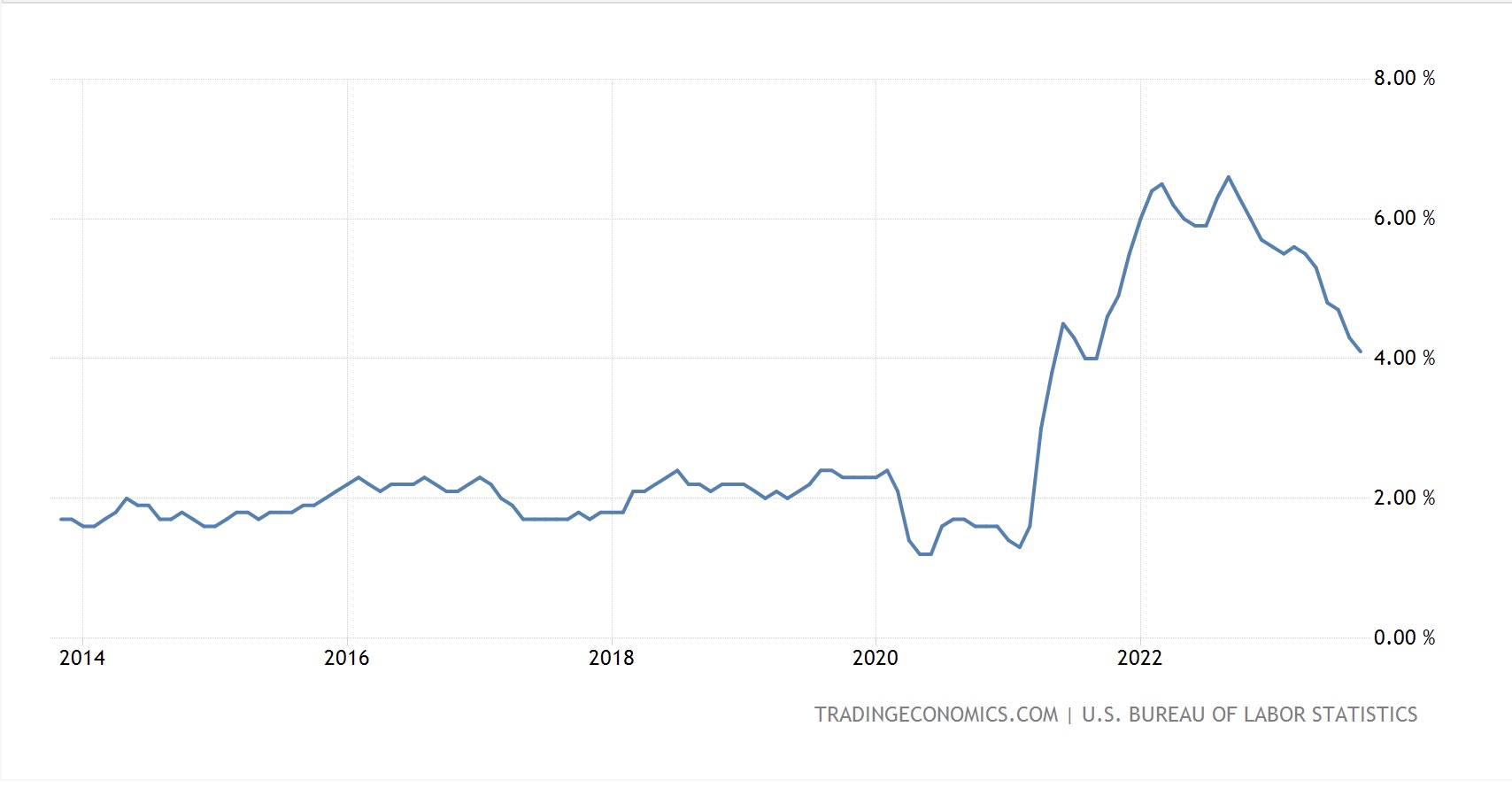
Market activity has been subdued overnight as we all await this morning’s big CPI report.  Currently the consensus views are for a 0.1% rise in the headline, leading to a 3.3% Y/Y number, down substantially from last month’s 3.7% reading, and a 0.3% rise in the core, leading to an unchanged Y/Y reading of 4.1%.  Here’s the thing, as can be seen in the below chart of core CPI, although it is clear inflation appears to be trending lower, it is still a LONG way from where anybody is comfortable.

Something else to remember is the different ways in which we all experience, and think about, inflation.  When writing about inflation, all analysts look at the rate of change of a percentage move as an indicator of what is happening.  But when you go to the grocery store, or your favorite restaurant, or when you order stuff on-line, especially things that you regularly buy, the price changes over the past two years have been so substantial, and taken place in such a short time, that we all remember the pre-covid prices.  The fact that prices may not be rising as fast as they did last year does not make the stuff any cheaper this year.  I would contend that is why virtually all of us consider the inflation data to be suspect, because the package of toilet paper that used to cost $4.99 now costs $8.99, and while it may not go higher anytime soon, it is still nearly double what we remember.  This perception is critical, in my mind, to understanding the national mood, and it is one that nobody in the Fed, or likely the administration, considers.  We know this because there are so many articles in the mainstream media about how things are really great, and people just don’t understand how good a job those two groups are doing.  

At any rate, if pressed, I would say that there are more deflationistas these days, who believe that inflation is going to quickly head back to 2% and that the Fed is going to be cutting rates early next year to prevent overtightening of policy.  The crux of their argument is that M2 is declining at a record pace (as can be seen in the below chart), and therefore is highly deflationary.  

I would counter that argument, though, with the fact that the velocity of money (see chart below) is rising at a record pace, offsetting those declines, and supporting ongoing inflationary tendencies.  

As some of us may remember from our macroeconomics classes, the identity to describe growth and inflation is:

                                                MV = PQ

The argument that a decline in M2 money supply (the “M”) will lead to lower prices assumes the velocity of money (the “V”) remains stable.  But as you can clearly see from the second chart, the velocity of money is rising sharply.  I would contend there is little chance that deflation is coming to a screen near you at any point in the next several years absent a depression brought on by a collapse in the bond market.  And ultimately, that means that the price of all those things we buy regularly is not going to retreat to pre-covid levels.

Away from the CPI drama, there were two things of note overnight.  First, Japanese FinMin Suzuki was on the tape explaining the government would take all possible steps necessary to respond to currency moves.  The market response was a very short-term rise in the yen, with the currency popping 0.35%, but giving back most of those gains within the hour and currently, it sits largely unchanged on the session.  There has been no evidence that the BOJ has intervened since October 2022, but it appears that 152.00 may be a sensitive spot right now.  The other thing he said was they were preparing a package to help citizens cope with the weakening yen which is driving inflation there.  That said, there is no indication yet they are going to raise the deposit rate from its current -0.10% level.  Net, I still think the yen has further to decline, at least until policy changes in Tokyo.

The other noteworthy occurrence was word from China that they were considering an additional CNY 1 trillion of support for the housing market as things on the mainland continue to slow despite Xi’s best efforts.  It seems when you blow a 20-year property bubble of such enormous proportions, such that the property sector consumes > 25% of your growing economy, slowing that down without collapsing the economy is a tough job.  I continue to think of King Canute and his command that the tide recedes every time I think about KingPresident Xi trying to stop the property market collapse.  At any rate, as can be seen by the fact that equity markets in China and Hong Kong did virtually nothing last night, the market is not excited by the prospects of more Chinese money sloshing around.

As to the rest of the equity markets, yesterday’s trading in the US was pretty limited with modest gains and losses in the indices while the Nikkei managed to gain 0.3% overnight.  European bourses are also mixed, with the continent a bit firmer while the UK is under some pressure.  Perhaps the marginally better than forecast German ZEW reading of 9.8 vs 5.0 expected and -1.1 last month is the driver on the continent, while UK employment data was arguably a bit better than forecast, with the Unemployment Rate remaining unchanged at 4.2% rather than ticking higher as expected, and so hopes for a quick BOE rate cut have faded a bit.

Too, in the bond market, activity has been extremely subdued with Treasury yields 2bps softer this morning while European sovereign yields are essentially unchanged across the board.  Last night in Asia, we saw little movement as well, with JGB yields slipping just 1bp and hanging around their new home at 0.85%.

While commodity prices managed to rally a bit yesterday, this morning, what little movement there is across energy and metals markets is ever so slightly lower.  Yesterday saw the EIA raise its forecast for oil demand slightly, and there is word that the administration is bidding for 1.2 million barrels of oil to start to refill the SPR, but sentiment in this space is clearly negative with the recession fears the driving force across all these markets.

Finally, the dollar, too, is very little changed this morning which should be no surprise given the lack of movement elsewhere.  If anything, it is trending a bit softer, but only just, as the deflationistas seem to be preparing themselves for a soft CPI print and want to get on board for that first Fed rate cut.  As we currently stand, at least according to the Fed funds futures market, the first cut is priced in for the June meeting, although the first hints of a cut show up in March.  That said, the probability of a rate hike in December has edged higher to 15% from below 10% last week.  There is still a great deal of confusion as to how market participants believe this is going to play out over time.

Aside from the CPI data, we hear from 3 more Fed speakers today, Barr, Mester and Goolsbee, while Governor Jefferson, in a speech in Zurich early this morning, didn’t really touch on current monetary policy, rather he was discussing uncertainty in a broad manner.  I suspect that the 3 speakers will generally reiterate Powell’s message from last week that the future is uncertain but higher for longer is the way forward.  As such, it is all about the data.  A hot print, certainly a M/M of 0.2% headline or 0.4% core will likely see bonds sell off along with stocks while the dollar rallies.  However, anything else, meaning a soft print or even an as expected print, will likely encourage risk buying and dollar selling.  We shall see,

Good luck

Adf

Towel Throwing

Did they sell?  Or not?
The new Mr Yen, Kanda
Explained, “No comment”

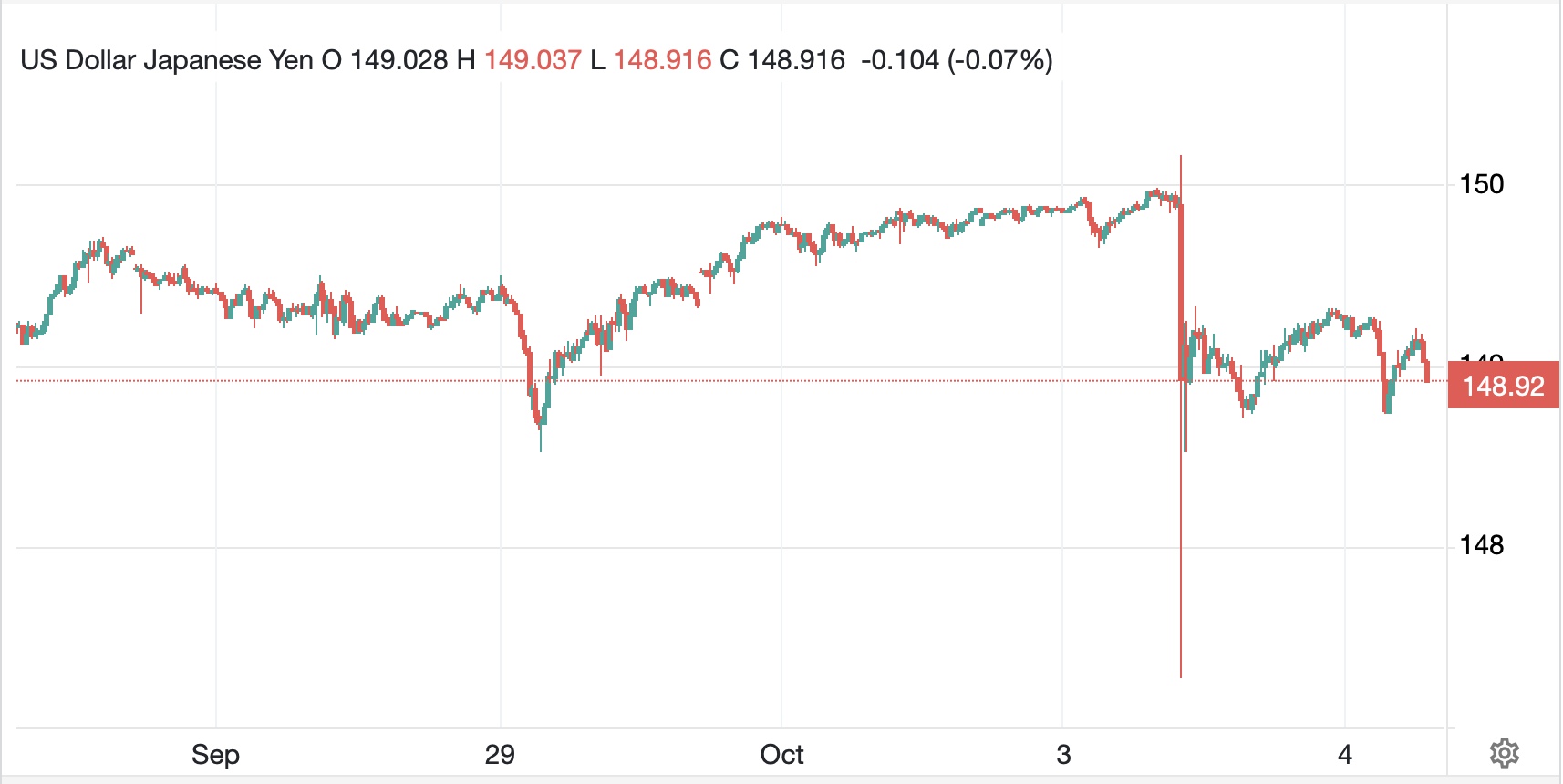
As is clear from the chart below (source tradingeconomics.com), there was a bit of movement in the USDJPY market yesterday morning.  The price action certainly had the feel of intervention, with a nearly 2% decline that occurred in seconds, but there has been neither confirmation nor denial of any BOJ trading activity.  Kanda-san, who is vice minister of international affairs which is the MOF role that deals with the currency, is the current Mr Yen.  His comments were certainly cryptic and as such, not very informative.  “We will continue with the existing stance on our response to excessive currency moves,” said Kanda. “While we are basically like a Gulliver in the market, we’re also coming and going as a market player, so usually we won’t say whether or not we’ve intervened each time,” Kanda said.  

The story that makes the most sense is that the BOJ reached out to the major Japanese banks in NY and London and checked rates.  The fact that the move happened minutes after the spot rate finally breeched the 150 level certainly was suspicious and indicated that contrary to yesterday’s comments by Watanabe-san, a former Mr Yen, the level really does matter, not just the speed of the move.  Others have tried to explain that breeching 150 triggered selling levels, but if there were exotic option barriers at 150, and I’m sure there were, the more typical move would be an acceleration higher as stop-loss orders by dealers were triggered.  The spike down, at least in my experience, is a sign of exogenous activity, not market internals.

Looking ahead, are we likely to see more of this type of activity?  You can never rule out currency support from any nation whose currency is weakening sharply, but there are G7 and G20 constructs that are supposed to limit these, and are designed to focus on volatility of movement, not levels.  This appeared contrary to those concepts, so we have much yet to learn.  At the end of the month, the BOJ will publish any intervention activity as part of their transparency initiative, but that might as well be next year for all the information it will provide.  Be wary of further movements like this, but the fundamentals continue to point to a higher USDJPY, especially given the accelerating rise in US Treasury yields.

The bond market rout keeps on going
As we see more folks towel throwing
The question at hand
Is can Powell stand
The pressure that’s certainly growing

Thus far, there’s no sign that the Fed
Is worried when looking ahead
More speakers were heard
To follow the word
That higher for longer’s not dead

Of course, away from the FX market, where the dollar has continued to show remarkable strength overall, the big story is the Treasury market.  After yesterday’s sharp move, the 10-year yield is higher by 23bps so far in October and it is only the morning of the third session of the month!  The yield curve inversion is down to -32bps and 30-year Treasury yields are pressing 5% now, a level not seen since summer 2007.  This sharp move has been the true driver of almost all markets and as long as it continues, there is going to be more pain for risk assets.  There has been no change in the fundamentals and yesterday’s move was ascribed to a much higher than expected JOLTS Job Openings number, which printed at 9.61M, far above the forecast 8.8M and a huge jump from last month’s outcome.  This seemed to encourage the Fed speakers to maintain their higher for longer attitude with a number still looking for one more rate hike this year.  Once again, I will point to Friday’s NFP number and its importance as a key driver of Fed policy.  If that number remains strong, and Unemployment remains low, the Fed can maintain this policy stance with limited fallout politically.

The rise in Treasury yields is being copied elsewhere around the world with yields following the US higher.  While today is seeing a bit of consolidation, with European sovereign and Treasury yields currently softer by 1bp-2bps, this is a trading effect, not a change of heart.  Interestingly, even JGB yields are getting dragged along higher as they closed last night at 0.80%, their highest level since 2012, the beginning of Abenomics.  But in the end, this is all about US yields with the rest of the world continuing to follow their lead.  I heard some analysts claiming this was a blow-off top in yields and we have seen the end.  Alas, I don’t believe that as history shows the yield curve will move back to a normal stance and with the Fed firmly in the higher for longer camp, 10-year yields have further to rise.  Yes, something is likely to break at some point, but so far, the few hiccups have been contained.

Not surprisingly, risk assets had a tough time in yesterday’s session with US indices all falling sharply, by -1.3% or more.  Yesterday’s European bourses were also under significant pressure and the Asian markets open overnight got hit hard as well with the Nikkei (-2.3%) and Hang Seng (-0.8%) the biggest movers.  However, this morning, Europe has a touch of green on the screen, with small gains on the order of 0.3% and US futures are also edging higher, +0.15% at this hour (7:45).  I wouldn’t read too much into this modest bounce and fear that there is further, and potentially much further, to go.  One of the remarkable things about the equity market is that earnings estimates for 2024 are for a rise of 12% on 2023 earnings.  Given the ongoing rise in energy costs and the increasing probability of a recession, those seem quite optimistic.  As they are revised lower, that, too, will weigh on equities, and by extension all risk assets.

Lastly, in the energy space, oil (-1.7%) is under further pressure this morning, although the fundamentals wouldn’t indicate that is the right move.  Not only did we see a further draw in inventories in the US, notably at the key Cushing, OK storage depot, but we heard from Russia that they are going to continue to restrict production by 300K bbl/day through the end of the year.  Meanwhile, the law in the US is set that the government cannot sell oil from the SPR when the inventory level falls below 330 million barrels.  Currently, it sits at 327 million, so that supply has ended.  Nothing has changed my view that oil has much higher to go, albeit not in a straight line.

Metals prices remain generally under pressure although gold (+0.2%) seems to be bouncing with other risk assets this morning on a technical trading basis.  However, both copper and aluminum are still sliding, typically a harbinger of weaker economic activity to come.

As to the dollar broadly, it, too, is a touch softer this morning, pulling back from highs seen yesterday in sync with all the markets.  But the same fundamentals driving the bond and stock markets are in play here, higher yields leading to more demand and a higher dollar.  Yes, this will end at some point, but we need to see a change in policy for that to happen.  The next real chance we have for something like that is on Friday with the payroll report.  A weak report, which seems unlikely at this time given the other employment indicators, would almost certainly change the market’s tone.  However, until then, look for positioning to continue to favor a stronger dollar, and for more and more dollar short sellers to get stopped out.

On the data front, this morning brings ADP Employment (exp 153K) as well as Factory Orders (-2.1%) and ISM Services (54.5).  the PMI Services data from Europe indicated that the worst may be over, but that there is, as yet, no real rebound.  We hear from a few more Fed speakers, but thus far they remain consistent, higher for longer is appropriate.

Today could see more consolidation of the recent moves across the board, but I do not believe that we have come to the end.  Calling a top or bottom is always impossible but remembering that the trend is your friend is likely to keep your activities in good shape.

Good luck

Adf