
A Final Bronx Cheer

Though markets are desperate for Jay
To cut, there is fear that he’ll say
It’s not yet the time
In this paradigm
As tariffs have caused disarray
 
But truly, Chair Jay’s greatest fear
Is that ere October this year
The Prez will have chosen
A new Chair and frozen
Him out with a final Bronx cheer


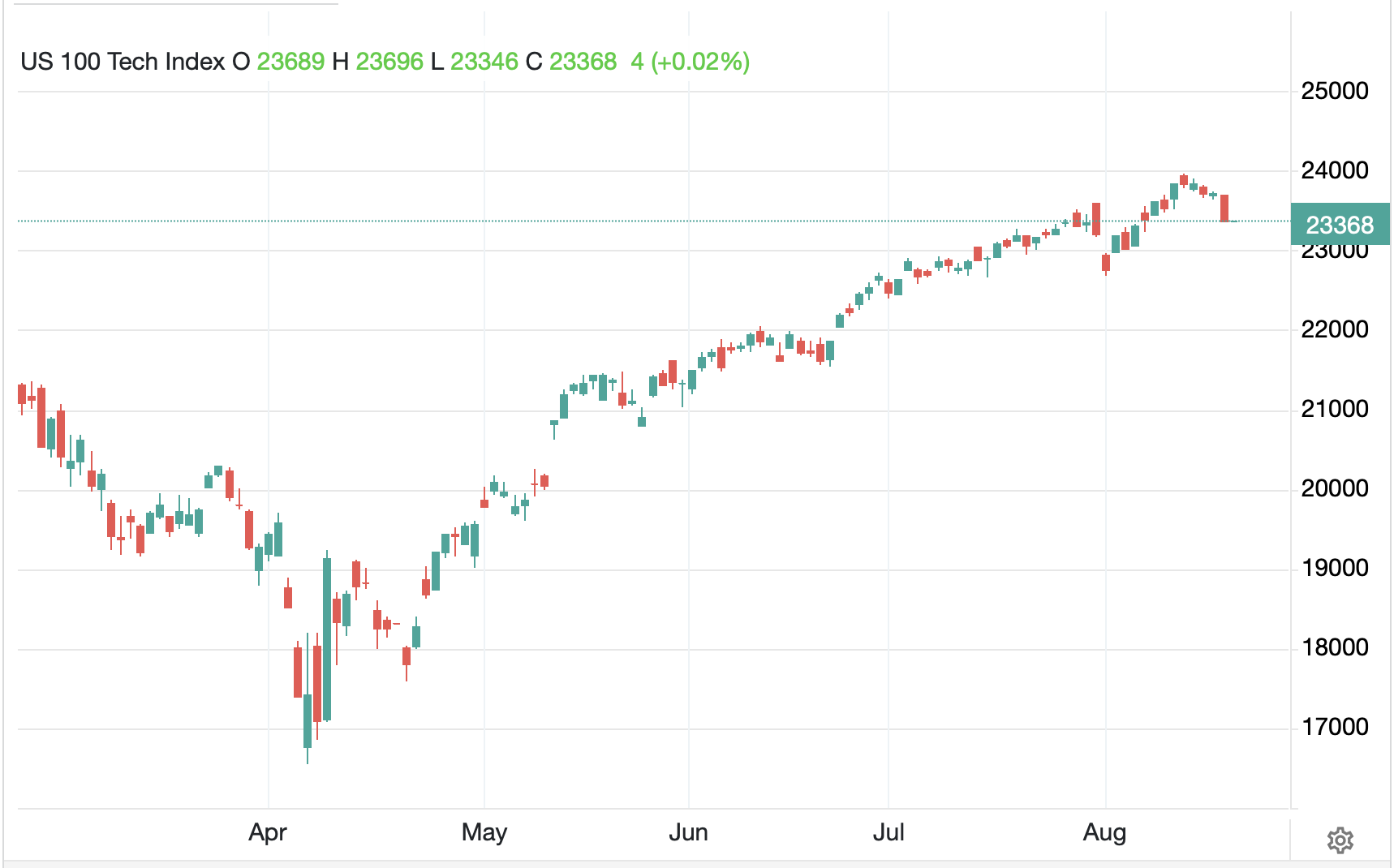
Yesterday saw the first substantial equity market move in nearly 3 weeks, with the NASDAQ declining 1.5% as concerns arose that the current extremely high valuations would have a more difficult time being maintained if the Fed does not ease policy as widely expected next month.  This resulted in all the Mag7 declining, which given they have been the driving force higher in the market, necessarily resulted in overall index declines.
Source: tradingeconomics.com

Of course, the question is, what made yesterday any different than previous sessions.  There were no earnings results of note, and arguably, the biggest tech news was the story about the US government taking a stake in Intel, something that seems likely to have been a positive.  However, there has been an increase in chatter about what Chair Powell is going to say on Friday at his Jackson Hole speech.  Notably, in the SOFR options market, there are a large, and still increasing, number of bets being placed that Powell will indicate 50bps is on the table in September.  But Wall St analysts continue to side with the patience crowd, explaining that while the current policy settings may be slightly restrictive, they are hardly suffocating for the economy.

While Powell has repeatedly blamed an uncertain impact of tariffs on his decision to maintain current policy settings, just like everything else, this is becoming extremely political.  Trump’s allies are lining up behind him and calling for immediate rate cuts to help support the economy.  At the same time, Trump’s political foes remain focused on preventing any Fed action that might help Trump, although they couch their arguments in terms of maintaining Fed ‘independence’.

However, last night was instructive in that two central banks, New Zealand and Indonesia, cut rates further while Sweden’s Riksbank, though standing pat, explained that more cuts are possible, if not likely, later this year.  While the PBOC did not cut rates, the pressure there is building as the economic situation is very clearly slowing down, as discussed last week after their data releases.  So, with most of the world cutting rates (Japan being the notable exception), pressure continues to mount on Powell and the Fed to pick up where they left off last December.

Hanging over both Powell’s speech and the September rate decision is the fact that Treasury Secretary Bessent explained yesterday that interviews for the next Fed chair would begin around Labor Day, just two weeks from now, and nearly eight months before Powell’s term ends.  This will almost certainly weaken Powell as other FOMC members and the market will look to whomever is selected for their views, with Powell serving out his term as a lame duck.  In fact, it is for this reason that my take is Powell’s speech at Jackson Hole will be less about policy and more an attempt to burnish his legacy.

And that’s where things stand.  With no data of note today, and yesterday’s housing data being mildly positive, but not enough to change macroeconomic opinions, the narrative writers are looking for something to say and Powell’s speech is where they have landed.  Absent a run of declining days, I put no stock in a change in the market temperature at this point.  So, let’s see how things behaved overnight.

In Asia, the Nikkei (-1.5%) had a rough night in a direct response to the US tech-led selloff.  Given that US markets have stabilized this morning, with futures unchanged at this hour (7:25), we need to see a continuation here before expecting a significant further decline there.  China (+1.1%), however, bucked that weaker trend, ostensibly on hopes that the ongoing trade talks with the US will prove fruitful.  Elsewhere in the region, Korea (-0.7%) and Taiwan (-3.0%) were both hit on the tech selloff blues but other markets, with less exposure to that sector were fine.  In Europe, it is a mixed picture with the DAX (-0.4%) the laggard after weaker than expected PPI indicated that current ECB policy needs to be more accommodative to help the country but may not be coming soon.  However, the rest of the continent is little changed.  surprisingly, UK stocks (+0.3%) are holding up well despite higher-than-expected CPI data which has adjusted analysts’ thoughts on whether the BOE will be able to cut again at their next meeting.

In the bond market, Treasury yields (-1bp) continue to trade in the middle of that band I showed yesterday, while European sovereign yields have also slipped between -1bp and -2bps this morning after the softer German price data.  The UK (-4bps) is a surprise as I would not have expected lower yields after a higher inflation reading.  Perhaps this is an indication that investors are expecting a much worse economic outcome from the UK going forward.

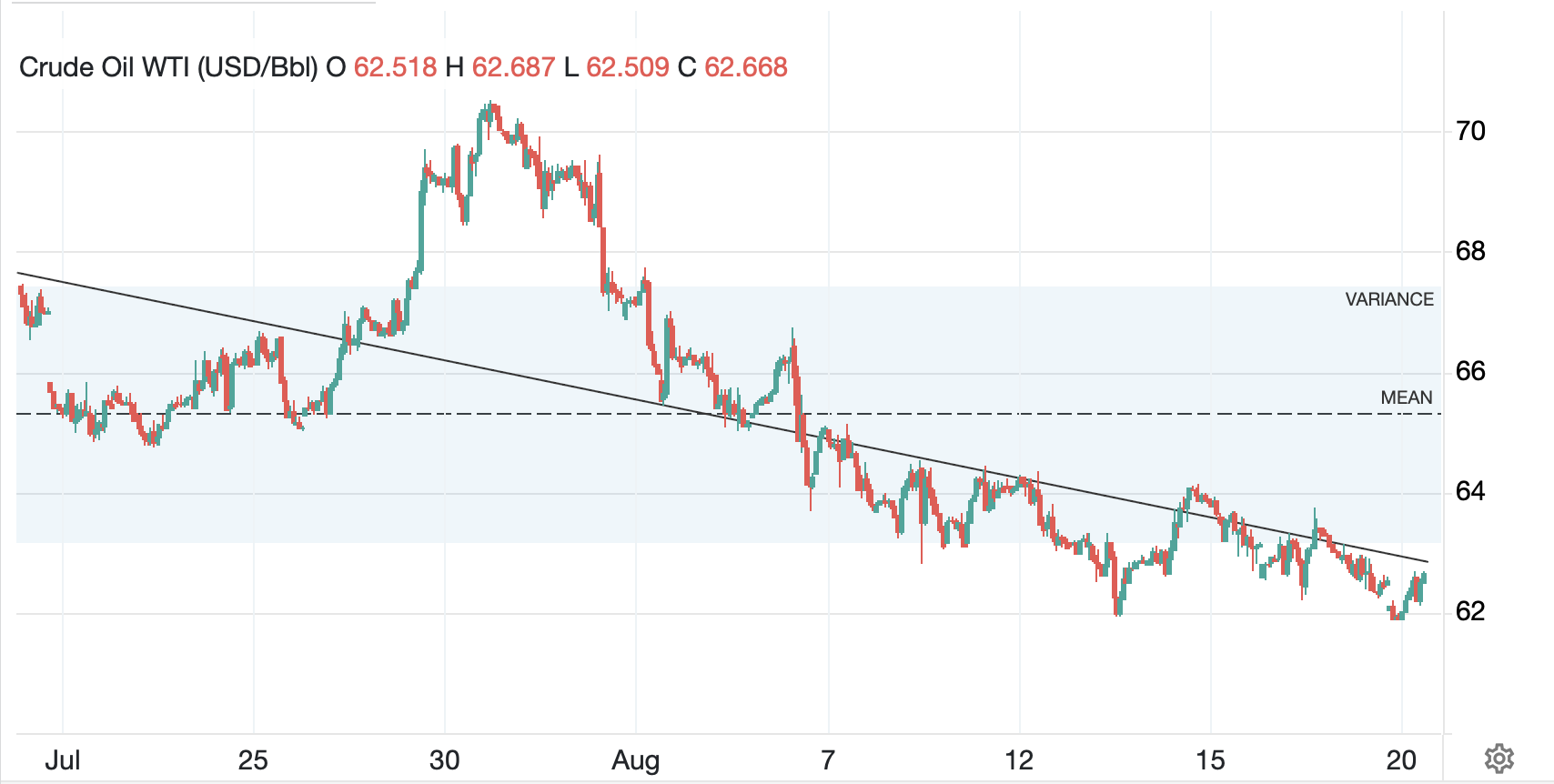
In the commodity markets, oil (+1.3%) is bouncing, but it remains in a well-defined downtrend for now as per the below chart.
Source: tradingeconomics.com

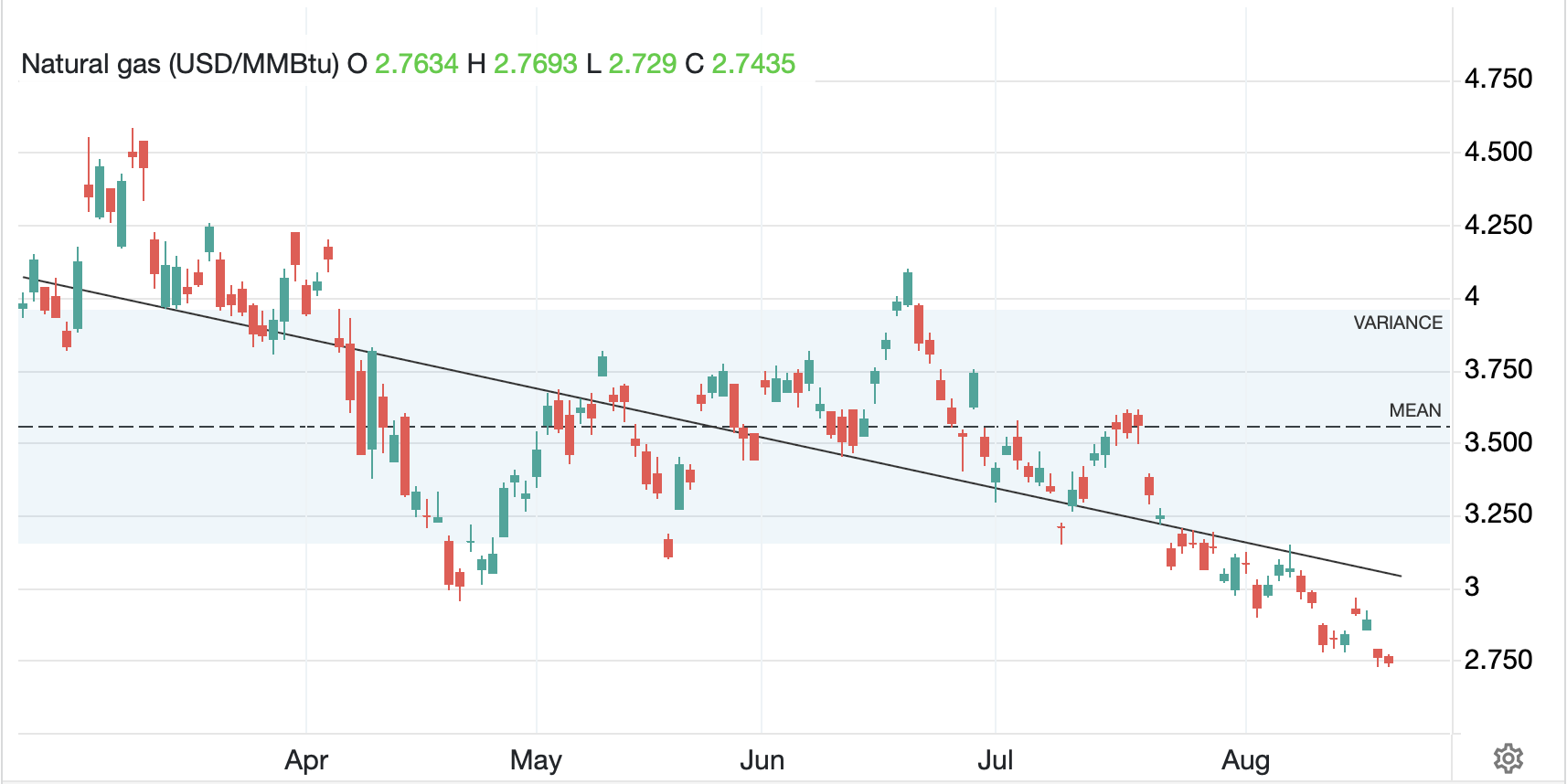
To change this trajectory, we will need to see something alter the production schedule, which with peace on the table in Ukraine seems likely to bring more oil to market not less, or we will need to see a significantly better economic outlook that drives a substantial increase in demand, something which right now seems unlikely as well.  I cannot get on board the higher oil price bandwagon at this time.  One other thing weighing on oil is the fact that NatGas has been trending lower for the past 6 months and is now at levels not seen since last November.  In fact, those two charts look remarkably similar!
Source: tradingeconomcis.com

There is a real substitution effect here and currently oil is trading at a price that is about 4X the energy price of NatGas.  Until that arbitrage closes, and it will eventually, oil will have difficulty rallying in my view. 

In the metals markets, gold (+0.4%) which sold off a few dollars yesterday is rebounding although both silver and copper are soft this morning.  These markets are just not that interesting right now.

Finally, the dollar is little changed this morning with one real outlier, NZD (-1.2%) which responded to the dovish tones of the RBNZ last night and is pricing in more interest rate cuts now.  KRW (-0.4%) also fell on concerns over trade and the semiconductor results but otherwise, there is very little ongoing here.

The only data this morning is EIA oil inventories with a small draw anticipated.  The FOMC Minutes come at 2:00 and there will be a lot of digging to see if other members seemed to agree with Bowman and Waller in their dissents at the last meeting.  Bowman spoke yesterday, but was focused on her role as chief regulator, not monetary policy, although we hear from Waller this morning.

A down day in equities is not the end of the world despite much gnashing of teeth.  It remains difficult to get excited about markets right now.  Perhaps Mr Powell will shake things up on Friday, but my sense is we will need to wait for the next NFP data to get some action.

Good luck

Adf

PS. A reader explained to me that in Australia, black swans are the norm, not the remarkable case as here in the US.  I guess we will need to find a new term to discuss an unexpected surprise.

Ne’er Have Nightmares

Said Harker, it’s likely one cut
Is all that we’ll need this year, but
Depending on data
My current schemata
Might wind up by changing somewhat
 
However, in truth no one cares
‘Bout Harker and views that he shares
As long as, stocks, tech
Don’t suddenly wreck
Investors will ne’er have nightmares


“If all of it happens to be as forecasted, I think one rate cut would be appropriate by year’s end.  Indeed, I see two cuts, or none, for this year as quite possible if the data break one way or another.  So, again, we will remain data dependent.”  These sage words from Philadelphia Fed president Patrick Harker are exactly in line with the message from Chairman Powell last week, as well as the dot plot release.  In other words, there was nothing new disclosed.  Now, today, we will hear from six more Fed speakers (Barkin, Collins, Kugler, Logan, Musalem, and Goolsbee) and I will wager that none of them will offer a substantially different take.  

At this point, market participants seem to feel quite confident they understand the Fed’s current reaction function and so will respond to data that they believe will drive different Fed actions than those defined by Harker above.  But if the trend of data remains stable, the Fed will not be the driving force in the market going forward.

In fact, there appears to be just one thing (or maybe two) that matters to every market, the share prices of Nvidia and Apple.  As long as they continue to rise, everything will be alright.  At least that’s what a growing share of investors and analysts have come to believe.  Alas, this poet has been in the market far too long to accept this gospel as truth.  I assure you there are other issues extant; they are simply hidden by the current Nvidia-led zeitgeist.

For example, Europe remains on tenterhooks for several reasons, only one of which is likely to be settled very quickly, the upcoming French election.  But remember, there is still a war in Ukraine and NATO and European nations have just upped the ante by allowing their weapons to be used to attack into Russia in addition to supplying F-14 fighter jets as part of the package.  In an almost unbelievable outcome so far, while Russian piped natural gas to Europe has fallen to essentially nil, Russia has become Europe’s largest supplier of LNG, surpassing cargoes from both the US and UAE.  I’m not sure I understand the idea behind sanctioning Russian oil and buying their gas, but then I am not a European politician, so perhaps there are nuances that escape me.  But the point is that Russia can cut that off as well, and once again disrupt the already weak Eurozone economy.

At the same time, Germany, still the largest economy in Europe, remains in economic purgatory as evidenced by today’s ZEW data (Sentiment 47.5, exp 50.0; Current Conditions -73.8, exp -65) as well as the fact that Germany’s largest union, IG Metall, is now demanding a 7% wage increase for this year, far above the inflation rate and exactly the sort of thing that, if agreed, will delay further rate cuts by the ECB.  Productivity growth throughout Europe remains lackluster and combining that with the structurally high cost of energy due to European energy policies like Germany’s Energiewend, is certain to keep the continent and its finances under pressure.  Right now, equity markets in Europe are following US markets higher, but they lack a champion like Nvidia or Apple, and are likely to be subject to a few hiccups going forward.

Or perhaps we can gaze eastward to China, where economic activity remains lackluster, at best as evidenced by the slowdown in Fixed Asset Investment and IP, as well as by the fact that the PBOC continues to try to create support for the still declining property sector without cutting rates further and inflating a bubble elsewhere.  The onshore renminbi continues to trade at the limit of the 2% band as the PBOC adjusts the currencies level weaker by, literally, one pip a day, and the offshore version is trading 0.25% through the band and has been there for the past month.  The economic pressure for the Chinese to weaken their currency is great, but obviously, the political goal is to maintain stability, hence the incremental movements.

My point is that Nvidia is not the only thing in the world and while its stock price performance has been extraordinary, I would contend it is not emblematic of the current global situation.  Rather, it is an extreme outlier.  Not only that, but when other things break, they will have deleterious impacts on many financial markets, probably including the NASDAQ.  Just sayin’!

However, despite my warnings that things will not always be so bright, so far in this session, they have been.  Overnight, Japanese stocks (+1.0%) followed the US higher as did Australia (+1.0%) and much of Asia other than Hong Kong (-0.1%) which slipped a bit.  Meanwhile, as all sides in the French election try to pivot toward the center to gather votes, European bourses are all in the green as well, somewhere between 0.25% and 0.5%.  As to US futures, at this hour (7:30), they are little changed.

Bond yields have continued to rebound from the lows seen Friday, with Treasury yields edging up another basis point this morning.  However, European sovereigns have seen demand with yields slipping a few bps, perhaps on the idea that growth remains lackluster as evidenced by the ZEW report, or perhaps on the idea that the French election may not be as terrible as first discussed.  Meanwhile, JGB yields edged up 1bp but remain below the 1.00% level despite Ueda-san explaining that a rate hike was on the table for July and that QT and rate hikes were different processes and independent decisions.

In the commodity markets, oil is unchanged this morning but that is after a strong rally yesterday in NY with WTI closing above $80/bbl for the first time since the end of April, as suddenly, the story is oil demand is improving while supply will remain tight on the back of OPEC+ measures.  I’m not sure how that jives with the IEA’s recent comments that there would be a “massive”oil supply glut going forward, (which I find ridiculous), and perhaps market participants have turned to my view.  Metals, though, remain in the doghouse falling yet again across the board.  Something else I don’t understand is how the demand story for metals can be weak while the demand story for oil can be improving given both are critical to economic activity.  

Finally, the dollar continues to find support, despite its oft-expected demise, as it gains vs. virtually all of its counterparts both G10 and EMG.  The biggest laggards this morning are NZD (-0.6%) and NOK (-0.4%) in the G10 while we have seen weakness in the CE4 (HUF -0.5%, CZK -0.55%, PLN -0.5%) as well as most Asian currencies.  The outliers here are ZAR (+0.5%) which continues to benefit from the re-election of President Ramaphosa and his coalition with centrist parties, and MXN (+0.4%) which seems to be finding a floor after its extraordinary decline in the wake of the election there two weeks ago.

On the data front, this morning we see Retail Sales (exp 0.2%, 0.2% ex autos), IP (0.3%) and Capacity Utilization (78.6%) in addition to all those Fed speakers.  While Retail Sales can be impactful, it would need to be extraordinary, in my view, to alter the current Fed viewpoint of wait for lots more data.  

My take is it will be a quiet session today, and likely for the rest of the week, as the next important data point is not until PCE on June 28th.  Til then, trading ranges seem the most likely outcome, although if I had to choose a side, I would be looking for the dollar to continue to grind higher.

Good luck

Adf