Some Shocks

While many still seek goldilocks
The problem is we’ve seen some shocks
Inflation won’t fall
And oil’s in thrall
To US and UK war hawks
 
But if we adhere to the data
It’s really not looking that great-a
For those who think Jay
Will soon lead the way
By cutting the Fed’s funding rate-a

We are back to being inundated with new information from both economic data and global events, both of which are driving markets for now.  Interestingly, depending on the asset class, it seems that some are studiously ignoring what this new information means, at least what it has historically meant.

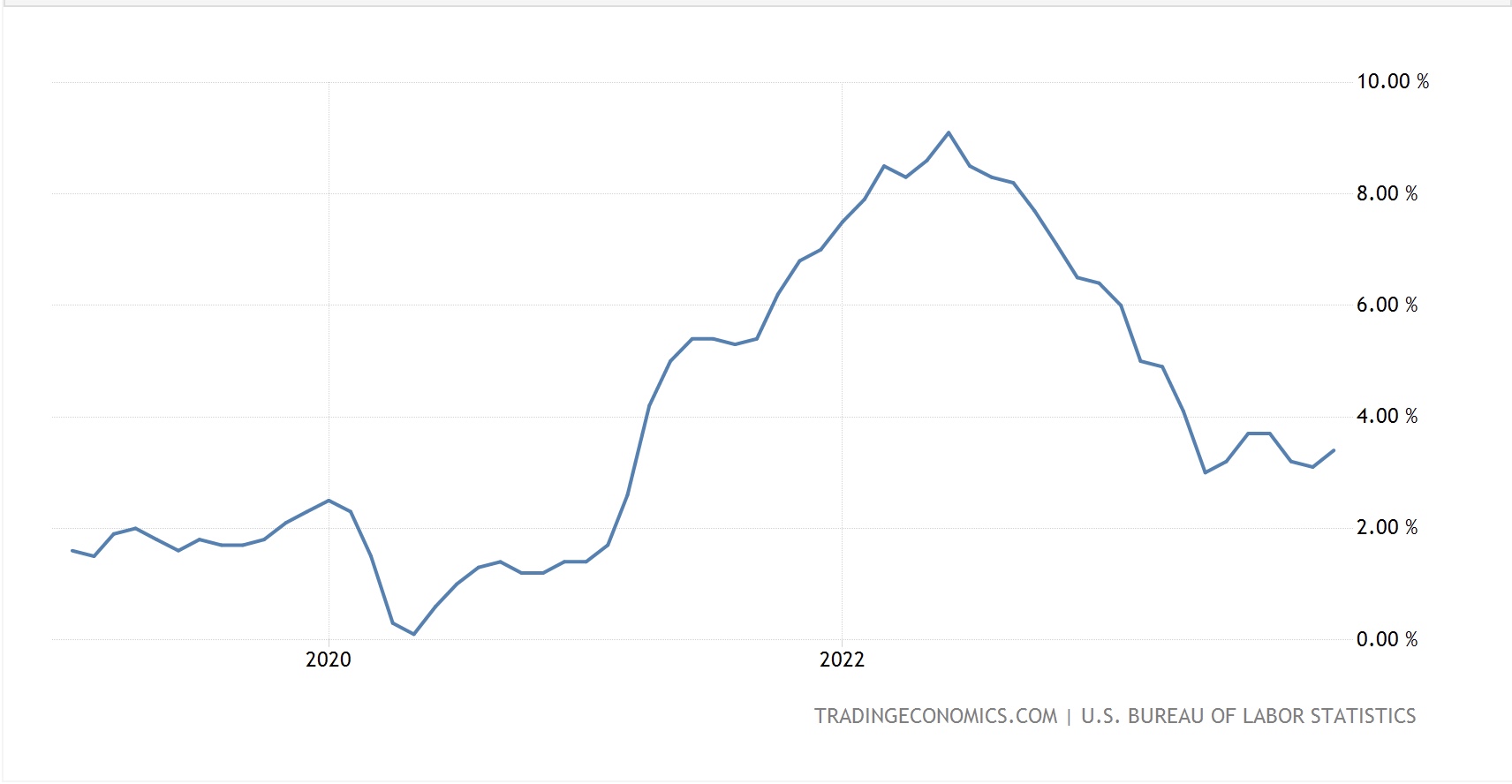
Let’s start with yesterday’s CPI data, which printed higher than forecast on both the headline (3.4%) and core (3.9%) measures.  One needn’t be a market technician to look at the chart below of annualized CPI over the past five years and consider the possibility that the downtrend has ended, and we are reversing higher.

Source: tradingeconomics.com

To the extent that financial data has trends, and I think that is a very realistic estimate of how things work, the Fed may have a much tougher time squeezing the last 1.0% – 1.5% out of the inflationary process than many seem to believe.  At least many in the bond market seem to believe that as despite the hotter than expected CPI data, bond yields actually declined yesterday.  As well, there is no indication from the Fed funds futures market that they have changed their view on the number of rate cuts coming in 2024 with an even higher probability of a March cut, > 70% this morning, and still 6 cuts priced in for the entire year.  

Regarding this seeming dichotomy, it is almost as if the market is trying to force the Fed’s hand.  Historically, the Fed has tried not to ‘surprise’ markets when it comes to decisions, keeping a close eye on market pricing on the day of each meeting.  As such, if the market is pricing in a cut or a hike, the Fed has been highly likely to follow through in the past.  When there have been disagreements, the Fed will typically roll out lots of speakers to get their view across before the meeting in order to prevent that surprise on meeting day.  As well, it is very clear that there is virtually no expectation of a rate adjustment at the FOMC meeting on January 31st, so perhaps the Fed doesn’t feel it is warranted to be that concerned yet.  And of course, the data may turn in the direction of much softer inflation and even modestly worse employment so a cut will become the de facto norm.  But my point is, the March 20th meeting is just 67 days away.  For an economy whose trends move very slowly, it seems like the market may be a bit ahead of itself in this case.

We did hear from three Fed speakers yesterday, Mester, Barkin and Goolsbee, all of whom indicated that while the broad direction of things seemed pretty good, a rate cut in March is very premature.  In fact, that has been the consistent theme from every Fed speaker and the market just doesn’t seem to care.  We will see two PCE reports, two more CPI reports and two more NFP reports before the March FOMC meeting.  And they will all be part of Q1 data, not Q4 data, so will at least have more relevance to the current situation.  Maybe the market is correct, and inflation is going to turn back lower, and the first signs of economic weakness will convince Powell and friends it’s time to preemptively cut rates.  However, even if that turns out to be the case, it is hard for me to see that as a > 70% probable outcome.  Of course, I am just an FX poet, so maybe I just don’t get it.

The other topic that is making an impact is the Middle East.  You may recall that oil prices had been on the soft side as the market saw weakening demand due to an impending recession with massive supply gains coming from better and better producer efficiency.  In fact, I wrote about the latter this past Sunday in Oil’s Price is not Rising.  However, all that efficiency is unimportant when compared to the escalation that we saw last evening in the Middle East, where US and UK forces attacked Houthi positions in Yemen in retaliation for the Houthi attacks on shipping in the Red Sea.  This morning, oil is higher by 3.5% and since Monday, the rise has been 6.6%.  

This poses several problems overall.  First, of course, is the widening of the Middle East conflict being a problem in and of itself.  The US military is already straining with its mission given the number of different places US troops are in harm’s way throughout the Middle East and Asia.  The one thing we have learned throughout history is that war is inflationary.  So, escalations in fighting will ultimately lead to escalations in prices of many things.  Oil is merely the first casualty.  

If you are Jay Powell whose current mission is to reduce inflationary pressures, a widening military conflict is not going to help the situation.  In fact, it is likely that he will be called upon to support the military by ensuring the Treasury can issue as much debt as necessary at reasonable prices.  This means the end of QT and a restarting of QE.  If that were to be the case, and that is a big if, inflation would start another strong leg higher, and markets will be greatly impacted.  Commodity prices will rise, the dollar will likely weaken, a bear steepening for bond yields would be in the cards and equity markets would rally, at least initially.  But it would throw out any ideas of low inflation.  I am not saying this is the current expectation, just that it is something that needs to be considered as events unfold going forward.

A quick look at the impact on markets today shows that equity markets are non-plussed by the escalation as yesterday’s benign US performance was followed by another rally in Japan although Chinese shares continue to lag after a big data dump showed economic activity there remains export oriented into a slowing global growth situation.  Inflation remains moribund there, the Trade Surplus grew, and domestic funding continues to grow at a slower and slower pace.    In Europe, though, there does not seem to be much concern as equity indices are all higher by about 0.5% although US futures are suffering a bit, -0.35%, at this hour (7:45).

In the bond market, Treasury yields are 3bps higher this morning than yesterday’s close, although they remain right at 4.00%, so are not really moving very much right now.  Meanwhile, European sovereign yields, which closed before the US yields declined late, are all down about 3bps this morning, helped by confirmation that final inflation readings in Europe remained at recent lows.  In the UK, the net data dump showed slightly weaker than forecast IP and GDP data which has helped drive the bid in Gilts. A quick JGB look, where yields fell 2bps, revolves around a story that the BOJ is going to reduce its end of year inflation forecast thus reducing the probability of any policy change anytime soon.  This is one of the things helping the Nikkei and also a key driver of USDJPY higher.

Aside from oil prices rising, we are seeing gold (+1.0%) on the move today on the back of the Middle East escalation although the base metals are mixed.  One other commodity note is uranium, a market which has been getting a lot more love lately given the recent acceptance by a portion of the eco community that its ability to generate electricity without producing CO2 is a net benefit.  40 nations have promised to increase their nuclear power use and demand for uranium has been rising amid a market where there is very limited supply and annual production does not meet current annual demand, let alone projected future demand.  I simply wanted to highlight that there are price movements all over the place and while uranium may not be a major contribution to inflation, the fact that its price is rising so rapidly (100% in the past year) is not going to push inflation lower.

Finally, the dollar is firming up this morning as risk assets come under pressure.  This is a typical war footing, where investors flee to the dollar in times of stress, just like they flee to gold.  While the movement thus far has not been substantial, just 0.3% on average, it definitely has room to move further if things deteriorate in the Red Sea.

On the data front, we see PPI this morning, expected 0.9% headline, 2.0% ex food & energy, although given CPI was released yesterday, I doubt it will matter very much.  As well, we hear from Minneapolis Fed president Kashkari, so it will be interesting to see if he has a different take than March is too soon, but things seem to be going well.

As we head into the weekend, the Middle East is the wild card.  If things heat up, look for oil prices to continue to rise and risk to be discarded.  That will probably help the bond market for now, and the dollar, but stocks will suffer.

Good luck and good weekend

Adf

Singin’ the Blues

Before Powell stepped to the mike
The buyers of bonds went on strike
Then Jay warned again
Inflation is when
Both prices and yields tend to spike

Investors absorbed this new news,
(The bond market fail and Jay’s cues)
And offloaded risk
In manner quite brisk
So, that’s why we’re singin’ the blues

Remember when I explained that some weeks are just really slow?  Just kidding!  The remarkable thing about financial markets is one most always be alert to a shift in sentiment, even if it doesn’t make that much sense.  However, yesterday’s shift made sense.

Last week when the QRA was published, the market took the news that a much larger percentage of issuance in the coming two quarters would be T-bills and not notes or bonds as a huge positive.  We saw a significant rally in the bond market with 10-year Treasury yields falling nearly 50bps and we saw a corresponding rally in the equity markets as the major indices rose nearly 5%.  Everybody was happy and the narrative was the worst was over for the risk asset correction.  Oops!

This week has been the Treasury auction week, when they issue the newest tranches of 3yr, 10yr and 30yr notes and bonds.  On Tuesday, the 3yr went fine.  On Wednesday, the 10yr was acceptable, if a little weak, but given the broader narrative of positivity, it had limited impact.  Alas, yesterday, the 30yr was an unmitigated disaster.  

The two key statistics that are followed in this relatively arcane part of the markets are the tail (the difference between the final yield and the lowest bid accepted) and the bid-to-cover (BTC) ratio which describes the total amount of bids compared to the issue on offer.  Typical tails are in the 0.5bp – 1.5bp range.  Yesterday saw a 5.3bp tail, the largest ever, with the implication that they had to go through many bids to fill in the auction.  The BTC yesterday was 2.24, far below the 2.38 average of the past ten auctions, and another indication that investors are not that interested in owning long duration Treasury paper.  In fact, dealers (mostly banks) had to absorb almost 40% of the issue, double the usual amount.  This is another indication that there aren’t many natural buyers of this paper right now.

In the wake of this auction, we saw bond yields rise sharply, up 11bps from the open, through the auction and then afterwards until the time that Chairman Powell spoke.  Now, while Powell didn’t actually throw more gasoline on this fire, he certainly stoked it.  Speaking at an IMF conference, he opened his comments with the following (emphasis added), “The Federal Open Market Committee (FOMC) is committed to achieving a stance of monetary policy that is sufficiently restrictive to bring inflation down to 2 percent over time; we are not confident that we have achieved such a stance.”  A bit later he made sure to remind us, “If it becomes appropriate to tighten policy further, we will not hesitate to do so.  We will keep at it until the job is done.”  

Needless to say, risk assets did not perform well yesterday or overnight (US indices fell between -0.65% and -0.95%, Asian indices fell as much as -1.75% and European bourses are all lower by about -1.0% this morning) as investors dreams of rainbows and unicorns came crashing into the reality of the idea that interest rates are not going to be declining anytime soon.  Not only is it unlikely that the Fed is going to reverse course, but yesterday was the first concrete indication that the cost of funding the US budget deficit may be starting to become a problem.  (In fairness, it has been a problem all year and pointed out as such by numerous pundits, but yesterday the market, as a whole, seemed to get the message.)  This is a major crimp in the narrative that just got developed last week.  

Recall, the view that had come out of the Fed’s allegedly dovish stance and the weaker than expected NFP report was the Fed was done, inflation was going to fall, and yields would be heading lower across the curve. The unspoken part of that narrative was that there would be plenty of demand for Treasury paper because both investors and traders would be jumping in to get ahead of the decline in yields.  Apparently, this feature of the narrative will need to be restructured, and with it, potentially, the entire narrative.  This process is going to be the major market driver over the coming months and quarters.  If the Fed maintains its higher for longer stance, and more importantly, continues along the QT path, shrinking its balance sheet, they will achieve the reduction in demand they currently seek to bring things into balance.  Unfortunately, given the Fed’s inability to fine-tune this process, things have the chance to get very messy on the downside.

Summing up, the bullish narrative took a major hit yesterday and we will need to see a perfect combination of gently slowing economic data alongside quickly slowing inflation data to resurrect it.  Personally, I would take the under on that bet.  In fact, I fear that we could well see a much more rapid decline in economic data, with a recession on tap for early 2024 along with still sticky inflation keeping the Fed firmly wedged between that rock and that hard place.  In this scenario, risk assets are very likely to underperform substantially.  A key to watch will be the shape of the US yield curve.  If (when) the bear steepening reasserts itself and long-term yields rise above the front end of the curve, you can be sure that a recession will be right around the corner.  Sic semper erat, et sic semper erit.  (Look it up)

Ok, well after that distressing discussion, a quick look at how other markets have behaved shows the following.  Treasuries have edged lower by 2bps this morning, but that was after yesterday’s 14bp rally.  European sovereigns, though, were closed when all the fun happened and so are catching up with yields higher by 6bps-7bps across the board.  Not surprisingly, JGBs are little changed, but then there is no indication that the BOJ is going to stop QE anytime soon.

On the commodity front, oil (+1.5%) seems like it is finding a floor after its recent sharp decline, although given its inherent volatility (both literal and financial) I’m not confident the bottom is in.  There has been much talk of significant speculative selling as a key driver of this move, but regardless of why, I would be wary of much signal from its price movement right now.  Meanwhile, gold (-0.6%) which rallied sharply yesterday is in the process of giving it all back and base metals remain under general pressure. 

Finally, the dollar is mixed this morning with both gainers and losers across the G10 and EMG blocs.  In truth, the G10 movement has been quite limited, +/- 0.2% or less with one exception, NOK (+0.8%) which is benefitting from higher-than-expected CPI data and the belief that Norgesbank is going to be tighter going forward.  In the EMG bloc, the movements have been a bit larger, 0.3% – 0.5%, but we are also seeing a mix of directions with, for example, MXN weaker while PLN is stronger.  Net, I would say there is not much new here (the dollar did rally yesterday in the wake of the higher US yields) and I expect that traders will be happy to go home square this weekend.

On the data front, this morning brings the Michigan Consumer Sentiment (exp 63.7) and, remarkably, even more Fed speakers with Logan and Bostic on the calendar.  At this point in time, I suspect that both traders and investors are going to be re-evaluating their medium- and long-term views on the progression of both economic activity and inflation.  The bullishness of last week’s narrative has clearly been called into question.  Arguably, we are going to need to see a lot more data to help convince market participants of the next trend.  Next Tuesday starts with CPI data where a hot print will likely be seen quite negatively as it will push any Fed ease further into the future.  But today does not seem like a session where much more will happen.  In the end, as long as the Fed remains the most hawkish, and after yesterday I think that was reinforced, the dollar should find support.

Good luck and good weekend

Adf

Many More Pains

Reporting of real GDP
Is what most investors will see
But nominal data
Is what could create a
New narrative reality

Combining both growth and inflation
This number could be the foundation
For further yield gains
And many more pains
Inflicted on stock adoration

After another lousy day in the equity markets, today the first Q3 GDP data will be released.  The current consensus forecast is for a 4.3% gain while the Atlanta Fed’s GDPNow number is up to 5.4%.  And that’s the real GDP (rGDP) number, which removes inflation from the discussion.  However, given all that is ongoing, it may be worthwhile to take a look at nominal GDP (nGDP), which is simply the change in total activity including price changes and economic output.  As you can see from the below graph (data source, FRED database), in the post-WWII era, we’ve had 10 periods where rGDP fell below zero, better known as recessions, but only 3 periods where nGDP was negative, with the GFC in 2009 being the worst at -2.0%.  The gap between the two lines is inflation, and you can also see how that has ebbed and flowed over time.

But turning to the current period, it is noteworthy that in the wake of the GFC, which was rightly called the worst financial crisis since the Great Depression and up through the Covid recession in 2020, nGDP had been pretty modest overall.  In fact, a quick look at the data shows that the average nGDP during that decade was just 3.4%.  This compares quite unfavorably with the long-term historical average of 6.4% since 1946.  Looking at rGDP data, the average between the GFC and Covid was just 1.8%, again comparing quite unfavorably to the long-term growth of 2.9%.

The thing is, we have all gotten quite used to that economic environment of slow growth and low inflation and there are many professional investors, let alone non-investment professionals, who believe that is the way the world works.  Well, let me tell you, that was the exception, not the rule.  Instead, if you look at the very right side of the chart, you can see that both nGDP and rGDP have risen sharply in the wake of the Covid recession as the deluge of fiscal spending combined with, first supply chain constraints and now reshoring/deglobalization efforts, has changed the framework.  In fact, I would contend that it is in the government’s best interest to continue down this path of high nominal growth and high inflation in order to try to outgrow the increase in debt.  After all, if nGDP can grow faster than the fiscal deficit, the real value of US debt will ultimately decline.  Of course, while it would be fantastic if the bulk of that high growth was a function of gains in productivity and high real growth, the FAR more likely outcome will be persistent high inflation.

What does this mean for markets?  As we have seen over the past several sessions, equities can quickly come under pressure in this scenario, and I believe they have further to decline.  While top-line revenues can continue to grow, the problem will come from a market that is going to derate the market multiple, especially in the tech sector, from its current nosebleed levels.  High inflation will also continue to press on bond prices and the value of the long-term 60/40 portfolio is likely to continue to be eroded.  In my view, the best place to hide will be in commodities as during inflationary periods, they tend to hold their value.

An anecdote from my early days in trading is that bond traders used to believe that the “natural” yield for 10-year Treasuries was right around nGDP.  If yields rose above that level, bonds were probably a buy, and below that level, they would have a short bias.  Nominal GDP for the past two years has been 10.7% in 2021 and 9.1% in 2022.  On this basis, there is considerably further for bond prices to fall and yields to rise.  Something to keep in mind as the talking heads work to convince you to catch the falling knife that is the bond market.

Ok, so how have things behaved ahead of today’s data, and ahead of the ECB’s rate decision this morning?  Equity markets around the world have been under pressure with the Nikkei (-2.1%) leading the way as most regional markets fell sharply, notably in South Korea and Taiwan, although Chinese shares held their own on the back of still more stimulus promised by the government there.  It is clear that President Xi is growing increasingly worried about the financial situation at home.  In Europe, we are also seeing weakness, with red across the screen on the order of -1.0% or more and US futures are also pointing lower at this hour (7:30) down by -0.75% or so across the board.

Bond markets are little changed this morning with most seeing yields creep very slightly higher, maybe 1bp or so, but that is after another bond sell-off yesterday which saw Treasury yields continue their rebound from Monday’s sharp drop.  As I type, we are back at 4.97% on the 10-year and the curve inversion is down to -15bps.  As an FYI, the 2yr-30yr curve is back to flat now and I expect it is only a matter of days before the 2yr-10yr is there as well.  Yesterday’s 5yr auction was particularly poorly received with a very wide tail and concern is growing that will be the case for all coupon auctions going forward.  Yields are heading higher folks.

Oil prices are falling this morning, down -1.8%, which has basically reversed yesterday’s rally.  EIA data showed inventory builds and it seems the longer Israel holds off on its ground invasion of Gaza, the more people are willing to believe that there will be no escalation.  However, gold prices continue to rally, up another 0.4% this morning and getting ever closer to the $2000/oz level.  Meanwhile, this morning, ahead of the GDP data, both copper and aluminum are in good spirits and rising.

Finally, the dollar is clearly back in the ascendancy with USDJPY finally breaking through that 150.00 level with no sign of intervention yet, while the euro is pressing back toward 1.05 and the pound is below 1.21.  We are seeing strength across the board for the greenback, against both G10 and EMG currencies as the yield story continues to be the driver.  As to the ECB today, expectations are for no change in policy, and the real question will be whether Madame Lagarde can maintain a hawkish bias, or if the obvious weakening in the data will reveal her inherent dovishness.  If it is the latter, look for the euro to break below 1.05 before tomorrow’s close.

In addition to the rGDP data (exp 4.3%), we see Initial (208K) and Continuing (1740K) Claims as well as Durable Goods (1.7%, 0.2% ex transports).  The ECB Press conference starts at 8:45 and will be carefully watched.  Yesterday’s New Home Sales data was much stronger than expected and the BOC left rates on hold with a hawkish commentary, although the CAD was unable to gain much in the wake.  The world continues to point to higher yields to fight structural inflationary pressures.  At the same time, the dollar will retain its status and remains in demand.  While it may not rally that sharply, I see very little case for any substantive weakness in the near and medium term.

Good luck

Adf

Wrecked

There once was a Treasury note
Whose yield every trader could quote
Of late, its price dive
To yields above five
Has tongues wagging while bond bears gloat

Now, looking ahead I expect
This rise in yields could architect
More problems worldwide
As risk assets slide
And equity markets get wrecked

There is only one story in financial markets today, and that is the fact that the 10-year US Treasury note is now yielding above 5.0%.  We briefly touched that level last Thursday, and then saw a pullback in yields on Friday, but today there is no question about a breach of that key psychological level.  As a corollary to that price action, the 2yr-10yr spread is down to -12bps and looks quite clearly as though it is going to complete the normalization process this week.  The real question is, how much further will it steepen?  A quick look at the chart below from the St Louis Fed’s FRED database shows that the average steepness of this spread is somewhere around +100bps.  The implication is that if the Fed continues to hold Fed funds at their current level, and higher for longer is the way forward, then 10-year Treasury yields could easily head to 6.00% and simply be back to their long-term relationship with the 2-year Treasury.

The other thing to note is why there is so much focus on the shape of the yield curve.  As you can see from the shaded gray areas on this chart, every recession was preceded by a curve inversion (negative 2yr-10yr spread) but then when the recession was in process, the curve was steepening dramatically.  It is this history that has economists and analysts concerned given the speed with which the curve is steepening of late.

And yet…two headlines in the WSJ this morning show a completely opposite expectation.   A Recession is no Longer the Consensus is one of them, explaining a survey of economists now shows that fewer than half anticipate a recession will arrive at all, let alone soon.  In addition, we have The Economy was Supposed to Slow by Now.  Instead it’s Revving Up” which describes the fact that recent data has been firmer than expected (see Retail Sales and NFP earlier this month) and now the proverbial soft landing is the new consensus call.  

Now, maybe this time really will be different, but that is always a hard pill to swallow.  There are many things that continue to haunt the economy with respect to things like bank lending standards tightening and consumer debt and delinquencies rising, neither a sign of economic strength.  In fact, there was a terrific note published this weekend on Substack by GrahamsBenjamins going into more detail.  The point is that there is a significant amount of economic stress in the economy and that combined with the rapid steepening of the yield curve has always been a sign of a looming recession.  And folks, if (when?) that recession arrives, you can be confident that risk assets are going to decline sharply in value.  Just sayin!

Ok, with that cheery opening, let’s see how markets have behaved overnight.  Following last week’s lousy price action in the US, Asian shares were lower across the board, somewhere between -0.75% and -1.0% while European bourses are also lower, perhaps a little less dramatically, with an average decline on the order of -0.5%.  US futures, too, are in the red, -0.6% or so at this hour (7:15), and not feeling very good.

Meanwhile, we already know the Treasury story, but it is important to understand that European sovereign yields are also rising rapidly, with most of them higher between 4bps and 6bps this morning.  That critical Bund-BTP spread continues to trade just north of 200bps and holds the potential to be quite destabilizing if it widens much further.  As well, we saw JGB yields creep up 2bps and are now at 0.85%. Inflation in Japan has been above 3.0% for the past 14 months,  and more and more analysts are concluding the BOJ is going to have to tweak their policy yet again.  There is far more to the bond market than just Treasuries, although Treasuries are clearly still story number one.

On the commodity front, oil (-0.6%) is a bit softer this morning although this seems a consolidation of last week’s strength.  The biggest question in this market is the tension between the possible recession and a corresponding reduction in demand, and the structural supply shortages that are currently being exacerbated by the Saudi and Russian production cuts.  My money is still on higher prices over time.  Meanwhile, gold is little changed this morning, holding up quite well in the face of rising yields and seeming to be showcasing its haven status of late.  As to the base metals, both copper and aluminum continue to grind lower with copper having fallen to its lowest level in a year and seemingly an indication of economic weakness to come.

Finally, the dollar is mixed to slightly softer this morning although slightly is the operative word.  Looking across the G10 currencies, the Skandies are under a bit of pressure, but the majors are essentially unchanged.  The real news is that the correlation between the dollar and Treasury yields seems to be disintegrating.  If that is changing, then there are certainly many reasons to believe the dollar can decline given the US fiscal situation and the continuous growth in the US debt portfolio.  As is often said, nothing matters until it matters.  Throughout my entire career, spanning > 40 years, there has been a constant drumbeat of how the dollar should decline because of the massive budget and trade deficits that the US has run consistently.  And that drumbeat has been studiously ignored for all that time.  But perhaps, it will soon matter.  While that is not my base forecast, one has to assign that outcome some real probability.

On the data front this week, this is what we see:

TodayChicago Fed National Activity-0.16
TuesdayFlash PMI Manufacturing49.5
 Flash PMI Services49.9
WednesdayNew Home Sales680K
ThursdayInitial Claims209K
 Continuing Claims1720K
 Durable Goods1.5%
 -ex Transport0.2%
 GDP Q34.2%
FridayPersonal income0.4%
 Personal Spending0.5%
 Core PCE0.3% (3.7% Y/Y)
 Michigan Sentiment63.0

Source: Tradingeconomics.com

Weirdly, while the Fed is supposed to be in its quiet period, I see three speeches scheduled, with Chairman Powell ostensibly speaking Wednesday afternoon.  I will need to confirm that as it would be highly unusual at this time.

It seems to me the big question is whether the dollar – rates correlation is breaking down.  If that is the case, then I will need to rethink, and likely adjust, my views of a stronger dollar over time, at least vs. the majors.  But tick by tick price action is not necessary for the relationship to generally hold.  I still like the dollar over time but am certainly going to review the situation more closely to see if something truly has changed.

Good luck

Adf

Dim-Witted

Said Jay, though we’re strongly committed
To make sure no ‘flation’s permitted
Quite frankly we’re lost
And ‘fraid of the cost
If we screw up cause we’re dim-witted

So, we’ll watch the data releases
And act if inflation increases
But if it should fall
Then it will forestall
More hiking lest we step in feces

As expected, the Powell comments were yesterday’s highlights as he once again explained that the goal of 2% inflation remains their primary effort.  Not surprisingly, given what we have heard from the onslaught of Fed speakers over the past two weeks, he made clear that there will be no rate hike at the November meeting, but December is still in play.  When asked about the rise in long-term yields, he did indicate it could be doing some of the Fed’s work for them, just like we heard earlier this week from Lorrie Logan and others.  Somewhat surprisingly, he mentioned the rising budget deficits, describing them as on an “unsustainable” path.  Now, we all know this is true, but Powell has been extremely careful not to discuss government funding throughout his tenure as Chair.  I suspect his next testimony to Congress could be a little spicier!

Of course, the other six speakers added exactly nothing to the conversation as they merely reiterated in their own words the same message.  Perhaps of more interest was that despite effective confirmation that there was no hike upcoming and that the bar for a December rate hike was quite high, bonds continued to sell off with the 10yr yield closing at 5.0% while stocks took it on the chin again.  Methinks there is more than a little concern starting to grow amongst asset managers that the concept of the Fed put may finally be gone.  

The other really interesting outcome yesterday was the fact that gold rallied another 1.3% despite the ongoing rise in interest rates.  As there was no new news out of the Middle East of any real note, one possible explanation is that investors are simply getting quite scared overall.  

One thing is quite certain and that is if the situation changes such that Powell and company become concerned that the economy is reversing course and they have, in fact, overtightened monetary policy, any reversal of the current message is likely to lead to some very big moves.  In that case I would expect a much weaker dollar, a huge rally in gold and other commodities, an initial rally in equities and, remarkably, not much movement in bonds.  I remain of the strong belief that the supply issue is the key bond market driver, so that will only increase in the event of an economic slowdown and that cannot help the bond market, even if the Fed starts to buy them again.  But that is all hypothetical.

Turning to the overnight session, while risk continues to be shed in Asia and Europe, we did see Japanese inflation data where the headline rate declined to 3.0% and the core to 2.8% although their super core reading is still at 4.2%.  Certainly, Ueda-san must be pleased that the numbers are beginning to edge a bit lower although they remain far above the 2% target.  Of course, the very fact that they are edging lower implies that any end to QQE is even further in the future.  Recall, Ueda-san has been clear that he does not believe 2% inflation is yet sustainable in the economy and is concerned it is going to slip back below that level in the medium term.  With that attitude, he has exactly zero incentive to end YCC or QQE and seems far more likely to continue with them.  

The implication of this outcome is that the yen seems likely to weaken further.  Currently, USDJPY is trading at 149.95 and although it hasn’t touched the 150 level since that first brush on October 3rd, it has been grinding ever so slowly back there again.  This price action has all the earmarks of stealth intervention, something that may be carried out by the three Japanese mega banks at the BOJ’s behest.  However, given the ongoing trajectory in US interest rates, it seems only a matter of time before we once again breech 150.  It will be quite interesting to see the MOF/BOJ reaction at that time, although I suspect they will, at the very least, “check rates.”  For hedgers, be careful here.

And really, that’s all we’ve got to talk about today.  As mentioned above, equity markets fell in Asia overnight, with losses on the order of -0.5% or so and European bourses are all down about -1.0% this morning heading into the US open.  As to US futures, at this hour (7:00) they are off about -0.4% as we head into an option expiration session.  Thus far, earnings season has not been sufficient to excite investors and fear seems to be the driver of note.

Turning to the bond market, while we have backed off from yesterday’s closing highs of 5.0% by 5bps, we remain at multi-year highs and there is no reason to believe that we have seen the top in yields.  In fact, this move appears to be driven by rising real yields, not inflation concerns.  While real yields have already risen substantially over the past 6 months, rising from ~1.0% to the current 2.45%, history has shown that real yields can easily rise to 4% or more in the right circumstances, and these may just be those circumstance.  Again, there is no evidence that Treasury yields have topped.  As to European sovereigns this morning, they are edging lower by about -1bp after a large rally yesterday as well.  US Treasury price action continues to be the global driver for now.

Oil prices (+1.5%) continue to trade higher as concerns over a widening of the Israeli-Palestinian conflict keep traders on edge.  Combine this with the weaker production numbers from the US and the drawdown in inventories and you have the ingredients for a further price rally.  News that a US Missile Cruiser in the Red Sea shot down several drones and missiles launched from Yemen cannot have helped sentiment.  Meanwhile, gold (+0.4%, +2.6% this week) continues to play the role of safe haven.  Either that or there is a lot of short-covering ongoing.  The price is approaching $2000/oz, one of those big round numbers on which markets tend to focus so I would look for a test there if nothing else.  However, base metals are softer this morning as the price action today is not economically related.

Finally, the dollar continues to tread water this morning with most of the major currencies within +/- 0.2% of yesterday’s closing levels while EMG currencies seem to be edging a bit lower, down on the order of -0.3%.  The renminbi is little changed this morning despite (because of?) the PBOC injecting CNY733 billions of fresh liquidity into the market/economy there overnight.  Again, just like the yen, the diametrically opposed monetary policy of China and the US should lead to further currency weakness here over time.  Now, the PBOC doesn’t like to see sharp movement and will continue to prevent a blowout move, but the spot rate is currently trading right at its 2% band vs. the CFETS fixing, so something has got to give soon.  In the end, the dollar trend remains intact, but I must admit I am surprised it is not a bit stronger given the underlying fear in the market.

On the data front, there are no statistics released and we hear from two more Fed speakers, Harker and Mester, to finish things off before the quiet period begins.  It seems hard to believe that anything they say will be seen as more important than Powell’s comments yesterday.  As such, looking at today’s market activity, while there will be tape-watching regarding the Middle East and any escalation in hostilities, I suspect the equity market will have the most influence on things.  At this point, further weakness seems the most likely outcome, especially as traders will be reluctant to be overly long risk heading into the weekend.  

Good luck and good weekend

Adf

Much More Afraid

Watanabe-san,
A previous Mr Yen,
“No intervention”

As USD/JPY approaches the psychological level of 150.00, there is a growing belief in the market that the BOJ is soon going to intervene.  Recall, last week we heard about the urgency with which the MOF is watching the exchange rate.  Historically, the next step would be for the BOJ to ‘check rates’.  This is when they call around to the big Tokyo bank FX trading desks and ask for levels.  The implication is they are ready to sell dollars and defend the yen.

However, unlike the previous decline in the yen almost exactly a year ago, the recent movement has been somewhat more gradual as can be seen in the chart below (source tradingeconomics.com)

This was highlighted last night by Hiroshi Watanabe, the deputy FinMin in charge of currency policy from 2004 through 2007.  He explained that after seeing the dollar remain in a 145-150 range for much of the past year, “I don’t think authorities are worried about the outlook as much as they were last year.  There’s no sense of imminence because the dollar/yen level hasn’t changed much from a year ago, and it doesn’t seem like the yen will start to plunge even if it breaches the 150 mark.

As is often the case when it comes to concerns about a currency’s value, the pace of its decline is far more important than the actual level.  Most countries, or at least most finance ministries, feel they can handle slow and steady.  It is the abrupt collapses that scare them.  This move has been quite steady, and as long as both the Fed and BOJ maintain their current monetary policies, a continuation seems likely.  Hedgers, keep that in mind.

Now, turning to yesterday’s trade
A message was clearly conveyed
As interest rates rise
Risk appetite dies
And people are much more afraid

The most pressing story in markets continues to be the US Treasury market where sellers outnumber buyers on a daily basis.  Yields on the 10-year rose 10bps yesterday, touching 4.70% and are continuing higher by another 2bps so far this morning.  The bear steepener continues to be the story with the 2yr-10yr spread falling to -40bps and looking for all the world like it is going to go positive before the end of the year, if not the end of the month.  And it makes sense.  There is still substantial demand for short-term paper yielding more than 5% (yesterday’s 3mo T-Bill auction cleared at 5.35%).  Meanwhile, we are seeing money flee those assets with long duration over fears that inflation has not yet been quelled and that the structural issues (ongoing massive supply meeting limited demand) has investors pulling back quickly.  Not only are Treasury bonds being sold aggressively driving yields higher, but yesterday saw utility stocks, often seen as a duration proxy given the high amount of debt on their balance sheets, fall nearly 5%.  

This activity is having the knock-on effects that one would expect as well.  Yields around the world continue to get dragged higher by Treasuries, the dollar continues to benefit, and commodity prices are suffering.  In fact, yesterday saw a sharp decline in the price of oil and it has now retraced more than 6% from the peak last week.  I had written about the simultaneous rise in yields, the dollar and oil as being a HUGE problem for global markets.  Well, it seems that oil is starting to feel the pain of higher yields and a stronger dollar.  As well, tomorrow OPEC meets in Vienna and there is some talk that the Saudis may increase their production, unwinding those unilateral cuts made back in June and continued since then.   

But make no mistake, ongoing rises in Treasury yields will continue to underpin the dollar and that will be enough of a problem for economies elsewhere even if oil prices slide some more.  And right now, there is no indication things are going to change.  Yesterday we heard from two Fed speakers, Governor Bowman and Cleveland Fed President Mester with both maintaining the hawkish views.  In fact, Bowman expressed the need for several more rate hikes in order to get inflation under control and both were clear that higher for longer was crucial.  As long as that remains the Fed attitude, until we see a substantial change in the data stream, yields are going to continue to rise.

Now, this week brings the all-important NFP report on Friday, which has been a key driver of Fed policy.  With inflation readings continuing far above the Fed’s target, as long as NFP remains positive and the Unemployment Rate remains either side of 4%, the Fed will have no reason to reconsider the current policy mix.  In their minds, they have not yet broken anything, at least not so badly that it couldn’t be fixed.  I’m sure they are straining their arms as they pat themselves on the back for the effectiveness of the Bank Term Funding Program (BTFP) which was created after the bank failures in March.  In fairness, it seems to be working for now.  However, I will warn that cans can only be kicked down the road for so long, and I fear the end of that road is nearing.

As to the rest of the session today, risk is decidedly on the back foot.  Those equity markets in Asia that were open all fell pretty sharply with the Nikkei (-1.6%) and Hang Seng (-2.7%) leading the way lower.  The story is similar in Europe with the major indices all lower by about -0.75% or so as they respond to the ongoing increase in interest rates around the world.  Finally, US futures are lower by -0.45% at this hour (7:30) with concerns growing that yields will not stop rising.

Looking at European sovereign bonds, yields there are rising alongside Treasury yields with most of them higher by 3bps-4bps and Italy higher by 9bps.  That Bund-BTP spread, currently at 193bps, is something we need to watch as 200bps is likely to be the first place the ECB really shows concern and if it heads higher than that, expect more direct actions.  As to JGB yields, they remain static at 0.76%.

We already discussed oil prices and we are seeing serious weakness across the entire metals complex lately, although today’s declines are relatively muted, on the order of -0.2%, as the moves have already been pretty large.  The lesson from the recent price activity is that yields continue to drive the market.

Finally, the dollar remains king with the euro below 1.05, USDJPY just below 150 and the pound making a run at 1.20.  Last night, the RBA met and left rates on hold, as widely expected, but the tone of new governor Michele Bullock’s first meeting was seen as somewhat dovish leading to a nearly 1% decline in the Aussie.  At the same time, the EMG bloc of currencies is also coming under pressure with declines today on the order of -0.5% across all three regions.  There is a term, the dollar wrecking ball, which is quite apt.  As it continues to rise it puts intense pressure on countries around the world as they scramble to get dollars to service the trillions upon trillions of dollars of debt outstanding.  Nothing has changed my view that this has further to run.

On the data front today, the only release is JOLTS Job Openings (exp 8.8M) a number that remains significantly larger than the number of unemployed.  We also hear from Atlanta Fed president Bostic this morning so it will be interesting if he is willing to push back against the ongoing hawkishness.

I see no catalysts to change the current trend in the dollar, so for all you receivables hedgers out there, keep that in mind.

Good luck

Adf

Into the Abyss

In Washington, something's amiss
As hardliners say with a hiss
Let government close
As we don’t oppose
A tumble into the abyss

The reason that markets might care
Is data will then become rare
Thus, how will the Fed
Keep looking ahead
If rear-facing data’s not there?

As this is not a political commentary, I generally try not to focus on these issues.  However, periodically, they impact the economics and the markets so I must.  As we approach the fiscal year-end for the US this Saturday, there are still a number of appropriation bills that have not passed Congress and been signed into law.  Some of the hardliners in the Republican majority in the House seem to be willing to die on this particular hill, although as we are talking politics, and there are still two days left before it becomes a fait accompli, things are subject to change.  

But the issue for markets has far less to do with the actuality of the government shutting down and entirely to do with the fact that the Bureau of Labor Statistics and Commerce Department, the source of most government data, will be shut down and so not be able to publish the monthly numbers.  Given that the Fed has repeatedly told us that they are data dependent, on what will they base their decisions if there is no fresh data to help guide them?  

The inherent problem with data dependence is that all the data published by the government is backward looking, reporting what happened in the past week/month/quarter, and the Fed uses its numerous econometric models to extrapolate how that will play out in the future.  History shows us, though, that the Fed’s models, especially lately, have not been terribly accurate.  Does anyone remember transitory inflation?  (Every time I go to the grocery store and see the price of staple items it crosses my mind.  How about you?)  Thus, if I were to analogize their process, it is like driving a car forward while looking only in the rearview mirror and the steering mechanism doesn’t work properly. 

At any rate, this story is going to dominate for a while.  Chairman Powell speaks this afternoon at a townhall with educators and he will be taking questions from the audience.  You can be sure that reporters will be there and there will be a question about how the Fed will handle the lack of data in the event of a shutdown.  This is unlikely to dominate the market narrative quite yet, but if the shutdown does happen, Monday could see some impact.  We shall see.

In the meantime, risk remains under pressure around the world as there are three current market features that are dissuading investors from jumping in, and in many cases pushing them to the sidelines.  

First is the price of oil, which rose 4% yesterday and is basically unchanged this morning, retaining all of this gains.  We are now back to levels not seen since July 2022 when oil was falling from the post Ukraine invasion spike while the Biden administration was flooding the market with SPR reserves.  Given the SPR is back to levels last seen in 1983, shortly after it was initiated, it seems there is less room for the Administration to repeat this performance.  At the same time, there has been no indication that OPEC+, and the Saudis specifically, are getting set to open the taps again.  Rising oil prices impact everything as they are an excellent proxy for the price of energy writ large.  And everything requires energy to keep going.  If it costs more to keep the lights on or ship products, it is going to work its way into the price of retail items.

Second is US yields, which we proxy with the 10-year Treasury bond.  This morning it is trading at 4.65%, continuing its recent move and, in truth, looking like it is accelerating it.  Since the beginning of September, the 10-year yield is higher by 55bps, a very large move, and that is dragging yields higher around the world.  For instance, German bunds, French OATs, and UK gilts are all trading at decade-plus high yields, and even worse for the ECB, Italian BTPs, are seeing their spread to bunds widen back toward 200bps.  You may recall that in July 2022 the ECB created a program called the Transmission Protection Instrument (TPI) which was designed to essentially roll maturing bund positions from the ECB’s balance sheet into Italian BTPs to support that market and prevent the euro from exploding.  Once that got going it was quite effective at moderating that spread, and things seemed fine.  But recently, the Italian fiscal situation has become increasingly weakened and the market is pushing on this issue again.  The point is the market is focusing on more risks and thus risk appetite is waning.

Finally, the dollar continues to rise.  Using the Dollar Index (DXY) as a proxy, it is currently trading well above 106 and taken out much technical resistance.  While it is a bit softer this morning, with the euro (+0.4%) and pound (+0.5%) both bouncing a bit along with the yen (+0.2%), this trend remains very clear.  (see graph courtesy tradingeconomics.com)

In fact, last night USDJPY touched 149.70, a new high for the move and that triggered some further comments from Japanese FinMin Suzuki that indicated he was close to the next stage of intervention known as “checking rates”.  This is the process by which the BOJ calls out to the big banks in Tokyo asking for a price in USDJPY but does not deal.  However, the simple fact of asking for the price gets these banks to sell dollars for their own accounts and they then spread the word that the BOJ is “checking rates” which all in the market know is a sell signal.  So, last night, when the dollar hit that high level, Suzuki was on the tape saying that might be the next step and the dollar fell back a bit.

Remember, though, intervention will only matter if it is concerted, with all the central banks, especially the Fed involved, and really only if monetary policies change.  And it is the latter that seems the least likely right now.  So, if when the dollar trades above 150 expect some fireworks, but unless there are other changes, it will be temporary.  Hedgers, be prepared.

And that is the situation as we head into today’s session.  There is a bunch of data coming this morning starting with Initial (exp 215K) and Continuing (1675K) Claims, as well as our third look at Q2 GDP (2.1%).  In addition to Chair Powell this afternoon, we hear from Chicago Fed president Goolsbee this morning and Governor Cook early this afternoon.  The most recent comments from both of them indicate that more rate hikes may well be necessary, and neither is in a hurry to cut rates.  

Yesterday saw a pretty flat day in the equity markets in the US and futures this morning are also little changed.  however, there is growing concern, as I outlined above, that risk is becoming riskier and that the safety of short-dated US paper, which currently yields 5.5% or more, is a very good place to be invested for the time being.  To my eye, the trends outlined above, higher oil, yields and a stronger dollar, remain intact.  As long as that is the case, equity markets are going to struggle.  As to the dollar, we will need substantial policy changes to turn that ship around, and right now, there is no sign that is on the horizon.

Good luck

Adf

Feel More Pain

The data continues to show
That growth seems increasingly slow
But Fed speakers say
That rates need to stay
Still higher for longer, you know

Meanwhile market stress has increased
With both stock and bond love deceased
Can this trend maintain
As folks feel more pain?
Or will Jay soon let the bulls feast?

Yesterday’s US data was pretty lousy with the key pieces, New Home Sales (675K vs. exp 700K) and Consumer Confidence (103 vs. exp 105.5) both missing pretty badly.  The news overnight was also worse than forecast with Japanese Leading Indicators falling alongside German GfK Consumer Confidence and French Employment.  In other words, weakening data is not a US-only phenomenon.  Yesterday’s equity market performance was certainly in sync with the downward view with markets selling off around the world.  All in all, bad news seems to be everywhere.

The interesting thing this morning is how many pundits are bottom fishing, at least rhetorically.  I have seen numerous comments on the idea that as the data continues to fade and markets come under pressure that is the signal that the central banks are going to be forced to pivot and cut rates soon.  Part and parcel of that argument is the slowing economic activity is going to not merely slow inflation but cause a deflationary crisis!  I guess if you are going to make the case, you need to be as hyperbolic as possible to get those clicks.

From this poet’s view, which incorporates far too many years of observation, I think it is quite premature to believe that the downward trend in risk assets is going to change anytime soon.  Remember this, Chairman Powell has repeatedly said that he expects there would need to be some economic pain in order for the Fed to achieve their goal of 2% core PCE inflation.  And he was not talking about market pain, he was referring to rising unemployment and slowing economic activity.  However, it seems that similar to the situation when he told us all that he would be raising rates to fight inflation regardless of the market’s response back at the beginning of this process in March 2022, and everybody (including this poet) doubted his conviction, he has been very clear that he is willing to accept some pain to achieve their goals.  I do not doubt him at this stage based on his actions to date and I think it would be a mistake for others to do so.  

The one thing that we know about the history of inflation is it is never transitory.  While past policy responses have resulted in either limited impact and a strong upward trajectory, or short-term impacts with increasing waves of inflation over time, there has never been a case where inflation rose, rates were raised, and things got better.  At least not once it hit 5%.  Powell has made it very clear that he is going to do everything he can to be the first to kill inflation with one shot, but that means the shot is going to be long and difficult to withstand.  FWIW, which may not be that much, the answer to my final question above is no, there is no rate cut on the horizon and that slower activity as well as rising unemployment are going to be a feature of the economy for at least another year.  I am sure that the Biden administration will be quite unhappy, but my sense is Powell is not really a Biden fan anyway (although interestingly he is a raging Dead Head!)

So, based on my thesis that higher for longer really means what it says, and that we are nowhere near longer yet, the fact that today has seen a very modest reprieve in risk assets is simply a function of a trading bounce, not a fundamental shift in views.  Let’s take a look.

Asian markets were broadly higher, but only just, with gains on the order of 0.1% – 0.25%, not nearly enough to offset recent weakness.  In Europe, most markets are actually a touch softer, not even able to bounce, but the losses are of similar magnitude, -0.1%.to -0.3%.  In fact, US futures, at this hour (7:30) are the best performing markets and they are only higher by 0.25% or so.  This has all the earmarks of a dead cat bounce.

In the bond market, yields have edged lower in the 10yr space by 2bp-3bp mostly, but remain very close to the recent 10 year plus highs.  It remains very difficult for me to look at the amount of issuance that is going to be necessary globally ($trillions) and combine that with the fact that central banks are no longer price insensitive buyers of bonds and come up with a scenario where yields can decline in the near term.  Add to this the ongoing inflation fears and the fact that curve inversions have allowed investors to buy short-term paper and gain better returns and I suspect that the clearing price for 10-year paper is going to be much higher yields, 5.5% or higher is not unreasonable.  

Now, understand that at some point, the pressure will become too great and central banks will reverse course, but I sense we are still early days in the process.  I do believe that the Fed, and all the major central banks will join the BOJ in their YCC activities at which point yields will fall sharply.  But we ain’t there yet!

In the commodity markets, oil (+2.0%) continues to rally and is back above $92/bbl this morning.  I know there is a great deal of belief that if we see slowing economic growth that will limit demand and prices will decline.  But the ongoing supply/demand mismatch is extreme and the fact that Russia has banned the export of diesel fuel, perhaps the most critical product that comes from a barrel of oil, has helped maintain an ongoing tightness in markets. 

One other thing to note is that the much-vaunted energy transition is showing the first signs of falling apart, or at least being subject to significant delays, as we have recently heard from the UK and Sweden that they would be delaying the ban on sales of ICE cars and gas boilers.  Remember, the transition is a key part of the lower oil price thesis.  It turns out that politicians have found that the reality of reducing energy consumption or transitioning to a source that is insufficient for current societal needs is a lot tougher when people feel the pain of the process.  Last year, in the wake of the Covid pandemic policies of infinite fiscal spending, there was limited concern about subsidizing the use of energy but this year as the budget numbers look uglier and uglier, that tune is changing.  I maintain it will be a very, very, very long time before fossil fuels are eliminated.  In fact, I suspect the dollar will be replaced before fossil fuels are, and you know I don’t foresee that for decades, at least.

As to the metals markets, both base and precious are lower this morning as higher yields, slowing economic activity and a strong dollar help undermine their short-term value.

Speaking of the dollar, rumors of its demise seem to have been greatly exaggerated as well.  Once again, this morning, it is higher with the euro (-0.3%) edging closer to 1.05 and the yen (-0.1%) solidly above 149.  USDCNY is pushing to 7.32 despite the PBOC’s continued efforts to drive it lower via the daily fix, and despite the fact that local banks were seen selling dollars aggressively onshore, apparently at the PBOC’s behest.  The only currency outperforming is NOK (+0.3%) which given oil’s rally makes perfect sense.  The same situation obtains in the emerging market blocs with most currencies weaker and a few simply treading water.  The dollar has rallied for the last 11 consecutive weeks, which is a pretty long streak in the broad scheme of things, so a pullback one week wouldn’t be a shock.  But right now, this does not seem like the week it is going to happen.

On the data front, today brings Durable Goods (exp -0.5%, 0.1% ex Transports) and then the EIA oil data later this morning.  There are no scheduled Fed speakers, so today’s price action is likely to continue based on risk appetite.  I still don’t see risk appetite as improving in the short term which implies lower stock and bond prices and the dollar maintaining its strength.

Good luck

Adf

Problems Squared

As the yen weakens
Suzuki-san tries to warn
This time he means it!

Another day, another new low for the Japanese yen.  USDJPY traded above 149.00 early this morning for the first time since October 2022 (chart below) and this clearly has the Finmin, Shunichi Suzuki spooked.  While I don’t understand the actual comment he made, “As I said at the morning press conference, I’m watching market trends with a high sense of urgency,” based on the fact the dollar did pull back a bit, I guess market participants got the message.  But how can you watch something urgently?  

Source: Tradingeconomics.com

Regardless of his fractured English, the fact remains that USDJPY has risen near the levels it reached last autumn and which resulted in aggressive intervention in the FX markets.  The point is we know they will step into the market so for those of you with immediate needs, be wary.

However, there is exactly zero indication that the BOJ is going to alter its monetary policy stance at this time, nor any indication that the Fed is going to do so either.  Ultimately, those diverging policies are the driver here and without a change in the underlying conditions, this trend should continue.  Perhaps Ueda-san will recognize that CPI running at 3.3% for the past twelve months is an indication that it is sustainable at these levels and change his tune.  But not so far.  With spot at this level, I am a strong proponent of utilizing options to hedge against further yen weakness.  Using them will allow hedgers to take advantage of a pullback, if it comes, but remain protected in the event that their new target is 160, for example.

Said Dimon, nobody’s prepared
And frankly, we all should be scared
A quick rates ascent
To seven percent
Will end up with our problems squared

I guess the question becomes, to whom should we listen, Jamie Dimon or Jay Powell?  In an interview with the Times of India yesterday, Dimon indicated he thought Fed funds could rise as high as 7% and that nobody was prepared for that outcome.  I certainly agree nobody is prepared for that outcome (I wonder if JPM is?) but of more interest is the fact that his comments are quite different than what we have heard from the ostensible powers-that-be at the FOMC.  Last week Chair Powell indicated they remained data dependent but that another hike was reasonable.  Yesterday we heard from erstwhile dove, Austan Goolsbee, the Chicago Fed president, that higher for longer was appropriate, a sign that even the doves are willing to wait a long time before pushing for rate cuts.  But Dimon was clear he thought things would play out differently.

Considering the two sources, I am more inclined to accept Dimon’s worldview than Powell’s as Dimon has fewer political restrictions.  In addition, given JPMChase is the largest bank in the nation, he is likely privy to a lot of information that may not be clear to the Fed.  But, boy, 7% would really throw a monkey wrench into the works.  While equity markets have worked very hard to ignore the ongoing rise in interest rates thus far, Fed funds at 6%, let alone 7% would seem to be a bridge too far.  If the Fed does feel forced to keep raising rates because CPI/PCE continues above target and the Unemployment Rate remains low, 4% or lower, it feels to me like the equity market would reprice pretty dramatically lower.  This is not my base case, but at this point, I would not rule out any outcome.

So, how have markets behaved with this new information?  Well, equity markets, which had a late rally in the US yesterday, have been under pressure around the world.  Meanwhile, bond yields continue to rise and the dollar remains in fine fettle.  Let’s take a look.

Asia was almost entirely in the red last night, certainly all the major markets were down led by the Nikkei (-1.1%) but all Chinese and Korean shares as well.  As to Europe, while the FTSE 100 has managed to stay relatively unchanged, the continent is entirely under water with losses on the order of -0.6% or so.  Finally, US futures are currently (7:30) lower by -0.3% or so, although that is off the worst levels of the overnight session.  It seems that the continued grind higher in yields around the world is taking its toll on the equity bull story.

Speaking of yields, yesterday saw the 10yr Treasury yield touch 4.56%, a new high for the move, although it has since backed off a few basis points and is currently around 4.50%.  But Treasury yields aren’t the only ones rising as we are seeing German bund yields at their highest levels since 2011, during the Eurozone bond crisis, and the same is true with French OATs and most of the continent.  Gilts, too, are pressing higher overall, and while this morning they have backed off 3bps-5bps, the trend remains clearly higher.

Oil prices are finally backing off a bit, down 1.1% this morning and 2% in the past week, although they remain quite high overall.  This movement has all the earmarks of a trading correction rather than a fundamental shift in the supply/demand balance.  The latest data that is out shows that global daily demand is up to ~102 mm bbl/day while supply is just under 100 mm bbl/day.  That trend cannot continue without oil prices rising substantially over time.  As to the metals markets, base metals continue to feel the pressure of a weakening economy while gold continues to suffer on the back of high interest rates, although it remains firmly above $1900/oz.

Lastly, the dollar is just a touch softer this morning although it remains near its recent highs.  We discussed the yen above, which is now unchanged on the day, although off earlier session highs for the dollar.  The euro has regained 1.06, although its grip there seems tenuous and a fall to 1.05 and below seems likely as the autumn progresses.  The pound, meanwhile, is below 1.22 and looking at the charts, a move to 1.18 or so seems very realistic, especially if we continue to hear hawkishness from the Fed.

As to emerging market currencies, the PBOC continues to try to hold back the yuan, although it is trading quite close to its 2% band from the CFETS fixing.  Meanwhile, KRW (-0.8%), IDR (-0.6%) and THB (-0.4%) are all falling as they are not getting that central bank support.  EEMEA currencies are also under pressure led by ZAR (-1.25%) which is suffering on the commodities market selloff.

On the data front, we see our first data of note this week with Case Shiller Home Prices (exp -0.3%), Consumer Confidence (105.5) and New Home Sales (700K).  We also hear from Fed Governor Bowman this afternoon and will see oil inventories late in the day, where continued drawdowns are expected.

Market sentiment is not happy with concerns growing that the Fed really means what they are saying and that interest rates are going to remain at these or higher levels for a while yet.  While the big data points continue to show the economy is hanging on, there are a growing number of ancillary data points that indicate a less robust economic future.  Unfortunately, I think that is going to be the outcome, although it will not be enough to drive inflation down to acceptable levels.  The coming stagflation should see weakness in both bonds and equities while the dollar continues to find buyers all around the world.

Good luck

Adf

Having Some Fits

While all eyes are on CPI
Some other news may now apply
The Germans and Brits
Are having some fits
As they both, to growth, wave bye-bye

The other thing that we have heard
Is ECB forecasts have stirred
What was 3%
They’ve had to augment
So, Thursday, a hike is the wor

Clearly, the top story today will be the release of the August CPI data with the following expectations: Headline 0.6% M/M, 3.6% Y/Y and ex food & energy 0.2% M/M, 4.3% Y/Y.  The headline number has been boosted by the rise in energy prices, although it is important to understand that the bulk of the gains in oil’s price are not going to be in this number, but in next month’s release.  As well, oil prices continue to rise, up another 0.65% this morning and now above $89/bbl.  Too, gasoline prices, the place where we feel this rise most directly, continue to climb right alongside crude.  This release will have the chance to alter some views on the Fed meeting next week, but it will need to be a big miss one way or the other to really have an impact, I think.  While I am not modeling inflation directly, certainly my anecdotal evidence is that prices are continuing to rise at better than a 4% clip for ordinary purchases, whether in the supermarket or at a restaurant or retail store.

But perhaps, the more interesting things today have come from Europe and the UK, with three key, somewhat related stories.  The first was the release of the UK monthly GDP data which fell -0.5%, far worse than anticipated as IP (-0.7%), Services (-0.5%), and Construction (-0.5%) all were released with negative numbers for July.  What had been a seemingly improving outlook in the UK certainly took a hit today and has placed even more pressure on the BOE.  Despite the weaker than expected growth situation, there is, as yet no evidence that inflation is really slowing down very much leaving Bailey and company in a pickle.  Tightening further to fight inflation while the economy declines is a very tough thing to do.  But letting inflation run is no bowl of cherries either.  It should be no surprise that both the pound (-0.2%) and the FTSE 100 (-0.5%) are under pressure today.

The other two stories come from Frankfurt where, first, the German government is apparently set to downgrade its outlook for full-year 2023 GDP to -0.3% from its previous assessment of +0.4%, which was quite weak in its own right.  Apparently, poorly designed energy policy is coming back to haunt the nation as manufacturing activity continues to diminish under the pressure of the highest energy prices in Europe.  Unfortunately for Germany, and likely for Europe as a whole, unless they adjust their energy policies such that they can actually generate relatively cheap power and create a hospitable environment for manufacturing, I fear this could be just the beginning of a longer-term trend.

The other story here is not an official change, but a leak from ECB sources, which indicates that the ECB’s inflation estimate for 2024 will now be above 3.0%, from its last estimate right at 3.0%.  The implication is that the hawks continue to push for another rate hike at tomorrow’s council meeting.  In the OIS market, the probability of a hike tomorrow has risen to 67% from about 50% yesterday.  As a reminder, this is what Madame Lagarde told us back in July, We have an open mind as to what decisions will be in September and subsequent meetings…We might hike, and we might hold. And what is decided in September is not definitive, it may vary from one meeting to another.”  With this in mind, it appears that some members are trying to put their thumb on the scales and get a push toward one more hike.  Especially given weakness in German economic activity, if they don’t hike tomorrow, it will get increasingly difficult to justify more hikes later, so in the hawks’ minds, it’s now or never.

In truth, I think that is an accurate representation because if we continue to see slowing growth in Europe, Madame Lagarde, who is a dove by nature, will be quite unwilling to weigh on growth and push up unemployment even if inflation won’t go away.  With this in mind, I’m on board to see the final ECB rate hike tomorrow.

Not surprisingly, today’s news did not help risk appetites at all.  Equity markets, after yesterday’s US declines (especially in the tech sector) were lower throughout most of Asia and are currently lower across all of Europe.  In fact, the losses on the continent are worse than in the UK, with an average decline of about -0.9%.  Pending higher interest rates amid weakening growth are definitely not a positive for equities.

However, investors have not been running to bonds as a substitute.  Instead, bond yields are higher pretty much across the board, with Treasury yields up 2.5bps while European sovereigns have seen yields climb between 3.5bps (Bunds) and 7.0bps (BTPs).  This has all the feel of rising inflation fears that are not likely to be addressed in the near term.

I already touched upon oil prices leading the energy space higher, but given the sliding views of economic activity, it is no surprise to see metals prices softer this morning with both precious and base metals under pressure.  While the long-term prospects for commodities overall, I believe, remain quite bullish, if (when) we do go into recession, I expect a further price correction.

Finally, the dollar is a bit stronger against all its G10 counterparts and most EMG counterparts this morning.  Granted, the movement has been modest so far, which given the importance of today’s data release, should be no surprise.  But my take is that a hot CPI print, especially in the core, will see the dollar rise further as the market starts to price in at least one more rate hike by the Fed, probably in November.  At the same time, if the CPI number is cool, then look for the dollar to give back a bunch of its recent gains as market participants go all in on rate cuts in the near future.  It is that last part of the concept with which I strongly disagree.  While the Fed may have reached its terminal rate, there is no evidence that they are even thinking about thinking about cutting rates.  However, that is my sense of how today will play out.

Good luck

Adf