That Man is Our Bane

Apparently, back in the day
Investors and CEOs say
The future was clear
But now they all fear
Uncertainty is in their way
 
So, they will now clearly explain
When earnings and profits do wane
That they’re not to blame
Instead, they now claim
It’s Trump’s fault, that man is our bane


I’m having some difficulty understanding a number of the concerns about which I read every day as more and more corporate executives and investment managers have suddenly found a new scapegoat, uncertainty.  Apparently, I missed the time when the future was certain, as I have no recollection of that at all.  Perhaps you remember.  If so, could you remind me please?

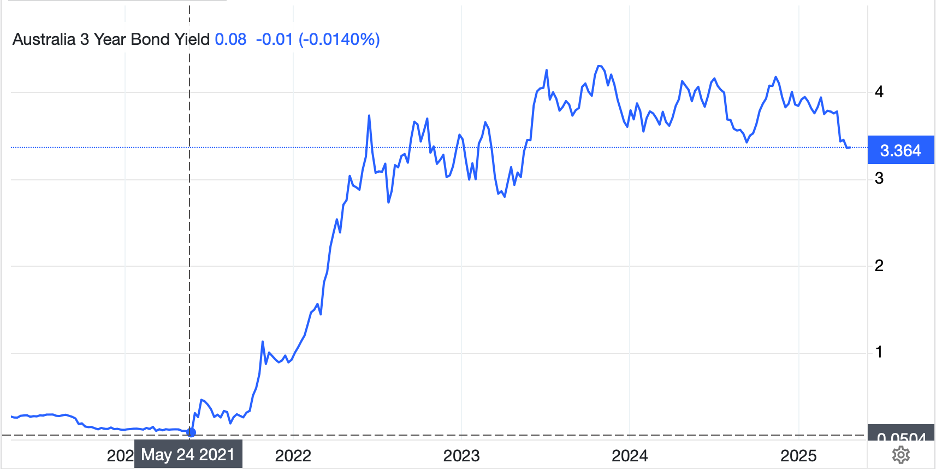
For instance, I remember the certitude of the comments from the RBA back in April 2021 that interest rates would remain lower for longer, and that it would be at least three years before they would need to raise interest rates.  I also remember, as the graph below demonstrates, that certainty was misplaced as less than two months after those comments, the RBA started raising interest rates despite the clear directive they would not need to do so for years.
Source: tradingeconomics.com

While this is just one example, in my experience, certainty is not part of the mix when running a business or a portfolio of assets or a position in any financial market.  So imagine my surprise when reading Bloomberg this morning and finding that suddenly, the world is awash in uncertainty.  Has it ever not been the case?  Pretty much once you get beyond the laws of physics or mathematics, it strikes me that certainty in the future just doesn’t exist. (Even at 4Imprint).  Nonetheless, uncertainty because of President Trump’s trade policies is the latest rationale for every problem at every company right now.  In truth, I suspect that many executives are quite happy with this as the Covid excuse was wearing thin.

In the markets, too, uncertainty is the favored excuse for underperformance as how can anyone manage money with tape bombs constantly appearing.  Powell is a loser one day to I’m not going to fire Powell the next.  Tariffs are forever to a 90-day pause.  And of course, there are many other political stories that have limited impact on markets but seem to change regularly.  While this gets back to my view that President Trump is the avatar of volatility, I seem to recall long before President Trump that there were numerous presidential statements that had major market impacts.  My point is, nothing has really changed folks, other than the media dislikes this president more than any other in my lifetime so amplifies anything they think makes him look bad.

However, the one thing about which we cannot be surprised is that trading activity is waning, at least compared to what we saw since Trump’s inauguration.  Volumes of activity on the exchanges are sliding (see chart of S&P 500 volume below from ycharts.com) which makes perfect sense in a volatile and uncertain market.  

Now, as per the above, I would contend that the future is always uncertain.  Rather the real culprit here is volatility.  My take is that the future is going to continue to be volatile which implies, to me at least, that trading activity is going to remain on the low side and with it, liquidity for those who have significant real flows to transact.  It’s funny, volatility begets lower volumes, and lower volumes beget volatility due to reduced liquidity.  I’m not sure what it will take to break us from this cycle, but I have a sense that it will be with us for a while.

With that in mind, let’s see what happened overnight.  Yesterday’s strength in the US was followed by strength in Tokyo (+1.9%) although both China (+0.1%) and Hong Kong (+0.3%) didn’t really participate.  Interestingly, this morning I read that China was exempting a number of imports from the US from tariffs as apparently, it was hurting their businesses so severely it could cause closures.  Elsewhere in Asia, the picture was mixed although there were more gainers (Korea, Taiwan, Philippines, Thailand) than laggards (India, Singapore).  I do believe the tariff story is impacting these markets more than any as they are directly in the line of fire.

Meanwhile, in Europe, most markets are firmer this morning (DAX +0.6%, CAC +0.4%, IBEX +0.9%) but the UK (-0.1%) is lagging despite much stronger than expected Retail Sales data there this morning.  As to US futures, at this hour (7:00) they are pointing lower by about -0.35%.

In the bond market, Treasury yields continue to slide, down another -3bps this morning although Europe is moving in the opposite direction, with yields climbing between 2bps and 3bps in the session.  It’s odd because I continue to hear about European growth forecasts being cut and the ECB preparing for more rate cuts while the talk around the markets is that the US is going to see inflation from the tariffs.  Today’s bond moves don’t really speak to those narratives, but it is just one day.  I need to mention JGB yields, which rose 3bps overnight after Tokyo CPI came in 2 ticks hotter than forecast at both headline and core levels.  

In the commodity markets, oil (-1.2%) is slipping again and has consistently demonstrated it is unable to make any dent in the major price gap above the market.  To close that gap, WTI will need to rally more than $8/bbl from current levels, something I just don’t see happening in the current environment.  That would require a war in Iran I think.  As to metals, yesterday’s gold rally has been reversed (-1.5%) and today it is impacting both silver (-0.75%) and copper (-2.1%) as is the stronger dollar it seems.

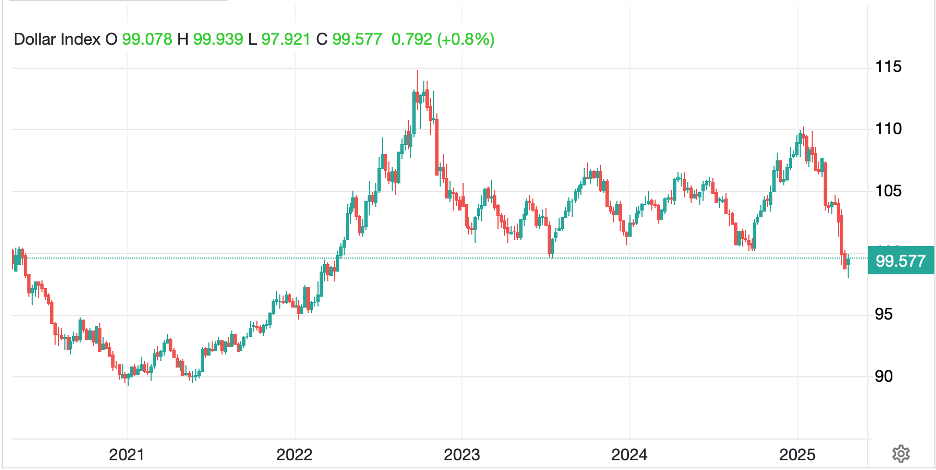
Speaking of the dollar, Monday’s narrative that the dollar was about to collapse will need at least another day to come to fruition as it is modestly higher again this morning.  looking at the DXY as a proxy, it is trading just below 100, a level that many are watching closely.  A quick look at the chart below shows this is the third time in the past two years it has traded to this level, although the first of those times it broke through.  Of course, it was much lower just a couple years earlier.
Source: tradingeconomics.com

Today’s dollar strength is modest but broad-based with only CLP (+0.6%) higher this morning which makes absolutely no sense given copper’s slide today.  The worst performer is SEK (-0.8%) but given it has been the best performer YTD amongst the G10, perhaps this is just corrective.  Otherwise, we are looking at movements on the order of 0.25% to 0.45% across the board.

The only data this morning is Michigan Sentiment (exp 50.8).  We continue to see a dichotomy between the ‘hard’ data, Claims, NFP, CPI, Factory Orders, and the ‘soft’ data, Michigan Sentiment, PMI, inflation expectations with the former holding in well while the latter weakens.  Many analysts believe that recession is coming our way by summer, but these same analysts have been predicting the recession for the past 3 years.  The one thing about the US economy is that it is extraordinarily resilient despite all the things governments try to do to disrupt it.  I understand the concern, at least if you watch/read the news, but I have a sense that many people across the nation do not really do that.  While I believe that equity valuations remain too high to be sustainable, it is not clear to me that the economy is heading into a recession at this time.  As to the dollar, I wouldn’t write its obituary just yet, although I do think it will soften further over time.

Good luck and good weekend

Adf

Fast or Slow Death?

As markets all take a deep breath
Concerns are that, just like Macbeth
The President will
The ‘conomy kill
The question is, fast or slow death?


Personally, I am hopeful that we can stop discussing tariffs after today.  It’s not that they will decrease in importance, but they will no longer be the primary topic.  Instead, they will be a secondary explanation for anything that anybody decides is wrong with the economy, or the country or the world.  Recession? Tariffs are the cause.  Inflation? Tariffs are the cause.  War? Tariffs are the cause.  Duke loses in the semis?  Tariffs are the cause.  

FWIW, which is probably not that much, my view is the market has absorbed this conversation and the correction we have seen over the past weeks in the equity market is the result of growing expectations of much slower growth or a recession.  Arguably, the biggest concern should be that US equity markets continue to trade at historically rich valuations and any negative catalyst can serve to both depress future expectations and compress multiples, and that’s how you get large equity market declines.

The thing about the tariff story is that while later today we will all find out the details, the actual impacts will take months, at least, to be determined.  For instance, the story that Israel has just decided to drop all tariffs on US made products, thus avoiding them on Israeli products is something I suspect we may see more frequently than now assumed.  Perhaps there would be no greater irony for all the naysayers than if this ‘end of free trade’ moment actually inspired a significant reduction in tariffs around the world as nations seek to retain access to the US.  I’m not saying this will be the case, but given the US is the consumer of last resort, running a nearly $1 trillion trade deficit, pretty much every other nation relies on the US as a market for some portion of their production.

Along these lines, I must ask, why is it that other nations, who apply tariffs and other non-tariff barriers like quotas or regulatory restrictions, to US products do so if tariffs are such a great evil?  Apparently when the French, for example, seek to protect their industries and farmers, it is healthy for the economy, but when the US does, it is world-ending.  Just sayin’

So, is the dip now to be bought?
Or are things still overly fraught?
The overnight session
Did naught for that question
As no one knows what Trump has wrought

Since there are literally no other stories to discuss regarding finance and markets right now, let’s turn to the overnight and see how markets are behaving in the runup to the Liberation Day announcement.  Yesterday’s mixed, but mildly positive, session in the US led to a mixed session in Asia with no real trend.  Even within a nation (Nikkei +0.3%, TOPIX -0.4%) there was no clarity.  Chinese shares were basically flat, Korea and Singapore fell while India and Malaysia rallied.  No movements approached even 1.0% so it is probably fair to say we didn’t learn anything.  However, European bourses are under pressure across the board this morning led by the DAX (-1.3%) and FTSE 100 (-0.9%).  Clearly, there is significant concern that the US tariffs, which are set to come into force immediately upon their announcement, will have a significant negative impact on European companies.  Certainly, German auto makers, who rely greatly on the US market, are likely to be negatively impacted, but as I said, it remains to be seen what actually occurs.  I guess considering that European shares have been performing well of late, with gains on the order of 10% or more YTD, some investors have decided to take their money and run.  

source: tradingeconomics.com

Meanwhile, US futures are pointing lower at this hour (7:10) down about -0.5% across the board.

In the bond market, while there is a lot of huffing and puffing that tariffs will be inflationary, yields are sliding this morning with Treasury yields (-2bps) declining to their lowest levels since last October, and a similar amount to most European sovereigns.  I suppose bond investors are more concerned over the mooted recession than the inflationary impact of tariffs.  Too, JGB yields slid -3bps, back to their lowest level in a month as questions remain about the BOJ’s future path as well as Japanese growth prospects in the new trade regime.

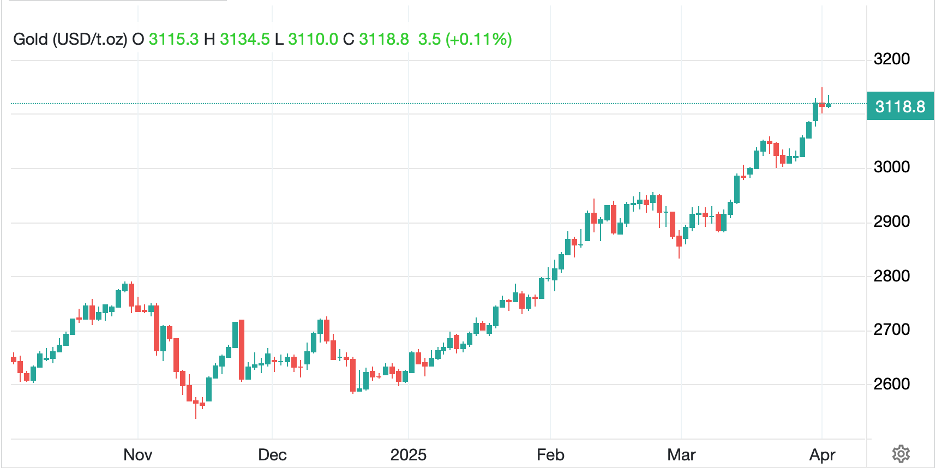
Turning to commodities, oil (-0.35%) has slipped a bit further but remains well up on the week as a story regarding the US moving more military assets toward the Middle East from Asia makes the rounds.  We cannot forget that President Trump has already initiated secondary sanctions on Venezuelan crude, and threatened to do so on Russian crude if Putin doesn’t agree to the ceasefire.  Meanwhile, Iran is always in Trump’s crosshairs while they remain a perceived threat to go nuclear.  As to the metals markets, gold (+0.1%) continues to edge higher with any pullbacks both short term and modest.  One look at the chart below shows how many more green days there have been than red ones over the past 6 months.  I see nothing to stop this trend.  As to the other metals, they are higher this morning and continue to trade well overall.  I believe the case can be made that going forward, commodity markets, and the shares of companies in the space, are set for some real outperformance in the new world order.

Source: tradingeconomics.com

Finally, the dollar is mixed as well, with some widely disparate movements seen.  For instance, NZD (+0.9%) is having a good day, perhaps because direct trade with the US is di minimus, or perhaps because it has been weakening so much for the past 6 months, down nearly 10% even after today’s rally, over that period, that it is a simple bounce.  At the same time, ZAR (-1.0%) is sliding despite the ongoing gold rally, although there are growing concerns over the outcome of the budget there and how it will be funded and impact the economy.  But in truth, as I look across the board, there are probably more currency gainers than losers this morning, which ironically is exactly the opposite of the forecast impact of tariffs by the US.  Just remember, as Yogi Berra allegedly explained, “in theory, there is no difference between theory and practice, in practice there is.” Detailed market outcomes based on economic theories rarely hold up.

On the data front, this morning brings ADP Employment (exp 105K) and Factory Orders (0.5%, 0.7% ex-Transport) as well as the EIA oil inventories.  Yesterday afternoon’s API inventories showed a large build, but expectations are for draws today.  We also hear from Adriana Kugler, Fed governor, but ironically, all the Fed talk is now about tariffs and not about monetary policy.

Today is a crapshoot, with no way to even guess how things will evolve.  Also, beware the initial reaction as it may not represent a new view, but rather the unwinding of current positions.  Until further notice, though, I still think the dollar has a slow decline in its future.

Good luck

Adf

Not Worried

‘Bout markets, Scott Bessent’s not worried
As favor with specs can’t be curried
Instead, what he seeks
Is policy tweaks
To help growth, though folks want that hurried
 
Meanwhile, Chairman Jay and his team
Continue their policy theme
Inflation’s still falling
Although they are calling
For patience, as bulls start to scream


I’ve been in the investment business for 35 years, and I can tell you that corrections are healthy, they are normal,” Bessent said Sunday on NBC’s Meet The Press. “I‘m not worried about the markets. Over the long term, if we put good tax policy in place, deregulation and energy security, the markets will do great.”

The above comments from Treasury Secretary Scott Bessent yesterday morning (quote courtesy of Bloomberg.com) have garnered a remarkable amount of commentary amidst both the political and market punditry.  My first comment is I must be much older than Mr Bessent, since I have been in the investment business for 43 years.  However, as I have written numerous times over the course of the past years, the market has not cleared for a very long time.  Since the 1987 stock market crash, when then Fed Chair Greenspan started pumping liquidity into the financial markets to stabilize things, and realized he could do that to prevent serious downturns, we have seen two significant downdrafts, the tech bubble and the housing market crash, both of which were immediately met with massive liquidity injections, extremely low interest rates and for the latter, the advent of QE.

All of that liquidity has resulted in market excesses across many markets and has been a key driver in the stock market’s exceptional rise since the Covid blip.  Adding to that was the massive fiscal spending (remember those 7% budget deficits?) which has helped to insure that not only did markets rise, but so did retail prices.

Now, along comes a Treasury Secretary who hasn’t married himself to higher stock markets on a day-to-day basis and instead is focused on the long-term.  What I find most interesting is that the same pundits who are screaming about Bessent and Trump destroying the economy, were all-in on the discussion of how the US debt was going to ultimately cause a collapse.  Yet as the administration explicitly tries to address that issue (you may disagree with their methods, but that is their clear goal) suddenly, the fact that stock prices are falling is a tragedy of biblical proportions.  Here’s the thing, the worst performer, the NASDAQ, is down about -12% since its peak last month as per the below chart.  I might argue that is hardly a collapse.  In fact, a healthy correction doesn’t seem to be a bad description.

Source: tradingeconomics.com

There is no doubt that uncertainty about the near-term direction of the economy has grown, and there is no doubt that President Trump’s mercurial tendencies make long-term planning difficult.  However, I would contend we are a long way from the apocalypse or even a stockopalypse.  But once again, I highlight that volatility remains the key metric for now, and that hedging exposures remains very important.

With that as backdrop, the FOMC meets on Wednesday and while there is no expectation of any rate move, the market continues to price three rate cuts for the rest of the year, pretty much one each quarter.  A key unknown is just how hawkish or dovish Fed members currently find themselves given the recent market gyrations.  As well, while inflation had seemingly been the primary focus, with all the concern over a significant slowdown in the US economy, there are now many who believe we will see a rising Unemployment Rate despite a lack of evidence from the weekly Claims data.  These same pundits are also certain that Trump’s tariff policy will lead to rising inflation, really putting the Fed in a bind with a stagflationary outcome.  And maybe that is what will happen.

But I would contend it is far too early to assume that is our future.  First off, on the inflationary front, energy prices have fallen, a key inflation component, and as far as the tariffs are concerned, if they reduce demand, that is likely to cap prices. If on the other hand, demand is not reduced, I don’t see slowing growth as the likely outcome.  

In the end, if the economy is adjusting from one with far more government spending support, to one with more organic private sector economic activity, the transition may be bumpy, but the outcome will be far stronger.  We shall see if that is how things evolve.

In the meantime, let’s look at how the world has responded to the latest stories.  Friday’s US equity rebound was welcomed everywhere, although the key narrative remains the end of American exceptionalism, at least as regards equity markets.  Friday also saw the exiting German Bundestag agree to eliminate the debt brake for infrastructure and defense, with Chancellor-to-be Merz agreeing to waste spend €100 billion on climate related projects to convince the Green Party, which is out of the new government, to vote in the rule change before the new government is seated.  It is not clear to me how spending that money on net-zero ideas will defend Germany, but then I am just a poet, not a German policymaker.

As to Asian markets, other than mainland China (-0.25%) green was the predominant color on screens overnight with Japan (+0.9%), Australia (+0.8%) and Hong Kong (+0.8%) all following the US.  One of the remarkable things, though, is that Chinese data overnight showing IP (5.9%), Retail Sales (4.0%) and Fixed Asset Investment (4.1%) was generally solid.  Of course, Unemployment (5.4%) rose 2 ticks, an unwelcome outcome, and House prices (-4.8%) continue to decline, albeit at a slowing rate, but neither of those speak to a rebound in the Chinese economy.  The end of the Chinese NPC offered more platitudes about supporting the consumer, but it is not clear where the money is coming from.  And recall, more than 60% of Chinese household wealth remains tied up in housing investment, which continues to decline in value.  The Chinese have a long way to go in my view.

Quickly, European bourses are all modestly higher this morning, on the order of 0.3% or so, as hope springs eternal that the rearming of Europe will drive profit margins higher.  Unfortunately, at this hour (7:15), US futures are pointing lower, about -0.25% across the board, although that is up from earlier session lows.

In the bond market, Treasury yields have slipped -2bps this morning, but are really just trading around in their new trading range of 4.20% to 4.35% as investors try to get a handle on which of the big themes are going to drive markets going forward.  European sovereigns are all seeing rallies, with yields slipping -5bps to -6ps which seems out of step with the news about the end of the German debt brake.  Perhaps bond investors don’t believe the legislation will pass, or perhaps that they won’t spend the money after all.  As to JGB yields, the edged lower by -1bp in the 10yr, although longer dated paper has seen yields rise with 40-year bonds touching 3.0% for the first time in their relatively short history.

In the commodity markets, oil (+1.4%) is continuing to bounce of its lows from last week but remains well below levels seen at the beginning of the month.  The US attack on the Houthis is being called the beginning of an escalation in the Middle East by some, and perhaps that has traders concerned.  On the flip side, ostensibly, Presidents Trump and Putin are to speak tomorrow in an effort to get peace talks moving along, potentially a bearish oil signal.  In the metals markets, gold (+0.6%) remains in great demand having crested the $3000/oz level last week and rising from there.  This has helped both silver and copper, with the latter, despite concerns over slowing economic activity, pushing closer to $5.00/lb.  There is much talk of shortages in the market driving the price action.

Finally, the dollar is under pressure this morning with every G10 currency firmer led by NZD (+0.6%) and AUD (+0.4%) although gains elsewhere are on the order of +0.25%.  This story seems to go hand-in-hand with the German defense spending and the end of US exceptionalism.  As to the EMG bloc, most of these currencies are also stronger this morning, but the magnitude of these moves is generally less than the G10 bloc.  Recall, Trump wants a lower dollar, and my default is that is where we are headed at this point.

On the data front, we have an action-packed week ahead starting this morning.

TodayRetail Sales0.6%
 -ex autos0.4%
 Empire State Manufacturing-0.75
TuesdayHousing Starts1.375M
 Building Permits1.45M
 IP0.2%
 Capacity Utilization77.8%
WednesdayFOMC Rate Decision4.50% (unchanged)
ThursdayInitial Claims224K
 Continuing Claims1880K
 Philly Fed12.1
 Existing Home Sales3.92M
 Leading Indicators-0.2%

Source: tradingeconomics.com

As we have seen over the past many months, I suspect that this week’s data will be likely to give analysts on both sides of the economy is stronger/weaker argument new fodder.  While the Fed won’t be doing anything, and despite their relative decline in importance, I suspect that Chairman Powell’s press conference will still get a lot of attention.

While we don’t know what the future will bring for sure, I remain convinced that the dollar will slide, and commodities will rally.  As to stocks and bonds, well your guess is as good as mine.

Good luck

Adf