
What We’ve Learned

It wasn’t but three weeks ago
That pundits who felt in the know
Were sure the attack
On Vene would crack
The world, and more chaos bestow
 
But that news, so quickly, has faded
While Greenland fears have been upgraded
The pundits were sure
That war was the cure
And Europe would soon be invaded
 
Now as it turns out, what we’ve learned
Is NATO, which had been concerned
Has ‘greed to a deal
Which stopped Denmark’s squeal
As Trump, to the US, returned


It is certainly difficult to keep up with current events these days, especially for the punditry who feel it is critical they demonstrate expertise on every issue, given the speed with which the issues change.  All that effort to understand the geopolitics behind ousting Nicholas Maduro has been forgotten in less than 2 weeks as they needed to pontificate on Greenland and its importance.  If, as the president’s TruthSocial post below is the current lay of the land, by Monday, Greenland will return to its historic obscurity as President Trump will move on to the next issue of his choosing.  In fact, this morning, the WSJ is claiming Cuba is next on the list, which, while it wouldn’t be that surprising, has to date only been mentioned in passing by Mr Trump.
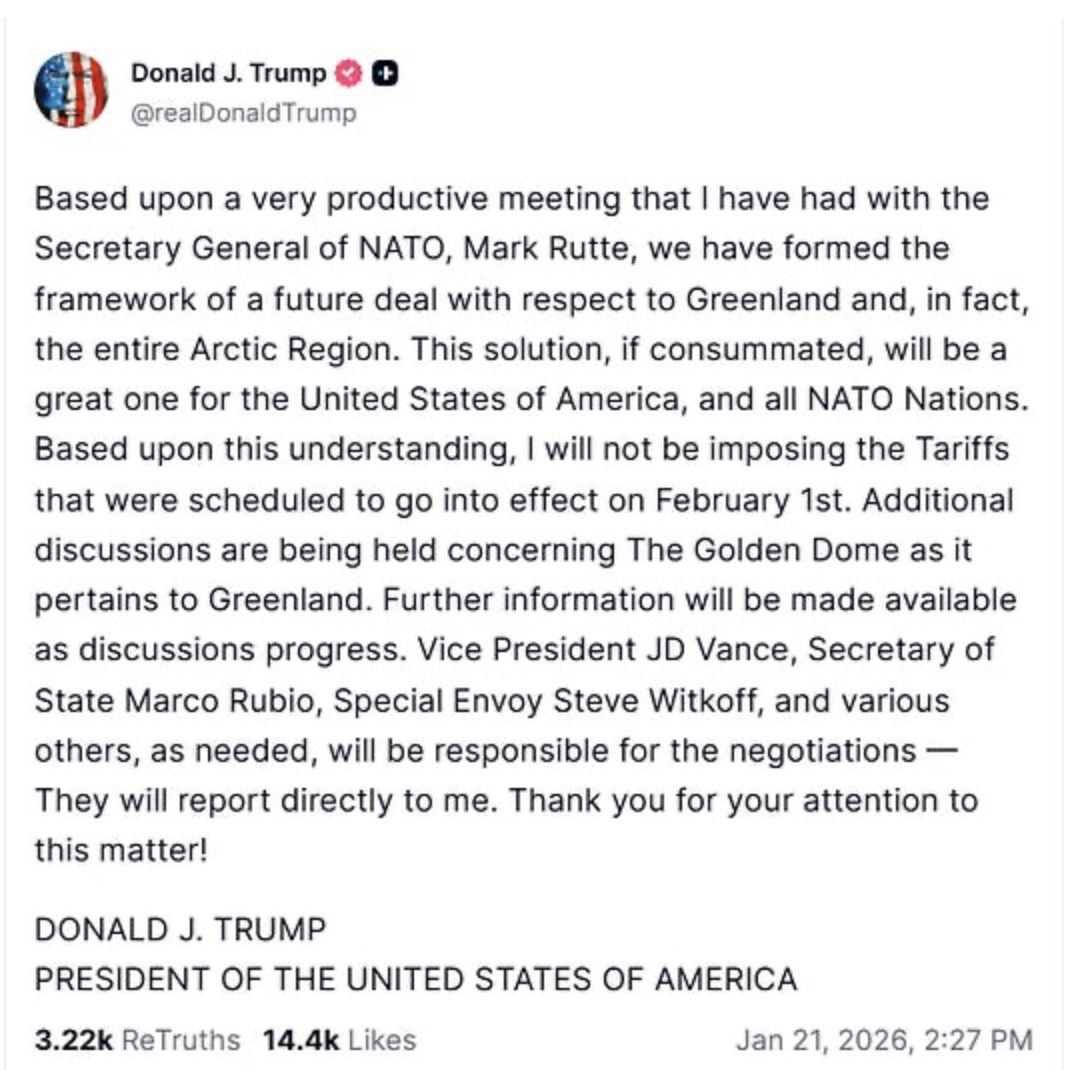
Here’s the thing about all the pontification regarding President Trump, nearly, if not all of it, is simply that, pontification by outsiders who have no idea about what is really happening.  These folks are not sitting in the Oval Office when the President is meeting with his advisors discussing strategy and are generally wishcasting their views and creating a narrative around that.  As I am also an outsider, all I can do is observe and try to ascertain how things might impact markets, but if you are not hearing it from the president or Secretary Rubio or someone like that, it is all speculation.  However, one must admit, it is entertaining!

As I don’t know what the next ‘global crisis’ is going to be ahead of time, let’s turn our attention to markets and how they responded to the president’s speech in Davos as well as the news of the deal framework.

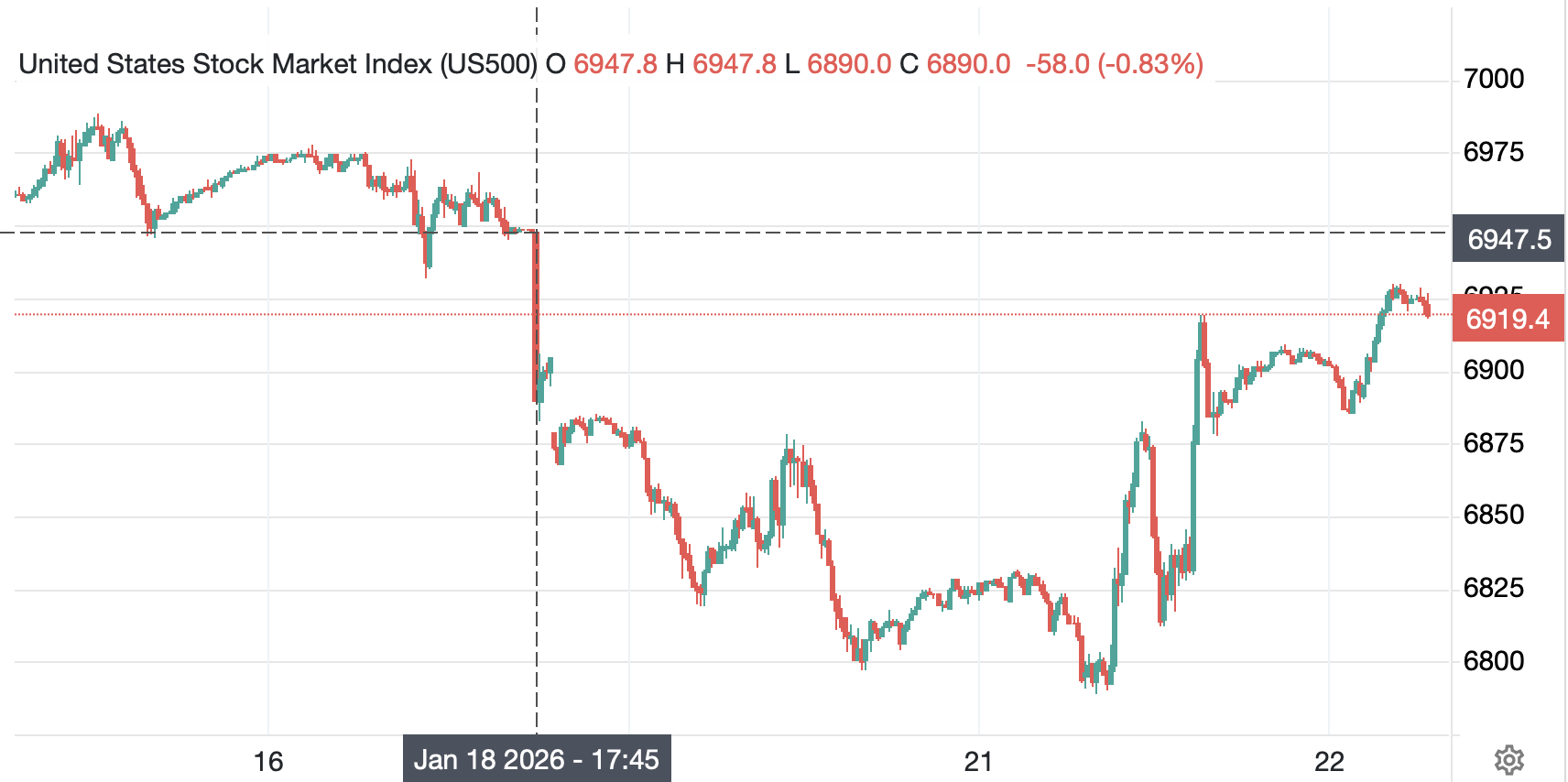
Equities were quite happy.  After the sharp decline seen Sunday night, when the tariff threats were made, the S&P 500 has recouped nearly all of the losses as per the below chart.  Yesterday saw US market gains of 1.2% across the board and futures, this morning, continue to rally, up about 0.5% across the board.
Source: tradingeconomics.com

It should be no surprise that things were bright in Asia as well, with Tokyo (+1.75%) leading the way as almost every exchange in the region was higher by a decent amount (Korea +0.9%, India +0.5%, Taiwan +1.6%, Australia +0.75%) but interestingly, China (0.0%) and HK (+0.2%) were the laggards.  Perhaps good news for the West is not seen that positively there, although the story of regulators in China cracking down on possible stock manipulation by social media influencers has raised some concerns.  After all, one of the biggest issues with investing in China by outsiders is the capriciousness of President Xi and the CCP as they decide what they don’t like that particular day.  

As to Europe, it should be no surprise that there has been a collective sigh of relief from investors there given the removal of the threat of more tariffs and the promises of more defense spending by European nations.  So, gains across the board with the DAX (+1.2%) leading the way although the CAC (+1.1%) is right there as well with most of the rest of the nations seeing gains on the order of 0.5% to 0.75%.

In the bond markets, apparently the end of the world has also been postponed.  Yields declined yesterday and this morning, Treasury yields are unchanged at 4.24%.  In Europe, yields have slipped -2bps to -4bps on the continent although UK gilts (+2bps) are bucking the trend, which appears to be an ongoing impact from yesterday’s higher than expected inflation data which continues to point toward stagflation in the UK.  Interestingly, JGB yields (-4bps) have also fallen again, although they certainly remain near recent highs.  PM Takaichi is going to formally dissolve the Diet tonight and the election is slated for February 8th (wouldn’t it be wonderful if US election campaigns were just 2 weeks long!).  While nothing has changed in her fiscal planning, it seems that investors are awaiting the BOJ announcement tonight (no change expected) and have been modestly appeased by a substantial increase in exports although the trade surplus declined slightly.  

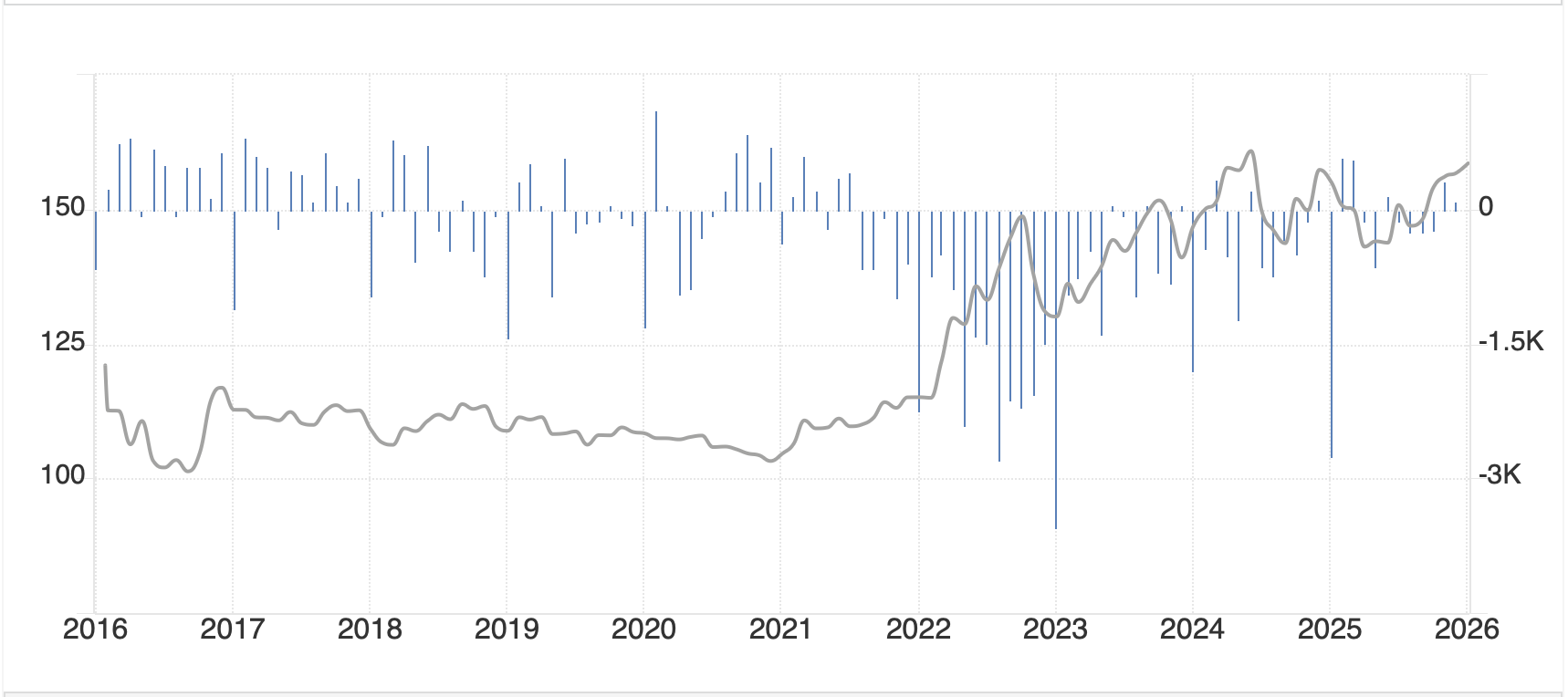
I think it is worth looking at the trade balance relative to the yen (-0.2%) as per the below chart.  Recall, historically, Japan ran major trade surpluses, which was always one of the tensions between the US and Japan dating back to President Reagan.  But as you can see below, the blue bars are the monthly trade numbers and since Covid, that situation changed dramatically.
Source: tradingeconomics.com

However, once the yen started to weaken substantially, the lagged effect showed up in trade data as can readily be seen above.  In fact, this is the real tension in Japan, I believe, that the weak yen helps exports significantly, but has become an inflation problem and the government is caught between the two issues.  This is why I believe we will see a weaker yen over time, especially if Takaichi-san comes out of the election with a solid majority.

As I’m on currencies, if we look elsewhere, the dollar, although we have been constantly assured it was collapsing, remains in its trading range.  This morning, the DXY (-0.1%) has edged lower after yesterday’s rebound.  As it happens, yen weakness has been offset by modest euro strength, but the real strength is in the commodity space with NOK (+0.8%), SEK (+0.36%), AUD (+0.6%) and NZD (+0.6%) all having solid sessions.  Now, my take is that the first two are more likely responses to the Greenland issue’s apparent resolution as NOK is rallying despite oil’s (-1.7%) sharp decline.  Remember, both those nations were in the crosshairs of Trump’s mooted tariffs.  On the other hand, last night, the employment situation in Australia perked up nicely which has helped raise market pricing for a rate hike by the RBA and given the strength in commodity prices and the apparent end of another global crisis, has helped support the currency.  Ironically, as I scan the EMG space, movements there have been much smaller overall.

Finally, turning to the rest of the commodity space, for the first time in a week, gold is not higher this morning, but rather essentially unchanged.  Silver (+0.25%) has bounced a tiny bit after selling off somewhat yesterday in NY.  I have maintained that trees don’t grow to the sky, and frankly, the price action here appears tired regarding ever larger gains.  I believe the fundamental story remains in place, but that doesn’t mean silver won’t chop around for a few weeks or months before starting higher again.   Copper (-0.6%) is also under modest pressure this morning and has retreated much further, about -6.3%, from its recent highs at $6.10/lb than the precious metals.  However, the red metal remains much in demand given the underlying electrification story. 

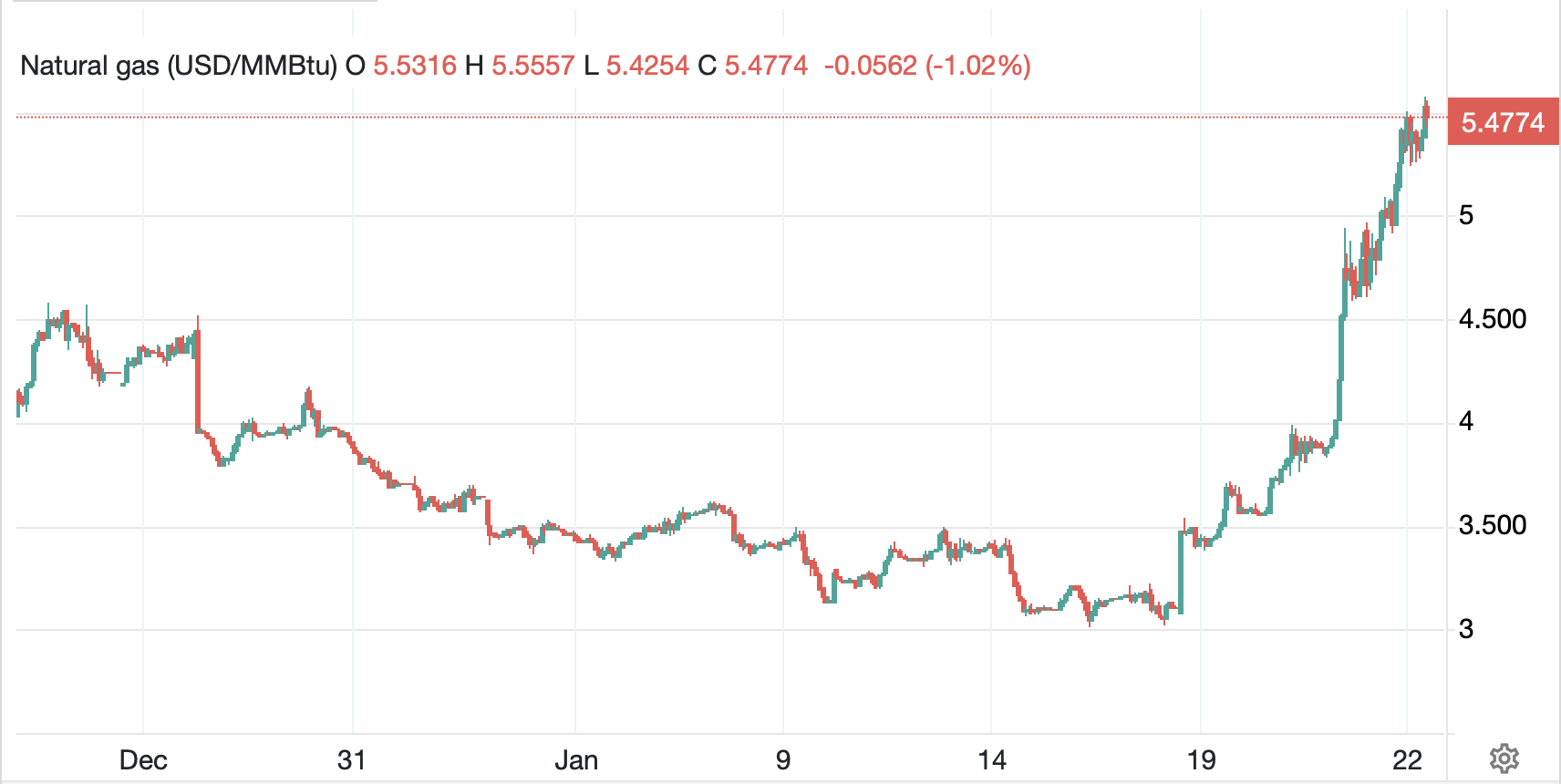
And lastly, a quick look at NatGas (+12%) shows what happens to commodity markets when there is the perception of insufficient supply for the current demand.  This is higher by 75% this week!  And while today in NJ, the temperature is a relatively balmy 34°, the forecast for the coming weekend is much colder and a huge snowfall.  It’s not often you see a movement of this magnitude so here is the chart for the past month.
Source: tradingeconomics.com

On the data front, today brings the final look at Q3 GDP (exp 4.3%) as well as Initial (212K) and Continuing (1880K) Claims.  Too, we get Personal Income (0.4%) and Spending (0.5%) for November and PCE (0.2%, 2.8% Y/Y) for both headline and core.  The EIA releases its weekly oil inventory data today, a day later than usual because of the holiday Monday, with a modest build expected.

Market participants in all markets appear to have found a comfort zone and are taking risk positions again, at least for now.  All the apocalyptic stories about the world rejecting the dollar and the rise of the BRICS will have to wait for another day.  While I don’t know what the next situation is going to be, I am highly confident we are going to have another geopolitical scenario that is going to result in more screaming, teeth gnashing and pearl clutching by those who continue to believe the rules-based order is the way things should be.  Alas for them, economic power and statecraft is the new world order, and my take is ultimately, the dollar benefits from this pivot.

Good luck

Adf

More Than a Tweet

In Davos, the global elite
Were treated to more than a Tweet
The president spoke
And in one broad stroke
Explained that he won’t be discreet
 
For oil, he wants prices falling
For Europe, he said it’s appalling
That nations don’t pay
Enough to defray
The costs of the war they’re forestalling


If, prior to yesterday, European leaders weren’t sure how things were going to play out now that Mr Trump is back in office, they have a whole lot better understanding now.  I imagine that all their fears were realized when Trump spoke via video at the WEF meeting in Davos, Switzerland.  It’s funny, Argentine president Javier Milei has been calling out the globalist agenda since his election last year and Europe didn’t care and didn’t change their behavior.  I guess that makes sense because the European press would never allow the narrative to change for a minor player like that.  Alas, for the European narrative now, the US, one of their largest trading partners and the nation that insures their safety via NATO membership, is calling them out for their behaviors, whether it is the rarely discussed tariffs they impose on US imports, or the lack of funding for a war they claim is critical to continue in Ukraine, and they are suddenly aware they better reconsider their positions. 

It will be very interesting to watch if things change in Europe (I think they will) and how quickly these changes will come (that could take more time).  Arguably, the biggest problem the current  European leaders have is that there are already large segments of their populations that are unhappy and have been voting accordingly, whether for AfD in Germany, or the RN in France to name two.  Trump’s comments are going to only foment more support for those positions.  I suspect the elections upcoming in Europe are going to see a further rightward swing, or perhaps simply a further swing against the incumbents given what appears to be a significant amount of dissatisfaction amongst the electorate.  No matter your view of Trump’s policies, we all must recognize he is a remarkable political force!

Fifty basis points
Is now Japan’s new baseline
Can it go higher?

As widely expected, the BOJ hiked its base rate by 25bps last night to 0.50%, the highest levels since October 2008.  The immediate market response, as you can see in the chart below, was for the yen to rally (dollar decline) almost one full percent despite interest rate markets having fully priced in the hike.  However, as you can also see, the yen has given back virtually all those gains in the wake of Ueda-san’s press conference where he explained the BOJ was not “seriously behind the curve” which was taken as meaning that it will be a while before they move again.  

Source: tradingeconomics.com

While JGB yields did perk up 2bps on the session, it hardly seems like the start of a rout.  And, as I highlighted yesterday, the interest rate differential does not seem likely to have changed enough to alter investor plans. Going forward, I expect the yen to be entirely beholden to the dollar’s broad movement.  If, as I suspect, the market starts to price in a more hawkish Fed, USDJPY is likely to go back and test its highs from last summer.

Ok, let’s move on to the overnight market action.  Once again, US equities rallied yesterday, although at this hour (7:10), futures are essentially unchanged.  In Asia, Japanese shares shed early gains after the BOJ rate hike and Ueda presser and closed unchanged on the day.  However, both Hong Kong (+1.9%) and China (+0.8%) rallied on the news that Trump and Xi had a “friendly” conversation as traders and investors took that to mean that tariffs on Chinese goods were not coming right away.  As to the rest of Asia, once again there were both gainers (Korea, Taiwan, Australia) and laggards (India, Indonesia, Philippines) with the rest showing little net movement.  

In Europe, the picture is also mixed as the CAC (+0.9%) is leading the way higher as investors want to believe that Trump’s call for lower interest rates as well as lower oil prices will help the European economy, especially the luxury sector in France.  But elsewhere in Europe we see Germany (+0.3%) a bit higher while Spain (-0.4%) and the UK (-0.4%) are lagging with the former suffering from rising energy prices while the ongoing political mess in the UK has investors steering clear of the Kingdom for now.

In the bond market, Treasury yields are unchanged this morning, holding the recent 10bp bounce from the lows seen last week.  European sovereign yields are higher by 1bp to 2bps across the board, with activity quiet and we’ve already discussed JGBs.  

Ironically, after Trump’s call for lower oil prices, they are firmer this morning, up 0.6%, although in the broad scheme of things, relative to the recent price action, that is tantamount to unchanged.  Here is something to consider though, which is a little bit outside the box.  The Biden EO that cited the OCSLA of 1953 prohibited drilling across a series of areas including the Atlantic and Pacific Oceans as well as the Gulf of Mexico.  Now, what is one of the first things that Trump said?  He is renaming the Gulf of Mexico to the Gulf of America.  Does that nullify the EO?  (h/t Alyosha).  I’m sure that is a legal battle to be had, but it would be right in line with Trump’s MO.  It would also allow drilling to continue unabated there, which to my understanding, has the most fruitful potential new sites.

Meanwhile, in the metals markets, they are all rallying nicely this morning with gold (+0.85%) now just about 1% below the all-time high seen in October of $2826/oz.  There are many market technicians (and gold bugs) calling for a breakout to new highs, but there is a case to be made this remains a technical short squeeze into NY delivery next week.  However, gold has dragged both silver (+0.9%) and copper (+0.9%) along for the ride.

Finally, the dollar is under pressure this morning with the DXY (-0.5%) falling to its lowest level since mid-December.  Ironically, while the G10 weakness is widespread (EUR +0.7%, GBP +0.5%, AUD +0.5%) the yen, after the rate hike, is the massive underperformer.  In the EMG bloc, one of the biggest movers is CNY (+0.5%) which is clearly benefitting from that phone call, while SGD (+0.5%) is benefitting despite the MAS having eased monetary policy.  This is an indication of just how much of a dollar selling move this is this morning.  In fact, other than the yen’s modest decline, every other major counterpart currency is higher vs. the dollar today. 

On the data front, Flash PMI (exp 49.6 Manufacturing, 56.5 Services) leads off at 9:45 then at 10:00 we see Existing Home Sales (4.19M) and Michigan Sentiment (73.2).  With the Fed meeting next Tuesday and Wednesday, there are still no speakers.  Perhaps of more interest is the fact that we have not seen a single article from the Fed whisperer lately.  As the data is third tier this morning, I wouldn’t expect anything today either.  Too, next week there is limited data of note before the meeting so unless we see a narrative shift of substance, I imagine the Fed will do nothing next week and Powell will dodge any questions regarding the future.

For now, it is all Trump and his actions, comments and EOs.  And you can’t plan how to trade those.  Once again, this is why hedging is so important.

Good luck and good weekend

Adf

Xi’s Heart Was Broken

The Taiwanese people have spoken
And President Xi’s heart was broken
The DPP won
Convergence is done
And Xi’s wrath has like been awoken

The results of the first presidential election around the world in 2024 are in and Lai Ching-te, the ruling Democratic Progressive Party’s candidate, and sitting vice-president, has won.  This is absolutely not the outcome that Chinese President Xi Jinping was looking for as his administration apparently orchestrated a great deal of election interference in order to get the opposition candidate into the seat.  Overall, the DPP does not have a majority in the Legislature so getting things done will be a challenge for Mr Lai, but as sitting VP, he is clearly quite politically capable.  It is important to know that he has not advocated for independence, which is the brightest red line President Xi sees, but his attitude is quite interesting now with his view that Taiwan is already, de facto, a state, and therefore doesn’t need to declare independence.

At this time, it doesn’t appear as if there will be any change in the status quo in the Taiwan Strait.  I imagine that Xi will continue to order periodic harassment of Taiwanese shipping and encroach on their airspace, but it strikes that the odds of invasion, at least currently, remain extremely low.  If Xi learned nothing else about war from the Russian invasion of Ukraine, it is that things don’t always work out as assumed.  Add to this lesson Xi’s recent purging of numerous high-ranking military officers on corruption and incompetence charges, and I suspect that the stalemate here will continue.  As such, I don’t anticipate any economic impact of note from this particular situation going forward.  At least not this year or next.

In Iowa, temps are sub-freezing
In Davos, it’s not as displeasing
The difference is stark
As both places mark
Their efforts, control, to be seizing

As it is Martin Luther King Day here in the US, so banks and the stock market are closed, I thought it might be a good time to discuss two events that are occurring in very different parts of the world and with very different views of the world, namely the Iowa caucuses and the beginning of the World Economic Forum (WEF) in Davos, Switzerland.

Starting with Iowa, this is the official beginning of the Presidential election cycle in the US with the first votes and the first delegates to be allocated.  This year, for the first time, it is only the Republicans caucusing as it appears President Biden, who came a weak 5th there in 2020, decided that he didn’t want to be embarrassed and so essentially canceled the vote.  As to the Republicans, they will be braving sub-zero temperatures throughout the state with the latest polls I have seen, courtesy of Five thirty-eight.com showing former President Trump with 52.7% of the vote, followed by Nikki Haley (18.7%), Ron DeSantis (15.8%) and Vivek Ramaswamy (6.4%).  This result is in line with the national polls and certainly indicates that, as of now, President Trump is going to be the Republican nominee.

That prospect is anathema to the entire Democratic Party, as well as to many Republicans, but even more interesting is how the rest of the world finds the prospects so alarming.  In fact, it seems to be a major topic at WEF as President Trump was essentially dismissive of the WEF agenda when he was last in office and if we have learned anything about WEF, it is they cannot stand being dismissed, especially by world leaders.

I might argue that the biggest problem WEF has is their agenda is running into the realities of physics and economics.  It turns out that many people are not willing to give up material progress that requires the use of fossil fuels or farming, and that seems to run contra to the WEF stated goal of, you will own nothing, and you will be happy.  For now, despite the vast amount of wealth that individual members of WEF control, its direct impact on the macroeconomy has been felt through government policies.  In fact, it seems clear these policies have been a driving force in the rise in populism around the world completely to oppose those policies, and that is not about to change.  At least not until the other 39 elections due this year around the world have been completed.  This is a key reason I believe we are going to see far more populism in many places, and that will have real economic consequences.

Consider for a moment, what populist policies might look like.  They are very likely to increase government spending on things like healthcare and retirement to the detriment of spending on things like energy and defense.  There will be an increase in the amount of reshoring manufacturing and buy local programs and I suspect that there will be more isolationism as a theme.  One of the things all these policies have in common is they will all be inflationary.  And that is something which will need to be considered in both investment and hedging decisions going forward.

Ultimately, the one thing of which I am confident is that the idea of a secular deflation makes very little sense.  Rather, a combination of current and potentially populist future policies is much more likely to result in higher inflation across the board.  Governments will find this convenient as it will help depreciate the real value of their growing debt piles and encourage them to continue to spend on these populist policies.  However, viewing this from a business’s point of view, it will require a focused approach on managing costs and pricing products and services appropriately.  Keep your eyes on the big picture, not just the most recent result.

Despite the fact that the holiday is a US holiday, it seems that most markets have decided to take the day off as well.  While European equity markets are drifting lower, that seems to be in response to the fact that Germany fell into official recession last year and its prospects remain dim for 2024.  Japanese equities continue their run as interest rates in Japan are drifting lower as all the talk of the end of ZIRP slowly fades away alongside fading inflation in the country.

Arguably, the one place where things are moving is European bond markets where yields have risen between 6bps and 8bps across the board despite what appears to be weaker than forecast Eurozone IP data.  On the surface, the data today would have indicated a bond rally, not sell-off, but it seems inflation remains a concern there as well.

Oil prices have slipped a bit overnight but remain in the middle of their recent trading range despite the escalation of tensions after the US and UK bombed Houthi sites in Yemen at the end of the week.  More and more shipping companies are avoiding the area driving up shipping costs, extending lead times, and adding to upward inflation pressures.  As to the metals markets, gold is little changed, and copper and aluminum are acting independently with copper higher and aluminum lower although there are no obvious catalysts for either.

Finally, the dollar is a bit stronger this morning, with JPY (-0.6%) continuing its recent slide as the market removes higher interest rates from its collective bingo card.  But the buck is strong pretty much everywhere with a few EMG currencies also falling by -0.5% or more (BRL, KRW, TWD).  However, with the US out, I don’t anticipate much further activity.

There is no data today nor Fedspeak so for those of you who are working today, it should be quiet in markets overall.

Good luck
Adf

Bred On Champagne

In Davos, the global elite
Are gathering midst their conceit
That they know what’s best
For all of the rest
Though this year they’re feeling some heat

As growth ‘round the world starts to wane
This group, which was bred on champagne
Is starting to find
Their sway has declined
And people treat them with disdain

This is Davos week, when the World Economic Forum meets in Switzerland to discuss global issues regarding trade, finance, economics and social trends. Historically, this had been a critical stopping point for those trying to get their message across, notably politicians from around the world, as well as corporate leaders and celebrities. But this year, it has lost some of its luster. Not only are key politicians missing (the entire US entourage, PM May, President Xi, President Macron, AMLO from Mexico and others), but the broad-based rejection of globalist policies that have led to a significant increase in populism around the world has reduced the impact and influence of the attendees. Of course, this hasn’t prevented those who are attending from declaring their certitude of the future, it just puts a more jaundiced eye on the matter. As to the market impact of this soiree, the lack of keynote addresses by policymakers of note has resulted in quite a reduction of influence. But that doesn’t mean we won’t see more headlines, it just doesn’t seem like it will matter that much.

Inflation forecasts
In Japan have been reduced
Again. Is this news?

The BOJ met last night and left policy settings unchanged, as universally expected. This means that the BOJ is still purchasing assets at a rate of ¥80 trillion per year (ostensibly) and interest rates remain at -0.10%. Their problem is that despite the fact that they have been doing this for more than 6 years, as well as purchasing corporate bonds and equity ETF’s, they are actually getting worse results. Last night they downgraded their growth and inflation forecasts to 0.9% for both GDP and CPI as they continuously fail in their attempts to stoke price increases.

While the Fed has already begun normalizing policy and the ECB is trying to move in that direction (although I think they missed the boat on that), the BOJ is making no pretenses about the fact that QE is a fact of life for the foreseeable future. Policy failure at the central bank level has become the norm, not the exception, and the BOJ is Exhibit A. As such, the yen is very likely to see its value remain beholden to the market’s overall risk appetite. If we continue to see sessions like yesterday, where equities and commodities suffer while Treasuries are bid, you can be pretty sure the yen will strengthen. While this morning the currency is actually weaker by 0.3%, that seems more like a position adjustment rather than a commentary on risk. In fact, if equities continue to suffer, look for the yen to regain its lost ground and then some.

As to Brexit, the pound is trading back above 1.30 this morning for the first time since the first week of November, which was arguably more about the US elections than the UK. But the market is becoming increasingly convinced that a hard Brexit is off the table, and that some type of deal will get done, maybe not by March, but then after a several month delay. If this is your belief, then the pound clearly has further to rally, as the market remains net short, but my only advice is to be very careful as policy mistakes are well within the remit of all government organizations, not just central banks.

Beyond those stories, there has been no movement on the trade talks, although Larry Kudlow did highlight that some type of verification would be needed before anything is agreed. US data yesterday showed a much weaker than expected housing market with Existing Home Sales falling 10.0% since last year to just 4.99M in December. The Fed is silent as they prepare for next week’s meeting and the ECB is silent as they prepare for tomorrow’s meeting. In other words, it is not that exciting. Equity futures are pointing modestly higher, about 0.25%, although that is after a >1% decline in all markets yesterday. Treasury yields are higher by 2bps and oil prices are modestly higher (0.7%) after a sharper decline yesterday. Overall, the market remains unexciting and I expect that until we see a resolution of one of the key issues, notably trade or Brexit, things are likely to remain quiet. That said, it does appear that there are ample underlying concerns to warrant a fully hedged position for risk managers.

Good luck
Adf