Xi’s Heart Was Broken

The Taiwanese people have spoken
And President Xi’s heart was broken
The DPP won
Convergence is done
And Xi’s wrath has like been awoken

The results of the first presidential election around the world in 2024 are in and Lai Ching-te, the ruling Democratic Progressive Party’s candidate, and sitting vice-president, has won.  This is absolutely not the outcome that Chinese President Xi Jinping was looking for as his administration apparently orchestrated a great deal of election interference in order to get the opposition candidate into the seat.  Overall, the DPP does not have a majority in the Legislature so getting things done will be a challenge for Mr Lai, but as sitting VP, he is clearly quite politically capable.  It is important to know that he has not advocated for independence, which is the brightest red line President Xi sees, but his attitude is quite interesting now with his view that Taiwan is already, de facto, a state, and therefore doesn’t need to declare independence.

At this time, it doesn’t appear as if there will be any change in the status quo in the Taiwan Strait.  I imagine that Xi will continue to order periodic harassment of Taiwanese shipping and encroach on their airspace, but it strikes that the odds of invasion, at least currently, remain extremely low.  If Xi learned nothing else about war from the Russian invasion of Ukraine, it is that things don’t always work out as assumed.  Add to this lesson Xi’s recent purging of numerous high-ranking military officers on corruption and incompetence charges, and I suspect that the stalemate here will continue.  As such, I don’t anticipate any economic impact of note from this particular situation going forward.  At least not this year or next.

In Iowa, temps are sub-freezing
In Davos, it’s not as displeasing
The difference is stark
As both places mark
Their efforts, control, to be seizing

As it is Martin Luther King Day here in the US, so banks and the stock market are closed, I thought it might be a good time to discuss two events that are occurring in very different parts of the world and with very different views of the world, namely the Iowa caucuses and the beginning of the World Economic Forum (WEF) in Davos, Switzerland.

Starting with Iowa, this is the official beginning of the Presidential election cycle in the US with the first votes and the first delegates to be allocated.  This year, for the first time, it is only the Republicans caucusing as it appears President Biden, who came a weak 5th there in 2020, decided that he didn’t want to be embarrassed and so essentially canceled the vote.  As to the Republicans, they will be braving sub-zero temperatures throughout the state with the latest polls I have seen, courtesy of Five thirty-eight.com showing former President Trump with 52.7% of the vote, followed by Nikki Haley (18.7%), Ron DeSantis (15.8%) and Vivek Ramaswamy (6.4%).  This result is in line with the national polls and certainly indicates that, as of now, President Trump is going to be the Republican nominee.

That prospect is anathema to the entire Democratic Party, as well as to many Republicans, but even more interesting is how the rest of the world finds the prospects so alarming.  In fact, it seems to be a major topic at WEF as President Trump was essentially dismissive of the WEF agenda when he was last in office and if we have learned anything about WEF, it is they cannot stand being dismissed, especially by world leaders.

I might argue that the biggest problem WEF has is their agenda is running into the realities of physics and economics.  It turns out that many people are not willing to give up material progress that requires the use of fossil fuels or farming, and that seems to run contra to the WEF stated goal of, you will own nothing, and you will be happy.  For now, despite the vast amount of wealth that individual members of WEF control, its direct impact on the macroeconomy has been felt through government policies.  In fact, it seems clear these policies have been a driving force in the rise in populism around the world completely to oppose those policies, and that is not about to change.  At least not until the other 39 elections due this year around the world have been completed.  This is a key reason I believe we are going to see far more populism in many places, and that will have real economic consequences.

Consider for a moment, what populist policies might look like.  They are very likely to increase government spending on things like healthcare and retirement to the detriment of spending on things like energy and defense.  There will be an increase in the amount of reshoring manufacturing and buy local programs and I suspect that there will be more isolationism as a theme.  One of the things all these policies have in common is they will all be inflationary.  And that is something which will need to be considered in both investment and hedging decisions going forward.

Ultimately, the one thing of which I am confident is that the idea of a secular deflation makes very little sense.  Rather, a combination of current and potentially populist future policies is much more likely to result in higher inflation across the board.  Governments will find this convenient as it will help depreciate the real value of their growing debt piles and encourage them to continue to spend on these populist policies.  However, viewing this from a business’s point of view, it will require a focused approach on managing costs and pricing products and services appropriately.  Keep your eyes on the big picture, not just the most recent result.

Despite the fact that the holiday is a US holiday, it seems that most markets have decided to take the day off as well.  While European equity markets are drifting lower, that seems to be in response to the fact that Germany fell into official recession last year and its prospects remain dim for 2024.  Japanese equities continue their run as interest rates in Japan are drifting lower as all the talk of the end of ZIRP slowly fades away alongside fading inflation in the country.

Arguably, the one place where things are moving is European bond markets where yields have risen between 6bps and 8bps across the board despite what appears to be weaker than forecast Eurozone IP data.  On the surface, the data today would have indicated a bond rally, not sell-off, but it seems inflation remains a concern there as well.

Oil prices have slipped a bit overnight but remain in the middle of their recent trading range despite the escalation of tensions after the US and UK bombed Houthi sites in Yemen at the end of the week.  More and more shipping companies are avoiding the area driving up shipping costs, extending lead times, and adding to upward inflation pressures.  As to the metals markets, gold is little changed, and copper and aluminum are acting independently with copper higher and aluminum lower although there are no obvious catalysts for either.

Finally, the dollar is a bit stronger this morning, with JPY (-0.6%) continuing its recent slide as the market removes higher interest rates from its collective bingo card.  But the buck is strong pretty much everywhere with a few EMG currencies also falling by -0.5% or more (BRL, KRW, TWD).  However, with the US out, I don’t anticipate much further activity.

There is no data today nor Fedspeak so for those of you who are working today, it should be quiet in markets overall.

Good luck
Adf
Already Wary

In China, the news wasn’t great

As Moody’s no longer could wait
Because of a glut
Of debt, they did cut
The outlook for China’s whole state

Investors were already wary
And as such, since last January,
Afraid of more shocks
Have been selling stocks
In quantities not arbitrary

The biggest news overnight was Moody’s downgrading their outlook for Chinese debt to negative from its previous stable view.  Moody’s currently rates the nation at A1, 4 notches below the best available of Aaa, but still a solid investment grade rating.  However, citing the property downturn in the country and the concomitant fiscal pressures that are building on local governments’ balance sheets, it appears there is a growing concern that national debt will be issued to cover the local failures.  

It must be very difficult to be a local government financial official in China as the competing pressures of ever faster growth and maintaining sound finances have become impossible to attain simultaneously.  The real question is, will President Xi determine that fiscal stability is more important than economic growth?  While that appeared to be his view last year, this year he seems to have changed his focus to growth.  Perhaps the fact that the US economy seems to be maintaining very solid growth while China is stumbling has become too much of a bad look for him to tolerate further.  (And that’s not to say things are fantastic here.) 

At any rate, his efforts to encourage more widespread economic activity while simultaneously deflating the immense property bubble there is starting to run into trouble.  As the pace of growth slows in the country, exacerbated by the demographic decline of the population (it is getting old and the population is shrinking), Xi appears to have thrown fiscal caution to the wind.  Once again, my concern is that if the domestic economy continues to deteriorate, Xi will determine that it is time for some international adventures to shore up his support at home.  I would contend that is not on anyone’s bingo card right now, but it is something to watch.

The market response to the news was to further sell Chinese equities with both onshore and Hong Kong markets suffering, each declining nearly 2%.  This weighed on Japanese markets (Nikkei -1.4%) as well as Taiwan, South Korea, and Australia, with only India ignoring the story.  It makes some sense that the China and India stories are uncorrelated given India is one of the few nations not reliant on China for much with respect to trade.  

Away from that story, however, things have been remarkably quiet on the economic front.  We saw Services PMI data from around the world with China, interestingly, one of the few nations printing above 50 (Caixin Services PMI 51.5), while all the continent remains firmly below the 50 boom-bust line save the UK which printed a much better than expected 50.9 reading.  While the market is waiting for US ISM Services data (exp 52.0) as well as JOLTS Job Openings data (9.3M), there is scant little else to discuss this morning.  Recall, though, as the week progresses, we will be receiving much more important data, notably the payroll report, which may help clarify the state of things now.

But, lacking anything else to discuss, let’s run down markets.  Away from Asia, equity markets are mixed with continental bourses all modestly firmer, on the order of 0.3%, although the FTSE 100 is lower by -0.5% despite the better than expected PMI data.  US futures are also pointing lower this morning, about -0.5% after a desultory day yesterday on Wall Street.

In the bond markets, Treasury yields have edged a bit lower this morning, -3bps, resuming what has been a powerful downtrend in yields.  In Europe, though, yields have really taken a dive, with sovereign bonds there all seeing declines of between 7bps and 9bps.  The weak PMI data has investors now bringing forward EB rate cuts to June.  Adding to this story were comments from the ECB’s Schnabel, historically one of the more hawkish members, describing the possibility of rate cuts next year as appropriate.  This seems quite similar to the Waller comments last week given Schnabel’s presumed importance on the ECB.  Finally, JGB yields are 2bps softer after slightly softer than expected Tokyo CPI data was seen as a harbinger for slowing inflation across Japan.  Once again, the idea that interest rate policy in Japan is due to normalize soon is being challenged by the facts on the ground.

Turning to commodities, oil (-0.3%) is slipping again as the weak PMI data encourages worries of an impending recession and the OPEC+ meeting was not taken seriously by the market as an effective manner to reduce supply.  Inventories have been building lately, so further pressure seems viable.  Meanwhile, metals markets are under further pressure with both copper and aluminum falling by more than -1.0% and gold, which had a remarkable session yesterday with a greater than $100 trading range, edging down a few bucks, but still well above the $2000/oz level.

Finally, the dollar refuses to obey the narrative and die.  Instead, it is higher again this morning vs. almost all its counterparts, both G10 and EMG.  The laggard today is AUD (-0.9%) which fell after the RBA left rates on hold, as expected, but apparently was not seen as hawkish as traders anticipated and the market has removed the pricing for any further rate hikes there.  The only exception to this movement has been the yen, which is now 0.1% firmer although in the wake of the Tokyo CPI data, it fell sharply.  USDJPY remains beholden to the twin narratives of declining US interest rates and normalizing monetary policy in Japan.  Right now, those stories are not working in concert, so until they do so, in either direction, I expect the yen will be choppy but not really make much headway in either direction.

Aside from the ISM and JOLTS data, we only see the API Crude Oil inventory data with a draw of 2.2 million barrels expected.  As there are no Fed speakers, it is shaping up to be a quiet day overall.  With that in mind, look for limited activity until 10:00 when the data is released and then I suspect that we remain in a ‘bad news is good’ regime.  So, weak ISM is likely to encourage risk taking on the belief the Fed will cut more aggressively and vice versa.  The same is true with the JOLTS data.  As to the dollar, I suspect it will follow the rate story, so strong data will help the buck and weak will see a bit of selling.

Good luck

Adf

Price Rise Regimes

Ahead of today’s CPI
Investors would not really buy
But neither would they
Sell short, as they weigh
If Jay is a foe or ally

Meanwhile, amongst pundits it seems
The world is split into extremes
Some see prices falling
And for cuts, are calling
While others fear price rise regimes

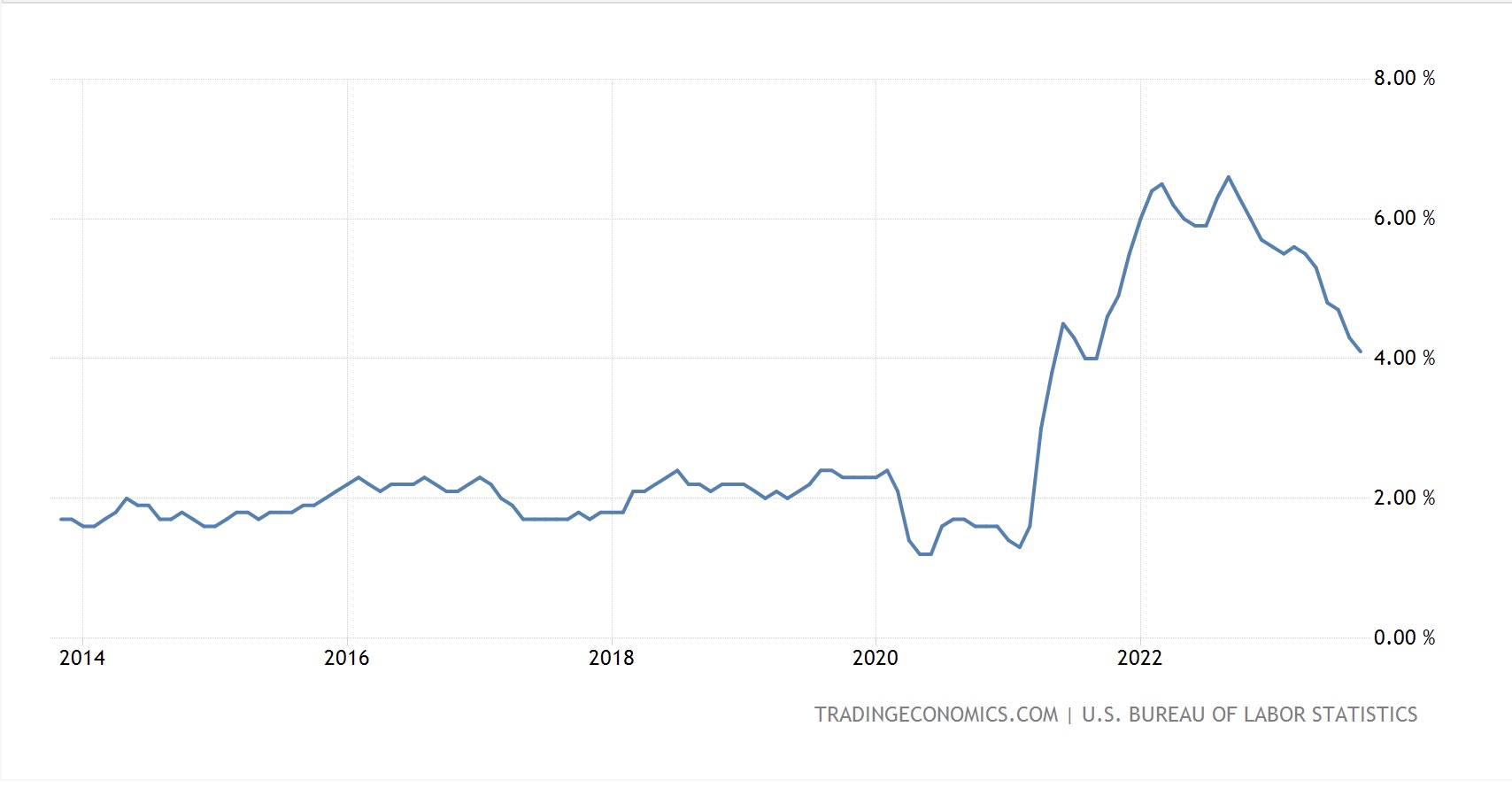
Market activity has been subdued overnight as we all await this morning’s big CPI report.  Currently the consensus views are for a 0.1% rise in the headline, leading to a 3.3% Y/Y number, down substantially from last month’s 3.7% reading, and a 0.3% rise in the core, leading to an unchanged Y/Y reading of 4.1%.  Here’s the thing, as can be seen in the below chart of core CPI, although it is clear inflation appears to be trending lower, it is still a LONG way from where anybody is comfortable.

Something else to remember is the different ways in which we all experience, and think about, inflation.  When writing about inflation, all analysts look at the rate of change of a percentage move as an indicator of what is happening.  But when you go to the grocery store, or your favorite restaurant, or when you order stuff on-line, especially things that you regularly buy, the price changes over the past two years have been so substantial, and taken place in such a short time, that we all remember the pre-covid prices.  The fact that prices may not be rising as fast as they did last year does not make the stuff any cheaper this year.  I would contend that is why virtually all of us consider the inflation data to be suspect, because the package of toilet paper that used to cost $4.99 now costs $8.99, and while it may not go higher anytime soon, it is still nearly double what we remember.  This perception is critical, in my mind, to understanding the national mood, and it is one that nobody in the Fed, or likely the administration, considers.  We know this because there are so many articles in the mainstream media about how things are really great, and people just don’t understand how good a job those two groups are doing.  

At any rate, if pressed, I would say that there are more deflationistas these days, who believe that inflation is going to quickly head back to 2% and that the Fed is going to be cutting rates early next year to prevent overtightening of policy.  The crux of their argument is that M2 is declining at a record pace (as can be seen in the below chart), and therefore is highly deflationary.  

I would counter that argument, though, with the fact that the velocity of money (see chart below) is rising at a record pace, offsetting those declines, and supporting ongoing inflationary tendencies.  

As some of us may remember from our macroeconomics classes, the identity to describe growth and inflation is:

                                                MV = PQ

The argument that a decline in M2 money supply (the “M”) will lead to lower prices assumes the velocity of money (the “V”) remains stable.  But as you can clearly see from the second chart, the velocity of money is rising sharply.  I would contend there is little chance that deflation is coming to a screen near you at any point in the next several years absent a depression brought on by a collapse in the bond market.  And ultimately, that means that the price of all those things we buy regularly is not going to retreat to pre-covid levels.

Away from the CPI drama, there were two things of note overnight.  First, Japanese FinMin Suzuki was on the tape explaining the government would take all possible steps necessary to respond to currency moves.  The market response was a very short-term rise in the yen, with the currency popping 0.35%, but giving back most of those gains within the hour and currently, it sits largely unchanged on the session.  There has been no evidence that the BOJ has intervened since October 2022, but it appears that 152.00 may be a sensitive spot right now.  The other thing he said was they were preparing a package to help citizens cope with the weakening yen which is driving inflation there.  That said, there is no indication yet they are going to raise the deposit rate from its current -0.10% level.  Net, I still think the yen has further to decline, at least until policy changes in Tokyo.

The other noteworthy occurrence was word from China that they were considering an additional CNY 1 trillion of support for the housing market as things on the mainland continue to slow despite Xi’s best efforts.  It seems when you blow a 20-year property bubble of such enormous proportions, such that the property sector consumes > 25% of your growing economy, slowing that down without collapsing the economy is a tough job.  I continue to think of King Canute and his command that the tide recedes every time I think about KingPresident Xi trying to stop the property market collapse.  At any rate, as can be seen by the fact that equity markets in China and Hong Kong did virtually nothing last night, the market is not excited by the prospects of more Chinese money sloshing around.

As to the rest of the equity markets, yesterday’s trading in the US was pretty limited with modest gains and losses in the indices while the Nikkei managed to gain 0.3% overnight.  European bourses are also mixed, with the continent a bit firmer while the UK is under some pressure.  Perhaps the marginally better than forecast German ZEW reading of 9.8 vs 5.0 expected and -1.1 last month is the driver on the continent, while UK employment data was arguably a bit better than forecast, with the Unemployment Rate remaining unchanged at 4.2% rather than ticking higher as expected, and so hopes for a quick BOE rate cut have faded a bit.

Too, in the bond market, activity has been extremely subdued with Treasury yields 2bps softer this morning while European sovereign yields are essentially unchanged across the board.  Last night in Asia, we saw little movement as well, with JGB yields slipping just 1bp and hanging around their new home at 0.85%.

While commodity prices managed to rally a bit yesterday, this morning, what little movement there is across energy and metals markets is ever so slightly lower.  Yesterday saw the EIA raise its forecast for oil demand slightly, and there is word that the administration is bidding for 1.2 million barrels of oil to start to refill the SPR, but sentiment in this space is clearly negative with the recession fears the driving force across all these markets.

Finally, the dollar, too, is very little changed this morning which should be no surprise given the lack of movement elsewhere.  If anything, it is trending a bit softer, but only just, as the deflationistas seem to be preparing themselves for a soft CPI print and want to get on board for that first Fed rate cut.  As we currently stand, at least according to the Fed funds futures market, the first cut is priced in for the June meeting, although the first hints of a cut show up in March.  That said, the probability of a rate hike in December has edged higher to 15% from below 10% last week.  There is still a great deal of confusion as to how market participants believe this is going to play out over time.

Aside from the CPI data, we hear from 3 more Fed speakers today, Barr, Mester and Goolsbee, while Governor Jefferson, in a speech in Zurich early this morning, didn’t really touch on current monetary policy, rather he was discussing uncertainty in a broad manner.  I suspect that the 3 speakers will generally reiterate Powell’s message from last week that the future is uncertain but higher for longer is the way forward.  As such, it is all about the data.  A hot print, certainly a M/M of 0.2% headline or 0.4% core will likely see bonds sell off along with stocks while the dollar rallies.  However, anything else, meaning a soft print or even an as expected print, will likely encourage risk buying and dollar selling.  We shall see,

Good luck

Adf

Bad Dreams

In China, the property bubble
Continues to cause Xi much trouble
So, they will add on
A trillion more yuan
Of debt, as help efforts redouble

And though Chinese markets did rise
They finished well off of their highs
Investors, it seems
Are having bad dreams
‘bout growth there and seek to downsize

Poor President Xi!  Instead of focusing all his energy on his saber rattling in the South China Sea and hinting at a Taiwanese invasion, he finds himself essentially forced to deal with the economy.  This was made clear yesterday when he made a surprise visit to both the PBOC and the SAFE (State Administration of Foreign Exchange), the two top Chinese financial institutions, and then today when the government announced an effective supplemental budget spend of CNY 1 trillion (~$137 billion) to support further infrastructure investment in the country.  

This move will increase the national government’s budget deficit for the year to 3.8%, well above the 3.0% target they had been shooting for, but obviously, the concern of continuing slow growth is being seen as a growing problem for Xi.  This is also a change from the previous process where local governments would issue debt to fund infrastructure investment and ultimately repaid that debt by selling land.  Of course, that is what led to the inflation of the massive property bubble in China, so that model is now clearly broken.

Arguably, the biggest worry is that if the domestic situation continues to deteriorate, Xi will get more adventuresome internationally as the standard national leadership political playbook is to seek to distract the population from the economic failures of a government by stoking nationalism and instigating conflict overseas.  We just saw it in Russia, and quite frankly, given the support for intensifying the war effort in the US, it is also being executed here in the US.

In the end, though, a 0.8% of GDP budget boost is unlikely to have a huge impact on the economy.  The problem the Chinese have is that they, too, have a very high debt level and are trying quite diligently to prevent it from growing out of hand.  The tradeoff there is that the amount of support is going to be restricted.  Initial economist estimates are that the package will raise GDP growth by 0.1% in Q4 and up to 0.5% in 2024 overall.  

It can be no surprise that shares in China rose on the news with the Hang Seng jumping 2.5% on the news while the CSI 300 jumped 1.3% initially.  However, both faded fast and closed higher by about 0.5%, not bad, but certainly not a huge vote of confidence.  Meanwhile, the yuan just continued is weak performance, falling another 0.2% and continuing to push against its 2% band vs. the daily CFETS fixing.

Away from that news, however, it has been dullsville this morning with pretty modest movement across both equity and bond markets around the world.  Yesterday’s PMI data indicated that the massive amount of fiscal stimulus that has been enacted in the US compared to elsewhere in the world is having the desired impact, at least from a statistical point of view, as US data continues to show relative strength compared to Europe, Japan and the rest of the G10.  However, despite those efforts, the political accolades remain absent as the national attitude is consistently measured in downbeat terms. 

And consider, if the data here are relatively better and the government is not gaining any ground, how bad it is for governments elsewhere in the world where the data is clearly worse and falling.  We continue to see populist parties from both sides of the aisle gaining in strength.  Do not be surprised to see quite a few new governments around the world over the next several years as support for incumbents continues to fall.  (It will be quite interesting to see the results of the Argentine election in a few weeks and see how Javier Milei, the upstart “anarcho-capitalist” who has promised to take a chainsaw to the government and shutter the central bank while dollarizing the economy, performs.)  A victory there could well be a harbinger of future shakeups everywhere.

Turning to markets, yesterday’s solid US performance was ultimately followed by 0.5% ish gains in China and Japan, although weaker performances elsewhere in Asia with a number of regional markets declining.  European bourses are showing very modest gains this morning, on the order of 0.1% while US futures are mostly softer at this hour (8:00), down roughly -0.4%.

The massive reversal in bonds seen on Monday is now history and we are seeing yields begin to creep back higher with Treasury yields up 3bps and similar rises throughout Europe, although Italian BTPs are the true laggard with yields there rising 6bps.  JGB yields also rose 2bps last night but have been largely capped at 0.85% by the market as there was no sign of extra intervention by the BOJ.  The yield curve inversion remains at -24bps, not quite at its tightest levels but still clearly trending toward normalization.

One thing to consider about the Treasury market is the fact that the US trade deficit has been steadily shrinking amidst the efforts at reshoring and all the CHIPS act spending on manufacturing capacity, as well as the simple fact that US energy exports continue to be quite robust.  The point is that one of the key demands for Treasury bonds in the past was the recycling of all those deficits, but if the deficits shrink, then there is less to recycle and therefore less demand for Treasuries.  Combine this process with the fact that the government continues to increase the amount of issuance and it is not hard to conclude that bond yields have further to rise over time.  The fact that an oversold market responded to a major psychological level does not mean the bond market move has ended.  Rather I would argue it has simply paused and yields will once again climb going forward.

Turning to the commodity markets, oil is marginally higher this morning, up 0.3%, but that is after another sharp decline yesterday as the market appears to believe that the odds of a widening of the Israeli-Palestinian conflict are shrinking amid growing pressure from organizations around the world.  Add to that the signs of weaker economic activity which implies reduced demand, and it is easy to understand why oil has retraced. However, inventories fell again last week, and the structural issues of supply remain in place.  The big picture remains for further strength over time in my eyes.  As to the metals markets, gold continues to benefit from its haven status, edging higher by 0.25% this morning while copper is suffering on the weaker growth story, falling -0.4%.

Finally, the dollar is stronger overall with the euro > 1% lower than its recent highs Monday afternoon which were seen in the wake of the bond market rally that day.  USDJPY is right back below 150.00 although it has not yet touched the level since early this month which was followed by what appeared to be intervention.  But generally, we are seeing the dollar gain against both G10 and EMG rivals as US rates once again edge higher, 2yrs as well as 10yrs.

On the data front today, New Home Sales (exp 680K) are due at 10:00 as well as the Bank of Canada rate decision where no change is expected.  We also see EIA oil inventory data later this morning and then Chairman Powell speaks late this afternoon.  I continue to believe it is unlikely that he will add anything to his message from last week.  As such, it is a status quo day.  If yields continue higher, look for the dollar to follow.  But I have a feeling that there will be very little movement today overall.

Good luck

Adf

No Certitude

The efforts from Xi haven’t yet
For locals, their appetites whet
So, more were announced
And equities bounced
But still there is just too much debt

Meanwhile, elsewhere things are subdued
As traders have no certitude
‘Bout data this week
And if it will wreak
More havoc on everyone’s mood

As the week progresses, we will get a raft of data culminating in Friday’s payroll report.  But for now, the market is looking elsewhere for its catalysts and China continues to provide fodder for the trading community.  Last night, the news hit that Chinese banks were going to be reducing their mortgage rates for mortgages on first homes by up to 60 basis points in order to help support domestic consumption.  At the same time, they are also likely to reduce deposit rates by between 5bps and 20bps as they try to maintain their lending margins, but net, it appears the move should free up some cash for the Chinese consumer.

This should certainly be a positive for the nation’s economy and the equity market in China responded accordingly, with the CSI 300 rallying 1.0% while the Hang Seng jumped nearly 2.0%.  However, Xi’s actions continue to be small beer, tweaking policies at the margin, while he apparently remains adamantly opposed to any broad fiscal stimulus.  Now, in the long-term, this is probably a pretty sensible move for China as they already have a massive amount of debt outstanding, especially in the property market, and if national debt were piled on top, it could lead to much worse long-term outcomes.  However, in the short run, a 50bp cut in mortgage rates is unlikely to change consumption patterns by very much, and more domestic consumption is what they need.  This is especially true given the ongoing economic weakness in Europe, which has become their largest trading partner.

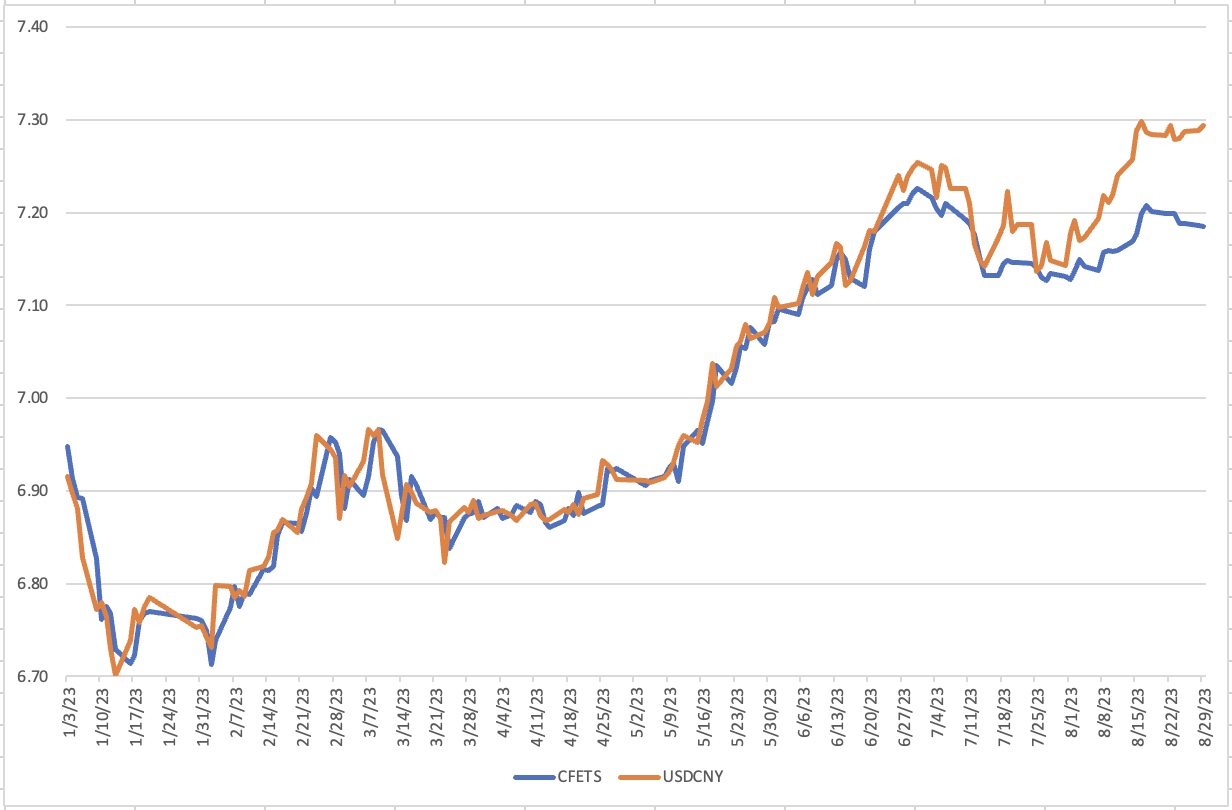
While Xi continues to fiddle with minor policy adjustments, the PBOC is desperately trying to prevent more severe weakness in the renminbi.  Last night, for instance, they fixed USDCNY at 7.1851, far below the market’s calculated expectations and 1.65% lower than the market is actually trading.  Remember, the onshore rules are that spot can only trade within a +/- 2.0% band compared to that CFETS fix, and it has been pushing that boundary for a while now as can be seen in the chart below (source Bloomberg):

The spread between the blue and orange lines continues to increase, but more importantly, the trends are moving in opposite directions.  Given how close the spread already is to the 2% limit, it appears that there is the potential for some fireworks in the future.  At this point, I cannot see how the PBOC will not ultimately allow a weaker CNY.  This is especially true if (when?) the Fed raises the Fed funds rate again.  Nothing has changed my view of 7.50 and beyond.

But, away from the ongoing recalibrations in the Chinese financial systems, there is precious little else on which to focus.  Generally, markets seem to have absorbed the idea that the Fed may continue to tighten further and remain resolutely bullish on risk.  It seems that the no-landing scenario is the current market fave.  And so, last night aside from the Chinese share gains, we saw green everywhere else as well, just not nearly as excited with rises on the order of 0.2% to 0.5%.  In Europe, it is also a positive morning with most gains relatively modest, of the 0.3% variety, with only the FTSE 100 (+1.45%) showing more substantial gains as the UK catches up with yesterday’s rally after their bank holiday.  Alas, US futures are actually leaning slightly negative this morning, but only just, as traders await the first pieces of data this week.  I would contend that the JOLTS data (exp 9.5M) is the most important as a key jobs indicator frequently mentioned by Powell, but we also see Case Shiller Home Prices (-1.60%) and Consumer Confidence (116.0).  Things pick up a bit tomorrow with ADP and then GDP on Thursday ahead of NFP on Friday.

In the bond market, lackluster describes things quite well with Treasury yields higher by 1 basis point and even lesser moves across the European sovereign space.  JGB’s, meanwhile are starting to drive a bit lower, but continue to hang around near 0.6%.  Traders and investors are awaiting this week’s data now that they have absorbed the Fed commentary.  If we see a surprisingly strong NFP print, do not be surprised to see yields back up toward their recent highs of 4.35% as many will assume at least one more hike is coming soon.  Correspondingly, a soft print will likely see a test of 4.00%, at least initially.

Oil prices continue to hold their own, perhaps getting a boost from the China story as any stimulus there is welcome and seen as a fillip for demand.  Metals prices, which had been a touch firmer earlier in the session, have given up those modest gains and at this hour (8:00), are basically flat on the day.

Finally, the dollar is mixed to slightly stronger this morning, but overall movement has been muted, like all the other markets.  While NOK (+0.15%) is managing some gains on oil’s strength, the rest of the G10 bloc is a touch softer, although other than JPY (-0.3%), which has managed to trade above 147 this morning, the movement is tiny.  In the EMG bloc, there is a more mixed view, but none of the movement is very large in either direction, with the biggest gainers and losers at +/- 0.3% on the day, effectively nothing in this space. Here, too, all eyes are on the data this week.

The only Fed speaker today is Michael Barr, and he is talking about banking services, with no policy discussions expected. Adding it all up leads to a conclusion of a pretty quiet session overall unless today’s data is dramatically surprising.  Remember, though, quiet sessions are good days to hedge.

Good luck

Adf

Still Avante-Garde

As always, when Chairman Jay speaks
Each hawk and each dove caref’lly seeks
The words that best suit
Their story, and mute
All others with varied techniques

Every hawk in the market heard these words, right at the beginning of Powell’s speech Friday morning and rejoiced [emphasis added], “we are prepared to raise rates further if appropriate, and intend to hold policy at a restrictive level until we are confident that inflation is moving sustainably down toward our objective.”

However, the doves didn’t need to wait long to find their counterpoint, with Powell giving them fodder in the very next paragraph, [emphasis added], given how far we have come, at upcoming meetings we are in a position to proceed carefully as we assess the incoming data and the evolving outlook and risks.

So, which is it?  Here is the link to the speech, so you can make up your own mind if you so choose but be prepared, if you listen to the punditry, you will hear both sides and likely no clear decision.  With that in mind, my take is that there is still far more hawkishness than dovishness around the table at the Eccles building.  Much of the speech focused on the fact that while things were certainly better than the peak inflation period last year, there is still a long way to go before they feel confident they have achieved their goal.  And one other thing, Powell made it clear that the goal remains 2%.  All this talk of raising the target seems like it will get no hearing at all for the time being.

A quick look at equity markets on Friday shows that the initial impression of the speech was the hawkish view as stocks fell pretty sharply right away.  However, after falling about 0.7% in the first hour, buyers returned, and the major indices all closed nicely higher on the day.  Of course, the irony of that outcome is higher equity prices beget easier financial conditions which implies even more tightening by the Fed.  But whatever.

Then later, said Madame Lagarde
This job that we have is so hard
The future’s unclear
And though we’re sincere
We’re clueless, though still avant-garde

Much later Friday, Madame Lagarde explained her updated framework for how the ECB is going to be handling things in the future.  The very best thing she said was that they would act with humility as they proceed.  And while it would be great if that were to be the case, my 40 years of experience tells me it is unlikely to work out that way.

The essence of her speech was to identify that the world has changed and that old economic relationships may no longer be viable.  As I have written many times about all the central banks, each of them has a series of econometric models by which they steer their course.  The problem is those models have over time been proven to be completely worthless.  And more disturbingly, anytime someone with a different viewpoint has a chance to be nominated to enter the club, they are shot down immediately.  There is virtually zero willingness to truly think outside of the box of their making.  While Lagarde preaches that they will be humble going forward, it seems highly unlikely they will consider anything that is not completely orthodox, even as a thought experiment.  And to my mind, that is the exact opposite of humility.

At any rate, Lagarde’s speech was very late in the market day and did not seem to have much impact at all.  Thus concludes the recap from Friday’s activity.  Now let’s turn to this morning.

In China, old President Xi
Keeps trying to force, by decree
A rally in stocks
By banning sales blocks
And halving the transaction fee

While it is getting tiresome to have to write about China yet again, it remains the other major story in the markets.  Last night, the government unveiled yet another set of measures to try to support the stock market there with only marginally more success than seen last week.  (As an aside, does it seem strange to anyone else that a communist country with state control over most aspects of life is keen to support the bastion of capitalism that is a stock market?).  

The latest effort included three steps; a 50% cut in the transaction tax, down to 0.05%; a limit on new listings (to prevent more supply); and a ban on sales by controlling shareholders if those companies have not paid dividends in the past three years or are trading below their IPO price.  These were announced before the market opened and the initial response was a 5.5% jump compared to Friday’s closing levels in the CSI 300.  Alas, it was a very short-lived gain with half that evaporating in the first 10 minutes of trading and the end result a gain of only about 1% on the day.  Certainly, better than a decline, but clearly not what President Xi had in mind.

Ultimately, the problems in China go far beyond the level of stamp duty on stock trades.  There are fundamental problems in the economy’s structure as well as the demographic and debt overhangs that exist there.  Despite the much ballyhooed efforts by Xi to adjust the Chinese economy away from its mercantilist economic model, that is still the predominant process there.  It is with this in mind that I continue to look for a much weaker renminbi going forward, and an eventual move to 7.50 and beyond.  

As to the rest of the equity markets, currently everything is in the green, with Japan having a great day (+1.7%) and all of Europe higher by between 0.50% and 1.00%.  US futures, too, are firmer this morning, although only just at this hour (7:20), about 0.2% across the board.  As there is a ton of data to come this week, I suspect that traders will be waiting for more information before making their next big bets.

In the bond market, things are quite benign with no major government market having seen a yield change of even 1 basis point this morning.  There are some gainers and some losers, but for all intents and purposes, bonds are unchanged on the day.  The one thing to note, though, is that the US Treasury curve inversion is growing again, back to -86bps, after having traded to as low as -65bps less than two weeks ago.  I feel like this movement simply adds to the confusion over the imminence of a recession, although I definitely believe one is coming by early next year.  Of course, we will learn far more about the economy this week given the data to be released.

In the commodity space, oil is marginally softer this morning, back just below $80/bbl, although there seems to be an increasing effort by OPEC+ to continue to restrict supply as they fear a recession coming.  Metals prices are generally little changed this morning, again, with market behaviors driven by the uncertainty over the week’s upcoming news.

Finally, the dollar is also mixed this morning, with a nice mix of gainers and losers across both the G10 and EMG blocs.  I feel the bias will be for a stronger dollar given my take on Powell’s comments as being hawkish, but as I explained, there was plenty of fodder for both arguments.

Turning to the data, there is a lot this week as follows:

TodayDallas Fed Manufacturing-19.0
TuesdayCase Shiller Home Prices-1.65%
 JOLTS Job Openings9450K
 Consumer Confidence116.2
WednesdayADP Employment 198K
 Advance Goods Trade Balance-$90.0B
 GDP Q22.40%
ThursdayInitial Claims235K
 Continuing Claims1705K
 Personal Income0.30%
 Personal Spending0.70%
 Core PCE Deflator0.2% (4.2% Y/Y)
 Chicago PMI44.1
FridayNonfarm Payrolls168K
 Private Payrolls150K
 Manufacturing Payrolls3K
 Unemployment Rate3.50%
 Average Hourly Earnings0.3% (4.3% Y/Y)
 Average Weekly Hours34.3
 Participation Rate62.60%
 Construction Spending0.50%
 ISM Manufacturing47.0
 ISM Prices Paid44.0

Source: Bloomberg

So, as can be seen there is a ton of stuff to digest this week.  On top of that, we do hear from a few Fed speakers, but I think that given we just got Powell’s views, the data will be far more important than anything from a few regional bank presidents.  While obviously, Core PCE is critical, as it is their key inflation metric, I continue to look at the payroll data as the key for Powell to believe that he has not broken anything yet.  Once that data starts to fade, we can look for a change in tone from the Fed.  But until then, higher for longer remains the key, and the dollar should continue to benefit.

Good luck

Adf

Growth Will, Fall, Free

In China when data is weak
And nothing implies there’s a peak
The answer is to
Remove it from view
And henceforth, no more of it speak

But just because President Xi
Decided there’s nothing to see
That will not prevent
The wid’ning extent
Of views China’s growth will, fall, free

Last night China released their monthly series of economic statistics, all of which were lousy.  Briefly, Retail Sales (2.5%), IP (3.7%), Fixed Asset Investment (3.4%), Property Investment (-8.5%) and Unemployment (5.3%) all missed the mark with respect to economists’ forecasts and all indicated much weaker growth than previously expected.  Conspicuously there was one data point that was missing, youth unemployment, which had been rising rapidly over the past months and in June reached a record high of 21.3%.  However, given the amount of negative press coverage that particular data point was receiving, especially in the West, it seems that President Xi decided it was no longer relevant and it will not be published going forward.  Given the broad-based weakness in all the other data, as well as the fact that there are many new graduates who would have just entered the workforce, one can only assume the number was pretty substantially higher than 21.3%.

The other news from China was that the PBOC cut their 1yr Medium-Term Lending Facility rate by 15bps in a complete surprise to the market.  As well, the 1wk repo rate was also cut by 10bps as the government there tries to address the very evident weakening economic picture without blanket fiscal stimulus.  One cannot be surprised that the renminbi weakened further, falling another -0.4% onshore with the offshore version currently -0.5% on the session.  One also cannot be surprised that Chinese equity markets were all under pressure as prospects for near-term growth continue to erode.  FYI, the renminbi is within pips of its weakest point in more than 15 years and, quite frankly, there is no indication it is going to stop sliding anytime soon.  I continue to look for 7.50 before things really slow down.

As growth increases
And inflation remains high
Can QE remain?

In contrast to the Chinese economic data, we also saw Japanese data overnight and it was a completely different story.  Q2 GDP was estimated at 6.0% on an annual basis, much higher than expected and an indication that Japan is finally benefitting from its policy stance.  While inflation data will not be released until Thursday, the current forecasts are for little change from last month’s readings.  However, remember every inflation indicator in Japan is above the BOJ’s 2% target so the question remains at what point is QE going to end?  For the FX market this matters a great deal as USDJPY is back above 145 again, and if you recall the activities last October, when USDJPY spiked above 150 briefly and the BOJ/MOF felt forced to respond with significant intervention, we could be headed for some more fireworks.  However, despite the BOJ’s YCC policy adjustment at the last BOJ meeting in July, the JGB market has remained fairly well-behaved, so it doesn’t appear there is great internal pressure to do anything yet.  The flipside of that is the US treasury market, where 10yr yields are back above 4.20% and that spread to JGBs keeps widening.  As the Bloomberg chart below demonstrates, the relationship between 10yr Treasury yields and USDJPY remains pretty tight.  Given there is no indication 10yr yields are peaking, I suspect USDJPY has further to rise.

All this, and we haven’t even touched on Europe or the UK, where UK employment data showed higher wages and a higher Unemployment Rate, a somewhat incongruous outcome.  The Gilt market has sold off on the news, with yields climbing about 6bps, but the rest of the European sovereign market is much worse off, with yields rising between 8bps and 12bps.  Treasuries are the veritable winner with yields this morning only higher by 3.5bps.

What about equities, you may ask, after yesterday’s positive US performance.  The disconnect between the NASDAQ’s ongoing strength in the face of rising US yields remains confusing to many, this poet included, as the NASDAQ, with all its tech led growth names, seems to be an extremely long duration asset.  But, another 1% rally was seen yesterday, ostensibly on the strength of Nvidia which rallied after a number of analysts raised their price target on the company amid news that Saudi Arabia and the UAE both have been buying up the fastest processors the company makes.  Well, while Japanese equities managed gains after the strong data, all of Europe is in the red, all by more than 1% and US futures are currently (7:30) lower by about -0.5%.  If US yields continue to rise, and there is no indication they are going to stop doing so in the near future, I find it harder and harder to see equity prices continue to rise as well.  Something’s gotta give.

Interestingly, the commodity space seems to be out of step with the securities markets.  Or perhaps not.  Oil (-1.0%) is down for the third day in four, hardly the sign of economic strength, as arguably the combination of rising interest rates and slowing growth in China would seem to weigh on demand.  And yet, the soft-landing narrative remains the highest conviction case among so many analysts.  So, which is it?  Soft landing with continued growth and energy demand?  Or a hard landing with energy demand falling sharply?  My money is on a harder landing, although I think energy demand will surprise on the high side regardless.  Meanwhile, both base and precious metals are under pressure today with copper (-1.6%) the laggard of the group.  Remarkably, despite ongoing USD strength, gold is still above $1900/oz, but at this point, just barely.

Speaking of the dollar, today is a perfect indication of why the dollar index (DXY) is not a very good estimator of the overall trend.  As I type, DXY is lower by about -0.2%, yet the dollar has risen against virtually every APAC currency and the entire commodity bloc in the G10.  In fact, the only currencies rising today are the euro and pound, both higher by about 0.2%.  At any rate, there is no indication that the dollar’s rebound is ending either.  This is especially true for as long as US yields continue to climb.  Think of it this way, global investors need to buy dollars in order to buy the high yielding Treasuries we now have, so demand is likely to remain robust for now.  

On the data front, Retail Sales (exp 0.4%, 0.4% ex autos) is the big number but we also see Empire Manufacturing (-1.0) and the Import and Export Price Indices.  In addition, we hear from Minneapolis Fed President Kashkari at 11:00, which is likely to have taken on more importance now that we have seen the first split on the concept of higher for longer.  Which camp will he fall into and how vocal will he be regarding the potential to cut rates next year?

But, putting it all together right now, risk is under pressure, and I see no reason for that to change today.  I guess a blowout Retail Sales number, something like 1.0% could get the bulls juices flowing, but that would likely push yields even higher and that is going to be a drag.  Either way, I like the dollar to continue to perform well here overall, especially against EMG currencies.

Good luck

Adf

Xi Jinping’s Dreams

The 30-year bond was a flop
Which helped cause an interest rate pop
Though CPI rose
A bit less than pros
Expected, risk prices did drop

Then early this morning we learned
That lending in China’s been spurned
It certainly seems
That Xi Jinping’s dreams
Of rebounds might soon be o’erturned

For all the bulls out there, yesterday must be just a bit disconcerting.  First, the highly anticipated July CPI data was released at a slightly lower than expected 3.2% headline number with core falling 0.1% to 4.7%, as expected.  As always when it comes to CPI data, there were two immediate takes on the result.  On one side, inflationistas pointed out that the future will be filled with higher numbers going forward as base effects for the rest of 2024 kick in with very low comparables in 2022.  They also point to the medical care issue, a detail I have not discussed, but which has to do with a change made by the BLS that has been indicating medical care prices have fallen all year, but which will fall out of the mix starting in September, thus reversing one of the drags we have seen on CPI.  And finally, the rebound in energy prices is continuing (oil +0.4% today) and will be a much bigger part of future readings.  This story was underpinned today by the IEA reporting a new record demand for oil in July of 103 million bbl/day.  Demand continues to support prices here.

Meanwhile, the deflationistas point to the recent trend in prices, which shows that on a 3-month basis, or a 6-month basis, if annualized, CPI is really only running at 2.4% or 2.9% or something like that.  The implication is because we have seen a reduction in the monthly number lately, that will continue.  As well, they make the case that China’s deflation is a precursor to lower US inflation with, I believe, a roughly 6-month lag.  Perhaps the most interesting take I saw was that the Fed has now achieved their goal of an average PCE of 2% if you take the last 14 years of data.  The idea is that Average Inflation Targeting was designed to have the economy run hot for a while to make up for the ‘too low’ inflation that has been published since the GFC.  And now, that average is 2.07% for the past 14 years.  (To me, the last idea is a chart crime, but I digress.)

The problem, though, for the bulls, is that the market’s behavior was not very bullish.  Although the initial move in Treasury yields was lower, with the 10-year yield falling 6bps right after the release, the 30-year Treasury auction that came later in the day was not nearly as well-received as the shorter dated paper seen earlier in the week.  The bid/cover ratio was only 2.42 and it seems that the market may be feeling a little indigestion from all the new paper just issued, as well as the prospects for the additional nearly $1.5 trillion left to come in 2023.  It is not hard to believe that longer end yields could rise further as the year progresses.  The upshot was 10-year yields rose 10bps on the day and are unchanged from there this morning.

Similarly, in the equity markets, the initial surge on the back of the slightly softer CPI was unwound throughout the day and though all three major indices ended the day in the green, the gains were on the order of 0.1% or less, so effectively unchanged.  Looking at futures there today, all three indices are unchanged from the close as investors and traders look for their next inspiration.  Meanwhile, I cannot ignore that overnight, Asian equity markets all fell, with the CSI 300, China’s main index, down -2.30%.  As well, European bourses are all lower this morning, mostly on the order of -1.0%.  Overall, this is not a positive risk day.

One of the things adding to the gloom is the financing data from China released early this morning.  New CNY Loans fell to CNY 345.9 billion, less than half the expected amount and down from >CNY 3 trillion in June.  M2 Money Supply there also grew more slowly than expected at just 10.7% as it seems that China’s debt woes are increasing.  China Evergrande was the first Chinese property company that gained notoriety for its problems, but Country Garden was actually the largest property company in China and now that looks to be heading toward bankruptcy.  

A quick tour of China shows it has a number of very big problems with which to contend.  Probably the biggest problem is demographics as the population begins to shrink.  However, two other critical issues are the massive amount of debt that is outstanding there (not dissimilar to the US situation) but much of it is more opaque sitting on the balance sheet of local government funding vehicles.  Just like in the West, this debt will not be repaid in full.  The question is, who is going to take the losses?  In China, the central government is trying to foist those losses on the local governments, but that will be a long-term power struggle despite President Xi’s ostensible powers.  Finally, the massive youth unemployment situation is simply dry tinder added to a very flammable mixture already.  This is not a forecast that China is going to implode, just that the claims that it is set to ascend to global superpower status may be a bit premature.

(By the way, for all of you who think a BRICS gold backed currency is on the way, ask yourself this question.  Why would India and Brazil want to link up with a nation with awful demographics and a gargantuan debt problem and link their currency to that?)

Finishing up, we have a bit more data this morning led by PPI (exp 0.7% Y/Y, 2.3% Y/Y ex food & energy) and then Michigan Sentiment (71.3) at 10:00.  With CPI already released, PPI would need to be dramatically different from expectations to have much of an impact at all.  There are no Fed speakers today, but yesterday we heard that there is still more to do by the Fed from both Daly and Bostic, and Harker did not repeat his idea that cuts were coming soon.

The dollar is mixed today, with Asian currencies under pressure, EEMEA and LATAM currencies performing well and the G10 all seeming in pretty good shape, although NOK (-0.7%) is under pressure after a much softer than expected CPI number yesterday has traders unwinding some future interest rate hikes.

Speaking of future interest rate hikes, the Fed funds futures market is down to a 10% chance of a September rate hike by the Fed, although there is still a ton of data yet to come, so that is likely to change a lot going forward.  My sense is that a little bit of fear is building in risk assets as despite some ostensible good news, with lower inflation and less chance of a Fed rate hike, risk is under pressure.  One truism is if a market cannot rally on good news, then it is likely to fall, especially if something negative shows up.  In that case, I suspect that we could see weakness in equities today, weakness in bonds and strength in the dollar before it is all over for the week.

Good luck and good weekend

Adf

Failed to Inspire

Consider poor President Xi
Whose efforts in his ‘conomy
Have failed to inspire
The quickening fire
Of growth for his people to see

It seems that the latest reports
Show signs of collapsing exports
Implying that growth
In China is sloth
And helping inspire yuan shorts

Chinese exports fell 14.5% Y/Y in July.  Imports also underperformed, falling -12.4%.  Perhaps of greater concern to President Xi is that they fell 23.1% to the US and 20.3% to the EU.  Now, they did rise aggressively to one place, Russia, where the increase was 52% Y/Y.  Alas for the Chinese, their business with Russia was always a fraction of that with the West, so, net, things are not looking too good on the mainland.  Ultimately, the problem for Xi is that despite years of effort to change the nature of the Chinese economy from a mercantilist model focused on export growth to a domestic consumption led model, they have not yet achieved that adjustment.  This has resulted in some very difficult decisions for President Xi which have yet to be made.

Consider that the Chinese growth miracle was built on three pillars, cheap labor, massive infrastructure spending and residential property investment.  For 18 years following the entry of China into the WTO this model was killer with average GDP growth over 10%.  It was remarkable in its ability to lift hundreds of millions of people out of poverty, a true humanitarian good.  But transition is always difficult, and China has now grown to the point where the old model is no longer effective and a new one needs to be implemented for the country’s future.

The first problem is the price of labor has risen in China to the point where it is no longer the cheapest place to manufacture goods as both India and Vietnam offer better value on this score.  Add to that the current tensions between China and the West and the efforts of western nations to reshore or friendshore manufacturing, and it seems unlikely that China is going to see a big boost in manufacturing for export anytime soon.

The second and third legs are intertwined in the following manner.  Historically, infrastructure spending has actually been financed by local governments, not by the national government except in some specific situations.  Those local governments would borrow money in the local bond markets and would use land sales as a means of repaying that debt over time.  So, as long as the property market was rising, these entities had access to additional investment funds.  When Beijing wanted to increase economic activity, they would simply instruct the local governments to pick up the pace of activity.

But now that the Chinese property market has been sinking for the past two years, which came to light with the problems at China Evergrande, but continue to this day, the Chinese people are not keen to continue to buy property as an investment vehicle, and in fact, many are looking to sell.  This has dramatically reduced the funds available for investment by local government entities and is weighing on economic activity.  This has hit both infrastructure and property investment and can be seen in the declining numbers for both Fixed Asset and Property investment that are released each month.

Thus, President Xi has very few levers to rekindle growth, especially if the west is heading into a recession.  Adding to his woes is the unemployment rate of the 16-24 set, which is currently > 21%.  In the end, China has only a limited ability to generate activity domestically at this point, and if things are slow elsewhere, they will remain slow there.

There are likely to be several direct impacts of this situation.  First, slowing growth in China is going to weigh on commodity prices as China has, for the past 20 years, been the largest consumer of commodities around.  As well, this will clearly be a deflationary impulse and weigh on price pressures, at least for certain parts of the economy going forward.  While I expect manufactured products will not rise much in price, it will probably not have much of an impact on services prices in the west, so don’t look for a collapse in inflation just yet.  And finally, a very common tactic for governments facing domestic difficulties is to try to distract their population with foreign issues.  I fear this elevates the chance for bigger problems in Asia, either with Taiwan or perhaps the South China Sea.  Xi needs to demonstrate he is still in charge so be wary.

As to the market response to this data, it was pretty negative all around.  Yesterday’s US equity rally had no real follow through with just the Nikkei managing a small gain overnight.  Not surprisingly, Chinese markets were lower along with the Hang Seng (-1.8%).  European bourses are all in the red this morning led by Italy’s FTSE MIB (-2.5%) after the Italian government imposed a 40% windfall profit tax on Italian banks.  Banks are in the firing line in Germany as well as the interest paid on reserves by the Bundesbank has been cut to 0.0%.  Do not be surprised to see this type of behavior in the US going forward, especially as the budget deficit swells.  US futures are also under pressure, down around -0.75% across the board at this hour (8:00).

In classic risk-off fashion, bond yields are falling aggressively this morning as the weak Chinese data has the recession talk back on top again.  10-year Treasury yields are lower by 10bps and now trading at 3.99%.  yield declines throughout Europe are much larger, on the order of 15bps and even JGB yields fell 3bps overnight. Suddenly there is real fear in the markets.

In keeping with the risk-off theme, commodity prices are under pressure with oil (-2.5%) leading the way and just now edging below $80/bbl.  Metals markets are also soft with copper (-2.7%) really feeling the heat although gold and aluminum are both under pressure as well.

Finally, the dollar is king of the hill this morning, rallying against all its G10 and EMG counterparts.  NOK (-1.5%) is the G10 laggard on the back of oil, but all the commodity currencies are lower by at least 1% and even the yen is softer by -0.4%.  As to the EMG bloc, again all the currencies are under pressure with the commodity bloc softest here as well.  This is a unified risk-off so buy dollars story today.

On the data front, NFIB Small Business Optimism was released at 91.9, slightly better than expected and now we await the Trade Balance (exp -$65.0B) at 8:30.  We have two speakers this morning, Philadelphia’s Harker and Richmond’s Barkin so continue to look for subtle changes in message.  Yesterday we heard from Bowman and Bostic, both indicating that more hikes might be needed to quell inflation.  I don’t believe we have seen a change there yet.

While the dollar has rallied a lot today, if equities start to retreat more aggressively, do not be surprised if this move continues.  It seems pretty clear that there is a growing concern over risk assets and, at the very least, a correction there.  That should help the dollar for now.

Good luck

Adf

Policy Lies

In China Xi’s growing concerned
That growth there will not have returned
Ere folks recognize
His policy lies
And seek changes for which they’ve yearned

So, last night they cut interest rates
While hoping it’s this that creates
The growth that is needed
So, Xi’s unimpeded
In ending all future debates

It has been another relatively dull session in markets as we are well and truly amid the summer doldrums despite solstice not arriving until tomorrow.  After an action-packed week with numerous central bank meetings as well as key inflation readings, this week is looking a lot less interesting.  From a market perspective, the most noteworthy news from overnight was the reduction in the Loan Prime Rate in China by 10 basis points, matching what we saw in their repo rates last week.  This is a very clear signal that there is a growing concern at the top in China regarding the growth trajectory of the country. 


Perhaps the most interesting part of this situation is the reversal of previous policy attempts to reduce property speculation with the latest message encouraging people to buy a second home!  It was only a few years ago when China, having massively leveraged its economy to generate their much vaunted 6% growth rate, realized that too much debt could turn into a problem.  This led to a policy change that discouraged property investment and ultimately led to the decimation of the property sector.  China Evergrande was the first major problem revealed, but there have been numerous other companies whose business model collapsed along with many people’s life savings. 


However, lately that story has been just background noise and represented just one of the many industries that the Xi government helped undermine.  You may recall the education (tutoring) companies that were turned into non-profits overnight, and the fight against the large tech companies like Alibaba and TenCent, which were deemed to be getting too powerful.  But a funny thing about a state-controlled economy is that business decisions made by government actors are typically abysmal and lead to further problems.  So, when the government decided that property speculation was bad, they cracked down hard.  But now that they are figuring out that much of the country’s wealth was tied up in the market they cracked down on, and that people reduced their economic activity accordingly, they realize that perhaps things were better with that speculation, at least politically.  Hence the reversal where the government is now encouraging that purchase of a second home.  You can’t make this stuff up.


At any rate, the one thing that is very clear is that the Chinese economy is continuing to drag and that the most natural outlet remains the renminbi, which weakened further last night (-0.3%) and continues to push toward the renminbi lows (dollar highs) seen in November 2022.  Given inflation remains extremely low there and given that the only model that the Chinese really know, the mercantilist export driven process, benefits from a weaker CNY, I would look for this trend to continue for quite a while going forward.


Otherwise, last night saw the release of the RBA Minutes which indicated that the surprise rate hike of a couple weeks ago was a much more closely debated outcome than previously thought.  This has led traders to downgrade their assessment of a rate hike next month and Aussie (-0.9%) fell accordingly.


Beyond those stories, though, there is precious little to discuss today.  Risk is on its back foot with equity markets in Europe mostly under pressures, and Chinese markets, especially, seeing weakness led by the Hang Seng’s -1.5% performance.  US futures are also a bit lower at this hour (7:30) following Friday’s lackluster session.  As discussed yesterday, there remains an active dialog between the bulls and the bears, with the bulls having the better of it for now, but the bears unwilling to give in.  My working assumption is we need that to occur before things can turn around, so we shall see.


As to the interest rate outlook, opposite the Chinese rate cuts, the Western markets continue to price in further rate hikes as inflation remains far above target levels throughout 6 of the G7 with only Japan maintaining their current QE/NIRP policies.  I think of greater concern for many economists is the fact that the inversion of the Treasury curve is not only substantial but has been increasing lately and is pushing back to -100bps for the 2yr-10yr spread.  Perhaps, after 11 months of this price action, the question needs to be asked if this is a natural occurrence and a clear signal for a recession in the not too distant future, or if there is something else happening, perhaps an artificial bid in the back end via Japanese QE, maintaining much lower than realistic long-term rates as a way to prevent the US government’s interest expenses from rising too rapidly.  With that as backdrop, though, it must be noted that European sovereign markets are much firmer this morning with 10-year yields all sharply lower, 6bp-7bp on the continent and 14bps lower in the UK after a new issuance with the highest coupon (4.5%) in decades drew substantial demand.


In the commodity markets, oil is relatively flat today having recaptured the $70/bbl level last month and to my mind seems to have found a bottom.  While gold is flat and continuing its consolidation, base metals markets are under a bit of pressure on this risk off day.


Finally, the dollar is generally a bit stronger, at least vs. its G10 counterparts, with only the yen (+0.4%) showing its haven characteristics while essentially the rest of the bloc has fallen about -0.35%.  In the emerging markets, the picture is more mixed with about half the currencies slightly stronger and half weaker but none having moved more than 0.3% in either direction, an indication that this is positional not newsworthy.


Looking ahead, this week brings mostly housing data but of more importance, we hear from Chairman Powell twice as he testifies to both the House Financial Services Committee and the Senate Banking Committee tomorrow and Thursday respectively.  We also hear from the BOE on Thursday with another 25bp rate hike expected there.


Today

Housing Starts

1400K


Building Permits

1425K

Thursday

Chicago Fed National Index

-0.10


Initial Claims

260K


Continuing Claims

1785K


Existing Home Sales

4.25M


Leading Indicators

-0.8%

Friday

Flash PMI Manufacturing

48.5


Flash PMI Services

54.0


Flash PMI Composite

53.5

Source: Bloomberg


I think we can expect Powell to continue the hawkish rhetoric and he will do so until either inflation is very clearly lowered, as measured by the regular data, or until the Unemployment rate starts to rise sharply.  However, the market is becoming of the opinion that Madame Lagarde and Governor Bailey will be more hawkish than Powell.  This has been the driver for the dollar’s relative softness over the past month.  In contrast, I remain quite confident that if Powell does pivot, it won’t be long before both the ECB and BOE do the same.


Good luck

Adf