
The story of late is the Bond
Where holders are now all despond
As governments spend
On infinite end
And traders are now far less fond

One question is, what will they buy?
With funds that, to bonds, don’t apply
Are stocks on their list?
With gold, will they tryst?
Or keep it in cash til they die?

As well, one must ask if the Chair
Is comfy or has some despair
Perhaps in his speech
Next Friday he’ll preach
He’ll offer more than laissez-faire
The bond market is where the narrative has turned as yields have broken above multi-year highs and apocalyptic scenarios are a dime a dozen. As you can see from the chart below from Yahoo Finance, the last time the 30-year yield touched its current yield of 5.31% was June 2007 and the last time it closed at this level or higher was June 2004. That’s a pretty long time.
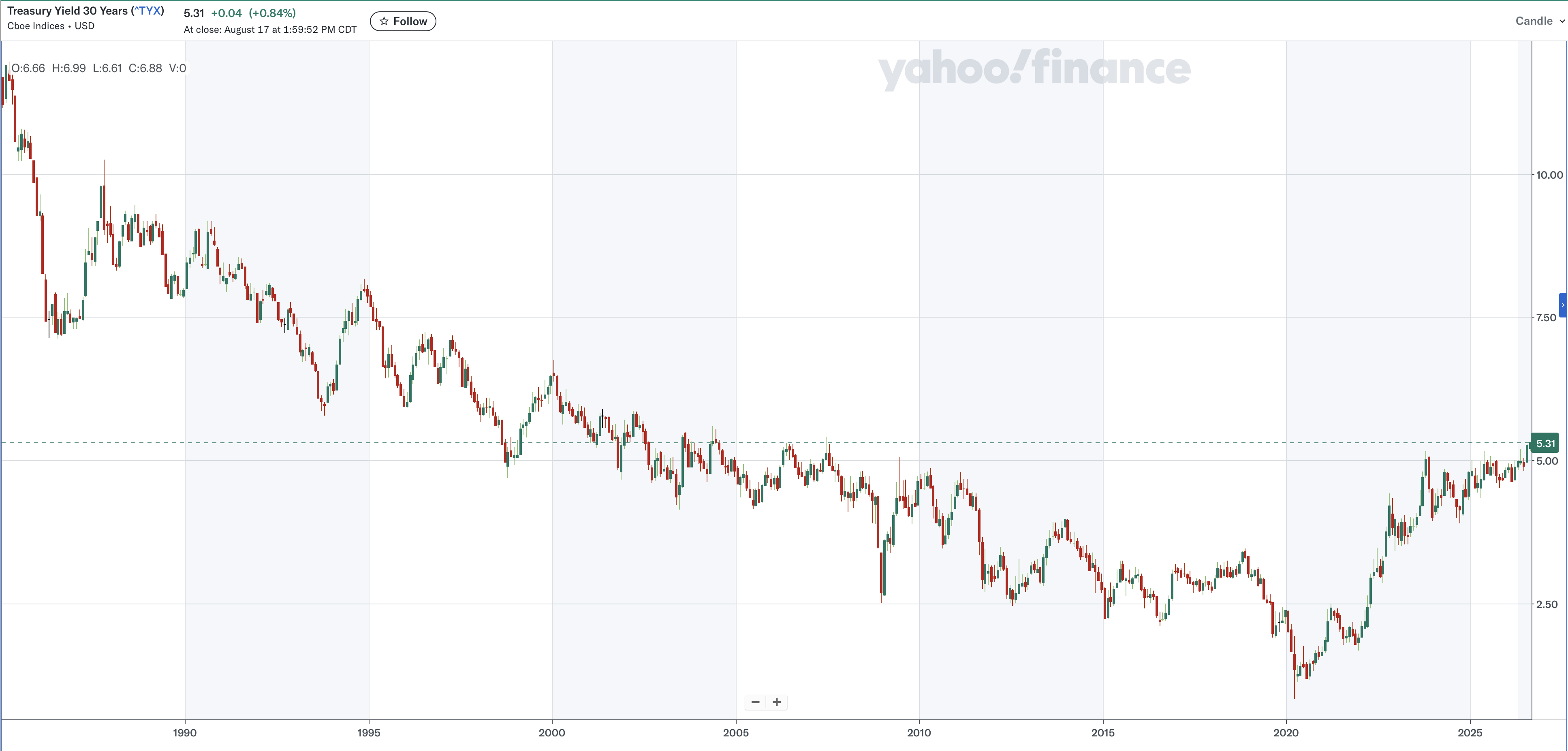
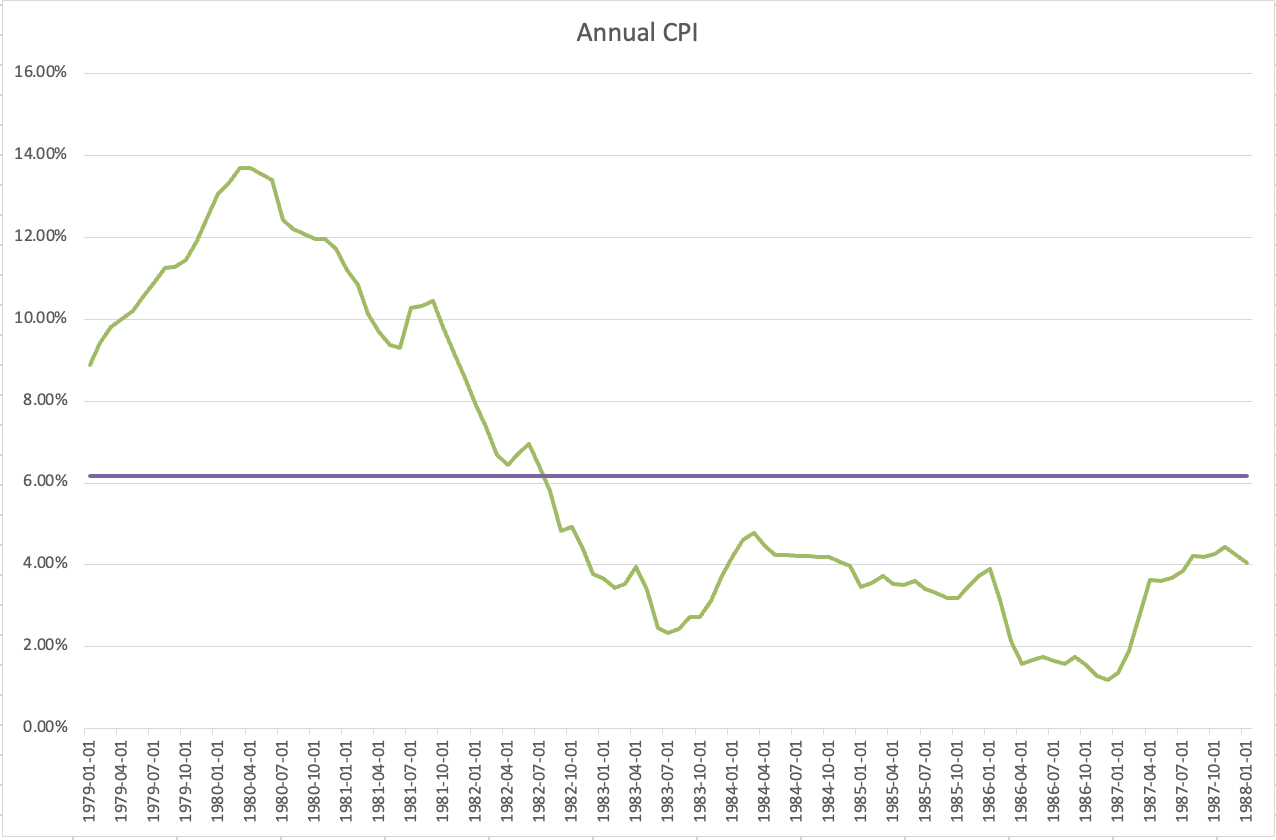
So, is this the aberration or is this the norm? I guess the answer to that question is; how do you define the norm? If you look at the very left edge of the chart above, in February 1985, the 30-year yield reached 11.9%, and in truth, was higher than that before then. This was the legacy of Paul Volcker’s attack on the rampant inflation he inherited when he sat down in the Fed Chair. While many of you will not remember, I’m sure you have all heard of his willingness to drive interest rates higher (which he did by withdrawing bank reserves from the market, not unilaterally raising interest rates like the Fed does today) until such time as inflation cracked. This resulted in the twin recessions early in the 1980’s and made life very difficult for small businesses around the country. But it was effective. As you can see in the chart below I constructed from FRED data, the average CPI during Volcker’s term was 6.17%, and although it did briefly dip below 2%, it finished right around 4%.
But what his actions did was create the prerequisite for a 40-year bond market rally, where prices rose and yields declined. That bottomed in 2020 during Covid and has since reversed course. Now, I think it is fair to say that the Covid year was an aberration as the Fed executed QE on steroids, pumping up their balance sheet by about $4 trillion. Of course, in the wake of the GFC, the Fed quadrupled their balance sheet from ~$1 trillion to ~$4 trillion prior to Covid as you can see in the below chart from FRED.

During the pre-Covid period, measured inflation never rose very high at all, in fact many Fed members, including Chairs Bernanke, Yellen and Powell, all expressed concern about “too low” inflation! The answer to this seeming conundrum was that all that money flowed into financial markets thus inflating asset prices, not consumable prices. But when the government handed out stimulus checks, three times, during Covid and the aftermath, as well as PPP loans and increased jobless benefits, the more recent $4 trillion of QE came rushing into the real economy and we experienced too much money chasing too few goods and services, which drove the dramatic rise in CPI in 2021-2022, something which we all still experience.
But the question remains, are 4% bond yields the norm? 5%? 6%? A rule of thumb from my early days in the markets, which was back in the mid 1980’s, was that the 10-year yield should approximate the nominal GDP growth rate, which given a ‘normal’ yield curve, would imply that the 30-year yield should be somewhere between 50bps and 100bps above that level. In the current ‘run it hot’ paradigm, where virtually every Western country is borrowing and spending money aggressively, and where nominal GDP just printed at 7.9% in Q2 (it was 5.8% in Q1), it is not hard to make the case that the 30-year bond yield remains ‘cheap’.
Of course, it has been a long time since that heuristic was widely known, and almost all market participants today have never lived in that world. In fact, most traders on major bank and fund desks, started their careers after the GFC so have no experience with the previous monetary regime.
Let’s cut to the chase. Is this the end of the world? Absolutely not, as I have shown, it’s not even an unusual place for yields. Are financial markets going to benefit from this? Probably not too much, at least not universally. There will be sectors that do well and others that suffer under a higher rate regime. Will the economy suffer? So far, it has shown impressive resilience, but that is a consequence of the ‘run it hot’ thesis. If that stops or even slows down if Congress reduces its spending (as if!), then I imagine we will see equity markets suffer pretty significantly alongside bonds. The current situation remains fragile, and while Chairman Warsh is trying to instill some antifragility to the market by forcing traders and investors to think for themselves, thus reducing their risk profiles, it is likely to get pretty bumpy if he succeeds.
So, how is this impacting markets around the world? Let’s take a tour. Yesterday’s modest weakness in the US was followed by a generally weak session in Asia (Tokyo -2.5%, China -0.3%, Korea -1.5%, India -0.6%, Taiwan -1.2%) with Tech obviously under pressure, although HK managed to stay unchanged and New Zealand (+1.0%) saw fit to rally on stronger commodity prices. In Europe this morning, bourses are lackluster with Germany, France and Italy all lower while Spain has edged higher and the UK is little changed after GDP data met expectations. US futures, though, are under pressure this morning led by the NASDAQ (-1.3%) at this hour (7:55).
In the bond market, yields are higher around the world with Treasuries (+2bps) performing slightly better than European sovereigns (+4bps across the board) although Gilts and JGBs are also only higher by 2bps. It does appear that bond investors are starting to get antsy about things, but history tells us things will need to get MUCH worse on the spending/deficit side before governments are forced to change their ways. Certainly, given the concerns over a Democratic sweep in Congress in November, there is no reason to believe that spending will slow.
In the commodity space, oil (+0.6%) is following on yesterday’s gains as uncertainty over the Hormuz situation and increased concern over Ukraine’s attacks on Russian oil infrastructure continue to drive fear in markets. I cannot opine on these things as despite the fact there are voluminous reports, it is nearly impossible to tell signal from noise. As to the metals markets, after a pretty solid session yesterday, they are softer this morning (au -0.5%, Ag -1.0%, Cu -1.0%) although trends continue to develop higher here.
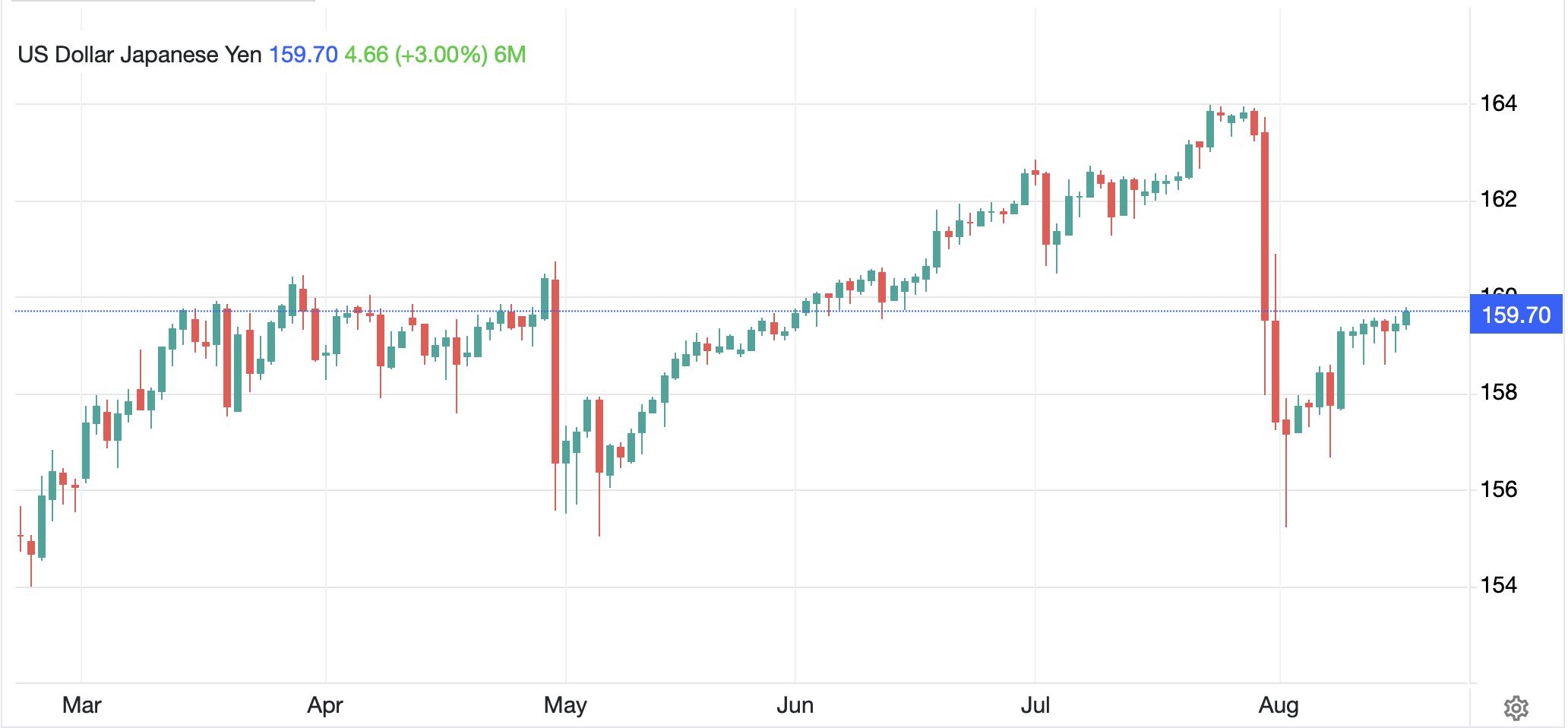
Finally, the dollar continues to be a sleeper overall, with the DXY unchanged on the day and most major currencies doing very little. One aberration is KRW (+0.4%) which has seen some significant investment inflow from real money accounts, part of the reason it has performed so well lately. But spare a moment for the yen (-0.2%) which refuses to strengthen no matter how hard Ueda, Takaichi or Bessent wish it to be so. As you can see from the chart below, the aftermath of the most recent intervention is remarkably similar to the previous bout, (and every bout before that).
Source: tradingeconomics.com
My take is we will continue to see a gradual depreciation in the yen until the BOJ acts decisively (don’t hold your breath for that) or the Fed reverses course and starts cutting. As of this morning, the probability of a September hike in the US is 34% and in Japan it is 79%. We shall see.
On the data front, we get Housing Starts (exp 1.35M), Building Permits (1.37M), IP (0.3%) and Capacity Utilization (76.3%), none of which I expect to move markets. Despite the growing concerns in the bond market, the movement has been quite contained and amid lighter than normal staffing through the summer, I still don’t anticipate a lot of movement. I still think we are waiting for Warsh next Friday before anything big happens.
Good luck
Adf

