
Said Scottie, since Congress keeps spending
And frankly, it seems never-ending
We’re going to buy
More bonds as we try
To stop yields from keeping ascending

The market response to this news
Was instant, as it did infuse
A bid to all risk
With movement quite brisk
Though skeptics claim it’s just a ruse
Boy, I leave you alone for one day and look what happens!
At 8:33 yesterday morning, the following announcement hit the US Treasury website [emphasis added]:
Treasury Announces Increased Sizes of Nominal Long-End Liquidity Support Buybacks Beginning September 9
WASHINGTON, D.C. —The U.S. Department of the Treasury is increasing, by at least double, the size of liquidity support buyback operations for longer-dated nominal coupon securities (the 10-year to 20-year sector and the 20-year to 30-year sector). The current maximum size of $2 billion per operation will be at least $4 billion per operation.
This change is effective September 9, 2026 and will be in effect for the remainder of this refunding quarter (through November 4, 2026). Treasury will provide more information about future buyback sizes at the next Quarterly Refunding, scheduled for November 4, 2026.
This increase in buyback operation sizes reflects Treasury’s desire to provide greater liquidity support in longer-dated nominal sectors where there is consistent strong sponsorship from market participants, as evidenced by the significant volume of high-quality offers Treasury routinely receives in longer-dated buyback operations.
An updated tentative Treasury buyback schedule will be released at a later date.
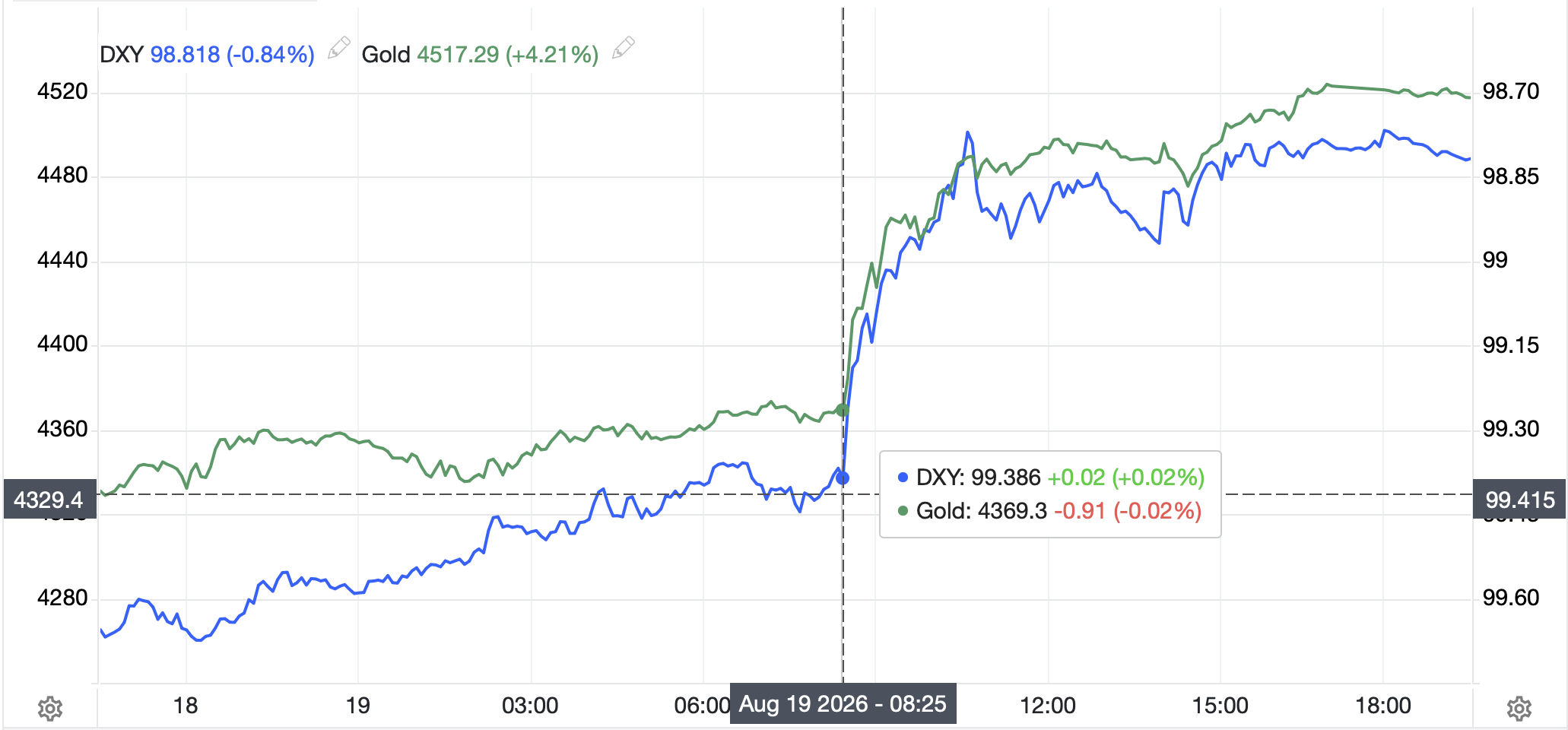
First, here is a picture of the market reaction in the DXY and gold, the two things that responded most aggressively. (I inverted the scale for the DXY, so it fell on the news.)
Source: tradingeconomics.com
And here is the bond market response with that gap occurring between 8:30 and 8:35.

Source: tradingeconomics.com
Obviously, this was a big deal, right? Well, that’s a good question and one worth discussing. As a baseline, the size of the current program that they are doubling is a maximum of $2 billion per operation, which means that the new limit is at least $4 billion per operation. Now, while an extra $2 billion of demand is nothing to sneeze at, we must consider how much of that debt is currently outstanding. According to Claude, which took the data from the Treasury website, there is about $3.7 trillion of debt that currently has between 10 and 30 years left to maturity, held by private investors. When adding the intragovernmental holdings and the Fed, that number appears to be about $5.4 trillion.
There are seven more of these operations planned before the November deadline, so they will be purchasing an additional $14 billion of notional value, probably paying about $8 billion in cash given it all has much lower coupons so trades at a steep discount to par (and funding it by issuing T-bills). And if we do the math, that means they will have absorbed (assuming the smaller outstanding of privately held debt) 0.38% of the notional.
The caveat here is the ‘at least’. Arguably they could buy any amount and stay within the confines of the announcement and that would certainly have a much larger impact. But everything I have read is focused on the extra $2 billion.
With that in mind, and while I’m just an FX poet, my long experience in markets tells me that removing 38 basis points worth of some security or asset from a market is unlikely to have a major long-term impact on the supply/demand balance given there is real elasticity here.
So, while yesterday’s moves were certainly impressive (gold +4.3%! as an example) I might contend that the movement was based on the narrative rather than the actual market impact. But the one thing we have learned of late is that the narrative matters.
Many in the market have immediately claimed that this is an act of desperation as Secretary Bessent seeks to drive longer end yields lower. Others have claimed that this is the beginning of Yield Curve Control (YCC), although the fact they are issuing more T-bills to buy the bonds makes it a lot more like Operation Twist, when the Fed did the same thing, sold the front of the curve to buy the back, thus maintaining the same size balance sheet but removing duration from the market. If this were YCC, they would need to print more money to buy those bonds, and the Treasury cannot do that, only the Fed can and they are not part of the process.
Here’s what I know, Scott Bessent is a very smart guy, and somebody who understands markets better than any Treasury Secretary since Bob Rubin and maybe better, certainly better than you or I. I also know he has been dealt a very bad hand; 2,3,5,7,8, off-suit in poker terms, so doesn’t have many good options. And I know that he has zero control over spending amounts which falls to Congress and the President, with him merely implementing the spending, not deciding how much to spend. I don’t know if this will be effective beyond yesterday’s market movement, but if he is able to get the narrative moving in the right direction, (i.e. there is a reduction in duration available to the market so prices there should rise and yields concomitantly fall), it may offer some more breathing room. The fact that he is using the tools available to manage the government’s balance sheet is a huge positive. I can only say, good luck Scott.
While there are probably other stories of some import, this was the one that got the most engagement, and I think the one with the potential longest-term impacts on things. So, let’s see how other markets responded. It was interesting to me that the equity markets did not wholly embrace this action, although there was an initial rally, much of it faded by the end of the session with very modest gains at the end of the day. Asian markets, however, fared very well with Tokyo (+1.4%), China (+0.1%), HK (+0.8%) and Korea (+5.9%!) all rallying and taking almost the entire region higher. I think it is worth showing a chart of Korea’s KOSPI to demonstrate the increase in volatility we have seen on a regular basis there since the Iran war began. Just look at the expansion of the daily ranges, especially since May, compared to the size of those bars for the prior six months. This is another indication that the way things were is no longer the way they are.

Source: finance.yahoo.com
In Europe, though, equity price action is desultory this morning, with modest declines of about -0.4% or so across all major markets with Spain (-0.1%) the outlier. As to US futures, at this hour (7:15), they are edging lower led by the NASDAQ (-0.5).
In the bond market this morning, yesterday’s euphoria is being tempered with Treasury yields backing up 3bps. European sovereigns, though, are little changed to +1bp, although they didn’t respond to the Treasury market in any real sense yesterday. That makes sense since Bessent’s announcement was highly US specific. As to JGB yields, they did slip -4bps overnight, and there are many who draw a direct link to Treasuries and USDJPY, with official efforts by the US to cap both of those things.
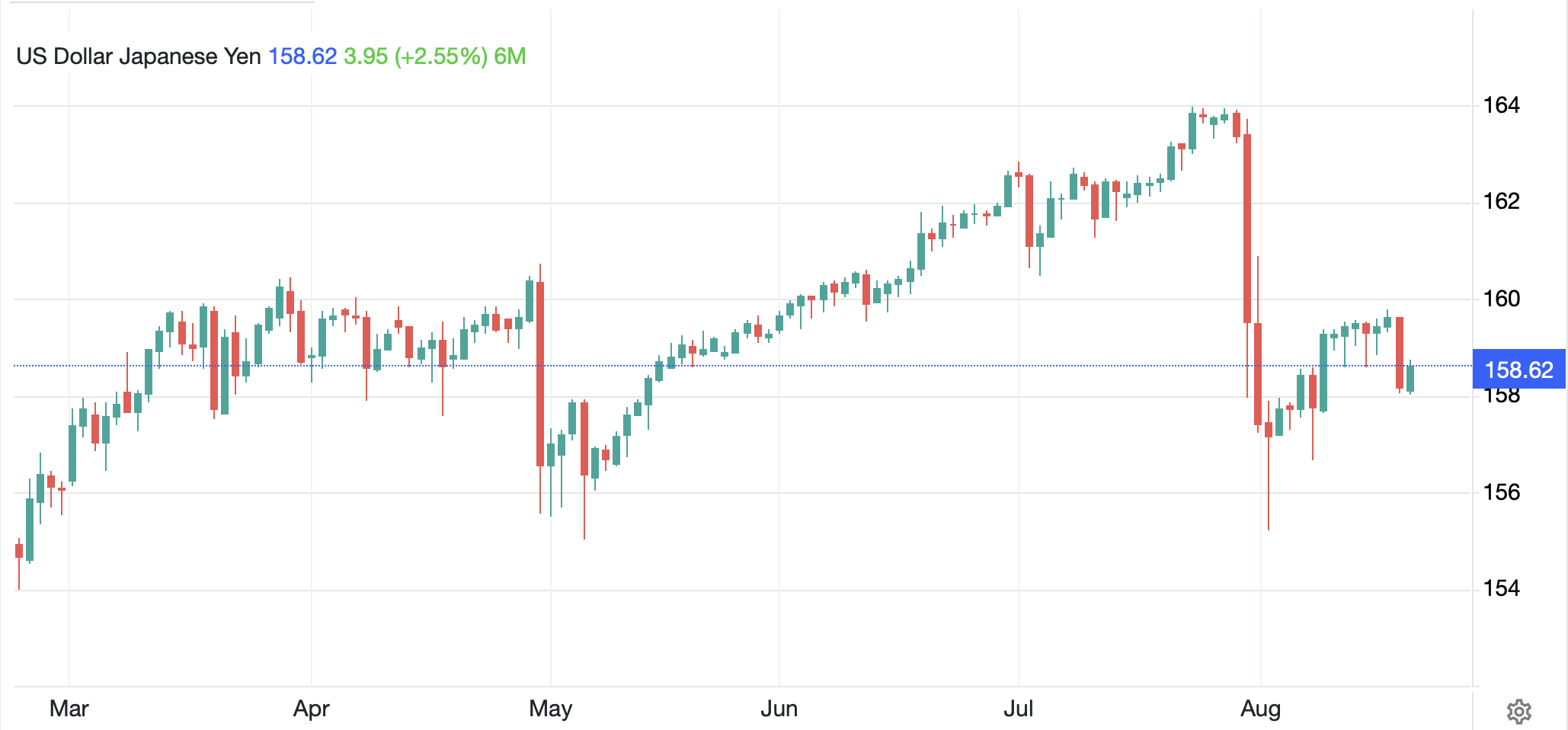
Speaking of the yen (-0.3%), it was one of the largest beneficiaries of the announcement, rallying nearly 1% as you can see in the chart below. However, this morning it is slipping a bit, and frankly, the post-intervention pattern has not been altered by yesterday’s move.
Source: tradingeconomics.com
In fact, most currencies rallied yesterday on the news but this morning, the picture is more mixed as we see both gainers (GBP +0.2%, EUR +0.15%, NOK +0.15%) and laggards (INR -0.25%, SEK -0.3%, ZAR -0.35%). In essence, while yesterday’s moves were large and broadly dollar lower, this morning there is more nuance. As it happens, the DXY (-0.1%) is edging lower today, but remains directly in the middle of that long-erm 96.50 / 100.50 range at 98.71.

Source: tradingeconomics.com
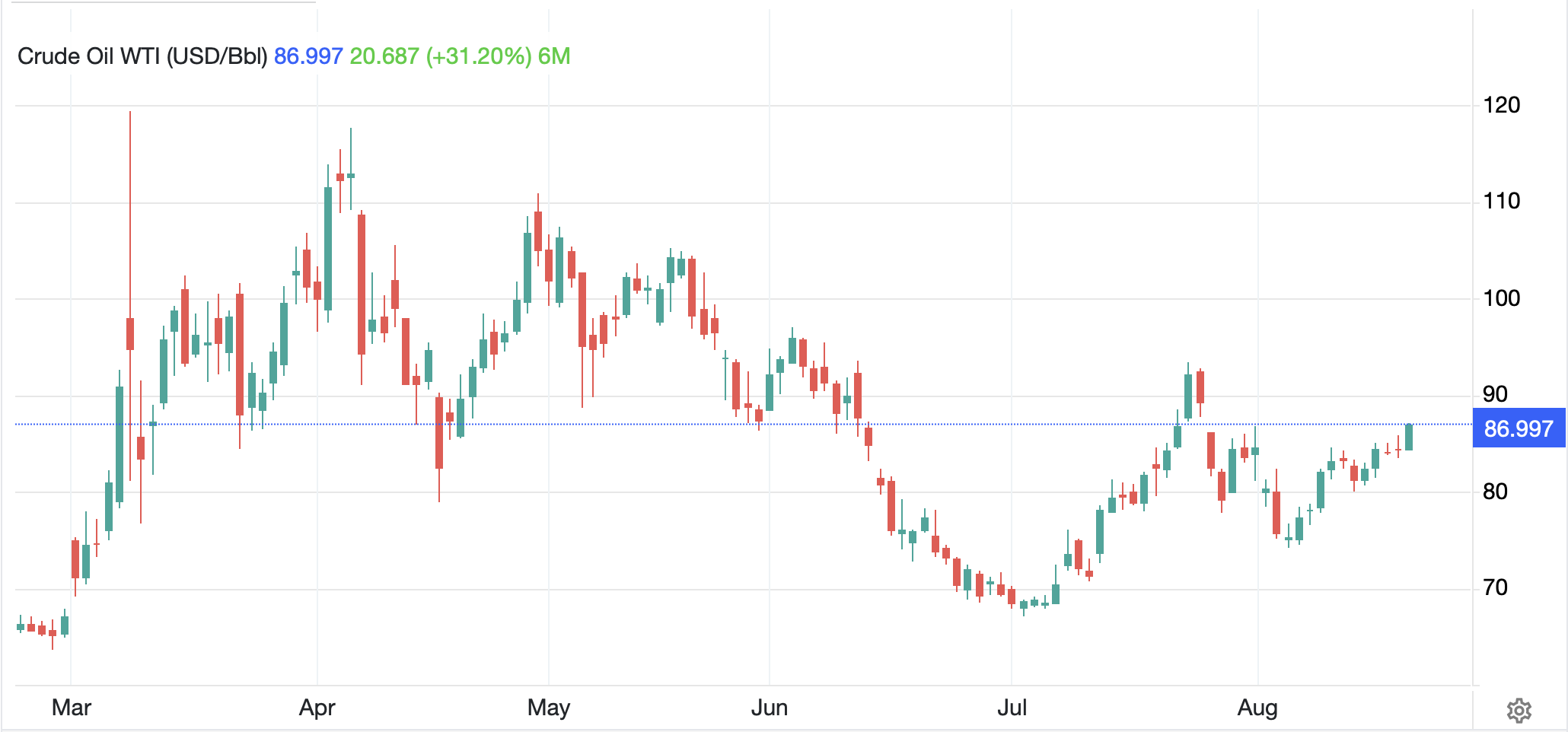
Finally, commodity prices show oil (+3.1%) continuing its recent rebound and back to its highest level in about a month. But if I look at the chart below, it remains in the middle of its much wider range as well, if anything somewhat closer to the bottom than the top. At this point, it is impossible to know what is happening in the Gulf war and frankly, I think market participants who don’t trade oil directly, have moved on to other drivers.
Source: tradingeconomics.com
As to the metals markets, after yesterday’s remarkable rallies, it ought not be that surprising that they are consolidating this morning (Au -0.7%, Ag -0.3%. Cu -1.1%). There are some analysts who believe that copper is getting set to roll over and decline in price as the narrative about shortages of supply for ever increasing data center and power production demand grow long in the tooth and may already be priced in.
On the data front, yesterday’s Minutes showed that there were non-voters who also would have been inclined to raise interest rates back in July, but we know that we have seen softer data since that meeting, so it is unclear if that is still the case. As well, EIA oil inventories rose again, >4 million barrels, so tank bottoms are still covered! This morning we get the weekly Initial (exp 210K) and Continuing (1790K) Claims as well as Philly Fed (25.0) and Leading Indicators (+0.1%). There are still no Fed speakers, and I continue to believe that Chairman Warsh’s speech next week is the most important thing on the horizon.
Until then, I imagine yesterday’s surprise announcement is the biggest news we will get for a while and that we are likely to see markets return to their somnolence. But there is a new narrative forming, the US is going to ignore inflation and push rates lower, which if it is followed implies higher commodity and equity prices and a falling dollar.
Good luck
Adf

