
The BOJ held
As widely expected, but
December looks live


“Medium- to long-term inflation expectations are at around 2 percent. Regarding the
outlook, inflation expectations are likely to remain broadly around their current level, as
firms' active wage- and price-setting behavior is expected to be maintained on the back of
factors such as the tightening of labor market conditions.”
The above is the key phrase from the BOJ last night after they left the base rate unchanged at 1.25%. The key is that they now acknowledge that their 13-year quest to overcome deflation, as part of their deal with the government at the beginning of Abenomics, has been achieved. Hooray! Prices are rising and I’m sure all the good folks in Japan are excited about that. After all, I know all my readers are always heartened when they see prices rising 🙃.
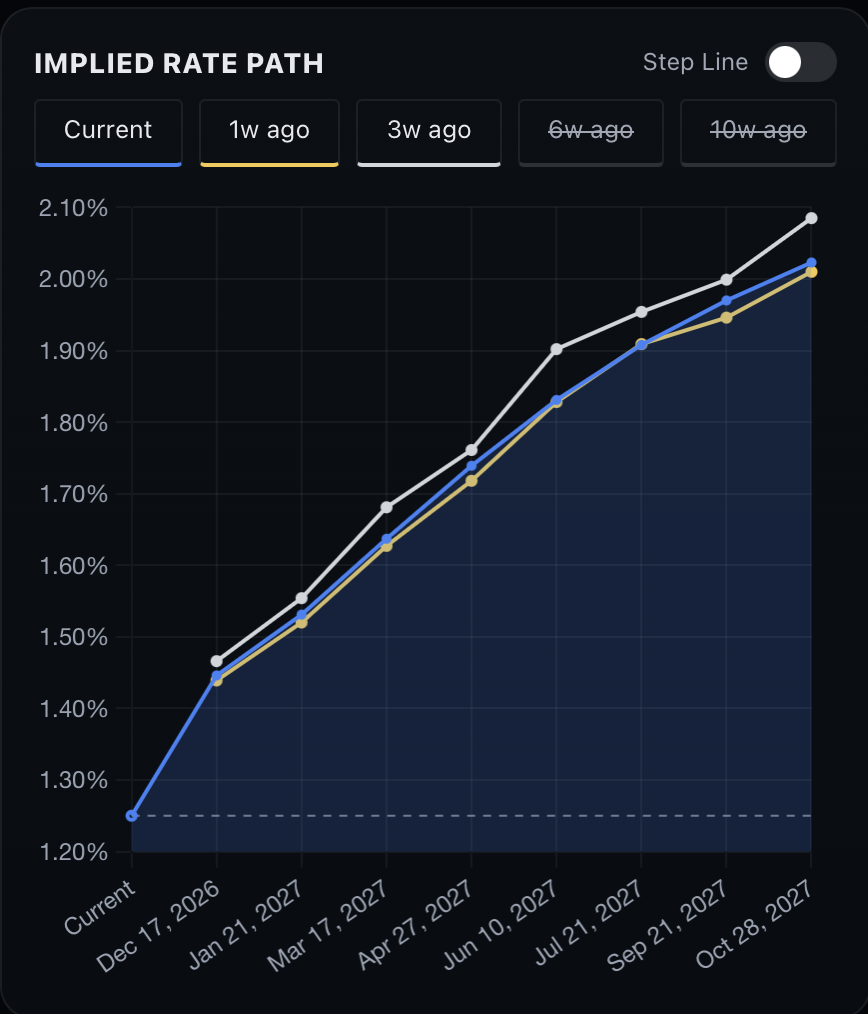
At any rate, that is seen as the signal that the BOJ will be raising rates in December and as you can see in the below chart from rateprobability.com, further hikes are expected consistently in the future as the BOJ attempts to normalize their interest rate structure, or at least have it more closely resemble the rest of the G10 world.
One of the things I have noticed lately, although I think it has been this way for a little while, is that the major central banks all meet on roughly the same schedule, with eight meetings per year, so roughly every 6 weeks. The BOE and BOJ both used to meet monthly but adjusted their schedules to align more closely with the Fed, while the ECB has always maintained that timing.
But now, the Fed is changing things by removing one rate setting meeting in 2027 and two in 2028. So, to me the question going forward is, will the other major central banks adjust their schedules as well? I have long been a proponent of less is more when it comes to central bankers speaking and meeting, but there was a great deal of demand for more ‘transparency’ after Paul Volcker basically ignored Congress completely. Alan Greenspan went out of his way to obfuscate everything he said with this quote perhaps his most famous line, “I know you believe you understand what you think I said, but I am not sure you realize that what you heard is not what I meant.”
Of course, it was Ben Bernanke who really opened the kimono by having press conferences after initiating QE and changing the Fed’s process from one of scarce reserves to abundant reserves, and that is where all the problems accelerated. But I digress.
One other thing that I continue to see highlighted by many pundits as a negative, which I personally believe is a positive, is that Chairman Warsh’s attempts to end forward guidance has already, and will going forward, result in more market volatility across all markets.
To me, and I imagine Chairman Warsh, that is a feature, not a bug of this process. The great economist Hyman Minsky is the one who observed that stability leads to instability, i.e. when things are quiet for a long time, market volatility declines and position sizes increase, generally with leverage. Then, when something changes, those much larger positions must be unwound quickly and significant market downturns can, and do, occur. One need only remember back to Covid and the market volatility there as the most recent major occurrence. When central banks offer guidance like rates are likely to stay low for a long time into the future, traders assume that they can lever up positions and generate significant profits easily. Ask Silicon Valley Bank how that worked out.
When viewing the US and France
I don’t think it’s really by chance
The US is growing
While France keeps on slowing
As though business there’s in a trance
This takes us to the other story of note, the dramatic difference between US and European economic activity. I’m picking on France because they reported this morning, and as the second largest economy in the Eurozone are, I believe, representative of the situation there. If you look at the table below from tradingeconomics.com of relative GDP growth rates, you can see the dramatic difference between the US and Europe these days.
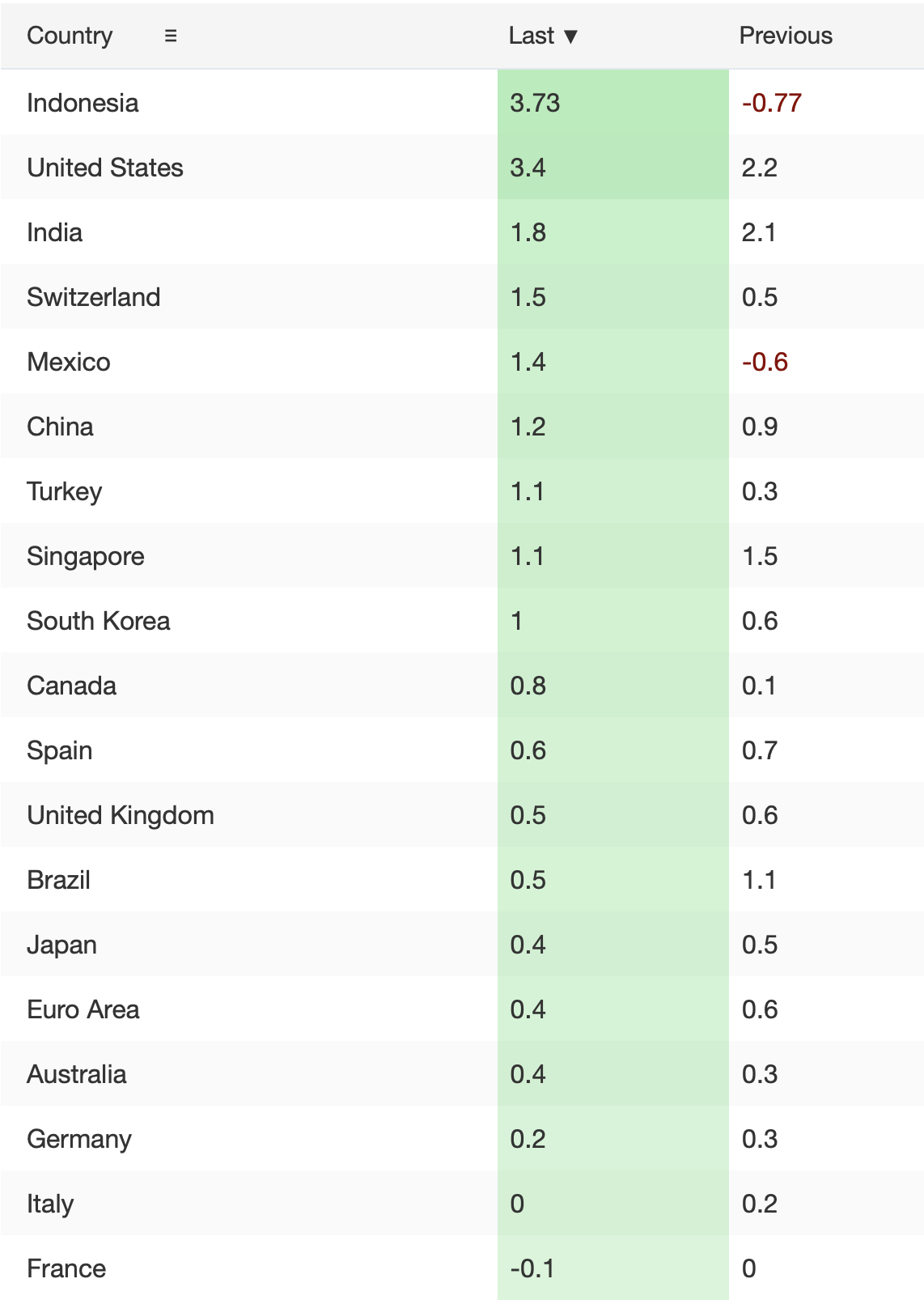
While on any given day, markets will behave as they do based on both recent news and positioning and rumor, the longer-term trends tend to hold up with bigger picture items, and this is a bigger picture item. Economic activity in the US has been significantly greater than anywhere in Europe, and most of the world, as the US policy of ‘run it hot’ continues to show what it can do. Investment into the US continues apace and as someone noted regarding the recent trade data, only 17% of the deficit was due to consumer goods, the rest was capital goods being imported to help expand production in the US. That speaks well of future economic activity here.
Also, quickly touching on yesterday’s US GDP number, which was a better than expected 3.4%, the corresponding PCE data from that report was just 2.1%, meaning nominal GDP was 5.5% with the exact split that the administration would like to see. Here is further proof that strong growth does not necessarily lead to inflation.
Ok, let’s turn to markets now. It wasn’t very pretty in the US yesterday, especially the tech sector and US futures are continuing down that path (NASDAQ -2.4%, SPX -1.1%) at this hour (7:00) after more earnings misses last night from Amazon and Intel as the AI boom / semiconductor boom / tech bubble narrative has run into a few bumps. So, Tokyo (-2.1%), China (-1.4%), Korea (-3.5%) and Taiwan (-2.5%) were all under great pressure to end the week. Weirdly, HK (+1.5%) went the other way although that was by overcoming tech concerns. Elsewhere in Asia, there were more laggards than winners, which given the overall sentiment is not that surprising.
European shares are mixed today with Spain (-0.6%) and Germany (-0.6%) both under pressure while France (+0.1%) and the UK (+0.2%) are both edging higher. Given France’s disappointing GDP results, this is a bit surprising, but remember, Europe’s almost complete lack of tech companies means when tech crashes, Europe is fine.
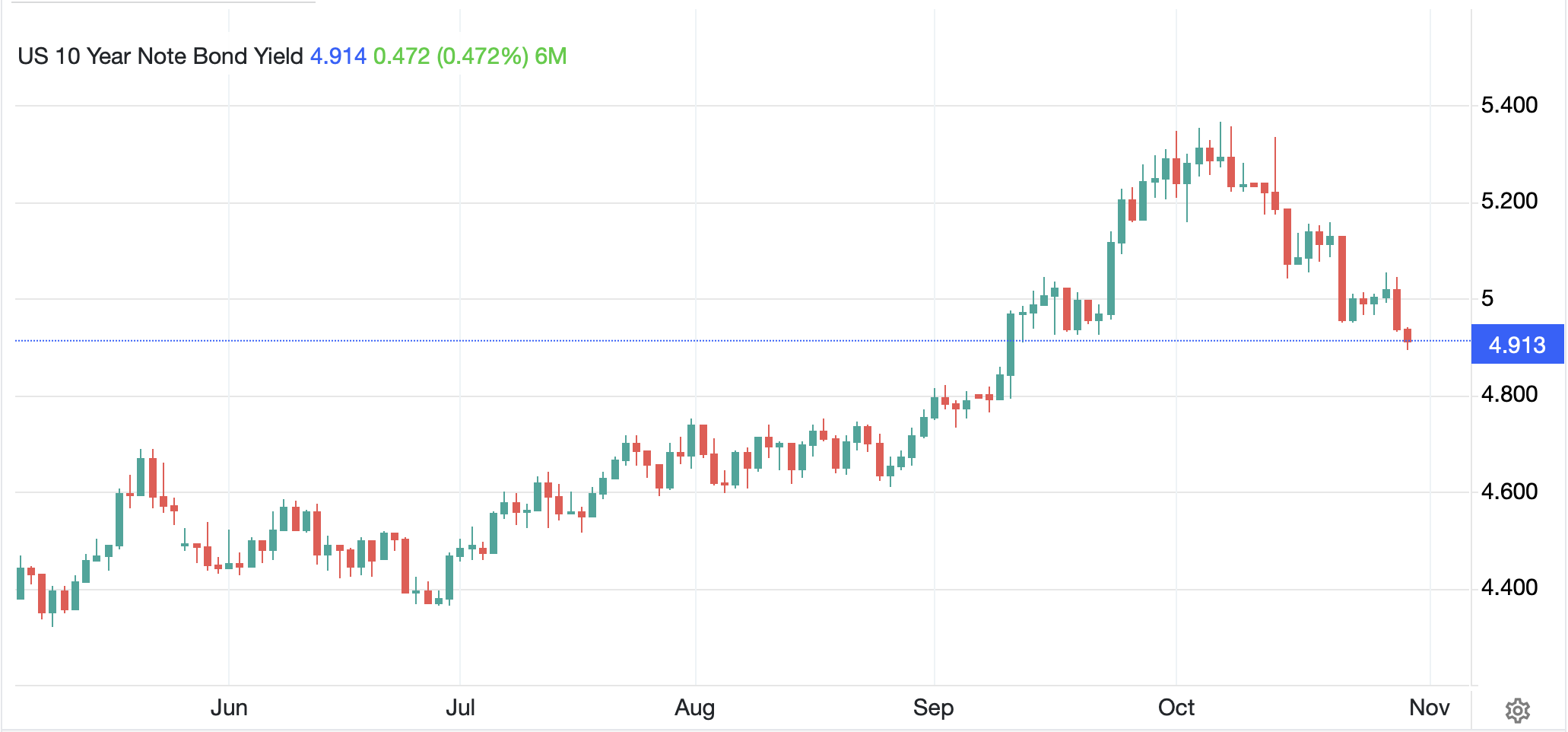
In the bond markets, yesterday saw US yields fall sharply, ~10bps in the 10-year and similar elsewhere, and they are continuing to slide this morning, down another -2bps. As you can see from the chart below, we are back to levels not seen since mid-September.
Source: tradingeconomics.com
I suppose part of this is a haven trade as equity markets have been under pressure around the world, and I find that quite interesting. For instance, I have been assured by the Twitterati that US bond yields are going to 6% or higher as the dollar loses its reserve status because of the US spending problems. And yet, many still see Treasuries as a haven. Go figure. I must admit that if I look into my personal crystal ball, which is both cracked and cloudy, I anticipate that both growth and inflation in the US are going to be around 3% going forward, but that implies real yields would slip to 1.9%, not terribly high and probably in line with the long-term average. In that situation, I expect bonds will find plenty of investors.
European sovereign yields slipped yesterday as well, although not like Treasuries and they, too, are lower by between -1bp and -2bps this morning.
In the commodity markets, oil (+2.1%) is rallying again and at $104/bbl, is back to levels last seen in mid-September. Concerns over a resumption of US military activity in Iran after the election next week are the proximate cause but I must admit, I don’t really understand all the talk and threats by the president on this subject. It is here I would take the Teddy Roosevelt thesis of speak softly and carry a big stick to extremes. But the negative correlation between oil and metals is back this morning with a real attack on silver (-3.3%) while both gold and copper are lower by -1.25% or so.
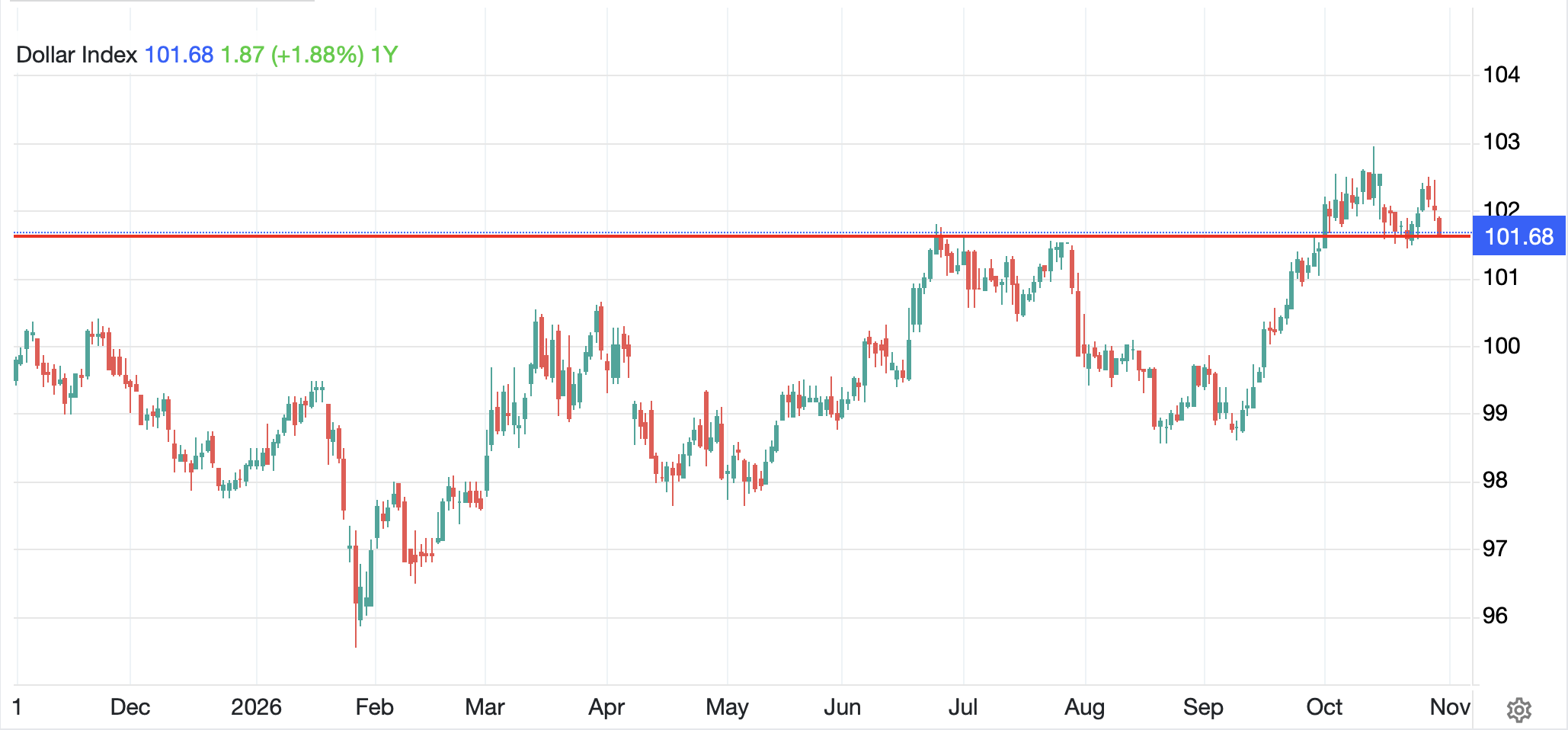
Finally, the dollar is a touch softer this morning, not behaving in a haven manner, although that may be a result of the sharp decline in yields yesterday. But through all this, for those who look at the DXY, it is slightly softer today (-0.35%) but still sitting right at its breakout level from the beginning of the month. Since February, as you can see in the chart below, it has been broadly trending higher, but the overall movement this year, about 6%, is hardly dramatic.
Source: tradingeconomics.com
As I have written lately, I think the FX markets are decoupling from the broader macro theses for the time being.
The only data point today is the Employment Cost index (exp +0.8%) and we hear from three Fed speakers, Daly, Barkin and Musalem, a dove, a moderate and a hawk respectively. The market is pricing only a 70% probability of a hike in December, and now only one more hike after that sometime next year. That’s a pretty big change from views just a few weeks ago when multiple hikes in 2027 were assumed.
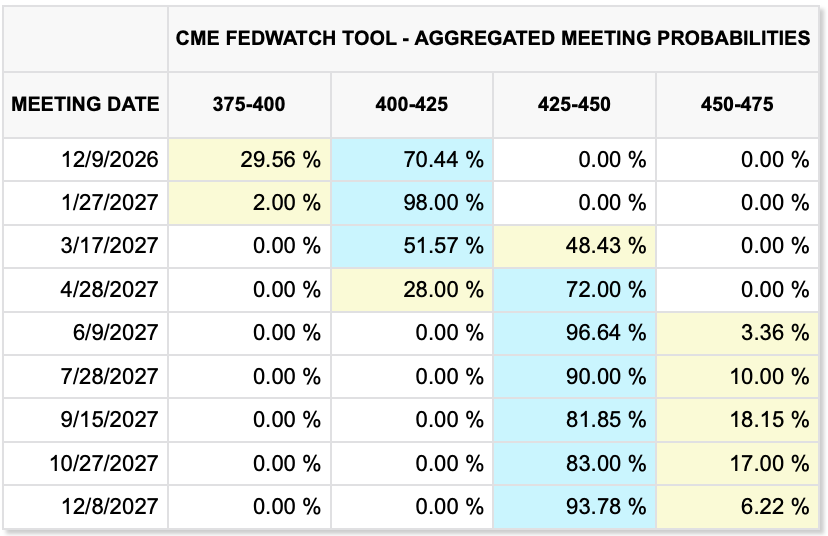
Source: cmegroup.com
In fact, unless we see dramatically strong inflation data ahead of the next meeting, one more PCE and two CPI reports, I would not be surprised for the Fed to stay on hold then as well.
Heading into the weekend, while tech is under pressure, the election continues to hang over the market and will do so until we find out next Tuesday night how things go. Again, close to the vest and hedged are my preferred positions.
Good luck and good weekend
Adf

