The Fed’s Tug-of-War

Each month there’s a Payrolls report
That pundits and traders exhort
To rise or to fall
Subject to their call
And whether they’re long or they’re short
 
But this month, there seems to be more
At stake, for the Fed’s tug-of-war
If joblessness rises
Each pundit advises
That rate cuts, this summer, we’ll score


Here we are on the first Friday of the month and, as almost always, markets remain quiet ahead of the release of the monthly Payroll report.  For good order’s sake, here are the current median expectations:

Nonfarm Payrolls185K
Private Payrolls170K
Manufacturing Payrolls5K
Unemployment Rate3.9%
Average Hourly Earnings0.3% (3.9% Y/Y)
Average Weekly Hours34.3
Participation Rate62.7%
Source: tradingeconomics.com

Recall, on Wednesday, the ADP Employment number was a bit softer at 152K while the ISM Employment sub-indices showed conflicting data between Manufacturing (much stronger at 51.1) and Services (weaker at 47.1).  Ironically, the headline ISM data was the other way around, with Manufacturing weaker and Services stronger than expected.  One other data point of note was the JOLTS Job Openings which shrunk about 300K to 8.059M, still high relative to the number of unemployed people, but with the ratio falling to 1.24 jobs/unemployed person.  That ratio is down from nearly 2:1 shortly after the pandemic, but up from about 1:1 pre-pandemic.

As with so much of the other data that we have seen over the past months, there is no clear direction here. Economy bulls can make the case that job growth remains solid and that there is no indication that a recession is on the way.  While the no-landing thesis has lost adherents, there are still many soft-landing adherents to be found.  At the same time, the economic bears have plenty of data to claim that a recession is around the corner, if we are not already in one.  I saw an analysis by Mike Shedlock (@MishGEA), a well-respected economist, that claims the NFP data has overstated job growth by 3.4 million jobs as per the following Tweet:
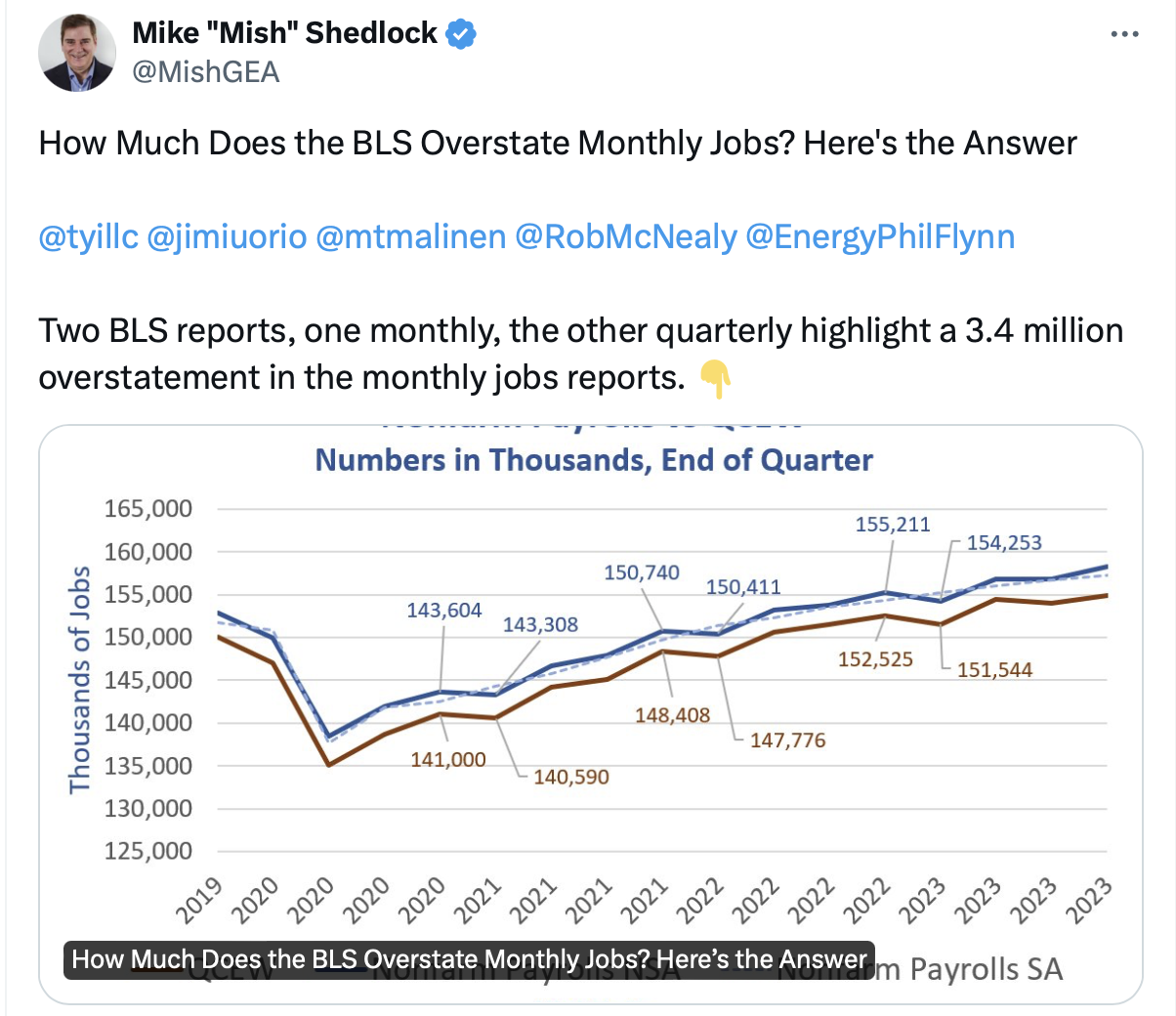
Since the beginning of 2023, looking at BLS data, the initial NFP report has been revised down in twelve of the fourteen months where there has been a third revision, by a total of 496K.  I created a chart to show the consistency of those revisions to help you get a better idea of the issue.

Source: data BLS, graph @fx_poet

Something that has always been true with respect to economic data, and NFP is no different than any other piece of information, is that the revisions tell an important story.  When initial data gets revised lower on a consistent basis, it has been indicative of a slowing economy.  Remember that when the NBER declares a recession, it is always a backward-looking effort, it is never in real-time.  But revisions are a key part of that process.  As well, given the fudge factors built into the BLS model, notably the birth/death factor for new businesses, history has shown that particular piece of the puzzle is always a lagging indicator as during a recession, more companies fail than are created, and that needs to be addressed via the revisions.

In the end, the issue is no matter the actual data point this morning, it will almost certainly be revised substantially before the end of the summer and could well tell a very different tale.  But today’s task is to understand what tale it is going to tell right now.

To that end, the narrative, the best that I can tell, is that we are seeing a gradual reduction in economic activity, but nothing dramatic.  Recession is still a remote concern, perhaps for 2025 or 2026, but the slowdown in activity will open the door for the Fed to start to ease policy going forward.  While the futures market is virtually certain that there will be no Fed action next week, the probability of a July cut has risen to 22.5% from less than 16% a week ago.  Several big banks are calling for a July cut, including JPM and Goldman Sachs, and there is a group of analysts who maintain that the underlying data that has been released indicates we are already in recession, and that rate cuts are coming very soon.

Here’s the thing, this focus on the Fed cutting rates remains, IMHO, a bad indicator of future risk asset strength.  Rather, as I showed earlier this week, when the Fed is cutting rates, it is usually because the economy is already in a recession and earnings are declining rapidly.  So, while the first cut may be sweet, the second should be a serious warning of what is coming down the pike.  I have already made my bed regarding my view that the top is in, but a softish number this morning, especially if the Unemployment Rate were to rise to 4.0% or 4.1%, would certainly increase the July cut probabilities, and almost certainly be followed by an equity market rally.  However, I would call that the last leg of the move.  As to my opinion of what today’s number will be, my sense, looking through my lens of further economic weakness (although still sticky inflation) is that it will be on the soft side, but not dramatically so.  Maybe 130K-150K.

Ok, ahead of the data, a quick tour of the markets shows that stocks in Asia were mixed with Japan edging lower, China and Hong Kong seeing declines of about -0.5%, but South Korea (+1.2%) and India (+2.1%) having strong sessions.  The same cannot be said for Europe, where every major index is lower by between -0.5% (Spain) and -1.0% (France) as German IP (-0.1%) continues to lag and the French Trade Balance (-€7.6B) fell into a deeper deficit than forecast.  Not surprisingly, US futures are essentially unchanged ahead of the NFP.

In the bond market, yields are edging up from their recent lows with Treasuries up 1bp and European sovereign yields higher by between 3bps and 5bps despite yesterday’s rate cut from the ECB.  Or perhaps because of it as remarkably, the ECB raised its own inflation forecasts and then cut rates.  The political imperative to cut interest rates is clearly growing quite strongly.

In the commodity markets, while oil (+0.7%) continues to rebound from its recent lows as OPEC+ worked to clarify their statements about future production, the big move today is in metals where gold (-1.8%) is selling off sharply after the news that the PBOC did not buy any additional metal during the month of May.  As they have been one of the key supporters of the barbarous relic, their absence really was a surprise.  Most pundits believe they are simply taking a break for now given the sharp rise in the price of the metal, but that they will return.  However, the other metals have all sold off alongside gold, with silver (-3.0%) and copper (-2.25%) giving back a good portion of their gains from the past two sessions.

Finally, the dollar is basically unchanged ahead of the NFP data with none of the G10 currencies moving more than 0.1%.  In the EMG bloc, though, ZAR (+0.9%) is the outlier, as despite the weakness in the gold price, the political situation seems to be getting better with a coalition government looking to be formed shortly.

In addition to the payroll data, we see Consumer Credit (exp $11B) this afternoon, and confusingly, despite the Fed being in its quiet period, Governor Lisa Cook is on the calendar to speak at noon today.  I would guess this will not be a discussion on monetary policy, but you never know.

At this point, it’s all about the data.  A hot number should see yields rise, stocks fall and the dollar bounce.  A cool number the opposite as more and more people anticipate that first rate cut.  Buckle up!

Good luck and good weekend

Adf

In Vogue

The cutting of rates is in vogue
And Madame Lagarde won’t go rogue
She’ll cut twenty-five
And keep hopes alive
That with Chair Jay, she did collogue
 
The stock market clearly believes
That soon they’ll be getting reprieves
In higher for longer
So, markets are stronger
As everyone, rate cuts, conceives


First it was Switzerland in March with a surprise 25bp rate cut.  Then Sweden cut 25bps in early May, although that was more widely touted ahead of the move.  Yesterday, the Bank of Canada joined the fray with a 25bp cut with Governor Tiff Macklem explaining that they are “not close to the limits” of the difference between US and Canadian interest rates and that with both inflation and growth receding, “markets have a very good idea of what’s on our minds” with respect to the value of CAD.  I think the last comment was an indication that they are comfortable if CAD were to weaken further, although after a very short-term dip of about -0.5% yesterday in the wake of the announcement, it is right back to where it was before and unchanged this morning.

With this as background, we turn now to the ECB which has virtually promised us a 25bp rate cut this morning and will almost certainly deliver it.  While many will remember that just last week, Eurozone CPI was released at a higher than expected 2.6% with core CPI also rising, up to 2.8%, at least those numbers have the same big figure as the ECB’s target.  But, as per the CPI chart below from tradingeconomics.com, it is not hard to make the case that the decline in inflation has bottomed above their target.

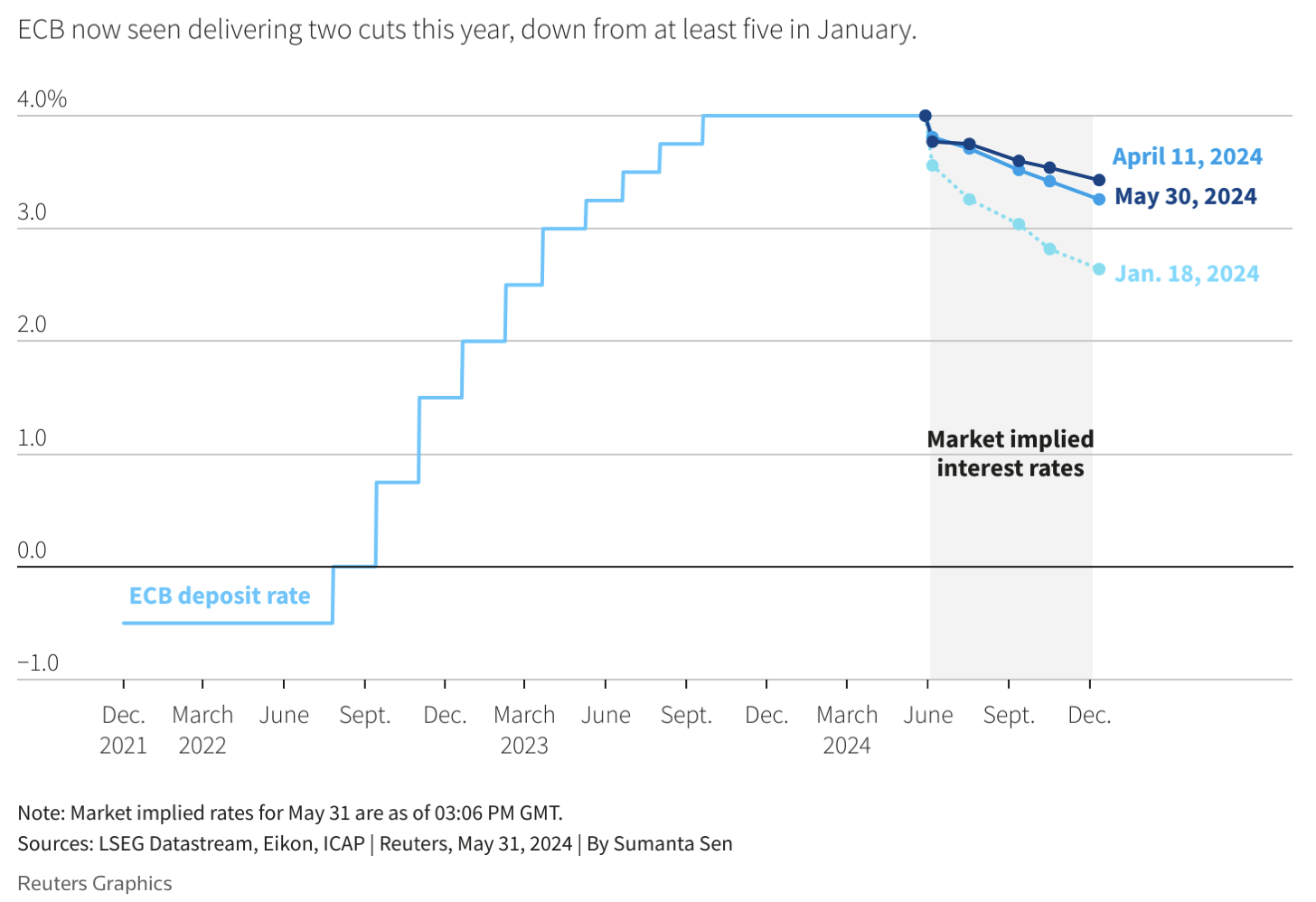
That could be awkward for their future actions but is also very likely why virtually every ECB speaker has been adamant that a July cut is not a given and they will continue to be data dependent.  Many analysts believe that there will be a total of three cuts this year, June, September and December, as the ECB will roll out their latest forecasts at those meetings, but beyond June, it is a bit less certain.  Market pricing shows that there are about 60bps total priced in at this stage, including today’s cut, as per the chart below.

Source: Reuters.com

Perhaps the most important question is, why do we care?  Well, certainly in the FX markets, given the importance of interest rate differentials, the relative speed of policy rate changes by the ECB and the FOMC can have an impact on the EURUSD exchange rate.  However, absent a surprise, something most central bankers try strenuously to avoid, the movement has already occurred ahead of the announcement.  Arguably, the more important part of this whole charade is the signal it gives for official views of future economic activity.  

When central banks are cutting interest rates, there is obviously concern that prospects for future economic activity to support the government in power are dimmer than they had been previously, hence the need to act.  As such, the very fact that a rate cutting cycle has begun in so many nations is indicative of the fact that expectations for future economic growth are diminishing.  It remains very difficult for me to understand that concept and expect that equity prices should rally substantially on the news.  But clearly, I am very old-fashioned in my thinking as evidenced by the fact that yet again, the S&P 500 and NASDAQ 100 have made new all-time highs on the strength of Nvidia’s non-stop rally.  While the Dow and NASDAQ Composite are still lagging, as are small cap stocks, euphoria remains the theme. (PS, my dour view from last Friday has been damaged, but I remain quite concerned with long-term prospects.)

However, this is where we are today.  The ECB will soon be the fourth major central bank to cut their policy rate and the pressure on the Fed to begin their cutting cycle will increase further.  Alas for the Fed, they continue to receive mixed signals from the data and rate cuts are not necessarily the proper prescription for what ails the US economy.  Just yesterday we received two contradictory signals with the ADP Employment report showing a weaker than expected 152K jobs created after a downwardly revised April number.  A few hours later, the ISM Services indicator was released at a much stronger than expected 53.8 reading, its highest since last August, and certainly not indicating that growth is ebbing.  As well, the Prices Paid subindex was a still hot 58.1, again not screaming out for a rate cut.

As of now, the market is pricing in virtually a zero probability of any rate move next week, but there has been a pickup in chatter about a cut at the July meeting with the probability of a cut then rising to 18.5% as of this morning, according to the Fed funds futures market.  If the Fed were to cut later this summer, nothing has changed my view that it will result in a significant decline in the dollar, and a significant rally in commodities. And, while the first move in both stocks and bonds might be higher, the specter of rising inflation will ultimately squash those moves.  But that is not today’s story, rather it is a story for the future.

Today, after those record highs in the US, we saw strength throughout most of Asia although Mainland Chinese shares did not participate in the fun.  That said, the gains were modest, between 0.25% and 0.5% overall.  In Europe this morning, the screens are all green with gains ranging from 0.3% in the UK to 0.7% in Germany as investors seem to believe in the goldilocks scenario there.  As to the US, futures at this hour (7:00) are unchanged as investors await tomorrow’s NFP data.

In the bond markets, after further declines yesterday, with 10-year Treasury yields touching their lowest level (4.27%) since the end of March, yields have bounced slightly this morning, higher by 2bps.  We are seeing similar price action throughout Europe, yield rallies of 2bps, except for the UK, which has seen a further 2bp decline despite the only data point, Construction PMI, rising the most in 2 years.  One last thing is that JGB yields, the ones that were supposed to be breaking out and running much higher now that the BOJ is leaving them alone, fell 5bps and are at 0.96%, below the 1.00% dotted line in the sand.

Commodity prices are rising this morning, continuing to rebound from the sharp declines earlier in the week, as oil (+0.6%) and NatGas (+0.4%) show there is still demand for energy regardless of the economic situation.  In the metals space, all the big four precious and industrial metals are higher this morning as it appears more and more like the weakness at the beginning of the week was a trading event, not a fundamental one.

Finally, the dollar is little changed overall this morning with the biggest mover being PLN (-0.3%), an indication that there is nothing ongoing.  While some currencies have managed small gains vs. the dollar and others have lagged, my sense is everyone is awaiting tomorrow’s NFP before deciding the next move, given the certitude of the ECB move later today.

We do, however, get some data this morning as follows: Initial Claims (exp 220K), Continuing Claims (1790K), Trade Balance (-$76.1B), Nonfarm Productivity (0.1%), and Unit Labor Costs (4.9%).  While we already know that the growth in the Trade Balance has been the key driver in the decline in the GDPNow figures (net exports are a subtraction from the calculation), I think the Fed may be more focused on the productivity numbers which are hardly inspiring and when combined with rising Labor Costs imply that inflation will have a tough time declining further.

So, the ECB will act first thing and then Madame Lagarde will very likely tell us that they remain data dependent, so nothing is promised for July or anytime the rest of the year.  As to today’s US data, I don’t believe it will be market moving.  This means that the equity bulls will continue to make their case and will need to be strongly disabused of the notion that the world is a great place right now.  When that time comes, beware, but it doesn’t seem likely today.

Good luck

Adf

Change at the Top

Democracy lives and it dies
By voting for folks who devise
The laws to define
What’s right, or a crime
And this year, there’s much to surmise
 
Some sixty-four nations will vote
And watch as incumbents scapegoat
Political foes
For national woes
And claim they’re the best antidote
 
However, results that we’ve seen
Show that many nations are keen
For change at the top
Or leastwise, to swap
The current regimes’ philistines


So, I know I am not a political analyst, but I try to be a keen observer of trends around the world.  After all, to understand the macroeconomic situation globally, one needs to at least be aware of the politics in the major nations.  As such, I am going to attempt to analyze the elections we have seen around the world to date and see if we can use this trend to look ahead and forecast how things may turn out here in the US come November.

As of today, 35 nations have held elections for either Parliament (Congress), president, or both ranging from St. Maarten to India and many in between with respect to populations.  Arguably the most important have been India, Mexico, South Africa, Taiwan, Russia, Indonesia and Iran.  That list is based on both population and geopolitical importance.  

A look at the results shows the following:

  • India – PM Modi lost significant support and will now be ruling in a coalition, rather than his previous majority.  This was a far cry from the anticipated super-majority he sought.
  • Mexico – AMLO’s hand-picked successor, Claudia Sheinbaum won handily and the Morena party won a supermajority in the lower house, but not in the Senate, so there are great expectations for significant changes unchecked by congress there.
  • South Africa – President Ramaphosa and the African National Congress (ANC) the party that has ruled this nation by itself since the end of apartheid in 1994, lost their absolute majority and is casting about for a coalition partner to allow them to remain in power.
  • Taiwan – New President Lai Ching-te, an avowed separatist relative to China won, but the people did not give him the parliamentary majority to enable significant policy changes
  • Russia – was this really an election?
  • Indonesia – New President Prabowo, a former soldier and defense minister is tipped to be far more aggressive in his handling of dissent and criticism, a concern for some, but clearly given the size of his majority (>58%) something the people are ready for.
  • Iran – This is difficult to assess as the parliamentary elections have been overshadowed by the recent accidental death of the president in a helicopter crash, with a presidential election slated for June 28th.

As well, starting tomorrow, there will be voting for the European Parliament by all twenty-seven member nations.  This is a three-day process so we should know the results by next week.

In the meantime, let me offer my take on the results in a broad-brush manner.  People around the world are unhappy with their leadership and are seeking change.  More importantly, current incumbents are really annoyed by the fact that their populations are not happy.  It has been quite a long time since there have been so many efforts by governments to control all dialog and censor anything that offers an opposing view to government rules, laws and commands.

For instance, in India, despite being very popular, Modi must now account for the fact that he has lost majority support.  He has done much good for the nation, but clearly, there is a large segment of the population that does not feel they are benefitting and were looking for change.

In South Africa, it was a little different as the economic situation there is a wreck.  Inflation is rising (5.3% and climbing), Unemployment is rampant (32.9%) and confidence readings are negative while GDP stagnates. Even though the ANC has ruled for 30 years, people want change, especially since there have been numerous allegations of corruption at the top, and the country continuously has blackouts because of failures with energy policy.

In Taiwan, while former president Tsai Ing-wen was widely admired and had high favorability ratings, there is a clear concern over too much saber rattling with the mainland.  Arguably, China spent a lot of money to interfere in that election but was unsuccessful in getting their candidate elected.  However, the population there does not want war, and that seems to be the driving force.

My point is that even popular leaders have found that their popularity is not necessarily translating into power.  It is not hard to understand why this is the case given that inflation has been a global phenomenon, and the list of military conflicts has grown and forced many nations to choose sides rather than simply do what’s seen as best for themselves.

I know I ignored Mexico here, the exception that proves the rule, although perhaps the people felt that AMLO didn’t go far enough and given the huge rise in crime from the cartels there, people were looking for a stronger government to act, hence the supermajority.

What does this mean for Europe this weekend and the US later in the year?  I have been quite clear in my views that this is a change election year.  The current left leaning coalition in the European parliament is in danger of losing its ability to enact any legislation.  We have seen these changes in the Netherlands and Sweden, and Germany’s AfD party continues to gain adherents alongside the National Front in France and Italy’s European Conservative party.  Germany has three landes (state) elections in September, all in the former East Germany, where AfD is strongest.  While every other party has indicated they will not enter a coalition with AfD, I predict that in at least one of these states, AfD will win outright, and that will really shake things up.  As to the European parliament, the voting bloc on the right may be large enough to prevent almost all new legislation.  

Meanwhile, turning back home, the US election season is heating up and here, too, I would argue the population is very unhappy.  This is evident by the dreadful polling numbers of President Joe Biden, and perhaps even more significantly, by the growth in the number of Trump converts from previously solid democratic voters (watch this 2 minute video and ask yourself if Joe Biden is in trouble or not).  The efforts to utilize the DOJ to prevent Trump from contesting the election is not going over well across the nation, and I believe it will be seen as the biggest own goal in this process.

While I believe that Mr Trump WILL BE PUT IN JAIL because the Democratic party is desperate to do anything to tarnish him, it will not matter.  In fact, it will martyr him even further.  Remember, Nelson Mandela was jailed before being elected president, Vaclav Havel of the Czech Republic was imprisoned before being elected president, Lech Walesa of Poland was imprisoned before being elected president, Lula da Silva of Brazil was imprisoned before being elected president, Mohandas Gandhi was imprisoned for sedition, and yet still became leader of India.  History shows that the people of a nation can see through the political efforts of an incumbent party in their effort to remain in power, and when they demand change, they will get it.

With this in mind, my views on the economic situation remain that inflation continues to be a major impediment for every government worldwide, but if recent data is truly an indication of slowing economic activity, the outcome could well be easier monetary policy, but still weak growth, rising inflation, a falling dollar and rising commodities.  

Politics clearly matters, but it is a longer-term issue.  For now, all the efforts by governments and central banks to apply band-aids for the current ailments seem unlikely to be effective in the timeline required to alter the current broad-based unhappiness amongst the electorate.  Change is coming, and there will be hell to pay on the other side as all these short-term fixes will simply leave the long-term problems in worse shape.

One poet’s views, and I welcome any commentary and pushback.

Thanks

Adf

Fervor and Joy

The talk of the Street is the Fed,
While quiet this week, will soon shed
The higher for longer
Idea, with words stronger
That cuts are directly ahead
 
So, bonds are the new favorite toy
Of every hedge fund girl and boy
Since growth is now slowing
Investors are going
To buy bonds with fervor and joy


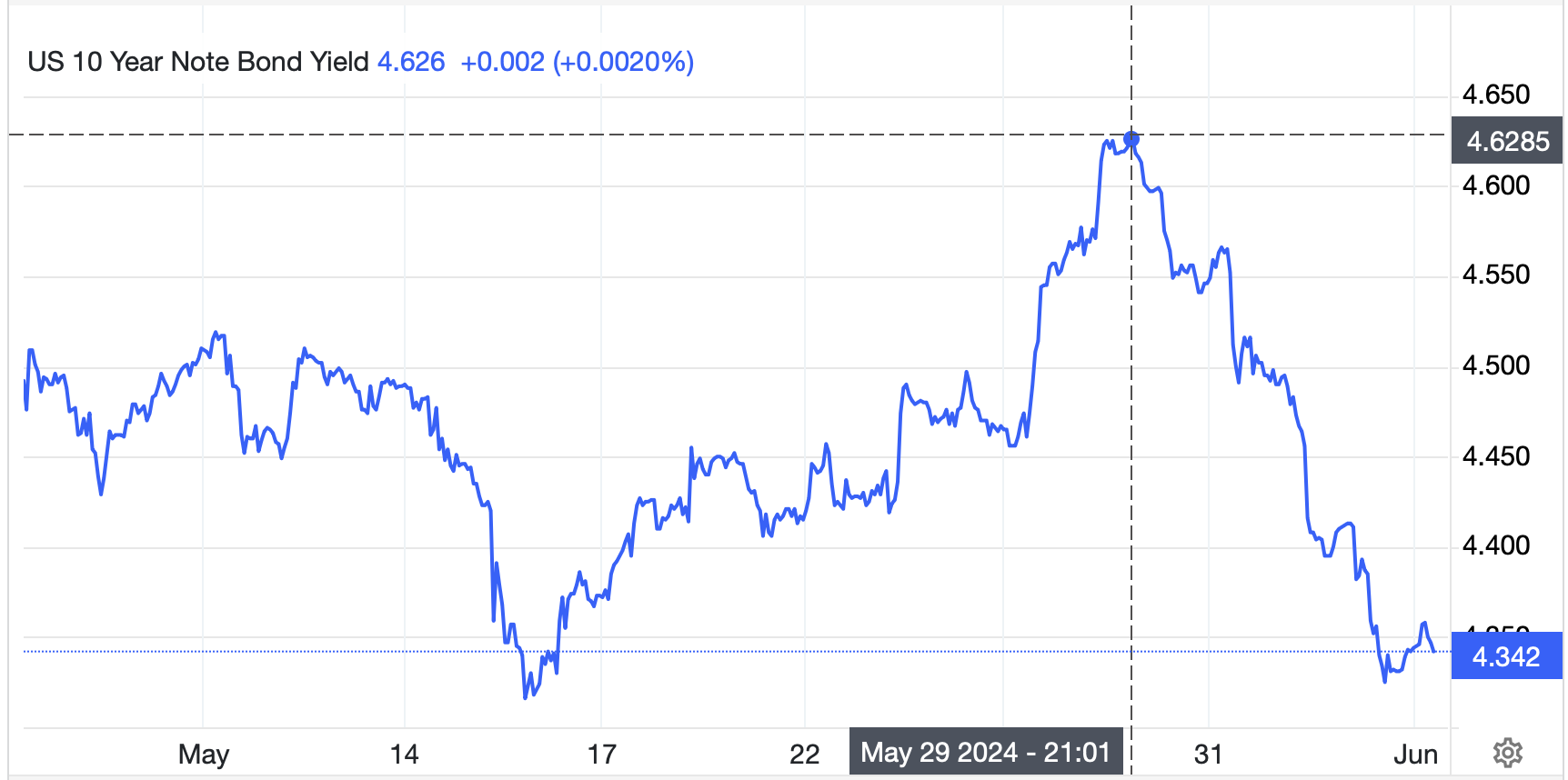
The amazing thing about markets is just how quickly they can shift their focus and reverse course if they find the right catalyst. Consider that just one week ago, 10-year Treasury yields were trading at 4.63%, having risen nearly 30 basis points in the prior two weeks on the strength of hawkish commentary from FOMC speakers, a much more hawkish than expected FOMC Minutes release, and economic data that indicated economic growth was still solid.

Source: tradingeconomics.com

And yet, in the past seven days, that entire move has been reversed and now the commentary is pointing to weakening economic activity, declining inflation, a looser jobs market and the inevitability of the Fed cutting rates before the election!  So, what happened?

Well, first, a little perspective is in order.  While a 30 basis point move in 10-year yields is a nice sized move, it is hardly unprecedented.  Consider that if we look at a chart of yields over just the past year, rather than the past month as above, the most recent dip does not stand out as particularly impressive.

Source: tradingeconomics.com

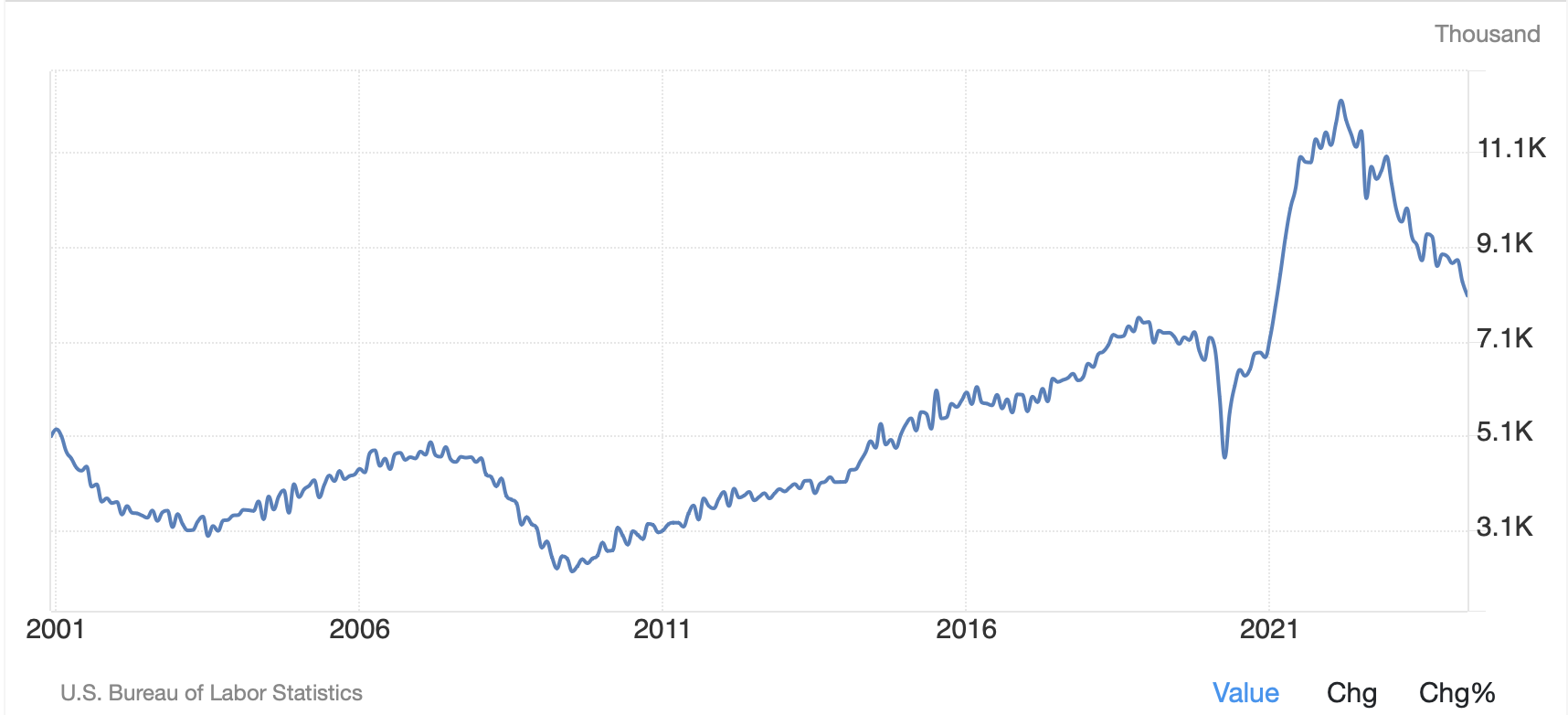
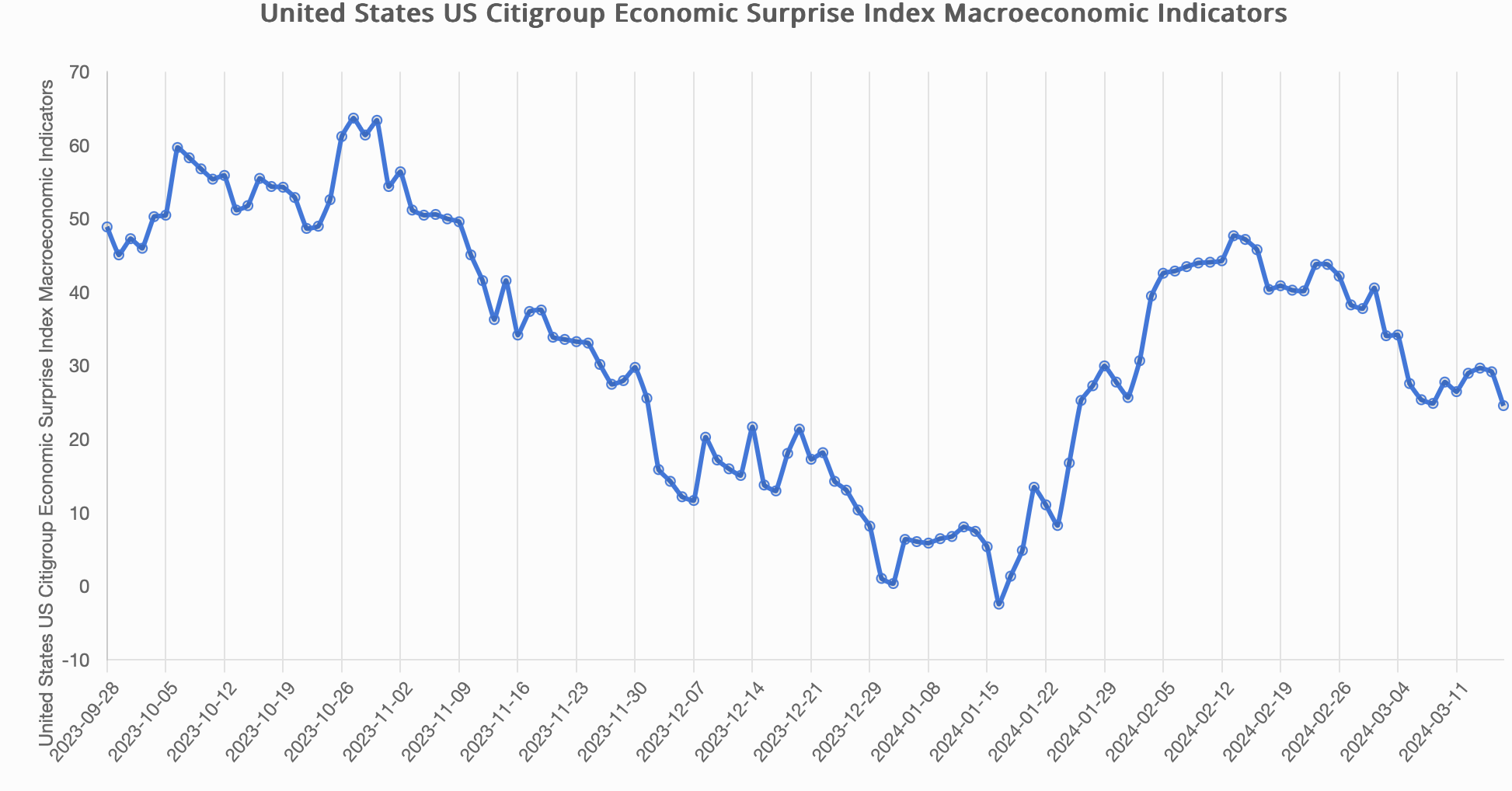
But second, the economic data in the US is starting to align more clearly in a negative fashion.  Yesterday I showed the Citi Surprise economic indicator index, which demonstrated that data is failing to keep up with forecasts.  Then yesterday, the JOLTS Job Openings data was released at a much diminished 8.059M, more than 300K jobs less than both anticipated and than last month.  In fact, despite this data point really looking backward (yesterday’s print was for April data), the recent trend, as seen below is very clearly lower.  

Source: tradingeconomics.com

This is an indication that the jobs market is much looser than the Fed had been worried about with regards to inflation, but of course is a problem for their maximum employment mandate.  In any event, the weaker data continues to pile up and the natural response of investors is to start to price in a more traditional weak growth scenario.  This includes declining bond yields on the assumption the Fed is going to ease policy, declining commodity prices on lessening demand, and a declining dollar on the back of those lower interest rates.  And that is exactly what we have seen.  

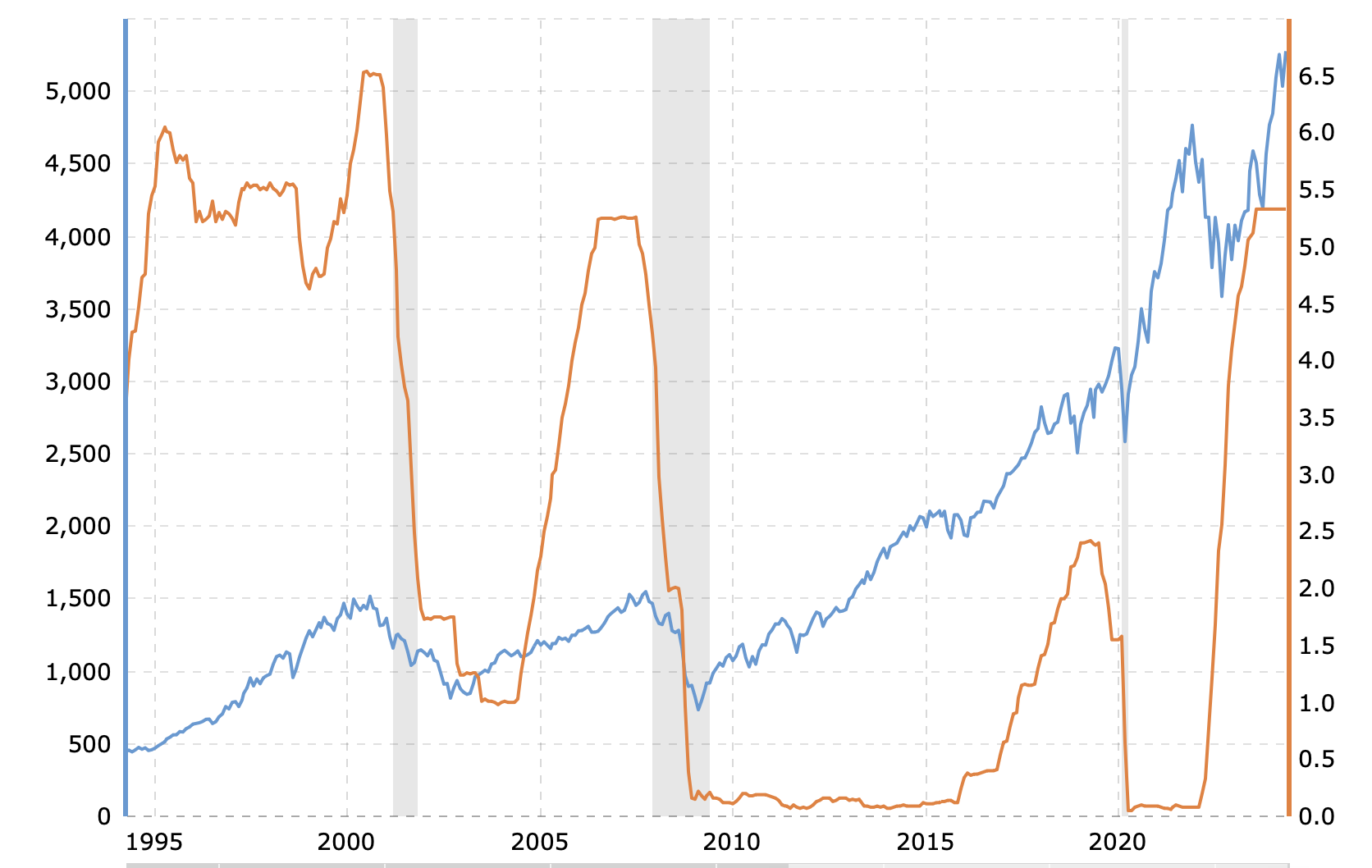
You will notice I left out the equity response to these events as I would contend it is far less clear.  Initially, I expect that equity investors will be excited by the prospects of rate cuts, and we could see stocks rally, but if growth is really slowing, then that is going to negatively impact earnings which should undermine equity prices.  Historically, when the Fed is cutting rates, it is in response to a slowing economy and equity prices have not fared well in this scenario.  You can see in the chart below, that the Fed tends to cut rates (orange line) during recessions (grey areas), and those declines are coincident with equity market (S&P 500 – blue line) declines.

Source: macrotrends.net

So, has the economy turned down for real now?  I would contend there are more indicators that are widely followed which indicate that is the case.  Several months ago, one really needed to dig into the secondary parts of major releases to conclude things were rolling over.  Today, it seems a bit clearer.  But remember, too, Treasury Secretary Yellen has > $700 billion in the TGA to spend leading up to the election in an effort to prevent that outcome, and you can be certain she will do all in her power to do so.  Will it be enough?  I guess we will find out.  

One last thought, though, is that my take is the current sticky inflation may well remain sticky despite an economic slowdown.  Remember, there is a humongous amount of money around, and the response of every government will be to print even more if things slow, so the idea of stagflation remains very real and cannot be dismissed at this time.

Ok, let’s look at the overnight session to see how things have fared.  After yesterday’s late equity rally resulted in very minor gains in the US, Asia had a mixed session with both Japan (-0.9%) and China (-0.6%) lower, although there were gains throughout the region led by India (+3.6%) rebounding from the initial election news there.  PM Modi will continue ruling, but in a coalition, so with much reduced power.  But Korea, Australia and Taiwan all performed well.  In Europe this morning, equity markets are having a good day with gains on the continent around 0.9% across the board although UK stocks are only higher by a bit (0.3%).  PMI Services data was released, and it was generally a touch better than forecasts (France excepted) but certainly not significant enough to change the view that the ECB is going to cut rates tomorrow.  Meanwhile, US futures are picking up at this hour (8:00), rising 0.3% across the board.

We discussed bonds earlier but not the fact that Treasury yields fell 7bps yesterday after the softer data, dragging European yields down as well.  This morning, Treasuries are another 1bp softer with Europe sliding by between 1bp and 4bps.  Overnight, yields also fell, with JGB’s down 2bps and now right back at 1.00%, while other bonds in Asia saw yields fall more sharply.  It seems pretty clear that the market is starting to price in a global slowdown in the economy.

In the commodity sector, after a week of routs, things have settled this morning with oil (+0.5%) bouncing slightly, although still lower by -7% in the past week.  Gold (+0.25%) too, is a bit firmer, although that was not the metal that fell most sharply.  Both silver and copper are unchanged this morning as the bullish long-term story mongers (present company included) are all licking their wounds, but absent more weak data, there is no incentive to sell things aggressively here right now.  However, if the data keeps softening, so will these prices.

Finally, the dollar, which had fallen earlier in the week, has edged up a touch this morning.  JPY (-0.6%) is giving back some of its recent haven inspired gains, and we have also seen both MXN (+0.9%) and INR (+0.25%) recoup a small amount of their election related losses.  ZAR (-1.0%), however, is still under pressure as the weakened state of the government combined with the weakness in metals prices is clearly a major weight on the rand.  All eyes today will be on CAD (unchanged) as the BOC meets and will be announcing their rate decision at 10:30. There is a 60% probability of a rate cut priced into the market, as recent data softness is getting traders excited that Governor Macklem will ignore his recent comments about needing “months of data” to confirm the situation.  After all, inflation up there is within the BOC’s range, and I suspect a cut is coming.

On the data front, ADP Employment was just released at a slightly softer than forecast 152K (exp 170K) and then we see ISM Services (50.8) at 10:00am.  As of yet, there has been no real response to the ADP data.  At this point, the narrative is swinging quickly to the idea that softer economic activity will lead the Fed to cut sooner than previously expected.  The Fed funds futures market has moved the probability of the September cut up to nearly two-thirds.  For now, that is going to drive things, and as such, I believe the dollar will remain under pressure overall.  Absent a very strong NFP report Friday, perhaps we have seen some near-term tops in yields and the dollar.

Good luck

Adf

Not Well Understood

The ISM data was weak
And traders, more bonds, did soon seek
The oil price fell
The dollar, as well
But stocks ended close to their peak
 
So, is now bad news really good?
‘Cause Jay will cut rates, or he should
Or is it the case
That growth’s slowing pace
Means risk is not well understood


The narrative had a little hiccup yesterday as the ISM data was released far weaker than expected.  The headline number, 48.7, fell vs. last month and was a full point below market expectations.  The real problem was that while the Employment sub-index was solid, New Orders tanked, and Prices remained high.  If you add this to the Chicago PMI data from Friday, which at 35.4, was the lowest print since the pandemic in May 2020 and back at levels seen in the recessions of 2001 and 2008, it is fair to question just how strong the US economy is right now.

Adding to this gloom is the news that the Atlanta Fed’s GDPNow estimate slipped to 1.8% for Q2, down from 2.7% last Friday, and the trend, as per the below chart, is not very pretty.

Given the data, it can be no surprise that the Treasury market rallied sharply, with yields declining 8 basis points on the session, although they are little changed this morning.  After all, if the economy is slowing, the theory is that inflationary pressures will decline, and the Fed will be able to cut rates sooner rather than later.   And maybe that is true.  But when we last heard from the FOMC membership, most were pretty convinced they needed to see more proof that inflation was actually lower, rather than simply that slowing growth should help their cause.  And I might argue that a weak ISM print, especially with the prices portion remaining high, is hardly the proof they require.

But yesterday’s markets were a bit confusing overall.  While the initial response to the weak data led to immediate selling across all equity markets, by the end of the day, those losses were reversed such that the NASDAQ had a fine day, rising 0.5%.  Ask yourself the question, why would stocks rebound despite further evidence that the economy is slowing down.  The obvious answer is that a slower economy will lead to slowing inflation and allow the Fed to reduce interest rates before long.  Of course, the flip side of that story is that a slower economy implies companies will lose pricing power as demand slides, thus reducing available profit margins and overall profits.  It seems hard to believe that stock prices will rally amid declining earnings, although these days, anything is possible.

While the Fed’s quiet period has many advantages (in truth I wish the entire time between meetings was the quiet period) one of its key attributes is that the narrative can run wild in whatever direction it likes.  As we will be receiving quite a bit of data this week, I suspect the narrative will have a few more twists and turns yet to come, although there is no question that the bulls remain in control of the conversation.  

One other thing to keep in mind about that ISM data is that while the US data was weak, the PMI data elsewhere in the world indicated that the worst had been seen elsewhere.  While it is not full speed ahead yet in Europe or the UK or China, the trend is far better than in the US.  Remember, a key part of the narrative is that the US is the ‘cleanest shirt in the dirty laundry’ and so funds continue to flow into US equities and the dollar by extension supporting both.  But what if other nations are starting to see an uptick in their growth stories while the US is starting to slide a bit?  Perhaps the non-stop bullishness for the NASDAQ will find a limit after all.  Perhaps another way to consider this is to look at the Citi Economic Surprise Index, which is designed to compare actual data releases with the forecasts before the release.  As such, a high number shows better than expected data and vice versa.  As you can see from the below chart, the trend here is lower.

Source: macrovar.com

One interesting aspect of this chart is that you can see during Q1, when the equity markets rallied and bullishness was rife, this index was rallying as well.  But remember what we learned last week regarding Q1’s GDP, it was revised lower to just 1.3% annualized.  So, if better than expected data still led to weak growth, what will declining data do?  

In the end, at least in my view, the economy is struggling overall, although not collapsing.  If I am correct, then it leads to several potential, if not likely, outcomes.  While the Fed has continuously claimed they remain focused on inflation, if growth starts to decline more sharply, and unemployment starts to rise more rapidly, they will cut rates regardless of CPI or PCE, and they may well end QT if not start QE again.  The clear loser here will be the dollar.  Equity markets are likely to initially react to the rate cuts and rise, but if earnings suffer, I think that will reverse.  Bond markets, too, will rally initially, but if inflation rebounds, which seems highly likely if the Fed eases policy, I don’t think the long end of the yield curve will be very happy, and we could easily see 5.0% or higher in 10-year yields.  Finally, commodities will see a lot of love and rally across the board.

Ok, let’s look at what happened overnight, as other markets responded to the surprisingly weak US data.  Asia wound up mixed, similar to the US indices, as Japan (-0.25%) slipped while China (+0.75%) rallied along with Hong Kong (+0.25%).  But the big mover overnight was India (-5.75
%) which fell sharply as the election results there indicated that PM Narendra Modi, while winning a third term, saw a decline in his support that left him somewhat weakened.  The rupee (-0.5%) also slipped, although nothing like what we saw yesterday in Mexico.  As to the rest of the region, we saw winners (Indonesia, Malaysia) and laggards (Taiwan, Korea, Australia) so no real trend.  In Europe, this morning, there is a trend, and it is all red, with losses ranging from -0.4% in the UK to -1.1% in Spain.  The only data here was employment in both Spain and Germany, and while both numbers were a touch soft, neither seemed dramatic.  And, as I type (8:00), US futures are all lower by -0.3%.

In the bond markets, yesterday’s Treasury rally was mimicked by European sovereigns, with yields there falling as well, albeit not quite as much as in the US.  This morning, the European market is extremely quiet, with yields +/-1bp from yesterday’s closes.  However, overnight, we did see Asian government bond yields fall, with JGB’s -3bps and greater declines elsewhere in the space.

Oil prices (-1.85%) are under severe pressure this morning, following on yesterday’s $3/bbl decline, falling another $1.50/bbl.  It seems the combination of the weak ISM data and the OPEC+ discussion of an eventual return of more production to market next year was enough to convince a lot of long positioning to throw in the towel.  As is its wont, the oil market can move very sharply and overshoot in either direction.  It feels to me this could be one of those cases.  But commodity prices are getting killed everywhere this morning as although metals held up well yesterday, this morning we are seeing blood in the water.  Both precious (Au -0.9%, AG -3.4% and back below $30/oz) and industrial (Cu -2.3%, Al -0.5%) are falling as slowing growth and the belief that it will reduce inflationary pressures is today’s story.

Finally, the dollar, which sold off sharply yesterday in the wake of the ISM data, is bouncing a bit this morning, at least against most of its counterparts.  While most of the G10 is softer, led by NOK (-1.2%), the outlier is JPY (+0.85%) which is suddenly behaving like a safe haven amid troubled times.  I think that the increased uncertainty amid Japanese investors as to the state of the global economy may have them bringing home their funds, especially now that 10yr JGB yields are above 1.0% with no hedging costs.  As to the EMG bloc, MXN (-1.7%) remains under severe pressure but today they are not alone with all EEMEA currencies and other LATAM currencies declining as well.

The two data points this morning are the JOLTS Jobs Openings (exp 8.34M) and Factory Orders (0.6%), both released at 10:00.  Obviously, there is no Fedspeak, so I expect that equities will be the driver, and if fear starts to grow, we could get an old-fashioned risk off day with stocks falling, bonds rallying and the dollar gaining as well.

Good luck

Adf

A Modest Decrease

On Friday, the latest release
For some, showed a modest decrease
In pace of inflation
Although observation
By others was not of that piece


As an indication of just how confusing everything is in the macroeconomic world, and how earnestly different pundits try to make their individual cases, the following two headlines were in the same email roundup of market and economic articles that I receive daily.

The Fed’s Favored Inflation Gauge Reinforces The Disinflationary Trend

Federal Reserve Watch: Inflation Not Dropping

Parsing a specific data point that is subject to so much revision is always a fraught activity, and this time is no different.  Did the PCE data Friday indicate the inflation trend is starting to head back down or not?  Beats me. Below are the forecasts and actual results as released Friday morning by the Bureau of Economic Analysis (BEA).  While the M/M Core PCE print was a tick lower than the consensus forecast, everything else was right there.  If anything, the fact that Personal Spending fell ought to be a bigger concern.

Source: tradingeconomics.com

So, ask yourself this question, based on the information above, is the disinflationary trend being reinforced?  Or is inflation still sticky and rising?  Personally, I don’t think we have enough information to have changed our views from whatever they were ahead of the release, but that’s just me.  If nothing else, perhaps this will help you understand just how little anybody really knows about the situation.  One other seeming anomaly is that the M/M Core PCE number was lower than expected, yet the Y/Y number was right on target.  Whatever your null hypothesis, it doesn’t seem as though there is enough new information in this report to reject it.  Of course, that didn’t stop the punditry!

In Mexico, voters have spoken
And Claudia Sheinbaum’s awoken
This morning as prez
From Roo to Juarez
Alas, now the peso’s been broken

In a historic, although completely expected outcome, Claudia Sheinbaum has been elected president of Mexico, the first woman to hold the office.  She is current president Lopez Obrador’s protégé as well as the former mayor of Mexico City.  Now, she will be ruling from Quintana Roo in the south to Ciudad Juarez in the north of the country.  However, perhaps the bigger news, at least from the market’s perspective, is that her party, Morena, looks like it will win a supermajority in both the House and Senate there.  This matters because it will allow congress to alter the constitution as they see fit with no checks against it.  Given that Morena is a left-wing party, markets have suddenly become concerned that there could be serious impacts to the nature of business in Mexico which might impact both strategic and operational questions.
 
Consider, part of Mexico’s attractiveness as a manufacturing base was its relatively low wages.  However, with this type of political control, it is not hard to believe that a much higher minimum wage would be imposed, perhaps only on companies that export goods, but one that would substantially reduce the profitability of those operations.  As well, changes in the constitution would now be achievable with no recourse.  Reduction of judicial independence and the removal of the presidential term limit are two key domestic issues that may be addressed and are garnering concern.  After all, the one thing we all know is that when one political party can change the rules without the opposition having a say, those rule changes are generally designed to maintain power in perpetuity.  History has shown that is not typically a great situation.
 
As to the market impact, under the rubric, a picture is worth 1000 words, behold the chart of the peso as of this morning.

Source: tradingeconomics.com

FX traders and investors have determined there is a great deal of risk attached to the overall election outcome, and the peso has suffered accordingly.  This morning it has fallen -2.6% and is showing no sign of slowing down.  Remember, the peso has been a favorite currency in the hedge fund world as the carry trade has been a huge winner since last October.  Not only did traders benefit from Mexico’s higher interest rates, but the currency appreciated nearly 10% as well from October through late May.  But as of this morning, MXN has weakened nearly one full peso from its level just two weeks ago.  I sense that many risk managers are forcing a lot of position unwinding as the broader concerns over the future direction of the country increase as per the above issues.  For those of you with MXN revenues or assets, this will be a tricky time as hedging remains very expensive.  For those with MXN expenses, flexibility will be key with option structures likely to be very effective right now.

However, beyond those stories, the overnight session was relatively muted.  PMI data was largely in line with expectations around the world, confirming that economies are not seeing either significant growth or weakness, but rather muddling through.  So, let’s see how markets behaved overall.

Friday’s late US rally was followed throughout Asia with the Nikkei (+1.1%), Hang Seng (+1.8%) and ASX 200 (+0.8%) all having solid sessions but pretty much all markets rallying overall.  European bourses are also having a good day led by the DAX (+0.85%) and Spain’s IBEX (+0.8%) with green being the dominant color on screens here as well.  US futures at this hour (6:45) are pointing higher, except for the Dow which is down ever so slightly.

In the bond market, yields are continuing their recent slide with Treasuries down 2bps this morning and 15bps from the levels seen just last Wednesday.  European sovereign yields are also lower this morning, but between 4bps and 6bps as it appears traders remain highly confident the ECB, which meets Thursday, will cut rates by 25bps despite last week’s firmer than expected CPI data there.  The fact that the PMI data was lackluster has probably helped this mindset.

In the commodity markets, oil prices have edged higher by 0.1% after OPEC+ laid out that they will maintain production cuts through 2025, but also created a process by which they would eventually grow production again.  Given the fact that there is no indication demand for oil has peaked, I expect that all that production and more will ultimately be needed.  In the metals markets, both precious and industrial metals are continuing their modest rebound after the recent selloff.  Of course, given the strength of the rally since March across the board here, more consolidation seems quite likely for a while.  However, I believe the direction of travel remains higher for all metals going forward.

Finally, in the FX markets, while the peso is the outlier, (now -3.4% just 45 minutes later than the earlier update), the dollar is mixed otherwise.  ZAR (+0.6%) is benefitting from the news that a coalition government is forming, and Cyril Ramaphosa is likely to remain president.   Meanwhile, KRW (+0.5%) rallied on the back of stronger PMI data.  However, the euro (-0.1%) and its CE4 acolytes are all softer this morning as there has been more saber rattling over Ukraine’s use of recently acquired long-range missiles and ammunition from the West to attack deeper into Russia.  Threats are now being made about an escalation of this conflict in terms of the sphere (i.e. Eastern Europe) and the tools (i.e. nukes), so the euro is feeling a little heat.

On the data calendar this week, there is a decent amount of new information culminating in the payroll report on Friday.  As well, we hear from both the Bank of Canada and the ECB this week.

TodayISM Manufacturing49.6
 ISM Prices Paid60.0
TuesdayJOLTS Job Openings8.34M
 Factory Orders0.6%
WednesdayADP Employment173K
 BOC Rate Decision4.75% (5.00% current)
 ISM Services50.5
ThursdayECB Rate Decision4.25% (4.50% current)
 Initial Claims220K
 Continuing Claims1798K
 Trade Balance-$76.0B
 Nonfarm Productivity0.3%
 Unit Labor Costs4.7%
FridayNonfarm Payrolls190K
 Private Payrolls170K
 Manufacturing Payrolls5K
 Unemployment Rate3.9%
 Average Hourly Earnings03% (3.9% Y/Y)
 Average Weekly Hours34.3
 Participation Rate62.7%
 Consumer Credit$10.5B
Source: tradingeconomics.com

So, lots to look forward to all week with two key central bank rate decisions and rate cuts seen as the most likely outcome.  As well, the payrolls will be a critical piece of the Fed discussion.  But mercifully, the Fed is in its quiet period so there will be no actual Fed discussion.

Last week, investors and traders got excited over the prospect that inflation was heading back toward target which would allow the Fed to finally cut rates.  However, that interpretation seems tenuous to me, as I do not see the data as pointing strongly in that direction.  Given it seems likely that both the BOC and ECB will be cutting rates, Friday’s data will be extremely important in helping us determine the tone of the FOMC meeting.  I believe we are seeing a growing split between the Fed governors and regional presidents with the former anxious to start easing policy while the latter see that as quite risky.  My take is that split will prevent any actions for quite a while as both sides argue their case and so any rate cuts will not be coming until next year at the earliest.  That is, of course, unless we see a significant economic downturn, which seems highly unlikely right now.  In the end, I think the dollar will maintain its value overall as the Fed remains the most hawkish central bank around.

Good luck

Adf

The Ocular Veil

In NY, the jury has spoken
And folks who run risk have awoken
Now looking ahead
Investors may dread
That property rights have been broken
 
For markets, what this may entail
Is loss of the ocular veil
The full faith and credit
Of Treasury debit
Just might not be seen as so hale


If you have suffered through my daily writings long enough, at least past the poetry up front, you have probably surmised that my views are in accord with free markets and capitalism.  In addition, regardless of the political insanity that continues to top headlines in every publication in the US, and across much of the world, I only try to touch on it if I believe it is going to have an impact on market behavior, whether short or long term.  For instance, during the runup to Brexit, I focused on the issue because I felt certain the outcome would impact the value of the pound as well as UK interest rates and equity markets.

Well, I might argue that another Rubicon has been crossed in the US, and one that I fear may have negative long-term implications for US assets of all stripes.  The guilty verdicts that were announced yesterday afternoon against former President Donald Trump are a new, and very disturbing outcome.  Whatever your view of the man, and whether you would like to see him be re-elected or not, the idea that a sitting government in the US would throw all its effort into imprisoning its major opponent seems far more akin to the actions of dictators like Vladimir Putin, Nicolas Maduro and Xi Jinping.  And yet here we are today with that being the biggest story in the world.

What, you may ask, is the market angle here?  Consider the other thing that has happened during this administration with respect to the Russian central bank’s reserve assets at the time of Russia’s invasion of Ukraine in the winter of 2022.  While freezing them was the first step, recent comments by Treasury secretary Yellen and her compatriots in the G7 indicate that they are going to start to confiscate those assets and give them to Ukraine to help them fight the war against Russia.  Irony aside, the bigger picture, which has been discussed numerous times since the initial action, is that the move calls into question the safety of foreign government assets held in the US and other G7 nations, especially those held in the most liquid, and ostensibly safest, debt instruments in the world, US Treasury securities.  If other nations begin to worry that the full faith and credit concept has a political angle, rather than purely a financial one, it will change asset allocations all over the world.

We have seen this already as China and Russia have been transacting between themselves in CNY, and we have seen India seek to pay Russia in rupees for the oil they have been buying.  Saudi Arabia has also been willing to accept CNY for oil sales in a major change to agreements made back in the 1970’s between the US and the Kingdom.  Of course, this has been the genesis of all the talk of the end of the dollar and dollar hegemony, and the idea that an alternative reserve currency will soon be coming to fruition.

Let me give you my take, at least at this early stage.  The connection between the Trump verdict and the Russian reserves is that arguably the bedrock of the US economy and one of the fundamental keys to its long-term success has been the knowledge, by friend and foe alike, that the rule of law is deeply imbedded into all business dealings here.  We know that other nations can be capricious and confiscate foreign-owned assets, or stomp on domestic businesses for political reasons.  But in the US, historically, while politics was part of the economic process, that strand was never before in doubt.  I fear that has changed irreparably now with the Trump verdict in combination with the Russian reserve assets decisions.

Going forward, will foreign investors truly believe that the rule of law, as written in the Constitution protecting property rights, is sacrosanct?  And if that is not the case, or there is doubt that is the case, will foreign investors (and domestic ones for that matter) be as anxious to purchase and hold US assets, whether they are equities or debt?  It is way too early to answer that question, but the fact that it needs to be asked is an entirely new and disconcerting situation.

I know this may seem like a big assertion based on limited evidence.  This will especially be true if you are of the belief that Trump is a crook, the NY DA was exactly correct, and the trial outcome was appropriate.  However, I am confident that this outcome will be seen very differently than that by many citizens and investors around the world and that very question of property rights and the rule of law will be raised again and again.  And that cannot be good for US risk assets.

If we add this new political angle to what has been a recent spate of weaker than expected economic data, it is quite possible, and I believe we are already moving in this direction, that soon, “bad news will be bad”.  This means that weak economic data will not encourage the bulls to buy quickly on the thesis that the Fed is going to start cutting rates sooner than the current view, but rather that a weak economy with still sticky inflation means that company earnings are going to suffer greatly, and equity multiples will rerate lower to reflect that.  Not necessarily today or Monday, but over time.  I am going to go out on a limb and predict that the highs for US equities are now in.  So, S&P 500 at 5341, DJIA at 40,077 and NASDAQ 100 at 17,032 are all we are going to get in this move with a substantial correction far more likely than a rally extension.  I also believe that the dollar will start to suffer more aggressively going forward, that the Treasury market will suffer as well, so much so that the Fed is going to be buying bonds again before the year ends, and that commodities are going to trade much higher.

Back in January, my view was just this, that we would peak around mid-year, that the Fed might get one rate cut in, but that was all, and that risk assets would finish the year much lower.  That was based on a belief that the economy would roll over.  Now, clearly the economy, while softening a bit, is not showing signs of a significant downturn.  After all, given how much money the government is pumping into it, it would be difficult to wind up with nominal GDP falling much at all.  But this is an entirely different reason, and one that is far more worrisome in my eyes, and likely to be more gradual in its impact, but more long-lasting.  As I said, a Rubicon has been crossed and not in a good way!

My apologies for that rant, but I am truly concerned for the way that things play out going forward.  However, let’s turn to the financial and economic issues rather than the political now.  US equities were under pressure all day yesterday, closing lower across the board as concerns over a lack of Fed policy ease joined with additional weaker-than-expected US data.  While the GDP revision was exactly as expected, Final Sales and Real Consumer Spending were both softer than forecast, and in the end, those are the critical drivers of economic activity.  The Trump verdict was released after the market close, so had no direct impact.  But following the US session, Asian stocks went their own way.  The Nikkei (+1.1%) performed well despite (because?) Tokyo CPI -ex food & energy printed at 2.2%, higher than last month, but continuing its broad downtrend from early last year.  Australia and New Zealand also performed quite well, but the rest of the region had a tougher time with both Hong Kong (-0.8%) and Mainland (-0.4%) shares under pressure and losses almost everywhere else in Asia.  

In Europe, the picture is one of mostly very small declines with the UK (+0.3%) the outlier in response to some solid UK housing data as well as growth in Mortgage Lending.  As to US futures, at this hour (6:00) they are little changed as we all await the PCE data.

In the bond markets, yesterday’s decline in yields is being reversed this morning as Treasuries creep back higher by 1bp while European sovereigns are seeing more selling pressure after Eurozone CPI was released at a hotter than forecast 2.6% (2.9% core).  While all the ECB commentary is still focused on a cut next week, this cannot have been a welcome result for the doves there.

Turning to the commodity markets, oil is slightly lower this morning following yesterday’s decline that was based on the significant build in gasoline inventories.  This was quite the surprise given the start of the summer driving season and may reflect softer overall demand (remember the weak GDP data).  As to the metals markets, gold, after a modest bounce yesterday is unchanged while silver (+0.25%) and copper (-0.5%) are responding differently to yesterday’s declines and weak data.  However, as I indicated earlier, I foresee these seeing continued structural strength.

Finally, the dollar fell yesterday on the back of softer US yields, at least versus the G10 currencies.  As I highlighted yesterday, several EMG currencies are also under pressure and we continue to see that this morning, notably KRW (-0.7%) which cannot get out of its own way as worries over Chinese growth (last night Chinese PMI data was weak across the board with Manufacturing printing at 49.5) continue to weigh on its export prospects.  But I would say that broadly, the dollar is on its back foot right now and unless US yields start to climb again, will remain so.

This morning’s key data is, of course, PCE (exp 0.3% M/M for both Headline and Core with 2.7% and 2.8% expectations for the Y/Y respectively.)  As well we see Personal Income (0.3%), Personal Spending (0.3%) and Chicago PMI (41.0).  Finally, the last Fed speaker before the quiet period will be Raphael Bostic from the Atlanta Fed, whom we have heard half a dozen times in the past two weeks and seems unlikely to change his tune.  However, I must note that there is some dissent on the FOMC as evidenced by dueling comments yesterday from Dallas’s Lorie Logan and NY’s Jonathan Williams.  Logan continues to be concerned over the pace of decline in inflation and exhorts the committee to remain flexible and consider hikes if necessary.  Williams was adamant that inflation would achieve their target by next year and easing policy was appropriate.  In truth, that has been the most dovish commentary we have heard from a Fed speaker in a while.

One last thing regarding elections.  Yesterday’s South African results show that the ANC, which has led the country since Apartheid, is now scrambling to put together a coalition government which will be much weaker, or at least less able, when it comes to implementing any agenda.  Meanwhile, this weekend, Mexico goes to the polls and AMLO’s hand-chosen successor, Claudia Sheinbaum, seems set to win in a landslide with very little change in the nation’s international stance.

As I said at the top, the changes I foresee will be gradual, but I believe the direction of travel has changed.  Today will be a response to the PCE data, where a hot number is very likely to see concerns rise over the Fed’s future actions and risky assets decline, while a cooler than forecast number could well see a short-term rally.  But do not lose sight of the big picture.

Good luck and good weekend 

Adf

Worries Abound

That smell in the market is fear
In truth, for the first time this year
As both bonds and stocks
Are now on the rocks
And no sign t’will soon disappear
 
The Fed is remaining on hold
Though elsewhere, rate cuts are foretold
But worries abound
As risk is unwound
That everything soon will be sold


It is very difficult to get excited about much in the markets these days as we see stocks, bonds and commodities all slide in price.  The fear in markets is palpable as investors and traders clearly remember 2022, when both stocks and bonds fell sharply and those holding the traditional 60/40 portfolio got crushed.  This is not to say that we are seeing the same thing right now, but the very fact that we can have both asset classes suffer simultaneously, even for a few days, is disconcerting to everyone.

It is difficult to pin down a specific driving force right now as opposed to the 2022 scenario when the Fed was raising the Fed funds rate aggressively amid a serious bout of inflation.  But currently, there are a relatively equal number of pundits and analysts on both sides of the inflation and growth debate.  With this as the case, it doesn’t seem logical that there would be a significant trend shift.

So, this morning let’s try to consider the current stories that may be driving this recent bout of investor skepticism.  On the macro side of things, while recent data hasn’t been awful, it has hardly been scintillating.  For instance, the recent Dallas Fed Manufacturing Index was quite weak, similar to what we saw with Philly and Empire State, but the Richmond number rebounded.  While we all await this morning’s second look at Q1 GDP (exp 1.3%, down from the initial reading of 1.6%), there is much more focus on tomorrow’s PCE data.  In fact, given the dour mood in the market, it is hard to remember that the CPI data earlier this month was seen as a slight positive.  

But bigger problems reside in the Retail Sales and consumption story on the micro side of things as we have been hearing from an increasing number of companies that customers are balking at higher prices.  Retail Sales were flat in April, hardly a sign of strength, and just this morning we had Walgreens say they will be cutting prices on 1500 items in their stores in an effort to stimulate sales.  We heard bad tidings from Target earlier this month, as well as McDonalds, Starbucks and Walmart.  

It is certainly difficult to hear these reports and come away feeling bullish about either the economy or the equity markets.  Yesterday’s Fed Beige Book was its usual mix of some good and some bad, but no strong trend in either direction.  Atlanta Fed president Bostic explained yesterday that “My outlook is that if things go according to what I expect — inflation goes slowly, the labor market slowly and orderly moves back into a sort of a weaker stance, but a stable-growth stance — I’m looking at the end of the year, the fourth quarter, as the time where we might actually think about and be prepared to reduce rates.”  That sounds like a December cut, a far cry from expectations just last week, let alone the beginning of the year.

In fact, I challenge you to come up with a bullish piece of news that may drive sentiment back toward overall risk bullishness.  Arguably, the only thing around is Nvidia, which is pretty thin gruel on which to sustain a global economy!  And ask yourself, how much of that is overdone?

Looking elsewhere in the world doesn’t make you feel much better either.  For instance, in Europe, while a rate cut next week seems certain, this morning’s Unemployment release showing a decline to 6.4%, the lowest level ever recorded, is hardly cause for the ECB to get aggressive in cutting rates further.  Similarly to the US, with unemployment so low, and inflation remaining well above target, please explain why any central bank would feel compelled to cut rates.

Summing up, it is quite easy to make the case that risk assets have gotten far ahead of themselves on the hope that the global interest rate structure was going to decline thus allowing the leverage that had been implemented during the post-Covid ZIRP and NIRP regimes to be refinanced at more attractive levels.  However, as the data continues to show more resilience than expected in both the employment and inflation regimes, central banks find themselves with few good reasons to cut rates despite their very clear bias to do so.  And now that each move and utterance they make is scrutinized so closely, they have limited incentive to act.  Here’s my take; while we may see some initial rate cuts by the ECB, BOE and BOC, do not look for a long cycle absent a significant decline in inflation or sharp rise in unemployment, neither of which seems imminent.

Ok, the negativity in the US yesterday followed through to Asia with all markets lower there, some by a bunch like the Nikkei (-1.3%) and the Hang Seng (-1.3%) while others were merely down by -0.5% or so.  However, in Europe this morning, bourses have edged a bit higher with one outlier, Spain’s IBEX (+1.25%) the biggest beneficiary after inflation numbers from that nation proved cooler than expected.  Alas, at this hour (7:30) US futures are lower by -0.5% or so after a weak Salesforce earnings report last night.

In the bond market, the last two days of higher yields has halted for now with Treasury yields lower by 2bps and European sovereigns trading in a similar manner.  Yesterday’s 7-year Treasury auction was also soft, although the bid-to-cover ratio was 2.37, not as low as the 5-year the day before.  However, confidence in the ability of the market to continue to absorb the number of Treasuries required to fund the government deficit appears to be slipping, at least a little.

In the commodity markets, oil is unchanged this morning, consolidating its recent gains as traders await the latest OPEC news from a meeting scheduled for next week.  In the metals markets, gold is also little changed this morning but both silver and copper are under pressure as they continue to give back some of their recent substantial gains.  For instance, even after today’s -2.2% performance in silver, it is higher by 4% in the past week and 17% in the past month.  

Finally, the dollar is under some pressure this morning following several days of strength on the back of the higher US yield story.  The biggest G10 movers are CHF (+0.7%) and JPY (+0.6%) as the former responds to comments from the SNB hinting that further rate cuts may be delayed over concerns of the franc weakening too quickly, while the latter looks mostly like a trading response as there were no comments or data to drive things. After all, despite the threat of intervention, the yen has been sliding consistently of late.  In the EMG bloc, it is a different story as the only noteworthy gainer is CNY (+0.25%) while ZAR (-0.7%) on the back of uncertainty regarding the election outcome, and KRW (-0.5%) on the back of continued weakness in the KOSPI index, cannot find any support today.

On the data front, in addition to the GDP data mentioned above, we see the weekly Initial (exp 218K) and Continuing (1800K) Claims as well as the Goods Trade Balance (-$91.8B).  Alongside the GDP data are a series of other indices like Final Sales (2.0%) and Real Consumer Spending (2.5%) which are important numbers to get a more holistic view of the economy.  Of course, it wouldn’t be a day ending in “Y” if we didn’t have more Fed speakers, with two more on the docket, Williams and Logan.

It is tough to fight a sentiment that is turning negative.  While I would expect the dollar to benefit from this, right now it is a mixed picture.  I doubt either Fed speaker will break new ground, so I fear that the overall negativity is going to be today’s key theme.  Lower stocks, lower bonds and a mixed dollar like we’ve seen overnight seem likely to be what we see in the US.

Good luck

Adf

Losing Some Steam

While equity bulls all still dream
The Fed has a rate cutting scheme
All ready to go
That going’s been slow
And clearly is losing some steam
 
Kashkari’s the latest to say
That higher for longer will stay
The policy choice
Of every Fed voice
Thus, bonds had a terrible day


Arguably, the most impactful news from yesterday’s session was the fact that the Treasury auctions of 2-year and 5-year Notes was so poorly received.  The tails on both auctions were more than 1 basis point, which for short-dated paper is highly unusual.  As well, the bid-to-cover ratio for the 5-year was just 2.3, well below the longer-term average of 2.45 resulting in dealers taking down more of the auction than either expected or wanted.  The overall bond market response was to see 10-year yields rise 7bps, although the 2-year yields only edged higher by about 2bps, thus steepening the yield curve a bit.

Of course, the question at hand is, what happened?  Not surprisingly, there are as many answers to this question as people asked, but a few of the logical responses ranged from the short-term concept that recent data has shown more robust growth than anticipated thus reducing the chance of any rate cuts soon to the long-term view that the Treasury is issuing so much debt they have overwhelmed the market and buyers are reluctant to step in at current levels given the ongoing deficit spending and lack of prospects for that to end regardless of the election results in November.

Of course, there may have been a more direct answer after Minneapolis Fed president Kashkari, added some quite hawkish commentary from an event in London.  Comments like, “I don’t think anybody has totally taken rate increases off the table.  I think the odds of us raising rates are quite low, but I don’t want to take anything off the table,” got tongues wagging, as well as, “Wage growth is still quite robust relative to ultimately what we think would be consistent with the 2% inflation target,” and “I want to get all the data I can get before the next FOMC meeting before I reach any conclusions, but I can tell you this, it certainly won’t be more than two cuts.”  This certainly didn’t warm the cockles of bond bulls’ hearts.  Stock bulls either, as other than Nvidia, equity markets gave up early gains after the comments.

Whatever the specific driver(s), the end result was that bonds sold off, and both stocks and metals markets gave up early gains.  In fact, the only beneficiaries on the day were the dollar, on the back of those higher interest rates and less prospects for future cuts, and oil, which continues to benefit from re-escalating tensions in Gaza and expectations that OPEC+ will continue producing at its current reduced rates.  

However, in truth, market activity remains lackluster overall.  The funny thing is that despite most risk asset markets still hovering near all-time highs, the mood has become far dourer than you might expect.  My take on reading headlines as well as my X(nee Twitter) feed is that there is much less bullishness around than just a week or two ago.  Certainly, the FOMC Minutes released last week didn’t help sentiment, but in fairness, the Fed commentary has been consistent since the last meeting, higher for longer has been the default option for every speaker.  So, let us look elsewhere for the catalysts.

Overnight, the Australian inflation rate rose to 3.6% unexpectedly with the result that traders have increased the odds of a rate hike Down Under although the Aussie dollar did not benefit at all, actually falling -0.25%. The bulls’ basic problem is that inflation throughout the Western economies is simply not cooperating with respect to heading back to central bank targets, and the prospect of rate cuts is slipping away.  In fact, in Japan, a BOJ member, Seiji Adachi, even indicated that the BOJ may be forced to act if the yen continues to weaken, even though he is not confident that the inflation rate is going to be sustainably at 2.0% anytime soon.  The point is, central banks, which had been almost universally expected to cut rates aggressively this year based on the idea that inflation was receding, are beginning to abandon those views and have continued to put rate hikes back in play, at least verbally.  While markets have not really started pricing hikes in yet, the number of rate cuts expected has fallen dramatically.  Keep in mind that if the future has higher rates in store, it seems likely that many risk assets will struggle.

Ok, let’s review last night’s price action to flesh out this bearishness.  In Asia, Japanese (Nikkei -0.8%) and Hong Kong (-1.8%) stocks were under pressure alongside Australian (-1.3%), Korean (-1.7%), Indian (-0.9%) and Taiwanese (-0.9%) shares.  In fact, the only market that managed to hold its own was China’s CSI 300 (+0.1%) after the IMF upgraded their GDP forecast to 5.0% for 2024. Not surprisingly given the overall tone, European bourses are all lower as well, ranging from -0.25% in the UK to -1.0% in Paris.  The most relevant data seems to be German inflation with the States reporting slightly higher than last month although the national number isn’t released for a little while yet.  Meanwhile, at this hour (7:30) US futures are in the red by about -0.6% across the board.

In the bond market, yesterday’s rally in yields is continuing with Treasuries higher by another 2bps and European sovereign yields all higher by between 4bps and 7bps.  Even JGB yields rose 5bps overnight to new highs but the biggest move was seen in Australia at +14bps after that inflation data.  While the future remains uncertain, I still don’t see any evidence that inflation is ebbing further and so there is no reason for bond yields to decline sharply.

In the commodity markets this morning, as mentioned above, oil (+0.1%) continues to edge higher while metals (Au -0.7%, Ag -0.35%, Cu -1.3%) are under pressure with higher interest rates all around the world.  But in fairness, these metals are all still solidly within their recent upward trends, so this seems like consolidation rather than a change in theme.

Finally, the dollar continues to benefit from the higher yield story in the US with gains this morning tacking onto yesterday’s moves.  While none of the moves have been very large, the movement has been universal, with only the yen, which is unchanged on the day, holding its own.  Aside from the interest rate story we also have South African elections today where the ANC, which has led the government since the end of Apartheid, appears set to lose its majority as Unemployment and Inflation rage there and the rand (-0.3%, today, -1.7% in the past week) is suffering accordingly.  Otherwise, there are precious few new stories to note here.

On the data front, the most noteworthy release is the Fed Beige Book this afternoon and we also hear from two more Fed speakers, Williams and Bostic, although it would be shocking if they didn’t repeat the higher for longer mantra.

Summing it all up, the recent Fed speakers seem to be leaning even more hawkish than the Minutes seemed to be, US yields continue to shake off every effort to sell them as the data has held in well enough to prevent any major fears of a sharp decline in the economy and quite frankly it is very difficult to look at the current situation and conclude that the US economy is in any trouble or that the dollar is going to suffer.  Can equities fell some pain?  Certainly, that is possible, but it is hard to see investors fleeing to bonds in that situation.

Good luck

Adf

Cash in a Flash

A century has passed us by
Since T+1 rules did apply
But starting today
That is the new way
So, what does this new rule imply?
 
For buyers, they’ll need to have cash
At hand, else their trades will all crash
While sellers get paid
Next day and can trade
Or else have their cash in a flash
 
The problem is those overseas
Are likely to feel quite a squeeze
‘Cause getting the bucks
May soon be the crux
Of trading, and cause much unease


Today is, in fact, quite momentous as North American equity markets (US, Canada and Mexico) are all converting to T+1 settlement.  This means that if you buy a stock today in your Fidelity (or other) account, you need to pay for it tomorrow.  Since 2017, that timeline was two business days, and prior to that it was three business days (1987-2017) and five business days (1929-1987).  Obviously, technology played an important part in the process as the electronification of trading and back-office systems allowed more information to be processed more quickly and removed the need to physically deliver share certificates.

Now, while this is an interesting historical fact, the importance of the change comes from the potential impact on the foreign exchange markets.  In the US equity market (which remember represents nearly 70% of global equity market values), most traders have cash or access to funding in their accounts and so this is of limited consequence.  But, for foreign investors, it is a much bigger deal.  

Consider a European fund manager who is investing throughout a given day and then is reconciling their position at the end of the day to determine how many dollars they need to settle the transactions.  Prior to today, they could find out, and execute the FX trade to buy those dollars any time during the next day with full confidence the funds would flow on a timely basis.  However, starting today, their timeline to determine the balances due and execute the transactions will be reduced to a matter of hours.  And not just any hours, but probably the worst hours to transact FX during the 24-hour session.  Given that equity markets in the US close at 4:00pm, and most bank trading desks leave around 5:00pm, the prime time for those executions is going to be in the twilight of the FX market, when the global day rolls over and only Wellington, NZ banks are even awake.  Liquidity during this time period is notoriously limited and the opportunity for outsized moves is significant.

None of this is likely to have an impact today, necessarily, but it could well have an impact as soon as Thursday or Friday when the month comes to an end and there are significant equity rebalancing flows.  In fact, thinking it through, Friday afternoons that happen to be month ends, like this week, are going to be subject to the most stress as there is no market and Sunday evening is going to potentially be subject to a lot of same-day FX settlement, which is not the strongest suit for that market.  

I bring this up for two reasons; first, it is well worth understanding and may impact market characteristics going forward, and second, there is absolutely nothing else happening today!  There has been almost no new information in the macroeconomic sense since Friday’s Michigan Sentiment numbers were released as yesterday brought only modestly softer than anticipated German Ifo results.  At the same time, with the ECB slated to meet next week, the plethora of ECB speakers have clearly agreed that there will be a 25-basis point cut next week, but there is still a lot of uncertainty as to when the next cut may arrive.  Meanwhile, Fed speakers will not shut up at all, but continue to promulgate the same message they have been pushing forward, higher for longer until they have confidence inflation is going to achieve their target.  Arguably, that makes Friday quite interesting as the PCE data will be released.

So, with nothing else of note, let’s take a quick run through the overnight session.  Quiet continues to be the best descriptor of things with Japanese shares virtually unchanged although Chinese shares fell (CSI 300 -0.7%) despite ongoing talk of further government support for the property market there.  Elsewhere in the region, markets were mixed with an equal number of gainers (Taiwan, Indonesia, Singapore) and laggards (India, Australia, New Zealand) with most of the rest very little changed.  It was not very exciting!  In Europe, while the screen is red, other than the CAC in Paris (-0.6%) the movement has been extremely limited.  Meanwhile, US futures are currently basically unchanged ahead of the open.

Bond markets, too, have been quiet overall with Treasury yields unchanged since Friday, and European sovereigns mostly edging higher by between 1bp and 2bps.  The exceptions here are the UK (-3bps) despite (because of?) a better-than-expected Retail Sales print. In Asia, while JGB yields did not move overnight, yesterday they did trade to a new high of 1.02%, although the impact on the yen remains di minimus.

In the commodity markets, oil has bounced from last week’s lows after Israel’s recent military activities in Rafah have some concerned that an escalation in that conflict is on its way and may include other parties.  Meanwhile, gold and silver prices, both of which rallied sharply yesterday, are consolidating those gains and remain well above the trading bottoms put in last week.  Copper, too, is rebounding although there is a lot of discussion in the market about how it has been massively overbought by speculators and has further to decline.  Regardless of the short-term trading implications, I believe there is no question that the long-term view here must be very bullish as there simply is not going to be enough supply for all the demands coming our way, especially given the still strong view amongst many that the energy transition must happen ASAP.

Finally, the dollar is a touch softer this morning, but only a touch.  While the greenback has been pretty steadily declining all month, the entire movement has been less than 2%, at least based on the DXY.  As to USDJPY, it remains in a very tight range between 156.50 and 157.00 lately as traders clearly remain comfortable running short positions, but the rush to add to those positions has faded. As to the other currency that continues to be questioned, the CNY continues to edge lower a few basis points each day, as the PBOC weakens its value in the daily fixing by a similar amount.  Nothing has changed my view that the renminbi will drift lower, but it is clear that the PBOC is going to control it all the way.

On the data front, it is a very quiet start to the week, but things get interesting toward the end.

TodayCase-Shiller Home Prices7.3%
 Consumer Confidence95.9
WednesdayFed’s beige Book 
ThursdayInitial Claims218K
 Continuing Claims1800K
 Q1 GDP1.3%
FridayPersonal Income0.3%
 Personal Spending0.3%
 PCE0.3% (2.7% Y/Y)
 Core PCE0.3% (2.8% Y/Y)
 Chicago PMI 
Source: tradingeconomics.com

In addition to this, we hear from seven more Fed speakers over nine venues this week and unless PCE collapses, and only one speaker comes after the release, it seems highly unlikely that they will change their tune.  Recall, the Minutes last week were seen as far more hawkish than Powell’s press conference immediately following the meeting, and that confused the soft-landing crowd.  As of this morning, the Fed funds futures market is pricing in about a 50% probability of a cut in September and a total of just 34bps of cuts now for the full year.

My view remains that the Fed is unlikely to cut anytime soon as the data will not give them confidence their inflation target is in view.  With that in mind, I foresee the best opportunity for a surprise as more aggressive rate cuts elsewhere in the world which will support the dollar.  Just not today.

Good luck

Adf