Bears Will Riposte

With CPI later this week

And many Fed members to speak

The news of the day

Is China’s array

Of debt issues they will soon seek


However, what matters the most

For markets is Wednesday’s signpost

If CPI’s cool

The bulls will still rule

But hot and the bears will riposte


While we all await Wednesday’s CPI data with bated breath, there are, in fact, other things happening in the world that can have an impact on markets and economies as well as on the narrative.  The story that seems to be getting the most press today is the leaked plans of China’s ultra-long bond issuance that was first hinted at two weeks ago.  The details show they are planning to issue, as soon as next Friday, the first tranche of 20-year bonds, with 50-year bonds coming in June and then the lion’s share of the issuance, 30-year bonds, due by November.  The total amount to be issued is CNY 1 trillion split as CNY 300 billion of 20-yr, CNY 600 billion of 30-yr and CNY 100 billion of 50-yr.

The reason this story is getting so much press is that the natural consequence of this issuance is that the national government is going to be spending that money on numerous projects, mainly infrastructure it seems, in an effort to ensure they achieve President Xi’s 5% GDP growth target for 2024.  This has knock-on implications for inflation, as it is unlikely that China’s disinflationary impulse can extend greatly with all this additional spending, and for markets as there will be clear impacts on Chinese interest rates, the CNY exchange rate and Chinese equity markets.  After all, CNY 1 trillion (~$138 billion) is a lot of money to push through in a short period of time so there will undoubtedly be some leakage from real economic activity into financial actions, and ultimately, that money will impact the performance of many companies to boot. 

A funny thing about leaked information is often the timing of those leaks.  After all, I’m pretty sure that it was no accident that this news managed to escape into the wild on the day after China’s loan data showed some pretty awful results.  For instance, what they term Total Social Financing, which is defined as a broad measure of credit and liquidity in the economy, FELL CNY 200 billion in April, the first decline in the history of the series since it began in 2002.  As well, New Yuan loans fell to CNY 730 billion, far below forecasts of CNY 1.2 trillion and down substantially from March’s data.  While this was not a historic low amount, it was definitely in the lower decile of readings and an indication that economic activity is just not doing much there.

As it happens, given the news was more about the specific timing than the idea of the issuance, the impact on the yuan was limited as it has barely moved.  Onshore Chinese equity markets did erase some early losses to close flat on the day after the news leaked into the market and Hong Kong shares rallied nicely, up 0.80%. 

But in truth, beyond this story, there has been very little of interest as all eyes turn to Wednesday morning’s CPI release.  I will offer my views on how that may play out tomorrow, so for now, let’s just quickly survey the overnight session and take a look at what is on deck this week, especially given the number of Fed speakers we shall hear.

Away from the Chinese markets, the only other equity market in Asia with a major move was Taiwan’s TAIEX (+0.7%), clearly benefitting on the idea that some of that money would head across the Strait, with the rest of the region +/- 0.2% or less.  Again, waiting for CPI is still the major idea.  This is true in Europe as well, although the bias is for very small losses, on the order of -0.2% or less, rather than the small gains seen in Asia.  Not surprisingly, US futures are virtually still asleep at this hour (6:45) and unchanged from Friday’s levels.

In the bond market, yields are edging lower by 2bps pretty much across the board, with Treasuries leading the way and virtually every European sovereign following suit by the same amount.  As always, the US market remains the dominant player here.  In Japan, though, yields crept higher by 3bps after the BOJ explained that they would be reducing their QQE purchases to ¥425 billion, from ¥475 billion last month.  Perhaps they really are trying to tighten policy!

In the commodity markets, oil (+0.6%) is edging higher after a generally rough week last week.  There has been no new news here, so this is all simply trading machinations.  Of more interest are the metals markets with copper (+0.9%) continuing its recent rally as it responds to the Chinese infrastructure spending news.  However, precious metals are under pressure today with gold (-0.75%) having a great deal of difficulty finding a bid as the market argument of whether inflation is picking up or not remains untested.

Finally, the dollar is mostly little changed with only a few currencies showing any life this morning, all in the EEMEA bloc.  ZAR (+0.4%) is firmer despite gold’s decline, as traders focus on hints that the SARB is going to maintain its tight monetary policy for even longer, not following the ECB when they cut in June.  Meanwhile, CZK (+0.5%) rallied on stronger than expected CPI data with the M/M number coming at +0.7% and talk that the central bank will be holding firm for longer than previously anticipated.

Looking at this week’s data and commentary, there is much ground to cover although we start off slow with nothing today:

TuesdayNFIB Small Biz Optimism88.1
 PPI0.3% (2.2% Y/Y)
 -ex food & energy0.2% (2.4% Y/Y)
WednesdayCPI0.4% (3.4% Y/Y)
 -ex food & energy0.3% (3.6% Y/Y)
 Empire State Mfg-10
 Retail Sales0.4%
 -ex autos0.2%
ThursdayInitial Claims220K
 Continuing Claims1790K
 Housing Starts1.41M
 Building Permits1.48M
 Philly Fed7.7
 IP0.1%
 Capacity Utilization78.4%
FridayLeading Indicators-0.3%
Source: tradingeconomics.com

In addition to all that, we hear from, count ‘em, 11 Fed speakers during the week, including Chair Powell Tuesday morning (before CPI although he will probably know the number).  As well, he speaks again next Sunday afternoon.  I maintain they all speak too much and too often, and we would be far better off if they simply adjusted policy as they saw fit and ended forward guidance!

But we know they will never shut up, so we must deal with it as it comes.  As to today, it is hard to get excited about anything happening of note given the perceived importance of the rest of the week.  So, look for a quiet day today, a perfect day to initiate some hedges amid benign market conditions.

Good luck

Adf

Smokin’

The CPI data was smokin’
So, Jay and the doves are now chokin’
He’s lost the debates
And they can’t cut rates
Without, higher prices, provokin’

As such, it should be no surprise
That traders, risk assets, despise
So, bond yields exploded
While stocks all eroded
And dollars made new five-month highs

Welp, the inflation data was not merely a little hot, it was a lot hot.  Measured prices rose 0.4% on both the headline and ex food & energy readings for the month of March with the annual rises ticking higher to 3.5% and 3.8% respectively.  Too, you will not likely hear the inflation doves and those who had been concerned with deflation talking about the trend for the past 3 months or 6 months, as both of those are now running well above 4%.

In truth, if the Fed was both data dependent and actually still fighting inflation, rate hikes would be on the table again as there is absolutely no indication that either wages or rental/housing prices are heading back to the levels necessary to see an overall inflation rate of 2.0%.  Alas, it is also clear that politics is a part of the decision process and the concept of fiscal dominance, where fiscal policy overwhelms monetary policy, remains the order of the day.

Fed funds futures adjusted their probabilities instantly with the idea of a June cut now down to just 16% while there are less than 40bps of cuts now priced in for the rest of 2024.  Given this price action, it is no surprise that bond yields rose dramatically, with the 10-year closing the session at 4.54%, up 18bps and the highest close since November 2023.  My sense is it has further to go.  Meanwhile, 2-year yields rose back to 4.97%, a more than 21bp rise to levels also last seen in November 2023.  One other aspect of the bond market was the worst 10-year auction in more than a year as the tail was 3.1bps, the third largest tail in history, with a lousy bid-to-cover ratio (2.33) and much less foreign interest (61.4%) than we have been seeing lately.  The last 5bps of the yield rally came after the auction result.

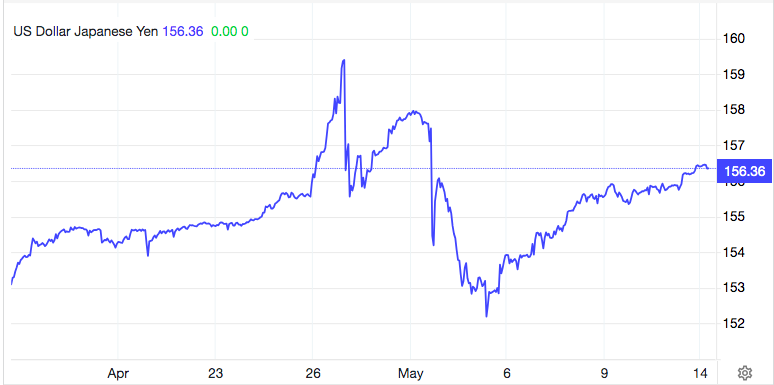
Adding to the general gloom, equity prices fell about -1.0% across the board, but closed above their session lows.  It is the dollar, though that really saw a big move with a greater than 1% move against most of its major counterparts.  USDJPY blasted through the 152.00 level that many had thought was a line in the sand for the MOF/BOJ and is a full big figure higher.  Meanwhile, European currencies all declined by more than -1.0% and Aussie (-1.8%) was the absolute laggard across both G10 and EMG blocs.

With this as backdrop, the ECB sits down this morning and must decide if it is too early to cut interest rates.  The economic data continues to underwhelm, and the inflation data is actually trending lower, rather than the situation in the US where it has turned back higher.  But the sharp decline in the euro yesterday has got to be a warning to Lagarde and her minions as a cut, especially since it is not priced at all, would likely see another sharp euro decline, something they are certainly keen to avoid.

One other thing, the Minutes of the March FOMC meeting were released in the afternoon, and it seems the committee is coming to an agreement that they are going to slow the roll-off of Treasury securities, likely cutting it in half to $30 billion/month although they are not going to touch the mortgage-backed part of the balance sheet since that is barely declining at all.  It appears that this may take place at the June or July meeting, but clearly before too long.

Enough about yesterday.  Overnight saw Chinese CPI data fall back to -1.0% M/M, reversing the previous month’s rise, as it becomes ever clearer that China will never be able to consume as much as it is able to produce.  That is the very crux of the trade issues that are becoming more heated as China ultimately dumps all its excess production overseas, or at least tries to.  This is an issue that is not going to disappear anytime soon, and one that will have major political and economic ramifications going forward.  I suspect that the tariff situation will only get worse, and I would not be surprised to see further absolute restrictions on Chinese trade regardless of who wins the US election in November.  As to the market impacts of this story, for now, I believe Xi is more fearful of a capital flight if he allows the yuan to weaken substantially, than he is of annoying the US and the rest of the world because the yuan is too weak.  But, given the clear difference in the trajectories of the US and Chinese economies and inflation stories, pressure for yuan weakness is going to continue.

Turning to this morning’s session, Madame Lagarde and her crew meet, and the market is not pricing in any movement.  June remains the odds-on favorite for the first rate cut, and given the fact that the Eurozone, as a whole, is stagnant from an economic growth perspective, and that price pressures there have been ebbing more quickly, that certainly makes sense.  Of course, after yesterday’s CPI, June is off the table in the US so the ECB will have to act without the ‘protection’ of the Fed.  As mentioned above, the euro declined by more than -1.0% yesterday and is edging lower this morning as well, down -0.1%.  Lagarde’s risk is she follows the path of lower rates, the euro declines more sharply, perhaps to parity or beyond, and that invites a resurgence in imported inflation.  Remember, energy is still priced in USD, so that a weak euro would raise the price of oil products across the continent.  Alas for Madame Lagarde, it’s not clear her political nous will allow her to solve this problem.

Recapping markets overnight, following the US declines yesterday, the Nikkei (-0.35%) also fell, but I think the yen weakness helped mitigate the declines.  Chinese shares were lackluster, slipping slightly both in HK and on the mainland and the rest of the time zone saw a mix of modest gains and losses.  Meanwhile, European bourses are all in the red this morning, with Spain (-0.9%) the laggard, but the average decline probably around -0.5%.  US futures, too, are softer at this hour (7:00), down about -0.3% across the board.  Clearly, there is grave concern that the Fed is not going to help ease global monetary policies.

As further proof that US yields drive global bond markets, yesterday’s CPI data pushed European sovereign yields higher by about 10bps across the board!  This despite the fact that inflation is going in the other direction in Europe.  This morning, those yields are continuing to grind higher, up between 2bps and 4bps across the board.  However, Treasury yields have stalled after yesterday’s dramatic rise.  Let me say that if the PPI data released this morning is hot, I fear things could move much further.

In the commodity space, oil rallied yesterday on stories that Iran was preparing for a more substantial retaliation against Israel and despite the fact that EIA inventory data showed surprising builds in crude and products.  However, this morning it is edging lower, -0.5%.  Perhaps more interesting is gold (+0.2%) which is a touch higher this morning but was able to rebound off its worst levels of the session after the CPI print to close nearly unchanged on the day.  In the end, the market remains quite concerned about inflation regardless of the Fed’s response, and gold continues to get love on that basis.  As to the base metals, yesterday’s rate induced declines were cut in half, but this morning both Cu and Al are drifting lower by about -0.2%.

It is the dollar, though that had the most impressive movement yesterday and this morning, it is holding onto most of those gains.  Absent a hawkish message from the ECB this morning, something which I believe is highly unlikely, the euro feels like it has further to decline.  The BOC left policy on hold and sounded fairly non-committal regarding its first rate cut there.  The Loonie suffered yesterday and has seen no rebound at all.  In fact, the only currencies showing any life this morning are AUD and NZD, both higher by 0.25%, which seems much more of a trading reaction after their dramatic declines yesterday, than a fundamental story.  As long as the Fed remains the most hawkish, the dollar should hold its bid.

Turning to the data today, PPI (exp 0.3% M/M, 2.2% Y/Y) and core PPI (0.2%, 2.3%) lead alongside Initial (215K) and Continuing (1792K) Claims.  Those numbers will arrive 15 minutes after the ECB policy decision is announced with no movement expected there.  Madame Lagarde has her press conference at 8:45 this morning.  We hear from Williams, Collins and Bostic over the course of the day, so it will be quite interesting to find out how far their thinking has changed.  I would be particularly concerned if there is further talk of rate hikes again.  Remember, Bowman intimated that might occur when she spoke last week, and Bostic has been in the one-cut camp so could turn as well.  Let me just say the market is not pricing in that eventuality at all!

At the beginning of the year, I opined that there would be at most one rate cut and rates would be higher by Christmas.  As of this morning, I see no cuts and a very real chance of hikes.  Keep that in mind for its impact on all asset classes going forward.

Good luck
Adf

Less Keen

While holding our breath has been fun
For CPI, soon we’ll be done
So far through this year
Each reading’s been dear
Can’t wait to see how today’s spun
 
A hot reading’s likely to mean
On rate cuts, Jay will be less keen
But if the print’s cool
It’s likely to fuel
A rally like we’ve never seen!


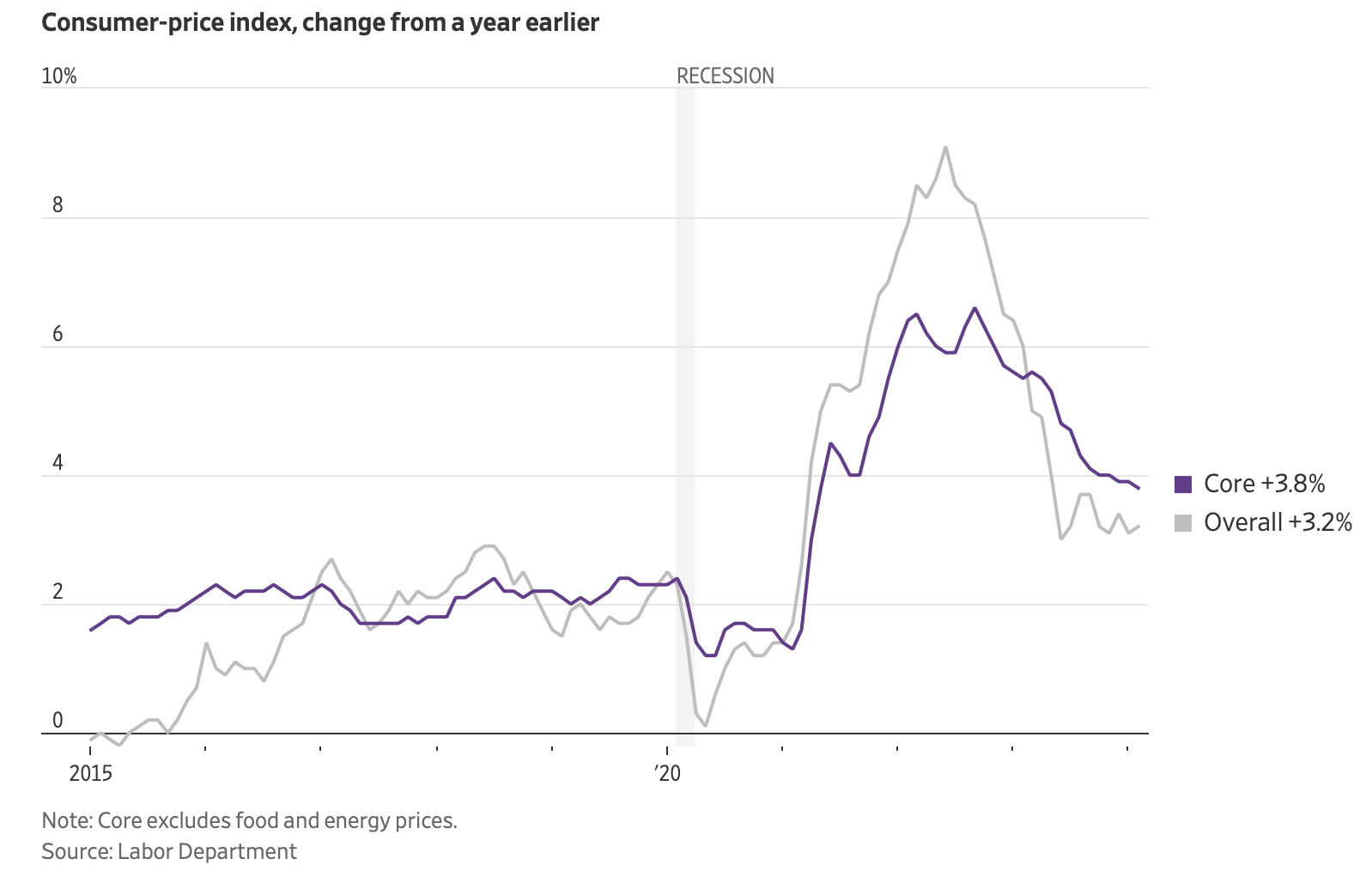
The number we have all been breathlessly awaiting is finally to arrive this morning at 8:30. The March CPI readings are expected as follows: Headline (0.3% M/M, 3.4% Y/Y) and core (0.3% M/M, 3.7% Y/Y).  As can be seen in the below chart from the WSJ, the question of whether inflation is continuing its slow decline or has bottomed is like a Rorschach Test.  Those who are all-in on the soft-landing thesis, notably every administration economist and spokesperson, see the ongoing decline of the core rate (the purple line) as the direction of travel.  However, those who are in the sticky inflation camp and who have made the case that the so-called last mile is going to take much longer than desired look at the headline rate (the gray line) and explain that the bottom seems to be in.

Source: WSJ

Perhaps the most frustrating part of this is that even after the release, neither side will be able to truly declare victory, although I’m sure one side will try to do so.  And to add insult to injury, the arguments are going to rely on the second decimal place, a level of precision that is meaningless in the context of economic data collection.  So, a 0.33% print will get the hawks all riled up while a 0.27% print will have the doves cooing that cuts are on their way soon.  But I challenge anyone to demonstrate that precision of that magnitude has any real meaning.  Clearly, the BLS can calculate numbers to whatever level of precision they desire but given the frequency or revisions to the big number, everything else is just narrative.

But this is where we are.  My take is that the market response will play out very much as expected, at least initially.  This means a hot print, even at the second decimal, will see bonds and equities sell off while the dollar rallies.  Funnily, my sense is that commodities will not suffer greatly on this as they are the current vogue for protecting against inflation.  Similarly, a cool number will lead to a risk asset rally and a dollar decline.  This will probably hurt commodities as well.

One of the interesting things is to observe positioning heading into big data points like this and there are two noteworthy items in the interest rate space.  First, yesterday there was a massive SOFR futures trade where one account bought 75,000 December contracts, the largest single trade ever in the contract according to the CME where it trades. (SOFR = Secured Overnight Funding Rate and is the replacement for LIBOR).  That is either a very large bet that the data is going to be soft, or somebody covered a very large short position, but either way, they are protecting against cooling inflation.  The other interesting thing has been the reduction in short bond positions.  There has been a significant decline in the number of short bond futures positions as well as short cash positions in the bond market, again an indication that many are looking for a benign reading this morning.

This poet has no formal inflation model and therefore can only estimate based on personal experience. Ultimately, nothing I have seen indicates that the rate of inflation is decreasing very rapidly at all.  As I remain in the sticky camp, my best guess is that we will lean toward the hot side this morning.

Turning to the overnight session, there was some interesting news to cover.  In Asia, Fitch put China on negative watch on its recent rise in debt.  Not surprisingly, Chinese shares suffered a bit on the news, but HK shares did not, as the Hang Seng (+1.9%) was the leading gainer in the time zone.  Elsewhere, the RBNZ left rates on hold, as expected, but the statement indicated zero rate cuts in 2024 and a continued hawkish bias.  Surprisingly, NZ equities rallied a bit on the news.  Finally, Ueda-san testified to the Diet again and the most interesting thing he said was that while they watch the FX rate, they will not adjust monetary policy simply to address any weakness in the yen.  Apparently, stock traders didn’t like that much as the Nikkei fell -0.5% on the session.

The story in Europe, though, is much better as all markets are firmer, somewhere between +0.4% and +0.7%. There was some data released, all of which pointed to slowing growth and inflation and therefore increasing the odds the ECB could act as soon as tomorrow, but certainly by June.  Norwegian CPI fell more than expected, Swedish GDP and IP were both quite weak as was Italian Retail Sales.  The point is the ongoing reduction in activity across the continent is going to allow (force?) Madame Lagarde to prove she isn’t waiting on the Fed.  After another limited movement day yesterday, US futures remain unchanged at this hour (7:00).

In the bond market, while Friday and Monday morning saw a sharp decline in prices and rise in yields, yesterday saw yields drift back further and this morning Treasuries are lower by -1bp with similar price action throughout Europe.  Thus far, the net retracement from the yield peak has been 10bps, with all eyes on this morning’s CPI print.  One other interesting tidbit is that the Treasury is auctioning $39 billion in 10-year notes today with the yield highly dependent on the CPI data.

Turning to the commodity market, oil (+0.6%) after a slight dip yesterday on a larger than expected inventory build, is rebounding.  The EIA released a report increasing expected supply and demand numbers for 2024 and 2025 as well.  Gold (-0.25%) is settling in just below its new highs although copper (+0.5%) and aluminum (+1.1%) continue to rally strongly on the rebounding manufacturing story as well as the structural supply shortages.

Finally, the dollar remains in the doldrums, little changed ahead of this morning’s data.  The biggest mover is MXN (+0.5%) which is a continuation of its yearlong price activity as Banxico maintains amongst the highest real interest rates around.  Surprisingly, NZD (+0.2%) is just barely higher despite the hawkish rhetoric from the central bank last night and after that, pretty much all the movement is +/- 0.1% or less.

In addition to the CPI data this morning, we get the Bank of Canada rate meeting where they are expected to leave policy on hold although given the slowing economy, they may set the table for a rate cut at the next meeting.  I would not be surprised to see them cut today, though, in an effort to get ahead of the curve.  The FOMC Minutes are also released this afternoon and we hear from Governor Bowman and Chicago Fed president Goolsbee, with both having been amongst the most hawkish Fed speakers lately.  Given all the talk from Fed speakers since the March meeting, it is hard to believe that the Minutes will matter that much.

And that’s what we have for today.  The CPI will set the tone and we will circle back tomorrow to see how things landed.

Good luck

Adf

Unchained

The data, on Friday, revealed
The job market’s mostly been healed
As such, any thought
The Fed really ought
Cut rates, simply must be repealed
 
In fact, two Fed speakers explained
That rate cuts were not yet ordained
Should prices keep rising
It won’t be surprising
If higher rates soon are unchained


Wow!  Once again, the NFP report was significantly hotter than any analysts forecast, with a top line number of 303K while the previous 2 months were revised higher as well.  The Unemployment Rate fell back a tick, to 3.8%, while wages continue to grow above 4%.  In other words, it seems quite difficult to make the case that the economy is in a state that requires rate cuts.  After all, if the Fed’s focus has turned from inflation specifically to employment now, and employment continues to rock, why cut?

However, the impression from the cacophony of Fedspeak we heard last week is that many members are still of a mind to cut the Fed funds rate, likely in June.  Just not all of them.  We heard from two more speakers Friday, Governor Michelle Bowman and Dallas Fed President Lorie Logan, and neither seemed in a cutting frame of mind.  [Emphasis added]

Bowman: “While it is not my baseline outlook, I continue to see the risk that at a future meeting we may need to increase the policy rate further should progress on inflation stall or even reverse.”

Logan: “In light of these risks, I believe it’s much too soon to think about cutting interest rates.  I will need to see more of the uncertainty resolved about which economic path we’re on.” She followed that with, “To be clear, the key risk is not that inflation might rise — though monetary policymakers must always remain on guard against that outcome — but rather that inflation will stall out and fail to follow the forecast path all the way back to 2 percent in a timely way.”

Now, it is very difficult for me to read these comments and think, damn, rate cuts are coming soon!  By now, you are all aware that I have been in the sticky inflation camp from the get-go and certainly Friday’s data did nothing to change my mind.  But my views don’t really matter. However, if we start seeing a majority of FOMC members talking about fewer cuts than expected/assumed in March, and even hikes, we need to pay attention. I don’t think it is yet a majority, and clearly Chair Powell is very keen to cut, but there is a long time between now and the June meeting, with much data to come.  Unless that data starts to really back off and hint at a substantial slowing of the economy, my sense is that June will morph into November or December, with the median dot pointing at just one cut this year.

A quick look at the Fed funds futures shows that traders are growing even less confident in those rate cuts being implemented.  As of this morning, the June probability has fallen slightly below 50% and there are a total of 61bps priced in by the December meeting, just over two cuts.  This is quite a contrast to the Eurozone, where the market has fully priced in a June cut and is beginning to consider a 50bp reduction to get things going there.  On the surface, this makes a great deal of sense as the Eurozone economy’s growth continues to lag that of the US and inflation has been ebbing more rapidly there than in the States.  And don’t forget, the ECB meets this Thursday, so at the very least we should have a better sense of what will happen in June, and we cannot rule out a cut this week, regardless of market pricing.

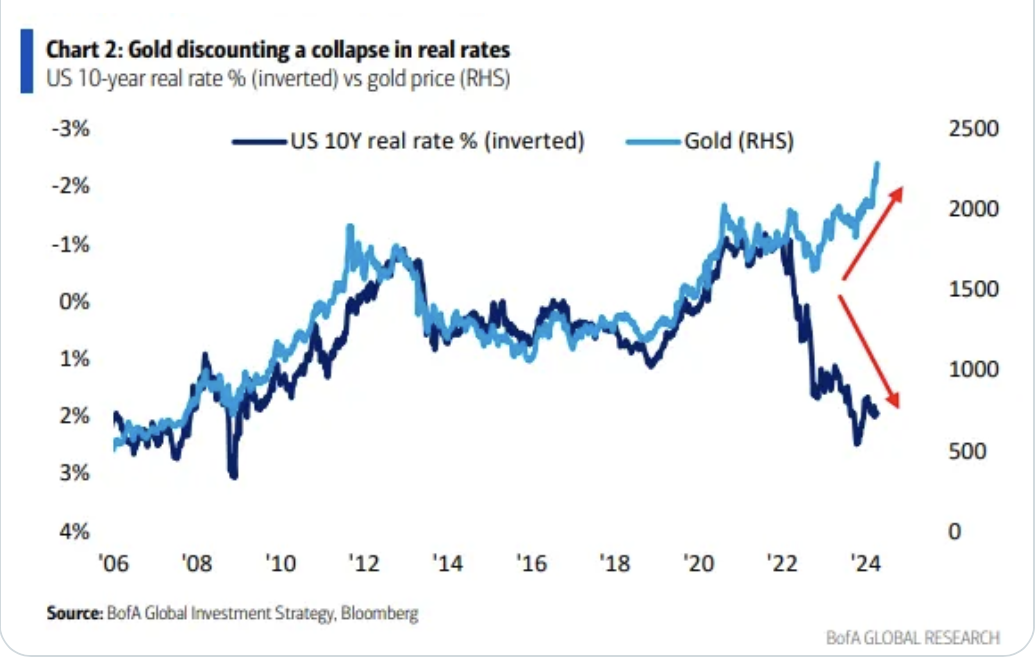
Trying to step back for a broader perspective on the economy and the future of policy rates as well as market movements, there continue to be several conundrums in markets compared to historical trends.  For instance, what is the meaning of the price of gold rising consistently alongside a rise in interest rates, both nominal and real?  Historically, there has been a strong negative correlation between the two, but something has changed in the past two years as evidenced by the BofA Research chart below.

Is this a signal that the market is getting indigestion over the amount of sovereign debt that is outstanding, led by Treasuries?  Is this an indication that investors are losing faith in fiat currencies and the current global monetary structure?  Or is this simply a temporary anomaly that will correct over the course of the next several years?  Unfortunately, there is no way for anyone to know the answer to these questions at this point in time.  Anyone who says otherwise is not being honest.  

However, my suspicion is that the consequences of monetary and fiscal policies around the world during the Pandemic and since has more and more people, and institutions, starting to hedge their bets on the future and its outcomes.  From a more benign view that the authorities will be able to kick the can down the road, this relationship seems to indicate more than a few folks think that the fiscal and monetary authorities are about to stub their collective toe on the next kick.  Ouch!

In many ways, I think that the change in this relationship is an excellent encapsulation of the problems currently faced by monetary and fiscal authorities.  As such, I will be watching it closely as a key indicator of market sentiment overall.

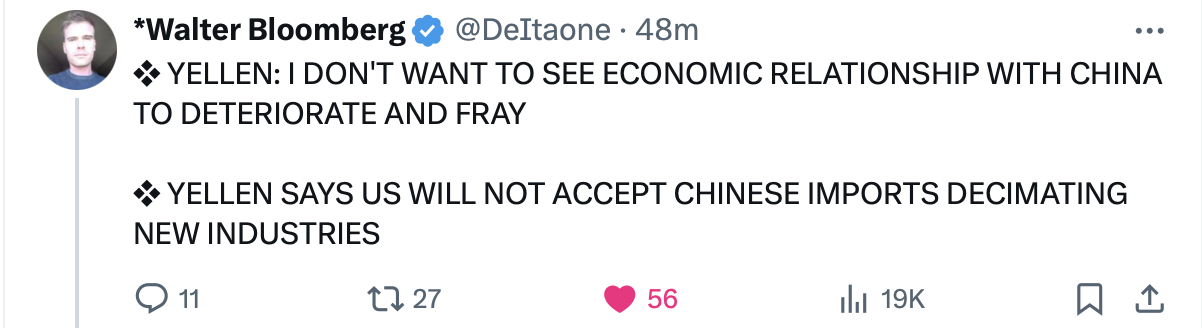
Ok, let’s look at the overnight session.  After Friday’s solid US equity performance, the picture elsewhere has been slightly less positive, although positive overall.  In Asia, the Nikkei (+0.9%) followed the US price action although Chinese shares had a less positive session, falling on the mainland with the HK market staying flat.  Treasury Secretary Yellen was in China trying to smooth things over, but the following two statements, I think, are a great description of how confused things are:

Talk about mixed messages!  Meanwhile, in Europe, most bourses are a bit higher this morning, but on the order of 0.5%, half what we saw in the US on Friday.  It seems that some traders are betting that the ECB, when it meets this Thursday, is going to cut rates.  Lastly, at this hour (7:20), US futures are essentially flat.

The bond market, though, has seen far more activity lately as it appears the bond vigilantes, last seen in the 1990’s are reawakening.  This morning, 10-year Treasury yields are back to 4.45%, their highest level since November when yields were falling in the wake of the Fed’s perceived pivot and the reduced amount of coupon issuance just announced at that time.  This is 13bps higher than the yield just before the NFP data was released, 8bps on Friday and another 5bps this morning.  Similarly, European sovereign yields hare higher by between 3bps and 5bps this morning, being dragged higher by Treasuries, but lagging as bets get made that the ECB acts sooner than the Fed.

In the commodity space, oil (-0.8%) is backing off its recent highs this morning as there appears to be an easing in some concerns over the Middle East, at least that is the story making the rounds.  Meanwhile, metals prices continue to flourish despite the rise in interest rates with both precious (Au +0.4%, Ag +0.9%) and base (Cu +0.7%, Al +0.3%) all continuing their recent climbs.  Another conundrum here is the fact that these metals prices are rising despite the dollar remaining reasonably well bid.

Turning to the dollar, it is little changed, on net, this morning although we have seen some strength against the CHF (-0.5%) and KRW (-0.4%).  The former is the only currency seemingly following the interest rate story as the recent SNB rate cut plus low inflation readings indicates that the policy divergence between Switzerland and the US is set to widen further.  The won, on the other hand, looks to be a proxy for China, which the PBOC refuses to allow to weaken despite many economic reasons it should.  On the flipside, ZAR (+0.4%) is rallying on the back of those metals’ prices.  One of the things that is confusing is the fact that the euro remains reasonably well bid despite the changing tone of the interest rate policies between the Fed and ECB.  While the single currency has generally been declining over the past month, in truth, since the beginning of April, it has rebounded about 1% and held strong since then.  Given the changing market perceptions, I would have anticipated the euro to continue its declining ways, but right now, that is not the case.

On the data front, the week starts out slowly, but we get the critical US CPI data on Wednesday.

TuesdayNFIB Small Biz Optimism89.5
WednesdayCPI0.3% (3.4% Y/Y)
 -ex food & energy0.3% (3.7% Y/Y)
 Bank of Canada Rate Decision5.0% (unchanged)
 FOMC Minutes 
ThursdayInitial Claims215K
 Continuing Claims1792K
 PPI0.3% (2.3% Y/Y)
 -ex food & energy0.2% (2.3% Y/Y)
 ECB Rate Decision4.5% (unchanged)
FridayMichigan Sentiment79.0
Source: tradingeconomics.com

In addition to the data and other central bank decisions, we hear from seven more Fed speakers this week, which given the recent more hawkish commentary, could well be quite interesting.  If Wednesday’s CPI data is hotter than expected again, I suspect it will become increasingly difficult for the doves to spread their wings.  As it happens, six of the seven speak after the CPI, so we could well see things evolve further.  In the meantime, relative to other currencies, I continue to look at the rate picture and believe the dollar should remain firm.  However, versus ‘stuff’ not so much.

Good luck

Adf

Not Fading Away

The first thing to mention today
Inflation’s not fading away
Instead, CPI
Was one again high
Though risk assets still made some hay

This raises the question again
Of if the Fed will, not of when,
Begin cutting rates
And foster debates
If Powell’s in charge…or Yel-len

Well, the CPI data was hotter than forecast with both headline and core printing at 0.4% and the Y/Y numbers both coming a tick higher than forecast at 3.2% and 3.8% respectively.  While serious analysts are revisiting their thoughts on whether the Fed is anywhere near a position to consider cutting rates, as I predicted yesterday, the Fed Whisperer, Nick Timiraos of the WSJ, was out before noon (at 11:25am to be precise) with his article explaining that the hot CPI print didn’t matter, and the Fed would still be cutting rates come June.

And maybe that is all we need to know.  As the working assumption is he is speaking directly to Chairman Powell, and that was the message he was instructed to convey, then maybe they will be cutting rates then.  But to take the doves’ favorite metric from December, the 3-month running average on an annualized basis, it is now running at 4.3%.  That feels a touch high for the Fed to consider cutting, but in fairness, we are still three months away from that June meeting so many things could change in the interim.

As it happens, the equity markets didn’t wait for the WSJ article to decide that rate cuts are still coming on schedule, as the futures rallied instantly, and stocks were higher all day.  At this point, it is very difficult to see what will derail the current rally as clearly there is no fear of the current rate structure remaining in place.  While trees don’t grow to the sky, apparently, they can get pretty tall!  It is a fool’s errand to try to determine the top ahead of time, and I believe the market, and the economy as a whole, needs to find a non-speculative clearing price (i.e. retreat sharply), but it doesn’t seem like that is a near-term scenario.  In other words, I guess it’s ‘party on!’

The first hints of Spring
Have seen wages in full bloom
Is ZIRP on its way?

Turning to Japan and the Spring wage negotiations there, headlines out of Tokyo this morning show that wages are going to be substantially higher in 2024 than they were in 2023.  Key results that have been announced include Nippon Steel, Nissan, Panasonic, and Toyota, which said its wages would be rising the most in 25 years.  These wage hikes are seen as a precondition for the BOJ to exit NIRP, although it is not clear if it is a sufficient condition.  While the politicians are crowing as higher wages are obviously welcome to the people there, the market is hardly behaving as though these numbers are going to do the job.  For instance, the yen (-0.2%) is a touch softer this morning, 10-year JGB yields didn’t budge while 2-year JGB’s saw yields tick down a bit, and Japanese stocks barely edged lower, down about -0.3%.  My point is the market behavior is not necessarily consistent with the view that Japanese rates are about to move.   The totality of the wage negotiations will be published on Friday, so perhaps that will offer more clarity.

However, at least with respect to USDJPY, given what we just learned about US inflation and the prospects for US rate cuts (which are diminishing in my view), that 10bp rate hike by the BOJ does not feel like it will be sufficient to cause a major adjustment.  We will need to hear Ueda-san explain that any move is the beginning of a new cycle, and rates are heading higher, full stop.  And I don’t see that happening.

And those are really the key stories for the morning, risk is still on, and Japan appears to be edging closer to exiting their negative rate policy.  So, let’s see how markets have behaved overall.

Despite the US rally, there were many more laggards than gainers in the Asia session with China, Hong Kong and India all seeing equity markets under pressure.  As well, the gainers showed only very modest gains (Australia +0.2%, South Korea +0.3%) so generally it was a negative session.  However, in Europe this morning, the screens are green with a mix of very marginal gains (UK, Germany) and strong performances (CAC +0.5%, IBEX +1.5%) with the Spanish and Italian markets making new multi-year highs.  As to US futures, at this hour (7:45) they are very slightly firmer, 0.15%.

The bond market did respond as one would expect on the back of the CPI data, with Treasury yields rising 6bps yesterday.  As well, there was a 10-year Auction which was a bit sloppy with a 0.9bp tail and settlement price of 4.166%.  European yields rose in the wake of Treasuries yesterday but are essentially unchanged this morning, as are Treasury yields.  As long as the inflation story remains on the hot side, it is difficult to see yields declining from these levels.

In the commodity markets, the one thing that really reacted to the CPI data was gold, which fell 1.1% yesterday, although given the recent remarkable run higher, it can be no surprise there was some profit-taking.  And this morning, it has bounced 0.25% so far.  As to oil (+1.6%) it is rallying this morning but that is simply offsetting yesterday’s declines and it remains in the middle of that $75-$80 range.  A quick word about copper (+2.0%) which has traded above $4.00/Lb for the first time in almost a year and looks to be making a strong move higher.  Whether that is on growing economic optimism in China or elsewhere is not clear, but that is the price action.

Finally, the dollar is surprisingly little changed overall.  In the immediate wake of the CPI print yesterday, it did rally nicely, but it has since ceded those gains and is largely unchanged from then.  In fact, net from yesterday’s closing levels, it is softer by about 0.2% against almost all its major counterpart currencies.  I am quite surprised at this price action as I would have expected the dollar to benefit, but not much as of yet.

The only data released today is the EIA oil and product inventories for the week, something which will impact the oil market but not much else.  When looking at the totality of the data, there is no indication to me that inflation is going to be declining soon.  It is very hard for me to look at what is happening and conclude that the Fed is compelled to cut interest rates to prevent a problem.  Until we see a more substantial decline in economic activity, I have to believe that they will stand pat, regardless of the politics.  If they don’t, I would expect the dollar will fall sharply as inflation reignites in the US.  And that doesn’t seem like the conditions they want if they truly want to prevent a change in the White House come November.

For today, and likely through the FOMC meeting in one week’s time, I suspect risk assets will perform well.  But it also feels like more risks are building that can have a negative result.

Good luck
Adf

Death Knell

If CPI data today
Is hot, then get out of the way
Amid the death knell
Investors will sell
Stocks for which they did overpay
 
But if, instead, CPI’s cool
The thing to expect, as a rule
Is risk asset rallies
And FinTwitter tallies
Of profits o’er which some will drool


There are some who believe that today’s CPI data will not lead to much price action at all.  The thesis seems to be that everybody is too focused on the outcome, and that any hot print will be immediately talked away by folks like Nick Timiraos in the WSJ and every other administration official (Yellen, Brainard) or folks like Larry Summers or Paul Krugman (although I don’t think anybody listens to him anymore).  The idea is that the government will not allow things to get out of control ahead of the election and so inflation will be denied and the path to a June rate cut will not be denied.  It is easy to ascertain that the FOMC is anxious to cut rates, and I’m sure there is intense pressure on them to do so behind the scenes from the administration.  After all, why would they all explain that inflation remains hotter than they expected, but think they are going to cut anyway?  The one thing I am willing to wager is that if we see a hot number, there will be an article in the WSJ before lunchtime explaining that it doesn’t change anything.

On the other hand, if the data comes in cooler than expected, one would have to believe that we are going to see risk assets once again take the bit in their proverbial mouth and run higher again.  Animal spirits remain quite robust and the modest down days from Friday and yesterday are nothing compared to what we have seen.  Very likely, some risk has been lightened up, but I would argue there is very little change of heart at this point.

One thing, though, that is very important is if the market behavior does not follow the data release.  For instance, if a hot print results in a short-term dip and then a reassertion of the bull trend, that is hugely positive for risk assets for the next several weeks I would think.  Or certainly up until the FOMC meeting.  Similarly, if a cool number results in a short-term pop in futures but a continued sell-off over the session, that would be a signal that a correction has begun.  A market that cannot rally on good news is one that is exhausted.

For good order’s sake, let me repeat the current expectations: Headline (0.4%/3.1% Y/Y) and Core (0.3%/3.7% Y/Y).  Prior to the CPI data, we have already seen the NFIB Small Business Optimism index which fell to 89.4, a point worse than expected.  Interestingly, the largest concern amongst this cohort of business owners is rising inflation, which has replaced ability to find quality employees at the top of the list of issues. This is not the type of data the Fed wants to see, rising inflation expectations alongside a softer labor market. But in the end, it’s the CPI data that is going to matter today.

Aside from that, or perhaps more accurately because everyone is so focused on that, there has been very little else ongoing in markets overnight.

After a very lackluster session in the US yesterday, last night saw Japanese stocks essentially unchanged with the big activity in Hong Kong (+3.0%) despite the largest listed property company, Vanke, getting downgraded to junk by Moody’s.  Methinks there could have been some official activity there to help support things.  Interestingly, both South Korea and Taiwan saw positive sessions, but most of the rest of the region did very little at all.  In Europe this morning, we are seeing gains led by the FTSE 100 (+1.0%) which seems to be responding to a slightly softer than forecast employment report (Unemployment rose to 3.9% and wages slid a bit) with growing expectations that a rate cut will come sooner rather than later.  And at this hour (7:30) US futures are a bit firmer, about 0.3% or so.

In the bond market, yields backed up slightly yesterday although the 10-year Treasury remains at 4.10% ahead of both the CPI report and today’s 10-year auction.  European yields are a touch softer this morning -1bp, except for UK Gilts (-6bps) which also see the prospects for a rate cut coming sooner than previously thought.  Finally, JGB yields edged 1bp higher overnight amid further chatter that the BOJ is going to move next week.  The latest rumors from Tokyo are that the Shunto wage talks have seen significant wage hikes agreed which has been a precondition for the BOJ to exit NIRP.  It strikes me that whether they move on Monday or next month it doesn’t really change anything as I continue to believe that the totality of the movement will be limited at best, perhaps 30bps overall.

In the commodities markets, oil is little changed this morning, still stuck in the middle of its recent trading range.  Gold (-0.4%) is sliding this morning for the first time in 2 weeks, in what appears to be a modest correction.  However, both copper and aluminum are a bit firmer this morning along with most of the rest of the commodities space as the dollar seems to be drifting a bit.

Speaking of the dollar, I would argue it is a touch softer overall, although there are both gainers and losers around.  ZAR (+0.6%) and SEK (+0.4%) are the best performers across all currencies while we are seeing weakness in JPY (-0.3%) and HUF (-0.4%).  The gainers appear to be a product of inflows to their equity markets as both have had good runs today while the laggards have no such excuse with Hungarian stocks rising nicely.  As to the yen, that remains beholden to the BOJ story I believe, so is likely to remain somewhat idiosyncratic compared to the rest of the FX complex until next week.

And that’s really all we have today.  It’s CPI then bust.  I remain in the sticky inflation camp and anticipate a print at least at the current expectations with a decent chance of something a touch higher.  I remain convinced that the next dot plot will show only 2 rate cuts as the median forecast for the Fed and today’s data will be a key part of that story.  If that is the case, the dollar’s recent weakness is likely to come to an end as it finds some real support.

Good luck

Adf

Whispers in the Wind

Whispers in the wind
Imply rates may be rising
Sooner than we thought

In the wake of Friday’s noncommittal payroll data, which I will discuss below, the topic garnering the most interest this morning is the BOJ and whether they will be adjusting monetary policy one week from today rather than in April.  There have been several articles published on the topic which is usually a sign that the BOJ is floating trial balloons.  At this point, the market is pricing about a 2/3 probability of a move next week based on current Japanese OIS swap data.  That is a significant increase compared to the pricing just two weeks ago.  In addition, we have seen a number of analysts from the major Japanese banks move their call to March from April previously

You may recall that a key discussion point on this subject has been the Spring wage negotiations and whether the new round will embed higher wages into the economy.  Last week I mentioned that Rengo, one of the labor associations, was seeking a 5.85% increase, which would be the largest such move in more than 30 years.  As it happens, the results will be released this coming Friday, so if the outcome is high enough, arguably Ueda-san and the BOJ would have enough information for a move.

One other interesting tidbit was the fact that last night, the BOJ remained out of the equity market despite the fact that the TOPIX (Japan’s other major index) fell more than 2% in the morning session.  Ever since Covid and the market panics then, on every occasion when the morning session saw the index decline that much, the BOJ was a buyer in the afternoon.  While this was not an official policy per se, it was the reality.  The upshot is that the BOJ is the largest holder of Japanese stocks in the world, owning something on the order of 8% of the market.  The fact that despite that decline, they changed their response could well be a tell that other changes are coming.

In the end, I would argue it matters less whether the first adjustment happens in March or April and more about just how far they are going to adjust policy.  I remain unconvinced that this is the beginning of a true normalization of monetary policy, or perhaps more accurately, that the BOJ is going to raise rates to bring them in line with the rest of the G10.  Rather, my sense is we will get to 0.0% at the first move, and that over the ensuing years, a move to even 0.3% in the overnight market will be difficult to achieve absent a major explosion of economic growth alongside rapidly rising inflation.  And frankly, I just don’t see that happening at all.

Keep this in mind, 2-year JGB yields, which have been edging higher steadily for the past two months, are still at only 0.2%.  That is not a sign that the market is expecting a dramatic increase in Japanese policy rates anytime soon.  Since the beginning of the month, the yen has rallied about 2.65% on this story.  Can it go much further?  Certainly, there is room for further strength given its performance over the past several years.  However, I would argue that will rely on the Fed cutting rates, and doing so aggressively, to truly narrow the yield differential.  And right now, I just don’t see that happening.

On Friday, the payroll report
In some ways, came up rather short
While headlines were strong
Revisions felt wrong
For rate hikes, more folks, to exhort

By now, you are aware that despite a much stronger than forecast headline NFP print of 275K, (exp 200K), the revisions to the prior two months were -167K, which took the luster off the headline and reverted the revision story back to negative from the surprising positive result last month.  In addition, the Unemployment Rate rose 2 ticks to 3.9% and Average Hourly Earnings only rose 0.1% on the month.  The market response here was interesting, to say the least.  While Treasury yields continued their recent slide, perhaps anticipating Fed action sooner rather than later, the equity market sold off as well, although that easily could have been simple profit taking after a huge run higher.  Of more interest is the fact that NY Fed President Williams, the last Fed speaker before the quiet period started, sounded just a touch more dovish than a number of the speakers we heard last week.

At this point, market participants are focused on a couple of things I think, with the next big thing tomorrow’s CPI print.  Thursday brings Retail Sales and then, of course, the FOMC statement and Powell presser is the following Wednesday.  June remains the odds-on favorite for the first Fed cut but that is subject to change based on tomorrow’s data.  If CPI indicates that the January number was not an aberration, and that inflation is actually stickier than many (want to) believe, I would not be surprised to see the median dot plot expectations rise to only 2 rate cuts in 2024. That is substantially fewer than the current estimate of 4+.  That will have a significant impact on markets if that is the case.  Alternatively, a very soft number tomorrow could easily bring May back onto the table for the first rate cut and may alter the dot plot in the other direction.  We shall see,

As the market awaits all the upcoming news, here’s what happened overnight.  Along with the slide in Japanese shares, most Asian markets sold off, all in the wake of Friday’s weak US equity performance.  The one exception was China, where both the Hang Seng (+1.4%) and CSI 300 (+1.25%) rallied at the end of the Chinese National People’s Congress as hopes for more stimulus remain high. In Europe, bourses are all in the red, although the declines have not been excessive, just -0.25% to -0.5%.  And at this hour (7:45), US futures are pointing slightly lower, -0.2% across the board.

In the bond market, yields are generally little changed in both treasury and European sovereign markets with all eyes on tomorrow’s data.  Last week’s ECB meeting didn’t really add too much to the conversation although it appears that expectations are cementing around a June rate cut, regardless of the Fed’s actions.  Overnight, JGB yields edged another 2bp higher, which given the increased scrutiny on a March rate hike is not that surprising.

In the commodity markets, oil (-0.5%) is sliding a bit and generally remaining right in the middle of its $75-$80 trading range for the past month.  Meanwhile, gold, while little changed this morning, is holding onto its recent gains and showing no signs of slipping back soon.  As to the base metals, copper (+0.3%) is edging higher while aluminum is unchanged on the day.  These metals markets are looking toward China to get a sense of the chances for fresh new demand.

It can be no surprise that the dollar is largely unchanged this morning with very modest gains and losses across both the G10 and EMG blocs.  In the G10, JPY (+0.3%) is the biggest mover with the rest of the bloc +/-0.1% on the day and giving no signal.  In the EMG bloc, KRW (+0.5%) is the largest mover, although it is not clear what would have driven the move as equities there fell pretty sharply overnight.  Also, CNY (+0.15%) is rallying after CPI data released over the weekend showed a monthly rise of 1.0% and that brought the Y/Y number back into positive territory at +0.7%.

On the data front, there is some other interesting data aside from CPI as follows:

TuesdayCPI0.3% (3.1% Y/Y)
 -ex food & energy0.4% (3.7% Y/Y)
ThursdayInitial Claims218K
 Continuing Claims1911K
 Retail Sales0.7%
 -ex autos0.4%
 PPI0.3% (1.2% Y/Y)
 -ex food & energy0.2% (2.0% Y/Y)
 Business Inventories0.2%
FridayEmpire State Manufacturing-7.5
 IP0.0%
 Capacity Utilization78.4%
 Michigan Sentiment76.6

Source tradingeconomics.com

However, while there is a bunch of stuff coming out, I suspect that after CPI, it will all be anticlimactic.  As we are in the Fed quiet period, there will be no commentary, although in the wake of the CPI report, look for anything in the WSJ from the current Fed whisperer, Nick Timiraos.  This is especially so if the numbers are far from expectations.

In the end, today ought to be very quiet overall, with all eyes on tomorrow.  From there we shall see.

Good luck

Adf

A Narrative Flaw

At first it was just CPI
With heat like the fourth of July
But Friday we saw
A narrative flaw
As PPI jumped, oh so high
 
The narrative’s now in a bind
While working so hard to remind
Investors that prices
Are not in a crisis
And Goldilocks can’t be maligned


It must be very difficult to be a cheerleader for the immaculate disinflation* these days given we continue to see data showing inflation is no longer receding.  Friday’s PPI was the latest chink in the deflationists’ armor as both the headline and core numbers printed well above expectations.  Of course, this followed Tuesday’s hot CPI prints as well as some lesser data like the prices paid portion of the NFIB survey and the last ISM Services survey.  Energy prices, which had fallen throughout Q4 but have since bottomed and appear to be trending higher again, are no longer a cap on inflation.  But of greater consequence is the fact that services inflation remains higher on the back of continued wage gains and rises in the price of things like insurance.  

Market participants are slowly coming around to the idea that the Fed may not be cutting rates quite like they were hoping for praying for anticipating just a few weeks ago.  This has been made clear by a quick look at the Fed funds futures market in Chicago which is now pricing in just a 10% chance of a March cut, a 35% chance of a May cut and a 75% chance of a June cut.  In fact, the market is now pricing in barely more than the Fed’s last dot plot for 2024, just 81bps for the entire year.

Of course, there is one benefit to the recent data and that is we stopped hearing about the 3-month trend and the 6-month trend showing the Fed had reached their target and so should be cutting rates NOW!  Instead, the fact that those trends are now pointing higher insures that we won’t hear about that for quite a while…I hope.

Philosophically, I remain confused as to why there is so much ‘demand’ that the Fed cuts rates at all.  While I certainly understand why the administration would like to see it, given the budget deficits that need to be financed, arguably, if nominal GDP growth is between 6% and 7% and Fed funds are at 5.5%, things don’t seem out of place.  If anything is out of place it is the 10-year yield, which even after rising 6bps on Friday, remains at 4.30%.  Historically, a more normal level of 10-year yields would be the same as nominal GDP growth.  Currently, that tells me either 10-year yields have much further to rise, or GDP is going to fall A LOT.  I sure hope it is the former.

Now, looking past Friday’s activity, this morning has been extremely quiet overall with the prospects for action looking quite limited.  Today the US celebrates President’s Day, so banks are closed as is the stock market, although futures markets are trading.  Canada is also mostly on holiday which implies that once Europe goes home, things will really die out.

But quiet is the best description of everything overnight.  One surprise was that Chinese equity markets were far less bullish than many anticipated as they reopened after the extended Lunar New Year holiday.  While the CSI 300 managed to rise 1.2% on the session, the bulk of the move came at the close with a wave of buying by their plunge protection team.  The disappointment was based on the stories that holiday travel had risen substantially which had been pumping up the Hang Seng which reopened last Thursday.  Alas, that market fell -1.1%, a perfect encapsulation of the overall disappointment.  In the meantime, European bourses are trading either side of unchanged and at this hour (7:00), US futures are doing the same, basically unchanged on the day.

Basically unchanged is an excellent description of the bond markets as well, with virtually every major European sovereign market either unchanged or higher by 1bp this morning.  Overseas trading of Treasuries has also seen limited activity and no yield change, and you will not be surprised to learn that JGB yields were also unchanged.  

In the commodity space, oil, which had a solid week last week and now shows WTI at ~$79.00/bbl, is a touch softer this morning, but only just.  I have seen a number of stories about peak oil having been reached again, but as you may know, I am no longer convinced that is the case.  Of course, that is a very long-term discussion which will have nothing to do with the daily fluctuations.  And shocks to the system can have a big impact regardless of the long-term story.  In the metals markets, gold is edging higher again, +0.3%, but both copper and aluminum are softer this morning by about -0.4%.  As with every other market, there is a lot of conflicting data that has been preventing a more coherent directional view here.  I suspect that will resolve over time, but in commodities, over time can mean months or years.

Finally, the dollar is little changed net with a mixture of gainers and losers.  For instance, in the G10, we are seeing very modest strength in NZD (+0.25%) and JPY (+0.2%, and just below 150.00 as I type), while in the EMG space there is some weakness as evidenced by ZAR (-0.4%) and KRW (-0.3%).  As with all markets today, I don’t think we are going to learn very much new.

As it is a holiday, there is no data today and, in truth, there is very little to be released all week.

TuesdayLeading indicators-0.3%
WednesdayFOMC Minutes 
ThursdayChicago Fed National Activity-0.19
 Initial Claims217K
 Continuing Claims1900K
 Flash Manufacturing PMI50.2
 Flash Services PMI52.0
 Existing Home Sales3.97M
source: tradingeconomics.com

In addition to that short slate, we hear from seven different Fed speakers including Governor Waller who seems to be the most important voice after Powell and Williams.  As it happens, five of those come Thursday with Waller the last at 7:30 that evening.

For today, I would not expect much at all in the way of market movement.  Given the lack of obvious catalysts, a quiet week seems likely as well.  Perhaps the biggest news is NVDIA is releasing their earnings Wednesday after the close, although from an FX perspective, that doesn’t seem crucial.  Big picture tells me that the Fed is not going to be easing policy soon, and that as long as the US economy continues to outperform those of Europe, Japan, the UK and China, the dollar is likely to find continued support.  Realistically, I think you could make the case for the dollar to rally substantially over the course of the year, but right now, that doesn’t feel like the move.

Good luck

Adf

*Immaculate disinflation – the idea that inflation can decline without a slowdown in growth or recession, but rather because it’s previous rise was transitory, just taking a little longer than originally anticipated.

Good…or Bad

FinMin Suzuki
Noted that a weaker yen
Might be good…or bad

One of the great things about finance and central bank officials is their ability to twist language into pretzels while trying to make their case in any given situation.  Last night offered another great example from Japanese FinMin Shun’ichi Suzuki with this being the money quote, “From that standpoint, I’m closely watching market moves with a strong sense of urgency.”  It is not clear how you watch something with urgency, but if you are the MOF official in charge of explaining why your currency has been declining so rapidly, I guess you have to say something.  (As an aside, I might simply point out that the interest rate differential between the US and Japan is now 5.5%, having risen from 0.35% over the past two years and that might have something to do with the FX move.)

As previously mentioned, the MOF is moving up its ladder of pre-intervention activities as detailed on Wednesday, arguably now somewhere between numbers 2 and 3.  The biggest problem Japan has is that there is a quickly declining probability that the US is going to be easing policy as soon as had been previously thought, and so the incentive to own yen remains diminished.  The second biggest problem they have is their economy has slipped into recession and so the urgency for Ueda-san to tighten policy is also diminished.  While USDJPY has been hovering just above 150 for a few days, I expect that it is going to grind higher still and force Suzuki-san to continue to climb that numeric ladder.  The one saving grace for Suzuki is that as we approach fiscal year-end in Japan, there is likely to be a seasonal flow of funds back home for dressing up balance sheets.  That could well keep things in check until sometime in April, but all signs are that the market is going to test him again before too long.

On Tuesday, the data was hot
On Thursday, it really was not
So, which one describes
The ‘conomy’s vibes?
Or have, now, stagflation, they wrought?

The CPI data on Tuesday certainly opened a rift between the narrative of smoothly declining inflation leading to numerous Fed rate cuts this year and what appears to be a more realistic situation where any further decline in inflation comes in fits and starts if it comes at all.  The narrative explanation for the sticky inflation was that economic activity was so strong that it should be expected.  But if the economy is truly that strong, someone needs to explain how Retail Sales can decline -0.8% in January, why Industrial Production would decline -0.1% and why Capacity Utilization would fall back to 78.5% despite all the government support for reshoring activity.  In an ironic twist, the other two releases yesterday, Philly Fed and Empire State Manufacturing, were both better than forecast.  This is a complete reversal of the pattern we have seen for the past 2 years where survey data is lousy but hard numbers remained strong.

In the end, it appears that market participants have given up on the macro data and are back to buying any dip with abandon.  I will be the first to explain that the economic outlook remains very cloudy.  To date, it appears that the excessive deficit spending has been successful in maintaining steady GDP growth.  Of course, excessive deficit spending is not something that can continue forever.  As Herbert Stein explained in 1985, “if something can’t go on forever, it will stop.”

This leads to the question; how long until forever?  If we have learned nothing else in the past decades it is that when governments involve themselves directly in economic activity and financial markets, forever is delayed. Things take MUCH more time than we expect for them to play out.  Simply consider how long Japan has been running massive budget deficits, NIRP and QE without destroying their economy.  (30 years.)

Of course, forever in the economy and forever in the markets are two very different things and while the government may be able to delay a reckoning in economic activity, we must be very careful around how markets behave with the same catalysts and inputs.  My point is any risk-off outcome will be important for your investing and hedging decisions, but not necessarily change the trajectory of GDP.  After all, there is always more money to be printed.  In fact, it is this issue that drives my longer-term inflation thesis.  Every government will do whatever they think they need to prevent a serious economic contraction and high on the list of actions will be much easier monetary policy.  Watch closely for things like QT to end or another BTFP-like program to continue to force liquidity into markets.

Ok, let’s look at how things finished the week.  As I said, the market no longer cares about bad data and simply continued to add to risk assets.  Yesterday saw gains in the major indices in the US which was followed by gains throughout Asia and most of Europe, all of them pretty substantial.  In fact, the only red numbers on my screen are in Spain’s IBEX which is suffering on the back of Spanish central banker Pablo Hernandez de Cos explained that several Spanish banks may suffer due to the ongoing drought in Spain and its negative impact on the economy there.  US futures are basically pointing higher again this morning as well.

In the bond market, though, yields are edging higher around the world.  Treasury yields are up 4bps today and pushing back to that peak seen immediately following the CPI print on Tuesday.  European sovereign yields are all higher by between 3bps and 4bps although JGB yields are unchanged on the day.  Ultimately, I continue to see the case for yields to climb from these levels as there is no indication that inflation is truly ending.

Oil markets powered higher yesterday, rising nearly 2% despite the huge build in inventories as concerns over supply being unable to keep up with ever growing demand have reemerged.  As well, the fact that any cease fire in the Israel-Hamas war seems to be a distant memory has some on edge that things can get worse in the Middle East overall.  As to the metals markets, gold managed to regain the $2000/oz level yesterday and is hanging right there this morning.  On a brighter note, both copper (+1.5%) and aluminum (+0.5%) are firmer this morning, perhaps in anticipation of China’s reopening next week, or perhaps because the dollar has stopped rising.

Speaking of the dollar, it is mixed this morning with the yen (-0.3%) and KRW (-0.3%) the laggards while ZAR (+0.3%) seems to be benefitting from the metals price action.  Broadly speaking, I still like the greenback for as long as the US maintains the tightest policy around.

On the data front, to finish the week we see PPI (exp 0.6% headline, 1.6% ex food & energy) as well as housing data with Starts (1.46M) and Building Permits (1.509M).  Finally, at 10:00 we see Michigan Sentiment (80.0).  We also hear from two more Fed speakers, Governor Michael Barr and SF President Mary Daly.  Yesterday, Atlanta Fed president Bostic explained he was not worried by Tuesday’s CPI print, but not yet convinced they had beaten inflation.  I have a feeling we will hear a lot of that sentiment for the time being.

Heading into the weekend, despite Tuesday’s shocking data, risk assets have performed well overall, with the S&P 500 making its 11th new all-time high this year yesterday.  I don’t know what will derail this train, and for now, there is nothing obvious to do so.  As such, I would keep with the trend overall, that means modestly higher stocks, yields grinding higher and the dollar edging higher as well.  I know that doesn’t seem to make much sense, but that’s what we’ve got.

Good luck and good weekend
Adf

Stanching Their Bleeding

For all of those pundits that claimed
inflation had died and been maimed
The data did show
What now we all know
Inflation is still quite inflamed

The upshot is all those who said
That real rates would soon force the Fed
To quickly cut rates
Are in dire straits
And stanching their bleeding instead

Wow!  Not much else you can say after yesterday’s market activities following the hotter than expected CPI data released in the morning.  As I wrote on Monday, a 0.1% difference in a monthly print is not really substantive in the broad scheme of things, but when the narrative is so strong and so many are convinced that the Fed is itching to cut rates because they don’t want to overtighten as inflation continues to fall, that 0.1% in the wrong direction means a lot.  Hence, yesterday’s price action (which I did presage in the last line of my note yesterday morning before the release.)

Of course, you are all aware that stocks got crushed, with the major indices falling -1.35% to -1.80% while the Russell 2000 small cap index fell -4.0%!  But it wasn’t just stocks, bonds joined the fun with the 10-year yield soaring 15bps to 4.30%, its highest yield since early December.  Gold got crushed, falling $30/oz and back below $2000/oz for the first time in two months, while the dollar exploded higher, rising about 1% against most currencies and almost 1.8% against the yen.

A quick analysis of the CPI data shows that the shelter component was the big surprise on the high side, although airfares also were higher than expected.  As well, wages remain much stickier than the Fed would like to see as they continue to support price increases in the services component of the data.  Forgetting the headline for a moment, a look at Median CPI, as calculated by the Cleveland Fed, shows that last month’s rise was 0.5% and the Y/Y number is +4.85%.  That feels to me like a much better estimate of what is happening than the newest darling of the bullish set, Truflation, which claims that inflation is “really” rising at only 1.39% as of yesterday.  One final thing, hopefully, all of those who claimed that the ‘real’ trend of inflation was sub 2% because the 3-month average had fallen there (please look at Monday’s note, What If?) will finally shut up for a while.

The new Mr. Yen
Said “we are closely watching”
So you don’t have to
Do not cross this line!

As mentioned above, the yen was the worst performer yesterday after the data which, not surprisingly, triggered a response from the Japanese government.  Now that USDJPY is back above 150.00, there are many who believe the MOF/BOJ will be intervening soon.  There is a terrific website called Harkster.com which aggregates all sorts of commentary and research from around the web as well as adding their own commentary.  I highly recommend it as a source for information.  At any rate, they have a very nice description of the historical actions that lead to intervention by the Japanese which I show here:

1.     Language such as “monitoring developments in currency markets”.
2.     “Sudden/abrupt/rapid” movements in currency markets are “undesirable”. In addition, markets are “not reflecting fundamentals”.
3.     “Excessive” is introduced next to describe the price movements alongside “clearly” in addition to referring to FX moves as “speculative”.
4.     Readying for action is normally reflected with the phrase “we are ready to take decisive action” which would suggest some action is imminent.
5.     Price checking is the step prior to actual intervention whereby the BoJ will call round selected Japanese banks and ask for a level of USDJPY. Even though they do not deal the act of them asking normally makes the banks, who have been contacted, sell USDJPY in anticipation of intervention and they will also spread the news around the market to encourage more selling.
6.     Same as 5 but this time the BoJ actually do sell USDJPY. This may happen in waves.
7.     Finally, coordinated intervention with other major central banks involved. This would generally happen early NY hours to include the US. This obviously has the most effect on the markets.

Arguably, we are somewhere between numbers 1 and 2 right now, but they can escalate this process quickly.  However, in the end, what matters for currencies over time are relative fiscal and monetary policy settings.  History has shown that to strengthen a currency, a country must run a tight monetary and loose fiscal policy.  To weaken a currency, the opposite is true.  Given the US 7% budget deficits and highest interest rates in the G10 + QT, it is pretty clear that the dollar should be strong.  Now, if the BOJ were to raise rates aggressively, it would have a chance to alter the trajectory of the yen, but while Ueda-san has implied that they may raise rates back to zero after the spring wage negotiations, assuming they agree large increases, unless there is a strong belief that they are going to continue to raise rates to attack inflation in Japan (which isn’t really a big problem) then absent the Fed starting to ease, there is no good reason to think the yen will strengthen very much at all.  Now, if the Fed does start cutting aggressively, that is a different story, but based on yesterday’s CPI, that feels like it is a long way in the future.

And those are the most noteworthy things to absorb.  Now, a look at the rest of the overnight session shows that Japanese stocks were softer, but the rest of Asia (absent China which is still on holiday) was mixed, with gains and losses around.  Europe, this morning, though is firmer, up about 0.5% except the UK, which is higher by 0.9% after CPI there fell more than expected, encouraging talk that the BOE will be cutting sooner.  Now remember, yesterday the UK lagged after their employment data was stronger than expected, especially wage data, so it is not clear which one to believe.  As to US futures, they are firmer at this hour (8:00), up about 0.5%.

After yesterday’s massive yield rallies, it is no surprise to see them slipping a bit today, with Treasury yields lower by 1bp and most European sovereign yields down by 3bps (UK Gilts are -6bps on that inflation data).  Overnight, the Asian session saw government bonds there slide with yields higher across the board although JGB yields were the laggard, rising just 3bps.

In the commodity markets, oil (flat today) is the only market that didn’t sell off yesterday and it has maintained those gains.  This is despite a much bigger inventory build than anticipated as it seems continued concerns over a wider Middle East war are extant, as is a new worry, as Ukraine has been able to bring the attack to Russia more effectively, sinking another Russian ship in the Black Sea last night.  Recall, they have been attacking Russian oil infrastructure and if they are successful in that effort, it will definitely give oil prices a boost.  But the rest of the commodity markets got crushed yesterday with gold, copper and aluminum all falling sharply.  This morning, though, those three markets are little changed, simply licking their wounds and not extending any losses.

Finally, the dollar is also little changed this morning, but that is after a massive rally across the board yesterday against both G10 and EMG currencies.  Against most major counterparts, it has traded back to levels last seen in mid-November, although the pound has been holding up better than most, with smaller net moves.  It is ironic that the dollar strengthens on a high inflation print as fundamentally, high inflation is supposed to weaken a currency.  Of course, this move has nothing to do with inflation per se, and everything to do with interest rate expectations.

On that subject, it is worth noting that the latest Fed funds futures rate cut probabilities are now; March 8.5%; May 37.9%; and there are now just 4 cuts priced into the year, down from 7 about a month ago.

There is no hard economic data released although the EIA oil inventories do come out later this morning.  We also hear from two Fed speakers, Goolsbee and Barr, and I imagine we could get a little ‘we told you so’ in their comments today.

If recent history is any guide, I suspect that equity markets will rebound a bit further early, but potentially drift lower as the day wears on.  The bulls were clearly shaken as their narrative took a big hit.  But this was just one data point of many.  I don’t believe the end is nigh, but in the longer term, it is not hard to believe that the Fed will remain the tightest policymaker of all the central banks and that will help the dollar while hurting risk assets.

Good luck
Adf