
Not Blazing

Inflation was hot, but not blazing
And so, though I am paraphrasing
A 50 bip cut
Is most likely what
We’ll see next week, ain’t that amazing!
 
Though futures are not there quite yet
The Claims data’s seen as a threat
It’s been four long years
Since Claims caused such fears
Seems Trump, what he wants he will get


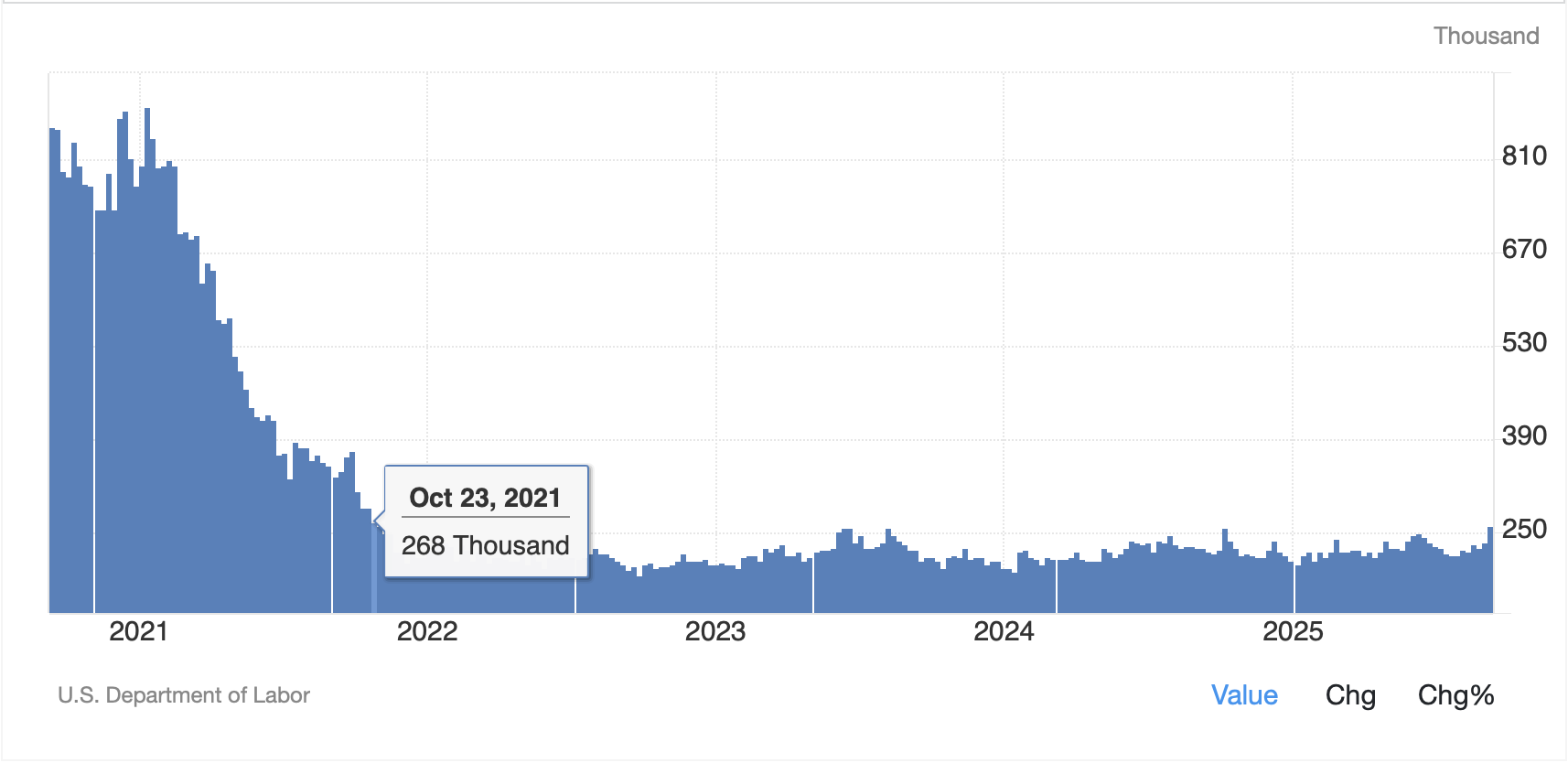
While I spent most of yesterday discussing the CPI data, which came out on the warm side of things with headline rising 0.4% M/M, a tick higher than forecast, although the Y/Y number at 2.9% was as expected, it seems far more attention than normal was paid to the Initial Claims data.  As it happens, the last time Initial Claims printed this high, 263K, was October 2021.
Source: tradingeconomics.com.

Now, we all remember last September, just prior to the Fed cutting 50bps in a surprise move, and as it happens, the Claims data the week before that jumped as well, a one-off blip to 259K.  Of course, the Fed felt it had a political imperative back then to cut as a means of supporting their preferred candidate for President, VP Harris, but that is another story.  Nonetheless, a precedent has been set that a strong claims number with inflation still warm was sufficient to get them to move.  So, will they cut 50bps next week?

Right now, the Fed funds futures market is still pricing just an 8% probability of that move, so apparently that is not the market perception.  However, this is exactly the time where we should be seeing an article from the Fed Whisperer, Nick Timiraos, at the WSJ (aka Nickileaks), which ought to explain that changes in the labor market are sufficient to overcome any concerns about inflation, especially since there is a growing expectation that a recession is coming.  Look for it on Monday.

But let us consider this for another moment.  Based on BLS data, the median reading for Initial Claims since January 1967 is 339K, far more than we saw yesterday.  In addition, if you look at a long-term chart of the Claims data, or even the shorter-term one above, while it is possible this is the beginning of a trend higher in Claims, there is no evidence yet for that, and blips higher are pretty common throughout the data set.
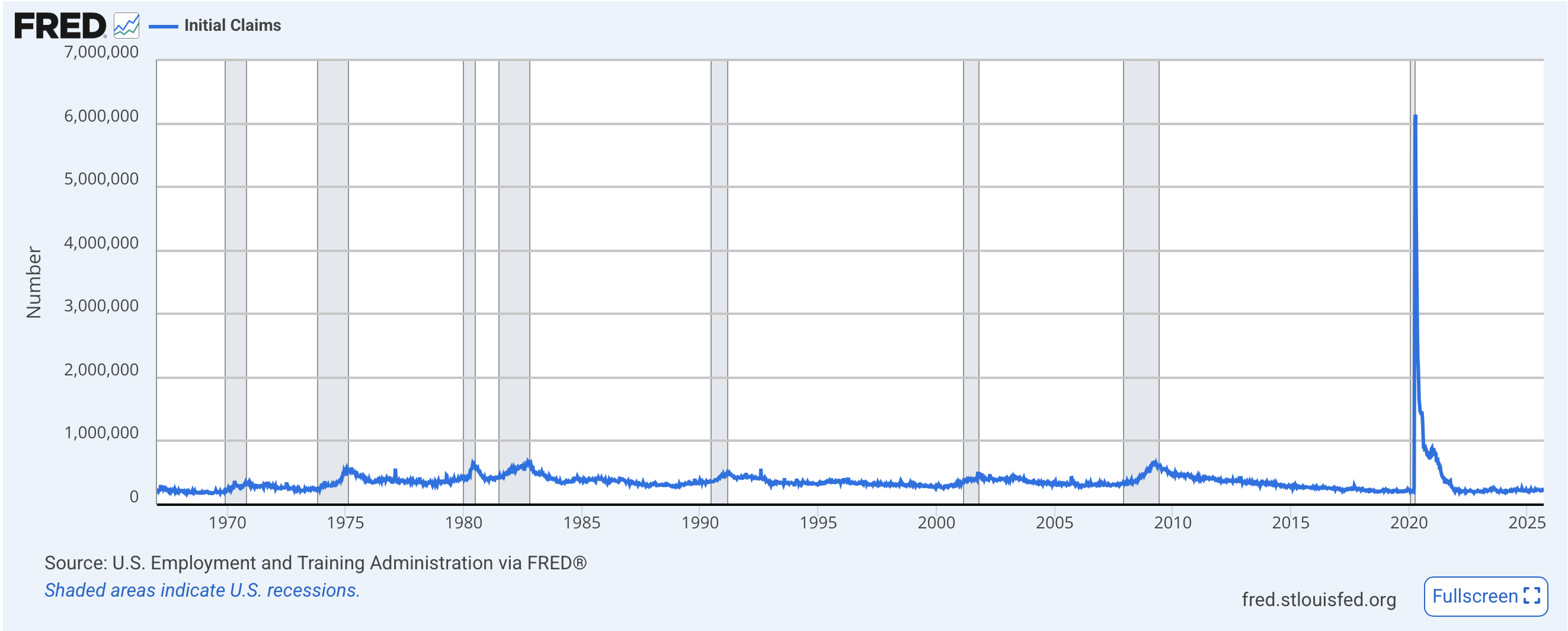
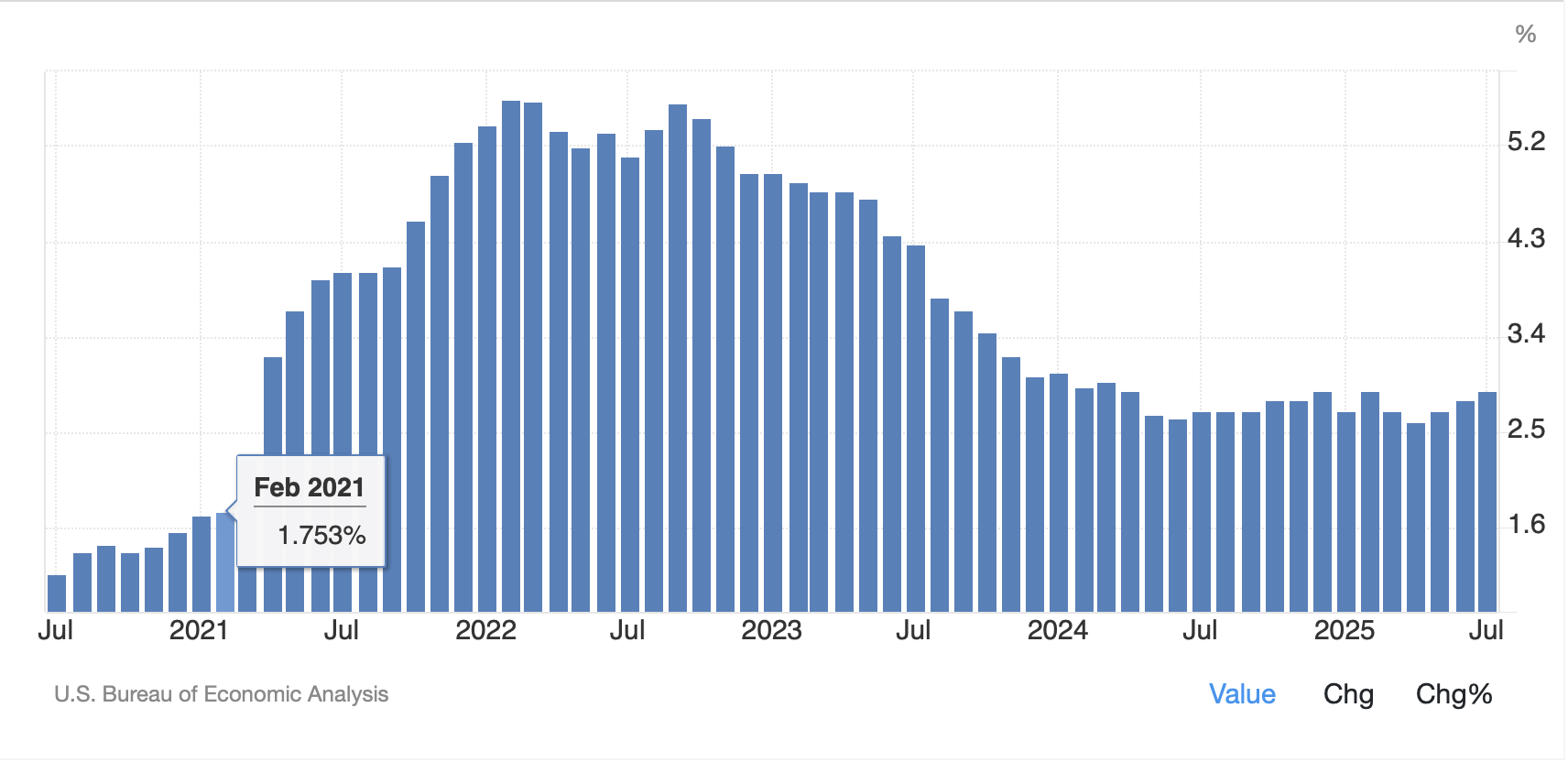
The one caveat here is that if we look at the recessions highlighted in gray in the above chart, the Claims data didn’t really rise until the end of the recession, so there is a chance that we are seeing the beginnings of bigger problems.  Certainly, if Claims data starts to climb further and we see 300K, there will be a stronger case to anticipate a recession.  But we haven’t yet seen that.  Alas, what we do know from Powell’s last press conference is that the Fed has basically abandoned their inflation target, so despite the fact it has been 54 months (February 2021) since core PCE has been at or below 2.0%, and even though the very idea that rate cuts are appropriate is remarkable, it seems the case for 50bps is strengthening.  
Source: tradingeconomics.com

But, as Walter Cronkite used to say, “That’s the way it is.”

So, how have markets been digesting this news?  Well, yesterday saw US equity indices make yet another set of new all-time highs on the prospects of a 50bp cut and that has largely fed to other equity markets around the world.  Bond yields remain quiescent, at least out to 10 years, although the really long stuff is having a tougher time, and the dollar remains range bound.  Aside from equities, the only market really moving is precious metals, which continue to rally nonstop.

Starting in Asia, Tokyo (+0.9%) rallied nicely as a combination of anticipated Fed cuts and the calming of trade tensions with the US has investors there feeling giddy.  It, too, has reached new all-time highs.  Hong Kong (+1.1%) also had a good session although China (-0.6%) didn’t follow through as profit taking was evident after what has been a very strong run in mainland stocks lately.  Elsewhere in the region, only two markets (Singapore and Philippines) lagged, and those were very modest declines of -0.3%.  Otherwise, gains of up to 1.5% were the norm.

However, Europe didn’t get that memo this morning with continental bourses all under pressure (DAX -0.3%, CAC -0.5%, IBEX -0.7%) amid a growing realization that the ECB may have finished its cutting cycle, at least according to Madame Lagarde’s comments yesterday expressing confidence the bank is in a “good place”.  However, under the rubric bad news is good, UK stocks (+0.3%) are edging higher after data showed GDP flatlined in July with the Trade deficit rising, and IP falling sharply (-0.9%) as traders are becoming more convinced the BOE will cut rates despite much stickier inflation than their target level.  Remember, too, the BOE’s mandate is entirely inflation focused, but these days, none of that matters!  Finally, US futures are either side of unchanged as I type (7:00).

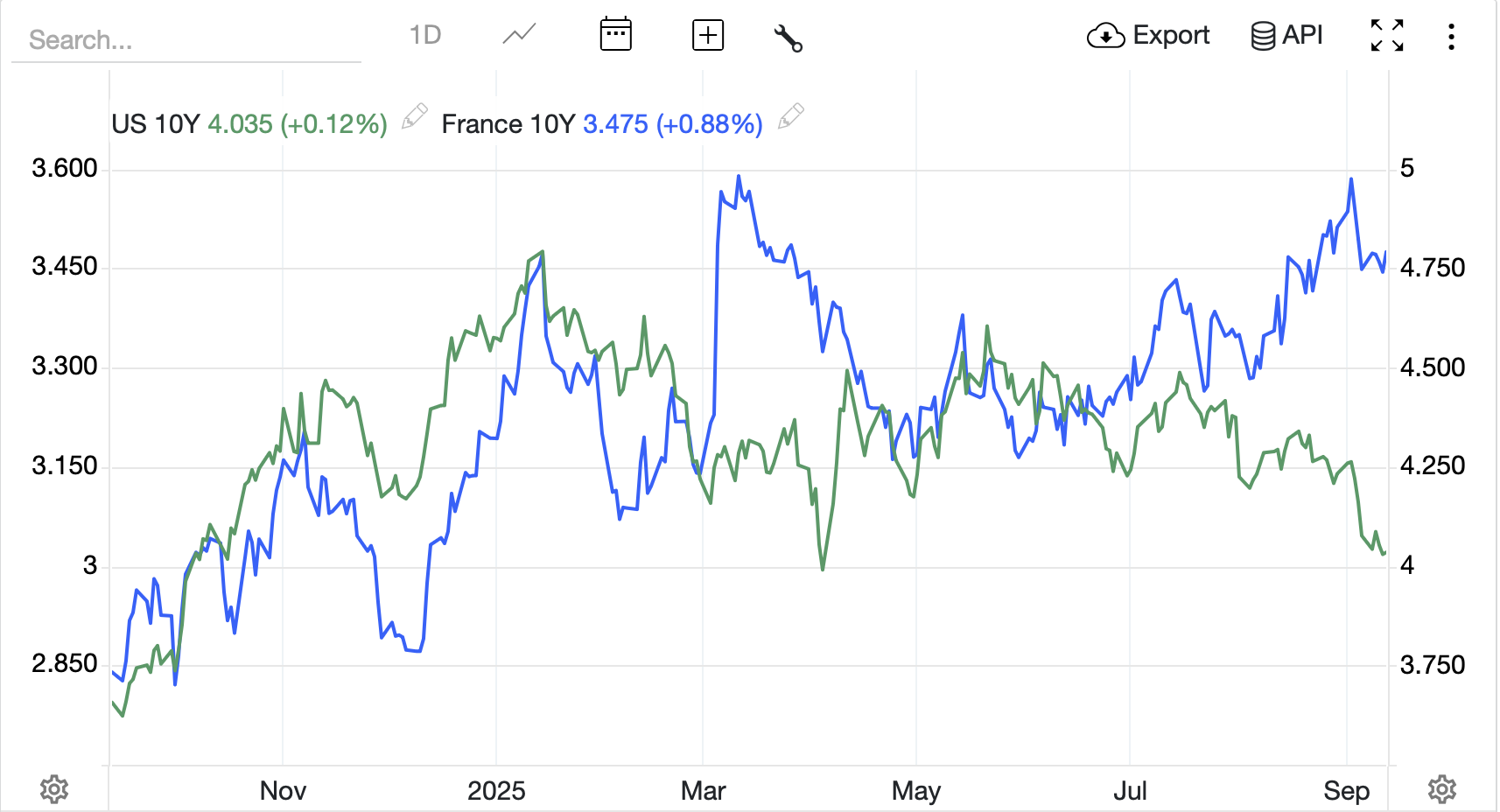
In the bond market, yields remain in their longer-term downtrend in the US although have edged higher by 1bp overnight.  European sovereign yields are higher by 3bps across the board as there are still growing concerns over French fiscal deficits and the fact that the ECB has finished cutting implies less support there.  It is interesting to look at the difference in performance between US and French 10-year bonds as per the below, as despite much angst over the US fiscal profligacy, which is well-deserved, investors still feel far more comfortable with Treasuries than with OATs.
Source: tradingeconomics.com

In the commodity markets, oil (+1.3%) is rebounding from yesterday’s decline and, net, continues to go nowhere.  Whatever the catalyst is that will change this view, it has not made an appearance yet.  Meanwhile, like the broken record I am, I see gold (+0.5%) and silver (+1.9%) continuing to rally as more and more investors around the world flock to the precious metals as they fear the destruction of the value of their fiat currencies.  And they are right because there is not a single central bank around (perhaps Switzerland and maybe Norway) that is concerned about inflation as evidenced by the fact that despite the fact inflation rates are running far higher than they had pre-Covid, every central bank is in a cutting cycle except Japan, and they have stopped hiking despite CPI there running at 3.4%!

Finally, the dollar is modestly firmer as I type, although it had been a bit softer overnight, and basically going nowhere fast.  If I look at the movement in the major currencies over the past month, only NOK (+3.0%) stands out on the back of higher than anticipated inflation readings and growing expectations that the Norges Bank, which did cut rates a few months ago, will soon have the highest interest rates in the G10 after the Fed cuts next week and they remain on hold.  As to today’s movement, JPY (-0.35%), NZD (-0.4%) and NOK (-0.3%) are the largest movers, with the EMG seeing even smaller movement than that.  Again, it is difficult to find a compelling short-term story here.

On the data front, this morning brings Michigan Sentiment (exp 58.0) and that’s it.  No Fed speakers ahead of the meeting next week, so we will be reliant on either the White House making some new, unexpected, announcement, or the dollar will take its cues from the equity markets.  It is interesting that the precious metals complex continues to perform well despite the dollar edging higher.  To me, that is the biggest story around.

Good luck and good weekend

Adf
Yellen’s Lifeblood

The QRA was quite the dud
Though mentioned, in Q3 a flood
Of new bonds are coming
To keep the gov humming
As debt is Ms Yellen’s lifeblood
 
So, now all eyes turn to the Fed
With doves looking on with much dread
According to Nick
Chair Powell will stick
With Higher for Longer ahead


Below is the actual QRA release from the Treasury which I thought would be useful to help everyone understand how benign the statement seems, although it has great importance.  

WASHINGTON – The U.S. Department of the Treasury today announced its current estimates of privately-held net marketable borrowing[1] for the April – June 2024 and July – September 2024 quarters. 

  • During the April – June 2024 quarter, Treasury expects to borrow $243 billion in privately-held  net marketable debt, assuming an end-of-June cash balance of $750 billion.[2]  The borrowing estimate is $41 billion higher than announced in January 2024, largely due to lower cash receipts, partially offset by a higher beginning of quarter cash balance.[3]
  • During the July – September 2024 quarter, Treasury expects to borrow $847 billion in privately-held net marketable debt, assuming an end-of-September cash balance of $850 billion.

During the January – March 2024 quarter, Treasury borrowed $748 billion in privately-held net marketable debt and ended the quarter with a cash balance of $775 billion.  In January 2024, Treasury estimated borrowing of $760 billion and assumed an end-of-March cash balance of $750 billion.  Privately-held net marketable borrowing was $12 billion lower largely because higher cash receipts and lower outlays were partially offset by a $25 billion higher ending cash balance.  

Additional financing details relating to Treasury’s Quarterly Refunding will be released at 8:30 a.m. on Wednesday, May 1, 2024.

The market response was muted, at best, as bonds barely budged throughout the day.  Clearly, the surprise that we received back in October was not part of today’s message.  Two things I would note are first, Q3 borrowing is a huge number, $847 billion expected, although it seems to have been largely ignored; and second, the action really comes tomorrow when Yellen will describe the mix of coupons and T-bills that she plans to issue this quarter.  However, given the Q2 numbers are so much smaller than either Q1 or Q3, while there may be some signaling effect, the actual impact on the fixed income markets seems likely to be muted.

Which takes us to the FOMC meeting that begins this morning and will conclude tomorrow at 2:00pm with the statement and then Chairman Powell will hold his press conference at 2:30.  But I have a funny feeling we already know what is going to happen as this morning’s WSJ had an article from the Fed whisperer, Nick Timiraos, explaining that higher for longer was still the play and that while there was no cause yet to consider rate hikes, the recent inflation data has done nothing to convince the Chairman that cuts are due anytime soon.  Now, this seems obvious to those of us paying attention given that the data continues to show a far more robust economy than many had anticipated, and more importantly, there has not been any type of inflation related print that indicated price pressures are abating very quickly.  Of course, one never knows what will happen at the presser, but it seems highly unlikely that the committee is in the mood to cut rates.

On this subject, if there is a move toward the dovish side, either with the statement or things Powell says in the press conference, I would take those very seriously as that would imply the Fed is no longer worried about inflation, per se, but more about doing what they perceive will benefit the current administration.  That would be hugely negative, in my view, for both the dollar and the bond market, although stocks and commodities would likely benefit greatly.  Ironically, it is not clear to me that cutting rates is going to be any help to President Biden as it is not going to change mortgage rates very much, and certainly not going to reduce credit card rates, so all it is likely to do is feed more inflation.  But one of the underlying narratives seems to be that a rate cut helps Biden’s election chances.  

Ok, with the Treasury and Fed out of the way, let’s look at overnight price action.  After modest gains in the US yesterday, most Asian equity markets performed well, although mainland Chinese shares were under some pressure (CSI 300 -0.5%).  This is interesting given the stories that the Chinese government is considering stepping up its support for the economy there with more borrowing at the national and local levels (total of ~$680B) to support overall activity as well as the property market.  I would have thought that was a positive, but I would have been wrong.  In Europe, preliminary GDP data showed that the economy across the major nations was not quite as bad as last quarter, but certainly not showing much strength.  Perhaps we are bottoming, but there is no V-shaped rebound coming.  Ultimately, equity markets on the continent are all lower as a result, with losses ranging from tiny (CAC -0.1%) to larger (IBEX -1.3%).  As to US futures, they are essentially unchanged this morning.

Meanwhile, bond yields are edging higher this morning with Treasuries (+1bp) just barely so, but all of Europe seeing yields rise by 3bps.  Perhaps investors are growing concerned that a rebound in growth in Europe is going to force rates higher, but the data this morning was really minimal.  In truth, I wouldn’t make much of today’s moves and rather focus on the trend since the beginning of the year where yields everywhere have rebounded following Treasuries.

In the commodity markets, oil (+0.4%) is bouncing slightly this morning after a couple of weak sessions as there appears to be a growing narrative that a ceasefire in Gaza is closer to being negotiated.  At least that’s the story making the rounds.  I will believe it when I see it actually happen.  But metals markets are under pressure this morning with all the main ones sharply lower (Au -0.8%, Ag -1.5%, Cu -1.0%, Al -0.5%).  Now, given how far these have moved higher over the past month, it should be no surprise there is a correction.  Has this changed the longer-term narrative?  I think not, but remember, nothing goes up in a straight line.

Finally, the dollar is modestly stronger this morning as the yen (-0.4%) starts to give back some of its intervention inspired gains from yesterday.  Apparently, the MOF spent ¥5.5 trillion (~$35B) in their activities yesterday and we are more than 1% lower (dollar higher) than the yen’s post intervention peak.  I expect that we will continue to see this move, especially if the Fed maintains its current policy stance.  Elsewhere, commodity currencies are under pressure (AUD -0.5%, ZAR -0.4%) on the back of the weaker metals prices while financially oriented currencies have shown much less activity, with all of them somewhere on the order of 0.2% weaker.  As I wrote above, a substantive change by the Fed will have an impact on the dollar, I just don’t see that happening this week.

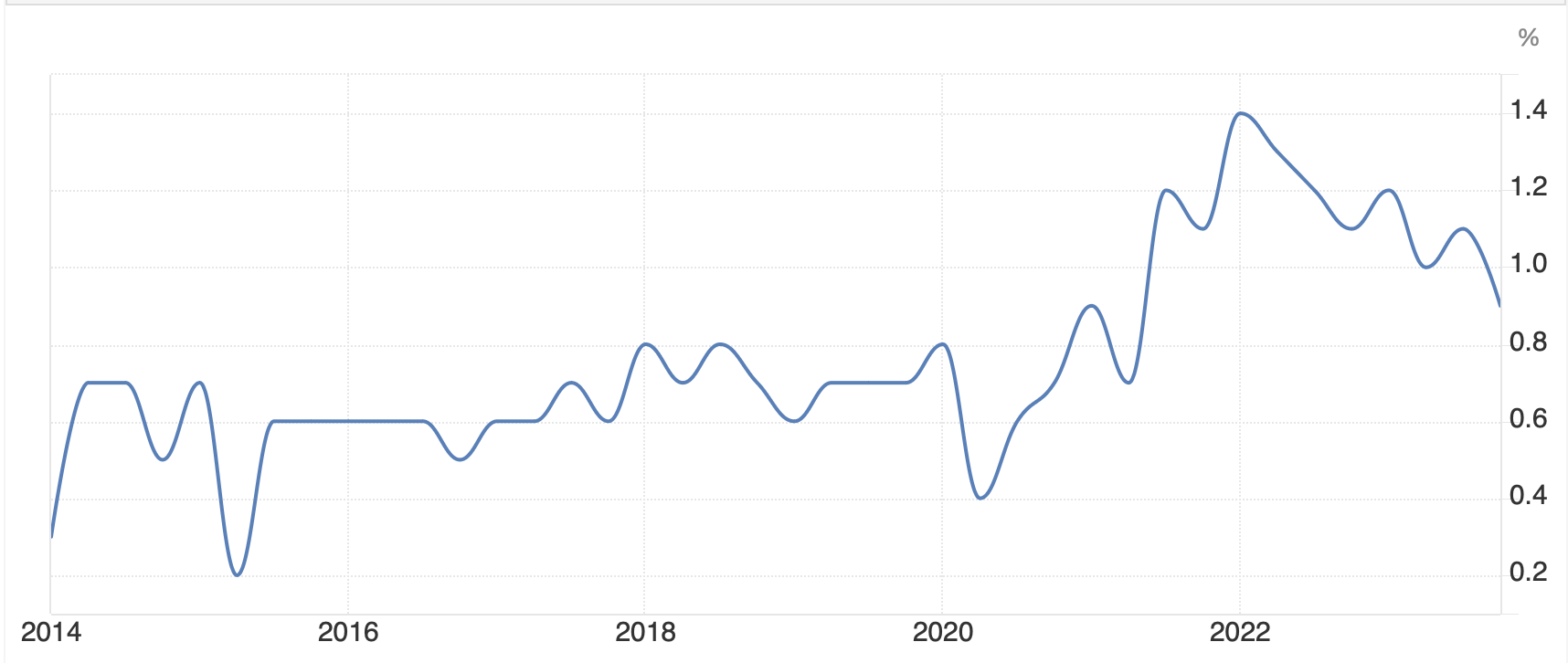
On the data front, there are a few things released this morning as follows: Employment Cost Index (exp +1.0%), Case-Shiller Home Prices (6.7%), Chicago PMI (44.9) and Consumer Confidence (104.0).  The ECI is something to which the Fed pays close attention as one of the best measures of the wage situation in the US.  As you can see from the below chart, while those costs have been declining, they remain well above the pre-pandemic levels and thus remain a concern for the Fed.  And a move back to 1.0% would indicate things have stopped declining.

Source: tradingeconomics.com

That’s really all we have today as the market awaits tomorrow’s Fed as well as Friday’s NFP data.  My take is there is very little chance the Japanese come back into the market soon, and so a grind higher in the dollar remains my base case.

Good luck

Adf

Goldilocks Dream

It seems many thought the word ‘could’
Was feeble when posed against ‘would’
The fact Chairman Jay
Had phrased things that way
Last month, for the bulls, is all good

And so, the new narrative theme
Is Jay is convincing his team
No more hikes are needed
And they have succeeded
In reaching the Goldilocks dream

The following quote from a weekend WSJ article by Fed whisperer Nick Timiraos is almost laughable in my mind.  

            This is apparent from how Fed Chair Jerome Powell recently described the risk that firmer-than-expected economic activity would slow recent progress on inflation. Last month, he twice used the word “could” instead of the more muscular “would” to describe whether the Fed would tighten again.Evidence of stronger growth “could put further progress at risk and could warrant further tightening of monetary policy,” he said in Jackson Hole, Wyo.

Talk about parsing language to the nth degree!  I bolded the line that I found the most ridiculous, but as we all know, my view does not drive the markets nor policy.  However, as I had written last week, we have definitely seen a shift amongst some of the FOMC members with respect to the idea of another rate hike this year.  Timiraos is widely believed to have the inside track to Chairman Powell, and now that the FOMC is in their quiet period ahead of the September 20th meeting, this will be the mode of communication.  

I guess the big risk of going all in on the Fed is done is we are still awaiting CPI Wednesday morning and with energy prices continuing to climb, I fear the opportunity for a high surprise is very real.  Literally every story that is written in the mainstream media these days tries to talk up the prospects of the economy and, correspondingly, for further equity market gains.  To me, there is a lot of whistling past the graveyard here, but so far, equities have held in despite some weaker data.  The one thing I would highlight is the market feels quite complacent with implied volatility across numerous markets, stocks, bonds, commodities and FX, all quite low.  Hedge protection is cheap here, if you need to hedge something, don’t wait for the move.

Ueda explained
We may soon understand if
Inflation is back

If we judge that Japan can achieve its inflation target even after ending negative rates, we’ll do so,” said Ueda.  This was the key sentence in a weekend interview published last night.  The market response was immediate with the yen jumping more than 1% in the early hours of Asian trading before ceding a large portion of those gains when Europe walked in the door.  However, regardless of today’s price action, there is a longer-term signal here that is important to understand.  It has become clear that the BOJ is becoming somewhat uncomfortable with the speed of the yen’s decline.  Prior to last night’s session, the yen had fallen 7.75% from July’s levels, which is a pretty big move for less than 2 months.  There is no secret to why the yen continues to decline, the vast policy differences between the US and Japan are sufficient reason.  While Ueda-san made no promises, this was very clearly a signal that a change is coming soon.  In the near-term, hedgers need to be very careful and those who are hedging JPY assets or revenues should really consider buying JPY puts outright or via collars as there is every reason to believe that further yen strength is coming by the end of the year.

Meanwhile, on the western edge of the Yellow Sea, the PBOC was quite vocal last night as well.  On the back of Chinese monetary data that showed a larger rebound than forecast in New Loan data as well as Aggregate Financing data, the PBOC issued the following statement, “Participants of the foreign exchange market should voluntarily maintain a stable market.  They should resolutely avoid behaviors that disturb market orders such as conducting speculative trades.”  That is very clear language that the PBOC is unhappy with the recent CNY performance.  In addition, the PBOC issued new regulations regarding large purchases of dollars telling banks that any corporate client that wants to purchase more than $50 million will need to get approval to do so, and that approval will take quite some time to be forthcoming.

It should be no surprise that the renminbi is stronger this morning, having rallied 0.65% and thus closing the gap with the CFETS fix for the first time in months.  Of course, given the double whammy of Japanese and Chinese policy implications, it should be no surprise that the dollar is softer overall.  Especially when considering the WSJ article explaining that the Fed may be finished hiking rates.  So, we have seen the dollar fall against all its counterparts in the G10 and most in the EMG blocs.  Aside from the yen (+0.65%), we have seen the most strength in AUD (+0.8%) which has benefitted from the overall Chinese story, both the currency issues and the better data, as well as the rise in commodity prices.  Kiwi (+0.55%) and SEK (+0.45%) are next on the list as there is broad-based dollar weakness today after an eight-week run higher.

In the emerging markets, ZAR (+1.1%) is actually the best performer on the commodity story as well as the general dollar weakness, but after that and CNY, HUF (+0.6%) is the only other currency in the bloc with substantial gains.  The story here is what appears to be a shift from zloty to forint as the market continues to punish PLN (-0.35%) after the surprisingly large rate cut last week by the central bank there.  Net, however, the dollar is clearly under pressure this morning.

If we turn to other markets, though, things don’t seem to make as much sense.  For instance, oil prices (-0.4%) are a bit softer while metals prices (AU +0.4%, CU +1.7%, AL +1.0%) are all firmer.  Now, the metals seem to be behaving well on the back of the dollar’s weakness, but oil’s decline is not consistent with that view.

In the equity markets, last night saw a mixed picture in Asia with the Nikkei (-0.4%) and Hang Seng (-0.6%) both under pressure while the CSI 300 (+0.75%) and ASX 200 (+0.5%) both responded well to the news.  For the Nikkei, the combination of prospects of higher rates and a stronger yen are both negative for Japanese stocks, while much of the rest of APAC benefitted from the Chinese story.  In Europe, the bourses are all green, averaging about +0.5% as investors continue to believe the ECB is done hiking rates with the market now pricing less than a 40% probability of a hike this week and not even one full hike priced into the curve over time.  US futures are also green as investors embrace the WSJ article’s hints that the Fed is done.

Finally, the big conundrum is the bond market, which is selling off across the board.  Or perhaps it is not such a conundrum.  If both the Fed and ECB are done hiking despite inflation continuing at a pace far above target, then the attractiveness of holding duration wanes dramatically.  Add to that the gargantuan amount of debt yet to be issued and the fact that the biggest buyers of the past decades, China and Japan, seem to be backing away from the market, and it will require much higher yields for these issues to clear.  Of course, one could also look at this as a risk-on session with stocks higher and bonds getting sold along with the dollar, so perhaps that is today’s explanation.  Just beware the movement here.  10-Year Treasury yields (+3bps) are back to 4.30%, and if the story is no more Fed tightening thus higher inflation, that is unlikely to be a long-term positive for equities.  At least that’s what history has shown.

On the data front, the back half of the week brings the interesting stuff.

TuesdayNFIB Small Biz Optimism91.5
WednesdayCPI0.6% (3.6% Y/Y)
 -ex food & energy0.2% (4.3% Y/Y)
ThursdayECB Rate Decision3.75% (current 3.75%)
 Initial Claims227K
 Continuing Claims1695K
 Retail Sales0.1%
 -ex autos0.4%
 PPI0.4% (1.3% Y/Y)
 -ex food & energy0.2% (2.2% Y/Y)
FridayEmpire Manufacturing-10.0
 IP0.1%
 Capacity Utilization79.3%
 Michigan Sentiment69.2

Source: Bloomberg

As we are in the Fed quiet period, there will be no Fedspeak, so it is all about the data this week.  Beware a hot CPI print as that will pressure the narrative of the soft landing.  This poet’s view is no soft landing is coming, rather a much harder one is in our future, but at this point, probably not until early next year.  Until then, and despite today’s news cycle, I still think the dollar is best placed to rally not fall.

Good luck

Adf