A Day to Give Thanks

Today is a day to give thanks
To those who flew planes and drove tanks
In multiple wars
And too many tours
No matter which service or ranks
 
Now, turning to markets at hand
The bulls, yesterday, had command
So, risk assets rose
While pundits compose
A narrative, things are just grand


And the thing is, there is just not that much new of note to discuss this morning.  As it is Veteran’s Day here in the US, banks and the bond market are closed, although equities and commodities markets are open.  But the news cycle overnight was led by the fact that Softbank sold their NVDA stake for a $5.8 billion profit.  And that’s pretty thin gruel for someone who writes about market activities.  Everything else is about who won/lost regarding the shutdown and frankly, that is something markets tend to ignore.

With that in mind, and given the absence of any substantive data, let’s go right into market activity overnight.  Asian equity markets were mixed although I would say there was more red (Japan, China, Taiwan, Australia, Indonesia, Thailand, Philippines) than green (HK, Singapore, Malaysia, Korea, India) but it appears most of the activity had limited volumes and there are few stories of note as drivers.  

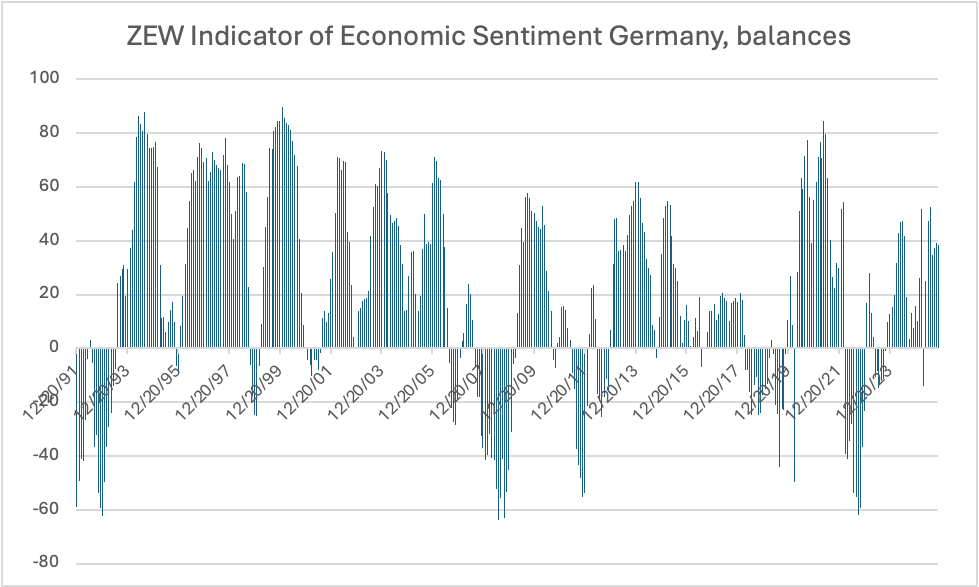
In Europe, though, things are looking better with all the major bourses higher this morning, led by the UK (+0.8%) where bad news was good for stocks as the Unemployment Rate ticked higher, to 5.0%, which has markets now pricing an 80% probability of a rate cut by the BOE next month.  This has been enough to help most European markets higher (CAC +0.65%, IBEX +0.5%) except for the DAX (0.0%) which is lagging after the ZEW Sentiment Index was released at a weaker than forecast 38.5, which was also down from last month’s reading.  

I think it might be worthwhile, though, to take a longer-term perspective on this sentiment survey.  As you can see from the chart below (data from ZEW.de), the current level is very middle of the pack.  In fact, the long-term average reading is 21.3, but of course, that includes numerous negative readings during recessions.  I might argue that things in Germany are not collapsing, but nowhere near robust.  My concern, if I were a German policymaker, is that it appears the survey has peaked at a much lower level than history, an indication that the best they can hope for is still mediocre.
Finally, US futures are pointing slightly lower, -0.2% or so, at this hour (7:50), arguably a little hangover from yesterday.

In the bond market, of course, Treasury yields aren’t trading, but European sovereigns are essentially unchanged as well, except for UK Gilts, which have seen yields slip -7bps on that higher Unemployment data driving rate cut expectations.  Given the ongoing fiscal issues in the UK, where they cannot seem to come up with a budget and all signs point to a worsening debt position, I’m not sure why yields there would decline, but that’s what’s happening.

Turning to the commodity markets, oil (+0.5%) continues to trade either side of $60/bbl, making no headway in either direction.  I listened to an excellent podcast yesterday with Doomberg, who once again highlighted his view that the long-term direction of the price of oil is lower.  The case he makes is that on an energy basis, NatGas, even though it is up 48% in the past year, remains significantly cheaper than oil, one-quarter the price, and that the arbitrage will close driving the price of oil lower and the price of NatGas higher.  Remember, politics is far more impactful on oil drilling than geology.  Ask yourself what will happen to the price of oil if Venezuela’s government falls and is replaced by a pro-US government allowing the oil majors in to help tap the largest oil reserves on the planet.  I assure you that is not bullish for the price of oil.

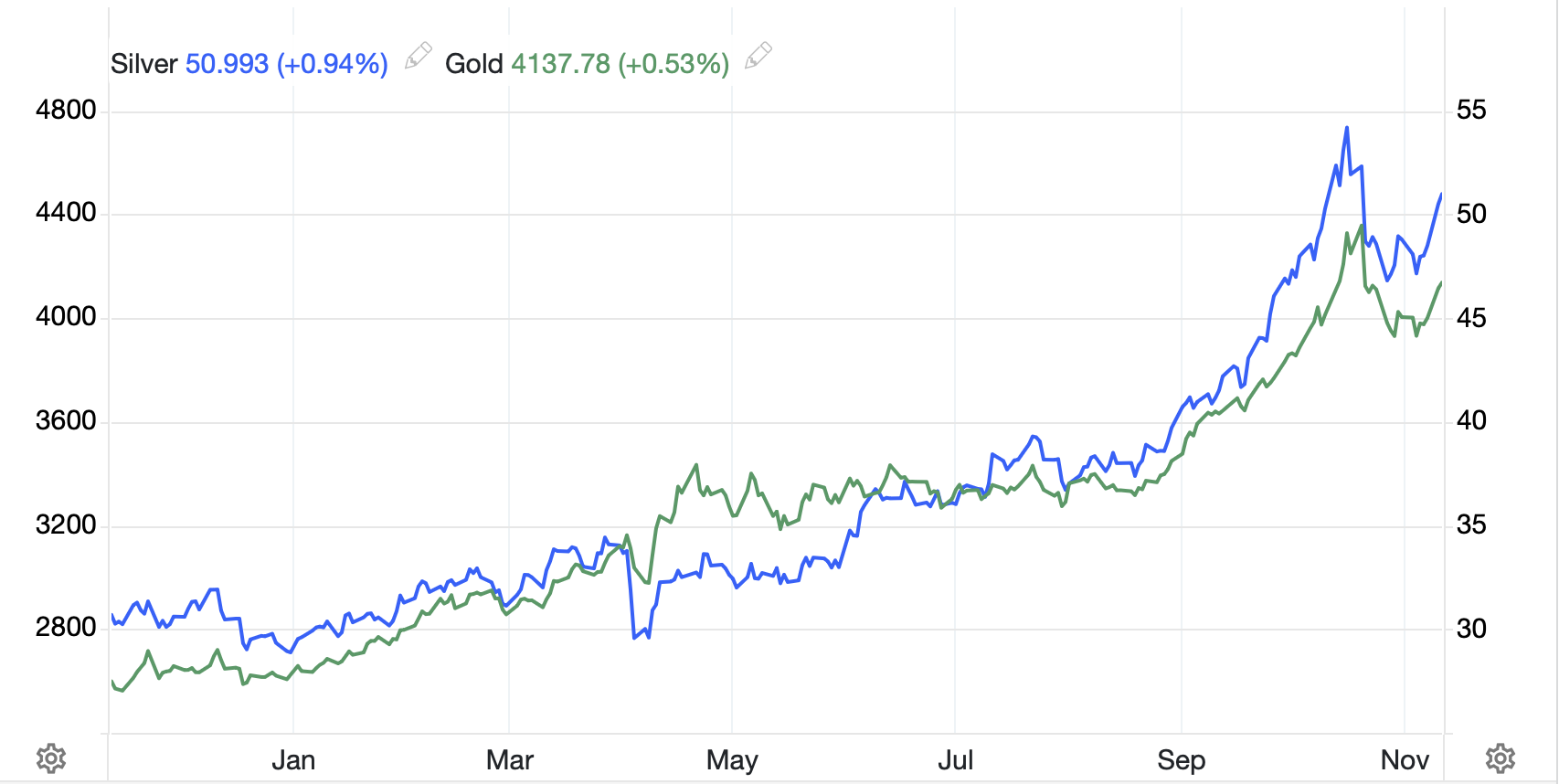
As to the metals markets, after yesterday’s very impressive moves, they are continuing higher this morning, at least the precious metals are with gold (+0.5%), silver (+0.8% and now over $50/oz) and platinum (+0.75%) all extending their gains.  These are the same charts in the metals, and my take is we had a blowoff run which has now corrected, and we could easily see another leg higher of serious magnitude.
Source: tradingeconomics.com

Finally, the dollar is mostly drifting lower this morning, although not universally so.  While the euro (+0.15%), CHF (+0.6%) and Scandies (NOK +0.6%, SEK +0.4%) are all firmer, the pound (-0.2%) and Aussie (-0.2%) are suffering a bit.  Yen is unchanged along with CAD.  In the EMG bloc, it is also a mixed bag with INR (+0.25%) and PLN (+0.25%) having solid sessions although KRW (-0.6%) is going the other way and the rest of the bloc is +/- 0.1% or so different.  Again, the dollar is just not that exciting in its own right.

There is a new data point coming out, ADP Weekly Employment change, seemingly in an effort to fill in gaps until the BLS gets back to work.  However, given its newness, it is not clear what value it will have to markets.  There is also a speech by Governor Barr but tomorrow is when the Fedspeak really hits.

It is shaping up to be a quiet day, and I suspect absent a major equity move, or some White House bingo, FX markets are going to drift nowhere of note.

Good luck

adf

Mind-Numbing

According to those in the know
The BBB’s ready to go
The vote is this morning
So, this is your warning
That President Trump will soon crow
 
As well, ere the Fourth of July
The NFP may quantify
If rate cuts are coming
(A subject, mind-numbing)
Or whether Fed funds will stay high


Perhaps this will be the last day we hear about the Big Beautiful Bill, or at least the last day it leads the news, as it appears that by the time you read this, the House will have voted on the changes and by all accounts it is set to pass.  If so, the President will sign it tomorrow amidst great fanfare and then it will just be a secondary story when somebody complains about something that was in the bill.  However, the drama over passage will have finally ended.  

(I guess what has really led the news was that Diddy was found not guilty of the RICO charges and Kohburger in Idaho got a plea deal avoiding the death penalty, but neither of those are market related.)

At any rate, the question now to be asked is will the BBB perform as advertised by either side of the aisle?  Experience tells us that while the economy will not take off rapidly while inflation collpases, neither will there be people dropping in the streets because of the changes in Medicare, although if you listened to the pundits on both sides of the aisle, that is what you might expect.  While this is not quite as bad as Nancy Pelosi’s immortal words, “we have to pass the bill to find out what’s inside it”, the fact that it approaches 1000 pages in length implies there is a lot inside it.

From what I have read, and it has not been extensive, it appears that there is some stimulus in the bill in the form of tax relief on tips and overtime as well as reductions for seniors, and spending on defense and the border.  It also appears there have been several previous subsidies, notably for wind and solar, that are being removed.  The fact that the CBO is claiming it will increase the budget deficit by $1.5 trillion, and given the fact that Jim Cramer is the only one with a worse track record than the CBO, tells me it will have limited impact on the nation’s fiscal stance initially, although if growth does pick up, that will clearly help things.

Which takes us to the other story this morning, the payroll report.  Here are the current median forecasts by economists for the results, as well as the rest of the data to be released:

Nonfarm Payrolls110K
Private Payrolls105K
Manufacturing Payrolls-5K
Unemployment Rate4.3%
Average Hourly Earnings0.3% (3.9% Y/Y)
Average Weekly Hours34.3
Participation Rate62.3%
Initial Claims240K
Continuing Claims1960K
ISM Services50.5
Factory Orders8.2%
-ex Transport0.9%

Source: tradingeconomics.com

Some will point to yesterday’s ADP Employment report which showed a decline of -33K, the first decline in more than 2 years, as a harbinger of a bad number, but as you can see from the chart below, there has been a pretty big difference between ADP (grey bars) and NFP (blue bars) for a while now.

Source: tradingeconomics.com

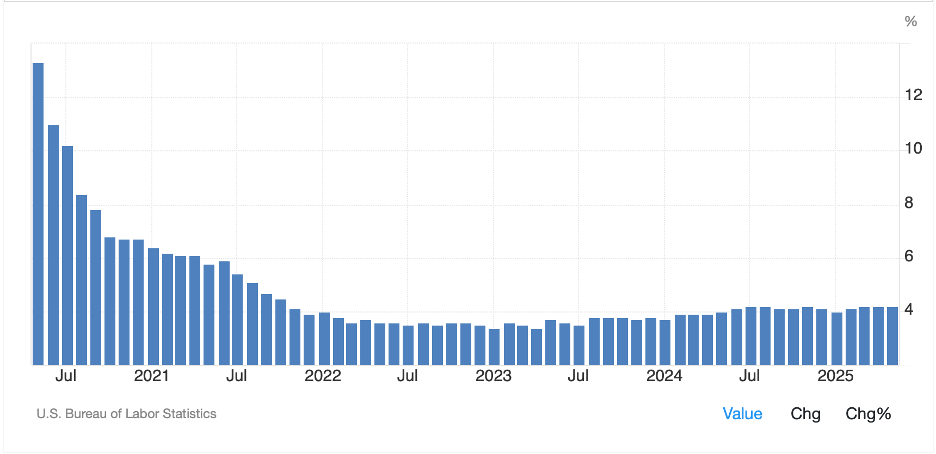
Perhaps of more concern is the Unemployment Rate, which is forecast to rise a tick to 4.3%, which would be its highest print since October 2021 and if I look at the chart below, it is not hard to see a very gradual trend rising higher here.  While markets really focus on NFP, I learned a long time ago from a very smart economist, Larry Kantor, that the Unemployment Rate was the best single indicator of economic activity in the US, and that when it is rising, that bodes ill for the future.  

Source: tradingeconomics.com

You may recall there was a great deal of discussion about a year ago regarding the Sahm Rule, which hypothesized that when the Unemployment Rate rose more than 0.5% above its cycle average within 12 months, the US was already in a recession.  The discussion centered on whether it had been triggered although the final claim was it hadn’t when extending the readings out to the second decimal place.  Now, for the past year, the Unemployment Rate has hovered between 3.9% and 4.2%, so there doesn’t seem to be any chance of a trigger here, although if it does rise, you can be sure you will hear about it.

And that’s what is on tap ahead of the long holiday weekend.  With that in mind, let’s look at the market action overnight. Excitement is clearly lacking in the equity markets these days as the summer doldrums are universal.  Yesterday’s new closing highs in the S&P 500 seem like they should be exciting but were anything but amid low volume.  As to Asia, Japan was flat, China (+0.6%) and Hong Kong (-0.6%) offset each other and in the rest of the region, other than Korea (+1.3%) which is starting to see a steady stream of foreign investment on the premise that the country is set to improve the regulatory structure for equities there, things were +/- a bit.

Meanwhile, in Europe, there is little net movement on the continent but the UK (+0.4%) is bouncing off recent lows after PM Starmer reiterated his support for Chancellor Reeves.  A story I missed yesterday was that when she was trying to make a case in parliament for spending cuts, the back bench liberals revolted, literally bringing her to tears.  The market response was that the UK would blow up its fiscal situation which saw Gilts tumble and yields rise 15bps yesterday at one point, while stocks fell.  But that problem has been addressed for now.  However, looking at the statement Starmer made, it reminded me of a baseball GM’s comments supporting his manager right before he fires him.

In the bond market, yields are declining, led by Gilts (-9bps) which are retracing yesterday’s gains on the above story.  But Treasury yields are down (-2bps) and European sovereigns are all seeing yields lower by between -4bps and -5bps.  In Japan, JGB yields are unchanged as PM Ishiba grapples with a trade deal where the US is keen to be able to export rice to the nation and Japan has a rice shortage with prices rising sharply but doesn’t want to accept imports.  Go figure.

In the commodity markets, oil (-0.2%) is slipping slightly after a solid rally over the past seven sessions where it rose over $3.50/bbl.  Gold (-0.3%) continues to trade around its pivot level of $3350/oz while silver (+1.0%) continues its longer run rally.

Finally, the dollar, which fell during yesterday’s session after I wrote, is effectively unchanged net this morning ahead of the data with very modest moves of +/-0.2% or less almost universal.  KRW (+0.4%) is the outlier here and based on equity inflows discussed above, that makes sense.

So, that’s where we stand heading into the payroll report and the long weekend.  If pressed on the NFP outcome, I expect a weak outcome, 50K or so, as the birth/death model continues to be revised.  But remember, the error bars on this number are huge.  However, if it is weak, look for the probability of a July rate cut (currently 25.3%) to rise and the equity market to follow that higher.  As to the dollar, I think for now, lower is still the trend.

Good luck and have a wonderful long weekend

Adf

A Future Quite Noeth

All eyes will be on NFP
As pundits are hoping to see
A modest result
That can catapult
The market to its apogee
 
If strong, the concern is that growth
Will strengthen and Jay will be loath
To cut rates once more
Which bulls will deplore
Implying a future quite noeth
 
If weak, then the problem for stocks
Is earnings will suffer a pox
So even if rates
Are cut in the States
The NASDAQ may still hit the rocks


It’s payroll day and especially after yesterday’s day of respect for the late President Carter closed equity markets in the US, investors are anxious to get back to business.  Here are the latest consensus estimates for the key figures to be released

Nonfarm Payrolls160K
Private Payrolls135K
Manufacturing Payrolls5K
Unemployment Rate4.2%
Average Hourly Earnings0.3% (4.0% Y/Y)
Average Weekly Hours34.3
Participation Rate62.8%
Michigan Sentiment73.8

Source: tradingeconomics.com

As well, there will be annual revisions to the household report today, which is the portion of the process that calculates the Unemployment Rate.  Next month we will see the annual revisions to the NFP, where estimates are already circulating that the number of jobs created in 2024 will be revised down by more than 1 million, nearly one-half of the claimed number (~2.2 million) created.

But ultimately, the reason this data point gets so much press is that it is half of the Fed’s mandate and so is closely watched by the FOMC as they consider any policy stance.  Yesterday, St Louis Fed president Musalem became the seventh or eighth Fed speaker since the last meeting to explain that more caution was warranted as the Fed tries to reduce what they still believe is a modest tightening bias.  “… [rate reductions] have to be gradual – and more gradual than I thought in September,” according to Musalem.  So, caution remains the watchword for every member of the FOMC and accordingly, the market is pricing just a 5% probability of a rate cut later this month.

The thing that has really changed over the past several months is the market’s reaction function to the data.  Part of this is based on the fact that it appears the Fed’s reaction function has changed a bit, and part of this is because the economic situation remains so confusing.

Regarding the Fed, given the fact that the data since they started cutting rates in September has been quite robust and given the fact they no longer have a political/partisan motive to cut rates, it strikes me it will be far harder for Powell and friends to justify further rate cuts from here.  After all, if GDP is growing at 3.0% and inflation is running at 3.3%, absent all other information, that data would truthfully argue for rate hikes.  However, there remains a large camp of analysts that continue to expect a significant slowdown in economic activity, with a number of well-respected voices claiming that we are already in a recession and have been in one since sometime in 2024.  

My view is that this confusion remains best explained by the concept of the K-shaped recovery where a smaller portion of the population, notably those with assets and investments in the markets, have been huge beneficiaries of Fed policies as they not only have seen their portfolios climb in value, but their cash is earning a nice return.  Meanwhile, a much larger percentage of the population, although a group that receives far less press from the financial reporters, continues to struggle given still rising prices and less overall opportunity for advancement.  This is the genesis of the labor strife we have seen, but there are many who remain left behind.  The problem for the Fed is they don’t really see this second cohort as their constituents, at least based on their policy actions.

As to today’s release, if we look at the recent Initial Claims data, it is consistent with a stronger number rather than a weaker one.  However, from a market perspective, I believe that a strong NFP number, something like 200K, will see a risk sell-off as the market continues to remove pricing for any rate cuts in 2025.  This will hurt stocks and likely bonds, although it will help the dollar and, surprisingly, commodities, as the market is likely to see increased demand forthcoming.

Elsewhere, aside from the wildfires in LA, which are a terrible tragedy, the other story in markets today revolves around the ongoing, slow motion disintegration of any remaining credibility in the UK government and its ability to address the many problems there.  Gilt yields continue to rise sharply, although I continue to hear many rationales as to why this is NOT like the October 2022 Gilt crisis.  Alas, while certainly the speed of this decline in Gilts is not quite as dramatic as we saw back then, the duration of the problem is far greater, and we have moved further now than then.  As you can see from the below chart, Gilt yields have risen 110bps since the middle of September, outpacing even Treasury yields and 10yr Gilts now yield 15bps more than Treasuries.  

Source: tradingeconomics.com

In fact, UK 10-year yields are the highest in the G10, although in fairness, they are not yet approaching levels like Mexico (10.6%), Brazil (14.75%) or Turkey (26.4%).  Perhaps Chancellor Reeves has those targets in mind.

OK, let’s see how markets behaved in the lead-up to the data this morning.  There was no joy in Mudville Asia last night as the Nikkei (-1.05%) slid amid new stories that the odds of a BOJ rate hike in two weeks are rising, while Chinese shares (Hang Seng -0.9%, CSI 300 -1.2%) were also under pressure amid news that the PBOC would stop buying bonds (ending QE) and additionally might be selling some to reduce liquidity in Hong Kong as they attempt to slow the decline of the renminbi.  The rest of the region was similarly under pressure across the board. 

In Europe, the picture is more nuanced with the DAX (+0.4%) and CAC +0.3%) showing some modest gains after slightly better than expected French IP data.  However, the FTSE 100 (-0.4%) and other continental bourses (IBEX -0.9%) are not quite as positive, with the FTSE clearly feeling pressure from the overall negative sentiment on the UK, while mixed data elsewhere is undermining any investor sentiment.  US futures at this hour (7:15) are pointing lower by about -0.25% across the board.  Fears of a strong number?

In the bond market, Treasury yields continue to climb, as they are holding onto yesterday’s rise of 5bps and this morning we are seeing European sovereign yields all creep higher by 1bp to 2bps.  JGB yields also rose 2bps overnight as part of that BOJ rate hike story.  In fact, the only market that didn’t see yields rise is China, where they remain within 2bps of their recent all-time lows

In the commodity markets, oil (+3.2%) is skyrocketing as continued cold weather increases heating demand while the reduction in inventories in Cushing, Oklahoma (the main point for NYMEX contract settlements) has raised concern over available supply of crude.  Meanwhile, metals prices continue to climb steadily with gold (+0.3%) continuing its run alongside silver (+0.8%) and copper (+0.45%).  The demand for “stuff” remains strong as nations around the world slowly lose confidence in government bonds as an effective store of value.

Finally, the dollar is, net, little changed this morning with some gains and some losses although few large moves.  On the dollar’s plus side we see KRW (-0.5%), ZAR (-0.55%) and BRL (-0.35%) while the yen and renminbi have both seen modest gains (+0.1%) on the back of the liquidity reduction stories in both nations.  However, we must keep in mind the dollar, as measured by the DXY, remains above 109 and continues to strongly trend higher.  My take is the highs seen in autumn 2022 are the next target, so look for the euro to sink below parity and the pound well below 1.20, probably 1.15, before too long.

There are no Fed speakers on the schedule today, although I imagine we will hear from somebody after the data since they cannot seem to shut up.  However, after today, they head into their quiet period ahead of the next FOMC meeting, so until then we will need to rely on Nick Timiraos from the WSJ to understand what Powell is thinking.

While nothing is that clear, and we could easily see a weak NFP report, my take is we are far more likely to see a strong one with stocks and bonds selling off and the dollar rising further.

Good luck and good weekend

Adf