At Long Last

With Jay and the Fed finally passed
All eyes are on jobs, at long last
These readings of late
Have all had the trait
Of rising more than the forecast
 
But now that Chair Powell has said
No rate hikes are likely ahead
If NFP’s hot
While stocks will be bought
Will bond markets trade in the red?


As we are another day removed from the FOMC meeting, perhaps we can get a better sense of what investors believe the future will bring.  But the clear dovishness that Powell expressed, while a positive for markets yesterday, will force many to rethink the Fed’s reaction function to data going forward.  And there is no single piece of data that garners more reaction than the payroll report.  So, let’s start with a look at current median expectations:

Nonfarm Payrolls243K
Private Payrolls190K
Manufacturing Payrolls5K
Unemployment Rate3.8%
Average Hourly Earnings0.3% (4.0% Y/Y)
Average Weekly Hours34.4
Participation Rate62.7%
ISM Services52.0

Source: tradingeconomics.com

Nine of the past twelve months have resulted in headline numbers higher than the forecast and the recent trend remains for substantial growth.  Certainly, there has been limited indication based on this data, that the job market is under significant negative pressure.  Clearly, that is one of the keys for the Fed’s maintenance of their higher for longer stance as both inflation and the job market remain hot. 

But now that Powell has taken a rate hike off the table, or at least raised the bar dramatically, how will markets respond to a hot number?  In the past, another big beat would likely have seen the bond market sell off quickly and equities suffer on the thesis that not only was no rate relief going to be coming anytime soon, but that higher rates could be in the cards.  However, most investors appear to have made their peace with the current interest rate framework and if they are no longer concerned about even higher funding costs, a hot number may simply be seen as an indication that profitability is going to continue to improve, and stocks are a raging buy.  At the same time, while the long end of the yield curve is likely to suffer somewhat on a big beat, the front end is now anchored by Powell’s comments.  In essence, we could easily see the yield curve bear steepen as inflation concerns grow and bond investors reduce duration risk while the front end of the curve remains relatively static.

Of course, despite the recent past, this morning’s data could be soft with a much lower print.  In that case, given Powell’s clear dovish bias, I suspect the bond market would rally sharply, as it would really change the calculus on the timing of that first rate cut, and stocks would be flying along with commodities.  In fact, the only loser in this scenario would be the dollar.

As it currently stands, the Fed funds futures market is now pricing just a 14% probability of a cut in June and still about 40bps of cuts total for the rest of the year.  On a timing basis, September is now the estimated first chance for a cut.  But a soft number, anything below 200K I think, is very likely to see that June probability jump substantially.  In fact, it would not surprise me if that type of print resulted in a one-third probability of a June cut by the end of the session.  Many people really want to see the Fed cut, and so they will push on any chance to drive the narrative.

To complete the discussion on the US session, we also see the ISM Services data at 10:00 and included with that will be the prices paid data.  That has been an important data point for many analysts when trying to determine the future course of inflation.  As can be seen from the chart below, unlike many other inflation readings, this one has the look of a still intact downtrend.

Source: tradingeconomics.com

And finally, we hear from our first Fed speakers post Wednesday’s meeting, with Goolsbee, Williams and Cook all on the calendar.  As always, it is a mug’s game to try to guesstimate what this morning’s data is going to be like numerically, but based on the recent overall trend in data, I have a feeling that we are going to continue with strong results, and a continued risk rally.

A quick peak at the overnight session shows that while Japan and China remain closed, there was more green than red in Asia with the Hang Seng (+1.5%) leading the way higher, but gains, too, in Taiwan, Australia, New Zealand and Indonesia.  Alas, both South Korea and India were under pressure, so not as universal a positive as might be hoped.  In Europe, though, it is unanimous with every market higher, mostly by about 0.5%, clearly following yesterday’s US outcome as there was virtually no data or commentary to note there other than the Norgesbank leaving their base rate on hold as expected.  As to US futures this morning, they are higher on the strength of Apple’s positive earnings report, and perhaps more importantly its newest buyback plan of $110 billion this year!

In the bond market, after rates declined yesterday despite data indicating higher prices (Unit Labor Costs +4.7%) along with weaker activity (Productivity 0.3%), it is clear that investors are simply paying attention to the Chairman’s messaging.  So, yields fell across the board yesterday, with 2yr yields sliding 8bps while 10yrs fell only 5bps.  That is the exact response you would expect given the end of any thoughts of a rate hike.  European bond yields fell yesterday as well on the order of 4bps and this morning, everything, Treasuries and European sovereigns, are all seeing yields lower by one more basis point.

In the commodity markets, oil (+0.3%) is edging higher today after a pretty flat day yesterday, although remains more than 5% lower than when the week began.  It appears that we have seen substantial position reductions here, but they seem to be finished for now.  However, the surprising inventory builds of the past few weeks are likely to keep a lid on the price.  Metals markets, too, were benign yesterday although this morning, copper (+1.2%) is showing some life.  My take is the investment community here is waiting to get a better sense of the pace of interest rate adjustments (aka cuts) since that is what everybody is assuming.  As well, metals prices have rocketed higher over the past several months, so this corrective price action can be no surprise.

Finally, the dollar is a touch softer this morning, arguably on the back of the recent decline in yields.  The outlier here continues to be the yen, which is consolidating near 153 now, well below the initial levels seen on Monday that inspired the first wave of intervention.  Remember, Japanese markets are closed, so liquidity there is suspect but more importantly, as the narrative adjusts to the idea that US rates will not be rising from here, that reduces substantial pressure on the yen.  One other noteworthy mover yesterday was BRL, which rallied 1.5% on the back of an improved economic outlook helping to allay concerns of rate cuts coming soon.  Away from those two, though, the overnight session has seen generally modest USD weakness pretty much across the board.

And that’s really all we have for today.  As I said before, I expect the data will be above the median forecast based on the fact that has been its recent trend as well as the other solid data we have seen. 

Good luck and good weekend

Adf
Still Premature

The talk of the town has been gold
Whose rally, by some, was foretold
While Christine and Jay
Would give it away
Elsewhere it’s what folks want to hold
 
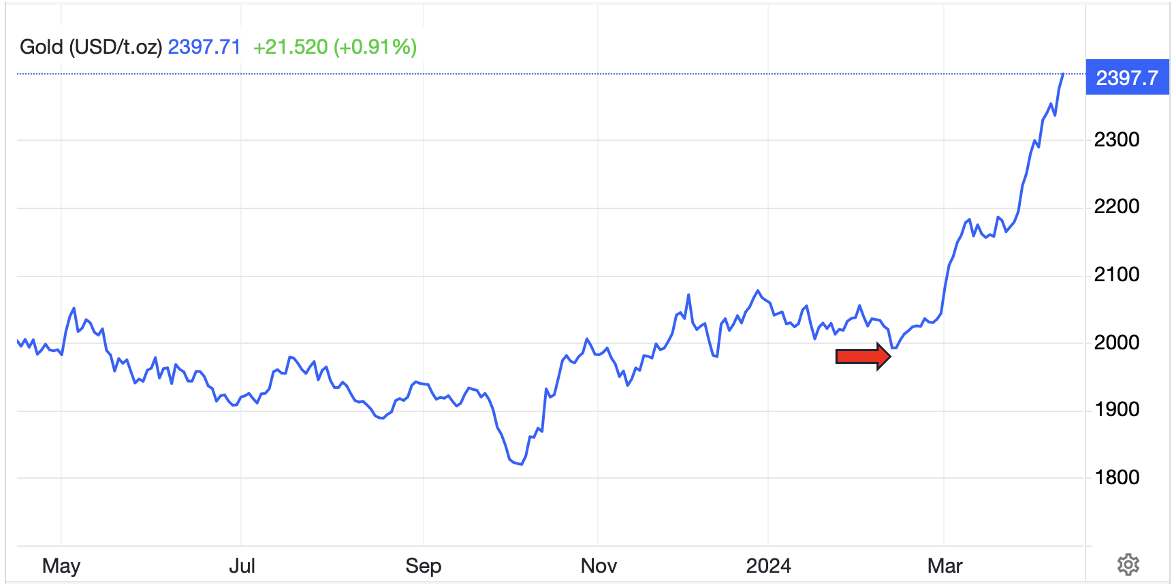
Under the rubric, a picture is worth a thousand words, have a look at the chart of the price of gold over the past twelve months below:

Source: tradingeconomics.com

That red arrow is pointing to the closing price on February 13, at $1988/oz, more than $400 lower than this morning’s market price.  There are many theories as to what is happening to drive this remarkable move in a commodity that has had a very limited role in the macroeconomic discussion for the past 53 years, ever since Nixon closed the gold window in 1971.  But the rally has been so strong it has fostered a host of theories as to what is driving it.  The latest is that there is a large, price-insensitive buyer acquiring large amounts outside the NY/London trading axis, with many people of the belief it is China and/or Russia preparing for a more complete break from the USD-based global monetary system.

Perhaps that is the case as we know from official reports that China has continued to acquire large amounts of gold over the past year.  But that has too much of a whiff of conspiracy theory in it for my taste.  My strong belief is that conspiracies are extremely difficult to maintain because people simply talk too much.  Rather, four decades of experience in financial markets, specifically FX and precious metals markets, has taught me that sometimes, markets move a long way on the basis of underlying fundamentals that have heretofore been ignored.  A simpler explanation could be that given its millennia-long history of being an able store of value and the fact that inflation remains rampant around most of the world while central bankers remain keen to cut interest rates and stop any efforts to fight it, many folks have decided it is a good idea to hold some portion of their personal wealth in the barbarous relic.  I know I do and have done so for quite a while.  I do not believe I am alone in that mindset.  Speaking of central bankers…

Said Christine, it’s still premature
To cut rates cause we’re not yet sure
Inflation is dying
Though we’re falsifying
It’s death from the Po to the Ruhr

At yesterday’s ECB meeting, as expected, there were no policy changes.  Madame Lagarde commented as follows: “If the Governing Council’s updated assessment of the inflation outlook, the dynamics of underlying inflation and the strength of monetary policy transmission were to further increase its confidence that inflation is converging to the target in a sustained manner, it would be appropriate to reduce the current level of monetary policy restriction.“  

That represents a lot of ten-dollar words to say, we want to cut rates, but we’re afraid if we do inflation might return so we are going to wait longer.  However, what was clear was that there is a wide range of views on the council.  For instance, this morning, Yannis Stournaris, the Greek central banker, said he thought that 4 cuts this year made sense.  At the same time, the last we heard from Robert Holtzmann of Austria, one cut was probably enough.  

Once again, Lagarde explained they are not waiting for the Fed, which is a good thing given the Fed seems less and less likely to cut this year at all, and Europe is in a recession already and needs lower rates.  This morning, the euro has fallen even further, down another -0.7%, and is back to levels last seen in early November.  It is becoming increasingly clear that monetary policies in the US and Europe are going to diverge further than currently priced and that does not bode well for the single currency going forward.

And those are really the big stories.  Yesterday’s PPI was a tick softer than expected, but the explanation was that in the calculation, the BLS seasonally adjusts the price of gasoline, so it showed a reduction despite the fact that gasoline prices, as we all know, have been rising steadily of late.  In any event, the market shook it off as we saw US equity markets perform well with both the S&P and NASDAQ reversing Thursday’s declines.  In Asia, however, while the Nikkei (+0.2%) managed a small gain, Chinese shares, and especially those in HK (-2.2%) had a lot more difficulty.  Chinese trade data was quite disappointing with the Trade balance shrinking dramatically (granted it is still >$50B) but both imports and exports declining.  And truthfully, all the other regional markets were lower to close the week.

European bourses, though, are all in the green, and nicely so, as investors and traders listen to the ECB doves and see more rate cuts, not less, coming.  This was confirmed with final pricing data showing the trend lower in inflation remains intact.  As to the US futures market, at this hour (7:50), they are lower by about -0.25% after weaker than expected earnings from JPM were released this morning.

In the bond market, after a week that has seen yields climb dramatically around the world, this morning Treasury yields are lower by 6bps, although still above 4.50%.  European sovereigns have seen yields decline even more, between 9bps and 11bps as the hope for rate cuts springs eternal.  Arguably, this is why the euro is under such pressure, the market narrative is gelling around the idea that the Fed won’t cut, and the ECB will be more aggressive.  One last thing, JGB yields are lower by 2bps this morning, but that is after a sharp rise seen in the wake of the US inflation report.  In fact, like many markets, with 10-year yields back at 0.84%, we are seeing levels not seen since November.

Turning to commodities, we have already discussed gold, and ignored silver (+2.0%) which is rallying even more aggressively, and copper (+1.80%) which is gaining on a combination of concerns over supply and a growing belief that China is going to add more stimulus to their economy.  Oil (+1.4%), too, is on the move, rebounding on growing concerns that the Middle East situation is getting even more dangerous with all eyes on Iran and any potential retaliation for Israel’s actions in Syria last week that resulted in the death of a key Iranian commander.  Historically, commodity rallies of this nature were accompanied by a weaker dollar, but not this time.  If this price action continues, there are going to be a lot of problems in nations all around the world that need to acquire commodities while their respective currencies are weakening.  Do not be surprised to see more market intervention in many places.

Finally, the dollar is back on top, rallying vs. virtually every currency this morning in a substantial manner.  In the G10, SEK (-1.3%) is the laggard, but the euro, pound, Aussie, Kiwi and Nokkie are all weaker by -0.6% or more.  In fact, only the yen (0.0%) is holding up, but that is after it blew through the previous ‘line-in-the-sand’ at 152.00 and is now above 153.00.  emerging market currencies are also uniformly weaker, although some are holding in better than others.  ZAR (-0.1%) is clearly benefitting from the metals rally, but not quite enough to rally on its own.  But KRW (-1.0%), MXN (-0.5%), BRL (-0.45%) and PLN (-0.65%) give a flavor of the overall price action.  Frankly, this is likely to continue until/unless we see a significant change in the data flow with US economic activity slowing, or at the very least, we get a consensus from all the Fed speakers that they are going to cut regardless of the data.

Speaking of the data, today we see only Michigan Sentiment (exp 79.0) and hear from two more Fed speakers, Bostic and Daly.  it doesn’t strike me that the data will matter that much, but market participants are quite keen to get more clarity from Fed speakers.  There is still a mix of views, although the one consistency is they have no confidence that inflation is falling toward their target sustainably.  However, some see a reversal higher as quite possible while others are holding out hope that this is a temporary bump in the road.  We will still see a significant amount of data before the FOMC meeting on May 1st including Retail Sales next week and the PCE data at the end of the month.  We will also hear much more from Fed speakers, so as of now, while there is no consensus, perhaps one will coalesce.  

Yesterday’s data did result in futures markets very slightly increasing the rate cut probabilities, with June now a 25% chance and 45bps priced for the rest of 2024.  I remain in the no-cut camp and so expect the dollar will continue to perform well vs. its brethren.  However, I see no reason for the commodity markets to back off either.  Bonds, however, are likely to see more pain going forward.

Good luck and good weekend

Adf

Wronger

The data was, once again, stronger
Reminding us higher for longer
Is still on the cards
Despite the diehards’
Beliefs that Chair Powell is wronger

As well, from two speakers we heard
And none of their signals were blurred
Said Daly and Mester
To every investor
All rate cuts are likely deferred

First, our thoughts are with the people of Taiwan which suffered a massive earthquake last night registering 7.4 on the Richter Scale.  The damage was substantial and while the early count of fatalities is relatively low, just seven so far, I fear there will be more.  From a business perspective, roads and rail lines were damaged and some of the semiconductor fabs were taken offline. The last issue matters greatly as it has the potential to drive up costs and thus prices of finished goods even further (remember what happened to auto prices during Covid when there was no availability of chips?).  It is still too early to determine what the ultimate impacts will be, but the risk is that this will add to inflationary pressures if anything.

However, away from that news, the market story from yesterday and overnight is that the data continues to point to stronger growth in the US (Factory Orders jumped 1.4%) and the latest Fed speakers we heard, Daly and Mester, explained that while three cuts are still possible this year, neither one yet has the confidence that inflation is truly heading back to their 2% goal.

And this is really the entire story for now.  It remains abundantly clear that the Fed is very keen to cut interest rates.  Their macroeconomic backgrounds look at all that has happened and given their underlying belief that the “proper” long-term interest rate is somewhere between 2.5% and 3.0%, they are concerned their current policy is too tight.  And yet, despite these views, virtually every data point that is released shows solid economic activity and no hint that things are slowing down, especially in the labor market.

So, despite that strong desire, they are wary of acting because they know, or at least Powell knows, that if they cut and inflation resurges, it is all on him.  Remember, Powell has made it clear multiple times that he wants to be Paul Volcker redux, not Arthur Burns redux.  The Fed funds futures market continues to price just 66bps of cuts by the December meeting, a telling statement about the difference between market beliefs and Fedspeak, at least yesterday’s Fedspeak.  Granted, we heard last week from two Fed speakers who thought either one or two cuts was the most likely outcome.

Today brings five more speakers including Chair Powell as well as both ADP Employment (exp 148K) and ISM Services (52.7), so there is ample opportunity for news to shake things up.  Based on everything we have seen regarding the US economic data; it seems the risks are for hotter data rather than softer data.  But of more importance, I believe, will be Powell’s comments.  If he accepts the idea that the economy continues to run fairly well with the current interest rate structure and says anything about less than three cuts being appropriate, watch out!

So, let’s look at what happened in markets overnight.  After a weak session in the US yesterday on the growing concern that monetary policy is going to remain tighter, Asia followed suit with declines across the sector.  The Nikkei (-1.0%) and Hang Seng (-1.2%) were both feeling the weight of this evolving narrative.  Surprisingly, mainland Chinese shares were also under pressure despite continued talk of more fiscal stimulus as well as a resurfacing of the idea that President Xi is willing to countenance some version of QE there.  It should be no surprise that virtually every regional market was in the red.

European bourses, though, are a different story this morning as they are higher after the initial read for Eurozone inflation fell to 2.4%, two ticks lower than expected while the Core reading fell to 2.9%, one tick lower than expected and the lowest since February 2022.  Equity investors saw this and decided that the ECB has far fewer impediments to cutting rates than the Fed.  In fact, the only market not behaving like this is the FTSE 100, which received no such news and is somewhat softer this morning.  As to US futures, they are essentially unchanged ahead of Powell’s speech today.

In the bond market, this dichotomy of policy views is also evident as Treasury yields continue to climb, edging up another basis point this morning while European sovereign yields are mostly lower, between 2bps (Spain) and 4bps (Germany) with one outlier, Italy (+2bps).  The Italian situation has to do with the European commission putting pressure on the nation regarding its budget situation which may fall afoul of the current regulations.

In the commodity markets, oil (+0.45%) continues to trade higher as the tensions in the Middle East show no sign of abating while Ukraine has been successful in interrupting Russian refinery production to some extent. Meanwhile. OPEC meets today and there is no indication that they will be changing their production restrictions.  Gold (-0.4%) which has been flying, is taking a breather today although the other metals continue to grind higher.  Nothing has really changed this story as the industrial metals continue to respond to brighter economic prospects while the precious sector continues to worry about the ultimate debasement of the fiat world.

Finally, in that fiat world, the picture is mixed this morning, although the best description is probably unchanged.  I’m hard pressed to look at my screen and see any exchange rate that is more than 0.1% different than yesterday’s levels.  Just like in the equity market, I believe traders are awaiting Chairman Powell’s comments today before taking any new positions.  Over the course of the past three weeks, the dollar has been quite strong, rallying about 3% on a DXY basis.  If the Fed continues to highlight that it is too soon to ease policy, and with today’s Eurozone inflation data, we start to hear more from ECB officials about the ability to cut, my sense is that we could see further strength in the greenback.

Overall, almost everything in markets continues to rely on Powell and the Fed.  Remember, Friday we will see the March payroll report.  If it continues the recent trend of >200K new jobs, it will be very difficult for any doves at the Fed to make their case effectively.  That could begin to weigh more heavily on the equity market but should support the dollar going forward.  Let’s listen to Chairman Jay today for our next clues.

Good luck
Adf

Dismay

The data continues to show
The US is able to grow
If this is the case
Seems foolish to chase
The idea rate cuts are a go
 
Instead, I expect Powell’s way
Is higher for longer will stay
If rates, thus, stay high
Can risk assets fly?
Or will those high rates cause dismay?


The case for the Fed to cut rates continues to fade as not only have Powell and his team been cautioning patience, the data continue to show that economic activity is not slowing down.  The latest exhibit comes from yesterday’s ISM Manufacturing data which printed at a much better-than-expected 50.3, its first print above 50 in 16 months.  Not only that, but the New Orders and Prices Paid sub-indices both printed much higher than last month indicating business is picking up and so are prices.  Certainly, the chart below from tradingeconomics.com indicates that a clear trend is forming for better growth ahead.

The Prices Paid chart looks almost identical.  It strikes me that the recession call continues to get harder to make.  Certainly, things can change, but as of right now, I cannot look at the menu of data and conclude growth is set to slow rapidly.  Given this as background, it becomes increasingly difficult to make the case that the Fed is going to cut rates at all, at least based on the data.  This is a big problem for Powell if he remains insistent on making those cuts because it will call into question the rationale and really push the politics front and center.

As it happens, I am not the only one concluding that rate cuts are less likely, the CME’s Fed funds futures contract is slowly pricing cuts out of the mix as well.  This morning not only has the probability of a June cut fallen slightly to 58.8%, but the market is now pricing in just 66bps of cuts by the December meeting, less than the three full 25bp moves that the median dot indicated.  There is a ton of Fedspeak this week, starting with 4 speeches today from Bowman, Williams Mester, and Daly.  Chairman Powell speaks tomorrow and there are a dozen more after that, so it will be very interesting to see if the tone has changed to even more caution and patience.  With this as a backdrop, perhaps longer duration assets, like bonds and high growth companies (i.e., tech) could well feel some pressure.  We shall see how things play out.

Cooperation
Is not what the market gives
Instead look for pain


While the US story continues to be about stronger economic activity and a reduced probability of lower rates, in Japan, the story remains entirely focused on the yen’s weakness and whether the MOF/BOJ are going to respond.  First, remember that in Japan, like here in the US, the MOF is responsible for the currency, not the BOJ, meaning any intervention is directed by the MOF although it is executed by the BOJ.  This is why we need to focus on the FinMin and his minions regarding any actions.  In this vein, last night as USDJPY once again approached 152.00, FinMin Suzuki was back in front of reporters explaining, “Language aside, we’re now watching markets with a strong sense of urgency.  We are carefully watching daily market moves.”  He added, “All we can say is that we will take appropriate action against excessive volatility, without ruling out any options.”  

So, the MOF continues to threaten intervention with their urgent watching of markets (I feel like that is a very poor translation of whatever he is actually saying, although I suppose it gets the message across.). In one way, it was surprising they didn’t take advantage of illiquid markets yesterday to push the dollar lower as every dollar spent would have been far more effective, but a look at the recent price activity shows that while the yen has weakened appreciably since the beginning of the year, thus far their words have been sufficient to prevent further damage as the currency hasn’t budged in two weeks.  

The problem they have is that the US seems less and less likely to begin easing monetary policy and so the underlying fundamental driver of the exchange rate, interest rate differentials, is going to continue to weigh on the yen (and every other currency).  I also see no reason for Secretary Yellen to consider that a weaker dollar is a help for the US right now, so concerted intervention, a redux of the Plaza Accord of 1985 seems highly unlikely.  While at some point I do expect the MOF to act on their own, as is always the case, it will only have a short-lived impact on markets and likely be used as an entry point for speculators to extend their short yen trade.  The only solution is a change in policies and the BOJ blew that last month.

Ok, now that markets are back open again, let’s see what’s happening.  In Asia, the big mover was the Hang Seng (+2.35%) which was catching up to the news that China seemed ready to implement further stimulus that we heard on Friday.  But there was no consistency throughout the rest of Asia with both gainers and losers around the continent.  Europe is a similar mixed bag, with some markets higher and others lower despite what I would characterize as mildly better than expected PMI data released this morning across the entire continent.  While it wasn’t showing growth, the data improved on the flash numbers of last week.  US futures, however, are softer this morning by about -0.5% after yesterday’s lackluster session.  Certainly, continued hopes for rate cuts are diminishing and that seems to be weighing on stocks at least a bit.

In the bond market, yesterday’s US data set the tone as Treasury yields jumped 12bps yesterday after the strong ISM data and are up another 5bps this morning.  This has dragged European yields higher across the board with gains between 9bps (Germany) and 14bps (Italy).  Of course, the mildly better PMI data in Europe is adding to that mix.  Even JGB yields managed to edge higher by 1bp overnight, although they remain below 0.75%.

Oil prices have been flying, up another 1.1% this morning and now nearly 9% in the past month.  It seems that the escalation of events in the Middle East is having an impact at the same time that OPEC+ is holding firm on their production cuts.  There are rumors of some big Middle East settlement deal to end the war as well as get Saudi Arabia to recognize Israel, but the market does not yet believe that, clearly.  Considering that growth is making a comeback, that China seems ready to stimulate further and that production is not growing, it seems there is a pretty good chance that oil prices continue to rally.  Meanwhile, metals remain the flavor of the day with gold (+0.3%), silver (+1.7%), copper (+0.6%) and aluminum (+1.6%) all in demand.  The industrial metals are responding to the growth story, while the precious set are simply on a roll with fears that fiat currencies are going to continue to be debased top of mind.

Speaking of fiat currencies, the dollar, which rallied nicely over the long weekend, is settling back a bit this morning, but with no consistency.  For instance, CHF (-0.5%) is lagging sharply while NOK (+0.5%) and SEK (+0.5%) are both powering ahead.  The rest of the G10 is modestly firmer, but the movements are within 10bps of yesterday’s closing levels.  In the EMG bloc, ZAR (+0.5%) continues to benefit from the metals rally while PLN (-0.4%) is under pressure after its PMI data disappointed relative to its peers.  My view continues to be that as long as the Fed remains the most hawkish central bank, the dollar will find support.

On the data front today we see JOLTS Job Openings (exp 8.75M) and Factory Orders (1.0%) and we have all those Fed speakers mentioned above.  German CPI fell to 2.2%, as expected, which implies to me that the chances remain greater the ECB will cut before the Fed.  And that is really the big question now, which major central bank acts first.  With all the Fed speakers on this week’s docket, I suspect by Friday we will have a much better idea as to whether a June cut is still on the table.  We will be watching closely.

Good luck

Adf

Not In a Rush

Said Waller, I’m not in a rush
To cut, though some hopes that may crush
Inflation’s still sticky
And so, it’s quite tricky
For us to cut with prices flush
 
He also said that PCE
Tomorrow, may help him to see
If trends from Q4
Still hold anymore
Or whether its new home is three


Investors and traders have a problem, or perhaps several of them.  The timing of key data and events coincides with the Easter holiday weekend as well as month- and quarter-ends (and for Japan, fiscal year end).  Their problem is to discern how much movement is based on new information and the anticipation of tomorrow’s releases versus how much movement is a result of declining liquidity as trading desks throughout Europe see staff exit early for the holiday weekend.  If movement is due to new information, perhaps a response is required.  However, if it is due to illiquidity, sitting tight may well be the right thing to do.

The biggest news yesterday came from a speech by Fed Governor Chris Waller.  He certainly didn’t bury the lead as this was his opening paragraph:

“We made a lot of headway toward our inflation goal in 2023, and the labor market moved substantially into better balance, all while holding the unemployment rate below 4 percent for nearly two years. But the data we have received so far this year has made me uncertain about the speed of continued progress. Back in February, I noted that data on fourth quarter gross domestic product (GDP) as well as January data on job growth and inflation came in hotter than expected. I concluded then that we needed time to verify that the progress on inflation we saw in the second half of 2023 would continue, which meant there was no rush to begin cutting interest rates to normalize the stance of monetary policy.”

He spent the rest of the speech going through particular details about the labor market and the broad economic measures and data we have seen with the conclusion being, higher for longer (H4L) is still the correct policy.  While he did not explicitly say he moved his ‘dot’ to less than three cuts, I believe we can infer that he is now in the 2-cut camp based on the entirety of the speech.

Given the absence of other data released yesterday, as well as the dearth of other commentary, he was the main event.  Interestingly, despite what appears to have been a more hawkish tone to his comments, equity markets were sanguine about the news and rallied anyway.  To me, that indicates equity investors have made their peace with the current interest rate structure.  

What does this mean for markets going forward?  First, let’s assume that there are three potential ways the Fed funds discussion can evolve going forward; 1) raising rates from here, 2) status quo (H4L) and 3) starting to reduce rates.  Based on recent market price action in both equities and bonds, there is very little fear attached to number 2.  Investors have absorbed this information, are pricing a 61% probability of a June rate cut but are now pricing slightly less than 3 cuts in for the rest of the year.  In other words, H4L is no longer frightening.  The key near-term risk to markets is number 1; if the inflation data not merely drags on at current levels but starts to accelerate again.  I believe that is what would be necessary for the FOMC to consider tightening policy further and my take is that risk assets will not respond well to that situation.  Stocks would suffer on a valuation basis while bonds would likely sell off on the basis of still untamed inflation.

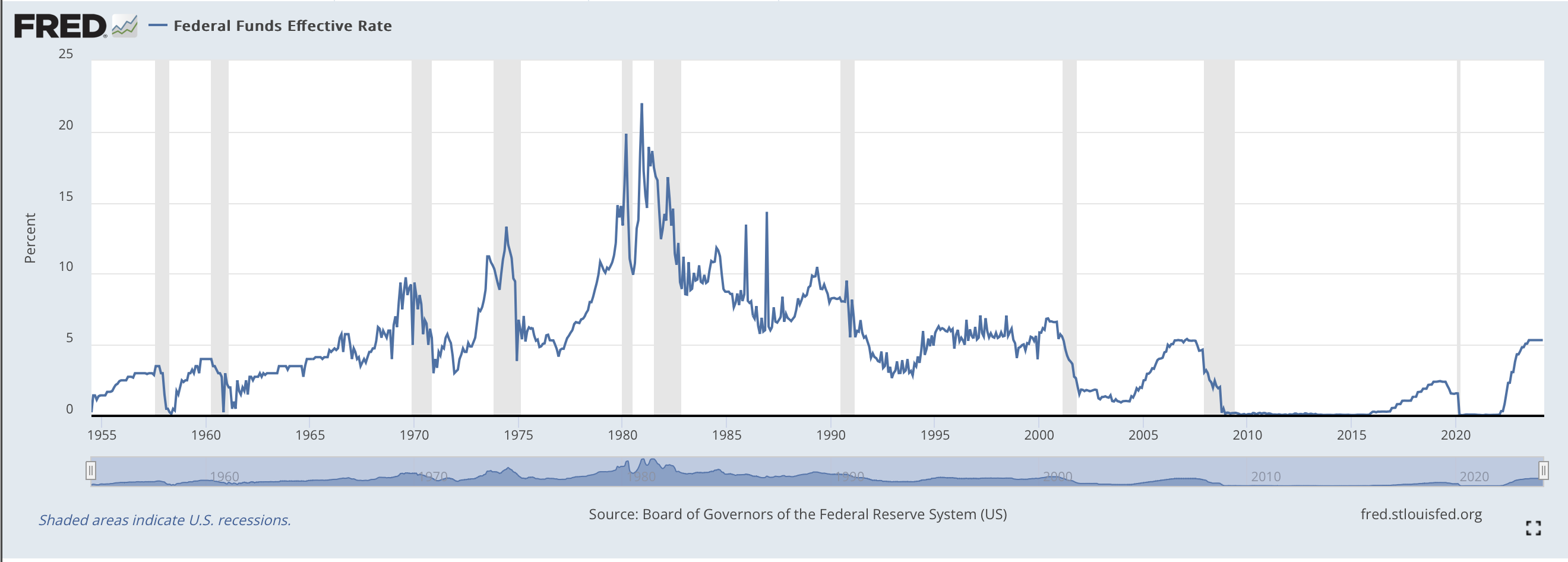
It is the third choice though, cutting rates, that is likely to generate the most fireworks.  Certainly, the initial movement will be a risk asset rally as investors will make the case that a lower discount rate means higher current values as well as invoke the idea that money currently invested in money-market funds will quickly move to stocks as interest rates decline.  At the same time, the front end of the yield curve will see yields decline amid what is likely to be a bull steepening of the curve.  And that’s the problem.  History has shown that when the curve re-steepens after a period of inversion, that is when trouble comes for markets.  As can be seen in the chart below from the St Louis Fed’s FRED database, the correlation between a declining Fed funds rate and a recession is very high (grey shaded areas represent recessions).  

This makes perfect sense as when the economy is heading into, or more likely already in, a recession, the Fed cuts rates to address the issue.  As such, the fervent desire to see rate cuts seems misplaced.  Strong economic activity comes alongside higher interest rates, not rate cuts.  If the Fed is cutting, that means there are problems as remember, whatever they say, they are always reactive, not proactive.  So, while the initial risk asset move may be positive, history has shown that during recessions, the average decline in the equity markets is on the order of 30%. Keep that in mind if you are hoping for the Fed to cut rates.

Ok, let’s tour the markets from overnight to see how things stand ahead of a bunch of data this morning. Japanese stocks suffered overnight, falling -1.5%, as the threat of intervention did little to strengthen the yen but certainly got some investors nervous.  As well, it is Fiscal year end there tonight, so I imagine we are seeing some profit taking given the remarkable run Japanese stocks have had in the past twelve months, rising 44% in yen terms.  The rest of Asia saw more gainers than losers with China, India and Australia all following the US markets higher although South Korea and Taiwan did lag.  In Europe, most bourses are higher this morning, but the gains have been more modest, on the order of 0.3% or so.  And as I write (7:30), US futures are unchanged on the day after yesterday’s gains.

In the bond market, yields are broadly higher with Treasuries (+3bps) reversing yesterday’s decline and similar price action in Europe with all sovereign yields higher by between 3bps and 5bps although Italy (+8bps) is an outlier as their finances are starting to look a bit dicier.  I would be remiss if I didn’t mention that JGB yields have edged down another basis point and are now at 0.70%.  There is no sign that yields are running away here.

Oil prices (+1.6%) continue to climb on the same story of reduced supply and ongoing demand.  Yesterday’s EIA data showed a smaller inventory build than forecast and there is no indication that OPEC+ is going to open the taps anytime soon.  Gold (+0.8%) is continuing its recent rally, following on yesterday’s move, as investors throughout Asia continue to hoard the barbarous relic.  As to the base metals, they are essentially unchanged over the past several sessions, seemingly waiting for the next economic data.

Finally, the dollar is feeling its oats this morning, rallying against every one of its G10 counterparts with this group (AUD -0.6%, NZD -0.6%, SEK -0.6%, NOK -0.6%) leading the way lower.  As well, the EMG bloc is also under pressure led by ZAR (-0.7%) and HUF (-0.6%) although the entire bloc is under pressure.  Of note is CNY (-0.15%) which the PBOC continues to struggle with as they cannot seem to decide if matching yen weakness is more important that maintaining stability.  It seems to me they are really hoping for BOJ intervention to reduce pressure on the renminbi.

On the data front, there is a bunch today starting with Initial (exp 215K) and Continuing (1808K) Claims, as well as the final look at Q4 GDP (3.2%).  As well we get Chicago PMI (46.0) and Michigan Sentiment (76.5) to finish out the morning.  There are no scheduled Fed speakers, but then, all eyes will be on Powell tomorrow.

It seems to me that Governor Waller made it clear that the tone in the Eccles Building is for more patience until they see inflation decline, or perhaps see the employment situation worse substantially.  With that as the backdrop, it is hard to see a good reason to sell dollars.  Keep that in mind for your hedging activities.

Good luck

Adf

Offsides

The PPI data revealed
Inflation has clearly not healed
Will Jay and the Fed,
When looking ahead
Now tell us one cut’s been repealed?

So, now here we are at the Ides
Of March, as opinion divides
Some still say a cut
Will come in June, but
Some others think, no that’s offsides

Once again, the inflation data did nothing to help the case for a rate cut anytime soon in the US.  This time the PPI data showed that prices rose far more than expected in February, 0.6% at the headline level and 0.3% at the core level.  The rises, when broken down, were across the spectrum of goods and services.  The point is despite what appears to be an overriding desire to cut rates by June, the data is not cooperating for Jay and his friends.  Will this be enough to dissuade them?  We still have 3 more months before the critical time and the market, despite itself, is now putting all its eggs in the June basket, having reduced the May probability to just 7%.  Clearly, it remains highly dependent on how the data progresses, and not just the inflation data, but also the employment data, but for now, I find it hard to make the case that the Fed should be cutting rates anytime soon.

Of course, there remains a large contingent of analysts, economists and pundits who believe that the Fed should cut next week, or May at the latest, as they are already doing grave damage to the economy.  You may recall the immediate response by the Nick Timiraos article to the hotter than expected CPI data.  Well, this morning, we have Bloomberg with an article that claims a solid majority of the forty-nine economists they surveyed continue to look for the first cut in June and three cuts this year.  It certainly appears there is a great effort to convince us that those rate cuts are coming, although as I have maintained, if the Fed is truly data dependent, the data is not pointing to cutting rates as the appropriate move at this time.  This argument discussion will continue for the foreseeable future, that is the only certainty.

Wages have blossomed
Will Ueda-san enjoy
The view, and end NIRP?

The preliminary indication from the Shunto wage negotiations shows that the average wage increases in Japan this year will be 5.28%, the largest rise in decades.  Apparently, Toyota accepted the union’s demands fully and didn’t even offer a counter!  When comparing this outcome to the most recent CPI readings in Japan, which showed a headline rate of 2.2% and a Core of 2.0%, it certainly appears that there could be some wage driven price increases upcoming.  As has been mentioned repeatedly, this was seen as a key issue for the BOJ ahead of their meeting this coming Monday night (Tuesday in Japan) in terms of being a sufficient catalyst for the BOJ to finally raise their overnight interest rate from its current -0.10%.

Now, while Ueda-san’s own words have seemed more circumspect, the growing consensus amongst the analyst community in Tokyo is that the move will happen next week with no need to wait until the April meeting.  But a funny thing has been ongoing in markets while this consensus has been building, the yen has been falling.  While there was essentially no movement overnight, since Monday, when the discussion began to heat up, the yen has declined more than 1.5% in value, almost as though the market is selling the news ahead of the news.  Perhaps of more interest is the fact that 2-year JGB yields have fallen this week by 2bps, which while not a great deal overall, represents a reversal of the gradual increase that has ostensibly been driven by the upcoming BOJ policy tightening.  I have a funny feeling that while NIRP may well turn into ZIRP next week, as the market looks ahead, there is much less tightening perceived in the future.  I have maintained that a move beyond +0.2% would be highly unlikely this year, and possibly next year.  As such, when considering the FX rate, USDJPY remains far more beholden to the Fed and US interest rates than to whatever the BOJ does at the margins.  Let’s face it, if the BOJ hikes rates to 0.2% by December, but Fed funds remains at 5.5%, it is still a very difficult case to buy yen.

And those have been the key stories driving things since I last wrote.  A look at the overnight session shows that Asian equity markets were mixed with the Nikkei sliding a bit, while the Hang Seng fell sharply (-1.4%), perhaps on fears of increased tech stress between China and the US.  However, the CSI 300 managed a small gain despite weak Loan data and the rest of the bloc saw a lot of red on the screen, following the US session losses yesterday.  In Europe this morning, it is the opposite reaction with green across the screen led by Spain (+1.1%) but modest strength everywhere as inflation data from Italy and France seemed to show more moderation.  Meanwhile, at this hour (7:30), US futures are edging higher by 0.3%, essentially unwinding yesterday’s losses.

In the bond market, yesterday’s PPI data saw bonds sell off aggressively in the US with yields across the entire curve rising 10bps.  This morning, Treasury yields have backed off 2bps, but remain at 4.27%, above what is perceived to be a trading pivot level of 4.20%.   European yields also rose yesterday, albeit not quite as aggressively as US yields, and this morning they are essentially unchanged.

In the commodity markets, oil (-0.5%) is giving back a bit of its recent gains but WTI remains above $80/bbl and Brent crude above $85/bbl.  Apparently, the IEA has revised its global oil demand figures higher by more than 1 million bbl/day and despite the fact that there is ample spare capacity in OPEC, the market is tightening right now.  Gold, which sold off yesterday on the rising rates / higher dollar situation, is rebounding a bit this morning, +0.3%.  Interestingly, copper (+1.3%) did not sell off on the interest rate or dollar story and is now back at its highest levels in nearly a year and firmly above $4.00/Lb.  Something is going on here which seems to be a positive hint for growth.

Finally, the dollar, which rocked yesterday, rising almost 0.65% across the board with some significant gains vs. specific currencies, is essentially unchanged overall this morning, holding onto those gains.  In fact, there are a few currencies that are still feeling pressure like KRW (-0.5%) and NZD (-0.5%) but there has been a modest bounce in ZAR (+0.4%) on the back of the strong metals complex.  Net, the DXY is unchanged on the day, back above the 103 level.

We finish the week with some more secondary data as follows:  Empire State Manufacturing (exp -7.0), IP (0.0%), Capacity Utilization (78.5%) and Michigan Sentiment (76.9).  Now, we have seen secondary data have an impact recently, and given the quiet period prevents any Fedspeak, market participants are looking for any clues they can find.  It will be very interesting to see if today’s data indicates that the economy is continuing at its above trend growth rate or implies things are fading.  My observation is manufacturing continues to struggle overall, and sentiment on the economy isn’t great, so I would look for weakness rather than strength.  In that case, perhaps bonds rally further, and the dollar unwinds some of yesterday’s gains.

Good luck and good weekend
Adf

He’s Got Spine

The market’s now certain that June
Is when Jay, the funds rate, will prune
Inflation don’t matter
Despite all the chatter
They don’t want to cut rates too soon
 
But what if inflation keeps rising?
And data continues surprising?
Can he hold the line?
And show he’s got spine
Despite all the doves’ vocalizing?


It’s funny.  So much was made about the CPI number on Tuesday and the lines seemed to have been drawn quite clearly; soft or as expected data would cement a June cut while hot data would call that into question.  And yet, here we are two days later, with the only information in the interim showing that oil and product inventories have fallen further driving oil prices higher, and the probability of a June cut has risen above 90%.  In fact, amid a day with limited new information, and during the Fed’s quiet period, perhaps the most interesting comments came from Treasury Secretary Yellen.  Not only did she indicate she regretted her use of the word ‘transitory’ at the beginning of the inflation episode, but more importantly, it appears that Treasury is now assuming much higher interest rates in their forecasts than before.  In other words, she no longer believes that interest rates are going to head back down to 2%.  Personally, I think that is a huge step in the right direction.  Alas, that concept certainly did nothing to constrain their spending plans, so it is not clear it really matters.

But the reality as that even though we get some more Tier 1 data this morning, it has become quite clear, to me at least, that the market is uninterested in anything other than the FOMC statement, the dot plots and Powell’s press conference coming on Wednesday next week.  You can see this in the equity markets which are now trading in ranges after their recent sharp rises, and you can see this in the FX market given the dollar’s virtual complete lack of volatility.  In fact, the only place that is demonstrating some concern is the bond market, where yields continue to edge higher very slowly.

Let’s start by taking a quick look at this morning’s data.  Retail Sales (exp 0.8%, 0.5% ex-autos) is set to rebound from last month’s terrible -0.8% print.  Many have looked past that number as a combination of bad seasonal adjustments and heavy discounting and continue to see strength in the economy.  We also see PPI (0.3%, 1.1% Y/Y) and Core (0.2%, 1.9% Y/Y) which seems to have bottomed, not dissimilar to CPI, but which will be a problem for those who believe that inflation is still trending lower.  Finally, as it is Thursday, we see Initial (218K) and Continuing (1900K) Claims, both in line with recent outcomes signaling the labor market remains in solid shape.

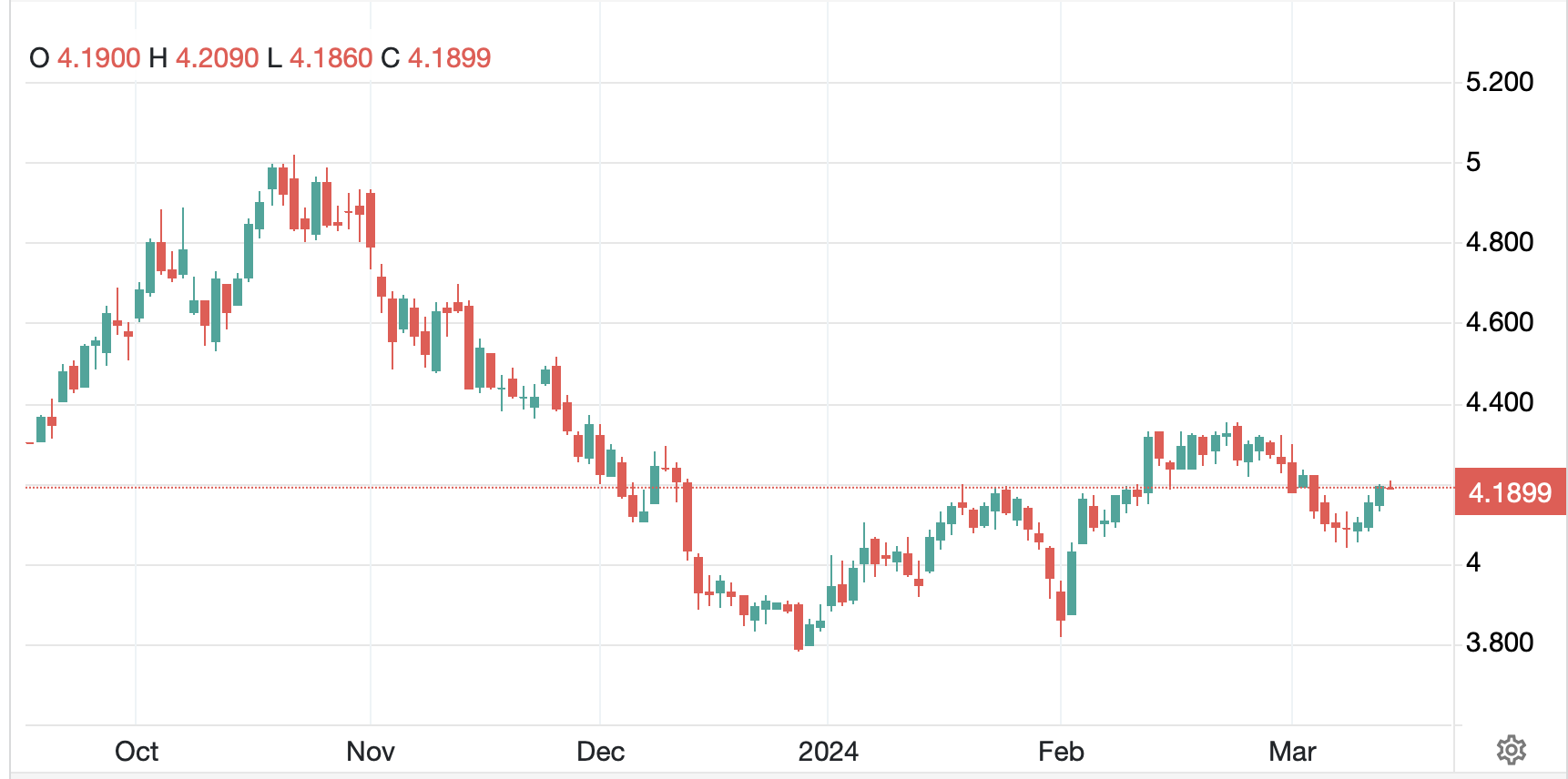
Now, you all know my view that inflation is not dead and that the market will need to continue to adjust interest rates higher over time to account for that fact.  Since the beginning of the year, as you can see from the chart below courtesy of tradingeconomics.com, while there have been several cycles, it seems clear that the trend in yields remains higher.

I think this makes a lot of sense and expect it to continue.  In fact, the question I have is how can the Fed truly consider it will be appropriate to cut the Fed funds rate given the economic signals are showing continued solid growth, a solid labor market and indications that inflation is heading higher?  Many make the political argument that since they are hell-bent on cutting, they need to get started before it gets too close to the election.  But I am going to go out on a limb here and say that I think Powell has shown he is made of sterner stuff and if the data remains where it has been, let alone inflation ticks higher between now and June, there will be no rate cuts.  If I am correct, risk assets are going to rerate, trust me.  And that is really the only question that needs to be answered at this point.

And so, other than bonds which seem to be sussing out the potential for rates to continue at their higher-for-longer pace, a look at other asset class markets shows not much overall movement.  After yesterday’s mixed US session, Asia, too, was mixed with Japan slightly firmer while Chinese shares slid as there appears to be no real help in sight there.  European bourses are also mixed with the UK lagging and slightly softer on the day and the bulk of the movement higher quite modest.  The only exception is the CAC in Paris higher by 0.9%, on the back of continued strong performance of the luxury goods sector.  (As an aside, why would central bankers think that the economy is going to tank if luxury goods remain hot?). US futures, though, are firmer at this hour (7:30) with all three indices higher by 0.5%.

In the bond market, while US yields have been dragging the global structure higher, they are unchanged on the morning and European sovereigns are actually a touch softer, between 1bp and 2bps today.  That is likely on the back of comments by Greek ECB member Stournaras that they need to quickly make two rate cuts to manage things properly.  While that seems excessive, I maintain the ECB cuts before the Fed.  As to Japan, JGB yields have edged higher by one more basis point overnight, though remain at just 0.77%.  Ueda-san, when he speaks, sounds far less hawkish than many of the analysts in Tokyo, or the other members of the BOJ from whom we have recently heard.  I am still in the April camp for the first rate hike, and very few afterwards.

Oil is the big mover of the day, up 0.9% with WTI back over $80/bbl for the first time since early November.  Yesterday’s EIA Inventory data showed drawdowns in crude and gasoline stocks that were much greater than expected.  You may have noticed at the pump that gas prices are rising, and it seems the market is figuring that out as well.  Remember, though, that OPEC+ has reduced production so has significant spare capacity at this stage, probably 2mm – 3mm bbl/day that they can restart at any time, so I don’t expect prices here to skyrocket.  Gold, which rallied nicely yesterday, is slightly softer this morning, as is copper, although the red metal remains above $4.00/Lb.  It strikes me that the commodity markets are not anticipating a significant economic slowdown right now.

Lastly, the dollar is very little changed overall this morning, with the largest moves NZD (+0.25%) and PLN (-0.25%) and every other major currency seeing less movement than that.  USDJPY is pushing back toward 148.00 slowly and seems likely to be the next big mover based on Monday night’s BOJ meeting.  Otherwise, this space is dead.

And that’s really what we have for the day.  If the data is hot, look for yields to continue their recent climb and for the dollar to take on a bid tone.  As to stocks, demand remains strong regardless of the economics.  If the data is soft, then a weak dollar should accompany strength in both stocks and bond prices.

Good luck

Adf

Not Fear, But Greed

It seems that on Friday, we learned
The prospect for rate cuts upturned
The ISM sunk
And Michigan stunk
So, doves got the data they yearned
 
And so, things are priced for perfection
Though history cautions reflection
Is what we all need
As not fear, but greed
Is likely to cause the correction


Markets are funny things with a history of reacting to catalysts that were completely unexpected while ignoring the ‘big’ things all the time.  Friday was a perfect example as the release of some second-tier data, ISM and Michigan Sentiment, drove a major change in the narrative and market prices in every asset class.  Prior to the Friday data releases, which saw ISM Manufacturing fall to 47.8, far below last month and forecasts, as well as the Michigan Sentiment index fall to 76.9, also well below last month’s number and forecasts, there had been a steady stream of strong data and hawkish Fed rhetoric.  

By now, you are all familiar with the Fed’s general lack of confidence that inflation is going to return to their 2.0% target soon as that sentiment has been expressed by, literally, all 17 FOMC members in the past three weeks.  The result of the hawkish talk and the solid data was a repricing in the Fed funds futures market of just how many rate cuts were coming in 2024, as well as their timing.  As well, we saw Treasury yields back up nearly 50bps during the month of February as the concept of higher for longer was finally getting internalized by market participants.  

But observing the market’s behavior, it was never clear that investors and traders really believed that tale of higher for longer.  Undoubtedly, there has been a camp, FX poets included, who have been singing that tune all year long.  But a much larger camp has been convinced that inflation was clearly on its way to 2% or lower and the Fed would want to cut sooner rather than later.  The rationales for these cuts had very little to do with the economy and focused instead on one of two things; the election this year and their effort to prevent President Trump from being elected support the current administration, or the fact that the extraordinary amount of funding that the Federal government needs to pay for its increasing deficits requires lower interest rates to prevent a fiscal disaster.

Then along comes Friday’s data and much of the Fed’s hard-won respect regarding higher for longer got tossed right out the window.  Treasury yields fell sharply, down 8bps, while the futures curves upped the ante for a May rate cut and made June that much more certain.  Not surprisingly, equity markets got quite the boost, although they have mostly been ignoring the rates story anyway. But perhaps the most interesting thing was what happened in the gold market, where the price of the barbarous relic jumped nearly 2% on the idea that rates were set to decline in the face of still high inflation.

It is important to remember that these two data points were, as I said at the top, secondary.  The fact that both pointed to economic weakness after a long string of strong data points was interesting, but was it really a signal that the trend has changed?  Personally, I am skeptical that is the case.  However, for a market that was looking for a reason to push back on the growing narrative of fewer rate cuts, they were a welcome sight.

In the broad scheme of things, though, this week is likely to be far more important in helping us all understand the nature of the current economy as well as the ongoing Fed reaction function thereto.  After all, not only do we hear from Chairman Powell as he testifies to the Senate and House on Wednesday and Thursday respectively, but Friday brings the payroll report.  Too, on Wednesday the Bank of Canada and on Thursday the ECB meet to lay out their latest views.  Remember, too, that the Chinese National People’s Congress is being held this week, and while leaks are rare, they will ultimately be announcing their growth targets for the year, so another crucial piece of information.  Net, I do not believe that last Friday’s data will have changed the minds of any FOMC members, and continue to believe that even a June cut is a low probability absent a significant overall economic decline, including lower inflation data.  But then, that’s what makes all this so exciting  A yellow face with a black line

Description automatically generated.

As we await all the activity to come, let’s recap the overnight session.  In Asia, only the Nikkei (+0.5%) managed to generate any excitement as it made yet another new all-time high and breached the 40,000 level for the first time.  Chinese shares were dull as was most of the rest of the region.  In Europe, the picture is mixed although the only mover of note is the FTSE 100 (-0.6%) which seems to be declining on the prospects of a lackluster budget announcement by the government this week.  Otherwise, bourses here are within +/- 0.2% of Friday’s closing levels.  And at this hour (8:00), US futures are edging slightly lower.

In the bond market, Treasury yields are backing up from Friday’s decline, rising 3bps this morning, but in Europe, sovereigns are mostly seeing some demand with yields slipping 2bps-4bps across the board.  The one exception is, again, the UK, where Gilt yields are unchanged on the day.  Overnight, JGB yields were unchanged, while we saw lower yields across the rest of Asia which seemed to simply be following the Treasury market.

In the commodity space, Friday also saw oil prices rise 2%, and this morning they are essentially unchanged, consolidating those gains.  OPEC+ announced that they would continue their lower production levels which clearly has had a bigger impact than rumors that a ceasefire would soon be taking place in Gaza.  Gold is also little changed this morning, holding its gains while copper is edging higher, and aluminum is slipping.  There are many analysts who discuss the coming super cycle for commodities, but thus far, there is little consistency in the price action there.

Finally, the dollar is mixed this morning.  In the G10 we are seeing weakness from SEK (-0.65%), NOK (-0.35%) and JPY (-0.3%) although some strength from the euro (+0.1%) and pound (+0.2%).  Similarly, EMG currencies are seeing gainers (ZAR +0.4%) and laggards (CLP -0.8%) and everything in between.  If the new narrative of easier Fed policy turns into reality, then I would look for the dollar to suffer.  However, I don’t yet accept that as the case.

As mentioned above, there is much on the data front this week as follows:

TuesdayISM Services53.0
WednesdayADP Employment150K
 Bank of Canada Rate Decision5.0% (unchanged)
 JOLTS Job Openings8.9M
 Fed’s Beige Book 
ThursdayECB Rate Decision4.0% (unchanged)
 Initial Claims215K
 Continuing Claims1885K
 Trade Balance -$63.4B
 Nonfarm Productivity3.1%
 Unit Labor Costs0.6%
 Consumer Credit$10B
FridayNonfarm Payrolls200K
 Private Payrolls158K
 Manufacturing Payrolls10K
 Unemployment Rate3.7%
 Average Hourly Earnings0.3% (4.4% Y/Y)
 Average Weekly Hours34.3
 Participation Rate62.6%

Source: tradingeconomics.com

In addition, as well as Chairman Powell’s testimonies in Congress, there are another four Fed speakers, although with Powell headlining, I don’t think folks will pay too close attention to them.  Last week, the Fedspeak onslaught was very consistent about that lack of confidence that inflation would reach target soon, and there is clearly no hurry to cut rates, although virtually all speakers expect rate cuts to be the case.  Perhaps the data this week will change some minds, but remember, the big number doesn’t come out until after Powell speaks, and after Friday, the Fed enters its quiet period ahead of the next FOMC meeting.  

Right now, I have to believe last Friday’s data was the exception, not the rule, but we will learn more as the week progresses.  In the end, I think the dollar remains tied to the yield story, so as long as growth remains stronger here than elsewhere, and doesn’t show signs of falling sharply, the dollar should maintain its broad level of strength.

Good luck

Adf

Not Even a Token

Like spring rains falling
So too, Japanese prices
Continue to slide


Once upon a time there was a tiny thought about Japan tightening monetary policy.  This thought, which had been seen lurking in the shadows of markets for the past thirty years, was largely ignored by all the ‘right’ people.  The illiterati economic gliteratti were all quite convinced that this would never happen as Japan was in a death spiral of rising debt and a shrinking population.  According to all the classical economic texts, interest rates could never rise again.

Then, one day there came along a virus that disrupted the world.  All the ‘important’ people in all the major nations determined that shutting down all economic activity while simultaneously printing trillions upon trillions of dollars, euros, pounds, and yen, and more importantly, giving that money to the people, was the best thing to do.  Not that surprisingly, with all that extra money chasing after fewer available goods and services, prices rose sharply almost everywhere.  Even in Japan, a nation that had suffered a generation-long deflationary bout, where companies literally apologized if they determined that a price rise was in order to cover rising expenses, prices started to go up more broadly.

This excited the policymakers in Japan as it was something they had been trying to achieve for the past 30 years.  It also excited the trading community as they became convinced that Japanese interest rates were set to explode higher.  And for a little while, Japanese inflation rates rose, surpassing the 2.0% target that had only been briefly brushed three times during that generation, the most recent being in the wake of the Covid actions.  Analysts were convinced that the new BOJ Governor, Kazuo Ueda, was getting set to raise the policy rate from its current level of -0.10%, its home for the past 8 years.  Traders positioned for JGB yields to rise and for the yen to strengthen against its currency counterparts.

Alas, so far this tale has not had that happy ending.  Instead, last night CPI in Japan printed at 2.2% headline, 2.0% core with both measures clearly trending lower for the past 18 months at least.  To be clear, in the very short term, these prints were marginally higher than market forecasts, which has resulted in a touch of strength in the yen (+0.3%), and a 1bp rise in 10-year JGB yields.  But bigger picture, this has further called into question the idea that Japanese inflation is going to remain stable at the BOJ’s 2% target.  In this situation, the idea the BOJ will tighten policy seems increasingly remote.  As such, all those delusions of tight money have been, once again, laid to rest.  The moral of this story is that; in Japan, the only money is easy money!

The newest Fed member has spoken
And Schmid said that things just ain’t broken
Thus, patience is needed
And so, he conceded
No rate cuts, not even a token
 
The Kansas City Fed’s new president, Jeffrey Schmid, made his first public comments yesterday but it could well have been his predecessor, uber-hawk Esther George, given that he hewed to the party line as follows:, “With inflation running above target, labor markets tight, and demand showing considerable momentum, my own view is that there is no need to preemptively adjust the stance of policy.  I believe that the best course of action is to be patient, continue to watch how the economy responds to the policy tightening that has occurred, and wait for convincing evidence that the inflation fight has been won.”  That’s pretty clear, and while he is not a current voter, it is simply another voice telling us that the Fed is not anxious to alter policy at all.  Even the market gets it now, with the March meeting down to a 0.5% probability of a cut, the May meeting down to a 16.3% probability and even the June meeting down to a 60% probability.  For all of 2024, the market is now pricing in just 3 ½ cuts, pretty darn close to the last dot plot.  Kudos to the Fed for getting their message across.
 
However, beyond those two stories, there is precious little to discuss this morning.  Data, beyond the Japanese CPI, has been sparse and the ECB speakers have also stayed true to their recent mantra of no reason to cut rates yet.  As such, it is not that surprising that markets remain mired in tight ranges overall.
 
Looking first at equity markets, after a lackluster session in the US yesterday, Japanese share prices were essentially unchanged although we did see some strength in Chinese shares with both the Hang Seng (+0.9%) and CSI 300 (+1.2%) rallying nicely on the back of increasing hopes for more Chinese stimulus coming in March at the annual plenary sessions.  As to the rest of Asia, activity was mixed with some countries seeing gains (India, Australia) and some losses (South Korea and Taiwan).  European bourses are also mixed with some gainers (Germany) and losers (Spain) while others have gone nowhere at all.  Finally, at this hour (6:45), US futures are ever so slightly firmer, just 0.1%.
 
In the bond market, both Treasuries and European sovereigns are seeing a bit of buying with yields lower by 1bp across the board.  Yesterday’s US 5-year auction was also somewhat unloved with a 0.8bp tail, quite large for that maturity.  It does appear that there is increasing pressure on the Treasury market as the pace of issuance picks up.  Over time, I believe this is going to matter a lot more to markets than it has thus far.
 
Oil prices, which rallied most of yesterday, are giving back some of those gains, down -0.4% this morning.  The rally was ostensibly based on further Red Sea concerns, but that really doesn’t make much sense given there were no new events there.  More likely, there was some short covering and analysts were looking for a story to tell.  Metals markets, though are in better shape this morning with gains in both precious (gold +0.3%) and base (copper +0.2%, aluminum +1.0%), largely on the back of the dollar’s modest weakness.
 
Which brings us to the dollar and the most confusing part of the session.  While it is true Treasury yields are lower by 1bp, that does not seem enough to weigh on the dollar, especially given the universal nature of yield declines.  The US curve actually inverted further, with the 2yr-10yr spread back to 42bps (it had been hanging around 25bps-30bps for several months), so that could be weighing on the greenback.  But whatever the cause, we are seeing pretty uniform weakness, although other than ZAR (+0.75%) which has clearly been helped by the metals rally, the rest of the movement is pretty modest, +/- 0.2% or less with more currencies gaining than losing.  I do not believe that the reaction function has changed here.  Rather, sometimes the FX market moves in funny ways.
 
On the data front, this morning brings Durable Goods (exp -4.5%, +0.2% ex transport) and Case-Shiller Home Prices (6.0%).  Yesterday saw a softer than expected New Home Sales and a weaker than expected Dallas Fed survey, although it was better than January’s print.  As well, we hear from Vice Chairman Barr, but there has been very little wavering from the message that patience is a virtue, and I don’t expect Mr Barr will change that tune.
 
The equity bulls took a rest yesterday but are clearly looking for more reasons to get back to buying.  To me, the potential problem will be home prices as, if they continue to rise, it will reduce hopes for any rate cuts at all, and there are still a number of pockets in the economy that are highly reliant on low interest rates to succeed.  Commercial real estate is simply the most frequently discussed, but consider much of the tech sector, where ideas that had been funded with free money that will not get the time of day if there is a cost of capital.  Ultimately, nothing has changed my idea of the dollar benefitting further as the market continues to understand that the Fed is not set to cut rates any time soon.  Of course, Thursday’s Core PCE could change a lot of views, mine included.
 
Good luck
Adf

Stanching Their Bleeding

For all of those pundits that claimed
inflation had died and been maimed
The data did show
What now we all know
Inflation is still quite inflamed

The upshot is all those who said
That real rates would soon force the Fed
To quickly cut rates
Are in dire straits
And stanching their bleeding instead

Wow!  Not much else you can say after yesterday’s market activities following the hotter than expected CPI data released in the morning.  As I wrote on Monday, a 0.1% difference in a monthly print is not really substantive in the broad scheme of things, but when the narrative is so strong and so many are convinced that the Fed is itching to cut rates because they don’t want to overtighten as inflation continues to fall, that 0.1% in the wrong direction means a lot.  Hence, yesterday’s price action (which I did presage in the last line of my note yesterday morning before the release.)

Of course, you are all aware that stocks got crushed, with the major indices falling -1.35% to -1.80% while the Russell 2000 small cap index fell -4.0%!  But it wasn’t just stocks, bonds joined the fun with the 10-year yield soaring 15bps to 4.30%, its highest yield since early December.  Gold got crushed, falling $30/oz and back below $2000/oz for the first time in two months, while the dollar exploded higher, rising about 1% against most currencies and almost 1.8% against the yen.

A quick analysis of the CPI data shows that the shelter component was the big surprise on the high side, although airfares also were higher than expected.  As well, wages remain much stickier than the Fed would like to see as they continue to support price increases in the services component of the data.  Forgetting the headline for a moment, a look at Median CPI, as calculated by the Cleveland Fed, shows that last month’s rise was 0.5% and the Y/Y number is +4.85%.  That feels to me like a much better estimate of what is happening than the newest darling of the bullish set, Truflation, which claims that inflation is “really” rising at only 1.39% as of yesterday.  One final thing, hopefully, all of those who claimed that the ‘real’ trend of inflation was sub 2% because the 3-month average had fallen there (please look at Monday’s note, What If?) will finally shut up for a while.

The new Mr. Yen
Said “we are closely watching”
So you don’t have to
Do not cross this line!

As mentioned above, the yen was the worst performer yesterday after the data which, not surprisingly, triggered a response from the Japanese government.  Now that USDJPY is back above 150.00, there are many who believe the MOF/BOJ will be intervening soon.  There is a terrific website called Harkster.com which aggregates all sorts of commentary and research from around the web as well as adding their own commentary.  I highly recommend it as a source for information.  At any rate, they have a very nice description of the historical actions that lead to intervention by the Japanese which I show here:

1.     Language such as “monitoring developments in currency markets”.
2.     “Sudden/abrupt/rapid” movements in currency markets are “undesirable”. In addition, markets are “not reflecting fundamentals”.
3.     “Excessive” is introduced next to describe the price movements alongside “clearly” in addition to referring to FX moves as “speculative”.
4.     Readying for action is normally reflected with the phrase “we are ready to take decisive action” which would suggest some action is imminent.
5.     Price checking is the step prior to actual intervention whereby the BoJ will call round selected Japanese banks and ask for a level of USDJPY. Even though they do not deal the act of them asking normally makes the banks, who have been contacted, sell USDJPY in anticipation of intervention and they will also spread the news around the market to encourage more selling.
6.     Same as 5 but this time the BoJ actually do sell USDJPY. This may happen in waves.
7.     Finally, coordinated intervention with other major central banks involved. This would generally happen early NY hours to include the US. This obviously has the most effect on the markets.

Arguably, we are somewhere between numbers 1 and 2 right now, but they can escalate this process quickly.  However, in the end, what matters for currencies over time are relative fiscal and monetary policy settings.  History has shown that to strengthen a currency, a country must run a tight monetary and loose fiscal policy.  To weaken a currency, the opposite is true.  Given the US 7% budget deficits and highest interest rates in the G10 + QT, it is pretty clear that the dollar should be strong.  Now, if the BOJ were to raise rates aggressively, it would have a chance to alter the trajectory of the yen, but while Ueda-san has implied that they may raise rates back to zero after the spring wage negotiations, assuming they agree large increases, unless there is a strong belief that they are going to continue to raise rates to attack inflation in Japan (which isn’t really a big problem) then absent the Fed starting to ease, there is no good reason to think the yen will strengthen very much at all.  Now, if the Fed does start cutting aggressively, that is a different story, but based on yesterday’s CPI, that feels like it is a long way in the future.

And those are the most noteworthy things to absorb.  Now, a look at the rest of the overnight session shows that Japanese stocks were softer, but the rest of Asia (absent China which is still on holiday) was mixed, with gains and losses around.  Europe, this morning, though is firmer, up about 0.5% except the UK, which is higher by 0.9% after CPI there fell more than expected, encouraging talk that the BOE will be cutting sooner.  Now remember, yesterday the UK lagged after their employment data was stronger than expected, especially wage data, so it is not clear which one to believe.  As to US futures, they are firmer at this hour (8:00), up about 0.5%.

After yesterday’s massive yield rallies, it is no surprise to see them slipping a bit today, with Treasury yields lower by 1bp and most European sovereign yields down by 3bps (UK Gilts are -6bps on that inflation data).  Overnight, the Asian session saw government bonds there slide with yields higher across the board although JGB yields were the laggard, rising just 3bps.

In the commodity markets, oil (flat today) is the only market that didn’t sell off yesterday and it has maintained those gains.  This is despite a much bigger inventory build than anticipated as it seems continued concerns over a wider Middle East war are extant, as is a new worry, as Ukraine has been able to bring the attack to Russia more effectively, sinking another Russian ship in the Black Sea last night.  Recall, they have been attacking Russian oil infrastructure and if they are successful in that effort, it will definitely give oil prices a boost.  But the rest of the commodity markets got crushed yesterday with gold, copper and aluminum all falling sharply.  This morning, though, those three markets are little changed, simply licking their wounds and not extending any losses.

Finally, the dollar is also little changed this morning, but that is after a massive rally across the board yesterday against both G10 and EMG currencies.  Against most major counterparts, it has traded back to levels last seen in mid-November, although the pound has been holding up better than most, with smaller net moves.  It is ironic that the dollar strengthens on a high inflation print as fundamentally, high inflation is supposed to weaken a currency.  Of course, this move has nothing to do with inflation per se, and everything to do with interest rate expectations.

On that subject, it is worth noting that the latest Fed funds futures rate cut probabilities are now; March 8.5%; May 37.9%; and there are now just 4 cuts priced into the year, down from 7 about a month ago.

There is no hard economic data released although the EIA oil inventories do come out later this morning.  We also hear from two Fed speakers, Goolsbee and Barr, and I imagine we could get a little ‘we told you so’ in their comments today.

If recent history is any guide, I suspect that equity markets will rebound a bit further early, but potentially drift lower as the day wears on.  The bulls were clearly shaken as their narrative took a big hit.  But this was just one data point of many.  I don’t believe the end is nigh, but in the longer term, it is not hard to believe that the Fed will remain the tightest policymaker of all the central banks and that will help the dollar while hurting risk assets.

Good luck
Adf