Not Quite Yet Dead

Inflation is not quite yet dead
And that has some thinking the Fed
May now have concern
That there’ll be no turn
And possibly more hikes instead

Last week, though, more Fedspeak, we heard
And three speakers’ comments sent word
That higher long rates
Have altered the fates
Now they think hikes could be deferred

Before I touch on the markets, I must acknowledge the heinous acts that occurred last weekend in Israel.  It is abundantly clear that this will not be ending soon, and it seems likely that it may ultimately have an impact on financial markets.  However, this commentary revolves around how global markets move, what new catalysts are driving things and how we might consider all the information when trying to determine the best way to hedge outstanding FX exposures.

So, before we talk about the overnight session, let’s quickly recap my week away.  Inflation, in both the guise of PPI and CPI, was a bit hotter than expected which has put a crimp in the Paul Krugman ‘inflation battle is won’ narrative.  I am constantly amazed at the disingenuity of analysts explaining that if you ignore food, energy, rent, used cars and any other thing that rose, then inflation is back at the Fed’s target.  It is not clear to me if they don’t eat, use energy, or pay for living expenses, but that is simply ridiculous.  The consumer confidence data makes clear that folks are extremely unhappy with the current economic situation and too high inflation remains the primary cause.  Regardless of the data points, people are feeling it when they buy gas and groceries, or if they go out for dinner, let alone buying other stuff.  

I have maintained this is not going to end soon and that 3.5% – 4.0% is going to be the new normal inflation rate.  While Daly, Logan and Jefferson all explained that the steepening of the yield curve with long end rates rising more rapidly than short end rates was helping the Fed’s cause, not one of them indicated they were even thinking about thinking about cutting rates.  In fact, my money is on at least one more hike, probably in December at this point, and I cannot rule out further hikes in 2024.  And folks, higher rates are going to wind up breaking more things.  Do not believe the soft-landing narrative, things are going to get worse, almost certainly.  Arguably, that sums up last week.

Turning to the overnight session, there was limited new news in the way of data or commentary.  Market participants continue to focus on central banks and any potential adjustments in their policies, economic data and clues as to whether the long-anticipated recession is finally coming, and the trajectory of inflation and whether the price of oil is going to have a longer-term impact on that trajectory.

Regarding the first of these issues, in addition to the above-mentioned Fedspeak, the market is anxiously awaiting Chairman Powell’s comments to be made Thursday afternoon just before the Fed’s quiet period begins.  While we will hear from ten other Fed speakers over sixteen different venues (!), the reality is that Powell’s words are the most important.  However, given the seeming unanimity in the new message about the long end of the curve helping the Fed, I suspect that Powell will touch on that subject as well.  To my mind, this is not an indication they are unhappy with the bond market selloff, rather that they are quite comfortable and will not do anything to stop it.  That could well give the bond market vigilantes a signal to sell even more aggressively so be prepared.

Last night we did hear from Kanda-san of the MOF who explained that rate hikes are one option when excessive forex moves are seen.  Now, that seems a bit of a surprise in that the BOJ is ostensibly the one controlling interest rates, but this shows that the concept of central bank independence is quite tenuous in Japan, and probably in most places.  You may recall a few weeks ago when USDJPY touched 150 and immediately reversed and fell 2% in mysterious fashion as no intervention was confirmed.  Do not be surprised if we see similar price action at various levels higher in the dollar, although helpfully, there was a comment that the fundamentals (meaning interest rate differentials) were responsible for much of the movement in FX.  Nothing has changed my view that USDJPY has higher to go.

On the economic data front, obviously last week’s inflation data had an impact with Treasury yields shaking off their safe-haven bid due to the Israeli-Palastinian conflict and rising again this morning.  While they are not yet back at the highest levels seen two weeks ago, I expect we will get back there and move higher still going forward.  This week’s Retail Sales data (exp 0.3%, 0.2% ex autos) is the big print and recall, it has been running hotter than expected for a while now.  Understand that Retail Sales counts the dollars spent, not the items bought, so rising inflation will drive this number higher even if things aren’t improving.  But for now, there is scant evidence that the economy is slowing rapidly, at least based on the headline data we have been seeing for the past months.

Finally, the inflation story is part and parcel of all the discussions.  Oil’s rise on the back of the Israeli-Palestinian conflict has been pronounced and this morning it remains some 7% higher than before things started there.  There is a growing concern that if the conflict widens, OPEC could consider an embargo of some sort, just like in 1973 in the wake of the Yom Kippur War, which would likely drive oil prices much higher, at least to $150/bbl.  Obviously, that would have a dramatic impact on financial markets as well as on our everyday lives.  It would also have a dramatic impact on inflationary readings.  But the other concern is that despite some of the more Pollyanna-ish narratives about the Fed has already achieved its goals, the reality appears to be that core inflation is simply not falling any further and ultimately, this is going to weigh on equity multiples and earnings as well as further on bond prices.  I would contend that inflation remains the primary issue for the foreseeable future.

With all this in mind, a quick look at the overnight session shows that after a mixed session in the US on Friday, Asian equity markets were all lower by at least -1.0%.  European bourses, however, have managed to eke out very modest gains, on the order of 0.2% and US futures are currently (7:30) higher by about 0.25%.

Meanwhile, Treasury yields are higher by 9bps this morning and we are seeing yields on European sovereigns all higher by between 4bps and 5bps.  Clearly inflation concerns are rampant, as are concerns over continuing increases in supply as every major nation runs a growing budget deficit.  Of course, the exception to this rule is Japan, where yields are unchanged on the day and currently sitting at 0.75%, their high point for the past decade, although still well below the current YCC cap of 1.00%.

Turning to commodities, with oil quiet this morning focus is turning to the metals markets where gold (-0.8%) is retracing some of last week’s 5.0% rally as the combination of rising inflation and fear seems to have underpinned the barbarous relic.  As to base metals, they are mixed this morning with copper a touch higher and aluminum a touch lower, a perfect metaphor for the confusion on the economic situation.

Finally, the dollar is clearly not dead yet.  While this morning it is consolidating last week’s gains and has edged lower about 0.15%, last week saw gains in excess of 1% vs. most major counterparts.  The dollar, despite all the problems in the US, continues to be the haven of choice for most investors.

On the data front, aside from Retail Sales and the remarkable amount of Fedspeak, we see the following:

TodayEmpire Manufacturing-7
TuesdayRetail Sales0.3%
 -ex autos0.2%
 IP0.0%
 Capacity Utilization79.6%
WednesdayHousing Starts1.38M
 Building Permits1.455M
ThursdayInitial Claims213K
 Continuing Claims1707K
 Philly Fed11.1
 Existing Home Sales3.89M

Source: TradingEconomics.com

For my money, barring something surprising from the Middle East, like an OPEC move, I expect that the market will be entirely focused on Powell’s speech Thursday at noon.  We are also at the beginning of earnings season, so we could get some surprises there.  However, the big picture remains sticky inflation, massive new supply of Treasuries and higher yields along with a higher dollar overall.

Good luck

Adf

Much More Afraid

Watanabe-san,
A previous Mr Yen,
“No intervention”

As USD/JPY approaches the psychological level of 150.00, there is a growing belief in the market that the BOJ is soon going to intervene.  Recall, last week we heard about the urgency with which the MOF is watching the exchange rate.  Historically, the next step would be for the BOJ to ‘check rates’.  This is when they call around to the big Tokyo bank FX trading desks and ask for levels.  The implication is they are ready to sell dollars and defend the yen.

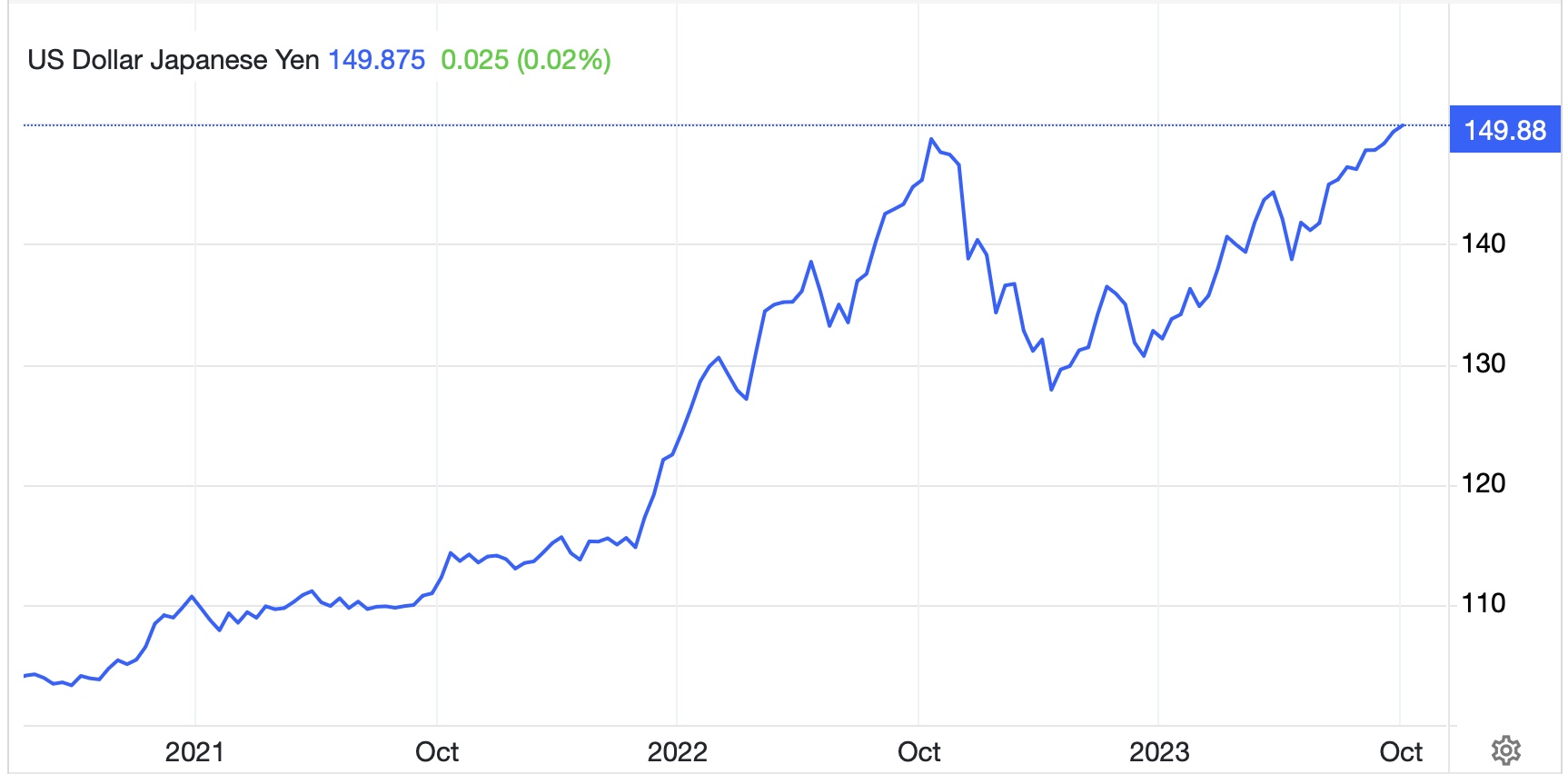
However, unlike the previous decline in the yen almost exactly a year ago, the recent movement has been somewhat more gradual as can be seen in the chart below (source tradingeconomics.com)

This was highlighted last night by Hiroshi Watanabe, the deputy FinMin in charge of currency policy from 2004 through 2007.  He explained that after seeing the dollar remain in a 145-150 range for much of the past year, “I don’t think authorities are worried about the outlook as much as they were last year.  There’s no sense of imminence because the dollar/yen level hasn’t changed much from a year ago, and it doesn’t seem like the yen will start to plunge even if it breaches the 150 mark.

As is often the case when it comes to concerns about a currency’s value, the pace of its decline is far more important than the actual level.  Most countries, or at least most finance ministries, feel they can handle slow and steady.  It is the abrupt collapses that scare them.  This move has been quite steady, and as long as both the Fed and BOJ maintain their current monetary policies, a continuation seems likely.  Hedgers, keep that in mind.

Now, turning to yesterday’s trade
A message was clearly conveyed
As interest rates rise
Risk appetite dies
And people are much more afraid

The most pressing story in markets continues to be the US Treasury market where sellers outnumber buyers on a daily basis.  Yields on the 10-year rose 10bps yesterday, touching 4.70% and are continuing higher by another 2bps so far this morning.  The bear steepener continues to be the story with the 2yr-10yr spread falling to -40bps and looking for all the world like it is going to go positive before the end of the year, if not the end of the month.  And it makes sense.  There is still substantial demand for short-term paper yielding more than 5% (yesterday’s 3mo T-Bill auction cleared at 5.35%).  Meanwhile, we are seeing money flee those assets with long duration over fears that inflation has not yet been quelled and that the structural issues (ongoing massive supply meeting limited demand) has investors pulling back quickly.  Not only are Treasury bonds being sold aggressively driving yields higher, but yesterday saw utility stocks, often seen as a duration proxy given the high amount of debt on their balance sheets, fall nearly 5%.  

This activity is having the knock-on effects that one would expect as well.  Yields around the world continue to get dragged higher by Treasuries, the dollar continues to benefit, and commodity prices are suffering.  In fact, yesterday saw a sharp decline in the price of oil and it has now retraced more than 6% from the peak last week.  I had written about the simultaneous rise in yields, the dollar and oil as being a HUGE problem for global markets.  Well, it seems that oil is starting to feel the pain of higher yields and a stronger dollar.  As well, tomorrow OPEC meets in Vienna and there is some talk that the Saudis may increase their production, unwinding those unilateral cuts made back in June and continued since then.   

But make no mistake, ongoing rises in Treasury yields will continue to underpin the dollar and that will be enough of a problem for economies elsewhere even if oil prices slide some more.  And right now, there is no indication things are going to change.  Yesterday we heard from two Fed speakers, Governor Bowman and Cleveland Fed President Mester with both maintaining the hawkish views.  In fact, Bowman expressed the need for several more rate hikes in order to get inflation under control and both were clear that higher for longer was crucial.  As long as that remains the Fed attitude, until we see a substantial change in the data stream, yields are going to continue to rise.

Now, this week brings the all-important NFP report on Friday, which has been a key driver of Fed policy.  With inflation readings continuing far above the Fed’s target, as long as NFP remains positive and the Unemployment Rate remains either side of 4%, the Fed will have no reason to reconsider the current policy mix.  In their minds, they have not yet broken anything, at least not so badly that it couldn’t be fixed.  I’m sure they are straining their arms as they pat themselves on the back for the effectiveness of the Bank Term Funding Program (BTFP) which was created after the bank failures in March.  In fairness, it seems to be working for now.  However, I will warn that cans can only be kicked down the road for so long, and I fear the end of that road is nearing.

As to the rest of the session today, risk is decidedly on the back foot.  Those equity markets in Asia that were open all fell pretty sharply with the Nikkei (-1.6%) and Hang Seng (-2.7%) leading the way lower.  The story is similar in Europe with the major indices all lower by about -0.75% or so as they respond to the ongoing increase in interest rates around the world.  Finally, US futures are lower by -0.45% at this hour (7:30) with concerns growing that yields will not stop rising.

Looking at European sovereign bonds, yields there are rising alongside Treasury yields with most of them higher by 3bps-4bps and Italy higher by 9bps.  That Bund-BTP spread, currently at 193bps, is something we need to watch as 200bps is likely to be the first place the ECB really shows concern and if it heads higher than that, expect more direct actions.  As to JGB yields, they remain static at 0.76%.

We already discussed oil prices and we are seeing serious weakness across the entire metals complex lately, although today’s declines are relatively muted, on the order of -0.2%, as the moves have already been pretty large.  The lesson from the recent price activity is that yields continue to drive the market.

Finally, the dollar remains king with the euro below 1.05, USDJPY just below 150 and the pound making a run at 1.20.  Last night, the RBA met and left rates on hold, as widely expected, but the tone of new governor Michele Bullock’s first meeting was seen as somewhat dovish leading to a nearly 1% decline in the Aussie.  At the same time, the EMG bloc of currencies is also coming under pressure with declines today on the order of -0.5% across all three regions.  There is a term, the dollar wrecking ball, which is quite apt.  As it continues to rise it puts intense pressure on countries around the world as they scramble to get dollars to service the trillions upon trillions of dollars of debt outstanding.  Nothing has changed my view that this has further to run.

On the data front today, the only release is JOLTS Job Openings (exp 8.8M) a number that remains significantly larger than the number of unemployed.  We also hear from Atlanta Fed president Bostic this morning so it will be interesting if he is willing to push back against the ongoing hawkishness.

I see no catalysts to change the current trend in the dollar, so for all you receivables hedgers out there, keep that in mind.

Good luck

Adf

Three Extra Trill

Said Goolsbee, I’m, processing, still
Why bond yields keep moving uphill
Perhaps he should look
At Yellen’s full book
Of issuance, three extra trill

So, with the third quarter now ending
And core PCE, today, pending
The hope and the dream
Is next quarter’s theme
Will be ‘bout risk assets ascending

In a speech yesterday at the Peterson Institute for International Economics, Chicago Fed President Austan Goolsbee laid out his current views on the US economic situation, which he thought was generally in good shape, and warned about overtightening.  He also noted the Fed has a rare opportunity to achieve a soft landing.  All that is ordinary enough.  The odd comment came when he mentioned that he was “still processing’ why bond yields were rising so much recently.  It is always disconcerting to me when the so-called best and brightest who lead our key institutions expose themselves as being clueless in their main role.  

As I have discussed in the past, it is not very difficult to determine why long-term yields are rising in the US, it is a combination of two absolutes and one likelihood.  The absolutes are the amount of supply hitting the market and the reduced demand.  Treasury Secretary Yellen has indicated in Q4 there will be new issuance of ~$852 billion on top of current refinancing of >$1.3 trillion, hitting the market.  At the same time, the Fed continues its QT program reducing demand by $180 billion in Q4 and both China and Japan, the two largest holders of Treasuries have been slowly reducing their positions.  The point is excess supply and reduced demand will drive prices lower.  The likelihood is that the private sector that will be required to purchase these bonds is wary of inflation rebounding on the back of higher energy prices and increasing wage costs (between the UAW strike and the latest law in California that mandates a $20/hour minimum wage for fast food workers, wages seem set to rise further still), and so are demanding to be paid more to buy the paper.  It is not really that complex.

Yesterday, after printing at 4.68%, a new high for the move, the 10-year yield fell back a bit, which is much more about market technicals and an oversold condition rather than a change in the underlying issues discussed above.  This morning, that yield is lower still, but just by 2bps and currently trading at 4.55%.  Of equal interest is the fact that the yield curve continues to bear steepen with the 2yr-10yr curve inversion now down to -50bps.  While we are likely to see a little trading bounce, this trend remains clear, and the fundamentals support higher yields.  I expect the 10-year yield to reach 5% by the end of 2023 and somewhere between 5.5% and 6.0% by the election next year.

If we look elsewhere in the world, we are seeing yields rise right alongside Treasury yields.  Perhaps the only place that is lagging is Japan, where the BOJ executed an unscheduled JGB buying operation last night of¥300 billion to help moderate recent movement.  This was interesting given the data out of Japan last night, notably weaker Retail Sales and a lower-than-expected Tokyo CPI at 2.8% (2.5% core) implies that the BOJ is not likely to feel much pressure to tighten.  With the Fed still all-in on higher for longer and the BOJ able to point to softening inflation as a reason to continue QE and loose policy, USDJPY will continue to be the outlet valve in the economy, and it should rise (yen weaken) still further.

Meanwhile, the most important spread in Europe, the bund-BTP spread in the 10-year space is back to 200bps.  This is the level at which the ECB has demonstrated concern in the past and I am confident that there is much discussion ongoing today.  We did hear from one of the ECB hawks overnight, Nagel, who was clear that another rate hike might be appropriate, but I assure you, if that spread widens much further, rate hikes are not going to be the ECB’s approach.  All in all, we are likely to see much future stress in bond markets.  And to think, none of this even touches on the potential government shutdown tomorrow!

And yet, equity markets bounced yesterday into month/quarter end and European bourses and US futures are all in the green today as the bulls are now telling us that things are oversold, and a rip-roaring rally is imminent.  Clearly, we have seen some pretty weak behavior in the risk asset space lately and a technical bounce is not surprising.  However, it remains very difficult for me to see the upside for stocks as long as bond yields are rising along with oil and inflation remains sticky.  Too, the dollar, while it also reversed course yesterday after a remarkable run higher over the past two plus months, is still quite firm overall, and as long as US yields rise, I look for the dollar to follow.

On the lighter side, the best non-sequitur correlation I have seen is that Top Gun was released in May 1986 and Black Monday, which saw the largest equity market selloff in history occurred in October 1987.  Well, Top Gun II was released in May 2022.  Should we be looking for a massive market decline in the next two weeks?  The starting conditions are not actually that different with an overvalued stock market, rising rates, rising oil prices and a rising dollar.  Just sayin!

As we look to the calendar today, the Core PCE data is set to be released at 8:30 and expected at 0.2% M/M, 3.9% Y/Y.  Many analysts continue to use the concept of annualizing last month’s data and pointing to the Fed achieving its target, or excluding the rise in prices of certain segments beyond food and energy and claiming not only is inflation falling, but deflation is coming.  Clearly, if you exclude the prices that are rising in the index, then the index will demonstrate falling prices, however it is not clear to me what that tells us.  We also get the Goods Trade Balance (exp -$95.0B), that excludes services, and we see Chicago PMI (47.6) and Michigan Sentiment (67.7).  Yesterday’s GDP data was a touch softer than expected at 2.1% with the most concerning part that Real Consumer Spending rose only 0.8% Q/Q, half the level of forecasts and down from 3.8% in Q1. On the flipside, Initial Claims fell to 204K, back to levels seen in January, and certainly no indication of economic weakness.

And that’s how we are heading into the weekend.  While yesterday saw trading reversals of the recent trends, there is no indication that those trends have ended.  The reversal and consolidation may last through today’s quarter end trading and into early next week but look for the longer term trends of a higher dollar, higher bond yields, higher oil prices and lower risk asset prices to resume before too long.

Good luck and good weekend

Adf

Into the Abyss

In Washington, something's amiss
As hardliners say with a hiss
Let government close
As we don’t oppose
A tumble into the abyss

The reason that markets might care
Is data will then become rare
Thus, how will the Fed
Keep looking ahead
If rear-facing data’s not there?

As this is not a political commentary, I generally try not to focus on these issues.  However, periodically, they impact the economics and the markets so I must.  As we approach the fiscal year-end for the US this Saturday, there are still a number of appropriation bills that have not passed Congress and been signed into law.  Some of the hardliners in the Republican majority in the House seem to be willing to die on this particular hill, although as we are talking politics, and there are still two days left before it becomes a fait accompli, things are subject to change.  

But the issue for markets has far less to do with the actuality of the government shutting down and entirely to do with the fact that the Bureau of Labor Statistics and Commerce Department, the source of most government data, will be shut down and so not be able to publish the monthly numbers.  Given that the Fed has repeatedly told us that they are data dependent, on what will they base their decisions if there is no fresh data to help guide them?  

The inherent problem with data dependence is that all the data published by the government is backward looking, reporting what happened in the past week/month/quarter, and the Fed uses its numerous econometric models to extrapolate how that will play out in the future.  History shows us, though, that the Fed’s models, especially lately, have not been terribly accurate.  Does anyone remember transitory inflation?  (Every time I go to the grocery store and see the price of staple items it crosses my mind.  How about you?)  Thus, if I were to analogize their process, it is like driving a car forward while looking only in the rearview mirror and the steering mechanism doesn’t work properly. 

At any rate, this story is going to dominate for a while.  Chairman Powell speaks this afternoon at a townhall with educators and he will be taking questions from the audience.  You can be sure that reporters will be there and there will be a question about how the Fed will handle the lack of data in the event of a shutdown.  This is unlikely to dominate the market narrative quite yet, but if the shutdown does happen, Monday could see some impact.  We shall see.

In the meantime, risk remains under pressure around the world as there are three current market features that are dissuading investors from jumping in, and in many cases pushing them to the sidelines.  

First is the price of oil, which rose 4% yesterday and is basically unchanged this morning, retaining all of this gains.  We are now back to levels not seen since July 2022 when oil was falling from the post Ukraine invasion spike while the Biden administration was flooding the market with SPR reserves.  Given the SPR is back to levels last seen in 1983, shortly after it was initiated, it seems there is less room for the Administration to repeat this performance.  At the same time, there has been no indication that OPEC+, and the Saudis specifically, are getting set to open the taps again.  Rising oil prices impact everything as they are an excellent proxy for the price of energy writ large.  And everything requires energy to keep going.  If it costs more to keep the lights on or ship products, it is going to work its way into the price of retail items.

Second is US yields, which we proxy with the 10-year Treasury bond.  This morning it is trading at 4.65%, continuing its recent move and, in truth, looking like it is accelerating it.  Since the beginning of September, the 10-year yield is higher by 55bps, a very large move, and that is dragging yields higher around the world.  For instance, German bunds, French OATs, and UK gilts are all trading at decade-plus high yields, and even worse for the ECB, Italian BTPs, are seeing their spread to bunds widen back toward 200bps.  You may recall that in July 2022 the ECB created a program called the Transmission Protection Instrument (TPI) which was designed to essentially roll maturing bund positions from the ECB’s balance sheet into Italian BTPs to support that market and prevent the euro from exploding.  Once that got going it was quite effective at moderating that spread, and things seemed fine.  But recently, the Italian fiscal situation has become increasingly weakened and the market is pushing on this issue again.  The point is the market is focusing on more risks and thus risk appetite is waning.

Finally, the dollar continues to rise.  Using the Dollar Index (DXY) as a proxy, it is currently trading well above 106 and taken out much technical resistance.  While it is a bit softer this morning, with the euro (+0.4%) and pound (+0.5%) both bouncing a bit along with the yen (+0.2%), this trend remains very clear.  (see graph courtesy tradingeconomics.com)

In fact, last night USDJPY touched 149.70, a new high for the move and that triggered some further comments from Japanese FinMin Suzuki that indicated he was close to the next stage of intervention known as “checking rates”.  This is the process by which the BOJ calls out to the big banks in Tokyo asking for a price in USDJPY but does not deal.  However, the simple fact of asking for the price gets these banks to sell dollars for their own accounts and they then spread the word that the BOJ is “checking rates” which all in the market know is a sell signal.  So, last night, when the dollar hit that high level, Suzuki was on the tape saying that might be the next step and the dollar fell back a bit.

Remember, though, intervention will only matter if it is concerted, with all the central banks, especially the Fed involved, and really only if monetary policies change.  And it is the latter that seems the least likely right now.  So, if when the dollar trades above 150 expect some fireworks, but unless there are other changes, it will be temporary.  Hedgers, be prepared.

And that is the situation as we head into today’s session.  There is a bunch of data coming this morning starting with Initial (exp 215K) and Continuing (1675K) Claims, as well as our third look at Q2 GDP (2.1%).  In addition to Chair Powell this afternoon, we hear from Chicago Fed president Goolsbee this morning and Governor Cook early this afternoon.  The most recent comments from both of them indicate that more rate hikes may well be necessary, and neither is in a hurry to cut rates.  

Yesterday saw a pretty flat day in the equity markets in the US and futures this morning are also little changed.  however, there is growing concern, as I outlined above, that risk is becoming riskier and that the safety of short-dated US paper, which currently yields 5.5% or more, is a very good place to be invested for the time being.  To my eye, the trends outlined above, higher oil, yields and a stronger dollar, remain intact.  As long as that is the case, equity markets are going to struggle.  As to the dollar, we will need substantial policy changes to turn that ship around, and right now, there is no sign that is on the horizon.

Good luck

Adf

Bears are All Thrilled

Kuroda explained
The future is like the past
Ergo, rates unchanged

The BOJ concluded their latest policy meeting last night and the results were…nothing changed.  Well, that’s not strictly true.  Their economic and inflation forecasts were tweaked to arrive at a revised path to the same outcome.  So, instead of faster growth this year, they decided it would be delayed a year before falling back to its long-term 1.0% trend while inflation is now forecast to jump up to… 1.1% for the next two years, from a previous expectation of 1.0%. Now that’s precision!  Kuroda-san’s term expires in April 2023 and despite 12 years of extraordinarily easy money, with QE, YCC and NIRP all employed to drive inflation higher, at this time it seems likely that he will have failed dismally in his only task.  (As an aside, I would wager if you surveyed the Japanese population, there would be scant few demands for higher prices in their purchases.  Just sayin’.)  As to the yen, it is essentially unchanged on the day and when asked about the currency, Kuroda explained it should move stably (whatever that means), but that a weaker yen would ultimately be desired.  Plus ça change.

Excitement has started to build
And bond market bears are all thrilled
With One point Eight breached
The story they’ve preached
Is finally being fulfilled

Arguably, however, the biggest story today is that the US 10-year yield has finally traded above 1.80% (as I type it is +3.2bps at 1.816%) for the first time since before the pandemic in February 2020.  For those market participants who have been preaching that rising inflation would lead to higher yields, this is a clear milestone.  Regarding the transitory vs. persistent inflation narrative, this also indicates a growing number of investors are moving toward the persistent side of the argument.  The key question, of course, is why has this happened today?  Are there specific catalysts or was it simply time?

Perhaps the first place to look is the oil market, where WTI (+1.2%) has rallied more than $1.00/bbl and is trading back above $85/bbl for the first time since October 2014.  We all know that higher oil prices tend to have a very clear impact on both actual prices and price expectations.  Today’s oil rally seems to be the result of a few different issues.  First has been the news that there was a drone attack on oil facilities in the UAE raising the specter of market disruptions from the Middle East.  A background story there is that the amount of spare capacity available in OPEC+ members may also be somewhat overstated as evidenced by the fact that OPEC’s last production increase of 400K barrels per day fell short because several members simply couldn’t pump enough to meet their quotas.  Meanwhile, demand seems pretty robust as 1) the omicron variant is quickly becoming seen as akin to the common cold and so not too disruptive; and 2) with NatGas prices so high in Europe and Asia, utilities are turning to both oil and coal to power their countries adding to oil demand.

Of course, the other key feature of the US interest rate market is forecasting what the Fed is going to do this year and how that will impact things.  It is worth noting that while 10-year yields have jumped 3+ basis points this morning, 2-year yields are higher by more than 6 basis points and back above 1.0% for the first time since before the pandemic as well.  But that means that the yield curve continues to flatten, a harbinger of slower future growth.  Now, one might expect that slower future growth would help reduce inflationary fears and ordinarily that would be a good thought.  However, there is nothing ordinary about the current policy settings nor their recent history and it is those features that are likely to drive market sentiment for at least a little longer.

Remember, monetary policy works with “long and variable lags” which historically has been calculated as somewhere between 24 and 30 months.  This implies that whatever action the Fed takes next week will not start to impact the economy until 2024.  It also means that the actions they took at the beginning of the pandemic, about 22 months ago, are likely starting to be felt in the real economy.  Money supply rose >35% for many months throughout 2020 and the early part of 2021, and it is fair to expect that the impact of all that extra cash floating around has not yet completely been seen.  The point is that inflation remains built up in the system and is likely to be with us for quite some time to come.  With this in mind, it is easy to see why yields are rising.

And there is one more thing to add to the puzzle, QT.  Remember, too, comments from a number of FOMC members hinted at an increasing desire to start reducing the size of their balance sheet.  If they do follow through with that process, it seems likely that Treasury yields will move even higher across the curve as the only price insensitive buyer leaves the market.  The question then becomes, at what point do yields rise enough to make the Treasury uncomfortable when it comes to refinancing the current debt?  I make no claims that I know where that level lies, but I remain confident that as soon as carrying costs for debt start to climb as a percentage of GDP, QT is going to end.  Summing up, there is a lot happening and it feels like we may be at the beginning of some significant trend changes.

How has all this activity impacted markets today?  You will not be surprised to know that risk has been significantly reduced across the board.  Looking at equity markets, red is the predominant color on screens this morning with only one exception, Shanghai (+0.8%) as traders react to easing monetary policy and support for property markets in China.  Otherwise, it is not pretty (Nikkei -0.3%, Hang Seng -0.4%, DAX -1.0%, CAC -1.0%, FTSE 100 -0.6%).  US futures are also under severe pressure led by the NASDAQ (-1.8%) although both the DOW and SPX are lower by -1.0% at this hour.  It seems that rising yields are pretty bad for growth stocks and I believe that story has legs.

Global bond markets had all been much softer earlier in the session but have since recouped their losses so that European sovereigns are essentially unchanged at this hour.  The one outlier, again, in Asia was China, where CGB’s saw yields decline 4.4bps last night as investors pile in looking for further policy ease.

On the commodity front, we have already discussed oil, which is by far the most interesting thing out there.  NatGas in the US is little changed on the day and actually slightly lower in Europe.  Gold (-0.3%) has fallen which should be no surprise given the rise in yields across the curve, and copper (-0.85%) is also under pressure as the flatter curve and declining stocks hint at weaker future growth.

As to the dollar, it is generally firmer this morning although not universally so.  SEK (-0.5%) is the laggard in the G10 on a combination of residual belief the Riksbank will remain relatively dovish and the beginnings of concern over election outcomes when the Swedes go to the polls in September.  After that, AUD (-0.4%) and NZD (-0.4%) are next in line, both suffering from weakness in metals and agricultural markets.  The rest of the bloc is softer by about 0.2% or so save CAD (+0.1%) which is benefitting from oil’s rise.

In the emerging markets, TRY (-0.8%) volatility continues to dominate, but INR (-0.45%), PHP (-0.45%) and HUF (-0.45%) are all under pressure as well.  The first two are feeling the effects of higher Treasury yields as well as concerns over potential CNY weakness after PBOC comments about preventing one-way trading (meaning continued strength).  As to HUF, it and the rest of the CE4 look simply to be displaying their relatively high betas with respect to the euro (-0.2%).

On the data front, Empire Manufacturing (exp 25.0) is today’s only number of note and we will need a big surprise in either direction to have a market impact.  Rather, today’s trend seems pretty clear, higher yields, weaker stocks and a stronger dollar.  Will it continue much longer?  That, of course, is the key question.

Good luck and stay safe
Adf

Somewhat Bizarre

Apparently, no one expected
The Fed, when they last met, detected
Their actions thus far
Were somewhat bizarre
And so, a new stance was erected

Not only would they halt QE
But also, a shrinkage they see
In balance sheet sizing
So, it’s not surprising
The bond market filled bears with glee

“…it may become warranted to increase the federal funds rate sooner or at a faster pace than participants had earlier anticipated.”
“… participants judged that the appropriate timing of balance sheet runoff would likely be closer to that of policy rate liftoff than in the Committee’s previous experience.”
“Many participants judged that the appropriate pace of balance sheet runoff would likely be faster than it was during the previous normalization episode.”

These were the words from the FOMC Minutes of the December meeting that roiled markets yesterday afternoon.  Arguably there were more as well, but these give the gist of the issue.  Suddenly, the Fed sounds so much more serious about their willingness to not only taper QE quickly, and not only begin to raise the Fed Funds rate, but also to actually shrink their balance sheet.  If the Fed does follow through on this, and finishes QE by March, starts raising the Fed Funds rate and also begins to reduce the size of the balance sheet, then you can expect that the global risk appetite is going to be pretty significantly reduced.  In fact, I would contend it is the last of these steps that is going to undermine risk assets, as balance sheet reduction will likely result in higher long-term bond yields and less liquidity available to flow into risky assets.  As I have highlighted in the past, in 2018, the last time the Fed was both raising interest rates and shrinking the balance sheet, the resulting 20% equity market decline proved too much to withstand.  Are they made of sterner stuff this time?

One other thing to note was that while omicron was mentioned in the Minutes, it was clearly not seen as a major impediment to economic growth in the economy.   The fact that, at least in the US, there doesn’t appear to be any appetite/willingness for complete lockdowns implies that the nation is beginning to move beyond the pandemic fear to a more relaxed attitude on the issue.  Granted there are still several city and state governments that are unwilling to live and let live, but for the nation writ large, that does not seem to be the case.  From an economic perspective, this means less demand interruptions but also, likely, less supply interruptions.  The inflationary impact on this change in attitude remains uncertain, but the underlying inflationary trends remain quite strong, especially housing.  Do not be surprised to see CPI and PCE peak in Q1, but also do not be looking for a return to 2.0% levels anytime soon, that is just not in the cards.

And really, that was the driving force in yesterday’s market activity and is likely to be the key feature going forward for a while.  We will certainly need to pay close attention to Fed comments to try to gauge just how quickly these changes will be coming, and we will need to pay attention to the data to insure that nothing has changed in the collective view of a strong employment situation, but in the US, at least, this is the story.

The question now is how did other markets respond to the Minutes and what might we expect there?  Looking at equities, the picture was not pretty.  Following the release, US equity markets sold off sharply with the NASDAQ falling 3.3% on the day and both the Dow (-1.1%) and S&P500 (-1.9%) also suffering.  Activity in Asia was also broadly weaker with the Nikkei (-2.9%) and Australia’s ASX (-2.75%) both sharply lower although Chinese stocks were less impacted (Hang Seng +0.7%, Shanghai -0.25%).  The story there continues to revolve around the property sector and tech crackdowns, but recall, both of those markets had been massively underperforming prior to this Fed news.  As to Europe this morning, red is the color of the day (DAX -1.0%, CAC -1.2%, FTSE 100 -0.5%) as the data mix showed continued high inflation in Germany with every Lander having reported thus far printing above 5.1%.  As to US futures, they are not buying the bounce just yet in the NASDAQ (-0.5%), but the other two indices are faring a bit better, essentially unchanged on the day.

It can be no surprise that the bond market is under further pressure this morning as the Fed has clearly indicated they are biased to not only stop new purchases but allow old ones to mature and not be replaced.  (There is no indication they are considering actually selling bonds from the portfolio.  That would be truly groundbreaking!)  At any rate, after the Minutes, yields jumped an additional 3bps and have risen another 2.8bps this morning.  This takes the move in 10-year yields to 23 basis points since the beginning of the week/year.  Technically, we are pushing very significant resistance levels in yields as these were the highs from last March.  If we do break higher, there is some room to run.  As well, the rise in Treasury yields is driving markets worldwide with European sovereigns all selling off (Bunds +3.5bps, OATs +4.2bps, Gilts +5.5bps) and similar price action in Asia, where even JGB’s (+2.0bps) saw yields rise. Real yields have risen here, although as we have not seen an inflation print in the US since last month, that is subject to change soon.

On the commodity front, the picture is mixed today with oil (+1.2%) higher while NatGas (-1.2%) continues to slide on milder weather.  Uranium (+3.9%) has responded to the fact that Kazakhastan is the largest producer and given the growing unrest in the country, concerns have grown about its ability to deliver on contracts.  With yields higher, gold (-0.6%) and silver (-2.2%) are both softer as are copper (-1.4%) and aluminum (-0.5%).  Clearly there are growing concerns that higher interest rates are going to undermine economic growth.

Finally, in the FX markets, the broader risk-off tone is manifesting itself as a generally stronger dollar (AUD -0.7%, NZD -0.6%, NOK -0.35%) with only the yen (+0.25%) showing strength in the G10.  In the EMG bloc, the picture is a bit more mixed with laggards (THB -0.9%, CLP -0.7%, MYR -0.5%) and some gainers (ZAR +0.8%, RUB +0.7%, HUF +0.5%).  Rand is the confusing one here as the ruble is clearly benefitting from oil’s rise and the forint from bets on even more aggressive monetary policy.  However, I can find no clear rationale for the rand’s strength though I will keep looking.  On the downside, THB is suffering from an increase in the lockdown levels while MYR appears to be entirely dollar driven (higher US rates driving dollar demand) while the peso seems to be suffering from concerns over fiscal changes regarding the pension system.

On the data front, this morning brings Initial Claims (exp 195K), Continuing Claims (1680K) and the Trade Balance (-$81.0B) at 8:30 then ISM Services (67.0) and Factory Orders (1.5%, 1.1% ex transport) at 10:00.  But tomorrow’s payroll report is likely to have far more impact.  And the Fed calendar starts to fill out again with Daly and Bullard both on the slate for today and seven more speakers over the next week plus the Brainerd vice-chair hearings.

I’m a bit surprised the dollar isn’t stronger in the wake of the new Fed attitude, but perhaps that is a testimony to the fact there are many who still don’t believe they will follow through.  However, for now, I expect the dollar will continue to benefit from this thesis, albeit more gradually than previously believed, but if we do see risk appetite diminish sharply, look for a little less tightening enthusiasm from Mr Powell and friends, and that will change sentiment again.

Good luck and stay safe
Adf

More Duration

A governor, Fed, name of Waller
Who previously had been a scholar
Remarked that inflation
Might have more duration
Which could cause a weakening dollar

As well, he explained that his view
Was rate hikes just might soon ensue
Were that to transpire
Then yields would move higher
While equity losses accrue

In what can only be termed a bit surprising, Fed governor Chris Waller, the FOMC member with the shortest tenure, explained yesterday that he is “greatly concerned abut the upside risk that elevated inflation will not prove temporary.”  While refreshing, that is certainly a far cry from the narrative that the Fed has been pushing for many months.  Of course, if one simply looks at the inflation data, which has been trending sharply higher, it seems apparent that transitory is not an apt description.  As well, he is the first Fed member to be honest in the discussion about bottlenecks and supply chain issues as he commented, “bottlenecks have been worse and are lasting longer than I and most forecasters expected, and an important question that no one knows the answer to is how long these supply problems will persist.” [emphasis added].

During the entire ‘transitory inflation’ debate, the issue with which I most disagreed was the working assumption that these transportation bottlenecks and supply chain disruptions would quickly work themselves out.  It was as though the central bank community believed that because economic models explain that higher prices lead to increased production of those goods or services, the result was a magical appearance of additional supply to push prices back down.  Meanwhile, in the real world filled with regulations, restrictions and skill and resource mismatches and misallocations, these things can take a long time to correct themselves.  There is no little irony that government regulations regarding truck drivers have significantly reduced the supply of available truckers which has led to those very bottlenecks that are now bedeviling the economy (and government).  Alas, in the great Rube Goldberg tradition, rather than simplify processes to open up supply chains, it appears that government will be adding new regulations designed to offset the current ones which will almost certainly have other negative consequences down the road.

Finally, Governor Waller was refreshingly honest in his view of things like core inflation and trimmed-mean CPI or PCE calling them, “a way of manipulating data.”  Of course, that is exactly what they are.  Central banks have relied on these lower numbers as a rationale for continuing extraordinarily easy monetary policy despite the very clear rise in inflation.   And despite Mr Waller’s comments, the Powell/Yellen narrative remains inflation is not that high and anyway it’s transitory.

As it happens, though, the bond market seems to have been listening to Waller’s comments as it sold off pretty aggressively yesterday with yields backing up 4 basis points to their highest level since May.  While this morning Treasury yields are unchanged, it is becoming clear that a trend higher in yields is manifesting itself with the market clearly targeting the highs seen in March at 1.75%.

A fair question would be to ask if this price action is occurring elsewhere in the world and the answer would be a resounding yes.  For instance, UK Gilts, which today have actually fallen 3.1bps, are trending sharply higher over the past two months and are at their highest levels since early 2019.  Today’s UK CPI report showed inflation at 3.1%, which was a tick lower than forecast, but still well above their 2.0% target.  In addition, virtually the entire MPC has acknowledged that CPI is likely to rise above 4.0% by December with a very uncertain timeline to fall back.  Governor Bailey has made it clear that they will be raising interest rates at their next meeting in early November and there has been no pushback regarding the market pricing in 3 more rate hikes in 2022.

The upshot of all this is the carefully curated narrative by the Fed and its brethren is being destroyed by events on the ground and in addition to damage control, they are trying very hard to establish the new narrative.  However, it is not clear the market is going to be so willing to go along this time.  Too, all this price pressure is occurring with a backdrop of softening economic data, with yesterday’s Housing data the latest numbers to fall both from the previous month and below forecasts.  As I’ve written before, were I Chairman Powell, I wouldn’t accept renomination even if it is offered.  The Fed chair, when things hit the fan, will not have a very good time.

On the flip side of all this distress there is the equity market, which continues blithely along the trail of rallying on every piece of news, whether good or bad.  Now that we have entered earnings season, with expectations for a strong Q2 (after all, GDP grew at 6.8%), algorithms investors remain ready to buy more of whatever is hot.  Yesterday saw solid gains across all three US indices and we continue to see more strength than weakness overseas.  In Asia, for instance, the Nikkei (+0.15%) edged higher while the Hang Seng (+1.35%) had quite a good day although Shanghai (-0.2%) continues to suffer under the ongoing pressure from the Chinese real estate market.  Today another Chinese real estate developer, Sinic, defaulted on a bond and by the end of the week the 30-day grace period for Evergrande will end and we will see if there are more ramifications there.

As to the rest of the world, both Europe (DAX +0.1%, CAC -0.1%, FTSE 100 +0.1%) and US futures are essentially flat this morning.  The investor question is, can strong earnings offset tighter monetary policy?  While we shall see over the course of the next few weeks, I suspect that a more hawkish Fed, if that is what shows up, will be very difficult to offset for the broad indices.

Commodities have taken a breather today with oil (-1.2%) and NatGas (-1.3%) slipping and dragging most other things down with them.  So, copper (-1.3%) and aluminum (-1.1%) are feeling that pain although gold (+0.7%) and silver (+1.25%) are both benefitting from either the inflation narrative or the fact that the dollar is arguably somewhat softer.

Speaking of the dollar, it is best described as mixed today, with a range of gainers and losers versus the greenback.  In the G10, NOK (-0.45%) is the worst performer, clearly suffering on the back of oil’s decline, with the pound (-0.3%) next in line after CPI printed a tick lower than expected and some thought that might dissuade the BOE from raising rates (it won’t).  But other than those two, everything else is +/- 0.15% which is indicative of nothing happening.

EMG currencies are also mixed with the biggest winners INR (+0.6%) and KRW (+0.4%) both benefitting from equity market inflows amid hopes for stronger growth.  After that, the gainers have been modest at best with nothing really standing out.  On the downside, RUB (-0.2%) following oil and CNY (-0.2%) have been the worst performers.  China is interesting as the PBOC set the fix for a much weaker than expected renminbi as it is clearly becoming a bit uncomfortable with the currency’s recent appreciation (+1.9% in past two months before last night).  Remember, for a mercantilist economy like China, excessive currency strength is an economic problem.  Look for the PBOC to continue to push against further strength.

On the data front, only the Fed’s Beige Book is released this afternoon, but we do hear from 5 more FOMC members.  Remember, nobody expected Waller’s comments to be market moving, so we must keep our antenna up for something else.

In fact, my sense is that the Fed is going to try very hard to reestablish the narrative they want regarding inflation and the future of interest rates.  That implies we are going to hear more and more from Fed speakers.  The risk is that the divide at the Fed between hawks and doves will widen to a point where no consistent narrative is forthcoming.  At that point, markets are likely to pay less attention to the comments and more to the data and expectations.  If forward guidance loses its strength, the Fed will be in a much worse position and market volatility is likely to increase substantially.  However, we have not yet reached that point.  In the meantime, the dollar is searching for its next catalyst.  Until then, consolidation of recent gains continues to be the most likely outcome.

Good luck and stay safe
Adf

As Much As They Want

Said Madame Lagarde with some jaunt
“They can test us as much as they want”
We’ve exceptional tools
And we still make the rules
These are words that could come back to haunt

If there were any questions as to the key driver in the markets, Madame Lagarde answered them tacitly this morning in a televised interview.  The number one driver of all things financial continues to be the yield on the 10-year Treasury bond and its knock-on effects for other markets.  Hence, when asked about the rising yields in the European sovereign markets, where similar to the Treasury market, yields are broadly at or near one-year high levels, she uttered what almost seemed like a challenge, “They can test us as much as they want.  We have exceptional circumstances to deal with at the moment and we have exceptional tools to use at the moment, and a battery of those.  We will use them as and when needed in order to deliver on our mandate and deliver on our pledge to the economy.”  While this doesn’t quite rise to Signor Draghi’s famous “whatever it takes” comment, it is certain that Lagarde was trying for the same impact.

Perhaps, however, something is lost in the translation from Italian to French, as the bond market stifled a collective yawn at her comments and yields continue to climb higher this morning, albeit not quite as dramatically as yesterday. So, a quick tour of European bond markets shows yields on the Bunds, OATs and Gilts all about 1 basis point higher, following right along with Treasury yields which are 2.2bps above yesterday’s close as I type.  While there is no doubt that this move higher in yields is getting a bit long in the tooth, and it would not be surprising to see a short-term respite, the underlying drivers, which remain a combination of anticipated excess new supply and rising prices, are still very much in place.  In fact, later today apparently President Biden is going to introduce his newest spending bill with a $2.25 trillion price tag.  This merely adds fuel to that fire of excess supply expectations.

There is one other thing that seems to belie the image of strength put forth by Lagarde, as well as by Chair Powell; the fact that they both go out of their way to explain that if when the time ever comes that they are actually going to slow down monetary injections, let alone actually reverse them, they will do so only after having given ample warning well in advance of such actions.  In other words, they remain terrified that taper tantrums are going to occur if they ever stop expanding their balance sheet, with a resulting decline in asset prices.  Now, the one thing that is abundantly clear, especially in the US, is that while there is a great deal of Fedspeak about achieving maximum employment, the Fed’s key indicator is the S&P 500.  Thus, a falling stock market will bring about a change in Fed policy faster than anything else.  However, it seems to me advance notice of tapering would not change the market reaction, merely its timing, so it is not clear what benefit they see in the idea.

Nonetheless, it remains the working thesis of central banks everywhere, that they must give significant forward guidance in order to be effective.  Yet once the market perceives an inflection point in that guidance, it is going to react immediately, even if the promised policy change is not until some future date.  My personal belief is that central banks would be far better off simply changing policies as they deem necessary without forward guidance and allow markets to find a new equilibrium after the policy change.  But that is a radical idea in today’s world.

In any case, there has been nothing new to change the ongoing narrative which remains the reflationary story is driving yields higher and the dollar along with them.  meanwhile, equity prices are beginning to struggle in the face of those rising yields as fixed income has started to become a viable alternative investment to equities, and the discount factor for future growth continues to point to lower current prices.  Thus, while markets this morning are taking a pause on their recent trajectory, with the dollar modestly softer along with most equity markets and commodities, much of this can be attributed to the fact that it is month and quarter end (and fiscal year end for many Asian nations), so recent positions may be reduced for balance sheet purposes.

So, let’s take a look at markets today.  Equity markets in Asia were mostly under pressure with the Nikkei (-0.9%), Hang Seng (-0.7%) and Shanghai (-0.4%) all weaker on the close.  Europe has seen a more mixed picture as the DAX (0.0%) has recovered from mild early losses, but the CAC (-0.2%) and FTSE 100 (-0.3%) are both feeling a bit of pressure.  US futures, meanwhile, continue their bipolar activities, this time with the NASDAQ (+0.65%) rising while the DOW (-0.2%) is under the gun.  However, remember that much rebalancing is likely to be seen again today given the calendar, so do not be surprised if there are short-term reversals to recent trends.

As to commodities, oil prices (-0.4%) are a touch softer this morning while gold (+0.1%) and silver (+0.25%) seem to have stabilized for the time being.  The base metal story is more mixed with Cu (+0.7%) on the day, but the rest of the main trading metals generally softer by a similar amount.

Finally, the dollar is under some pressure today, although given its run over the past week, this appears merely to be a short-term corrective.  In the G10, NOK (+0.5%) is the leading gainer, despite oil’s modest decline, as the market continues to look at the Norwegian economy and forecast Norgesbank may be the first G10 bank to raise interest rates. Inflation pressures appear to be building in the country and growth remains on the upswing.  Away from the krone, the rest of the bloc is firmer by between 0.2% and 0.3% with modest impact from CPI data across Europe showing prices rising compared to February, but a tick less than forecast in the major countries.  The one exception is JPY (-0.25%) which is simply cratering of late and has now declined about 7.5% in 2021. It appears that we are beginning to see an increase in unhedged Treasury buying by Japanese investors, with the 10-year yield spread now above 165 basis points, a level that historically has seen significant interest from the Japanese investment community.  In fact, if drawing a long-term trend line from its recent peak in early 2017, USDJPY appears to be breaking higher with a target of 112.00 a very real near-term possibility.

Regarding EMG currencies, there is general strength there as well, led by ZAR (+0.7%) and RUB (+0.6%) which have been two of the overall better performers for the week.  But in a broader sense, we are seeing modest reversals of what had been EMG currency weakness for the past week or more.

On the data front, ADP Employment (exp 550K) is the first part of the employment picture this morning with some whisper numbers growing for the NFP on Friday to over 1 million new jobs as the economy reopens.  We also see Chicago PMI (61.0), which should show continued growth in the manufacturing sector.  Overnight, Chinese PMI data (Composite 55.3) was much better than expected and indicates that the Chinese economy has moved past the Lunar New year lull.  There are no Fed speakers, but really, people will be focused on the new spending package, and more importantly, the indications of how it will be funded.  The less tax discussion, the likelihood of the bigger negative impact on the bond market.

As to the dollar today, the current trend remains clearly higher, but with month-end rebalancing taking place here as well, a touch of further weakness is quite viable on the day.

Good luck and stay safe
Adf

More Terrified

The narrative starting to form
Is bond market vol’s the new norm
But Jay and Christine
Explain they’re serene
Regarding this new firestorm

However, the impact worldwide
Is some nations must set aside
Their plans for more spending
As yields are ascending
And FinMins grow more terrified

Confusion is the new watchword as investors are torn between the old normal of central bank omnipotence and the emerging new normal of unfettered chaos.  Now, perhaps unfettered chaos overstates the new normal, but price action, especially in the Treasury and other major government bond markets, has been significantly more volatile than what we had become used to since the first months of the Covid crisis passed last year.  And remember, prior to Covid’s appearance on the world stage, it was widely ‘known’ that the Fed and its central bank brethren had committed to insuring yields would remain low to support the economy.  Of course, there was the odd hiccup (the taper tantrum of 2013, the repo crisis of 2018) but generally speaking, the bond market was not a very exciting place to be.  Yields were relatively low on a long-term historical basis and tended to grind slowly lower as debt deflation central bank action guided inflation to a low and stable rate.

But lately, that story seems to be changing.  Perhaps it is the ~$10 trillion of pandemic support that has been (or will soon be) added to the global economy, with the US at $5 trillion, including the upcoming $1.9 trillion bill working its way through Congress, the leading proponent.  Or perhaps it is the fact that the novel coronavirus was novel in how it impacted economies, with not only a significant demand shock, but also a significant supply shock.  This is important because supply shocks are what tend to drive inflation with the OPEC oil embargos of 1973 and 1979 as exhibits A and B.

And this matters a lot.  Last week’s bond market price action was quite disruptive, and the terrible results of the US 7-year Treasury auction got tongues wagging even more about how yields could really explode higher.  Now, so far this year we have heard from numerous Fed speakers that higher yields were a good sign as they foretold a strong economic recovery.  However, we all know that the US government cannot really afford for yields to head that much higher as the ensuing rise in debt service costs would become quite problematic.  But when Chairman Powell spoke last week, he changed nothing regarding his view that the Fed was committed to the current level of support for a substantially longer time.

Yesterday, however, we heard the first inkling that the Fed may not be so happy about recent bond market volatility as Governor Brainerd explained that the sharp moves “caught her eye”, and that movement like that was not appropriate.  This is more in sync with what we have consistently heard from ECB members regarding the sharp rise in yields there.  At this point, I count at least five ECB speakers trying to talk down yields by explaining they have plenty of flexibility in their current toolkit (they can buy more bonds more quickly) if they deem it necessary.

But this is where it gets confusing.  Apparently, at least according to a top story in Bloomberg this morning which explains that ECB policymakers see no need for drastic action to address the rapidly rising yields of European government bonds, everything is fine.  But if everything is fine, why the onslaught of commentary from so many senior ECB members?  After all, the last thing the ECB wants is for higher yields to drive the euro higher, which would have the triple negative impact of containing any inflationary impulses, hurting export industries and ultimately slowing growth.  To me, the outlier is this morning’s story rather than the commentary we have been hearing.  Now, last week, because of a large maturity of French debt, the ECB’s PEPP actually net reduced purchases, an odd response to concerns over rising yields.  Watch carefully for this week’s action when it is released next Monday, but my sense is that number will have risen quite a bit.

And yet, this morning, bond yields throughout Europe and the US are strongly higher with Treasuries (+5.3bps) leading the way, but Gilts (+3.6bps), OATs (+2.7bps) and Bunds (+2.4bps) all starting to show a near-term bottom in yields.  The one absolute is that bond volatility continues to be much higher than it has been in the past, and I assure you, that is not the outcome that any central bank wants to see.

And there are knock-on effects to this price action as well, where less liquid emerging and other markets are finding fewer buyers for their paper.  Recent auctions in Australia, Thailand, Indonesia, New Zealand, Italy and Germany all saw much lower than normal bid-to-cover ratios with higher yields and less debt sold.  Make no mistake, this is the key issue going forward.  If bond investors are unwilling to finance the ongoing spending sprees by governments at ultra-low yields, that is going to have significant ramifications for economies, and markets, everywhere.  This is especially so if higher Treasury yields help the dollar higher which will have a twofold effect on emerging market economies and really slow things down.  We are not out of the woods yet with respect to the impact of Covid and the responses by governments.

However, while these are medium term issues, the story today is of pure risk acquisition.  After yesterday’s poor performance by US equity markets, Asia turned things around (Nikkei +0.5%, Hang Seng +2.7%, Shanghai +1.9%) and Europe has followed along (DAX +0.9%, CAC +0.6%, FTSE 100 +0.8%).  US futures are right there with Europe, with all three indices higher by ~0.6%.

As mentioned above, yields everywhere are higher, as are oil prices (+1.5%).  However, metals prices are soft on both the precious and base sides, and agricultural prices are mixed, at best.

And lastly, the dollar, which had been softer all morning, is starting to find it footing and rebound.  CHF (-0.3%) and JPY (-0.25%) are the leading decliners, but the entire G10 bloc is lower except for CAD (+0.1%), which has arguably benefitted from oil’s rally as well as higher yields in its government bond market.  In what cannot be a great surprise, comments from the ECB’s Pablo Hernandez de Cos (Spanish central bank president) expressed the view that they must avoid a premature rise in nominal interest rates, i.e. they will not allow yields to rise unopposed.  And it was these comments that undermined the euro, and the bulk of the G10 currencies.

On the EMG front, overnight saw some strength in Asian currencies led by INR (+0.9%) and IDR (+0.55%) as both were recipients of foreign inflows to take advantage of the higher yield structure available there.  On the downside, BRL (-0.7%) and MXN (-0.5%) are the laggards as concerns grow over both governments’ ongoing response to the economic disruption caused by Covid.  We have seen the Central Bank of Brazil intervening in markets consistently for the past week or so, but that has not prevented the real from declining 5% during that time.  I fear it has further to fall.

On the data front, ADP Employment (exp 205K) leads the day and ISM Services (58.7) comes a bit later.  Then, this afternoon we see the Fed’s Beige Book.  We also hear from three more Fed speakers, but it would be shocking to hear any message other than they will keep the pedal to the metal for now.

Given all the focus on the Treasury market these days, it can be no surprise that the correlation between 10-year yields and the euro has turned negative (higher yields leads to lower euro price) and I see no reason for that to change.  The story about the ECB being unconcerned with yields seems highly unlikely.  Rather, I believe they have demonstrated they are extremely concerned with European government bond yields and will do all they can to prevent them from moving much higher.  While things will be volatile, I have a sense the dollar is going to continue to outperform expectations of its decline for a while longer.

Good luck and stay safe
Adf