There Is No Plan B

Said Europe, “there is no Plan B”
This deal is the best that you’ll see
Opponents keep saying
The deal is dismaying
Because it cedes full sovereignty

It turns out last week was quite a difficult one in markets, with equity prices around the world under significant pressure as concerns continue to grow regarding growth prospects everywhere. In fact, for the first time we heard Fed Chair Jay Powell moderate his description of the US economy’s growth trajectory. It seems that the clear slowing in the housing sector combined with less positive IP and Durable Goods data has been enough to alert the Fed to the possibility that all may not be right with the world. While there is no indication that the Fed will delay its December rate hike, questions about 2019’s rate path have certainly been debated more aggressively with the consensus now believing that we can see a pause before just two more rate hikes next year. With the Powell Fed indicating that they are truly data dependent (as opposed to the Yellen Fed which liked the term, but not the reality), if we continue to see slowing US growth, then it is quite reasonable to expect a shallower trajectory of rate hikes in the US.

But that was last week’s news and as the new week begins, the biggest story is that the EU has agreed the terms of the Brexit negotiations that were just completed two weeks ago. The entire process now moves on to the next stage, where all 28 parliaments need to approve the deal. Given the terms of the deal, which has the opportunity to lock the UK into the EU’s customs union with no say in its evolution, it would be surprising if any of the other 27 members reject the deal. However, it remains unclear that the deal will be accepted by the UK parliament, where PM May does not hold a majority and rules because of a deal with the Northern Irish DUP. Of course the irony here is that Northern Ireland is the area of greatest contention in the deal, given the competing desires of, on the one hand, no hard border between Ireland and Northern Ireland, and on the other hand, the desire to be able to separate the two entities for tariff and immigration purposes.

At this stage, it seems there is at best a fifty-fifty chance that the deal makes it through the UK parliament, as the opposition Labour Party has lambasted the deal (albeit for different reasons) in the same manner as the hard-line Brexiteers. But political outcomes rarely follow sound logic, and so at this point, all we can do is wait until the vote, which is expected to be on December 12. What we do know is that the FX market is not sold on the deal’s prospects as despite the announcement by the EU, the pound has managed to rally just 0.25% today and remains, at 1.2850, much closer to the bottom of its recent trading range than the top. I continue to believe that a no vote will be tantamount to a hard Brexit and that the pound will suffer further from here in that event. However, if parliament accepts the deal, I would expect the pound to rally to around1.35 initially, although its future beyond that move is likely to be lower anyway.

Last week’s risk-off behavior led to broad-based dollar strength, with the greenback rallying on the order of 1.0% against both its G10 and major EMG counterparts. While that movement pales in comparison to the rout in equity markets seen last week, it was a consistent one nonetheless. This morning, though, the dollar is under a modicum of pressure as the fear evident last week has abated.

For example, despite softer than expected German IFO data (102.0 vs. exp 102.3), the euro has rallied 0.25% alongside the pound. A big part of this story seems to be that the Italians have made several comments about a willingness to work with a slightly smaller budget deficit in 2019 than the 2.4% first estimated. While the euro has clearly benefitted from this sentiment, the real winner has been Italian debt (where 10-year BTP’s are 17bps lower) and Italian stocks, where the MIB is higher by 2.7%. In fact, that equity sentiment has spread throughout the continent as virtually every European market is higher by 1% or more. We also saw strength in APAC equity markets (Nikkei +0.75%, Hang Seng +1.75%) although Shanghai didn’t join in the fun, slipping a modest 0.15%. The point is that market sentiment this morning is clearly far better than what was seen last week.

Looking ahead to the data this week, the latest PCE data is due as well as the FOMC Minutes, and we have a number of Fed speakers, including Chairman Powell on Wednesday.

Tuesday Case-Shiller Home Prices 5.3%
  Consumer Confidence 135.5
Wednesday Q3 GDP 3.5%
  New Home Sales 578K
Thursday Initial Claims 219K
  Personal Income 0.4%
  Personal Spending 0.4%
  PCE 0.2% (2.1% Y/Y)
  Core PCE 0.2% (1.9% Y/Y)
Friday Chicago PMI 58.3

In addition to Powell, we hear from NY Fed President Williams as well as Vice-Chairman Richard Clarida, both of whom will be closely watched. Given the recent change in tone to both the US data (slightly softer) and the comments from Fed speakers (slightly less hawkish), I think the key this week will be the Minutes and the speeches. Investors will be extremely focused on how the evolution in the Fed’s thinking is progressing. But it is not just the Fed. Remember, the ECB has promised to end QE come December despite the fact that recent data has shown slowing growth in the Eurozone.

The greatest fear central bankers currently have is that their economy rolls into a recession while interest rates are already at “emergency” levels and monetary policy remains extremely loose. After all, if rates are negative, what can they do to stimulate growth? This has been one of the forces driving central bankers to hew to a more hawkish line lately as they are all keen to get ahead of the curve. The problem they face collectively is that the data is already beginning to show the first indications of slowing down more broadly despite the continuation of ultra easy monetary policy. In the event that the global economy slows more rapidly than currently forecast, there is likely to be a significant increase in market volatility across equities, bonds and currencies. In this case, I am not using the term volatility as a euphemism for declines, rather I mean look for much more intraday movement and much more uncertainty in expectations. It is this scenario that fosters the need for hedgers to maintain their hedge programs at all times. Having been in the markets for quite a long time, I assure you things can get much worse before they get better.

But for today, there is no reason to believe that will be the case, rather the dollar seems likely to drift slightly lower as traders position for the important stuff later this week.

Good luck
Adf

QE He’ll Dismember

The head of the Fed, Chairman Jay
Implied there might be a delay
In how far the Fed
Will push rates ahead
Lest policy does go astray

Meanwhile, his Euro counterpart,
Herr Draghi’s had no change of heart
He claims, come December
QE he’ll dismember
Despite slower growth in Stuttgart

In what can only be seen as quite a twist on the recent storylines, Wednesday’s US CPI data was soft enough to give pause to Chairman Powell as in two consecutive speeches he highlighted the fact that the US economy is facing some headwinds now, and that may well change the rate trajectory of the Fed. While there was no indication of any change coming in December, where a 25bp rate hike is baked in, there is much more discussion about only two rate hikes next year, rather than the at least three that had been penciled in by the Fed itself back in September. Powell mentioned the slowing growth story internationally, as well as the winding down of fiscal stimulus as two potential changes to the narrative. Finally, given that the Fed has already raised rates seven times, he recognized that the lagged effects of the Fed’s own policies may well lead to slower growth. The dollar has had difficulty maintaining its bid from the past several weeks, and this is clearly the primary story driving that change of heart.

At the same time, Signor Draghi, in a speech this morning, reiterated that the risks to growth in the Eurozone were “balanced”, his code word to reassure the market that though recent data was soft, the ECB is going to end QE in December, and as of now, raise rates next September. Now, there is a long time between now and next September, and it is not hard to come up with some scenarios whereby the Eurozone economy slows much more rapidly. For example, the combination of a hard Brexit and increased US tariffs on China could easily have a significant negative impact on the Eurozone economy, undermining the recent growth story as well as the recent (alleged) inflation story. For now, Draghi insists that all is well, but at some point, if the data doesn’t cooperate, then the ECB will be forced to change its tune. His comments have helped support the euro modestly today, but the euro’s value is a scant 0.1% higher than its close yesterday.

Adding to the anxiety in the market overall is the quickening collapse of the Brexit situation, where it seems the math is getting much harder for PM May to get the just agreed deal through Parliament. Yesterday’s sharp decline in the pound, more than 1.5%, has been followed by a modest rebound, but that seems far more likely to be a trading event rather than a change of heart on the fundamentals. In my view, there are many more potential negatives than positives likely to occur in the UK at this point. A hard Brexit, a Tory rebellion ousting May, and even snap elections with the chance for a PM Corbyn all would seem to have negative overtones for the pound. The only thing, at this time, that can support the currency is if May somehow gets her deal agreed in Parliament. It feels like a low probability outcome, and that implies that the pound will be subject to more sharp declines over time.

Pivoting to the Emerging markets, the trade story with China continues to drive equity markets, or at least all the rumors about the trade story do that. While it seems that there are mid-level conversations between the two nations ahead of the scheduled meeting between Trump and Xi later this month, we continue to hear from numerous peanut gallery members about whether tariffs are going to be delayed or increased in size. This morning’s story is no deal is coming and 25% tariffs are on their way come January 1. It is no surprise that equity futures are pointing lower in the US. Look for CNY to soften as well, albeit not significantly so. The movement we saw last week was truly unusual.

Other EMG stories show that Mexico, the Philippines and Indonesia all raised base rates yesterday, although the currency impacts were mixed. Mexico’s was widely anticipated, so the 0.5% decline this morning seems to be a “sell the news” reaction. The Philippines surprised traders, however, and their peso was rewarded with a 0.5% rally. Interestingly, Bank Indonesia was not widely expected to move, but the rupiah has actually suffered a little after the rate hike. Go figure.

Yesterday’s US data arguably leaned to the strong side with only the Philly Fed number disappointing while Empire State and Retail Sales were both quite strong. This morning brings IP (exp 0.2%) and Capacity Utilization (78.2%), although these data points typically don’t impact the FX market.

As the week comes to a close, it appears the dollar is going to remain under some pressure on the back of the newly evolving Fed narrative regarding a less aggressive monetary policy. However, if we see a return of more severe equity market weakness, the dollar remains the haven of choice, and a reversal of the overnight moves can be expected.

Good luck and good weekend
Adf


Troubles Anew

Though yesterday all seemed okay
Today, poor Prime Minister May
Has troubles anew
As two from her crew
Of cabinet ministers stray

As I wrote yesterday, it seemed odd to me that despite the headline news of a Brexit deal being reached, and ostensibly signed off by PM May’s cabinet, the market response was tepid, at best. Given that the Brexit story has been THE key driver of the pound for the past eighteen months, how was it that one of the biggest developments in the entire saga was met with a collective yawn by the market? One would have expected a sharp rally in the pound on the news of a Brexit deal being agreed. Instead, what we got was a pound that fell slightly after the announcement, seeming to respond to modestly softer inflation data rather than to the Brexit story.

Well, today we learned the answer to that question. The news this morning is that Brexit Minister, Dominic Raab, as well as Pensions Secretary Esther McVey, both resigned from the cabinet citing the PM’s Brexit deal. Both indicated that they could not support the deal in its current form given the relatively high probability that it will result in different treatment for Northern Ireland than for the rest of the UK, a de facto sovereign rift within the UK. While May remains in office, and there has not, as yet, been any official effort to dethrone her, it is also clear that the probability of this deal being passed by Parliament has fallen sharply. And along side that probability falling, so too has the pound fallen sharply, down 1.5% as I type. In truth, this outcome can be no real surprise given the intractable nature of the underlying problem. A nation is defined by its borders. Insisting that there be no border and yet two distinct nations has been an inherent dilemma during the entire Brexit process. One side has to concede something, and thus far neither side is willing to do so. It remains to be seen if one side does cave in. For now, however, the pound is likely to remain under pressure.

The other story on which FX traders have focused was the speech by Chairman Powell last evening, where in a subtle change in tone, he recognized potential headwinds to the US growth story. These include, slowing growth elsewhere in the world, trade friction and the lagged impact of the Fed’s own policy changes, as well as the diminishing impact of this year’s fiscal stimulus. While none of this is ‘new’ information, what is new is the communication that the Fed is paying close attention. It had seemed to some pundits that the Fed was on autopilot and ignoring the changes that were ongoing in the global economy. By his remarks, Powell made it very clear that was not the case. The market impact, however, is a belated recognition of that fact, and instead will respond to the information that they see. If financial conditions tighten sufficiently because the underlying growth situation is weaker, the Fed has made it clear they will adjust policy accordingly.

The result of these comments was a very mild softening in the dollar as traders and investors implicitly reduce the probability of further policy tightening. However, the movement has not been very significant. Since Monday’s dollar peak, it has drifted lower by about 1% in a relatively smooth manner. Certainly, yesterday’s US CPI data didn’t help the dollar as it printed slightly softer than expected. Combining that with the Powell comments has been plenty to help stop the dollar’s recent rally. The question, of course, is how will upcoming data and information impact things. At this time, the market is following a completely logical pattern whereby strong US data results in a stronger dollar and weak data the opposite. With that in mind, I would suggest that this morning’s data will be of some real importance to the FX market.

Here are expectations for today:

Initial Claims 212K
Philly Fed 20.0
Empire State Manufacturing 20.0
Retail Sales 0.5%
-ex autos 0.5%
Business Inventories 0.3%

In addition, Chairman Powell speaks again at 11:00 this morning, although it would be hard to believe that he will have something new to say versus his comments yesterday. In all, if today’s data shows signs of faltering US growth, I expect the dollar will slide a little further, whereas strong data should see the dollar retraces some of yesterday’s losses. As to the pound, absent another resignation, it has likely found a new home for now. However, it will be increasingly difficult for the pound to rally unless a new idea is formulated, or we hear soothing words from the EU. At this time, neither of those seems very likely.

Good luck
Adf

A Major Mistake

There once was a pundit named Fately
Who asked, is Fed policy lately
A major mistake
Or did Yellen break
The mold? If she did t’was sedately

Please sanction my poetic license by listing Janet Yellen as the primary suspect in my inquiry; it was simply that her name fit within the rhyme scheme better than her fellow central bankers, all of whom acted in the same manner. Of course, I am really discussing the group of Bernanke, Draghi, Kuroda and Carney as well as Yellen, the cabal that decided ZIRP (zero interest rate policy), NIRP (negative interest rate policy) and QE (quantitative easing) made sense.

Recently, there has been a decided uptick in warnings from pundits about how current Fed Chair, Jay Powell, is on the verge of a catastrophic policy mistake by raising interest rates consistently. There are complaints about his plainspoken manner lacking the subtleties necessary to ‘guide’ the market to the correct outcome. In this case, the correct outcome does not mean sustainable economic growth and valuation but rather ever higher equity prices. There are complaints that his autonomic methodology (which if you recall was actually instituted by Yellen herself and simply has been followed by Powell), does not take into account other key issues such as wiggles in the data, or more importantly the ongoing rout in non-US equity markets. And of course, there is the constant complaint from the current denizen of the White House that Powell is undermining the economy, and by extension the stock market, by raising rates. You may have noticed a pattern about all the complaints coming back to the fact that Powell’s policy actions are no longer supporting the stock markets around the world. Curious, no?

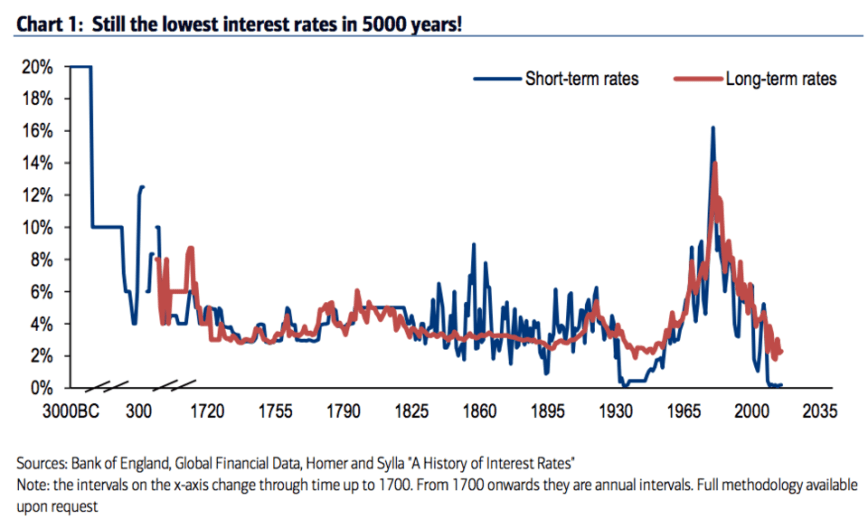
But I think it is fair to ask if Powell’s policies are the mistake, or if perhaps, those policies he is unwinding, namely QE and ZIRP, were the mistakes. After all, in the scope of history, today’s interest rates remain exceedingly low, somewhere in the bottom decile of all time as can be seen in Chart 1 below.

5000 yr interest rate chart

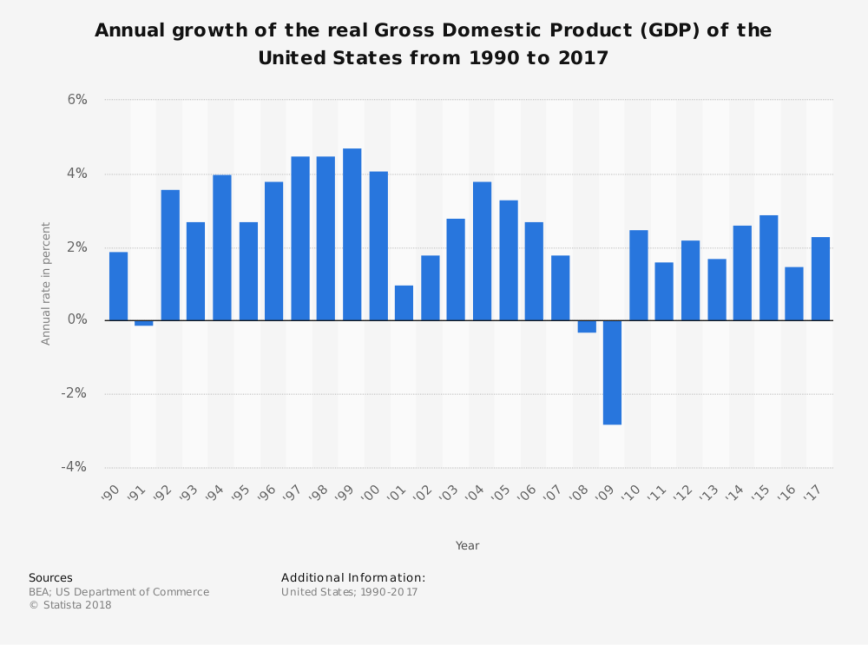
So maybe the mistake was that the illustrious group of central bankers mentioned above chose to maintain these extraordinary monetary policies for nearly a decade, rather than begin the unwinding process when growth had recovered several years after the recession ended. As the second chart shows, the Fed waited seven years into a recovery before beginning the process of slowly unwinding what had been declared emergency policy measures. Was it really still an emergency in 2015, six years after the end of the recession amid 2.0% GDP growth, which caused the Fed to maintain a policy stance designed to address a severe recession?

Chart 2

real gdp growth

My point is simply that any analysis of the current stance of the Federal Reserve and its current policy trajectory must be seen in the broader context of not only where it is heading, but from whence it came. Ten years of extraordinarily easy monetary policy has served to build up significant imbalances and excesses throughout financial markets. Consider the growth in leveraged loans, especially covenant lite ones, corporate debt or government debt, all of which are now at record levels, as key indicators of the current excesses. The history of economics is replete with examples of excesses leading to shakeouts throughout the world. The boom and bust cycle is the very essence of Schumpeterian capitalism, and as long as we maintain a capitalist economy, those cycles will be with us.

The simple fact is that every central bank is ‘owned’ by its government, and has been for the past thirty years at least. (Paul Volcker is likely the last truly independent Fed Chair we have had, although Chairman Powell is starting to make a name for himself.) And because of that ownership, every central bank has sought to keep rates as low as possible for as long as possible to goose growth above trend. In the past, although that led to excesses, the downturns tended to be fairly short, and the rebounds quite robust. However, the advent of financial engineering has resulted in greater and greater leverage throughout the economy and correspondingly bigger potential problems in the next downturn. The financial crisis was a doozy, but I fear the next one, given the massive growth in debt outstanding, will be much worse.

At that point, I assure you that the first person who will be named as the culprit for ‘causing’ the recession will be Jay Powell. My point here is that, those fingers need to be pointed at Bernanke, Yellen, Draghi, Carney and Kuroda, as it was their actions that led to the current significantly imbalanced economy. The next recession will have us longing for the good old days of 2008 right after Lehman Brothers went bankrupt, and the political upheaval that will accompany it, or perhaps follow immediately afterwards, is likely to make what we are seeing now seem mild. While my crystal ball does not give me a date, it is becoming abundantly clear that the date is approaching far faster than most appreciate.

Be careful out there. Markets and politics are going to become much more volatile over the next several years.

One poet’s view!

Powell’s Fixation

Though spending by business has slowed
(And debt from the government growed)
There’s no indication
That Powell’s fixation
On raising rates soon will erode

The Fed left rates on hold yesterday, as universally expected. The policy statement was largely unchanged although it did tweak the wording regarding business investment, which previously had been quite strong but is now slowing somewhat. That said, there is absolutely no indication that the Fed is going to slow its trajectory of rate increases anytime soon. With the meeting now out of the way, I expect that the Fedspeak we hear going forward will reinforce that view, with only Kashkari and Bullard seeking to slow the pace, and neither of them is yet a voting member. The market response was actually mildly surprising in that equities sold off somewhat after the news (and have fallen sharply in Asia and Europe) despite the fact that this was the expected outcome. Meanwhile the dollar has continued to rebound from its recent lows touched on Wednesday, with the euro having declined 0.2% further this morning and 1.4% from its peak.

As an aside, I am constantly amazed at the idea that the Fed, especially as overseen by Jay Powell, is more than mildly interested in the happenings in the stock market. The Fed mandate is clear, maximum employment and stable prices, notably lacking any discussion of rising equity markets. Alas, ever since the Maestro himself, Alan Greenspan, was Fed Chair, it seems that the default reaction has been to instantly add liquidity to the market if there was any stock market decline. The result is we have seen three massive bubbles blown in markets, two of which have burst (tech stocks and real estate) with the third ongoing as we speak. If you understand nothing else about the current Fed chairman, it is abundantly clear that he is unconcerned with the day-to-day wobbles in financial markets. I am confident that if there is a significant change in the economic situation, and markets respond by declining sharply, the current Fed will address the economic situation, not the markets, and that, in my view, is the way policy should be handled.

But back to today’s discussion. I fully admit that I did not understand the market response to the election results, specifically why the dollar would have declined on the news. After all, a split Congress is not going to suddenly change policies that are already in place, especially since the Republican majority in the Senate expanded. And as the Fed made clear yesterday, they don’t care about the politics and are going to continue to raise rates for quite a while yet. Certainly, we haven’t seen data elsewhere in the world which is indicative of a significant uptick in growth that would draw investment away from the US, and so the dollar story will continue to be the tension between the short-term cyclical factors (faster US growth and tighter monetary policy) vs. the long-term structural factors (rising budget deficits and questionable fiscal sustainability). Cyclical data points to a stronger dollar; structural data to a weaker one, and for now, the cyclical story is still the market driver. I think it is worth keeping that in mind as one observes the market.

Regarding other FX related stories, the Brexit situation is coming to a head in the UK as PM May is trying to get her cabinet to sign off on what appears to be quite a bad deal, where the Irish border situation results in the UK being forced to abide by EU rules without being part of the EU and thus having no input to their formation. This is exactly what the Brexiteers wanted to avoid, and would seemingly be the type of thing that could result in a leadership challenge to May, and perhaps even new elections, scant months before Brexit. While I have assumed a fudge deal would be agreed, I am losing confidence in that outcome, and see an increasing chance that the pound falls sharply. Its recent rally has been based entirely on the idea that a deal would get done. For the pound, it is still a binary outcome.

The Italian budget story continues to play out with not only Brussels upset but actually the backers of the League as well. While I am no expert on Italian politics, it looks increasingly likely that there could be yet another election soon, with the League coming out on top, five star relegated to the backbenches, and more turmoil within the Eurozone. However, in that event, I think it highly improbable that the League is interested in leaving the euro, so it might well end up being a euro positive net.

So the week is ending on a positive note for the dollar, and I expect to see that continue throughout the session. This morning’s PPI data was much firmer than expected with the headline print at 2.9% and the core at 2.6%, indicating that there is no real moderation in the US inflation story. This data is likely tariff related, but that is no comfort given that there is no indication that the tariff situation is going to change soon. And if it does, it will only get worse. So look for the dollar to continue its rebound as the weekend approaches.

Good luck and good weekend
Adf


Change Can Come Fast

There once was a market that soared
With tech stocks quite widely adored
The Fed, for eight years
Suppressed any fears
And made sure that rates were kept floored

But nothing, forever, can last
Now ZIRP and QE’s time has passed
Investors are frightened
‘Cause Powell has tightened
Beware because change can come fast!

Many of you will have noticed that equity markets sold off sharply in the past twenty-four hours, and that as of now, it appears there is more room to run in this correction. The question in situations like these is always, what was the catalyst? And while sometimes it is very clear (think Brexit or the Lehman bankruptcy) at other times movements of this nature are simply natural manifestations of a very complex system. In other words, sometimes, and this appears to be one of them, markets simply move because a confluence of seemingly minor events all occur at the same time. Trying to ascribe the movement to yesterday’s PPI reading, or comments from the IMF meetings, or any other specific piece of information is unlikely to be satisfying and so all I will say is that sometimes, markets move further than you expect.

Consider, though, that by many measures equity prices, especially in the US, are extremely richly valued. Things like the Shiller CAPE, or the Buffet idea of total market cap/GDP both show recent equity market levels at or near historic highs. And while the tax cuts passed into law for 2018 have clearly helped profitability this year, 2019 comparisons will simply be that much tougher to meet. There are other situations regarding the market that are also likely having an impact, like the increase in algorithmic trading, the dramatic increase in passive indexing and the advent of risk parity strategies. All of these tended to lead to buying interest in the same group of equities, notably the tech sector, which has been the leading driver of the stock market’s performance. If these strategies are forced to sell due to investor withdrawals, they will do so with abandon (after all, they tend to be managed by computer programs not people, and there is no emotion involved at all) and we could see a substantial further decline. Something to keep in mind.

But how, you may ask, is this impacting the FX markets? Interestingly, the dollar is not showing any of its risk-off tendencies through this move. In fact, it has fallen against almost all counterpart currencies. And while in some cases, there is a valid story that has nothing to do with the dollar per se, in many cases, it appears that this is simply dollar weakness. For example, the euro has rallied 0.5% this morning, after a 0.25% gain yesterday. Part of this has been driven by modestly higher than expected inflation data from several Eurozone countries (Spain and Ireland) while there is likely also a benefit from the story that the Brexit negotiations seem to be moving to a conclusion. However, despite the positive Brexit vibe, the pound has only managed a 0.15% rise this morning. The big winner in the G10 space has been Sweden, where the krone has rallied 1.5% after it also released higher than expected CPI data (2.5%) and the market has priced in further tightening by the Riksbank.

Looking at the EMG space, the dollar has fallen very consistently here, albeit not universally. We haven’t paid much attention to TRY lately, but it has rallied 1.4% today, and 5.5% in the past month. While yesterday they did claim to create some measures to help address the rising inflation there, they appear fairly toothless and I suspect the lira’s recent strength has more to do with the market correcting a massive decline than investor appetite for the currency. But all of the CE4 are rallying today, albeit in line with the euro’s 0.5% move, and there have been no stories of note from the region.

Looking to APAC, the movement has actually been far less pronounced with THB the best performer, rising 0.7% but the rest of the space largely trading within 0.2% of yesterday’s close. In other words, there is no evidence that, despite a significant decline in equity markets throughout the region, that risk-off sentiment has reached dramatic proportions. Now, if equity markets continue their sharp decline today, my best guess is that we will see a bit more activity in the currency markets, likely with the dollar the beneficiary.

Finally, LATAM currencies have had a mixed performance, with MXN rising 0.5% this morning, but BRL having fallen more than 1% on news that the mooted finance minister for Jair Bolsonaro (assuming he wins the second round election) is being investigated for corruption.

Turning to this morning’s session, the key data point of the week is released, with CPI expected to have declined to 2.4% in September (from 2.7%) and the core rate to have risen to 2.3%, up from August’s reading of 2.2%. With every comment from a Fed speaker focused on the idea of continuing to increase Fed Funds until they reach neutral, this data has the opportunity to have a real impact. If the release is firmer than expected, look for bonds to suffer, equities to suffer more and the dollar to find support. However, if this data is weak, then I would expect that the dollar could fall further, maybe back toward the bottom of its recent range, while the equity market finds some support as fears of an overly tight Fed dissipate.

So there is every opportunity for some more market fireworks today. As I believe that inflation remains likely to continue rising, especially based on the anecdotal evidence of rises in wages, I continue to see the dollar finding support. Of course, that doesn’t speak well of how the equity market is likely to perform if I am correct.

Good luck
Adf

Still Under Stress

As traders are forced to assess
A bond market still under stress
Today’s jobs report
Might be of the sort
That causes some further regress

Global bond markets are still reeling after the past several sessions have seen yields explode higher. The proximate cause seems to have been the much stronger data released Wednesday in the US, where the ADP Employment and ISM Non-Manufacturing reports were stellar. Adding to the mix were comments by Fed Chairman Powell that continue to sing the praises of the US economy, and giving every indication that the Fed was going to continue to raise rates steadily for the next year. In fact, the Fed funds futures market finally got the message and has now priced in about 60bps of rate hikes for next year, on top of the 25bps more for this year. So in the past few sessions, that market has added essentially one full hike into their calculations. It can be no surprise that bond markets sold off, or that what started in the US led to a global impact. After all, despite efforts by some pundits to declare that the ECB was the critical global central bank as they continue their QE process, the reality is that the Fed remains top of the heap, and what they do will impact everybody else around the world.

Which of course brings us to this morning’s jobs data. Despite the strong data on Wednesday, there has been no meaningful change in the current analyst expectations, which are as follows:

Nonfarm Payrolls 185K
Private Payrolls 180K
Manufacturing Payrolls 12K
Unemployment Rate 3.8%
Participation Rate 62.7%
Average Hourly Earnings (AHE) 0.3% (2.8% Y/Y)
Average Weekly Hours 34.5
Trade Balance -$53.5B

The market risk appears to be that the release will show better than expected numbers today, which would encourage further selling in Treasuries and continuation of the cycle that has driven markets this week. What is becoming abundantly clear is that the Treasury market has become the pre-eminent driver of global markets for now. Based on the data we have seen lately, there is no reason to suspect that today’s releases will be weak. In fact, I suspect that we are going to see much better than expected numbers, with a chance for AHE to touch 3.0%. Any outcome like that should be met with another sharp decline in Treasuries as well as equities, while the dollar finds further support.

Away from the payroll data, there have been other noteworthy things ongoing around the world, so lets touch on a few here. First, there is growing optimism that with the Tory Party conference now past, and PM May still in control, that now a Brexit deal will be hashed out. One thing that speaks to this possibility is the recent recognition by Brussels that the $125 trillion worth of derivatives contracts that are cleared in London might become a problem if there is no Brexit deal, with payment issues needing to be sorted, and have a quite deleterious impact on all EU economies. As I have maintained, a fudge deal was always the most likely outcome, but it is by no means certain. However, today the market is feeling better about things and the pound has responded by rallying more than a penny. The idea is that with a deal in place, the BOE will have the leeway to continue raising rates thus supporting the pound.

Meanwhile, stronger than expected German Factory orders have helped the euro recoup some of its recent losses with a 0.25% gain since yesterday’s close. But the G10 has not been all rosy as the commodity bloc (AUD, NZD and CAD) are all weaker this morning by roughly 0.4%. Other currencies under stress include INR (-0.6%) after the RBI failed to raise interest rates as expected, although they explained there would be “calibrated tightening” going forward. I assume that means slow and steady, but sounds better. We have also seen further pressure on RUB (-1.3%) as revelations about Russian hacking efforts draw increased scrutiny and the idea of yet more sanctions on the Russian economy make the rounds. ZAR (-0.75%) and TRY (-2.0%) remain under pressure, as do IDR (-0.7%) and TWD (-0.5%), all of which are suffering from a combination of broad dollar strength and domestic issues, notably weak financial situations and current account deficits. However, there is one currency that has been on a roll lately, other than the dollar, and that is BRL, which is higher by 3.4% in the past week and 8.0% since the middle of September. This story is all about the presidential election there, where vast uncertainty has slowly morphed into a compelling lead for Jair Bolsonaro, a right-wing firebrand who is attacking the pervasive corruption in the country, and also has University of Chicago trained economists as his financial advisors. The market sees his election as the best hope for market-friendly policies going forward.

But for today, it is all about payrolls. Based on what we have heard from Chairman Powell lately, there is no reason to believe that the Fed is going to adjust its policy trajectory any time soon, and if they do, it is likely only because they need to move tighter, faster. Today’s data could be a step in that direction. All of this points to continued strength in the dollar.

Good luck and good weekend
Adf

Goldilocks Ain’t Dead Yet

The Chairman said, no need to fret
Our low unemployment’s no threat
To driving up prices
And so my advice is
Relax, Goldilocks ain’t dead yet

Chairman Powell’s message yesterday was that things were pretty much as good as anyone could possibly hope. The current situation of unemployment remaining below every estimate of NAIRU while inflation remains contained is a terrific outcome. Not only that, there are virtually no forecasts for inflation to rise meaningfully beyond the 2.0% target, despite the fact that historically, unemployment levels this low have always led to sharper rises in inflation. In essence, he nearly dislocated his shoulder while patting himself on the back.

But as things stand now, he is not incorrect. Measured inflationary pressures remain muted despite consistently strong employment data. Perhaps that will change on Friday, when the September employment report is released, but consensus forecasts call for the recent trend to be maintained. Last evening’s news that Amazon was raising its minimum wage to $15/hour will almost certainly have an impact at the margin given the size of its workforce (>575,000), but the impact will be muted unless other companies feel compelled to match them, and then raise prices to cover the cost. It will take some time for that process to play out, so I imagine we won’t really know the impact until December at the earliest. In the meantime, the Goldilocks economy of modest inflation and strong growth continues apace. And with it, the Fed’s trajectory of rate hikes remains on track. The impact on the dollar should also remain on track, with the US economy clearly still outpacing those of most others around the world, and with the Fed remaining in the vanguard of tightening policy, there is no good reason for the dollar to suffer, at least in the short run.

However, that does not mean it won’t fall periodically, and today is one of those days. After a weeklong rally, the dollar appears to be consolidating those gains. The euro has been one of today’s beneficiaries as news that the Italian government is backing off its threats of destroying EU budget rules has been seen as a great relief. You may recall yesterday’s euro weakness was driven by news that the Italians would present a budget that forecast a 2.4% deficit, well above the previously agreed 1.9% target. The new government needs to spend a lot of money to cut taxes and increase benefits simultaneously. But this morning, after feeling a great deal of pressure, it seems they have backed off those deficit forecasts for 2020 and 2021, reducing those and looking to receive approval. In addition, Claudio Borghi, the man who yesterday said Italy would be better off without the euro, backed away from those comments. The upshot is that despite continued weakening PMI data (this time services data printed modestly weaker than expected across most of the Eurozone) the euro managed to rally 0.35% early on. Although in the past few minutes, it has given up those gains and is now flat on the day.

Elsewhere the picture is mixed, with the pound edging lower as ongoing Brexit concerns continue to weigh on the currency. The Tory party conference has made no headway and time is slipping away for a deal. Both Aussie and Kiwi are softer this morning as traders continue to focus on the interest rate story. Both nations have essentially promised to maintain their current interest rate regimes for at least the next year and so as the Fed continues raising rates, that interest rate differential keeps moving in the USD’s favor. It is easy to see these two currencies continuing their decline going forward.

In the emerging markets, Turkish inflation data was released at a horrific 24.5% in September, much higher than even the most bearish forecast, and TRY has fallen another 1.2% on the back of the news. Away from that, the only other currency with a significant decline is INR, which has fallen 0.65% after a large non-bank lender, IL&FS, had its entire board and management team replaced by the government as it struggles to manage its >$12 billion of debt. But away from those two, there has been only modest movement seen in the currency space.

One of the interesting things that is ongoing right now is the fact that crude oil prices have been rallying alongside the dollar’s rebound. Historically, this is an inverse relationship and given the pressure that so many emerging market economies have felt from the rising dollar already, for those that are energy importers, this pain is now being doubled. If this process continues, look for even more anxiety in some sectors and further pressure on a series of EMG currencies, particularly EEMEA, where they are net oil importers.

Keeping all this in mind, it appears that today is shaping up to be a day of consolidation, where without some significant new news, the dollar will remain in its recent trading range as we all wait for Friday’s NFP data. Speaking of data, this morning brings ADP Employment (exp 185K) and ISM Non-Manufacturing (58.0), along with speeches by Fed members Lael Brainerd, Loretta Mester and Chairman Powell again. However, there is no evidence that the Fed is prepared to change its tune. Overall, it doesn’t appear that US news is likely to move markets. So unless something changes with either Brexit or Italy, I expect a pretty dull day.

Good luck
Adf


Too Arcane

The Fed took the time to explain
Why ‘Neutral’ they’ll never attain
Though theories suppose
O’er that rate, growth slows
Its measurement is too arcane

If one needed proof that Fed watching was an arcane pastime, there is no need to look beyond yesterday’s activities. As universally expected, the FOMC raised the Fed funds rate by 25bps to a range of 2.00% – 2.25%. But in the accompanying statement, they left out the sentence that described their policy as ‘accommodative’. Initially this was seen as both surprising and dovish as it implied the Fed thought that rates were now neutral and therefore wouldn’t need to be raised much further. However, that was not at all their intention, as Chairman Powell made clear at the press conference. Instead, because there is an ongoing debate about where the neutral rate actually lies, he wanted to remove the concept from the Fed’s communications.

The neutral rate, or r-star (r*) is the theoretical interest rate that neither supports nor impedes growth in an economy. And while it makes a great theory, and has been a linchpin of Fed models for the past decade at least, Chairman Powell takes a more pragmatic view of things. Namely, he recognizes that since r* cannot be observed or measured in anything like real-time, it is pretty useless as a policy tool. His point in removing the accommodative language was to say that they don’t really know if current policy is accommodative or not, at least with any precision. However, given that their published forecasts, the dot plot, showed an increase in the number of FOMC members that are looking for another rate hike this year and at least three rate hikes next year, it certainly doesn’t seem the Fed believes they have reached neutral.

The market response was pretty much as you would expect it to be. When the statement was released, and initially seen as dovish, the dollar suffered, stocks rallied and Treasury prices fell in a classic risk-on move. However, once Powell started speaking and explained the rationale for the change, the market reversed those moves and the dollar actually edged higher on the day, equity markets closed lower and Treasury yields fell as bids flooded the market.

In the end, there is no indication that the Fed is slowing down its current trajectory of policy tightening. While they have explicitly recognized the potential risks due to growing trade friction, they made clear that they have not seen any evidence in the data that it was yet having an impact. And given that things remain fluid in that arena, it would be a mistake to base policy on something that may not occur. All told, if anything, I would characterize the Fed message as leaning more hawkish than dovish.

So looking beyond the Fed, we need to look at everything else that is ongoing. Remember, the trade situation remains fraught, with the US and China still at loggerheads over how to proceed, Canada unwilling to accede to US demands, and the ongoing threat of US tariffs on European auto manufacturers still in the air. As well, oil prices have been rallying lately amid the belief that increased sanctions on Iran are going to reduce global supply. There is the ongoing Brexit situation, which appears no closer to resolution, although we did have French President Macron’s refreshingly honest comments that he believes the UK should suffer greatly in the process to insure that nobody else in the EU will even consider the same rash act as leaving the bloc. And the Italian budget spectacle remains an ongoing risk within the Eurozone as failure to present an acceptable budget could well trigger another bout of fear in Italian government bonds and put pressure on the ECB to back off their plans to remove accommodation. In other words, there is still plenty to watch, although none of it has been meaningful to markets for more than a brief period yet.

Keeping all that in mind, let’s take a look at the market. As I type (which by the way is much earlier than usual as I am currently in London) the dollar is showing some modest strength with the Dollar Index up about 0.25% at this point. The thing is, there has been no additional news of note since yesterday to drive things, which implies that either a large order is going through the market, or that short dollar positions are being covered. Quite frankly, I would expect the latter reason is more compelling. But stepping back, the euro has traded within a one big figure range since last Thursday, meaning that nothing is really going on. The same is true for most of the G10, as despite both data and the Fed, it is clear very few opinions have really changed. My take is that we are going to need to see material changes in the data stream in order to alter views, and that will take time.

In the emerging markets, we have two key interest rate decisions shortly, Indonesia is forecasts to raise their base rate by 25bps to 5.75% and the Philippines are expected to raise their base rate by 50bps to 4.50%. Both nations have seen their currencies remain under pressure due to the dollar’s overall strength and their own current account deficits. They have been two of the worst three performing APAC currencies this year, with India the other member of that ignominious group. Meanwhile, rising oil prices have lately helped the Russian ruble rebound with today’s 0.2% rally adding to the nearly 7% gains seen in the past two plus weeks. And look for the Argentine peso to have a solid day today after the IMF increased its assistance to $57 billion with faster disbursement times. Otherwise, it is tough to get very excited about this bloc either.

On the data front, this morning brings the weekly Initial Claims data (exp 210K), Durable Goods (2.0%, 0.5% ex transport) and our last look at Q2 GDP (4.2%). I think tomorrow’s PCE data will be of far more interest to the markets, although a big revision in GDP could have an impact. But overall, things remain on the same general trajectory, solid US growth, slightly softer growth elsewhere, and a Federal Reserve that is continually tightening monetary policy. I still believe they will go tighter than the market has priced, and that the dollar will benefit accordingly. But for now, we remain stuck with the opposing cyclical and structural issues offsetting. It will be a little while before the outcome of that battle is determined, and in the meantime, a drifting currency market is the most likely outcome.

Good luck
Adf


Doves Will Despise

Come two o’clock later today
The Fed will attempt to convey
How high rates may rise
Though doves will despise
The idea that more’s on the way

Ahead of the conclusion of the FOMC meeting today, very little has happened in the FX markets, and in fact, in most markets. At this point, given the fact that the Fed remains one of the key drivers to global monetary policy, and the still significant concern that the ongoing divergence in Fed policy with that of the rest of the world can have negative consequences, pretty much every investor is awaiting the Fed statement and Chairman Powell’s press conference. It is a foregone conclusion that they will raise the Fed Funds rate by 25bps to 2.00% – 2.25%.

So the big question is just what the dot plot will look like, especially since today is the first time we will see their 2021 forecasts. Economists and analysts have slowly accepted that the Chairman is on a mission here, and that rates are going to continue to rise by 25bps every quarter at least through June 2019. That would put Fed Funds at 2.75% – 3.00%, a level that is currently seen as ‘neutral’. But what is still uncertain is how the Fed itself expects the economy to evolve beyond the end of the previous forecast period. Any indication that their models point to faster growth would be quite surprising and have a market impact. In fact, the most recent Fed forecasts have been for the economy to peak soon and begin to slow back to a 2.0% GDP growth rate by 2020. It is changes in this trajectory that will be of the most interest. That and Chairman Powell’s comments and answers at the press conference. But at this point, all we can do is wait.

Looking around the rest of the world, we see that central banks everywhere continue to have their policy dictated by the Fed. Two examples are Indonesia and the Philippines, both of whom are expected to raise rates this week (Indonesia by 25bps, Philippines by 50bps) as both of these nations continue to run current account deficits and have seen their currencies erode in value faster than any of their Asian peers other than India. The nature of these two countries, which is quite common in the emerging market sphere, is that currency weakness passes through quickly to higher inflation, and so the dollar strength that we have seen since the beginning of Q2 has already had a significant impact. It is this issue that has prompted a number of emerging market central bankers to caution Chairman Powell of the negative consequences of the current Fed policy trajectory. However, Powell has dismissed these out of hand and the Fed continues on its course.

The other notable movement in the EMG bloc was in Argentina, where the central bank president resigned after just three months on the job. Luis Caputo was both liked and respected by markets and the FX market responded by pushing the peso lower by 2.5% on the news. Of course, in the broad scheme of things, this is not very much compared to the currency’s 50% decline this year.

Pivoting to the G10, FX movement has been modest overall, with the biggest movers AUD and NZD, both of which seem to be benefitting from the recent revival in commodity prices. There has been no new Brexit news and so the pound remains relatively unscathed. Meanwhile, after Monday’s excitement in the euro following Signor Draghi’s “relatively vigorous” comments, it seems that ECB member Peter Prâet was trotted out to explain that there was no change in the committee’s view and that rates would not be rising until much later next year. Ultimately, however, the euro is essentially unchanged on the day, with the market having drawn that conclusion shortly after the comments were made.

Yesterday’s US data showed that Consumer Confidence was approaching all time highs but House prices seemed to display some weakness. This is the perfect mix for the Fed, lessening price pressures along with optimism on economic growth. I assure you this will not deter the Fed from continuing on its path. Before the FOMC meeting ends this afternoon, New Home Sales data will print, expected to be 630K, which looks right about in line with the longer term trend, albeit showing some softness from the situation earlier this year.

I see no reason to expect that the market will move significantly before the FOMC, and of course, can only watch with the rest of the market to see what actually comes from the meeting as well as what the Chairman says. Until then, look for a quiet session.

Good luck
Adf