
Waiting for Jay

While everyone’s waiting for Jay
And hope he’s got good things to say
No stories of note
Have lately been wrote
And bulls keep on getting their way
 
The only place that’s not been true
Is China, where, policies, new
Allow new home prices
To make sacrifices
And slide hoping sales follow through


Although there has been a dearth of new information to drive activity, at least with respect to hard data, equity markets are mostly trading higher as the rebound from the early August correction continues.  In the US this week, the big news won’t be out until Friday, when Chairman Powell speaks at the Jackson Hole symposium.  Elsewhere, while we do see things like both Japanese and Canadian inflation as well as the flash PMI data, so much importance has been attributed to the Powell speech, it is hard for traders to get excited about very much.  For instance, early this morning the Swedish Riksbank cut their policy rate by 25bps, as expected, and indicated that there could be another 3 cuts during 2024, but nobody really cared.  In fact, the Swedish stock market is lower on the day, simply proving that rate cuts are not a stock market panacea.

However, not every nation is using the same playbook right now, and while Japan may be the biggest outlier, attempting to tighten monetary policy, albeit not as successfully as they had hoped, China is taking a different approach to fiscal and economic policy.  As I have mentioned before and has been widely reported for the past several years, the property market in China has been under severe stress.  What has become a bit clearer in that time is that much of the Chinese growth miracle was the result of massive overinvestment in housing.  The stories about ghost cities, that were built but where nobody lived, which had made the rounds for a while turned out to be true. 

In essence, a key driver of the Chinese economy was the property market.  Cities and states would sell land to property developers, using the funds to help themselves develop infrastructure.  Meanwhile, property developers had a ready market for their homes (mostly condos in high rises) as the Chinese people felt more comfortable with property as a savings vehicle than banks or the stock market.  Looking at the performance of the Shanghai Composite below, it is no wonder that people gravitated toward property.  After a peak in the summer of 2015, the PBOC devalued the renminbi 2%, stocks fell nearly 50% in the ensuing six months, and have remained at that lower level ever since.

A graph with numbers and lines

Description automatically generated

Source: tradingeconomics.com

But for the past four years, since China Evergrande, a major property developer, started to crumble, the desire of the Chinese people to own property has greatly diminished.  This has had a major impact on Chinese local government finances as the demand for property they were selling to fund themselves collapsed.  At this point, there is a glut of unfinished homes around as developers ran out of funding, so the country is in a bad spot.  Not surprisingly, one of the problems is regulatory, as Chinese city and state governments have had restrictions on new home prices, trying to prevent them from declining thus keeping the cycle of new homes funding the cities ongoing.  But recently, some major cities and states have relaxed those restrictions and suddenly, new home prices have fallen to make them competitive with resales.  Remarkably, sales volumes are picking up.  Who would have thunk?  

It is ironic that Communist China is defaulting to market pricing activity to help markets clear while in the ostensibly capitalist US, we have a major party seeking to intervene in housing markets to achieve a social goal of home ownership, regardless of the fact it will push prices higher.  At any rate, the upshot is that property prices in China continue to decline which is weighing on the share prices of those developers that have not already gone bust.  And that is dragging down the entire Chinese stock market and adding to that underperformance we see above.

But you can tell it is a slow day if that is the most interesting story I can discuss!  So, without further ado, let’s take a look at the overnight activity as we await the NY open.  While the CSI 300 (-0.7%) and Hang Seng (-0.3%) were both in the red, the rest of Asia followed the US higher with Japan (+1.8%) and Korea (+0.8%) leading the way higher.  As to European bourses, it is much less exciting as continental exchanges are all +/- 0.1% from yesterday’s close although the FTSE 100 (-0.6%) is under a bit of pressure with the energy sector weighing on the index amid the decline in oil prices.  As to US futures, they are essentially unchanged at this hour (7:20).

In the bond market, the doldrums also describe the price action with Treasury yields unchanged on the day and the same virtually true across all of Europe and Asia.  This is a situation where it is very clear that both traders and investors are waiting anxiously for Godot Powell.

While oil prices have stopped their slide this morning, they have fallen -6.0% in the past week as the slowing growth/recession story is on the minds of traders everywhere.  Concerns over supply on the back of either Ukraine/Russia or Israel/Iran are clearly no longer part of the discussion.  It feels to me like that is somewhat short-sighted, but I am not an oil trader.  In the metals markets, the barbarous relic (+0.85%) continues to pull all metals higher as it is trading at yet another new all-time high this morning ($2525/0z) and dragging silver (+1.3%) and copper (+0.2%) along for the ride.  While the silver movement makes some sense given it has precious characteristics, copper is wholly an industrial metal, so it is giving opposite signals to the oil market.  They both cannot be right.

Finally, the dollar remains under pressure, with the euro (-0.1% today, +0.75% this week) pushing toward its end 2023 highs.  Remember, back then, markets were pricing 6-7 Fed rate cuts this year, something which is clearly not going to happen.  As well, we are seeing the strength in CHF (+0.3%), SEK (+0.3% despite the rate cut and threats of more) and JPY (+0.2%). Interestingly, in the EMG space, ZAR (-0.6%) and MXN (-0.6%) are both under pressure this morning despite the rally in metals markets.  As well, I guess given the general malaise in China, it can be no surprise that the renminbi (-0.2%) has fallen.  Perhaps a more interesting thing to consider is the fact that the renminbi fixing has been right around current market levels, an indication that pressure on the PBOC to devalue has faded, and a sign that the dollar is losing some fans.  In fact, I suspect that this is a key feature of the dollar’s recent softness, and if the Fed does get aggressive, do not be surprised if the market pushes USDCNY to the other side of the +/- 2% trading band around the fix.

On the data front, there is no US data today at all, with the most interesting thing to be released being the Canadian inflation report (exp 2.5%).  We do hear from two Fed speakers this afternoon, Atlanta Fed president Raphael Bostic and Governor Michael Barr, but with Powell on the horizon, it would be hard for them to get much traction in my view.  As an aside, the Atlanta Fed’s GDPNow has fallen to 2.0% as of last Friday, down nearly 1% last week.  This, of course, is another brick in the recession story.

Net, today seems like it will be a quiet one, with markets biding their time until Friday.  Of course, given that these days, biding their time means equities will keep rallying and the dollar keep sliding, I think that seems like the best bet for now.

Good luck

Adf
Concerns Are Severe

One look at the dot plot makes clear
Inflation concerns are severe
So, higher for longer
Is growing still stronger
And Jay implied few cuts next year

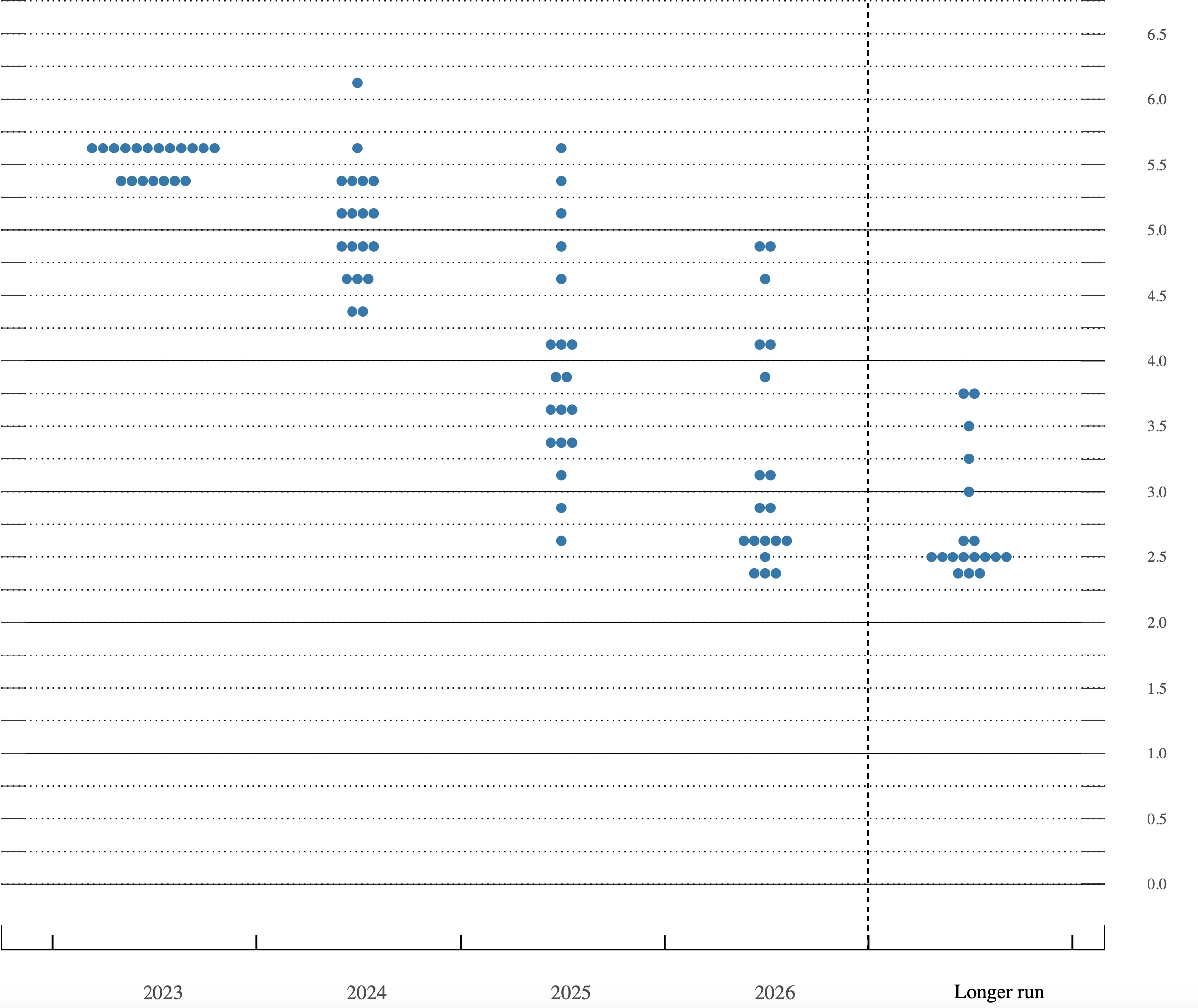
First, let’s recap the FOMC meeting.  The term hawkish pause had been used prior to the meeting as an expectation, and I guess that was a pretty apt description.  While they left policy on hold, as expected, the change in the dot plots, as seen below, indicate that even the doves on the Fed see fewer rate cuts next year, with just two now priced in from four priced in June.

Source: Fedreserve.gov

A quick reading shows that a majority of members expect one more hike this year, and now the median expectation for the end of 2024 has moved up to 5.125%, so 50bps lower than the median expectation for the end of 2023 and 50bps higher than the June plot.  To me, what is truly fascinating is the dispersion of expectations in 2025 and 2026, where there are clearly many opinions.  And finally, the longer run expectation has risen to 2.5% with many more members thinking it should be even higher than that.  The so-called neutral rate estimations seem to be creeping higher.  If you think about it, that makes some sense.  After all, given the ongoing forecasts for continued labor market tightness due to demographic concerns, and add in the massive budget deficits leading to significantly higher Treasury debt issuance, there is going to be pressure on rates to find a higher level.

The market response was quite negative, albeit not immediately, only after Powell started speaking.  But in the end, equity markets fell across the board in the US, with the NASDAQ taking the news the hardest, down -1.5%, as its similarity to long duration bonds was made evident.  Asian markets all fell overnight as well, with most tumbling more than -1.0% and European bourses are all under similar pressure, down -1.0% or so as well.  The one exception in Europe is Switzerland, where the SNB surprised the market and left rates on hold resulting in a weaker CHF and a very modest gain in their equity market.

However, the bigger market response was arguably in bonds, where yields rose to new highs for the move with the 2yr at 5.15% and the 10yr at 4.43%.  Once again, I point to the significant increase in debt that will be forthcoming from the US Treasury as they need to fund those budget deficits.  I have been making the case that a bear steepener would be the more likely outcome for the US yield curve.  That is where long-term rates rise more quickly than short-term rates due to the US fiscal policy and shrinking demand for US debt by key players, notably the Fed, but also China and Japan.  Nothing has changed that view.

Then early this morning, up north
Both Sweden and Norway brought forth
A quarter point hike
To act as a dike
Preventing price rises henceforth

After the Fed’s hawkish pause, we turn our attention to Europe, where the early movers, Sweden and Norway, both hiked twenty-five basis points, as expected, while both hinted that further hikes are not out of the question.  Inflation remains higher than target in both nations and in both cases, the currency has been relatively weak overall.  Switzerland left rates on hold, pointing to the fact that for the past three months, inflation has been within their target range, and they are beginning to see downward pressure on economic activity which they believe will keep that trend intact.

And lastly, from London we’ve learned
Another rate hike has been spurned
Though voting was tight
They said they’re alright
With waiting to see if things turned

As to the bigger story, the UK, expectations were split on a hike after yesterday’s tamer than expected CPI report while the pound fell ahead of the news.  And the change in expectations was appropriate as in a 5-4 vote, the BOE opted to remain on hold for the first time in two years.  They see that inflation may be easing more rapidly than previously expected, and they are concerned about overtightening.  While I have a hard time understanding how a 5.15% Base rate is tight compared to CPI running at 6.7% and core at 6.2%, I am clearly not a central banker.  At any rate, the pound fell further on the news and is now at its lowest level since March, while the FTSE 100 rallied back and is close to flat on the day from down nearly -1.0% before the announcement.  Gilt yields, however, are moving higher as the bond market there doesn’t seem to believe that the BOE is serious about fighting inflation.

And really, those are today’s key stories.  Late yesterday, Banco Central do Brazil cut the SELIC rate by 0.50%, as expected, and at the same time the BOE announced, the Central Bank of Turkey raised their refinancing rate by 5 full percentage points, to 30.0%, exactly as expected.  And to think, we get concerned over rates at 5%!

As to the rest of the day, there is a bunch of US data as follows: Philly Fed (exp -0.7), Initial claims (225K), Continuing Claims (1695K), Existing Home Sales (4.1M) and Leading Indicators (-0.5%).  As is typical, there are no Fed speakers scheduled the day after the FOMC meeting, but we will start to hear from them again tomorrow.

Putting it all together tells me that the Fed is not nearly ready to back off their current stance and will need to see substantial weakness in economic activity before changing their mind.  Meanwhile, last week’s ECB meeting and this morning’s BOE meeting tell me that the pain of higher interest rates in Europe is becoming palpable and the central banks are leaning more toward inflation as an outcome despite their mandates.  This continues to bode well for the dollar as the US remains the place with the highest available returns in the G10.

Tonight, we hear from the BOJ, where no change is expected.  I would contend, though, that the risk is there is some level of hawkishness that comes from that meeting as being more dovish seems an impossibility.  As such, there is a risk that the yen could see some short-term strength.  Keep that in mind as you look for your hedging levels.  

Good luck

Adf

Ephemeral

Inflation remains
Ephemeral in Japan
Will Suga as well?

Leadership in Japan remains a fraught situation as highlighted this week.  First, three by-elections were held over the weekend and the governing LDP lost all three convincingly.  PM Yoshihide Suga is looking more and more like the prototypical Japanese PM, a one-year caretaker of the seat.  Previous PM, Shinzo Abe, was the exception in Japanese politics, getting elected and reelected several times and overseeing the country for more than 8 years.  But, since 2000, Suga-san is the 9th PM (counting Abe as 1 despite the fact he held office at two different times).  In fact, if you remove Abe-san from the equation, the average tenor of a Japanese PM is roughly 1 year.  Running a large country is a very difficult job, and in the first year, most leaders are barely beginning to understand all the issues, let alone trying to address whichever they deem important.  In Japan, not unlike Italy, the rapid turnover has left the nation in a less favorable position than ought to have been the case.

Of course, long tenure is no guarantee of success in a leadership role, just ask BOJ Governor Haruhiko Kuroda.  He was appointed to the role in February 2013 and has been a strong proponent of ultra-easy monetary policy as a means to stoke inflation in Japan.  The stated target is 2.0%, and for the past 8 years, the BOJ has not even come close except for the period from March 2013-March 2014 when a large hike in the Goods and Services Tax raised prices on everyday items and saw measured inflation peak at 3.7% in August.  Alas for Kuroda-san, once the base effects of the tax hike disappeared, the underlying lack of inflationary impulse reasserted itself and in the wake of the Covid-19 pandemic lockdowns, CPI currently sits at -0.2%.

Last night, the BOJ met and left policy on hold, as expected, but released its latest economic and inflation forecasts, including the first look at their views for 2023.  Despite rapidly rising commodity prices as well as a slightly upgraded GDP growth forecast, the BOJ projects that even by 2023, CPI will only rise to 1.0%.  Thus, a decade of monetary policy largesse in Japan will have singularly failed to achieve the only target of concern, CPI at 2.0%.

Personally, I think the people of Japan should be thankful that the BOJ remains unsuccessful in this effort as the value of their savings remains intact despite ZIRP having been in place since, essentially, 1999.  While they may not be earning much interest, at least their purchasing power remains available.  But the current central bank zeitgeist is that 2.0% inflation is the holy grail and that designing monetary policy to achieve that end is the essence of the job.  The remarkable thing about this mindset is that every nation has a completely different underlying situation with respect to its demographics, debt load, fiscal accounts and growth capabilities, which argues that perhaps the one size fits all approach of 2.0% CPI may not be universally appropriate.

In the end, though, 2.0% is the only number that matters to a central banker, and for now, virtually everyone worldwide is trying to design their policy to achieve it.  As I have repeatedly discussed previously, here at home I expect that soon enough, Chairman Powell and friends will find themselves having to dampen inflation to achieve their goal, but for now, pretty much every G10 central bank remains all-in on their attempts to push price increases higher.  That means that ZIRP, NIRP and QE will not be ending anytime soon.  Do not believe the tapering talk here in the US, the Fed is extremely unlikely to consider it until late next year, I believe, at the earliest.

Delving into Japanese monetary policy seemed appropriate as central banks are this week’s story line and we await the FOMC outcome tomorrow afternoon.  In addition to the BOJ, early this morning Sweden’s Riksbank also met and left policy unchanged with their base rate at 0.0% and maintained its QE program of purchasing a total of SEK 700 billion to help keep liquidity flowing into the market.  But there, too, the inflation target of 2.0% is not expected to be achieved until 2024 now, a year later than previous views, and there is no expectation that interest rates will be raised until then.

What have these latest policy statements done for markets?  Not very much.  Overall, risk appetite is modestly under pressure this morning as Japan’s Nikkei (-0.5%) was the worst performer in Asia with both the Hang Seng and Shanghai indices essentially unchanged on the day.  I would not ascribe the Nikkei’s weakness to the BOJ, but rather to the general tone of malaise in today’s markets.  European equity markets have also been underwhelming with red numbers across the board (DAX -0.35%, CAC -0.2%, FTSE 100 -0.2%) albeit not excessively so.  Here, too, apathy seems the best explanation, although one can’t help but be impressed with the fact that yet another bank, this time UBS, reported significant losses ($774M) due to their relationship with Archegos.  As to US futures, their current miniscule gains of 0.1% really don’t offer much information.

Bond prices are also under very modest pressure with 10-year Treasury yields higher by 1.1bps and most of Europe’s sovereign market seeing yield rises of between 0.5bps and 1.0bps.  In other words, activity remains light as investors and traders await the word of god Powell tomorrow.

Commodity prices, on the other hand, are not waiting for anything as they continue to march higher across the board.  Oil (+0.8%) is leading the energy space higher, while copper (+1.1%) is leading the base metals space higher.  Gold and silver have also edged slightly higher, although they continue to lag the pace of the overall commodity rally.

The dollar, which had been uniformly higher earlier this morning is now a bit more mixed, although regardless of the direction of the move, the magnitude has been fairly small.  In the G10 space, the leading decliner is AUD (-0.2%) which is happening despite the commodity rally, although it is well off its lows for the session.  That said, it is difficult to get too excited about any currency movement of such modest magnitude.  Away from Aussie, JPY (-0.2%) is also a touch softer and the rest of the G10 is +/- 0.1% changed from yesterday’s closing levels, tantamount to unchanged.

EMG currencies have seen a bit more movement, but only TRY (+0.75%) is showing a substantial change from yesterday.  it seems that there is a growing belief that the tension between the US and Turkey regarding the Armenian genocide announcement by the Biden administration seems to be ebbing as Turkish President Erdogan refrained from escalating things.  This has encouraged traders to believe that the impact will be small and return their focus to the highest real yields around.  But away from the lira, gainers remain modest (KRW +0.25%, TWD +0.2%) with both of these currencies benefitting from equity inflows.  On the downside, ZAR (-0.35%) is the laggard as despite commodity price strength, focus seems to be shifting to the broader economic problems in the nation, especially with regard to a lack of power generation capacity.

Data this morning brings Case Shiller Home Prices (exp 11.8%) and Consumer Confidence (113.0), neither of which is likely to have a big impact although the Case Shiller number certainly calls into question the concept of low inflation. With the FOMC tomorrow, there are no Fed speakers today, so I anticipate a relatively dull session.  Treasury yields continue to be the underlying driver for the dollar in my view, so keep your eyes there.

Good luck and stay safe
Adf

Inflation Be Damned

The Minutes revealed that the Fed
Cares not about outlooks, instead
Inflation be damned
They now are programmed
To wait until growth is widespread

There is a conundrum in markets today, one that when considered thoughtfully can only force you to scratch your head and say, huh?  Economic growth in 2021 is going to be gangbusters, that much is virtually assured at this time.  We heard it from the IMF, we heard it from the Fed and basically from every central bank and government around.  And that’s great!  Equity markets have certainly gotten the message, as we achieve new all-time highs across numerous indices on a regular basis.  Bond markets are also buying the message, or perhaps selling the message is more apropos, as sovereign bond markets have sold off pretty sharply this year with the concomitant rise in yields being quite impressive.  And yet, those same central banks who are forecasting significant economic growth this year remain adamant that monetary policy support is critical, and they will not be withdrawing it for years to come.  A cynic might think that those central banks don’t actually believe their own forecasts.

Yesterday’s FOMC Minutes revealed this exact situation.  “Participants noted that it would likely be some time until substantial further progress toward the committee’s maximum-employment and price-stability goals would be realized.”  In other words, they are nowhere near even thinking about thinking about tapering asset purchases, let alone raising interest rates.  On the subject of inflation, they once again made it clear that there was virtual unanimous belief that short-term rises in PCE would be transitory and that the dynamics of the past decade that have driven inflation lower would soon reassert themselves.  After the Minutes were released, uber-dove Lael Brainerd made all that clear with the following comment, “Our monetary policy forward guidance is premised on outcomes, not the outlook.”

It is also critical to understand that this is not simply a US phenomenon, but is happening worldwide in developed nations.  For example, in Sweden, Riksbank Governor Stefan Ingves explained, “It’s like sitting on top of a volcano.  I’ve been sitting on that volcano for many, many years.  It hasn’t blown up, but it’s not heading in the right direction,” when discussing the buildup in household debt via mortgages in Sweden due to rising house prices.  Recently released data shows that household debt there has risen to 190% of disposable incomes, as housing prices in March rose 17% over the past year, to the highest levels ever.  And yet, Ingves is clear that the Riksbank will not be raising rates for at least three years.

Thus, the conundrum.  Explosive growth in economic activity with central banks adamant that interest rates will remain near, or below, zero and QE will continue.  Certainly every central banker recognizes that monetary policy adjustments work with a lag, generally seen to be between 6 months and 1 year, so if the Fed were to raise rates, it would be September at the earliest when it might show up as having an impact on the economy.  But every central bank has essentially promised they will be falling behind the curve to fight the current battle.

So, let’s follow this line of thought to some potential conclusions.  Economic activity continues to expand rapidly as governments everywhere pump in additional fiscal stimulus on top of the ongoing monetary largesse.  Central banks allow economies to ‘run hot’ in order to drive unemployment rates lower at the expense of rising inflation.  (Perhaps this is the reason that so many central bank studies have declared the Phillips Curve relationship to be dead, it is no longer convenient!)  Equity markets continue to rise, but so do sovereign yields in the back end of the curve, such that refinancing debt starts to cost more money.  Pop quiz: if you are a central banker, do you; A) start to raise rates in order to rein in rising inflation? Or B) cap yields through either expanded QE or YCC to insure that debt service costs remain affordable for your government, but allow inflation to run hotter?  This was not a difficult question, and what we continue to hear from virtually every central bank is the answer is B.  And that’s the point, if we simply listen to what they are saying, it is very clear that whether or not inflation prints higher, policy interest rates are stuck at zero (or below).  Oh yeah, as inflation rises, and it will, real rates will be heading lower as well, you can count on it.

So, with that in mind, let’s take a quick tour of the markets.  Equities in Asia showed the Hang Seng (+1.15%) rising smartly, but both the Nikkei (-0.1%) and Shanghai (+0.1%) relatively unchanged on the day.  In Europe, the picture is mixed with the DAX (-0.2%) lagging but both the CAC (+0.35%) and FTSE 100 (+0.35%) moving a bit higher.  As to the US futures market, there is a split here as well, with the NASDAQ (+0.9%) quite robust, while the SPX (+0.3%) and DOW (0.0%) lag the price action.

As to the bond market, Treasury yields continue to back off from their highs at quarter-end, and are currently lower by 3 basis points, although still within 12bps of their recent highs.  European markets are a little less exuberant this morning with yields on Bunds (-0.7bps), OATs (-0.6bps) and Gilts (-0.5bps) all lower by less than a full basis point.  A quick discussion of Japan is relevant here as well, given the budget released that indicates the debt/GDP ratio there will be rising to 257% at the end of this year!  Despite the fact that the BOJ has pegged yields out to 10 years at 0.0%, debt service in Japan still consumes 22% of the budget.  Imagine what would happen if yields there rose, even 100 basis points.  And this perfectly illustrates the trap that governments and central banks have created for themselves, and why there is a case to be made that policy rates will never be raised again.

Commodity markets are mixed as oil (-0.85%) is softer but we are seeing strength in the metals (Au +0.6%, Ag +0.9%, Cu +0.7%) and the Agricultural sector.  And lastly, the dollar is generally weaker on the day, with only NOK (-0.15%) lagging in the G10 space under pressure from oil’s decline.  But JPY (+0.5%) is the leading gainer after some positive data overnight, with a widening current account and rising consumer confidence underpinning the currency. Otherwise, we are seeing AUD (+0.3%) and NZD (+0.3%) firmer as well on the back of the non-energy commodity strength.

In emerging markets, PLN (+0.6%) is the leading gainer, which seems a bit anomalous given there was no new news today.  Yesterday the central bank left rates on hold at 0.10% despite a much higher than expected CPI print last week.  As described above, inflation s clearly not going to be a major policy driver in most economies for now.  But away from the zloty, movements show a few more gainers than laggards, but all the rest of the movement being relatively small, +/- 0.3%, with no compelling narratives attached.

On the data front, this morning brings us Initial (exp 680K) and Continuing (3638K) Claims at 8:30, and then a few more Fed speakers including Chairman Powell at noon.  But what can the Fed tell us that we don’t already know?

As to the dollar, I continue to look to the 10-year yield as the key driver so if it continues to slide, I expect the dollar to do so as well.  And it is hard to make a case for some new piece of news that will drive Treasury selling here, so further USD weakness makes sense.

Good luck and stay safe
Adf

Tempting the Fates

Around the world most central banks
Have, monthly, been forced to give thanks
That tempting the fates
With negative rates
Has not destroyed euros or francs

And later today we will hear
From Draghi, the man who made clear
“Whatever it takes”
Would fix the mistakes
Investors had grown, most, to fear

With Brexit on the back burner for the day, as the UK awaits the EU’s decision on how long of a delay to grant, the market has turned its attention to the world’s central banks. Generally speaking, monetary ease remains the primary focus, although there are a few banks that are bucking the trend.

Starting with the largest for today, and world’s second most important central bank, the ECB meets today in what is Mario Draghi’s final policy meeting at the helm. Given their actions last month, where they cut the deposit rate a further 10bps to -0.50% and restarted QE to the tune of €20 billion per month, there is no expectation for any change at all. In fact, the only thing to expect is more exhortations from Draghi for increasing fiscal policy stimulus by Germany and other Northern European nations that are not overly indebted. But it will not change anything at this stage, and he has already tied Madame Lagarde’s hands going forward with their most recent guidance, so this will be the farewell tour as everybody regales him for saving the euro back in 2012.

But there have been a number of other moves, the most notable being the Swedish Riksbank, which left rates unchanged, but basically promised to raise them by 25bps in December to return them to 0.00%. Apparently they are tired of negative rates and don’t want them to become habit forming. While I admire that concept, the problem they have is growth there is slowing and inflation is falling well below their target of 2.0%. The most recent reading was 1.5%, but the average going back post the financial crisis is just 1.1%. SEK gained slightly after their comments, rallying 0.15% this morning, but the trend in the krone remains lower and I think they will need to raise a lot more than 25bps to change that.

Meanwhile, other central bank activity saw Norway leave rates unchanged at 1.50% as core inflation there remains above their 2.0% target. NOK’s response was essentially nil. Indonesia cut rates by 25bps, as widely expected, its fourth consecutive rate cut, and although the rupiah is ever so slightly softer this morning, -0.2%, its performance this year has been pretty solid, having gained 2.3% YTD. Finally, the Turkish central bank cut rates by a surprising 250bps this morning, much more than the 100bps expected. If you recall, President Erdogan has been adamant that higher interest rates beget higher inflation, and even fired the previous central bank head to replace him with someone more malleable. Interestingly, a look at Turkish inflation shows that it has been falling despite (because of?) recent rate cuts. And today, despite that huge cut, the initial currency impact was pretty modest, with the lira falling 0.5% immediately, but already recouping some of those losses. And in the broader picture, the lira’s recent trend has clearly been higher and remains so after the cut.

On the data front we saw PMI data from the Eurozone and it simply reinforced the idea that the Eurozone is heading into a recession. Germany’s numbers were worse than expected (Manufacturing 41.9, Composite 48.6) which was enough to drag the Eurozone data down as well (Manufacturing 45.7, Composite 50.2). It seems clear that when Germany reports their Q3 GDP next month it will be negative and Germany will ‘officially’ be in a recession. It is data of this nature that makes it so hard to turn bullish on the single currency. Given their economic travails, the Teutonic austerity mindset, which was enshrined in law, and the fact that the ECB is essentially out of bullets, it is very difficult to have a positive view of the euro in the medium term. This morning, ahead of the ECB policy statement, the euro is little changed, and I see no reason for it to move afterwards either.

So, there was lots of central bank activity, but not so much FX movement in response. My sense is that FX traders are now going to fully turn their attention to the FOMC meeting next week, as even though a rate cut seems assured, the real question is will the Fed call a halt to the mid-cycle adjustment, or will they leave the door open to further rate cuts. The risk with the former is that the equity market sells off sharply, thus tightening financial conditions, sowing fear in Washington and forcing a reversal. However, the risk with the latter is that the Fed loses further credibility, something they have already squandered, by being proven reactive to the markets, and less concerned with the economy writ large.

For today’s session, we have the only real data of the week, Durable Goods (exp -0.7%, -0.2% ex Transport), and Initial Claims (215K) at 8:30, then New Home Sales (702K) at 10:00. We also see the US PMI data (Manufacturing 50.9, Services 51.0) although the market generally doesn’t pay much attention to this. Instead it focuses on the ISM data which won’t be released until next week.

Without any Fed speakers on the docket, once again the FX market is likely to take its cues from equities, which are broadly higher this morning after a number of better than expected earnings announcements. In this risk-on environment, I think the dollar has room to edge lower, but unless we start to see the US data really deteriorate, I have a feeling the Fed is going to try to end the rate cuts and the dollar will benefit going forward. Just not today.

Good luck
Adf


Soon On the Way

Said Brainerd and Williams and Jay
A rate cut is soon on the way
Inflation’s quiescent
And growth’s convalescent
So easing will help save the day

We have learned a great deal this week about central bank sentiment from the Fed, the ECB, the BOE, Sweden’s Riksbank as well as several emerging market central banks like Mexico and Serbia. And the tone of all the commentary is one way; easier policy is coming soon to a central bank near you.

Let’s take a look at the Fed scorecard to start. Here is a list of the FOMC membership, voting members first:

Chairman Jerome Powell                – cut
Vice-Chair Richard Clarida             – cut
Lael Brainerd                                    – cut
Randal Quarles                                 – cut
Michelle Bowman                            – ?
NY – John Williams                           -cut
St Louis James Bullard                    – cut
Chicago – Charles Evans                  – cut
KC – Esther George                           – stay
Boston – Eric Rosengren                 – cut

Non-voting members
Philadelphia – Patrick Harker       – cut
Dallas – Robert Kaplan                    – ?
Minneapolis – Neel Kashkari         – cut 50!
Cleveland – Loretta Mester            – stay
Atlanta – Rafael Bostic                    – stay
Richmond – Thomas Barkin          – stay

While we have not yet heard from the newest Governor, Michelle Bowman, it would be unprecedented for a new governor to dissent so early in their tenure. In the end, based on what we have heard publicly from voting members, only Esther George might dissent to call for rates to remain on hold, but it is clear that at least a 25bp cut is coming at the end of the month. The futures market has priced it in fully, and now the question is will they cut 50. At this point, it doesn’t seem that likely to me, but there are still two weeks before the meeting, so plenty can happen in the interim.

But it’s not just the Fed. The ECB Minutes were released yesterday, and the telling line was there was “broad agreement” that the ECB should “be ready and prepared to ease the monetary policy stance further by adjusting all of its instruments.” It seems pretty clear to me (and arguably the entire market) that they are about to ease policy. There are many analysts who believe the ECB will wait until their September meeting, when they produce new growth and inflation forecasts, but a growing number of analysts who believe that they will cut later this month. After all, if the Fed is about to cut based on weakening global growth, why would the ECB wait?

And there were the Minutes from Sweden’s Riksbank, which were released this morning and showed that their plans for raising rates as early as September have now been called into question by a number of the members, as slowing global growth and ongoing trade uncertainties weigh on sentiment. While Sweden’s economy has performed better than the Eurozone at large, it will be extremely difficult for the Riksbank to tighten policy while the ECB is easing without a significant adjustment to the krona. And given Sweden’s status as an open economy with significant trade flows, they cannot afford for the krona to strengthen too much.

Meanwhile, Banco de Mexico Minutes showed a split in the vote to maintain rates on hold at 8.25% last month, with two voters now looking for a cut. While inflation remains higher than target, again, the issue is how long can they maintain current policy rates in the face of cuts by the Fed. Look for rate cuts there by autumn. And finally, little Serbia didn’t wait, cutting 25bp this morning as growth there is beginning to slow, and recognizing that imminent action by the ECB would need to be addressed anyway.

In fairness, the macroeconomic backdrop for all this activity is not all that marvelous. For example, just like South Korea reported last week, Singapore reported Q2 GDP growth as negative, -3.4% annualized, a much worse than expected outcome and a potential harbinger of the future for larger economies. Singapore’s economy is hugely dependent on trade flows, so given the ongoing US-China trade issues, this ought not be a surprise, but the magnitude of the decline was significant. Speaking of China, their trade data, released last night, showed slowing exports (-1.3%) and imports (-7.3%), with the result a much larger than expected trade surplus of $51B. Additionally, we saw weaker than expected Loan growth and slowing M2 Money Supply growth, both of which point to slower economic activity going forward. Yesterday’s other important economic data point was US CPI, where core surprised at 2.1%, a tick higher than expected. However, the overwhelming evidence that the Fed is going to cut rates has rendered that point moot for now. We will need to see that number move much higher, and much faster, to change any opinions there.

The market impact of all this has generally been as expected. Equity prices, at least in the US, continue to climb as investors cling tightly to the idea that lower interest rates equal higher stock prices. All three indices closed at new records and futures are pointing higher across the board. The dollar, too, has been under pressure, as would be expected given the view that the Fed is going to enter an easing cycle. Of course, while the recent trend for the dollar has been down, the slope of the line is not very steep. Consider that the euro is only about 1% above its recent cyclical lows from late April, and still well below the levels seen at the end of June. So while the dollar has weakened a bit, it is quite easy to make the case it remains within a trading range. In fact, as I mentioned yesterday, if all central banks are cutting rates simultaneously, the impact on the currency market should be quite limited, as the relative rate stance won’t change.

Finally, a quick word about Treasury bonds as well as German bunds. Both of these markets were hugely overbought by the end of last week, as investors and speculators jumped on the idea of lower rates coming soon. And so, it should be no surprise that both of these markets have seen yields back up a decent amount as those trades are unwound. This morning we see 10-year yields at 2.13% in the US and -0.21% in Germany, well off the lows of last week. However, this trade is entirely technical and at some point, when these positions are gone, look for yields on both securities to head lower again.

This morning brings just PPI (exp 1.6%, 2.2% core) which is unlikely to have much impact on anything. With no more Fed speakers to add to the mix, I expect that we will continue to see equities rally, and that the dollar, while it may remain soft, is unlikely to move too far in any direction.

Good luck and good weekend
Adf

Spring Next Year

Interest rates shan’t
Rise ere spring next year. But might
They possibly fall?

This morning’s market theme is that things look bad everywhere, except perhaps in the US. Starting in Tokyo, the BOJ met last night and, to no one’s surprise, left their policy rate unchanged at -0.10%. They maintained their yield curve control target of 0.00% +/- 0.20% for 10-year JGB’s and they indicated they would continue to purchase JGB’s at a clip of ¥80 trillion per year. But there were two things they did change, one surprising and one confusing.

First the surprise; instead of claiming rates would remain low for an “extended period”, the new language gave a specific date, “at least through around spring 2020”. Of course, this gives them the flexibility to extend that date specifically, implying an even more dovish stance going forward. Market participants were not expecting any change to the language, but interestingly, the yen actually rallied after the report. Part of that could be because there was significant weakness in Asian equity markets and a bit of a risk-off scenario, but I also read that some analysts see this as a prelude to tighter policy. I don’t buy the latter idea, but it does have adherents. The second thing they did, the confusing one, was they indicated they would create a lending facility for their ETF portfolio. The unusual thing here is that generally, lending securities is a way to encourage short-selling, although they did couch the idea in terms of added liquidity to the market. Given they own more than 70% of the ETF market, it is clear that liquidity must be suffering, but I wouldn’t have thought bringing short-sellers to the party would be their goal.

In South Korea, Q1 GDP shrank -0.3%, a much worse outcome than the expected 0.3% growth, and largely caused by a sharp decline in exports and IP. This is an ominous sign for the global economy, and also calls into question the accuracy of the Chinese data last week. Given the tight relationship between Korean exports and Chinese growth, something seems out of place here. The market impact was a decline in the KOSPI (-0.5%), falling Korean yields and a decline in the KRW, which fell a further 0.6% and is now at its weakest point in two years. Look for the Bank of Korea to ease policy going forward.

Turning to Europe, the Swedish Riksbank left policy rates unchanged at -0.25%, as expected, but their statement indicated that there would be no rate hike later this year, as previously expected, given the slowing growth and lack of inflation in Sweden. While I foreshadowed this earlier this week, the market response was severe, with SEK falling 1.4%, although the Swedish OMX (stock market) rallied 1% on the news. You know, bad news is good because rates remain low.

One last central bank note, the Bank of Canada has thrown in the towel on normalizing policy, dropping any reference to higher rates in the future from their statement yesterday. Upon the release of the statement, the Loonie fell a quick 1%. Although it has since recovered a bit of that, it is still lower by 0.6% from before the meeting. It seems concerns over slowing growth now outweigh concerns over excess leverage in the private sector.

The other market note was the sharp decline in Chinese stocks with the Shanghai Composite falling 2.4% as traders and investors there lose faith that the PBOC is going to continue to support the economy, especially after the better than expected GDP data last week. Even the renminbi fell, -0.3%, although it has been especially stable for the past two months as the US-China trade talks continue. Speaking of which, the next round of face-to-face talks are set to get under way shortly, but there has been little in the way of news, either positive or negative, for the past two weeks.

One other thing about which we have not heard much lately is Brexit, where the internal political machinations continue in Parliament, but as yet, there has been no willingness to compromise on either side of the aisle. Of note is that the pound continues to fall, down a further 0.2% this morning and now firmly below 1.29. While there is no doubt that the dollar is strong across the board, it also strikes that some market participants are beginning to price in a chance of a no-deal Brexit again, despite Parliament’s stated aim of preventing that. As yet, there is no better alternative.

Finally, the euro is still under pressure this morning as well, down a further 0.2% this morning, which makes 1.5% in the past week. This morning’s only data point showed Unemployment in Spain rose unexpectedly to 14.7%, another sign of slowing growth throughout the Eurozone. At this point, the ECB is unwilling to commit to easing policy much further, but with the data misses piling up, at some point they are going to concede the point. Easier money is coming to the Eurozone as well.

This morning brings Initial Claims data (exp 200K) and Durable Goods (0.8%, 0.2% ex Transport). It doesn’t seem that either of these will change any views, and as we have seen all week, I expect that Q1 earnings will be the market’s overall focus. A bullish spin will continue to highlight the different trajectories of the US and the rest of the world, and ultimately, continue to support the dollar.

Good luck
Adf


Headwinds Exist

Of late from the Fed we have heard
That “gradual” is the watchword
Though headwinds exist
The Fed will persist
Their rate hikes just won’t be deferred

It appears there is a pattern developing amongst the world’s central bankers. Despite increasing evidence that economic activity is slowing down, every one of them is continuing to back the gradual increase of base interest rates. Last week, Signor Draghi was clear in his assessment that recent economic headwinds were likely temporary and would not deter the ECB from ending QE on schedule and starting to raise rates next year. This week, so far, we have been treated to Fed speakers Charles Evans and Richard Clarida both explaining that the gradual increase of interest rates was still the appropriate policy despite indications that economic activity in the US is slowing. While both acknowledged the recent softer data, both were clear that the current policy trajectory of gradual rate hikes remained appropriate. Later this morning we will hear from Chairman Powell, but his recent statements have been exactly in line with those of Evans and Clarida. And finally, the Swedish Riksbank remains on track to raise rates next month despite the fact that recent economic data shows slowing growth and declining consumer and business confidence.

Interestingly, the San Francisco Fed just released a research paper explaining that inflation was NOT likely to rise significantly and that the increases earlier this year, which have been ebbing lately, were the result of acyclical factors. The paper continued that as those factors revert to more normal, historical levels, inflation was likely to fall back below the Fed’s 2.0% target. But despite their own research, there is no indication that the Fed is going to change their tune. In fact, the conundrum I see is that Powell’s Fed has become extremely data focused, seemingly willing to respond to short term movement in the numbers despite the fact that monetary policy works with a lag at least on the order of 6-12 months. In other words, even though the Fed is completely aware that their actions don’t really impact the data for upwards of a year, they are moving in the direction of making policy based on the idiosyncrasies of monthly numbers.

All this sounds like a recipe for some policy mistakes going forward. However, as I wrote two weeks ago, current attempts to normalize policy are very likely simply addressing previous policy mistakes. After all, the fact that pretty much every central bank in the G20 is seeking to ‘normalize’ monetary policy despite recent growth hiccups is indicative of the fact that they all realize their policies are in the wrong place for the end of the economic cycle. Belatedly, it seems they are beginning to understand that they will have very limited ability to address the next economic downturn, which I fear will occur much sooner than most pundits currently predict.

The reason I focus on the central banks is because of their outsized impact on the currency markets. After all, as I have written many times, the cyclical factor of relative interest rates continues to be one of the main drivers of FX movements. So as long as central banks are telling us that they are on a mission to raise rates, the real question becomes the relative speed with which they are adjusting policy and how much of that adjustment is already priced into the market. The reason that yesterday’s comments from Evans and Clarida are so important is that the market had begun pricing out rate hikes for 2019, with not quite two currently expected. However, if the Fed maintains its hawkish tone that implies the dollar has further room to rise.

Speaking of the dollar, despite the risk-on sentiment that has been evident in equity markets the past two sessions, the dollar continues to perform well. That sentiment seems to be driven by the idea that the Trump-Xi meeting on Saturday will produce some type of compromise and restart the trade talks. I am unwilling to handicap that outcome as forecasting this president’s actions has proven to be extremely difficult. We shall see.

Pivoting to the market today, the dollar is actually little changed this morning, with the largest G10 movement being a modest 0.3% rally in the pound Sterling. There are numerous articles describing the ongoing machinations in Parliament in the UK regarding the upcoming Brexit vote, and today’s view seems to be that something will pass. However, away from the pound, the G10 is trading within 10bps of yesterday’s close, although yesterday did see the dollar rally some 0.4% across the board. Yesterday’s US data showed that consumer confidence was slipping from record highs and that house prices were rising less rapidly than forecast, although still at a 5.1% clip. This morning brings the second look at Q3 GDP (exp 3.5%) as well as New Home Sales (575K) and the Goods Trade Balance (-$76.7B). However, Chairman Powell speaks at noon, and that should garner the bulk of the market’s attention. Until then, I anticipate very little price action in the FX markets, and truthfully in any market.

Good luck
Adf