Not Soaring

It seems that prices
In Japan are not soaring
Like the hawks would want


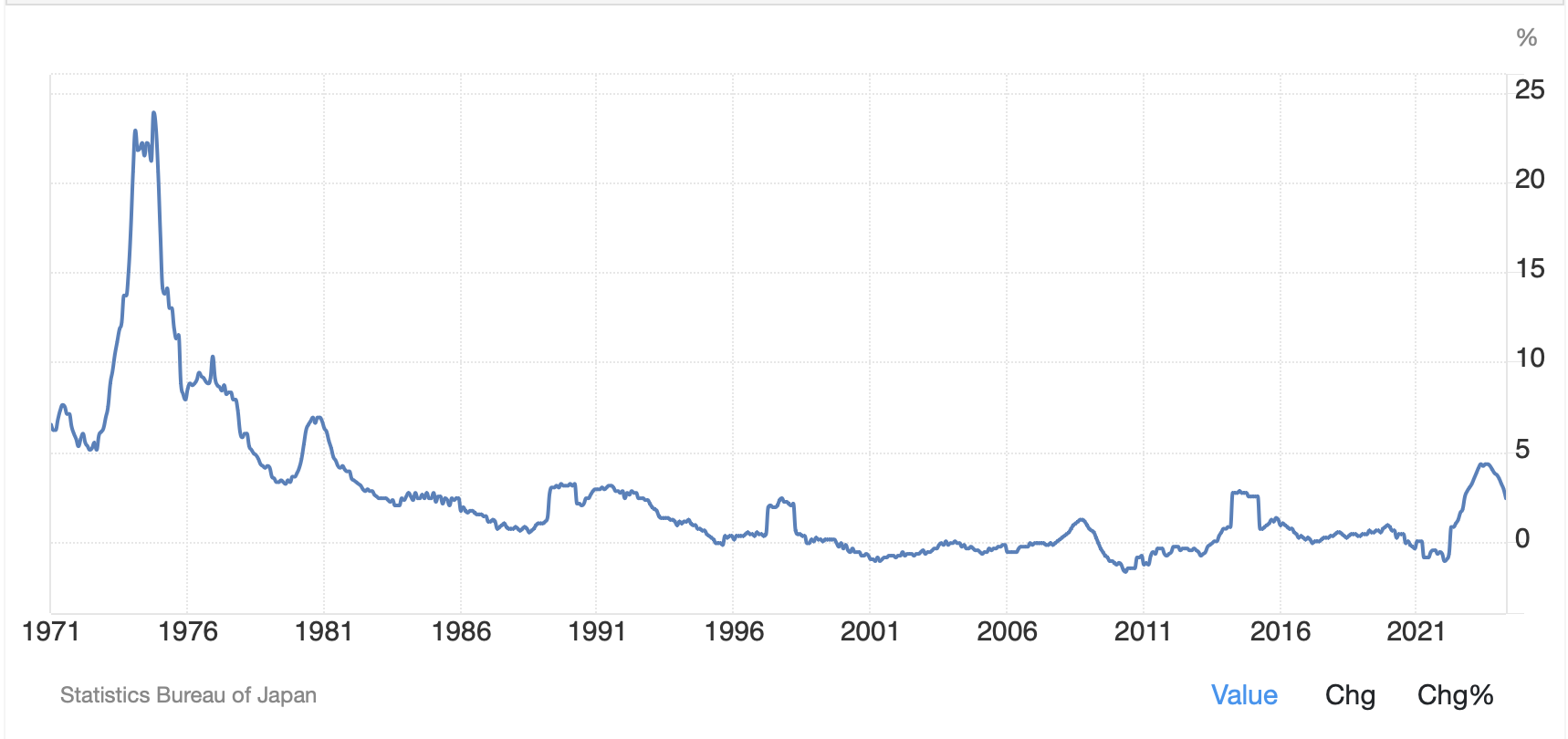
Japanese inflation data last night showed a continued decline as the Core rate fell to 2.2%, and the so-called super core rate slipped to 2.4%, its lowest level since October 2022.  As you can see in the super core chart below, the trend seems clearly to be downward although the current level remains far above inflation rates for most of the past 30 years.

Source: tradingeconomics.com

The irony here is that were this the chart of the inflation rate in any other G7 nation, the central bank would be crowing about how successful they had been at slaying the inflation dragon.  Alas, as the chart demonstrates, Japan’s dragon was a different species, and one that I’m pretty sure the 122 odd million people there were very comfortable having as a “pet”.  After all, I have never met a consumer who was seeking prices to rise before they bought something, have you?

From a market perspective, the continued decline in inflation rates calls into question just how much further Japanese interest rates need to rise in order to achieve the BOJ’s goals.  Again, remember the BOJ’s goals for the past decade has been to RAISE the inflation rate to 2% and their tactic has been to create the largest QE program in the world such that they now own more than 50% of the outstanding Japanese government debt across all maturities.  If inflation continues to decline back to, and below, 2%, while I’m confident the general population there will have no objections, Ueda-san may find himself in a difficult position.  

Arguably, if higher inflation is the goal (and politically that seems nuts) then the most effective tool the nation has is to allow the yen to continue to weaken and import inflation.  I continue to believe that this will be the process going forward, and while very sharp and quick declines will be addressed, a slow erosion will be just fine.  Absent a major change in US monetary policy to something much easier, I still don’t see a case for a much stronger yen.  However, as a hedger, I would continue to consider options to manage the risk of any further bouts of intervention.

While many are still of the view
That rate cuts are long overdue
What yesterday showed
Is growth hasn’t slowed
So, Jay and his friends won’t come through

Back home in the US, yesterday’s data releases did nothing to encourage the large contingent of people who are desperate looking for a rate cut before too long.  While New Home Sales were certainly lousy, falling from the previous month’s downwardly revised level, and the Chicago Fed’s National Activity Index was also quite soft, indicating economic activity had slowed last month, the Flash PMI data got all the attention with both Manufacturing (50.9) and Services (54.8) rising sharply, an indicator that there is still life in the economy yet.  The result was that we saw US yields rise (10yr +7bps), the dollar strengthen, and equity markets give back their early, Nvidia inspired, gains to close lower on the day.  While equity futures are rebounding slightly this morning, confidence that a rate cut is coming soon has clearly been shaken.

Adding to the gloom was a reiteration by Atlanta Fed president Bostic that it is going to take a lot longer for rates to impact inflation than in the past.  In a discussion with Stanford Business School students, he focused on the fact that so many people locked in low mortgage rates during the pandemic and recognized, “the sensitivity to our policy rate — the constraint and the degree of constraint that we’re going to put on is going to be a lot less.” For those reasons, Bostic said, “I would expect this to last a lot longer than you might expect.”  This discussion has been gaining more adherents as the punditry is grudgingly beginning to understand that their previous models are not necessarily relevant given all the changes the pandemic wrought.  Summing up, there continues to be no indication, especially in the wake of the more hawkish tone of the Minutes on Wednesday, that the Fed is going to cut rates soon.

So, with the new slightly less perfect world now coming into view, let’s take a look at market behavior overnight.  Yesterday’s US equity slide was continued everywhere else around the globe with Asian markets (Nikkei -1.2%, Hang Seng -1.4%, CSI 300 -1.1%) under uniform pressure and European bourses, this morning, also in the red, but by a lesser -0.4% or so across the board.  For many of these markets (China excepted) they have recently run to all-time highs, or at least very long-term highs, so it should be no surprise that there is some consolidation.  There is a G7 FinMin meeting this weekend and the comments we have heard so far indicate that the ECB is on track to cut rates next month, but there are no promises for further cuts.  Net, it seems clear that as much as most central banks want to cut interest rates, they are still terrified that inflation will return and then they have an even bigger problem.

In the bond market, it has been a very quiet session after yesterday’s yield rally with Treasury yields unchanged this morning and European sovereign yields similarly unmoved.  Even JGB yields are flat on the day as it appears bond traders and investors started their long weekend a day early.  Remember, not only Is Monday a US holiday, but it is a UK holiday as well, so there will be very little activity then.

In the commodity markets, oil prices remain under pressure and are drifting back toward the low end of their recent trading range.  One story I saw was that there is a renewed effort to get the ceasefire talks in Gaza back on track, but that seems tenuous at best.  Given the strength seen in the PMI data across Europe and the US, it would seem the demand side of the story would improve things here, but not yet.  As to the metals markets, after a serious two-day correction, this morning is bringing a respite with both gold and silver prices bouncing while copper prices remain unchanged.  I remain of the view that the longer-term picture for metals is still intact, so day-to-day trading activity should be taken with a grain of salt.  Ultimately, I continue to believe that the central banking community is going to cut rates before inflation is controlled and that will lead to much bigger problems going forward along with much higher commodity prices.

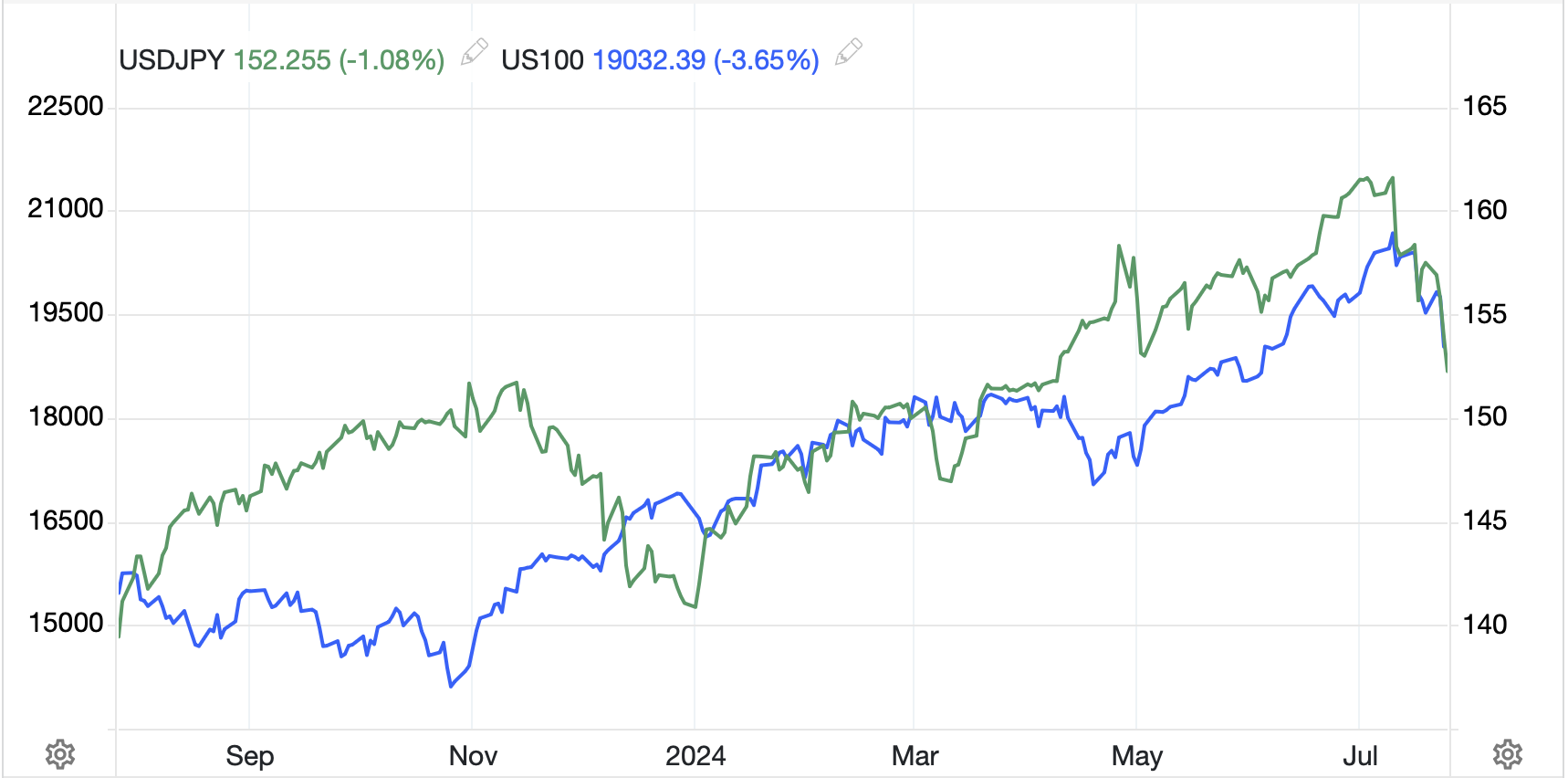
Finally, the dollar, which rallied alongside yields yesterday, is giving back some of those gains, albeit not very many of them.  The commodity currencies (AUD +0.2%, NZD +0.2%, ZAR +0.4%, NOK +0.6%) are the leading gainers this morning although the euro is also firmer as is the pound despite much weaker than expected UK Retail Sales data.  Alas, the poor yen can find no support and continues to drift a bit lower, with the dollar back above 157 this morning and keep an eye on CNY, which is now back above 7.25 for the first time in a month after Chinese FDI data showed larger than expected -27.9% decline.  It seems that President Xi has successfully scared off most foreign investment which is very likely a long-term problem for the nation.  While it has been very gradual, the fixing rate continues to weaken each day as it appears the PBOC is finally accepting the need for a weaker yuan.

On the data front, we see Durable Goods (exp -0.8%, +0.1% ex-Transports) and then Michigan Confidence (67.5) which continues to be a problem for President Biden’s reelection campaign as the people in this country are just not happy.  We also hear from Governor Waller this morning.  It will be very interesting to hear him as my anecdotal take is that the regional presidents have been much more hawkish than the governors and Chairman Powell, so if he leans dovish, it may demonstrate a bigger split between factions on the board than we have been led to believe.  We shall see.

Net, it remains very difficult for me to make a case for the dollar to weaken substantially at this time.  While it may not power ahead, a decline seems unlikely for as long as higher for longer remains the mantra.

Good luck and good long weekend

Adf

There will be no poetry on Monday due to the holiday.

Wages on Fire

The ECI data’s designed
To help understand what’s enshrined
In hiring workers,
Including the shirkers,
With numbers quite nicely streamlined
 
The problem for Jay and the Fed
Is yesterday’s data brought dread
It rocketed higher
With wages on fire
And showing that rate cuts are dead

It’s funny the way things work.  Historically, the number of people who paid attention to the Employment Cost Index (ECI), even in financial markets, could be counted on your fingers and toes.  It was just not a meaningful datapoint in the scheme of the macro conversation.  And yet, here we are in extraordinary times and suddenly it is a market mover!  I have updated yesterday’s 10-year graph with the most recent print of 1.2% and it is now very evident that wage pressures are not dissipating at all.  Rather, they seem to be accelerating and that is not going to help Jay achieve the 2.0% inflation goal.

Source: tradingeconomics.com

But in fairness, it wasn’t just the ECI.  Yesterday’s data releases were lousy across the board.  Case-Shiller Home prices rose more than expected, by 7.3% Y/Y.  Chicago PMI fell sharply to 37.9, far below expectations and I guess we cannot be surprised that, given all that, Consumer Confidence fell to 97.0, its lowest reading since immediately after the pandemic.  The upshot is rising prices and weakening growth, back to fears of stagflation.  With that as backdrop, the fact that risk assets got slaughtered across the board yesterday seems par for the course. 

And that is the setup for Jay and his merry band at the FOMC today.  At this point, much ink has already been spilled trying to anticipate what the statement will say and how hawkish/dovish Powell will be at the press conference so there is very little I can add that will be new.  I would contend the consensus is that the statement will be more hawkish, likely removing the line about “Inflation has eased over the past year but remains elevated,” or adjusting it.  However, one of the things that has been pointed out lately is that Powell’s press conferences seem to have consistently been more dovish than the statement.  Perhaps that happens again today, but I have to have some faith that Powell is actually trying to achieve the mandates and it is abundantly clear that right now the price side of the mandate is in jeopardy.  As there are no dots or ‘official’ forecasts coming, my take is a slightly more hawkish statement and Powell backing that up later.

I guess the biggest question, especially after yesterday’s data, is how he will respond to questions regarding hiking rates further.  If I were him, I would have that answer prepared to be as nondescript as possible. Because if he opens up that avenue of discussion, we are going to see a much more serious decline in risk assets.

One other thing of note yesterday was a comment by Secretary Yellen which was almost laughable when considering who is making the statement.  Apparently, she is,” concerned about where we’re going with [the] US deficit.”  Seriously?  She is the Treasury Secretary in charge of spending plans and after pitching for ever more money to spend she is now concerned about the budget deficit?  Then, apparently according to Axios, in a speech later today she is set to make a plea for the Fed’s independence!  Again, seriously?  The Fed is ostensibly already independent, yet I’m pretty certain she is bending Powell’s ear daily about what to do, i.e., commingling Treasury and the Fed.  But suddenly she is concerned about its independence?  It is things like this that make it so difficult to take certain players on the stage seriously.  It doesn’t speak well of the current administration’s efforts to fix the problems that exist, many of which they have initiated.

Ok, enough ranting on my part.  As it is May Day, much of Europe and some of Asia was closed last night but let’s recap the session as well as look ahead to the data before the FOMC.  I’m pretty sure you know how poorly the equity markets behaved yesterday with -1.5%- to -2.0% losses in the US.  In Asia, the markets that were open, Japan, Australia and New Zealand followed the same course, falling, albeit not quite as far, more on the order of -0.5% to -1.0%.  in Europe, only the FTSE 100 is trading today, and it is flat on the session while US futures are pointing lower again, down -0.3% or so at this hour (7:00).

In the bond market, after yesterday’s Treasury selloff with yields jumping 8bps across the curve, markets are quiet with Europe on holiday so no change ahead of the NY opening.  The rise in Treasury yields did drag European sovereign yields up as well, just not as far with most higher by 3bps-4bps yesterday and they are closed today.  As to JGB yields, despite all the huffing and puffing in the FX market, they are essentially unchanged so far this week.

But the real fun yesterday was in the commodity markets with significant declines across the board.  Oil prices fell on a combination of higher inventories according to the API as well as hopes of a ceasefire in Gaza helping to settle things down in the middle east.  And they are lower by another -1.5% this morning.  Meanwhile, metals markets, which had been exploding higher across the board until two days ago, had another wipeout yesterday with all the metals falling by 1% or more.  This morning, though, they seem to have found some support with gold (+0.1%) and silver (+0.5%) bouncing slightly while copper (-0.8%) and aluminum (-0.3%) are still under pressure given the weaker economic data.  Of course, underlying all this movement is concerns that interest rates are going to continue higher.

Which brings us to the dollar, which, not surprisingly given the rise in interest rates, rose sharply yesterday and is holding those gains this morning.  On average, I would say the dollar gained 0.5% yesterday and it was broad based, rising against both G10 and EMG currencies as well as against financial and commodity currencies.  For instance, CLP, which is closely linked to copper prices, fell -2.0% yesterday while ZAR was lower by -1.0%.  But the euro (-0.6%) and pound (-0.4%) were also under pressure as traders started to anticipate an even more hawkish Fed today.  I suspect things will be quiet until the FOMC this afternoon despite the data that is due.

Speaking of that data, first thing we get the ADP Employment report (exp 175K) then JOLTS Job Openings (8.69M) and ISM Manufacturing (50.0).  A little later comes the EIA oil inventory data and then, of course, the FOMC statement at 2:00 with the press conference at 2:30.  Since all eyes are focused on that, I would not expect much activity until it is released, and Powell speaks.

Good luck

Adf

Stagflation

Call rates will remain
Zero to Point-one percent
We’ll still purchase bonds


In a move that clearly captured my heart, the BOJ left policy on hold last night, as widely expected.  But the key is that the policy statement, in its entirety, is as follows:

I would contend they could have used my haiku above and completely gotten the message across!  This is the best central bank move I have seen in forever, an economy of words with limited discussion about their views of the future.  But that the Fed would be so terse in their statements.  By forcing investors and traders to consider all the issues and the best, or at least possible, ways in which the central bank can achieve their stated goals, positioning would be substantially reduced because nobody would think the central bank ‘had their back’.  This would prevent another SVB-type collapse, and probably go a long way to reducing the massive wealth inequalities that central banks have fostered since the GFC.  Just sayin’!

The market response to this, and the subsequent Ueda press conference was to sell the yen even more aggressively, with USDJPY touching yet further new 34-year highs at 156.80, higher by more than one full yen (0.7%) and JGB yields climbed to 0.92%, slowly approaching the big round number of 1.00%.  FinMin Suzuki was out trying to talk the yen higher (dollar lower) with the following comments, “the weak yen has both positive and negative impacts, but we are more concerned about the negative effects right now.”  Those comments were sufficient to drive USDJPY down about 90 pips in a few minutes, but as of right now (6:20), the dollar is back to its highs.  As long as the Fed and the BOJ remain on different wavelengths, the yen will not be able to rally, trust me.

The GDP data surprised
By showing less strength than surmised
But really, for Jay
The prob yesterday
Was PCE so energized

This brings us to the GDP data yesterday, which missed badly at 1.6%.  However, that was not the worst part of the report.  Alongside the GDP data, there is a PCE calculation, that while not the one on which the Fed focuses, is still a harbinger of how things are going.  That number was higher than expected with the Core rising 3.7% Q/Q, up from 2.0% in Q4.  The upshot of this data was that growth is slowing and inflation is rising, exactly the opposite of the Fed’s (and the administration’s) goals and moving toward the concept of stagflation.

While quoting oneself is not the best etiquette, I think it makes some sense here as I described this exact situation back in January as follows:

Stagflation is an awful word as it describes a state
Where prices rise too fast while growth just cannot germinate.
And this, dear friends, is what I fear will come to pass this year
By Christmas, bonds and stocks will fall while metals hit high gear.

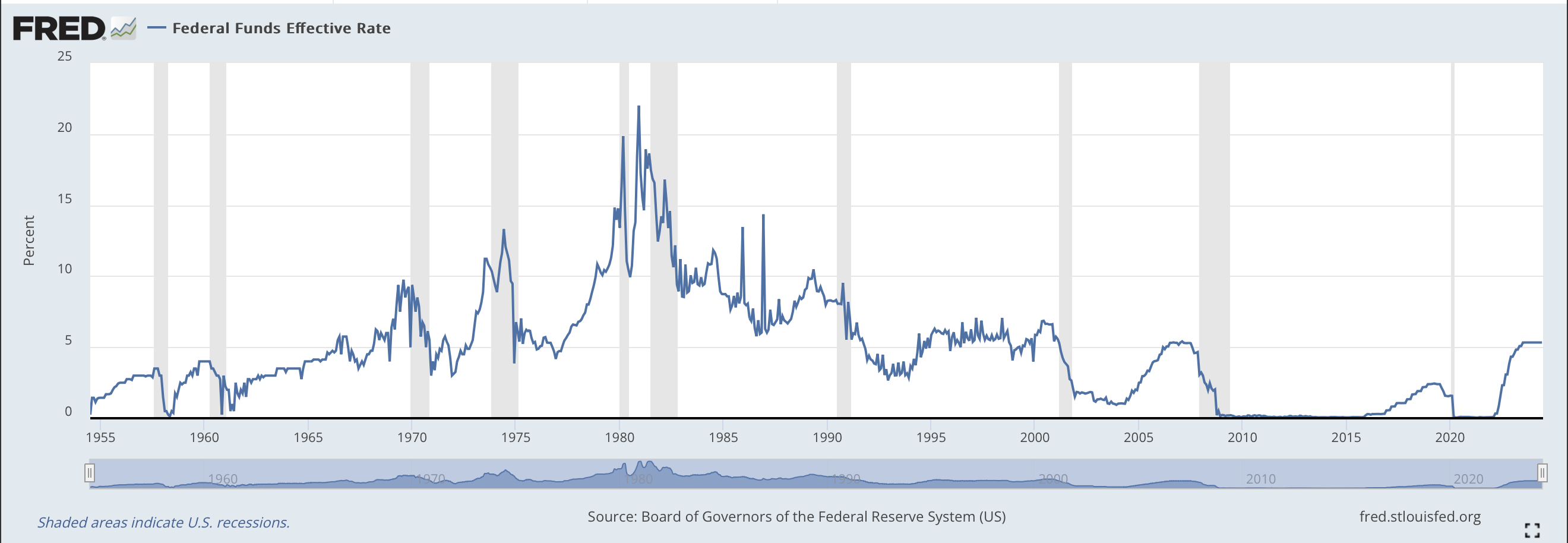
It should be no surprise that both bonds and stocks fell yesterday as market participants are growing concerned that the Fed has lost control of the narrative.  After all, the last time we had stagflation, Chairman Volcker chose to fight inflation first by raising the Fed funds rate to 21% and driving the economy into a double-dip recession from 1980-1982.  But the debt/GDP ratio at the time was just 30% or so and the government could afford it.  That is not the case today, and quite frankly, there are exactly zero politicians on either side of the aisle who can tolerate a recession of any type, let alone a double dip.  My guess is that all hands will be pushing to increase the rate of growth and let inflation rip because given the current drivers of inflation (commodity prices, near-shoring and demographics), it is not clear the Fed can do anything about it anyway.  Don’t you feel better now?

All this leads us to this morning’s PCE data (exp 0.3% M/M for both headline and core, 2.6% Y/Y for both readings) as well as Personal Income (0.5%) and Personal Spending (0.6%).  Given yesterday’s outcomes and the fact that the Bureau of Economic Analysis produces both sets of numbers, the whisper number is clearly higher.  If that should manifest, I suspect that the price action from yesterday, lower stocks and bonds, is very likely to continue despite the after-market rally of both Google and Microsoft on better-than-expected earnings data.  I also suspect that before noon, the Fed whisperer, Nick Timiraos, will have an article out in the WSJ to give some Fed perspective as they are currently muzzled in their quiet period.            

I don’t think there’s anything else to say about this, so let me recap the overnight session, at least the parts I have not yet discussed.  While the US equity session did not finish on its lows, all three major indices were lower by at least -0.5% on the day.  However, the same was not true in Asia with the Nikkei (+0.8%) responding positively to the fact that tighter monetary policy was not on its way, while Chinese (+1.5%) and Hong Kong (+2.1%) shares positively ripped on the back of the strong tech earnings in the US.  As to European bourses, they are all in the green this morning, with Spain (+1.1%) leading the way but all higher by at least +0.5%.  Lastly, US futures are pointing higher as well after the strong earnings numbers overnight, up by +1.0% or so at this hour (7:20).

After jumping 8bps in the wake of the GDP data yesterday, 10-year Treasury yields slid a bit and finished the day up 5bps.  This morning, they have given back two more basis points, but still trade right at 4.70%.  If this morning’s data is 0.4%, watch for another sharp move higher in yields today.  European yields pretty much followed the US yesterday, all closing higher by between 4bps and 6bps, and this morning they are lower by similar amounts, right back to where they started.

Oil prices (+0.5%) are climbing higher again, seeming to have found a recent bottom and looking like they are set to push back toward $90/bbl by summer.  While the real GDP data was softer, nominal remains solid and that is what drives demand.  In the metals markets, they all jumped on the data release and this morning are continuing higher (Au +0.7%, Ag +0.8%, Cu +0.8%, Al +0.9%).  In the industrial metals, inventories are dropping while the precious space is clearly responding to the inflation fears.

Finally, the dollar is little changed overall this morning.  while it has rallied sharply vs. the yen, ZAR (+0.85%) is gaining on metal market strength as an offset and pretty much everything else is +/- 0.25% or less.  My take is everyone is waiting for this morning’s data to determine if the Fed is going to become even more hawkish, or if there will be a reprieve. 

In addition to the PCE data, we get Michigan Sentiment at 10:00 (exp 77.8, down from 79.4).  Right now, players are holding their collective breath for the numbers.  After the release, it’s all about the results.  Given that every recent inflation print has been on the high side, I expect this to be no different.  Bonds should suffer, commodities should outperform, and I expect the dollar to do well.

Good luck and good weekend

Adf

Showing Concern

Investors are showing concern
And, risk assets, starting to spurn
But this time, it seems
That only in dreams
Are bonds something for which they yearn
 
Instead, the two havens of note
As evidenced by every quote
Are dollars and gold
Which folks want to hold
While stock bears are starting to gloat


**There will be no poetry for the rest of the week as this poet will be seeking rhythm only in his golf swing for a few days.  I will return on Monday, April 22.**

It appears that investors are beginning to ask more serious questions about the macroeconomic outlook and whether the current valuations in financial markets are representative of the future.  Not only did equity markets suffer significant declines yesterday, but so did bond markets.  At the same time, geopolitical tensions continue to rise driving even more risk reticence.  While it is still far too early to claim that things have turned decisively, it is certainly worth a discussion as to whether that may be a valid explanation.

I would paint the big picture in the following manner:

  1. US economic activity remains firm although there are still pockets of weakness.
    1. Retail Sales printed much higher than expected at +0.7% with a revision higher to last month’s data up to +0.9%.
    1. Empire State Manufacturing improved from last month to -14.3 but was worse than the expected -9.0.
  2. The Fed continues to downplay the probabilities of rate cuts in the near future.
    1. Daly: “The worst thing we can do right now is act urgently when urgency isn’t necessary.  The labor market’s not giving us any indication it’s faltering, and inflation is still above our target, and we need to be confident it is on the path to come down to our target before we would feel the need – and I would feel the need – to react.”
  3. Concerns over the next step in the evolving Israel/Iran conflict have market participants (and the rest of us) on edge.
    1. Bloomberg Headline: Israel Vows Response to Iran as US and Allied Urge Restraint.
    1. Reuters headline: Iran Says Any Action Against its Interests will get a Severe Response.

Clearly, there are other issues as well, with the ongoing Russia/Ukraine conflict, the critical elections upcoming, not only in the US but in Mexico, India and several German states, and confusion on the Chinese economy.

My point is that uncertainty is very high, and rightly so.  It is a fraught time in the world.  Historically, in this situation, US Treasuries were the place to where so many global investors would run.  The dollar would often benefit from this flight to safety, while risky assets, especially stocks, would suffer.  But it appears this generation of investors did not get the memo on how they are supposed to respond.  Instead, they seem to be looking at the ongoing fiscal profligacy in the US and the very real likelihood that inflation is not going to be declining anytime soon and decided that being long duration is a losing proposition.  Instead, the things that are in demand are dollars (with the highest cash yield around) and gold, with no yield, but with a long history of maintaining its value in both good times and bad.

Quite frankly, it is hard to argue with this sentiment, at least in my view.  I have long maintained that inflation was going to be stickier than many Fed and analyst models had forecast over the past several years.  I see no reason for the Fed to cut rates anytime soon.  Rather, while I expect that there may be ample reason to consider rate hikes going forward, given their inherent bias to cut, the outcome will be Fed funds remaining at their current level for much longer than most people expect.  Think, through mid-2025 at least.  

In this situation, absent a significant economic downturn, which doesn’t appear imminent, I continue to look for a bear steepening of the yield curve with 10yr yields rising above 5.0% and possibly as high as 5.5%.  In fact, this is exactly what the US needs to address its debt problem, high nominal GDP growth, high inflation, and negative real interest rates.  My fear is that the Fed will resort to Yield Curve Control, keeping the entire interest rate structure at an artificially low level in order to speed this process along.  This was the playbook immediately after WWII and it worked.  Do not be surprised to see them repeat that strategy.

If this is the way things evolve, protecting the value of your assets will require holding commodities and precious metals, real estate and some equities.  Both cash and bonds will be terrible investments in that environment, and equity selection will be important as not all will do equally well.  Value over growth is likely to be the play.  

In the meantime, let’s look at the wreckage from last night.  After the second down day in a row in the US, with red everywhere, Asia followed suit as both Japan (Nikkei -1.9%) and Hong Kong (-2.1%) really suffered while the mainland (-1.1%) was less awful after the Chinese data dump.  Surprisingly, Q1 GDP there rose 5.3%, better than expected and more than last quarter, but Retail Sales (3.1%, exp 4.5%) and IP (4.5%, exp 5.4%) both showed weakness compared to last month as well as expectations.  It seems odd that GDP was so firm with weak underliers.  Perhaps we should take this data with a grain or two of salt!  As to the rest of the regional markets, they were all in the red as well.

The picture is no better in Europe with red across the board, mostly on the order of 1.1% or more.  The only noteworthy data was German ZEW which showed current conditions to be horrible but expectations, for some reason, brightening.  As to US futures, at this hour (7:30) they have turned slightly green, up about 0.3% across the board.

In the bond market, yields around the world continue to rise as inflation concerns remain top of mind everywhere, or at least here in the States and since the US leads the parade in the global bond markets, everyone is following.  Yesterday saw 10-year yields climb 4bps and this morning they are a further 5bps higher, now sitting at 4.64%.  European yields are also firmer, up between 2bps and 4bps throughout the continent, but did not see as much of a move yesterday.  Regardless, it is pretty clear that investors are shying away from duration.  Even JGB yields are edging higher, up 1bp overnight, although they continue to badly lag the US situation, and that continues to weigh on the yen.

Oil prices, which rallied yesterday are consolidating those gains and edging lower this morning, down -0.4%.  The geopolitical concerns remain top of mind for traders, but economic forecasts are also key.  After all, if China truly is growing, that implies an uptick in demand which should be supportive overall.  Thus far, the middle east conflict has not targeted oil infrastructure, but if that changes, watch for much higher prices.  In the metals markets, yesterday saw strength across the board which is reverting this morning.  The biggest change in this market is that it has become far more volatile than its recent history.  I expect that will be the case in all markets going forward as uncertainty remains a key feature of the entire macro story.  Net, the metals have been rallying sharply for the past month or more, so this morning’s modest declines are more corrective than indicative in my view.

Finally, the dollar is ‘strong like bull!’  At least that has been the case for the past week or more as, especially the yen (-0.3% today, -1.9% in the past week), continues to lack buyers anywhere.  While I believe that the BOJ/MOF are less worried about the actual rate, the reality is that the yen is starting to decline pretty quickly.  If I were a hedger who needed to sell yen to hedge assets or revenues, I would be using options here, probably zero-premium collars, as you cannot be surprised if intervention is on the table.  We are just a shade below 155.00 and market talk is of a push to 160.00.  I have to believe that FinMin Suzuki and Governor Ueda are starting to get a little uncomfortable.   Now, the dollar is rising against all its counterparts, having risen more than 2% against many in the past week, but still, the yen’s decline has been consistent for more than two years and is starting to look unruly.

As to the rest of the currencies, this morning sees MXN (-0.6%) and PLN (-0.7%) as the laggards while the euro (+0.15%) has reversed losses from earlier in the session but is still lower by more than 2% since last Wednesday.  As the market continues to price Fed cuts out of the future while other central banks are seen still on track to cut, the dollar will likely keep going.

While we see Housing Starts (exp 1.48M) and Building Permits (1.514M) early and then IP (0.4%) and Capacity Utilization (78.5%) a bit later, the big news is that Chairman Powell will be speaking at the Spring IMF conference this afternoon at 1:15pm.  As well we will hear from Governor Jefferson, NY Fed president Williams and BOE Governor Bailey and BOC Governor Macklem before the day is through.  In other words, there will be a lot of words to digest.  However, none will be as important as Powell’s. if he acknowledges that inflation is hotter than they want and turns more hawkish, watch out for more severe risk asset declines.  But if he doesn’t, it could be even worse!

Good luck for the rest of the week

Adf

Smokin’

The CPI data was smokin’
So, Jay and the doves are now chokin’
He’s lost the debates
And they can’t cut rates
Without, higher prices, provokin’

As such, it should be no surprise
That traders, risk assets, despise
So, bond yields exploded
While stocks all eroded
And dollars made new five-month highs

Welp, the inflation data was not merely a little hot, it was a lot hot.  Measured prices rose 0.4% on both the headline and ex food & energy readings for the month of March with the annual rises ticking higher to 3.5% and 3.8% respectively.  Too, you will not likely hear the inflation doves and those who had been concerned with deflation talking about the trend for the past 3 months or 6 months, as both of those are now running well above 4%.

In truth, if the Fed was both data dependent and actually still fighting inflation, rate hikes would be on the table again as there is absolutely no indication that either wages or rental/housing prices are heading back to the levels necessary to see an overall inflation rate of 2.0%.  Alas, it is also clear that politics is a part of the decision process and the concept of fiscal dominance, where fiscal policy overwhelms monetary policy, remains the order of the day.

Fed funds futures adjusted their probabilities instantly with the idea of a June cut now down to just 16% while there are less than 40bps of cuts now priced in for the rest of 2024.  Given this price action, it is no surprise that bond yields rose dramatically, with the 10-year closing the session at 4.54%, up 18bps and the highest close since November 2023.  My sense is it has further to go.  Meanwhile, 2-year yields rose back to 4.97%, a more than 21bp rise to levels also last seen in November 2023.  One other aspect of the bond market was the worst 10-year auction in more than a year as the tail was 3.1bps, the third largest tail in history, with a lousy bid-to-cover ratio (2.33) and much less foreign interest (61.4%) than we have been seeing lately.  The last 5bps of the yield rally came after the auction result.

Adding to the general gloom, equity prices fell about -1.0% across the board, but closed above their session lows.  It is the dollar, though that really saw a big move with a greater than 1% move against most of its major counterparts.  USDJPY blasted through the 152.00 level that many had thought was a line in the sand for the MOF/BOJ and is a full big figure higher.  Meanwhile, European currencies all declined by more than -1.0% and Aussie (-1.8%) was the absolute laggard across both G10 and EMG blocs.

With this as backdrop, the ECB sits down this morning and must decide if it is too early to cut interest rates.  The economic data continues to underwhelm, and the inflation data is actually trending lower, rather than the situation in the US where it has turned back higher.  But the sharp decline in the euro yesterday has got to be a warning to Lagarde and her minions as a cut, especially since it is not priced at all, would likely see another sharp euro decline, something they are certainly keen to avoid.

One other thing, the Minutes of the March FOMC meeting were released in the afternoon, and it seems the committee is coming to an agreement that they are going to slow the roll-off of Treasury securities, likely cutting it in half to $30 billion/month although they are not going to touch the mortgage-backed part of the balance sheet since that is barely declining at all.  It appears that this may take place at the June or July meeting, but clearly before too long.

Enough about yesterday.  Overnight saw Chinese CPI data fall back to -1.0% M/M, reversing the previous month’s rise, as it becomes ever clearer that China will never be able to consume as much as it is able to produce.  That is the very crux of the trade issues that are becoming more heated as China ultimately dumps all its excess production overseas, or at least tries to.  This is an issue that is not going to disappear anytime soon, and one that will have major political and economic ramifications going forward.  I suspect that the tariff situation will only get worse, and I would not be surprised to see further absolute restrictions on Chinese trade regardless of who wins the US election in November.  As to the market impacts of this story, for now, I believe Xi is more fearful of a capital flight if he allows the yuan to weaken substantially, than he is of annoying the US and the rest of the world because the yuan is too weak.  But, given the clear difference in the trajectories of the US and Chinese economies and inflation stories, pressure for yuan weakness is going to continue.

Turning to this morning’s session, Madame Lagarde and her crew meet, and the market is not pricing in any movement.  June remains the odds-on favorite for the first rate cut, and given the fact that the Eurozone, as a whole, is stagnant from an economic growth perspective, and that price pressures there have been ebbing more quickly, that certainly makes sense.  Of course, after yesterday’s CPI, June is off the table in the US so the ECB will have to act without the ‘protection’ of the Fed.  As mentioned above, the euro declined by more than -1.0% yesterday and is edging lower this morning as well, down -0.1%.  Lagarde’s risk is she follows the path of lower rates, the euro declines more sharply, perhaps to parity or beyond, and that invites a resurgence in imported inflation.  Remember, energy is still priced in USD, so that a weak euro would raise the price of oil products across the continent.  Alas for Madame Lagarde, it’s not clear her political nous will allow her to solve this problem.

Recapping markets overnight, following the US declines yesterday, the Nikkei (-0.35%) also fell, but I think the yen weakness helped mitigate the declines.  Chinese shares were lackluster, slipping slightly both in HK and on the mainland and the rest of the time zone saw a mix of modest gains and losses.  Meanwhile, European bourses are all in the red this morning, with Spain (-0.9%) the laggard, but the average decline probably around -0.5%.  US futures, too, are softer at this hour (7:00), down about -0.3% across the board.  Clearly, there is grave concern that the Fed is not going to help ease global monetary policies.

As further proof that US yields drive global bond markets, yesterday’s CPI data pushed European sovereign yields higher by about 10bps across the board!  This despite the fact that inflation is going in the other direction in Europe.  This morning, those yields are continuing to grind higher, up between 2bps and 4bps across the board.  However, Treasury yields have stalled after yesterday’s dramatic rise.  Let me say that if the PPI data released this morning is hot, I fear things could move much further.

In the commodity space, oil rallied yesterday on stories that Iran was preparing for a more substantial retaliation against Israel and despite the fact that EIA inventory data showed surprising builds in crude and products.  However, this morning it is edging lower, -0.5%.  Perhaps more interesting is gold (+0.2%) which is a touch higher this morning but was able to rebound off its worst levels of the session after the CPI print to close nearly unchanged on the day.  In the end, the market remains quite concerned about inflation regardless of the Fed’s response, and gold continues to get love on that basis.  As to the base metals, yesterday’s rate induced declines were cut in half, but this morning both Cu and Al are drifting lower by about -0.2%.

It is the dollar, though that had the most impressive movement yesterday and this morning, it is holding onto most of those gains.  Absent a hawkish message from the ECB this morning, something which I believe is highly unlikely, the euro feels like it has further to decline.  The BOC left policy on hold and sounded fairly non-committal regarding its first rate cut there.  The Loonie suffered yesterday and has seen no rebound at all.  In fact, the only currencies showing any life this morning are AUD and NZD, both higher by 0.25%, which seems much more of a trading reaction after their dramatic declines yesterday, than a fundamental story.  As long as the Fed remains the most hawkish, the dollar should hold its bid.

Turning to the data today, PPI (exp 0.3% M/M, 2.2% Y/Y) and core PPI (0.2%, 2.3%) lead alongside Initial (215K) and Continuing (1792K) Claims.  Those numbers will arrive 15 minutes after the ECB policy decision is announced with no movement expected there.  Madame Lagarde has her press conference at 8:45 this morning.  We hear from Williams, Collins and Bostic over the course of the day, so it will be quite interesting to find out how far their thinking has changed.  I would be particularly concerned if there is further talk of rate hikes again.  Remember, Bowman intimated that might occur when she spoke last week, and Bostic has been in the one-cut camp so could turn as well.  Let me just say the market is not pricing in that eventuality at all!

At the beginning of the year, I opined that there would be at most one rate cut and rates would be higher by Christmas.  As of this morning, I see no cuts and a very real chance of hikes.  Keep that in mind for its impact on all asset classes going forward.

Good luck
Adf

Stanching Their Bleeding

For all of those pundits that claimed
inflation had died and been maimed
The data did show
What now we all know
Inflation is still quite inflamed

The upshot is all those who said
That real rates would soon force the Fed
To quickly cut rates
Are in dire straits
And stanching their bleeding instead

Wow!  Not much else you can say after yesterday’s market activities following the hotter than expected CPI data released in the morning.  As I wrote on Monday, a 0.1% difference in a monthly print is not really substantive in the broad scheme of things, but when the narrative is so strong and so many are convinced that the Fed is itching to cut rates because they don’t want to overtighten as inflation continues to fall, that 0.1% in the wrong direction means a lot.  Hence, yesterday’s price action (which I did presage in the last line of my note yesterday morning before the release.)

Of course, you are all aware that stocks got crushed, with the major indices falling -1.35% to -1.80% while the Russell 2000 small cap index fell -4.0%!  But it wasn’t just stocks, bonds joined the fun with the 10-year yield soaring 15bps to 4.30%, its highest yield since early December.  Gold got crushed, falling $30/oz and back below $2000/oz for the first time in two months, while the dollar exploded higher, rising about 1% against most currencies and almost 1.8% against the yen.

A quick analysis of the CPI data shows that the shelter component was the big surprise on the high side, although airfares also were higher than expected.  As well, wages remain much stickier than the Fed would like to see as they continue to support price increases in the services component of the data.  Forgetting the headline for a moment, a look at Median CPI, as calculated by the Cleveland Fed, shows that last month’s rise was 0.5% and the Y/Y number is +4.85%.  That feels to me like a much better estimate of what is happening than the newest darling of the bullish set, Truflation, which claims that inflation is “really” rising at only 1.39% as of yesterday.  One final thing, hopefully, all of those who claimed that the ‘real’ trend of inflation was sub 2% because the 3-month average had fallen there (please look at Monday’s note, What If?) will finally shut up for a while.

The new Mr. Yen
Said “we are closely watching”
So you don’t have to
Do not cross this line!

As mentioned above, the yen was the worst performer yesterday after the data which, not surprisingly, triggered a response from the Japanese government.  Now that USDJPY is back above 150.00, there are many who believe the MOF/BOJ will be intervening soon.  There is a terrific website called Harkster.com which aggregates all sorts of commentary and research from around the web as well as adding their own commentary.  I highly recommend it as a source for information.  At any rate, they have a very nice description of the historical actions that lead to intervention by the Japanese which I show here:

1.     Language such as “monitoring developments in currency markets”.
2.     “Sudden/abrupt/rapid” movements in currency markets are “undesirable”. In addition, markets are “not reflecting fundamentals”.
3.     “Excessive” is introduced next to describe the price movements alongside “clearly” in addition to referring to FX moves as “speculative”.
4.     Readying for action is normally reflected with the phrase “we are ready to take decisive action” which would suggest some action is imminent.
5.     Price checking is the step prior to actual intervention whereby the BoJ will call round selected Japanese banks and ask for a level of USDJPY. Even though they do not deal the act of them asking normally makes the banks, who have been contacted, sell USDJPY in anticipation of intervention and they will also spread the news around the market to encourage more selling.
6.     Same as 5 but this time the BoJ actually do sell USDJPY. This may happen in waves.
7.     Finally, coordinated intervention with other major central banks involved. This would generally happen early NY hours to include the US. This obviously has the most effect on the markets.

Arguably, we are somewhere between numbers 1 and 2 right now, but they can escalate this process quickly.  However, in the end, what matters for currencies over time are relative fiscal and monetary policy settings.  History has shown that to strengthen a currency, a country must run a tight monetary and loose fiscal policy.  To weaken a currency, the opposite is true.  Given the US 7% budget deficits and highest interest rates in the G10 + QT, it is pretty clear that the dollar should be strong.  Now, if the BOJ were to raise rates aggressively, it would have a chance to alter the trajectory of the yen, but while Ueda-san has implied that they may raise rates back to zero after the spring wage negotiations, assuming they agree large increases, unless there is a strong belief that they are going to continue to raise rates to attack inflation in Japan (which isn’t really a big problem) then absent the Fed starting to ease, there is no good reason to think the yen will strengthen very much at all.  Now, if the Fed does start cutting aggressively, that is a different story, but based on yesterday’s CPI, that feels like it is a long way in the future.

And those are the most noteworthy things to absorb.  Now, a look at the rest of the overnight session shows that Japanese stocks were softer, but the rest of Asia (absent China which is still on holiday) was mixed, with gains and losses around.  Europe, this morning, though is firmer, up about 0.5% except the UK, which is higher by 0.9% after CPI there fell more than expected, encouraging talk that the BOE will be cutting sooner.  Now remember, yesterday the UK lagged after their employment data was stronger than expected, especially wage data, so it is not clear which one to believe.  As to US futures, they are firmer at this hour (8:00), up about 0.5%.

After yesterday’s massive yield rallies, it is no surprise to see them slipping a bit today, with Treasury yields lower by 1bp and most European sovereign yields down by 3bps (UK Gilts are -6bps on that inflation data).  Overnight, the Asian session saw government bonds there slide with yields higher across the board although JGB yields were the laggard, rising just 3bps.

In the commodity markets, oil (flat today) is the only market that didn’t sell off yesterday and it has maintained those gains.  This is despite a much bigger inventory build than anticipated as it seems continued concerns over a wider Middle East war are extant, as is a new worry, as Ukraine has been able to bring the attack to Russia more effectively, sinking another Russian ship in the Black Sea last night.  Recall, they have been attacking Russian oil infrastructure and if they are successful in that effort, it will definitely give oil prices a boost.  But the rest of the commodity markets got crushed yesterday with gold, copper and aluminum all falling sharply.  This morning, though, those three markets are little changed, simply licking their wounds and not extending any losses.

Finally, the dollar is also little changed this morning, but that is after a massive rally across the board yesterday against both G10 and EMG currencies.  Against most major counterparts, it has traded back to levels last seen in mid-November, although the pound has been holding up better than most, with smaller net moves.  It is ironic that the dollar strengthens on a high inflation print as fundamentally, high inflation is supposed to weaken a currency.  Of course, this move has nothing to do with inflation per se, and everything to do with interest rate expectations.

On that subject, it is worth noting that the latest Fed funds futures rate cut probabilities are now; March 8.5%; May 37.9%; and there are now just 4 cuts priced into the year, down from 7 about a month ago.

There is no hard economic data released although the EIA oil inventories do come out later this morning.  We also hear from two Fed speakers, Goolsbee and Barr, and I imagine we could get a little ‘we told you so’ in their comments today.

If recent history is any guide, I suspect that equity markets will rebound a bit further early, but potentially drift lower as the day wears on.  The bulls were clearly shaken as their narrative took a big hit.  But this was just one data point of many.  I don’t believe the end is nigh, but in the longer term, it is not hard to believe that the Fed will remain the tightest policymaker of all the central banks and that will help the dollar while hurting risk assets.

Good luck
Adf

Ain’t Hunky-Dory

For President Xi it appears
The stock market’s shed enough tears
So, he’s set to meet
The finance elite
And likely to box all their ears

As such, I expect we shall see
The Hang Seng will start on a spree
With New Year’s approaching
A little more coaching
By Xi, for a rally, is key

The big news overnight was that Chinese equity markets rebounded sharply (Hang Seng +4.0%, CSI 300 +3.5% CSI 1000 +7.0%) after the news that President Xi Jinping would be meeting with market regulators to find out what is going on there.  Banning short sales has not yet been effective nor has increased purchases by specific state funds.  According to Morgan Stanley, foreign investors sold $2.4 billion in Chinese equities in January, arguably a key driver of the market’s recent weakness there.  But the fact that Xi is getting involved directly has traders believing that more support from the government is on its way, hence today’s big rally.

While that is all fine and well for equity investors, the far more important question for the rest of us is will this stock market support help the Chinese economy as well?  Or will that continue to meander along at a weak growth pace?  Of course, it is far too early to know the answer to this question but given that the preponderance of Chinese individual wealth is tied up in real estate, not equities, I expect that this will have far less impact on the economy there than is hoped by both Xi and the traders.  After all, one of the key reasons so many in the US care about the stock market is that so much of our 401K investments are in equities, a rally shows up in our accounts daily.  But in China, that same situation does not hold.  Will a rally in stocks, if it even comes, be enough to sway the average person’s thinking there that things are getting better?  I have my doubts.

A turn to the interest rate story
Shows things there just ain’t hunky-dory
Yields just won’t stop rising
And that’s neutralizing
The thought rate cuts are mandatory

Friday morning, 10-year Treasury yields traded as low as 3.82% prior to the release of the NFP report.  This morning, they are trading at 4.16%, 34 basis points higher and the largest two-day yield rally since the covid volatility in March 2020.  Prior to that, it was 1981 when yields moved that far that fast.  Adding to Friday’s NFP story, yesterday’s ISM Services report was not only stronger than expected at 53.4, but the Prices index jumped to 64.0, its highest in a year and hardly a comforting thought for Chairman Powell and his fight against inflation.

At this point, the Fed funds futures market has lowered the March rate cut probability to 16.5%, and some of the punditry, although not yet any Fed speakers, have raised the question if another hike might be in order if things continue on their recent trajectory.  I assure you that the equity market has not priced in the possibility of a rate hike anywhere in the next 2 years at least.  Let’s just say that next week’s CPI report is going to be quite closely watched by everyone as if what I have seen as recent stickiness continues to exert itself, and with the economy seeming to be ticking over quite nicely, then the narrative could well change.  It is not impossible for the Fedspeak to turn even more hawkish if we were to see CPI rise 0.4%, a rate that is far too high for Fed comfort.  And that, my friends, would likely not be well-received by the equity market or risk assets overall.  While I have no special insight into how this data is going to evolve, I think the reaction function is clear.

Ok, let’s look at the overnight session beyond Chinese stocks.  In what cannot be that surprising after US equities struggled and given its recent negative correlation to Chinese stocks, the Nikkei fell -0.5% while the rest of Asia was mixed with some gainers (India, Taiwan) and some laggards (Korea, Australia).  However, the story in Europe is a little brighter with gains most everywhere except Germany, which is flat on the day after mixed data, with a blowout Factory Orders result of +8.9%, but the Construction PMI falling to 36.3.  Contradictory data leading to no movement.  As to US futures, at this hour (7:45) they are essentially unchanged on the day.

In the bond market, it seems traders are sitting on the sidelines after the bloodbath described above as 10-year Treasury yields are unchanged on the day and in Europe, the sovereign bonds are higher by a mere 1bp-2bps across the board.  We saw a similar lack of movement in Asia as well, despite the fact that the RBA, at their meeting last night, sounded somewhat hawkish although left policy rates on hold as universally expected.  As the treasury market is clearly leading the way globally, we will need to get some new information here, I think, before we see any substantive movement again.  Since the next big piece of data is CPI in one week’s time, it could be a quiet week for bonds.

In the commodity market, oil (+0.6%) is bouncing slightly this morning although it remains far lower than levels seen last week.  Gold (+0.1%) is also edging higher along with the industrial metals although there has been no strong catalyst here today given the lack of substantive rate movement.  Perhaps there is some optimism from the Chinese stimulus story, but that feels quite premature.

Finally, the dollar is a touch softer this morning, although only just.  While the euro has been unable to bounce, we have seen some modest gains in the pound (+0.25%) and Aussie dollar (+0.25%) as well as the renminbi (+0.3%).  In addition, the LATAM bloc is very modestly firmer this morning but generally, most of the movement is of that 0.25% magnitude or less.  This feels very much like a trading response to a powerful rally over the past two days.

There is no hard data to be released today but we do hear from three more Fed speakers, Kashkari, Collins and Mester, all this afternoon.  Yesterday, Chicago Fed president Goolsbee strayed from the Powell message, indicating he still believed a cut in March was possible, but he is not a voter this year and nobody really paid any attention.  After yesterday’s data, it would be hard to believe that any of these three would sound dovish, but you never know.

Overall, when looking at the dollar, as long as the inflation story has reawakened and is driving yields in the US, it is hard to see coming weakness.  This is especially true given the economic weakness we continue to see elsewhere in the world.  Today feels like a reaction, not a trend in the making, and I expect that the dollar has better days ahead for as long as inflation is once again the driving force.

Good luck
Adf

Led to Dismay

The first thing we saw yesterday
Was ADP led to dismay
But Treasury news
Adjusted some views
And stocks started trading okay
 
However, t’were two things we learned
First NYCB stock was spurned
Now, you may recall
That their greatest haul
Was Signature Bank, which was burned
 
And lastly Chair Powell, at two
Explained what he’s likely to do
They’re not cutting rates
As both their mandates
Remain far ahead in their view
 
Just when you thought it was safe to go back in the water…
 
I am old enough to remember when there was a growing certainty that not only was the Fed virtually guaranteed to cut rates by the May meeting, but the March meeting was very much on the table.  After all, inflation was below their 2.0% target (if you look at the recent 6-month run rate anyway) and therefore they just had to cut rates or stock prices might fall!  Or something like that.  But somehow, Jay and the FOMC missed that memo.  Instead, what they told us was [my emphasis];
 
The Committee seeks to achieve maximum employment and inflation at the rate of 2 percent over the longer run. The Committee judges that the risks to achieving its employment and inflation goals are moving into better balance. The economic outlook is uncertain, and the Committee remains highly attentive to inflation risks.
In support of its goals, the Committee decided to maintain the target range for the federal funds rate at 5-1/4 to 5-1/2 percent. In considering any adjustments to the target range for the federal funds rate, the Committee will carefully assess incoming data, the evolving outlook, and the balance of risks. The Committee does not expect it will be appropriate to reduce the target range until it has gained greater confidence that inflation is moving sustainably toward 2 percent. In addition, the Committee will continue reducing its holdings of Treasury securities and agency debt and agency mortgage-backed securities, as described in its previously announced plans. The Committee is strongly committed to returning inflation to its 2 percent objective.”
 
In other words, while it is highly unlikely that they will need to hike rates further, unlike the markets or the punditry, Powell has little confidence that they have won the inflation battle and rate cuts remain merely a distant prospect.  Certainly, there was no obvious concern that interest rates are “too” high at this time.  In other words, this was a much more hawkish statement, and Powell’s answers in the press conference were in exactly the same vein.  Memories of the dovish December meeting have faded from view.    And this was the denouement to quite a day, one which gave us so much new information.
 
Things started with a weaker than expected ADP Employment result, just 107K, although that data point’s correlation to NFP has been diminishing of late.  Regardless, it was the type of softness that got people primed for a dovish Fed.  Then, the QRA indicated that the Treasury will be issuing what appears to be about $45-$50 billion in new coupons this quarter to fund a $400 billion or $500 billion budget deficit.  The balance of that will be via T-bills which means that while the ratio is not as aggressively leaning toward T-bills as last quarter, it is still miles above the historical rate of 20% ish.  Those two stories got bond bulls hyped, although equity markets struggled on some weak earnings numbers. 
 
And then we heard from New York Community Bank (NYCB), which you may recall, was the lucky recipient of the Signature Bank assets last March.  Well, it turns out they made a hash of things, losing a bunch of money with some pretty bad loan impairments added on to increased capital requirements because they grew to a new, larger risk-weighting tier after the acquisition.  At this time, there is no indication they are about to go bust, but the question has been asked a lot as the stock cratered and investors ran into Treasury debt just to be safe.  As it happens, the stock, which had basically doubled over the past year after buying Signature, has reverted to its pre-acquisition price and that added jitters to everyone’s views.  PS, those loan impairments were CRE based which naturally leads to the question of what is going on with other regional banks.
 
Finally, during the press conference, Chairman Powell was clear that a March rate cut was highly unlikely and that was the final nail in the equity market’s coffin.  So, the NASDAQ led the way lower, falling -2.2% while the S&P 500 tumbled -1.6%.  At the same time, 10-year yields dropped like a stone, down 12bps to 3.91%.
 
Looking ahead, I wonder how all those folks who were certain the Fed HAD to cut because policy was just TOO TIGHT for their liking will reframe their narrative.  To my eye, yesterday’s equity declines are a blip and will not even register at the Eccles Building.  There is a bit of irony in that the doves need now eat so much crow.
 
Ok, on to this morning, where the overnight price action saw another mixed picture in Asia, but this time with Japan (Nikkei -0.75%) sliding while Chinese shares (Hang Seng +0.5%, CSI +0.1%) edging higher.  There was yet another announcement of a bit of further fiscal support from the Chinese government, but Xi remains reluctant to bring out the bazookas.  European shares are also mixed with gains in the UK and Spain and losses in France and Germany.  PMI data showed that the Flash numbers were pretty much spot on and all of Europe remains well below 50.0 except Norway (50.7) which benefits from its oil industry.  It remains very difficult to get excited about the Eurozone’s economic prospects these days which should ultimately weigh on the ECB to cut rates sooner and the euro to suffer in that case.  As to US futures, after a wipeout yesterday, this morning they are firmer by about 0.5% at this hour (6:45).
 
In the bond market, after yesterday’s Treasury yield collapse, 10-year yields are higher by 3bps this morning and European sovereigns have risen about 4bps on average.  This movement is more a response to the large move yesterday rather than a result of new information.  Overnight, JGB yields slipped 4bps, clearly following in the footsteps of Treasury yields. 
 
As to commodities, oil (+1.0%) has bounced after a weak session yesterday that was driven by demand worries.  But tensions in the Middle East seem to be reasserting themselves with several stories in the press this morning regarding the danger to the world from a potential collapse in shipping capabilities.  The ongoing Houthi attacks in the Red Sea are starting to really take their toll on supply chain situations.  This is not only bad for inflation readings but could well impair the ultimate delivery of critical things like oil, thus driving its price even higher.  As to the metals markets, they are all under pressure this morning with gold holding on best given its haven status but all the industrial metals lower by 1% or more.
 
Finally, the dollar is coming up roses this morning.  While in the early going yesterday, before the FOMC meeting, the dollar broadly sold off on the softer ADP and dovish QRA, Powell changed everything, and the dollar reversed course in the middle of the day and rallied back nicely.  This is true against virtually all its G10 and EMG counterparts.  The weakest members are AUD (-0.7%) after weak housing data Down Under added to thoughts of a rate cut coming soon.  As well, we see GBP (-0.4%) just ahead of the BOE meeting where expectations are for a more dovish statement although no policy change.  But we are seeing weakness in CLP (-1.3%) on the back of that weak copper price and weakness in ZAR (-0.4%) on the weak metals complex as well.  Given the hawkish tilt from Powell yesterday, unless there is a concerted effort by the Fed speakers that will be flooding the tape over the coming weeks to reverse that course, I suspect the dollar will benefit in the near-term.
 
On the data front, this morning brings Initial (exp 212K) and Continuing (1840K) Claims, Nonfarm Productivity (2.5%), Unit Labor Costs (1.6%) and ISM Manufacturing (47.0).  With NFP tomorrow, I expect that the productivity and ULC data should be of the most interest as they will play most deeply into the Fed’s thinking.  Improved productivity implies that there is less reason to cut interest rates as the “neutral rate” should be higher than previously thought.  In fact, that dynamic would be very positive for the dollar, and interestingly, for the equity market as well as it would be a clear boost to earnings potential.  We shall see how it turns out.
 
Good luck
Adf


As Good As It Gets

Said Waller, I have no regrets
For things are “as good as it gets”
We’ve been quite outstanding
And reached that soft landing
Though rate cut forecasts won’t be met

Wow is all I can say.  While Treasury Secretary Yellen was brasher last week by explicitly saying they have achieved the mythical soft landing, Governor Waller’s speech yesterday went into great detail about his work in 2022 on Beveridge curve analysis that almost perfectly forecast the current situation.  I certainly hope he didn’t sprain his arm patting himself on the back.  The certitude that has been coming from Fed speakers and their acolytes, like ex Fed economist @claudia_sahm, is remarkable to me.  After literally a century of having no great insight into the workings of inflation, the Fed has now declared they have it under control because the past 6 months have seen price increases rise at a slowing pace.

Key Waller comments were as follows, “By late November, the latest economic data left me encouraged that there were signs of moderating economic activity in the fourth quarter, but inflation was still too high.  As of today, the data has come in even better. Real gross domestic product (GDP) is expected to have grown between 1 and 2 percent in the fourth quarter, unemployment is still below 4 percent, and core personal consumption expenditure (PCE) inflation has been running close to 2 percent for the last 6 months. For a macroeconomist, this is almost as good as it gets.”

He finished with this comment, although interestingly, the market did not applaud, “As long as inflation doesn’t rebound and stay elevated, I believe the FOMC will be able to lower the target range for the federal funds rate this year. This view is consistent with the FOMC’s economic projections in December, in which the median projection was three 25-basis-point cuts in 2024.”

Maybe the Fed really has stuck the landing and inflation is going to smoothly slide back to 2% and stay there while the economy ticks over at 2%-3% GDP growth.  Certainly, if the fiscal impulse continues to run at deficit levels of 8% of GDP, I would hope we could get 3% growth.  But to my understanding of the way the economy responds to policy actions, that 8% deficit is going to find itself into rising prices across the economy.  But then again, I’m just an FX guy.

In the end, the market heard Waller and decided that maybe higher for longer was still a thing.  The Fed funds futures market reduced its probability of a March rate cut to 60% from 70% before the speech and the bond market sold off pretty hard with yields closing at 4.07%, their highest level since the day before that December FOMC meeting when everybody was certain that the Fed had pivoted.  It seems the question now is, have they actually pivoted?

One of the problems they have is that the inflation data last month indicated the pace of price increases could be stabilizing around the 3.0%-3.5% level, rather than their target 2.0% level.  We have very consistently heard from all the acolytes that if you annualize the past 3 or 6 months’ worth of data, the Y/Y rate is pushing to 2.0%.  This, they claim, means the Fed has achieved their goal.  The problem with this argument is that the Fed’s goal is not simply touching a 2.0% inflation rate, it is to maintain it at that level over time.  That is a much more difficult landing to stick, and there is no evidence things will work out that way especially given we haven’t even reached a Y/Y rate of 2.0%!

Here’s another problem for that crew, inflation elsewhere in the world is not continuing its recent decline.  Yesterday, Canadian CPI data showed that the trend numbers, Trimmed-Mean (3.7%) and Median (3.6%) were both higher than forecast and higher than last month.  This morning, from the UK we learned that CPI rose 0.4% M/M, far more than expected with the Y/Y data rising to 4.0% headline and 5.1% core.  In both these nations, the recent trend had been lower but has now reversed.  While we have seen a significant rebalancing of markets and measured inflation has clearly fallen from its levels of the past two years, I would argue the evidence is scant that this trend is necessarily going to continue.  Wage growth continues to hold up as employees try to catch up to the huge price increases since 2019.  With the Unemployment Rate remaining near multi-decade lows, absent a major recession it appears it will be very difficult to continue to squeeze prices lower.  And this doesn’t even consider the fact that increased tensions in the Middle East and the rerouting of ships around the Cape of Good Hope in South Africa, is adding weeks and costs to any movement of goods or oil, and could last for a considerable length of time.

We have consistently heard from ECB members that rate cuts are not coming soon.  We have had a lot of pushback lately from FOMC members about the timing of any rate cuts with both sets of speakers explicitly saying the market is overexuberant in their current pricing.  As I wrote yesterday, I think we are looking at a bimodal outcome, either virtually no rate cuts, or many more because we are in a recession.  In either case, I think equity markets will need to reprice lower.  However, the impact of these two situations will be different on the dollar, the bond market and commodities.  We will discuss those outcomes tomorrow.

In the meantime, overnight was a sea of red (as opposed to the Red Sea) in equity markets with the Hang Seng (-3.7%) leading the way lower but weakness on the mainland as well (CSI -2.2%) and throughout the region.  Japanese stocks (Nikkei -0.4%) were actually the leaders in the space.  The China story was informed by their monthly data dump which showed GDP grew at a slightly weaker than forecast 5.2%, while IP (6.8%), Retail Sales (7.4%) and Fixed Asset Investment (3.0%) were all around expectations, but still soft overall and compared to last month.  The Unemployment Rate there ticked higher to 5.1%, and they put out a new version of the youth unemployment rate at 14.9%, which they insist is a better measure than the old one which was screaming higher and was discontinued when it breached 21%.

European equity markets are also under pressure, mostly down about -1.0% on the continent and lower by -1.75% in the UK after the data releases.  As to the US, after a lackluster session that was saved by a late day rally yesterday, futures this morning are lower by about -0.25% at 7:30.

In the bond market, after the large move yesterday, Treasury yields are unchanged on the day and European yields have edged up by about 1bp across the board with UK Gilts the exception, having jumped 10bps after the inflation readings.  JGBs continue their lackluster activity and while they rose 2bps overnight, they remain below 0.60% overall.  Again, slowing inflation there indicates little reason to believe they are going to change their monetary policy anytime soon.

On the commodity front, oil (-1.8%) is showing a lot more concern over demand destruction after the modestly weaker Chinese data than concern over supply issues from Middle East tensions.  Plus, with US rates higher, commodity prices tend to suffer anyway.  Gold, which got crushed yesterday amid the repricing of interest rates is unchanged this morning, licking its wounds while copper and aluminum trade either side of unchanged as the economic situation remains so uncertain right now.

Finally, the dollar remains king of all it sees this morning, rallying further after yesterday’s rally and now has retraced virtually all the weakness that came from Powell’s December “pivot”.  This has been true in both the G10 and EMG blocs as the dollar is almost universally higher this morning.  The one exception is the pound, which has managed a 0.35% rally on the back of the move in UK interest rates after the higher inflation data print this morning.  The key to remember here is that despite a great deal of chatter about the dollar’s demise, the reality is that it has moved very little, net, over the past year and is far higher than where it was 5 years ago.  If the Fed really is going to maintain higher for longer, which if inflation continues its rebound seems likely to me, then the dollar has to benefit.

Turning to the data, this morning we see Retail Sales (exp 0.4%, 0.2% ex autos), IP (0.0%) and Capacity Utilization (78.7%).  In addition, we have three Fed speakers this morning and then this afternoon we get the Fed’s Beige Book and NY Fed president Williams speaks.  Given what appears to be a change in tone from Waller, it will be interesting to see if the others follow his lead or push back.  I have to believe that we are going to see more higher for longer talk and how it is premature to talk about rate cuts in March.  If that is the case, the dollar should retain its recent strength and I expect risk assets to come under further pressure.

Good luck
Adf

Democracy’s Died

There once was a fellow named Trump
Whose plan was, Joe Biden, to dump
He started last night
By winning the fight
And heads to New Hampshire to stump

Political pundits worldwide
Now claim that democracy’s died
But markets don’t seem
In touch with that theme
Instead, interest rates are their guide

The Iowa caucus results can be no surprise to anyone as the polls were quite clearly in Donald Trump’s favor.  In the end, he won with slightly more than 50% of the vote while Governor DeSantis came second, Ambassador Haley was in third and Vivek Ramaswamy was a weak fourth.  Ramaswamy has now dropped out of the race and thrown his support behind Trump.  Next week, is the New Hampshire primary and then two weeks later is the South Carolina primary.  After that, comes Super Tuesday in early March, and quite frankly, it would be shocking, at this point, if Trump did not wrap up the nomination by then.

I only mention this because of all the elections this year, arguably the US presidential one is the most impactful on the world at large as well as financial markets.  I will remind you of the equity market behavior in 2016 when Trump was elected the first time and as the evening progressed, the initial response was to see equity futures fall sharply as it became clearer that Trump was going to win, but by the time the markets opened in NY, they had completely reversed and rallied quite sharply, several percent.  Ultimately, I would not be surprised to see more market impacts this year as well.  It is one of the reasons that I believe the major theme this year is going to be more volatility across all markets than we have seen in the past several years combined.

However, right now, we are too early in the cycle and there has been no change of views or broad polling results, so investors are going to focus elsewhere, namely central bank actions.  This brings us to the question of will the Fed actually be cutting interest rates six times in 2024, or more accurately, will they be reducing the Fed funds rate by 150bps?  Funnily enough, I think that may be the least likely outcome of the array of possibilities that exist.  Instead, I expect that the futures market is pricing in an almost binary outcome.  On the one hand, the Fed remains true to their comments that inflation remains too high and while some cuts will come, it is very premature, so perhaps only one or two cuts this year.*  On the other hand, the recessionistas are correct, a hard landing is coming and the Fed is going to have to cut by 300bps or 350bps to support the market.  Play with these probabilities and it is pretty easy to come up with a scenario that shows 150bps of cuts this year.

But for now, whatever my views on how the Fed and other central banks are going to behave, the only important thing is what the market is anticipating.  This takes us back to the market’s assumption about the Fed’s reaction function regarding all the data that is coming our way.  Hence, the fact that the market largely ignored what appeared to be a hotter than expected CPI print last week, but jumped all over a softer than expected PPI print is telling in and of itself.  The market is desperate for the Fed to cut rates which will open the doors for all the other central banks to cut rates.

And in truth, I think this is exactly what we should expect for the time being.  The market is all-in on the idea that not only has the peak in inflation been seen, but that it is quickly falling back to the 2% target that is almost universal.  And they are all-in on the idea that central banks will be able to lower rates back to much more comfortable levels for those in debt while supporting risk asset prices.  My take is we will need to see a long series of data that indicates anything other than this scenario before market views change.  So, any data that indicates inflation remains sticky will be ignored, while data that indicates it is falling sharply will be regurgitated constantly.  The same will be true in the employment and production data.  All I’m saying is we need to be prepared to see certain data that doesn’t fit the narrative get completely ignored for now.  Manage your risk accordingly.

As to the overnight session, things have been less optimistic overall with most stock markets in Asia under pressure, even Japan (Nikkei -0.8%) and Hong Kong (-2.2%) really feeling pressure although mainland Chinese shares held in there after word that the Chinese government would be issuing an emergency CNY 1 trillion (~$139 billion) of debt to fund spending domestically.  As to Europe, all red there, albeit only on the order of -0.4% across the board and US futures are also lower this morning, something around -0.25% at this hour (7:45).

In the bond market, after the US holiday prevented any changes of note yesterday, we see Treasury yields backing up 7bps this morning, a similar move to what we saw in Europe yesterday.  Arguably, this seems like a catch-up move.  In fact European sovereign yields are essentially unchanged on the day as German GDP data confirming the recession of 2023 did nothing to change views, nor surprisingly, did slightly better than expected UK employment data where wage growth was seen rising less rapidly than anticipated.  JGB yields remain moribund and the idea that the BOJ is going to change anything seems a more and more distant prospect for now.

Oil prices (+0.6%) are a touch higher amid further threats from the Houthis as well as some missile attacks by Iran on areas in Iraq and Syria.  I cannot keep up with all the different allegations here, but we cannot ignore the fact that things seem to be escalating.  This cannot be a good outcome for oil prices, or perhaps more accurately, seems likely to push them higher.  The higher interest rates are weighing on precious metals with gold and silver both lower, but surprisingly, copper and aluminum are both rallying this morning.

Finally, the dollar is flexing its muscles this morning, higher against all its counterparts in both the G10 and EMG spaces.  AUD, NOK and SEK have all declined by -0.8% or so, leading the way in the G10 space, although -0.6% covers the bulk of the rest of the bloc.  In the EMG space, KRW (-1.25%), PLN (-1.0%) and MXN (-1.0%) are the laggards across an entire bloc that is under pressure.  This is all about the dollar this morning with no idiosyncratic stories to drive things.

On the data front, we only have the Empire State Manufacturing Index (exp -5.0) and we hear from Fed Governor Waller as well at 11:00.  It seems to me that the market has really gone a bit too far in its bullish beliefs and today is a bit of a correction.  Unless we start to see a lot more push back regarding policy ease though, I expect this movement will be short-lived.  Although ultimately, I believe that we will see a weaker economy, higher inflation and weaker asset prices, I do not think that is the near-term view.  Rather, I expect we will see more dip buying for risk assets by tomorrow at the latest.

Good luck
Adf

*I am well aware that the recent dot plot indicated a median expectation of 75bps of rate cuts this year, but do not forget that the dispersion of that grouping was quite wide, with one assuming no cuts and several assuming just one or two.  I feel it is very weak thinking to say the Fed has indicated three rate cuts this year, they have done no such thing!