Into the Abyss

In Washington, something's amiss
As hardliners say with a hiss
Let government close
As we don’t oppose
A tumble into the abyss

The reason that markets might care
Is data will then become rare
Thus, how will the Fed
Keep looking ahead
If rear-facing data’s not there?

As this is not a political commentary, I generally try not to focus on these issues.  However, periodically, they impact the economics and the markets so I must.  As we approach the fiscal year-end for the US this Saturday, there are still a number of appropriation bills that have not passed Congress and been signed into law.  Some of the hardliners in the Republican majority in the House seem to be willing to die on this particular hill, although as we are talking politics, and there are still two days left before it becomes a fait accompli, things are subject to change.  

But the issue for markets has far less to do with the actuality of the government shutting down and entirely to do with the fact that the Bureau of Labor Statistics and Commerce Department, the source of most government data, will be shut down and so not be able to publish the monthly numbers.  Given that the Fed has repeatedly told us that they are data dependent, on what will they base their decisions if there is no fresh data to help guide them?  

The inherent problem with data dependence is that all the data published by the government is backward looking, reporting what happened in the past week/month/quarter, and the Fed uses its numerous econometric models to extrapolate how that will play out in the future.  History shows us, though, that the Fed’s models, especially lately, have not been terribly accurate.  Does anyone remember transitory inflation?  (Every time I go to the grocery store and see the price of staple items it crosses my mind.  How about you?)  Thus, if I were to analogize their process, it is like driving a car forward while looking only in the rearview mirror and the steering mechanism doesn’t work properly. 

At any rate, this story is going to dominate for a while.  Chairman Powell speaks this afternoon at a townhall with educators and he will be taking questions from the audience.  You can be sure that reporters will be there and there will be a question about how the Fed will handle the lack of data in the event of a shutdown.  This is unlikely to dominate the market narrative quite yet, but if the shutdown does happen, Monday could see some impact.  We shall see.

In the meantime, risk remains under pressure around the world as there are three current market features that are dissuading investors from jumping in, and in many cases pushing them to the sidelines.  

First is the price of oil, which rose 4% yesterday and is basically unchanged this morning, retaining all of this gains.  We are now back to levels not seen since July 2022 when oil was falling from the post Ukraine invasion spike while the Biden administration was flooding the market with SPR reserves.  Given the SPR is back to levels last seen in 1983, shortly after it was initiated, it seems there is less room for the Administration to repeat this performance.  At the same time, there has been no indication that OPEC+, and the Saudis specifically, are getting set to open the taps again.  Rising oil prices impact everything as they are an excellent proxy for the price of energy writ large.  And everything requires energy to keep going.  If it costs more to keep the lights on or ship products, it is going to work its way into the price of retail items.

Second is US yields, which we proxy with the 10-year Treasury bond.  This morning it is trading at 4.65%, continuing its recent move and, in truth, looking like it is accelerating it.  Since the beginning of September, the 10-year yield is higher by 55bps, a very large move, and that is dragging yields higher around the world.  For instance, German bunds, French OATs, and UK gilts are all trading at decade-plus high yields, and even worse for the ECB, Italian BTPs, are seeing their spread to bunds widen back toward 200bps.  You may recall that in July 2022 the ECB created a program called the Transmission Protection Instrument (TPI) which was designed to essentially roll maturing bund positions from the ECB’s balance sheet into Italian BTPs to support that market and prevent the euro from exploding.  Once that got going it was quite effective at moderating that spread, and things seemed fine.  But recently, the Italian fiscal situation has become increasingly weakened and the market is pushing on this issue again.  The point is the market is focusing on more risks and thus risk appetite is waning.

Finally, the dollar continues to rise.  Using the Dollar Index (DXY) as a proxy, it is currently trading well above 106 and taken out much technical resistance.  While it is a bit softer this morning, with the euro (+0.4%) and pound (+0.5%) both bouncing a bit along with the yen (+0.2%), this trend remains very clear.  (see graph courtesy tradingeconomics.com)

In fact, last night USDJPY touched 149.70, a new high for the move and that triggered some further comments from Japanese FinMin Suzuki that indicated he was close to the next stage of intervention known as “checking rates”.  This is the process by which the BOJ calls out to the big banks in Tokyo asking for a price in USDJPY but does not deal.  However, the simple fact of asking for the price gets these banks to sell dollars for their own accounts and they then spread the word that the BOJ is “checking rates” which all in the market know is a sell signal.  So, last night, when the dollar hit that high level, Suzuki was on the tape saying that might be the next step and the dollar fell back a bit.

Remember, though, intervention will only matter if it is concerted, with all the central banks, especially the Fed involved, and really only if monetary policies change.  And it is the latter that seems the least likely right now.  So, if when the dollar trades above 150 expect some fireworks, but unless there are other changes, it will be temporary.  Hedgers, be prepared.

And that is the situation as we head into today’s session.  There is a bunch of data coming this morning starting with Initial (exp 215K) and Continuing (1675K) Claims, as well as our third look at Q2 GDP (2.1%).  In addition to Chair Powell this afternoon, we hear from Chicago Fed president Goolsbee this morning and Governor Cook early this afternoon.  The most recent comments from both of them indicate that more rate hikes may well be necessary, and neither is in a hurry to cut rates.  

Yesterday saw a pretty flat day in the equity markets in the US and futures this morning are also little changed.  however, there is growing concern, as I outlined above, that risk is becoming riskier and that the safety of short-dated US paper, which currently yields 5.5% or more, is a very good place to be invested for the time being.  To my eye, the trends outlined above, higher oil, yields and a stronger dollar, remain intact.  As long as that is the case, equity markets are going to struggle.  As to the dollar, we will need substantial policy changes to turn that ship around, and right now, there is no sign that is on the horizon.

Good luck

Adf

Feel More Pain

The data continues to show
That growth seems increasingly slow
But Fed speakers say
That rates need to stay
Still higher for longer, you know

Meanwhile market stress has increased
With both stock and bond love deceased
Can this trend maintain
As folks feel more pain?
Or will Jay soon let the bulls feast?

Yesterday’s US data was pretty lousy with the key pieces, New Home Sales (675K vs. exp 700K) and Consumer Confidence (103 vs. exp 105.5) both missing pretty badly.  The news overnight was also worse than forecast with Japanese Leading Indicators falling alongside German GfK Consumer Confidence and French Employment.  In other words, weakening data is not a US-only phenomenon.  Yesterday’s equity market performance was certainly in sync with the downward view with markets selling off around the world.  All in all, bad news seems to be everywhere.

The interesting thing this morning is how many pundits are bottom fishing, at least rhetorically.  I have seen numerous comments on the idea that as the data continues to fade and markets come under pressure that is the signal that the central banks are going to be forced to pivot and cut rates soon.  Part and parcel of that argument is the slowing economic activity is going to not merely slow inflation but cause a deflationary crisis!  I guess if you are going to make the case, you need to be as hyperbolic as possible to get those clicks.

From this poet’s view, which incorporates far too many years of observation, I think it is quite premature to believe that the downward trend in risk assets is going to change anytime soon.  Remember this, Chairman Powell has repeatedly said that he expects there would need to be some economic pain in order for the Fed to achieve their goal of 2% core PCE inflation.  And he was not talking about market pain, he was referring to rising unemployment and slowing economic activity.  However, it seems that similar to the situation when he told us all that he would be raising rates to fight inflation regardless of the market’s response back at the beginning of this process in March 2022, and everybody (including this poet) doubted his conviction, he has been very clear that he is willing to accept some pain to achieve their goals.  I do not doubt him at this stage based on his actions to date and I think it would be a mistake for others to do so.  

The one thing that we know about the history of inflation is it is never transitory.  While past policy responses have resulted in either limited impact and a strong upward trajectory, or short-term impacts with increasing waves of inflation over time, there has never been a case where inflation rose, rates were raised, and things got better.  At least not once it hit 5%.  Powell has made it very clear that he is going to do everything he can to be the first to kill inflation with one shot, but that means the shot is going to be long and difficult to withstand.  FWIW, which may not be that much, the answer to my final question above is no, there is no rate cut on the horizon and that slower activity as well as rising unemployment are going to be a feature of the economy for at least another year.  I am sure that the Biden administration will be quite unhappy, but my sense is Powell is not really a Biden fan anyway (although interestingly he is a raging Dead Head!)

So, based on my thesis that higher for longer really means what it says, and that we are nowhere near longer yet, the fact that today has seen a very modest reprieve in risk assets is simply a function of a trading bounce, not a fundamental shift in views.  Let’s take a look.

Asian markets were broadly higher, but only just, with gains on the order of 0.1% – 0.25%, not nearly enough to offset recent weakness.  In Europe, most markets are actually a touch softer, not even able to bounce, but the losses are of similar magnitude, -0.1%.to -0.3%.  In fact, US futures, at this hour (7:30) are the best performing markets and they are only higher by 0.25% or so.  This has all the earmarks of a dead cat bounce.

In the bond market, yields have edged lower in the 10yr space by 2bp-3bp mostly, but remain very close to the recent 10 year plus highs.  It remains very difficult for me to look at the amount of issuance that is going to be necessary globally ($trillions) and combine that with the fact that central banks are no longer price insensitive buyers of bonds and come up with a scenario where yields can decline in the near term.  Add to this the ongoing inflation fears and the fact that curve inversions have allowed investors to buy short-term paper and gain better returns and I suspect that the clearing price for 10-year paper is going to be much higher yields, 5.5% or higher is not unreasonable.  

Now, understand that at some point, the pressure will become too great and central banks will reverse course, but I sense we are still early days in the process.  I do believe that the Fed, and all the major central banks will join the BOJ in their YCC activities at which point yields will fall sharply.  But we ain’t there yet!

In the commodity markets, oil (+2.0%) continues to rally and is back above $92/bbl this morning.  I know there is a great deal of belief that if we see slowing economic growth that will limit demand and prices will decline.  But the ongoing supply/demand mismatch is extreme and the fact that Russia has banned the export of diesel fuel, perhaps the most critical product that comes from a barrel of oil, has helped maintain an ongoing tightness in markets. 

One other thing to note is that the much-vaunted energy transition is showing the first signs of falling apart, or at least being subject to significant delays, as we have recently heard from the UK and Sweden that they would be delaying the ban on sales of ICE cars and gas boilers.  Remember, the transition is a key part of the lower oil price thesis.  It turns out that politicians have found that the reality of reducing energy consumption or transitioning to a source that is insufficient for current societal needs is a lot tougher when people feel the pain of the process.  Last year, in the wake of the Covid pandemic policies of infinite fiscal spending, there was limited concern about subsidizing the use of energy but this year as the budget numbers look uglier and uglier, that tune is changing.  I maintain it will be a very, very, very long time before fossil fuels are eliminated.  In fact, I suspect the dollar will be replaced before fossil fuels are, and you know I don’t foresee that for decades, at least.

As to the metals markets, both base and precious are lower this morning as higher yields, slowing economic activity and a strong dollar help undermine their short-term value.

Speaking of the dollar, rumors of its demise seem to have been greatly exaggerated as well.  Once again, this morning, it is higher with the euro (-0.3%) edging closer to 1.05 and the yen (-0.1%) solidly above 149.  USDCNY is pushing to 7.32 despite the PBOC’s continued efforts to drive it lower via the daily fix, and despite the fact that local banks were seen selling dollars aggressively onshore, apparently at the PBOC’s behest.  The only currency outperforming is NOK (+0.3%) which given oil’s rally makes perfect sense.  The same situation obtains in the emerging market blocs with most currencies weaker and a few simply treading water.  The dollar has rallied for the last 11 consecutive weeks, which is a pretty long streak in the broad scheme of things, so a pullback one week wouldn’t be a shock.  But right now, this does not seem like the week it is going to happen.

On the data front, today brings Durable Goods (exp -0.5%, 0.1% ex Transports) and then the EIA oil data later this morning.  There are no scheduled Fed speakers, so today’s price action is likely to continue based on risk appetite.  I still don’t see risk appetite as improving in the short term which implies lower stock and bond prices and the dollar maintaining its strength.

Good luck

Adf

Problems Squared

As the yen weakens
Suzuki-san tries to warn
This time he means it!

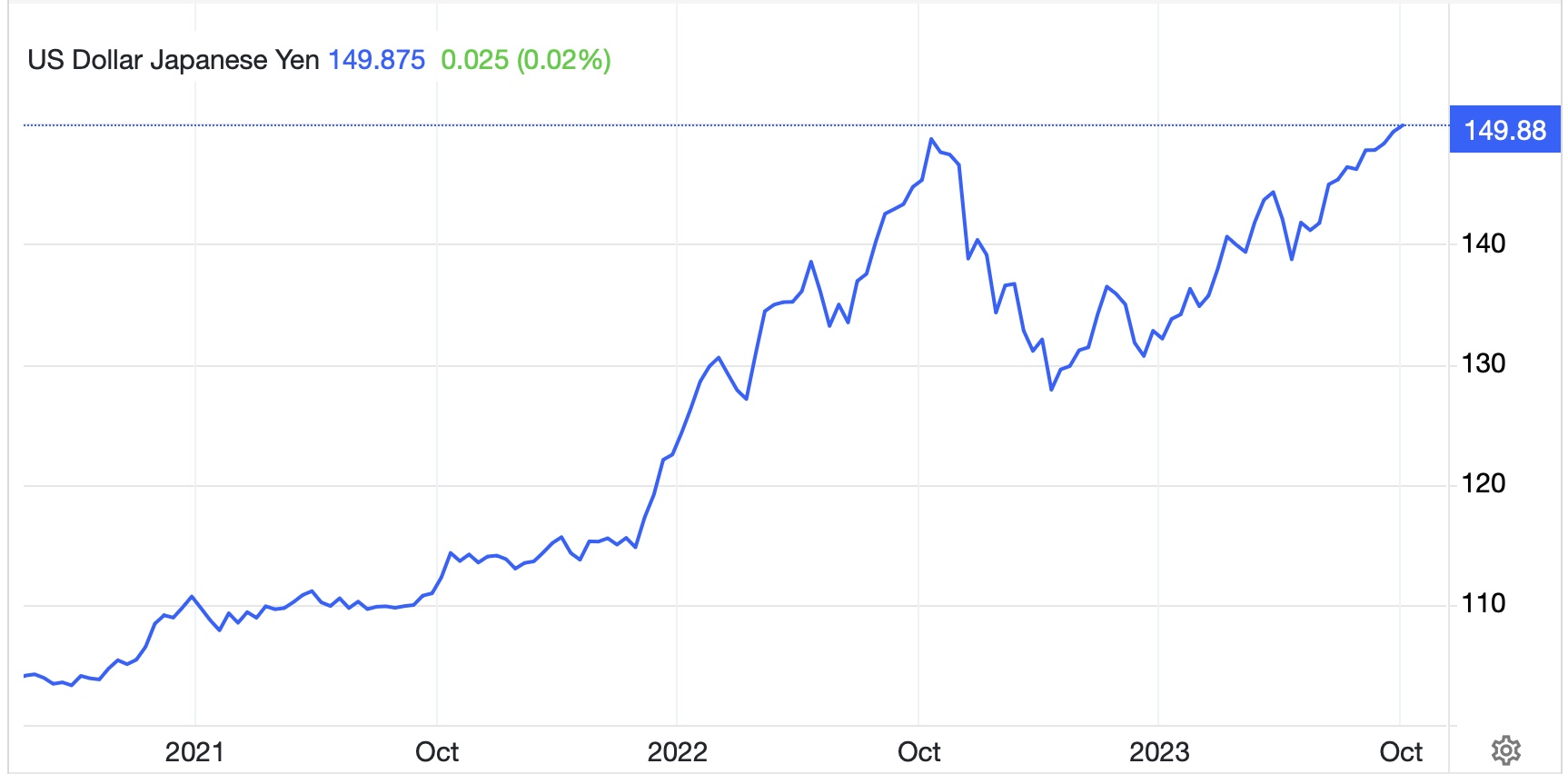
Another day, another new low for the Japanese yen.  USDJPY traded above 149.00 early this morning for the first time since October 2022 (chart below) and this clearly has the Finmin, Shunichi Suzuki spooked.  While I don’t understand the actual comment he made, “As I said at the morning press conference, I’m watching market trends with a high sense of urgency,” based on the fact the dollar did pull back a bit, I guess market participants got the message.  But how can you watch something urgently?  

Source: Tradingeconomics.com

Regardless of his fractured English, the fact remains that USDJPY has risen near the levels it reached last autumn and which resulted in aggressive intervention in the FX markets.  The point is we know they will step into the market so for those of you with immediate needs, be wary.

However, there is exactly zero indication that the BOJ is going to alter its monetary policy stance at this time, nor any indication that the Fed is going to do so either.  Ultimately, those diverging policies are the driver here and without a change in the underlying conditions, this trend should continue.  Perhaps Ueda-san will recognize that CPI running at 3.3% for the past twelve months is an indication that it is sustainable at these levels and change his tune.  But not so far.  With spot at this level, I am a strong proponent of utilizing options to hedge against further yen weakness.  Using them will allow hedgers to take advantage of a pullback, if it comes, but remain protected in the event that their new target is 160, for example.

Said Dimon, nobody’s prepared
And frankly, we all should be scared
A quick rates ascent
To seven percent
Will end up with our problems squared

I guess the question becomes, to whom should we listen, Jamie Dimon or Jay Powell?  In an interview with the Times of India yesterday, Dimon indicated he thought Fed funds could rise as high as 7% and that nobody was prepared for that outcome.  I certainly agree nobody is prepared for that outcome (I wonder if JPM is?) but of more interest is the fact that his comments are quite different than what we have heard from the ostensible powers-that-be at the FOMC.  Last week Chair Powell indicated they remained data dependent but that another hike was reasonable.  Yesterday we heard from erstwhile dove, Austan Goolsbee, the Chicago Fed president, that higher for longer was appropriate, a sign that even the doves are willing to wait a long time before pushing for rate cuts.  But Dimon was clear he thought things would play out differently.

Considering the two sources, I am more inclined to accept Dimon’s worldview than Powell’s as Dimon has fewer political restrictions.  In addition, given JPMChase is the largest bank in the nation, he is likely privy to a lot of information that may not be clear to the Fed.  But, boy, 7% would really throw a monkey wrench into the works.  While equity markets have worked very hard to ignore the ongoing rise in interest rates thus far, Fed funds at 6%, let alone 7% would seem to be a bridge too far.  If the Fed does feel forced to keep raising rates because CPI/PCE continues above target and the Unemployment Rate remains low, 4% or lower, it feels to me like the equity market would reprice pretty dramatically lower.  This is not my base case, but at this point, I would not rule out any outcome.

So, how have markets behaved with this new information?  Well, equity markets, which had a late rally in the US yesterday, have been under pressure around the world.  Meanwhile, bond yields continue to rise and the dollar remains in fine fettle.  Let’s take a look.

Asia was almost entirely in the red last night, certainly all the major markets were down led by the Nikkei (-1.1%) but all Chinese and Korean shares as well.  As to Europe, while the FTSE 100 has managed to stay relatively unchanged, the continent is entirely under water with losses on the order of -0.6% or so.  Finally, US futures are currently (7:30) lower by -0.3% or so, although that is off the worst levels of the overnight session.  It seems that the continued grind higher in yields around the world is taking its toll on the equity bull story.

Speaking of yields, yesterday saw the 10yr Treasury yield touch 4.56%, a new high for the move, although it has since backed off a few basis points and is currently around 4.50%.  But Treasury yields aren’t the only ones rising as we are seeing German bund yields at their highest levels since 2011, during the Eurozone bond crisis, and the same is true with French OATs and most of the continent.  Gilts, too, are pressing higher overall, and while this morning they have backed off 3bps-5bps, the trend remains clearly higher.

Oil prices are finally backing off a bit, down 1.1% this morning and 2% in the past week, although they remain quite high overall.  This movement has all the earmarks of a trading correction rather than a fundamental shift in the supply/demand balance.  The latest data that is out shows that global daily demand is up to ~102 mm bbl/day while supply is just under 100 mm bbl/day.  That trend cannot continue without oil prices rising substantially over time.  As to the metals markets, base metals continue to feel the pressure of a weakening economy while gold continues to suffer on the back of high interest rates, although it remains firmly above $1900/oz.

Lastly, the dollar is just a touch softer this morning although it remains near its recent highs.  We discussed the yen above, which is now unchanged on the day, although off earlier session highs for the dollar.  The euro has regained 1.06, although its grip there seems tenuous and a fall to 1.05 and below seems likely as the autumn progresses.  The pound, meanwhile, is below 1.22 and looking at the charts, a move to 1.18 or so seems very realistic, especially if we continue to hear hawkishness from the Fed.

As to emerging market currencies, the PBOC continues to try to hold back the yuan, although it is trading quite close to its 2% band from the CFETS fixing.  Meanwhile, KRW (-0.8%), IDR (-0.6%) and THB (-0.4%) are all falling as they are not getting that central bank support.  EEMEA currencies are also under pressure led by ZAR (-1.25%) which is suffering on the commodities market selloff.

On the data front, we see our first data of note this week with Case Shiller Home Prices (exp -0.3%), Consumer Confidence (105.5) and New Home Sales (700K).  We also hear from Fed Governor Bowman this afternoon and will see oil inventories late in the day, where continued drawdowns are expected.

Market sentiment is not happy with concerns growing that the Fed really means what they are saying and that interest rates are going to remain at these or higher levels for a while yet.  While the big data points continue to show the economy is hanging on, there are a growing number of ancillary data points that indicate a less robust economic future.  Unfortunately, I think that is going to be the outcome, although it will not be enough to drive inflation down to acceptable levels.  The coming stagflation should see weakness in both bonds and equities while the dollar continues to find buyers all around the world.

Good luck

Adf

Having Some Fits

While all eyes are on CPI
Some other news may now apply
The Germans and Brits
Are having some fits
As they both, to growth, wave bye-bye

The other thing that we have heard
Is ECB forecasts have stirred
What was 3%
They’ve had to augment
So, Thursday, a hike is the wor

Clearly, the top story today will be the release of the August CPI data with the following expectations: Headline 0.6% M/M, 3.6% Y/Y and ex food & energy 0.2% M/M, 4.3% Y/Y.  The headline number has been boosted by the rise in energy prices, although it is important to understand that the bulk of the gains in oil’s price are not going to be in this number, but in next month’s release.  As well, oil prices continue to rise, up another 0.65% this morning and now above $89/bbl.  Too, gasoline prices, the place where we feel this rise most directly, continue to climb right alongside crude.  This release will have the chance to alter some views on the Fed meeting next week, but it will need to be a big miss one way or the other to really have an impact, I think.  While I am not modeling inflation directly, certainly my anecdotal evidence is that prices are continuing to rise at better than a 4% clip for ordinary purchases, whether in the supermarket or at a restaurant or retail store.

But perhaps, the more interesting things today have come from Europe and the UK, with three key, somewhat related stories.  The first was the release of the UK monthly GDP data which fell -0.5%, far worse than anticipated as IP (-0.7%), Services (-0.5%), and Construction (-0.5%) all were released with negative numbers for July.  What had been a seemingly improving outlook in the UK certainly took a hit today and has placed even more pressure on the BOE.  Despite the weaker than expected growth situation, there is, as yet no evidence that inflation is really slowing down very much leaving Bailey and company in a pickle.  Tightening further to fight inflation while the economy declines is a very tough thing to do.  But letting inflation run is no bowl of cherries either.  It should be no surprise that both the pound (-0.2%) and the FTSE 100 (-0.5%) are under pressure today.

The other two stories come from Frankfurt where, first, the German government is apparently set to downgrade its outlook for full-year 2023 GDP to -0.3% from its previous assessment of +0.4%, which was quite weak in its own right.  Apparently, poorly designed energy policy is coming back to haunt the nation as manufacturing activity continues to diminish under the pressure of the highest energy prices in Europe.  Unfortunately for Germany, and likely for Europe as a whole, unless they adjust their energy policies such that they can actually generate relatively cheap power and create a hospitable environment for manufacturing, I fear this could be just the beginning of a longer-term trend.

The other story here is not an official change, but a leak from ECB sources, which indicates that the ECB’s inflation estimate for 2024 will now be above 3.0%, from its last estimate right at 3.0%.  The implication is that the hawks continue to push for another rate hike at tomorrow’s council meeting.  In the OIS market, the probability of a hike tomorrow has risen to 67% from about 50% yesterday.  As a reminder, this is what Madame Lagarde told us back in July, We have an open mind as to what decisions will be in September and subsequent meetings…We might hike, and we might hold. And what is decided in September is not definitive, it may vary from one meeting to another.”  With this in mind, it appears that some members are trying to put their thumb on the scales and get a push toward one more hike.  Especially given weakness in German economic activity, if they don’t hike tomorrow, it will get increasingly difficult to justify more hikes later, so in the hawks’ minds, it’s now or never.

In truth, I think that is an accurate representation because if we continue to see slowing growth in Europe, Madame Lagarde, who is a dove by nature, will be quite unwilling to weigh on growth and push up unemployment even if inflation won’t go away.  With this in mind, I’m on board to see the final ECB rate hike tomorrow.

Not surprisingly, today’s news did not help risk appetites at all.  Equity markets, after yesterday’s US declines (especially in the tech sector) were lower throughout most of Asia and are currently lower across all of Europe.  In fact, the losses on the continent are worse than in the UK, with an average decline of about -0.9%.  Pending higher interest rates amid weakening growth are definitely not a positive for equities.

However, investors have not been running to bonds as a substitute.  Instead, bond yields are higher pretty much across the board, with Treasury yields up 2.5bps while European sovereigns have seen yields climb between 3.5bps (Bunds) and 7.0bps (BTPs).  This has all the feel of rising inflation fears that are not likely to be addressed in the near term.

I already touched upon oil prices leading the energy space higher, but given the sliding views of economic activity, it is no surprise to see metals prices softer this morning with both precious and base metals under pressure.  While the long-term prospects for commodities overall, I believe, remain quite bullish, if (when) we do go into recession, I expect a further price correction.

Finally, the dollar is a bit stronger against all its G10 counterparts and most EMG counterparts this morning.  Granted, the movement has been modest so far, which given the importance of today’s data release, should be no surprise.  But my take is that a hot CPI print, especially in the core, will see the dollar rise further as the market starts to price in at least one more rate hike by the Fed, probably in November.  At the same time, if the CPI number is cool, then look for the dollar to give back a bunch of its recent gains as market participants go all in on rate cuts in the near future.  It is that last part of the concept with which I strongly disagree.  While the Fed may have reached its terminal rate, there is no evidence that they are even thinking about thinking about cutting rates.  However, that is my sense of how today will play out.

Good luck

Adf

Higher For Longer is Key

As markets await CPI
Some folks have begun to ask why
The Fed needs to keep
Inversion so deep
Since ‘flation is no longer high

Instead, what these folks want to see
Is rates heading back down to three
But Jay’s been quite clear
Throughout this whole year
That higher for longer is key

It has been an extremely quiet evening session with very little in the way of new information for market participants as all eyes are on tomorrow morning’s CPI print in the US.  There were only two pieces of mildly noteworthy data, UK Unemployment rose one tick to 4.3%, as expected and the overall employment report was largely in line with expectations.  As well, the German ZEW Survey showed that while the current situation has actually deteriorated, falling to Covid-like levels, Expectations were marginally less awful than forecast.  But in the end, it is hard to make the case that either of these releases had much of an impact on the market.

On the geopolitical front, much is being made of North Korean leader Kim Jung-Un’s trip to Moscow to meet with President Putin, and ostensibly promise to sell him weapons and ammunition.  But again, this doesn’t appear to have any market impact.  Arguably, of much more importance to the market are two US tech firm stories; first Oracle giving disappointing guidance in their earnings last night indicating that perhaps AI is not actually going to rain money into every tech firm right away, and, second the anticipation of Apple’s release of the iPhone 15 today, as analysts try to determine if that company can continue to deserve its current valuation.  At this hour (7:30), Oracle stock is much lower, about -10%, and the entire US equity futures market is marginally under water as well, but just -0.2% or so.

If I had to characterize today’s market it would be stagnant with a flavor of risk-off.  Given the perceived importance of tomorrow’s data release, and the fact that its timing was well-known in advance, it appears that positions have already been established based on individual views.  The result has been lower volumes and less movement ahead of the release.  As well, absent any Fed speakers it is hard to come up with a reason to adjust any views at this point in time.  So, my sense is we are set for quite a dull session overall.

Perhaps this is a good time to recap the current narrative, at least as I see it.  I believe a majority of market participants believe the Fed is done hiking rates and it is only a matter of time before they start cutting them.  There is a strong belief that the Fed will achieve the much-vaunted soft landing despite the long odds of success on that front and a history that shows they have only ever been able to do so once.  The odd thing about this soft-landing belief is the idea that if the Fed is successful in achieving that outcome with interest rates at 5%, that they would suddenly cut rates afterwards.  I need someone to explain to me why the Fed would change the policy that achieved their goals.  A correlating narrative remains that AI is not merely the future, but the present and that tech stocks can grow to the sky.  And maybe they can, but I would bet the under there.  

And lastly, there is a conundrum in this narrative as the de-dollarization story continues to get a great deal of play.  However, if the Fed is successful and AI really is going to drive tech stocks higher forever, why would the dollar lose its luster?  It seems to me, especially given the fact that Europe and probably China are heading into recession, that the dollar will be in huge demand.  At any rate, my take is those are the underlying theses driving markets right now.

So, a tour of markets overnight shows that bond markets are essentially unchanged, stock markets were mixed in Asia, with Chinese shares under pressure but Japanese and Australian shares ok while European shares are under some pressure, and the dollar is rebounding a bit from yesterday’s sell-off.  Arguably, yesterday’s dollar move was a result of the news from Japan and China, both of whom were unhappy over their respective currency’s weakness, but that is, literally, yesterday’s news.  One last thing shows oil (+0.8%) rallying again with WTI above $88/bbl this morning, a new high for this move, which continues to support all energy prices.  In fact, it is this story, a continued lack of supply in the oil market relative to demand that, regardless of the much-hyped transition to renewables, continues to grow, is going to support the price for a long time to come.  And that is going to continue to pressure prices higher as energy is an input into everything we do, both manufacturing and services.

And that’s really it for today, a very quiet session ahead of the next big data drop tomorrow morning.  Before I end, though, I think it is important to understand the nature of economic forecasting and there is a perfect example right now.  I have frequently mentioned the Atlanta Fed’s GDPNow forecast as a potential harbinger of things to come.  Certainly, the market sees it that way.  Well, other regional Fed banks wanted to have their own versions of that GDP Nowcast and this is what we are currently seeing:

  • Atlanta Fed:     5.7%
  • NY Fed:            2.3%
  • St Louis Fed:    -0.3%

To me, that is a perfect picture of the current situation, proof that nobody has any idea what is going on in the economy.

Good luck

Adf

On the Schneid

While data at home is robust
In Europe and China the thrust
Is weakness abounds
Which seems to be grounds
For traders, their risk, to adjust

So, equities are on the schneid
While bond yields have been amplified
The dollar’s on fire
Continuing higher
And oil’s climb won’t be denied

Another day, another wave of bad economic news from elsewhere in the world.  However, the US continues to surprise with better than expected results.  Yesterday’s ISM Services data was far better than forecast with a headline print of 54.5, 2 points above both last month and expectations for this month, while the sub-indices all showed significant strength, including the Prices Paid index.  The latter is clearly a concern for Chairman Powell and his crew as it is an indication that inflationary tendencies have not yet been snuffed out.  Ultimately, the market response was to sell stocks and bonds while increasing the probability of a November Fed funds rate hike a few points.  Interestingly, the market pricing for a September hike has fallen to just a 7% probability despite the hotter than expected data.  My sense is that the big market adjustment is going to come as traders come to understand that higher for longer means no cuts until 2025 on the current basis, especially if we continue to see data like the ISM print yesterday.

But the US storyline is clearly not the same as the storyline elsewhere in the world.  Last night, for example, Chinese trade data was released and both imports (-7.3%) and exports (-8.8%) fell sharply again, with the Trade Surplus falling to $68.3B.  Granted, the declines were not as bad as last month, nor quite as bad as expectations, but there is no way to spin the data as indicating a positive economic impulse in China right now.  While Chinese equity markets fell sharply (Hang Seng and CSI 300 both -1.4%) we also saw further weakness in the renminbi.  

The PBOC is still desperately trying to prevent the renminbi from weakening too quickly, but they are having a hard time at this stage.  The difference between the CFETS fixing and the onshore spot market is now 1.8%, dangerously close to the 2.0% boundary.  At the same time, the offshore renminbi, CNH, is pushing back to its highs from last October, now trading above 7.3400, which is 1.97% above the fixing.  This is a losing battle for the PBOC unless they change their monetary policy, but given the Chinese economy’s weakness, tighter money seems an unlikely step.  7.50 is still on the cards here.

China, though, is not the only problem.  European data this morning was uniformly lousy with German IP (-0.8%) and Eurozone GDP (Q2 revised lower to 0.1% Q/Q, 0.5% Y/Y) highlighting the problems facing the old world.  Alas, price pressures have not yet abated there, and stagflation is the new watchword on the continent.  

When the US was faced with stagflation in the 1970’s, Paul Volcker opted to fight inflation first, sending the country into a double dip recession in 1980 and 1981-82, before things turned around.  But that was a different time…and Christine Lagarde is no Paul Volcker!  Is it even possible for an “independent” central bank to knowingly create a recession to slay inflation these days?  I suspect inflation would need to be far higher, stable in double digits, before politicians would accept that it is a bigger problem than a recession, at least electorally.  The upshot of this scenario is that the ECB, despite ongoing higher than targeted inflation, is very likely at the end of its hiking cycle.  This, combined with the overall weak economy there, is going to continue to undermine support for the euro.  While the movement will be gradual, I expect that the single currency will slide below 1.05 and possibly get to parity by the end of the year.

And I would be remiss if I didn’t touch quickly on Japan, where they released their Leading Indicators at a weaker than expected 107.6, continuing the two-year downtrend.  Slowing growth in Japan and still extraordinarily loose monetary policy is going to continue to weigh on the yen.  While it has bounced slightly this morning, 0.2%, it continues to weaken steadily closer to the psychological 150.00 level.  

So, with all that happy news, let’s tour the overnight session to see the results.  The rest of the APAC equity markets also were under pressure overnight with Japan, Australia and South Korea all in the red as well.  In Europe this morning, the picture is more mixed with some gainers and some losers but no large movements overall, mostly +/- 0.2%.  US futures, after a lousy session yesterday, are all pointing lower at this hour (7:30) as well.

In the bond market, Treasury yields are essentially unchanged on the day, holding onto their gains for the past week and just below the 4.30% level.  European sovereigns, though, are seeing a bit of support as the weak economic data has engendered hope that inflation will stop rising and the ECB will be okay to pause.  The latter remains to be seen.  I cannot get over the idea that the uninversion of the yield curve is going to come because long rates are going to rise, not because short rates are going to be cut, and I’m pretty sure nobody is ready for that outcome.

Oil (-0.5%) is consolidating its recent gains with WTI north of $87/bbl and showing no signs of backing off.  If OPEC+ keeps a lid on production, you have to believe that prices will continue to rise.  In the metals markets, both copper and aluminum are soft today, responding to the weak Chinese and German data, while gold, after a selloff this week, is bouncing slightly.

Finally, the dollar remains king of the hill, stronger against virtually all its counterparts in both the G10 and EMG blocs.  I’m old enough to remember when the prevailing narrative was the dollar was dead and would be replaced by the euro, or the yuan, or a BRICS currency and yet, it continues to be subject to more demand than virtually every other currency around.  The broad story is the US economy continues to lead the global economy and the prospects for Fed rate cuts are diminished relative to other nations.  Tight monetary and loose fiscal policy combinations have historically been very supportive of a currency and clearly that is the current US state.

Two quick stories in the EMG bloc are from Poland (-0.7%), where yesterday’s surprising 75bp rate cut has undermined the zloty amid concerns that inflation is going to remain unhindered there, and MXN (+0.75%) where traders are unwinding some positions after a sharp decline over the past week.  The peso has been one of the few currencies that has outperformed the dollar this year as Banxico has been ahead of the curve on inflation and tight monetary policy.  However, with an election upcoming it appears there may be a change in attitude there.  If that is the case, then look for the dollar to regain some lost ground.

On the data front, Initial (exp 234K) and Continuing (1719K) Claims are released along with Nonfarm Productivity (3.4%) and Unit Labor Costs (1.9%).  As traders and investors bide their time ahead of next week’s CPI and the following week’s FOMC meeting, it is not clear that today’s numbers will have much impact.  As such, I see no reason for the dollar to cede its recent gains, especially if equities remain under pressure.

Good luck

Adf

A Gaggle of Bankers

At altitude 8000 feet
A gaggle of bankers will meet
All eyes are on Jay
And what he might say
Regarding the Fed’s balance sheet

Now, pundits galore have opined
But something we need bear in mind
Is policy tweaks
Are still several weeks
Away, and will like be refined

Well, at 10:00 this morning, Chairman Powell will speak to the world regarding his latest views on “Structural Shifts in the Global Economy.”  At least that is the theme of the entire event where there will be numerous speeches by central bankers including Madame Lagarde later today, as well as papers presented by economists.  The reason this event is so widely discussed is in the past, Fed Chairs have used the forum to signal a shift in policy.  

Is that likely today?  This poet’s view is no, it is unlikely.  The message from the July meeting was that the Fed was still concerned about inflation running too hot and that the higher for longer mantra still applied.  Since then, the data has, arguably, been somewhat better than expected, although certainly not universally so.  At the same time, 10-yr yields are some 40bps higher and the S&P 500 is lower by about 4% since the last FOMC meeting, market moves that indicate investors are listening.  I do not believe Chairman Powell is keen to rock the boat.  As well, I don’t believe he feels the need to imply any major changes are necessary and I have a feeling that he is actually going to speak about the global economy, and not the US one specifically.

Summing up, I have a feeling this is going to be a complete non-event, with no useful information forthcoming, at least from Powell.  As it happens, Madame Lagarde speaks at 3:00 this afternoon NY time, and there is considerably more uncertainty as to the ECB’s path forward given the fact that the economic data in the Eurozone continues to be weak (today, German GDP in Q2 was confirmed as 0.0% Q/Q, -0.2% Y/Y, with Private Consumption also at 0.0% and the Ifo sentiment fell to 85.7, several points below expectations) while inflation remains far above their target.  While the ECB hawks are still claiming it is far too early to consider a pause in rate hikes, the ECB doves have been clear they are ready to stop.  Remember, too, Lagarde is a dove at heart.  It would not be difficult to believe that Lagarde discusses the slowing growth in China and the assumed knock-on effects for Europe as a rationale for expecting inflation to continue to fall without further ECB actions.

But as always, this is merely speculation ahead of the speeches, which is why we all listen.  Away from this meeting, though, investors are demonstrating some concerns about the overall situation, at least as evidenced by recent market activity.

Yesterday, in what was clearly something of a surprise to most pundits, equities sold off sharply in the US, led by the NASDAQ which was down -1.9%.  The surprise comes from the fact that the Nvidia earnings the night before were so strong and the stock rallied sharply on the news.  And this weakness was spread across all the major US indices.  Adding to the confusion was the fact that the US data yesterday generally pointed to more economic growth, with lower Claims data, and a strong Durable Goods -ex transport print with survey data looking up as well.  I guess this is a ‘good news is bad’ situation as continued economic strength informs the idea the Fed is not going to change their stance on higher for longer.

That weakness fed into Asia, where markets were lower across the board led by the Nikkei (-2.05%).  But in Asia, the interesting thing was that China announced, during the session, additional support for the property market by altering some mortgage and tax rules to encourage more home buying as Beijing tries to grapple with the increasing speed of the property implosion.  Alas for President Xi, the positive impact in the stock market lasted…10 minutes only!  After that, selling resumed and all the major indices in Asia finished lower on the day.  Now, European bourses have reversed that trend and are higher by roughly 0.6% across the board, perhaps anticipating a Lagarde ease, while US futures at this hour (7:30) are edging higher by 0.2% or so.

In the bond market, yields, which had fallen sharply earlier in the week, bottomed on Wednesday and are now higher in the US and throughout Europe.  While the move largely occurred in the US yesterday, with a 5bp bounce, and this morning we are little changed, Europe is seeing yields climb by 5bp-6bp across the board today.  The one place where yields remain dull is Japan, which has seen the 10yr JGB hover either side of 0.65% for the past week or two.

In the commodity space, oil (+1.5%) is rebounding again, arguably on the better than expected US data.  This is consistent with firmer prices in base metals, which are rising despite the rise in yields.  Ultimately, what this tells me is that there remains a great deal of uncertainty as to the near future regarding the economy.  The battle over whether a recession is coming soon or never coming continues apace.  The thing about commodities is that the supply piece of the puzzle continues to be undermined (pun intended) by ESG focused investors and governmental actions, and so the ultimate direction remains higher in my mind. 

Finally, the dollar is mixed to slightly stronger this morning, with most of the G10 a touch weaker vs. the greenback except for NOK (+0.4%) which is clearly benefitting from oil’s rally.  In the EMG sector, ZAR (+0.9%) is the outlier on the high side as allegedly traders are betting on increased investment flows to the country in the wake of the expansion of the BRICS nations.  (As an aside, can somebody please tell me why adding Argentina, a nation with a history of hyperinflation and serial debt defaulter, would inspire confidence in a BRICS currency?). But other than the rand, movement in this space has also been limited, arguably with everyone waiting for Powell.

On the data front, just ahead of Powell’s speech, we get the Michigan Sentiment Survey (exp 71.2), but that will clearly be overshadowed by Powell.  While I anticipate very little activity in the market ahead of 10:00, I also anticipate very little after the speech as I don’t believe he is going to change any perceptions at this point.  There is still a lot of data before the next meeting, another NFP, CPI and PCE reading, so it is too early to look for a change.  

Good luck and good weekend

Adf

Lacking In Gains

The PMI data remains
A place clearly lacking in gains
At least cross the pond
And Asia beyond
But will the US feel those pains?

The hard data hasn’t supported
That weakness, but is it distorted?
The latest we hear
Is NFP’s near
Revisions that show growth’s been thwarted

As market participants look ahead to Friday’s Powell speech at Jackson Hole, and seemingly more importantly to Nvidia’s earnings report and forecasts this afternoon, we must look at a few things that are going on in the economy.  The most noteworthy situation is that there remains, at least in the US, a wide gap between the survey data and the actual data.  We continue to see weak readings from the regional Fed manufacturing surveys, as well as PMI and ISM data, yet the key numbers, like NFP and Retail Sales continue to perform at a better than expected rate consistently.  While we await this morning’s Flash PMI data (exp Mfg 49.0, Services 52.2, Composite 51.5), which are essentially unchanged from last month’s readings and perhaps the best in the G10, there is a story this morning that the NFP data is going to be revised down by 650K jobs at the preliminary revisions today.  That is a huge adjustment and one that would certainly call into question the ongoing strength in the labor market.

It is not yet clear if it will impact the Unemployment Rate but if this story is accurate, it will almost certainly impact some of the thinking at the Eccles Building.  Consider that, after revisions, the seven NFP numbers have totaled 1807K so far this year, with the last two months showing 185K and 187K respectively.  If that 650K number is correct, and it comes from the past two months, then they will be revised into negative territory, a very different indication than anyone has considered to date.  However, even if it is more evenly spread across the year, it still represents more than one-third of the alleged jobs created.  This feels important to me.  While I have no way of determining if this story is accurate, it is important to understand it is making its way through the markets.  If this is the case, I would expect that the market’s view on the economy, as well as the Fed’s is likely to change somewhat.  

Arguably, the market response would be to alter pricing for interest rates going forward with more rate cuts priced in and priced in sooner than the middle of next year.  At the same time, though, former St Louis Fed President Bullard was interviewed by the WSJ yesterday and was crowing about how the market got the recession call wrong and the economy is doing much better than expected.  These diametrically opposed views are the norm in the markets these days, with no clear consensus that things are going to improve or worsen.  Again, it is this situation that informs why hedges for natural exposures are so important.

Turning to the other PMI’s released this morning, the story in Europe remains one of desultory growth or outright shrinkage.  The German manufacturing sector PMI printed at 39.1, better than last month’s 38.8, but still deep in recessionary territory.  While the French and Eurozone numbers were a bit better, they were both well in recession territory.  In fact, given the weakness of this data, and the fact that the ‘hard’ data in Europe has also been soft, the new narrative is the ECB is finished.  What had been a 50:50 probability for a hike in September has fallen to a one-third chance and if we continue to see weaker data, I expect that will fall further.  As to the UK, it also saw weak PMI data, with both Services and Manufacturing below the key 50 level, and the market has pulled back to just two 25bp rate hikes over the next 6 months despite the fact that inflation in the UK remains the highest in the developed world at 6.9% core, while the base rate sits at 5.25%.

It is not hard to look at this data and understand why the dollar continues to perform well.  Despite all the problems in the US, especially regarding the debt and massive interest payments, as well as the recent credit downgrade by Fitch, the US remains the most attractive opportunity around in the G10.  In fact, this is why that story about the massive downward revision in NFP data is so important.  Without it, the distinction is very clear, buy the USD, but if it is true, opinions are likely to change somewhat.

Turning to the overnight session, while most markets managed to do reasonably well in Asia, the mainland equity markets continue to suffer with the CSI 300 down -1.6%.  In Europe, the picture is mixed with some early gains being ceded and only the UK (+0.7%) managing to stay positive while the continent slips slightly into the red.  US futures, meanwhile, are barely in the green as all eyes await the Nvidia earnings after the close.

In the bond market, it is a one-way street with yields falling across the board and in a meaningful way.  Treasuries are actually the laggard with yields only down by 5bps while European sovereigns have seen yield declines of 9bps and UK gilts of 11bps.  Clearly, the bond market is responding to the weak PMI data and anticipating weakness in the US as well.  One other interesting thing is that the yield curve inversion, which had been unwinding for the past week or two, widened again yesterday and is back above the -75bp level, having traded as low as -65bps just a few days ago.

Recession is the view in the commodity space as well, at least in energy, as oil prices (-1.5%) fall again and are now back below the $80/bbl level.  Stories of more Iranian crude making its way to the market as well as fears over reduced demand are having an impact.  Interestingly, the metals markets are holding up this morning with both base and precious varieties all in the green led by copper (+1.0%).  This is a harder outcome to square with the recession fears.

Finally, the dollar is doing quite well this morning, which given the growing risk-off attitude makes some sense.  Vs. the G10, only the yen (+0.25%) has managed any gains, and they are small.  Meanwhile, the rest of the bloc is weaker across the board led by the pound (-0.9%) and NOK (-0.9%) for obvious reasons.  In the EMG bloc, ZAR (+0.5%) is the lone gainer of note after South African data implied better times ahead.  On the flipside, though, weakness is broad based with APAC, EEMEA and LATAM currencies all under pressure amidst the risk sentiment today.

Yesterday’s Existing Home Sales data was a bit softer than expected and as well as the PMI data due, we also see New Home Sales (exp 703K) and that NFP revision.  Clearly, all eyes will be on that last piece of data given the rumors of a large decrease.  So, we will need to see how that comes.  If it is benign, then I expect risk appetite may return as the bulls look for a big Nvidia story this afternoon.  However, if that huge revision appears, I suspect risk will remain in abeyance for now.

Net, nothing has changed the medium-term view of dollar strength, but the day to day remains open to the news.

Good luck

Adf

Problems Galore

The story continues to be
The China of President Xi
Has problems galore
With more still in store
So, traders, as such, want to flee

The issue for markets elsewhere
Is knock-on effects aren’t rare
Protecting the yuan
Means it is foregone
Bond sales will send yields on a tear

For yet another day, China is offering the biggest market stories.  In no particular order we have seen the following overnight; China Evergrande filed for Chapter 15 bankruptcy, a process by which foreign entities can access the US bankruptcy court system, regarding $19 billion of their offshore debt; the PBOC set their CFETS fixing more than 1000 pips lower than market expectations, the largest gap since the process began in 2018, in their effort to arrest the yuan’s consistent decline; and Chinese police visited the homes of the protesters who were complaining about Zhongzhi’s missed payments (I wrote about these Monday in Risks Were Inbred).  And this doesn’t include the fact that Country Garden, the largest property developer in China is losing money quite rapidly and may also be on the brink of bankruptcy.  It seems the Chinese property bubble is deflating.

Ultimately, there appear to be two main impacts of the gathering storm in China, market participants are increasingly leery of taking on risk in general, and the PBOC’s efforts to stem the decline of the yuan means they must sell their holdings of Treasuries to generate the dollars to deliver into the FX market thus adding downward pressure to the bond market.  Of course, one of the typical outcomes of a risk-off attitude is that bond markets rally as investors exit equities and run to bonds.  This stands at odds to the recent bond market behavior, although it is quite evident this morning.  In fact, after touching yields above 4.30% in the 10yr Treasury yesterday, this morning we have seen a half-point rally with yields declining about 5bps in the US.  In Europe, the yield declines have been even greater, mostly around -10bps, so this is a real reprieve for bond markets everywhere.

The key question here is whether we have seen the worst, or if other potential selling catalysts will appear.  Consider for a moment the fact that between China and Japan, they represent >26% of foreign owned US Treasury debt, and that both of these nations are dealing with rapidly weakening currencies.  Not only that, but both have demonstrated they are quite willing to intervene in FX markets to arrest those declines, and as mentioned above, that typically requires selling Treasuries.  It’s a self-reinforcing cycle as higher yields beget currency sales which beget Treasury sales to intervene, which results in higher yields starting the cycle all over.  

With this in mind, we need to consider, what can break the cycle?  Well, if the Fed were to turn dovish and indicate they agreed with the futures markets that rate cuts are coming early next year, I suspect the dollar would fall against most currencies, especially these two, and the cycle would break.  Alternatively, China could step up and guarantee the debt of Countrywide and Evergrande thus removing the investor risk and reduce pressure dramatically.  Finally, I suppose the Fed could make a deal with the BOJ and PBOC and directly absorb their bond sales, so they never hit the market while restarting QE.  That, too, would likely end the cycle.  It is possible there are other ways to break the cycle, but I doubt we will see any of these occurring anytime soon and so the cycle will have to wear out naturally.  That will occur when either or both of the currencies decline far enough so the market believes the trade has ended and unwinds their short positions.  In other words, none of this has changed my view that 7.50 is on the cards for USDCNY as the year progresses, very possibly with 10yr yields getting to 4.5% or more.  And don’t be surprised if we see another move to 150.00 in USDJPY.

But, away from the China connection, things are very much in the summer doldrums.  Equity markets have been treading fearfully and continue to do so this morning.  However, while we have seen several days of declines, there has been no panic selling of note.  So, yesterday’s US weakness was followed by selling throughout Asia and this morning in Europe with most markets down about -1.0%.  US futures, too, are softer, down about -0.5% at this hour (8:00).

Oil prices (-0.85%) which stabilized yesterday, are back under a bit of pressure on the overall negative risk sentiment as they continue to trade either side of $80/bbl.  Metals prices, meanwhile, are mixed with precious metals finding a bit of support while base metals suffer today.  The most interesting story here I saw today was that CODELCO, the world’s largest copper miner in Chile, may be going bankrupt as previous projects didn’t pan out.  That strikes me as a very large potential problem, but one for the future.  

Finally, the dollar is mixed this morning.  It had been softer overall in the overnight session, but as risk is getting marked down, the dollar is gaining strength.  The biggest mover has been PHP (+1.1%) which rallied after the central bank indicated they were going to put a floor under the currency and adjust rates accordingly.  After that, the EMG bloc has not done very much, +/- 0.25% type activity.  However, just recently, G10 currencies started to slide with NOK (-0.8%) the laggard as oil slides, but the entire bloc now coming under pressure.  This is all about risk off.  

There is no US data today nor are there any Fed speakers.  As such, the dollar will take its cues from the equity markets, and the bond market to some extent.  Right now, equity weakness is driving the risk attitude and that means the dollar is likely to remain bid into the weekend.  Next week brings the Fed’s Jackson Hole meeting where everybody will be looking for any policy hints by Chairman Powell on Friday morning.  But for now, the dollar is on top of the mountain.

Good luck and good weekend

Adf

Risk Were Inbred

In China, the problems have spread
From property company dread
To shadow finance
Where folks took a chance
To earn more though risks were inbred

And elsewhere, the Argentine voters
Surprised governmental promoters
By choosing a man
Whose primary plan
Is ousting Peronist freeloaders

While the goal of this commentary is to remain apolitical, there are times when the politics impacts the markets and expectations for future movement so it must be addressed, though not promoted on either side.  Today, amid general summer doldrums, it seems there are more political stories around that are either having or have the potential to impact financial markets.

But first, a quick look in China where the latest problem to bubble to the surface comes from Zhongzhi Enterprise Group Company, one of the many shadow banking companies in the country.  These firms are conduits for investment by wealthier individuals and corporations who offer structured products and investments promising higher returns than the banking sector.  And they are quite large, with an estimated $2.9 trillion invested in the sector.  Well, Zhongzhi has roughly $138 billion under management and last week they apparently missed some coupon payments on several of these high-yielding investments.  While this is the first that we have heard of problems in the sector, given the terrible performance of the Chinese equity market as well as the ongoing collapse of the Chinese property market, my guess is this won’t be the last firm with a problem.  As has often been said, there is never just one cockroach when you turn on the lights.

As proof positive that there is really no difference between the Chinese and US governments, the first response by the Chinese was to set up a task force to investigate the risks at Zhongzhi and its brethren shadow banks.  That sounds an awful lot like what would happen here, no?  Anyway, depending on who is invested in Zhongzhi and whether they are politically important enough to bail out, I suspect that there will be government intervention of some sort.  Do not be surprised to hear about Chinese banks making extraordinary loans to the sector or guarantees of some kind put in place.  The last thing President Xi can afford at this time is a meltdown in a different sector of the financial space.

It can be no surprise that Chinese equity markets were under pressure again last night, with both the Hang Seng and CSI 300 falling sharply, nor that the renminbi has fallen to its weakest levels since the dollar’s overall peak last October.  I maintain that 7.50 is in the cards here and that it is simply a matter of time before we get there.  In the end, a weaker CNY is the least painful way for China to support its economy, especially since it is a big help to its export industries which remain the most important segment of the economy.  Later this week we will see the monthly Chinese data on investment and activity so it will be interesting to see how things are ostensibly progressing there.  However, this data must always be consumed with an appropriate measure of salt (or something stronger) as there is no independent way to determine its veracity.

Meanwhile, on the other side of the world, a presidential primary in Argentina resulted in a huge surprise with Javier Milei, a complete outsider and ostensible free market advocate, winning the most votes, more than 30%.  The election comes in October and the ruling Peronist party is at risk of being eliminated in the first round.  What struck a chord in the country was his plan to dollarize the economy and close the central bank as well as to shut down numerous government agencies.  Inflation there remains above 115% so it can be no surprise that someone who promised to change the process garnered a lot of support.

I raise this issue because in Germany, the AfD (Alternative für Deutschland) party is currently polling at >21%, the second largest party in the country, and that has a lot of people very concerned.  Like Senor Milei, the AfD’s platform is based on destruction of much of the current government setup.  Because this party is on the right, and given Germany’s dark history with the far right, the latest idea mooted has been to ban the party completely.  Now, certainly the idea of a resurrection of the Nazi party is abhorrent to everyone except some true extremists, but simply banning the party seems a ridiculous idea.  After all, the members will either create a new party with the same support or take over a smaller existing party and drive the platform in the desired direction.  

Support for Marine LePen in France continues to grow, as does support for right of center parties throughout Europe, especially Eastern Europe.  And of course, here in the US, the upcoming election has fostered even more polarization along partisan lines with the Republican party seeming to gain a lot of support of late.  All this implies that there is a chance of some real changes in the financial world that will accompany these political changes.  At this point, it is too early to determine how things will play out, but as we are currently in the Fourth Turning, as defined by historian Neil Howe, the part of civilization’s cycle when there is great unrest, I expect there will be a lot more change coming.  Food for thought.  And it is for this reason that hedging exposures is so critical.

Ok, last week’s inflation readings were mixed, with CPI a bit softer than forecast while PPI was a bit firmer.  But the one consistency was that Treasury yields rose regardless of the situation.  After a further 5bp rise on Friday, 10yr yields are unchanged at 4.15% this morning, an indication that inflation concerns remain front of mind for most investors.  I expect that the peak yields seen back in October will be tested again soon.  As to European sovereigns, while yields there are down a tick this morning, the trend there remains higher as well.

Equity markets, too, have had some trouble of late, sliding a few percent over the past several weeks.  While the move lower has been modest so far, there is clearly concern over a technical break lower should the indices break below their 50-day moving averages.  With yields heading higher, I fear that is the path of least resistance for now.

Oil prices are a touch softer this morning but remain well above $80/bbl and appear to be consolidating before their next leg higher.  Supply is still a consideration and given economic activity continues to outperform, I suspect higher is still the path going forward.  Metals prices are little changed this morning despite some incipient dollar strength, so keep that in mind as well.

Finally, the dollar is much stronger against its Asian counterparts and modestly stronger against most others this morning.  Continuing rises in US yields offer support for the greenback and increased turmoil elsewhere, along with the US economy seemingly outperforming all others have been the hallmarks of the dollar’s strength.  I don’t see that changing soon.

Data this week brings the following:

TuesdayRetail Sales0.4%
 -ex autos0.4%
 Empire Manufacturing-0.7
 Business Inventories0.1%
WednesdayHousing Starts1445K
 Building Permits1468K
 IP0.3%
 Capacity Utilization79.1%
 FOMC Minutes 
ThursdayInitial Claims240K
 Continuing Claims1700K
 Philly Fed-10.5

Source: Bloomberg

While Retail Sales will be watched for their economic portents, I think the Minutes will be the most interesting part of the week, especially as we have now had at least two FOMC voters, Harker and Williams, talk about cutting rates next year.  

For today, while US equity futures have edged higher so far, I feel like the dollar has legs for now.  This will be confirmed if yields continue to rise.

Good luck

Adf