A New Pox

The interest rate doves are excited
That job growth in August was blighted
If that was the case
The Fed may embrace
Enough cuts to leave them delighted
 
But if they’re correct, what of stocks?
Will weak data be a new pox
On earnings and growth
And undermine both
With stocks falling onto the rocks?


As far as anyone can tell, there is only one thing that matters today, the payroll report.  Let’s set the table with the latest median forecasts:

Nonfarm Payrolls160K
Private Payrolls139K
Manufacturing Payrolls0K
Unemployment Rate4.2%
Average Hourly Earnings 0.3% (3.7% Y/Y)
Average Weekly Hours34.3
Participation Rate62.6%

Source: tradingeconomics.com

I’m sure you all remember that last month we got a surprising, and disappointing, reading of 114K for the headline number and then we subsequently got those massive revisions from the BLS which indicated that they had overstated job growth by more than 800K over the year from April 2023 through March 2024.  As well, yesterday’s ADP Employment data showed private job growth of a below expectations 99K with a revision lower to the previous month’s number.  Certainly, some of the data we have seen is pointing in the direction of a weaker outcome.  However, if one looks at the Initial and Continuing Claims data, neither of those series are pointing to a significant weakening in the labor market, although it has cooled somewhat since last year.

Since the last NFP report, 10-year Treasury yields have declined by 28bps and now sit at 3.70% this morning.  If you compare that to the current Fed funds rate of 5.375%, the implication is that rates are going to fall by at least 160 basis points over the next two years.  In fact, we are starting to see some analysts (Citi) call for nearly that many cuts by the end of 2024!  It strikes me that 150bps of cuts by December 2024 would only occur in response to a significant slowing of US economic activity, in other words, the long-awaited recession. Now, if the Fed were to cut that aggressively without a clear decline in the economy, it would certainly open the door to much higher inflation ahead.  After all, why add liquidity and ease policy if the economy continues to cruise along at a decent clip?

The upshot is that it appears, at least to this poet’s eyes, that the bond market is way ahead of itself with respect to potential Fed rate cuts.  Either that or the stock market is completely mispriced for the potential future earnings results of its components.  The one consistent outcome from all recessions is that corporate earnings growth slows dramatically.  Given that current equity prices embody P/E multiples near historically high levels (see chart below of Cyclically Adjusted Price Earnings for the S&P 500), if the E in that fraction declines, you better believe that so will the P.
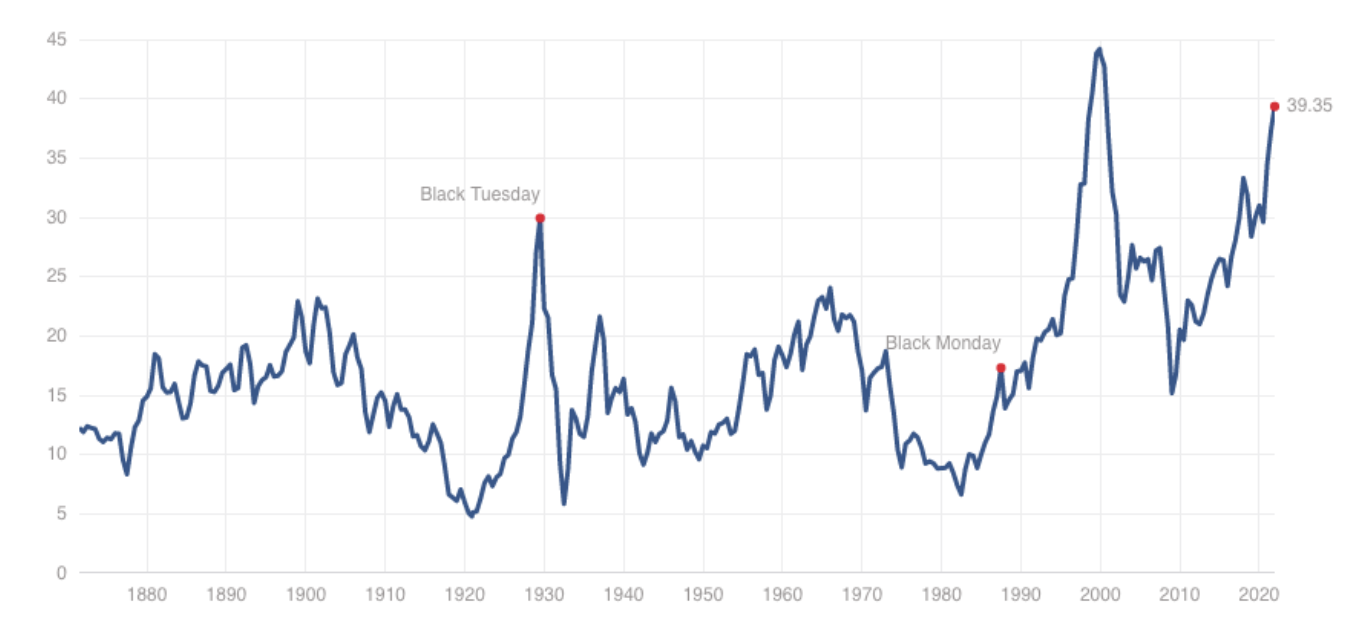
Source: lesswrong.com

What will this mean for other asset classes, notably commodities and the dollar?  Here we need to consider the driver of the potential rate cuts in question.  If the US economy is clearly slowing dramatically and the Fed is responding by cutting rates aggressively, I would expect that the dollar will come under real pressure, at least initially, as the Fed is likely to be more aggressive than other central banks.  However, remember that the market is already pricing in significant rate cuts, so given the reality that if the US enters recession, most of the rest of the world is going to see much slower economic growth with their central banks easing policy as well, I would not look for a dollar decline of historic proportions.  Another 5%-8% seems viable but looking for the euro at 1.50 or the pound at 1.75 or the renminbi at 6.00 seems unrealistic.  The one outlier here is the yen, of course, where a situation with declining US equity prices, and correspondingly declining risk asset prices all over the world, could easily see Japanese investors run home with their money and USDJPY could well fall back to the 120 level or even lower in that scenario.

As to commodity prices, I expect the initial move would be lower as concerns about growth would imply falling demand for the key commodities oil and copper.  Gold, however, is a different animal and I imagine that we could see more uptake here as a weaker dollar and growing fear drive more retail buying of the barbarous relic.

Of course, if the data this morning is firmer than expected, all these bets are off.  In fact, that appears to be the biggest risk in markets today, a strong NFP number with a decline in the Unemployment Rate.  Market participants seem quite confident that the slowdown is coming and that the Fed is going to stick the soft landing.  That is the only explanation for the fact that equity markets, despite yesterday’s modest declines, continue to trade near all-time highs regardless of the indications that US economic activity is slowing somewhat.  The belief seems to be that the Fed will be able to cut rates the appropriate amount to prevent a collapse without triggering a renewed burst in inflation.  And maybe they will.  But given the fact that equity ownership is at record high levels already, the question becomes who is going to buy from here.  Any misstep by the Fed, where it becomes clear that the outcome will be worse than a soft landing (either a recession or higher inflation or both) is going to weigh heavily on equity and other risk markets.

So, as we await the big news, a quick review of the overnight session shows that most equity markets in Asia (Nikkei -0.7%, CSI 300 -0.8%) and Europe (DAX -0.4%, FTSE 100 -0.3%) are lower, following the US session.

In the bond markets, yields everywhere continue to decline with Treasury yields (-3bps) continuing their fall while European sovereign yields are all softer by between -4bps and -5bps this morning.  Even JGB yields (-3bps) are continuing lower as the global bond markets seem to be implying that economic activity is waning everywhere.

In the commodity markets, oil (+0.5%) is a touch firmer but remains below $70/bbl and has not shown any real strength despite a dramatic inventory drawdown reported by the EIA yesterday.  OPEC+ has explained they are not going to restart production next month and will wait until at least December before doing so, but based on the price action of oil, I will wager they will delay it again then.  Metals markets are little changed this morning after rallying yesterday during the US session, but like almost every market, all eyes are on the tape at 8:30 when NFP is released.

Finally, the dollar is a touch softer net, with traders seemingly preparing for a weak number.  But the movements are so small that the largest is JPY (+0.25%) which is the result of a combination of fear and the broader dollar weakness I think.    Here, too, we will learn much based on the data, so not much to do until then.

In addition to the payroll report we will hear from NY Fed President Williams and Governor Waller this morning as they will be the last to speak ahead of the Fed’s quiet period.  Williams is due at 8:45, so his speech is prepared, but Waller will have time to alter things if the data is a significant surprise given he doesn’t speak until 11:00.

And that’s really it for today.  It’s all NFP all the time.  While it is very easy to believe that a weak number is coming, it is also clear to me that the pain trade would be a strong number.  As such, I have a sneaking suspicion we could see something much firmer than forecast, maybe 200K with the Unemployment Rate ticking back down to 4.1%.  That would be the real surprise.

Good luck and good weekend

Adf
The Fed’s Tug-of-War

Each month there’s a Payrolls report
That pundits and traders exhort
To rise or to fall
Subject to their call
And whether they’re long or they’re short
 
But this month, there seems to be more
At stake, for the Fed’s tug-of-war
If joblessness rises
Each pundit advises
That rate cuts, this summer, we’ll score


Here we are on the first Friday of the month and, as almost always, markets remain quiet ahead of the release of the monthly Payroll report.  For good order’s sake, here are the current median expectations:

Nonfarm Payrolls185K
Private Payrolls170K
Manufacturing Payrolls5K
Unemployment Rate3.9%
Average Hourly Earnings0.3% (3.9% Y/Y)
Average Weekly Hours34.3
Participation Rate62.7%
Source: tradingeconomics.com

Recall, on Wednesday, the ADP Employment number was a bit softer at 152K while the ISM Employment sub-indices showed conflicting data between Manufacturing (much stronger at 51.1) and Services (weaker at 47.1).  Ironically, the headline ISM data was the other way around, with Manufacturing weaker and Services stronger than expected.  One other data point of note was the JOLTS Job Openings which shrunk about 300K to 8.059M, still high relative to the number of unemployed people, but with the ratio falling to 1.24 jobs/unemployed person.  That ratio is down from nearly 2:1 shortly after the pandemic, but up from about 1:1 pre-pandemic.

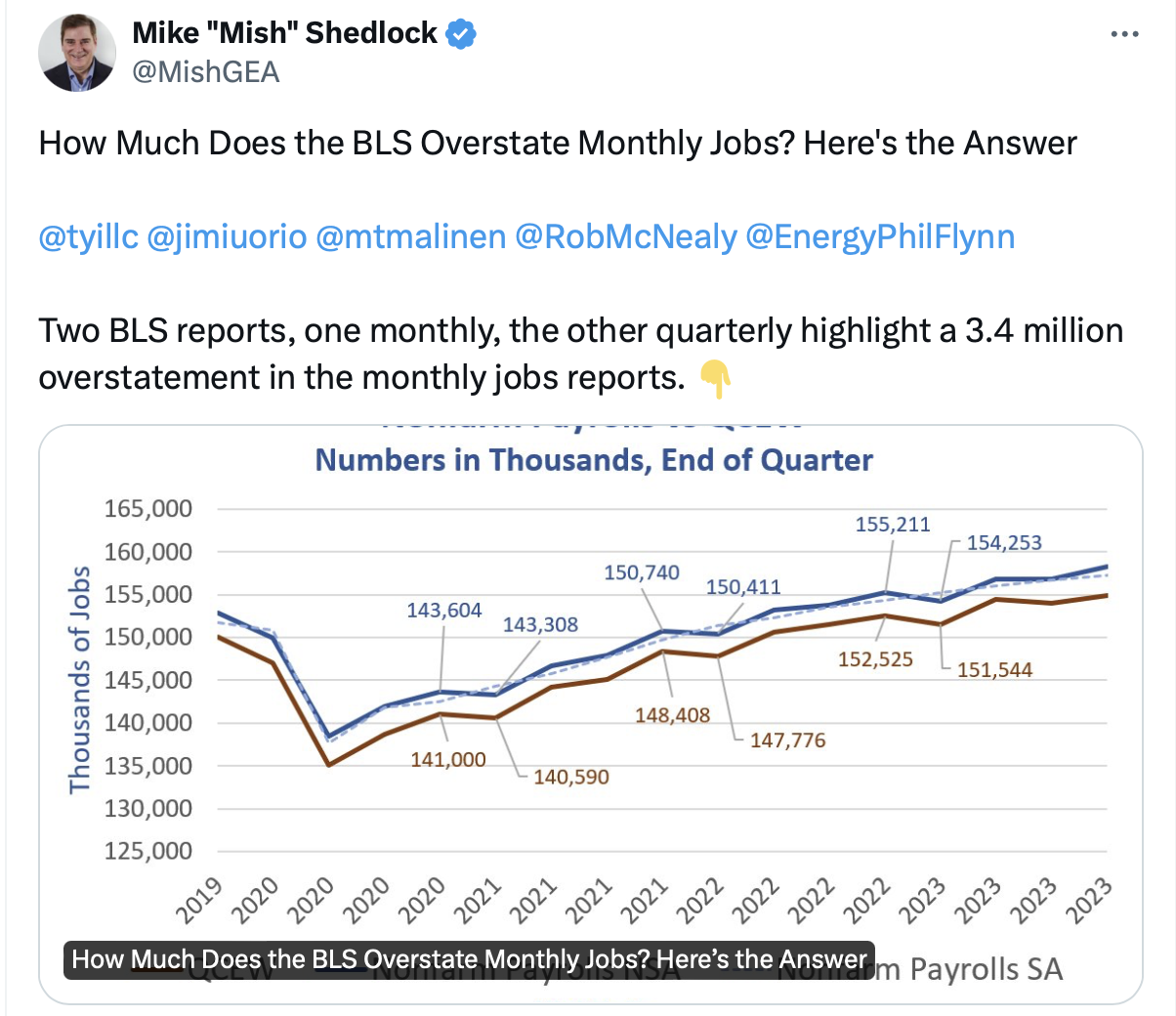
As with so much of the other data that we have seen over the past months, there is no clear direction here. Economy bulls can make the case that job growth remains solid and that there is no indication that a recession is on the way.  While the no-landing thesis has lost adherents, there are still many soft-landing adherents to be found.  At the same time, the economic bears have plenty of data to claim that a recession is around the corner, if we are not already in one.  I saw an analysis by Mike Shedlock (@MishGEA), a well-respected economist, that claims the NFP data has overstated job growth by 3.4 million jobs as per the following Tweet:

Since the beginning of 2023, looking at BLS data, the initial NFP report has been revised down in twelve of the fourteen months where there has been a third revision, by a total of 496K.  I created a chart to show the consistency of those revisions to help you get a better idea of the issue.

Source: data BLS, graph @fx_poet

Something that has always been true with respect to economic data, and NFP is no different than any other piece of information, is that the revisions tell an important story.  When initial data gets revised lower on a consistent basis, it has been indicative of a slowing economy.  Remember that when the NBER declares a recession, it is always a backward-looking effort, it is never in real-time.  But revisions are a key part of that process.  As well, given the fudge factors built into the BLS model, notably the birth/death factor for new businesses, history has shown that particular piece of the puzzle is always a lagging indicator as during a recession, more companies fail than are created, and that needs to be addressed via the revisions.

In the end, the issue is no matter the actual data point this morning, it will almost certainly be revised substantially before the end of the summer and could well tell a very different tale.  But today’s task is to understand what tale it is going to tell right now.

To that end, the narrative, the best that I can tell, is that we are seeing a gradual reduction in economic activity, but nothing dramatic.  Recession is still a remote concern, perhaps for 2025 or 2026, but the slowdown in activity will open the door for the Fed to start to ease policy going forward.  While the futures market is virtually certain that there will be no Fed action next week, the probability of a July cut has risen to 22.5% from less than 16% a week ago.  Several big banks are calling for a July cut, including JPM and Goldman Sachs, and there is a group of analysts who maintain that the underlying data that has been released indicates we are already in recession, and that rate cuts are coming very soon.

Here’s the thing, this focus on the Fed cutting rates remains, IMHO, a bad indicator of future risk asset strength.  Rather, as I showed earlier this week, when the Fed is cutting rates, it is usually because the economy is already in a recession and earnings are declining rapidly.  So, while the first cut may be sweet, the second should be a serious warning of what is coming down the pike.  I have already made my bed regarding my view that the top is in, but a softish number this morning, especially if the Unemployment Rate were to rise to 4.0% or 4.1%, would certainly increase the July cut probabilities, and almost certainly be followed by an equity market rally.  However, I would call that the last leg of the move.  As to my opinion of what today’s number will be, my sense, looking through my lens of further economic weakness (although still sticky inflation) is that it will be on the soft side, but not dramatically so.  Maybe 130K-150K.

Ok, ahead of the data, a quick tour of the markets shows that stocks in Asia were mixed with Japan edging lower, China and Hong Kong seeing declines of about -0.5%, but South Korea (+1.2%) and India (+2.1%) having strong sessions.  The same cannot be said for Europe, where every major index is lower by between -0.5% (Spain) and -1.0% (France) as German IP (-0.1%) continues to lag and the French Trade Balance (-€7.6B) fell into a deeper deficit than forecast.  Not surprisingly, US futures are essentially unchanged ahead of the NFP.

In the bond market, yields are edging up from their recent lows with Treasuries up 1bp and European sovereign yields higher by between 3bps and 5bps despite yesterday’s rate cut from the ECB.  Or perhaps because of it as remarkably, the ECB raised its own inflation forecasts and then cut rates.  The political imperative to cut interest rates is clearly growing quite strongly.

In the commodity markets, while oil (+0.7%) continues to rebound from its recent lows as OPEC+ worked to clarify their statements about future production, the big move today is in metals where gold (-1.8%) is selling off sharply after the news that the PBOC did not buy any additional metal during the month of May.  As they have been one of the key supporters of the barbarous relic, their absence really was a surprise.  Most pundits believe they are simply taking a break for now given the sharp rise in the price of the metal, but that they will return.  However, the other metals have all sold off alongside gold, with silver (-3.0%) and copper (-2.25%) giving back a good portion of their gains from the past two sessions.

Finally, the dollar is basically unchanged ahead of the NFP data with none of the G10 currencies moving more than 0.1%.  In the EMG bloc, though, ZAR (+0.9%) is the outlier, as despite the weakness in the gold price, the political situation seems to be getting better with a coalition government looking to be formed shortly.

In addition to the payroll data, we see Consumer Credit (exp $11B) this afternoon, and confusingly, despite the Fed being in its quiet period, Governor Lisa Cook is on the calendar to speak at noon today.  I would guess this will not be a discussion on monetary policy, but you never know.

At this point, it’s all about the data.  A hot number should see yields rise, stocks fall and the dollar bounce.  A cool number the opposite as more and more people anticipate that first rate cut.  Buckle up!

Good luck and good weekend

Adf

Miles Off Base

This poet was miles off base

As Powell, more growth, wants to chase
So, hawks have been shot
With nary a thought
While doves snap all stocks up apace.

It seems clear that Jay and the Fed
Decided inflation is dead
Through Q1 at least
Bulls will have a feast
Though after, take care where you tread

It turns out that not only were my tail risk ideas wrong, I was on the wrong side of the distribution!  Powell has decided that the soft-landing narrative is the best estimator of the future and wants to make sure the Fed is not responsible for a recession.  Concerns over inflation, while weakly voiced, have clearly dissipated within the Eccles Building.  I hope they are right.  I fear they are not.

In fairness, once again, yesterday I heard a very convincing argument that inflation was not only going to decline back to the Fed’s target of 2.0%, but it would have a 1 handle or lower by the middle of 2024 based on the weakening credit impulse that we have seen over the past 18 months.  And maybe it will.  But, while there is no question that money supply has been shrinking slowly of late, which has been a key part of that weakening credit impulse story, as can be seen from the chart below based on FRED data from the St Louis Fed, compared to the pace of M2 growth for decades, there are still an extra $3 trillion or so floating around the economy.  Iit seems to me prices will have a hard time falling with that much extra cash around.

Of course, there is one other place that money may find a home, and that is in financial assets.  So, perhaps the outcome will be a repeat of the post-GFC economy, with lackluster growth, and lots of money chasing financial assets while investors lever up to increase returns.  My guess is that almost every finance official in the world would take that situation in a heartbeat, slow growth, low inflation and rising asset prices.  The problem is that series of events cannot last forever.  As is usually the case with any negative outcome, the worst problems come from the leverage, not the idea.  When things are moving in one’s favor, leverage is fantastic.  But when they reverse, not so much.

A little data is in order here.  According to Statista, current global GDP is ~$103 trillion in current USD, current global stock market capitalization is ~$108 trillion, and the total amount of current global debt is ~$307 trillion according to the WEF.  In a broad view, the current debt/equity ratio is about 3:1 and the current debt/sales ratio is the same.  While this is not a perfect analogy, usually a debt/equity ratio of 3.0 is considered pretty high and a company that runs that level of debt would be considered quite risky.  Now, ask yourself this, if economic activity only generates $108 trillion, how will that >$300 trillion of debt ever be repaid?  The most likely answer is, it never will be repaid, at least not on a real basis.

If you wonder why central bankers favor lower interest rates, this is the primary reason.  However, at some point, there is going to be more discrimination between to whom lenders are willing to lend and who will be left out because they are either too risky, or the interest rate demanded will be too high to tolerate.  When considering these facts, it becomes much easier to understand the central bank desire to get back to the post-GFC world, doesn’t it?  And so, I would contend that Chairman Powell has just forfeited his efforts to be St Jerome, inflation slayer. 

The implication of this policy shift, and I would definitely call this a policy shift, is that the near future seems likely to see higher equity prices, higher commodity prices, higher inflation, first higher, then lower bond prices and a weaker dollar.  The one thing that can prevent the inflation outcome would be a significant uptick in productivity.  While last quarter we did see a terrific number there, +5.2%, the long-term average productivity growth, since 1948 is 2.1%.  Since the GFC, that number has fallen to 1.5%.  We will need to see a lot more productivity growth to keep goldilocks alive.  I hope AI is everything the hype claims!

Today, Madame Christine Lagarde

And friends are all partying hard
Now that Jay’s explained
Inflation’s restrained
And rate cuts are in the vanguard

This means that the ECB can
Lay out a new rate cutting plan
The doves are in flight
Which ought to ignite
A rally from Stuttgart to Cannes

Let’s turn to the ECB and BOE, as they are this morning’s big news, although, are they really big news anymore?  Both these central banks have been wrestling with the same thing as the Fed, inflation running far higher than target, although they have had the additional problem of a much weaker economic growth backdrop.  As long as the Fed was tightening policy, they knew that they could do so as well without having an excessively negative impact on their respective economies.  But given that pretty much all of Europe is already in recession, and the UK is on the verge, their preference would be to cut rates as soon as possible.  

But yesterday changed everything.  Powell’s bet on goldilocks has already been felt across European markets, with rallies in both equity and bond markets in every country.  The door is clearly wide open for Lagarde and Bailey to both be far more dovish than was anticipated before the FOMC meeting.  And you can be sure that both will be so.  While there will be no rate cuts in either London or Frankfurt today, they will be coming soon, likely early next year.  

At this point, the real question is which central bank will be cutting rates faster and further, not if they will be cutting them at all.  My money is on the ECB as there is a much larger contingent of doves there and the fact that Germany and northern European nations are already in recession means that the hawks there will be more inclined to go along for the ride.  Regardless, given the Fed has now reset the central bank tone to; policy ease is ok, look for it to happen everywhere.

Right now, this is all that matters.  Yesterday’s PPI data was soft, just adding fuel to the fire.  Inflation data that was released this morning in Sweden and Spain saw softer numbers and while Retail Sales (exp -0.1%, ex autos -0.1%) are due this morning along with initial Claims (220K), none of this is going to have a market impact unless it helps stoke the fire.  Any contra news will be ignored.

Before closing, there are two things I would note that are outliers here.  First, Japanese equity markets bucked the rally trend, with the Nikkei sliding -0.7% and the TOPIX even more (-1.4%) as they could not overcome the > 2% decline in USDJPY yesterday and the further 1% move overnight.  That very strong yen is clearly going to weigh on Japanese corporate profitability.  The other thing is that there is one country that is not all-in on the end of inflation, Norway.  This morning, in the wake of the Fed’s reversing course, the Norges Bank raisedrates by 25bps in a total surprise to the markets.  This has pushed the krone higher by a further 2.3% this morning and nearly 4% since the FOMC meeting.  

As we head toward the Christmas holidays and the beginning of a new year, it seems like the early going will be quite positive for risk assets and quite negative for the dollar.  Keep that in mind as you consider your hedging activities for 2024.

Good luck

adf

Buyers’ Chagrin

Last month everything was just fine

As stocks traded up on cloud nine
But this week has been,
To buyers’ chagrin,
Less fun, and perhaps e’en malign

While soft is the landing of choice
And one where the Fed would rejoice
As data keeps slipping
The narrative’s flipping
Said some, in a very low voice

Oops!  ADP Employment fell further last month, down to 103K, well below forecast and moving into a more dangerous territory for the growth story.  Last month’s outcome was revised lower as well and the 3-month moving average is now 99K.  This is certainly not a level that inspires confidence in future economic activity.  Now, we all know that ADP is not the really important number, that is Friday’s NFP, but of late, the story there has also not been that fantastic either.  Last month printed just 150K, and revisions for virtually the entire year have been lower.  All I’m saying is that I get a soft landing requires slowing growth which will impact the employment situation.  But this is a $27 trillion economy, and not something that is steered so easily.  Be prepared for the narrative to start to slip from soft-landing to recession and perhaps onto deep recession.  

One number does not a trend make, but as I discussed yesterday, the weight of evidence is beginning to pile up on the slowing growth story.  The market that really is buying the recession story is the oil market, where prices fell a further 4% yesterday with WTI settling below $70/bbl.  That is not a market that is convinced demand is going to be robust!

I guess the question is, at what point does the data stop confirming the goldilocks wishes and point to a more significant economic decline?  With respect to the employment situation, I suspect we will need to see a series of negative NFP prints as the Unemployment Rate rises.  While the former has not yet been seen, the Unemployment Rate has risen by 0.5% over the past seven months.  While tomorrow’s rate is forecast to be unchanged at 3.9%, there will be much angst in some circles if it goes higher.  As far as other metrics, Retail Sales, which had a very strong run in Q3, slipped last month and is forecast to be -0.1% when released next week.  Currently, the GDPNow forecast from the Atlanta Fed is calling for a 1.3% growth rate in Q4, much weaker than last quarter but not recessionary.

Combining these ideas, plus the other ancillary ones that come from the plethora of data released each month, it is easy to understand the belief in the soft landing.  But remember this, monetary policy famously works with long and variable lags.  That is just as true when the Fed is easing policy as when they are tightening policy.  Currently, there is an ongoing debate over whether the Fed’s 525 basis points of tightening is fully embedded in the economy, or if there is still more pain to come.  But if we are already seeing economic activity slow and the Fed continues to expound its higher for longer mantra, it is easy to make the case that the slowdown will be far deeper than a soft landing.  

One other thing, all this is happening while measured inflation remains well above the Fed’s target which is likely to remain a constraining factor on their behavior going forward.  If pressed, I would say the economy is heading toward a more significant recession, probably starting in Q1 or early Q2 of next year unless we see a remarkable turn of events in the US.  Given the intransigence that the current House of Representatives is demonstrating with respect to funding Ukraine, it appears that fiscal help may be a quarter or two later than hoped.  Be prepared.

Is the BOJ

Ready to change policy?
No breath-holding please!

One other thing of note was an article in Nikkei Japan that discussed recent comments from Governor Ueda as well as Deputy Governor Himino, where the implication seems to be that the committee there is contemplating the idea of raising their base rate to 0.0% or even 0.1% from its current -0.1% level.  Certainly, the market is willing to believe this story as evidenced by the moves last night where 10-year JGB yields jumped 11bps while the Nikkei fell 1.75%.  As to the yen, this morning it is the outlier in the FX market, with a 1.4% rally and is now trading back to its strongest level (weakest dollar) since August.  While the most recent inflation data from Japan has continued to show consumer prices rising above the BOJ’s 2% target, 19 straight months now, wages remain more benign and that is a key metric there.  While I’m sure that the BOJ will alter policy at some point, it still feels like it is a mid 2024 event.

And one other thing to note with respect to USDJPY, tomorrow the December futures options on the CME expire and there is some very substantial open interest at strike prices right here.  Apparently, a single buyer purchased upwards of $2 billion notional of JPY calls with strike prices ranging from 145.50 down to 144.75 back in mid-November, which are now at- and in-the-money.  The thing to look for here is a choppier market as dealers hedge their gamma risk.  And don’t be surprised if we see another leg lower in USDJPY before they expire tomorrow.

Ok, let’s look at how all the other markets have behaved overnight as we await today’s Initial Claims data, but more importantly, tomorrow’s payroll report.  After another soft showing in the US yesterday regarding equity markets, Asia, aside from Japan were broadly weaker, albeit not dramatically so.  In Europe, the screens are all red too, but the losses are quite small, between -0.1% and -0.2%.  Adding to the idea that there is very little ongoing, US futures, at this hour (7:30) are essentially unchanged.

Turning to the bond markets, Treasury yields, which had fallen below 4.10% briefly yesterday, have bounced on the day and are firmer by 5bps.  But European sovereign bonds are little changed on the day with only UK Gilts (+5bps) an outlier here.  Perhaps that move was on the back of the Halifax House Price Index, which rose slightly more than expected, but I suspect it has more to do with position adjustments ahead of tomorrow’s US payroll data.  After all, remember, the US is still the straw that stirs the drink.

After a horrific day yesterday, oil (+0.6%) is trying to stabilize although WTI remains below $70/bbl.  There is now talk in the market that OPEC+ is going to cut production further, although given they just held their monthly confab last week, this seems premature.  Gold (+0.4%) is finding support again after its wild ride earlier in the week, and copper and aluminum are both showing green today.

Finally, the dollar, away from the yen, is mixed with modest weakness vs. most G10 currencies, and a completely uncertain picture in the EMG bloc.  For instance, MXN (-0.5%) is under pressure this morning while ZAR (+0.9%) is putting in quite a performance.  Looking at the entire space, it is hard to characterize a general theme here today.  As such, it strikes me that choppiness ahead of tomorrow’s data is the most likely outcome in the session.

As mentioned before, Initial (exp 222K) and Continuing (1910K) Claims are the only data this morning although we do see Consumer Credit ($9.0B) this afternoon at 3:00pm.  Right now, the dollar is trendless, except perhaps against the yen, although that means that hedging should be quite viable right now.  As to the broader economic trend, tomorrow’s data will really set the tone for the FOMC meeting next week, and for Q1 next year.

Good luck

Adf

Hawk-Eyed

A landing that’s soft will require

A joblessness growth multiplier
Demand needs to slide
Enough so hawk-eyed
Fed members, rate cuts can inspire

The thing is, when looking at data
The trend hasn’t been all that great-a
While prices are falling
Growth seems to be stalling
More quickly than Jay’d advocate-a

As we await the onslaught of data starting this morning with ADP Employment and culminating in Friday’s Payroll and Michigan Sentiment reports, I thought it would be worthwhile to try to take a more holistic look at the recent data releases to see if the goldilocks/soft landing narrative makes sense, or if there is a growing probability of a more imposing slowdown in growth, aka a recession.

The problem is, when looking at the past one month’s worth of data, the trend in either direction is not that clear.  One of the things that has been true for a while is that there continues to be a dichotomy between the survey data and the hard figures.  Survey data has tended toward weakness, with one outlier, the most recent Chicago PMI print at 55.8.  But otherwise, ISM data has been quite soft for manufacturing and so-so for services.  Looking at the regional Fed surveys, it has been generally much worse with more negative outcomes than positive ones.  

At the same time, we all remember last week’s blowout GDP result for Q3 at 5.2% and we continue to see employment growth, albeit at a slowing pace to what was ongoing last year and earlier this year.  Retail Sales finally fell slightly last month, but that is after a string of much stronger than expected prints, arguably why Q3 GDP was so strong.  Perhaps the more worrying points are that the Continuing Claims data has started to grow more rapidly, meaning that people are remaining on unemployment insurance for longer and longer periods and yesterday’s JOLTS data was substantially lower than expectations and lower than the November reading.  Finally, Durable Goods and Factory Orders have been quite weak.

If I try to add it up, it seems to point to a weaker outcome than a soft-landing with the proper question, will the recession be mild or sharp?  Funnily enough I think the data highlights the Biden administration’s ‘messaging’ problem.  Surveys are generally quite negative and now hard data seems to be rolling over.  That is clearly not the story that a president running for re-election is seeking to tell.  

All this begs the question, how will the Fed respond?  And here’s the deal, at least in this poet’s view; the current market pricing of upwards of 125 basis points of rate cuts through 2024 is not the most likely outcome.  Rather, I continue to strongly believe that we will see either very little movement, as higher for longer maintains, or we will see 300-350bps of cuts as a full-blown recession becomes evident.  

To complete the exercise, let’s game out how markets may behave in those two situations.  If the Fed holds to its guns and maintains the current policy stance with Fed funds at 5.50% and QT ongoing, risk assets seem likely to have problems going forward.  It is quite easy to believe that the key driver to last month’s massive equity rally was the pricing of easier monetary policy to support the economy, and by extension profitability and the stock market.  So, if the Fed does not accommodate this view, at some point investors and traders are going to need to reevaluate the pricing of their holdings and we could see a sharp decline in equities.  As well, this would likely result in a further inversion in the yield curve as expectations for a future recession would grow.  On the commodity front, this ought to weigh on both the energy and metals complexes even further than their current pricing.  Recall, I have been highlighting that the commodities markets seem to be the only ones pricing in a recession.  As to the dollar, in this scenario I expect to see it regain its strength as the rest of the world will be sliding into recession regardless of the US outcome, so rate cuts will be on the table for the ECB, BOE, BOC, and PBOC.

Alternatively, the economic situation in the US could well deteriorate far more rapidly than the current goldilocks set believes.  In fact, I believe that is what it will take to get the much larger rate cuts that everybody seems to be pining for.  But ask yourself, do you really want rate cuts because economic activity is collapsing?  That seems a tough time to be snapping up risk assets.  In fact, historically, equity market declines through recessions occur while the central bank is cutting rates.  Be careful what you wish for here.

But, to finish the scenario analysis, much weaker economic data (think negative NFP as a first step along with Unemployment at 4.5%) will almost certainly result in cyclically declining inflation data and a dramatic fall in demand.  So, equity markets would be under pressure everywhere.  meanwhile, the normalization of the yield curve would finally occur with the front end falling far faster than the back.  In the commodity markets, I think precious metals will outperform as real rates tumble and safety is sought.  However, industrial metals would decline and likely so would energy prices, both driving inflation lower.  As to the dollar, this is much trickier.  At this point, I would argue the Eurozone is ahead of the US in the economic down wave and so will also be cutting rates.  The dollar’s performance will be a product of the relative policy response and I suspect will result in a very choppy market.  At least against G10 currencies.  Versus its EMG counterparts, I suspect the dollar will significantly underperform absent a global recession.

But enough daydreaming, let’s take a look at the overnight session.  From an equity perspective, yesterday’s late rally in the US, getting things back close to unchanged, was followed by strength in Asia, notably in Japan (Nikkei +2.0%) but also across the board with India’s Sensex making yet more new all-time highs, and modest strength in Europe despite some weak German Factory Orders data.  Or perhaps because of that as traders grow their belief the ECB is going to start cutting rates soon.  US futures are edging higher at this hour (7:00), but only by 0.2% or so.

In the bond market, after a day where yields fell sharply, this morning we are seeing a slight bounce with Treasury yields backing up by 3bps and European sovereign yields edging higher by between 1bp and 3bps.  The European bond market is clearly of the opinion that the ECB is done hiking with that confirmation coming from the Schnabel comments yesterday morning.  Now, the only question is when they start to cut.  Something else to note is that JGB yields have fallen 3bps this morning and are essentially back at levels seen in early September before the BOJ’s latest comments about the 1% cap being a guideline, not a hard cap.  Perhaps the argument that the BOJ was going to normalize its policy was a bit premature.  

On the commodity front, oil prices continue to slide, down another 0.7% this morning and nearly 8% this week.  While this is great for when we go to fill up the gas tank, it is a harbinger of a weaker economy going forward, which may not be so great overall.  Gold prices have stabilized and are still above $2000/oz and we are also seeing stabilization in the base metals prices right now.

Finally, the dollar, which rallied nicely yesterday, and in fact has been climbing for the past week, is little changed this morning stabilizing with the euro below 1.08 and USDJPY above 147.  There continues to be a narrative that is calling for the dollar’s demise, and in fact, I understand the idea based on the belief that the Fed is turning easy.  But for right now, it is also becoming clear that the rest of the world’s central banks are rolling over on their policy tightening and given the lack of a strong interest rate incentive, plus the fact that a weaker global economy will send investors looking for safe havens, the dollar is likely to maintain its recent strength, if not strengthen further going forward.  In order to see a substantial dollar decline, IMHO, we will need to see the US enter a sharp recession without the rest of the world following in our footsteps.  As I see that to be an unlikely outcome, my guess is we have seen the bottom of the dollar for the foreseeable future.

On the data front, we start today with the ADP Employment (exp 130K) and also see the Trade Balance (-$64.2B), Nonfarm Productivity (4.9%) and Unit Labor Costs (-0.9%).  From North of the Border, at 10:00 we see the Ivey PMI (their ISM data, expected at 54.2) and the BOC interest rate decision where there is no change expected and there is no press conference either.

I really wanted to get bearish on the dollar and felt that way when we heard Fed Governor Waller talk about rate cuts, but lately, the news from everywhere is negative and I just don’t see the dollar suffering in this situation.  Stable, yes; falling no.

Good luck

Adf

Gradually Growing

Two giants have recently passed

Who both, did a century last
Charles Munger went first
Whose wit was well-versed
Then Kissinger, quite the contrast

Meanwhile, recent data is showing
Economies worldwide are slowing
But pundits still think
The world will not sink
Instead t’will keep gradually growing

If there is any truth to the concept that things happen in threes, keep your eyes peeled for another well-known individual to pass away soon.  In the past week, both Charlie Munger, Warren Buffet’s partner at Berkshire Hathaway, and the one with the sharp wit, passed at 99 and, last night, Henry Kissinger passed away after 100 years on this earth.  Both were highly accomplished and extraordinary individuals, and the world is a lesser place for their passing.  May they rest in peace.

But back to the market saga, or perhaps it is the economic saga, that we have been both watching and through which we are living.  The soft-landing narrative remains strong as we continue to see economic activity data slide slowly lower, although it is certainly not collapsing.  In fact, that is the whole point, the idea that the central banks have been able to engineer a sufficient slowdown in growth such that inflation pressures recede but economic activity remains strong enough so unemployment doesn’t rise too far.  While historically this has been a very rare occurrence, perhaps they will achieve it this time.

If we are to look at the recent data, certainly the forward looking data, it certainly seems like growth is slowing.  We can ignore yesterday’s upward revision in Q3 GDP as that is already behind us, although it is impressive in its own right.  But for things that are more current, or the surveys that look ahead like PMI, the news is not quite so robust.  For instance, yesterday saw weakness in Spanish Retail Sales, Swedish Business Confidence and Eurozone Industrial Sentiment.  Overnight, we saw weaker Korean IP and Retail Sales, weak Japanese Retail Sales, a further decline in Australian Building Permits and Chinese PMI data continuing to slide with Manufacturing slipping to 49.4 and Non-Manufacturing falling to 50.2, both the lowest levels in a year.  The point is, looking all around the world, the trend is pretty clearly for slowing economic activity.

The flip side of this story is the one that the central banks are really watching, the inflation situation, and there the central banks are starting to feel better.  Eurozone CPI was released this morning with headline falling to 2.4% and core to 3.6%.  Given the declines in CPI we have seen this month around the world (remember energy prices fell sharply), this should be no surprise.  And of course, later this morning we will see the Fed’s favorite, Core PCE (exp 0.2% M/M, 3.5% Y/Y).  While this reading remains well above their target, the trend has clearly been beneficial of late.

This idea has been largely reinforced by central bank speakers this week, notably with Chris Waller’s comments on Tuesday that in a few months, if inflation continues this trend, it could be time to cut rates, but also mostly from the other speakers, with even uber-hawk Mester, yesterday, saying the Fed is in a good place to wait and watch.  Talk of additional hikes if inflation resurfaces is scarce now and the market is really looking for Chairman Powell to reiterate that message when he speaks tomorrow morning at 11:00.  But the market will not wait for confirmation, they are already onboard with the message as it suits the narrative of BUY STONKS!  So, we have seen Fed funds futures rally further with the market now looking for 125bps of cuts by the end of 2024 with a 50/50 chance of the first coming in March.  Wow!

So, how should we think about this situation?  To me, there are two issues with which to contend.  First, my take is much of the CPI decline is due to energy and the one really sticky piece of inflation, at least in the US, the price of housing, is not showing any signs of declining.  I think the Case Shiller Home Price index remains the best measure and it is continuing to go higher.  While existing home sales have been crashing, it is because of a lack of supply, not a lack of demand.  So, prices remain firm, and that is going to feed into inflation data for a while.   My point is, while recent readings have shown CPI falling, we remain well above target, and I expect that we are going to stay above target, although not anywhere near where things were last summer.

The second thing is that as evidenced by the litany of weaker data we are seeing around the world, economic activity is pretty clearly slowing everywhere.  In this situation, waiting for the Fed to cut first may be a mistake as other central banks may find themselves with more dire economic circumstances before the US gets there.  And, if that is the case, all the bearishness that is building around the dollar because of the renewed belief the Fed is going to cut rates soon could well be misplaced.  Remember, the FX markets are relative, so if the ECB cuts before the Fed, that seems unlikely to help the euro.  The same is true with the BOE or BOC or any other central bank.  My point is, while the dollar has retraced some of its recent gains on the belief the Fed is ready to cut, even if the Fed does cut, they will not do so in isolation.

Remember, too, the wise words from Hemingway’s The Sun Also Rises.  “How did you go bankrupt?  Two ways, gradually and then suddenly”.  It is very possible, if not likely, that we are currently in the gradually phase of economic slowdown, with the suddenly phase yet to come.  Just beware.

Ok, in the meantime, a quick look at markets shows that after another lackluster session in the US, Asian markets were able to rally a bit with the Hang Seng and mainland indices shaking off the weak PMI data while European bourses are clearly benefitting from the soft CPI data this morning out of Frankfurt.  At this hour (7:45) US futures are also a bit firmer, about 0.4% or so.

In the bond market, yields are rebounding a bit with Treasury yields up 4bps and European sovereigns a little less dynamic, higher between 1bp and 3bps.  However, we have come a long way this month, with 10yr Treasury yields down 64bps, their largest monthly decline since 2008.  My take is we will need to see confirmation from Powell tomorrow for there to be another leg lower in yields, but if he pushes back, look for a few fireworks there.

Oil prices are continuing their rebound as OPEC+ is meeting, up another 1% this morning and 4% on the week.  The whispers are another production cut is coming, and we also have seen the inventory builds slow down.  Meanwhile, gold is slightly softer this morning, but remains well above $2000/oz with many looking for a test of that all-time high at $2080.  As to the base metals, they are under a bit of pressure, which given the economic data, makes some sense.

Finally, the dollar is firmer this morning, recouping about 0.4% of its recent losses with strength largely across the board.  Ultimately, relative interest rates remain the key driver in this space and for now, while dollar yields have declined, they have not done so in isolation.  As such, until they start to fall more sharply than rates elsewhere, I think the dollar will be treading water in a range.

On the data front, aside from PCE we also see Personal Income (exp 0.2%), Personal Spending (0.2%), Initial Claims (220K), Continuing Claims (1872K) and Chicago PMI (45.4).  We hear from John Williams this morning as well, so it will be interesting to see if he backs up the recent shift of the Fed is done and things are going well.

My take is Williams will, indeed, hew that new line and we will see a bit more positivity in equities and bonds while the dollar fluctuates and perhaps gives up some of this mornings gains.  But really, all eyes are on Powell tomorrow.

Good luck

Adf

Higher For Longer is Key

As markets await CPI
Some folks have begun to ask why
The Fed needs to keep
Inversion so deep
Since ‘flation is no longer high

Instead, what these folks want to see
Is rates heading back down to three
But Jay’s been quite clear
Throughout this whole year
That higher for longer is key

It has been an extremely quiet evening session with very little in the way of new information for market participants as all eyes are on tomorrow morning’s CPI print in the US.  There were only two pieces of mildly noteworthy data, UK Unemployment rose one tick to 4.3%, as expected and the overall employment report was largely in line with expectations.  As well, the German ZEW Survey showed that while the current situation has actually deteriorated, falling to Covid-like levels, Expectations were marginally less awful than forecast.  But in the end, it is hard to make the case that either of these releases had much of an impact on the market.

On the geopolitical front, much is being made of North Korean leader Kim Jung-Un’s trip to Moscow to meet with President Putin, and ostensibly promise to sell him weapons and ammunition.  But again, this doesn’t appear to have any market impact.  Arguably, of much more importance to the market are two US tech firm stories; first Oracle giving disappointing guidance in their earnings last night indicating that perhaps AI is not actually going to rain money into every tech firm right away, and, second the anticipation of Apple’s release of the iPhone 15 today, as analysts try to determine if that company can continue to deserve its current valuation.  At this hour (7:30), Oracle stock is much lower, about -10%, and the entire US equity futures market is marginally under water as well, but just -0.2% or so.

If I had to characterize today’s market it would be stagnant with a flavor of risk-off.  Given the perceived importance of tomorrow’s data release, and the fact that its timing was well-known in advance, it appears that positions have already been established based on individual views.  The result has been lower volumes and less movement ahead of the release.  As well, absent any Fed speakers it is hard to come up with a reason to adjust any views at this point in time.  So, my sense is we are set for quite a dull session overall.

Perhaps this is a good time to recap the current narrative, at least as I see it.  I believe a majority of market participants believe the Fed is done hiking rates and it is only a matter of time before they start cutting them.  There is a strong belief that the Fed will achieve the much-vaunted soft landing despite the long odds of success on that front and a history that shows they have only ever been able to do so once.  The odd thing about this soft-landing belief is the idea that if the Fed is successful in achieving that outcome with interest rates at 5%, that they would suddenly cut rates afterwards.  I need someone to explain to me why the Fed would change the policy that achieved their goals.  A correlating narrative remains that AI is not merely the future, but the present and that tech stocks can grow to the sky.  And maybe they can, but I would bet the under there.  

And lastly, there is a conundrum in this narrative as the de-dollarization story continues to get a great deal of play.  However, if the Fed is successful and AI really is going to drive tech stocks higher forever, why would the dollar lose its luster?  It seems to me, especially given the fact that Europe and probably China are heading into recession, that the dollar will be in huge demand.  At any rate, my take is those are the underlying theses driving markets right now.

So, a tour of markets overnight shows that bond markets are essentially unchanged, stock markets were mixed in Asia, with Chinese shares under pressure but Japanese and Australian shares ok while European shares are under some pressure, and the dollar is rebounding a bit from yesterday’s sell-off.  Arguably, yesterday’s dollar move was a result of the news from Japan and China, both of whom were unhappy over their respective currency’s weakness, but that is, literally, yesterday’s news.  One last thing shows oil (+0.8%) rallying again with WTI above $88/bbl this morning, a new high for this move, which continues to support all energy prices.  In fact, it is this story, a continued lack of supply in the oil market relative to demand that, regardless of the much-hyped transition to renewables, continues to grow, is going to support the price for a long time to come.  And that is going to continue to pressure prices higher as energy is an input into everything we do, both manufacturing and services.

And that’s really it for today, a very quiet session ahead of the next big data drop tomorrow morning.  Before I end, though, I think it is important to understand the nature of economic forecasting and there is a perfect example right now.  I have frequently mentioned the Atlanta Fed’s GDPNow forecast as a potential harbinger of things to come.  Certainly, the market sees it that way.  Well, other regional Fed banks wanted to have their own versions of that GDP Nowcast and this is what we are currently seeing:

  • Atlanta Fed:     5.7%
  • NY Fed:            2.3%
  • St Louis Fed:    -0.3%

To me, that is a perfect picture of the current situation, proof that nobody has any idea what is going on in the economy.

Good luck

Adf

Demimonde

There once was a government bond
About which investors were fond
Regardless of yield
Their safety appealed
But lately, they’ve turned demimonde

So, as we await Payroll data
Demand has just started to crate-a
As yield keeps on rising
More folks are downsizing
Positions today and not late-a

It’s Payrolls Day and market participants are all anxiously awaiting the news at 8:30. Recall, last month, for the first time in more than a year, the NFP number printed slightly lower than the median forecast and that was seen as proof positive that the soft landing was on its way.  Subsequently, headline CPI fell to its lowest in two years as a confirmation of that process, and market participants decided, as one, that risk was the thing to own.  Equities rallied, bond yields fell and there was joy around the world markets. 

But lately, that story is having a rougher go of things as 10-year Treasury yields have jumped 43bps from their levels following the CPI release even though the PCE data was similarly soft.  What gives?  Arguably, part of this is because energy prices have rebounded sharply since last month, so it is increasingly clear that next week’s CPI data is going to higher than last month’s number.  As well, the growing confidence in the soft-landing scenario, which is touted across mainstream media constantly, implies that rate cuts may not be necessary.  After all, if Fed funds are at 5.5% and GDP is growing at 2.5% and Unemployment remains below 4.0%, why would the Fed change its policy rate?  The answer is, they wouldn’t.  At the same time, in the event the economy is clearly growing with positive future prospects, it is very likely that the yield curve will steepen back to a ‘normal’ shape with longer dated yields higher than short-dated yields.  If the Fed is not going to cut, that means the back end of the curve must see yields rise.  The current 2yr-10yr inversion is down to -74bps, so another 100bp rise in 10-year yields would seem realistic.

Of course, the question is, how would risk assets behave in that scenario?  And the answer there is likely to be far less positive.  After all, if risk free returns for 10 years were at 5+%, equities would need to offer a very good return opportunity to attract investors.  While there will be some companies that offer that, I suspect there are many more that would be shunned and need to reprice substantially lower to become attractive.  In other words, investors will want much lower entry prices to get involved and that could see a pretty big sell-off in the equity markets.  Just one possible scenario, but one with a decent probability of occurring, I think.

But that is all future prognostication.  In the meantime, let’s look at what the current consensus forecasts are for today:

Nonfarm Payrolls200K
Private Payrolls180K
Manufacturing Payrolls5K
Unemployment Rate3.6%
Average Hourly Earnings0.3% (4.2% Y/Y)
Average Weekly Hours34.4
Participation Rate62.6%

Source: Bloomberg

Wednesday’s ADP number was much higher than expected at 324K although the prior blowout number, 497K in June, was revised lower by 42K.  Still, 455K was much larger than the BLS report so there are many questions as to whether we will see a similar outcome today, a softer NFP number despite a very strong ADP number.  Looking at other indicators, the Initial Claims data continues to improve, hovering around 225K.  The JOLTS data was slightly softer than expected, but still right around 9.6 million and well above levels prior to the pandemic.  And finally, if you look at the employment subsets of the ISM data, they were soft in manufacturing, but solid in services, and services is a much larger part of the economy.

My take is the market is going to behave very clearly based on the actual outcome.  A strong number, anything over 225K, is likely to see the bond market sell off further and I wouldn’t be surprised to see 10-year yields, which have edged up another basis point this morning to 4.19%, trade back above the levels seen last October at 4.25% or more.  That will not be a positive for the stock markets as it will reintroduce the idea the Fed is going to continue to raise rates, something the market has completely priced out at this point.  Similarly, a soft number will open the door to a sharp equity rally and bond rally, with yields likely to even test the 4.0% level if the NFP number is soft enough.  I think we need a 100K or less number for a reaction like that.

Ahead of the data, there seems to be a growing concern over the outcome.  While Asian markets rebounded a bit, European bourses have started to fall across the board from earlier levels and are now all down by between -0.2% and -0.5%.  US futures, too, are now back to unchanged having spent the bulk of the evening higher on the back of a strong earnings report from Amazon.  

Bond markets are under pressure as energy prices around the world are rising, as are food prices, and so inflation prospects seem to be worsening.  This is despite the very earnest efforts of central banks around the world to convince us all that inflation has peaked, and they are near the end of their hiking cycles.  After the BOE raised rates by 25bps yesterday, the market has reduced the expected UK terminal rate down to 5.75%, two more hikes despite CPI running at 7.9% with Core at 6.9%.  In the Eurozone, the ECB has released a new report claiming that inflation has peaked as well, and the market has priced out any further rate hikes.  This all smacks of whistling past the graveyard in my view.

For instance, oil (+0.35%) is higher again, up more than 14% in the past month, and shows no signs of slowing down.  Not only did Saudi Arabia extend their one million bbl/day production cut for another month, but Russia now claims it will cut production by 300K bbl/day in September as well.  I haven’t discussed food prices in a while as they had eased off from the immediate post invasion highs, but the FAO Food price index rebounded last month and despite a sharp decline from its highest levels last year, is still at levels that have caused riots in the streets of African nations in the past.  Metals prices are also under pressure today, but that seems more to do with the strong dollar than anything else.  

Turning to the dollar, it is once again seeing demand as only NOK (+0.2%) has managed to gain on the greenback in the G10 space, although the other currencies’ losses are not large.  The same cannot be said for the EMG space where the APAC bloc is under real pressure led by KRW (-0.8%) and THB (-0.4%) on the dual concern of a slower growing China and broad risk-off sentiment.  One thing that seems likely is the dollar will benefit from a strong NFP print and suffer from a weak one.

And that’s really it for the day.  No Fed speakers are on the docket, but do not be surprised to hear some interviews if the number is very different from the forecasts.  In the end, nothing has changed my view that inflation will remain stickier than forecast and the Fed will hold tight thus supporting the dollar.  Remember, the combination of tight monetary and loose fiscal policy is the recipe for a strong currency.  And the US is running that in spades!

Good luck and good weekend

Adf

Never-Ending

A landing that’s soft’s now the bet
By many who poo-poo the debt
But deficit spending
Which seems never-ending
Means prices ain’t coming down yet

So, nominal growth may still rise
Inflation, though, will not downsize
And yields on the bond
Are like to respond
By soaring right up to the skies

Fitch downgraded US government debt one notch to AA+ from its previous AAA.  Now, only Moody’s rates the US a AAA credit.  As per their announcement, their rationale was threefold: “The rating downgrade of the United States reflects the 1) expected fiscal deterioration over the next three years, 2) a high and growing general government debt burden, and 3) the erosion of governance relative to ‘AA’ and ‘AAA’ rated peers over the last two decades that has manifested in repeated debt limit standoffs and last-minute resolutions.”   

Let’s forget the political implications and the commentary from the government as it is completely expected.  And I am not here to defend or attack the outcome, but rather hope to try to make sense of what they were thinking and how markets are likely to behave.

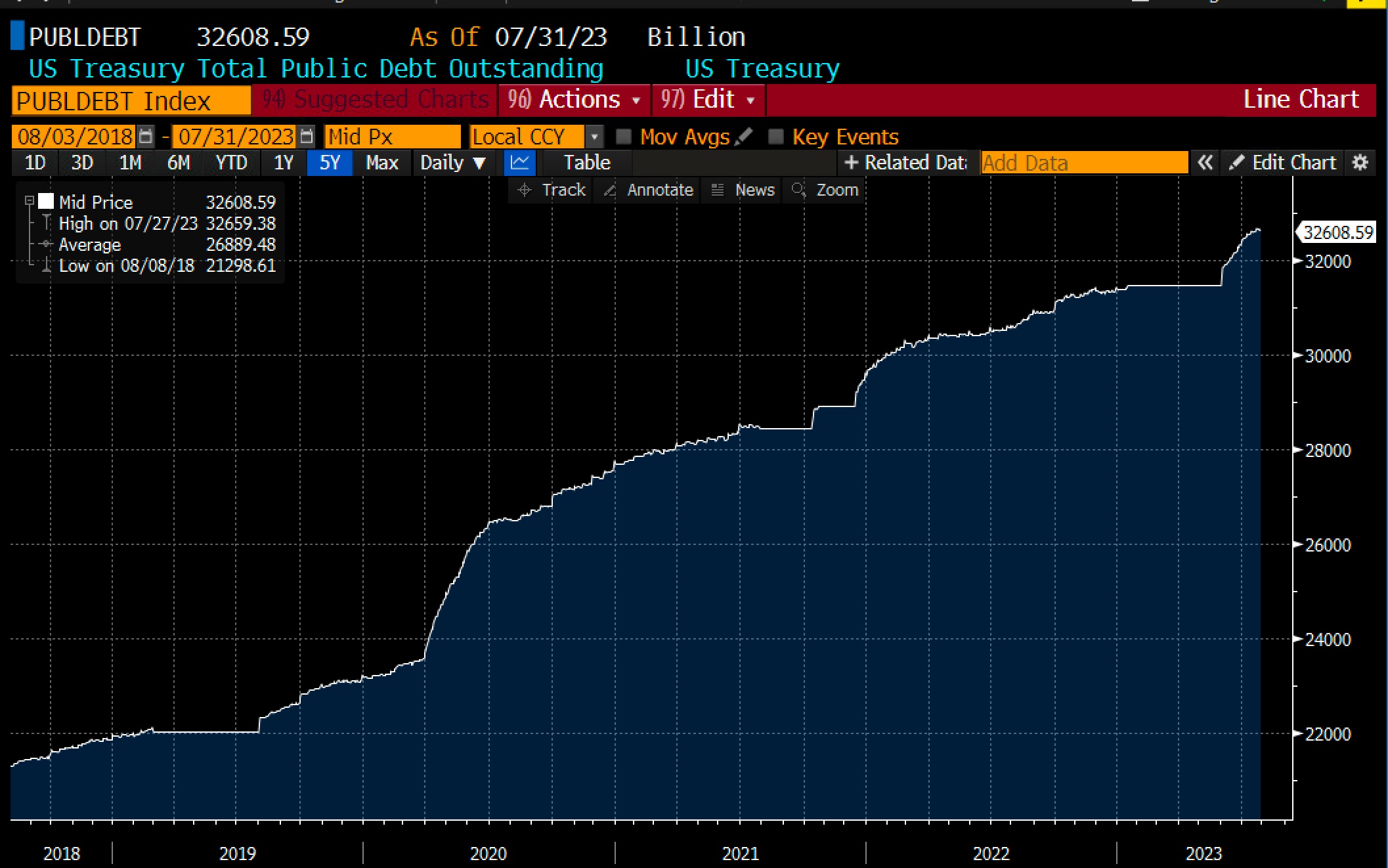
Regarding the first issue, expected fiscal deterioration over the next three years, that seems a pretty fair point.  After all, fiscal deterioration has been consistently getting worse since the turn of the century, the last time we had a budget surplus.  In fact, as per the below Bloomberg chart, absent the Covid drama, the current budget deficit, at -8.5% of GDP, is larger than any time other than the GFC.  And this is occurring when, not only is there no recession, but GDP seems to be accelerating.  In fact, the Atlanta Fed’s GDPNow forecast has jumped up to 3.86%.  It seems fair to ask if part of that ‘growth’ is a direct result of deficit spending.

As to point number two, a high and growing government debt burden, that also seems like a fair point.  Since the debt ceiling was removed, government debt has grown by ~$1.2 trillion in exactly 2 months’ time (see Bloomberg chart below).  At the same time, the Treasury just announced they would be issuing $1.9 trillion in new debt during the rest of 2023.  Those are pretty big numbers and based on the legislation that was passed last year, the IRA and CHIPS act, as well as the fact that recent tax revenues have been declining, it is reasonable to expect the government debt burden to continue to grow.  

Finally, this poet is in no position to judge the relative erosion of governance compared to other nations, but on an absolute basis, it is not hard to argue that governance in the US has diminished, at least fiscal governance, given the political split between the House of Representatives and the Senate/White House.

Of course, this all begs the question, does it matter for markets?  Well, we have seen this movie before in 2011 when S&P downgraded the US government credit rating after the last standoff in Congress regarding the debt ceiling.  While it was a big deal politically, it actually had limited impact on the markets.  In fact, it may fairly be said that it marked the bottom in the equity market and ignited a massive multi-year rally.  Can we expect the same thing this time?  I would contend the situation now is quite different than back then, with a much higher debt/GDP ratio as well as a much higher level of interest rates.  The point is that the government’s fiscal stance is more tenuous now as interest payments on existing debt either start to crowd out other spending or drive deficits even higher, as per Fitch’s point.

Back then, 10-year yields were also much lower, ~2.5%, and the debt/GDP ratio was ~90% as compared to today’s ~120%.  In other words, there was a little more flexibility for the government.  In fact, following the move, bond yields fell another 100bps over the ensuing year, bottoming at 1.39%, the pre-Covid low.  An optimistic reading of that outcome is that investors looked around the world and decided that despite the flaws in the US, it was still the safest place to be.  Of course, that low interest rate coincided with the Eurozone debt crisis, so perhaps investors were simply fleeing the euro (the dollar did rally) given those problems.

So far, the reaction has been a downtick in equity markets and little movement in the bond market.  But it is not clear to me that either of those moves are directly related to this news.  Rather, it is entirely possible that we are starting to see the effects of what Fitch is describing, rather than the effects of Fitch’s move.

For instance, there is a growing perception that a soft landing is going to be the result of the Fed’s policy moves.  While inflation has obviously fallen from its highs of last year, the two things that have been driving that, lower commodity prices and base effects in the calculation, are reversing going forward.  For instance, oil prices are higher by nearly 17% in the past month while the monthly comparison for CPI in July is just 0.0%, so any inflation at all is going to result in a rise in the Y/Y figure.  

Instead, I would contend that the massive fiscal stimulus from the IRA and CHIPS Act are going to continue to drive demand, as well as debt issuance, and continue to pressure inflation higher.   While nominal growth may remain firm, inflation will too, so real growth will decline.  Arguably, the government needs this outcome in order to devalue their massive debt pile.  However, whether this will be a positive for risk assets is a much tougher question.  Certainly, bond yields are likely to rise in this scenario, and if that is the case, I suspect equity markets may start to revalue as well.  Government spending is not organic economic growth. Instead, it is far less efficient and debt driven, thus underpinning the Fitch viewpoint.  I fear that this time, the ratings downgrade may result in a different result than last time, with risk assets suffering as we go forward.

And that was certainly the case last night as equity markets throughout Asia were all in the red, as are European equities this morning.  Notable declines were seen in Japan (-2.3%), Hong Kong (-2.5%) and Spain (-1.2%), but it is universal.  As to US futures, they are all in the red as well this morning.

As to the bond market, 10-year Treasury yields are back above 4.0%, although they are little changed this morning.  Remember, the last several times the 10-year yield has gone above 4%, there have been problems somewhere in the market, with the UK bond meltdown and Silicon Valley Bank’s implosion the most widely remembered.  The curve is steepening (really getting less inverted) because long rates are rising, not because the Fed is cutting.  If the yield curve heads back to normal with 10-year yields at 5.5%, consider how that will impact equities.  It won’t be pretty.

Away from oil prices, base metals are under pressure this morning as well, potentially because China has yet to offer real support to its economy, or potentially because yields continue to rise thus hurting the investment case.

Finally, the dollar is broadly stronger this morning, certainly against the EMG bloc with KRW (-1.1%) and PHP (-0.75%) the laggards, but weakness widespread.  Both of those currencies are reacting to fading data and concerns over China’s actions going forward.  Meanwhile, in the G10, NOK (+0.45%) and JPY (+0.4%) are the outliers on the high side, with the former following oil while the yen’s move looks to be a trading bounce given the lack of news or rate activity.    However, the rest of the bloc is under pressure led by NZD (-0.6%) and AUD (-0.5%) with both sliding alongside the metals markets.

On the data front, ADP Employment (exp 190K) is coming shortly *Flash, ADP +324K* with most analysts anxiously awaiting not only the headline print, but any revision to last month’s extraordinary 497K rise.  As to Fed speakers, there are none on the calendar today.  All in all, the market will be keenly focused on the ADP especially after mildly softer than expected JOLTS Jobs data yesterday as well as a soft ISM Employment print.  There are certainly still hints of an impending recession, but the situation remains very uncertain.  Remember this, though, prior to the GFC, the consensus view was that a soft landing was going to be achieved.  The same was true in 2001 and as far back as 1980.  The only time the Fed successfully engineered that soft landing was in 1994 and I am not of the mind that they are going to be successful this time.  It’s just not clear what is going to break first.

Good luck

Adf