
Too Much Debt

In Spain, electricity failed
In Canada, Carney prevailed
But markets don’t care
As movement’s quite spare
It seems many traders have bailed
 
But problems, worldwide, still abound
Though right now, they’re in the background
There’s far too much debt
And still a real threat
That no true solutions are found


The two biggest stories of the past twenty-four hours were clearly the national scale blackout in Spain and Portugal yesterday, and the slim victory for Mark Carney in Canada, where the Liberal Party appears to have a plurality, but not a majority, and will oversee a minority government.

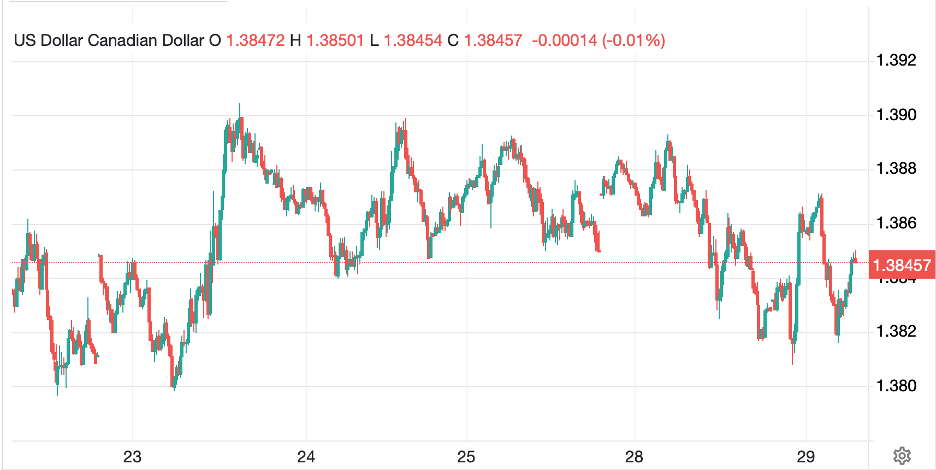
Touching on the second story first, in truth there is not much to discuss.  Much has been made of the vote being an anti-Trump statement with the idea that Carney is better placed to defend Canada from President Trump’s (imagined) predations.  However, given the lack of a majority government, it is not clear how effective this line of reasoning will prove.  As there is no futures market for the TSX, we really don’t have a sense yet of how the Canadian equity market will greet the news.  Yesterday’s modest gains of 0.35% amid a general atmosphere of modest gains doesn’t really tell much of a tale.  As to CAD (-0.1% today), a quick look at the past week shows it has done nothing even in the wake of the news. (see below).  My take is this is a nothingburger event, a perfect description for Mark Carney, a nothingburger of a politician.
Source: tradingeconomics.com

As to the story about Spain’s electricity, I think it may be more instructive on two levels.  The first is as a warning to the risks inherent of powering your electric grid with more than 25% – 30% intermittent, renewable energy sources like wind and solar.  It is somewhat ironic that just twelve days prior to the blackout, Spain’s entire electricity requirement was met by solar, wind and hydro power, the Green dream.  Alas, here we are now and while no answers have yet been forthcoming, and I assume the media will downplay any blame on too much renewable power, virtually every engineering study has shown that once a grid has more than that 25% renewables, it tends towards instability.  This issue will be argued by both sides for a while, although as always, physics will be the final arbiter.  

But I have to wonder if the sudden failure of the electric grid is an omen of sorts, for what may be happening in global markets.  If we analogize global supply chains to the electrical grid, over the course of the past 50 years, we have seen the world create a massively complex web of trade with raw materials, intermediate goods and final products all crisscrossing the world.  There have been myriad benefits to all involved with real per capita economic benefits abounding, and for everybody reading this note, the ability to essentially buy whatever you want/need with limited interference and trouble.  Certainly, the availability of everyday necessities like food and clothing is widespread.

However, underpinning that bounty were two networks.  The first being the obvious one, the supply chains which since Covid have been much discussed by the punditry.  But the second, which gets far less notice is the network of debt that is issued around the world by governments and companies, as well as taken on by individuals, and that has grown to be more than 3x the entire global economic output.  While we most often read about the US government debt which is quickly approaching $37 trillion, total global debt is much greater than that.  In fact, at this point, the debt market is not about issuing new debt to fund new investment, rather it is almost entirely a refinancing mechanism.  

It is this latter issue that should concern us all.  What happens if, one day, the ability to refinance some of that debt, whether US Treasuries, German bunds or Chinese government bonds, has a hiccup of some sort?  A failed US Treasury auction, where the Fed is required to purchase bonds, or a power outage in a key financial center that prevents trades from being confirmed/settled and moneys not moving as expected, or some other force majeure type event that disrupts the current smooth functioning of global debt markets.  

Frankly, the combination of the changes being wrought by President Trump to the global economy, where globalization is giving way to mercantilism, and the significant weight of global debt that hangs over the global economy and is given very little thought seems a potentially volatile mix.

Ironically, as much as I have lately been describing how the Fed’s role seems to have diminished, in the event that something upsets this apple cart, the Fed will be the only game in town.  While this is not a today event, it is something we must not forget.

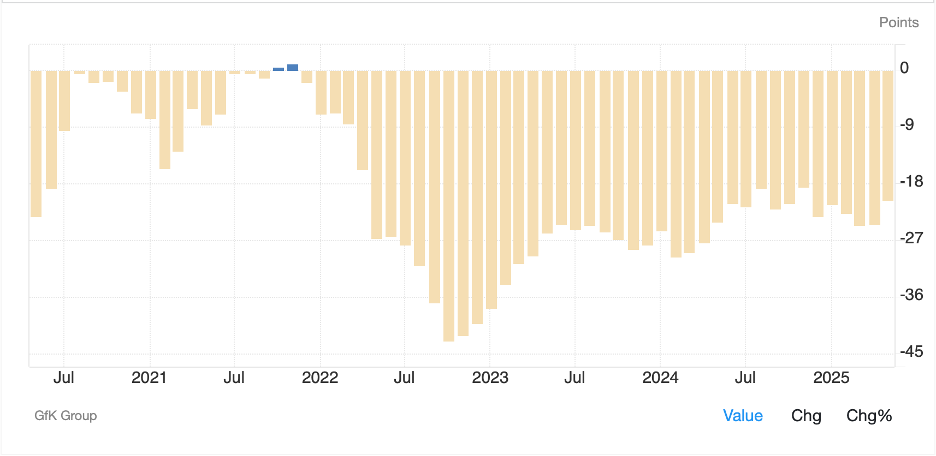
I apologize for my little diatribe, but with so little ongoing in markets, and the parallel to the Spanish electrical grid, it seemed timely.  Let’s look at markets.  Asian equity markets were mixed with the main markets very quiet but a couple of 1% gainers (Australia, Taiwan and Korea) although the rest of the region was +/- 0.3% or less.  Too, volumes were quite lethargic.  In Europe, it should be no surprise that Spain (-0.8%) is the laggard today as the first economists’ to opine on the impact of the blackout said it could be a hit of as much as 0.5% of GDP.  Germany (+0.6%) is the other side of the coin after the GfK Consumer Confidence reading came out at a better than expected -20.6.  Now, maybe it’s just me, but if I look at the past 5 years’ worth of this index, it is difficult to get excited about German economic prospects.
Source: tradingeconomics.com

Yes, this was a better reading, but either the people of Germany are manic depressive, or the index is indicative of major structural problems in the country.  Maybe a bit of both.  As to US futures, at this hour (7:10) they are basically unchanged after being basically unchanged yesterday.

In the bond market, Treasury yields have bounced 2bps this morning after touching their lowest level in 3 weeks yesterday.  European sovereign yields, though, are all softer by 1bp to 2bps this morning as comments from ECB members seem to highlight more rate cuts as Europe achieves their inflation target and are now getting concerned they will fall below the 2.0% rate.

In the commodity markets, oil (-1.7%) is under pressure this morning ostensibly on a combination of concerns over slowing growth and little movement in the US-China trade talks as well as a report that Kazakhstan is pushing up output and other OPEC+ members are talking about increasing production further when they meet next week.  Meanwhile, gold (-0.75%), which rallied back to unchanged in NY yesterday is once again finding sellers at its recent trading pivot of $3340ish (H/T Alyosha).  However, gold’s slide has not impacted either silver (+0.4%) or copper (+0.9%) at least so far in the session.

Finally, the dollar is firmer, largely across the board, this morning.  The euro (-0.3%), pound (-0.4%), JPY (-0.4%) and CHF (-0.6%) are all under some pressure, perhaps profit taking.  But in truth, other than INR (+0.15%) the rest of the major currencies, both G10 and EMG, are all softer vs. the greenback.  I guess the dollar’s demise will need to wait at least one more day.

On the data front, the Goods Trade Balance (exp -$146B), Case Shiller Home Prices (4.7%) and JOLTs Job Openings (7.48M) are the main numbers, although we also see Consumer Confidence (87.5).  But with no Fed discussions much more crucial data on Thursday (GDP, PCE) and Friday (NFP) it seems that today is setting up for not much excitement.

In fact, lack of excitement seems the best description of markets right now.  I don’t know what the next catalyst will be to change things, but absent peace in one of the wars, kinetic or trade, or another force majeure event, it feels like range trading is the order of the day for a while.  My big picture view of a slowly declining dollar is still intact, but day-to-day, it’s hard to see much right now.

Good luck

Adf

Still Feeling Stressed

The overnight data expressed
That China is still feeling stressed
But Europe’s reports
Showed growth of some sorts
Might finally be manifest

The dollar is on its heels this morning after data from Europe showed surprising strength almost across the board. Arguably the most important data point was Eurozone GDP printing at 0.4% in Q1, a tick higher than expected and significantly higher than Q4’s 0.2%. The drivers of this data were Italy, where Q1 GDP rose 0.2%, taking the nation out of recession and beating expectations. At the same time Spain grew at 0.7%, also better than expectations while France maintained its recent pace with a 0.3% print. Interestingly, Germany doesn’t report this data until the middle of May. However, we did see German GfK Consumer Confidence print at 10.4, remaining unchanged on the month rather than falling as expected. Adding to the growth scenario were inflation readings that were generally a tick firmer than expected in Italy, Spain and France. While these numbers remain well below the ECB target of “close to but just below” 2.0%, it has served to ease some concerns about Europe’s future. In the end, the euro has rallied 0.25% while European government bond yields are all higher by 2-5bps. However, European equity markets did not get the memo and remain little changed on the day.

Prior to these releases we learned that China’s PMI data was softer than expected, with the National number printing lower at 50.1, while the Caixin number printed at 50.2. Even though both remain above the 50.0 level indicating future growth, there is an increasing concern that China’s Q1 GDP data was more the result of a distorted comparison to last year’s data due to changed timing of the Lunar New Year. Remember, that holiday has a large impact on the Chinese economy with manufacturing shutdowns amid widescale holiday making, and so the timing of those events each year are not easily stabilized with seasonal adjustments to the data. As such, it is starting to look like Q1’s 6.4% GDP growth may have been somewhat overstated. Of course, China remains opaque in many ways, so we may need to wait until next month’s PMI data to get a better handle on things. One other clue, though, has been the ongoing decline in the price of copper, a key industrial metal and one which China represents approximately 50% of global demand. Arguably, a falling copper price implies less demand from China, which implies slowing growth there. Ultimately, while it is no surprise that the renminbi is little changed on the day, Chinese equities edged higher on the theory that the PBOC is more likely to add stimulus if the economic slowdown persists.

Of course, the other China story is that the trade talks are resuming in Beijing today and market participants will be watching closely for word that things are continuing to move in the right direction. You may recall the President Xi Jinping gave a speech last week where he highlighted the changes he anticipated in Chinese policy, all of which included accession to US demands in the trade talks. At this point, it seems the negotiators need to “simply” hash out the details, which of course is not simple at all. But if the direction from the top is broadly set, a deal seems quite likely. However, as I have pointed out in the past, the market appears to have already priced in the successful conclusion of a deal, and so when (if) one is announced, I would expect equity markets to fall on a ‘sell the news’ response.

Turning to the US, yesterday’s data showed that PCE inflation (1.5%, core 1.6%) continues to lag expectations as well as remain below the Fed’s 2.0% target. With the FOMC meeting starting this morning, although we won’t hear the outcome until tomorrow afternoon, the punditry is trying to determine what they will say. The universal expectation is for no policy changes to be enacted, and little change in the policy statement. However, to me, there has been a further shift in the tone of the most recent Fed speakers. While I believe that Loretta Mester and Esther George remain monetary hawks, I think the rest of the board has morphed into a more dovish contingent, one that will respond quite quickly to falling inflation numbers. With that in mind, yesterday’s readings have to be concerning, and if we see another set of soft inflation data next month, it is entirely possible that the doves carry the day at the June meeting and force an end to the balance sheet roll-off immediately as a signal that they will not let inflation fall further. I think the mistake we are all making is that we keep looking for policy normalization. The new normal is low rates and growing balance sheets and we are already there.

As Powell and friends get together
The question is when, it’s not whether
More policy easing
Will seem less displeasing
So prices can rise like a feather

Looking at this morning’s releases, the Employment Cost Index (exp 0.7%) starts us off with Case-Shiller home prices (3.2%) and then Chicago PMI (59.0) following later in the morning. However, with the Fed meeting ongoing, it seems unlikely that any of these numbers will move the needle. In fact, tomorrow’s ADP number would need to be extraordinary (either high or low) to move things ahead of the FOMC announcement. All this points to continued low volatility in markets as players of all stripes try to figure out what the next big thing will be. My sense is we are going to see central banks continue to lean toward easier policy, as the global focus on inflation, or the lack thereof, will continue to drive policy, as well as asset bubbles.

Good luck
Adf

Incessant Whining

Can someone help me understand
Why euros remain in demand?
Theira growth rate’s declining
While incessant whining
Is constant from Rome to Rhineland

Another day, another failure in Eurozone data. This morning’s culprits were German and Spanish IP, both of which fell sharply. The German outcome was a fourth consecutive monthly decline, with a surprise fall of 0.4%, as compared to expectations for a 0.7% rise. Not only that, November’s release was revised lower to -1.3%. It seems pretty clear that positive growth momentum in Germany has faded. At the same time, Spain, which had been the best growth story in the entire Eurozone, also released surprisingly weak IP data, -6.2%, its largest decline in seven years, and significantly lower than the -2.3% expected. This marks two consecutive months of decline, and three of the past four. It appears that the Spanish growth story is also ebbing.

It should be no surprise that the euro has fallen further, down another 0.3% this morning and back to its lowest levels in two weeks. As I have consistently maintained, FX movements rely on two stories, with the relative strength of one currency’s economy and monetary policy stance compared to the other’s. And while the Fed’s U-turn at the end of January, marked an important point in the market’s collective eyes, thus helping to undermine the dollar strength story, the fact that the European growth story seems to be diminishing so rapidly is now having that same impact on the euro. The EU has reduced, yet again, its growth forecasts for the EU and virtually every one of its member nations. Italy’s forecast was cut to just 0.2% GDP growth in 2019. Germany’s has been cut to 1.1% from a previous forecast of 1.9% in 2019. As I have written repeatedly, the idea that the ECB can tighten policy any further given the economic outlook is fantasy. Look for a reversal by June and either a reinstatement of QE, or forward guidance eliminating any chance of a rate hike before 2021! Rolling over TLTRO’s is a given.

But the euro is not the only currency under pressure this morning, in fact, the dollar, once again, is on the move. The pound, for example, is also down by 0.3% as the market awaits the BOE’s rate decision. There is no expectation for a rate move, but there is a great deal of interest in Governor Carney’s comments regarding the future. Given the ongoing uncertainty with Brexit (which shows no signs of becoming clearer anytime soon), it remains difficult to believe that the BOE can raise rates. This is especially true because the economic indicators of late have all shown signs of a substantial slowdown of UK growth. The PMI data was awful, and growth forecasts by both private and government bodies continue to be reduced. However, despite the fact that the measured inflation rate has been falling back to the 2.0% target more quickly than expected, there is a great deal of discussion amongst BOE members that wages are growing quite quickly and thus are set to push up overall inflation. This continues to be the default mindset of central bankers around the world, as it is built into their models, despite the fact that there is scant evidence in the past ten years that rising wages has fed into measured price inflation. And while it is entirely possible that inflation is coming soon to a store near you, the recent evidence has pointed in the opposite direction. Inflation data around the world continues to decline. Despite Carney’s claims that Brexit may force the BOE to raise rates after a sudden spike higher in inflation, I think that is an extremely low probability event.

In the meantime, the Brexit saga continues with no obvious answers, increasing frustration on both sides, and just fifty days until the UK is slated to exit the EU. Parliament is due to vote on PM May’s Plan B next week, although it now appears that might be delayed until the end of the month. But in the end, Plan B is just Plan A, which was already soundly rejected. At this point, it is delay or crash, and as the pound’s recent decline implies, there are more and more folks thinking it is crash.

Other currency news saw the RBI cut rates 25bps last night in what was a mild surprise. If you recall I mentioned the possibility yesterday, although the majority of analysts were looking for no movement. Interestingly, the rupee actually rallied on the news (+0.2%), apparently on the belief that the new RBI Governor, Shaktikanta Das, has a more dovish outlook which is going to support both growth and the current market friendly government of PM Modi. However, beyond that, the dollar is broadly higher this morning. This is of a piece with the fact that equity markets are generally under pressure after a lackluster decline yesterday in the US; commodity prices have continued their recent slide, and government bonds are firming up with yields in the havens, like Treasuries and Bunds, declining. In addition, the one other currency performing well this morning is the yen. In other words, it appears we are seeing a mild risk-off session

Turning to the data, yesterday’s Trade deficit was significantly smaller than expected at ‘just’ -$49.7B with lower imports the driving force there. Arguably, we would rather see that number shrink on higher exports, but I guess tariffs are having their intended effect. This morning, the only scheduled data is Initial Claims (exp 221K), which jumped sharply last week, but have been averaging about 225K for the past several months. However, given what might be a turn in the Unemployment Rate trend, it is entirely possible that this number starts trending slightly higher. We will need to keep watch.

At this point, the dollar has continued to perform well for the past several sessions and there is no reason to believe that will change. The initial dollar weakness in the wake of the Fed’s more dovish commentary is now being offset by what appears to be ongoing weakness elsewhere in the world. I admit I expected to see the dollar remain under pressure for a longer period than a week, but so far, that’s been the case, one week of softening followed by a rebound with no obvious reason to see it stop. If equity markets continue to underperform, then it seems likely the dollar will remain bid.

Good luck
Adf