
Looking Distressed

The market was looking distressed
So, Jay clearly thought it was best
To tell everyone
The Fed had begun
To buy corporates at his behest

Frankly, I’m stunned. Anyone who believes that the Fed is focusing on any variable other than the S&P 500 was completely disabused of that notion yesterday. While I know it seems like it was weeks ago, yesterday morning there was concern that Chairman Powell’s comments last week about a long, tough road to recovery were still top of mind to market participants. Concerns over a rising infection rate in some states and countries were growing thus driving investors to react negatively. After all, if the mooted second wave of Covid comes and the nascent economic revival is squashed at the outset, the case for the V-shaped recovery and stratospheric stock prices would quickly die. And so, Chairman Powell responded by explaining that the Fed would expand the SMCCF* program to start buying individual bonds today. Remember, the initial story was ETF’s were the only purchases to be made. Now, the Fed is effectively cherry-picking which investors it wants to help as certainly the companies whose bonds the Fed buys will not be getting any of that money. Or will they? Perhaps the hope is that if the Fed owns individual corporate bonds, in the coming debt jubilee, they will tear up those bonds as well as their Treasuries, thus reducing leverage in a trice.

A debt jubilee, for those who are unfamiliar with the term, is a government sanctioned erasure of outstanding debts. Its origins are in the book of Deuteronomy in the Old Testament, when every 50 years there was a call for the release of all debts, both monetary and personal (indenture). Of course, in the modern world it is a bit more difficult to accomplish as all creditors would be severely impacted by the concept. All creditors except one, that is, a nation’s central bank.

Now that we are in a fiat currency system where central banks create money from nothing (paraphrasing Dire Straits), any public debt that they hold on their balance sheets can simply be forgiven by decree, thus reducing the leverage outstanding. While there would seem to be some inflationary consequences to the action (after all, an awful lot of funds would be instantly freed up to chase after other goods, services and investments), the modern central bank viewpoint on inflation is that it is dangerously low and a problem at current levels, so those consequences are likely to be quickly rationalized away. Thus, if the Fed owns individual corporate bonds, especially of highly indebted companies, they will be able forgive those, reduce leverage and support those companies’ prospects to maintain a full-sized staff. You see, the rationalization is it will support employment, not help investors.

To be clear, there is no official plan for a debt jubilee, but it is something that is gaining credence amongst a subset of the economics community. Especially because of the inherent concerns over near- and medium-term growth due to Covid-19, as future consumer behavior is likely to be very different than past consumer behavior, I expect that a debt jubilee is something about which we will hear a great deal more going forward. Nonstop printing of money by the world’s central banks is not a sustainable activity in the long run. Neither is it sustainable for governments to run deficits well in excess of GDP. A debt jubilee is a potential solution to both those problems, and if it can be accomplished by simply having central banks tear up debt, other creditors will not be destroyed. Truly a (frightening) win-win.

It can be no surprise that the stock market reacted positively to the news, turning around morning losses to close higher by 0.85% in the US with the sharpest part of the move happening immediately upon the statement’s release at 2:15 yesterday. This euphoria carried over into Asia with remarkable effect as the Nikkei (+4.9%) and KOSPI (+5.3%) exploded higher while the rest of the region merely saw strong gains of between 1.4% (Shanghai) and 3.9% (Australia). And naturally, Europe is a beneficiary as well, with the DAX (+2.8%) leading the way, but virtually every market higher by more than 2.0%. US futures? Not to worry, all three indices are currently higher by more than 1.1%.

In keeping with the risk-on attitude, we also saw Treasury bonds sell off in the afternoon with yields rising a bit more than 4bps since the announcement. In Europe, bund yields are higher as are gilts, both by 2.5bps, but the PIGS are basking in the knowledge that their future may well be brighter as we are seeing Portugal (-2bps), Italy (-5.5bps), Greece (-6.5bps) and Spain (-3bps) all rallying nicely.

And finally, the dollar, which had started to show some strength yesterday, has also reversed most of those gains and is broadly, though not deeply, softer this morning. In the G10, the pound is the leader, higher by 0.45%, as the market ignored Jobless Claims in the UK falling by 529K, only the second worst level on record after last month’s numbers, and instead took heart that a Brexit deal could well be reached after positive comments from both Boris Johnson and the EU leadership following a videoconference call earlier today. While nothing is confirmed, this is the best tone we have heard in a while. However, away from the pound gains are limited to less than 0.25% with some currencies even declining slightly.

In the emerging markets, the leading gainer is KRW (+0.75%) despite the fact that North Korea blew up the Joint Office overnight. That office was the sight of ongoing discussions between the two nations and its destruction marks a significant rise in hostility by the North. In my view, the market is remarkably sanguine about the story, especially in light of its response to the news out of India, where Chinese soldiers ostensibly attacked and killed three Indian soldiers in the disputed border zone. There, the rupee fell 0.25% on the report as concerns grow over an escalation of tensions between the two nations. But aside from those two currencies, there were many more gainers in APAC currencies as funds flowed into local stock markets on the Fed inspired risk appetite.

On the data front, we see Retail Sales (exp 8.4%, 5.5% ex autos) as well as IP (3.0%) and Capacity Utilization (66.9%), with all three numbers rebounding sharply from their lows set in April. We saw a similar rebound in German ZEW Expectations (63.4 and its highest since 2006), but recall, that is based on the change of view month to month.

Chairman Powell testifies to the Senate this morning, so all ears will be listening at 10:00. Yesterday we heard from two Fed speakers, Dallas’s Kaplan and San Francisco’s Daly, both of whom expressed the view that a rebound was coming, that YCC was not appropriate at this time and that the Fed still had plenty they could do, as they made evident with yesterday afternoon’s announcement.

While equity markets continue to react very positively to the central bank activities, the dollar seems to be finding a floor. In the end, investment flows into the US still seem to be larger than elsewhere and continue to be a key driver for the dollar. Despite a positive risk appetite, it appears the dollar has limited room to fall further.

Good luck and stay safe
Adf

*Secondary Market Corporate Credit Facility
Money to Burn

If Covid is back on the rise
It’s likely it will compromise
The mooted return
Of money to burn
Instead, growth it will tranquilize

For the past two or three months, market behavior has been driven by the belief that a V-shaped recovery was in the offing as a combination of massive fiscal and monetary stimulus alongside a flatter infection curve and the reopening of economies would bring everything back close to where it was prior to the outbreak of Covid-19. However, since last Thursday, that narrative has lost more than a few adherents with the growing concern that the dreaded second wave of infections was starting to crest and would force economies, that were just starting to reopen, back into hibernation.

The most recent piece of evidence for the new storyline comes from Beijing, where the weekend saw the reporting of 100 new infections after several weeks of, allegedly, zero infections in the country. This has resulted in the Chinese government re-imposing some restrictions as well as massively increasing testing again. Chinese data last night showed that the economy remains under significant pressure, although analysts fell on both sides of the bullish-bearish spectrum. The four key data points are Retail Sales (-13.5% YTD, up from April’s -16.2% and right on the economic estimates); IP (-2.8% YTD, up from -4.9% and slightly better than -3.0% expected); Fixed Asset Investment (-6.3% YTD vs. -10.3% last month and -6.0% expected); and the Jobless Rate (5.9%, as expected and down from 6.0% last month). My read is that the Chinese economy remains quite troubled, although arguably it has left the worst behind it. The PBOC continues to inject liquidity into the market and the Chinese government continues to add fiscal support. Unfortunately for President Xi, China remains an export led economy and given the complete demand destruction that has occurred everywhere else in the world, the near-term prospects for Chinese growth would seem to be muted at best.

For political leaders everywhere, this is not the story that they want to tell. Rather, the narrative of the V-shaped recovery was crucial to maintaining some level of confidence for their populations as well as for their own popularity. Remember, at the government level, everything is political, so crafting a story that people believe accept is just as important, if not more so, than actually implementing policies that work to address the problems.

Another chink in the narrative’s armor is the fact that despite the approach of the summer solstice, and the northern hemisphere warming that accompanies it, infection levels are growing in many different places; not only Beijing, but Korea, Japan, California, Texas and Florida, all locations that had begun to reopen their respective economies due to reduced infections. Remember, a key part of the narrative has been that the virus, like the ordinary flu, thrives in cold weather, and warmth would be a natural disinfectant, if you will. While it remains too early to claim this is not the case, the recent flare-ups are not helping that storyline.

Ultimately, what is abundantly clear is we still don’t know that much about the virus and its potential and weaknesses. While we will certainly see more businesses reopen over the next weeks, it is unclear how long it will take for actual economic activity to start to revert to any semblance of normal. Equity markets have been wearing rose-colored glasses for at least two months. Beware of those slipping off and haven assets regaining their bid quite quickly.

So, a quick look at markets this morning simply reinforces the changing narrative, with equity markets lower around the world, bond markets rallying and the dollar reasserting itself. Overnight, Asian markets all fell pretty sharply, led by the Nikkei’s 3.5% decline, but also seeing weakness in the Hang Seng (-2.2%) and Shanghai (-1.0%). European indices are also bleeding this morning, with the DAX (-0.9%) and CAC (-0.8%) slipping on increasing concerns over the growth of the second wave. US futures will not miss this party, with all three indices sharply lower, between 1.5% and 2.0%.

In the bond market, Treasury yields are sliding, down 3 basis points, as haven assets are in demand. We are seeing increased demand across European bond markets as well, surprisingly even in the PIGS, although that seems more in anticipation of the almost certain increase in the pace of ECB QE. What is clear, however, is that we are seeing a rotation from stocks to bonds this morning.

Finally, the dollar is feeling its oats this morning, rallying against the high-beta G10 currencies with AUD the leading decliner (-0.9%) followed by NOK (-0.6%) and CAD (-0.5%). The latter two are clearly feeling the pressure from oil’s declining price, down 1.75% as I type, although it had been even lower earlier in the session. While we do see both JPY and CHF slightly firmer, the emphasis is on slightly, with both less than 0.1% higher than Friday’s closing levels. Meanwhile the euro and pound are both slightly softer, also less than 0.1% off Friday’s levels, which simply implies a great deal of uncertainty over the next big move. This is corroborated by price action in the option market, where implied volatility continues to climb, as 1mo EURUSD volatility is up 1.3 points in the past week. Of perhaps more interest is the fact that the 1mo risk reversal has flipped from 0.5 for euro calls to 0.35 for euro puts in the same time frame. Clearly, concern is growing that all is not right with the world.

As to the EMG bloc, one would not be surprised to see the Mexican peso as the biggest laggard this morning, down 1.5% as the combination of declining oil prices, increasing infections and risk reduction all play into the move. Asian currencies did not have a good evening, led by KRW (-1.0%) which suffered from a combination of concern over the US-Korean alliance (as the US withdrew some troops unexpectedly and continues to demand more payment for protection) as well as some warmongering from the North. But we have also seen weakness across the rest of the region, with declines in the 0.2%-0.5% range nearly universal. Too, the rand is under pressure this morning, falling 1.0%, on what appears to be broad-based risk reduction as there are no specific stories to note there.

Data this week is on the light side with Retail Sales tomorrow likely to garner the most attention.

Today Empire Manufacturing -30.0
Tuesday Retail Sales 8.0%
  -ex autos 5.3%
  IP 3.0%
  Capacity Utilization 66.9%
Wednesday Housing Starts 1100K
  Building Permits 1250K
Thursday Initial Claims 1.29M
  Continuing Claims 19.65M
  Philly Fed -25.0
  Leading Indicators 2.4%

Source: Bloomberg

We also hear from six Fed speakers in addition to the Chairman’s congressional testimony on Tuesday and Wednesday. Clearly, it will be the latter that keeps everyone most interested. There are those who complain that Powell should have done more last week, starting YCC or adding more stimulus, but that remains a slight minority view. Most mainstream economists seem to believe that we are fast approaching the point where excessive central bank largesse is going to create much bigger problems down the road. In fact, ironically, I believe that is one of the reasons we are in risk-off mode overall, growing concerns that the future is not as bright as markets have priced to date.

My sense is that the dollar is set to end its slide overall and start to regain traction as the reality that the V-shaped recovery is not coming begins to hit home. Hedgers beware, and don’t miss these opportunities.

Good luck and stay safe
Adf

Yesterday’s News

The first bit of data we’ve seen
Has shown what economists mean
When most business stops
And GDP drops
Reacting to Covid – 19

This data describes people’s fear
Another wave just might appear
But right now those views
Are yesterday’s news
And ‘buy the dip’ traders are here

The UK is an interesting study regarding GDP growth because they actually publish monthly numbers, rather than only quarterly data like the rest of the developed world. So, this morning, the UK reported that GDP activity in April declined 20.4% from March, which had declined 5.8% from February when the first impact of Covid-19 was felt. This has resulted in the UK economy shrinking back to levels last seen in 2002. Eighteen years of growth removed in two months! Of course, when things recover, and they will recover as the lockdowns are eased around the world, we will also get to see the fastest growth numbers in history. However, we must remember that a 20% decline will require a 25% rebound to get back to where we started. Keep that in mind when we start to see large positive numbers in the summer (hopefully) or the autumn if people decide that the risks of Covid outweigh the benefits of returning to previous activities.

Needless to say, this has been an unprecedented decline, on a monthly basis, in the economy for both its depth and speed. But the more remarkable thing, is that despite this extraordinary economic disruption, a look at financial markets shows a somewhat different story. For example, on February 28, the FTSE 100 closed at 6580.61 and the pound finished the session at 1.2823. On April 30, after the worst two-month economic decline in the UK’s history, its main stock market had declined 10.3% while the pound had fallen just 1.8%. Granted, both did trade at substantially lower levels in the interim, bottoming in the third week of March before rebounding. But it seems to me that those are pretty good performances given the size of the economic dislocation. And since then, both the FTSE 100 and the pound have rallied a bit further.

The question is, how can this have occurred? Part of the answer is the fact that on a contemporaneous basis, investors could not imagine the depths of the economic decline that was taking place. While there were daily stories of lockdowns and death counts, it is still hard for anyone to have truly understood the unprecedented magnitude of what occurred. And, of course, part of the answer was this did not happen in a vacuum as policymakers responded admirably quickly with the BOE cutting rates by a total of 0.65% in the period while expanding their balance sheet by £150 billion (and still growing). And the UK government quickly put together stimulus packages worth 5% of then measured GDP. Obviously, those measures were crucial in preventing a complete financial market collapse.

Another thing to remember is that the FTSE 100 was trading at a P/E ratio of approximately 15 ahead of the crisis, which in the long-term scheme of things was actually below its average. So, stock prices in the UK were nowhere near as frothy as in the US and arguably had less reason to fall.

As to the pound, well, currencies are a relative game, and the same things that were happening in the UK were happening elsewhere as well to various degrees. March saw the dollar’s haven status at its peak, at which point the pound traded below 1.15. But as policymakers worldwide responded quite quickly, and almost in unison, the worst fears passed and the ‘need’ to own dollars ebbed. Hence, we have seen a strong rebound since, and in truth a very modest net decline.

The questions going forward will be all about how the recovery actually unfolds, both in timing and magnitude. The one thing that seems clear is that the uniformity of decline and policy response that we saw will not be repeated on the rebound. Different countries will reduce safety measures at different paces, and populations will respond differently to those measures. In other words, as confusing as data may have been before Covid, it will be more so going forward.

Now, quickly, to markets. Yesterday’s equity market price action in the US was certainly dramatic, with the Dow falling nearly 7% and even the NASDAQ falling 5.25%. The best explanation I can offer is that reflection on Chairman Powell’s press conference by investors left them feeling less confident than before. As I wrote in the wake of the ECB meeting last week, the only way for a central banker to do their job (in the market’s eyes) these days is to exceed expectations. While analysts did not expect any policy changes, there was a great deal of talk on trading desks floors chatrooms about the next step widely seen as YCC. The fact that Jay did not deliver was seen as quite disappointing. In fact, it would not be surprising to me that if stock markets continued to decline sharply, the Fed would respond.

But that is not happening as buying the dip is back in fashion with European markets higher by roughly 1.5% and US futures also pointing higher. Meanwhile, with risk back in favor, Treasury yields have backed up 3bps and the dollar is under pressure.

On the FX front, the G10 is a classic depiction of risk-on with the yen (-0.5%) and Swiss franc (-0.3%) both declining while the rest of the bloc is higher led by CAD and AUD, both up 0.5%. In truth, this has the feeling of a bounce from yesterday’s dollar strength, rather than the beginning of a new trend, but that will depend on the broader risk sentiment. If equity market ebullience this morning fades as the session progresses, look for the dollar to take back its overnight losses.

Meanwhile, EMG markets are having a more mixed session with APAC currencies all having fallen last night in the wake of the US equity rout. APAC equities were modestly lower to unchanged but had started the session under far more pressure. At the same time, the CE4, with the benefit of the European equity rebound and higher US futures are mostly firmer led by PLN (+0.6%). But the biggest winner today in this space is MXN, which has rebounded 0.7% from yesterday’s levels, although that represented a nearly 4% decline! In other words, the defining characteristic of the peso these days is not its rate but its volatility. For example, 10-day historic volatility in the peso is currently 28.37%, up from 13.4% last Friday and 21.96% in the middle of May when we were looking at daily 3% moves. Do not be surprised if we see another bout of significant peso volatility, especially given the ongoing concerns over AMLO’s handling of Covid.

On the data front, only Michigan Sentiment (exp 75.0) is on the docket today, which may have an impact if it is surprisingly better than expected, but I don’t anticipate much movement. Rather, FX remains beholden to the overall risk sentiment as determined by the US equity markets. If the rebound continues, the dollar will remain under pressure. If the rebound fails, look for the dollar to resume yesterday’s trend.

Good luck, good weekend and stay safe
Adf


Jay Was Thinking

If anyone thought Jay was thinking
‘Bout raising rates while growth was sinking
The chairman was clear
That long past next year
Their balance sheet will not be shrinking

The money quote: “We’re not thinking about raising rates. We’re not even thinking about thinking about raising rates,” said Mr. Powell.  And this pretty much sums up the Fed stance for the time being.  While there are those who are disappointed that the Fed did not add to any programs or announce something like YCC or, perhaps, more targeted forward guidance, arguably the above quote is even more powerful than one of those choices.  Frequently it is the uncertainty over a policy’s duration that is useful, not the policy itself.  Uncertainty prevents investors from anticipating a change and moving markets contrary to policymakers’ goals.  So, for now, there is no realistic way to anticipate the timing of the next rate hike.  Perhaps the proper question is as follows: is timing the next hike impossible because of the lack of clear targets?  Or is it impossible because there will never be another rate hike?

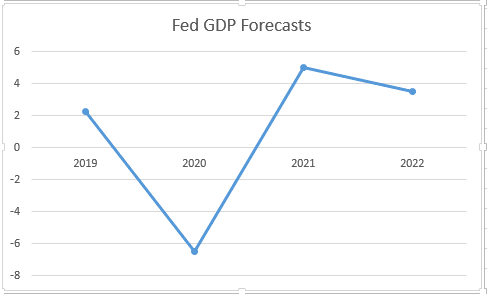
What the Fed did tell us (via the dot plot) is that only two of the seventeen FOMC members believe interest rates will be above 0.0% in 2022 (my money is on Esther and Mester, the two most hawkish members), but mercifully, not a single dot in the dot plot was in negative territory.  They also expressed a pretty dour view of the economy as follows:


  2020 2021 2022
Real GDP -6.5% 5.0% 3.5%
Core PCE 1.0% 1.5% 1.7%
Unemployment 9.3% 6.5% 5.5%

Source: Bloomberg

It is, of course, the 11.5% gain from 2020 to 2021 that encourages the concept of the V-shaped recovery as evidenced by simply plotting the numbers (including 2019’s 2.3% to start).

Screen Shot 2020-06-11 at 9.30.05 AM

So, perhaps the bulls are correct, perhaps the stock market is a screaming buy as growth will soon return and interest rates will remain zero for as far as the eye can see.  There is, however, a caveat to this view, the fact that the Fed is notoriously bad at forecasting GDP growth over time.  In fact, they are amongst the worst when compared with Wall Street in general.  But hey, at least we understand the thesis.

Another interesting outcome of the meeting was the tone of the press conference, where Chairman Jay sounded anything but ebullient over the current economic situation, especially the employment situation.  And it is this takeaway that had the biggest market impact.  After the press conference, equity markets in the US sold off from earlier highs (the NASDAQ set another all-time high intraday) and Treasuries rallied with yields falling again.  In other words, despite the prospect of Forever ZIRP (FZ), equity investors seemed to lose a bit of their bullishness.  This price action has been in place ever since with Asian equity markets all falling (Nikkei -2.8%, Hang Seng -2.3%, Shanghai – 0.8%) and Europe definitely under pressure (DAX -2.1%, CAC -2.2%, FTSE 100 -2.0%).  US futures are also lower with the Dow (-1.9%) currently the laggard, but even NASDAQ futures are lower by 1.1% at this hour.

It should be no surprise that bond markets around the world are rallying in sync with these equity declines as the combination of risk-off and the prospect for FZ lead to the inevitable conclusion that lower long term rates are in our future.  This also highlights the fact that the Fed’s concern over the second part of its mandate, stable prices, has essentially been set aside for another era.  The belief that inflation will remain extremely low forever is clearly a part of the current mindset.  Yesterday’s CPI (0.1%, 1.2% core) was simply further evidence that the Fed will ignore prices going forward.  So, 10-year Treasury yields are back to 0.7% this morning, 20 basis points below last Friday’s closing levels.  In other words, the impact of last Friday’s NFP number has been erased in four sessions.  But we are seeing investors rotate from stocks to bonds around the world, perhaps getting a bit nervous about the frothiness of the recent rallies.  (Even Hertz, the darling of the Robinhooders, is looking like Icarus.)

With risk clearly being jettisoned around the world, it should be no surprise that the dollar has stopped falling, and in fact is beginning to rally against almost all its counterparts.  While haven assets like CHF (+0.2%) and JPY (+0.1%) are modestly higher, NOK (-0.9%) and AUD (-0.85%) are leading the bulk of the G10 lower.  Norway is suffering on, not only broad dollar strength, but oil’s weakness this morning, with WTI -3.1% on the session.  As to Aussie, the combination of weaker commodity prices, the strong dollar, and market technicals as it once again failed to hold the 0.70 level, have led to today’s decline.

Emerging market activity is also what you would expect in a risk-off session, with MXN (-1.6%), ZAR (-1.1%) and RUB (-0.7%) leading the way lower.  Obviously, oil is driving both MXN and RUB, while ZAR is suffering from the weakness in the rest of the commodity complex.  I think the reason that the peso has fallen so much further than the ruble is that MXN has seen remarkable gains over the past month, more than 13% at its peak, and so seems overdue for a correction.  One notable exception to this price action today is THB, which is higher by 0.65% on a combination of reports of a fourth stimulus package and a breach of the 200-day moving average which got technicians excited.

This morning’s data brings the latest Initial Claims data (exp 1.55M), as well as Continuing Claims (20.0M) and PPI (-1.2%, 0.4% core).  While nobody will care about the latter, there will be ongoing intense scrutiny on the former as Chairman Jay made it abundantly clear that employment is the only thing the Fed is focused on for now.  With the FOMC meeting behind us, we can expect to start to hear from its members again, but on the schedule, nothing happens until next week.

It is not hard to make the case that both the euro and pound have been a bit toppish at recent levels, and with risk decidedly off today, further declines there seem quite viable.


Good luck and stay safe

Adf

Unless Lowered Instead

All eyes have now turned to the Fed
As pundits expect Jay will spread
The message that rates,
Until future dates,
Are fixed, unless lowered instead

Most market activity is muted this morning as traders and investors await the latest words of wisdom from Chairman Jay and his compadres. The key questions in the air are:

1. What will the Fed’s new forecasts describe?
2. What will the dot plot (remember that?) look like?
3. Will there be any change in current forward guidance?
4. Will there be any mention of yield curve control (YCC)?

Let’s quickly try to unpack these and see what they mean.

1. The Fed ordinarily updates its economic forecasts quarterly, but wisely, in my view, skipped March’s update given the incredible uncertainty that existed due to the beginnings of the Covid-19 impact. Three months later, the breadth of economic destruction has become clearer, but it will be interesting to learn their current views on the topic. For comparison, last week the ECB forecast a central scenario of Eurozone GDP as follows: 2020 -8.7%, 2021 +5.2%, 2022 +3.3%. The OECD forecast global GDP at -6.0% this year and US GDP at -7.3% this year assuming no second wave of infections. Those numbers fall to -7.6% and -8.5% respectively if there is a second wave of Covid infections. No matter how you slice it, 2020 is set to report negative GDP growth, but the question is, will the Fed demonstrate relative optimism or not?

2. The dot plot, as you may recall, was the biggest issue for a long time, as it was the Fed’s non-verbal way of offering forward guidance. The idea was that each FOMC member would offer his/her own views of the future level of rates and the median forecast was seen as a proxy of the Fed’s views. While it is abundantly clear that the view for 2020 will remain 0.00%, the real question is what the timeline anticipated by the FOMC will be as to when rates can start to rise again. It strikes me that while there will be some divergence, as always, we are likely to see only very gradual increases expressed, with a real possibility that 2021’s median will also be 0.00% and rates only beginning to rise in 2022. This begs the question…

3. How will they proffer their forward guidance? Current language is as follows: “The Committee expects to maintain this target (0.00%-0.25%) until it is confident that the economy has weathered recent events and is on track to achieve its maximum employment and price stability goals.” Current thoughts are they could become more specific with respect to the timeline, (e.g. saying rates would remain at current levels until the end of 2022) or with respect to data (e.g. until Unemployment is at 5.0% and Inflation is back to 2.0%). Of course, the lesson from Chairman Bernanke is that if they go the latter route, they can easily change the level as they see fit. But for now, the longer the timeline, the more confidence that would seem to be imparted. At least, that’s the theory.

4. Finally, there has been a great deal of discussion regarding YCC and whether the Fed will announce a program akin to the BOJ (10-year) or RBA (3-year) where they target a rate on a specific maturity of the Treasury curve. Most analysts, as well as Cleveland Fed President Mester, believe it is too early to make a pronouncement on this subject, but there are those who believe that despite the equity market’s recent frothiness, they may want to step harder on the gas pedal to make sure they keep up what little momentum seems to have started. To me, this is the biggest story of the afternoon, and the one with the opportunity for the most market impact. It is not fully priced in, by any means, and so would likely see a huge rally in both bonds and stocks as the dollar fell sharply if they were to announce a program like this. I like gold on this move as well.

So, plenty to look forward to this afternoon, which explains why market activity has been so limited overall so far today. Equity markets in Asia were barely changed, although in the past few hours we have seen European bourses start to decline from early modest gains. At this point the DAX (-0.8% and CAC (-0.6%) are fully representative of the entire Eurozone space. At the same time, US futures have turned mixed from earlier modest gains with Dow e-minis down 0.3% although NASAAQ futures are actually higher by a similar amount.

Bond markets are generally anticipating something from the Fed as the 10-year has rallied and yields declined a further 3bps which now takes the decline since Friday’s close to 10bps. Bunds and Gilts are both firmer as well, with modestly lower yields while the PIGS are mixed as Greek yields have tumbled 9bps while Spain (+3bps) and Portugal (+4.5bps) see rising yields instead.

And finally, the dollar is definitely on its back foot this morning. In fact, it is lower vs. the entire G10 bloc with Aussie and Kiwi leading the way with 0.5% gains. Right now, the Aussie story looks more technical than fundamental, as it approaches, but cannot really hold 0.70, its highest point in almost a year. But overall, what is interesting about this movement is that despite yesterday’s desultory equity performance and this morning’s modest one as well, the dollar is behaving in a risk-on manner. Something else is afoot, but I have not yet been able to suss it out. I will though!

In the EMG space, the dollar is lower against virtually all its counterparts with IDR as the major exception. The rupiah fell 0.65% last night, actually recouping larger earlier losses at the end of the session, after the central bank explained they would be capping any strength in an effort to help Indonesian exporters. On the plus side is a range of currencies from all three blocs, which is evidence of pure dollar weakness rather than specific positive currency stories.

On the data front, overnight we learned that Chinese PPI was weaker than expected, reflecting weakness in its export markets and not boding well for that elusive V-shaped recovery. We also saw horrific April French IP data (-34.2% Y/Y), but that was pretty much as expected. This morning we get the latest CPI data from the US (exp 0.3%, 1.3% ex food & energy), but inflation remains a secondary concern to the Fed for now. Rather, there is far more focus on the employment data at the Mariner Eccles Building, so really, for now it is all about waiting for the Fed. If pressed, I think they will be more likely to offer some new, more dovish, guidance as it appears they will not want to lose any positive momentum. That means the dollar should remain under pressure for a little while longer.

Good luck and stay safe
Adf

Value, Nought

In college Econ 101
Professors described the long run
As when we all died
Like Keynes had replied
Debating a colleague for fun

However, the rest that they taught
Has turned out to have, value, nought
Their models have failed
While many have railed
That people won’t do what they ought

Observing market activity these days and trying to reconcile price action with the theories so many of us learned in college has become remarkably difficult. While supply and demand still seem to have meaning, pretty much every construct more complex than that turns out to have been a description of a special case and not a general model of behavior. At least, that’s one conclusion to be drawn from the fact that essentially every forecast made these days turns out wrong while major pronouncements, regarding the long-term effect of a given policy, by esteemed economists seem designed to advance a political view rather than enhance our knowledge and allow us to act in the most effective way going forward. Certainly, as merely an armchair economist, my track record is not any better. Of course, the difference is that I mostly try to highlight what is driving markets in the very short term rather than paint a picture of the future and influence policy.

I bring this up as I read yet another article this morning, this by Stephen Roach, a former Chairman of Morgan Stanley Asia and current professor at Yale, about the imminent collapse of the dollar and the end of its status as the world’s reserve currency. He is not the first to call for this, nor the first to call on the roster of models that describe economic activity and determine that because one variable has moved beyond previous boundaries, doom was to follow. In this case growth of the US current account deficit will lead to the end of the dollar’s previous role as reserve currency. Nor will he be the last to do so, but the consistent feature is that every apocalyptic forecast has been wrong over time.

This has been true in Japan, where massive debt issuance by the government and massive debt purchases by the BOJ were destined to drive inflation much higher and weaken the yen substantially. Of course, we all know that the exact opposite has occurred. This has been true around the world where negative interest rates were designed to encourage borrowing and spending, thus driving economic growth higher, when it only got half the equation right, the borrowing increase, but it turns out spending on shares was deemed a better use of funds than spending on investment, despite all the theories that said otherwise.

Ultimately, the point is that despite the economics community having built a long list of very impressive looking and sounding models that are supposed to describe the workings of the economy, those models were built based on observed data rather than on empirical truths. Now that the data has changed, those models are just no longer up for the task. In other words, when it comes to forecasting models, caveat emptor.

Turning to the markets this morning, equity markets seem to have stopped to catch their collective breath after having recouped all of their March losses. In fact, the NASDAQ actually set a new all-time high yesterday, amid an economy that is about to print a GDP number somewhere between -20% and -50% annualized in Q2.

I get the idea of looking past the short-run problems, but it still appears to me that equity traders are ignoring long-run problems that are growing on the horizon. These issues, like the wave of bankruptcies that will significantly reduce the number of available jobs, as well as the potential for behavioral changes that will dramatically reduce the value of entire industries like sports and entertainment, don’t appear to be part of the current investment thesis, or at least have been devalued greatly. And while in the long-run, new companies and activities will replace all these losses, it seems highly unlikely they will replace them by 2021. Yet, yesterday saw US equity indices rally for the 7th day in the past eight. While this morning, futures are pointing a bit lower (SPU’s and Dow both lower by 1.2%, NASDAQ down by 0.7%), that is but a minor hiccup in the recent activity.

European markets are softer this morning as well, with virtually every major index lower by nearly 2% though Asian markets had a bit better showing with the Hang Seng (+1.1%) and Shanghai (+0.6%) both managing gains although the Nikkei (-0.4%) edged lower.

Bond markets are clearly taking a closer look at the current risk euphoria and starting to register concern as Treasury yields have tumbled 5bps this morning after a 4bp decline yesterday. We are seeing similar price action in European markets, albeit to a much lesser extent with bunds seeing yields fall only 2bps since yesterday. But, in true risk-off fashion, bonds from the PIGS have all seen yields rise as they are clearly risk assets, not havens.

And finally, the dollar is broadly stronger this morning with only the other havens; CHF (+0.3%) and JPY (+0.4%) gaining vs. the buck. On the downside, AUD is the laggard, falling 1.4% as a combination of profit taking after a humongous rally, more than 27% from the lows in March, and a warning by China’s education ministry regarding the potential risks for Chinese students returning to university in Australia have weighed on the currency. Not surprisingly, NZD is lower as well, by 1.1%, and on this risk-off day, with oil prices falling 2.5%, NOK has fallen 1.0%. But these currencies’ weakness has an awful lot to do with the dollar’s broad strength.

In the emerging markets, the Mexican peso, which had been the market’s darling for the past month, rallying from 25.00 to below 21.50 (13.5%) has reversed course this morning and is down by 1.4%. But, here too, weakness is broad based with RUB (-0.95%), PLN (-0.7%) and ZAR (-0.6%) all leading the bloc lower. The one exception in this space was KRW (+0.6%) after the announcement of some significant shipbuilding orders for Daewoo and Samsung Heavy Industries improved opinions of the nation’s near-term trade situation.

Turning to the data, although it’s not clear to me it matters much yet, we did see some horrific trade data from Germany, where their surplus fell to €3.5 billion, its smallest surplus in twenty years, and a much worse reading than anticipated as exports collapsed. Meanwhile, Eurozone Q1 GDP data was revised ever so slightly higher, to -3.6% Q/Q, but really, everyone wants to see what is happening in Q2. At home, the NFIB Small Biz Index was just released at a modestly better than expected 94.4 but has been ignored. Later this morning we see the JOLT’s Jobs data (exp 5.75M), but that is for April so seems too backward-looking to matter.

Risk is on its heels today and while hopes are growing that the Fed may do something new tomorrow, for now, given how far risk assets have rallied over the past two weeks, a little more consolidation seems a pretty good bet.

Good luck and stay safe
Adf

Buy With More Zeal

The stimulus story is clear
Expect more throughout the whole year
C bankers are scared
And war they’ve declared
On bears, who now all live in fear

Thus, Wednesday the Fed will reveal
They’ll not stop til they hear the squeal
Of covering shorts
While Powell exhorts
Investors to buy with more zeal!

The market is biding its time as traders and investors await Wednesday’s FOMC statement and the press conference from Chairman Powell that follows. Patterns that we have seen over the past week are continuing, albeit on a more modest path. This means that the dollar is softer, but certainly not collapsing; treasury yields are higher, and those bonds almost seem like they are collapsing; commodity prices continue to mostly move higher; and equity markets are mixed, with pockets of strength and weakness. This is all part and parcel of the V-shaped recovery story which has completely dominated the narrative, at least in financial markets.

Friday’s payroll report was truly surprising as the NFP number was more than 10 million jobs higher than estimated. This led to a surprisingly better than expected, although still awful, Unemployment Rate of 13.3%. However, this report sowed its own controversy when the Labor Department happened to mention, at the bottom of the release, that there was a little problem with the count whereby 4.9 million respondents were misclassified as still working and temporarily absent rather than unemployed. Had these people been accounted for properly, the results would have been an NFP outcome of -2.4 million while the Unemployment rate would have been about 3% higher. Of course, this immediately raised questions about the propriety of all government statistics and whether the administration is trying to cook the books. However, Occam’s Razor would point you in another direction, that it is simply really difficult to collect accurate data during the current pan(dem)ic.

What is, perhaps, more interesting is that the financial press has largely ignored the story. It seems the press is far more interested in fostering the bullish case and this number was a perfect rebuttal to all the bears who continue to highlight things like the coming wave of bankruptcies that are almost certain to crest as soon as the Fed (and other central banks) stop adding money to the pot every day. Of course, perhaps the central banking community will never stop adding money to the pot thus permanently supporting higher equity valuations. Alas, that is the precise recipe for fiat currency devaluation, perhaps not against every other fiat currency, but against real stuff, like gold, real estate, and even food. So, while FX rates may all stay bounded, inflation would become a much greater problem for us all.

At this point, the universal central bank view is that deflation remains the primary concern, and inflation is easily tamed if it should appear. But ask yourself this, if central banks have spent trillions of dollars to drive rates lower to support the economy, how much appetite will they have to raise rates to fight inflation at the risk of slowing the economy? Exactly.

So, let’s take a look at today’s markets. After Friday’s blowout performance by US equities, which helped drive the dollar lower and Treasury yields higher, Asia was actually very quiet with only the Nikkei (+1.4%) showing any life at all. And that came after a surprisingly good Q1 GDP report showing Japan shrank only 2.2% in Q1, not the -3.4% originally reported. This also represents a data controversy as Capex data appeared far more robust than originally estimated. However, this too, seems to be a case of the government having a difficult time getting accurate data with most economists expecting the GDP result to be revised lower. But the rest of Asia was basically flat in equity space.

Meanwhile, European bourses are mixed with the DAX (-0.4%) and CAC (-0.5%) leading the way lower although we continue to see strength in Spain (+0.7%) and Italy (+0.2%). The ongoing belief that the largest portion of ECB stimulus will be used to support the latter two nations remains a powerful incentive for investors to keep buying into their markets.

On the bond front, Treasury yields, after having risen 25bps last week, in the 10-year, are higher by a further 2bps this morning. 30-year yields are rising even faster, up 3.5bps so far today. This, too, is all part of the same narrative; the V-shaped recovery means that lower rates will no longer be the norm going forward. This is setting up quite the confrontation with the Fed and is seen as a key reason that yield-curve control (YCC) is on the horizon. The last thing the Fed wants is for the market to undermine all their efforts at economic recovery by anticipating their success and driving yields higher. Thus, YCC could be the perfect means for the Fed to stop that price action in its tracks.

As to the dollar, it is having a more mixed performance today as opposed to the broad-based weakness we saw last week. In the G10, SEK and NOK (+0.4% each) are the best performers although we are seeing modest 0.15%-0.2% gains across the Commonwealth currencies as well as the yen. NOK is clearly following oil prices higher, while SEK continues to benefit from the fact that its rising yields are attracting more investment after reporting positive Q1 growth last week. On the downside, the pound is the leading decliner, -0.25%, although the euro is weakening by 0.15% as well. While the pound started the session firmer on the back of easing lockdown restrictions, it has since turned tail amid concerns that this dollar decline is reaching its limits.

In the EMG bloc, RUB (+0.65%) is the clear leader today, also on oil’s ongoing rally, although there are a number of currencies that have seen very modest gains as well. On the downside, TRY and PHP (-0.25% each) are the leading decliners, but here, too, there is a list of currencies that have small losses. As I said, overall, there is no real trend here.

While this week brings us the FOMC meeting, there is actually very little other data to note:

Tuesday NFIB Small Biz Sentiment 92.2
  JPLT’s Job Openings 5.75M
Wednesday CPI 0.0% (0.3% Y/Y)
  -ex food & energy 0.0% (1.3% Y/Y)
  FOMC Rate Decision  0.25%
Thursday Initial Claims 1.55M
  Continuing Claims 20.6M
  PPI 0.1% (-1.3% Y/Y)
  -ex food & energy -0.1% (0.5% Y/Y)
Friday Michigan Sentiment 75.0

Source: Bloomberg

While we can be pretty sure the Fed will not feel compelled to change policy at this meeting, you can expect that there will be many questions in the press conference regarding the future, whether about forward guidance or YCC. As they continue to reduce their daily QE injections, down to just $4 billion/day, I fear the equity market may start to feel a bit overdone up here, and a short-term reversal seems quite realistic. For now, risk is still on, but don’t be surprised if it stumbles for a while going forward. And that means the dollar is likely to show some strength.

Good luck and stay safe
Adf

Fear of Deflation

The ECB’s fear of deflation
Inspired more euro creation
They’ll keep buying bonds
Until growth responds
In every EU member nation

Investors responded by buying
As much as they could while still trying
To claim, it’s quite clear
That early next year
Economies all will be flying

Madame Lagarde is clearly getting the hang of what it means to be a central banker these days, at least at a major central bank. The key to success is to listen to how much easing the pundits are expecting and deliver significantly more than that. In the mold of Chairman Powell back in March, Lagarde yesterday exceeded all expectations. The ECB increased its PEPP by €600 billion, extended the minimum deadline to June 2021 and explained they would be reinvesting the proceeds of all maturing purchases until at least the end of 2022. They, of course, kept their other programs on autopilot, so the APP (their first QE program) will still be purchasing €20 billion per month through at least the end of this year. And finally, they left the interest rate structure on hold, so the deposit rate remains at -0.50%, but more importantly, they didn’t adjust the tiering. Tiering is the ECB’s way of limiting the amount of bank reserves that ‘earn’ negative interest rates. So, if the ECB decides that rates need to be cut even lower, they will be able to adjust the tiering levels to help minimize the damage to bank balance sheets. This is key in Europe because banks remain far more important in the transmission of monetary policy than in the US and negative rates have been killing them.

With this increase in accommodation, the Eurozone has finally created a support structure that is in concert with the size of the Eurozone economy. Adding up the pieces shows the ECB buying €1.5 trillion in assets, the EU having already created a €500 billion cheap lending program and now close to agreeing on an additional €750 billion program with joint borrowing and grants as well as loans. Add to that the individual national support (remember Germany just plumped for €130 billion yesterday) and the total is now well over €3 trillion. That is real money and should help at least mitigate the worst impacts of the economic shutdowns across the continent.

And so, can anybody be surprised that markets responded favorably to the news. Equity markets throughout Europe are higher this morning with the DAX (+1.8%), CAC (+2.3%) and the rest of the continental bourses all looking forward to more free money. Of course, the risk-on attitude has investors swapping their haven bonds for stocks and risky bonds, so bund yields have risen 1.5bps (Dutch bonds are up 2.5bps) while Greek yields have fallen 3bps. Italy and Spain are unchanged on the day, as there is no real selling, but just more interest in equities in the two nations. Finally, the euro, although currently slightly softer on the day (-0.15%) traded to a new high for this move at 1.1384. Except for two days in early March, as the virus story was disrupting markets, this is the highest level for the single currency since last July.

Technically, it is pretty easy to make the case that the euro is breaking out of a multi-year downtrend, although that is not confirmed. When viewing fundamentals, the question at hand is whether the Fed or ECB has more accommodative monetary policy. Clearly, despite the recent EU package, the US has been far more accommodative fiscally. And while the longer end of the US yield curve continues to sell off (10-year yields are now up to 0.85%, 20 bps this week, with 30-year yields at 1.66%, also 20bps higher on the week), the 2-year T-note remains anchored at 0.2% with a real yield firmly negative. Recall, there is a strong correlation between real 2-year yields and the value of the dollar, so those negative yields are clearly weighing on the buck. While it will not be a straight line, as long as the market continues to believe that central banks will not allow a market correction, the dollar should continue to slide.

Away from the euro, the dollar is soft almost across the board again today, with only PLN (-0.5%) having fallen any distance in the EMG bloc, and the Swiss franc (-0.3%) the only real loser in the G10. The Swiss story seems to be a technical one as the EURCHF cross has broken higher technically after the ECB announcement yesterday and continued with a little momentum. Poland is a bit more mystifying as there does not appear to be any specific news that would have led to selling, although the trend for the past 3 weeks remains clearly higher.

On the plus side, the big winner today is IDR (+1.55%) after the central bank governor, Perry Warjiyo, commented that the rupiah remains undervalued amid low inflation and a declining current account deficit.

With this as a backdrop, this morning brings the US payroll report with the following forecasts:

Nonfarm Payrolls -7.5M
Private Payrolls -6.75M
Manufacturing Payrolls -400K
Unemployment Rate 19.1%
Average Hourly Earnings 1.0% (8.5% Y/Y)
Average Weekly Hours 34.3
Participation Rate 60.1%

Source: Bloomberg

Remember, Wednesday’s ADP number was much lower than expected at -2.76M, still remarkably awful, but nonetheless surprising. However, data continues to be of secondary importance to the markets. I expect this will be the case until we start to see a recovery in earnest, but for now, we seem to be trying to define the bottom. The dichotomy between the destruction of the economy via lockdowns and the ebullience of the stock markets remains a key concern. The positive spin is that we truly will see a very sharp recovery in Q3 and Q4 with unemployment rolls tumbling back to a more normal recessionary level, and the bulls will have been right. Alas, the other side of that coin is that forecasts of permanent job destruction and decimated corporate earnings will prove too much for the central banks to overcome and we will have a longer-term decline in equity prices as the recession/depression lingers far longer.

For now, the bulls remain in charge. Today’s data is unlikely to change that view, so further dollar weakness seems the best bet. However, be aware of the risk of the other side of the trade, it has not disappeared by any stretch.

Good luck, good weekend and stay safe
Adf

Revert to the Mean

For more than two weeks we have seen
Risk assets all polish their sheen
But now has the bar
Been raised much too far?
And will we revert to the mean?

I read today that recent price action (+42% since March 23) has been the largest 50-day rally in the S&P 500’s long history. Think about that for a moment, the economy has cratered (the Atlanta Fed GDPNow forecast is currently at -52.8% for Q2), unemployment has hit levels not seen since the Great Depression with more than 40 million Americans losing their job in the past three months and the stock market is flying. Well, at least the S&P 500 index is flying as the value of its five largest constituents continues to rise, seemingly inexorably, thus dragging the index along with them. The disconnect between the performance of risk assets and the data representing the economy is truly stunning. And while I understand that equity markets are discounting ‘instruments’ looking ahead to the future, it still beggars belief that most of the companies in the index are going to see earnings recover in anywhere near the time anticipated by the market. Remember, the CBO just published an analysis describing the most likely outcome being a 10-year timeframe before the US economy gets back to the levels seen in 2019.

Part and parcel of this movement in risk assets has been the dollar’s decline, with the Dollar Index (DXY) down more than 5% during the same period. While that is not historic in nature, it is still a very large move for such a short period of time.

And so I must ask, is this movement in risk assets sustainable? Clearly the driving force here has been central bank, (mainly the Fed) largesse as they have pumped trillions of dollars of liquidity into the economy, much of which seems to have found its way into stocks. But remember, the Fed started its unlimited QE by buying $75 billion A DAY of securities. That number is now down to less than $5 billion each day and declining on a weekly basis. In fairness, the Fed got ahead of the curve, recognizing just how devastating the situation was going to be. But the Treasury has caught up and has been issuing debt as quickly as they can. Now the Fed’s liquidity is being funneled directly to the Treasury, rather than finding a home elsewhere, and unless Powell reverses course and starts to increase daily purchases again, there is every chance for equity markets to begin to suffer instead.

One other thing that is missing from this market, and which has been a key driver of the long bull market, is share repurchases by companies. Stock buybacks represented nearly all of the net stock buying seen during the rally. And I assure you, that ship has sailed and is not likely to return to port for many years to come. In fact, it would not be surprising if new laws are enacted that limit or prohibit repurchases going forward. The point I am trying to make is that there are numerous reasons to believe that this remarkable rebound in the stock market, and risk assets in general, is overdone and due for its own correction.

Is today that correction? Well, for a start, it is not an extension of the rally as equity markets in Asia were little changed (Nikkei +0.35%, Hang Seng +0.2%, Shanghai -0.15%) and those in Europe are all in the red (DAX -0.7%, CAC -0.6%, FTSE 100 -0.3%). The DAX performance is quite interesting given the announcement by the German government that they have agreed on a €130 billion stimulus package, 30% larger than anticipated. Meanwhile, US futures are all pointing lower as well, down between 0.2% and 0.5%.

Bond markets continue to lack any informational value as they have become entirely controlled by the central bank community. While yield curve control is only explicit in Japan (for the 10-year) and Australia (for the 2-year) the reality is that every central bank is actively preventing government interest rates from rising out of necessity. After all, given how much borrowing is ongoing, governments cannot afford for interest rates to rise, they would not be able to pay the bills. Perhaps the only exception to this rule is the very long end, 30 years and beyond, where yields continue to rise as curves continue to steepen. (Remember when an inverted yield curve was seen as the death knell of the economy? The reality is the problem comes when it steepens like this! Steepening curves are not so much about future economic growth as much as about higher future inflation.)

And then there is the dollar, which is broadly higher this morning, albeit not in any dramatic fashion. As the market awaits word from Madame Lagarde and her 24 colleagues, we have seen the dollar rise modestly vs. both G10 and EMG counterparts. The biggest retreats have been seen by PLN (-1.25%), where the government just announced an expected 8.5% budget deficit, and MXN (-0.9%), which is suffering as oil sells off a bit. However, both those currencies have seen significant rallies in the past two weeks, so a little reversal is not surprising. As to the rest of the bloc, EEMEA currencies are underperforming APAC currencies, but generally they are all lower.

In the G10, the movement have been much more muted, with GBP, AUD and SEK all lower by 0.4% or so and the rest of the bloc, save the Swiss franc’s 0.1% rally, lower by smaller amounts. Again, it is difficult to point to any one thing as the cause for this movement, arguably it is simply position reductions after a long run.

At this point, all eyes are on the ECB, where expectations have built for an increase in the PEPP of as much as €500 billion. While they have not come close to using the original amount, it seems clear they will need more before the end of the year, and so the market has latched onto the idea it will be announced today. One potential problem with this action is it could reduce pressure on the EU to actually go ahead with their mooted €750 billion fiscal support program that includes joint borrowing, a key feature for the euro’s future. It is clear that as much as the frugal four don’t want to see the ECB distort markets further, they are even more disinclined to give their money to the Italians and Spanish directly. However, in the end, I believe Madame Lagarde will give the market what it wants and raise the PEPP limit.

Today’s data picture brings Initial Claims (exp 1.843M), Continuing Claims (20.0M), the April Trade Balance (-$49.2B), Nonfarm Productivity (-2.7%) and Unit Labor Costs (5.0%). With the monthly NFP report tomorrow, it seems unlikely the market will respond to today’s data in any meaningful way. Earlier we saw Eurozone Retail Sales decline 11.7%, not as bad as feared but still the worst outcome in the history of the series dating back to January 1998. And yet, as we have seen lately, the data is not the driver right now, it is the central banks and sentiment. While we have paused today, sentiment still seems to be for a further rally, but my take is that sentiment is getting old and tired. Beware the reversion to the mean!

Good luck and stay safe
Adf


Depression’s Price In

As cities continue to burn
The stock market bears never learn
Depression’s priced in
And to bears’ chagrin
Investors have shown no concern

Once again risk is on fire this morning as every piece of bad news is seen as ancient history, riots across the US are seen as irrelevant and the future is deemed fantastic based on ongoing (permanent?) government economic support and the continued belief that Covid-19 has had its day in the sun and will soon retreat to the back pages. And while the optimistic views on government largesse and the virus’s retreat may be well founded, the evidence still appears to point to an extremely long and slow recovery to the global economy. Just yesterday, the Congressional Budget Office, released a report indicating it will take nearly ten years before GDP in the US will return to its previous trend growth levels. That hardly sounds like they type of economy that warrants ever increasing multiples in the stock market. But hey, I’m just an FX guy.

A look around the world allows us to highlight what seem to be the driving forces in different regions. There are two key assumptions underpinning European asset performance these days; the fact that the EU has finally agreed to joint financing of a budget and mutualized debt issuance and the virtual certainty that the ECB is going to increase the PEPP in their step tomorrow. The flaws in these theories are manifest, although, in fairness, despite themselves the Europeans have generally found a way to get to the goal. However, the EU financing program requires unanimous approval of all 27 members, something that will require a great deal of negotiation given the expressed adamancy of the frugal four (Austria, the Netherlands, Sweden and Denmark) who are not yet convinced that they should be paying for the spendthrift habits of their southern neighbors. And the problem with this is the amount of time it will take to finally agree. Given the urgent need for funding now, a delay may be nearly as bad as no support at all.

At the same time, the ECB, despite having spent only €250 billion of the original €750 billion PEPP monies are now assumed to be ready to announce a significant increase to the size of the program. Not surprisingly, members of the governing council who hail from the frugal four have expressed reluctance on this matter as well. However, after Madame Lagarde’s gaffe in March, when she declared it wasn’t the ECB’s job to protect peripheral nation bond markets (that’s their only job!) I expect that she will steamroll any objections and look for a €500 billion increase.

Clearly, traders and investors are on the same page here as the euro continues to rally, trading higher by 0.3% this morning (+4.2% since mid-May) and back above 1.12 for the first time since March. European equity markets are rocking as well, with the DAX once again leading the way, up 2.4%, despite a breakdown in talks between Chancellor Merkel’s CDU and its coalition partner SPD over the nature of the mooted €100 billion German support program. But the rest of Europe is flying as well, with the CAC up 2.0% and both Italy’s and Spain’s main indices higher by about 2.0%. European government bonds are sliding as haven assets are simply no longer required, at least so it seems.

Meanwhile, in Asia, we have seen substantial gains across most markets with China actually the laggard, essentially flat on the day. But, for example, Indonesia’s rupiah has rallied another 2.2% this morning after a record amount of bidding for a government bond auction showed that investors are clearly comfortable heading back to the EMG bloc again. The stock market there jumped 2.0% as well, and a quick look shows the rupiah has regained almost the entirety of the 22% it lost during the crisis and is now down just 1.6% on the year. What a reversal. But it is not just Indonesia that is seeing gains. KRW (+0.7%, -5.0% YTD), PHP (+0.5%, +1.1% YTD) and MYR (+0.35%, -4.0% YTD) are all gaining today as are their stock markets. And while both KRW and MYR remain lower on the year, each has recouped more than half of the losses seen at the height of the crisis.

So, the story seems great here as well, but can these nations continue to support their economies to help offset the destruction of the shutdowns? That seems to vary depending on the nation. South Korea is well prepared as they announced yet another extra budget to add stimulus, and given the country’s underlying finances, they can afford to do so. But the Philippines is a different story, with far less resources to support themselves, although they have availed themselves of IMF support. And Indonesia? Well, clearly, they have no problem selling bonds to investors, so for the short term, things are great. The risk to all this is that the timeline to recovery is extended far longer than currently perceived, and all of that support needs to be repaid before economic activity is back.

The point of all this is that while there is clearly a bullish story to be made for these markets, there are also numerous risks that the bullish case will not come to fruition, even with the best of intentions.

And what about the US? Looking at the stock market one would think that the economy is going gangbusters and things are great. But reading the news, with every headline focused on the ongoing riots across the nation and the destruction of property and businesses, it is hard to see how the latter will help the economy return to a strong pace of growth in the short run. If anything, it promises to delay the reopening of many small businesses and restaurants, which will only exacerbate the current economic malaise.

The other thing that seems out of step with the politics is the underlying belief that there will be another stimulus bill passed by Congress soon. While the House passed a bill several weeks ago, there has been no action in the Senate, nor does there seem to be appetite in the White House for such a bill at this time with both seeming to believe that enough has been done and ending the lockdowns and reopening businesses will be sufficient. But if there are riots in the streets, will ordinary folks really be willing to resume normal activities like shopping and eating out? That seems a hard case to make. While the cause of the riots was a tragedy, the riots themselves have created their own type of tragedy as well, the delay and destruction of an economic rebound. And that will not help anybody.

So, on a day where the dollar is under pressure across the board, along with all haven assets, we have a bit of data to absorb starting with the ADP Employment number (exp -9.0M) and then ISM Non-Manufacturing (44.4) and Factory Orders (-13.4%). The Services and Composite PMI data from Europe that was released earlier showed still awful levels but marginally better results than the preliminary reports. However, it is hard to look at Eurozone PMI at 31.9 and feel like the economy there is set to rebound sharply. Those levels still imply a deep, deep recession.

However, today is clearly all about adding risk to the portfolio, and that means that equities seem likely to continue their rally while the dollar is set to continue to decline. For receivables hedgers, I think we are getting to pretty interesting levels. If nothing else, leave some orders a bit above the market to take advantage.

Good luck
Adf