Growth Vs. Shrink

The data continue to show
That things ain’t so bad, don’t you know
So why do folks feel
The bad stuff is real
With growth steady, though somewhat slow?

Apparently, there is a link
Twixt wage growth and what people think
As real wages fall
They cast a great pall
O’er viewpoints on growth versus shrink

That much anticipated recession seems like it will have to wait at least another quarter or two before landing as yesterday’s 3rd revision of the GDP data jumped to 2.0% annualized, much higher than forecast, with strength continuing to be seen in both personal and government consumption.  As well, the Initial Claims data fell to 239K, far below expectations and an indication that the steady drumbeat of layoffs may just be slowing down a bit.  It should be no surprise that equity markets rallied on the news, although the NASDAQ was the definitive laggard on the day.  It was not a tech story or an AI story, but a straight up growth story getting investors back into the game.  As today is quarter end, it is also important to remember that many investment managers who had been underweight equities were actively buying to achieve the appropriate window dressing for their clients.


Of more interest, in my view, was the bond market response where yields exploded higher by 15bps in the 10yr as traders priced in even higher for even longer than had been seen before the release.  Here, too, the recession call remains a mirage, or at least very uncertain in the mists.  The 2yr yield rose even further, 18bps, taking the curve inversion to -103bps.  Fed funds futures are now pricing an 85% chance of a rate hike next month, up from a 70% probability prior to the release as pretty much everyone is now on board the rate hike train.


One of the key conundrums is the idea that the Fed continues to tighten policy while equity markets continue to rally.  Historically, rate hikes of this speed and magnitude would have seen a very different reaction, but this time that is just not the case.  For those who remain suspect of the market’s euphoria, there seem to be a number of potential time bombs littering the landscape, notably commercial real estate (CRE) and housing.  In the case of CRE, there are two concerns.  First is that there is a huge overhang of debt that needs to be rolled over in the next 18 months, >$1.5 trillion, which currently has coupons far below today’s interest rate levels.  Adding to the concern is the WFH trend and how many of these buildings, especially office properties in big cities, are not generating the same cash flows as before.  So, higher rates with lower cash flows are a recipe for default and fears are growing that there are going to be many defaults on these outstanding loans.  The fact that the small regional banks have a large proportion of their assets in the CRE class also bodes ill for their ultimate situation.  So far, we have seen several high-profile buildings sell at extremely low valuations and we have also seen landlords walk away from several buildings, with two large hotels in San Francisco the current bellwethers.


Turning to housing, the overriding view has been that the Fed would kill the market given that mortgage rates have risen from ~3% to ~7% alongside higher prices thus more than doubling the average monthly cost of owning a home.  However, two things have conspired to prevent a collapse in this market so far.  First, is the fact that many people who refinanced to a 3% mortgage during ZIRP are simply unwilling to move thus reducing the supply of existing homes on the market, hence keeping prices elevated.  Second is that given the structural reduction in the labor force and the increased demand for construction workers for industrial activity (which has exploded on the back of the Inflation Reduction Act), the housing market remains far more robust than would have been expected.  Add to this the fact that builders are buying down mortgage rates (paying a part of the mortgage so the rate is more like 5% than 7%) and things are working just fine.  Again, it is possible that this time bomb has been defused.


So why the long faces everywhere?  The best explanation I have seen, which apparently has some academic workbehind it, indicates that the evolution of real wages very accurately tracks economic sentiment.  In other words, if real wages are rising, people remain relatively bullish on the economy whereas if they are falling (and they have been negative since April 2021), people tend to have a much more dour view of things.  Politically, if real wages rise it will change the entire population’s view on everything, so if I were in office, it would be the only thing I targeted.  This also explains why inflation is such a major problem for the administration in office.


So, with this as background, perhaps we have a better understanding of what the prospects are for the future, or maybe a roadmap to watch for key signals.


Meanwhile, the data continue to come out fast and the spin doctors are working overtime.  For example, in Europe this morning, CPI printed a tick lower than forecast (5.5% vs. 5.6%) with core CPI doing the same thing (5.4% vs. 5.5%), and people are raving about the better result.  But remember, the target is 2.0%, so there is no evidence they have improved things at all, nor that they are going to be able to slow the tightening process.  However, equity markets across Europe are all higher on the day, most by more than 1%.  Go figure.  The narrative remains the key, and as long as the central banks can control the narrative and get people to believe that things are getting better, markets will respond accordingly.


Bond yields in Europe did not move as far as in the US yesterday but are all modestly higher this morning as well, except for Gilts +8bps on a massive Current Account deficit result generating concerns over the UK’s finances.


As to commodities, oil bounced back toward $70/bbl yesterday and is holding those gains, although not adding to them, but the metals markets continue to suffer with both aluminum and copper falling again today.  Gold, too, is under pressure from higher yields.  Commodities remains the place where recession is seen looming.


Finally, the dollar can best be described as mixed this morning, with a 50:50 split in the G10 although no movers have even made it 0.25% away from yesterday’s close.  In the emerging markets, ZAR (-1.2%) is the lone outlier, falling on the back of the metal market weakness.  However, away from the rand, a split in performance without any outliers is the best description.  However, I must point out that USDCNH, the offshore renminbi, has traded above 7.28 and continues its slow march higher (to 7.50 and beyond!)


On the data front, there is a bunch of stuff today starting with Personal Income (exp 0.3%) and Spending (0.2%) along with core PCE (0.3% M/M, 4.7% Y/Y) at 8:30, then Chicago PMI (43.8) and Michigan Sentiment (63.9) later in the morning.  It seems that the Fed has begun their July 4th holiday weekend already with no speakers on the calendar until the 5th.  The market remains very data focused so more strong data should see higher US yields and a firmer dollar, although it depends on which data is strong as to how equities respond.  Strong spending and income data should help, but a high surprise on PCE will not.


And that’s really it heading into the long weekend.  I, too, will take Monday off so no poetry until Wednesday next week, ahead of the NFP report.


Good luck and good weekend

Adf

Double Secret Inflation

In Sintra, each central bank head
From Europe, Japan and the Fed
Explained all was well
Amongst their cartel
So, ideas of changing were dead

However, in Asia it seems
The PBOC’s latest schemes
To strengthen the yuan
Have failed to catch on
Look, now, for a change in regimes

The panel in Sintra that mattered had the three key central bank heads on the dais, Powell, Lagarde and Ueda, and each one held true to their recent word.  Both Powell and Lagarde insisted that inflation remains too high and that the surprising resilience in both the US and European (?) economies means that they would both be continuing their policy tightening going forward.  Powell hinted at a July hike and Lagarde promised one a few weeks ago.  At the same time, Ueda-san explained that while headline inflation was higher than their target, given the lack of wage growth, the BOJ’s ‘double-secret’ core inflation reading was still below 2% and so there would be no policy changes anytime soon.  He did explain that if this key reading moved sustainably above 2%, it would be appropriate to tighten monetary policy, but quite frankly, my take (and I’m not alone) is that all three of these central bank heads are very happy with the current situation.


Why, you may ask, are they happy?  Well, politically, inflation remains the biggest headache for both Powell and Lagarde, and quite frankly most of the rest of the world, while in Japan, recent rises in inflation have not raised the same political ire.  At the same time, as long as the BOJ continues YCC and QE with negative rates, the flood of liquidity into the market there helps offset the liquidity withdrawn by the Fed and ECB.  The result of this policy mix is a very gradual reduction in total global liquidity along with an ongoing demand for US and European sovereign issuance.  It should be no surprise that Japan is now the largest holder of US Treasuries outside the Fed.  As well, the policy dichotomy has resulted in a continued depreciation of the yen which supports the mercantilist aspects of the Japanese economy.  And finally, higher inflation in Japan helps erode the real value of the 250% of GDP worth of JGBs outstanding, allowing eventual repayment of that debt to proceed more smoothly.  Talk about a win, win, win!  Until we see a material change in the macroeconomic statistics in one of these three areas, it would be a huge surprise if policies changed.


The upshot of this analysis is that it seems unlikely that we are going to see any substantive movement in yields, either up or down, given the relative offsets in policy, and that the yen is likely to continue to erode in value.  Last autumn, the yen fell very sharply, breaching 150 for a short time and generating serous angst at the BOJ and MOF.  We saw intervention and the idea was there was a line in the sand at that level.  However, my take is that as long as the move remains gradual, and it has been gradual as the yen has steadily, but slowly depreciated for the past 5 months, about 2%/month, we are likely to see more verbal intervention, but not so much in the way of actual activity.  In the end, unless policies change, actual intervention simply serves to moderate the move.


Speaking of failed intervention, we can turn to China which has a similar problem to Japan, weakening growth and low inflation.  As I have written before, a weak renminbi is the best outlet valve they have, and the market has been doing the job.  However, here the movement has been a bit faster than the PBOC would like thus resulting in more overt and covert intervention.  On the overt side, we continue to see the PBOC try to fix the onshore currency strong (dollar lower) than the market would indicate as they try to get the message across that they don’t want the currency to collapse.  On the covert side, there has been an increase in the number of stories regarding Chinese banks, like China Construction Bank and Bank of China, actively selling USDCNH, the offshore renminbi in an effort to slow the currency’s depreciation.  But the story that is circulating is that all throughout Africa and Asia, nations that were encouraged to accept CNY for sales of commodities are now quite unhappy with the CNY’s weakness and are quickly selling as much as they can in order to preserve their reserve’s value.  My sense is this process will continue as the dichotomy between a stronger than expected US economy and a weaker than expected Chinese one continues to push the renminbi lower.  PS, for everyone who was concerned about the dollar losing its reserve currency status to the renminbi or some theoretical BRICS backed currency, this should help remind you of why any change to the dollar’s global status is very far in the future.


And those are today’s stories.  Yesterday’s mixed US risk picture has been followed overnight with Chinese shares, both Mainland and Hong Kong, suffering but the Nikkei eking out a gain.  In Europe, the FTSE 100 is under pressure, but we are seeing strength on the continent despite what I would consider slightly worse than expected data prints in German State CPIs as well as Eurozone Confidence measures.  However, the one place where inflation slowed sharply was Spain, where headline fell to 1.9%!  While that was a touch higher than forecast, it is the first reading of any country in the Eurozone below the 2% level since early 2021.  Alas, what is not getting much press is the fact that core CPI there fell far less than expected to 5.9% and remains well above targets.  The ECB has a long way to go.


Bonds are under pressure across the board today, with yields higher by about 3bps-4bps in Treasuries and across Europe.  This seems to be a response to the idea that a) neither the Fed nor ECB is going to stop raising rates and b) inflation is not falling as quickly as hoped.  JGB yields, though, remain well below the YCC cap at 0.38% so there is no pressure on Ueda-san to change his tune.


Oil prices are creeping higher this morning but remain below $70/bbl and in truth have not done very much lately.  The big picture of structural supply deficits vs. concerns over shorter term demand deficits due to the coming recession continue to play out as choppy markets but no direction.  Copper has fallen sharply this morning and is down more than 5% in the past week.  Its recent rally appears to have been a short squeeze more than a fundamental view.  Gold, meanwhile, continues to consolidate just above $1900/oz.


Finally, the dollar is mixed on the day, with both gainers and losers across the EMG space although it is broadly lower vs the G10.  AUD (+0.5%) is the leading major currency after better-than-expected Retail Sales data was released overnight but the rest of the bloc, while higher, is just barely so.  In the EMG, PLN (+0.75%) is the best performer, but that is very clearly a position rebalancing after a week of structural weakness.  On the downside, KRW (-0.75%) is the worst performer after weaker Chinese data impacted the view of Korea’s future.  Otherwise, most currencies are relatively unchanged on the day.


We get some important data today starting with Initial Claims (exp 265K) and Continuing Claims (1765K) as well as Q1 GDP (1.4%).  Frankly, since this is the third look at GDP, I expect that the Claims data, which has been trending higher lately, is the most critical piece.  If we see another strong print, be prepared for the recession narrative to come back with a vengeance, but if it is soft, then there will be nothing stopping the Fed going forward.


Powell made some comments this morning in Madrid, but they were about bank stability not economic policy, and we hear from Bostic this afternoon.  But frankly, I see little reason for a change in sentiment anywhere on the Fed given the data continues to show surprising economic strength.  As such, I still like the dollar medium term.


Good luck

Adf

Inflation’s at Bay

While waiting to hear more from Jay
Investors keep socking away
More assets that need
Low rates to succeed
With clues, now, inflation’s at bay

In Europe, the money supply
Although really still very high
Is starting to fall
As well, there’s a call
To start waving PEPP bonds bye-bye

Overall, it has been an uneventful session in the markets with risk assets generally performing well amid clues that all the central bank efforts to tame inflation may be starting to work.  The first sign was the release of lower-than-expected Italian CPI data at 6.7%, down sharply from last month’s 8.0% reading.  As well, Italian PPI continues its recent negative trend, printing at -6.8% Y/Y, widely seen as a harbinger of future CPI activity.  In addition, money supply data has continued to fall rapidly as per the below chart from the ECB, with M1 growth falling to -6.4%, its lowest reading ever.

Yesterday I mentioned the idea that the ECB was turning into a closet monetarist institution as they continue to see their balance sheet shrink and today’s data helps bolster that view.  In addition, there is increasing discussion at Sintra that the ECB should consider actually selling some of the bonds from their QE programs, APP and PEPP, rather than simply let them roll off without reinvesting.  Recall, that while the Fed is allowing $95 billion / month to mature without reinvestment, the ECB’s pace is a mere €15 billion / month.  Granted, the ECB also has the benefit of having a large slug of TLTRO loans maturing this week (approximately €500 billion) which has been the driving force behind their balance sheet’s decline, but whatever is driving the process, it seems like the ECB is tightening monetary policy more aggressively than the Fed. 


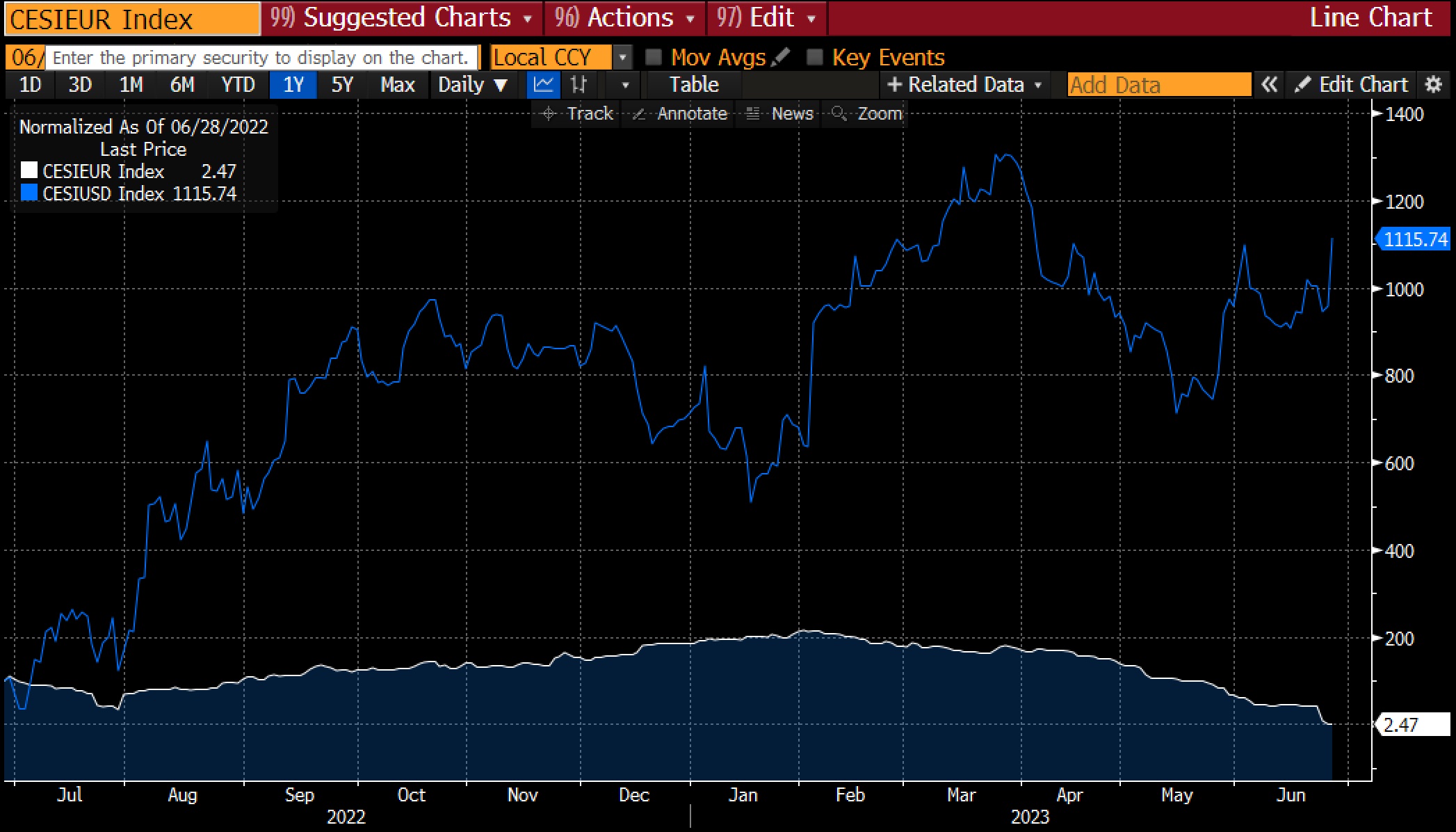
The big difference between the US and Europe, though, is that Europe is already clearly in a recession while the US, despite a widely anticipated slowdown, continues to perform quite well.  For instance, yesterday’s data releases were uniformly better than expected.  Durable Goods, Home Prices, New Home Sales, Consumer Confidence and the Richmond Fed Manufacturing Index all printed at better levels than expected.  This goes back to the Citi Surprise Index, which jumped nearly 17 points yesterday after the releases and sits firmly in positive territory in an uptrend.  Meanwhile, the same measure in the Eurozone is collapsing, deep in negative territory.  The below Bloomberg chart is normalized at 100 from one year ago.  It is quite easy to see the remarkable gap between the US (blue line) and Eurozone (white line) with respect to relative economic performance.

Arguably, one would expect that given the US economy’s seeming resilience, the Fed would be the more aggressive of the two central banks, but that is just not the case, at least based on the behavior of their respective balance sheets.


The big question is, can this dichotomy continue?  With the Eurozone already in a recession and showing no signs of coming out of it, can the ECB continue to tighten policy in the same manner they have to date?  As well, can the US equity market continue to perform well despite no indication that the Fed has any reason to pivot to easier money in the near future?  Logically, at least based on previous logic, one would have thought these conditions could not continue very long.  And yet, here we are with no obvious end in sight. 


My sense, and my fear, is that the ‘long and variable lags’ with which monetary policy impacts economic activity have not yet been felt in the US economy and that much more stress is still in the not-too-distant future.  If I had to select a particular weak spot it would be commercial real estate, especially the office sector, as already we have seen a number of high-profile mortgage defaults, and given the change in working conditions for so many people and companies, are likely to see many more.  The GFC was driven by the retail mortgage sector imploding.  It is not hard to imagine the next financial downturn being driven by the inability of commercial mortgage holders to refinance over the next year or two as they are currently upside down on their properties and cash flows are suffering dramatically to boot.  If this sector is the genesis of the problems, then given local and community banks are quite exposed to the sector all over the country, we are likely to be in for a rough ride, both in the economy and the stock market.  Be wary.


As to the overnight session, generally speaking, equity markets followed yesterday’s US rally with gains.  Japan was the leader with the Nikkei rallying 2% and only mainland China suffered as there was less clarity that the Chinese government was going to support the economy, and the currency.  European bourses are all nicely higher although US futures, especially the NASDAQ, are a bit softer after the Biden administration indicated further restrictions on semiconductor sales to China.


Bond yields are sliding a bit this morning but not too much, 2bp-3bp and quite frankly, all remain in a fairly narrow trading range.  Despite the Treasury issuance onslaught that has been proceeding since the debt ceiling was eliminated, yields have not moved very far at all.  It would seem that as issuance is pushed further out the maturity ladder, we would see higher yields, but that has not been evident yet.  Meanwhile, the yield curve remains massively inverted, right at -100bps this morning.


Oil prices are stabilizing this morning but have fallen more than 6% in the past week as this is the one market that truly believes the recession story.  Gold is also under pressure, falling further and pushing toward $1900/oz.  Higher yields continue to undermine the barbarous relic.  As to base metals, copper is under pressure, but aluminum is holding in reasonably well. 


Finally, the dollar is rebounding from a few days of softness with strength virtually across the board this morning.  Every G10 currency is weaker led by NZD (-1.3%) and AUD (-0.95%) as concerns over Chinese economic activity weigh on the antipodeans.  But the whole bloc is under pressure.  Meanwhile, in the EMG space, the picture is the same, virtual unanimity in currency weakness led by ZAR (-1.0%) and THB (-0.95%) with CNY (-0.3%) reversing course after the PBOC was absent from the market last night.  Despite hawkish comments from the SARB, the rand continues to suffer over concerns about the broader economy while the baht is suffering from political concerns.  This is an interesting story as Pita Limjaroenat was the surprise victor in recent elections but was not backed by the military.  Not surprisingly they are not happy, and he is having trouble putting a government together.


There is no major data today, so we are all awaiting Chairman Powell’s comments at 9:30 to see if he has any further nuance to impart.  At this point, I have to believe he will continue to push the higher for longer mantra as the data has certainly done nothing to dissuade him.  As such, I still like the dollar over time.


Good luck

Adf

Havoc We’ll Wreak

Said Christine, we’ve not reached the peak
Of rate hikes, more pain we still seek
So, come this July
A hike we’ll apply
To see how much havoc we’ll wreak

The ECB summer retreat began this morning and ECB President Lagarde kicked things off with the following comments, “It is unlikely that in the near future the central bank will be able to state with full confidence that the peak rates have been reached.  Barring a material change to the outlook, we will continue to increase rates in July.”  That seems like a pretty clear signal that there is no pause on the horizon.  Remarkably, the OIS market in Europe is only pricing in a 90% probability of a hike, despite a virtual guarantee from Lagarde.  Overall, the market has two more hikes total priced in, with a terminal rate of ~3.90%.  If you think about it, that is remarkable considering that core CPI in the Eurozone currently sits at 5.3%!  There is an awful lot of belief that despite both lower interest rates and higher inflation readings compared to the US, the ECB is nearly done.


Working in Lagarde’s favor is the fact that Europe appears to be slipping into a recession with Germany already there and the overall data output of late consistently underperforming rapidly declining expectations.  In fact, a look at the Citi Surprise Index for the Eurozone shows a reading of -140.20, lower than anytime other than the Covid collapse and the GFC.  This is even lower than during the Eurozone bond crisis in 2011-12, which given the dire straits at the time, is really impressive.  So, maybe Lagarde and the ECB anticipate a deep recession that will help crush demand and price pressures as well.  Of course, she can never actually say that, but who knows what she actually believes.  Or…perhaps the ECB have become closet monetarists and are relying on the fact that, unlike the Fed, their balance sheet has actually fallen substantially in size this year, > €1.1 trillion and is tracking lower still.  Compare this to the Fed where the balance sheet has only fallen by half as much and perhaps there is hope yet for the ECB. 


At any rate, the overall market response to these comments has been nonplussed.  It has certainly not engendered concerns in the equity market as European bourses are essentially unchanged on the day.  It has not engendered concerns in the bond market as European sovereigns are less than one basis point different than yesterday’s closes, and as far as the currency markets, the euro has edged higher by 0.3%, continuing its recent trend of bouncing off its lows ever so slowly.  For the rest of the day, we hear from various ECB speakers and several BOE members, but Powell doesn’t speak until tomorrow, and as we can see from today’s price action, he remains THE man when it comes to moving markets.

In China, they’re getting annoyed
That analysts there have employed
Some logic and said
When looking ahead
That stock value will be destroyed

If you want to understand the dangers of recent efforts to censor mis- or disinformation, look no further than China, where last night, three prominent finance writers were banned suspended from their Weibo accounts (China’s version of Twitter) for spreading “negative and harmful information” about the stock market.  In other words, after a 20% decline since the beginning of the year and no indication that the government was going to do anything substantive to try to address a clearly slowing economy, they didn’t exhort the public to buy stocks, but rather seemingly indicated they could fall further.  Apparently, that analysis is not appropriate hence the banning.  At the same time, the PBOC fixed the onshore renminbi much higher (dollar lower) than expected in an effort to slow the ongoing decline in the currency.  Since January 16th, prior to last night, CNY had declined more than 8%, pretty much in a straight line.  As I have written consistently, with inflation remaining quite low on the mainland, the PBOC seemed fairly relaxed about the currency’s weakness, but I guess that started to get a little out of hand.  It remains to be seen if they are going to intervene more aggressively, but the pressures clearly remain for a weaker renminbi.  The interest rate differential significantly favors the dollar and that is not going to change anytime soon.  As such, given the significant carry advantage for the dollar, I continue to expect USDCNY to rally to 7.50 and beyond as the year progresses.


Otherwise, it’s been a fairly dull session with no other noteworthy news and no critical data.  Risk has had a mixed picture with China and Hong Kong rebounding from recent lows on rumors that China was going to add some support, but Japan is continuing its recent correction from a massive run up this year.  European bourses are edging a bit lower at this hour (8:00) while US futures are mixed, albeit not really having moved very much. 


Bond yields, as mentioned above, are little changed with Gilts (+2.2bps) the only outlier of note.  There has been no data from the UK, so I expect this movement is position related more than anything else.


In the commodity space, oil (-1.6%) is once again under pressure as it remains the only market that truly is pricing for declining growth, although most base metals are under pressure today as well.  Gold, however, seems to be forming a new bottoming pattern above the $1900/oz level, although given reduced geopolitical fears and, more importantly, still high and rising interest rates, it will be tough for the yellow metal to rise in the current environment.


Finally, the dollar is under pressure again with a bit more universal negativity today.  The euro, now +0.45%, leads the way with the rest of the G10 showing far less impetus higher and NOK (-0.1%) unable to shake oil’s weakness.  As to the EMG space, ZAR (+1.2%) is the leading gainer followed by PLN (+0.7%) and PHP (+0.7%) showing that the gains are widespread.  LATAM currencies are also firmer, but by much smaller amounts.  As to the drivers, some hawkish talk from the SARB has traders looking for higher rates for longer, with similar commentary from the Polish Central Bank a key support there.  Completing this trio, a change at Bangko Sentral Pilipinas has been coming but the outgoing governor expressed his view that policy would not change, thus keeping relative tightness there as well.  I sense a theme.  Higher for longer is the central bank mantra virtually everywhere in the world with just China and Japan not playing along.


On the data front, Durable Goods just printed at a much better than expected 1.7% with the ex Transport reading at 0.6%, also firmer than expected.  That is certainly a different story than the survey data we have been seeing for the past several months, but it is also going to be confirmation for the Fed that they need to continue to raise rates.  Later this morning we will see Case Shiller House Prices (exp -2.40%), New Home Sales (675K), Consumer Confidence (104.0) and Richmond Fed (-12).  There are no Fed speakers on the calendar, so I expect that we will take our cues from equities and anything surprising out of Sintra.  Right now, the dollar is under gradual pressure, but over time, I continue to believe it will find support on the back of a Fed which is likely to be the most hawkish of all.


Good luck

Adf

Confusion Reigns

Investors and traders are caught
Twixt data which shows that they ought
Be uber concerned
Although they have learned
That fighting momentum is fraught

And so, it’s confusion that reigns
Reminding us of Maynard Keynes
Though logic dictates
We’re in dire straits
That doesn’t prevent further gains

One of the remarkable things about the current situation across markets and macroeconomics is that every piece of new information seems to add to the confusion rather than any sense of clarity.  As such, both the bulls and the bears, or perhaps the hawks and the doves, have constant reinforcements for their views.  As John Maynard Keynes famously told us all in 1920, “the market can stay irrational longer than you can stay solvent,” and right now, there are many who are flummoxed by the seeming irrationality of the markets.


Data continues to print demonstrating economic weakness, with this morning’s German IFO results simply the latest.  Expectations fell sharply to 83.6, a level whose depths had only been plumbed in the past during the GFC, at the beginning of Covid and when Russia invaded Ukraine.  Too, the Business Climate fell to 88.5, mirroring the Expectations index in futility.  In other words, this is an indication that businesses in Germany are not merely in a recession currently but see no escape soon.  And why would they?  After all, Madame Lagarde promised another rate hike next month and there is talk of further hikes later.  So, it appears there will be no short-term relief for the citizens there.   And yet, despite a very modest amount of equity market selling at the end of last week, most equity markets remain solidly higher halfway through 2023.


This morning’s data begs the question, can the global economy, or really any industrialized nation’s economy, avoid a recession if the manufacturing sector is declining.  We are all aware that most of the G10 economies are services oriented, while we see much larger proportions of GDP driven by manufacturing in larger emerging markets.  The following table, with data from the World Bank shows what these proportions as percentages of GDP were in 2021 (latest data available):


Australia

6

Brazil

10

Canada

10

China

27

Germany

19

India

14

Ireland

35

Japan

20

Korea

25

Mexico

18

South Africa

12

Spain

12

Sweden

13

UK

9

US

11


It should be no surprise that China, given their mercantilist policies, are at 27%, nor that South Korea (25%) and Mexico (18%) have relatively large manufacturing sectors.  But both Germany (19%) and Japan (20%) are also quite manufacturing focused.  As such, it should not be that surprising they both had run large trade and current account surpluses given that’s what mercantilist policies generate.  The point is, if manufacturing is heading into a slump, or perhaps already in one, can the broader economy maintain overall growth? 


Arguably, there is a significant portion of the services economy that is highly dependent on manufacturing as well.  Consider things like financial services for those companies, transportation of manufactured goods as well as raw materials to factories and food and janitorial services at factories.  Those are not part of the equation, but if factories close down in ‘service oriented’ economies, all those services will shrink as well.  The point is even in the US, where manufacturing technically represents only 11% of GDP, a slump in that sector will have wide ranging impacts.   And what we have seen just this month is a litany of lousy data on the manufacturing side.  ISM Manufacturing (46.9), Kansas City Fed (-12), Philly Fed (-13.7), Dallas Fed (-29.1) and Chicago PMI (40.4) all point to severe weakness in the US manufacturing sector.  Can the US economy really grow strongly with a key sector under such pressure?  Can any economy?  Germany is already in a recession, and we know that their manufacturing sector is sliding.  China, too, has shown weaker data consistently and the government there is trying to figure out how to support the economy to prevent a severe slowdown.  These are the arguments for why an official recession is coming to the US and all of Europe and probably the world. 


And yet, equity market bullishness remains intact.  At least based on the major indices.  Despite the fastest set of interest rate hikes in history by the Fed, ECB and BOE amongst others, equity indices are higher throughout the G10 this year, led by the NASDAQ’s remarkable 29% rally.  In addition, as we approach month/quarter end this week investment managers who have not been willing to close their eyes and buy are finding themselves forced into that situation.  Meanwhile, inflation data, while slowing from its peak seen 6mo-9mo ago remains well above central bank targets indicating that there is further monetary policy tightening to come.


So, who do you believe?  The data that shows key sectors of the global economy are slowing?  Or the data that shows ongoing strong employment means overall economic activity is continuing to rise?  It is easy to understand why so many analysts are forecasting a recession.  It is also easy to understand why investors don’t respond that way as they watch market performance.  And this, of course, is why Keynes’ words were so prescient, right now, markets do not seem rational, but they are what they are.


Arguably the one thing that is not frequently discussed but has been shown to be true over time is that G10 governments do not like to see recessions at all and will do anything they can and spend any amount, to prevent one from occurring.  As long as central banks continue to monetize the debt required to do so, this structure can continue.  But at some point, the debt will overwhelm the system and a correction will occur.  It is anybody’s guess as to when that might happen, but it certainly feels like that day is slowly coming into view.  At some point, investors will ignore what the central banks say and there will be a very significant correction.  But there’s nothing to say it can’t wait five more years.  As I said, confusion reigns.


Turning to the market activity overnight, After Friday’s down session in the US, Asia continued that trend with Chinese equity markets the weakest of the bunch, but screens red across the region.  Europe, which had been uniformly negative earlier in the session has now seen a very modest bounce back to basically unchanged although US futures remain slightly in the red.


That risk-off feeling is being seen in bond markets with yields lower across the board this morning as both Treasuries and European sovereigns find themselves with yields sitting between 3bps and 4bps softer than Friday’s closing levels.  The 2yr-10yr yield curve inversion remains -102bps, certainly not a positive economic sign, and we are seeing European curves invert as well.  Even JGB yields are a touch lower this morning.


Oil prices are a touch higher this morning although WTI remains below $70/bbl and metals prices are also a bit firmer, bouncing off recent lows.  However, that seems more to do with dollar weakness than commodity strength.


Which is a bit odd as during a classic risk-off session, the dollar tends to do quite well, yet today it is softer vs. all its G10 counterparts led by NOK (+0.9%) and many EMG currencies.  Forgetting TRY (-2.7%), the other losers are CNY (-0.7%) which is catching up after a few days of Mainland holidays, and TWD (-0.3%).  However, there is a long list of gainers led by ZAR (+0.9%) and HUF (+0.6%).  Arguably, falling Treasury yields are hurting the dollar somewhat, but quite frankly, I’m not convinced that is the driver here.


On the data front, as it is the last week of the month, we will get updated GDP and PCE figures as well as an array of things:


Today

Dallas Fed

-20.0

Tuesday

Durable Goods

-0.9%


-ex transportation

0.0%


Case Shiller Home Prices

-2.60%


New Home Sales

675K


Consumer Confidence

103.8

Thursday

Initial Claims

264K


Continuing Claims

1772K


Q1 GDP

1.4%

Friday

Personal Income

0.3%


Personal Spending

0.2%


Core PCE Deflator

0.3% (4.7% Y/Y)


Chicago PMI

44.0


Michigan Sentiment

63.9

Source: Bloomberg


On the speaker front, the ECB has their summer confab in Sintra, Portugal this week with Powell, Lagarde, Ueda and Bailey all speaking on Wednesday and Thursday.  It will certainly be interesting to hear them all together as they try to convince themselves they are in control.


I remain skeptical as to the potential for further gains in risk assets, but I have been skeptical for months and been wrong.  As to the dollar, if yields are going to decline, I could see the dollar slide further, but if risk does get jettisoned, I expect the dollar to find a bid.


Good luck

Adf

No Longer Clear

Inflation remains
Far higher than desired
Will Ueda-san blink?

Which one of these is not like the other?


Central Bank

Policy Interest Rate

Core CPI

Federal Reserve

5.25%

5.3%

ECB

4.00%

5.3%

BOE

5.00%

7.1%

Bank of Canada

4.75%

4.2%

RBA

4.10%

6.8% (headline)

BOJ

-0.10%

3.2%

Source: Bloomberg


Japanese inflation readings were released overnight, and they showed no signs of declining.  In fact, they were actually a tick higher than the median forecasts.  However, there has been zero indication that the BOJ is set to respond to the highest inflation in decades.  As everything economic is political, by its very nature, the reality seems to be that there is not yet any political price for PM Kishida to pay for rising inflation.  Recall, as inflation started to pick up sharply in the wake of the pandemic reopenings, the universal central bank response was, inflation is transitory and it will subside soon.  Politically, at that time, governments were keen to keep interest rates near (or below) zero as part of their belief that it would foster economic activity and recession was the big concern.


However, once it became so clear that even central banks understood this bout of inflation was not a transitory phenomenon, policy prescriptions changed rapidly leading to the very rapid rise in interest rates we have seen since early 2022.  Politically, inflation was the lead story in every media outlet with governments around the world and their central banks being blamed, so they had to respond.  (Whether their response has been effective is an entirely different story).  Except in one place, Japan.  As is abundantly clear from the table I constructed above, the BOJ has yet to alter their monetary policy stance despite core CPI remaining at extremely elevated levels far above the BOJ’s 2% target.  In fact, prior to the recent spike, you have to go back to 1981 to see Japanese core CPI this high.


Apparently, though, inflation is not making headlines in Japan as it has been throughout the rest of the G7 and so the BOJ is perfectly happy to continue on their path of infinite QE and YCC.  Remarkably, 10-year JGB yields fell further last night, now around 0.35%, as there is seemingly very little concern that a policy change is in the offing there.  Certainly, there has been no indication from any BOJ commentary nor from Kishida’s government.  As such, it can be no surprise that the yen continues to fall, declining 1% this week and more than 3% over the past month. 


Interestingly, there has definitely been an uptick in the buzz from market talking heads about the need for the BOJ to abandon YCC and that a change is imminent.  I have seen a number of analyses that foretell of the inevitable change and how the yen is likely to rise dramatically when it happens.  FWIW, which may not be that much, I agree that when the BOJ does change policy, we are likely to see the yen rally sharply.  The problem is, I see no indication that is going to happen anytime soon.  Show me the headlines in the Asahi Shimbun or the Nikkei Shimbum (major Japanese newspapers) that are focused on inflation and I will change my view.  But until it is a political problem, the BOJ is serving its current function of supplying the world’s liquidity with a correspondingly weaker yen as a result.

The messaging’s no longer clear
Regarding the rest of the year
While some at the Fed
See more hikes ahead
Some others feel ending is near

Once again yesterday we heard mixed messages from Fed speakers with some (Barkin) talking about evaluating their actions so far and waiting for more proof that further tightening was needed while others (Bowman, Waller) seeming pretty clear that more hikes are in the offing.  Powell’s Senate testimony was largely the same as the House testimony on Wednesday with more of the questions focused on bank capital rather than monetary policy.  Of course, the big question remains, are they done or not?  Fed funds futures are still pricing a 72% chance of a hike in July and a terminal rate of 5.33%, so one more hike from current levels.  But the arguments on both sides remain active.  It appears to me that as long as the employment situation remains robust, they will continue to hike until inflation falls closer to their target.  Yesterday’s Initial Claims data printed just a touch higher, 264K, and the trend certainly seems to be moving higher, but is not nearly at levels consistent with recession.  The NFP report in two weeks will be critical but until then, we are likely to be whipsawed by commentary.


As to the overnight session, risk is very definitely on its heels this morning with equity markets in the red around the world, with all of Asia falling by -1.5% or more although European bourses have not suffered quite as much, -0.3% to -0.8%.  US futures are also under pressure, down about -0.5% at this hour (8:00).


Bond markets, on the other hand, are performing their role as safe haven, with yields sharply lower this morning. Treasury yields, which had risen yesterday have given all that back and then some, down 6bps, while in Europe, sovereigns are down 12-13bps virtually across the board.  The latter seems to be a response to the Flash PMI data which was released showing slowing activity across the continent, especially in France where both Manufacturing and Services fell below 50 and where German Manufacturing PMI tumbled to 41.0.  If the Eurozone economy is truly performing so poorly, it is hard to believe that the ECB will continue on its current path much longer.  One other rate story is the short-term GBP rates which are now pricing a terminal rate by the BOE at 6.13%, pricing another 5 rate hikes into the curve by the middle of next year.


However, on this risk off day, it is the dollar that is truly king of the world, rallying vs every one of its counterparts in both the G10 and EMG.  NOK (-2.2%) is the G10 laggard on the back of general risk aversion as well as the fact that oil prices are tumbling again, down a further -1.25% this morning on the recession fears.  But the weakness is pervasive with AUD (-1.0%) weak and the euro (-0.7%) giving up chunks of its recent gains in short order.  Interestingly, the yen (-0.1%) is the best performer in the G10.  The picture in the emerging markets is similar, with substantial losses across the board led by TRY (-1.3%) and ZAR (-1.1%).  Of course, Turkey’s lira is destined to continue collapsing given the dysfunctional monetary policy there, but ZAR is feeling the pressure of declining metals prices, especially gold, which is down again this morning and now pressing $1900/oz.  Meanwhile, China’s renminbi continues to slide, trading to new lows for this move with the dollar marching inexorably higher.


On the data front, today brings Flash PMI data (exp 48.5 Manufacturing, 54.0 Services, 53.5 Composite) and that’s it. Two more Fed speakers, Bullard and Mester, are due to speak and both have been leading hawks so we know what to expect.  So, looking at the rest of the session, I suspect that the dollar will maintain most of its gains, but do not be surprised to see a little sell off as we head into the weekend and positions are reduced.


Good luck and good weekend

Adf

A Pitiful Claim

Said Jay, we’ve “a long way to go”
Ere driving inflation too low
Employment’s still tight
But we’ll get it right
Or not… it’s too early to know

His colleagues, though, aren’t in sync
As some of them seemingly think
They’ve tightened enough
And now would rebuff
The call for more Kool-Aid to drink

Lots to touch on this morning between Powell’s testimony yesterday along with other Fed speakers and then a raft of central bank meetings with rate hikes across the board.


Starting with the Fed, Powell tried to be very clear that his expectation, and that of the bulk of the FOMC, is interest rates have further to rise.  While they chose to skip a hike last week, they are under no illusion that they have beaten inflation.  Instead, Powell was very clear in his comments that they “have a long way to go” before they have finished the job with inflation.  Of course, yesterday I laid out a theme of why their medicine for inflation is not likely to be that effective, but that is not a conversation that Powell, or any FOMC member, is likely to entertain.


However, despite Powell’s insistence that there are likely two more 25bp rate hikes in the offing, we are finally beginning to hear some dissent from the rest of the committee.  Yesterday both Raphael Bostic from Atlanta and Austin Goolsbee from Chicago were clear that a pause at the current level made the most sense and they would support that outcome.  While Governor Christopher Waller remains on board with further rate hikes, Bostic is not a voter (Goolsbee is) so I expect that the July meeting will have a lot of discussion.


Interestingly, the market reaction was different in different markets, with the equity markets hearing Powell and accepting his words at face value thus selling off, while the FX market seems more suspect, with the dollar failing to gain after his comments.  In fact, the euro has traded back above 1.10 this morning for the first time in more than a month.  As to the Treasury market, yields are pushing higher again, with 10yr yields up by 1.5bps this morning, but the real movement has been in the 2yr which has seen the curve inversion push back to -99bps.  Bond investors seem to believe Powell.

In Europe, though, things ain’t the same
As central banks still try to blame
Their failure to slow
Inflation and grow
On Russia, a pitiful claim

In the meantime, three central banks met today in Europe and all three hiked rates, with two, Norway and the UK, hiking by 50bps and Switzerland hiking just 25bps.  The 50bp hikes were more than expected and indicative of the fact that both nations, and in truth the entire continent, remain far behind the curve in their respective inflation fights.  Alas, for these nations, too, I fear they are not using the best tool to address the issue as all were guilty of excessive fiscal stimulus and all face worse demographic trends than the US, so are unlikely to get the desired response from rate hikes. 


It should be no surprise that both the pound and krone have rallied sharply on the day, with NOK higher by 1.3% and the best performing currency in the world, as investors and traders are concluding that these central banks are going to keep at it until such time as inflation finally does slow down.  The pound reacted immediately, with a quick 0.5% pop, although it is since retraced those gains and is only slightly higher on the day now. 


What should we make of all this central bank activity?  While there are a growing number of analysts and economists who continue to believe that inflation is due to decline sharply over the summer, apparently none of them work in any central bank.  The relative amount of tightness from one bank to another may vary slightly, but other than the BOJ, which is completely uninterested in adjusting its policy anytime soon, it is very easy to believe that interest rates have higher to go from here.  Plan accordingly.


So, what have these comments and actions wrought in markets?  Well, my entire equity market screen is red this morning with Japan and China both sharply lower as well as every major index in Europe falling by at least -1.0%.  US futures are also in the red after a weak session yesterday, and it is very easy to believe that we are due a correction, if nothing else, given the remarkable run up we have seen lately.


Bond yields, as mentioned above, are generally higher, although 10yr Gilts are bucking the trend, falling 3bps in the wake of the BOE action as investors are hopeful they are truly going to be able to halt the inflationary spiral.  As with most other things, JGB’s are not following suit and in fact, with the 10yr yield back down to 0.367%, virtually all discussion of the end of YCC has vanished.  Ueda-san is one lucky guy.


On the other hand, oil (-2.1%) is under pressure this morning as the idea of higher interest rates slowing economic growth continues to pervade the market.  Perhaps more surprisingly, both copper and aluminum have rallied a bit and are holding onto their gains in the face of higher rates.  Ultimately, copper especially, is a resource that is in short supply for all the grandiose electrification plans that are bandied about by politicians worldwide, and so I expect, just like oil, there is a structural deficit and it should trade higher.  I am simply surprised it is doing so in the current environment.


Finally, the dollar is mixed this morning, as after the NOK, the rest of the G10 is +/- 0.2% from yesterday’s closing levels, hardly enough to discuss.  In the emerging markets, the biggest mover is TRY (-2.3%) after the central bank disappointed by only raising rates from 8.50% to 15.0%!  With a new central bank chief, the market was expecting a move to 20.0%, which would still be far below the current level of CPI there, which at last reading was 39.6%.  But away from that, the dollar is mixed with no outliers in either direction.


Today we do get a lot of data as follows: Chicago Fed National Activity Index (exp -0.10); Initial Claims (259K); Continuing Claims (1785K); Existing Home Sales (4.25M); Leading Indicators (-0.8%) and KC Fed Manufacturing Index (-5).  Chair Powell also speaks to the Senate Banking Committee today, but I doubt much new will come from that.  Look at the Initial Claims data, which is the best real time indicator of the employment situation as any jump there will likely get tongues wagging about the end of the Fed rate hikes.


Right now, investors are a bit nervous about just how hawkish the Fed is going to ultimately be, so my take is we will see caution, meaning profit taking and a modest correction in risk assets, until such time as participants are all convinced that the pivot is coming.  The fact that a pivot means the economy is distressed does not seem to matter right now. As to the dollar, it will have a hard time as long as traders question the Fed’s conviction while other central banks raise rates.  So, while the yen and renminbi should be the worst performers, the G10 is likely to outperform the buck for now.


Good luck

Adf

4% is the New 2%

The Kingdom that’s sort of United
Reported inflation’s ignited
And simply won’t fall
Regardless of all
The rate hikes that they’ve expedited

But of more importance today
Is hearing what Jay has to say
He’ll speak to the House
Whose members will grouse
Though their views will not hold much sway

Starting with the first big data point, CPI in the UK was higher than expected yet again, printing at 8.7%, unchanged from April’s reading and above the 8.4% consensus expectation.  Core CPI actually rose further, to 7.1%, a new high reading for the current bout of inflation and an indication that thus far, the BOE has not been very effective in fighting inflation.  The market response was mostly in line with what one would expect as the equity market sold off alongside Gilts as yields climbed further.  In fact, 2yr Gilt yields are now above 5.0% for the first time since 2008 and the UK yield curve is also steeply inverted, albeit not as steeply as the US curve.  As well, the OIS market is now pricing a one-third probability of a 50bp rate hike by the BOE when they meet tomorrow.  But weirdly, the pound is under pressure this morning.  It is the worst performing G10 currency (-0.4%) and unlike most recent market reactions, where higher interest rates lead to currency strength, it has a throwback feel to your old International Finance textbooks where higher inflation leads to currency weakness.


Arguably, the biggest problem that Governor Bailey has right now is that it doesn’t seem to matter what the BOE does, prices are continuing to rise.  My sense is that interest rate hikes may not be the right medicine for the UK’s current ailments (which could well be true in the US) as the genesis of this inflation is not excessive economic growth driving demand but rather fiscal policy profligacy driving demand.  If it is the latter, then higher interest rates may only exacerbate the inflation situation as the increased cost of debt service simply adds to the growing budget deficit which increases the amount of money available for people to spend.  Consider, if one owns 2yr Gilts yielding 5%, the amount of income available to that person/entity is far greater than when 2yr Gilts were yielding 1% two years ago and so there is more money to spend.  Just like in the US, the employment situation in the UK remains tight and wages are rising along with interest rates.  In other words, there is a lot more money floating around chasing goods, a pretty surefire recipe for increasing inflation.  Alas, this idea doesn’t fit well within the Keynesian dogma so I fear things will take a long time to recover in the UK.


Turning to the US, this morning we will hear from Chairman Powell for the first time since the FOMC meeting a week ago as he testifies before the House Financial Services Committee.  While it is always difficult to anticipate what types of questions people like Representative Maxine Waters (who thankfully no longer chairs this committee) will ask, I expect that there will be a lot of discussion regarding whether the Fed should continue tightening policy in the face of recent softer, albeit still high, inflation readings, and what is being done about issues like bank safety and oversight.  I am also quite confident that there will be questions/demands for the Fed to do something about climate change although Chairman Powell has already made clear it is not in their mandate.


However, ex ante, trying to assess what Powell is likely to say, I would estimate he will continue with the current Fed mantra of inflation remains far too high and that they are going to bring the rate of inflation back to their 2% target.  He is also likely to admit that doing so will cause pain via rising unemployment, something no Congressman/woman is going to want to hear.  But just like in the UK as explained above, it is entirely possible that the Fed’s reading of the current situation may not be accurate.  The playbook, as written by Paul Volcker, explains that the way to squash inflation is to raise interest rates high enough to cause a recession, kill demand and watch price increases end.  And that worked well in 1980-1982 as the US was dealing with both rising commodity prices as well as a demographic boom as Baby Boomers were entering the workforce along with women and there was a significant uptick in activity and productivity. 


The problem for Powell, who came of age during that period, is that is not very descriptive of today’s economy.  Instead, we have just come through a massive fiscal policy spend on the back of the pandemic response (similar to the end of a war) but the demographics are far less impactful as population is growing far more slowly and the working population is growing even slower.  Higher interest rates have increased the income for retirees and allowed them to increase demand as they spend that newfound money.  I’m not saying that cutting rates is the right path, just that raising them a lot more may not be very effective either.  Fiscal discipline would be a far more effective tool to fight inflation in the current environment I believe.  Alas, that is something that simply no longer exists.  As such, I fear that we are going to see inflation remain much higher than we had become used to for a much longer time.  I expect 4% is the new 2%.


At any rate, ahead of the Powell comments, which begin at 10:00am, this is what we’ve seen overnight.  Japanese equities continue to rock, rising again and now up nearly 29% YTD in yen terms.  The Nikkei has reached its highest level since December 1989, although has not yet passed the peak set in September of that year.  However, Chinese equities are on a completely different trajectory right now, with both the Hang Seng and mainland indices down on the year.  It seems investors are not enamored of President Xi’s economic leadership right now.  As to Europe, it is mostly softer, albeit not by much and US futures are similarly down slightly ahead of the opening.


Bond yields are edging higher outside of the UK with Treasuries back up 3bps and most of the continent up around 1bp.  Looking at Treasury activity lately, it has been choppy but not trending either higher or lower and sits in the middle of the 3.50% – 4.0% range that has defined trading since September.


Oil prices are little changed this morning and are also hanging about in a range lately as the market tries to determine the supply/demand function.  Is China growing enough to increase demand substantially?  How much oil is Iran getting into the market?  These are the questions that have no clear answers so visibility into trends is limited.  Meanwhile, gold got clobbered yesterday on dollar strength and the base metals had a similar response.


Finally, the dollar remains stronger rather than weaker overall, rallying yesterday against most of its counterparts and holding the bulk of those gains.  Today’s outlier is KRW (-0.9%) which suffered after the release of its export data showed a 12.5% decline of exports to China.  In truth, this bodes ill for both currencies, the won and the renminbi, which saw the offshore version trade through 7.20 last night for the first time in this move.  As I have written before, this has further to go.


There is no data today so basically, all eyes will be on the tape at 10:00 to hear what Powell has to say and how he responds to the questions.  For now, the market is losing conviction that another rate hike is coming, although there is no indication from Fed speakers that they have changed their view.  Next week, we will see the PCE data, and I suspect much will depend on how that prints before any new views can be expressed.  In the meantime, the dollar is caught between a sense of risk-off and a sense the Fed may be done.  Choppy is the name of the game.


Good luck

Adf


Policy Lies

In China Xi’s growing concerned
That growth there will not have returned
Ere folks recognize
His policy lies
And seek changes for which they’ve yearned

So, last night they cut interest rates
While hoping it’s this that creates
The growth that is needed
So, Xi’s unimpeded
In ending all future debates

It has been another relatively dull session in markets as we are well and truly amid the summer doldrums despite solstice not arriving until tomorrow.  After an action-packed week with numerous central bank meetings as well as key inflation readings, this week is looking a lot less interesting.  From a market perspective, the most noteworthy news from overnight was the reduction in the Loan Prime Rate in China by 10 basis points, matching what we saw in their repo rates last week.  This is a very clear signal that there is a growing concern at the top in China regarding the growth trajectory of the country. 


Perhaps the most interesting part of this situation is the reversal of previous policy attempts to reduce property speculation with the latest message encouraging people to buy a second home!  It was only a few years ago when China, having massively leveraged its economy to generate their much vaunted 6% growth rate, realized that too much debt could turn into a problem.  This led to a policy change that discouraged property investment and ultimately led to the decimation of the property sector.  China Evergrande was the first major problem revealed, but there have been numerous other companies whose business model collapsed along with many people’s life savings. 


However, lately that story has been just background noise and represented just one of the many industries that the Xi government helped undermine.  You may recall the education (tutoring) companies that were turned into non-profits overnight, and the fight against the large tech companies like Alibaba and TenCent, which were deemed to be getting too powerful.  But a funny thing about a state-controlled economy is that business decisions made by government actors are typically abysmal and lead to further problems.  So, when the government decided that property speculation was bad, they cracked down hard.  But now that they are figuring out that much of the country’s wealth was tied up in the market they cracked down on, and that people reduced their economic activity accordingly, they realize that perhaps things were better with that speculation, at least politically.  Hence the reversal where the government is now encouraging that purchase of a second home.  You can’t make this stuff up.


At any rate, the one thing that is very clear is that the Chinese economy is continuing to drag and that the most natural outlet remains the renminbi, which weakened further last night (-0.3%) and continues to push toward the renminbi lows (dollar highs) seen in November 2022.  Given inflation remains extremely low there and given that the only model that the Chinese really know, the mercantilist export driven process, benefits from a weaker CNY, I would look for this trend to continue for quite a while going forward.


Otherwise, last night saw the release of the RBA Minutes which indicated that the surprise rate hike of a couple weeks ago was a much more closely debated outcome than previously thought.  This has led traders to downgrade their assessment of a rate hike next month and Aussie (-0.9%) fell accordingly.


Beyond those stories, though, there is precious little to discuss today.  Risk is on its back foot with equity markets in Europe mostly under pressures, and Chinese markets, especially, seeing weakness led by the Hang Seng’s -1.5% performance.  US futures are also a bit lower at this hour (7:30) following Friday’s lackluster session.  As discussed yesterday, there remains an active dialog between the bulls and the bears, with the bulls having the better of it for now, but the bears unwilling to give in.  My working assumption is we need that to occur before things can turn around, so we shall see.


As to the interest rate outlook, opposite the Chinese rate cuts, the Western markets continue to price in further rate hikes as inflation remains far above target levels throughout 6 of the G7 with only Japan maintaining their current QE/NIRP policies.  I think of greater concern for many economists is the fact that the inversion of the Treasury curve is not only substantial but has been increasing lately and is pushing back to -100bps for the 2yr-10yr spread.  Perhaps, after 11 months of this price action, the question needs to be asked if this is a natural occurrence and a clear signal for a recession in the not too distant future, or if there is something else happening, perhaps an artificial bid in the back end via Japanese QE, maintaining much lower than realistic long-term rates as a way to prevent the US government’s interest expenses from rising too rapidly.  With that as backdrop, though, it must be noted that European sovereign markets are much firmer this morning with 10-year yields all sharply lower, 6bp-7bp on the continent and 14bps lower in the UK after a new issuance with the highest coupon (4.5%) in decades drew substantial demand.


In the commodity markets, oil is relatively flat today having recaptured the $70/bbl level last month and to my mind seems to have found a bottom.  While gold is flat and continuing its consolidation, base metals markets are under a bit of pressure on this risk off day.


Finally, the dollar is generally a bit stronger, at least vs. its G10 counterparts, with only the yen (+0.4%) showing its haven characteristics while essentially the rest of the bloc has fallen about -0.35%.  In the emerging markets, the picture is more mixed with about half the currencies slightly stronger and half weaker but none having moved more than 0.3% in either direction, an indication that this is positional not newsworthy.


Looking ahead, this week brings mostly housing data but of more importance, we hear from Chairman Powell twice as he testifies to both the House Financial Services Committee and the Senate Banking Committee tomorrow and Thursday respectively.  We also hear from the BOE on Thursday with another 25bp rate hike expected there.


Today

Housing Starts

1400K


Building Permits

1425K

Thursday

Chicago Fed National Index

-0.10


Initial Claims

260K


Continuing Claims

1785K


Existing Home Sales

4.25M


Leading Indicators

-0.8%

Friday

Flash PMI Manufacturing

48.5


Flash PMI Services

54.0


Flash PMI Composite

53.5

Source: Bloomberg


I think we can expect Powell to continue the hawkish rhetoric and he will do so until either inflation is very clearly lowered, as measured by the regular data, or until the Unemployment rate starts to rise sharply.  However, the market is becoming of the opinion that Madame Lagarde and Governor Bailey will be more hawkish than Powell.  This has been the driver for the dollar’s relative softness over the past month.  In contrast, I remain quite confident that if Powell does pivot, it won’t be long before both the ECB and BOE do the same.


Good luck

Adf

Naught but Naive

Right now, there are two distinct views
On prices and markets and news
For bulls it’s a time
For rapture sublime
While bears are all singing the blues

But there are still those who believe
The bullish view’s naught but naïve
Inflation’s not dead
And looking ahead
The bulls will have reason to grieve

As it is a US market holiday, with no equity or bond market trading, today’s observations will be brief.  While there are always two sides to the market story, I find that the recent gap between views is remarkably wide.  Perhaps this is because after more than a decade of ultralow interest rates, where whether one was bullish or bearish, the outcomes didn’t seem dramatically different, we are now in a situation where interest rates enter into investment decisions in a far more impactful manner.


Arguably, everything starts with the Fed, as well as its brethren central banks.  And this is the first place where opinions are so widely varied.  There is a growing camp that is certain that the Fed did not merely skip hiking rates last week while they observe the data, but that the rate hiking cycle is over.  This view is based on the strong belief that inflation is over, it is trending lower and that by the end of the year, not only will headline inflation be 2% or lower, but that core CPI will be following it down as well.  If this is your underlying belief set, it is easy to understand why you would be bullish on risk assets going forward.


The sequence goes something like this: tepid economic growth => rapidly falling inflation => end of Fed hiking cycle with eventual pivot to cuts => equity markets anticipating lower rates and growth rebound => Buy Stonks! 


Certainly, tepid economic growth seems to be the only part of the narrative that is widely accepted.  However, it is the inflation piece where different views start to drive the separation between camps.  Headline CPI (and likely PCE next week) has been falling on the back of the decline in energy and food prices compared with the immediate post Ukraine invasion situation.  The bullish argument also relies on the idea that due to the BLS methodology of incorporating housing inflation into its data with a significant lag, that the core number is going to start to decline sharply as well.  And it is this piece of the puzzle that is far harder to accept as a given. 


Thus far, there has been little to no evidence that core CPI is declining rapidly, in fact it is not declining at all and has been running around 5+% for a year now.  Perhaps wage pressures will collapse and eventually service prices will fall, but there is no evidence of that yet.  Perhaps home prices will fall sharply across the country, but there is no evidence of that either.  Rather, there are pockets of strength and pockets of weakness, but the overall data continues to show slow gains in prices.  As to straight rents (not OER), again, with Unemployment remaining low and wage gains evident, why is there a strong belief that rents are going to fall?  But all of this is part of the bull case, inflation is over, deflation is coming and the Fed is going to cut rates.  Oh yeah, AI!  AI is going to drive equity market values higher forever!


At the same time, the bear case essentially disagrees with the inflation collapsing thesis and points to the fact that the entire equity market rally this year has been on the narrowest breadth in history, with just 7  stocks accounting for the entire gain of the S&P 500.  So, 493 of the 500 companies are essentially unchanged on the year while 7 have had outsized gains and that is the definition of a bull market.  In the past, when market breadth had narrowed to levels currently seen, there has always been a retracement.  This is not to say that we are about to turn lower starting tomorrow (although risk was clearly off in the overnight session and in Europe as I type), but unless one is willing to believe that the entire economy will be driven by 7 companies going forward, changes seem likely.  And those changes mean repricing those seven leading companies lower.


Add to this view the idea that inflation will remain far stickier than the bullish narrative which means that interest rates are going to remain higher for longer (just like the Fed has explained) and having a bearish view is easier to understand.  Remember, too, there are a large percentage of companies in the S&P 500, something like 100 or so, that are zombies, defined as companies whose cash flows doesn’t cover their debt service and so they need to constantly borrow more to stay afloat.  There have already been more than 230 bankruptcies of companies with >$50 million in liabilities through the first four months of the year, a record pace.  Some are quite well-known, like Bed Bath & Beyond, and many are less famous.  But given T-bill yields are above 5%, there is much less search for yield and junk names have to pay a lot more for their funding.  Many of them will not be able to afford the new funding levels and will follow BB&B into bankruptcy.  This is not a bullish take.


So, that’s what we have, a growing gap between the bulls and the bears, with each side looking at the same data and seeing completely different things. (Sounds a lot like politics these days!)  Personally, I fall on the bearish side of the line, but you probably already knew that.  As time passes, I expect that we will see far less indication that inflation is over, and at some point, there will be capitulation.  But right now, the following graphic from CNN tells the story:

Good luck

adf