The Ocular Veil

In NY, the jury has spoken
And folks who run risk have awoken
Now looking ahead
Investors may dread
That property rights have been broken
 
For markets, what this may entail
Is loss of the ocular veil
The full faith and credit
Of Treasury debit
Just might not be seen as so hale


If you have suffered through my daily writings long enough, at least past the poetry up front, you have probably surmised that my views are in accord with free markets and capitalism.  In addition, regardless of the political insanity that continues to top headlines in every publication in the US, and across much of the world, I only try to touch on it if I believe it is going to have an impact on market behavior, whether short or long term.  For instance, during the runup to Brexit, I focused on the issue because I felt certain the outcome would impact the value of the pound as well as UK interest rates and equity markets.

Well, I might argue that another Rubicon has been crossed in the US, and one that I fear may have negative long-term implications for US assets of all stripes.  The guilty verdicts that were announced yesterday afternoon against former President Donald Trump are a new, and very disturbing outcome.  Whatever your view of the man, and whether you would like to see him be re-elected or not, the idea that a sitting government in the US would throw all its effort into imprisoning its major opponent seems far more akin to the actions of dictators like Vladimir Putin, Nicolas Maduro and Xi Jinping.  And yet here we are today with that being the biggest story in the world.

What, you may ask, is the market angle here?  Consider the other thing that has happened during this administration with respect to the Russian central bank’s reserve assets at the time of Russia’s invasion of Ukraine in the winter of 2022.  While freezing them was the first step, recent comments by Treasury secretary Yellen and her compatriots in the G7 indicate that they are going to start to confiscate those assets and give them to Ukraine to help them fight the war against Russia.  Irony aside, the bigger picture, which has been discussed numerous times since the initial action, is that the move calls into question the safety of foreign government assets held in the US and other G7 nations, especially those held in the most liquid, and ostensibly safest, debt instruments in the world, US Treasury securities.  If other nations begin to worry that the full faith and credit concept has a political angle, rather than purely a financial one, it will change asset allocations all over the world.

We have seen this already as China and Russia have been transacting between themselves in CNY, and we have seen India seek to pay Russia in rupees for the oil they have been buying.  Saudi Arabia has also been willing to accept CNY for oil sales in a major change to agreements made back in the 1970’s between the US and the Kingdom.  Of course, this has been the genesis of all the talk of the end of the dollar and dollar hegemony, and the idea that an alternative reserve currency will soon be coming to fruition.

Let me give you my take, at least at this early stage.  The connection between the Trump verdict and the Russian reserves is that arguably the bedrock of the US economy and one of the fundamental keys to its long-term success has been the knowledge, by friend and foe alike, that the rule of law is deeply imbedded into all business dealings here.  We know that other nations can be capricious and confiscate foreign-owned assets, or stomp on domestic businesses for political reasons.  But in the US, historically, while politics was part of the economic process, that strand was never before in doubt.  I fear that has changed irreparably now with the Trump verdict in combination with the Russian reserve assets decisions.

Going forward, will foreign investors truly believe that the rule of law, as written in the Constitution protecting property rights, is sacrosanct?  And if that is not the case, or there is doubt that is the case, will foreign investors (and domestic ones for that matter) be as anxious to purchase and hold US assets, whether they are equities or debt?  It is way too early to answer that question, but the fact that it needs to be asked is an entirely new and disconcerting situation.

I know this may seem like a big assertion based on limited evidence.  This will especially be true if you are of the belief that Trump is a crook, the NY DA was exactly correct, and the trial outcome was appropriate.  However, I am confident that this outcome will be seen very differently than that by many citizens and investors around the world and that very question of property rights and the rule of law will be raised again and again.  And that cannot be good for US risk assets.

If we add this new political angle to what has been a recent spate of weaker than expected economic data, it is quite possible, and I believe we are already moving in this direction, that soon, “bad news will be bad”.  This means that weak economic data will not encourage the bulls to buy quickly on the thesis that the Fed is going to start cutting rates sooner than the current view, but rather that a weak economy with still sticky inflation means that company earnings are going to suffer greatly, and equity multiples will rerate lower to reflect that.  Not necessarily today or Monday, but over time.  I am going to go out on a limb and predict that the highs for US equities are now in.  So, S&P 500 at 5341, DJIA at 40,077 and NASDAQ 100 at 17,032 are all we are going to get in this move with a substantial correction far more likely than a rally extension.  I also believe that the dollar will start to suffer more aggressively going forward, that the Treasury market will suffer as well, so much so that the Fed is going to be buying bonds again before the year ends, and that commodities are going to trade much higher.

Back in January, my view was just this, that we would peak around mid-year, that the Fed might get one rate cut in, but that was all, and that risk assets would finish the year much lower.  That was based on a belief that the economy would roll over.  Now, clearly the economy, while softening a bit, is not showing signs of a significant downturn.  After all, given how much money the government is pumping into it, it would be difficult to wind up with nominal GDP falling much at all.  But this is an entirely different reason, and one that is far more worrisome in my eyes, and likely to be more gradual in its impact, but more long-lasting.  As I said, a Rubicon has been crossed and not in a good way!

My apologies for that rant, but I am truly concerned for the way that things play out going forward.  However, let’s turn to the financial and economic issues rather than the political now.  US equities were under pressure all day yesterday, closing lower across the board as concerns over a lack of Fed policy ease joined with additional weaker-than-expected US data.  While the GDP revision was exactly as expected, Final Sales and Real Consumer Spending were both softer than forecast, and in the end, those are the critical drivers of economic activity.  The Trump verdict was released after the market close, so had no direct impact.  But following the US session, Asian stocks went their own way.  The Nikkei (+1.1%) performed well despite (because?) Tokyo CPI -ex food & energy printed at 2.2%, higher than last month, but continuing its broad downtrend from early last year.  Australia and New Zealand also performed quite well, but the rest of the region had a tougher time with both Hong Kong (-0.8%) and Mainland (-0.4%) shares under pressure and losses almost everywhere else in Asia.  

In Europe, the picture is one of mostly very small declines with the UK (+0.3%) the outlier in response to some solid UK housing data as well as growth in Mortgage Lending.  As to US futures, at this hour (6:00) they are little changed as we all await the PCE data.

In the bond markets, yesterday’s decline in yields is being reversed this morning as Treasuries creep back higher by 1bp while European sovereigns are seeing more selling pressure after Eurozone CPI was released at a hotter than forecast 2.6% (2.9% core).  While all the ECB commentary is still focused on a cut next week, this cannot have been a welcome result for the doves there.

Turning to the commodity markets, oil is slightly lower this morning following yesterday’s decline that was based on the significant build in gasoline inventories.  This was quite the surprise given the start of the summer driving season and may reflect softer overall demand (remember the weak GDP data).  As to the metals markets, gold, after a modest bounce yesterday is unchanged while silver (+0.25%) and copper (-0.5%) are responding differently to yesterday’s declines and weak data.  However, as I indicated earlier, I foresee these seeing continued structural strength.

Finally, the dollar fell yesterday on the back of softer US yields, at least versus the G10 currencies.  As I highlighted yesterday, several EMG currencies are also under pressure and we continue to see that this morning, notably KRW (-0.7%) which cannot get out of its own way as worries over Chinese growth (last night Chinese PMI data was weak across the board with Manufacturing printing at 49.5) continue to weigh on its export prospects.  But I would say that broadly, the dollar is on its back foot right now and unless US yields start to climb again, will remain so.

This morning’s key data is, of course, PCE (exp 0.3% M/M for both Headline and Core with 2.7% and 2.8% expectations for the Y/Y respectively.)  As well we see Personal Income (0.3%), Personal Spending (0.3%) and Chicago PMI (41.0).  Finally, the last Fed speaker before the quiet period will be Raphael Bostic from the Atlanta Fed, whom we have heard half a dozen times in the past two weeks and seems unlikely to change his tune.  However, I must note that there is some dissent on the FOMC as evidenced by dueling comments yesterday from Dallas’s Lorie Logan and NY’s Jonathan Williams.  Logan continues to be concerned over the pace of decline in inflation and exhorts the committee to remain flexible and consider hikes if necessary.  Williams was adamant that inflation would achieve their target by next year and easing policy was appropriate.  In truth, that has been the most dovish commentary we have heard from a Fed speaker in a while.

One last thing regarding elections.  Yesterday’s South African results show that the ANC, which has led the country since Apartheid, is now scrambling to put together a coalition government which will be much weaker, or at least less able, when it comes to implementing any agenda.  Meanwhile, this weekend, Mexico goes to the polls and AMLO’s hand-chosen successor, Claudia Sheinbaum, seems set to win in a landslide with very little change in the nation’s international stance.

As I said at the top, the changes I foresee will be gradual, but I believe the direction of travel has changed.  Today will be a response to the PCE data, where a hot number is very likely to see concerns rise over the Fed’s future actions and risky assets decline, while a cooler than forecast number could well see a short-term rally.  But do not lose sight of the big picture.

Good luck and good weekend 

Adf
Worries Abound

That smell in the market is fear
In truth, for the first time this year
As both bonds and stocks
Are now on the rocks
And no sign t’will soon disappear
 
The Fed is remaining on hold
Though elsewhere, rate cuts are foretold
But worries abound
As risk is unwound
That everything soon will be sold


It is very difficult to get excited about much in the markets these days as we see stocks, bonds and commodities all slide in price.  The fear in markets is palpable as investors and traders clearly remember 2022, when both stocks and bonds fell sharply and those holding the traditional 60/40 portfolio got crushed.  This is not to say that we are seeing the same thing right now, but the very fact that we can have both asset classes suffer simultaneously, even for a few days, is disconcerting to everyone.

It is difficult to pin down a specific driving force right now as opposed to the 2022 scenario when the Fed was raising the Fed funds rate aggressively amid a serious bout of inflation.  But currently, there are a relatively equal number of pundits and analysts on both sides of the inflation and growth debate.  With this as the case, it doesn’t seem logical that there would be a significant trend shift.

So, this morning let’s try to consider the current stories that may be driving this recent bout of investor skepticism.  On the macro side of things, while recent data hasn’t been awful, it has hardly been scintillating.  For instance, the recent Dallas Fed Manufacturing Index was quite weak, similar to what we saw with Philly and Empire State, but the Richmond number rebounded.  While we all await this morning’s second look at Q1 GDP (exp 1.3%, down from the initial reading of 1.6%), there is much more focus on tomorrow’s PCE data.  In fact, given the dour mood in the market, it is hard to remember that the CPI data earlier this month was seen as a slight positive.  

But bigger problems reside in the Retail Sales and consumption story on the micro side of things as we have been hearing from an increasing number of companies that customers are balking at higher prices.  Retail Sales were flat in April, hardly a sign of strength, and just this morning we had Walgreens say they will be cutting prices on 1500 items in their stores in an effort to stimulate sales.  We heard bad tidings from Target earlier this month, as well as McDonalds, Starbucks and Walmart.  

It is certainly difficult to hear these reports and come away feeling bullish about either the economy or the equity markets.  Yesterday’s Fed Beige Book was its usual mix of some good and some bad, but no strong trend in either direction.  Atlanta Fed president Bostic explained yesterday that “My outlook is that if things go according to what I expect — inflation goes slowly, the labor market slowly and orderly moves back into a sort of a weaker stance, but a stable-growth stance — I’m looking at the end of the year, the fourth quarter, as the time where we might actually think about and be prepared to reduce rates.”  That sounds like a December cut, a far cry from expectations just last week, let alone the beginning of the year.

In fact, I challenge you to come up with a bullish piece of news that may drive sentiment back toward overall risk bullishness.  Arguably, the only thing around is Nvidia, which is pretty thin gruel on which to sustain a global economy!  And ask yourself, how much of that is overdone?

Looking elsewhere in the world doesn’t make you feel much better either.  For instance, in Europe, while a rate cut next week seems certain, this morning’s Unemployment release showing a decline to 6.4%, the lowest level ever recorded, is hardly cause for the ECB to get aggressive in cutting rates further.  Similarly to the US, with unemployment so low, and inflation remaining well above target, please explain why any central bank would feel compelled to cut rates.

Summing up, it is quite easy to make the case that risk assets have gotten far ahead of themselves on the hope that the global interest rate structure was going to decline thus allowing the leverage that had been implemented during the post-Covid ZIRP and NIRP regimes to be refinanced at more attractive levels.  However, as the data continues to show more resilience than expected in both the employment and inflation regimes, central banks find themselves with few good reasons to cut rates despite their very clear bias to do so.  And now that each move and utterance they make is scrutinized so closely, they have limited incentive to act.  Here’s my take; while we may see some initial rate cuts by the ECB, BOE and BOC, do not look for a long cycle absent a significant decline in inflation or sharp rise in unemployment, neither of which seems imminent.

Ok, the negativity in the US yesterday followed through to Asia with all markets lower there, some by a bunch like the Nikkei (-1.3%) and the Hang Seng (-1.3%) while others were merely down by -0.5% or so.  However, in Europe this morning, bourses have edged a bit higher with one outlier, Spain’s IBEX (+1.25%) the biggest beneficiary after inflation numbers from that nation proved cooler than expected.  Alas, at this hour (7:30) US futures are lower by -0.5% or so after a weak Salesforce earnings report last night.

In the bond market, the last two days of higher yields has halted for now with Treasury yields lower by 2bps and European sovereigns trading in a similar manner.  Yesterday’s 7-year Treasury auction was also soft, although the bid-to-cover ratio was 2.37, not as low as the 5-year the day before.  However, confidence in the ability of the market to continue to absorb the number of Treasuries required to fund the government deficit appears to be slipping, at least a little.

In the commodity markets, oil is unchanged this morning, consolidating its recent gains as traders await the latest OPEC news from a meeting scheduled for next week.  In the metals markets, gold is also little changed this morning but both silver and copper are under pressure as they continue to give back some of their recent substantial gains.  For instance, even after today’s -2.2% performance in silver, it is higher by 4% in the past week and 17% in the past month.  

Finally, the dollar is under some pressure this morning following several days of strength on the back of the higher US yield story.  The biggest G10 movers are CHF (+0.7%) and JPY (+0.6%) as the former responds to comments from the SNB hinting that further rate cuts may be delayed over concerns of the franc weakening too quickly, while the latter looks mostly like a trading response as there were no comments or data to drive things. After all, despite the threat of intervention, the yen has been sliding consistently of late.  In the EMG bloc, it is a different story as the only noteworthy gainer is CNY (+0.25%) while ZAR (-0.7%) on the back of uncertainty regarding the election outcome, and KRW (-0.5%) on the back of continued weakness in the KOSPI index, cannot find any support today.

On the data front, in addition to the GDP data mentioned above, we see the weekly Initial (exp 218K) and Continuing (1800K) Claims as well as the Goods Trade Balance (-$91.8B).  Alongside the GDP data are a series of other indices like Final Sales (2.0%) and Real Consumer Spending (2.5%) which are important numbers to get a more holistic view of the economy.  Of course, it wouldn’t be a day ending in “Y” if we didn’t have more Fed speakers, with two more on the docket, Williams and Logan.

It is tough to fight a sentiment that is turning negative.  While I would expect the dollar to benefit from this, right now it is a mixed picture.  I doubt either Fed speaker will break new ground, so I fear that the overall negativity is going to be today’s key theme.  Lower stocks, lower bonds and a mixed dollar like we’ve seen overnight seem likely to be what we see in the US.

Good luck

Adf

Losing Some Steam

While equity bulls all still dream
The Fed has a rate cutting scheme
All ready to go
That going’s been slow
And clearly is losing some steam
 
Kashkari’s the latest to say
That higher for longer will stay
The policy choice
Of every Fed voice
Thus, bonds had a terrible day


Arguably, the most impactful news from yesterday’s session was the fact that the Treasury auctions of 2-year and 5-year Notes was so poorly received.  The tails on both auctions were more than 1 basis point, which for short-dated paper is highly unusual.  As well, the bid-to-cover ratio for the 5-year was just 2.3, well below the longer-term average of 2.45 resulting in dealers taking down more of the auction than either expected or wanted.  The overall bond market response was to see 10-year yields rise 7bps, although the 2-year yields only edged higher by about 2bps, thus steepening the yield curve a bit.

Of course, the question at hand is, what happened?  Not surprisingly, there are as many answers to this question as people asked, but a few of the logical responses ranged from the short-term concept that recent data has shown more robust growth than anticipated thus reducing the chance of any rate cuts soon to the long-term view that the Treasury is issuing so much debt they have overwhelmed the market and buyers are reluctant to step in at current levels given the ongoing deficit spending and lack of prospects for that to end regardless of the election results in November.

Of course, there may have been a more direct answer after Minneapolis Fed president Kashkari, added some quite hawkish commentary from an event in London.  Comments like, “I don’t think anybody has totally taken rate increases off the table.  I think the odds of us raising rates are quite low, but I don’t want to take anything off the table,” got tongues wagging, as well as, “Wage growth is still quite robust relative to ultimately what we think would be consistent with the 2% inflation target,” and “I want to get all the data I can get before the next FOMC meeting before I reach any conclusions, but I can tell you this, it certainly won’t be more than two cuts.”  This certainly didn’t warm the cockles of bond bulls’ hearts.  Stock bulls either, as other than Nvidia, equity markets gave up early gains after the comments.

Whatever the specific driver(s), the end result was that bonds sold off, and both stocks and metals markets gave up early gains.  In fact, the only beneficiaries on the day were the dollar, on the back of those higher interest rates and less prospects for future cuts, and oil, which continues to benefit from re-escalating tensions in Gaza and expectations that OPEC+ will continue producing at its current reduced rates.  

However, in truth, market activity remains lackluster overall.  The funny thing is that despite most risk asset markets still hovering near all-time highs, the mood has become far dourer than you might expect.  My take on reading headlines as well as my X(nee Twitter) feed is that there is much less bullishness around than just a week or two ago.  Certainly, the FOMC Minutes released last week didn’t help sentiment, but in fairness, the Fed commentary has been consistent since the last meeting, higher for longer has been the default option for every speaker.  So, let us look elsewhere for the catalysts.

Overnight, the Australian inflation rate rose to 3.6% unexpectedly with the result that traders have increased the odds of a rate hike Down Under although the Aussie dollar did not benefit at all, actually falling -0.25%. The bulls’ basic problem is that inflation throughout the Western economies is simply not cooperating with respect to heading back to central bank targets, and the prospect of rate cuts is slipping away.  In fact, in Japan, a BOJ member, Seiji Adachi, even indicated that the BOJ may be forced to act if the yen continues to weaken, even though he is not confident that the inflation rate is going to be sustainably at 2.0% anytime soon.  The point is, central banks, which had been almost universally expected to cut rates aggressively this year based on the idea that inflation was receding, are beginning to abandon those views and have continued to put rate hikes back in play, at least verbally.  While markets have not really started pricing hikes in yet, the number of rate cuts expected has fallen dramatically.  Keep in mind that if the future has higher rates in store, it seems likely that many risk assets will struggle.

Ok, let’s review last night’s price action to flesh out this bearishness.  In Asia, Japanese (Nikkei -0.8%) and Hong Kong (-1.8%) stocks were under pressure alongside Australian (-1.3%), Korean (-1.7%), Indian (-0.9%) and Taiwanese (-0.9%) shares.  In fact, the only market that managed to hold its own was China’s CSI 300 (+0.1%) after the IMF upgraded their GDP forecast to 5.0% for 2024. Not surprisingly given the overall tone, European bourses are all lower as well, ranging from -0.25% in the UK to -1.0% in Paris.  The most relevant data seems to be German inflation with the States reporting slightly higher than last month although the national number isn’t released for a little while yet.  Meanwhile, at this hour (7:30) US futures are in the red by about -0.6% across the board.

In the bond market, yesterday’s rally in yields is continuing with Treasuries higher by another 2bps and European sovereign yields all higher by between 4bps and 7bps.  Even JGB yields rose 5bps overnight to new highs but the biggest move was seen in Australia at +14bps after that inflation data.  While the future remains uncertain, I still don’t see any evidence that inflation is ebbing further and so there is no reason for bond yields to decline sharply.

In the commodity markets this morning, as mentioned above, oil (+0.1%) continues to edge higher while metals (Au -0.7%, Ag -0.35%, Cu -1.3%) are under pressure with higher interest rates all around the world.  But in fairness, these metals are all still solidly within their recent upward trends, so this seems like consolidation rather than a change in theme.

Finally, the dollar continues to benefit from the higher yield story in the US with gains this morning tacking onto yesterday’s moves.  While none of the moves have been very large, the movement has been universal, with only the yen, which is unchanged on the day, holding its own.  Aside from the interest rate story we also have South African elections today where the ANC, which has led the government since the end of Apartheid, appears set to lose its majority as Unemployment and Inflation rage there and the rand (-0.3%, today, -1.7% in the past week) is suffering accordingly.  Otherwise, there are precious few new stories to note here.

On the data front, the most noteworthy release is the Fed Beige Book this afternoon and we also hear from two more Fed speakers, Williams and Bostic, although it would be shocking if they didn’t repeat the higher for longer mantra.

Summing it all up, the recent Fed speakers seem to be leaning even more hawkish than the Minutes seemed to be, US yields continue to shake off every effort to sell them as the data has held in well enough to prevent any major fears of a sharp decline in the economy and quite frankly it is very difficult to look at the current situation and conclude that the US economy is in any trouble or that the dollar is going to suffer.  Can equities fell some pain?  Certainly, that is possible, but it is hard to see investors fleeing to bonds in that situation.

Good luck

Adf

Cash in a Flash

A century has passed us by
Since T+1 rules did apply
But starting today
That is the new way
So, what does this new rule imply?
 
For buyers, they’ll need to have cash
At hand, else their trades will all crash
While sellers get paid
Next day and can trade
Or else have their cash in a flash
 
The problem is those overseas
Are likely to feel quite a squeeze
‘Cause getting the bucks
May soon be the crux
Of trading, and cause much unease


Today is, in fact, quite momentous as North American equity markets (US, Canada and Mexico) are all converting to T+1 settlement.  This means that if you buy a stock today in your Fidelity (or other) account, you need to pay for it tomorrow.  Since 2017, that timeline was two business days, and prior to that it was three business days (1987-2017) and five business days (1929-1987).  Obviously, technology played an important part in the process as the electronification of trading and back-office systems allowed more information to be processed more quickly and removed the need to physically deliver share certificates.

Now, while this is an interesting historical fact, the importance of the change comes from the potential impact on the foreign exchange markets.  In the US equity market (which remember represents nearly 70% of global equity market values), most traders have cash or access to funding in their accounts and so this is of limited consequence.  But, for foreign investors, it is a much bigger deal.  

Consider a European fund manager who is investing throughout a given day and then is reconciling their position at the end of the day to determine how many dollars they need to settle the transactions.  Prior to today, they could find out, and execute the FX trade to buy those dollars any time during the next day with full confidence the funds would flow on a timely basis.  However, starting today, their timeline to determine the balances due and execute the transactions will be reduced to a matter of hours.  And not just any hours, but probably the worst hours to transact FX during the 24-hour session.  Given that equity markets in the US close at 4:00pm, and most bank trading desks leave around 5:00pm, the prime time for those executions is going to be in the twilight of the FX market, when the global day rolls over and only Wellington, NZ banks are even awake.  Liquidity during this time period is notoriously limited and the opportunity for outsized moves is significant.

None of this is likely to have an impact today, necessarily, but it could well have an impact as soon as Thursday or Friday when the month comes to an end and there are significant equity rebalancing flows.  In fact, thinking it through, Friday afternoons that happen to be month ends, like this week, are going to be subject to the most stress as there is no market and Sunday evening is going to potentially be subject to a lot of same-day FX settlement, which is not the strongest suit for that market.  

I bring this up for two reasons; first, it is well worth understanding and may impact market characteristics going forward, and second, there is absolutely nothing else happening today!  There has been almost no new information in the macroeconomic sense since Friday’s Michigan Sentiment numbers were released as yesterday brought only modestly softer than anticipated German Ifo results.  At the same time, with the ECB slated to meet next week, the plethora of ECB speakers have clearly agreed that there will be a 25-basis point cut next week, but there is still a lot of uncertainty as to when the next cut may arrive.  Meanwhile, Fed speakers will not shut up at all, but continue to promulgate the same message they have been pushing forward, higher for longer until they have confidence inflation is going to achieve their target.  Arguably, that makes Friday quite interesting as the PCE data will be released.

So, with nothing else of note, let’s take a quick run through the overnight session.  Quiet continues to be the best descriptor of things with Japanese shares virtually unchanged although Chinese shares fell (CSI 300 -0.7%) despite ongoing talk of further government support for the property market there.  Elsewhere in the region, markets were mixed with an equal number of gainers (Taiwan, Indonesia, Singapore) and laggards (India, Australia, New Zealand) with most of the rest very little changed.  It was not very exciting!  In Europe, while the screen is red, other than the CAC in Paris (-0.6%) the movement has been extremely limited.  Meanwhile, US futures are currently basically unchanged ahead of the open.

Bond markets, too, have been quiet overall with Treasury yields unchanged since Friday, and European sovereigns mostly edging higher by between 1bp and 2bps.  The exceptions here are the UK (-3bps) despite (because of?) a better-than-expected Retail Sales print. In Asia, while JGB yields did not move overnight, yesterday they did trade to a new high of 1.02%, although the impact on the yen remains di minimus.

In the commodity markets, oil has bounced from last week’s lows after Israel’s recent military activities in Rafah have some concerned that an escalation in that conflict is on its way and may include other parties.  Meanwhile, gold and silver prices, both of which rallied sharply yesterday, are consolidating those gains and remain well above the trading bottoms put in last week.  Copper, too, is rebounding although there is a lot of discussion in the market about how it has been massively overbought by speculators and has further to decline.  Regardless of the short-term trading implications, I believe there is no question that the long-term view here must be very bullish as there simply is not going to be enough supply for all the demands coming our way, especially given the still strong view amongst many that the energy transition must happen ASAP.

Finally, the dollar is a touch softer this morning, but only a touch.  While the greenback has been pretty steadily declining all month, the entire movement has been less than 2%, at least based on the DXY.  As to USDJPY, it remains in a very tight range between 156.50 and 157.00 lately as traders clearly remain comfortable running short positions, but the rush to add to those positions has faded. As to the other currency that continues to be questioned, the CNY continues to edge lower a few basis points each day, as the PBOC weakens its value in the daily fixing by a similar amount.  Nothing has changed my view that the renminbi will drift lower, but it is clear that the PBOC is going to control it all the way.

On the data front, it is a very quiet start to the week, but things get interesting toward the end.

TodayCase-Shiller Home Prices7.3%
 Consumer Confidence95.9
WednesdayFed’s beige Book 
ThursdayInitial Claims218K
 Continuing Claims1800K
 Q1 GDP1.3%
FridayPersonal Income0.3%
 Personal Spending0.3%
 PCE0.3% (2.7% Y/Y)
 Core PCE0.3% (2.8% Y/Y)
 Chicago PMI 
Source: tradingeconomics.com

In addition to this, we hear from seven more Fed speakers over nine venues this week and unless PCE collapses, and only one speaker comes after the release, it seems highly unlikely that they will change their tune.  Recall, the Minutes last week were seen as far more hawkish than Powell’s press conference immediately following the meeting, and that confused the soft-landing crowd.  As of this morning, the Fed funds futures market is pricing in about a 50% probability of a cut in September and a total of just 34bps of cuts now for the full year.

My view remains that the Fed is unlikely to cut anytime soon as the data will not give them confidence their inflation target is in view.  With that in mind, I foresee the best opportunity for a surprise as more aggressive rate cuts elsewhere in the world which will support the dollar.  Just not today.

Good luck

Adf

Not Soaring

It seems that prices
In Japan are not soaring
Like the hawks would want


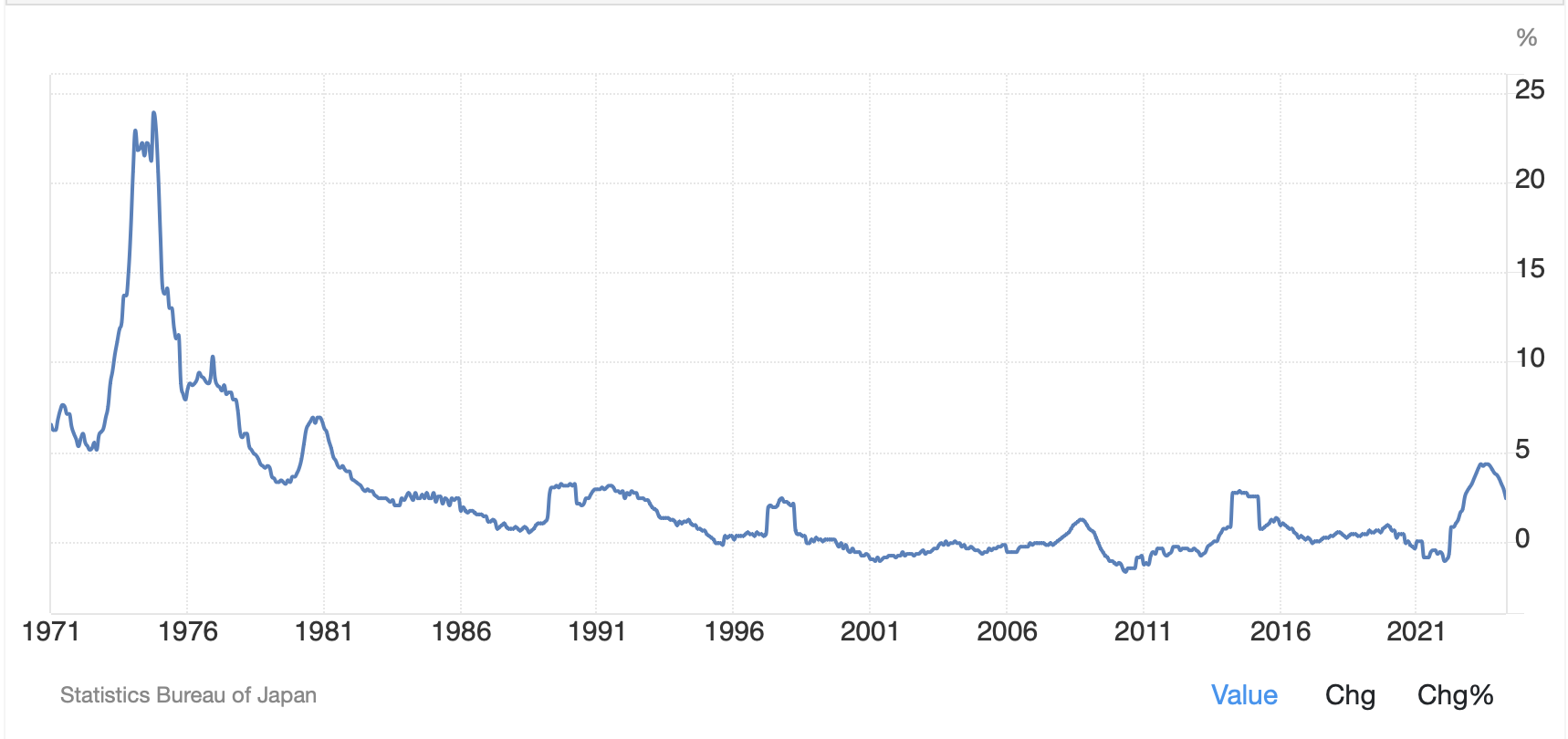
Japanese inflation data last night showed a continued decline as the Core rate fell to 2.2%, and the so-called super core rate slipped to 2.4%, its lowest level since October 2022.  As you can see in the super core chart below, the trend seems clearly to be downward although the current level remains far above inflation rates for most of the past 30 years.

Source: tradingeconomics.com

The irony here is that were this the chart of the inflation rate in any other G7 nation, the central bank would be crowing about how successful they had been at slaying the inflation dragon.  Alas, as the chart demonstrates, Japan’s dragon was a different species, and one that I’m pretty sure the 122 odd million people there were very comfortable having as a “pet”.  After all, I have never met a consumer who was seeking prices to rise before they bought something, have you?

From a market perspective, the continued decline in inflation rates calls into question just how much further Japanese interest rates need to rise in order to achieve the BOJ’s goals.  Again, remember the BOJ’s goals for the past decade has been to RAISE the inflation rate to 2% and their tactic has been to create the largest QE program in the world such that they now own more than 50% of the outstanding Japanese government debt across all maturities.  If inflation continues to decline back to, and below, 2%, while I’m confident the general population there will have no objections, Ueda-san may find himself in a difficult position.  

Arguably, if higher inflation is the goal (and politically that seems nuts) then the most effective tool the nation has is to allow the yen to continue to weaken and import inflation.  I continue to believe that this will be the process going forward, and while very sharp and quick declines will be addressed, a slow erosion will be just fine.  Absent a major change in US monetary policy to something much easier, I still don’t see a case for a much stronger yen.  However, as a hedger, I would continue to consider options to manage the risk of any further bouts of intervention.

While many are still of the view
That rate cuts are long overdue
What yesterday showed
Is growth hasn’t slowed
So, Jay and his friends won’t come through

Back home in the US, yesterday’s data releases did nothing to encourage the large contingent of people who are desperate looking for a rate cut before too long.  While New Home Sales were certainly lousy, falling from the previous month’s downwardly revised level, and the Chicago Fed’s National Activity Index was also quite soft, indicating economic activity had slowed last month, the Flash PMI data got all the attention with both Manufacturing (50.9) and Services (54.8) rising sharply, an indicator that there is still life in the economy yet.  The result was that we saw US yields rise (10yr +7bps), the dollar strengthen, and equity markets give back their early, Nvidia inspired, gains to close lower on the day.  While equity futures are rebounding slightly this morning, confidence that a rate cut is coming soon has clearly been shaken.

Adding to the gloom was a reiteration by Atlanta Fed president Bostic that it is going to take a lot longer for rates to impact inflation than in the past.  In a discussion with Stanford Business School students, he focused on the fact that so many people locked in low mortgage rates during the pandemic and recognized, “the sensitivity to our policy rate — the constraint and the degree of constraint that we’re going to put on is going to be a lot less.” For those reasons, Bostic said, “I would expect this to last a lot longer than you might expect.”  This discussion has been gaining more adherents as the punditry is grudgingly beginning to understand that their previous models are not necessarily relevant given all the changes the pandemic wrought.  Summing up, there continues to be no indication, especially in the wake of the more hawkish tone of the Minutes on Wednesday, that the Fed is going to cut rates soon.

So, with the new slightly less perfect world now coming into view, let’s take a look at market behavior overnight.  Yesterday’s US equity slide was continued everywhere else around the globe with Asian markets (Nikkei -1.2%, Hang Seng -1.4%, CSI 300 -1.1%) under uniform pressure and European bourses, this morning, also in the red, but by a lesser -0.4% or so across the board.  For many of these markets (China excepted) they have recently run to all-time highs, or at least very long-term highs, so it should be no surprise that there is some consolidation.  There is a G7 FinMin meeting this weekend and the comments we have heard so far indicate that the ECB is on track to cut rates next month, but there are no promises for further cuts.  Net, it seems clear that as much as most central banks want to cut interest rates, they are still terrified that inflation will return and then they have an even bigger problem.

In the bond market, it has been a very quiet session after yesterday’s yield rally with Treasury yields unchanged this morning and European sovereign yields similarly unmoved.  Even JGB yields are flat on the day as it appears bond traders and investors started their long weekend a day early.  Remember, not only Is Monday a US holiday, but it is a UK holiday as well, so there will be very little activity then.

In the commodity markets, oil prices remain under pressure and are drifting back toward the low end of their recent trading range.  One story I saw was that there is a renewed effort to get the ceasefire talks in Gaza back on track, but that seems tenuous at best.  Given the strength seen in the PMI data across Europe and the US, it would seem the demand side of the story would improve things here, but not yet.  As to the metals markets, after a serious two-day correction, this morning is bringing a respite with both gold and silver prices bouncing while copper prices remain unchanged.  I remain of the view that the longer-term picture for metals is still intact, so day-to-day trading activity should be taken with a grain of salt.  Ultimately, I continue to believe that the central banking community is going to cut rates before inflation is controlled and that will lead to much bigger problems going forward along with much higher commodity prices.

Finally, the dollar, which rallied alongside yields yesterday, is giving back some of those gains, albeit not very many of them.  The commodity currencies (AUD +0.2%, NZD +0.2%, ZAR +0.4%, NOK +0.6%) are the leading gainers this morning although the euro is also firmer as is the pound despite much weaker than expected UK Retail Sales data.  Alas, the poor yen can find no support and continues to drift a bit lower, with the dollar back above 157 this morning and keep an eye on CNY, which is now back above 7.25 for the first time in a month after Chinese FDI data showed larger than expected -27.9% decline.  It seems that President Xi has successfully scared off most foreign investment which is very likely a long-term problem for the nation.  While it has been very gradual, the fixing rate continues to weaken each day as it appears the PBOC is finally accepting the need for a weaker yuan.

On the data front, we see Durable Goods (exp -0.8%, +0.1% ex-Transports) and then Michigan Confidence (67.5) which continues to be a problem for President Biden’s reelection campaign as the people in this country are just not happy.  We also hear from Governor Waller this morning.  It will be very interesting to hear him as my anecdotal take is that the regional presidents have been much more hawkish than the governors and Chairman Powell, so if he leans dovish, it may demonstrate a bigger split between factions on the board than we have been led to believe.  We shall see.

Net, it remains very difficult for me to make a case for the dollar to weaken substantially at this time.  While it may not power ahead, a decline seems unlikely for as long as higher for longer remains the mantra.

Good luck and good long weekend

Adf

There will be no poetry on Monday due to the holiday.

Just Swell!

The markets were truly surprised
As yesterday’s Minutes advised
That higher for longer
Intent was much stronger
Than prior belief emphasized
 
The market response was to sell
Risk assets and thus, prices fell
But after the close
Nvidia rose
And now everything is just swell!


It turns out that Chairman Powell’s press conference had a distinctly more dovish feel to it than the tone of the FOMC meeting at the beginning of the month.  At least that appears to be the situation based on the Minutes of the meeting that were released yesterday afternoon.  In truth, it is somewhat surprising that given all the comments we have heard by virtually every member of the FOMC in the intervening three weeks, a reading of the Minutes resulted in altered opinions of how policy would evolve going forward.

While every Fed speaker has maintained the view that higher for longer remains the baseline, at the press conference, Powell essentially ruled out further rate hikes.  But in the Minutes, it turns out “various” members indicated a willingness to raise rates if necessary.  In addition, “a few” members would have supported continuing the QT process at the previous $60 billion/month runoff rather than adjusting it lower.  Finally, “many” questioned just how restrictive current monetary policy actually is, and whether it is sufficient to drive inflation back to their target.  Net, it appears there was quite a lively discussion in the room and the hawks are not willing to be ignored.

With this more hawkish stance now more widely understood, it cannot be surprising that risk assets sold off yesterday afternoon.  While I grant that the equity declines were modest, between -0.2% and -0.5% in the US, the tone of conversation clearly changed.  Meanwhile, the real damage occurred in the commodity markets where the recent sharp rise in metals prices ran into a proverbial buzzsaw and all of them fell sharply.  For instance, gold fell -1.5% yesterday and is lower by another -0.7% this morning.  Silver was a bit more volatile, losing -3.0% yesterday and down a further -1.25% today and the king of this move was copper, which tumbled more than -4% yesterday although it seems to be basing for now.

While there are several pundits who are describing these commodity price moves as a reaction to the dollar’s rebound, I actually see it more as a response to the idea that the Fed may be willing to fight inflation more aggressively than previously thought.  Remember, a key to the metals markets’ rally is the idea that the Fed is going to allow inflation to run hotter than target going forward, with 3% as the new 2%, and the widely mooted rate cuts would simply hasten that outcome.  In that scenario, ‘real’ stuff will retain its value better than paper assets and metals are as real as it gets.  However, if the Fed is truly going to stay the course and is willing to raise rates further to achieve their 2% goal, that is a very different stance which will support the dollar and paper assets far better.

Of course, none of this really mattered because the most important news yesterday was after the equity market close when Nvidia reported even stronger than expected results and also split their stock 10:1.  And, so, all is now right in the universe because…AI!  

Alas, this poet is not an equity analyst and has no useful opinion on the merits of the current valuations of AI stocks, so I will continue to focus on the macroeconomic story and try to interpret how things may evolve going forward.

Keeping in mind that the Fed may well be more hawkish than previously thought, that is quite a change in mindset compared to most other central banks where rate cuts appear far more likely as the summer progresses.  For instance, yesterday Madame Lagarde explained, “I’m really confident that we have inflation under control. The forecast that we have for next year and the year after that is really getting very, very close to target, if not at target. So, I am confident that we’ve gone to a control phase.”  This is her rationale for essentially promising, once again, that the ECB will cut rates next month.  However, we continue to get pushback from the ECB hawks that a June cut does not mean a July cut or any other cuts afterwards.  Now, I am inclined to believe that while they may skip July, they will cut again in September and probably consistently after that.

Of course, this is a very different stance than what was indicated by the FOMC Minutes, and I expect that there should be a greater divergence between European and US markets going forward because of this.  In fact, I am quite surprised that the FX market has not taken this to heart and that the euro remains as well bid as it is.  While the single currency has slipped about 2% since the beginning of the year, it is higher this morning by 0.2% and well above the lows seen back in mid-April.  Today’s price action has been driven by slightly better than expected Flash PMI data, but the big picture strikes me that there is more room for the euro to fall than rise.

And really, isn’t that the entire discussion overall, relative policy stances by the main central banks?  I continue to see that as the key driving force in markets at this time, and the macro data helps inform what those stances are likely to be.  If the US growth story is accelerating vs. other G7 countries, then we should expect to see continued outperformance by US assets and the dollar.  However, if the rest of the G7 is catching up, perhaps those tables will turn.  While PMI data has not been a particularly good indicator lately, the fact that European data (and Japanese data overnight) were slightly better than forecast may be an indication that things are changing.  Later this morning we will see the US version (exp 50.0 Manufacturing, 51.3 Services, 51.1 Composite) so it will be interesting to see if the market responds to any surprises there.

As to the rest of the overnight session, markets in Asia were mixed with more gainers (Japan, India, South Korea, Taiwan) than laggards (China, Hong Kong, Australia) with the gainers generally benefitting from somewhat better than expected PMI data and the laggards the opposite.  European bourses are mostly higher on the back of that better data as well.  As to US futures, at this hour (7:30) Nvidia has pulled the entire complex higher with the NASDAQ (+1.1%) leading the way.

In the bond markets, most major countries have seen essentially zero movement this morning with the UK (-3bps) the one exception as the PMI data there was a touch softer than expected.  Of course, you may recall that yields rose sharply in the UK yesterday after the hotter than expected CPI data, so this is a bit of a give-back.  JGB yields, interestingly, slipped back 1bp and are now back below 1.00% despite a modestly better than expected PMI reading.

Oil prices (+0.7%) are bouncing slightly after a string of down days and despite slightly larger than expected inventory builds in the US.  But for now, it seems clear there is ample supply.  And, of course, we already discussed the metals markets.

Finally, the dollar is a touch softer overall this morning with most of the movement as you might expect.  For instance, NOK (+0.7%) is rallying alongside oil and adding to the dollar’s broad weakness.  However, ZAR (-0.5%) remains beholden to the metals complex and is still under pressure.  Of minor note is the fact that the CNY fixing last night at 7.1098 was the weakest renminbi fix since January and some are claiming this is a harbinger of the PBOC relaxing its control of the currency.  While that may be true, I suspect it will be extremely gradual.  And the yen continues to tend weaker, not stronger, as the interest rate differential is too wide for traders and investors to ignore.  As well, it is fair to ask if Japan is really concerned about the level of the yen, or if they truly are only concerned with a slow and steady movement.  

Before the PMI data, we see Initial (exp 220K) and Continuing (1799K) Claims and the Chicago Fed National Activity Index (0.16).  Then, at 10:00 we see New Home Sales (680K) which are following yesterday’s much softer than expected Existing Home Sales data.  It seems clear that there is an ongoing problem in the housing market.  Finally, this afternoon, Atlanta Fed president Rafael Bostic speaks, and it will be quite interesting to hear his views now in the wake of the Minutes.

While actions speak louder than words, yesterday’s FOMC Minutes certainly have given me pause regarding my view that they were going to ease policy more quickly than inflation data may warrant.  That should help support the dollar and keep pressure on risk assets.  Of course, given the ongoing euphoria over AI and the Nvidia earnings, I don’t expect equity traders to care much about that at all.

Good luck

Adf

Likely Passé

The markets continue to snooze
Although today we’ll get some news
But Home Sales don’t spark
A narrative arc
About which most folks would enthuse
 
As well, given all that they’ve said
Those dozens of folks from the Fed
The Minutes today
Are likely passé
So, markets will head back to bed


Another very lackluster session yesterday resulting in marginal equity gains in the US as the dearth of new information continues to weigh on trading volumes and overall activity.  Of course, the one thing we did get yesterday was another tsunami of Fedspeak but all of it was the same as what we have already heard.  There is no need to go into details but suffice to say that the theme remains, April’s CPI reading was encouraging, but not nearly enough to consider rate cuts soon.  Instead, while they all believe that inflation will continue to head back to their 2% goal (although none of them have explained why they believe that) it appears that the first cut is not likely to be warranted before the fourth quarter.  In fact, it seems that several FOMC members are lining up with a December cut in mind although the Fed funds futures market continues to price a 60% probability of that first cut coming in September.

But here’s the thing I don’t understand; why are they so keen to cut rates at all?  This is the actual language in the Federal Reserve Act as amended in 1977 [emphasis added]:

“The Board of Governors of the Federal Reserve System and the Federal Open Market Committee shall maintain long run growth of the monetary and credit aggregates commensurate with the economy’s long run potential to increase production, so as to promote effectively the goals of maximum employment, stable prices and moderate long-term interest rates.”

As is typical with legislation, there is no specificity as to what each of these terms mean and thus, they are open to interpretation by each Fed chair.  For instance, prior to 2012, the concept of stable prices did not have a numeric attachment, and, in fact, when Alan Greenspan was Fed chair, he explicitly mentioned that 0% inflation was indicated.  However, Ben Bernanke determined that in the wake of the GFC, a numeric definition would be appropriate and that is how we got the 2% target.

On the employment question, the economic concept of NAIRU (non-accelerating inflation rate of unemployment) had been the north star for the Fed for decades and that number had typically been estimated at 5% +/- a bit.  The concept is that there is a theoretical unemployment rate below which wage pressures will rise and drive inflation higher and above which the opposite will occur.  However, just like the Fed’s other imaginary friend, R*, NAIRU is not observable, and nobody knows where it is.  Recent indications are that it is at a much lower level than previously thought as evidenced by the fact that Unemployment (ignoring the pandemic activity) was able to hover below 4% without any inflationary pressures of note.  At least that was true until the pandemic response flooded the economy with massive amounts of liquidity and funding directly to the population via stimulus checks.  But, as I said, nobody really knows what that level is, and so the concept of maximum employment is extremely nebulous.

Finally, moderate long-term interest rates are another bridge too far for the Fed given its ordinary operations.  While the Fed clearly controls the short end of the curve via the Fed funds markets and its interest payments on reserves, the long end of the interest rate curve is a completely different story.  Certainly, QE was a direct effort to impact long-term interest rates and was quite successful at lowering them, although the definition of moderate remains missing in action.  For instance, a look at the below chart with data from the FRED database shows that the long-term average 10-year yield (my definition of long-term interest rates in this context) is 5.56%.

Source: data FRED database; calculations @fx_poet

With this in mind, the current level of 4.45% or so remains relatively low, not high, and so the idea that rate cuts are necessary to meet the Fed’s mandate seems disingenuous at best.  This is especially true given that inflation is still well above their target of 2%.  Unless there has been a complete sea change of economic theories at the Fed where suddenly higher interest rates are inflationary*, not deflationary, it seems that there is something else at play here.

In the end, my point is that Fedspeak, which is widely followed, usually highlights that there is no guiding star as to what they want to achieve.  As well, their definitions are apt to change quickly if there is a perceived political expedient.  However, I will say that at the current moment, it certainly appears the entire committee is on the same page and wants to cut rates but cannot come up with an excuse they believe the market will accept as real.

Essentially, this was all a preamble to today’s FOMC Minutes release, which given just how much Fedspeak there has been between the meeting and today indicates there is very little new information likely to be revealed.  In the meantime, markets overall remain quiet and rangebound with commodities the lone exception.

Equity markets overnight were mixed in Asia while European bourses are marginally lower (albeit still near all-time highs) and US futures are essentially unchanged yet again.  Bond yields are rising a bit with Treasuries higher by 3bps and European yields higher by 4bps with an outlier UK rise of 10bps after a much hotter than expected inflation reading this morning (3.9% vs. 3.6% expected) reduced the chance of a rate cut next month.  And finally, 10-year JGB yields broke through the 1.00% level last night although the JPY (-0.15%) is actually weaker on the news.

Commodities, though, continue to be the most interesting story around with oil (-0.7%) slipping further after a bigger than expected inventory build from the API data as well as news that the Biden administration is looking to release a portion of gasoline inventories into the market to lower prices ahead of the election.  In the metals markets, the big three are softer again this morning (Au -0.4%, Ag -085%, Cu -2.3%) although on the charts, all remain above key support levels.  It can be no surprise that they are consolidating after their massive runs of the past week or two.

Finally, the dollar is tracking Treasury yields higher with strength almost across the board.  The notable exception is NZD (+0.4%) which has rallied after the RBNZ, while maintaining interest rates unchanged, was far more hawkish in their commentary and indicated they discussed further rate hikes given inflation’s stubbornness overall.  But otherwise, ZAR (-0.8%) is the worst performer, which given the metals market moves should be no surprise, but the dollar’s strength is otherwise universal.

On the data front, as well as the Minutes this afternoon, we see Existing Home Sales (exp 4.21M) at 10:00 and then the EIA oil inventory data at 10:30.  Mercifully, there are no Fed speakers scheduled today, although I wouldn’t be surprised if one gets interviewed somewhere.

Rumors of the dollar’s demise seem badly overblown, and it remains tightly linked to the move in US yields.  Unless we see yields take a serious step lower, I suspect the dollar is likely to remain well bid overall.

Good luck

Adf

*As an aside, several years ago Turkish President Erdogan made this case and kept firing central bankers who wanted to raise interest rates in Turkey to fight their significant inflation problems.  At that time, the economics profession ridiculed the idea completely.  However, lately, there have been a number of articles published that have made the case Erdogan was correct.  Of course, that seems to be an effort to encourage the Fed to cut rates despite high inflation.  As of yet, this brainworm has not infected Chairman Powell, but who knows what will happen as the election approaches.

Soothsay

On Monday, we heard the first five
Fed speakers, as all of them strive
To make a clear case
As why there’s no place
For cuts, lest they see a crash-dive
 
Amazingly, later today
We’ll hear seven others soothsay
Inflation’s still falling
Although it was stalling
Last quarter, much to our dismay


As Queen Gertrude noted in Shakespeare’s Hamlet, “The lady doth protest too much, methinks.” This is the first thing that comes to mind as we face yet another seven Fed speakers today (at eight venues, Mr Bostic will speak twice) in their effort to effectively communicate their current strategy, whatever that may be.  The very fact that we will have heard from a dozen of the nineteen FOMC members in the first two days of the week implies to me that the FOMC has absolutely no confidence that market participants are on the same page as they are.

My first observation is they really don’t have any idea what to do to achieve their goals.  Whatever their models are telling them, it is not aligned with the reality on the ground around the nation.  This is the most benign explanation I can see for their actions.  History has shown that the Fed PhD’s all believe very strongly in their models and when the models don’t accurately describe the economy, their first instinct is that the economy is wrong and that the people who make up the economy are not behaving properly because they don’t understand the beauty of the models and why the model should be correct.  This is akin to the government complaining that things are great and those who say otherwise just don’t understand things well enough.  Not surprisingly, this leads to overcommunication as the in-house view is the messaging is the problem, not the reality.

A less benign view is that they are politicking quite hard to ensure that the current administration is re-elected because they have a significant fear of a change of control at the White House.  As such, they believe that a constant drumbeat of ‘things are going to get better, and we are doing a great job’ will allay any fears that the current administration’s policies have resulted in the inflation that has been the main feature of the nation’s very clear unhappiness.

Perhaps the thing I understand less, though, is why any market participants even care about what Fed speakers say right now.  After all, yesterday’s comments were so closely aligned that a single speech would have sufficed.  I am quite certain that today’s messages will be similarly aligned both amongst themselves and with yesterday’s message.  The one thing that is very clear is that Chairman Powell has them all singing from the same hymnal.

And for those of you who have not been paying close attention, the message, in a nutshell, is that Q1 inflation was disappointingly high and so while April’s data was a bit better, they still do not have confidence that inflation is going to quickly head back to their 2% target so will maintain the current, restrictive, policy for as long as necessary.  It strikes me as unnecessary to have a dozen FOMC members repeat this message in a short period of time.

At any rate, given the remarkable lack of new information, other than the Fedspeak, which as I explain above is hardly new, let’s look at the markets overnight.  Yesterday’s US equity markets mixed performance was followed by weakness throughout Asia with Japan (-0.3%) slightly lower and Hong Kong (-2.1%) sharply lower and a lot more red than green throughout the region.  Of course, given the recent rally we have seen, it is not that surprising to see some consolidation.  European bourses are all lower this morning with losses ranging from Spain (-0.25%) to France (-1.0%) and everything in between.  There has been precious little new information here either, so again, given most of these indices are near record highs, some consolidation is inevitable.  Finally, US futures are little changed at this hour (7:30) as the market awaits idiosyncratic news for individual stocks as well as Nvidia earnings later this week.

In the bond market, quiet is the name of the game with Treasury yields edging lower by 2bps this morning, but really, just back to where they were yesterday morning.  Across Europe, the sovereign market is mixed with Switzerland (+3bps) the worst performer and the UK (-2bps) the best but most markets unchanged on the day.  Unchanged also describes the Asian session as JGB yields didn’t budge.

In the commodity markets, oil (-1.5%) is under pressure this morning, following yesterday’s modest declines as clearly there are no concerns over the situation in Iran regarding the death of the president there yesterday.  As to the metals markets, which in fairness have been FAR more exciting, more record highs yesterday are seeing a bit of consolidation this morning, although the declines in precious, (both Au and Ag -0.25%) are modest.  However, copper (+0.7%) knows no top as it continues to rally on the growing understanding that there is a long-term supply/demand mismatch, and it will be a sellers’ market going forward.

Finally, the dollar is basically unchanged this morning as while it has fallen from the recent highs at the beginning of the month (DXY at 106.40), there is very little follow through selling of the dollar now that US yields have stopped declining.  Recall, Treasury yields are lower by about 25bps in the same period but have stopped their decline as well.  The largest movers overnight have been KRW (-0.3%), which suffered after a weaker than expected Consumer Confidence reading and NOK (+0.3%) which is odd given oil’s recent weakness but absent any other related news.  Sometimes, markets simply move.

And that’s all there is today.  The Fedspeak starts at 9:00 with Richmond’s Thomas Barkin and Governor Chris Waller at separate venues, and last all day into the evening when Bostic, Collins and Mester speak at 7:00pm.  My money is on the idea that there will be nothing new learned from any of them.

As such, we remain in a holding pattern, I think.  US rates are finding a home around 4.4% and the dollar index at 104.50 seems pretty comfortable as well.  While later in the week we start to see some new information, I fear that until next week’s PCE data, we could well be stuck in a pretty narrow range.

Good luck

Adf

None Be Unique

When looking ahead to this week
The noteworthy thing is Fedspeak
At least fifteen times
They’ll give us their dimes’
Worth of knowledge, though none be unique
 
For instance, we already know
Their confidence is rather low
So, absent new data
Do they have schemata
Designed to get ‘flation to slow?


Arguably, the biggest news this morning is the death of the Iranian President and Foreign Minister in a helicopter crash overnight as it opens a range of possibilities regarding the future stance of Iran in the Middle East.  Will it remain the strict theocracy that it has been?  Or will a new leadership recognize the people appear to be growing tired of that stance and want something different.  While it would seem unlikely that there will be a major change, at least from this view thousands of miles away, if one were to come about, it would have a major impact on the Middle East and the ongoing conflict in Gaza.  After all, if Iran stopped funding terrorist groups, that would de-escalate things dramatically and potentially see a significant decline in the price of oil.  At this time, however, there is no information as to who will step into the role and what policies will be followed, so it is a wait-and-see period.  As it happens, oil prices (-0.35%) have edged lower this morning, but this is hardly a sign of anything new.  This will be quite critical to watch going forward.

However, beyond that, there has been vanishingly little new information about which to speak regarding the macroeconomic situation around the world.  The Chinese left their policy rates unchanged, as universally expected, and there has literally not been any other data from any major nation since Friday.  In fact, looking ahead at the calendar for the week, arguably the most significant piece of data to be released is Canadian CPI, or perhaps UK CPI and then on Friday we see the Flash PMI reports. 

Which brings us back to the Fedspeak.  It is staggering to think that the FOMC believes they need to be so visible at this time, especially after Chairman Powell explained that rate hikes were off the table and that while it may take a little longer than they had initially expected, they were still certain that inflation was going to head back to their 2% target.

Speaking of inflation, over the weekend I was reading some analysis (sad, I know) that highlighted if the US used the European HICP calculation the core reading would already be below their target with April’s data coming in at 1.9%.  To me this is a similar stance to what we heard at the end of 2023 when numerous pundits were explaining that the 3-month trend or the 6-month trend was already at 2.0% so why wait to cut?  Of course, the sticky inflation camp (this poet included) was quick to hoist them on their own petard as the recent 3-month and 6-month trends are pointing to 4+% CPI readings going forward.  

In this particular instance the question I would ask is, other than the fact that the reading is lower, why would anyone think that the European HICP inflation reading is a more accurate representation than the BLS representation?  The difference lies in the fact that HICP doesn’t incorporate housing price changes, which given they remain stubbornly high, have been supporting higher CPI readings.  But don’t people pay for their housing?  Certainly, it would be easy to create a lower CPI if you simply remove all the items that are going higher in price.  Unfortunately, that process doesn’t really tell you anything about reality.

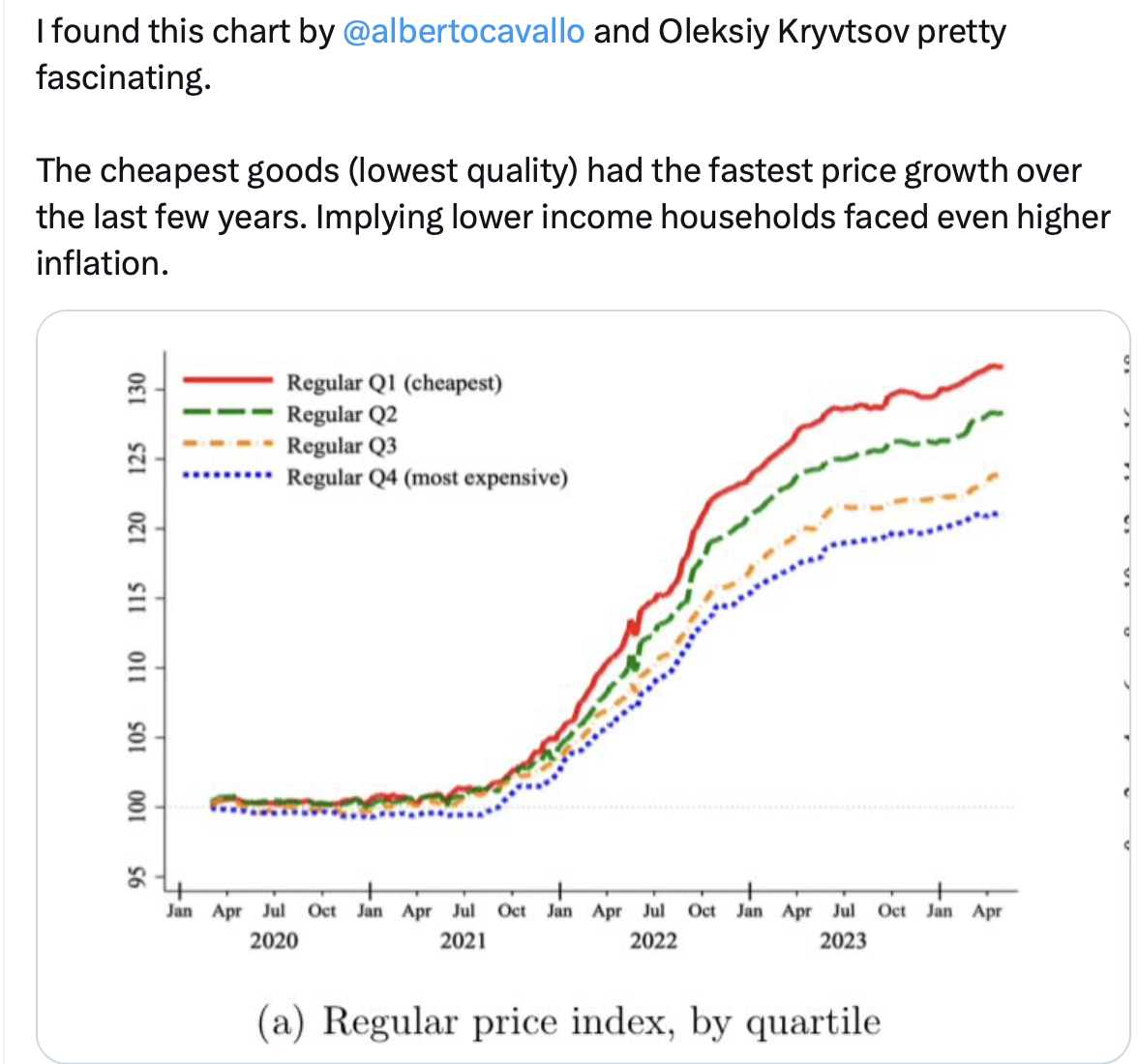
Below is a very interesting chart I found on X (nee Twitter) created by Professor Alberto Cavallo of Harvard and Oleksiy Kryvtsov, a Bank of Canada economist, which may be a better description of inflation as felt by the average person.

The fact that prices are rising fastest for the least expensive goods indicates that inflation is a major problem for Joe Sixpack, and no matter how pundits seek to adjust the measurement, so the numbers look better, reality is a harsh mistress.  (If you want to know why President Biden’s numbers are so bad, you needn’t look further than this chart.)  

Alas, there is no escaping the plethora of blather that will be coming from the Fed this week, although I sincerely doubt any of it will change anyone’s opinions about anything.  Ok, it was another generally quiet session overnight with the exception being the ongoing blast higher in metals markets.

Equity markets have performed well across the board, although the gains have not been too dramatic.  Japan (Nikkei +0.7%) was the best performer although the entire region was in the green to a lesser extent, about 0.35% or so.  In Europe, all the bourses are higher as well, but here the gains are even smaller, on the order of +0.25% across the board while US futures are essentially unchanged at this hour (6:30).

In the bond market, Treasury yields, which backed up 2bps on Friday are unchanged this morning while European sovereigns are higher by roughly 1bp across the board.  ECB speakers have conceded that a rate cut is coming in June, but many are pushing back hard against the idea that a July cut is a sure thing, preferring to wait until September.  However, the really interesting thing is in Japan, where JGB yields have traded up to 0.98%, a new high yield for this move and a level not seen since March 2012.  At this point, it would seem that 1.00% is a foregone conclusion so it will be interesting to see how the BOJ responds when that ‘magic’ number is finally traded.

But, as I mentioned above, it is a metals day with gold (+0.9%), silver (+1.1%) and copper (+0.9%) all continuing last week’s strong gains with gold making yet further new highs, copper pushing its historic highs and silver breaking above a key technical resistance level at $30/oz last week and now extending those gains.  While there have been many explanations for this price movement, I think you need to consider precious and industrial metals separately.  For precious, there continues to be a growing concern in the ongoing debasement of the fiat currency universe and both individuals and central banks are seeking to hold alternative assets.  On the industrial side, though, especially copper and silver which are both critical to electronics, the ten-year hiatus in investment due to the ESG cult combined with the recent recognition that all the new-fangled tech wizardry like AI is going to require gobs of power and electrical capacity has simply skewed the supply/demand curve to much more demand than supply.

Finally, the dollar is little changed this morning, pretty much at the same level overall since Thursday.  Given the lack of movement in the rates space, this ought not be a surprise.  It also ought not be surprising that the best performing currencies of the past week have been CLP (+3.5%) as it has simply traveled alongside its major export, copper, and ZAR (+5.1%) as it rallies alongside the precious metals complex.  Meanwhile, there has been no movement in the interest rate narrative with, perhaps, the exception of Japan, but what we have learned there lately is that higher JGB yields lead to a weaker yen.  Go figure!

On the data front, as I said earlier, it is extremely light this week,

WednesdayExisting Home Sales4.22M
 FOMC Minutes 
ThursdayInitial Claims220K
 Continuing Claims1799K
 New Home Sales680K
FridayDurable Goods-0.7%
 -ex Transport0.1%
 Michigan Sentiment67.6
Source: tradingeconomics.com

It is not clear, given how much we have already heard from Fed speakers since the last FOMC meeting, that the Minutes will be very informative.  Perhaps the discussion about QT will change some minds, but I doubt it.  Otherwise, if stocks continue to rally, market players will be happy and not try to rock the boat.  Meanwhile, the dollar will need a new impetus to break out of this narrow range, but that may not come until next month’s NFP data.

Good luck

Adf

Naught to be Gained

It now seems inflation has stalled
Which has bond investors enthralled
But Fedspeak explained
There’s naught to be gained
By cutting ere its, further, falled

Meanwhile, data China released
Showed Retail Sales nearly deceased
But factories still
Produce stuff at will
Thus, exports have widely increased

It has been quite a week with respect to the data that has been released as well as regards the ongoing commentary onslaught from central bank speakers around the world.  A quick recap shows that market participants have decided they know what is going to happen in the future (the Fed is going to start cutting rates and continue doing so) while every member of the Fed who has spoken has claimed just the opposite, that there is no reason for the Fed to adjust policy at this time given the still too high inflation readings and the seeming appearance of ongoing economic strength.  I continue to marvel at the ‘narrative’ which for 15 years warned, ‘don’t fight the Fed’ which was in its historic process of driving rates to and maintaining them at essentially 0.00%.  And yet now, those very same pundits listen to every Fed speaker with bated breath and conclude that despite their insistence that rate cuts are not coming anytime soon, rate cuts are just around the corner so ignore the Fed and buy risk assets.

My observations on this conundrum are that first, the market is much bigger than the Fed or any central bank or even all the central banks put together.  So, if the market is of the mind to continue to add risk to their portfolios for whatever reason, risky assets will increase in price.  However, the central banks are not irrelevant to the process as they do control short-term interest rates (aka funding costs) directly and can have great sway on long-term interest rates through both commentary and the ability to intervene in those markets a la QE or QT.  In other words, the battle has been joined and while I expect the market will ultimately go wherever it wants to, the central banks will have something to say about the path taken to get there.  So, do not be surprised if there are some downdrafts along the way to higher prices.

Remember, too, that central banks have a great deal to do with creating inflation, not merely fighting it, and if they continue to add money and liquidity to both the economy and markets, the real value of assets will not climb nearly so far and could well decline.  While this is an age-old battle, arguably having been ongoing since the first central banks were created in the 1700’s, it does have the feeling as though we are coming to a point in time where things could get out of hand in the near future.  Perhaps not Weimar Republic out of hand, but certainly 1970’s stagflation out of hand.

Turning to the only real news overnight, Chinese data was released and the dichotomy in the Chinese economy continues to be evident to one and all.  While IP printed at a better than expected 6.7%, highlighting that Chinese factories are humming, Retail Sales fell to a 2.3% Y/Y reading, far below both last month and expectations.  In other words, while China continues to build lots of stuff, it is all for export as the domestic population is not in the mood to buy.  This has led to two consequences of note.  The first is that as the Chinese trade balance continues to expand, we have seen, and will likely see more, tariffs imposed by destination markets like Europe and the US thus straining economic ties further.  Too, this is in direct opposition to the idea of reshoring of manufacturing which continues to be the political goal throughout the West.

The second impact is that President Xi has clearly recognized that a major impediment to further Chinese economic growth is the ongoing disaster otherwise known as the Chinese property market.  This is the driving force behind the recent efforts to support things via government purchase of unfinished and unsold homes with the goal of those being converted into public housing. 

Alas, there are a few problems with this plan which may hinder a smooth application of the idea.  The first problem is that the reason these homes are unfinished or unsold is that the developers have run out of money or cannot sell them at a profit.  In other words, somebody needs to take some big losses and absent a directive from Beijing I assure you none of the developers will willingly do so.  The proposed fixes of reducing the minimum mortgage rate and size of the down payment necessary to purchase a home may help at the margin but will not solve the problem.  The problem is that the losses likely approach $1 trillion, a large amount for even the national government, and so finding those who can afford to absorb those losses is a difficult task.  Certainly, some of the state-owned banks will be in the spotlight here, but they are already insolvent (if one takes a realistic look at their non-performing loans) so don’t have that much capacity to do more. 

The critical feature here is that more time is needed for companies and banks to grow via their other businesses such that they can eventually absorb those losses.  But time is not on Xi’s side here.  All told, the underlying situation in China remains fraught, in my view, and so must be viewed with care.  While the PBOC is clearly willing to prevent the renminbi from collapsing, such an unbalanced economy is going to display a great deal of volatility going forward.

Ok, did markets do anything interesting overnight?  In truth, not really.  After yesterday’s modest declines in the US equity markets, Asian markets were mixed with Japan, Australia, Korea and Taiwan all under pressure while Chinese and Hong Kong shares rallied sharply on the back of the property proposals.  This morning, European bourses are mostly a bit softer as it seems that while a June rate cut is baked in, there has been significant push-back against a following cut in July, a story which had gained great credence lately.  Meanwhile, at this hour (6;45) US futures are ever so slightly lower, -0.1% across the board.

In the bond markets, after the post CPI yield decline in the US on Wednesday, yields have been backing up since their nadir and are now nearly 8bps higher from the bottom with 2bps this morning’s contribution.  European yields have shown similar price action, falling through Wednesday evening and bouncing since then.  As to the JGB market, yields there have backed up a bit as well, now trading at 0.95%, but have not yet been able to touch the big 1.00% level.  The irony is that USDJPY has been trading in sync with JGB yields, so as they climb, so does the dollar!  That is not what the narrative had in mind; I assure you!

In the commodity space, oil is little changed this morning but that is after rallying $1 during yesterday’s session as the market absorbed the larger than expected draw in inventories described on Wednesday.  As well, the idea that the Fed is soon going to cut rates and stimulate economic activity has pushed bullishness on the demand side.  As to the metals markets, they are edging higher again this morning with copper seeming to consolidate after its rocket higher and collapse earlier this week.  Adding to the copper story is that Goldman Sachs commodity analyst, Jeff Currie, said he was more bullish on copper than anything else during his career!  Based on my view that debasement of currencies remains a key feature of the current monetary regime globally, I expect metals to continue to rise as well.

Finally, the dollar continues to rebound from its lows seen Wednesday night late with the DXY having regained 0.8% since the bottom and the greenback higher versus nearly every one of its counterparts this morning.  I believe the dollar story remains closely tied to the Fed for now, and as long as the Fed maintains that rate cuts are a distant prospect, at best, it will retain its value.

The only data release this morning is Leading Indicators (exp -0.3%) which has been in negative territory for nearly two years and still no recession.  We also hear from Governor Waller, but all four Fed speakers yesterday were consistent that they do not yet have confidence inflation is falling to target and so higher for longer remains the base case.

It has been a volatile week and I expect that today will see far less activity as the lack of critical data and the fact that traders are tired from all the activity so far this week will lead to many leaving for an early weekend.  But the big trends remain intact, a higher for longer Fed will help support the dollar while the narrative will not be dissuaded and continue to buy risk assets.

Good luck and good weekend

Adf