New Shibboleth

A second rate hike
By Japan has resulted
In strong like bull yen


Last night, Governor Kazuo Ueda and the BOJ raised their overnight call rate to 0.25% from the previous level of between 0.00% and 0.10%.  This move was forecast by several analysts but was certainly not the base case for most, nor what this poet expected.  However, it appears that the gradual slowing in inflation in Japan was not seen as sufficient and so they moved.  By far, the biggest reaction came in the FX markets where the yen jumped sharply, now higher by 1.5% compared to yesterday’s NY close.  A look at the longer-term chart of USDJPY below shows that at its current level just above 150.00 (obviously a big round number), the currency has reached a double support level based on its 50-week moving average (the curved line) and the trend line that starts from the time the Fed began raising interest rates in March 2022.

Source: tradingeconomics.com

Surprisingly, given the sharp move seen overnight, there has been virtually no discussion as to whether the MOF asked the BOJ to intervene and further push the yen higher (dollar lower) in concert with its recent strategy of pushing a market that is moving in its favor rather than fighting a market that is moving against its goals.  Regardless, the 150 level is going to be a very important technical support, and any break below may open up another 10 yen decline in the dollar.

What, you may ask, would lead to such a move?  How about the Fed?

The pundits are holding their breath
With “cut Jay” their new shibboleth
But will Chairman Powell
Now throw in the towel
On prices and channel Macbeth?

Of course, this afternoon, the big news is the FOMC meeting wraps up and at 2:00 they release their statement which is followed by the Chairman’s press conference at 2:30.  As of this morning, the probability of a cut today is down to 3.1% according to the CME’s futures market.  However, that market has a 25bp cut locked in for September with a further 10% probability of a 50bp cut then and is pricing in a total of 66bps of cuts by the December meeting, so, a bit more than a 60% probability of three 25bp cuts by the end of the year.  That pricing continues to feel aggressive to this poet as the data has not yet shown that the economy is clearly in trouble.  Remember, too, the Fed is always reactive, despite any of their comments on trying to get ahead of the curve.

Continuing our observations of mixed data, yesterday saw that home prices, as per the Case-Shiller Index, remain robust, rising 6.8% in May (this data is always lagging), but there is little indication that the shelter component of the inflation statistics is set to decline sharply.  As well, the JOLTs Job Openings data printed at a higher than expected 8.184M, indicating that there is still labor demand out there.  Finally, the Consumer Confidence number rose a touch more than expected to 100.3.  My point is there continues to be strength in many parts of the economy and prices are nowhere near declining.  Granted, this Friday’s NFP report will take on added importance as if the numbers there start to decline and Unemployment continues its recent trend higher, there will be far more urgency to cut rates.  Perhaps this morning’s ADP Employment report (exp 150K) will help clear up some things, but I’m not confident that is the case.

Interestingly, there are still a number of analysts who are clamoring for the Fed to cut today, claiming they can get ahead of the curve and stick the soft landing.  However, history has shown that the Fed lives its life behind the curve, and there is no indication that is about to change.

There is one other thing to consider, though, and that is the politics of the situation.  While the Fed is adamant they are apolitical and only trying to achieve their mandated goals, we all know that in order to even be considered to reach the FOMC as a named member of the committee, one needs to be highly political.  Does that mean that partisan politics enters the arena?  These days, it is almost impossible for that not to be the case.  

The current narrative on this subject is that a rate cut will help the current administration, and by extension the candidacy of VP Harris.  I’m not sure I understand that given inflation, which remains a major topic of conversation around the country, especially at the proverbial kitchen table, is so widely hated across the board.  The most interesting poll results I saw were that a majority of those questioned indicated they hated inflation far more than a recession.  This surprised the economic PhD set, but as inflation is an insidious cancer on everyone’s wellbeing, it is no surprise to this poet.  My point is that a rate cut now will do exactly zero to help support growth before the election, but it will almost certainly boost the price of commodities, notably energy and gasoline, and that will show up in inflation post haste.  Thus, does the narrative even make sense?  If Powell is truly partisan (and I don’t think that is the case), he would refrain from cutting rates until September as any impact, other than in financial markets, will not be felt until long after the election.  FWIW, I agree with the market there will be no cut today, but absent a major decline in the employment situation by September, I see only 25bps there.

Ok, a bit too long to start today, but obviously there is much of importance to understand.  So, let’s look at how markets have responded to the BOJ while they await the FOMC.  As earnings season continues, the tech sector in the US continues to struggle as evidenced by the sharp decline in the NASDAQ yesterday, although the DJIA managed to gain 0.5%.  In Asia, though, tech concerns were overwhelmed by the excitement of the BOJ’s action and the strength in the yen.  Perhaps the surprising thing is the Nikkei (+1.5%) rose so much given a strong yen generally undermines the index, but the rate hike boosted bank shares by 5% or more across the board.  And that strong yen was welcomed everywhere else in Asia with Chinese shares (Hang Seng +2.0%, CSI 300 +2.2%) and almost every regional exchange gaining real ground on the back of a less competitive Japan given the higher yen.

In Europe, most markets are much firmer as well this morning, led by the CAC (+1.4%) and FTSE 100 (+1.4%) although Spain’s IBEX (-1.0%) is lagging on uninspiring corporate earnings results.  I would contend these markets are being helped by that stronger yen as well, given Japan’s status as a major exporter.  Lastly, US futures are higher at this hour (7:20) after some better-than-expected results from chipmaker AMD, although MSFT’s numbers were less impressive.  Net, though, NASDAQ futures are up 1.6% this morning dragging everything else along for the ride.

In the bond market, Treasury yields continue to edge lower, down -1bp this morning and European sovereign yields are all lower by between -2bps and-3bps.  That is somewhat interesting given the flash Eurozone inflation data printed higher than expected at 2.6% headline, 2.9% core, but the market is clearly going all-in on the rate cutting narrative.  The big moves in this market, though, came in Asia with JGB yields jumping 5bps after the rate hike and the BOJ’s announcement they would be reducing their monthly purchases by 50%…OVER THE NEXT TWO YEARS!  They are not exactly rushing to tighten policy.  However, even more impressive was the -16bp decline in Australian 10yr bond yields after softer than expected inflation data overnight got the market thinking about rate cuts instead of the previous view of rate hikes being the next move.

In the commodity markets, things have really broken out.  Oil (+3.5%) is finally paying attention to the escalation of hostilities in the Middle East after Hamas leader Haniyeh was killed while in Iran.  While Israel has not officially claimed the act, that is the assumption and concerns are elevated that there will be a more dramatic response impacting many oil producing nations.  This has encouraged the rally in precious metals with gold (+0.4%) continuing its rally after a >1% gain yesterday, and support for both silver and copper as well.  Frankly, the copper story doesn’t make that much sense given the ongoing lackluster economic growth story, but with the metal’s recent sharp decline, this could simply be a trading bounce.

Finally, the dollar is all over the place this morning.  As mentioned above, the yen is today’s big winner, but we have seen strength in CNY (+0.25%) and KRW (+0.85%) as well, with both those currencies directly aided by yen strength.  Meanwhile, AUD (-0.5%) has responded to the quickly evolving rate story Down Under and is cementing its position as the worst performing G10 currency in July.  Not surprisingly, the commodity linked currencies are having a good day with ZAR (+0.6%) and NOK (+0.5%) both stronger, but after that, the financially linked currencies are not doing very much, so the euro, pound, Loonie and Swiss franc are all only marginally changed on the day.

In addition to the ADP and the FOMC, this morning also brings the Treasury’s QRA, although there is little interest in that report this time around as expectations remain that there will be no major change to the recent mix of debt, i.e., mostly T-bills.  We also see Chicago PMI (exp 44.5) and get the EIA oil data, although the latter will have a hard time competing with a pending war in the Middle East.

All told, not only has a lot happened, but there is also room for a lot more to occur before we go home today.  Quite frankly, I don’t see anything extraordinary coming from Powell, but the risk, to me, is he is more dovish than required and the dollar falls more broadly while commodity prices rise.  Keep your eye on that 150 level in USDJPY, as a break there can really get things moving.

Good luck

Adf
German Malaise

With central bank meetings ahead
Tonight BOJ, then the Fed
The discourse today’s
On German malaise
And why vs. the PIGS its widespread


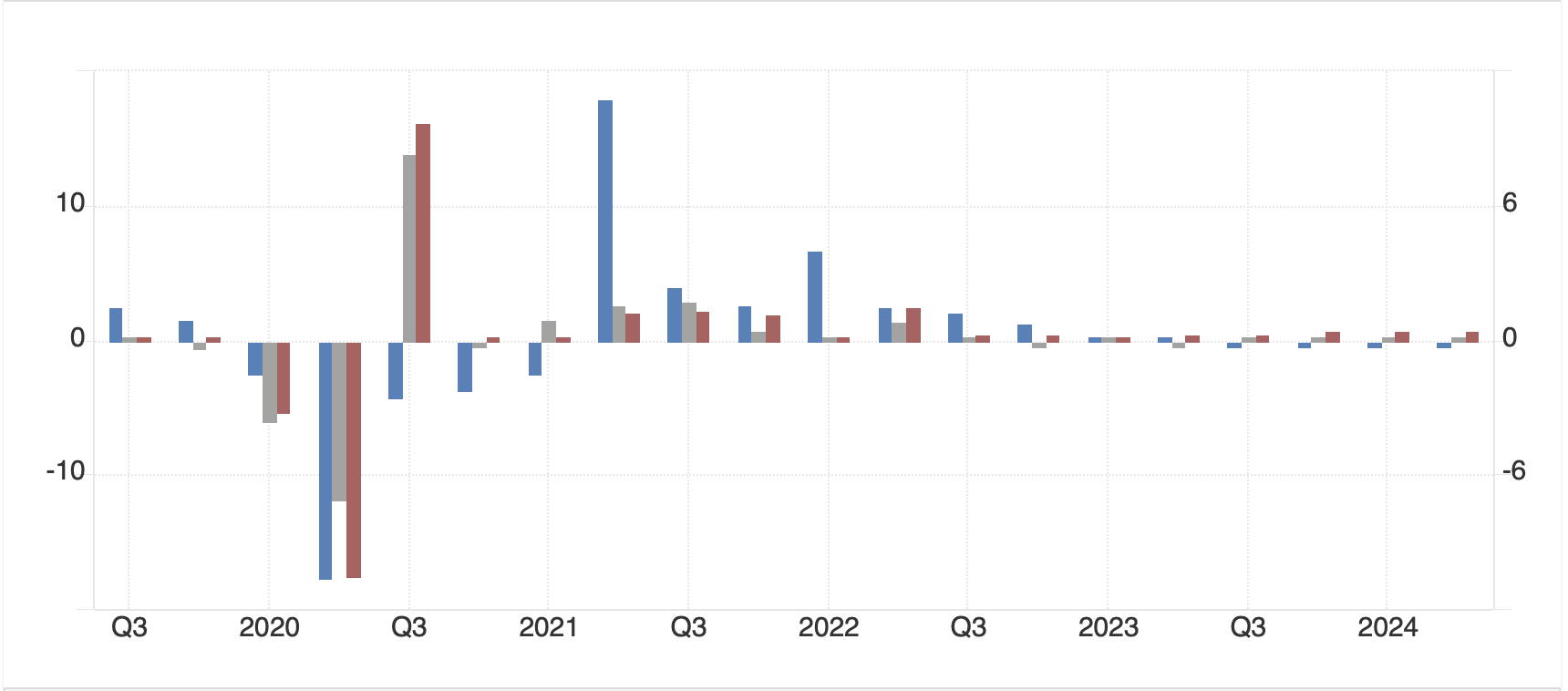
As investors await the news from Ueda-san tonight and Chairman Powell tomorrow, the market discussion has revolved around the potential problems that Madame Lagarde is going to have going forward given the split in economic outcomes within the Eurozone.  As can be seen in the below graph, German GDP growth (grey bars) has been running at a negative rate for the past 4 quarters.  But you can also see that the situation in both Spain (red bars) and Italy (blue bars) has been the opposite, with both of those nations maintaining a steady pace of growth.


Source: tradingeconomics.com

So, while Germany is the largest single economy within the Eurozone, its current trajectory is very different than much of the rest of the bloc, ironically specifically the PIGS.  Should the ECB ignore German weakness and manage monetary policy toward the overall group?  Or should they ease more aggressively in order to support the Germans while risking a rebound in still sticky inflation?

Perhaps the first thing to answer is why Germany has been suffering for so long. This is an easy question to answer. Germany’s energy policy, Energiewende, has been an unmitigated disaster.  Their efforts to address climate change have led to the highest energy costs in Europe which, not surprisingly, has resulted in a massive reduction in manufacturing activity.  Areas where Germany had been supreme, like chemicals and autos, are hugely energy intensive industries, so as their cost of production rose, the companies moved their activities elsewhere.  Adding to the insanity was the policy to shutter their nuclear fleet, which had produced 10% of the nation’s electricity, during the post Ukraine invasion energy crisis.  And ultimately, this is the problem.  The cost of money is not Germany’s economic problem, it is their policies which have undermined their own growth ability.  While the ECB cannot ignore Germany outright, there is nothing they can do that will help the nation rebound in any meaningful way.  With that in mind, I would contend Lagarde needs to focus on the rest of the bloc to make sure policy suits them.  But that is a political discussion.

What are the likely impacts of this situation?  Eurozone growth, overall, surprised on the high side despite the lagging German data.  As well, inflation readings released thus far this month have shown that prices remain sticky on the continent.  With that in mind, the idea the ECB needs to cut aggressively seems to make little sense.  This is not to say they will maintain tighter policy, just that it doesn’t seem justified to ease.  But right now, the market zeitgeist is all about easing monetary policy (except in Japan) so I expect they will do just that going forward.  With this in mind, it strikes that the euro (+0.15%) is going to struggle to rally from current levels absent a dramatic shift in Fed policy to aggressive rate cuts.  As to European bourses, I suspect that they will reflect each nations’ own circumstances, so the DAX seems likely to lag going forward.

Will he, or won’t he?
Though inflation’s been falling
Hiking pressure’s real
 
A quick thought regarding tonight’s BOJ meeting and whether Ueda-san believes that further rate hikes are appropriate for the Japanese economy.  As with many things Japanese, the proper move is not necessarily the obvious one.  A dispassionate view of the recent data trends shows that inflation (2.8%) has been sliding slowly, GDP growth (-0.5%) has been falling more quickly and Unemployment (2.5%) remains at levels consistent with the economy’s situation given the shrinking population.   On the surface, this does not seem like a situation where hiking is desperately needed except for one thing, the yen remains broadly weak.  The chart below shows that since the advent of Abenomics in 2011, the yen has lost 50% of its value. 


Source: tradingeconomics.com

Now, initially, that was a key plank of the Abenomics platform, weakening the yen to end deflation.  Well, kudos to them, 13 years later they have achieved that result.  But where do they go from here?  There is a growing belief that the BOJ is going to hike by 15bps tonight and bring their base rate up to 0.25%.  I disagree with this theory given the very clear recent direction of travel in the inflation data in Japan as despite the yen’s weakness, it dispels any notion that a rate hike is needed to push things along.  One positive of the weak yen is that the balance of trade has returned to surplus in Japan.  

Source: tradingeconomics.com

For decades, Japan ran a large positive trade balance but since the GFC, that situation has been far less consistent.  However, the trade balance remains an important domestic signal as to the strength of the economy and its recent return to surplus is welcomed by the Kishida government.  It is not clear how raising interest rates will help that situation.  Net, with inflation sliding and the economy under pressure, hiking interest rates does not make any sense to me.

Ok, let’s take a look at how markets have behaved overnight.  Yesterday’s lackluster US equity market performance was followed by very modest strength in Japan (+0.15%), although weakness throughout the rest of Asia with the Hang Seng (-1.4%) the laggard, although mainland Chinese (-0.6%) and Australian (-0.5%) shares also suffered.  Meanwhile, in Europe this morning bourses on the continent are higher by about 0.4% across the board after the Eurozone GDP data seemed to encourage optimism.  The UK (FTSE 100 -0.2%), however, is under a bit of pressure amid ongoing discussions in the new Labour government about the need for austerity.  At this hour (7:20) US futures are edging higher by about 0.25%.

In the bond market, after yesterday’s sharp decline in yields around the world, it has been far less exciting with Treasury yields edging down another basis point and European sovereigns either unchanged or 1bp lower.  Perhaps the most interesting things is that JGB yields fell 2bps overnight and the 10yr yield is now back below 1.00%.  That doesn’t seem like a market preparing for a rate hike there.

In the commodity space, everybody still hates commodities with oil (-0.5%) continuing its recent slide.  In fact, it is down nearly 10% in the past month (which is good for us as we refill our gas tanks).  In the metals markets, copper continues to slide, down another -1.5% this morning as optimism over economic and manufacturing activity around the world remains absent, especially in China.  For instance, the Politburo there met yesterday and pledged to help the domestic economy, although they did not lay out specific actions they would take.  Recall last week’s Third Plenum was also a disappointment, so until the market perceives China is back and growing rapidly, or that the global growth impulse without them is picking up, it seems that industrial metals will remain under pressure.  Gold (+0.4%) however, remains reasonably well bid as continued Asian central bank buying along with retail interest in Asia props up the price.

Finally, the dollar is generally under modest pressure although the outlier is the yen (-0.6%) which does not appear to be expecting a BOJ hike tonight.  But elsewhere, the movements in both the G10 and EMG blocs have been pretty limited overall, on the order of 0.15% – 0.35%.  It is hard to find an interesting story about any particular currency as a driver today.

On the data front, this morning brings the Case-Shiller Home Price Index (exp +6.7%), JOLTs Job Openings (8.0M) and the Consumer Confidence Index (99.7).  I keep looking at that Case-Shiller index and wondering when the housing portion of the inflation readings is going to decline given its consistent strength.  But really, I suspect that all eyes will be on Microsoft’s earnings this afternoon along with the other hundred plus names that are reporting today.  With the Fed coming tomorrow, macro is not important right now.  So, more lackluster trading seems the most likely outcome today, although with the opportunity for some fireworks starting around midnight when the BOJ statement comes out.

Good luck

Adf

Jay’s Motivation

The Keynesian view of inflation
Claims growth is its major causation
If that is the case
Then given the pace
Of growth, what is Jay’s motivation?
 
Instead, ought he not be concerned
Inflation will soon have returned?
Or does he believe
That he can deceive
The market without getting burned?


Another week passed with another set of confusing data.  But more important than the data’s inconsistency is the inconsistency in the arguments made by those desperate for the Fed to cut rates.  For instance, former NY Fed president Bill Dudley wrote a widely read article for Bloomberg saying that he had suddenly become a convert and that the Fed needed to act this week and cut rates.  Granted, he wrote this article the day before the much hotter than expected GDP data was printed, but nonetheless, he had been a staunch hawk and changed his feathers.  And he is not alone, with a number of other high profile financial personalities (I’m looking at you Claudia Sahm) in the same camp.

But I would ask them the following: since you are strong proponents of Keynesianism which describes inflation as a direct result of strong growth and labor markets, given that GDP is running at 2.8% annualized, double Q1’s pace and above trend, and a federal government budget deficit that is approaching 7% despite that growth, and the latest PCE data showing that services inflation remains quite robust (the 6-month level has risen to 5.4%), why do you think the Fed should cut rates?  By your own thesis, inflation is more likely to rise than fall given the economic strength.  Alas, either no journalist will ask that question, or no Fed official will answer. 

At the same time, those analysts who have been calling for a recession in the near future, continue to dig through the better-than-expected data releases and find the weak points to make their case.  Here’s the thing, Powell and company cannot point to yet another subindex of the major data points and claim that is why they are cutting.  He remembers far too well his focus on so-called super core (core ex housing) with the expectation that housing was the problem and if he removed the part of the index that was rising, the rest of the index would be lower.  Alas for his finely tuned plans, that number continues to power along at 4.0% or higher.  He will not make the same mistake again and focus on some obscure view.  

At this point, there is certainly no reason for the Fed to act this Wednesday, and unless the economy essentially falls out of bed by September, it will be difficult to make that case as well.  This is not to say they won’t cut in September come hell or high water, just that if the economy proceeds as it currently appears to be doing, there will be no justification.  But just to put an exclamation point on the likelihood a cut is coming in September, this morning the Fed whisperer, Nick Timiraos, told us that is the case in his latest missive for the WSJ.

In addition to the Fed meeting this week, we also hear from Ueda-san and the BOJ on Tuesday night and Governor Bailey and the BOE on Thursday morning.  Given the near certainty that the Fed is going to remain on hold this week, arguably the BOJ is the far more interesting meeting, at least for financial market cues.  Remember, the narrative has been that the BOJ was finally going to start to “normalize” their policy, lifting interest rates above 0.0% and start to reduce their ongoing QQE program.  Now, this has been the story since last October, and while they did exit the NIRP stage back in March, there has been nothing since then.  Not only that, as I highlighted last week, inflation in Japan is already slowing with the current policy.  

In addition, the yen, while it has backed away from its recent highs (dollar lows) by about 1%, is far from its worst levels and appears to be trending slowly higher, exactly what they want.  I see no case for a rate hike here, although we will certainly hear about how they may modify their QQE actions going forward.  (As an aside, for those with JPY exposures, 152.00 is a very critical level in the market’s perception and a break below that level could well lead to a significant decline in the dollar.)

Lastly, the BOE is going to cut by 25bps.  Given that the ECB has already cut, as has Switzerland and Canada, they will not be able to hold out any further.  I don’t think we need any rationale beyond this to believe Bailey will act.

Ok, let’s look at the overnight market activities.  Friday, you may recall, US equities rebounded sharply from the short-term correction and Japanese shares (Nikkei +2.1%) followed right along, as did the Hang Seng (+1.3%) and almost every other major market in Asia save one, China (CS! 300 -0.5%) as there continues to be a distinct lack of progress on the economy there.  In Europe, the situation is mostly positive as both the DAX (+0.4%) and Spain’s IBEX (+0.6%) are rallying nicely but the French (CAC -0.1%) are suffering a bit, perhaps because of the seemingly constant mishaps regarding the Olympics and the nation’s infrastructure.  This morning, major internet connections were severed around the country, although backups are now working, which added to a dramatic blackout over the weekend and the high-speed rail terrorist arsonist attacks late last week.  But here at home, US futures are firmly in the green (+0.4%) at 6:15am.

In the bond market, euphoria is the story as virtually every major bond market has rallied with yields falling around the world.  Treasury yields are lower by -4bps while across European sovereigns, we are seeing declines of between -5bps and -7bps across the board.  Even JGB yields (-4bps) have fallen, perhaps another signal that the BOJ is unlikely to be acting this week.

In the commodity markets, oil (-0.3%) cannot seem to find any support of note despite a significant inventory draw last week and an escalation in events in the middle east over the weekend.  For the past year, oil has traded between $70/bbl and $90/bbl and we continue to trade in that range with no exit in sight.  We will need to see some very significant economic changes, either a sharp recession or a giant rebound in China, to break out of this range I believe, neither of which seems like a near-term phenomenon.  In the metals space, gold (+0.3%) continues to find support even after a sharp decline a couple of days last week, with spot hovering just below $2400/oz.  This morning, silver (+0.75%) is also rallying but copper (-1.1%) is in a sharp downtrend, despite the news that the workforce at the world’s largest copper mine, Escondida in Chile, is preparing to go on strike.  

Finally, in the currency markets, despite the lower yields everywhere and the generally positive risk environment, the dollar is higher nearly across the board.  Both the euro and pound are softer by about -0.2% and we are seeing the EEMEA currencies following suit with declines on the order of -0.4% across this bunch.  USDJPY is little changed this morning although CNY (-0.1%) is edging lower again after the PBOC’s recent efforts to prevent a sharp decline in the wake of their rate cuts.  Interestingly, the outlier this morning is NOK (+0.3%) despite oil’s decline and there is no obvious catalyst for this movement.  One other currency that is bucking this trend is AUD (+0.1%) which while not much higher this morning, given it has been falling sharply every day for the past two weeks, seems to have found a bottom.  That movement is highly linked to the JPY strength as AUDJPY is a favorite carry trade for many in both the institutional and retail spaces.  If USDJPY does break through that 152 level look for AUD to continue its decline.

On the data front, we know it is a big week, but here are the details:

TuesdayCase Shiller Home Prices6.6%
 JOLTS Job Openings8.03M
 Consumer Confidence99.5
WednesdayBOJ Interest Rate Decision0.1% (unchanged)
 ADP Employment149K
 Treasury QRA 
 Chicago PMI44.5
 FOMC Rate Decision5.5% (unchanged)
ThursdayBOE Rate Decision5.0% (-0.25%)
 Initial Claims236K
 Continuing Claims1860K
 Nonfarm Productivity1.7%
 Unit Labor Costs1.8%
 ISM Manufacturing49.5
 ISM Prices Paid52.5
FridayNonfarm Payrolls175K
 Private Payrolls150K
 Manufacturing Payrolls-2K
 Unemployment Rate4.1%
 Average Hourly Earnings0.3% (3.7% Y/Y)
 Average Weekly Hours34.3
 Participation Rate62.5%
 Factory Orders-3.0%
 -ex transport+0.3%

Source: tradingeconomics.com

Obviously, an awful lot to consume and digest this week with the central banks and then NFP.  In addition to all that, we have a significant amount of earnings data coming from some big names including Apple, Amazon, Meta and Microsoft.  Certainly, the strong expectation is for the Fed to remain on hold and prepare the market for a September cut.  That is already priced into the futures market, so much will depend on the tone of the statement and the press conference following the meeting.  As such, my sense is the real unknown is the BOJ early Wednesday morning, but I suspect they leave rates on hold.  If they do hike, I would look for USDJPY to break that key support level of 152, so that feels like the biggest risk heading into the week.

Good luck

Adf

Quite Vexatious

The data remains quite vexatious
As some shows that growth is bodacious
But other releases
Are closer to feces
Implying the first stuff’s fallacious
 
For instance, the GDP print
At two point eight offered no hint
Recession is nearing
Yet stocks aren’t cheering
For bears, in their eyes, there’s a glint
 
But Durable Goods was abysmal
At minus six plus, cataclysmal
And more survey data
Implied that pro rata
The story ‘bout growth’s truly dismal


In the past week, we have seen a decent amount of data, and the upshot is that there is still no clarity on the US economic condition.  Many analysts accept the data at face value, and with today’s GDP print as the latest installment, dismiss the idea of a recession coming soon.  Others look at the headline, and then the underlying pieces and detect that ‘something is rotten in Denmark the US’.

 A quick review of the recent data shows the housing market is weakening further, with both New and Existing Home Sales declining on a monthly and annual basis.  As well, the Survey data showed the Richmond and Kansas City Fed’s Manufacturing Indices falling deeper into negative territory as well as a weak Flash PMI Manufacturing print.  Durable Goods headline fell -6.6%, which while it is a volatile series (depending largely on airplane deliveries by Boeing), was still a terrible outcome.  Absent transports, though, it rose 0.5%, which seems more in line with the first look at Q2 GDP, showing a 2.8% annualized growth rate.  (One thing to watch in that GDP report is the PCE index that is implied and showed a surprising rise.  Keep this in mind for tomorrow’s PCE report.). Alas, final Sales in the GDP report only rose 2.0%, a potential harbinger of future weakness.  

If we go back and look at the CPI data, which was soft, or the NFP data, which was strong, there continue to be underlying pieces of almost every report which indicate weakness compared to headline strength or vice versa.  So, which is it, recession or no?

Unfortunately, we will not know until the next recession has likely finished given the NBER’s methodology of declaring a recession.  (It is important to understand in the US, the rule of thumb, two consecutive quarters of negative real GDP growth is not the definition.)  Regardless, we haven’t even had one quarter of negative growth.  This poet’s view is that the economy is clearly slowing down with respect to activity but does not seem like it has yet tipped into recession.  Perhaps things will be clearer in Q3, but for now, the arguments are going to continue.

Tokyo prices
Keep on decelerating
Why will they tighten?

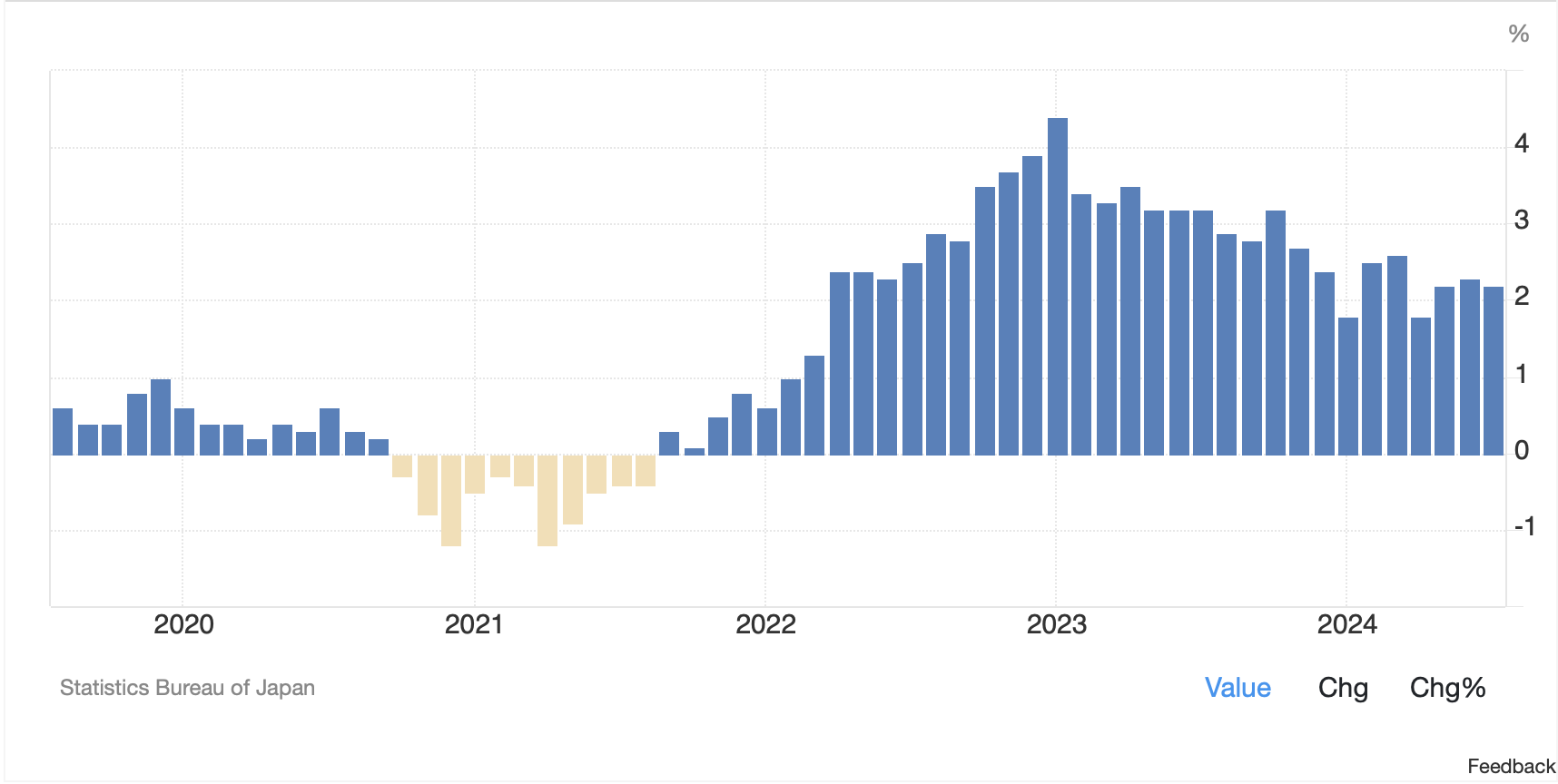
Tokyo CPI data was released overnight and once again, it was a touch softer than expected with both headline and core printing at 2.2%.  In fact, the ex-food & energy index rose only 1.1% Y/Y!  The Tokyo data is typically a harbinger of the national number and when looking at the data, it is easy to understand why Ueda-san is reluctant to tighten further.  As per the chart below, the trend here remains toward lower inflation without any further policy adjustments.  

Source: tradingeconomics.com

So, why would they move next week?  This is especially so given the yen has rebounded nearly 6% over the past several weeks, relieving pressure on the biggest current concern.  I know it is fashionable to think that the BOJ is going to tighten policy while the Fed cuts, but it is not difficult to make the case that the US economy is continuing to tick along and so higher for longer remains appropriate, while in Japan, price pressures are easing without any further policy tightening.  There is increasing analyst discussion the BOJ is going to move, but I remain suspect, at least at this point.  Rather, I expect that there is probably more short-covering to come in the JPY and that is going to further relieve pressure on the BOJ to act.

This morning, we get PCE
The data most pundits agree
Will license the Fed
To cut rates ahead
At least that’s the stock market’s plea
 
The final big story today is the release of the PCE data.  As we all know by now, this is the inflation metric the Fed uses in their models.  Current median expectations are as follows: Headline (+0.1% M/M, 2.5% Y/Y) and Core (+0.1% M/M, 2.5% Y/Y).  In both cases, that would represent a tick lower in the annual number compared to last month, and based on the current narrative, would add to the Fed’s confidence that inflation is coming under control.  And maybe that will be the case.  After all, the past two inflation reports have come in below the median expectations. 
 
However, there is another PCE report that is published alongside the GDP data.  Essentially, it is the number that determines how much of nominal GDP is actual growth and how much is price growth.  As part of yesterday’s GDP release, the core PCE index rose at a 2.9% rate, lower than Q1 but above expectations.  I’m merely pointing out that as seen above, there is a lot of conflicting data out there.  It would be premature to assume that inflation is under complete control in my view, although that is the growing market belief.
 
Ok, let’s look at what happened overnight.  Equity markets are trying to figure out what everything means right now.  Yesterday’s US performance was mixed, with Tech stocks still under pressure although the DJIA managed to gain on the day.  Overnight, Japanese stocks (-0.5%) continued their recent decline, following the NASDAQ lower, but both Hong Kong and China managed small gains on the session.  As to Europe, most major indices are in the green led by the CAC (+0.85%) despite the terrorist attacks on the high-speed rail network as the Olympics begin there.  But after several down days, investors feel like the correction has run its course and are coming back.  This is evidenced by US futures which are higher by upwards of 1% at this hour (6:30).
 
After yesterday’s more aggressive risk-off session, this morning bond yields are little changed to slightly higher around the world.  Treasuries are unchanged and European sovereigns have seen yields rise by either one or two basis points.  JGB yields, too, are higher by 1bp, as it appears investors have been exhausted by this week’s volatility.  Of course, a surprising number this morning will almost certainly get things moving again.
 
In the commodity markets, oil, which managed to rebound at the end of the day yesterday, is lower by -0.4% this morning.  Given the volatility across all markets right now, it is difficult to come up with a coherent story about the situation here in the short run.  Gold (+0.4%) which got decimated yesterday, has run into technical support and is rebounding, but the same is not true for silver or copper, both of which remains near their recent lows.  I will say this about copper; as it remains one of the most important industrial metals, its weakness does not seem to bode well for economic growth going forward, and yet as we saw yesterday, US GDP is running above trend.  This is simply more evidence that confusion reigns in market views.
 
Finally, the dollar is generally lower this morning. While the yen (-0.55%) is giving back some of its recent gains, almost all of the other major currencies in both the G10 and EMG blocs are a touch stronger.  MXN (+0.7%) is the leader followed by ZAR (+0.5%) with most others gaining much smaller amounts.  The thing is, aside from the US data, there has been precious little other data of note that would drive things.  One might make the argument that the rebound in gold is helping the rand, but that seems tenuous.  Right now, with risk being re-embraced, my take is the dollar is simply softening a bit.
 
In addition to the PCE data we also see Personal Income (exp 0.4%) and Personal Spending (0.3%) and then at 10:00 we get the Michigan Sentiment Index (66.0).  But all eyes will be on PCE.  I look at the GDP data and think we could see something a bit hotter than currently forecast and desperately hoped for.   If that is the case, I suspect that stocks may falter and bonds as well although the dollar should regain ground.
 
Good luck and good weekend
Adf


Destined for Sloth

The Chinese are starting to worry
That if they don’t act in a hurry
Their ‘conomy’s growth
Is destined for slowth
Explaining their rate cutting flurry


Sunday night, the PBOC surprised markets by cutting both their 1-year and 5-year Loan Prime Rates by 10 basis points each.  As well, they cut the rate on their newly developed 7-day repo rate by 10bps as they endeavor to shorten the maturity of their money market operations. At the time, it was taken as a response to the Third Plenum and the only concrete action seen as new support for the economy.  As its name suggests, those rates represent the cost to borrow for credit worthy companies.  A quick look at the history of this rate (the blue line), which was first tracked toward the end of 2013, shows that over time, it has done nothing but decline.  I have overlayed a chart of USDCNY in the chart (the grey line) to help appreciate the long-term trend in that as well which, not surprisingly, shows a steady weakening of the renminbi (rise in the dollar).

Source: tradingeconomics.com

But the reason I bring this up is that last night, the PBOC surprised markets yet again by cutting its One-Year Medium-Term Lending Facility by 20 basis points, to 2.30%.  Not only was this the largest cut since the pandemic, but it was also done at an extraordinary meeting and combined with an injection of CNY235 billion (~$32B) into the economy.  Arguably, this is the most aggressive monetary policy stance that has been effected by the PBOC since the summer of 2015 when they surprisingly devalued the renminbi 2%.  Apparently, the PBOC is trying to adjust its policy actions to be more in line with the G7 where central banks use short term rates as their tools.  One other thing this implies is that President Xi remains steadfastly against any fiscal stimulus of substance at this point.  On the one hand, you must admire that effort, but I fear that the domestic Chinese economy remains so weighed down by the ongoing property sector problems, achieving their 5.0% GDP growth target is going to become that much more difficult as the year progresses.

For our purposes, though, the story is all about the CNY (+0.7%), which rallied sharply after the announcement, continuing its movement from the Monday rate cuts which totals 1.1%.  Now, ordinarily one might think that a country cutting its rates would lead to a weaker currency, ceteris paribus, However, given the market outcome, there is much discussion about how the PBOC “requested” Chinese banks to more aggressively buy CNY to support the currency.  Interestingly, the fixing rate on shore overnight (7.1321) continues to weaken ever so slightly overall, but now the spread between the fix and the market has fallen to just over 1%, well within the +/- 2% band and an indication there is less pressure on the currency.  My take is this is just window dressing, but I would not fight it.  I expect that we will see USDCNY slowly return to higher levels over time, with the key being it will take lots of time.

The ongoing rout
In tech stocks has another
Victim, dollar-yen

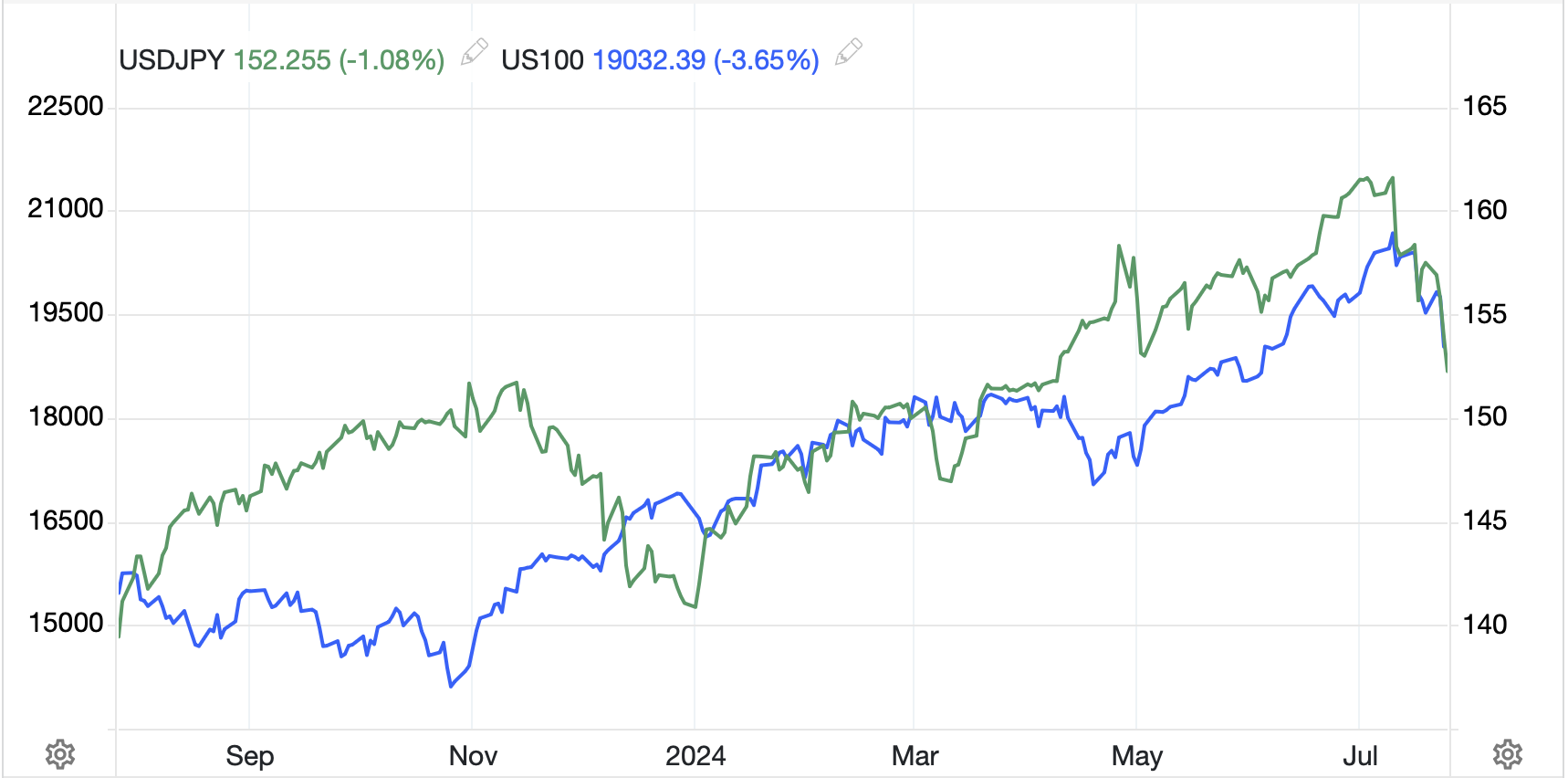
Under the guise, a picture is worth a thousand words, the below chart showing the NASDAQ 100 (blue line) and USDJPY (green line) overlaid is quite interesting.

Source: Tradingeconomics.com

While there is an ongoing argument amongst market practitioners as to whether it is the decline in the tech sector that is driving USDJPY’s decline or the other way round, what is clear is that there is a strong correlation between the two.  If you think about what the USDJPY trade represents, it is the purest form of a carry trade, shorting the cheapest currency and using the funds to buy a much higher yielding currency with maximum liquidity.  But another thing to do with those funds obtained from borrowing yen and buying dollars was to use the dollars to jump on the tech stock bandwagon.  After all, that added another 30% to the trade since the beginning of the year.  

However, over the past two weeks, nearly one-third of the NASDAQ gains have been erased and that has been made worse by the >6% rise in the yen.  At this stage, it no longer matters which is driving which, the reality is that we are seeing significant short covering in the yen with sales in other assets required to unwind the trade.  Arguably, this is why we are seeing virtually every risk asset lower this morning, although bonds are holding up as havens, as all have been funded with short yen.  Given that relationship, I am coming down on the side of the yen being the driver, but as I said, I don’t think it matters.  

The real question is can it continue?  It is important to understand that when markets achieve excessive levels like we saw in USDJPY, they rarely simply unwind to some concept of fair value.  Rather they typically overshoot dramatically in the other direction.  As such, if we assume PPP is fair value, and PPP for USDJPY is currently around 110.00, it appears there is ample room for USDJPY to decline much further.  Consider, this movement has happened, and the Fed has not even started to cut rates.  If we do, indeed, fall into recession, the Fed will respond, and I expect that we could see a very sharp decline in USDJPY.  Something to consider looking ahead.

While that was a lot about the currency markets, they seem to be the current drivers, so are quite important.  But let’s look at everything else.

Equity market pain has been universal with Japan (-3.3%), Hong Kong (-1.8%) and China (-0.6%) all following the US lower overnight and in Europe, this morning, it is no better with the CAC (-2.2%) the worst performer, but all the major indices falling sharply.  US futures are little changed at this hour (7:00), but remember, we are awaiting key GDP data and more earnings numbers, which have been the driver.

As mentioned above, bond markets are rallying with Treasury yields lower by 5bps and most European sovereigns seeing declines of -3bps or -4bps.  Credit is an issue as Italian BTPs are the laggard this morning, with yields there only lower by 1bp.  Equally of interest is the fact that the US yield curve inversion has been reduced to just 14bps and has been normalizing dramatically for the past several sessions.  One thing to remember about the yield curve is that when it inverts, it indicates a recession is coming, but when it uninverts, it indicates the recession has arrived!  This is all of a piece with softer economic data and expectations of Fed policy ease coming soon to a screen near you.

In the commodity markets, nobody wants to own anything.  Oil (-1.3%) is continuing its recent poor performance despite EIA data showing significant inventory reductions.  This is not a sign of strong demand.  But we are also seeing weakness across the entire metals space with gold (-1.0%) breaking back below $2400/oz and silver and copper under severe pressure.  Right now, nobody wants to hold these, although I suspect that the long-term supply/demand situation remains bullish.

Finally, the dollar is mixed overall.  While we have seen strength in JPY and CNY, as discussed above, and CHF (+0.8%) is also showing its haven status and use as a funding currency, there are numerous currencies under pressure, notably AUD (-0.8%), NOK (-0.8%), MXN (-0.8%), ZAR (-0.7% and SEK (-0.6%) all of which are commodity linked to some extent.  Yesterday, the BOC cut rates by 25bps, as expected, but the Loonie has been steadily weakening for the past two weeks, so yesterday’s decline and today’s is just of a piece with that.  Ultimately, we are watching a serious risk-off event, and I expect the dollar will hold its own vs. most currencies, although JPY and CHF seem to have room to run yet.

On the data front, once again yesterday’s data was on the soft side with the Flash Manufacturing PMI falling to 49.5, well below expectations and New Home Sales slipping to 617K.  In fact, it is difficult to find the last strong piece of data, perhaps the ex-autos Retail Sales number from last week.  This morning, we see Initial (exp 238K) and Continuing (1860K) Claims, Q2 GDP (2.0%), and Durable Goods (0.3%, 0.2% ex transport).  The Atlanta Fed’s GDPNow tool is indicating GDP in Q2 was 2.6%, well above the forecasts.  However, I think of much more interest will be to see how it starts out for Q3.  We have had a spate of weak data, and those recession calls are growing louder.

This is a tough market, but I expect we have not yet seen the last of the risk-off trade (just consider how long the risk-on trade has been going on) so further dollar strength against most currencies, except for JPY and CHF, and further weakness in commodities and equities seem the most likely direction.

Good luck

Adf

Losing Their Mirth

The data of late round the earth
Is showing, of late, there’s a dearth
Of positive vibes
Which aptly describes
Why people are losing their mirth
 
Last night and this morning we learned
The PMI data has turned
Much lower worldwide
Though many bulls tried
To urge us to not be concerned


Are we in a recession?  That question, which several analysts have already declared to be the case, is being asked more actively of late.  While the official recession call is not made until well after the fact by the National Bureau of Economic Research (NBER), for investing and hedging purposes, that is a little late in the game. Rather, the reason analysts exist at all is to help people understand the situation in real-time, not on a historical basis.  And remember, one of the biggest problems is that, almost by definition, most data are backward looking, describing what happened already, not what will occur going forward.

Now, it is true that when it comes to economic data, it tends to trend so extrapolating that trend makes some sense, but history has shown that the timing of those changes can vary widely.  Alternatively, we can look at the Survey data like PMI, ISM or the regional Fed surveys, to try to get a sense of what business managers are expecting.  This is certainly more forward-looking, but as it is describing expectations rather than actual spending and output, can diverge from what ultimately occurs.  We have seen this frequently over the past several years as several surveys indicated slowing activity while the hard data (payrolls, GDP, Retail Sales, IP, etc.) held up well.

This brings us back to the opening question, are we in a recession?  Well, so far this week the data that has been released is not pointing to strength of economic activity.  In the US, Monday’s Chicago Fed National Activity Index printed at 0.05, down significantly from the May print of 0.23.  Then yesterday, Existing Home Sales fell to 3.89M, far below expectations and pushing back toward levels last seen during the housing crisis in the GFC.  As well, the Richmond Fed Manufacturing Index fell to -17, well below last month and expectations.  

Turning the clock on the global day, we saw Japanese Manufacturing PMI fall to 49.2, well below expectations of 50.5, although the Services PMI held in well at 53.9.  Australian PMI data was soft (47.4) and the same was true in Europe (France 44.1, Germany 42.6, Eurozone 45.6). Again, there can easily be a difference between the survey data and the hard data, but the weight of evidence is starting to lean toward slowing growth.

Another key feature of a growing economy is rising profitability of the corporate sector.  As we have entered Q2 earnings season, it is worth looking at some of the big names that have released already.  Last night, Tesla reported weak earnings, and this morning we heard a similar story from LVMH in Paris and Deutsche Bank.  UPS was weak and Alphabet (Google), even though they beat forecasts, has been punished in the aftermarket because its YouTube data was poor.  In fact, I think that is a critical issue.  The equity market, or at least the large cap space, seems priced for perfection, so even good earnings may not support current pricing.  But more importantly, if large corporations are seeing earnings declines that could well be indicative of weaker economic activity.  And that comes back to that opening question.

To recap, we have recently seen broadly weaker Survey data, the US housing market is clearly struggling, and corporate earnings are not uniformly keeping up with expectations.  Does this mean we are in recession?  Absolutely not, but it has certainly raised the probability that the most widely anticipated recession in history is closer than we would like.

What are the implications of this situation?  Well, this morning we saw Bill Dudley, former NY Fed President, write in Bloomberg that the Fed shouldn’t wait until September to cut rates, but rather should cut them next week.  The market does not believe that will be the case as futures continue to price just a 4.7% probability of such a move, although the September cut is baked in right now.  In fact, dovish analysts and former policymakers are increasingly calling for the Fed to act before it’s too late.  Personally, I don’t see that happening, although if data continues to soften, there will be increasing discussion of a 50bp move in September, mark my words.

There is one other place to look for clues about economic activity as well, the commodity markets.  Consider that slowing economic activity generally leads to reduced demand for inputs like commodities, be they energy, metals or agricultural products.  A quick look at the Goldman Sachs Commodity Index, which is widely followed as a measure of broad commodity activity, shows that throughout Q2, at least, the trend has been down.

Source: tradingeconomics.com

My point is that the odds of a recession seem to be rising and that means we are likely to see weaker equities, weaker commodities, lower yields and a softer dollar, at least at first.  But remember, the dollar is a relative trade.  If the US enters recession, you can bet that so will many other countries, and the reaction functions around the world could well result in currency weakness of even greater magnitude elsewhere and the dollar holding its own.

Ok, I rambled a bit, so let’s quickly see how the overnight session went in markets.  After a very modest sell-off in the US, Asian markets were far more reactive to some negative US earnings reports with the Nikkei (-1.1%) and Hang Seng (-0.9%) leading pretty much all indices lower here.  Adding to the woes of the Nikkei was the further strength in the yen (+0.85%, +3.3% in the past month) as Japanese exporters feel the pain.  European bourses are also under pressure with the DAX (-0.7%) and CAC (-0.9%) leading the way lower after their worse than expected Flash PMI data discussed above.  Finally, US futures are all in the red this morning led by the NASDAQ (-1.0%) at this hour (7:30).

In the bond market, yields are little changed so far this morning despite the weaker data.  In fact, in the past month, 10-year Treasury yields have not moved at all.  There continues to be confusion as to whether inflation or economic activity is going to be the driving force in central bank activities and as long as that is the case, bond traders don’t know which way to jump.  One exception is JGB yields which are creeping higher again, up 2bps overnight.  There is now much discussion that the BOJ is going to raise rates at their meeting next week, as well as start to taper its ongoing QE program.  This is likely supporting the yen (as well as short covering there) but will seemingly undermine the equity markets in Japan if this is the case.  However, I expect this story to gain traction until the BOJ meeting.

In commodity markets, oil (+0.6%) is bouncing after a very rough week as the market awaits the EIA inventory data.  The API data, which is not given as much credence, showed a larger than expected draw yesterday, which seems to be helping crude this morning.  Gold (+0.1%) continues to hold its own but copper (-0.6%) remains under pressure on the weak China and recession stories.  Remember, it is often called Dr. Copper on the theory it has a PhD in economics for its ability to forecast economic activity.

Finally, the dollar is mixed this morning with the yen the notable outlier, but strength, too, in ZAR (+0.5%) on the back of a sharp rise in South African yields this morning.  But there are more laggards, albeit with modest movements in the G10 (EUR -0.1%, AUD -0.25%. SEK -0.2%).  In the EMG bloc, HUF (-0.8%) is the laggard, although we are seeing weakness throughout the CE4 on the back of the euro’s modest decline.  This story continues to be focused on the rate differential.  The more we hear about calls for the Fed to cut sooner or more aggressively, the more likely the dollar will remain under pressure.

On the data front, we see the Goods Trade Balance (exp -$98.0B) as well as the Flash PMI data (Manufacturing 51.7, Services 55.0) and finally New Home Sales (640K).  With no Fed speakers, the data will gain more prominence, especially if it shows up weaker than expected and continues the trend discussed above.  As well, the equity market will continue its importance to overall trading as further earnings reports are released.  Net, it is starting to feel like weaker economic activity is making itself felt.  That should result in a little dollar softness, at least until other countries demonstrate the same traits.  But for today, the one thing I see is further short covering in JPY and a continuation of that trend.

Good luck

Adf

A Bummer

The narrative writers have turned
Their focus, as markets they’ve spurned
It’s politics now
That they all endow
With ideas we need be concerned
 
And so, if the pricing is right
Come next week, the Fed will sit tight
The rest of the summer
Could well be a bummer
For traders, with volumes quite light


It is not uncommon for the summer months to lack interesting new information for market participants.  While the regular monthly cycle of data continues to be released, the fact remains that there seems to be less interest overall.  This is not to say there have never been summer surprises, but the very fact we call them surprises is indicative of their relative scarcity.  

This year, especially, seems likely to have even fewer financial or economic discussions than usual given the ongoing drama in the US political cycle.  And while this poet has opinions as to how things may work out (and of course what I would like to see) that is not what this morning missive is all about.  Rather, I continue to try to find the stories that drive market activity and alert you to what is happening.  But the ongoing political narrative is now so dominant, everything else pales in comparison.  And as I wrote yesterday, while political narratives can have some market impact, it is not typically that significant.

I mention this because there were exactly zero stories of any market consequence overnight.  Much was written about the US elections and there were some ‘thought’ pieces on issues like the long-term impacts of President Xi’s iron grip on China and what that means for the economy there, but there was no data to excite, there were no comments of note and basically, it was all quite dull.  For instance, I’ll bet you were unaware that the G20 is meeting in Rio de Janeiro because it is almost impossible to find a story on the meeting.  I suspect that Thursday’s GDP and Friday’s PCE data are going to be the most exciting things that occur this week.  

Unless, of course, there is a real summer surprise.  It is earnings season with the Mega-cap tech companies set to report this week and next, but those are generally not market wide movers.  So, with that in mind, let’s take a look at the overnight market activity and call it a day.

After US equity markets showed their resilience yesterday, laughing off the concept of a rotation out of tech or the beginning of a serious correction, Asian markets mostly followed that same line of thinking if you ignore Japan (flat) and China (CSI 300 -2.1%, Hang Seng -1.0%) as the rest of the region was in the green, with some markets really enjoying a boost, notably Taiwan (+2.75%).  The Chinese story seems to be ongoing disappointment that the Third Plenum did nothing to indicate support for the economy and the 10bp rate cuts were seen as insufficient.  As to Japan, the tension between the rebound in tech shares and the strengthening in the yen led to no net movement.  In Europe, though, bourses are all following the US lead and rising nicely, led by the DAX (+1.2%) as hints by some ECB members indicate that a cut is coming in September despite Madame Lagarde’s insistence that no decisions have been made.  As to the US futures markets, at this hour (7:15) they are little changed overall.

Bond markets have seen yields decline this morning with Treasuries (-2bps) the laggard compared to Bunds (-4bps) and OATs (-3bps).  Of course, this follows yesterday’s session where yields edged higher by a few basis points and basically shows that investors are unwilling to take any directional views until we at least see the PCE data, if not until the FOMC next Wednesday.  Since the beginning of the month, Treasury yields have been choppy in a range of 4.15% – 4.30% and are currently sitting right in the middle.  There continue to be two longer term views, with the recessionistas calling for a sharp decline in yields as it becomes clear the US economy is slowing and the Fed will cut rates to stimulate, while the fiscal policy bears keep pointing to the massive deficits and issuance that accompanies those deficits, and explains that at some point, demand will not meet supply and yields will rise sharply.  My own view is that both of these outcomes will obtain, with the first recession signals helping to send yields lower before longer-term troubles emerge for the US fiscal picture.  But right now, it’s hard to get excited in either direction.

In the commodity space, oil (-0.3%) remains under pressure although today’s decline is far less severe than we’ve seen in the past several sessions.  Rumors of OPEC increasing production in Q4 seem to be one driver as well as forecasts for inventory builds in the US this week.  Gold (+0.6%) continues to find buyers and remains above $2400/oz as Asian demand, from both central banks and individuals remains a key driver.  Copper (-1.0%) on the other hand continues to suffer, down more than -6.0% this month, as the slowdown in China’s economy weighs on demand for the red metal.

Finally, the dollar, which has been written off more times than I can count, is firmer again, back above 104.00 on the DXY.  For all the discussion about how the dollar is set to decline, a quick look at the DXY over the past year tells me that there is no discernible downtrend at all (nor is there an uptrend).  

Source: tradingeconomics.com

There has been an uptick in the long-term ‘dollar will die’ narrative, but certainly that has not had any impact on the ordinary activity that we watch regularly.  As to today’s activity, NOK (-0.5%) is leading the G10 lower although we are seeing declines averaging -0.25% elsewhere with one exception, JPY (+0.5%) which is bucking the trend.  From a currency perspective, one might think it is a risk off day, with investors flocking to havens, but given equity market strength, that is clearly not the case.  As to the EMG bloc, ZAR (-0.9%) continues to demonstrate impressive volatility overall, suffering on weakness in commodity markets and the CE4 are also soft, tracking the euro’s decline.

On the data front, we see Existing Home Sales (exp 3.99M) at 10:00 this morning and that is all she wrote.  It is difficult to get excited about today’s market and I suspect that absent some terrible earnings data that causes a real stock market decline, tomorrow when we wake up, things will be close to where they are now.

Good luck

Adf

No Quid

We have now a President Joe
Whose allies had asked him to go
Reject them, he did
For there was no quid
To pay him if he gave the quo
 
But Sunday, the news was revealed
That his campaign, he would now yield
It’s, therefore, not clear
Who’s running this year
‘Gainst Trump, it’s a wide-open field


Of course, you are all aware by now that President Biden has decided to abandon his re-election campaign and “to focus solely on fulfilling my duties as president for the remainder of my term.”  While he has endorsed Vice-president Kamala Harris, and since the announcment, there have been more endorsements for the VP, nothing is clear yet.  If nothing else, there has been no clarity whatsoever regrading who VP Harris would select as her running mate should she be the presidential nominee.

In the end, this adds uncertainty to the political situation and is likely to add some volatility to financial markets as well.  However, remember that political impact on financial markets tends to be relatively rare and if it is going to be significant, must be a genuine surprise.  Given the drumbeat from an increasing number of Democrat politicians and donors, this cannot be considered a real surprise.  I suspect that recent volatility will continue, but it is unlikely to increase substantially because of this.  However, if, say, the Fed were to cut rates next week, that would be a genuine surprise with a major market reaction.  (That is a hypothetical, I am not forecasting that.)  All told, the circus that is the US presidential campaign seems likely to simply continue for the next four months.

In China, the Plenum has ended
And rate cuts last night were extended
But is that enough
To help Xi rebuff
The weakness with which he’s contended

In the meantime, while all eyes around the world remain on the US as both allies and enemies try to determine what is happening, and likely to happen going forward, in the US regarding its presidential politics, China’s Third Plenum has ended, and the decisions have been made public.  Reuters has given an excellent, and succinct, description of what this meeting represents and why it is seen as so important.  The link above is a worthwhile, and quick read, but the money lines are [emphasis added]: “China’s ruling Communist Party commenced its so-called third plenum on Monday, a major meeting held roughly once every five years to map out the general direction of the country’s long-term social and economic policies,” and “This week’s third plenum, described by Chinese state media as “epoch-making”, is expected to deliver major initiatives to address the risks and obstacles related to China’s long-term social and economic progress.”  

So, in essence, this is the annual meeting where Xi and his fellow senior policymakers focus on the economy for the next decade.  This is quite timely given the economy in China has been consistently disappointing over the past several years with the most recent data releases showing that GDP growth declined to 4.7%, far below expectations as well as Xi’s target, in the second quarter.  Now, the law of large numbers would indicate it will be increasingly difficult for China, a $17 trillion economy, to continue to grow at previous rates, especially since its population is shrinking.  But that will not stop Xi from trying, or at least from having the government publish numbers that indicate he is succeeding.  

Ultimately, the problem in China remains that domestic consumer demand remains lackluster, largely because of the sharp decline in the Chinese property market.  In China, property had been a key store of personal wealth as there were limited vehicles in which citizens could invest.  But with that bubble having burst, and continuing to deflate, ordinary people do not feel the confidence to continue previous consumption patterns.  This is the underlying reason why China continues to focus on industry, and the genesis of the international angst over China’s manufacturing exports.  It is also the genesis of why tariffs are so prominent in discussions around Western policy circles.  The perception that China is dumping product offshore at a loss, undermining Western companies, and therefore Western job markets, is a powerful political motive to find some way to restrict said exports.  Tariffs are the most obvious first solution.

But China knows there are problems internally and that led to last night’s surprise cuts in the Loan Prime Rates for both 1-year and 5-year, with each being cut by 10 basis points.  I would look for further rate cuts shortly after the Fed starts to cut rates here (assuming they do so) whether that is next week or in September. Ultimately, I continue to believe that the PBOC will need to allow the renminbi to weaken, but it will be a long, drawn-out process as Xi remains steadfast in his view that the currency must be seen as a stable store of value.  Ironically, I believe we are entering a timeline when pretty much every nation will seek to weaken their currency to gain a trading advantage, but of course, if that is the case, then the only thing that will change is inflation will rise.  Oh well, policymakers around the world all have the same blind spots.

And those are really the only stories of note, although naturally, the first one is massive and will be the talk of the world for at least the next month until the Democratic convention produces a presidential ticket.  So, with all that in mind, let’s look at the market responses overnight.

Friday’s continued weakness in the US equity markets was mostly followed in Asia with the Nikkei (-1.2%) continuing its recent retracement from the highs made a week and a half ago.  And that red ink was seen throughout the region with one exception, the Hang Seng (+1.25%) as it responded to the PBOC’s rate cuts.  Interestingly, the onshore markets (CSI 300 -0.7%) did not.  However, in Europe, this morning, equities are having a great day with strong gains across the board.  While part of this is certainly simply a rebound from last week’s declines, it seems that there is a thesis brewing regarding Europeans now gaining confidence that Mr Trump will not be re-elected and so attracting some bullish views.  I don’t necessarily agree with that, but that seems to be the take.  As to US futures, they are firmer this morning as well, although given the sharp declines at the end of last week, this seems a reflexive bounce

In the bond markets, Treasury yields, which backed up despite the equity market declines on Friday, are softening a bit this morning, down 2bps, while European sovereign yields are mostly little changed from Friday’s levels, down about 1bp in most nations.  Right now, there is very little excitement in this space.

In the commodity space, oil prices are continuing their decline from last week with WTI back below $80/bbl as this market seems to believe that Mr Trump will win in November and that he is very serious about ‘drill baby, drill’.  Certainly, I would anticipate a Trump administration will be quite focused on increasing energy output and that should undermine prices.  As to the metals markets, gold (+0.5%) continues to find buyers although it did sell off sharply on Friday, but the rest of the space is under pressure, notably copper (-1.25%) as that Third Plenum did not encourage anyone that China would be subsidizing further economic activity and driving up demand for the red metal.

Finally, in the FX markets, the dollar is under modest pressure overall, although not universally so.  JPY (+0.4%) is the leading gainer in the G10 space as hopes for a Fed cut continue to impact views on the carry trade here.  However, the euro (+0.1%) and pound (+0.25%) are also edging higher, albeit on much less information.  Perhaps, the idea that Trump has been vocally calling for a weaker dollar is part of this movement, but that seems awfully early in the process.  On the flip side, AUD (-0.3%) is being weighed down by the decline in commodity prices.  In the EMG bloc, MXN (+0.35%) is the biggest gainer on the day although the CE4 currencies are all demonstrating their high beta with the euro as they have gained about 0.25% across the board.  Lacking new information, it appears that the peso is acting as a broad EMG proxy for traders wanting to short the dollar.

On the data front, the important stuff all comes at the end of the week with GDP on Thursday and PCE on Friday.

TodayChicago Fed National Activity0.3
TuesdayExisting Home Sales3.99M
WednesdayGoods Trade Balance-$98.0B
 Flash Mfg PMI51.7
 Flash Services PMI54.4
 New Home Sales640K
ThursdayInitial Claims239K
 Continuing Claims1869K
 GDP Q21.9%
 Durable Goods0.4%
 -ex Transport0.2%
FridayPersonal Income0.4%
 Personal Spending0.3%
 PCE0.1% (2.4% Y/Y)
 Core PCE0.1% (2.5% y/Y)
 Michigan Sentiment66.5
Source: tradingeconomics.com

Mercifully, there will be no Fedspeak at all this week as they remain in the quiet period.  The expected declines in PCE inflation will continue to support the September rate cut expectation which remains at a virtual 100% probability according to the CME Fed funds futures pricing.  That would be in concert with everything we heard from Fed speakers in the past several weeks, although the stronger than expected Retail Sales data has some claiming the Fed will remain on hold.  My read is there are fewer people discussing an impending recession, although that may be more about the cacophony of political discussion drowning things out, than a real change in sentiment.  Alas, I find myself far more concerned about an economic slowdown, although not necessarily with a corresponding decline in inflation.  Meanwhile, the dollar, while under some modest pressure, remains pretty solid and I wouldn’t look for a significant change, at least not until Friday’s data.

Good luck

Adf

A Bruising

While many consider AI
The future, and can’t wait to buy
The stocks that convey
The future’s today
Perhaps that result’s not yet nigh
 
For instance, today’s biggest news
Is Windows is stuck with, screen, blues
What’s happened is that
A bug, not a gnat
Disrupted what most people use

Oops!  That seems to be the response so far by Microsoft and Crowdstrike as they try to troubleshoot and fix an apparent bug in the most recent release of their software.  The result of this bug is that computers all over the world that use Microsoft Windows as their operating system have, this morning, the dreaded ‘blue screen of death’, something with which far too many of us are familiar.  This problem has affected airports, airlines, banks and businesses of all stripes, essentially shutting down key processes and by extension the businesses themselves.  And consider, this is allegedly because of a single bug in a new rollout of security software.
 
We all know that bugs are an inherent part of the computing world, and most of us have lived through glitches in the past.  The difference this time, though, is that as more and more businesses move more and more of their computing operations into the cloud, the impact of any imperfection in the computer code grows exponentially.  This will not stop the migration of business operations to the cloud, of that I am certain.  But perhaps it will force some businesses to rethink what it means to be secure.
 
Additionally, given the hype surrounding AI, and the growing belief amongst a subset of businesses and investors, that companies which are not utilizing AI are going to wither and die due to its absence, perhaps this situation will cause some to rethink the pace of that utilization.  Remember, the essence of the AI hype is that the computers will be able to replace humans in many jobs, thus increasing efficiency and with it, profitability.  However, not only is the jury still out, but I would contend it has not yet started deliberations as; to date, I have not seen a single application where the results from AI are so superior to human actions, that the vast expenses to train and run AI applications make economic sense.  There is no killer app. 
 
Rather, the best analogy I have seen is that AI represents an advance similar to Microsoft Excel, where prior to the existence of spreadsheets, calculations by hand were incredibly time consuming and correspondingly expensive, but once Excel came along, analyzing data became a routine and much less expensive task.  The difference is Excel was cheap to buy and didn’t use much power to run.  AI is hugely expensive to train and then to run as well.  And bringing this full circle, removing operations from human oversight opens the door to situations like today, where things just don’t work.  Also, consider that Nvidia has sold ~$60 billion of chips in the past year, which means that companies like Microsoft, Alphabet, Apple and Meta have spent that much money on those chips as they build out their AI capabilities.  However, their revenues have not increased by nearly that much, certainly not from any AI initiatives.  Maybe the “killer” in killer app refers to what it is going to do to company profitability for those firms trying to lead this charge.
 
And, since this is a note about money and finance, let’s consider one other issue, the drive by many governments to eliminate cash.  Consider how things would be if cash was gone and all payments were electronic, but then a bug in the system resulted in banking and payments software shutting down.  Exactly how will firms conduct business?  I’m not talking about large-scale manufacturing operations, but rather about the grocery store or the McDonalds or pizza place where you want to get something to eat.  If there is no cash, what do you do?  Money is truly a remarkable invention and until the point when computer systems work 100% of the time, not 99.9%, the absence of a physical medium of exchange has the potential to be devastating to many people if the network goes down.  Just sayin’.
 
For many it was quite confusing
That stocks could absorb such a bruising
But data keeps hinting
That nobody’s minting
More profits, they just might be losing
 
Ok, let’s take a look at markets as we try to prepare for today’s activities.  It seems that as of 7:00am in NY, the bug has been fixed and things are starting to get back to normal.  But this is going to leave a mark.  Yesterday saw the first down day across the board in US markets in weeks with the DJIA (-1.3%) leading the way lower.  Most of Asia followed this move although Japanese declines (Nikkei -0.2%) were mitigated by the release of CPI data that showed no acceleration in prices in Japan.  The Hang Seng (-2.0%) reflected the tech sell-off and equities throughout the region were lower with one exception, mainland Chinese shares rose 0.5% after the end of the Third Plenum.  While many had hoped for some new economic stimulus, it seems that President Xi believes he is already on the right path and will not change.  As to European bourses, they are all lower this morning, following the trend started in the US yesterday while US futures are little changed right now.
 
Treasury yields, which traded higher during yesterday’s session despite the sharp sell-off in stocks, are unchanged this morning and European sovereigns, which closed before the full move was complete in the US have edged up the last 1bp to 2bps to maintain their relative spreads.  The ECB left rates on hold, as universally expected, but Madame Lagarde disappointed the doves by not promising a cut in September.  Despite weakening growth on the continent, inflation remains uncomfortably high it seems.  The same is not true in the US, though, where more Fed speakers gave the same message that things are going well, they are watching unemployment, and a rate cut is likely coming in the not too distant future.
 
In the commodity markets, oil edged lower yesterday after a nice rally Wednesday, and is continuing that this morning, down a further -0.5%.  But the pain trade is in metals with gold (-1.2%) and silver (-1.8%) leading the way lower on what appears to be some market technical issues rather than specific fundamental questions.  Both copper and aluminum are also softer this morning, but that is reflective of the continued concerns over economic growth.
 
Finally, the dollar is firmer again this morning, despite the modestly more hawkish discussion from the ECB and despite the ongoing belief that the Fed is preparing to cut rates at the September meeting.  Yesterday saw some impressive movement with BRL (-1.0%) and CLP (-2.0%) amid that broad-based dollar strength.  However, this morning, the worst performers are SEK (-0.6%) and NOK (-0.4%) with the rest of both the G10 and EMG blocs within 0.2% of Thursday’s closing levels.  The NOK is clearly following oil lower, and SEK is following NOK, as there has been no news or commentary from either nation that would offer a solid rationale for the move.  As I often explain, sometimes currency markets are simply perverse.
 
There is no US data due this morning, but we do hear from two more Fed speakers, Williams and Bostic. However, both have already spoken this week and there certainly hasn’t been any data that would likely have changed their views.  It seems all eyes will be on the equity markets this morning.  If they follow yesterday’s moves lower, I think we may see a more traditional risk-off outcome, but even if stocks rebound, it is hard to get too negative on the greenback.
 
Good luck and good weekend
Adf


Birds of a Feather

We all know that birds of a feather
Eventually will flock together
So, yesterday’s color
From Williams and Waller
Implied cuts are when and not whether


As I described yesterday morning, and have been observing since Chairman Powell’s Congressional testimony, all the members of the FOMC are on the same page.  Yesterday it was NY Fed president John Williams and Governor Chris Waller who explained that [Williams] “It is not really a story about a ‘last mile’ or some part that’s particularly sticky.”  [Different inflation measures are] “all moving in the right direction and doing that pretty consistently,” and [Waller] “The time to lower the policy rate is drawing closer.  Right now, the labor market is in a sweet spot.  We need to keep the labor market in this sweet spot.”

This is the same message Powell gave us in his testimony and on Monday.  It is what we have heard from Barkin, Kugler, Daly and Goolsbee so far this week and are likely to hear from Daly and Williams again today and Bowman and Bostic before they all go quiet ahead of the July 31st meeting.  While there are those who are calling for a cut at the July meeting (Goldman Sachs analysts explained their reasons and in this morning’s WSJpundit Greg Ip did the same), and, even though I think it is an interesting risk/reward opportunity, with less than a 5% probability currently priced into the market, I do not believe that the FOMC is going to cut even if next week’s PCE data is extremely soft.  

Consider, though, that between now and the September FOMC meeting, we will receive two more each of CPI, PCE and payroll reports as well as hear all the talk from the Jackson Hole Symposium.  If, and it’s a big if, the economy shows that it is slowing more rapidly than currently seems to be the case, I would not rule out a 50bp cut then, although that is clearly not my base case.

I think it says a great deal about the market’s narrative overall that the ECB is meeting as I write and will release their policy statement and actions, if any, shortly and it is not a top ten topic of conversation right now. There is no expectation of movement, and the market has lined up for a September cut there as well.  In other words, everything remains all about the Fed.

Well, the Fed and the US stock market.  Since its high print a week ago, the NASDAQ is down by 4% with some of its key constituents (NVDA -14.3%, MSFT -5.1%, GOOGL -5.6%) having fallen much further.  At the same time, the DJIA has rallied 3.7% as the new discussion is a rotation from growth to value stocks as the latter will ostensibly be better served by the Fed’s now-imminent rate cuts.  At least, that’s the story that has become the universal belief set.  It certainly sounds good and is logical so let’s go with it.  However, I guess the question we need to answer is, can it continue?  

Can it continue for another day or two?  Certainly, given positioning that exists and the fact this new idea has developed some momentum, it can go a bit further.  But is this the beginning of an entirely new trend?  Somehow, I do not see that being the case.  Remember, the Magnificent-7 story had evolved from an idea into a cult, not dissimilar to the Bitcoin story.  People believed and were rewarded for doing so.  Plus, they had the benefit of feeling like they were taking part in the cutting edge of technology and economic activity.  But buying the Dow Jones, the very definition of old-line manufacturing and traditional service companies, is not something that inspires that same fervor.  My take is this narrative will soon end.  The thing for which we must all watch out, though, is that investors have now seen that their golden stocks, specifically NVDA, can go down, and go down quickly.  The thing about momentum is that once it gets going in either direction, it can continue for quite a while.  Stay alert.

Ok, let’s see how all this has impacted markets elsewhere in the world.  In Asia, the Nikkei (-2.4%) continued its recent struggles even though the yen (-0.5%) has slipped a bit overnight.  But just like in the US, the momentum in the Nikkei seems to be pointing lower for now as it tracks the NASDAQ.  Meanwhile, Chinese stocks showed modest gains with the rest of the region showing wildly disparate outcomes, (Korea -0.7%, Taiwan -1.6%, India +0.8%, Indonesia +1.3%) so it is hard to take a consistent message from here.  However, European bourses are all in the green this morning as they resemble the DJIA far more than the NASDAQ.  Granted, the gains have been modest (CAC +0.5%, FTSE 100 +0.7%, DAX +0.2%) but that is better than the red they have been showing lately.  Lastly, US futures at this hour (7:15) are reverting to the DJIA under pressure while the NASDAQ futures are higher by 0.4%.

In the bond market, yields are edging higher, pretty much by 2bps across the board in both Treasuries and European sovereigns.  However, I would contend that price action here has been a mere consolidation over the past several sessions after a sharp decline in yields since the beginning of the month.  In truth, during the past 3 sessions, there has been no net movement.

Commodity markets are mostly little changed this morning as oil, which rallied yesterday on further inventory draws according to the EIA, is unchanged and gold and silver are also unchanged this morning.  The one outlier is copper (-1.8%) which is continuing its recent declines as it seems the market is calling into question the demand side of the story.  While supply is currently adequate, Chinese economic weakness has been a major drag on the perception of demand.  I suspect that will change over time, but right now, the chart looks awful.

Source: tradingeconomics.com

Finally, the dollar is rebounding a bit this morning with modest gains against most of its G10 counterparts, although other than the yen, those gains are on the order of 0.1% to 0.2%.  In the EMG bloc, it is basically the same story, very modest USD gains with no outliers of which to speak.  One broader picture comment is that there have been several analysts who have discussed the dollar selling off sharply recently and how that is a harbinger of the end of the dollar’s dominance as the world’s reserve currency.  To put things in context, using the DXY as our proxy (which is very imperfect), for the past year, the DXY has traded between 101 and 107 and this morning it is trading at 103.8.  This is neither the story of a major move in either direction, nor of a trend of any consequence.  In order for things to change, we will need to see the Fed change its policy at a much different pace than the rest of the world’s central banks, and that is not yet an obvious outcome.

On the data front this morning, we get the weekly Initial (exp 230K) and Continuing (1860K) Claims data as well as Philly Fed (2.9) and the Leading Indicators (-0.3%).  I think we already know what the Fed speakers are going to tell us, as per the opening monologue, so absent some new piece of news, today is shaping up to be a very dull one.  The summer doldrums are clearly here.

Good luck

Adf