
Said Kevin, well, not really much
And pundits, their pearls, they did clutch
The haters all said
He's over his head
While others admired his touch

The hawks, meanwhile, think he said "Hike!"
And two-year yields promptly did spike
The dollar exploded
And gold just eroded
Though stocks drifted somewhat dreamlike
I must have listened to a different Kevin Warsh speech than most in the market on Friday morning, as the extreme hawkishness that seems to be the consensus outcome was completely lost on me. Perhaps this is simply another Warshach Test. He certainly repeated that the Fed is going to be successful at achieving their 2% target, although I clearly missed the part where he said they would be hiking in September. But I must be the only one. Futures traders clearly heard a hike was coming as the probability for a hike has risen to 62%, from about 32% prior to Warsh’s comments as you can see below.
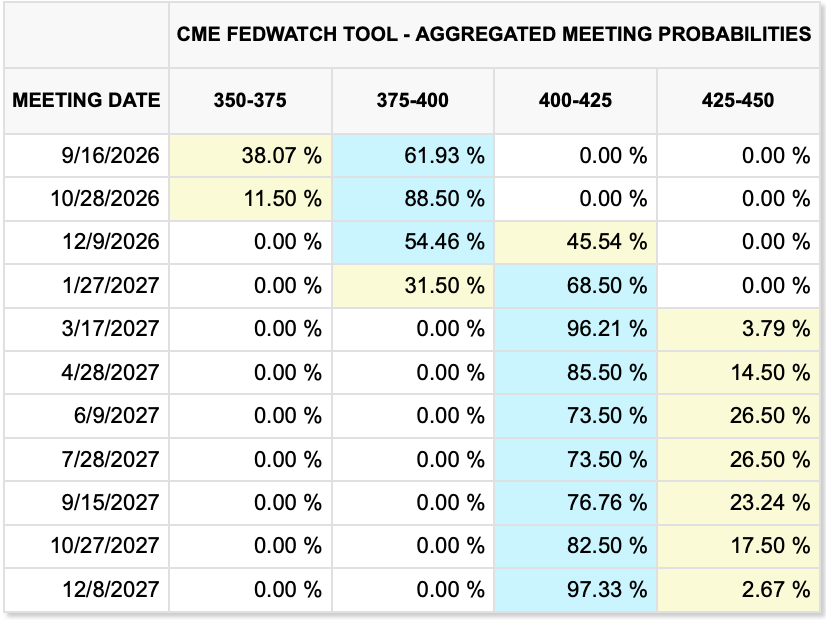
In addition, a second hike in January seems highly probable and the chance of another one next summer has risen to 25%.
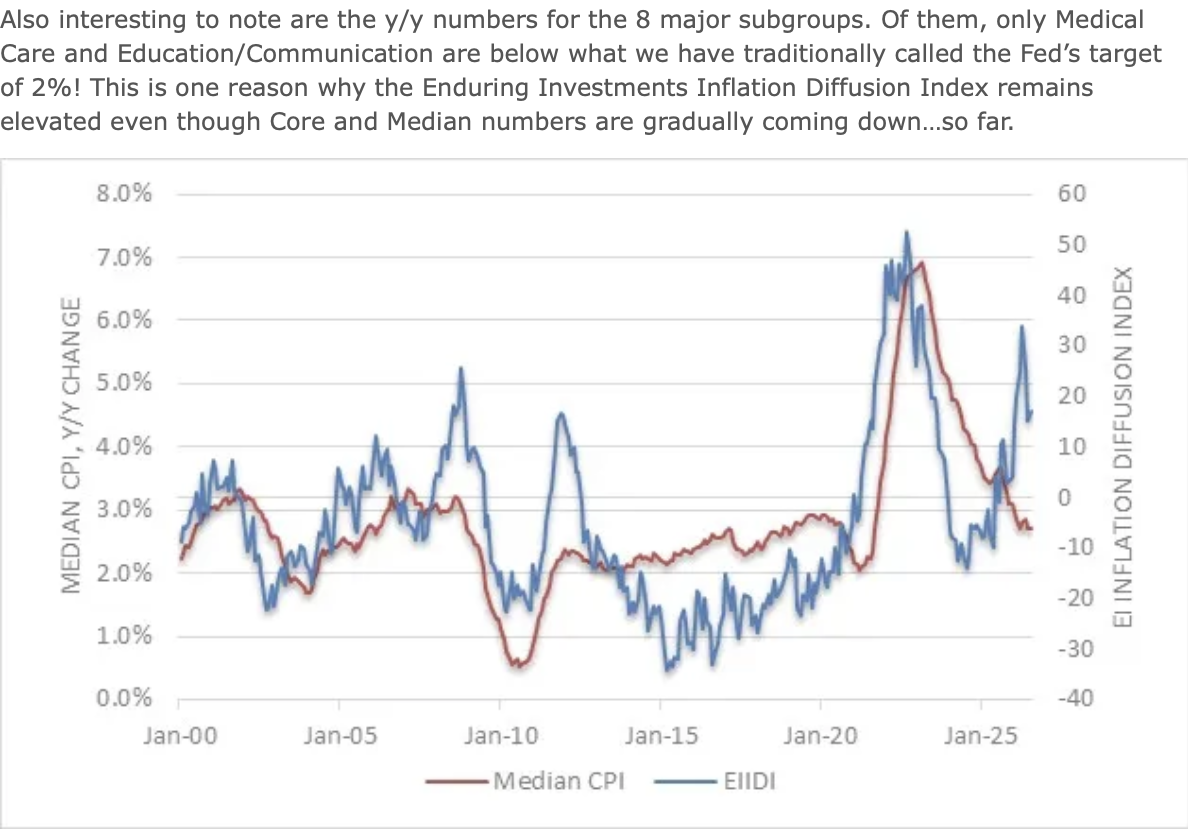
Personally, I thought the most interesting, and encouraging, feature of the speech was his willingness to discuss the details of how PCE is created, a combination of 199 subcategories. This is akin to the way my favorite inflation analyst, @inflation_guy, Mike Ashton, views the CPI data, and he has created a diffusion index to follow just how many categories are rising rapidly and how many are either falling or rising less rapidly than the overall rate. Here is his discussion of the July data, released in August. And here is a chart from that note (which you all should read and subscribe to as it’s free) showing his diffusion index and why inflation is not likely to subside quickly.
But clearly, the market is not interested in my spin, nor in the spin of anyone who disagrees that a hike is on the way. The behavior of the Treasury market was quite interesting with 2yr yields jumping 12bps while 10yr yields rose 4bps and 30yr yields rose only 1bp. This was a classic bear flattening of the curve, and it was the driver behind the dollar’s strength (+0.55%) and more impressively, the 3+% decline in the price of gold and silver. If yields are going up, there is no reason to own gold, apparently. That seems at odds with all last week’s talk about the resurrection of the debasement trade, but then, I’m just a poet.
One last thing. After rereading the speech several times (talk about a boring life) my interpretation of the following comment within his Key Principles seems to be very different than the rest of the Street.
“Fifth, short-term interest rates are the predominant tool to achieve the dual mandate. Unconventional policies to spur economic activity may suit genuine crises but should otherwise be used sparingly, if at all.”
I read this as he wants to reduce the balance sheet to reduce the Fed’s market impact and use interest rates as their policy tool and that currently, reducing the balance sheet will result in tighter policy with the same Fed funds rate. But it appears the first part of my view, which is something Warsh has explained numerous times, is being ignored by the trading community. Of course, it will take a change of the ‘ample reserves’ framework to get the Fed to reduce its balance sheet, and that will need the imprimatur of the balance sheet task force as well as time for the rest of the committee to get on board.
Regardless of my views, though, the market is now increasingly convinced the Fed is going to hike next month absent much weaker than expected NFP and CPI releases.
It wasn't all that long ago
When war in the Gulf ran the show
When fighting expanded
The market demanded
More havens as risk was the foe

But now, when the fighting gets hot
Most traders don't give it a thought
We're back to the Fed
And all that they've said
As key to what's sold or what's bought
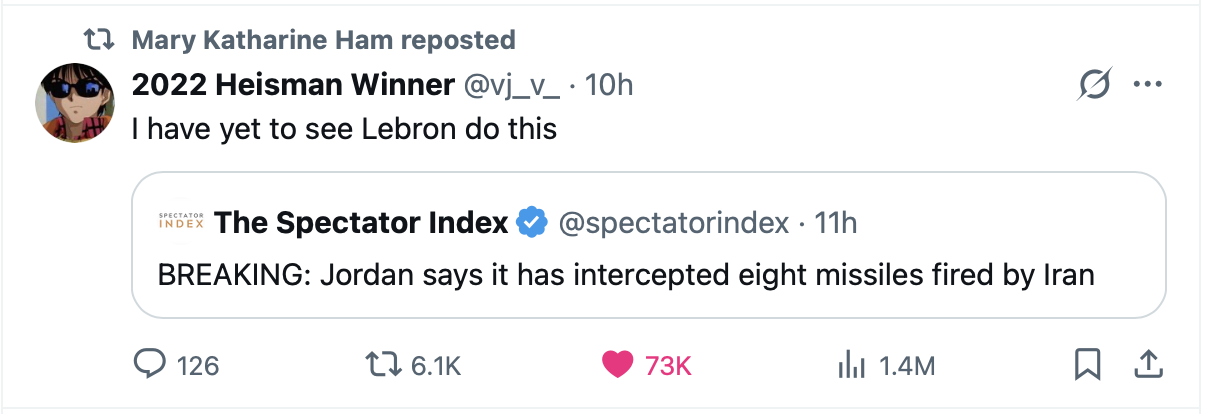
Apparently, there was further military action in the Persian Gulf and the Strait of Hormuz yesterday as the US struck missile launchers on a small island there, claiming the IRGC was planning to launch more naval mines. Iran said there will be great consequences, but the missile volleys they sent at US bases in Jordan were intercepted which prompted one of the funniest responses on X that I have seen.
Meanwhile, oil (+3.3%) prices have risen in response, but it has not generated nearly the excitement that we have seen in the past. And I cannot help but look at the price action in oil over the past six months, since the war began, and remain unconcerned about the future. Certainly, there has been volatility, but as I have highlighted in other markets, volatile markets are anti-fragile, and that is worth a lot.
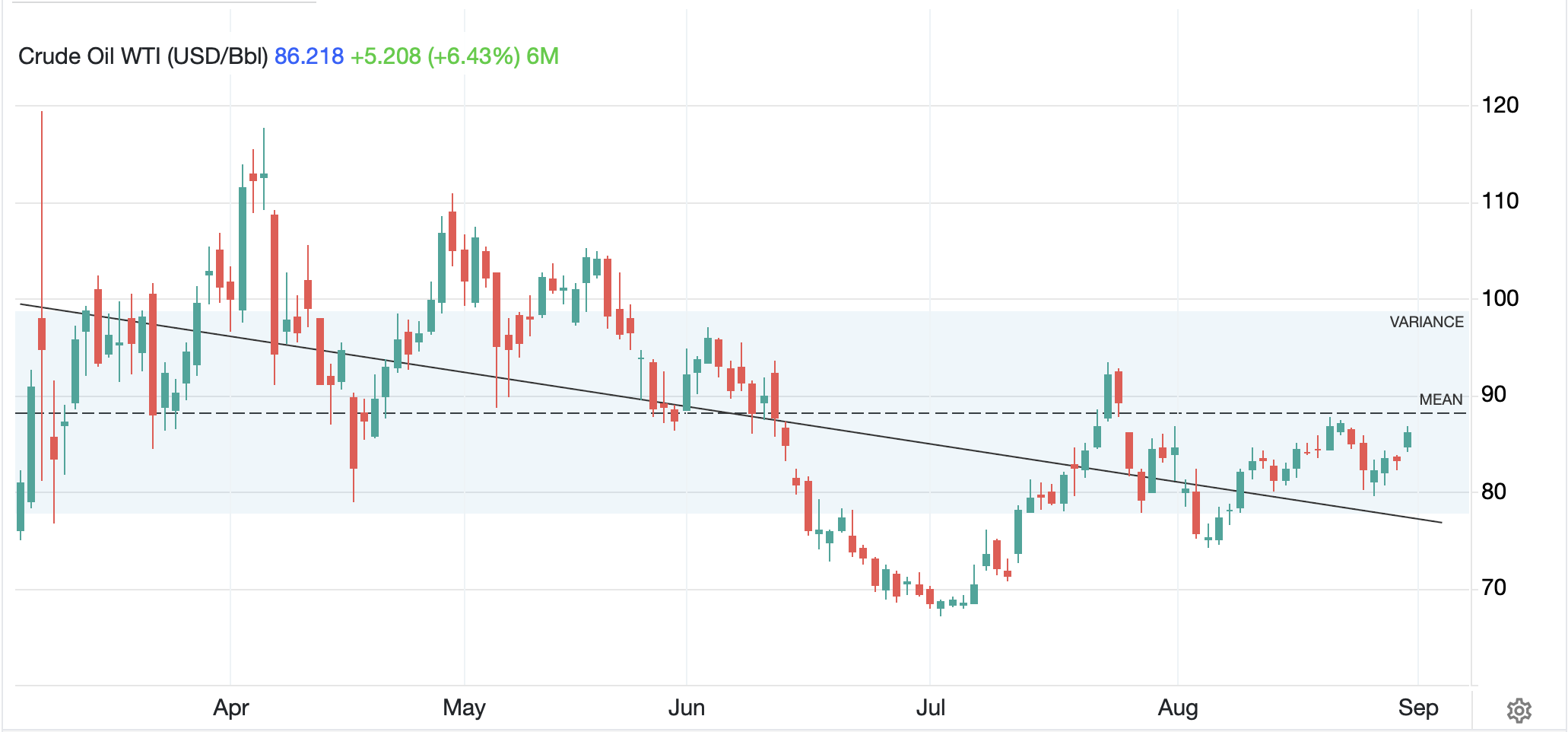
Source: tradingeconomics.com
As to the metals markets, after Friday’s washout across the board, this morning gold is unchanged, silver (+1.7%) has rebounded more than $1/oz and copper (+0.4%) has basically recouped its much smaller decline from Friday. Nothing has changed my view that all metals remain in uptrends.
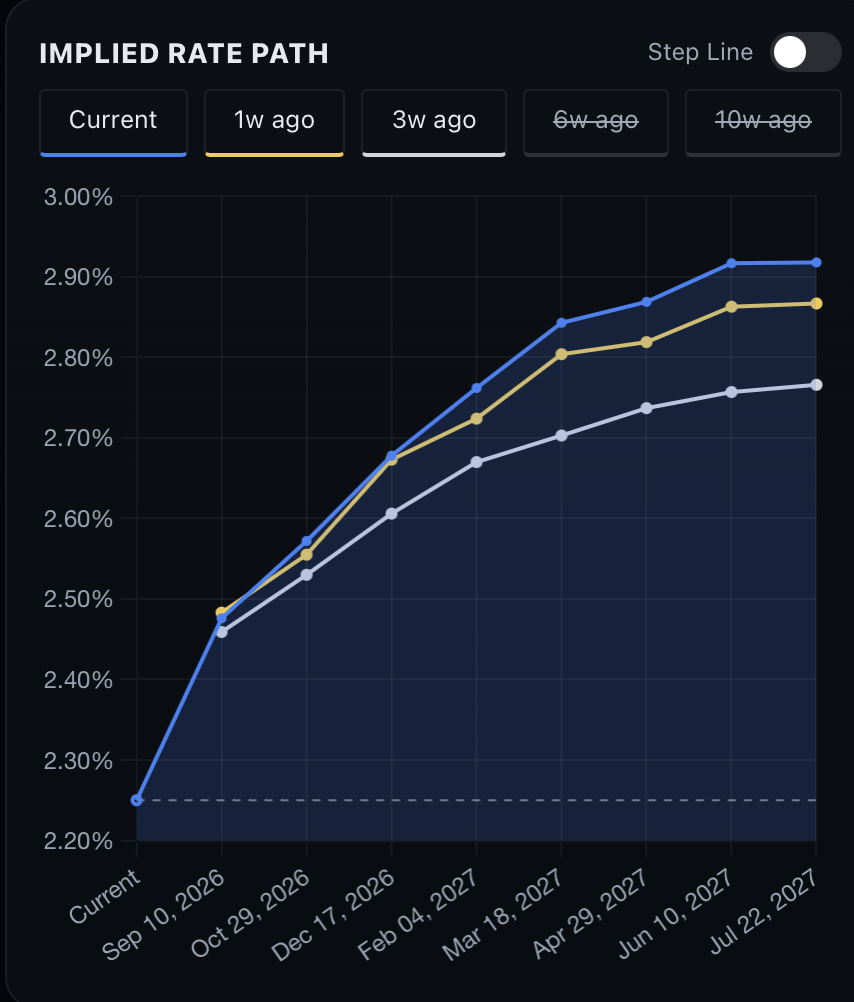
Perhaps the most interesting reaction to the Warsh speech was the equity market on Friday, where the main indices only fell by very modest amounts. There was no indication from that price action that there is concern about a major tightening cycle. Turning overseas, the picture was mixed last night in Asia (Tokyo -0.15%, China +0.35%, HK -0.1%, Korea +0.5%, India -0.4%) and is mixed this morning in Europe (Germany -0.8%, France 0.0%, Spain +0.1%) with Germany the obvious outlier. I might argue that is a response to higher-than-expected inflation readings there and concerns that it might drive the ECB tighter. I guess if you look at the curve below from rateprobability.com it does imply slightly tighter policy over time, but that’s really at the margin.
As to US futures, at this hour (7:10) they are pointing slightly softer, -0.2% or so.
Of course, Friday was much more exciting for the bond market but this morning Treasury yields are unchanged from the Friday close. Europe, however, has seen yields climb higher with continental sovereigns all higher by 3bps.
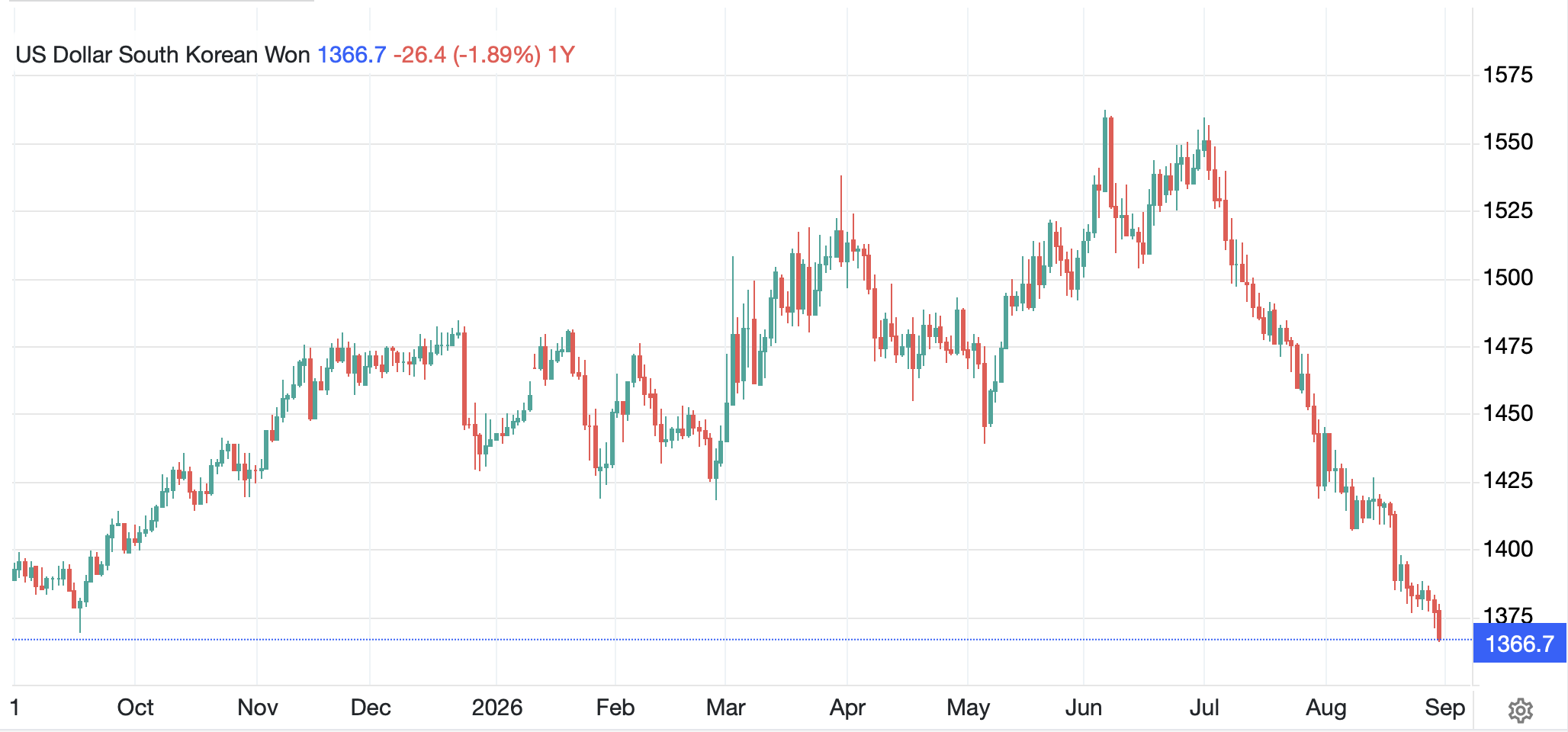
Finally, the dollar, which rallied sharply on Friday is giving back some of those gains with USDJPY back below 160, having closed above that level on Friday, while the bulk of the G10 currencies have gained between 0.1% and 0.2%. The one exception here has been KRW (+0.7%) which has been on a remarkable roll over the past two months. Between efforts to internationalize the currency and repatriation by the big semiconductor producers, the won has risen ~12% in the past two months, largely in a straight line.
Source: tradingeconomics.com
On the data front, there is nothing today but there is a big week coming culminating in NFP on Friday.
| Tuesday | ISM Manufacturing | 55.2 |
| ISM Prices Paid | 72.0 | |
| JOLTs Job Openings | 7.3M | |
| Wednesday | ADP Employment | 47K |
| Factory Orders | 0.6% | |
| -ex Transport | 0.2% | |
| Fed’s Beige Book | ||
| Thursday | Trade Balance | -$90.0B |
| Initial Claims | 205K | |
| Continuing Claims | 1816K | |
| Nonfarm Productivity | 1.4% | |
| Unit Labor Costs | 1.3% | |
| ISM Services | 54.3 | |
| Friday | Nonfarm Payrolls | 58K |
| Private Payrolls | 58K | |
| Manufacturing Payrolls | 5K | |
| Unemployment Rate | 4.1% | |
| Average Hourly Earnings | 0.3% (3.0% Y/Y) | |
| Average Weekly Hours | 34.4 | |
| Participation Rate | 61.4% |
Source: tradingeconomics.com
In addition to this, we hear from three Fed speakers. The data we have seen of late indicates that the economy remains quite resilient in the face of higher energy prices. Corporate earnings remain on fire and that continues to underpin risk assets overall. However, all eyes will be on Friday’s NFP as that will serve to reconfirm prior opinions or perhaps change them. The hawks will have a hard time making their case if the number is weak, and similarly, the doves if it is strong. One little noticed thing from Friday was the NFP revisions for the 12 months from April 2025 through March 2026, which were revised lower by ‘just’ 79K. Last year, the revision was -911K, so if nothing else, the BLS counted better! But this begs the question, if the population is not growing, or even shrinking after all the deportations, and Baby boomers are retiring, thus reducing headcount, how many jobs are needed to maintain strong economic output?
It makes a great deal of sense that Chairman Warsh wants to rethink the data because it does feel like the current data is outdated when it arrives, and that does not help forward looking policy decisions. As to today’s session, it is hard to get too excited about anything right now, certainly in the FX markets.
Good luck
Adf

