
The Doves Will Be Shot


Inflation was just a touch hot

And certainly more than Jay sought
So, later today
What will the Fed say?
My sense is the doves will be shot

Instead, as Jay’s made manifest
Inflation is quite a tough test
So, higher for longer
Or language much stronger
Is like what he’ll say when he’s pressed

Let’s think a little outside of the box this morning, at least from the perspective of virtually every pundit and their beliefs about what will happen at the FOMC meeting today.  At this point, most of the punditry seems to believe that Powell cannot be very much more hawkish, especially since the market is expecting comments like inflation is still too high and the Fed will achieve their goal.  So, there is a growing camp that thinks any surprise can only be dovish, since if he doesn’t push back hard enough or talk about loosening financial conditions being a concern, the equity market response will be BUY STONKS!!!

But what if, the thing Powell really wants, or perhaps more accurately needs, is not a soft landing, but a full-blown recession!  Think about it.  As I have written repeatedly, the idea that the Fed will cut rates by 125bps next year because growth is at 1.5% or 2.0% and inflation has slipped to 2.5% seems like quite an overreaction.  But given the current US debt situation ($34 trillion and counting) and the fact that the cost of carrying that debt is rising all the time, what would get the Fed to really cut rates?  And the only thing that can do it is a full-blown, multiple quarters of negative GDP growth, rising Unemployment Rate, recession.  If come February or March, we start seeing negative NFP numbers, and further layoff announcements as well as declining Retail Sales and production data, that would get the Fed to act. 

At least initially, we would likely see inflation slide as well, and with that trend plus definitive weakness in the economy, it would open the door for some real interest rate cuts, 400bps in 100bp increments if necessary. Now, wouldn’t that take a huge amount of pressure off Treasury with respect to their refi costs?  And wouldn’t that encourage accounts all over the world to buy Treasuries so there would be no supply issues?  All I’m saying is that we cannot rule out that Powell’s master plan to cut rates is to drive the economy into a ditch as quickly as possible so he can get to it.  In fact, it would open the door to restart QE as well.

This is not to say that this is what is going to happen, just that it is not impossible, and I would contend is not on anyone’s bingo card.  Now, Powell will never say this out loud, but it doesn’t mean it is not the driving force of his actions.  Powell is incredibly concerned with his legacy, and he has made abundantly clear that he will not allow his legacy to be the second coming of Arthur Burns.  Instead, he has his sights on the second coming of Paul Volcker, the man who killed the 1970s inflation dragon.  St Jerome Powell, inflation slayer, is what he wants as his epitaph.  And causing a recession to kill inflation and then cut rates is a very clever, non-consensus solution.

How will we be able to tell if I’m completely nuts or if there is a hint of truth to this?  It will all depend on just how hard he pushes back on the current narrative.  Yesterday’s CPI results could best be described as ‘sticky’, not rebounding but certainly not declining further.  Shelter costs continue apace at nearly 6% Y/Y and have done so for more than 2 years.  I was amused this morning by a chart on Twitter (I refuse to call it X) that showed CPI less shelter rose at just 1.4% with the implication that the Fed needs to start cutting rates right away.  The problem with that mindset is that shelter is something we all pay, and there is scant evidence that housing markets are collapsing.  In fact, according to the Case Shiller index, they are rising again.  I would contend that there is plenty of evidence to which Powell can point that makes his case for an economy that is still running far too hot to allow inflation to slide back to their target.  And that’s what I expect to hear this afternoon.

Speaking of recession, let us consider the situation in China, where despite the CCP’s annual work conference just concluding with some talk of building a “modern industrial system” the number one goal this year, thus boosting domestic demand, they announced exactly zero stimulus measures to help the process.  Data from China overnight showed that their monthly financing numbers were all quite disappointing compared to expectations and the upshot was a further decline in Chinese and Hong Kong equity markets.  This ongoing economic weakness and the lack of Xi’s ability or willingness to address it continues to speak to my thesis that commodity prices will remain on the back foot.  If you combine the high interest rate structure in the G10 with a weaker Chinese economy, the direction of travel for energy and base metals is likely to be lower.  The one exception here is Uranium, where there is an absolute shortage of available stocks and a renewed commitment around the world to build more nuclear power plants.

At the same time, Europe remains pretty sick as well, with Germany leading the entire continent into recession, and likely dragging the UK with it.  Germany, France, Norway, the UK and others are all sliding into negative growth outcomes.  While Chairman Powell will continue to push back on the idea of rate cuts soon, I expect that tomorrow, when both the ECB and BOE meet, they will open the door to rate cuts early next year.  Inflation in both places has been falling sharply and there is no evidence that Madame Lagarde or Governor Bailey is seeking to be the next Paul Volcker.  Both will blink with the result that both the euro and the pound should feel pressure.

Summing it all up, today I think we get maximum hawkishness from the Fed with Powell pushing back hard on the market pricing.  Initially, at least, I expect we could see yields rise a bit and stocks sell off while the dollar continues its overnight rise.  But I also know that there are far too many people invested in the idea that the Fed must cut soon, and they will be back shortly, buying that dip until they are definitively proven wrong.  

As to the rest of the overnight session, aside from China’s weak performance, South Korea also lagged, but the rest of the APAC region saw modest gains.  Europe, meanwhile, is all green, although it is a very pale green with gains on the order of 0.2%, so no great shakes.  Finally, US futures are firmer by 0.1% at this hour (7:15) after yesterday’s decent gains.

Bond yields are sliding this morning, down 2bps in the US and falling further in Europe with declines of between -3bps and -6bps on the continent as investors and traders there start to price in a more aggressive downward path for interest rates by the ECB.  UK yields are really soft, -9bps, after GDP data this morning was disappointing across the board, especially the manufacturing data.

Oil prices (+0.45%) which got slaughtered yesterday, falling nearly 4%, are stabilizing this morning, as are gold prices, which fell yesterday, but not quite as much as oil.  However, the base metals complex continues to feel the pressure of weak Chinese demand.  I continue to believe that there are structural supply issues, but right now, the macro view of weak economic activity is the main driver, and it is driving prices lower.

Finally, the dollar is firmer this morning as weakness elsewhere in the world leaves fewer choices for where to park funds.  While the movement has not been overly large, it is quite uniform across both G10 and EMG currencies.  The laggards have been NZD (-0.6%) after a softer than expected CPI reading and ZAR (-0.6%) on the back of weakening metals prices.  If I am correct about the path going forward, the dollar should perform well right up until the Fed responds to much weaker economic activity and starts to cut rates aggressively.  At that point, we can see a much sharper decline in the greenback.

Ahead of the FOMC meeting, this morning we get November PPI (exp 1.0%, 2.2% core) which would represent a small decline from last month’s data.  We will also see the EIA oil inventory data, which has shown a recent history of builds helping to drive the oversupply narrative there.

At this point, it is all up to Jay.  I suspect that markets will be quiet until then, and it will all depend on the statement, the dot plot and the presser.

Good luck

Adf
The New Allegory

On Friday, the data surprised

With job growth more than advertised
So, bonds took a bath
And stocks strode a path
Where growth is what’s now emphasized

But what of the soft landing story?
Will rate cuts now be dilatory?
If Jay just stands pat
Will stocks all go splat?
Or is this the new allegory?

Well, this poet was clearly wrong-footed by Friday’s employment report where not only were non-farm payrolls stronger than anticipated at 199K, but hours worked rose and the Unemployment Rate fell 2 ticks to 3.7%.  While revisions to previous reports were lower, as they have been all year, the report did not point to an imminent slowing of the economy nor a recession in the near-term.  Arguably, the soft-landing crowd made out best, as equity markets, which initially plunged on the report following Treasury prices, rebounded as investors decided that growth is a better outcome than not.  Yields jumped higher, as would be expected, rising 8bps in the US with larger gains throughout Europe before they went home for the weekend.  And finally, the dollar flexed its muscles again, rallying universally with gains against 9 of the G10 currencies, averaging 0.4% (only CAD (+0.1%) managed to hold its own) and against most of the EMG bloc with a notable decline by ZAR (-1.1%), although MXN (+0.6%) bucked the trend.

Does this mean the soft landing is coming?  As we start the last real data intensive week of 2023, it remains the favored narrative, but is by no means assured.  After all, before the end of this week we will have seen the latest CPI reading in the US (exp 3.1% headline, 4.0% core) and we will have heard from the FOMC, ECB and BOE as well as several smaller central banks like the Norgesbank and the SNB.  And let us not forget that the BOJ meets next Monday.  So, there is plenty of new, important information that is coming soon and will almost certainly drive potential narrative changes.

Perhaps an important part of the discussion is to define what we mean by a soft landing, or at least what the ‘market’ means by the concept.  My best understanding is as follows: GDP slides to 1% or so, but never goes negative.  Unemployment may edge higher than 4.0%, but only just, with a cap at the 4.2% or 4.3% area, and inflation, as measured by Core PCE finds a home between 2.0% and 2.5%.  This result, measured inflation falling back close to target while the growth and employment story just wobbled a bit, would be nirvana for Powell and friends.  

How likely is this outcome?  Ultimately, history is not on their side as arguably the only time the Fed ‘engineered’ a soft landing was in 1995, and on an analogous basis they had already started cutting rates by this time in the cycle.  The fact that we are still discussing higher for longer implies that there is much more pain likely to come than the optimists believe.  We have already seen the first signs of trouble as the number of bankruptcies soar and stories about non-investment grade companies needing to refinance their debt at much higher interest rates than the previous round fill the news.  Certainly, Friday’s employment data is encouraging for the economic situation, but the chink in the armor was the wage data which showed more resilience (+0.4%) than expected.  Given the Fed’s focus on wages and their impact on inflation, the fact that wage growth remains well above the levels the Fed deems appropriate to meet their inflation target is not a sign that policy ease is coming soon.

And ultimately, I believe that is the critical feature here.  The economy has held in remarkably well considering the pace and size of the interest rate changes we have already seen.  The big unknown is how much of that interest rate change has really been felt by the economy.  Obviously, the housing market has felt the impact, and to some extent the auto industry, but otherwise, it is not as clear.  Do not be surprised if this period of slow economic activity extends for a much longer time than in the past as the drip of companies that find themselves unable to refinance at affordable rates slowly grows.  By 2025, about $1 trillion of corporate debt that was issued at much lower interest rates will need to be refinanced.  I’m not worried about Apple refinancing their debt, but all the high-yield debt that was snapped up with a 4% or 5% handle during the period of ZIRP will now be at 10% or so and it is an open question if those business models will be functional with financing that expensive.  

So, perhaps, the story will be as follows:  economic activity is going to muddle along at low rates for an extended period, another 2 or 3 quarters, until such time as the debt ‘time-bomb’ explodes with refinancing rates high enough to force many more bankruptcies and start a more aggressive recessionary cycle with layoffs leading to rapidly rising Unemployment rates and economic activity falling more sharply.  In this timeline, we are talking about the recession becoming clear in Q3 of 2024, a time when most of that $1 trillion of corporate debt will be current.    While interest rates will certainly be slashed at some point, this does not bode well for risk assets in the second half of 2024.  For now, though, it certainly seems like the current narrative is going to continue.

There’s no urgency

To change policy quite yet
But…some day we will

A quick story about the BOJ which last night pushed back firmly against the growing narrative that they were about to start normalizing interest rate policy with a rate hike in either December or January.  Instead, several stories were released that described the recent decline in both GDP and inflation as critical and the fact that they still don’t have enough information with respect to wages in Japan, given the big spring wage negotiation has not yet happened, to make a decision.  In other words, the BOJ was successful at convincing markets to behave as the BOJ wants, not as the rest of the world wants.  The upshot was that the yen weakened sharply (-0.9%) while the Nikkei rose 1.5% and JGB yields were unchanged.  The BOJ pivot remains one of the biggest themes in the macro community, mostly because it is seen as the place where the largest profits can be made by traders.  But my experience (4 years working for a Japanese bank) helps inform my view that whatever they do will take MUCH longer to happen than the optimists believe.

Ok, let’s try a quick trip around markets here for today.  Aside from Japan, most of Asia had a good equity session with Hong Kong (-0.8%) the only real laggard.  Remember, a key story there remains the Chinese property sector as many of those firms are listed in HK.  Meanwhile, European bourses are mixed although movements haven’t been very large in either direction.  The worst situation is the UK (FTSE 100 -0.5%), while we are seeing some gains in the CAC and DAX, albeit small gains.  Finally, US futures are pointing a bit lower, -0.2%, at this hour (7:45).

In the bond market, after Friday’s dramatic price action, Treasury yields are continuing to rise, up 5bps this morning, although European sovereign yields are little changed on the day, with the bulk of them slipping about 1bp.  Given most saw quite large moves on Friday, and given the imminent policy decisions by the big 3 central banks, I suspect traders are going to be quiet for now.  

Oil prices (-0.3%) are slipping slightly this morning but are mostly consolidating Friday’s gains.  On the metals front, though, everything is red with gold, silver, copper and aluminum all under pressure.  Again, this is the one market that has been pricing a recession consistently for the past several months while certainly equity markets have a completely different view.

Finally, the dollar is continuing to rebound on the strength of rising Treasury yields.  While the euro is little changed on the day, the yen is driving price action in Asia with weakness also seen in CNY, KRW and TWD.  As well, ZAR (-0.8%) continues to suffer on weaker commodity pricing and both MXN and BRL are under pressure leading the LATAM bloc lower.  At this point, I would say the FX market has more faith in Powell’s higher for longer mantra than some other markets.

As mentioned, there is a lot of data this week:

TodayNY Fed Inflation Expectations3.8%
TuesdayNFIB Small Biz Optimism90.9
 CPI0.0% (3.1% Y/Y)
 -ex food & energy0.3% (4.0% Y/Y)
WednesdayPPI0.1% (1.0% Y/Y)
 -ex food & energy0.2% (2.3% Y/Y)
 FOMC Rate Decision5.5% (unchanged)
ThursdayECB Rate Decision4.5% (unchanged)
 BOE Rate Decision5.25% (unchanged)
 Retail Sales-0.1%
 -ex autos-0.1%
 Initial Claims221K
 Continuing Claims1891K
FridayEmpire State Manufacturing2.0
 IP0.3%
 Capacity Utilization79.2%
 Flash PMI Manufacturing49.1
 Flash PMI Services50.5

Source tradingeconomics.com

Thursday also has the Norges Bank and SNB, both of whom are expected to leave rates on hold.  For today, it strikes me that the discussion will continue as pundits try to anticipate what the FOMC statement will say and how Powell sounds in the press conference.  As such, it is hard to get excited that there is going to be a big move in either direction.  With all that in mind, my overall read on the economy is that while we may muddle along in the US for a while yet, it will be better than many other places in the world, notably the EU, the UK and China, and so the dollar is likely to hold up far better than most expect…at least until Powell changes his tune.

Good luck

Adf

A Havoc Nightmare

While real wages fall
Kishida’s polls fall faster
Will Ueda act?

The first big thing this week is tonight’s BOJ meeting where many in the market are anticipating another tweak to the current YCC framework.  I have seen several analysts calling for a widening of the band to +/- 1.25% from the current +/- 1.00%.  While current yields have yet to reach the cap, they continue to grind higher and are currently at 0.88%, new highs for the move.  Ironically, it is likely the BOJ will need to buy even more JGB’s if they make an adjustment as the wider band would give the green light for speculators to short bonds even more aggressively.  Recall, since they widened from 0.50% to 1.00%, there have been at least five unscheduled bond buying episodes by the BOJ, with the last one, just a week ago, being the largest to date.

One thing to remember about the BOJ is that the concept of central bank independence is not as strong in Japan as it is, perhaps, elsewhere in the Western world.  (Of course, it is not that strong elsewhere either, but Japan is closer to China on this front than the US).  At any rate, the most recent polls in Japan show that PM Kishida’s approval ratings have fallen to new lows for his tenure, with an approval of just 33% according to the most recent Nikkei poll.  And this was after the announcement that he was cutting taxes to help people deal with the consistently rising inflation in Japan.  While it has not grown to levels seen in the US or Europe, it is clearly far higher than they have seen there in more than a generation.

But it doesn’t seem to be enough.  Now, there is no requirement for an election until sometime in 2025, but that doesn’t mean Kishida-san won’t feel the pressure to do more.  And arguably, one of the things they can do to fight inflation is raise rates and see if the yen can recapture some of the 35%+ that it has declined over the past two years.  

So, will they act?  My one observation on this is that unlike the Fed, which never likes to surprise the market, the BOJ has figured out that they only way they can have an impact is if they do surprise the market.  Given that an increasing number of people are starting to look for this outcome, I think the probability of a BOJ policy change tonight is quite low.  I would not be surprised, if I am correct, to see USDJPY head back through 150 and start to grind to new highs above the 152+ peak seen just before the intervention last year.

Meanwhile, for the rest of the week
Both meetings and data might wreak
A havoc nightmare
So, traders, beware
Of comments or data that’s bleak

Beyond tonight’s BOJ meeting, the week is jam-packed with other potential market moving catalysts between central bank meetings (FOMC on Wednesday, BOE on Thursday) and important data including ISM (Wednesday) and NFP on Friday.  However, there is one other thing set to be released Wednesday morning, well before the FOMC announcement and that is the Quarterly Refunding Announcement (QRA).  While, as its name suggests, this is released every quarter, it has generally been relegated to the agate type of market information as a technical feature for bond traders.  But this time, it has gained far more interest given the combination of the bond market’s performance since the last QRA (yields are higher by 80ish basis points) and the fact that the government budget deficit is continuing to grow with many new forecasts for a $2 trillion deficit this year thus a need for even more borrowing. 

Back in August at the last QRA, the Treasury increased issuance more than anticipated which has been seen as one of the drivers of the recent bond market decline.  If they were to increase it significantly again, there is certainly concern that bond yields can move much higher still.  Now, the Treasury could issue more short-term T-bills to take pressure off the bond market but bills already represent about 22% of the total debt outstanding.  That is a couple of points higher than the top of the historic range of 15%-20% and may be seen as a point of contention.  The positive is that given T-bill yields are all above 5.3%, there will be plenty of demand for their issuance.  However, on the flip side, that means that refinancing will need to occur far more frequently and that makes it subject to market dislocations and disruptions.

Another key part of the discussion will be just how large Secretary Yellen wants to keep the Treasury General Account (TGA), which is the government’s ‘checking’ account at the Fed.  As of Thursday, it held $835 billion and there has been talk she wants to increase it to $1 trillion to make sure the government has ample liquidity going forward, especially if there is another issue regarding government financing in Congress.  Historically, the Treasury has issued bills when they are seeking to build up balances in the TGA, which would tend toward seeing even more bills issued rather than substantial growth in the longer-dated maturities.  All in all, it is possible the QRA is going to have the largest potential impact on markets this week so beware.

In truth, the overnight session has been somewhat dull.  While the Israeli-Palestinian situation has seemed to enter a new phase regarding Israel’s incursion into Gaza, markets are non-plussed over the matter with bond yields little changed across the board, the dollar little changed across the board and oil prices sliding (-1.5%) this morning.  Even gold (-0.6%), which has been the best performer in the wake of the middle east crisis, has slipped back below the $2000/oz level, although remains higher by almost 10% in the past month.

In fact, the one area where things are moving is in equity space where we are seeing gains across the board in Europe, somewhere between 0.5% and 1.1%, in the major bourses as inflation data there showed that price rises have begun to slow down and Germany’s economy “only” shrunk by -0.1% in Q3, a much better than expected outcome!  US futures are also higher at this hour (7:15), up by 0.5% or so after a pretty awful week last week.  In fact, the only real outlier was Japan where the Nikkei slid -0.5% as Chinese shares were stronger along with most of the APAC markets.

As mentioned earlier, though, we do have a lot of news coming out this week so let’s go through it here:

TuesdayBOJ Rate Decision-0.1% (unchanged)
 BOJ YCC+ / – 1.00% (unchanged)
 Case Shiller Home Prices1.6%
 Chicago PMI45
 Consumer Confidence100
WednesdayADP Employment150K
 QRA$114 billion (+$11 billion)
 ISM Manufacturing49.0
 JOLTS Job Openings9.2M
 Construction Spending0.4%
 FOMC Decision5.5% (unchanged)
ThursdayBOE Decision5.25% (unchanged)
 Initial Claims210K
 Continuing Claims1795K
 Nonfarm Productivity4.0%
 Unit Labor Costs0.8%
 Factory Orders1.9%
FridayNonfarm Payrolls188K
 Private Payrolls145K
 Manufacturing Payrolls0K
 Unemployment Rate3.8%
 Average Hourly Earnings0.3% (4.0% Y/Y)
 Average Weekly Hours34.4
 ISM Services53.0

Source: tradingeconomics.com

So, as you can see, there is a lot of stuff coming our way starting tonight in Tokyo.  What that tells me is that we are not likely to see very much movement today as traders and investors await the plethora of new information that is due.  However, by the end of the week, we could have a very different narrative.  

Good luck

Adf

Aghast

The BOJ did
Absolutely nothing new
Can we be surprised?

The last of the key central bank meetings finished last night with the BOJ not only leaving policy on hold, as expected, but not even hinting that changes were in the offing.  Much had been made earlier this month about a comment from Ueda-san that they may soon have enough information to consider policy changes.  This was understood to mean that YCC might be ending soon.  Oops!  If that is going to be the case, it was not evident last night.  Rather, the status quo seems the long-term view in Tokyo right now.  Not surprisingly, the yen suffered accordingly, selling off another -0.5% overnight and is now back at its weakest point (highest dollar) since October 2022 when the BOJ intervened actively.

Also, not surprisingly, after the yen weakened further, we started to hear from the MOF trying to scare the market.  FinMin Shunichi Suzuki once again explained that he would not rule out any actions with respect to the currency market if volatility (read depreciation) increased too much.  But as of yet, there have been no BOJ sightings and I suspect they will not enter the market until 150.00 is breached once again.  Maybe next week.

With central bank meetings now past
The markets’ response has been fast
It seems there’s a pox
On both bonds and stocks
And owners of both are aghast

While further rate hikes may be rare
Investors feel some small despair
No rate cuts are planned
Throughout any land
And bond yields are now on a tear

Turning to the rest of the G10, what was made clear over the past two weeks is that policy rates are not anticipated to fall anytime soon.  While some central banks seemed to finish for sure (ECB, SNB, BOE) others seem like there may be another in the pipeline (Fed, Riksbank, Norgesbank, BOC, RBA), but in no case is there a discussion that inflation has reached a place of comfort for any central bank.  Rather, even those banks on hold seem comfortable that policy rates need to remain at current levels in order to continue to battle the scourge of inflation.  If anything, the hawks from most central banks continue to push for further tightening, although I suspect that will be a difficult hill to climb given the inherent dovishness of most central bank chiefs.

So, what are we to expect if this is the new home for interest rates rather than the ZIRP/NIRP to which we had become accustomed for the past 15 years?  The first thing to consider is that despite the higher rate structure, the financial position of the private sector, at least in the US, remains strong.  Corporates termed out debt and tend toward being cash rich, so for now, they are benefitting from high interest rates as they locked in low financing and are earning the carry.  Many households are in the same position, having refinanced home mortgages at extremely low rates so are not feeling the pain of the recent rise in mortgage rates.  Of course, this has reduced the amount of activity in the housing market and is a problem for first-time buyers, but that is not the majority, so net, the pain is not so great.

However, the US is unique in this situation as most of the rest of the world are beholden to short-term rates in their financing.  This is true in the commercial sector, where bank lending is a far more important part of the capital structure than public debt.  Those loans are floating, which is also true in the household sector where most mortgages elsewhere have 5-year fixed terms and so are already repricing higher and impacting homeowners.  In fact, if you want one reason as to why the US is likely to outperform the rest of the world, this would be a good place to start.  Despite much higher interest rates, the pain is not being felt across much of the US economy while it is being felt acutely throughout Europe and the UK.  

The upshot of this process is that inflation is likely to remain with us for quite a while going forward.  This means that central banks are going to have a great deal of difficulty reversing course absent a major crash in economic activity.  Given the US tends to lead the world’s capital markets, it also means that the combination of continuing gargantuan issuance by the Treasury to finance the never-ending budget deficits along with the stickiness of inflation implies that interest rates need to be higher.  We saw this price action yesterday with 10yr Treasury yields jumping to 4.5%, another new high for the move, and importantly, a larger move than the 2yr yield.  This is the ‘bear steepening’ that I have been writing about, with longer end yields rising faster than shorter yields.  Ultimately, this will be quite a negative for risk assets, especially paper ones, although hard assets ought to benefit.  The world that we knew has changed, so we all need to adjust accordingly.

Turning to the overnight session, yesterday’s US weakness was followed by Japan (-0.5%) but Chinese shares bucked the trend, rising strongly on hopes that the recent data shows the worst is past for the mainland.  That seems odd given the lack of additional stimulus forthcoming from the government, but that is the story.  European shares are mostly a bit lower this morning after flash PMI data was released showing growth in the Eurozone remains elusive.  Germany is still in dire straits with its Manufacturing PMI <40, but the whole of Europe is sub 50 for the past four months at least.  Finally, US futures are bouncing slightly this morning, but that seems like a trading reaction to two consecutive days of sharp losses rather than new optimism.

Other than YK Gilts, which traded at much higher levels back in August, European sovereigns are following Treasury yields to their highest level in more than a decade.  And despite the weak economic story, the fact remains that sticky inflation is the clear driver for now.  Consider that the ECB has essentially explained they have finished raising rates with their policy rate at 4.0% while CPI is running at 5.2% headline and 5.3% core.  Those numbers do not inspire confidence that the ECB has done its job.  I continue to look for higher long-term yields going forward.

Part of the reason for this is that oil (+0.9%) continues to find support.  While it had a couple of days of a modest pullback, we are back above $90/bbl and the news remains bullish the outcome.  The latest is the Russia is halting deliveries of diesel fuel, a particular sore spot as there are already tight supplies around the world, especially here in the US.  I see no reason for oil to decline structurally, and that is going to continue to pressure inflation higher.  Perhaps of more interest is the fact that the metals complex is rallying today, despite the rise in interest rates.  Gold (+0.3%), silver (+1.3%), copper (+0.8%) and aluminum (+1.1%) are all in the green.  Again, I would say that owning hard assets is going to be a better outcome than paper ones.

Finally, the dollar is mixed this morning, showing gains against the euro, pound and yen, but softer vs. the commodity bloc with AUD, NZD, CAD and NOK all firmer this morning.  As well, EMG currencies are having a better session, rising a bit vs. the greenback, but recall, the dollar has had quite a good run lately.  My take is there is a lot of profit-taking as we head into the weekend given the lack of fundamental stories that would undermine the buck.  Nothing has changed my view it has further to rise.

On the data front, the only releases are the flash PMIs here (exp 48.0 Manufacturing, 50.6 Services) and we get our first Fed speaker, Governor Lisa Cook, a confirmed dove.  We have already had a lot of activity this week so I suspect that heading into the weekend, it is going to be a quiet session as traders and investors start to plan for next week’s excitement.

Good luck and good weekend
Adf

Concerns Are Severe

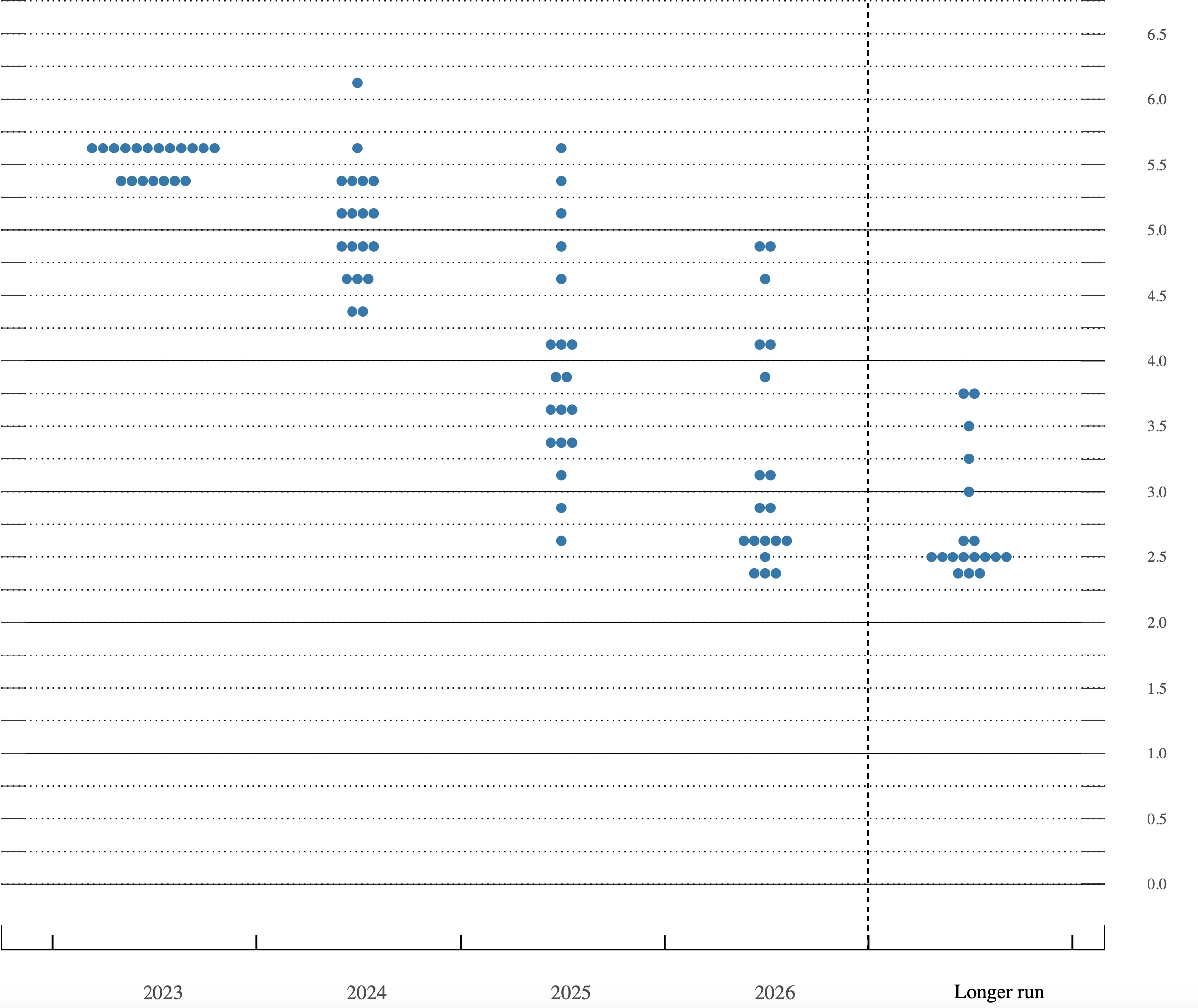
One look at the dot plot makes clear
Inflation concerns are severe
So, higher for longer
Is growing still stronger
And Jay implied few cuts next year

First, let’s recap the FOMC meeting.  The term hawkish pause had been used prior to the meeting as an expectation, and I guess that was a pretty apt description.  While they left policy on hold, as expected, the change in the dot plots, as seen below, indicate that even the doves on the Fed see fewer rate cuts next year, with just two now priced in from four priced in June.

Source: Fedreserve.gov

A quick reading shows that a majority of members expect one more hike this year, and now the median expectation for the end of 2024 has moved up to 5.125%, so 50bps lower than the median expectation for the end of 2023 and 50bps higher than the June plot.  To me, what is truly fascinating is the dispersion of expectations in 2025 and 2026, where there are clearly many opinions.  And finally, the longer run expectation has risen to 2.5% with many more members thinking it should be even higher than that.  The so-called neutral rate estimations seem to be creeping higher.  If you think about it, that makes some sense.  After all, given the ongoing forecasts for continued labor market tightness due to demographic concerns, and add in the massive budget deficits leading to significantly higher Treasury debt issuance, there is going to be pressure on rates to find a higher level.

The market response was quite negative, albeit not immediately, only after Powell started speaking.  But in the end, equity markets fell across the board in the US, with the NASDAQ taking the news the hardest, down -1.5%, as its similarity to long duration bonds was made evident.  Asian markets all fell overnight as well, with most tumbling more than -1.0% and European bourses are all under similar pressure, down -1.0% or so as well.  The one exception in Europe is Switzerland, where the SNB surprised the market and left rates on hold resulting in a weaker CHF and a very modest gain in their equity market.

However, the bigger market response was arguably in bonds, where yields rose to new highs for the move with the 2yr at 5.15% and the 10yr at 4.43%.  Once again, I point to the significant increase in debt that will be forthcoming from the US Treasury as they need to fund those budget deficits.  I have been making the case that a bear steepener would be the more likely outcome for the US yield curve.  That is where long-term rates rise more quickly than short-term rates due to the US fiscal policy and shrinking demand for US debt by key players, notably the Fed, but also China and Japan.  Nothing has changed that view.

Then early this morning, up north
Both Sweden and Norway brought forth
A quarter point hike
To act as a dike
Preventing price rises henceforth

After the Fed’s hawkish pause, we turn our attention to Europe, where the early movers, Sweden and Norway, both hiked twenty-five basis points, as expected, while both hinted that further hikes are not out of the question.  Inflation remains higher than target in both nations and in both cases, the currency has been relatively weak overall.  Switzerland left rates on hold, pointing to the fact that for the past three months, inflation has been within their target range, and they are beginning to see downward pressure on economic activity which they believe will keep that trend intact.

And lastly, from London we’ve learned
Another rate hike has been spurned
Though voting was tight
They said they’re alright
With waiting to see if things turned

As to the bigger story, the UK, expectations were split on a hike after yesterday’s tamer than expected CPI report while the pound fell ahead of the news.  And the change in expectations was appropriate as in a 5-4 vote, the BOE opted to remain on hold for the first time in two years.  They see that inflation may be easing more rapidly than previously expected, and they are concerned about overtightening.  While I have a hard time understanding how a 5.15% Base rate is tight compared to CPI running at 6.7% and core at 6.2%, I am clearly not a central banker.  At any rate, the pound fell further on the news and is now at its lowest level since March, while the FTSE 100 rallied back and is close to flat on the day from down nearly -1.0% before the announcement.  Gilt yields, however, are moving higher as the bond market there doesn’t seem to believe that the BOE is serious about fighting inflation.

And really, those are today’s key stories.  Late yesterday, Banco Central do Brazil cut the SELIC rate by 0.50%, as expected, and at the same time the BOE announced, the Central Bank of Turkey raised their refinancing rate by 5 full percentage points, to 30.0%, exactly as expected.  And to think, we get concerned over rates at 5%!

As to the rest of the day, there is a bunch of US data as follows: Philly Fed (exp -0.7), Initial claims (225K), Continuing Claims (1695K), Existing Home Sales (4.1M) and Leading Indicators (-0.5%).  As is typical, there are no Fed speakers scheduled the day after the FOMC meeting, but we will start to hear from them again tomorrow.

Putting it all together tells me that the Fed is not nearly ready to back off their current stance and will need to see substantial weakness in economic activity before changing their mind.  Meanwhile, last week’s ECB meeting and this morning’s BOE meeting tell me that the pain of higher interest rates in Europe is becoming palpable and the central banks are leaning more toward inflation as an outcome despite their mandates.  This continues to bode well for the dollar as the US remains the place with the highest available returns in the G10.

Tonight, we hear from the BOJ, where no change is expected.  I would contend, though, that the risk is there is some level of hawkishness that comes from that meeting as being more dovish seems an impossibility.  As such, there is a risk that the yen could see some short-term strength.  Keep that in mind as you look for your hedging levels.  

Good luck

Adf

If Doves Seduced

The British inflation release
Showed prices did not quite increase
As much as expected
Though still they’re projected
To stay at a level, obese

But truly, all eyes have now turned
To Jay, when past two, we’ll have learned
If hawks rule the roost
Or if doves seduced
The Chairman with more rate hikes spurned

As New York walks into the office this morning, all thoughts are on how the FOMC meeting will play out.  The current expectation is for no rate movement today and still about a 50% chance of one more hike either in November or December.  More remarkably, as I wrote yesterday, is the belief that there will be 100 basis points of cuts next year despite the growing belief of either a soft landing or no landing.  Again, I ask, why would the Fed cut rates if the economy continues to grow with the current monetary policy?  However, at this point, all we can do is wait.

FWIW, which may not be much, I continue to see the outcome as follows; no movement today, 25bps in November and then a reassessment in December based on how the data continues to flow.  Nothing Powell has said indicates that he is comfortable that the Fed has vanquished inflation, and similar to the idea that every politician only cares about one thing, his reelection, I believe Powell is completely focused on just one thing, killing inflation.  He has made it abundantly clear in the past that he expected some economic pain would be necessary in order to achieve that outcome, and he is not going to be deterred at this stage.  It would not surprise me if Fed funds remained at the year-end 2023 rate, whether that is 5.50% of 5.75%, for all of 2024.  In fact, absent a very significant recession, that is what I believe will occur.  One man’s view.

Anyway, turning to the only other data of note today, UK CPI surprisingly fell to 6.7%, down from last month’s 6.8% reading and forecasts for a 7.0% outcome today based on rising energy and food prices.  Even better for Governor Bailey, the core rate fell to 6.2%, well below last month’s level of 6.9% and forecasts of 6.8%.  The pound dipped on the news, but only by -0.2%, as the entire FX complex remains in thrall to the FOMC outcome later this afternoon.  However, this inflation result has pundits asking whether Governor Bailey will be able to skip tomorrow’s rate hike, just like the Fed, and wait until November if they deem it still necessary.  My view here is that will not be the case.  Given the overall weakness in the UK economy, Bailey is clearly running out of room to hike rates, and tomorrow is likely to be his last chance to raise rates before the evidence of sustained weakness becomes clear.  Just like the rest of Europe, I expect the BOE will hike tomorrow and be done.

Once again, I will point out that the basis of my dollar views remains that the US is going to be the most hawkish of all the major economies, maintaining tighter monetary policy far longer than other nations, and that the dollar will naturally see investment flows continue.  After all, the combination of higher yields and potentially better growth prospects will be far too much for international investors to ignore.

For now, though, we wait for 2:00pm and the FOMC statement along with their new Summary of Economic Projections, and then for Chairman Powell’s presser at 2:30.  As such, until then I expect a pretty dull day.

Overnight, Asian equity markets were under pressure with losses in both Japanese and Chinese shares, as well as generally throughout the region.  The only noteworthy news was that the PBOC left rates on hold, which was widely expected, although there were those who thought they might cut again to support the weakening Chinese economy.  European bourses, though, are having a much better day, with all markets higher by at least 0.5% and several southern European nations seeing gains greater than 1%.  Meanwhile, at this hour (7:30), US futures are edging higher by 0.2% or so after modest declines yesterday.

In the bond market, yesterday’s closing level for 10yr Treasuries was the highest, at 4.36%, since October 2007, and although the yield is lower today by about 2bps, this trend remains intact.  The big mover today, though, is UK Gilts which have seen yields drop 8bps after that CPI report.  This has helped drag European sovereign yields lower by about 2bps as traders want to believe that the rate hikes are over everywhere in Europe, and cuts are the next step.  While that’s not my view, it is gaining traction.

In the commodity markets, oil (-1.0%) has finally had a pullback of substance after a rumor yesterday that the Biden administration was going to completely empty the SPR.  There has been no source for that story and no corroboration but given the move that oil has seen over the past 3 months, up more than 35%, a pullback is no surprise.  While there is likely to be a further short-term retreat here, the long-term prospects for oil remain significantly positive in my view.  As to the metals markets, industrials are a bit firmer this morning, perhaps on the idea that the rate hiking cycle in Europe is ending, while gold is unchanged.

Finally, the dollar is a bit softer this morning, but not very much.  The euro remains either side of 1.07 while USDJPY is pushing the 148 level, very close to the key 150 point where many participants believe the BOJ will step back into the market.  As to CNY, its home has been the 7.30 level despite all the effort that the PBOC has expended to strengthen the yuan.  The biggest winners today have been the Antipodeans, with both AUD and NZD firmer by 0.5% after the Minutes of the RBA meeting indicated that they were considering another rate hike at the last meeting although decided to hold off.  The implication is another hike could be in the cards.

On the data front, really the FOMC meeting is today’s only activity of note, although we will see the EIA oil inventories as well.  Until the meeting ends, I expect very little to occur.  Once the announcement is out, and even more importantly, once Powell starts to speak, be prepared for more volatility.

Good luck

Adf

Some Dismay

While everyone’s certain that Jay
Will leave rates alone come Wednesday
The curve’s longer end
Is starting to trend
Toward rates that might cause some dismay

The problem remains his frustration
That he can do naught ‘bout inflation
As oil keeps rising
It’s demoralizing
For Jay and his rate formulation

The overnight session was quite dull overall with virtually no new data or information on the macroeconomic front and a limited amount of commentary from the central banking and financial poohbahs of the world.  Friday’s desultory US equity market performance was followed by a mixed session in Asia while European bourses are all in the red after the Bundesbank indicated that Germany would have negative growth in Q3.  As well, after last week’s ECB rate hike, we did hear from one of the more hawkish members that further hikes are possible, although listening to Madame Lagarde’s comments, that seems quite a high bar at this time.

So, given the limited amount of new information, it seems that it is time for central bank prognostications.  The first thing to note is that while the Fed is certainly the main act this week, there are no less than a dozen other major interest rate decisions due this week including the BOE, BOJ, PBOC, Swedish Riksbank, Norgesbank, SNB and Banco Central do Brazil.  

While much has been written about the FOMC on Wednesday, with the current market pricing just less than a 1% probability of a hike, the European banks that are meeting are all expected to follow the ECB and hike by 25bps.  Meanwhile, the PBOC remains caught between a rock (slowing economic growth) and a hard place (a weakening currency) and seems highly likely to follow the Fed’s lead and leave rates on hold.  

The BOJ is also very likely to leave their rate structure on hold, but questions keep arising regarding any other potential tweaks to the YCC framework.  However, given the relatively strong denials of anything like that from Ueda-san at the end of last week, I am inclined to believe they are comfortable where they are.  

Finally, a look down south shows that Brazil is forecast to cut the SELIC rate (their Fed funds equivalent) by 50bps to 12.75% with a handful of analysts calling for a 75bp cut.  Of course, inflation in Brazil has fallen from effectively 12% last summer to 4.65% now, so real rates are still remarkably high there which is the key reason the real has been such a great performer over the past twelve months, having risen ~8%.

The only market that is really showing much movement is oil, which is higher yet again this morning, by another 0.5% and now above $91/bbl.  It is becoming very clear that the OPEC+ production cuts are having the impact that MBS desired, with tightening supply meeting ongoing demand growth, despite slowing economic activity.  The one thing that should remain abundantly clear to all is that no amount of effort by Western governments to reduce demand for fossil fuels is going to have the desired impact as developing nations will not be denied their opportunities to improve their own economic situation and that generally takes access to energy.  To date, fossil fuels continue to prove to be the most cost-effective and efficient sources, so that demand will just not abate.  Oil prices are going to continue to head higher, mark my words.

And truthfully, on this rainy Monday morning in NY, that is pretty much all the excitement that we have ongoing.  The data this week is focused on Housing and expectations are as follows:

TuesdayHousing Starts1437K
 Building Permits1440K
WednesdayFOMC Rate Decision5.50% (current 5.50%)
ThursdayInitial Claims225K
 Continuing Claims1695K
 Philly Fed-1.0
 Existing Home Sales4.10M
 Leading Indicators-0.5%
FridayFlash PMI Manufacturing48.2
 Flash PMI Services50.6

Source: Bloomberg

A side note regarding the data is that the Leading Indicators Index is forecast to decline again, which will be the 17th consecutive decline, a very strong indication that future economic activity seems likely to suffer.  Of course, this is just one of the numerous signals of an impending recession (inverted yield curve, ISM/PMI sub 50.0, etc.) that have yet to play out as they have done historically.  Perhaps the UAW strikes will be enough to tip things over, especially if they widen in scope, but that seems premature. 

In addition, we are beginning to hear more about a potential government shutdown as the House has not yet completed its funding bills but my take here is that while the rhetoric may heat up, the reality is that a continuing resolution will be passed and that this is just another tempest in a teapot in Washington, SOP really.

When looking a little further ahead, I continue to see a far better chance that the Fed remains the most hawkish of the major central banks, and that higher for longer really means just that.  Economic activity elsewhere, notably in Europe and China, is suffering far more acutely than in the US, at least statistically, and that implies that this week’s rate hikes across the UK and the continent are very likely the end of the cycle.  I am not convinced that the Fed is done.  That combination leads me to continue to look for relative dollar strength over time.  For asset/receivables hedgers, keep that in mind.

Good luck

Adf

A Pitiful Claim

Said Jay, we’ve “a long way to go”
Ere driving inflation too low
Employment’s still tight
But we’ll get it right
Or not… it’s too early to know

His colleagues, though, aren’t in sync
As some of them seemingly think
They’ve tightened enough
And now would rebuff
The call for more Kool-Aid to drink

Lots to touch on this morning between Powell’s testimony yesterday along with other Fed speakers and then a raft of central bank meetings with rate hikes across the board.


Starting with the Fed, Powell tried to be very clear that his expectation, and that of the bulk of the FOMC, is interest rates have further to rise.  While they chose to skip a hike last week, they are under no illusion that they have beaten inflation.  Instead, Powell was very clear in his comments that they “have a long way to go” before they have finished the job with inflation.  Of course, yesterday I laid out a theme of why their medicine for inflation is not likely to be that effective, but that is not a conversation that Powell, or any FOMC member, is likely to entertain.


However, despite Powell’s insistence that there are likely two more 25bp rate hikes in the offing, we are finally beginning to hear some dissent from the rest of the committee.  Yesterday both Raphael Bostic from Atlanta and Austin Goolsbee from Chicago were clear that a pause at the current level made the most sense and they would support that outcome.  While Governor Christopher Waller remains on board with further rate hikes, Bostic is not a voter (Goolsbee is) so I expect that the July meeting will have a lot of discussion.


Interestingly, the market reaction was different in different markets, with the equity markets hearing Powell and accepting his words at face value thus selling off, while the FX market seems more suspect, with the dollar failing to gain after his comments.  In fact, the euro has traded back above 1.10 this morning for the first time in more than a month.  As to the Treasury market, yields are pushing higher again, with 10yr yields up by 1.5bps this morning, but the real movement has been in the 2yr which has seen the curve inversion push back to -99bps.  Bond investors seem to believe Powell.

In Europe, though, things ain’t the same
As central banks still try to blame
Their failure to slow
Inflation and grow
On Russia, a pitiful claim

In the meantime, three central banks met today in Europe and all three hiked rates, with two, Norway and the UK, hiking by 50bps and Switzerland hiking just 25bps.  The 50bp hikes were more than expected and indicative of the fact that both nations, and in truth the entire continent, remain far behind the curve in their respective inflation fights.  Alas, for these nations, too, I fear they are not using the best tool to address the issue as all were guilty of excessive fiscal stimulus and all face worse demographic trends than the US, so are unlikely to get the desired response from rate hikes. 


It should be no surprise that both the pound and krone have rallied sharply on the day, with NOK higher by 1.3% and the best performing currency in the world, as investors and traders are concluding that these central banks are going to keep at it until such time as inflation finally does slow down.  The pound reacted immediately, with a quick 0.5% pop, although it is since retraced those gains and is only slightly higher on the day now. 


What should we make of all this central bank activity?  While there are a growing number of analysts and economists who continue to believe that inflation is due to decline sharply over the summer, apparently none of them work in any central bank.  The relative amount of tightness from one bank to another may vary slightly, but other than the BOJ, which is completely uninterested in adjusting its policy anytime soon, it is very easy to believe that interest rates have higher to go from here.  Plan accordingly.


So, what have these comments and actions wrought in markets?  Well, my entire equity market screen is red this morning with Japan and China both sharply lower as well as every major index in Europe falling by at least -1.0%.  US futures are also in the red after a weak session yesterday, and it is very easy to believe that we are due a correction, if nothing else, given the remarkable run up we have seen lately.


Bond yields, as mentioned above, are generally higher, although 10yr Gilts are bucking the trend, falling 3bps in the wake of the BOE action as investors are hopeful they are truly going to be able to halt the inflationary spiral.  As with most other things, JGB’s are not following suit and in fact, with the 10yr yield back down to 0.367%, virtually all discussion of the end of YCC has vanished.  Ueda-san is one lucky guy.


On the other hand, oil (-2.1%) is under pressure this morning as the idea of higher interest rates slowing economic growth continues to pervade the market.  Perhaps more surprisingly, both copper and aluminum have rallied a bit and are holding onto their gains in the face of higher rates.  Ultimately, copper especially, is a resource that is in short supply for all the grandiose electrification plans that are bandied about by politicians worldwide, and so I expect, just like oil, there is a structural deficit and it should trade higher.  I am simply surprised it is doing so in the current environment.


Finally, the dollar is mixed this morning, as after the NOK, the rest of the G10 is +/- 0.2% from yesterday’s closing levels, hardly enough to discuss.  In the emerging markets, the biggest mover is TRY (-2.3%) after the central bank disappointed by only raising rates from 8.50% to 15.0%!  With a new central bank chief, the market was expecting a move to 20.0%, which would still be far below the current level of CPI there, which at last reading was 39.6%.  But away from that, the dollar is mixed with no outliers in either direction.


Today we do get a lot of data as follows: Chicago Fed National Activity Index (exp -0.10); Initial Claims (259K); Continuing Claims (1785K); Existing Home Sales (4.25M); Leading Indicators (-0.8%) and KC Fed Manufacturing Index (-5).  Chair Powell also speaks to the Senate Banking Committee today, but I doubt much new will come from that.  Look at the Initial Claims data, which is the best real time indicator of the employment situation as any jump there will likely get tongues wagging about the end of the Fed rate hikes.


Right now, investors are a bit nervous about just how hawkish the Fed is going to ultimately be, so my take is we will see caution, meaning profit taking and a modest correction in risk assets, until such time as participants are all convinced that the pivot is coming.  The fact that a pivot means the economy is distressed does not seem to matter right now. As to the dollar, it will have a hard time as long as traders question the Fed’s conviction while other central banks raise rates.  So, while the yen and renminbi should be the worst performers, the G10 is likely to outperform the buck for now.


Good luck

Adf

Walking the Walk

Two central banks managed to shock
The market by walking the walk
The Old Lady jacked
By fifteen, in fact
Banxico then doubled the talk

So, now that it’s all said and done
C bankers, a new tale have spun
The virus no longer
Is such a fearmonger
Inflation’s now job number one

Talk, as we all know, is cheap, but from the two largest central banks, that’s mostly what we got.  While Chairman Powell got a positive market response from his erstwhile hawkish comments initially, yesterday investors started to rethink the benefits of tighter monetary policy and decided equity markets might not be the best place to hold their assets.  This is especially true of those invested in the mega-cap tech companies as those are the ones that most closely approximate an extremely long-duration bond.  So, the NASDAQ’s -2.5% performance has been followed by weakness around the globe and NASDAQ futures pointing down -0.9% this morning.  As many have said (present company included) the idea that the Fed will be aggressively tightening monetary policy in the face of a sharp sell-off in the stock market is pure fantasy.  The only question is exactly how far stocks need to fall before they blink.  My money is on somewhere between 10% and 20%.

Meanwhile, Madame Lagarde continues to pitch her view that inflation remains transitory and that while it is higher than the target right now, by next year, it will be back below target and the ECB’s concerns will focus on deflation again.  So, while the PEPP will indeed be wound down, it will not disappear as it is always available for a reappearance should they deem it necessary.  And in the meantime, they will increase the APP by €40 billion/month while still accepting Greek junk paper as part of the mix.  Even though inflation is running at 4.9% (2.6% core) as confirmed this morning, they espouse no concern that it is a problem.  Perhaps the most confusing part of this tale is that the EURUSD exchange rate rallied on the back of a more hawkish Fed / more dovish ECB combination.  One has to believe that is a pure sell the news result and the euro will slowly return to recent lows and make new ones to boot.

One final word about the major central banks as the BOJ concluded its meeting last night and…left policy unchanged as universally expected.  There is no indication they are going to do anything different for a long time to come.

However, when you step away from the Big 3 central banks, there was far more action in the mix, some of it quite surprising.  First, the BOE did raise the base rate by 15 basis points to 0.25% and indicated that it will be rising all throughout next year, with expectations that by September it will be 1.00%.  The MPC’s evaluation that omicron would not derail the economy and price pressures, especially from the labor market, were reaching dangerous levels led to the move and the surprise helped the pound rally as much as 0.7% at one point.  Earlier yesterday, the Norges Bank raised rates 25bps, up to 0.50%, and essentially promised another 25bp rise by March.  Then, in the afternoon, Banco de Mexico stepped in and raised their overnight rate by 0.50%, twice the expected hike and the largest move since they began this tightening cycle back in June.  It seems they are concerned about “the magnitude and diversity” of price pressures and do not want to allow inflation expectations to get unanchored, as central bankers are wont to say.

Summing up central bank week, the adjustment has been significant from the last round of meetings with inflation clearly now the main focus for every one of them, perhaps except for Turkey, where they cut the one-week repo rate by 100 basis points to 14.0% and continue to watch the TRY (-7.0%) collapse.  It is almost as if President Erdogan is trying to recreate the Weimar hyperinflation of the 1920’s without the war reparations.

Will they be able to maintain this inflation fighting stance if global equity markets decline?  That, of course, is the big question, and one which history does not show favorably.  At least not the current crop of central bankers.  Barring the resurrection of Paul Volcker, I think we know the path this will take.

This poet is seeking his muse
To help him define next year’s views
Thus, til New Year’s passed
Do not be aghast
My note, you’ll not have, to peruse

Ok, for my final note of the year, let’s recap what has happened overnight.  As mentioned above, risk is under pressure after a poor performance by equity markets in the US.  So, the Nikkei (-1.8%), Hang Seng (-1.2%) and Shanghai (-1.2%) all fell pretty sharply overnight.  This morning, Europe has also been generally weak, but not quite as badly off as Asia with the DAX (-0.65%) and CAC (-0.7%) both lower although the FTSE 100 (+0.3%) is bucking the trend after stronger than expected Retail Sales data (+1.4%).  Meanwhile, Germany has been dealing with soaring inflation (PPI 19.2%, a new historic high) and weakening growth expectations as the IFO (92.6) fell to its lowest level since January and is trending sharply lower.  US futures are also pointing lower at this hour.

Bond markets, meanwhile, are generally firmer although Treasury yields are unchanged at this time.  Europe, though, has seen declining yields across the board led by French OATs (-2.6bps) and Bunds (-1.8bps) with the peripherals also doing well.  Gilts are bucking this trend as well, with yields unchanged this morning.

In the commodity space, oil (-1.75%) is leading the energy sector lower along with NatGas (-1.9%), but metals markets are going the other way.  Gold (+0.5%, and back above $1800/oz) and silver (+0.7%) feel more like inflation hedges this morning, and we are seeing strength in the industrial space with copper (+0.45%), aluminum (+2.1%) and tin (+1.8%) all rallying.  

Lastly, looking at the dollar, on this broad risk-off day, it is generally stronger vs. its G10 counterparts with only the yen (+0.2%) showing its haven status.  Otherwise, NZD (-0.5%) and AUD (-0.4%) are leading the way lower with the entire commodity bloc under pressure.  As to the single currency, it is currently slightly softer (-0.1%) but I believe it has much further to run by year end.  

In the EMG bloc, excluding TRY’s collapse, the biggest mover has actually been ZAR (+0.6%) after it reported that the hospitalization rate during the omicron outbreak has collapsed to just 1.7% of cases being admitted.  This speaks to the variant’s less pernicious symptoms despite its rapid spread.  Other than that, on the plus side KRW (+0.25%) benefitted from central bank comments that they would continue to support the economy but raise rates if necessary.  On the downside, CLP (-0.4%) is opening poorly as traders brace for this weekend’s runoff presidential election between a hard left and hard right candidate with no middle ground to be found.  However, beyond those moves, there has been much less activity.

There is no economic data today and only one Fed speaker, Governor Waller at 1:00pm.  So, the FX market will once again be seeking its catalysts from other markets or the tape.  At this point, if risk continues to be shed, I expect the dollar to continue to recoup its recent losses and eventually make new highs.

As I mention above, this will be the last daily note for 2021 but the FX Poet will return with his forecasts on January 3rd, 2022, and the daily will follow afterwards.  To everyone who continues to read, thank you for your support and I hope everyone has a happy and healthy holiday season.

Good luck, good weekend and stay safe
Adf

Til ‘flation Responds

Apparently, Powell has learned
Why everyone’s been so concerned
With prices exploding
The sense of foreboding
‘Bout ‘flation seemed very well earned

So, Jay and his friends at the Fed
Said by March, that they would stop dead
The buying of bonds
Til ‘flation responds
(Or til stocks fall deep in the red)

By now you are all aware that the FOMC will be reducing QE twice as rapidly as their earlier pace, meaning that by March 2022, QE should have ended.  Chairman Powell was clear that inflation has not only been more persistent than they had reason to believe last year but has also moved much higher than they thought possible, and so they are now forced to respond.  Interestingly, when asked during the press conference why they will take even as long as they are to taper policy rather than simply stop buying more assets now if that is the appropriate policy, Powell let slip what I, and many others, have been saying all along; by reducing QE gradually, it will have a lesser impact on markets.  In other words, the Fed is more concerned with Wall Street (i.e. the stock market) than it is with Main Street.  Arguably, despite a more hawkish dot plot than had been anticipated, with the median expectation of 3 rate hikes in 2022 and 3 more in 2023, the stock market rallied sharply in the wake of the press conference.  If one is seeking an explanation, I would offer that Chairman Powell has just confirmed that the Fed put remains alive and well and is likely struck far closer to the market than had previously been imagined, maybe just 10% away.

One other thing of note was that Powell referred to the speed with which this economic cycle has been unfolding, much more rapidly than the post-GFC cycle, and also hinted that the Fed would consider reducing the size of its balance sheet as well going forward.  Recall, however, what happened last time, when the Fed was both raising the Fed funds rate and allowing the balance sheet to run off by $50 billion/month back in 2018; stocks fell 20% in Q4 and the Powell Pivot was born.  FWIW my sense is that the Fed will not be able to raise rates as much as the dot plot forecasts.  Rather, the terminal rate will be, at most, 2.00% (last time it was 2.50%), and that any shrinkage of the balance sheet will be minimal.  The last decade of monetary policy has permanently changed the role of central banks and defined their behavior in a new manner.  While not described as such by those “independent” central banks, debt monetization (buying government bonds) is now a critical role required to keep most economies functioning as debt/GDP ratios continue to climb.  In other words, MMT is the reality and it will require a much more dramatic, and long-lasting, negative shock for that to change.

One last thing on this; the bond market has heard what Powell said and immediately rallied.  The charitable explanation is that bond investors are now comforted by the Fed’s recognition that inflation is a problem and will be addressed.  Powell’s explanation about foreign demand seems unlikely, at least according to the statistics showing foreign net sales of bonds.  Of more concern would be the explanation that bond investors are concerned about a policy mistake here, where the Fed is tightening too late and will drive the economy into a recession, as they always have done when they tighten policy.

With Jay and the Fed finally past
The market will get to contrast
The Fed’s hawkish sounds
With Europe’s shutdowns
And watch Christine hold rates steadfast

But beyond the Fed, this has been central bank policy week with so many other central bank decisions today.  Last night the Philippines left policy on hold at 1.50%, as did Indonesia at 3.50%, both as expected.  Then, this morning the Swiss National Bank (-0.75%) left rates on hold and explained the franc remains “highly valued”.  Hungary raised their Deposit rate by 0.30% as expected and Norges Bank raised by 0.25%, also as expected, while promising another 0.25% in March.  Taiwan left rates unchanged at 1.125%, as expected and Turkey continue their unique inflation fighting policy by cutting the one-week repo rate by 1.00%, down to 14.00% although did indicate they may be done cutting for now.  As to the Turkish lira, if you were wondering, it has fallen another 3.8% as I type and is now well through 15.00 to the dollar.  YTD, TRY has fallen more than 51% vs. the dollar and quite frankly, given the more hawkish turn at the Fed, seems like it has further to go!

Which of course, brings us to the final two meetings today, the ECB and the BOE.  Madame Lagarde and most of her minions have been very clear that they are not about to change policy, meaning they will continue both the PEPP and APP and are right now simply considering how they are going to manage policy once the PEPP expires in March.  That is another way of saying they are trying to figure out how to continue to buy as many bonds as they are now, while losing one of their programs.  I’m not worried about them finding a way to continue QE ad infinitum, but the form that takes is the question at hand.  While European inflation pressures have certainly lagged those in the US, they are still well above their 2.0% target, and currently show no signs of abating.  If anything, the fact that electricity prices on the continent continue to skyrocket, I would expect overall prices to only go higher.  But Madame Lagarde is all-in on MMT and will drag the few monetary hawks in the Eurozone down with her.  Do not be surprised if the ECB sounds dovish today and the euro suffers accordingly.

As to the BOE, that is much tougher to discern as inflation pressures there are far more prevalent and members of the MPC have been more vocal with respect to discussing how they need to respond by beginning to raise the base rate.  But with the UK flipping out over the omicron variant and set to cancel Christmas impose more lockdowns, it is not clear the BOE will feel comfortable starting their tightening cycle into slower economic activity.  Ahead of the meeting, the futures market is pricing in just a 25% probability of a 0.15% rate hike.  My money is on nothing happening, but we shall see shortly.

Oh yeah, tonight we hear from the BOJ, but that is so anticlimactic it is remarkable.  There will be no policy shifts there and the yen will remain hostage to everything else that is ongoing.  Quite frankly, given the yen has been sliding lately, I expect Kuroda-san must be quite happy with the way things are.

And that’s really the story today.  Powell managed to pull off a hawkish turn and get markets to embrace risk, truly an impressive feat.  However, over time, I expect that equity markets will decide that tighter monetary policy, especially if central bank balance sheets begin to shrink, is not really a benefit and will start to buckle.  But right now, all screens are green and FOMO is the dominant driver.

In the near term, I think the dollar has further to run higher, but over time, especially when equity markets reverse course, I expect the dollar will fall victim to the impossible trilemma, where the Fed can only prop up stocks and bonds simultaneously, while the dollar’s decline will be the outlet valve required for the economy.  But that is many months away.  For now, buy dollars and buy stocks, I guess.

Good luck and stay safe
Adf