
We All Will Be Fucted

The Fed PhD’s have constructed
Their models, from which they’ve deducted
The future will be
Like post-GFC
In which case, we all will be fucted
 
Instead, perhaps what’s really needed
And for which Steve Miran has pleaded
Is changing impressions
In future Fed sessions
Accepting the past has receded


While we all know that things change over time, human nature tends to drive most of us, when facing a new situation, to call on our experience and analogize the new situation to what we have experienced in the past.  But sometimes, the differences are so great that there are no viable analogies.  For the past several years I have made the point in this commentary that the Fed’s models are broken.  Consider, as an example, how wrong they were regarding the alleged transitory nature of inflation in 2022 which led to policy adjustments that not only were far too late to address the issue, but in reality, only had a marginal impact anyway.

On a different, and topical subject, consider the issue with tariffs.  Economists explained that the imposition of tariffs would be devastating to the US consumer, raise prices dramatically and strengthen the dollar as FX markets adjusted to reflect the new trade policy.  But none of that happened, at least not yet.  In fact, the dollar continued to fall in the wake of the Liberation Day tariff announcements, while CPI since then has, granted, edged higher, but remains in its recent range for now and well below the 2022 levels (see below chart from tradingeconomics.com).

And a more important question regarding inflation is, have the tariffs been the driver, or has it been other parts of the price index, housing and core services for instance, that have been the key issue, neither of which would be directly impacted by tariffs.

All of this is to highlight the fact that the world has changed and that the evidence of the past several years, at least, is that the Fed’s econometric models are no longer fit for purpose.  I raise this issue because a look at so many previous market relationships show that many are breaking down.  We have seen gold rise alongside rising real interest rates and the dollar rise alongside gold, two things that are 180o from previous history.  Too, think back to 2022 when both stocks and bonds fell sharply at the same time, breaking the decades-long history of bonds behaving in a manner to offset declines in equity markets.
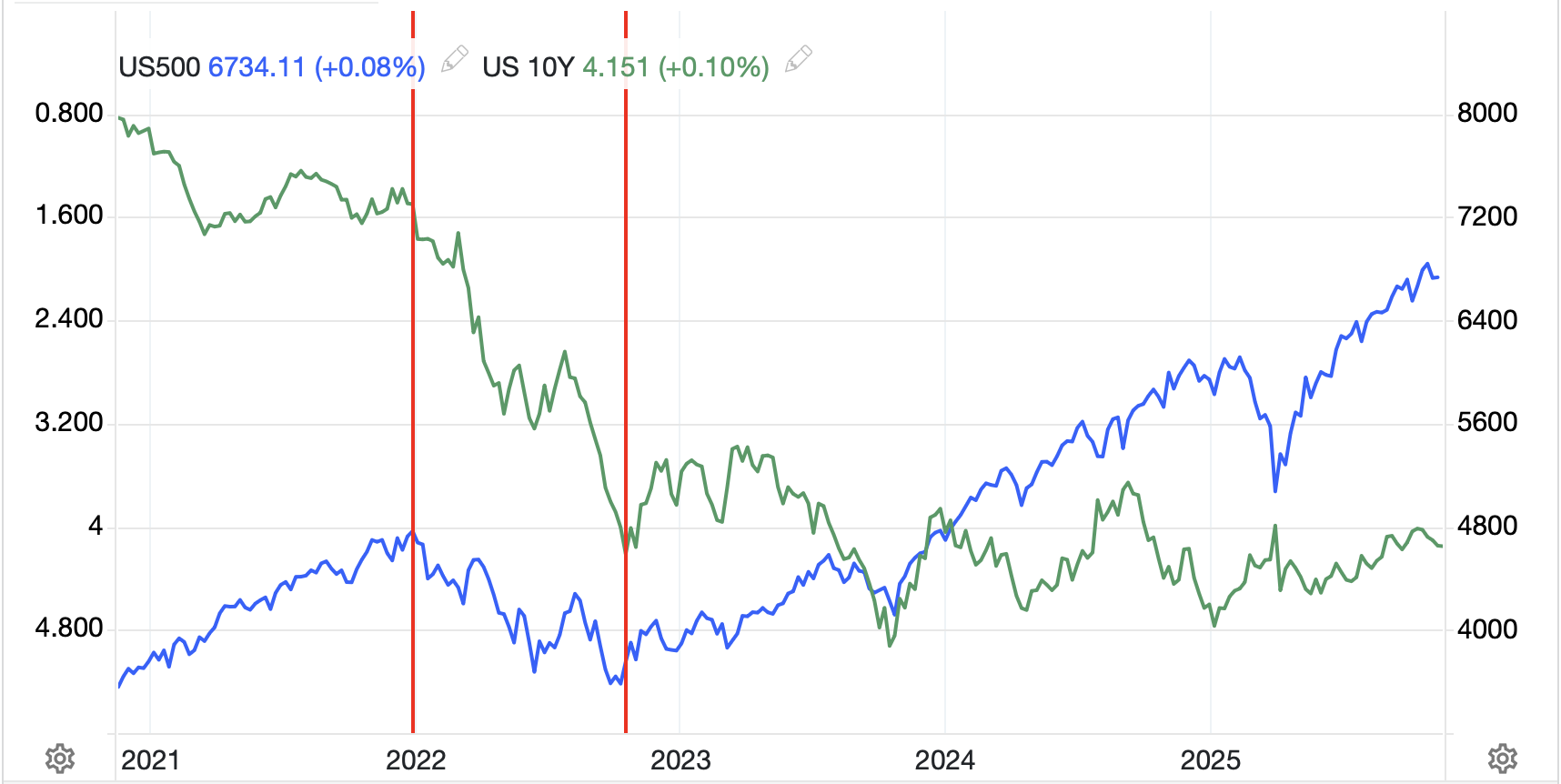
Source: tradingeconomics.com

This contemplation was brought on by a tweet which led me to a very interesting article (just a 5 minute read) by DL Jacobs of the Platypus Affiliated Society, regarding Fed Governor Miran and his recognition that the world has changed and that the Fed needs to change too.  Here is the second paragraph, and I think it explains the issue beautifully [emphasis added]:

He [Miran] used the moment to challenge the foundations of United States monetary policy. “I think it’s important to take these models seriously, not literally,” he said. He warned that models do not take into account the scale and speed of policy changes in light of the Trump administration’s re-election. The problem with the Fed isn’t wrong technique or bad data, he suggested, but rather that the very structure of its models is embedded in the economic and political assumptions of a bygone era. The world the forecasts are trying to measure no longer exists.

(At this point, I have to explain that the Platypus Society is a left-wing organization trying to explain why Marxism failed and recreate it, but that doesn’t make this article any less worthwhile.  I believe they see it as a step in the destruction of capitalism, which appears to be their goal.)

To me, this is just another point indicating that we’re not in Kansas anymore.  Policies need to change, and the Trump administration is working hard to do so.  One of the key points Miran makes is that the Fed and Treasury ought to be considered as a single entity, with the idea of Fed independence an anachronism from a bygone age.  The upshot is the Trump administration is going to continue to run things hot, or as macro analyst Lynn Alden has been saying, “Nothing stops this train”.  

This means that the Fed is going to run relatively easy monetary policy while the government, via the Treasury, is going to ensure there is ample liquidity available for everything, real economic activity and market activity.  The downside of these policies, alas, is that the idea inflation is going to decline in any meaningful way is simply wrong. It’s not.  Keep this in mind as we go forward.

As it happens, there was very little news of note overnight, at least market news, so let’s see how things behaved.  Friday’s mixed session in the US was followed by Chinese weakness with HK (-0.7%) and China (-0.7%) both under pressure.  Tokyo (-0.1%) was not nearly as impacted and the regional exchanges were actually broadly higher (Korea, India, Taiwan, Indonesia, Thailand).  The big news in Asia is the increasing verbal jousting by China and Japan at each other after PM Takaichi said, out loud, that if China attacked Taiwan, it would impact Japan.  Given the proximity, that is, of course, true, but apparently it was a taboo item in the diplomatic dance in the past.  I don’t see this having a long-term impact on anything.

In Europe, though, bourses are lower this morning led by Spain (-0.8%) although weakness is widespread (Germany -0.5%, France -0.4%. UK -0.1%).  There has been no data of note to drive this movement and it seems as though we are seeing the beginning of some longer-term profit taking after strong YTD gains by most bourses on the continent.  US futures at this hour (6:45) are pointing a bit higher, 0.43% or so.

In the bond market, Treasury yields have slipped -3bps this morning despite (because of?) the market pricing a December rate cut as a virtual coin toss.  This is a huge change over the past month as can be seen at the bottom of the chart below from cmegroup.com

Recent Fedspeak has highlighted the Fed’s uncertainty, especially absent data, and the belief that waiting is a better choice than acting incorrectly (what if waiting is the incorrect move?).  At any rate, we are going to be inundated with both Fedspeak (14 speeches this week!) as well as the beginnings of the delayed data so there will be lots of headlines.  Right now, I think it is fair to say that nobody is confident in the current direction of travel in the economy.  But perhaps, a more hawkish tone at the front of the curve has investors believing that inflation will, once again, become the Fed’s focus.  Alas, I don’t think so.  Looking elsewhere, European sovereign yields have followed Treasury yields lower, slipping between -2bps and -3bps this morning.  Perhaps more interesting is Japan, where JGB yields (+3bps) have risen to a new 17-year high as a prominent LDP member put forth a massive new spending bill to be passed.

In the commodity space, oil remains pinned to the $60/bbl level with lots of huffing and puffing about Russian sanctions and oil gluts and IEA changes of opinion but in the end, WTI has been either side of $60 for the past month+ and continues to trend slowly lower.  
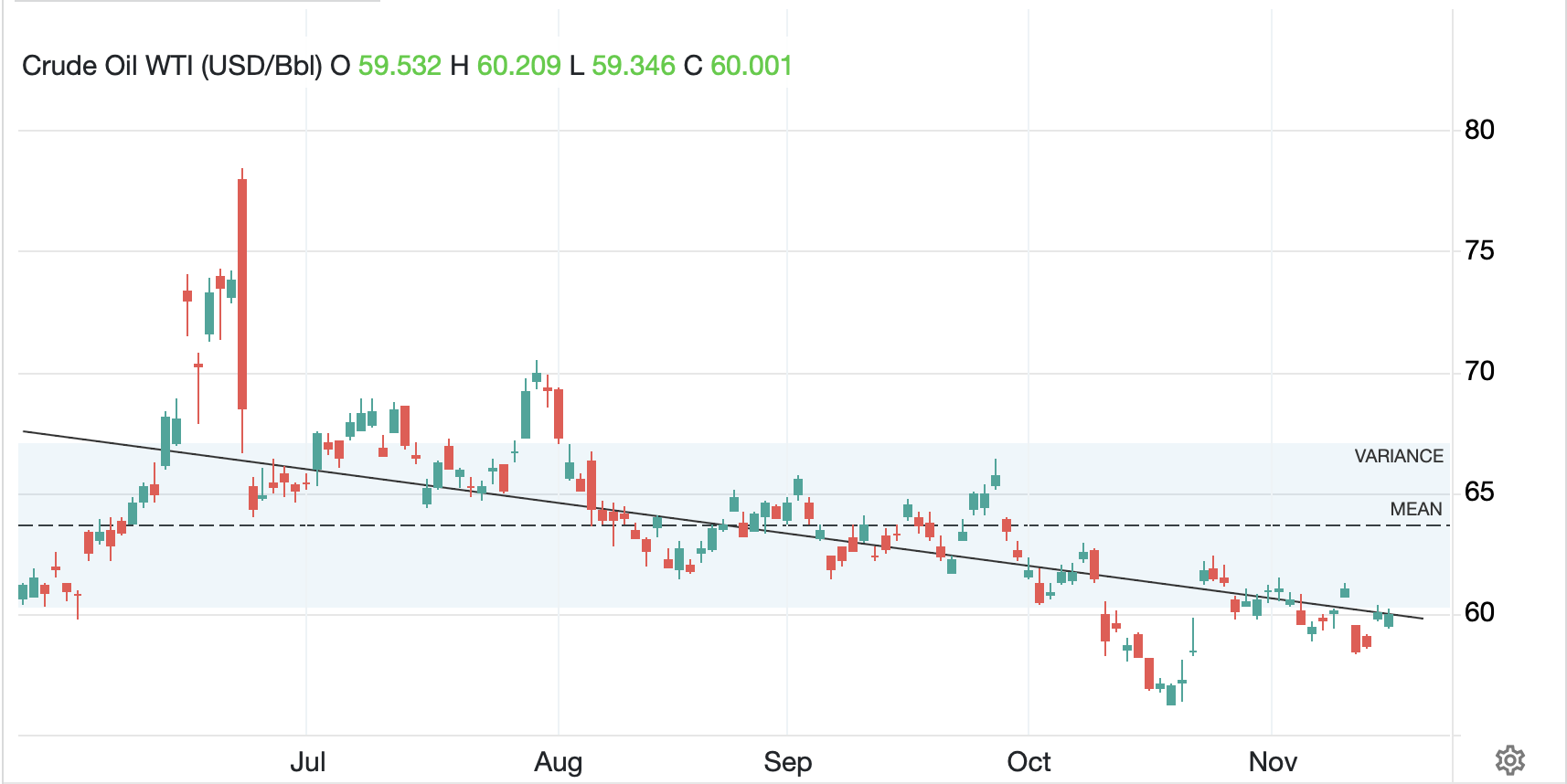
Source: tradingeconomics.com

Metals remain the most volatile segment of the entire market complex although this morning, movement has not been so dramatic (Au -0.1%, Ag +0.9%, Cu -0.4%, Pt -0.1%).  All the metals remain substantially higher than where they began the year and all have seemingly run into levels at which more consolidation is needed before any further substantial gains can be made.  I don’t think the supply/demand story has changed here, just the price action.

Finally, the dollar is a touch firmer this morning, with the DXY (+0.1%) a good representation of the entire space.  The only two currencies that have moved more than 0.2% today are KRW (-0.9%) which reversed Friday’s price action and is explained as continued capital outflows to the US for investment.  On the flip side, CLP (+1.1%) is benefitting from the first round of Presidential elections in Chile, where the right-wing candidate came out ahead and is expected to consolidate the vote and win an absolute majority in the second round.  Jose Antonio Kast, if he wins, is expected to proffer more market-friendly policies than the current socialist president, Gabriel Boric.  It seems the people in Chile have had enough of socialism for now.  But other than those two currencies, this market remains quiet.

On the data front, there is so much data to be released, but the calendar for much of it has not yet been finalized.  One thing that is finalized is the September employment situation which is due for release Thursday morning at 8:30. This morning we see Empire State Manufacturing (exp 6.0) and Construction Spending (-0.1%) and hopefully, the calendar will fill in as the week passes.

While equity markets remain very near their all-time highs, the Fear and Greed Index is firmly in Fear territory as per the below from cnn.com.

Historically, this has been seen as an inverse indicator for stock markets although it has been down here for more than a month.  Uncertainty breeds fear and the lack of data has many people uncertain about the current state of the US economy since the only information they get is either from the cacophony of social media, the bias of mainstream media or their own two eyes.  But even if you trust your own eyes, they just don’t see that much, likely not enough to come to a broad conclusion. 

FWIW, which is probably not much, my take is things are slower than they have been earlier in the year, but nowhere near recession.  I think it is the correct decision for the Fed to hold next month rather than cut because the drivers of inflation remain extant.  But Jay doesn’t ask me.  Whether Miran is correct in his prescriptions for the economy, I am gratified that he is questioning the underlying structure.  In the meantime, run it hot remains the name of the game and that means any risk-off period is likely to be short.

Good luck

Adf

They Haven’t the Nerve

It’s not just the Federal Reserve
Who thinks that inflation’s steep curve
Is likely short-term
And so reconfirm
For rate hikes, they haven’t the nerve

In Mexico, Chile, Peru
Each central bank chose to eschew
The chance to raise rates
For like in the States
They pray that inflation’s not true

Inflation remains the key talking point in every market these days.  This means not just equity, bond and commodity markets, but also geographically, not just the US, but literally every country in the world.  And in every one of these situations the two camps remain strongly at odds over the likely permanence of rising prices.  In the US, of the 16 current members of the FOMC, only one, Dallas’s Richard Kaplan, is concerned that inflation may be more than transitory.  Meanwhile the Bank of Canada has already made their move to begin tapering QE over concerns that rising inflation may become a bigger problem in the future.

Of course, inflation is not just a G10 phenomenon, it is a global one, arguably more so an issue in emerging markets than in developed ones.  Given the timing of recent central bank actions, I thought it would be interesting to take a quick look at Latin America for a sense of how other nations are dealing with rising prices.

Mexico – Banco de Mexico left its overnight rate at 4.00% for the third consecutive month yesterday despite the fact that CPI is running at 6.08% and they are currently focused on targeting 3.0% inflation.  Clearly, those numbers don’t seem to go together well, but the explanation is that the disappointingly slow rebound in the economy after last year’s Covid induced disaster has the central bank determined to help support economic growth at the risk of allowing higher inflation to become entrenched.  Not only that, they have committed to maintaining policy rates here until growth picks up further.  Look for higher inflation going forward.

Chile – Banco Central de Chile left its overnight rate at a record low of 0.50% yesterday for the 13th consecutive month despite the fact that inflation is running at 3.3%, above its 3.0% target, and trending sharply higher.  While the rise in copper prices has been an extraordinary boon to the country, given its reliance on the metal for so much of its export earnings (nearly 30%), the economy is still recovering from last year and the central bank deemed economic support, especially in this time of political uncertainty, more important than price stability.

Peru – Banco Central de Reserva del Peru left its rate at 0.25%, also a record low, for the 13th consecutive month despite the fact that inflation is running at 2.4% vs. BCRP’s 2.0% target.  Here, too, political considerations are in the mix given the upcoming second round of presidential elections and the concern that a little known left-wing school teacher may become president next month.  Here, too, the board explained that policy was appropriate for the current situation despite higher than desired inflation.

These moves contrast with Brazil, which raised rates last week by 0.75%, to 3.50%, for the second consecutive meeting and are set to do so again in June.  Of course, CPI in Brazil, which is targeted at 3.0%, is currently running at 6.76% and climbing quickly.  If it weren’t for Argentina (CPI 46.3%) Brazil would be suffering the worst inflation in Latin America.  (I exclude Venezuela here as it is impossible to measure the inflation rate given the utter collapse of the economy and monetary system.)

It seems that the central banking community is filled with a great number of people who are either innumerate or highly political.  Neither of these characteristics make for an effective and independent central bank, and given the plethora of central bankers worldwide who exhibit these tendencies, it is a fair bet that rising prices are going to be a feature of our lives, no matter where we live, for a long time to come.  The point is, it is not just the Fed that is willfully blind to the evidence of rising prices, it is a widely held viewpoint.

Today, however, the markets have decided to agree with the predominant central bank view that inflation is a transitory phenomenon as evidenced by the fact that risk appetite is back in vogue.  It starts with the bond market, where Treasury yields are falling (-1.9bps) and now 6 basis points below the levels reached after Wednesday’s CPI data.  Yesterday’s PPI data, though also higher than expected, had virtually no impact on markets.  In Europe, Gilts (-3.1bps) are also rallying along with Bunds (-0.8bps) although French OATs are flat on the day.

This renewed confidence in a lack of inflation scare has had a much bigger impact on the equity markets, where once again, buying the dip seemed to be the correct move.  Asia saw robust gains (Nikkei +2.3%, Hang Seng +1.1%, Shanghai +1.8%) and Europe is having a solid day as well (DAX +0.7%, CAC +0.7%, FTSE 100 +0.7%).  US futures are pointing to a continuation of yesterday’s rally with NASDAQ (+1.0%) leading the way, but all three indices higher by at least 0.5%.

Commodity prices are rising led by oil (+1.25%) and precious metals (Au +0.5%, Ag +0.7%) although the base metals are a bit more mixed (Cu -0.8%, Fe -5.2%) after China instituted price restrictions against steel producers in order to try to quash the recent explosion higher in steel prices.

As to the dollar, it should be no surprise that it is broadly softer this morning against both its G10 and EMG counterparts.  NOK (+1.1%) leads the way higher on the back of oil’s rally but we are seeing solid gains in NZD (+0.6%) and SEK (+0.5%) on the back of broadly positive risk appetite.  In the EMG bloc, only TWD (-0.03%) managed to lose any ground after another day of significant foreign equity outflows and an uptick in Covid cases.  Otherwise it is all green led by TRY (+0.85%), HUF (+0.6%) and MXN (+0.45%).  Turkey’s lira, which is approaching all time lows appears to be seeing a simple trading bounce as there is no news to drive things.  Mexico is clearly benefitting from the oil rally while Hungary’s forint is the beneficiary of a growing belief that the central bank there is going to raise rates to fight rising inflation.  As I said, there are several central banks that still try to focus on reality rather than wishful thinking, but they seem to be few and far between.

This morning brings Retail Sales (exp 1.0%, 0.6% ex autos) as well as IP (0.9%), Capacity Utilization (75.0%) and Michigan Sentiment (90.0).  On the central bank front, only Richard Kaplan, the lone hawk standing, speaks today, so look for more discussion about the need to think about tapering QE.  The thing is, the market is fully aware that he has no support in this stance and so it will not likely have any impact.

With the inflation scare behind us for at least another two weeks (Core PCE will be released at the end of the month), it seems the way is open for more risk-on sentiment.  This means bond yields are unlikely to rise very much and the dollar will therefore remain under pressure.

Good luck, good weekend and stay safe
Adf

Hawks Would Then Shriek

Lagarde and Chair Powell both seek
Consensus, when later this week
Their brethren convene
While doves are still keen
To ease more, though hawks would then shriek

Markets are relatively quiet this morning as investors and traders await three key events as well as some important data. Interestingly, neither the Fed nor ECB meetings this week are likely to produce much in the way of fireworks. Chairman Powell and his minions have done an excellent job convincing market participants that the temporary cyclical adjustment is finished, that rates are appropriate, and that they are watching everything closely and prepared to act if necessary. Certainly Friday’s blowout NFP data did not hurt their case that no further easing is required. By now, I’m sure everyone is aware that we saw the highest headline print since January at 266K, which was supported by upward revisions of 41K to the previous two months’ data. And of course, the Unemployment Rate fell to 3.5%, which is back to a 50-year low. In fact, forecasts are now showing up that are calling for a 3.2% or 3.3% Unemployment Rate next November, which bodes well for the incumbent and would be the lowest Unemployment Rate since 1952!

With that as the economic backdrop in the US, it is hard for the doves on the Fed to make the case that further easing is necessary, but undoubtedly they will try. In the meantime, ECB President Lagarde will preside over her first ECB meeting where there are also no expectations for policy changes. Here, however, the situation is a bit tenser as the dramatic split between the hawks (Germany, the Netherlands and Austria) and the doves (Spain, Portugal and Italy) implies there will be no further action anytime soon. Madame Lagarde has initiated a policy review to try to find a consensus on how they should proceed, although given the very different states of the relevant economies, it is hard to believe they will agree on anything.

Arguably, the major weakness in the entire Eurozone construct is that the lack of an overarching continent-wide fiscal authority means that there is no easy way to transfer funds from those areas with surpluses to those with deficits. In the US, this happens via tax collection and fiscal stimulus agreed through tradeoffs in Congress. But that mechanism doesn’t exist in Europe, so as of now, Germany is simply owed an extraordinary amount of money (~€870 billion) by the rest of Europe, mostly Italy and Spain (€810 billion between them). The thing is, unlike in the US, those funds will need to be repaid at some point, although the prospects of that occurring before the ECB bails everyone out seem remote. Say what you will about the US running an unsustainable current account deficit, at least structurally, the US is not going to split up, whereas in Europe, that is an outcome that cannot be ruled out. In the end, it is structural issues like this that lead to long term bearishness on the single currency.

However, Friday’s euro weakness (it fell 0.45% on the day) was entirely a reaction to the payroll data. This morning’s 0.15% rally is simply a reactionary move as there was no data to help the story. And quite frankly, despite the UK election and pending additional US tariffs on China, this morning is starting as a pretty risk neutral session.

Speaking of the UK, that nation heads to the polls on Thursday, where the Tories continue to poll at a 10 point lead over Labour, and appear set to elect Boris as PM with a working majority in Parliament. If that is the outcome, Brexit on January 31 is a given. As to the pound, it has risen 0.2% this morning, which has essentially regained the ground it lost after the payroll report on Friday. At 1.3165, its highest point since May 2019, the pound feels to me like it has already priced in most of the benefit of ending the Brexit drama. While I don’t doubt there is another penny or two possible, especially if Boris wins a large majority, I maintain the medium term outlook is not nearly as robust. Receivables hedgers should be taking advantage of these levels.

On the downside this morning, Aussie and Kiwi have suffered (each -0.2%) after much weaker than expected Chinese trade data was released over the weekend. Their overall data showed a 1.1% decline in exports, much worse than expected, which was caused by a 23% decline in exports to the US. It is pretty clear that the trade war is having an increasing impact on China, which is clearly why they are willing to overlook the US actions on Hong Kong and the Uighers in order to get the deal done. Not only do they have rampant food inflation caused by the African swine fever epidemic wiping out at least half the Chinese hog herd, but now they are seeing their bread and butter industries suffer as well. The market is growing increasingly confident that a phase one trade deal will be agreed before the onset of more tariffs on Sunday, and I must admit, I agree with that stance.

Not only did Aussie and Kiwi fall, but we also saw weakness in the renminbi (-0.15%), INR (-0.2%) and IDR (-0.2%) as all are feeling the pain from slowing trade growth. On the plus side in the EMG bloc, the Chilean peso continues to stage a rebound from its worst levels, well above 800, seen two weeks ago. This morning it has risen another 0.85%, which takes the gain this month to 4.8%. But other than that story, which is really about ebbing concern after the government responded quickly and positively to the unrest in the country, the rest of the EMG bloc is little changed on the day.

Turning to the data this week, we have the following:

Tuesday NFIB Small Business Optimism 103.0
  Nonfarm Productivity -0.1%
  Unit Labor Costs 3.4%
Wednesday CPI 0.2% (2.0% Y/Y)
  -ex Food & Energy 0.2% (2.3% Y/Y)
  FOMC Rate Decision 1.75%
Thursday ECB Rate Decision -0.5%
  PPI 0.2% (1.2%)
  -ex Food & Energy 0.2% (1.7%)
  Initial Claims 215K
Friday Retail Sales 0.4%
  -ex autos 0.4%

Source: Bloomberg

While there is nothing today, clearly Wednesday and Thursday are going to have opportunities for increased volatility. And the UK election results will start trickling in at the end of the day on Thursday, so if there is an upset brewing, that will be when things are first going to be known.

All this leads me to believe that today is likely to be uneventful as traders prepare for the back half of the week. Remember, liquidity in every market is beginning to suffer simply because we are approaching year-end. This will be more pronounced next week, but will start to take hold now.

Good luck
Adf

Quite a Breakthrough

Is stealing IP now taboo?
If so that is quite a breakthrough
Now maybe Phase One
Can finally be done
Or is this just more déjà vu?

Tell me if you’ve heard this one before; a phase one trade deal is really close! For the umpteenth time in the past six months, this is the story driving markets this morning, although, in fairness, today’s version may have a bit more substance to it. That substance comes from an announcement by China that they are going to institute penalties on IP theft and potentially lower the threshold for considering criminal punishments for those convicted of the crime. This, of course, has been one of the key US demands in the negotiations thus far and the fact that the Chinese have conceded the argument is actually quite a big deal. Recall, if you will, that when this entire process started, the Chinese wouldn’t even admit that the practice was ongoing. Now they are considering enshrining the criminality of these actions into law. That is a huge change. Perhaps the current US stance in the negotiations is beginning to bear fruit.

Given this positive turn in the discussions, it should be no surprise that risk assets are in demand today and we are seeing equity markets rally around the world. Overnight in Asia, we saw strength across the board (Nikkei +0.8%, Hang Seng +1.5%, Shanghai +0.7%) and we are seeing solid gains in Europe as well (DAX +0.4%, CAC +0.3%, FTSE 100 +0.8%). The two outliers, Hong Kong and London have additional positive stories to boot. In Hong Kong the weekend’s local council elections resulted in the highest turnout in years and not surprisingly, given the ongoing protests for democracy, the pro-democracy candidates won 85% of the seats. HK Chief Executive Carrie Lam was quick to respond by explaining the government will listen carefully to the public on this issue. One other aspect of the elections was that they were completely peaceful, with no violence anywhere in the city this weekend, a significant difference to recent activity there, and that was also seen as a risk positive outcome.

Meanwhile, in the UK, PM Boris Johnson released his election manifesto and it was far more sensible than his predecessor’s attempt three years ago. While it included spending promises on infrastructure and increased hiring of nurses for the National Health Service, there were few other spending categories. Of course, he did remind everyone that a Tory majority will allow him to deliver Brexit by January 31 and he assured that the trade deal would be complete by the end of 2020. The latest polls show that the Tories lead 42% to 30% for Labour with the rest still split amongst minor players. Also, a Datapraxis study shows that on current form, the Tories will win 349 of the 650 seats in Parliament, a solid majority that will allow Boris to implement his policies handily. Given this news less than three weeks from the election, investors and traders are becoming increasingly bullish on the outcome and the pound has benefitted accordingly this morning, rising 0.3%. Now, it is still well below the levels seen last month, when it briefly peeked over 1.30 in the euphoria that Boris was going to get Brexit done by October 31. But, it is today’s clear winner in the G10 space.

Away from the pound, the rest of the G10 space has been quite dull, with the euro slipping a scant 0.1% after German IFO data showed that while the economy may not be getting worse, it is not yet getting much better. In keeping with the equity driven risk-on theme, the yen is softer this morning as well, -0.2%, but that is entirely risk related.

Turning to the EMG space, there has been a touch more activity but still nothing remarkable. On the positive side we see CLP rising 0.7% which has all the earmarks of a position consolidation after a very troubled couple of weeks. There has been no specific news although a background story has been focused on shifts in the local pension scheme. It seems there are five funds, labeled A through E with A the most aggressive, invested 60% in international equities, while E is the most conservative, investing 92% in local fixed income assets. It seems that in the wake of the protests, there was a substantial shift into the A fund, which has outperformed given the peso’s weakness. However, it now appears that local investment advisors are highlighting the benefits of the E fund which will result in CLP purchases and corresponding CLP strength. This is certainly consistent with the idea that risk is back in vogue so perhaps we have seen the worst in CLP. But otherwise, nothing much of interest here either.

During this holiday shortened week, we actually get a decent amount of data with most of it released Wednesday morning.

Tuesday Case Shiller Home Prices 3.30%
  New Home Sales 707K
  Consumer Confidence 127.0
Wednesday Initial Claims 221K
  Q3 GDP 1.9%
  Durable Goods -0.8%
  -ex Transport 0.1%
  Chicago PMI 46.9
  Personal Income 0.3%
  Personal Spending 0.3%
  Core PCE 0.1% (1.7% Y/Y)
  Fed’s Beige Book  

Source: Bloomberg

In addition to this, where my sense is the market will be most focused on the Personal Income and Spending data, we hear from Chairman Powell later this evening. While it is always an event when a Fed chair speaks, it seems pretty unlikely that we are going to learn anything new here. At this stage, it has been made quite clear that the Fed is on hold for the foreseeable future. If that is not the message, then you can look for market fireworks.

So the session today is shaping up to be risk focused which means that away from the yen and maybe Swiss franc, I expect the dollar to be softer rather than firmer.

Good luck
Adf

Dying To See

Said Trump, it’s not me it’s the Fed
Preventing us moving ahead
While China and Xi
Are dying to see
A deal where all tariffs are dead

It should be no surprise that President Trump was at the center of the action yesterday, that is the place he most covets. In a speech at the Economic Club of New York, he discussed pretty much what we all expected; the economy is doing great (low unemployment, low inflation and solid growth); the Fed is holding the economy back from doing even better (give us negative rates like Europe and Japan, we deserve it) and the Chinese are dying to do a deal but the US is not going to cave in and remove tariffs without ironclad assurances that the Chinese will stop their bad behavior. After all, this has been the essence of his economically focused comments for the past year. Why would they change now? But a funny thing happened yesterday, the market did not embrace all this is good news, and we started to see a little bit of risk aversion seeping into equity prices and filter down to the bond and currency markets.

For example, although the Dow Jones Industrial Average closed yesterday just 0.3% from the all-time high set last Thursday, there has been no follow-through in markets elsewhere in the world, and, in fact, US futures are pointing lower. Now arguably, this is not entirely a result of Trump’s comments, after all there are plenty of problems elsewhere in the world. But global markets have proven to be quite vulnerable to the perception of bad news on the US-China trade negotiations front, and the fact that there is no deal clearly set to be signed is weighing on investors’ collective minds. So last night, we saw Asian markets suffer (Nikkei -0.85%, Hang Seng -1.8%, KOSPI -0.85%, Shanghai -0.35%) and this morning European markets are also under pressure (DAX -0.75%, CAC -0.45%, FTSE -0.55%, Spain’s IBEX -1.65%, Italy’s MIB -1.3%). In other words, things look pretty bad worldwide, at least from a risk perspective.

Now some of this is idiosyncratic, like Hong Kong, where the protests are becoming more violent and more entrenched and have demonstrably had a negative impact on the local economy. Of even more concern is the growing possibility that China decides to intervene directly to quell the situation, something that would likely have significant negative consequences for global markets. Too, Germany is sliding into recession (we will get confirmation with tomorrow’s Q3 GDP release) and so the engine of Europe is slowing growth throughout the EU, and the Eurozone in particular. And we cannot forget Spain, where the fourth election in four years did nothing to bring people together, and where the Socialist Party is desperately trying to cobble together a coalition to get back in power, but cannot find enough partners, even though they have begun to climb down from initial comments about certain other parties, namely Podemos, and consider them. The point is, President Trump is not the only reason that investors have become a bit skeptical about the future.

In global bond markets, we are also seeing risk aversion manifest itself, notably this morning with 10-year Treasury yields falling more than 6bps, and other havens like Bunds (-4bps) and Gilts (-5bps) following suit. There has been a great deal of ink spilled over the recent bond market price action with two factions completely at odds. There continue to be a large number of pundits and investors who see the long-term trend of interest rates still heading lower and see the recent pullback in bond prices as a great opportunity to add to their long bond positions. Similarly, there is a growing contingent who believe that we have seen the lows in yields, that inflation is beginning to percolate higher and that 10-year yields above 3.00% are going to be the reality over the course of the next year. This tension is evident when one looks at the price action where since early September, we have seen a 40bp yield rally followed by a 35bp decline in the span of five weeks. Since then, we have recouped all the losses, and then some, although we continue to see weeks where there are 15bp movements, something that is historically quite unusual. Remember, bonds have historically been a dull trading vehicle, with very limited price activity and interest generated solely for their interest-bearing qualities. These days, they are more volatile than stocks! And today, there is significant demand, indicating risk aversion is high.

Finally, the dollar continues to benefit against most of its counterparts in both the G10 and EMG blocs, at least since I last wrote on Friday. In fact, there are four G10 currencies that have performed well since then, each with a very valid reason. First, given risk aversion, it should be no surprise that both the yen and Swiss franc have strengthened in this period. Looking further, the pound got a major fillip yesterday when Nigel Farage said that his Brexit party would not contest any of the 317 seats the Tories held going into the election, thus seeming to give a boost to Boris Johnson’s electoral plans, and therefore a boost toward the end of the Brexit saga with a deal in hand. Finally, last night the RBNZ surprised almost the entire market by leaving rates on hold at 1.0%, rather than cutting 25bps as had been widely expected. The reaction was immediate with kiwi jumping 1.0% and yields in New Zealand rallying between 10 and 15 bps across the curve.

Turning to the Emerging markets, the big mover has been, of course, the Chilean peso, the erstwhile star of LATAM which has fallen more than 5.0% since Friday in the wake of the government’s decision to change the constitution in an effort to address the ongoing social unrest. But this has dragged the rest of the currencies in the region down as well, with Colombia (-2%) and Mexico (-1.7%) also feeling the effects of this action. The removal of Peruvian president, Evo Morales, has further undermined the concept of democracy in the region, and investors are turning tail pretty quickly. Meanwhile, APAC currencies have also broadly suffered, with India’s rupee the worst performer in the bunch, down 1.1% since Friday, as concerns about slowing growth there are combining with higher than expected inflation to form a terrible mix. But most of the region is under pressure due to the ongoing growth and trade concerns, with KRW (-0.9%) and PHP (-0.7%) also feeling strains on the trade story. The story is no different in EEMEA, with the bulk of the bloc lower by between 0.5% and 0.85% during the timeframe in question.

Turning to this morning, we see our first important data of the week, CPI (exp 0.3%, 0.2% core) for the month and (1.7%, 2.4% core) on an annual basis. But perhaps more importantly Chairman Powell speaks to Congress today, and everybody is trying to figure out what it is he is going to say. Most pundits believe he is going to try to maintain the message from the FOMC meeting, and one that has been reinforced constantly by his minions on the committee, namely that the economy is in a good place, that rates are appropriately set and that they will respond if they deem it necessary. And really, what else can he say?

However, overall, risk remains on the back foot today, and unless Powell is suddenly very dovish, I expect that to remain the case. As such, look for the dollar to continue to edge higher in the short term, as well as the yen, the Swiss franc and Treasuries.

Good luck
Adf