Kind of a Mess

The narrative which had been forming
Was prices were constantly warming
While job growth was strong
The bears were all wrong
And buyers of stocks were now swarming
 
But Friday the data was less
Impressive, and kind of a mess
At first, NFP
Was weak, all agree
Then ISM caused more distress


It is remarkable how quickly a narrative can change, that’s all I can say!  One week ago, the story was all about how the economy continued to perform well overall, that inflation remained sticky at levels higher than targeted and that the Fed would stick with higher for longer with a chance of a rate hike on the table.  This morning, in the wake of a clearly dovish Powell press conference and softer than expected ISM and employment data, the narrative appears to be coalescing around the idea that cuts are back on the table while a recession can no longer be ruled out.

The table below, courtesy of the Chicago Mercantile Exchange, shows the current probabilities for Fed funds based on futures pricing for the December 2024 contract as well as how they have evolved over the past week and month.

Source: CME

When calculating how much is priced into the market, one simply multiplies the size of the cut by its stated probability and voila, the answer appears.  To save you the trouble of doing the math, the current market pricing shows that as of this morning, the market is pricing in 47.6bps of cuts by year-end, so essentially two cuts.  One week ago, that number was 34.8bps while one month ago it was 65.7bps.  in other words, we have seen a bit of movement in this sentiment indicator.  And really, that’s exactly what this is, a measure of the market’s sentiment and expectations of how Fed funds are going to evolve over time.  

What should we make of this information?  Well, anecdotally, for the past several weeks I have not been reading about recession at all.  The no-landing scenario seemed to be the favorite as the soft-landing idea ebbed amid too high inflation readings.  But this morning, in concert with the Fed funds futures market, I have seen several stories discussing that a recession is on the horizon now and coming into view.  The ISM data was clearly a problem as both the Manufacturing (49.2) and Services (49.4) numbers slipped below the 50.0 boom/bust line while the Chicago PMI release was abysmal at 37.9.  Even worse, the Prices paid data for both Manufacturing (60.9) and Services (59.2) rose sharply, exactly what Chair Powell did not want to see.  In fact, this data rhymes with the Q1 GDP data which showed the mix of activity was turning toward less growth (1.6%) and more inflation (3.7%) for a given amount of activity.

Now, Powell was very clear that he saw neither the ‘stag’ nor the ‘flation’ sides of the idea that the US was slipping into stagflation, and certainly compared to the situation in the 1970’s, we are nowhere near that type of situation.  But there is a bit of whistling past the graveyard here, I believe, as slowing real growth and rising prices are not the combination that any central bank wants to have to fight.  When Mr Volcker took over the role as Fed Chair in 1979, he pretty quickly decided that it was more important to fight inflation first, and deal with any recession later, hence the double-dip recessions of 1980 and 1982.  But that set the stage for structurally lower interest rates for two generations.

Based on Powell’s press conference comments as well as the tone of many of the mainstream media stories that are currently in print regarding the economic situation, it appears to this poet as though Mr Powell may be far more willing to allow inflation to run hotter than target for longer as he tries to prevent a sharp recession, especially ahead of the presidential election.  With rate hikes no longer an option, any semblance of higher inflation will be met with words alone, and that will not do the trick.  I have maintained for a long time that if the Fed eased policy before inflation was squashed, it would be bad for bonds, bad for the dollar and good for commodities and stocks.  I am now coming to believe that we are entering this environment, and that while the initial move in bonds may be higher (lower yields) as it becomes clear that inflation remains with us, bond investors will quickly decide that the risk/reward in an inflationary environment is quite poor, and we will see the back end of the curve sell off.

After those cheery thoughts for a Monday morning, let’s look at how markets have behaved overnight.  Friday’s rip-roaring rally in the US was mostly followed by strength throughout Asia where markets were open (Japan and South Korea were closed) with China, Hong Kong, Australia, and Taiwan all having good sessions, up between 0.75% and 1.25%.  It should also be no surprise that European bourses are all in the green this morning as rate pressures eased and adding to the happiness were PMI Services reports that were generally on target or slightly better than the flash numbers.  In other words, all is right with the world!  Finally, US futures are also firmer by a bit this morning, up 0.2% or so with the main talk still about Apple’s massive stock repurchase program as well as the Berkshire Hathaway AGM this past weekend.

Of course, bonds were the big mover on Friday, with yields plummeting in the wake of the softer than expected NFP data, where not only were claims lower, but so was earnings data and the Unemployment Rate ticked up to 3.9%.  The initial move was a 9bp decline in the 10yr and and 10bps in the 2yr although by Friday’s close, both markets had retraced half of those declines.  This morning, though, yields are sliding again with 10yr Treasuries down 3bps and all European sovereigns following suit, falling 4bps.  (As an aside, on Friday, the European yields followed Treasuries tick for tick.). With Japan closed, there was no JGB movement overnight.

In the commodity markets, crude oil (+1.0%) is bouncing today from yet another weak performance on Friday as the weaker economic data is weighing on the demand story there.  However, regarding geopolitics and the middle east, this morning’s headlines regarding Israel telling Palestinians to leave Rafah has the market on edge.  But metals markets are back on fire this morning with both precious (Au +0.7%, Ag +2.1%) and industrial (Cu +2.0%, Al +1.1%) rallying on the lower interest rate, higher inflation story that is percolating through markets.

Finally, the dollar, too, is under pressure this morning continuing its trend from last week, although it is not collapsing by any stretch with the DXY still trading just above 105.00.  There is a great deal of discussion as to whether the BOJ/MOF have been successful in their efforts to stem the yen’s decline permanently.  It is clear that their two bouts of intervention (neither officially admitted) has done a good job in the short run.  The story here, though, is all about interest rates.  If, and this is a big if, the Fed is truly turning their sights on cutting rates with any help at all from inflation showing signs of ebbing again, then the higher dollar thesis is going to run into real trouble.  I have made no bones about the idea that the dollar’s strength was entirely reliant on the fact that the Fed was the most hawkish of all the main central banks.  If that is no longer the case, then the dollar is going to come under universal pressure and the yen probably has the most to recover.

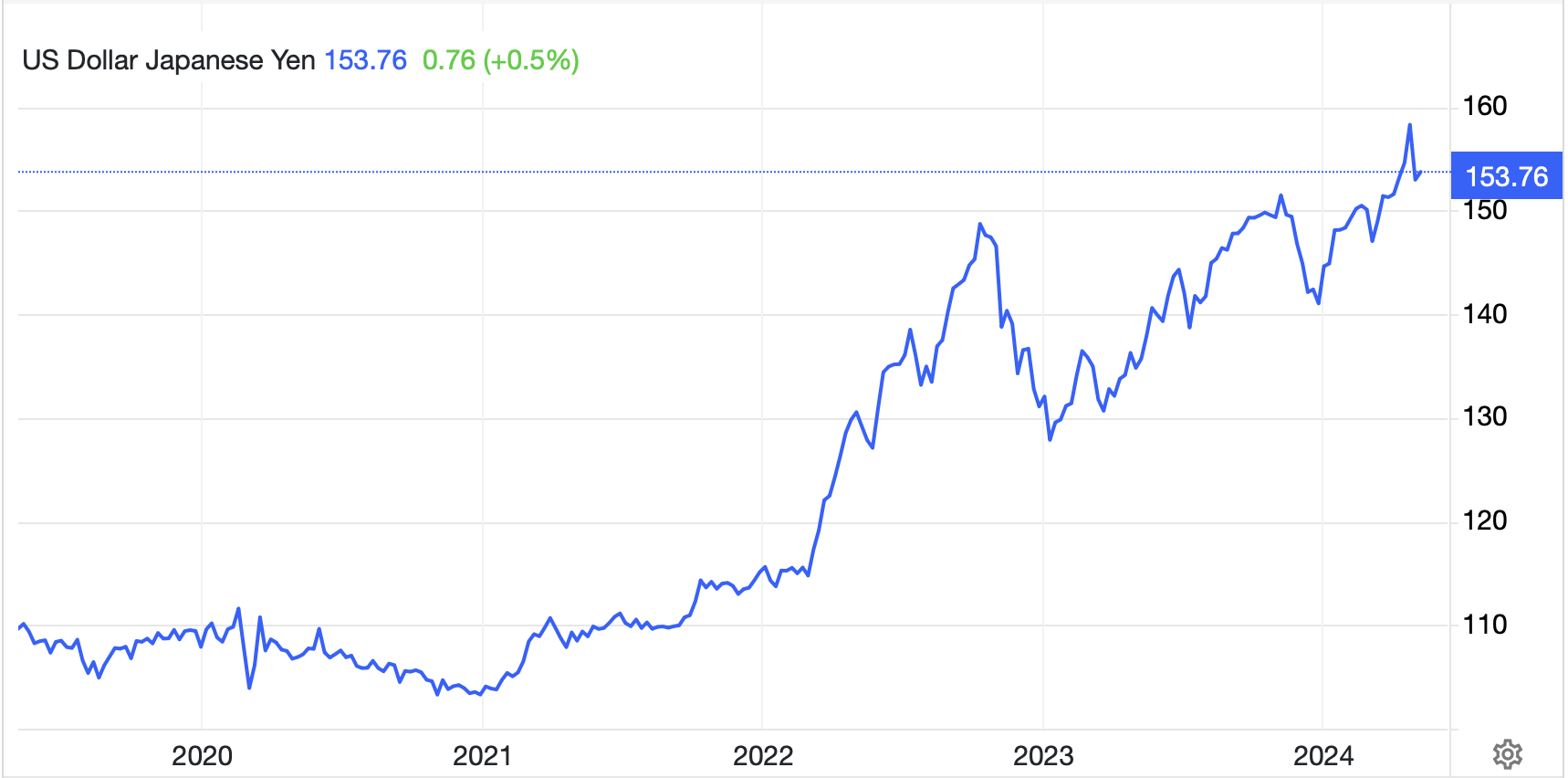
**This is really critical for JPY asset and receivables hedgers.  There is no better time to consider using purchased options or zero premium collars than right now.  If the recent movement is a head fake, and the inflation story in the US grows such that the Fed puts hikes back on the table, then you will have put hedges in place.  But…if this is the beginning of a truly new narrative, where US rates are going to decline, USDJPY can fall a very long way in a very short time.  Look at the 5-year chart of USDJPY below.  It was in 2022 when USDJPY was trading at 115 and that had been the level for several years.  we can go back there in a hurry, believe me!**

Source: tradingeconomics.com

As to the rest of the currencies out there, you will not be surprised that ZAR (+0.5%) is top of the heap this morning although a thought must be given to CLP’s 2.25% gain on Friday (market not open yet) as it rallied alongside copper’s rally.  Ironically, the one currency that is under pressure this morning is JPY (-0.5%), but remember, it has risen 4% from the levels when the BOJ first intervened, so a little bounce is no surprise.

Turning to the data this week, it is an incredibly light week, with CPI not coming until next week.

TuesdayConsumer Credit$15B
ThursdayInitial Claims212K
 Continuing Claims1895K
FridayMichigan Sentiment77.0
Source: tradingeconomics.com

As well, we have eight Fed speakers including NY president Williams and vice-Chair Jefferson.  It will be very interesting to hear how they play the apparent pivot.  While I expect that the governors are all on board, the regional presidents will have more leeway to speak their mind I believe.

And that’s what we have for today.  I believe that things have changed and that the Fed is now very clearly far more willing to allow inflation to run hotter.  Be very wary of your bond positions and watch for the dollar to remain under pressure until something else changes.

Good luck

Adf

Wronger

The data was, once again, stronger
Reminding us higher for longer
Is still on the cards
Despite the diehards’
Beliefs that Chair Powell is wronger

As well, from two speakers we heard
And none of their signals were blurred
Said Daly and Mester
To every investor
All rate cuts are likely deferred

First, our thoughts are with the people of Taiwan which suffered a massive earthquake last night registering 7.4 on the Richter Scale.  The damage was substantial and while the early count of fatalities is relatively low, just seven so far, I fear there will be more.  From a business perspective, roads and rail lines were damaged and some of the semiconductor fabs were taken offline. The last issue matters greatly as it has the potential to drive up costs and thus prices of finished goods even further (remember what happened to auto prices during Covid when there was no availability of chips?).  It is still too early to determine what the ultimate impacts will be, but the risk is that this will add to inflationary pressures if anything.

However, away from that news, the market story from yesterday and overnight is that the data continues to point to stronger growth in the US (Factory Orders jumped 1.4%) and the latest Fed speakers we heard, Daly and Mester, explained that while three cuts are still possible this year, neither one yet has the confidence that inflation is truly heading back to their 2% goal.

And this is really the entire story for now.  It remains abundantly clear that the Fed is very keen to cut interest rates.  Their macroeconomic backgrounds look at all that has happened and given their underlying belief that the “proper” long-term interest rate is somewhere between 2.5% and 3.0%, they are concerned their current policy is too tight.  And yet, despite these views, virtually every data point that is released shows solid economic activity and no hint that things are slowing down, especially in the labor market.

So, despite that strong desire, they are wary of acting because they know, or at least Powell knows, that if they cut and inflation resurges, it is all on him.  Remember, Powell has made it clear multiple times that he wants to be Paul Volcker redux, not Arthur Burns redux.  The Fed funds futures market continues to price just 66bps of cuts by the December meeting, a telling statement about the difference between market beliefs and Fedspeak, at least yesterday’s Fedspeak.  Granted, we heard last week from two Fed speakers who thought either one or two cuts was the most likely outcome.

Today brings five more speakers including Chair Powell as well as both ADP Employment (exp 148K) and ISM Services (52.7), so there is ample opportunity for news to shake things up.  Based on everything we have seen regarding the US economic data; it seems the risks are for hotter data rather than softer data.  But of more importance, I believe, will be Powell’s comments.  If he accepts the idea that the economy continues to run fairly well with the current interest rate structure and says anything about less than three cuts being appropriate, watch out!

So, let’s look at what happened in markets overnight.  After a weak session in the US yesterday on the growing concern that monetary policy is going to remain tighter, Asia followed suit with declines across the sector.  The Nikkei (-1.0%) and Hang Seng (-1.2%) were both feeling the weight of this evolving narrative.  Surprisingly, mainland Chinese shares were also under pressure despite continued talk of more fiscal stimulus as well as a resurfacing of the idea that President Xi is willing to countenance some version of QE there.  It should be no surprise that virtually every regional market was in the red.

European bourses, though, are a different story this morning as they are higher after the initial read for Eurozone inflation fell to 2.4%, two ticks lower than expected while the Core reading fell to 2.9%, one tick lower than expected and the lowest since February 2022.  Equity investors saw this and decided that the ECB has far fewer impediments to cutting rates than the Fed.  In fact, the only market not behaving like this is the FTSE 100, which received no such news and is somewhat softer this morning.  As to US futures, they are essentially unchanged ahead of Powell’s speech today.

In the bond market, this dichotomy of policy views is also evident as Treasury yields continue to climb, edging up another basis point this morning while European sovereign yields are mostly lower, between 2bps (Spain) and 4bps (Germany) with one outlier, Italy (+2bps).  The Italian situation has to do with the European commission putting pressure on the nation regarding its budget situation which may fall afoul of the current regulations.

In the commodity markets, oil (+0.45%) continues to trade higher as the tensions in the Middle East show no sign of abating while Ukraine has been successful in interrupting Russian refinery production to some extent. Meanwhile. OPEC meets today and there is no indication that they will be changing their production restrictions.  Gold (-0.4%) which has been flying, is taking a breather today although the other metals continue to grind higher.  Nothing has really changed this story as the industrial metals continue to respond to brighter economic prospects while the precious sector continues to worry about the ultimate debasement of the fiat world.

Finally, in that fiat world, the picture is mixed this morning, although the best description is probably unchanged.  I’m hard pressed to look at my screen and see any exchange rate that is more than 0.1% different than yesterday’s levels.  Just like in the equity market, I believe traders are awaiting Chairman Powell’s comments today before taking any new positions.  Over the course of the past three weeks, the dollar has been quite strong, rallying about 3% on a DXY basis.  If the Fed continues to highlight that it is too soon to ease policy, and with today’s Eurozone inflation data, we start to hear more from ECB officials about the ability to cut, my sense is that we could see further strength in the greenback.

Overall, almost everything in markets continues to rely on Powell and the Fed.  Remember, Friday we will see the March payroll report.  If it continues the recent trend of >200K new jobs, it will be very difficult for any doves at the Fed to make their case effectively.  That could begin to weigh more heavily on the equity market but should support the dollar going forward.  Let’s listen to Chairman Jay today for our next clues.

Good luck
Adf

Dismay

The data continues to show
The US is able to grow
If this is the case
Seems foolish to chase
The idea rate cuts are a go
 
Instead, I expect Powell’s way
Is higher for longer will stay
If rates, thus, stay high
Can risk assets fly?
Or will those high rates cause dismay?


The case for the Fed to cut rates continues to fade as not only have Powell and his team been cautioning patience, the data continue to show that economic activity is not slowing down.  The latest exhibit comes from yesterday’s ISM Manufacturing data which printed at a much better-than-expected 50.3, its first print above 50 in 16 months.  Not only that, but the New Orders and Prices Paid sub-indices both printed much higher than last month indicating business is picking up and so are prices.  Certainly, the chart below from tradingeconomics.com indicates that a clear trend is forming for better growth ahead.

The Prices Paid chart looks almost identical.  It strikes me that the recession call continues to get harder to make.  Certainly, things can change, but as of right now, I cannot look at the menu of data and conclude growth is set to slow rapidly.  Given this as background, it becomes increasingly difficult to make the case that the Fed is going to cut rates at all, at least based on the data.  This is a big problem for Powell if he remains insistent on making those cuts because it will call into question the rationale and really push the politics front and center.

As it happens, I am not the only one concluding that rate cuts are less likely, the CME’s Fed funds futures contract is slowly pricing cuts out of the mix as well.  This morning not only has the probability of a June cut fallen slightly to 58.8%, but the market is now pricing in just 66bps of cuts by the December meeting, less than the three full 25bp moves that the median dot indicated.  There is a ton of Fedspeak this week, starting with 4 speeches today from Bowman, Williams Mester, and Daly.  Chairman Powell speaks tomorrow and there are a dozen more after that, so it will be very interesting to see if the tone has changed to even more caution and patience.  With this as a backdrop, perhaps longer duration assets, like bonds and high growth companies (i.e., tech) could well feel some pressure.  We shall see how things play out.

Cooperation
Is not what the market gives
Instead look for pain


While the US story continues to be about stronger economic activity and a reduced probability of lower rates, in Japan, the story remains entirely focused on the yen’s weakness and whether the MOF/BOJ are going to respond.  First, remember that in Japan, like here in the US, the MOF is responsible for the currency, not the BOJ, meaning any intervention is directed by the MOF although it is executed by the BOJ.  This is why we need to focus on the FinMin and his minions regarding any actions.  In this vein, last night as USDJPY once again approached 152.00, FinMin Suzuki was back in front of reporters explaining, “Language aside, we’re now watching markets with a strong sense of urgency.  We are carefully watching daily market moves.”  He added, “All we can say is that we will take appropriate action against excessive volatility, without ruling out any options.”  

So, the MOF continues to threaten intervention with their urgent watching of markets (I feel like that is a very poor translation of whatever he is actually saying, although I suppose it gets the message across.). In one way, it was surprising they didn’t take advantage of illiquid markets yesterday to push the dollar lower as every dollar spent would have been far more effective, but a look at the recent price activity shows that while the yen has weakened appreciably since the beginning of the year, thus far their words have been sufficient to prevent further damage as the currency hasn’t budged in two weeks.  

The problem they have is that the US seems less and less likely to begin easing monetary policy and so the underlying fundamental driver of the exchange rate, interest rate differentials, is going to continue to weigh on the yen (and every other currency).  I also see no reason for Secretary Yellen to consider that a weaker dollar is a help for the US right now, so concerted intervention, a redux of the Plaza Accord of 1985 seems highly unlikely.  While at some point I do expect the MOF to act on their own, as is always the case, it will only have a short-lived impact on markets and likely be used as an entry point for speculators to extend their short yen trade.  The only solution is a change in policies and the BOJ blew that last month.

Ok, now that markets are back open again, let’s see what’s happening.  In Asia, the big mover was the Hang Seng (+2.35%) which was catching up to the news that China seemed ready to implement further stimulus that we heard on Friday.  But there was no consistency throughout the rest of Asia with both gainers and losers around the continent.  Europe is a similar mixed bag, with some markets higher and others lower despite what I would characterize as mildly better than expected PMI data released this morning across the entire continent.  While it wasn’t showing growth, the data improved on the flash numbers of last week.  US futures, however, are softer this morning by about -0.5% after yesterday’s lackluster session.  Certainly, continued hopes for rate cuts are diminishing and that seems to be weighing on stocks at least a bit.

In the bond market, yesterday’s US data set the tone as Treasury yields jumped 12bps yesterday after the strong ISM data and are up another 5bps this morning.  This has dragged European yields higher across the board with gains between 9bps (Germany) and 14bps (Italy).  Of course, the mildly better PMI data in Europe is adding to that mix.  Even JGB yields managed to edge higher by 1bp overnight, although they remain below 0.75%.

Oil prices have been flying, up another 1.1% this morning and now nearly 9% in the past month.  It seems that the escalation of events in the Middle East is having an impact at the same time that OPEC+ is holding firm on their production cuts.  There are rumors of some big Middle East settlement deal to end the war as well as get Saudi Arabia to recognize Israel, but the market does not yet believe that, clearly.  Considering that growth is making a comeback, that China seems ready to stimulate further and that production is not growing, it seems there is a pretty good chance that oil prices continue to rally.  Meanwhile, metals remain the flavor of the day with gold (+0.3%), silver (+1.7%), copper (+0.6%) and aluminum (+1.6%) all in demand.  The industrial metals are responding to the growth story, while the precious set are simply on a roll with fears that fiat currencies are going to continue to be debased top of mind.

Speaking of fiat currencies, the dollar, which rallied nicely over the long weekend, is settling back a bit this morning, but with no consistency.  For instance, CHF (-0.5%) is lagging sharply while NOK (+0.5%) and SEK (+0.5%) are both powering ahead.  The rest of the G10 is modestly firmer, but the movements are within 10bps of yesterday’s closing levels.  In the EMG bloc, ZAR (+0.5%) continues to benefit from the metals rally while PLN (-0.4%) is under pressure after its PMI data disappointed relative to its peers.  My view continues to be that as long as the Fed remains the most hawkish central bank, the dollar will find support.

On the data front today we see JOLTS Job Openings (exp 8.75M) and Factory Orders (1.0%) and we have all those Fed speakers mentioned above.  German CPI fell to 2.2%, as expected, which implies to me that the chances remain greater the ECB will cut before the Fed.  And that is really the big question now, which major central bank acts first.  With all the Fed speakers on this week’s docket, I suspect by Friday we will have a much better idea as to whether a June cut is still on the table.  We will be watching closely.

Good luck

Adf

A Narrative Flaw

At first it was just CPI
With heat like the fourth of July
But Friday we saw
A narrative flaw
As PPI jumped, oh so high
 
The narrative’s now in a bind
While working so hard to remind
Investors that prices
Are not in a crisis
And Goldilocks can’t be maligned


It must be very difficult to be a cheerleader for the immaculate disinflation* these days given we continue to see data showing inflation is no longer receding.  Friday’s PPI was the latest chink in the deflationists’ armor as both the headline and core numbers printed well above expectations.  Of course, this followed Tuesday’s hot CPI prints as well as some lesser data like the prices paid portion of the NFIB survey and the last ISM Services survey.  Energy prices, which had fallen throughout Q4 but have since bottomed and appear to be trending higher again, are no longer a cap on inflation.  But of greater consequence is the fact that services inflation remains higher on the back of continued wage gains and rises in the price of things like insurance.  

Market participants are slowly coming around to the idea that the Fed may not be cutting rates quite like they were hoping for praying for anticipating just a few weeks ago.  This has been made clear by a quick look at the Fed funds futures market in Chicago which is now pricing in just a 10% chance of a March cut, a 35% chance of a May cut and a 75% chance of a June cut.  In fact, the market is now pricing in barely more than the Fed’s last dot plot for 2024, just 81bps for the entire year.

Of course, there is one benefit to the recent data and that is we stopped hearing about the 3-month trend and the 6-month trend showing the Fed had reached their target and so should be cutting rates NOW!  Instead, the fact that those trends are now pointing higher insures that we won’t hear about that for quite a while…I hope.

Philosophically, I remain confused as to why there is so much ‘demand’ that the Fed cuts rates at all.  While I certainly understand why the administration would like to see it, given the budget deficits that need to be financed, arguably, if nominal GDP growth is between 6% and 7% and Fed funds are at 5.5%, things don’t seem out of place.  If anything is out of place it is the 10-year yield, which even after rising 6bps on Friday, remains at 4.30%.  Historically, a more normal level of 10-year yields would be the same as nominal GDP growth.  Currently, that tells me either 10-year yields have much further to rise, or GDP is going to fall A LOT.  I sure hope it is the former.

Now, looking past Friday’s activity, this morning has been extremely quiet overall with the prospects for action looking quite limited.  Today the US celebrates President’s Day, so banks are closed as is the stock market, although futures markets are trading.  Canada is also mostly on holiday which implies that once Europe goes home, things will really die out.

But quiet is the best description of everything overnight.  One surprise was that Chinese equity markets were far less bullish than many anticipated as they reopened after the extended Lunar New Year holiday.  While the CSI 300 managed to rise 1.2% on the session, the bulk of the move came at the close with a wave of buying by their plunge protection team.  The disappointment was based on the stories that holiday travel had risen substantially which had been pumping up the Hang Seng which reopened last Thursday.  Alas, that market fell -1.1%, a perfect encapsulation of the overall disappointment.  In the meantime, European bourses are trading either side of unchanged and at this hour (7:00), US futures are doing the same, basically unchanged on the day.

Basically unchanged is an excellent description of the bond markets as well, with virtually every major European sovereign market either unchanged or higher by 1bp this morning.  Overseas trading of Treasuries has also seen limited activity and no yield change, and you will not be surprised to learn that JGB yields were also unchanged.  

In the commodity space, oil, which had a solid week last week and now shows WTI at ~$79.00/bbl, is a touch softer this morning, but only just.  I have seen a number of stories about peak oil having been reached again, but as you may know, I am no longer convinced that is the case.  Of course, that is a very long-term discussion which will have nothing to do with the daily fluctuations.  And shocks to the system can have a big impact regardless of the long-term story.  In the metals markets, gold is edging higher again, +0.3%, but both copper and aluminum are softer this morning by about -0.4%.  As with every other market, there is a lot of conflicting data that has been preventing a more coherent directional view here.  I suspect that will resolve over time, but in commodities, over time can mean months or years.

Finally, the dollar is little changed net with a mixture of gainers and losers.  For instance, in the G10, we are seeing very modest strength in NZD (+0.25%) and JPY (+0.2%, and just below 150.00 as I type), while in the EMG space there is some weakness as evidenced by ZAR (-0.4%) and KRW (-0.3%).  As with all markets today, I don’t think we are going to learn very much new.

As it is a holiday, there is no data today and, in truth, there is very little to be released all week.

TuesdayLeading indicators-0.3%
WednesdayFOMC Minutes 
ThursdayChicago Fed National Activity-0.19
 Initial Claims217K
 Continuing Claims1900K
 Flash Manufacturing PMI50.2
 Flash Services PMI52.0
 Existing Home Sales3.97M
source: tradingeconomics.com

In addition to that short slate, we hear from seven different Fed speakers including Governor Waller who seems to be the most important voice after Powell and Williams.  As it happens, five of those come Thursday with Waller the last at 7:30 that evening.

For today, I would not expect much at all in the way of market movement.  Given the lack of obvious catalysts, a quiet week seems likely as well.  Perhaps the biggest news is NVDIA is releasing their earnings Wednesday after the close, although from an FX perspective, that doesn’t seem crucial.  Big picture tells me that the Fed is not going to be easing policy soon, and that as long as the US economy continues to outperform those of Europe, Japan, the UK and China, the dollar is likely to find continued support.  Realistically, I think you could make the case for the dollar to rally substantially over the course of the year, but right now, that doesn’t feel like the move.

Good luck

Adf

*Immaculate disinflation – the idea that inflation can decline without a slowdown in growth or recession, but rather because it’s previous rise was transitory, just taking a little longer than originally anticipated.

Finally Dead

It’s been, now, two weeks since the Fed
Said rate cuts were not straight ahead
Their confidence lacked
Support to abstract
Inflation was finally dead
 
Which brings us now to CPI
Where analysts identify
Used cars and soft gas
As just ‘nuff to pass
The test and wave ‘flation bye-bye


Finally, the CPI report will be released this morning so we will be able to collectively exhale!  The current consensus forecasts are for a 0.2% M/M rise in the headline, leading to a 2.9% Y/Y outcome and a 0.3% M/M rise in the ex-food & energy reading leading to a 3.7% Y/Y increase.  Those annual numbers would be down from 3.4% and 3.9% respectively.

A key part of the thesis for the ongoing decline is that Used Car prices will continue to fall as well as gasoline prices, which fell about 30 cents/gallon on the NYMEX exchange.  However, rent increases remain stubbornly high and any declines in foodstuffs seem to have ended.  There was a ‘brilliant’ article by a UC Berkeley economist, Ulrike Malmendier, that determined most people’s view of inflation was skewed by the prices of things they bought most frequently, rather than the ‘proper’ economists’ view of the totality of prices.  Who would have thunk it?  Honestly, it is hard to believe that some of these people have degrees at all.

At any rate, the market is highly fixated on the number and there is no doubt that many are looking for a soft outcome and, perhaps, sufficient proof for the Fed to gain enough confidence to cut rates in March.  As it stands, right now the Fed funds futures market is pricing a 15.5% probability of a March cut and a 57.5% probability of a May cut.  But the pining for this cut is palpable.  I will reiterate my view that based on the current trajectory of economic data, there is no reason for the Fed to cut at all absent a major downturn.  Clearly, given the government’s ongoing fiscal largesse, economic activity continues to move along.  While price rises have been slowing over time, I would contend there is no risk of a major deflationary event.  

The flip side of this argument is that the Federal government cannot afford to continue with interest rates this high.  Much has been made of the fact that interest payments on the Federal debt are now in excess of $1 trillion per annum, more than either defense spending or Medicare, and trending inexorably higher.  While they remain <5% of GDP, the fact that the government is running a budget deficit of >7% of GDP and slated to do so for the foreseeable future, there will come a time when this process will be unsustainable.  However, as Japan has proven over the past twenty years, things previously thought impossible are not necessarily so if the population tolerates them.  Right now, the major financial problem for the government is not the deficit, but inflation.  So that is where the attention is focused.  Eventually, something will have to give, but it is not clear that will occur within the next several political cycles, and ultimately, that’s the only time things like this will be addressed.  So, look for more of the same for now.

Turning back to markets, ahead of the CPI report, most markets around the world have remained quiet, with one notable exception, Japanese equities which have continued their impressive rally.  After a mixed and lackluster session yesterday in the US, the Nikkei rose nearly 3.0% overnight as the ongoing yen weakness and a growing suspicion that the BOJ is not going to act anytime soon continues to support things there. Chinese markets remain closed all week for the New Year holiday but the rest of the APAC markets had solid sessions.  European bourses, however, are under some pressure this morning with all of them lower by between -0.3% and -0.6%.  The data from the UK showed that the employment situation was better than expected, with lower Unemployment and firmer wage growth.  This will not encourage the BOE to consider cutting rates anytime soon.  As to US futures, at this hour (7:45) they are somewhat lower with the NASDAQ (-0.75%) leading the way down.

Meanwhile, in the bond market, yields have edged lower everywhere except the UK (+2bps and see employment data for explanation) as Treasuries (-2bps) show the way and most of Europe has followed directly in its footsteps with similar yield declines.  Interestingly, JGB yields were unchanged overnight despite the equity rally and yen weakness.

Oil prices (+0.75%) are bouncing this morning as any hopes of a ceasefire in the Middle East have faded for now but we are also seeing broad-based strength across the metals markets with gold (+0.4%), copper (+0.75%) and aluminum (+0.3%) all finding support this morning.  Perhaps this is on the back of dollar weakness in anticipation of a cool CPI print.

Speaking of the dollar, it is broadly softer, albeit not dramatically so.  GBP (+0.4%) is the leading G10 currency although CHF (-0.4%) has fallen on the back of a much lower than expected CPI reading there, just 1.3% Y/Y, with market participants now looking for rate cuts sooner rather than later.  In the EMG bloc, things are mixed although there are more gainers than laggards with ZAR (+0.5%) the leader of the pack on those strong metals prices.

Looking at this week’s data beyond today shows the following:

ThursdayInitial Claims220K
 Continuing Claims1880K
 Retail Sales-0.1%
 -ex autos0.2%
 Empire State Manufacturing-15
 Philly Fed-8
 IP0.3%
 Capacity Utilization78.8%
 Business Inventories0.4%
FridayPPI0.1% (0.6% Y/Y)
 Ex Food & energy0.1% (1.6% Y/Y)
 Housing Starts1.46M
 Building Permits1.509M
 Michigan Sentiment80.0

Source: tradingeconomics.com

As well, today we already saw the NFIB Small Business Optimism Index show a little less optimism printing at 89.9, down 2 points from last month.  Of course, things would not be complete without a bit more Fedspeak, with 6 more on the calendar including Governor Waller, perhaps the 3rd most important voice there.

Overall, while I don’t think the rate of inflation has much further to fall, and in fact, I expect it to rise again as the spring and summer progress, today’s number feels like it could be soft.  Here’s the thing, the market is anticipating that soft number so it is not clear to me how much further they can drive risk assets higher on this news.  They need something new.  However, if it is hot, look for a sharp down day in risk assets and higher yields and a higher dollar.

Good luck

Adf

Turns to Sh*t

The FOMC’s out in force
Explaining the still likely course
Of rates is to stay
Where they are today
Unless there’s some hidden dark horse
 
Investors, though, don’t give a whit
As Spooz seem quite likely to hit
Five thousand quite soon
Then onto the moon
Take care lest this view turns to sh*t


The WSJ led with an interesting article today with the below graphic as the teaser.  This is called a hair chart, for obvious reasons, with those light blue lines describing Fed funds futures curves and comparing them to the subsequent actual Fed funds rate over time.  The article’s point, which is important to understand, is that the futures market tends not to get things right very often.  In other words, just because the market is pricing in 5 or 6 rate cuts today does not mean that is what will occur over time.  In fact, looking at the chart, it almost seems that 5 or 6 cuts is the least likely outcome.  One need only look at the past several years to see that while they were pricing cuts, the Fed was still hiking.

Of course, this fits with my thesis that the Fed funds futures market is actually reflecting a bimodal outcome of either zero cuts or 10.  But regardless of my view, the equity market is all-in on the idea that the Fed is going to be cutting rates soon as evidenced by the fact that the S&P 500 is now trading just a hair below 5000 after yesterday’s 0.8% gain.  

In the meantime, yesterday we heard from four more Fed speakers and to a wo(man) they all said effectively the same thing; progress has been made on the inflation front but they still don’t have confidence that 2% inflation on a sustainable basis has been achieved.  In fact, several mentioned that the recent hot GDP and NFP data indicated more caution is warranted.  By the way, if we look at the Atlanta Fed’s GDPNow forecast, it currently sits at 3.4%, hardly a level of concern, while their Wage Growth Tracker remains at 5.0%.  Again, that is not data that indicates inflation is collapsing.  It remains very difficult for me to expect inflation to fall given the recent totality of the data.  In other words, nothing has changed my view that inflation will remain stickier than currently priced and very likely start to creep higher again, and that will ultimately have a negative impact on risk assets.  But not today!

The other news overnight was that Chinese CPI rose less than expected in January, just 0.3%, which took the annual change to -0.8%.  As China heads into their two-week Lunar New Year holiday, welcoming the Year of the Dragon, the question for investors around the world is, will Xi do anything to halt the decline?  Thus far, his efforts have been weak and insufficient as evidenced by the equity markets in Hong Kong and on the mainland both having fallen sharply over the past year with little net movement this year despite several efforts at support and stimulus.  Now, Xi has nearly two weeks to come up with a new plan to get things going when markets return on February 20th, but for the past several years he has been unwilling to fire a big fiscal bazooka.  Will it be different this time?  Remember, they still have a catastrophic mess in the property market there which will impinge on anything they do.  I expect there will be some more half-hearted measures, but nothing sufficient to turn things around.  Ultimately, while they don’t want to see the renminbi fall sharply, I suspect it may have a bit more weakness in it before things are done, especially if the Fed really does stay higher for longer.

Ok, let’s look at markets elsewhere overnight.  The Nikkei (+2.0%) rallied sharply after comments by a BOJ member indicating that even when rates get back above zero, they will not move very much higher, and it will take time.  This saw the yen weaken further while stocks benefitted.  Meanwhile, the only loser in Asia overnight was India, where investors were disappointed that the RBI left rates on hold rather than cutting them (see a pattern here?).  Otherwise, everything followed the US rally yesterday.  The same is broadly true in Europe with decent gains, about 0.5%, almost everywhere except the UK, which is flat on the day after comments by a BOE official that cuts may not come as soon as hoped.  As to the US, at this hour (7:30) futures are basically unchanged.

In the bond market, after a generally quiet session yesterday, yields are starting to creep higher again with Treasuries +2bps and European sovereign yields rising a similar amount across the board.  Once again, the global bond markets revolve around Treasury yields with the only exception being JGB’s which saw the yield decline 1bp after those BOJ comments.

In the commodity markets, oil (+0.9%) is higher once again with Brent trading back above $80/bbl, as Secretary of State Blinken returned to the US with no real improvement in the Israeli-Hamas war and no prospects for a cease-fire.  Meanwhile, the US was able to kill the Iranian commander who allegedly led the attack on a US base that killed three soldiers, certainly not the type of thing to cool down tensions in the region.  Between the rise in cost of shipping oil from the Mideast to the rest of the world because of the Red Sea situation, and the lack of hope for an end to the fighting, it seems oil may have some legs here.  As to the metals markets, there is a split with both gold and copper under some pressure but aluminum seeing a bid this morning.  Quite frankly, I understand the former two rather than the gains in aluminum, but in the end, none of these metals has moved very much over the past months and remain trendless for now.

Finally, the dollar is starting to assert itself this morning as though the yen (-0.75%) is leading the way lower, pretty much every G10 and EMG currency is weaker vs. the greenback at this time.  Again, I would contend this is all about the ongoing Fed message of caution and confidence regarding inflation’s disposition, and the prospects of higher for longer.  FWIW, the current probability of a March cut is 18.5%.  barring a collapse in the CPI data next week, I expect that to head toward zero over time.

As to the data situation, we only see the weekly Initial (exp 220K) and Continuing (1878K) Claims data first thing and then it is Fedspeak for the rest of the day.  I expect that traders are going to push the S&P 500 over 5000 early this morning, if for no other reason than to say it was done, but what happens after is far less certain.  Earnings data has been generally ok, but some pretty bad misses have had quite negative impacts on individual names.  As to the dollar, the more I hear Fed speakers urge caution in the idea for rate cuts soon, the better its prospects.

Good luck

Adf

Now Estranged

“Something appears to be giving”
Said Waller, the true cost of living
So, bonds rallied hard
The dollar was scarred
But stocks were quite unreactive-ing

The narrative clearly has changed
With hawks on the Fed now estranged
Is everything better?
As world’s largest debtor
We need low rates to be arranged

Fed Governor Chris Waller, one of the erstwhile hawks on the FOMC was covered in white feathers yesterday as he explained his latest perception that the Fed was on a path to achieving their 2% inflation goal as Q3’s expansive GDP was clearly an outlier and the data he cited showed economic growth slowing toward trend just below 2%.  The other Fed speakers on the day did not back him up specifically, and in fact, Governor Bowman explained her base case was the Fed needed to hike still further to be certain inflation was under control.  However, the market only had eyes for Waller and has heard the following message from the Fed, ‘we have finished hiking, and the next move will be a cut.’  Although this had been a building narrative, until yesterday there had been consistent pushback from virtually every Fed speaker with the higher for longer mantra.  However, the current belief set is that higher for longer has just been buried and that lower rates are in our future.  Let the celebrations begin because the Fed has achieved the much discussed, though rarely achieved, soft-landing.

However…it is still a bit premature, to my mind, to celebrate accordingly.  In fact, just yesterday the Case Shiller Home Price Index showed an annual rise of 3.9%, which although 0.1% less than forecast, also shows that the widely claimed decline in house prices due to higher yields, has not materialized.  And consider, if yields are set to go lower, the idea that house prices are going to fall and feed into lower inflation seems absurd unlikely.

But logic has never been an important part of any market narrative, and this time is no different.  The fact that declining bond yields (Treasuries fell 6bps yesterday and a further 5bps in the aftermarket) and the fact that the dollar, as measured by the DX, fell 0.5% led by USDJPY falling nearly 1.5% to its lowest level since September, has eased financial conditions thus supporting economic activity and inflation, is of no importance to the narrative.  Once again, we have heard from some big-name traders, Bill Ackman in this case, claiming that the Fed is now going to cut well before the market is pricing, predicting the first cut in March 2024. The market response to this has been for Fed funds futures to price a 40% chance of a March cut and a 75% chance of one at the May meeting.

And maybe all this is correct.  However, as I wrote yesterday, I believe that we are going to see a significant additional amount of federal government largesse to help prop up the economy, and that is not going to push inflationary pressures lower, the opposite in fact.  As is always the case, nothing matters until it matters, and right now, the only thing that matters is that the narrative is all-in on rate cuts coming soon to a screen near you.  While we could easily see further short-term weakness in equity markets as portfolios rebalance after a huge equity rally this month, it certainly seems like a push higher in risk assets is on the cards into Christmas.

As we consider the price action from yesterday and overnight, the thing that really stands out is that the US equity markets did so little on this very clear change in tone from a key Fed speaker.  Had you told me this was going to be Waller’s attitude prior to the session, I would have expected US equity markets to rally by 1+% each, with the NASDAQ really embracing the idea of lower rates.  But while the three major indices all closed in the green, it was only at the margin, +0.1% – +0.3% with a very late day rally.  Yes, futures are pointing higher this morning, up about 0.3% across the board, but again, this is somewhat unimpressive.  Perhaps the market has already priced in this idea, hence the 10% rally in November.

There is another wrinkle in this narrative as well, and that is that APAC shares are underperforming in both China and Japan.  Regarding the former, the Hang Seng (-2.0%) fell again as continuing concerns over Chinese corporate growth and profitability weigh on the index with Meituan reporting poor results.  On the mainland, despite hopes that the government was going to do more to support the property market, thus far it has been all talk, and no action and investors are getting tired of waiting.  Europe, however, is having a better go of it this morning, excluding the UK, where continental indices are all nicely higher, at least 0.5% with some as much as 0.9%.  

Not surprisingly, European debt markets are rallying as European sovereigns are following the US lead, ignoring the pleas from ECB speakers that higher for longer remains the path forward.  As such, we are seeing further declines on the order of 4bps – 6bps across the continent, matching US yield declines for the past two days.  Yields in Asia, though, are quite interesting with some very different narratives playing out there.  Starting with Japan, which saw yields fall 9bps last night, back to their lowest level since September, we heard from BOJ member Seiji Adachi that it was premature to consider exiting ultra-loose monetary policy amid global economic uncertainties and the end of the aggressive rate hikes in the US.  That seems counter to what had been the building narrative regarding Ueda-san’s next move.  Australia saw yields decline 14bps but in New Zealand, the decline was much more muted, just 2bps, after the RBNZ left rates on hold, as expected, but was far more hawkish in their statement than expected and hinted at potential further rate hikes.  

Turning to the commodity markets, oil continues to rebound, rallying another 1.8% this morning and recouping all its recent losses as confusion still reigns over the OPEC+ meeting tomorrow, or perhaps to be delayed again.  As well, it seems that a massive early winter storm closed ports in the Baltic and so oil shipments have been interrupted there for the time being.  Gold, though, has been the big story in commodity markets as it exploded higher yesterday after the Waller comments, jumping $30/0z (1.5%) to levels last seen in May and once again approaching its all-time highs of $2085/oz.  The market technicians are getting quite excited as they see a break there as having potential for a much larger run higher.  A case can be made that this is not a vote of confidence in the Fed’s anticipated future handling of inflation, but for now, we can simply attribute it to lower interest rates around the world.

Finally, the dollar has taken a straight-right to the chin and is reeling against virtually all its counterparts, both G10 and EMG. While we have seen a bit of a rebound this morning, since Monday’s close, EUR (+0.3%), GBP (+0.5%) and JPY (0.65%) have all rallied nicely, and that is after giving up some of those gains overnight.  We saw similar movement in the EMG bloc with CNY (+0.3%), PLN (+0.3%) and BRL (+0.8%) all responding positively to the Waller comments.  As I have been saying recently, if the Fed is truly done, then the dollar is likely to suffer, at least until such time as the other central banks fall in line.

On the data front, in addition to the Case Shiller Home Prices yesterday, we saw Richmond Fed Manufacturing which disappointed at -5.0 (exp 1.0), yet another sign that growth is waning.  It is data like this that has Waller in the mindset that slowing growth will lead to lower inflation.  Of course, rising home prices would certainly be a crimp in that theory.  Today we see the second look at Q3 GDP (exp 5.0%) with Real Consumer Spending expected at +4.0%.  We also get the Fed’s Beige Bok at 2:00pm and Cleveland Fed president Mester speaks at that time.  It will be interesting to hear if Mester, a very clear hawk, confirms the Waller thoughts or tries to push back alongside Governor Bowman.

For now, while the dollar has bounced slightly this morning, as long as the narrative remains the Fed is done and that cuts are coming soon, you have to believe the dollar is going to fall further from here.  If pressed, I would suggest USDJPY has the furthest to decline, but the fact that we have already had pushback from the BOJ implies that they are not that unhappy it remains weak.  After all, it supports their corporate sector and helps keep inflation higher, which remains one of their goals.

Good luck

Adf

Not Preordained

The first cracks have started to show
In Jay’s, up til now, status quo
When Harker explained,
Though not preordained,
That rate cuts, next year, they’d bestow

While he is the first of the Fed
To claim that rate cuts are ahead
Do not be surprised
When views are revised
By others now this road’s been tread

While things looked dire yesterday morning with respect to risk assets, along around lunchtime there was a reversal of attitudes and while equity markets did finish in the red, they were all well off their lows by the close. So, the question is, what could have caused that reversal?  Interestingly, an argument can be made that Philadelphia Fed President Patrick Harker’s comments may well have been the catalyst.  

After explaining, “I think there is a path to an economic soft landing,” Harker went on to the money quote, “Sometime, probably next year, we’ll start cutting rates.”  While the first comment was a nice sentiment, the second comment was the first time we have heard any Fed speaker consider that rate cuts would be appropriate in 2024.  Remember, the entire mantra has been, ‘higher for longer’ with no indication that the FOMC was even close to considering rate cuts.  Importantly, Mr Harker is a current voting member, so his views carry a touch more weight than the non-voters.

Of course, the Fed funds futures market has been pricing in that exact scenario for months, with the current expectation that by the end of 2024, Fed funds will be back to 4.0%.  The conundrum here, though, is that if the economy comes in for a soft landing, meaning we do not have a recession while inflation falls back to their target, why would they adjust rates at all?  It would seem under that scenario that interest rates could be termed ‘appropriate’, neither too high nor too low.  I get why equity investors want lower rates, but then seemingly, rate cuts could well bring on another bout of inflation as an already growing economy overheats with extra monetary stimulus.

Yesterday’s other Fed speaker, Richmond’s Thomas Barkin (a non-voter this year) had a less dovish message.  He was unwilling to ‘predeclare’ where rates are going, explaining they have time before the next FOMC meeting to monitor the data.  He also explained that there are competing outlooks for the economy, “one where inflation will glide down to 2%, another where it remains persistent.”  But that message is far more in line with what we have been hearing.  It was the Harker comments that got things rolling.

And so, as we walk in this morning, there is a lot of green on the screen in the equity markets as risk is once again in favor.  Not surprisingly, this has pushed commodity prices higher, especially oil, which while higher by 1.3% this morning, and back over $83/bbl, is more than 5% above the lows seen yesterday morning.  That is a big reversal!  Metals markets, too, are firmer this morning with gold, copper and aluminum all benefitting from this change in sentiment.

In the equity space, Asian markets were more mixed with the Nikkei (-0.5%) which had been holding its own giving back a bit, but the Hang Seng managed to reverse a small portion of yesterday’s losses.  The real story, though, is in Europe, where all the markets are higher, mostly by 1% or more, notably Italy’s FTSE MIB (+1.75%) which has benefitted from both the overall risk sentiment as well as a change in plans by the Italian government regarding the bank windfall profit tax mooted yesterday.  It seems that they got a little nervous over the market’s reaction, which wiped out more than €10 billion in market cap from the banking sector, and so reversed course a bit.  As to US futures, they are modestly firmer (+0.3%) at this hour (7:45).

In the bond market, after sharp declines in yields yesterday, we are seeing a bit of a reversal with 10yr Treasury yields up 1bp this morning.  While early yesterday that yield had fallen below 4.0%, it was a short-lived move, and we are back above that key level today.  The easy part of the quarterly refunding was well received yesterday with the 3yr note clearing at 4.398% and a 2.90 bid/cover ratio.  In other words, there were plenty of buyers for that $42 billion tranche.  Today could be a bit trickier as the Treasury seeks to sell $38 billion of 10yr notes.  We shall see where bonds trade as the auctions progress.  And tomorrow comes the 30yr, with $23 billion set to be auctioned, so there is still plenty of new supply coming.  Meanwhile, European sovereign bonds are all seeing yields higher as well this morning, mostly on the order of 1bp to 2.5 bps, after yesterday’s sharp yield declines.

Finally, the dollar is under a bit of pressure this morning, as would be expected given the change in risk attitude.  NOK (+0.5%) leads the way in the G10 on the back of oil’s performance, but in truth, the rest of this bloc has not moved very far at all, although I would argue that gainers mean more than laggards.  In the EMG space, the situation is similar with quite a few more currencies gaining ground, albeit not too much, while only a few are under pressure.  ZAR (-0.5%) is the laggard although there is no obvious catalyst for the movement, especially given the commodity rebound.

There is no data of note today and no Fed speakers are on the docket either.  With this in mind, and as we all await tomorrow’s CPI data, I suspect that risk will remain in favor today.  That means that commodities should continue to perform well along with equities, while the dollar remains under pressure.

Good luck

Adf