A Trumpian Size

A question on analysts’ lips
Is whether Jay can come to grips
With job growth expanding
While he was demanding
A rate cut of fifty whole bips
 
Concerns are beginning to rise
That voters will soon recognize
Inflation’s returning
And they will be yearning
For change of a Trumpian size


By now, I am guessing you are aware that the payroll report on Friday was significantly better than expected.  Nonfarm Payrolls rose 254K, much higher than the 140K expected, and adding to the gains were revisions higher for the previous three months of 55K.  The Unemployment Rate fell to 4.051%, rounding to 4.1%, lower than expected and another encouraging sign for the economy.  You may remember the discussion of the Sahm Rule, which claims that if the 3-month average Unemployment Rate rises 0.5% from its low in the previous 12 months, history has shown the US is already in recession at that point.  Well, ostensibly that rule was triggered two months ago, and the Unemployment Rate has now fallen 0.25% since then with a gain of over 400K jobs since then.  Those are not recessionary sounding numbers.

The upshot is that the market got busy adjusting its views with the dollar continuing to rebound against most currencies, equity markets rejoicing in the renewed growth story and bond markets getting hammered with 10-year yields rising sharply in the US (10bps Friday and 4bps more this morning) with moves higher everywhere else in the world.  In fact, this morning, European sovereign yields are also higher by between 3bps and 5bps and we saw JGB yields jump 5bps overnight.  The end of inflation story is having a tough time.

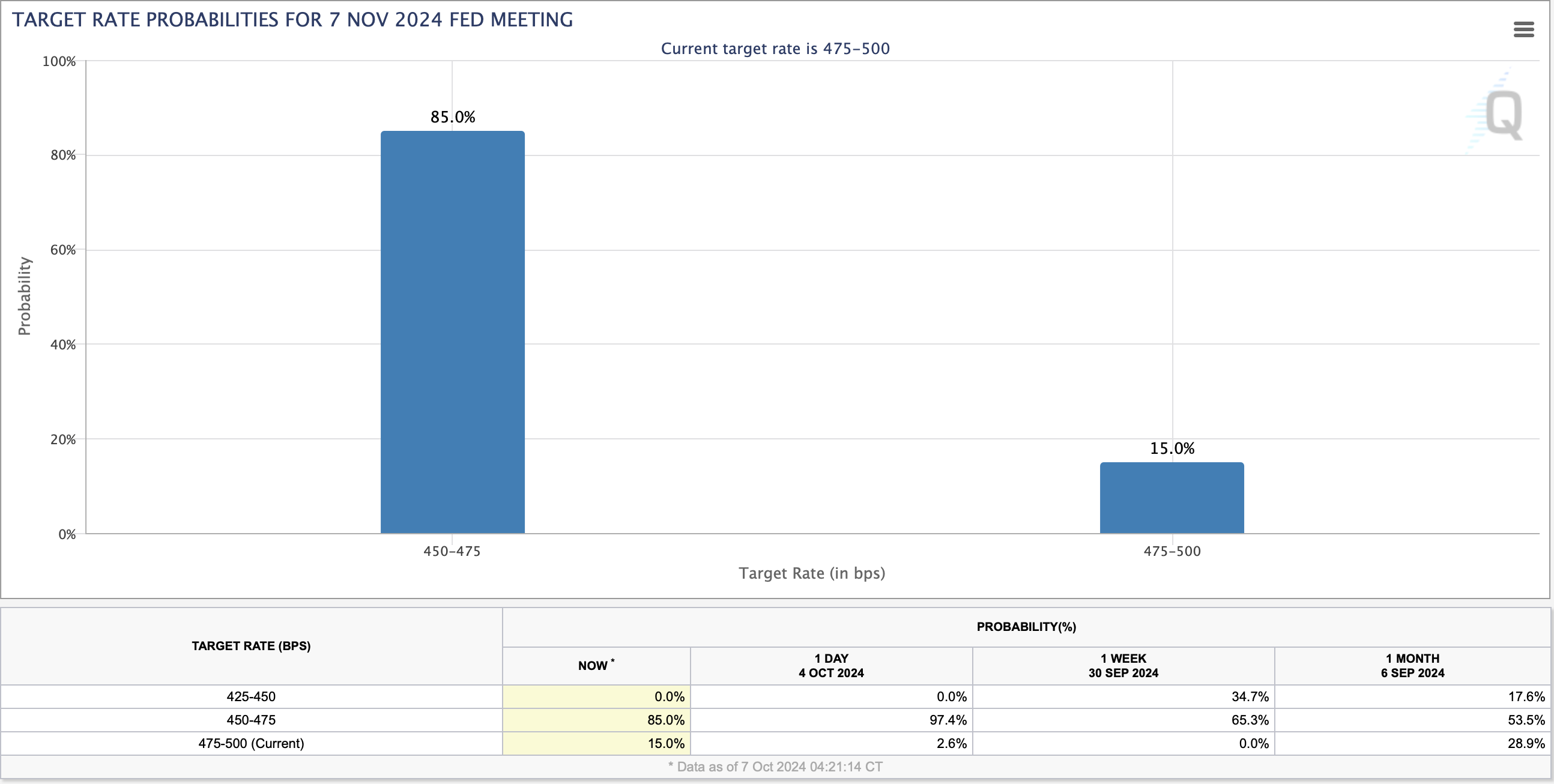
Perhaps the best depiction of things comes from the Fed funds futures markets where now there is only an 85% probability priced for a 25bp cut and a 15% probability of no cut at all.  Look at the table below the bar chart to show how much things have changed in the past week.  Jumbo rate cuts are no longer a consideration.  It will be very interesting to see how the Fed speakers adjust their tone going forward as there were many who seemed all-in on another 50bp cut as soon as next month.
Source: cmegroup.com

So, is this the new reality?  Recession is out and another up-cycle is with us?  Certainly, recent data has been quite positive as evidenced by the Citi Surprise Index, seen below courtesy of cbonds.com, which has shown a positive trend since early July.
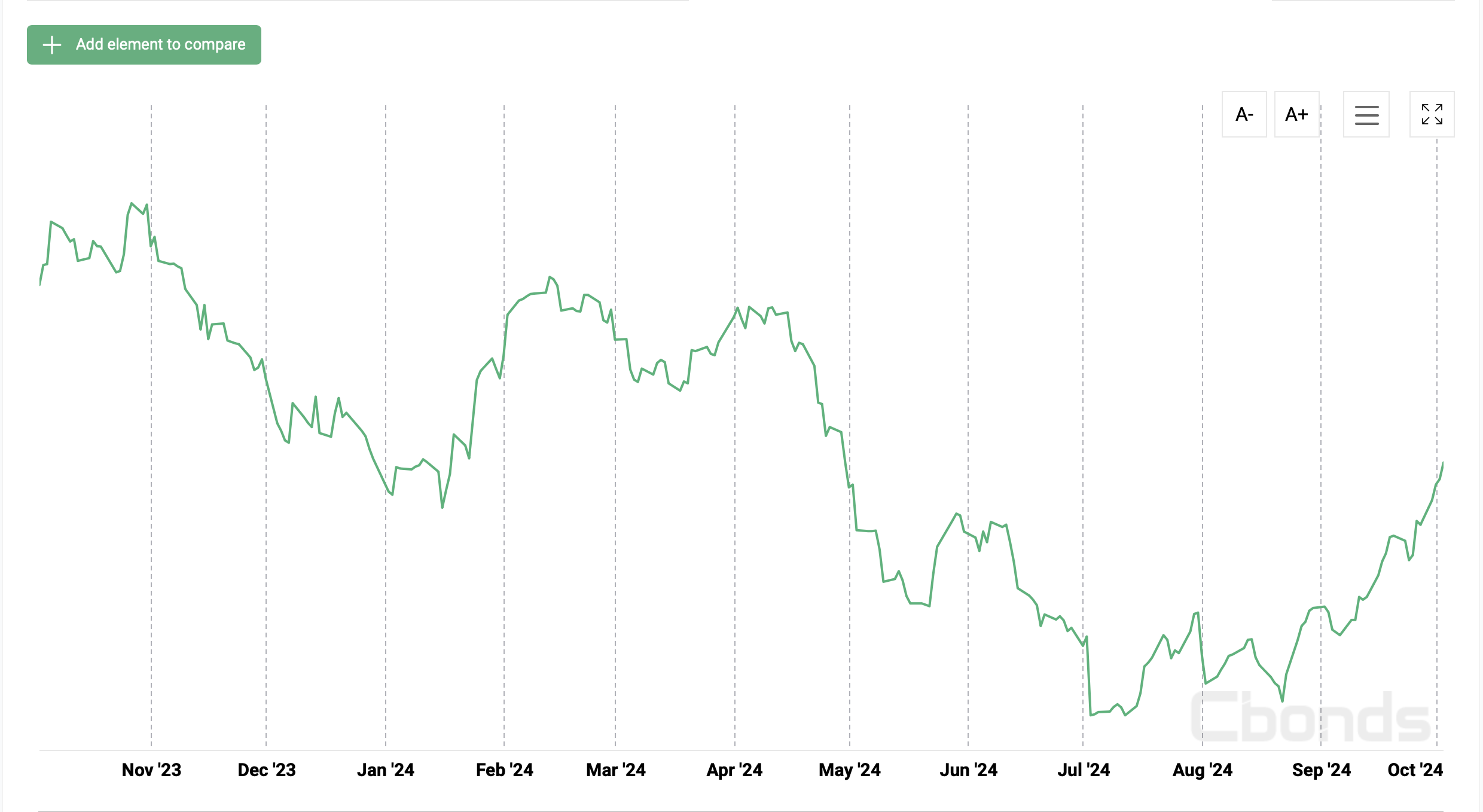
This index is a measure of the actual data releases compared to consensus market forecasts ahead of the release.  When it is rising, the implication is that the economy is outperforming expectations and therefore is growing more rapidly than previously priced by markets.  Again, the point is the recessionistas are having a hard time making their case.  However, for the inflationistas, it is a different story.  With the employment situation improving greatly and last week’s Services ISM data showing real strength, the inflation narrative is regaining momentum.  Recall, the Fed’s rationale for cutting 50bps was that they had beaten inflation and were much more concerned about the employment situation where things seemed to be cooling.  That line of reasoning has now been called into question and the market is awaiting Powell’s answers.

Remember the time
The yen carry trade was dead?
Nobody else does!

While it may seem like this is ancient history, it was less than a month ago when the market was convinced that the yen carry trade (shorting yen to go long higher yielding assets) was dead, killed by the combination of a dovish Fed and a hawkish BOJ.  Oops!  It turns out that story may not have been completely accurate, although it was a wonderful discussion at the time.  As you can see from the chart below, the yen peaked two days ahead of the FOMC meeting, as those assumptions about both central banks reached their apex and has been steadily weakening ever since.  In fact, late last week I saw an article somewhere discussing how the carry trade was back!  The thing to understand is the carry trade never left.  It has been a popular hedge fund positioning strategy for a decade, made even more popular by the Fed’s aggressive rate hiking cycle.  While latecomers to the trade may have been forced out in the past several months, I am confident the position remains widely held.  And, based on the recent price action in USDJPY, it is growing again.

Source: tradingeconomics.com

And I believe those are the key drivers of markets this morning.  Fortunately, the Middle East situation does not appear to have gotten worse although oil (+2.6%) is trading like something is about to blow up.  The rest of the noteworthy news shows that Germany remains in a funk with Factory Orders falling sharply, -5.8%, just another indication that growth on the continent is going to struggle going forward.

Ok, let’s tour the markets we have not yet touched upon.  While Chinese markets remain closed (the holiday ended today and markets there reopen tomorrow), the Nikkei (+1.8%) continues to rebound alongside USDJPY and amid stories that new PM Ishiba has dramatically moderated his hawkish views ahead of the snap election called for the end of the month.  The Hang Seng (+1.6%) also had a strong session, with rumors of still more Chinese stimulus to be announced tonight. The combination of positive US growth news and the Chinese stimulus news helped virtually every market in Asia save India (-0.8%), which has been singing a different tune consistently.  In Europe, it should be no surprise the DAX (-0.3%) is softer, although there are some gainers on the continent (Spain +0.4%, Hungary (+0.4%) and other laggards (Norway -0.7%, Netherlands (-0.3%).  Overall, it is hard to get excited about the European scene this morning.  Alas, US futures are pointing lower this morning, down -0.5% at this hour (6:30).

We’ve already discussed the bond market and oil, but metals markets show a split this morning with gold (+0.2%) seeming to find haven support while both silver (-0.7%) and copper (-0.3%) are under modest pressure.  Remember, though, if the economic growth story is real, these metals should climb further.

Finally, the dollar is continuing its climb alongside US rates with the pound (-0.4%) the G10 laggard of note.  Most other G10 currencies are softer by a lesser amount although the yen (+0.1%) and NOK (+0.1%) are pushing slightly the other way, the former on a haven trade with the latter following oil.  The EMG bloc is more mixed with ZAR (+0.5%) actually the biggest mover as investors continue to flock toward the stock market there on the back of positivity of a change in the trajectory of the economy from the new government.

On the data front, the biggest number this week is CPI, but of real note are the 13(!) Fed speakers over 20 different venues this week.  I don’t know if I’ve ever seen that many on the calendar for such a short period.  It strikes me that they understand they need to tweak their message after the recent data.  It will be very interesting to see if they fight the data and stay the course for another cut in November or whether they walk it back completely. After all, they claim to be data dependent, and if the data points to growth, why cut?

Here is the rest of the data:

TodayConsumer Credit$12B
TuesdayNFIB Small Biz Optimism91.7
 Trade Balance-$70.4B
WednesdayFOMC Minutes 
ThursdayInitial Claims230K
 Continuing Claims1829K
 CPI0.1% (2.3% Y/Y)
 -ex food & energy0.2% (3.2% Y/Y)
FridayPPI0.1% (1.6% y/Y)
 -ex food & energy0.2% (2.7% Y/Y)
 Michigan Sentiment71.0

Source: tradingeconomics.com

And that’s how we start the week.  Whatever your personal view of the economy, the recent data certainly points to more strength than had been anticipated previously and markets are responding to that news.  For equities and the dollar, good news is good, but there seems to be a lot of time between now and Thursday’s CPI reading for attitudes to change.

Good luck

Adf
Just Simply Don’t Care

On Tuesday, six Fed members spoke
And none of them, from the pack, broke
While May’s CPI
Caught everyone’s eye
No ideas of cuts did it stoke
 
But markets just simply don’t care
Instead, all is well, traders swear
Nvidia rose
And at Tuesday’s close
No other firm could quite compare


Another day, another new all-time high for the S&P 500 and the NASDAQ (boy, my call from two weeks ago didn’t age well!).  And so it goes, the Fed imagines it is maintaining tight financial conditions and is trying to rein in spending and price pressures, and equity investors simply buy more NVDA every day.  Yesterday, the chipmaker became the most valuable company in the world, or at least the one with the largest market capitalization, cresting Microsoft and Apple, although all three are now worth about $3.3 trillion each.  I raise the point because it is such a perfect description of market sentiment.  It seems that everyone has placed their hopes (and potentially future wealth) on the back of a single company.  I’m sure it will work out well 😱.

In fact, as the investing community narrows its focus to an ever-smaller number of companies, and news elsewhere appears to show cracks in the façade of a solid economy, I suspect that problems may be coming our way.  For instance, remember Battery Electric Vehicles, and how they were the future?  Not just Tesla, but all these companies like Lucid, Polestar, Nikola, VinFast and Fisker?  Well, every name on this list has either gone bankrupt or is on the edge with Fisker being the latest to file Chapter 11.  The point is that in an environment where liquidity is abundant, or overly so, investment decisions tend to be less well thought out.  While the Fed has certainly tightened policy dramatically and been resolute in its efforts to maintain that tighter policy while inflation still percolates, the federal government’s excessive largesse (the CBO just announced they now expect a budget deficit this fiscal year of $1.9 trillion, up from the $1.5 trillion estimate last quarter) is too much for the Fed to stop.

One other thing to note about Nvidia, and AI in general, is that in China, Ali Baba has reduced the charge for using its AI function and it appears that AI, rather than being a new revenue stream for companies may simply become increased overhead of doing business.  In that world, as margins of the Apples and Microsofts and Googles compress, perhaps there will be more discernment before the next order of Nvidia chips.  There are many imbalances in this market, and it appears most of them are a result of the mania for AI.  When this passes, and it will pass, be prepared for some repricing of risk.

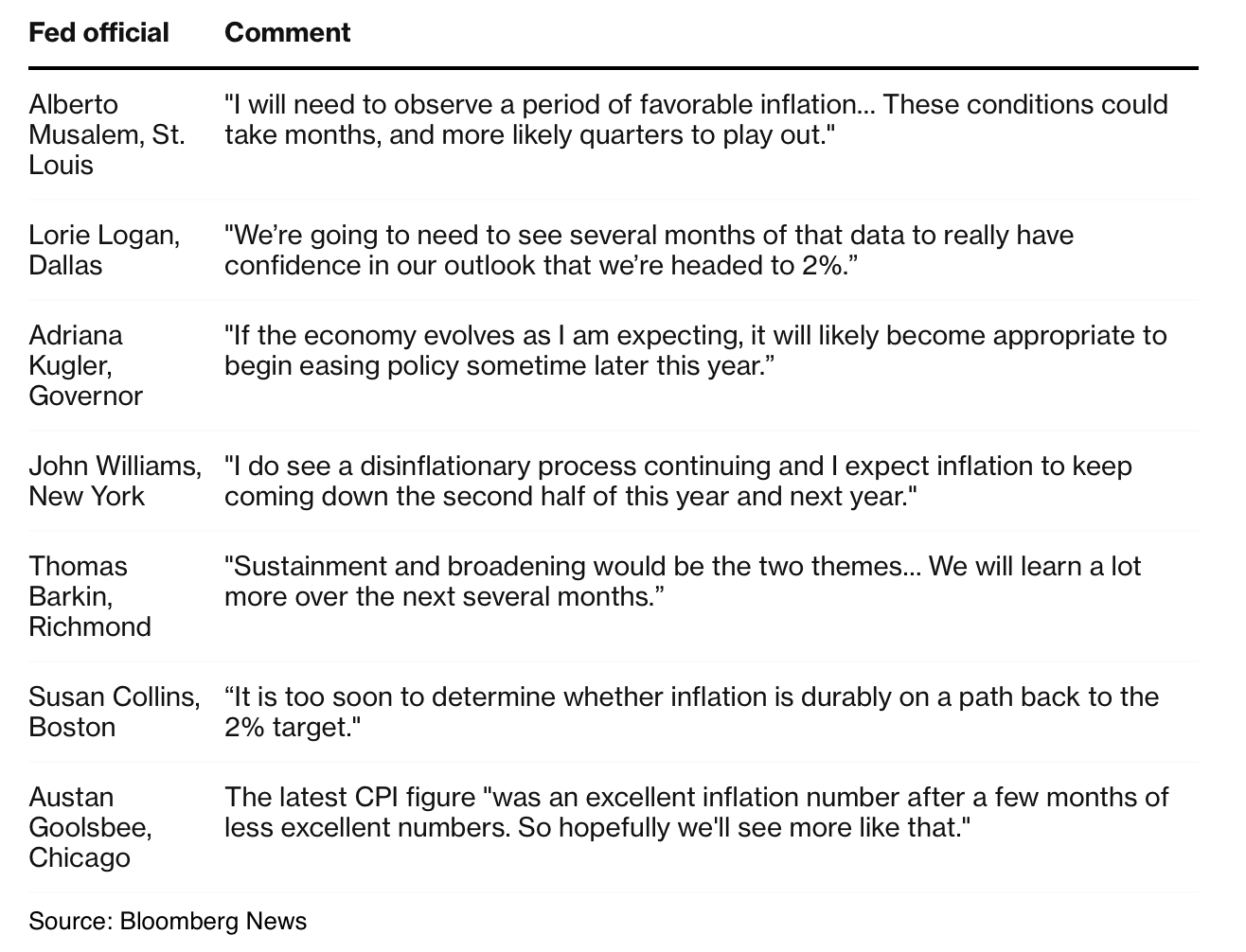
Ok, but back to the other stuff, namely the overwhelming amount of Fedspeak that keeps coming from all these FOMC members.  Yesterday, we actually had seven members speak, NY’s John Williams was not on the calendar ahead of time, and to a (wo)man, they explained that patience remains a virtue.  Happily, Bloomberg News put together the following list of key comments from the entire group:

Despite the modestly softer than expected CPI data last week, and even yesterday’s somewhat softer than expected Retail Sales data, it is hard to look at this grouping of comments and expect a rate cut is coming anytime soon.  Now, the one thing we can never forget is that markets can move incredibly quickly when it comes to readjusting its views on a subject.  In addition, history has shown that when the Fed figures out they are behind the curve and the economy is beginning to slow, they have the ability to cut rates very quickly as well.  But right now, I just don’t see the roadmap for a rate cut before the end of the year.  If this is the case, the one thing that seems most evident is that the dollar will maintain its overall bid.  Despite all the talk that the dollar is losing its reserve status, and that too much debt is going to destroy it, the reality remains there is no viable alternative as a means to store wealth and for governments to store reserves.  I don’t doubt the day will come when a substitute is found, but I do doubt I will be around to see it.

Ok, let’s see how the rest of the world celebrated the new leader in the market cap sweepstakes.  In Asia, the Nikkei (+0.25%) edged higher but the Hang Seng (+2.9%) had a fantastic run as the tech stocks resident there seemed to follow Nvidia.  Not surprisingly, Taiwan and Korea had good days, but elsewhere in the region, there was far more red than green as tech stocks are not the basis of those markets.  As to Europe, it is a mixed picture there but probably more red than green.  UK (+0.15%) stocks have edged higher after the UK inflation report showed that the headline number touched 2.0% for the first time in three years, but it doesn’t appear that will be enough to get the Tories re-elected next month.  However, we have seen most of the continent bleed lower after the European Commission warned a series of nations (including France and Italy) that they needed to address their budget deficits which are far above the 3% “limit” that was embedded in the entire Eurozone project.  Meanwhile, despite the fact that the US equity markets will be closed today for the Juneteenth holiday, futures are trading although they are little changed at this hour (7:45).

It is also a bank holiday here, so there will be no bond trading in the US, but in Europe, yields are a bit higher this morning, between 2bps and 4bps, bucking the trend from yesterday’s Treasury market and seeming to demonstrate a little concern over the ongoing political ructions on the continent.  However, there is one place where yields are having difficulty finding a base, Japan.  Despite all the talk that the BOJ was going to allow yields to rise more aggressively, or that there was no cap at 1.00%, JGBs fell 1bp overnight and have shown no inkling of moving higher in any substantial amount.  With this in mind, look for the yen to remain under pressure.

In the commodity markets, the early part of the month, which saw oil prices slide is just a memory now as once again, WTI (+0.1%) is holding onto its gains from yesterday and is now firmly above $81/bbl.  It appears that demand figures are starting to improve and inventory draws are being seen now.  Watch at the pump.  In the metals markets, after rallies yesterday, the precious set are holding the gains, up just 0.1% each, but copper has rebounded a further 1.5%, again an indication that economic activity seems better than feared.

Finally, the dollar is slightly softer this morning, slipping a touch against most of its G10 and EMG counterparts, but the noteworthy thing is that no currency has moved more than 0.25% in either direction.  In other words, nobody seems to care this morning here.

There is no data and no Fed speakers given the holiday so not only will things slow quickly by 11:00am, it seems a safe bet that movement will be di minimus.  Tomorrow brings a reawakening, but for today, enjoy the sunshine.

Good luck

Adf

Cash in a Flash

A century has passed us by
Since T+1 rules did apply
But starting today
That is the new way
So, what does this new rule imply?
 
For buyers, they’ll need to have cash
At hand, else their trades will all crash
While sellers get paid
Next day and can trade
Or else have their cash in a flash
 
The problem is those overseas
Are likely to feel quite a squeeze
‘Cause getting the bucks
May soon be the crux
Of trading, and cause much unease


Today is, in fact, quite momentous as North American equity markets (US, Canada and Mexico) are all converting to T+1 settlement.  This means that if you buy a stock today in your Fidelity (or other) account, you need to pay for it tomorrow.  Since 2017, that timeline was two business days, and prior to that it was three business days (1987-2017) and five business days (1929-1987).  Obviously, technology played an important part in the process as the electronification of trading and back-office systems allowed more information to be processed more quickly and removed the need to physically deliver share certificates.

Now, while this is an interesting historical fact, the importance of the change comes from the potential impact on the foreign exchange markets.  In the US equity market (which remember represents nearly 70% of global equity market values), most traders have cash or access to funding in their accounts and so this is of limited consequence.  But, for foreign investors, it is a much bigger deal.  

Consider a European fund manager who is investing throughout a given day and then is reconciling their position at the end of the day to determine how many dollars they need to settle the transactions.  Prior to today, they could find out, and execute the FX trade to buy those dollars any time during the next day with full confidence the funds would flow on a timely basis.  However, starting today, their timeline to determine the balances due and execute the transactions will be reduced to a matter of hours.  And not just any hours, but probably the worst hours to transact FX during the 24-hour session.  Given that equity markets in the US close at 4:00pm, and most bank trading desks leave around 5:00pm, the prime time for those executions is going to be in the twilight of the FX market, when the global day rolls over and only Wellington, NZ banks are even awake.  Liquidity during this time period is notoriously limited and the opportunity for outsized moves is significant.

None of this is likely to have an impact today, necessarily, but it could well have an impact as soon as Thursday or Friday when the month comes to an end and there are significant equity rebalancing flows.  In fact, thinking it through, Friday afternoons that happen to be month ends, like this week, are going to be subject to the most stress as there is no market and Sunday evening is going to potentially be subject to a lot of same-day FX settlement, which is not the strongest suit for that market.  

I bring this up for two reasons; first, it is well worth understanding and may impact market characteristics going forward, and second, there is absolutely nothing else happening today!  There has been almost no new information in the macroeconomic sense since Friday’s Michigan Sentiment numbers were released as yesterday brought only modestly softer than anticipated German Ifo results.  At the same time, with the ECB slated to meet next week, the plethora of ECB speakers have clearly agreed that there will be a 25-basis point cut next week, but there is still a lot of uncertainty as to when the next cut may arrive.  Meanwhile, Fed speakers will not shut up at all, but continue to promulgate the same message they have been pushing forward, higher for longer until they have confidence inflation is going to achieve their target.  Arguably, that makes Friday quite interesting as the PCE data will be released.

So, with nothing else of note, let’s take a quick run through the overnight session.  Quiet continues to be the best descriptor of things with Japanese shares virtually unchanged although Chinese shares fell (CSI 300 -0.7%) despite ongoing talk of further government support for the property market there.  Elsewhere in the region, markets were mixed with an equal number of gainers (Taiwan, Indonesia, Singapore) and laggards (India, Australia, New Zealand) with most of the rest very little changed.  It was not very exciting!  In Europe, while the screen is red, other than the CAC in Paris (-0.6%) the movement has been extremely limited.  Meanwhile, US futures are currently basically unchanged ahead of the open.

Bond markets, too, have been quiet overall with Treasury yields unchanged since Friday, and European sovereigns mostly edging higher by between 1bp and 2bps.  The exceptions here are the UK (-3bps) despite (because of?) a better-than-expected Retail Sales print. In Asia, while JGB yields did not move overnight, yesterday they did trade to a new high of 1.02%, although the impact on the yen remains di minimus.

In the commodity markets, oil has bounced from last week’s lows after Israel’s recent military activities in Rafah have some concerned that an escalation in that conflict is on its way and may include other parties.  Meanwhile, gold and silver prices, both of which rallied sharply yesterday, are consolidating those gains and remain well above the trading bottoms put in last week.  Copper, too, is rebounding although there is a lot of discussion in the market about how it has been massively overbought by speculators and has further to decline.  Regardless of the short-term trading implications, I believe there is no question that the long-term view here must be very bullish as there simply is not going to be enough supply for all the demands coming our way, especially given the still strong view amongst many that the energy transition must happen ASAP.

Finally, the dollar is a touch softer this morning, but only a touch.  While the greenback has been pretty steadily declining all month, the entire movement has been less than 2%, at least based on the DXY.  As to USDJPY, it remains in a very tight range between 156.50 and 157.00 lately as traders clearly remain comfortable running short positions, but the rush to add to those positions has faded. As to the other currency that continues to be questioned, the CNY continues to edge lower a few basis points each day, as the PBOC weakens its value in the daily fixing by a similar amount.  Nothing has changed my view that the renminbi will drift lower, but it is clear that the PBOC is going to control it all the way.

On the data front, it is a very quiet start to the week, but things get interesting toward the end.

TodayCase-Shiller Home Prices7.3%
 Consumer Confidence95.9
WednesdayFed’s beige Book 
ThursdayInitial Claims218K
 Continuing Claims1800K
 Q1 GDP1.3%
FridayPersonal Income0.3%
 Personal Spending0.3%
 PCE0.3% (2.7% Y/Y)
 Core PCE0.3% (2.8% Y/Y)
 Chicago PMI 
Source: tradingeconomics.com

In addition to this, we hear from seven more Fed speakers over nine venues this week and unless PCE collapses, and only one speaker comes after the release, it seems highly unlikely that they will change their tune.  Recall, the Minutes last week were seen as far more hawkish than Powell’s press conference immediately following the meeting, and that confused the soft-landing crowd.  As of this morning, the Fed funds futures market is pricing in about a 50% probability of a cut in September and a total of just 34bps of cuts now for the full year.

My view remains that the Fed is unlikely to cut anytime soon as the data will not give them confidence their inflation target is in view.  With that in mind, I foresee the best opportunity for a surprise as more aggressive rate cuts elsewhere in the world which will support the dollar.  Just not today.

Good luck

Adf

None Be Unique

When looking ahead to this week
The noteworthy thing is Fedspeak
At least fifteen times
They’ll give us their dimes’
Worth of knowledge, though none be unique
 
For instance, we already know
Their confidence is rather low
So, absent new data
Do they have schemata
Designed to get ‘flation to slow?


Arguably, the biggest news this morning is the death of the Iranian President and Foreign Minister in a helicopter crash overnight as it opens a range of possibilities regarding the future stance of Iran in the Middle East.  Will it remain the strict theocracy that it has been?  Or will a new leadership recognize the people appear to be growing tired of that stance and want something different.  While it would seem unlikely that there will be a major change, at least from this view thousands of miles away, if one were to come about, it would have a major impact on the Middle East and the ongoing conflict in Gaza.  After all, if Iran stopped funding terrorist groups, that would de-escalate things dramatically and potentially see a significant decline in the price of oil.  At this time, however, there is no information as to who will step into the role and what policies will be followed, so it is a wait-and-see period.  As it happens, oil prices (-0.35%) have edged lower this morning, but this is hardly a sign of anything new.  This will be quite critical to watch going forward.

However, beyond that, there has been vanishingly little new information about which to speak regarding the macroeconomic situation around the world.  The Chinese left their policy rates unchanged, as universally expected, and there has literally not been any other data from any major nation since Friday.  In fact, looking ahead at the calendar for the week, arguably the most significant piece of data to be released is Canadian CPI, or perhaps UK CPI and then on Friday we see the Flash PMI reports. 

Which brings us back to the Fedspeak.  It is staggering to think that the FOMC believes they need to be so visible at this time, especially after Chairman Powell explained that rate hikes were off the table and that while it may take a little longer than they had initially expected, they were still certain that inflation was going to head back to their 2% target.

Speaking of inflation, over the weekend I was reading some analysis (sad, I know) that highlighted if the US used the European HICP calculation the core reading would already be below their target with April’s data coming in at 1.9%.  To me this is a similar stance to what we heard at the end of 2023 when numerous pundits were explaining that the 3-month trend or the 6-month trend was already at 2.0% so why wait to cut?  Of course, the sticky inflation camp (this poet included) was quick to hoist them on their own petard as the recent 3-month and 6-month trends are pointing to 4+% CPI readings going forward.  

In this particular instance the question I would ask is, other than the fact that the reading is lower, why would anyone think that the European HICP inflation reading is a more accurate representation than the BLS representation?  The difference lies in the fact that HICP doesn’t incorporate housing price changes, which given they remain stubbornly high, have been supporting higher CPI readings.  But don’t people pay for their housing?  Certainly, it would be easy to create a lower CPI if you simply remove all the items that are going higher in price.  Unfortunately, that process doesn’t really tell you anything about reality.

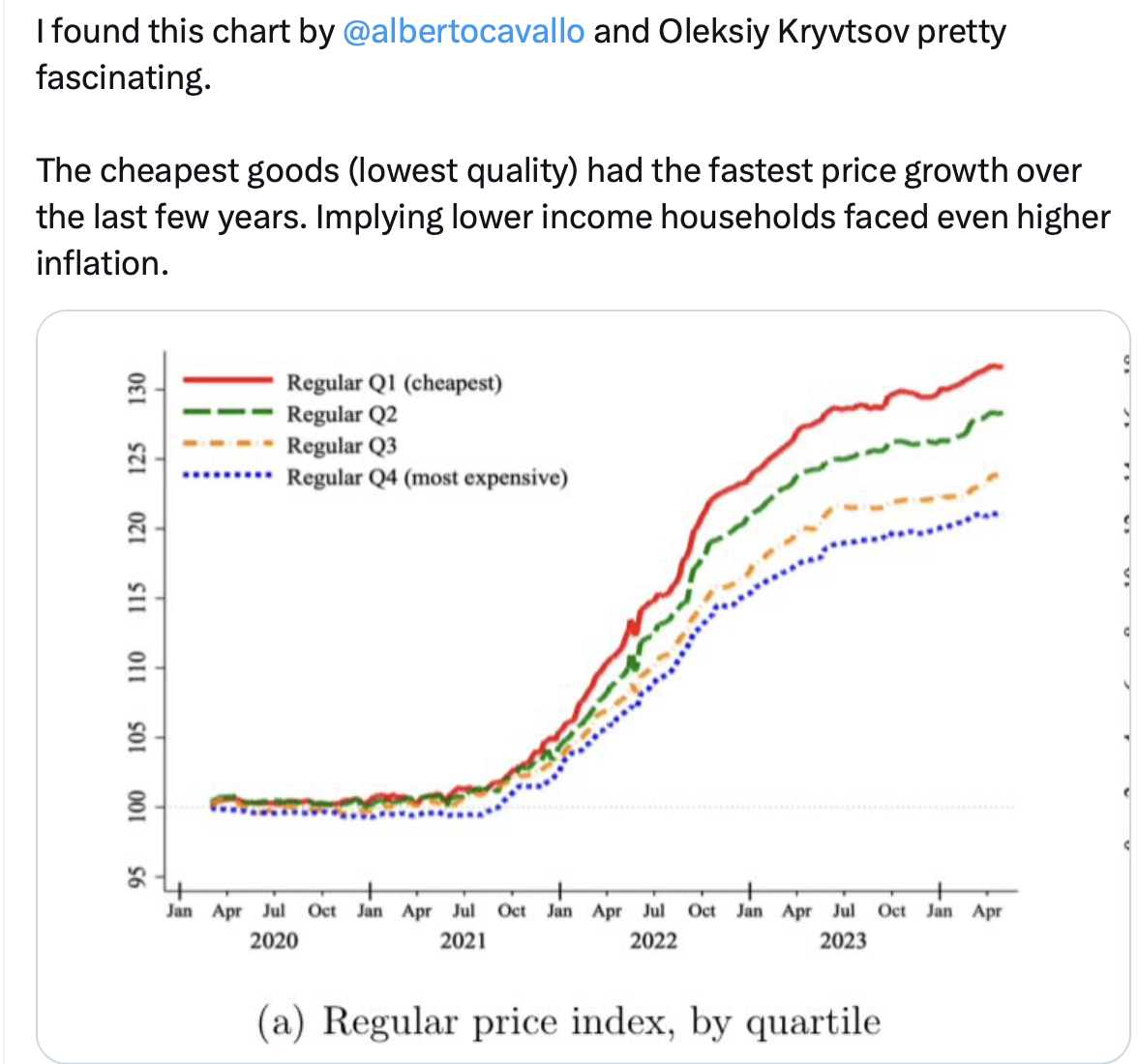
Below is a very interesting chart I found on X (nee Twitter) created by Professor Alberto Cavallo of Harvard and Oleksiy Kryvtsov, a Bank of Canada economist, which may be a better description of inflation as felt by the average person.

The fact that prices are rising fastest for the least expensive goods indicates that inflation is a major problem for Joe Sixpack, and no matter how pundits seek to adjust the measurement, so the numbers look better, reality is a harsh mistress.  (If you want to know why President Biden’s numbers are so bad, you needn’t look further than this chart.)  

Alas, there is no escaping the plethora of blather that will be coming from the Fed this week, although I sincerely doubt any of it will change anyone’s opinions about anything.  Ok, it was another generally quiet session overnight with the exception being the ongoing blast higher in metals markets.

Equity markets have performed well across the board, although the gains have not been too dramatic.  Japan (Nikkei +0.7%) was the best performer although the entire region was in the green to a lesser extent, about 0.35% or so.  In Europe, all the bourses are higher as well, but here the gains are even smaller, on the order of +0.25% across the board while US futures are essentially unchanged at this hour (6:30).

In the bond market, Treasury yields, which backed up 2bps on Friday are unchanged this morning while European sovereigns are higher by roughly 1bp across the board.  ECB speakers have conceded that a rate cut is coming in June, but many are pushing back hard against the idea that a July cut is a sure thing, preferring to wait until September.  However, the really interesting thing is in Japan, where JGB yields have traded up to 0.98%, a new high yield for this move and a level not seen since March 2012.  At this point, it would seem that 1.00% is a foregone conclusion so it will be interesting to see how the BOJ responds when that ‘magic’ number is finally traded.

But, as I mentioned above, it is a metals day with gold (+0.9%), silver (+1.1%) and copper (+0.9%) all continuing last week’s strong gains with gold making yet further new highs, copper pushing its historic highs and silver breaking above a key technical resistance level at $30/oz last week and now extending those gains.  While there have been many explanations for this price movement, I think you need to consider precious and industrial metals separately.  For precious, there continues to be a growing concern in the ongoing debasement of the fiat currency universe and both individuals and central banks are seeking to hold alternative assets.  On the industrial side, though, especially copper and silver which are both critical to electronics, the ten-year hiatus in investment due to the ESG cult combined with the recent recognition that all the new-fangled tech wizardry like AI is going to require gobs of power and electrical capacity has simply skewed the supply/demand curve to much more demand than supply.

Finally, the dollar is little changed this morning, pretty much at the same level overall since Thursday.  Given the lack of movement in the rates space, this ought not be a surprise.  It also ought not be surprising that the best performing currencies of the past week have been CLP (+3.5%) as it has simply traveled alongside its major export, copper, and ZAR (+5.1%) as it rallies alongside the precious metals complex.  Meanwhile, there has been no movement in the interest rate narrative with, perhaps, the exception of Japan, but what we have learned there lately is that higher JGB yields lead to a weaker yen.  Go figure!

On the data front, as I said earlier, it is extremely light this week,

WednesdayExisting Home Sales4.22M
 FOMC Minutes 
ThursdayInitial Claims220K
 Continuing Claims1799K
 New Home Sales680K
FridayDurable Goods-0.7%
 -ex Transport0.1%
 Michigan Sentiment67.6
Source: tradingeconomics.com

It is not clear, given how much we have already heard from Fed speakers since the last FOMC meeting, that the Minutes will be very informative.  Perhaps the discussion about QT will change some minds, but I doubt it.  Otherwise, if stocks continue to rally, market players will be happy and not try to rock the boat.  Meanwhile, the dollar will need a new impetus to break out of this narrow range, but that may not come until next month’s NFP data.

Good luck

Adf

Turns to Sh*t

The FOMC’s out in force
Explaining the still likely course
Of rates is to stay
Where they are today
Unless there’s some hidden dark horse
 
Investors, though, don’t give a whit
As Spooz seem quite likely to hit
Five thousand quite soon
Then onto the moon
Take care lest this view turns to sh*t


The WSJ led with an interesting article today with the below graphic as the teaser.  This is called a hair chart, for obvious reasons, with those light blue lines describing Fed funds futures curves and comparing them to the subsequent actual Fed funds rate over time.  The article’s point, which is important to understand, is that the futures market tends not to get things right very often.  In other words, just because the market is pricing in 5 or 6 rate cuts today does not mean that is what will occur over time.  In fact, looking at the chart, it almost seems that 5 or 6 cuts is the least likely outcome.  One need only look at the past several years to see that while they were pricing cuts, the Fed was still hiking.

Of course, this fits with my thesis that the Fed funds futures market is actually reflecting a bimodal outcome of either zero cuts or 10.  But regardless of my view, the equity market is all-in on the idea that the Fed is going to be cutting rates soon as evidenced by the fact that the S&P 500 is now trading just a hair below 5000 after yesterday’s 0.8% gain.  

In the meantime, yesterday we heard from four more Fed speakers and to a wo(man) they all said effectively the same thing; progress has been made on the inflation front but they still don’t have confidence that 2% inflation on a sustainable basis has been achieved.  In fact, several mentioned that the recent hot GDP and NFP data indicated more caution is warranted.  By the way, if we look at the Atlanta Fed’s GDPNow forecast, it currently sits at 3.4%, hardly a level of concern, while their Wage Growth Tracker remains at 5.0%.  Again, that is not data that indicates inflation is collapsing.  It remains very difficult for me to expect inflation to fall given the recent totality of the data.  In other words, nothing has changed my view that inflation will remain stickier than currently priced and very likely start to creep higher again, and that will ultimately have a negative impact on risk assets.  But not today!

The other news overnight was that Chinese CPI rose less than expected in January, just 0.3%, which took the annual change to -0.8%.  As China heads into their two-week Lunar New Year holiday, welcoming the Year of the Dragon, the question for investors around the world is, will Xi do anything to halt the decline?  Thus far, his efforts have been weak and insufficient as evidenced by the equity markets in Hong Kong and on the mainland both having fallen sharply over the past year with little net movement this year despite several efforts at support and stimulus.  Now, Xi has nearly two weeks to come up with a new plan to get things going when markets return on February 20th, but for the past several years he has been unwilling to fire a big fiscal bazooka.  Will it be different this time?  Remember, they still have a catastrophic mess in the property market there which will impinge on anything they do.  I expect there will be some more half-hearted measures, but nothing sufficient to turn things around.  Ultimately, while they don’t want to see the renminbi fall sharply, I suspect it may have a bit more weakness in it before things are done, especially if the Fed really does stay higher for longer.

Ok, let’s look at markets elsewhere overnight.  The Nikkei (+2.0%) rallied sharply after comments by a BOJ member indicating that even when rates get back above zero, they will not move very much higher, and it will take time.  This saw the yen weaken further while stocks benefitted.  Meanwhile, the only loser in Asia overnight was India, where investors were disappointed that the RBI left rates on hold rather than cutting them (see a pattern here?).  Otherwise, everything followed the US rally yesterday.  The same is broadly true in Europe with decent gains, about 0.5%, almost everywhere except the UK, which is flat on the day after comments by a BOE official that cuts may not come as soon as hoped.  As to the US, at this hour (7:30) futures are basically unchanged.

In the bond market, after a generally quiet session yesterday, yields are starting to creep higher again with Treasuries +2bps and European sovereign yields rising a similar amount across the board.  Once again, the global bond markets revolve around Treasury yields with the only exception being JGB’s which saw the yield decline 1bp after those BOJ comments.

In the commodity markets, oil (+0.9%) is higher once again with Brent trading back above $80/bbl, as Secretary of State Blinken returned to the US with no real improvement in the Israeli-Hamas war and no prospects for a cease-fire.  Meanwhile, the US was able to kill the Iranian commander who allegedly led the attack on a US base that killed three soldiers, certainly not the type of thing to cool down tensions in the region.  Between the rise in cost of shipping oil from the Mideast to the rest of the world because of the Red Sea situation, and the lack of hope for an end to the fighting, it seems oil may have some legs here.  As to the metals markets, there is a split with both gold and copper under some pressure but aluminum seeing a bid this morning.  Quite frankly, I understand the former two rather than the gains in aluminum, but in the end, none of these metals has moved very much over the past months and remain trendless for now.

Finally, the dollar is starting to assert itself this morning as though the yen (-0.75%) is leading the way lower, pretty much every G10 and EMG currency is weaker vs. the greenback at this time.  Again, I would contend this is all about the ongoing Fed message of caution and confidence regarding inflation’s disposition, and the prospects of higher for longer.  FWIW, the current probability of a March cut is 18.5%.  barring a collapse in the CPI data next week, I expect that to head toward zero over time.

As to the data situation, we only see the weekly Initial (exp 220K) and Continuing (1878K) Claims data first thing and then it is Fedspeak for the rest of the day.  I expect that traders are going to push the S&P 500 over 5000 early this morning, if for no other reason than to say it was done, but what happens after is far less certain.  Earnings data has been generally ok, but some pretty bad misses have had quite negative impacts on individual names.  As to the dollar, the more I hear Fed speakers urge caution in the idea for rate cuts soon, the better its prospects.

Good luck

Adf

Inflation is Dead

For anyone who’s ever doubted
Inflation is falling and touted
The price of their food
Or Natgas and crude
The market has recently shouted

Inflation is dead, can’t you see?
The CPI’s back down to three
Soon Jay and the Fed
Will clearly have said
It’s time to cut rates, we agree

Another day, another soft inflation reading, two of them, actually.  First, the UK reported that CPI there fell to 4.6% in October, its lowest point in two years and a bit below expectations.  While that was quite a sharp decline from the September print of 6.7%, things there are still a bit problematic as the core rate remains much higher, at 5.7%, and is not declining at anywhere near the same rate as the headline.  What this tells us is that the energy component is a big driver as the price of oil is down about 10% in the past month.

Then, US PPI printed with the M/M number at -0.5%, much softer than expected which took the Y/Y down to 1.3%.  Core PPI is a bit higher, 2.4% Y/Y, but obviously, at a level that is not seen as a major problem.  Meanwhile, Retail Sales was released at a slightly less negative than expected -0.1% and last month’s print was revised up to 0.9%, the indication being that economic activity is not collapsing yet.  For the optimists, this has all the earmarks of a soft landing, declining inflation, modest growth, and still relatively strong employment.  As well for the optimists, they are all in on the idea that not only has the Fed, and every other central bank, finished their rate hiking cycle, but that rate cuts are coming soon!

In fact, that is the clear narrative this morning, rate hikes are dead, long live rate cuts.  There are numerous takes on this particular subject, but the general view is that now that inflation is finally heading back toward target, the central bank community will need to cut rates to prevent destruction in economic activity.  Europe is already teetering on the edge, if not currently in recession, and though GDP in Q3 here in the US printed at a robust 4.7%, Q4 appears to be slowing down somewhat with the latest GDPNow estimate at 2.2%.  However, given that growth in the US remains far better than many anticipated considering the speed and magnitude of the Fed’s rate hikes, my question is, why would the Fed cut?  At this point, there is limited evidence in the data that the economy is going to fall into recession, and based on their models, strong growth is likely to be inflationary, so maintaining the current levels should be fine.

At any rate, that is the crux of the bull/bear argument these days, and for now, the bulls are leading the dialog.  Equity markets continue to buy into that narrative as evidenced not just by Tuesday’s powerful rally, but the fact that yesterday saw a continuation of those gains, albeit at a much more muted pace.  Now, Asian markets didn’t really participate last night, with Japanese shares modestly lower but Chinese shares, especially the Hang Seng (-1.4%) suffering more broadly.  The data from China continues to show that the property market is crumbling, with home prices reported declining further last month despite Xi’s government pumping more money into the sector.  That is a bubble that is going to haunt President Xi for a very long time.  As to European bourses, they are mixed this morning with some (Germany and Spain) modestly firmer while others (UK and France) are modestly softer.  It is hard to get a read from this, especially given there has been no data released this morning.  Finally, US futures are ever so slightly softer at this hour (7:10), maybe on the order of -0.2%.  However, this seems a lot like a consolidation rather than a major retracement.

The bond market story, though, is probably more inciteful with regard to the overall narrative.  Given the softer inflation data, and the fact that futures and swaps markets are now pricing in the first interest rate cuts by May and 100bps of cuts over 2024, interest rates are still the key focus.  You will remember that in the wake of the CPI number, 10yr yields crashed 20bps.  Yesterday they did rebound a bit, rising 10bps at one point in the day before closing higher by about 7bp at 4.54%.  this morning, though, they are slipping back again, lower by 5bps as that 4.50% level remains the market’s trading pivot.  We are seeing similar yield declines throughout Europe as well, with investors there embracing the slowing inflation story.  In fact, UK yields are down 8bps this morning continuing the positive inflation story there.

Interestingly, the oil market is not embracing the goldilocks narrative as oil prices are softer again this morning, -0.75%, and have no real life in them.  Yesterday we did see EIA data describe a much larger than expected inventory build, and the US continues to pump out record amounts of oil, 13mm bbl/day, so in the short run, there is clearly ample supply.  Do not be surprised to see other OPEC members discuss voluntary production cuts in the near future.  On the other hand, gold and silver continue to rally, taking their cue from lower interest rates and the weaker dollar while this morning, the base metals are little changed.  One thing to remember is that if we truly are in a new, declining interest rate regime, look for the dollar to fall, and all the metals to rally.

Speaking of the dollar, it is very slightly firmer overall this morning, but remains well below levels seen prior to the CPI print on Tuesday.  In the G10, AUD (-0.4%) and NZD (-0.8%) are the laggards with the rest of the bloc seeing much smaller price action.  But, to demonstrate that things seem to be heading back to pre-CPI levels, USDJPY is back firmly above 151, although has not yet threatened the apparent line in the sand at 152.  In the EMG bloc, the story is far more mixed with KRW (+0.7%) seemingly benefitting from the warmer tone between Presidents Biden and Xi at yesterday’s APEC meeting, while ZAR (-0.7%) is suffering on the back of signs the economy there is slowing more rapidly based on construction activity reports.  The big picture remains that the dollar should continue to follow US yields broadly.  This means that if the Fed really is done and that cuts are coming, the dollar is going to fall further.  This is especially true if they start cutting before inflation is truly under control.  This is the key risk which we will need to watch going forward.

On the data front, today brings the weekly Initial (exp 220K) and Continuing (1847K) Claims data as well as the Philly Fed Manufacturing Index (-9.0).  Later we will see IP (-0.3%) and Capacity Utilization (79.4%) and we hear from four more Fed speakers before the day is through.  So far, the cacophony of Fedspeak has not wavered from the Powell idea that higher for longer is the game plan and that they will not hesitate to raise rates if they feel it is necessary.  Not one of them has cracked and acknowledged that rate cuts may happen next year, so keep an eye for that.

However, absent a Fed slip of the tongue, I suspect that today will be relatively quiet although this bullish equity/bullish bond/bearish dollar move does seem to have legs.  With the big data now behind us, until GDP and PCE at the end of the month, my take is the bulls are going to push as hard as they can.  Be prepared.

Good luck

Adf