
Stagflation

Call rates will remain
Zero to Point-one percent
We’ll still purchase bonds


In a move that clearly captured my heart, the BOJ left policy on hold last night, as widely expected.  But the key is that the policy statement, in its entirety, is as follows:
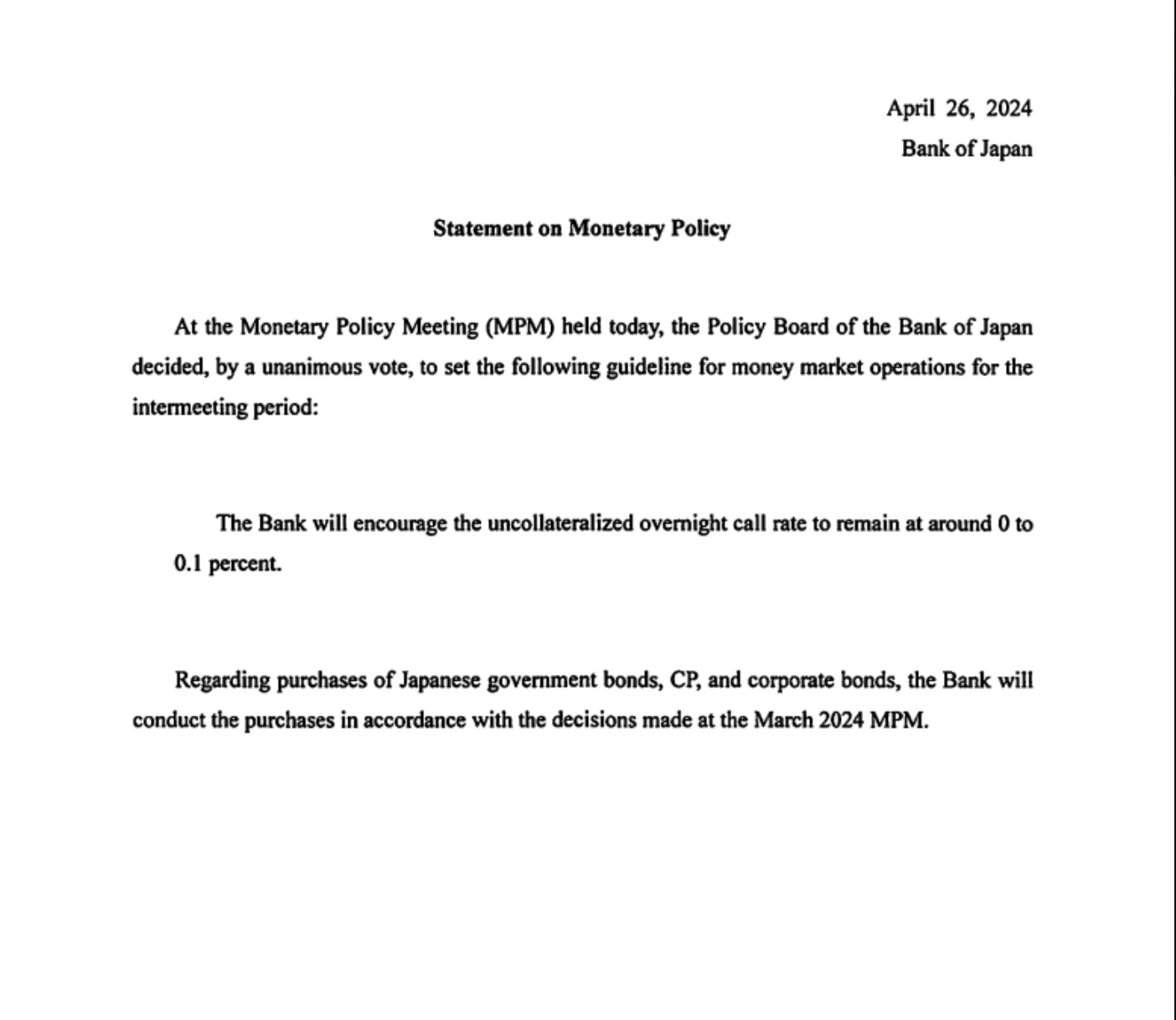
I would contend they could have used my haiku above and completely gotten the message across!  This is the best central bank move I have seen in forever, an economy of words with limited discussion about their views of the future.  But that the Fed would be so terse in their statements.  By forcing investors and traders to consider all the issues and the best, or at least possible, ways in which the central bank can achieve their stated goals, positioning would be substantially reduced because nobody would think the central bank ‘had their back’.  This would prevent another SVB-type collapse, and probably go a long way to reducing the massive wealth inequalities that central banks have fostered since the GFC.  Just sayin’!

The market response to this, and the subsequent Ueda press conference was to sell the yen even more aggressively, with USDJPY touching yet further new 34-year highs at 156.80, higher by more than one full yen (0.7%) and JGB yields climbed to 0.92%, slowly approaching the big round number of 1.00%.  FinMin Suzuki was out trying to talk the yen higher (dollar lower) with the following comments, “the weak yen has both positive and negative impacts, but we are more concerned about the negative effects right now.”  Those comments were sufficient to drive USDJPY down about 90 pips in a few minutes, but as of right now (6:20), the dollar is back to its highs.  As long as the Fed and the BOJ remain on different wavelengths, the yen will not be able to rally, trust me.

The GDP data surprised
By showing less strength than surmised
But really, for Jay
The prob yesterday
Was PCE so energized

This brings us to the GDP data yesterday, which missed badly at 1.6%.  However, that was not the worst part of the report.  Alongside the GDP data, there is a PCE calculation, that while not the one on which the Fed focuses, is still a harbinger of how things are going.  That number was higher than expected with the Core rising 3.7% Q/Q, up from 2.0% in Q4.  The upshot of this data was that growth is slowing and inflation is rising, exactly the opposite of the Fed’s (and the administration’s) goals and moving toward the concept of stagflation.

While quoting oneself is not the best etiquette, I think it makes some sense here as I described this exact situation back in January as follows:

Stagflation is an awful word as it describes a state
Where prices rise too fast while growth just cannot germinate.
And this, dear friends, is what I fear will come to pass this year
By Christmas, bonds and stocks will fall while metals hit high gear.

It should be no surprise that both bonds and stocks fell yesterday as market participants are growing concerned that the Fed has lost control of the narrative.  After all, the last time we had stagflation, Chairman Volcker chose to fight inflation first by raising the Fed funds rate to 21% and driving the economy into a double-dip recession from 1980-1982.  But the debt/GDP ratio at the time was just 30% or so and the government could afford it.  That is not the case today, and quite frankly, there are exactly zero politicians on either side of the aisle who can tolerate a recession of any type, let alone a double dip.  My guess is that all hands will be pushing to increase the rate of growth and let inflation rip because given the current drivers of inflation (commodity prices, near-shoring and demographics), it is not clear the Fed can do anything about it anyway.  Don’t you feel better now?

All this leads us to this morning’s PCE data (exp 0.3% M/M for both headline and core, 2.6% Y/Y for both readings) as well as Personal Income (0.5%) and Personal Spending (0.6%).  Given yesterday’s outcomes and the fact that the Bureau of Economic Analysis produces both sets of numbers, the whisper number is clearly higher.  If that should manifest, I suspect that the price action from yesterday, lower stocks and bonds, is very likely to continue despite the after-market rally of both Google and Microsoft on better-than-expected earnings data.  I also suspect that before noon, the Fed whisperer, Nick Timiraos, will have an article out in the WSJ to give some Fed perspective as they are currently muzzled in their quiet period.            

I don’t think there’s anything else to say about this, so let me recap the overnight session, at least the parts I have not yet discussed.  While the US equity session did not finish on its lows, all three major indices were lower by at least -0.5% on the day.  However, the same was not true in Asia with the Nikkei (+0.8%) responding positively to the fact that tighter monetary policy was not on its way, while Chinese (+1.5%) and Hong Kong (+2.1%) shares positively ripped on the back of the strong tech earnings in the US.  As to European bourses, they are all in the green this morning, with Spain (+1.1%) leading the way but all higher by at least +0.5%.  Lastly, US futures are pointing higher as well after the strong earnings numbers overnight, up by +1.0% or so at this hour (7:20).

After jumping 8bps in the wake of the GDP data yesterday, 10-year Treasury yields slid a bit and finished the day up 5bps.  This morning, they have given back two more basis points, but still trade right at 4.70%.  If this morning’s data is 0.4%, watch for another sharp move higher in yields today.  European yields pretty much followed the US yesterday, all closing higher by between 4bps and 6bps, and this morning they are lower by similar amounts, right back to where they started.

Oil prices (+0.5%) are climbing higher again, seeming to have found a recent bottom and looking like they are set to push back toward $90/bbl by summer.  While the real GDP data was softer, nominal remains solid and that is what drives demand.  In the metals markets, they all jumped on the data release and this morning are continuing higher (Au +0.7%, Ag +0.8%, Cu +0.8%, Al +0.9%).  In the industrial metals, inventories are dropping while the precious space is clearly responding to the inflation fears.

Finally, the dollar is little changed overall this morning.  while it has rallied sharply vs. the yen, ZAR (+0.85%) is gaining on metal market strength as an offset and pretty much everything else is +/- 0.25% or less.  My take is everyone is waiting for this morning’s data to determine if the Fed is going to become even more hawkish, or if there will be a reprieve. 

In addition to the PCE data, we get Michigan Sentiment at 10:00 (exp 77.8, down from 79.4).  Right now, players are holding their collective breath for the numbers.  After the release, it’s all about the results.  Given that every recent inflation print has been on the high side, I expect this to be no different.  Bonds should suffer, commodities should outperform, and I expect the dollar to do well.

Good luck and good weekend

Adf
Piffling

The topic du jour
Is, will Japan intervene?
And will it matter?

History has shown
Until policy changes
All else is piffling

The next 30 hours have the chance to be quite meaningful for markets as we will learn a great deal about several very key issues.  While this morning’s Q1 US GDP data will be mildly interesting, I believe the real keys will be the following in order of their release: 1) earnings from Alphabet Google, Intel and Microsoft; 2) BOJ meeting and Ueda press conference; and 3) US Core PCE.

Let’s unpack them in order.

1)    Earnings for three key tech stocks are a critical data point to determine whether the current equity mulitples still make sense.  Already this week we saw Tesla miss estimates but give positive guidance and rally sharply on Tuesday, then Meta Facebook beat earnings nicely but gave negative guidance (they said costs were rising because of all the AI spending but revenues would not show a bump anytime soon on the back of that spending) and the stock fell sharply overnight and is called down -13% to open this morning.  Just remember, if the generals of the stock market rally are slipping, typically the market can follow lower.

2)    Now that USDJPY has breached the 155 level and has not even consolidated, but continues marching higher, all eyes are on Ueda-san to see if he will adjust policy to help mitigate the yen’s declines.  Of course, the BOJ is not in charge of yen policy, that is an MOF issue, but I assure you the two entities work closely together.  Ueda’s problem is that no matter what he does, it will not have enough of an impact to make a difference.  While no policy change is expected, even if the BOJ hikes rates 25bps, it would only have a very short-term effect because the interest rate differential remains huge and would still be in excess of 500 basis points.  While there are reasons for Ueda to consider a hike (rising wages, higher energy prices and the weak yen all can lead to further inflation), given they hiked at the last meeting and explicitly said they would be maintaining easy policy, it seems hard to believe anything will change.  (As an aside, the very fact that nobody is expecting a move would allow a disproportionate pop in the yen, although I believe it would be quite short-lived.)

3)    Finally, the release of the PCE data tomorrow morning will update both market participants and policymakers on the likelihood that the Fed is going to achieve their inflation target anytime soon.  Recall, we have seen three consecutive hotter than expected CPI monthly reports and the last two PCE reports were similarly hotter than expected.  If this one follows that pattern, any idea that a cut is coming before the election will dissipate even further.  As of this morning, the Fed funds futures market is pricing just 42bps of cuts for all of 2024 with the first cut not expected until September.  The options market is now pricing a 20% probability of a rate hike in the next twelve months.  I believe tomorrow’s data matters a great deal.

It is part 3 of my little exercise that is the key for USDJPY going forward.  Just like the ECB (and BOE and BOC), the BOJ was counting on the Fed to begin their rate cutting cycle initially by March, but certainly by June, and expecting quite a few rate cuts.  That would have been crucial to reduce the US yield advantage over the yen and likely would have seen the dollar slide against most currencies.  But it appears that the US economy, which continues to be propped up by massive deficit government spending, is not going to allow the Fed any leeway to reduce rates.  If that continues to be the case, and I see no reason for that to change ahead of the election, then the dollar is going to retain its bid.  In fact, this is exactly why yesterday I highlighted the conversations that are apparently ongoing within the Trump camp regarding ways to weaken the dollar.  Right now, it is not going to fall on its own.

So that’s how things stand as we head into a crucial period with disparate but important information.  In the meantime, let’s look at the overnight activity.

Yesterday’s US session was a wash as early declines were recovered into the close, but the Meta earnings have US futures pointing lower by about 0.7% at this hour (6:45).  Those earnings also seemed to impact Tokyo, which saw a sharp decline of -2.2% although Chinese and Hong Kong shares managed to rally on the session a bit, about 0.5%.  The rest of the time zone was mixed with some gainers (India, New Zealand, Thailand) and some laggards (South Korea, Taiwan).  The picture in Europe is also mixed with the FTSE 100 (+0.6%) having a solid session on the strength of an M&A deal regarding Anglo American, the mining giant receiving an unsolicited buyout offer from BHP Billiton.  However, pretty much the entire continent is under water this morning, sagging by 0.65% or so across the board.

In the bond market, Treasury yields are unchanged this morning, but 10yr still sit at 4.64%.  I expect that the data today and tomorrow will have quite an impact there.  European sovereign yields are all slipping 2bps this morning, as what little data that has been released, German GfK Confidence and French Business Confidence) have been on the soft side with a few comments that the June rate cut remains the favorite. Perhaps of more interest is that 10yr JGB yields rose 3bps overnight and are now at 0.89%, their highest level since November in the wake of the ostensible end of YCC.  Perhaps traders here are starting to bet on a BOJ move.

In the commodity space, oil (+0.3%) is bouncing from its worst levels recently, but in truth, remains in the middle of its trading range for the past week near $83/bbl.  Yesterday’s EIA data showed a very large net draw of inventories which has helped support the black sticky stuff.  As to the metals markets, it appears that the correction may be over with all the main players higher this morning (Au +0.5%, Ag +0.6%, Cu +1.7%, Al +0.2%).  Remember, if tomorrow’s PCE is hot, the metals should continue to rally.

Finally, the dollar is under a little pressure overall this morning, although it remains near its recent highs.  ZAR (+1.15%) is the leading gainer on the back of that metals strength, but we are seeing strength in AUD (+0.45%) and CLP (+0.6%) also helped by the metals markets.  However, it is not just that story as the euro (+0.2%) and pound (+0.4%) are both firmer and dragging their CE4 acolytes along for the ride as well.  The one exception remains the yen (-0.2%), which is above 155.50 as I type.  Of course, that story is told above.

Today’s data is as follows: Initial (exp 214K) and Continuing (1810K) Claims as well as Q1 GDP (2.5%) with its subsets of Real Consumer Spending (2.8%) and its measure of PCE (3.4%).  It is important to note that this PCE data is not the one the Fed tracks closely, although I am certain they pay attention.  FWIW, the Atlanta Fed’s GDPNow number is currently 2.7%.

Now we wait for the data to come.  When the dust settles, we should have a somewhat better idea of how things may play out, but right now there is a great deal of uncertainty.  In the end, nothing has altered the fact that the dollar continues to benefit from the relative tightness of the Fed vs. other nations, and that should continue to support the dollar.

Good luck
Adf

What If?

What if inflation’s not dead
And set to go higher instead?
Can Fed funds still fall?
Well, that’s a tough call
If not, look for trouble ahead


As we await Tuesday’s latest CPI data, I thought it might be a good time to review how things currently stand on a macro basis.  As I am just an FX guy, I am not nearly smart enough to see through the headlines and determine what is wrong with the narrative story of Goldilocks.  However, I can look at the actual numbers and perhaps we can draw some conclusions from that data.

Let’s start with CPI, as that is the next shoe to drop.  Looking at the last twelve months of monthly data, we see the following results on both an original and adjusted basis:

 CPI m/mannualizedCPI m/m (adj)annualized
Dec-230.33.60.22.4
Nov-230.23.00.22.4
Oct-230.12.40.12.0
Sep-230.43.00.42.7
Aug-230.53.60.53.36
Jul-230.23.40.23.2
Jun-230.2 0.2 
May-230.1 0.1 
Apr-230.4 0.4 
Mar-230.1 0.1 
Feb-230.4 0.4 
Jan-230.5 0.5 
Data tradingeconomics.com, calculations @fx_poet

Since the January 2024 data hasn’t been released, there would ordinarily be no revision yet.  However, as I wrote last week, the BLS does an annual revision which lowered the December 2023 result by a tick.  

As you can see that one tick had a big impact on the annualization trend for the past 6 months, and especially the past 3 months (highlighted), reducing it substantially.  Now, given the imperfections of the measuring process, 0.1% is probably not significant in the broad scheme of things.  But oh boy, for the narrative, it is everything.  Prior to that revision, it was pretty easy for those who believe inflation has bottomed to highlight that turn higher in the annualization rate.  This was especially true given how much the ‘inflation is dead’ crowd was relying on just that point.  But now that turn looks like a dead-cat bounce and is not nearly so impressive.  Tuesday’s outcome will be quite interesting as anything that is soft will almost certainly encourage the doves to be calling for a March cut more aggressively, and just as certainly, we will see risk assets rally sharply as the dollar declines.  A hot print, though, 0.3 or more, will have the opposite impact.

What if the ‘conomy’s state
Was built by the deficit’s weight?
And actual growth
Ain’t fast, but more sloth
Will Janet, more spending create?


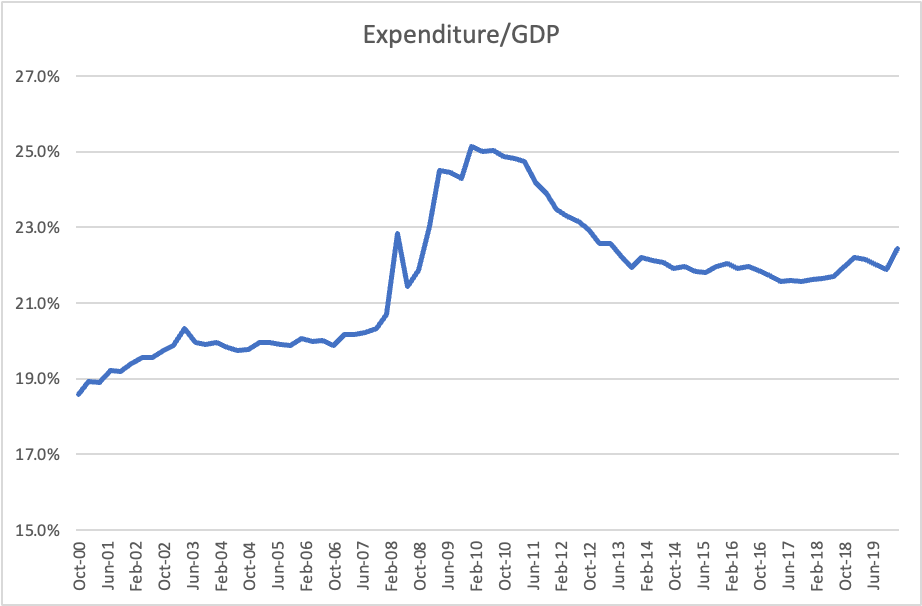
When looking at GDP data and Federal government expenditures, it becomes pretty easy to determine why GDP continues to percolate along so well.  Given that GDP = Consumption + Investment + Government + Net eXports (Y = C + I + G + NX), a quick look at the G component shows just how much support the government has been adding to the economy despite what has been recorded as strong growth.  Or perhaps, more accurately, this is why growth has been so strong.  The below chart shows the trend of government expenditures relative to total GDP growth.  I removed the Covid years because they are extremely volatile and confusing. However, looking at the trend since the GFC in 2008/2009, there has been a step change higher in the amount of government activity measured in the economy. 

Source: data FRED St Louis Fed, calculations @fx_poet

Given the current budget deficit is running > 7% of GDP and is projected to remain at least this high going forward, it is quite clear that there is a lot of nonorganic effort to raise the GDP measures.  Look at the sharp upward turn at the right side of the chart.  It appears that the administration will do everything they can to continue to show that the economy is strong.  

Of course, this is where the rubber meets the road.  If the administration continues to pump more government spending into the economy, can inflation really decline any further?  Remember, government spending is almost entirely consumption based, with limited investment at this time.  Even the CHIPS Act only created incentives for private companies to invest, it is not government investment per se.  The point is, pumping up consumption demand without adding productive capacity is very likely to drive prices higher.  And if anything, given this administration’s war on energy markets, they are discouraging investment in critical infrastructure.  It is hard to see how this plays out for a Goldilocks outcome.  Far more likely, in my view, is that they continue to pump as hard as possible, and prices start moving higher again.  Timing is everything in life, and perhaps they can work it out so price hikes are delayed until after the election, but I am skeptical given the vast incompetence this administration has shown in virtually every sphere in which it operates.

What if employment’s a mess
And actually in some distress?
Is JOLTS data real?
And what is the deal
With households, it’s hard to assess


The last big macro area is, of course, the employment situation.  We all know that the NFP report was much stronger than expected for January, rising 353K, but also seeing upward revisions of the previous months for the first time in quite a while.  In fact, one of the bearish stories had been that the revisions mattered more than the headline data, and if revisions were for the worse, that was indicative of a slowing economy.  

Remember, too, that the US employment situation is measured in two ways, via the establishment survey which is a survey of companies’ (both large and small) actual hiring activity and leads to the NFP number, and the household survey, which is a telephone survey of ~60,000 households and asks the question if someone is employed and if not, whether they are looking for work.  The Unemployment Rate is calculated from the household survey, so both are clearly critical in assessing the situation on the ground.  

The funny thing is that the numbers come across pretty differently when you dig down.  While in the long-term, both data series have shown a strong correlation (96% since January 2000), the Household survey is far more volatile and in the past year has been telling a somewhat different story than the establishment survey.  Look at this chart below mapping each since the beginning of 2023:

Source: data FRED St Louis Fed, calculations @fx_poet

Doing the math shows that the establishment survey claims that 3.409 million jobs were created while the Household survey comes in at just over half that amount, 1.852 million jobs.  Now, in a nation of 330 million people, especially given the expansion of the gig economy and the dramatic changes in employment overall, maybe that is not such a big deal.  As well, simply looking at the two lines shows that the Household survey is far more volatile than the Establishment survey.  Does this mean we should ignore the household survey, given it seems to have more noise and less signal?  The problem with this is the household survey drives the Unemployment Rate, and nobody is willing to ignore that.  And these differences beg the question, is the employment situation as rosy as it seems?  With the Unemployment rate remaining so low for so long, it certainly appears that there is ample demand for workers.  Of course, that also implies that the cost of labor seems unlikely to decline very much and could well increase further and faster.  If that is the case, the impact will be seen in the inflation data as well.

Trying to sum things up here, looking at the three critical macro variables, inflation, growth and employment, there is a strong case to be made that the combination of ongoing government support and continued demand for labor into an aging workforce can lead to solid nominal GDP growth with inflation remaining far stickier than many currently anticipate.  If that is the situation, all the hopes and dreams of the interest rate doves may be delayed, if not destroyed, as it will be increasingly difficult for the Fed to ease policy into an inflationary environment.  Arguably, this is why they are seeking greater confidence that inflation is really dead.  

Now, maybe Goldilocks is real, and inflation will continue to decline on its own because…well just because.  But I find it hard to look at the data and conclude that lower inflation is our future, at least for any length of time.

Ok, this has gotten much longer than I intended but fortunately, absolutely nothing of note happened overnight in markets.  Literally.  There has been de minimis movement in stocks, bonds, commodities and currencies, and there is a distinct lack of data to be released today.  Tomorrow’s CPI is THE number of the week, so perhaps that will get the juices flowing again and drive some movement.  Until then, a quiet day is usually a good one on which to establish hedges.

Good luck

Adf

Smokin’

The GDP number was smokin’
As animal spirits have woken
The Core PCE
If higher than three
Could slay rate-cut talk that’s been spoken

Thus, if the Fed’s data dependent
The ‘conomy’s truly resplendent
So, please do explain
Why rate cuts are sane
Seems rates ought, instead, be ascendent

By now you are all aware that Q4 GDP was a significantly better than expected 3.3% SAAR, far above the 2.0% analyst forecasts and far above the Atlanta Fed’s GDPNow readings.  For everyone who is looking for that recession, thus far it still appears to be somewhere further down the road.  At some point, it is certain, there will be a recession but the when is the big question.

Now, a different question would be what is driving the economic activity that we have seen?  That answer is far easier to determine as in the equation that defines economic growth: Y=C+I+G+NX (exports-imports), the variable that is growing most consistently is the G, government spending. Simply look at the size of the budget deficit. This is not to say that government spending is not growth as measured, just that it is not organic growth that feeds on itself.  It is the organic kind that is the sign of a healthy economy.  Government spending can be analogized as gaining weight but not growing stronger, i.e. getting fat.

Regardless, though, of the reasons for the growth, it is real in the sense that more activity is taking place.  This implies that demand continues to be robust.  Since this is the case, I would ask all those who are expecting the Fed to cut rates by May at the latest, but begging for a March rate cut, why do you think that is appropriate?

First off, another way to say data dependent is to call the Fed reactive.  This means that the Fed is explicitly going to be behind the curve and react to the data they see, they are not going to pre-empt expectations for future economic outcomes.  Back in the day, when Alan Greenspan was Fed chair, he would raise rates occasionally to head off what he thought was incipient inflation, but rate cuts were then, and have always been, reactive to problems in the economy.  That is why, generally, rate decline much faster than the rise.  This cycle was quite the exception but then Chairman Powell was in denial for a very long time before he figured out he had made a mistake.  It is this reason that I believe the Fed funds outcome is bimodal, that either there will be only one or two token cuts, or we will see 300bps or more as the economy craters.  Based on yesterday’s data, I’m still in the one cut camp this year as per my 2024 forecasts.

It is important to remember that the Fed’s dot plot is not the road map, per se, it is merely a compilation of each member’s individual forecasts.  But they are just that, forecasts, and as we saw with yesterday’s GDP number, FORECASTS ARE WRONG ALL THE TIME!  There is no reason to believe the Fed or its members, who have an atrocious forecasting record, know where things are going to be later this year, let alone in 2025 or 2026.

Back to my point, to drive it home; the Fed has explained they are going to be reactive to the data when it comes to setting policy rates.  So far, the data is pointing to continued solid, above trend, economic growth and the employment situation remains strong (Initial Claims at 200K, Unemployment Rate at 3.7%).  As well, inflation remains well above their target.  Once again, I will ask, why will they be cutting rates in H1?  If they do, it implies that things have gotten a whole lot worse in a hurry, and that, my friends, will not be a positive for risk assets.

Turning to the overnight session, after a solid equity market performance in the US, where all three major indices rallied a bit, Asia took a different path as both Japanese and Chinese shares fell 1.35% or more.  Apparently, the luster of the Chinese fiscal and market support has faded a bit, but that hasn’t stopped those who got long Japanese shares in that pairs trade I discussed yesterday, from continuing to sell.  Interestingly, the data overnight showed that Tokyo CPI, on every measure, was much softer than forecast implying that the BOJ has far less need to consider tightening policy in the near future.  I would have thought that would have helped Japanese shares, but not so much.  Europe, though, is having a much better day with the CAC (+2.1%) leading the way on the back of very strong results by LVMH, the luxury goods firm.  But all the indices are higher on the continent.  Alas, US futures are a bit softer at this hour (7:00), but only just and really it is the NASDAQ which has been lagging a bit.

In the bond market, activity has been muted everywhere as investors and traders around the world await this morning’s PCE data in the US.  Treasury yields, which slid a few bps yesterday, are unchanged on the day and European sovereigns are all seeing yields drift lower by between 1bp and 3bps.  Perhaps the least surprising move is JGB yields sliding 3bps overnight on the back of that Tokyo CPI data.  As an indication of what those numbers are like, Headline and Core both printed at 1.6% Y/Y, significantly below the December readings and the lowest in nearly two years.

While oil prices have backed off a bit this morning, -0.8%, they have had an excellent week, up nearly 5% on the back of the stronger showing in the US economy, the fiscal stimulus stories in China and the fact that Ukraine was able to successfully attack a Russian oil shipping facility, closing it down and reducing supply.  In the short-term, it does feel like there are more potential catalysts to drive this price higher, but the long-term question remains open.  As to the metals markets, they continue to do very little with marginal gains or losses on a day-to-day basis as we have been trendless in gold and copper for the past several months.  We will need to see some fundamental changes in the supply/demand equation to shake out of this lethargy, but that remains true in many markets.  Data of late is a Rorschach test as there always seems to be a data point to help someone justify their view, regardless of their view.  We need to see things align more clearly for a change in either direction.

Finally, the dollar, which has been grinding ever so slightly higher over the past month or two, is a bit softer overall this morning, roughly 0.3% across the board in both the G10 and EMG blocs.  Arguably, the most important data overnight was that Tokyo CPI, but the yen is actually unchanged on the session, lagging the euro and pound, but not responding very much.  Interestingly, despite oil’s decline, NOK is slightly firmer, so this is really a modest dollar weakness story for now.  Perhaps in anticipation of a soft PCE number?

So, let’s turn to the data today.  Everything comes at 8:30 and here are the consensus views right now: Personal Income (0.3%), Personal Spending (0.4%) PCE (0.2% M/M, 2.6% Y/Y), and most importantly, Core PCE (0.2% M/M, 3.0% Y/Y).  Much has been made of comments that Governor Waller made a few weeks ago which have been interpreted as ‘knowledge’ that the M/M number would be soft, 0.1%, dragging all the other indicators with it.  As well, Treasury Secretary Yellen ostensibly explained that the recession has been avoided and the soft landing achieved so inflation is no longer a problem.  And maybe that will be the case.  But inflation is a funny thing.  It is insidious and extremely difficult to remove from an economy as complex as the United States once it is embedded there.  I have no idea where today’s data will print, but I will say that my bias is that inflation is stickier than the rate cut advocates believe.

As to the market reaction, that is also very difficult to anticipate.  Yesterday in my assessment of what would occur in response to a hot number, I was right about the dollar and oil, but not about stocks and bonds, both of which rallied.  As of now, the Fed funds futures market continues to price a 50:50 chance of a March cut.  I feel like we will need to see a very soft number today to keep that stable.  And if the M/M number is 0.3%, I would expect that March probability to shrink rapidly.  However, for now, those looking for rate cuts remain on top in the game, and they will only give up their views kicking and screaming.  Keep your ears peeled.

Good luck and good weekend
Adf

Possibly Soaring

So far this week, things have been boring
With data or news not outpouring
But starting today
More stuff’s on the way
With GDP possibly soaring

As well, we’ll hear from M Lagarde
Who’s promised her backbone is hard
It’s too soon to cut
As there’s still a glut
Of funds spread all over the yard

Heading into this morning’s data releases, we have had remarkably little on which to focus this week.  Flash PMI data yesterday was modestly better than expected, although manufacturing is still trending in recession around Europe and Asia.  Perhaps the biggest surprise was in the US where the manufacturing print was a solid 50.3, the first time it has been above the boom/bust line since last April.  However, that was not enough to quicken any pulses.

You can tell how dull things have been by the fact that the biggest news yesterday came from the Fed regarding the BTFP.  The BTFP (Bank Term Funding Program), you may recall, is the facility the Fed invented last March in the wake of the collapse of Silicon Valley and Signature banks.  The idea was they would lend money to the banks without the banks taking a haircut on the value of the collateral, so lending 100% of the collateral’s face value despite the fact the bonds were trading at 75 cents on the dollar.  It was designed to tide over weak banks and ostensibly had less stigma than borrowing from the Fed’s Discount Window, which is supposed to tide over weak banks.  But the funding was cheaper given the collateral price adjustment and over time, it garnered about $110 billion in utilization.  However, last November, when the market decided that the Fed was going to cut rates aggressively in 2024, the funding formula for these loans fell substantially below the IOER that the Fed pays to banks, reaching a spread of 60bps.  So, banks started using the BTFP to earn risk free cash.  Well, the Fed got tired of that game and as of today, raised the cost of funding thus eliminating the arbitrage.  And that was the most interesting thing in the markets yesterday!

But that was then.  Now we get to look ahead to a few key pieces of information starting with US Q4 GDP’s first reading (exp 2.0%) as well as Durable Goods (1.1%, 0.2% ex transport) and Initial (200K) and Continuing (1828K) Claims data.  That will be followed by the ECB’s press conference at 8:45 where Madame Lagarde will be able to reiterate her strong views that despite a very weak Eurozone economy, they have not yet solved the inflation problem and they are not going to cut rates anytime soon.  I have ignored the ECB official decision time as there is a vanishingly small probability that they will adjust rates from the current 4.0% level.

The question for market participants is whether any of this will matter, or if we still need to see the next crucial information, tomorrow’s PCE data and, of course, the FOMC meeting and press conference next Wednesday.  My sense is that much will revolve around that GDP print.  The Atlanta Fed’s GDPNow is forecasting a 2.4% print for Q4, still above the economists’ consensus, albeit not as far above as in Q3.  Given the market’s ongoing strong belief that the Fed is going to be aggressively cutting rates this year, an outcome at the GDPNow level or higher would certainly have a market impact, likely seeing a sell-off in bonds and a reduction in the probability of rate cuts going forward.  The natural extension of this would be a stronger dollar, weaker stocks and probably stronger oil prices as the demand side of the equation would be rising.

But in this topsy-turvy world where good news is bad, the converse is also likely true, a soft print will reinforce the ideas that the Fed is going to cut sooner and more aggressively which will have a short-term positive impact on stocks and bonds, although the dollar will suffer accordingly.

One of the market conversations about the Fed has been regarding the political implications of their moves and whether they may cut sooner just to try to avoid any appearance of a political bias.  But as I think about that, while the very small minority of people in this country who focus on the economy and markets will certainly have opinions on the subject, I would contend that for the vast majority of folks, whether the Fed cuts 25bps in March or May or June is just not going to change their lives nor change their vote.  Remember, monetary policy works with “long and variable” lags, so even if they do cut in March, it probably won’t start to feed through into any economic impact before the election.  The only conceivable impact would be that money-market fund yields would fall that 25bps, an annoyance but not a significant change.  My point is far too much emphasis is put on the potential political nature of this and I think it is overblown.

Turning to the overnight market activity, Chinese shares continue to benefit from the recent monetary and fiscal support that the government is adding with shares in HK and the mainland both higher by 2% overngith.  Meanwhile, Japanese shares were essentially unchanged, although that spread continues to narrow.  As to European bourses, they are softer this morning with the DAX (-0.5%) falling after weaker than forecast IFO data across the board indicating not only weak current conditions but weak prospects as well.  (As an aside, this is why it is so difficult to believe that Lagarde will hold off on rate cuts until the summer.  A weak Germany is a problem for the Eurozone.)   finally, after a mixed session yesterday, US futures are edging a bit higher as I type (7:45).

In the bond market, Treasury yields, which rose a few bps on the session yesterday, are essentially unchanged this morning but European sovereign yields are higher by 2bps across the board, perhaps in anticipation of something from the ECB.  JGB yields continue to creep higher as well, up another 2bps overnight as there is a growing confidence that the BOJ is going to exit their negative interest rate policy by April.  Right now I would still fade that bet.

Oil prices (+0.9%) have continued to rally with WRTI back above $75/bbl and Brent above $80/bbl.  Yesterday’s EIA inventory data showed surprisingly large drawdowns in crude and most distillates although gasoline inventories rose a bunch.  As well, it appears that the costs of transport are starting to drive the overall price higher with more and more shipping traffic avoiding the Red Sea.  Meanwhile, metals markets, after an ok day yesterday, are essentially unchanged this morning.

Finally, the dollar, which fell sharply yesterday, is mixed but broadly unchanged across the board.  Looking at my screen the largest move I see is KRW (-0.4%) with every G10 currency within 0.25 of yesterday’s closes.  At this point, the market is biding its time for today’s data as well as tomorrow’s PCE and next week’s FOMC meeting.  Unless that GDP number is a big miss in either direction, which I outlined above, I suspect a very quiet session here.

Right now, we are in a wait and see mode, so, let’s wait and see what the data brings and we can evaluate after the releases.

Good luck
Adf

A Rough Week

Investors have had a rough week
As both stocks and bonds sprung a leak
The hope is, today
The data will say
Inflation is well past its peak

The thing is, Q3’s GDP
Described a robust ‘conomy
Will that push the Fed
When looking ahead
To restart their tightening spree?

I imagine most of us are a little tired of the negativity in markets on a daily basis of late.  Yesterday was just another in a series of negative equity market sessions with the US indices declining between -0.75% (DJIA) and -1.75% (NASDAQ).  And this happened despite (because of?) a significantly higher GDP report than most analysts had forecast.  The print, 4.9%, was truly impressive and it was accompanied by stronger than expected Durable Goods orders (4.7%) and continuing solid Initial Claims data (210K).  In other words, the data points to a robust US economy which, one might conclude, would be a positive for risk assets.  One would be wrong.

It seems there are many possible explanations for this seeming conundrum although I favor the following: ongoing elevated interest rates are putting pressure on earnings multiples and driving them lower.  The fact that GDP growth remains robust implies the Fed will be in no hurry to cut rates thus maintaining its higher for longer attitude for even longer.  In this situation, the discount cash flow model, which underlies much, if not most, stock market analysis, tells us that companies growing at 10% cannot be valued at 50x earnings, the math just doesn’t work.  Hence, despite solid performance, investors are rerating the value of these companies lower.  The bigger problem is that the current market multiple remains well above its long-term average so there is further, potentially, to fall.

One other thing to note regarding the economy is that it is quite common for there to be very strong quarterly GDP prints just before a recession begins.  Clearly yesterday’s number was quite strong, in fact the strongest (excluding the post-covid rebound) since Q1 2014.  However, that does not preclude the fact that we may still be headed toward a recession.  Now, arguably, a recession, or at least if the data starts to look like a recession is upon us, would get the Fed to change their tune and consider relaxing their current policy stance.  However, recessions tend to come with much lower earnings and historically are not that good for risk assets either.  It is this concern that has so many praying calling for a soft landing.  Alas, I would not wager on that outcome.

I think it is important to remember that market movements do not have to be driven by outside catalysts but can happen of their own volition.  In fact, that is my point on the rerating of market multiples.  This can occur regardless of any data, whether good or bad.  If the investor community is becoming nervous, and if there is an alternative like we have today with short-dated Treasuries yielding 5% or more, equity prices can decline much further around the world, whatever their current valuations are.  While we all try to rationalize movements in the markets after the fact, on any given day, no specific catalyst is needed from outside the market itself.

With this in mind, though, the rest of the world has not followed yesterday’s US market lead and instead we have seen a rebound in Asian shares with the Hang Seng (+2.1%) leading the way but the rest of the space mostly higher by at least 1%.  European bourses are more mixed with a combination of mostly small gains and losses although the CAC in Paris is an outlier (-1.0%).  US futures, though, are mostly in the green with the NASDAQ the leader (+0.6%) at this hour (7:45).

The bond story, though, is quite interesting as there has been a great deal of volatility in this space of late.  You may recall that I mentioned the abysmal 5-yr auction on Wednesday.  Well, yesterday the Treasury auctioned 7-year paper and the results were outstanding with the best bid-to-cover ratio since March 2020.  This led to a major rally in the bond market with yields continuing their yoyo movement and falling 14bps although this morning they are bouncing from those levels and are higher by 3bps.  European sovereigns did not come along for the Treasury ride yesterday showing much less movement and this morning they are edging lower by between 1bp and 3bps. This is in the wake of yesterday’s ECB meeting where Madame Lagarde left policy on hold for the first time after eleven consecutive rate hikes, and tried to explain that they would be completely data dependent for the time being.  Not for nothing but the recent data from Europe looks pretty awful, so if that is the case, I would expect to see cuts on the horizon there.

Volatility continues apace in the oil market as well with yesterday’s decline followed by 1.5% rally this morning.  It seems that yesterday’s story about a potential de-escalation of the Israeli-Palestinian crisis was trumped by news that the US had bombed several sites in Syria in response to attacks on US bases in Iraq last week.  Ostensibly these sites are controlled by Iranian proxies indicating the possibility of a widening conflict in the Middle East.  I suspect that we are going to continue to see volatility here, but net, the structural issues remain beneficial for oil in my view.  As to gold, it is little changed this morning and simply maintaining its recent gains as fear continues to be a market driver right now.  Base metals were clearly cheered by the strong US data as both copper (+1.1%) and aluminum (+0.25%) are firmer this morning.

Looking at the dollar, it should be no surprise that it continues to perform well overall.  Between the risk issues and the strong economic data, the US certainly seems a better place to put your money than most others right now.  USDJPY continues to trade above 150 but is not running away and there is no indication the BOJ has been involved at all.  The euro keeps pushing toward 1.05 and the pound looks like it is headed down to 1.20 soon.  USDCNY is back near its recent highs as the perceived benefits of Chinese fiscal stimulus are not seen as yuan positives at this point, especially given the divergence between US and Chinese monetary policy.  It is very difficult, at this time, to come up with a reason for the dollar to decline in any substantial way.

On the data front, this morning brings Personal Income, (exp 0.4%), Personal Spending (0.5%), and the all-important Core PCE (0.3%, 3.7% Y/Y) with Michigan Sentiment (63.0) coming later at 10:00.  At this point, all eyes remain on the FOMC meeting next week where there is essentially no expectation of a rate move.  We would need to see a REALLY hot PCE number this morning to change that.  As such, I expect that a consolidation in risk markets is quite possible with little movement in the dollar overall.  Beware, however, if stocks sell off later today as that could be a tell that there is more pressure to come.  I clearly recall that the Friday before Black Monday in October 1987, stocks sold off aggressively, just not as aggressively as they did on the Monday!.

Good luck and good weekend

Adf

Weakness is Fate

The punditry’s all of a piece
That growth in the future will cease
But ‘flation still reigns
And Jay’s been at pains
To force prices, soon, to decrease

There is a website, Seeking Alpha, that publishes a great deal of macroeconomic and market commentary on a daily basis.  Yesterday morning’s top headlines under the Economy section included the following list.

  1. Is Recent GDP Data Overestimating U.S. Growth?
  2. U.S. Stagflation Risks Rise as Service Sector Falters Alongside Manufacturing Downturn
  3. Global PMI Shows Recovery Fading Further in August as Developed World Output Falls
  4. The Unemployment Rate Just Signaled that a Recession May Occur Within the Next 6 Months
  5. German Industrial Production Goes from Bad to Worse
  6. The Economy is Not ‘Running Hot’
  7. U.S Labor Market Activity: Slowing, Not Weakening

The authors ranged from Investment firms like Neuberger Berman and ING to individuals with decent reputations and large numbers of followers (for whatever that is worth.)  My point is there is a lot of negativity in the analyst community regarding the near-term future of economic activity.  My question is, are people really concerned about the growth trajectory?  Or are they just trying to make the case that the Fed will consider cutting interest rates sooner rather than later in an effort to support the equity market?  

While I understand the negativity based on anecdotal evidence, the headline data continues to print at better than expected levels.  For instance, yesterday’s Initial and Continuing Claims data both fell sharply during the most recent week, indicating that the labor market remains quite robust.  It remains very difficult for me to see a case for the Fed to even consider cutting anytime soon.  Rather, the case for another rate hike seems to be growing, and if next week’s CPI print is at all hot, look for that to be the market discussion going forward.  

Of course, my opinions don’t sway markets.  The important voices are those of the Fed members themselves and yesterday, we heard from several of them that a pause is in the offing.  Based on the comments from John Williams (voter), Lorrie Logan (voter), Raphael Bostic (non-voter) and Austan Goolsbee (voter), it seems that the market pricing of < 7% probability of a hike on September 20th is appropriate.  However, the views of Fed actions in the ensuing meetings are beginning to diverge.  There are those (Logan, Bowman and Waller) who have been clear that further rate hikes past September may still be appropriate depending on the totality of the data.  Meanwhile, there are others who are quite ready to call the top and one (Harker) who is already calling for cuts in 2024.  In the end, though, Chairman Powell’s views remain the most important and the last we heard from him was that higher for longer remains the story and more hikes are possible.

The pressure’s been simply too great
For Xi’s central bank to dictate
The yuan shouldn’t sink
Which led them to blink
And now further weakness is fate

The PBOC cried uncle last night when they fixed the renminbi at its weakest level since early July as the pressures had simply grown too great to withstand.  The onshore yuan fell further and the spread between the fix and the spot rate there remains just below 2%.  The offshore market shows an even weaker CNY and looks like it will soon be trading more than 2% weaker.  As well, the CNY lows (dollar highs) seen in October 2022 are in jeopardy of being breeched quite soon.  Clearly, there is a steady flow of capital out of China at the current time and given the lackluster economic performance there along with the structural problems in the property market, it is hard to make a case that China is a good spot for investment right now.  And just think, this is all happening while the market belief is the Fed is finished raising rates.  What happens if we do see hotter inflation data and the Fed decides another hike is appropriate?  As I have maintained for quite a while, I expect the renminbi to continue to slide and a move to 7.50 or beyond to occur over the rest of 2023.  In fact, today I saw the first analyst say 8.00 is in the cards before this move is over.  Hedgers beware.

So, what comes next?  Well, on a day with no noteworthy economic data and no Fed speakers scheduled, with the FOMC set to enter their quiet period, market participants will be forced to look elsewhere for catalysts.  My take on the current zeitgeist is that the negativity seen in those headlines listed above is seeping into risk attitudes overall.  Not only that, but that there is nothing in the near-term that will serve to change that viewpoint.  We will need to see a very cool CPI print next Wednesday to get people excited and given the combination of base effects and oil’s recent price trajectory, that seems unlikely.  Anyway, let’s look at the overnight sessions results.

Equities continue to perform poorly overall as yesterday’s broad weakness in the US was followed by weakness in Asia across the board while European bourses are also all in the red.  In fairness, the European session, while uniform in direction, has not seen significant declines.  Rather, markets are down by -0.25% or so on average.  Alas, US futures are still under pressure at this hour (7:30), but here, too, the losses are modest so far.

Bond markets are not doing very much this morning as yields in the US and Europe are within 1 basis point of yesterday’s closing levels.  Yesterday we did see 10yr Treasury yields slide 4bps, but we remain at 4.25%, a level that is not indicative of expectations of rapidly declining inflation.  The odd thing about this is that if you look at inflation expectation metrics, they almost all are looking at inflation heading back to the 2% level within a year or two.  Something seems amiss here although exactly what is not clear.

Oil prices are rebounding this morning as the recent uptrend resumes.  If we continue to see better than expected US data and the soft landing or no landing thesis remains in play, it is hard to accept the idea that oil demand will decline very much.  Add to that the very clear efforts by OPEC+ to push prices higher and it seems there is further room to rise here.  But once again, the rest of the commodity space is telling a different story with base metals softer along with agricultural prices in general.  That is much more of a recession story than a growth one.  This is just another of the many conundra in markets these days.

Lastly, the dollar is softer this morning overall, although not dramatically so, at least not against its major counterparts.  The biggest gainer today is MXN (+0.7%) which is benefitting from one thing, the highest real yields available for investment at 5.5%, while overcoming another, comments from the opposition presidential candidate, Xochitl Galvez, that the peso is too strong and is hurting exports.   (There is a presidential election next year in Mexico and AMLO is prohibited from running as they have a one-term limit in place there.)  Regarding the peso, unless Banxico starts to cut rates aggressively, of which there is no sign, I expect it will continue to perform well.  As to the rest of the EMG bloc, there are more gainers than losers, but the movements have not been substantial.  In the G10, it is no surprise that NOK (+0.4%) is higher on the back of the rise in oil prices, and we have also seen NZD (+0.5%) rally, although that looks more like a trading rebound than a fundamental move.  Given the dollar’s relative strength over the past several sessions, it is no surprise to see it drift back at the end of the week.

There is no data of consequence on the docket and no Fed speakers.  This implies that the FX market will be looking for its catalysts elsewhere and that usually means the stock market.  If we continue to see weakness in equities, I suspect the dollar will regain a little ground, but in truth, ahead of next week’s key CPI data, I don’t anticipate very much activity at all today.

Good luck and good weekend

Adf

Further Downhill

The data from China is still
Desultory and likely will
Result in support
In order, quite short,
Lest Xi’s plans go further downhill

Perhaps, though, he’ll find a reprieve
If Jay and his brethren perceive
Employment is slowing
And risks are now growing
Recession they’re soon to achieve

Poor President Xi.  Well, not really, but you have to admit his plans for widespread prosperity in China have certainly not lived up to the hype lately.  Last night, PMI data was released, and like the Flash PMI data we saw last week in Europe and the US, it remains quite weak.  Specifically, Manufacturing PMI printed at 49.7, slightly better than expectations but still below the key 50.0 level.  Non-manufacturing PMI printed at 51.0, continuing its slide toward recession and indicative that there is no strong growth impulse coming from any portion of the economy there.

Remember, manufacturing remains a much larger piece of the Chinese economy (28%) than that of the US economy (11%), so weakness there is really problematic for the overall economic situation.  And while the PBOC continues to try to prevent excessive weakness in the renminbi, Chinese exporters clearly need the support of a weaker currency to thrive.  Finally, given the slowing economic situation in Europe, which is now China’s largest export market, demand for their products is simply weak.  

To date, the Chinese government has not really provided substantial support to the economy, certainly there has been no fiscal ‘bazooka,’ and monetary efforts have been at the margin.  In the current environment, it remains hard to make a case for China’s natural rebound until the rest of the global economy rebounds.  And woe betide Xi if (when) the US goes into recession.  Things there will only get worse.  The FX market is uninterested in the PBOC’s views of where USDCNY should trade, maintaining a 1.5% dollar premium vs. the daily fixing rate.  At some point, the PBOC is going to have to relent and USDCNY will go higher, in my view to 7.50 or beyond.

Speaking of recession, while the Atlanta Fed’s GDPNow forecast for Q3 is at 5.90% (a remarkably high number in my view), yesterday we saw Q2 GDP revised lower to 2.1%, with the Personal Consumption component falling to 1.7%.  At the same time, Gross Domestic Income (GDI) in Q2 was released at +0.5%, substantially lower than GDP.  (GDI and GDP are supposed to measure the same thing from different sides of the equation.  GDP represents expenditures while GDI represents income.  Eventually, they must be equal, by definition, but the estimates until all the data is finally received can vary.  In fact, looking at GDI, it was negative in Q4 and Q1 and is just barely growing now.  This is another reason many are looking for a US recession soon.) 

In this vein, Richmond Fed president but non-voter, Raphael Bostic, in a speech overnight in South Africa said, “I feel policy is appropriately restrictive.  We should be cautious and patient and let restrictive policy continue to influence the economy, lest we risk tightening too much and inflicting unnecessary economic pain.  However, that does not mean I am for easing policy any time soon.”  So, this is not exactly the same message we heard from Chairman Powell last week, but the caveat of not cutting is certainly in line.  I suspect, especially if we start to see weaker labor market data, that more FOMC members are going to feel comfortable that rates have gone high enough.  At least that will be the case as long as inflation remains quiescent.  However, if it starts to pick up again, that will be a different story.

Ok, let’s look at the overnight session.  It should be no surprise, given the Chinese data, that equity markets there were underwater, with losses on the order of -0.6% in Hong Kong and on the mainland.  However, the Nikkei (+0.9%) was the star performer across all markets on the strength of strong Retail Sales data.  As to Europe, the DAX (+0.5%) is managing some gains, but the rest of the space is little changed on the day.  It seems the CPI data that has been released from Europe, showing higher prices in Germany, France and Italy despite weakening growth has raised concerns about another ECB rate hike.  As to US futures, at this hour (7:30) they are little changed to slightly higher.

Bond yields are falling today, especially in Europe where they are lower by about 5bp-6bp across the board.  It seems that there is more concern over the growth story, or lack thereof, than the inflation story right now.  In the Treasury market, yields are lower by 2bps as well, although remain well above the 4.0% level.  This has been a response to yet another weak headline labor number with yesterday’s ADP Employment figure reported at 177K.  It seems that the huge revision higher to the previous month, a 47K increase, was ignored.  However, this is setting the stage for tomorrow’s NFP, that’s for sure.

Oil prices (+0.8%) continue to rebound after another huge inventory draw last week and despite concerns over an impending recession.  Gold (+0.1%) has been performing extremely well given the dollar’s rebound, but the base metals remain recession focused, or at least focused on Chinese weakness, and are under pressure again today.

Finally, the dollar is firmer this morning, with only the yen (+0.2%) gaining in the G10 bloc as even NOK (-0.65%) is falling despite oil’s rally.  In fact, this move looks an awful lot like a risk-off move, especially when considering the rally in Treasuries, except the equity market didn’t get the memo.  In the emerging markets, the situation is similar, with many more laggards than gainers and much larger movement to the downside.  ZAR (-0.75%) is the worst performer followed by HUF (-07%) and CZK (-0.6%) although the entire EEMEA bloc is down sharply.  However, these currencies are simply showing their high beta attachment to the euro, which is lower by -0.5% this morning.  Again, given the data from Europe, this can be no surprise.

On the US data front, this morning brings the weekly Initial (exp 235K) and Continuing (1706K) Claims data as well as Personal Income (0.3%), Personal Spending (0.7%), the all-important Core PCE (0.2% M/M, 4.2% Y/Y) and finally Chicago PMI (44.2).  Yesterday’s data was soft and if that continues into today’s session, I suspect the ‘bad news is good’ theme will play out.  That should entail a further decline in yields and the dollar while equities continue higher.  However, any strength is likely to see the opposite.  Remember, too, tomorrow is the NFP report, so given the holiday weekend upcoming, it seems likely that positioning is already quite low and trading desks are thinly staffed.  In other words, liquidity could be reduced and moves more exaggerated accordingly.  However, until we see that recession and drop in inflation, my default view remains the dollar is better off than not.

Good luck

Adf

Growth Vs. Shrink

The data continue to show
That things ain’t so bad, don’t you know
So why do folks feel
The bad stuff is real
With growth steady, though somewhat slow?

Apparently, there is a link
Twixt wage growth and what people think
As real wages fall
They cast a great pall
O’er viewpoints on growth versus shrink

That much anticipated recession seems like it will have to wait at least another quarter or two before landing as yesterday’s 3rd revision of the GDP data jumped to 2.0% annualized, much higher than forecast, with strength continuing to be seen in both personal and government consumption.  As well, the Initial Claims data fell to 239K, far below expectations and an indication that the steady drumbeat of layoffs may just be slowing down a bit.  It should be no surprise that equity markets rallied on the news, although the NASDAQ was the definitive laggard on the day.  It was not a tech story or an AI story, but a straight up growth story getting investors back into the game.  As today is quarter end, it is also important to remember that many investment managers who had been underweight equities were actively buying to achieve the appropriate window dressing for their clients.


Of more interest, in my view, was the bond market response where yields exploded higher by 15bps in the 10yr as traders priced in even higher for even longer than had been seen before the release.  Here, too, the recession call remains a mirage, or at least very uncertain in the mists.  The 2yr yield rose even further, 18bps, taking the curve inversion to -103bps.  Fed funds futures are now pricing an 85% chance of a rate hike next month, up from a 70% probability prior to the release as pretty much everyone is now on board the rate hike train.


One of the key conundrums is the idea that the Fed continues to tighten policy while equity markets continue to rally.  Historically, rate hikes of this speed and magnitude would have seen a very different reaction, but this time that is just not the case.  For those who remain suspect of the market’s euphoria, there seem to be a number of potential time bombs littering the landscape, notably commercial real estate (CRE) and housing.  In the case of CRE, there are two concerns.  First is that there is a huge overhang of debt that needs to be rolled over in the next 18 months, >$1.5 trillion, which currently has coupons far below today’s interest rate levels.  Adding to the concern is the WFH trend and how many of these buildings, especially office properties in big cities, are not generating the same cash flows as before.  So, higher rates with lower cash flows are a recipe for default and fears are growing that there are going to be many defaults on these outstanding loans.  The fact that the small regional banks have a large proportion of their assets in the CRE class also bodes ill for their ultimate situation.  So far, we have seen several high-profile buildings sell at extremely low valuations and we have also seen landlords walk away from several buildings, with two large hotels in San Francisco the current bellwethers.


Turning to housing, the overriding view has been that the Fed would kill the market given that mortgage rates have risen from ~3% to ~7% alongside higher prices thus more than doubling the average monthly cost of owning a home.  However, two things have conspired to prevent a collapse in this market so far.  First, is the fact that many people who refinanced to a 3% mortgage during ZIRP are simply unwilling to move thus reducing the supply of existing homes on the market, hence keeping prices elevated.  Second is that given the structural reduction in the labor force and the increased demand for construction workers for industrial activity (which has exploded on the back of the Inflation Reduction Act), the housing market remains far more robust than would have been expected.  Add to this the fact that builders are buying down mortgage rates (paying a part of the mortgage so the rate is more like 5% than 7%) and things are working just fine.  Again, it is possible that this time bomb has been defused.


So why the long faces everywhere?  The best explanation I have seen, which apparently has some academic workbehind it, indicates that the evolution of real wages very accurately tracks economic sentiment.  In other words, if real wages are rising, people remain relatively bullish on the economy whereas if they are falling (and they have been negative since April 2021), people tend to have a much more dour view of things.  Politically, if real wages rise it will change the entire population’s view on everything, so if I were in office, it would be the only thing I targeted.  This also explains why inflation is such a major problem for the administration in office.


So, with this as background, perhaps we have a better understanding of what the prospects are for the future, or maybe a roadmap to watch for key signals.


Meanwhile, the data continue to come out fast and the spin doctors are working overtime.  For example, in Europe this morning, CPI printed a tick lower than forecast (5.5% vs. 5.6%) with core CPI doing the same thing (5.4% vs. 5.5%), and people are raving about the better result.  But remember, the target is 2.0%, so there is no evidence they have improved things at all, nor that they are going to be able to slow the tightening process.  However, equity markets across Europe are all higher on the day, most by more than 1%.  Go figure.  The narrative remains the key, and as long as the central banks can control the narrative and get people to believe that things are getting better, markets will respond accordingly.


Bond yields in Europe did not move as far as in the US yesterday but are all modestly higher this morning as well, except for Gilts +8bps on a massive Current Account deficit result generating concerns over the UK’s finances.


As to commodities, oil bounced back toward $70/bbl yesterday and is holding those gains, although not adding to them, but the metals markets continue to suffer with both aluminum and copper falling again today.  Gold, too, is under pressure from higher yields.  Commodities remains the place where recession is seen looming.


Finally, the dollar can best be described as mixed this morning, with a 50:50 split in the G10 although no movers have even made it 0.25% away from yesterday’s close.  In the emerging markets, ZAR (-1.2%) is the lone outlier, falling on the back of the metal market weakness.  However, away from the rand, a split in performance without any outliers is the best description.  However, I must point out that USDCNH, the offshore renminbi, has traded above 7.28 and continues its slow march higher (to 7.50 and beyond!)


On the data front, there is a bunch of stuff today starting with Personal Income (exp 0.3%) and Spending (0.2%) along with core PCE (0.3% M/M, 4.7% Y/Y) at 8:30, then Chicago PMI (43.8) and Michigan Sentiment (63.9) later in the morning.  It seems that the Fed has begun their July 4th holiday weekend already with no speakers on the calendar until the 5th.  The market remains very data focused so more strong data should see higher US yields and a firmer dollar, although it depends on which data is strong as to how equities respond.  Strong spending and income data should help, but a high surprise on PCE will not.


And that’s really it heading into the long weekend.  I, too, will take Monday off so no poetry until Wednesday next week, ahead of the NFP report.


Good luck and good weekend

Adf

Desperate Straits

In Europe, the growth impulse faded
As governments there were persuaded
To lock people down
In city and town
While new strains of Covid invaded

Contrast that with here in the States
Where GDP growth resonates
Tis no real surprise
That stocks made new highs
And bond bulls are in desperate straits

There is no better depiction of the comparative situation in the US and Europe than the GDP data released yesterday and today.  In the US, Q1 saw GDP rise 6.4% annualized (about 1.6% Q/Q) after a gain of 4.3% in Q4 2020.  This morning, the Eurozone reported that GDP shrank -0.6% in Q1 after declining -0.7% in Q4 2020.  In other words, while the US put together a string of substantial economic growth over the past 3 quarters (Q3 was the remarkable 33.4% on this measure), Europe slipped into a double dip recession, with two consecutive quarters of negative growth following a single quarter of rebound.  If you consider how markets behaved in Q1, it begins to make a great deal more sense that the dollar rallied sharply along with Treasury yields, as the economic picture in the US was clearly much brighter than that in Europe.

But that is all backward-looking stuff.  Our concerns are what lies ahead.  In the US, there is no indication that things are slowing down yet, especially with the prospects of more fiscal stimulus on the way to help goose things along.  As well, Chairman Powell has been adamant that the Fed will not be reducing monetary accommodation until the economy actually achieves the Fed’s target of maximum employment.  Essentially, this has been defined as the reemployment of the 10 million people whose jobs were eliminated during the depths of the Covid induced government lockdowns.  (Its stable price target, defined as 2.0% average inflation over time, has been kicked to the curb for the time being, and is unimportant in FOMC discussions…for now.)

At the same time, the fiscal stimulus taps in Europe are only beginning to drip open.  While it may be a bit foggy as it was almost a full year ago, in July 2020 the EU agreed to jointly finance fiscal stimulus for its neediest members by borrowing on a collective level rather than at the individual country level.  This was a huge step forward from a policy perspective even if the actual amount agreed, €750 billion, was really not that much relative to the size of the economy.  Remember, the US has already passed 3 separate bills with price tags of $2.2 trillion, $900 billion and just recently, $1.9 trillion.  But even then, despite its relatively small size, those funds are just now starting to be deployed, more than 9 months after the original approval.  This is the very definition of a day late and a dollar euro short.

Now, forecasts for Q2 and beyond in Europe are much better as the third wave lockdowns are slated to end in early to mid-May thus freeing up more economic activity.  But the US remains miles ahead on these measures, with even NYC declaring it will be 100% open as of July 1st.  Again, on a purely economic basis, it remains difficult to look at the ongoing evolution of the Eurozone and US economies and decide that Europe is the place to be.  But we also know that the monetary story is critical to financial markets, so cannot ignore that.  On that score, the US continues to pump more money into the system than the ECB, offering more support for the economy, but potentially undermining the dollar.  Arguably, that has been one of the key drivers of the weak dollar narrative; at some point, the supply of dollars will overwhelm, and the value of those dollars will decrease.  This will be evident in rising inflation as well as in a weakening exchange rate versus its peers.

The thing is, this story has been being told for many years and has yet to be proven true, at least in any significant form.  In the current environment, unless the Fed actually does ease policy further, via expanded QE or explicit YCC, the rationale for significant dollar weakness remains sparse.  Treasury yields continue to define the market’s moves, thus, that is where we must keep our attention focused.

Turning that attention to market activity overnight, whether it is because it is a Friday and traders wanted to square up before going home, or because of the weak data, risk is definitely on the back foot today.  Equity markets in Asia were all red led by the Hang Seng (-2.0%) but with both the Nikkei and Shanghai falling 0.8% on the session.  Certainly, Chinese PMI data were weaker than expected (Mfg 51.1, Services 54.9) both representing declines from last month and raising questions about the strength of the recovery there.  At the same time, Japanese CPI remains far below target (Tokyo CPI -0.6%) indicating that whatever policies they continue to implement are having no effect on their goals.

European bourses are mixed after the weaker Eurozone data, with the DAX (+0.2%) the star, while the CAC (-0.2%) and FTSE 100 (0.0%) show little positive impetus.  Looking at smaller country indices shows lots of red as well.  Finally, US futures are slipping at this hour, down between -0.4% and -0.7% despite some strong earnings reports after the close.

Perhaps the US markets are taking their cue from the Treasury market, where yields continue to edge higher (+1.2bps) with the idea that we have seen the top in rates fading quickly.  European sovereign bonds, however, have seen demand this morning with yields slipping a bit as follows: Bunds (-1.8bps), OATs (-1.2bps) and Gilts (-1.3bps). Perhaps the weak economic data is playing out as expected here.

Commodities are under pressure this morning led by WTI (-1.9%) but seeing weakness in the Agricultural space (Wheat -0.7%, Soy -0.9%) as well.  The one thing that continues to see no end in demand, though, is the base metals with Cu (+0.3%), Al (+0.9%) and Sn (2.2%) continuing their recent rallies.  Stuff is in demand!

In the FX markets, the day is shaping up to be a classic risk-off session, with the dollar firmer against all G10 counterparts except the yen (+0.1%) with SEK (-0.55%) and NOK (-0.5%) the leading decliners.  We can attribute Nokkie’s decline to oil prices while Stockie seems to be demonstrating its relatively high beta to the euro (-0.3%). EMG currencies have far more losers than gainers led by ZAR (-0.7%), TRY (-0.65%) and RUB (-0.6%).  The ruble is readily explained by oil’s decline while TRY is a bit more interesting as the latest central bank governor just promised to keep monetary policy tight in order to combat inflation. Apparently, the market doesn’t believe him, or assumes that if he tries, he will simply be replaced by President Erdogan again.  The rand’s weakness appears to be technical in nature as there is a belief that May is a particularly bad month to own rand, it having declined in 8 of the past 10 years during the month of May, and this is especially true given the rand has had a particularly strong performance in April.

On the data front, today brings a bunch more information including Personal Income (exp 20.2%), Personal Spending (+4.1%), Core PCE Deflator (1.8%), Chicago PMI (65.3) and Michigan Sentiment (87.5).  Given the Fed’s focus on PCE as their inflation measure, it will be important as a marker, but there is no reason to expect any reaction regardless of the number.  That said, every inflation reading we have seen in the past month has been higher than forecast so I would not be surprised to see that here as well.

In the end, though, it is still the Treasury market that continues to drive all others.  If yields resume their rise, look for a stronger dollar and pressure on equities and commodities.  If they were to head back down, so would the dollar while equities would find support.

Good luck, good weekend and stay safe
Adf