Juxtapose

In Europe, the ‘conomy’s woes
Continue while some juxtapose
Their weak PMIs
With US’s rise
Expecting the buck, higher, goes
 
Meanwhile, out of China we learned
The government there is concerned
Again, they cut rates
Which just illustrates
Their efforts, thus far, have been spurned


As we start a new week leading into month and quarter end, the market dialog continues to be about whether a recession is imminent or has been avoided completely.  As we have seen during the past months, it remains easy to choose the data that supports your view, in either direction, and make your case.  Ultimately, my take on that is very few opinions have been changed because as soon as one positive (negative) data point is printed, the opposite arrives within 24 hours.

However, let’s look at what we learned overnight.  The first story is that the PBOC cut their 14-day reverse repo rate by 10bps, another sign that the government there recognizes things are not really up to snuff.  In fact, most pundits were surprised that they didn’t cut the loan prime rates in the wake of the Fed’s rate cut last week.  Overall, this action is not that surprising, and most analysts are anticipating further rate cuts going forward, likely following the Fed lower every step of the way.  Perhaps the best indicator that more policy ease is coming is the fact that the yield on longer-term Chinese government debt has fallen to record lows (30-year at 2.15%, 10-year at 2.045%).

While the CSI 300 (+0.35%) did finally manage a bounce in the wake of the rate cut, perhaps there is no better picture of the situation in China than the chart of that stock index, which has been falling steadily since 2021.  I realize that the stock market is not the economy, especially in a command economy like China’s, but it appears quite clear that the many problems that have manifest themselves in China as the property bubble continues to unwind have been reflected in investor appetite, or lack thereof, to own potential future growth on the mainland.  The below chart speaks volumes I believe.  It ought to be no surprise that the renminbi (-0.25%) suffered a bit after the rate cut as well.

Source: tradingeconomics.com

As to the other noteworthy story, the Flash PMI data out of Europe was, in a word, dreadful.  Both manufacturing and services readings were below last month’s readings and below forecasts as the European growth story continues to suffer.  Given Europe’s reliance on imported energy overall, the recent rebound in oil and product prices are clearly impacting the economies there.  As well, there appears to be a growing divergence of opinion as to how different nations in the Eurozone want to move forward.  

For instance, this weekend’s elections in the German state of Brandenburg once again saw AfD make huge strides and massively complicate the coalition math, the third state to have that outcome this month.  As well, one of the keys to European convergence is the Schengen Agreement which allows for open borders within the EU.  However, the immigration situation there has now resulted in several nations closing their borders, not merely with the outside world, but internally as well as they try to cope with the massive influx of immigrants and asylum seekers that have been coming to the continent.  My point is if nations cannot agree on critical policies of this nature, it will become that much more difficult to arrive at common economic policies that are universally accepted.

Remember, last week Mario “whatever it takes” Draghi released his report on how the Eurozone could improve things with suggestions including more Eurozone debt (as opposed to individual national debt) and more government focused investment in areas where Europe lags, notably technology.  I guess the first step to correcting a problem is recognizing it exists, so credit is due that the Eurozone leadership has figured out things aren’t great for their citizens.  Alas, I fear Signor Draghi’s prescriptions, if enacted, are unlikely to solve many problems.

But that’s really all we have from the weekend, so let’s see how markets fared ahead of the US open.  Japan was closed for Vernal Equinox Day, a delightfully quaint holiday, while we’ve already discussed the mainland. The rest of Asia was generally positive, although Australian shares slid from recent all-time highs as investors await the RBA rate tonight with no change expected.  In Europe, it is a mixed picture, which given the PMI data, is better than I would have expected.  In fact, Germany (+0.5%) is the leading gainer there, although I cannot figure out any sensible catalyst driving that move.  The rest of the continent is +/-0.2%, so nothing really to note.  As to US futures, overall, they are slightly firmer at this hour (7:00), maybe 0.15%.

In the bond market, Treasury yields have edged higher by 1bp, continuing their rise from last week just ahead of the FOMC decision and now 13bps off the lows.  My sense is that yields will continue to slowly grind higher as a more aggressive Fed will open the door for a rebound in inflation.  As to European sovereigns, all are seeing yields slide between 2bps and 4bps this morning as it becomes clearer that the growth situation there is fading.

Oil prices (+0.3%) continue their slow rebound from the lows seen two weeks ago, although this looks much more like market internals and positioning than fundamental news.  Some claim that the escalation between Israel and Hezbollah is behind this, but given how little the market has seemed to care about the entire situation there for the past year, virtually, that doesn’t make much sense to me.  As to the metals markets, gold is unchanged this morning, sitting on its new all-time high although we have seen a retracement in both silver (-1.7%) and copper (-0.7%), though both remain in uptrends for now.

Finally, the dollar is mixed this morning with the euro (-0.4%) feeling the weight of the lousy PMI data but the commodity bloc mostly performing well (AUD +0.3%, NZD +0.25%, CAD +0.2%).  One exception here is NOK (-0.3%) and we are seeing far more weakness in EMG currencies as well (PLN -0.6%, HUF -0.9%, MXN -0.4%, KRW -0.5%).  The outlier here is ZAR (+0.25%) where investors are becoming increasingly comfortable with the pro-business attitude of the recently elected government and inward investment continues to grow.

On the data front this week, there is plenty as well as a number of Fed speakers

TodayChicago Fed Nat’l Activity-0.6
 Flash Manufacturing PMI48.5
 Flash Services PMI55.3
TuesdayCase-Shiller Home Prices5.8%
 Consumer Confidence103.8
WednesdayNew Home Sales700K
ThursdayInitial Claims225K
 Continuing Claims1832K
 Durable Goods-2.6%
 -ex Transport0.1%
 Q2 GDP3.0%
 GDP Final Sales2.2%
FridayPersonal Income0.4%
 Personal Spending0.3%
 PCE0.1% (2.3% Y/Y)
 Core PCE0.2% (2.7% Y/Y)
 Michigan Sentiment69.3

Source: tradingeconomics.com

Given the Fed’s pivot to employment from inflation, I suspect there will be a lot of scrutiny on the Claims data, especially since last week’s numbers were so surprisingly low.  If the labor market is behaving better, the need for rate cuts diminishes.  In addition to the data, we also hear from 7 Fed speakers including Chairman Powell Thursday morning.  As well, Treasury Secretary Yellen speaks on Thursday, no doubt to explain how great a job she has done.

Summing it all up, we continue to see signs of weakness elsewhere in the world while thus far, the headline data in the US continues to hold up reasonably well.  While I have consistently explained that as the Fed starts cutting rates, the dollar would suffer, the decline may be quite gradual if the rest of the world is in worse shape than the US.

Good luck

Adf
Taboo’s Been Broken

The calendar’s now turned the page
So, summer has moved to backstage
Thus, risk is retreating
And people are treating
The autumn as though it’s a phage
 
Meanwhile, German voters have spoken
And fears are a new trend’s awoken
Political leaning
Is rightward, thus meaning
A longstanding taboo’s been broken


Arguably, the biggest story from the long weekend was the voting in two German states, Thuringia and Saxony, where the Alternative for Germany (AfD) won one-third of the vote in each state thus destroying the traditional political calculus.  AfD is the right-wing party that has been described as neo-nazi and fascist regularly by the media (of course, the Republican party in the US has also been described in those same words), but more importantly, represents a complete rejection of the current status quo in Germany.  But perhaps the bigger concern for the German political elite is that an entirely new party, the Sarah Wagenknecht Alliance (BSW) won 15.5% and 11.5% of the votes in those two states respectively.  The BSW is a far-left party that espouses some of the same opinions, notably on immigration, as the AfD.  In other words, nearly half the electorate voted against the traditional parties as apparently people in Germany are not very happy.

To complete this story, the issue is that AfD, with which all parties have sworn against working in the parliament, has enough votes for a blocking minority, meaning they can (and almost certainly will) prevent the appointment of new judges and any constitutional changes that they don’t like.  As I said, the political calculus in Germany has changed significantly.  In fact, the parties in the current federal coalition (SPD, FDP and the Greens) saw their share of the vote fall to just 10.3% and 12.4%, respectively, in the two states.

I highlight this issue because it is indicative of the ongoing changes in Europe that may well undermine the single currency’s potential, and assumed, future strength based on the dollar’s assumed future weakness.  After all, whether or not the Fed embarks on a long period of rate cutting, or simply implements a token cut or two, given the political upheaval in Europe, is that going to be a good place for industry to invest?  Their energy policies have been hugely counterproductive, and Europe has about the most expensive energy in the Western world.  In fact, Volkswagen AG, has indicated it may be closing plants in Germany for the first time in the company’s long history.  It has simply become too expensive a place to do business.

This is not to imply that the euro (-0.25%) is going to collapse imminently.  Germany is only one of twenty nations in the Eurozone, albeit the largest economy by far.  But the story in Germany is not isolated to that nation.  We have seen similarly poor energy decisions and similar voter responses in other nations (notably the Netherlands, France and Austria). Whatever you think about the dollar, it is very difficult to get excited about the euro in my view.  

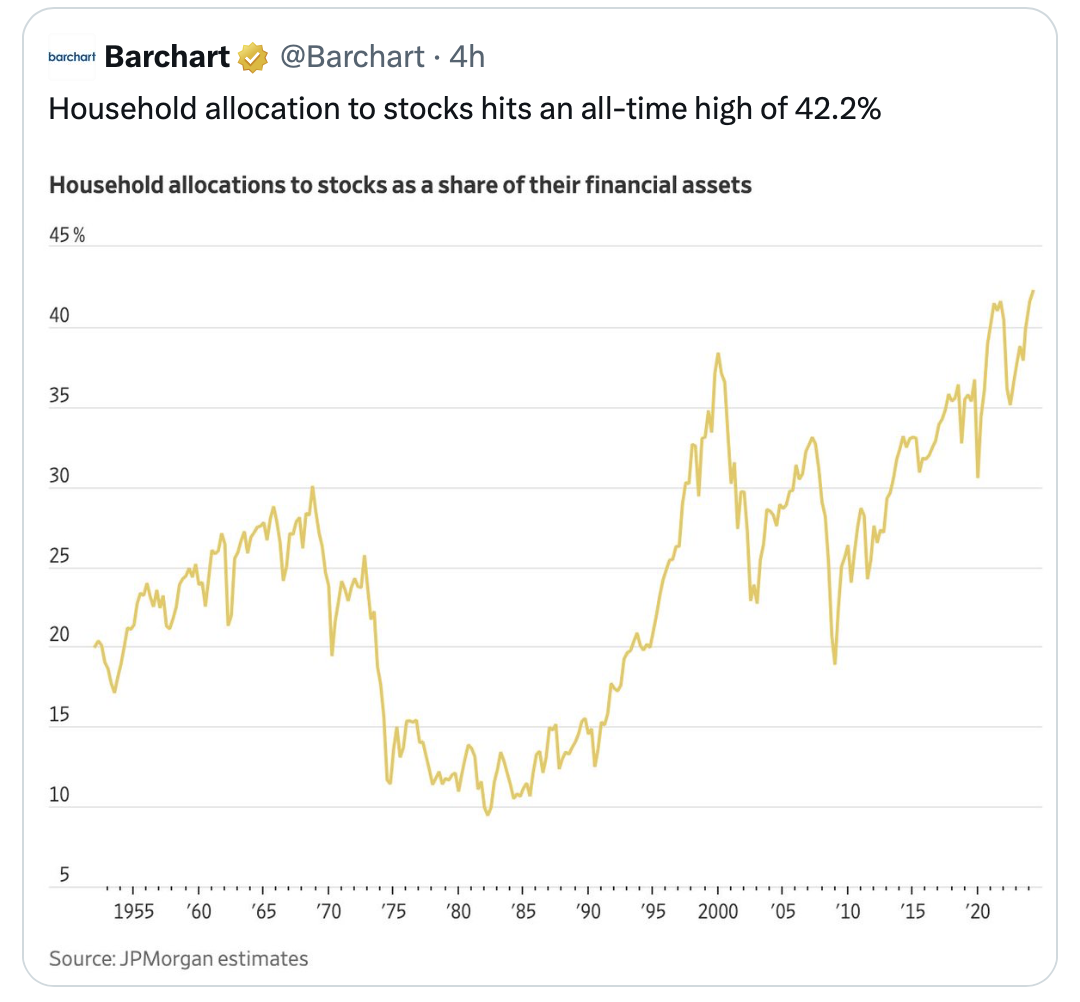
But let’s turn our attention to risk writ large.  I keep reading that September is historically the weakest month in the US equity markets and given the number of sources of strong repute that have written such, am willing to take that at face value.  As well, apparently, US households are the most bullish equities, or at least have the largest equity positions as a portion of their assets, in history (see chart below from @InvariantPersp1 on X).

It strikes me that the combination of extreme long positioning and a historical tendency for weakness may open up some downside in the equity markets, at least for a period.  Of course, if you are old enough to remember the yen carry trade debacle all the way back at the beginning of August, you know that even if we see a big downdraft, it can be reversed quite quickly.  And given both the Fed and ECB (and BOE) all meet later this month, it is not hard to believe that if equities were to decline sharply before their meetings, we could see larger than expected rate cuts across the board.  For now, the market continues to price a one-third probability of a 50bp cut by the Fed while expectations are for the ECB to cut in September and a 50% probability of an October cut.  

Net, do not be surprised if September has nearly as much volatility as August as the idea of max-long equity exposure into a slowing economy with still high inflation feels like a tenuous position.  We shall see.

Ok, let’s try to catch up to overnight activity, which has generally been of the risk-off variety.  Since Friday’s close, the story has been more negative than positive with Japanese (-1.1%) and Chinese (-1.5%) markets falling amid slightly softer than expected data and a more general malaise.  In Europe, too, things have been soft with today’s declines ranging from -0.2% (CAC) to -0.8% (Spain’s IBEX) and everything in between.  This is completely in sync with US futures markets which are all lower by at least -0.6% at this hour (7:20).  

Interestingly, while risk is under pressure, the traditional havens of government bonds are not seeing much benefit with Treasury yields edging higher by 1bp and similar moves throughout much of Europe although both Gilts and Bunds have seen yields edge lower by 1bp.  JGB yields have also edged higher by 1bp and are creeping, ever so slowly, back toward 1.00%.  This follows comments by BOJ Governor Ueda that he really means it when he says they BOJ will normalize policy.  The caveat is that will occur only if the economy meets their expectations with growth rising and inflation remaining high.  However, inflation continues to be fairly stable with services inflation actually declining there, thus undermining his message somewhat.

In the commodity markets, oil (-2.3%) has been taking it on the chin for the past week as the combination of the weaker demand story on a slowing global economy combines with growing confirmation that OPEC+ is going to end their production cuts starting next month, thus adding to supply, has weighed heavily on prices.  Back in January, I wrote a piece discussing my change of view on the long-term prospects for oil prices, which I flipped from bullish to bearish.  The essence of the piece was that there is plenty of oil around, it is political decisions that prevent its extraction.  As the politics of everything around the world continues to quickly change, I think this is an important baseline to keep in mind, although that doesn’t mean we won’t see short term spikes in oil’s price.  However, right now, it looks awful on the charts.

As to the metals markets, they have been under some pressure lately as well, notably copper and silver, with each of those falling more than 5% in the past week.  Gold, however, continues to find buyers as the bigger picture concerns of monetary debasement combine with still active central bank purchasers to support the barbarous relic.

Finally, the dollar is quite strong this morning, rallying against almost all its counterparts.  The commodity bloc are the laggards with AUD (-0.8%), NOK (-0.75%), NZD (-0.7%) and SEK (-0.5%) all suffering in the G10 with only JPY (+0.5%) rallying, arguably playing its haven role.  In the EMG bloc, ZAR (-0.8%), and the CE4 (-0.5% each) are under pressure along with KRW (-0.4%) and even CNY (-0.2%).  LATAM is the surprise with MXN (-0.1%) little changed at this hour.

On the data front, this is a big week that culminates in the payroll report on Friday.

TodayISM Manufacturing47.5
 Construction Spending0.0%
WednesdayTrade Balance-$78.9B
 JOLTs Job Openings8.10M
 Factory Orders4.6%
 -ex Transport-0.2%
ThursdayADP Employment145K
 Initial Claims230K
 Continuing Claims1870K
 Nonfarm Productivity2.4%
 Unit Labor Costs0.9%
 ISM Services51.1
FridayNonfarm Payrolls165K
 Private Payrolls138K
 Manufacturing Payrolls0K
 Unemployment Rate4.2%
 Average Hourly Earnings0.3% (3.7% Y/Y)
 Average Weekly Hours34.3
 Participation Rate62.6%

Source: tradingeconomics.com

Obviously, all eyes will be on NFP as the Fed has clearly turned its primary attention to the employment side of its mandate.  However, don’t fall asleep on the JOLTs data tomorrow, as that has also been part of Powell’s calculus. (seems there was a lot of calculus today, I hope you all managed to get through that in college 😂).  Remember, too, that CPI comes next week and then the FOMC meeting is the following week, so there is no respite.

This morning, risk feels unwanted.  With equity markets still within spitting distance of their all-time highs, it appears there is ample room for some down days ahead.  Of course, Friday will be key.  Regarding the dollar, for now, I believe the bounce continues.  But Friday will dictate the medium term, at least until the FOMC meeting.

Good luck

Adf

Still Weak

In Germany, data’s still weak
For Europe, that doesn’t, well, speak
So, riddle me this
Are traders remiss
For claiming that euros are chic?
 
It’s true interest rates matter most
And Powell said Fed funds are toast
But can M. Lagarde
Just simply discard
The Germans, though they’re comatose?


There is a growing opinion that the dollar is going to decline sharply as the Fed begins to cut rates.  Numerous analysts believe that the market is underpricing how many Fed fund cuts are coming as they are all-in on the US recession story.  After Friday’s Jackson Hole speech, it certainly appears that we will get at least one cut come September, but stranger things have happened.  And obviously, given Powell’s pivot from inflation to unemployment as job #1, the NFP report a week from Friday is going to be crucial.

But we must never forget that the FX market is a relative concept.  It is not simply that one country’s economy is doing well or poorly, nor that their interest rates are high or low, or perhaps moving up or down, it is how those data points compare to other countries that determines the movement in the FX markets, at least the fundamentals, but also frequently the capital flows.  It is with this in mind that on a quiet day we have time to dissect the story in Germany for a bit.  Early this morning, Germany’s Federal Statistical Office released two data points, the GfK Consumer Confidence reading, which fell sharply to a below consensus reading of -22.0 and the Final GDP Growth numbers for Q2, which printed at -0.1% Q/Q and 0.0% Y/Y.  Now, this is not a single quarter feature in Germany as is illustrated in the below chart.

A graph with blue and yellow squares

Description automatically generated

Source: tradingeconomics.com

In fact, GDP growth in Germany has averaged just 0.3% annually over the past 5 years, a pretty anemic level, and one that bodes ill for Europe as a whole.  Recall, Germany’s economy is the largest in Europe (and 3rdlargest in the world) and represents about 28.6% of the Eurozone’s total economy.  If the largest economy in a group of nations is stagnating, it is very difficult for the group’s overall growth rate to expand.  Compare that to the fact that the data to date in the US indicate that growth remains fairly solid (GDP +2.8% in Q2), and then ask yourself, where are the opportunities for activity more prevalent, Europe or the US?  Again, the macro picture seems to point to the US as a continued preferred destination for capital.

And yet, the euro is pushing back to its highest level since a brief spike in July 2023, and otherwise, early 2022 prior to that.  So, does it really make sense for the euro to continue to rally from here?  Literally, the only argument in its favor is that the Fed has now committed to begin easing policy and the market is pricing in about 200bps of rate cuts through the end of 2025.  Meanwhile, although the ECB has implemented their first rate cut, and seem set to execute their second next month, the market is only pricing in 125bps of cuts by December 2025, and just 50bps total for 2024, compared to 100bps for the Fed.

As such, here is the explanation for the euro’s recent solid performance.  But I believe the question to ask is, can this last?  If Germany’s economy is going to continue to bounce along at essentially zero growth, and there is nothing indicating a rebound is coming soon, it seems more likely to me that the rest of Europe follows it lower, rather than ignores Germany and powers ahead.  It’s not that individual small nations in the Eurozone won’t grow more quickly, but Germany’s position in the Eurozone, notably as a trade partner, implies that things are more likely to sag than soar.  

Yes, the euro has rebounded lately, but that has been in response to the interest rate pricing described above.  I think it is a fair bet that Madame Lagarde, when faced with a Eurozone that is growing more slowly than desired, is likely to accelerate interest rate cuts there.  And when that happens, the euro’s recent rise will very likely retrace.  I am not saying that the dollar is going to climb against everything, just that the euro’s strength feels suspect.  One poet’s view.

I’m sorry for the focus on Germany, but some days, there is very little macro news of note, and this seemed the most important, especially given that the idea of a much weaker dollar going forward is gaining traction.  

Ok, with that in mind, let’s look at the overnight activity, which was not all that substantial.  After yesterday’s split between tech shares (NASDAQ -0.85%) and industrials (DJIA +0.16% and a new ATH), Asian shares were mixed as well.  The Nikkei (+0.5%) had a solid session as did the Hang Seng (+0.4%) although mainland Chinese shares (-0.6%) continue to suffer, last night due to a much weaker than forecast earnings result from the parent company of Temu.  Of more concern than the result was the commentary by their CEO that prospects for consumption were dimming.  In Europe, there are some very modest gains, with the DAX (+0.2%) surprisingly holding up well, although the move is obviously quite minimal.  I cannot look at the Eurozone economy and expect anything other than more aggressive rate cuts from the ECB going forward.  As to US futures, at this hour (7:30), they are essentially flat.

In the bond market, yields are backing up from their recent lows with Treasuries higher by 3bps and European sovereigns by between 5bps and 7bps.  In fact, the real outlier is the UK gilt market where 10yr yields are higher by 9bps as there is an increasing concern that the Starmer government is going to blow up the budget there as the PM tries to implement his new policies.  You may remember what happened when Liz Truss was PM and proposed a high spending, high deficit budget and caused all kinds of havoc in the gilt market back in October 2022.  I would not rule out another situation like that quite frankly.  Finally, JGB yields edged lower by 1bp last night, continuing to prove that normal monetary policy in Japan remains a distant prospect.

In the commodity markets, oil (-0.4%) which is higher by > 5% in the past week, has stopped climbing for now.  Perhaps the fact that there have been no new military incursions in the Middle East has been sufficient to get the algos to start selling again on the poor demand story.  Gold (-0.2%) is also biding its time, as are the other metals, although all are retaining the bulk of their recent gains.  Generically, my dollar view is that it will weaken vs. stuff like commodities, not necessarily vs. other currencies.  Of course, this implies a rebound in inflation, something which I continue to see going forward.

Lastly, the dollar is little changed this morning, with most G10 and EMG currencies +/-0.2% or less compared to yesterday’s closing levels.  The biggest mover today is NZD (+0.4%), although I am hard-pressed to see any fundamental reason as there was neither data nor central bank commentary.  Arguably, this is the result of some position changes rather than a fundamental move.  And after that, nothing has moved much at all.

Yesterday’s Durable Goods print of +9.9% was astonishingly high, although the ex-transport reading of -0.2% was a tick lower than forecast.  I guess Boeing sold more planes than anticipated.  As to this morning, we see Case-Shiller Home Prices (exp 6.0%) and Consumer Confidence (100.7), neither of which seems likely to have a major impact.  SF Fed president Daly reiterated the Powell idea that the time has come to cut rates, and I expect every Fed speaker going forward up to the quiet period to say the same.  I guess the real problem will be if the NFP report is hot.  Right now, the early forecasts are for 100K NFP and the Unemployment Rate to remain unchanged at 4.3%.  But what if it prints at 200K and Unemployment slips back a tick?  Will they still be anxious to cut?  I’m not forecasting that, simply reminding us all that assumptions need to be tempered.

As it is the last week of August with holidays rife around the Street, I suspect it will be very quiet overall.  At this point, we need more data to make decisions, so look for limited activity in the FX markets, although I guess the world is really waiting for Nvidia’s earnings tomorrow more than anything else.

Good luck

adf

German Malaise

With central bank meetings ahead
Tonight BOJ, then the Fed
The discourse today’s
On German malaise
And why vs. the PIGS its widespread


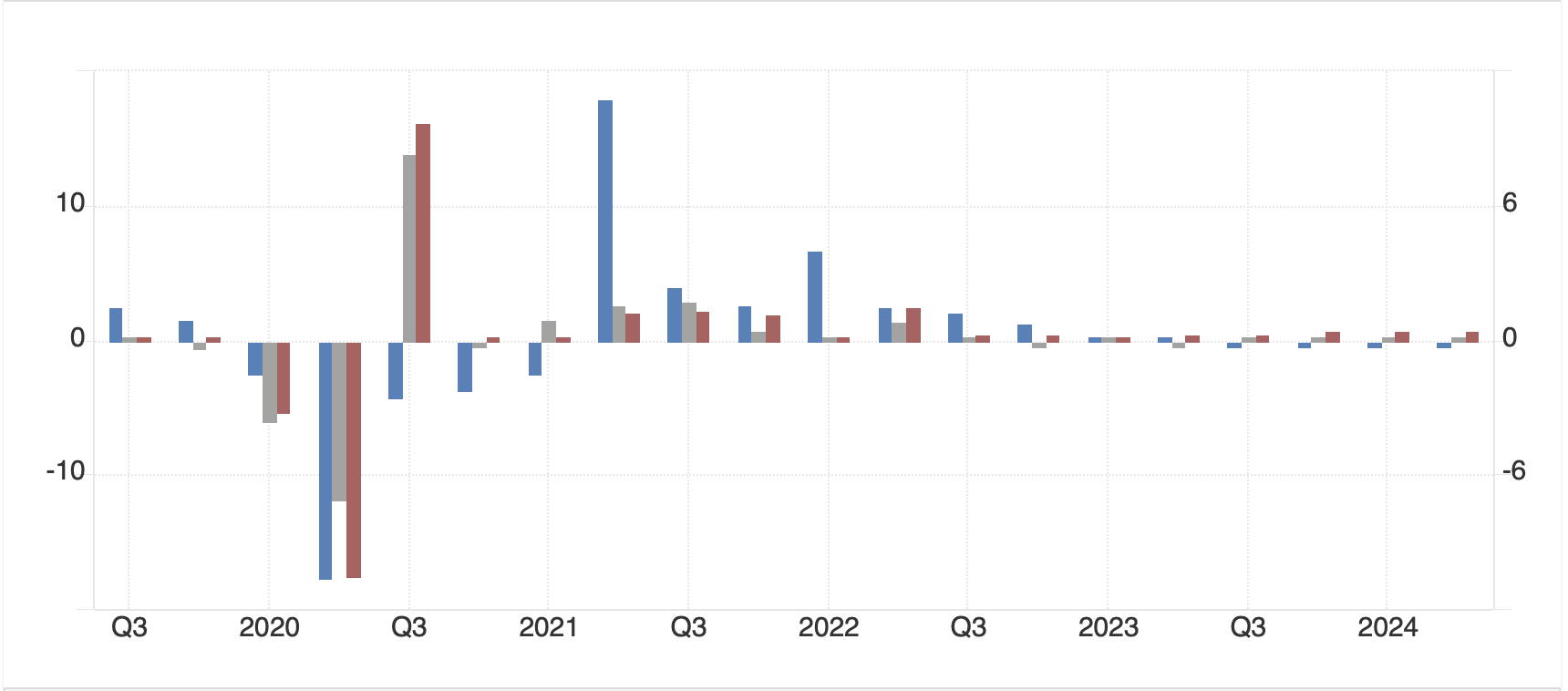
As investors await the news from Ueda-san tonight and Chairman Powell tomorrow, the market discussion has revolved around the potential problems that Madame Lagarde is going to have going forward given the split in economic outcomes within the Eurozone.  As can be seen in the below graph, German GDP growth (grey bars) has been running at a negative rate for the past 4 quarters.  But you can also see that the situation in both Spain (red bars) and Italy (blue bars) has been the opposite, with both of those nations maintaining a steady pace of growth.


Source: tradingeconomics.com

So, while Germany is the largest single economy within the Eurozone, its current trajectory is very different than much of the rest of the bloc, ironically specifically the PIGS.  Should the ECB ignore German weakness and manage monetary policy toward the overall group?  Or should they ease more aggressively in order to support the Germans while risking a rebound in still sticky inflation?

Perhaps the first thing to answer is why Germany has been suffering for so long. This is an easy question to answer. Germany’s energy policy, Energiewende, has been an unmitigated disaster.  Their efforts to address climate change have led to the highest energy costs in Europe which, not surprisingly, has resulted in a massive reduction in manufacturing activity.  Areas where Germany had been supreme, like chemicals and autos, are hugely energy intensive industries, so as their cost of production rose, the companies moved their activities elsewhere.  Adding to the insanity was the policy to shutter their nuclear fleet, which had produced 10% of the nation’s electricity, during the post Ukraine invasion energy crisis.  And ultimately, this is the problem.  The cost of money is not Germany’s economic problem, it is their policies which have undermined their own growth ability.  While the ECB cannot ignore Germany outright, there is nothing they can do that will help the nation rebound in any meaningful way.  With that in mind, I would contend Lagarde needs to focus on the rest of the bloc to make sure policy suits them.  But that is a political discussion.

What are the likely impacts of this situation?  Eurozone growth, overall, surprised on the high side despite the lagging German data.  As well, inflation readings released thus far this month have shown that prices remain sticky on the continent.  With that in mind, the idea the ECB needs to cut aggressively seems to make little sense.  This is not to say they will maintain tighter policy, just that it doesn’t seem justified to ease.  But right now, the market zeitgeist is all about easing monetary policy (except in Japan) so I expect they will do just that going forward.  With this in mind, it strikes that the euro (+0.15%) is going to struggle to rally from current levels absent a dramatic shift in Fed policy to aggressive rate cuts.  As to European bourses, I suspect that they will reflect each nations’ own circumstances, so the DAX seems likely to lag going forward.

Will he, or won’t he?
Though inflation’s been falling
Hiking pressure’s real
 
A quick thought regarding tonight’s BOJ meeting and whether Ueda-san believes that further rate hikes are appropriate for the Japanese economy.  As with many things Japanese, the proper move is not necessarily the obvious one.  A dispassionate view of the recent data trends shows that inflation (2.8%) has been sliding slowly, GDP growth (-0.5%) has been falling more quickly and Unemployment (2.5%) remains at levels consistent with the economy’s situation given the shrinking population.   On the surface, this does not seem like a situation where hiking is desperately needed except for one thing, the yen remains broadly weak.  The chart below shows that since the advent of Abenomics in 2011, the yen has lost 50% of its value. 


Source: tradingeconomics.com

Now, initially, that was a key plank of the Abenomics platform, weakening the yen to end deflation.  Well, kudos to them, 13 years later they have achieved that result.  But where do they go from here?  There is a growing belief that the BOJ is going to hike by 15bps tonight and bring their base rate up to 0.25%.  I disagree with this theory given the very clear recent direction of travel in the inflation data in Japan as despite the yen’s weakness, it dispels any notion that a rate hike is needed to push things along.  One positive of the weak yen is that the balance of trade has returned to surplus in Japan.  

Source: tradingeconomics.com

For decades, Japan ran a large positive trade balance but since the GFC, that situation has been far less consistent.  However, the trade balance remains an important domestic signal as to the strength of the economy and its recent return to surplus is welcomed by the Kishida government.  It is not clear how raising interest rates will help that situation.  Net, with inflation sliding and the economy under pressure, hiking interest rates does not make any sense to me.

Ok, let’s take a look at how markets have behaved overnight.  Yesterday’s lackluster US equity market performance was followed by very modest strength in Japan (+0.15%), although weakness throughout the rest of Asia with the Hang Seng (-1.4%) the laggard, although mainland Chinese (-0.6%) and Australian (-0.5%) shares also suffered.  Meanwhile, in Europe this morning bourses on the continent are higher by about 0.4% across the board after the Eurozone GDP data seemed to encourage optimism.  The UK (FTSE 100 -0.2%), however, is under a bit of pressure amid ongoing discussions in the new Labour government about the need for austerity.  At this hour (7:20) US futures are edging higher by about 0.25%.

In the bond market, after yesterday’s sharp decline in yields around the world, it has been far less exciting with Treasury yields edging down another basis point and European sovereigns either unchanged or 1bp lower.  Perhaps the most interesting things is that JGB yields fell 2bps overnight and the 10yr yield is now back below 1.00%.  That doesn’t seem like a market preparing for a rate hike there.

In the commodity space, everybody still hates commodities with oil (-0.5%) continuing its recent slide.  In fact, it is down nearly 10% in the past month (which is good for us as we refill our gas tanks).  In the metals markets, copper continues to slide, down another -1.5% this morning as optimism over economic and manufacturing activity around the world remains absent, especially in China.  For instance, the Politburo there met yesterday and pledged to help the domestic economy, although they did not lay out specific actions they would take.  Recall last week’s Third Plenum was also a disappointment, so until the market perceives China is back and growing rapidly, or that the global growth impulse without them is picking up, it seems that industrial metals will remain under pressure.  Gold (+0.4%) however, remains reasonably well bid as continued Asian central bank buying along with retail interest in Asia props up the price.

Finally, the dollar is generally under modest pressure although the outlier is the yen (-0.6%) which does not appear to be expecting a BOJ hike tonight.  But elsewhere, the movements in both the G10 and EMG blocs have been pretty limited overall, on the order of 0.15% – 0.35%.  It is hard to find an interesting story about any particular currency as a driver today.

On the data front, this morning brings the Case-Shiller Home Price Index (exp +6.7%), JOLTs Job Openings (8.0M) and the Consumer Confidence Index (99.7).  I keep looking at that Case-Shiller index and wondering when the housing portion of the inflation readings is going to decline given its consistent strength.  But really, I suspect that all eyes will be on Microsoft’s earnings this afternoon along with the other hundred plus names that are reporting today.  With the Fed coming tomorrow, macro is not important right now.  So, more lackluster trading seems the most likely outcome today, although with the opportunity for some fireworks starting around midnight when the BOJ statement comes out.

Good luck

Adf

Ne’er Have Nightmares

Said Harker, it’s likely one cut
Is all that we’ll need this year, but
Depending on data
My current schemata
Might wind up by changing somewhat
 
However, in truth no one cares
‘Bout Harker and views that he shares
As long as, stocks, tech
Don’t suddenly wreck
Investors will ne’er have nightmares


“If all of it happens to be as forecasted, I think one rate cut would be appropriate by year’s end.  Indeed, I see two cuts, or none, for this year as quite possible if the data break one way or another.  So, again, we will remain data dependent.”  These sage words from Philadelphia Fed president Patrick Harker are exactly in line with the message from Chairman Powell last week, as well as the dot plot release.  In other words, there was nothing new disclosed.  Now, today, we will hear from six more Fed speakers (Barkin, Collins, Kugler, Logan, Musalem, and Goolsbee) and I will wager that none of them will offer a substantially different take.  

At this point, market participants seem to feel quite confident they understand the Fed’s current reaction function and so will respond to data that they believe will drive different Fed actions than those defined by Harker above.  But if the trend of data remains stable, the Fed will not be the driving force in the market going forward.

In fact, there appears to be just one thing (or maybe two) that matters to every market, the share prices of Nvidia and Apple.  As long as they continue to rise, everything will be alright.  At least that’s what a growing share of investors and analysts have come to believe.  Alas, this poet has been in the market far too long to accept this gospel as truth.  I assure you there are other issues extant; they are simply hidden by the current Nvidia-led zeitgeist.

For example, Europe remains on tenterhooks for several reasons, only one of which is likely to be settled very quickly, the upcoming French election.  But remember, there is still a war in Ukraine and NATO and European nations have just upped the ante by allowing their weapons to be used to attack into Russia in addition to supplying F-14 fighter jets as part of the package.  In an almost unbelievable outcome so far, while Russian piped natural gas to Europe has fallen to essentially nil, Russia has become Europe’s largest supplier of LNG, surpassing cargoes from both the US and UAE.  I’m not sure I understand the idea behind sanctioning Russian oil and buying their gas, but then I am not a European politician, so perhaps there are nuances that escape me.  But the point is that Russia can cut that off as well, and once again disrupt the already weak Eurozone economy.

At the same time, Germany, still the largest economy in Europe, remains in economic purgatory as evidenced by today’s ZEW data (Sentiment 47.5, exp 50.0; Current Conditions -73.8, exp -65) as well as the fact that Germany’s largest union, IG Metall, is now demanding a 7% wage increase for this year, far above the inflation rate and exactly the sort of thing that, if agreed, will delay further rate cuts by the ECB.  Productivity growth throughout Europe remains lackluster and combining that with the structurally high cost of energy due to European energy policies like Germany’s Energiewend, is certain to keep the continent and its finances under pressure.  Right now, equity markets in Europe are following US markets higher, but they lack a champion like Nvidia or Apple, and are likely to be subject to a few hiccups going forward.

Or perhaps we can gaze eastward to China, where economic activity remains lackluster, at best as evidenced by the slowdown in Fixed Asset Investment and IP, as well as by the fact that the PBOC continues to try to create support for the still declining property sector without cutting rates further and inflating a bubble elsewhere.  The onshore renminbi continues to trade at the limit of the 2% band as the PBOC adjusts the currencies level weaker by, literally, one pip a day, and the offshore version is trading 0.25% through the band and has been there for the past month.  The economic pressure for the Chinese to weaken their currency is great, but obviously, the political goal is to maintain stability, hence the incremental movements.

My point is that Nvidia is not the only thing in the world and while its stock price performance has been extraordinary, I would contend it is not emblematic of the current global situation.  Rather, it is an extreme outlier.  Not only that, but when other things break, they will have deleterious impacts on many financial markets, probably including the NASDAQ.  Just sayin’!

However, despite my warnings that things will not always be so bright, so far in this session, they have been.  Overnight, Japanese stocks (+1.0%) followed the US higher as did Australia (+1.0%) and much of Asia other than Hong Kong (-0.1%) which slipped a bit.  Meanwhile, as all sides in the French election try to pivot toward the center to gather votes, European bourses are all in the green as well, somewhere between 0.25% and 0.5%.  As to US futures, at this hour (7:30), they are little changed.

Bond yields have continued to rebound from the lows seen Friday, with Treasury yields edging up another basis point this morning.  However, European sovereigns have seen demand with yields slipping a few bps, perhaps on the idea that growth remains lackluster as evidenced by the ZEW report, or perhaps on the idea that the French election may not be as terrible as first discussed.  Meanwhile, JGB yields edged up 1bp but remain below the 1.00% level despite Ueda-san explaining that a rate hike was on the table for July and that QT and rate hikes were different processes and independent decisions.

In the commodity markets, oil is unchanged this morning but that is after a strong rally yesterday in NY with WTI closing above $80/bbl for the first time since the end of April, as suddenly, the story is oil demand is improving while supply will remain tight on the back of OPEC+ measures.  I’m not sure how that jives with the IEA’s recent comments that there would be a “massive”oil supply glut going forward, (which I find ridiculous), and perhaps market participants have turned to my view.  Metals, though, remain in the doghouse falling yet again across the board.  Something else I don’t understand is how the demand story for metals can be weak while the demand story for oil can be improving given both are critical to economic activity.  

Finally, the dollar continues to find support, despite its oft-expected demise, as it gains vs. virtually all of its counterparts both G10 and EMG.  The biggest laggards this morning are NZD (-0.6%) and NOK (-0.4%) in the G10 while we have seen weakness in the CE4 (HUF -0.5%, CZK -0.55%, PLN -0.5%) as well as most Asian currencies.  The outliers here are ZAR (+0.5%) which continues to benefit from the re-election of President Ramaphosa and his coalition with centrist parties, and MXN (+0.4%) which seems to be finding a floor after its extraordinary decline in the wake of the election there two weeks ago.

On the data front, this morning we see Retail Sales (exp 0.2%, 0.2% ex autos), IP (0.3%) and Capacity Utilization (78.6%) in addition to all those Fed speakers.  While Retail Sales can be impactful, it would need to be extraordinary, in my view, to alter the current Fed viewpoint of wait for lots more data.  

My take is it will be a quiet session today, and likely for the rest of the week, as the next important data point is not until PCE on June 28th.  Til then, trading ranges seem the most likely outcome, although if I had to choose a side, I would be looking for the dollar to continue to grind higher.

Good luck

Adf

Having Some Fits

While all eyes are on CPI
Some other news may now apply
The Germans and Brits
Are having some fits
As they both, to growth, wave bye-bye

The other thing that we have heard
Is ECB forecasts have stirred
What was 3%
They’ve had to augment
So, Thursday, a hike is the wor

Clearly, the top story today will be the release of the August CPI data with the following expectations: Headline 0.6% M/M, 3.6% Y/Y and ex food & energy 0.2% M/M, 4.3% Y/Y.  The headline number has been boosted by the rise in energy prices, although it is important to understand that the bulk of the gains in oil’s price are not going to be in this number, but in next month’s release.  As well, oil prices continue to rise, up another 0.65% this morning and now above $89/bbl.  Too, gasoline prices, the place where we feel this rise most directly, continue to climb right alongside crude.  This release will have the chance to alter some views on the Fed meeting next week, but it will need to be a big miss one way or the other to really have an impact, I think.  While I am not modeling inflation directly, certainly my anecdotal evidence is that prices are continuing to rise at better than a 4% clip for ordinary purchases, whether in the supermarket or at a restaurant or retail store.

But perhaps, the more interesting things today have come from Europe and the UK, with three key, somewhat related stories.  The first was the release of the UK monthly GDP data which fell -0.5%, far worse than anticipated as IP (-0.7%), Services (-0.5%), and Construction (-0.5%) all were released with negative numbers for July.  What had been a seemingly improving outlook in the UK certainly took a hit today and has placed even more pressure on the BOE.  Despite the weaker than expected growth situation, there is, as yet no evidence that inflation is really slowing down very much leaving Bailey and company in a pickle.  Tightening further to fight inflation while the economy declines is a very tough thing to do.  But letting inflation run is no bowl of cherries either.  It should be no surprise that both the pound (-0.2%) and the FTSE 100 (-0.5%) are under pressure today.

The other two stories come from Frankfurt where, first, the German government is apparently set to downgrade its outlook for full-year 2023 GDP to -0.3% from its previous assessment of +0.4%, which was quite weak in its own right.  Apparently, poorly designed energy policy is coming back to haunt the nation as manufacturing activity continues to diminish under the pressure of the highest energy prices in Europe.  Unfortunately for Germany, and likely for Europe as a whole, unless they adjust their energy policies such that they can actually generate relatively cheap power and create a hospitable environment for manufacturing, I fear this could be just the beginning of a longer-term trend.

The other story here is not an official change, but a leak from ECB sources, which indicates that the ECB’s inflation estimate for 2024 will now be above 3.0%, from its last estimate right at 3.0%.  The implication is that the hawks continue to push for another rate hike at tomorrow’s council meeting.  In the OIS market, the probability of a hike tomorrow has risen to 67% from about 50% yesterday.  As a reminder, this is what Madame Lagarde told us back in July, We have an open mind as to what decisions will be in September and subsequent meetings…We might hike, and we might hold. And what is decided in September is not definitive, it may vary from one meeting to another.”  With this in mind, it appears that some members are trying to put their thumb on the scales and get a push toward one more hike.  Especially given weakness in German economic activity, if they don’t hike tomorrow, it will get increasingly difficult to justify more hikes later, so in the hawks’ minds, it’s now or never.

In truth, I think that is an accurate representation because if we continue to see slowing growth in Europe, Madame Lagarde, who is a dove by nature, will be quite unwilling to weigh on growth and push up unemployment even if inflation won’t go away.  With this in mind, I’m on board to see the final ECB rate hike tomorrow.

Not surprisingly, today’s news did not help risk appetites at all.  Equity markets, after yesterday’s US declines (especially in the tech sector) were lower throughout most of Asia and are currently lower across all of Europe.  In fact, the losses on the continent are worse than in the UK, with an average decline of about -0.9%.  Pending higher interest rates amid weakening growth are definitely not a positive for equities.

However, investors have not been running to bonds as a substitute.  Instead, bond yields are higher pretty much across the board, with Treasury yields up 2.5bps while European sovereigns have seen yields climb between 3.5bps (Bunds) and 7.0bps (BTPs).  This has all the feel of rising inflation fears that are not likely to be addressed in the near term.

I already touched upon oil prices leading the energy space higher, but given the sliding views of economic activity, it is no surprise to see metals prices softer this morning with both precious and base metals under pressure.  While the long-term prospects for commodities overall, I believe, remain quite bullish, if (when) we do go into recession, I expect a further price correction.

Finally, the dollar is a bit stronger against all its G10 counterparts and most EMG counterparts this morning.  Granted, the movement has been modest so far, which given the importance of today’s data release, should be no surprise.  But my take is that a hot CPI print, especially in the core, will see the dollar rise further as the market starts to price in at least one more rate hike by the Fed, probably in November.  At the same time, if the CPI number is cool, then look for the dollar to give back a bunch of its recent gains as market participants go all in on rate cuts in the near future.  It is that last part of the concept with which I strongly disagree.  While the Fed may have reached its terminal rate, there is no evidence that they are even thinking about thinking about cutting rates.  However, that is my sense of how today will play out.

Good luck

Adf

On the Schneid

While data at home is robust
In Europe and China the thrust
Is weakness abounds
Which seems to be grounds
For traders, their risk, to adjust

So, equities are on the schneid
While bond yields have been amplified
The dollar’s on fire
Continuing higher
And oil’s climb won’t be denied

Another day, another wave of bad economic news from elsewhere in the world.  However, the US continues to surprise with better than expected results.  Yesterday’s ISM Services data was far better than forecast with a headline print of 54.5, 2 points above both last month and expectations for this month, while the sub-indices all showed significant strength, including the Prices Paid index.  The latter is clearly a concern for Chairman Powell and his crew as it is an indication that inflationary tendencies have not yet been snuffed out.  Ultimately, the market response was to sell stocks and bonds while increasing the probability of a November Fed funds rate hike a few points.  Interestingly, the market pricing for a September hike has fallen to just a 7% probability despite the hotter than expected data.  My sense is that the big market adjustment is going to come as traders come to understand that higher for longer means no cuts until 2025 on the current basis, especially if we continue to see data like the ISM print yesterday.

But the US storyline is clearly not the same as the storyline elsewhere in the world.  Last night, for example, Chinese trade data was released and both imports (-7.3%) and exports (-8.8%) fell sharply again, with the Trade Surplus falling to $68.3B.  Granted, the declines were not as bad as last month, nor quite as bad as expectations, but there is no way to spin the data as indicating a positive economic impulse in China right now.  While Chinese equity markets fell sharply (Hang Seng and CSI 300 both -1.4%) we also saw further weakness in the renminbi.  

The PBOC is still desperately trying to prevent the renminbi from weakening too quickly, but they are having a hard time at this stage.  The difference between the CFETS fixing and the onshore spot market is now 1.8%, dangerously close to the 2.0% boundary.  At the same time, the offshore renminbi, CNH, is pushing back to its highs from last October, now trading above 7.3400, which is 1.97% above the fixing.  This is a losing battle for the PBOC unless they change their monetary policy, but given the Chinese economy’s weakness, tighter money seems an unlikely step.  7.50 is still on the cards here.

China, though, is not the only problem.  European data this morning was uniformly lousy with German IP (-0.8%) and Eurozone GDP (Q2 revised lower to 0.1% Q/Q, 0.5% Y/Y) highlighting the problems facing the old world.  Alas, price pressures have not yet abated there, and stagflation is the new watchword on the continent.  

When the US was faced with stagflation in the 1970’s, Paul Volcker opted to fight inflation first, sending the country into a double dip recession in 1980 and 1981-82, before things turned around.  But that was a different time…and Christine Lagarde is no Paul Volcker!  Is it even possible for an “independent” central bank to knowingly create a recession to slay inflation these days?  I suspect inflation would need to be far higher, stable in double digits, before politicians would accept that it is a bigger problem than a recession, at least electorally.  The upshot of this scenario is that the ECB, despite ongoing higher than targeted inflation, is very likely at the end of its hiking cycle.  This, combined with the overall weak economy there, is going to continue to undermine support for the euro.  While the movement will be gradual, I expect that the single currency will slide below 1.05 and possibly get to parity by the end of the year.

And I would be remiss if I didn’t touch quickly on Japan, where they released their Leading Indicators at a weaker than expected 107.6, continuing the two-year downtrend.  Slowing growth in Japan and still extraordinarily loose monetary policy is going to continue to weigh on the yen.  While it has bounced slightly this morning, 0.2%, it continues to weaken steadily closer to the psychological 150.00 level.  

So, with all that happy news, let’s tour the overnight session to see the results.  The rest of the APAC equity markets also were under pressure overnight with Japan, Australia and South Korea all in the red as well.  In Europe this morning, the picture is more mixed with some gainers and some losers but no large movements overall, mostly +/- 0.2%.  US futures, after a lousy session yesterday, are all pointing lower at this hour (7:30) as well.

In the bond market, Treasury yields are essentially unchanged on the day, holding onto their gains for the past week and just below the 4.30% level.  European sovereigns, though, are seeing a bit of support as the weak economic data has engendered hope that inflation will stop rising and the ECB will be okay to pause.  The latter remains to be seen.  I cannot get over the idea that the uninversion of the yield curve is going to come because long rates are going to rise, not because short rates are going to be cut, and I’m pretty sure nobody is ready for that outcome.

Oil (-0.5%) is consolidating its recent gains with WTI north of $87/bbl and showing no signs of backing off.  If OPEC+ keeps a lid on production, you have to believe that prices will continue to rise.  In the metals markets, both copper and aluminum are soft today, responding to the weak Chinese and German data, while gold, after a selloff this week, is bouncing slightly.

Finally, the dollar remains king of the hill, stronger against virtually all its counterparts in both the G10 and EMG blocs.  I’m old enough to remember when the prevailing narrative was the dollar was dead and would be replaced by the euro, or the yuan, or a BRICS currency and yet, it continues to be subject to more demand than virtually every other currency around.  The broad story is the US economy continues to lead the global economy and the prospects for Fed rate cuts are diminished relative to other nations.  Tight monetary and loose fiscal policy combinations have historically been very supportive of a currency and clearly that is the current US state.

Two quick stories in the EMG bloc are from Poland (-0.7%), where yesterday’s surprising 75bp rate cut has undermined the zloty amid concerns that inflation is going to remain unhindered there, and MXN (+0.75%) where traders are unwinding some positions after a sharp decline over the past week.  The peso has been one of the few currencies that has outperformed the dollar this year as Banxico has been ahead of the curve on inflation and tight monetary policy.  However, with an election upcoming it appears there may be a change in attitude there.  If that is the case, then look for the dollar to regain some lost ground.

On the data front, Initial (exp 234K) and Continuing (1719K) Claims are released along with Nonfarm Productivity (3.4%) and Unit Labor Costs (1.9%).  As traders and investors bide their time ahead of next week’s CPI and the following week’s FOMC meeting, it is not clear that today’s numbers will have much impact.  As such, I see no reason for the dollar to cede its recent gains, especially if equities remain under pressure.

Good luck

Adf

Quickly Slowing

We will take action
Threatened Vice FinMin Kanda
If you speculate

If these moves continue, the government will deal with them appropriately without ruling out any options.”  So said Vice FinMin Masato Kanda, the current Mr Yen.  Based on these comments, one might conclude that ‘evil’ speculators were taking over the FX market and distorting the true value of the yen.  One would be wrong.  The below chart shows the yields for 10yr JGBs vs 10yr Treasuries.  You may be able to see that the most recent readings show a widening in that yield spread in the Treasury’s favor.  It cannot be a surprise that investors continue to seek the highest return and the yen most certainly does not offer that opportunity.

While I don’t doubt there is a place where the BOJ/MOF will intervene, they know full well that the yen’s weakness is a policy choice, not a speculative outcome.  They simply don’t want to admit it.  The upshot is that the yen edged a bit higher overnight, just 0.2%, as market realities are simply too much for words to overcome.  The yen has further to fall unless/until the BOJ changes its monetary policy and ends YCC while allowing yields in Japan to rise.  Until then, nothing they can say will prevent this move.

While ECB hawks keep on screeching
More rate hikes are not overreaching
The data keeps showing
That growth’s quickly slowing
So, comments from Knot are just preaching

I continue to think that hitting our inflation target of 2% at the end of 2025 is the bare minimum we have to deliver.  I would clearly be uncomfortable with any development that would shift that deadline even further out.  And I wouldn’t mind so much if it shifted forward a little bit.”   These are the words of Dutch central bank chief and ECB Governing Council member Klaas Knot.  As well, he intimated that the market might be underestimating the chance of a rate hike next week, which at the current time is showing a 33% probability. Another hawk, Slovak central bank chief Peter Kazimir also called for “one more step” next week on rates.  

The thing about these comments is they came in the wake of a German Factory Orders number that was the second worst of all time, -11.7%, which was only superseded by the Covid period in March 2020.  Otherwise, back to 1989, Factory Orders have never fallen so quickly in a month.  This is hardly indicative of an economy that is going to grow anytime soon.  Rather, it is indicative of an economy that has inflicted extraordinary harm to itself through terrible energy policies which have forced producers to leave the country.  

The key unknown is whether the slowing economic growth will also slow price growth.  Given oil’s continued recent strength, with no reason to think that process is going to change given the supply restrictions we have seen from the Saudis and Russia, I fear that Germany is setting up for a very long, cold winter in both meteorological and economic terms.  With the largest economy in the Eurozone set to decline further, it is very difficult to be excited at the prospect of a stronger euro at any point in time.  It feels to me like the late summer downtrend in the single currency has much further to go.  

This is especially true if the US economy is actually as resilient in Q3 as some economists are starting to say.  Yesterday, I mentioned the Atlanta Fed GDPNow number at 5.6%, but we are seeing mainstream economists start to raise their Q3 forecasts substantially at this point given the strength that was seen in July and August.  Not only will this weigh on the single currency, and support the dollar overall, but it may also put a crimp in the view that the Fed is done hiking rates.  Consider, if GDP in Q3 is 3.5% even, it will not encourage the Fed that inflation is going to slow naturally.  And while they may pause again this month, it seems highly likely they would hike again in November with that type of data.

Which takes us to the markets’ collective response to all this news.  Risk is definitely under some pressure as the combination of stickier inflation and slowing growth around the world is weighing on investors’ minds.  The only market to manage a gain overnight was the Nikkei (+0.6%) which continues to benefit from the weaker yen, ironically.  But China, which is also growing increasingly concerned over the renminbi’s slide, remains under pressure as do all the European bourses and US futures.  Good news is hard to find right now.

Meanwhile, bond investors are in a tough spot.  High inflation continues to weigh on prices, but softening growth, everywhere but in the US it seems, implies that yields should be softening with bond buyers more evident.  This morning, 10yr Treasury yields are lower by 2bp, but that is after rallying 16bps in the past 3 sessions, so it looks like a trading pullback, not a fundamental discussion.  But in Europe, sovereign yields are edging higher as concern grows the ECB will not be able to rein in inflation successfully.  As to JGB yields, they seem to have found a new home around 0.65%, certainly not high enough to encourage yen buying.

Oil prices (-0.1%) while consolidating this morning, continue to rally on the supply reduction story and WTI is back to its highest level since last November.  Truthfully, there is nothing that indicates oil prices are going to decline anytime soon, so keep that in mind for all needs.  At the same time, metals prices are mixed this morning with copper a bit softer and aluminum a bit firmer while gold is unchanged.  It seems like the base metals are torn between weak global economic activity and excess demand from the EV mandates that are proliferating around the world.  Lastly a word on uranium, which continues to trend higher as more and more countries recognize that if zero carbon emissions is the goal, nuclear power is the best, if not only, long term solution.  The price remains below the marginal cost of most production but is quickly climbing to a point where we may see new mining projects announced.  For now, though, it seems this price is going to continue to rise.

Finally, the dollar is mixed this morning, having fallen slightly vs. most G10 currencies, but rallied slightly vs. most EMG currencies.  This morning we will hear from the Bank of Canada, with expectations for another pause in their hiking cycle, but promises to hike again if needed.  Meanwhile, the outlier in the EMG bloc is MXN (-0.7%) which seems to be a victim of the overall risk situation as well as the belief that its remarkable strength over the past year might be a bit overdone.  In truth, this movement, five consecutive down days, looks corrective at this stage.

On the data front, we see the Trade Balance (exp -$68.0B) and ISM Services (52.5) ahead of the Beige Book this afternoon.  We also hear from two FOMC members, Boston’s Susan Collins and Dallas’s Lorrie Logan.  Yesterday, Fed Governor Waller indicated that while right now, the data doesn’t point to a compelling need to hike, he is also unwilling to say they have finished their task.  However, that is a far cry from the Harker comments about cutting in 2024 seems appropriate.  I suspect Harker is the outlier for now, at least until the data truly turns down.

Net, the big picture remains that the US economy is outperforming the rest of the world and the Fed is likely to retain the tightest monetary policy around, hence, the dollar still has legs in my view.

Good luck

Adf

Much Pain

There once was a nation quite strong

Whose policies worked for so long

But war in Ukraine

Inflicted much pain

And now it seems they were all wrong

Relying on, energy, cheap

They rose to the top of the heap

But when prices rose

They’d naught to propose

‘Bout how to, advantages, keep

It turns out that Germany has fallen into a recession after all.  The German Statistics office revised down their Q4 2022 GDP reading from stagnation at 0.0%, to a -0.5% reading after adjusting for a substantial decline in government spending.  Meanwhile, Q1 GDP growth fell -0.3%, so Germany is solidly in a recession, at least based on the traditional definition of two consecutive quarters of negative GDP growth.  It certainly is remarkable that an economy that predicated itself on levering cheap, imported energy into the manufacture of steel, chemicals and machinery would encounter any problems simply because it became totally reliant on raw materials from a communist regime…NOT!  But in fairness, the Germans have hamstrung themselves by spending hundreds of billions of euros in their Energiewende program to reduce greenhouse gas emissions.  Unfortunately, this included shuttering their entire nuclear power fleet, which had produced upwards of 25% of their electricity with zero emissions and replacing it with heavily subsidized solar and wind power generation.  (By the way, whoever thought that solar power was a good idea in Northern Europe?  Arizona I get, Germany not so much.)

Granted, prior to Vladimir Putin invading Ukraine, things were going along swimmingly.  China was soaking up so much of what Germany was producing, and of course the rest of Europe were huge customers as well.  But it turns out risk management is a real thing, and not just when it comes to your foreign exchange or interest rate risks.  If we learned nothing else from the Covid pandemic it is that surety of supply of critical products or inputs is worth a lot, perhaps just as much as the price of that supply.  

Once Russia invaded, though, the world changed dramatically, and a critical flaw in the German economy was exposed.  Prior to the invasion, because of Energiewende, German electricity prices were the highest in Europe and approaching the highest in the world.  And that included cheap Russian gas as a source.  Now those prices are higher still and major manufacturers are picking up stakes and moving their facilities to places where they can get reliable, and relatively inexpensive, energy.  BASF moving key production to both China and Saudi Arabia is merely indicative of the problems Germany will have going forward.  It strikes me that Germany has a long road to hoe in order to get their economy back working as effectively as it had in the past.  This does not bode well for the euro (-0.2%) which is continuing its slow grind lower this morning, as the dollar continues to buck the majority analyst view of USD weakness.

The future belongs to AI

At least that’s what bulls glorify

So, last night we learned

Nvidia earned

A ton helping futures to fly

Obviously, this is not an equity piece and so I rarely cover specific names, but the buzz on Nvidia’s earnings is having a significant impact on markets overall.  The most instructive thing is to look at the performance of the NASDAQ vs. that of the Dow, at least in the pre-market futures trading.  At this hour (7:30), NASDAQ futures are higher by 2.0% while Dow futures are lower by -0.4%.  This dichotomy continues to grow on a daily basis, with the tech megacaps generating virtually all of the equity market performance seen this year, hence the relative outperformance of the NASDAQ vs. both the S&P 500 and the Dow.  The narrowing breadth of the market’s performance, with 7 names accounting for more than the entire S&P 500 gains this year means the other 493 names are actually lower.  From a more macro point of view, historically, price action of this nature has preceded significant bear markets every time it has occurred.  It is very easy to look at the totality of information including still high US inflation, softening growth metrics and a stock market that is reliant on just 7 names for its performance, and conclude a reckoning is coming.  Oh yeah, did I mention that the Fed remains committed to keeping its policy at current, relatively tight levels?  It is no wonder that the recession that is forecast to come soon is so widely forecast.

Quickly, the FOMC Minutes yesterday indicated that while there was a lot of discussion as to whether or not rates needed to go higher, there was zero discussion that rates would need to decline anytime soon.  The commentary we have heard since the last meeting has certainly had a less conclusive tone regarding further hikes, with several members indicating they thought a pause for observation was worthwhile.  But unless the economy craters, and Unemployment spikes much higher, there is no reason  to believe the Fed is going to change course.  And that, my friends, will continue to support the greenback for quite a while.

As to the overnight session, after a weak US equity performance yesterday, Asia was mixed and most European bourses are edging lower on the order of -0.2%.  It is certainly no surprise that the DAX is falling, and we have also seen lackluster data from France weighing on the CAC.  The problem for Europe is they don’t have any megacap tech stocks to support the indices.

Bond yields continue to mostly edge higher with gains on the order of 1bp this morning although there was a standout here, Gilt yields have risen by 9bps, still feeling the hangover from yesterday’s inflation data.

Meanwhile, in commodities, recession is the watchword as oil prices (-1.2%) are giving back some of their recent gains, although copper has seen a trading bounce.  

And finally, in the FX markets, the dollar continues to perform well, rising against all its G10 and most EMG counterparts.  Remarkably, the debt ceiling concerns seem to be the driver as the dollar is still considered the safest of havens despite the issues here.  There have been no outstanding stories to note other than the risk-off nature of things.

On the data front, we see Initial (exp 245K) and Continuing (1800K) Claims as well as the second look at Q! GDP (1.1%).  Also, Chicago Fed  National Activity (-0.2) is released, which has been pointing to slowing economic growth for a while now.   Two Fed speakers, Barkin and Collins are on the slate today, but I feel that mixed message continues unabated and won’t be changed here.

Ultimately, until the Fed backs off, the dollar is going to continue to perform well, keep that in mind.

Good luck

Adf

Unchecked

In Europe, the maximum nation
Is facing the scourge of inflation
And so, they are calling,
To help it start falling,
For less money accommodation

But others in Europe reject
The idea inflation’s unchecked
T’would be premature
To tighten, they’re sure
As QE they want to protect

It appears there is a growing rift in the ECB as we are beginning to hear more opposing views regarding the nature of inflation and correspondingly as to the prescription to address the issue.  On the one hand, the hawks have been sharpening their talons with Germany’s Schnabel, Slovenia’s Vasle and Spain’s de Guindos having all warned of inflation’s surprising persistence and explaining that the risk is to the upside for higher inflation still.  Meanwhile, this morning we had an erstwhile Hawk, Austria’s Holzmann, and an uber-dove, Italy’s Panetta pushing back on that view and insisting that the inflation that has been afflicting Europe is being driven by “purely temporary factors” and that premature withdrawal of stimulus would be a mistake.

The surprising feature of this discussion is that the Spanish voice is hawkish while the Austrian is dovish.  Perhaps what that tells us is that, just like in the US, inflation has become a bigger political problem in Spain and the Socialist PM, Pedro Sanchez, is feeling the heat from the population there.  This would not be surprising given inflation is running at 5.4%, the highest level since the introduction of the euro in 1999.  Arguably, the fact that Robert Holzmann seems to be siding with the transitory camp is also quite the surprise, but as they say, politics makes strange bedfellows.  In the end, as long as Madame Lagarde remains at the helm, the doves remain in control.  As such, these comments sound very much like posturing for particular audiences.

Turning to other news, Germany is at the center of the most interesting stories today as local politics (the formation of a new government…finally) as well as data (IFO Expectations fell to 94.2) seem to be driving the euro bus, and with the euro, the rest of the markets.  A brief look at the proposed government shows a coalition of the Social Democrats (SPD), the Greens and the Free Democratic Party (FDP) which is a pro-growth, free markets group.  This unprecedented grouping of 3 parties remains tenuous, at best, if only because the underlying belief sets are very different.  It remains unclear how a party whose focus is on less government (FDP) is going to work effectively with a party whose focus is on bigger government (SPD).  Olaf Scholz will be the new PM, a man with long experience in politics and a widely respected name.  As I said before, politics makes strange bedfellows!

On the economic side, this morning’s IFO data was quite disappointing, with Expectations falling back to levels seen in the beginning of the year and reaching a point that foretells of a recession coming.  Adding this to the imminent lockdown scenario (Germany’s Covid caseload jumped by 54K yesterday, with a significant surge ongoing), leaves quite the negative impression for the German economy.  In fact, given this news, it becomes harder for the hawks to make their case as the central bank model continues to believe that slowing growth will slow inflation.  (And while that would be true for demand-pull inflation, the whole cost-push framework is different.)  At any rate, the result is a day where risk is being shed and havens sought.  This is especially so in Germany, where the DAX (-0.6%) is the weakest performer in Europe, while Bunds (-1.7bps) have rallied despite a terrible auction outcome as investors adjust asset mixes.  And the euro?  Down a further 0.3%, trading just above 1.1200, although it appears that there is further to run.

What about the rest of markets?  Well, the Nikkei (-1.6%) fell sharply as investors in Japan expressed concern that the Fed would begin to tighten, and it would have negative impacts throughout the world.  At least that is what they claim.  China, on the other hand saw much less movement with the Hang Seng (+0.1%) and Shanghai (+0.1%) seeing a mix of gainers and losers internally thus offsetting for the index as a whole.  The rest of Europe is generally softer (CAC -0.2%, Spain’s IBEX -0.3%), although the FTSE 100 is basically unchanged on the day.  And after a mixed day yesterday, US futures are pointing modestly lower, -0.2% or so across the board.

As to the rest of the bond market, Treasuries (-2.4bps) are finally rallying after seeing a dramatic 12 basis point rise in the past three sessions.  We have also seen OATs (-0.7bps) rally slightly and Dutch bonds (-1.6bps) all the havens.  It should not, however, be surprising that Italian BTPs (+1.2bps) and Greek bonds (+3.9bps) are being sold as they remain risk assets in full.

On the commodity front, oil, which has been suffering from the SPR release story, seems to have absorbed that risk and after rebounding yesterday is flat this morning.  While still below $80/bbl, my sense is this has further to run higher.  NatGas (-0.25%) is a touch lower in the US as is gold (-0.1%).  However, the industrial metals are performing far better (Cu +0.7%, Al +0.7%, Sn +0.4%).

Lastly, the dollar is generally having a good day again, as risk appetite wanes.  NZD (-0.6%) is the weakest G10 currency after the market was disappointed in their actions last night, only raising the base rate by 0.25% while the whisper number was 0.5%. SEK (-0.4%) is the next laggard, with the krona continuing to suffer on the view that the Riksbank will remain reluctant to tighten policy at all in the face of actions by the Fed and potentially the BOE.  The rest of the bloc is generally softer with only the haven, JPY (+0.1%), showing any strength.

In the EMG space, we need to look away from TRY (+5.6%) which is retracing some of yesterday’s remarkable decline, as it is destined for extreme volatility in the near future.  But elsewhere, there is actually a mixed result with BRL (+0.6%) and PHP (+0.5%) leading the gainers while THB (-0.7%) and RUB (-0.3%) lag the space.  The real is benefitting from the central bank announcement it will be auctioning off 14K contracts in the FX markets, part of their intervention process, while the Philippine peso has benefitted from further investment inflows to the local stock market.  On the flipside, the baht seems to be suffering from concerns that the lockdowns in Europe will reduce tourism there during the high season, while the ruble continues to suffer from concerns over potential military activity and the further negative impacts of sanctions that could follow.

Given tomorrow’s Thanksgiving holiday, all the rest of the week’s data will be released today:

Initial Claims 260K
Continuing Claims 2033K
GDP Q2 2.2.%
Durable Goods 0.2%
-ex Transport 0.5%
Personal Income 0.2%
Personal Spending 1.0%
Core PCE 0.4% (4.1% Y/Y)
Michigan Sentiment 67.0
New Home Sales 800K
FOMC Minutes

Source: Bloomberg

As the GDP data is a revision, it will not garner much attention.  Rather, all eyes will be focused on Core PCE, as if recent form holds, it will print higher than expectations, further forcing the Fed debate.  And of course, the Minutes will be parsed intently as traders try to divine just how quickly things may change next month, especially since Chairman Powell and Governor Brainerd have both been clear that inflation is their primary concern now.

At this point, there is nothing to stand in the way of the dollar and I expect that it will continue to grind higher for a while.  The hallmark of the move so far this month, where the single currency has fallen 3.0%, is that it has been remarkably steady with a majority of sessions showing modest declines.  That pattern seems likely to continue for now unless there is a change from either the Fed or the ECB, neither of which seems likely.  Hedge accordingly.

Have a wonderful Thanksgiving holiday and poetry will return on Monday November 29th.

Good luck, good weekend and stay safe
Adf