
As Good As It Gets

Said Waller, I have no regrets
For things are “as good as it gets”
We’ve been quite outstanding
And reached that soft landing
Though rate cut forecasts won’t be met

Wow is all I can say.  While Treasury Secretary Yellen was brasher last week by explicitly saying they have achieved the mythical soft landing, Governor Waller’s speech yesterday went into great detail about his work in 2022 on Beveridge curve analysis that almost perfectly forecast the current situation.  I certainly hope he didn’t sprain his arm patting himself on the back.  The certitude that has been coming from Fed speakers and their acolytes, like ex Fed economist @claudia_sahm, is remarkable to me.  After literally a century of having no great insight into the workings of inflation, the Fed has now declared they have it under control because the past 6 months have seen price increases rise at a slowing pace.

Key Waller comments were as follows, “By late November, the latest economic data left me encouraged that there were signs of moderating economic activity in the fourth quarter, but inflation was still too high.  As of today, the data has come in even better. Real gross domestic product (GDP) is expected to have grown between 1 and 2 percent in the fourth quarter, unemployment is still below 4 percent, and core personal consumption expenditure (PCE) inflation has been running close to 2 percent for the last 6 months. For a macroeconomist, this is almost as good as it gets.”

He finished with this comment, although interestingly, the market did not applaud, “As long as inflation doesn’t rebound and stay elevated, I believe the FOMC will be able to lower the target range for the federal funds rate this year. This view is consistent with the FOMC’s economic projections in December, in which the median projection was three 25-basis-point cuts in 2024.”

Maybe the Fed really has stuck the landing and inflation is going to smoothly slide back to 2% and stay there while the economy ticks over at 2%-3% GDP growth.  Certainly, if the fiscal impulse continues to run at deficit levels of 8% of GDP, I would hope we could get 3% growth.  But to my understanding of the way the economy responds to policy actions, that 8% deficit is going to find itself into rising prices across the economy.  But then again, I’m just an FX guy.

In the end, the market heard Waller and decided that maybe higher for longer was still a thing.  The Fed funds futures market reduced its probability of a March rate cut to 60% from 70% before the speech and the bond market sold off pretty hard with yields closing at 4.07%, their highest level since the day before that December FOMC meeting when everybody was certain that the Fed had pivoted.  It seems the question now is, have they actually pivoted?

One of the problems they have is that the inflation data last month indicated the pace of price increases could be stabilizing around the 3.0%-3.5% level, rather than their target 2.0% level.  We have very consistently heard from all the acolytes that if you annualize the past 3 or 6 months’ worth of data, the Y/Y rate is pushing to 2.0%.  This, they claim, means the Fed has achieved their goal.  The problem with this argument is that the Fed’s goal is not simply touching a 2.0% inflation rate, it is to maintain it at that level over time.  That is a much more difficult landing to stick, and there is no evidence things will work out that way especially given we haven’t even reached a Y/Y rate of 2.0%!

Here’s another problem for that crew, inflation elsewhere in the world is not continuing its recent decline.  Yesterday, Canadian CPI data showed that the trend numbers, Trimmed-Mean (3.7%) and Median (3.6%) were both higher than forecast and higher than last month.  This morning, from the UK we learned that CPI rose 0.4% M/M, far more than expected with the Y/Y data rising to 4.0% headline and 5.1% core.  In both these nations, the recent trend had been lower but has now reversed.  While we have seen a significant rebalancing of markets and measured inflation has clearly fallen from its levels of the past two years, I would argue the evidence is scant that this trend is necessarily going to continue.  Wage growth continues to hold up as employees try to catch up to the huge price increases since 2019.  With the Unemployment Rate remaining near multi-decade lows, absent a major recession it appears it will be very difficult to continue to squeeze prices lower.  And this doesn’t even consider the fact that increased tensions in the Middle East and the rerouting of ships around the Cape of Good Hope in South Africa, is adding weeks and costs to any movement of goods or oil, and could last for a considerable length of time.

We have consistently heard from ECB members that rate cuts are not coming soon.  We have had a lot of pushback lately from FOMC members about the timing of any rate cuts with both sets of speakers explicitly saying the market is overexuberant in their current pricing.  As I wrote yesterday, I think we are looking at a bimodal outcome, either virtually no rate cuts, or many more because we are in a recession.  In either case, I think equity markets will need to reprice lower.  However, the impact of these two situations will be different on the dollar, the bond market and commodities.  We will discuss those outcomes tomorrow.

In the meantime, overnight was a sea of red (as opposed to the Red Sea) in equity markets with the Hang Seng (-3.7%) leading the way lower but weakness on the mainland as well (CSI -2.2%) and throughout the region.  Japanese stocks (Nikkei -0.4%) were actually the leaders in the space.  The China story was informed by their monthly data dump which showed GDP grew at a slightly weaker than forecast 5.2%, while IP (6.8%), Retail Sales (7.4%) and Fixed Asset Investment (3.0%) were all around expectations, but still soft overall and compared to last month.  The Unemployment Rate there ticked higher to 5.1%, and they put out a new version of the youth unemployment rate at 14.9%, which they insist is a better measure than the old one which was screaming higher and was discontinued when it breached 21%.

European equity markets are also under pressure, mostly down about -1.0% on the continent and lower by -1.75% in the UK after the data releases.  As to the US, after a lackluster session that was saved by a late day rally yesterday, futures this morning are lower by about -0.25% at 7:30.

In the bond market, after the large move yesterday, Treasury yields are unchanged on the day and European yields have edged up by about 1bp across the board with UK Gilts the exception, having jumped 10bps after the inflation readings.  JGBs continue their lackluster activity and while they rose 2bps overnight, they remain below 0.60% overall.  Again, slowing inflation there indicates little reason to believe they are going to change their monetary policy anytime soon.

On the commodity front, oil (-1.8%) is showing a lot more concern over demand destruction after the modestly weaker Chinese data than concern over supply issues from Middle East tensions.  Plus, with US rates higher, commodity prices tend to suffer anyway.  Gold, which got crushed yesterday amid the repricing of interest rates is unchanged this morning, licking its wounds while copper and aluminum trade either side of unchanged as the economic situation remains so uncertain right now.

Finally, the dollar remains king of all it sees this morning, rallying further after yesterday’s rally and now has retraced virtually all the weakness that came from Powell’s December “pivot”.  This has been true in both the G10 and EMG blocs as the dollar is almost universally higher this morning.  The one exception is the pound, which has managed a 0.35% rally on the back of the move in UK interest rates after the higher inflation data print this morning.  The key to remember here is that despite a great deal of chatter about the dollar’s demise, the reality is that it has moved very little, net, over the past year and is far higher than where it was 5 years ago.  If the Fed really is going to maintain higher for longer, which if inflation continues its rebound seems likely to me, then the dollar has to benefit.

Turning to the data, this morning we see Retail Sales (exp 0.4%, 0.2% ex autos), IP (0.0%) and Capacity Utilization (78.7%).  In addition, we have three Fed speakers this morning and then this afternoon we get the Fed’s Beige Book and NY Fed president Williams speaks.  Given what appears to be a change in tone from Waller, it will be interesting to see if the others follow his lead or push back.  I have to believe that we are going to see more higher for longer talk and how it is premature to talk about rate cuts in March.  If that is the case, the dollar should retain its recent strength and I expect risk assets to come under further pressure.

Good luck
Adf
Worse Than Just Sloth

With payrolls on everyone’s mind
The overnight range was confined
The bulls live in fear
That job growth’s still clear
While bears worry payrolls declined

But, looking beyond NFP
There’s something the bulls fail to see
Liquidity’s growth
Is worse than just sloth
It’s shrinking to quite a degree

Before I start this morning, please know I will be on vacation next week so there will be no poetry again until the 16th.

Now, to start this morning, all eyes are on the payroll report where the market is definitely in the ‘bad is good’ frame of mind.  Median analyst expectations are as follows:

Nonfarm Payrolls170K
Private Payrolls160K
Manufacturing Payrolls5K
Unemployment Rate3.7%
Average Hourly Earnings0.3% (4.3% Y/Y)
Average Weekly Hours34.4
Participation Rate62.9%

Source: tradingeconomics.com

We know that Wednesday’s ADP number was quite weak, and we know that Tuesday’s JOLTS number was quite strong.  Yesterday’s Initial Claims data was also a harbinger of strength with the weekly number falling to 207K.  If we look at the ISM employment sub-indices, both showed relative strength with the Manufacturing number rising above 50 for the first time in 5 months while the Services employment index remains at a healthy 53.4 level.  Much of what I have read over the past several weeks has focused on the idea that companies are still reluctant to lose employees as they remember how difficult it was to hire post the Covid fiasco.   I have a funny feeling we are going to see a better than expected number this morning, as between the JOLTS and Claims data it feels like we’re due for a pop.  However, I believe we need to see a print above 200K to have a meaningful impact on the markets.

To be clear, if I am correct, I would look for bond yields to retest their recent highs, equities to fall and the dollar to rebound from its recent consolidation/correction.

But let’s discuss the dollar for a moment and a data point that gets short shrift these days, the Trade Balance.  A brief history lesson shows that once upon a time, the Trade Balance was the most important monthly release for the FX market.  This was during the Reagan years when US policy was highly focused on the trade deficit with Japan and concerns over whether Japan was going to replace the US as the preeminent global economy.  (We know how that worked out!). But the point is trade data used to matter.  One of the things that gets little attention these days but is directly impacted by the trade data is the amount of global USD liquidity that exists. Despite all the hyperventilation over the concept of dedollarization, the reality is that the dollar has never been a more integral part of the global financial system than now.  The reason for this is the fact that there is somewhere north of $275 trillion of USD debt outstanding around the world, according to the IMF, and the US portion is only on the order of $95 trillion.  This means the rest of the world needs to service $180 trillion of debt, paying USD interest.   

How, you may ask, does everybody get those dollars to pay the interest on that debt?  Well, one of the keys had been the US running a massive trade deficit, buying stuff and sending dollars all over the world.  Those dollars were used to service the debt.  But lately, the US trade deficit has been declining pretty steadily, with yesterday’s better than expected reading of -$58.3 billion a continuation of the last two years’ trend from the worst print of -$105B in March 2022.   The thing is, if the US trade deficit is shrinking, we are not sending as many dollars out into the world for everyone else to use.  There has also been a great deal of discussion lately about how M2 money supply has been shrinking at an unprecedentedly fast rate, yet another sign that liquidity is drying up.  One consequence of these two factors, shrinking M2 and a shrinking trade deficit, is that foreigners need to bid more aggressively for the dollars they need to service and repay their USD notional debt.  This has been a key driver in the dollar’s recent strength and there is no sign this is going to change in the near future.

But shrinking liquidity also weighs on other things, notably risk assets.  Again, think about the post GFC era when QE’s 1 through infinity were ongoing and all the calls for inflation to ramp up never materialized.  Well, as I wrote during that time and is becoming clearer today, there was plenty of inflation, it was just concentrated in asset prices like stocks, bonds and real estate, as opposed to everyday items like groceries, clothing and dining out.  At this point, we realize that the Covid fiscal stimulus around the world is what unleashed the recent bout of inflation, and that central banks are working feverishly to halt this trend.  Combine the Fed leading the way, having raised rates the furthest of the major central banks, and the fact that there are less dollars around due to shrinking money supply and trade deficits, and you come up with a good understanding of why the dollar remains well bid.  Regardless of the short-term impact of numbers like today’s NFP, the underlying structural effects continue to point to dollar strength.

With that structural backdrop in mind, a look at today’s price activity shows modest net activity ahead of the data.  Asian equity markets that were open had a mixed session with the Nikkei sliding while the Hang Seng managed some solid gains (+1.6%) and mainland Chinese markets remained closed, set to reopen on Monday.  European bourses, though, are having an ok day, with gains on the order of 0.5% or so after better than expected Factory Orders data from Germany.  As to US futures, they are currently (7:30) higher by 0.1% and trading in a tight range.

Bond yields are backing up again with Treasuries and most of Europe higher by 3bps or so.  One move that has been growing lately is the Bund-BTP spread, which is now 202bps, right at the level where the ECB has historically started to get a bit nervous.  If this spread continues to widen look for more ECB talk about, first, how the market is wrong, and then second, how the TPI, their program to buy BTPs and sell Bunds, is likely to be appropriate.  At 250bps, their hair will be on fire, but that still feels pretty far off.

Oil prices, which are unchanged today, appear to be consolidating after a hellacious week where they fell >$10/bbl.  The thing is demand data continues to point to growth and supply data continues to point to limits.  The recent price action has all the earmarks of Russian disinformation a trading response to the massive run higher through the summer where a lot of trend followers got into the market too late.  Longer term, the direction here remains higher in my view.  As to the metals markets, they also are consolidating after a rough period with gold unchanged though silver, copper and aluminum are all higher between 0.3% and 0.9% this morning.  Again, we have seen a pretty sharp decline here, so this feels like a trading reaction, not a fundamental thing.

Finally, the dollar is a bit firmer this morning as we await the data.  USDJPY continues to hold the 149 level and it looks to be merely a matter of time before we test 150 again.  According to the flow data from the BOJ, there was no indication that they intervened earlier this week which implies there was some rate checking.  However, it is very clear they remain quite concerned over the movement.  One currency that has really seen some movement lately is MXN, which after a long period of strength on the back of a very stout monetary policy by Banxico, has given back 10% in the past 5 weeks.  Interestingly, the US is running a growing trade deficit with Mexico, which should help alleviate some pressure on the peso, but right now, the difference in tone between the Fed’s higher for longer and Banxico’s we are done is the driver.

Aside from payrolls this morning we see consumer Credit (exp $11.7B) and hear from Governor Waller at noon.  Yesterday’s Fed speak was much of a muchness with no changes in tone overall.  At this point, all we can do is wait.

Good luck, good weekend and until Monday October 16th

Adf

Two-Faced

On Tuesday the market was JOLTed
And buyers of assets revolted
But then ADP
Said, no, look at me
And bulls, toward risk assets, all bolted

Now those numbers offer a foretaste
Of how market prices are two-faced
But really the key
Is Sep’s NFP
Ahead of which, traders will stay chaste

Remember all the carnage on Tuesday?  Never mind!  In truth, it is remarkable that the market response to the Tuesday JOLTS data was so strong, given the number has historically not been a key market driver. At the same time, yesterday’s weaker than expected ADP Employment data, just 89K new jobs, had the exact opposite impact on the market.  So, bonds rallied, and yields declined sharply, with 10-yr Treasury yields lower by 14bps from the highs seen yesterday pre-data, while stocks rallied nicely, led by the NASDAQ’s 1.4% gains although the other two indices lagged that badly.

My first thought was to determine what type of relationship both numbers have with the NFP data which is set for release tomorrow morning.  I ran some simple regressions for the past year and as it happens, the Rbetween NFP and ADP is 0.5 while between NFP and JOLTS it is 0.65.  I do find it interesting that the JOLTS data, which has a bigger lag built in, has the stronger relationship, but I also remember that ADP changed its model and formulation and since they have done that, the fit to NFP is far less impressive.

It is anyone’s guess as to what tomorrow’s data is actually going to be like, but it is clearly instructive that the market was so keen to react to both of these data points so dramatically ahead of the release.  Ostensibly, the market has come around to my view that NFP is the data point on which the Fed is relying to continue their higher for longer mantra.  As such, a weak number (something like 100K or lower) seems very likely to soften the tone of Fedspeak and result in an immediate rip-roaring rally in the stock market.  Correspondingly, a strong number (200K or higher) seems more likely to bring out the hawkishness that remains widely evident on the FOMC.  The consensus view appears to be 160K, but then consensus for ADP was 150K and that missed badly.

The point is, for now, the market is hyper focused on the NFP number, and I suspect that between now and then, we are unlikely to see too much movement.  As an aside, one of the best indicators of the employment situation is Initial Claims, which is more frequent and thus timelier, and that number, which is expected at 210K this morning, has clearly been trending lower, a sign of a strong jobs market.  I believe we will need to see a lot of convincing evidence for the Fed to alter their current stance, but tomorrow’s NFP will certainly be important.

Away from that, right now other fundamentals just don’t seem to matter very much.  The dysfunction in Washington is a big issue in Washington, but not in financial markets, at least not yet.  I guess if we wind up in a situation where there is a government shutdown it may wind up mattering, but we know there is six weeks before that will come up again.  Next week is the Treasury refunding auction with $102 billion of notes and bonds coming to market.  I believe a key part of the bond market’s recent downward trend is the concern over the massive supply that is coming to market.  Next week’s realization, plus the fact that there is no end in sight should continue to weigh on bond prices and support yields.  And as long as US yields are forced higher, so too will be European sovereign, and truthfully, global yields.

On the oil front, the OPEC+ meeting came and went without incident as the production cuts that the Saudis initiated back in June are to remain in place through December, at least, with the group set to revisit the issue later in the year.  While oil (-2.0%) has been slumping badly during the past week, falling $10/bbl in that short time frame, I would contend the trend remains higher.  Remember, oil is a highly volatile commodity, both in reality and from a market price perspective.  We have heard nothing to alter my long-term conclusion that oil demand is going to continue to grow and oil supply remains constricted.  In truth, if I were a hedger, I would be looking to take advantage of the current price action, especially since the market is in backwardation (future prices are lower than current spot prices) so hedging is quite cost effective.  It’s kind of like earning the points in FX.

At the same time, metals prices remain under pressure with gold suffering from the combination of still high US yields and a strong dollar, while industrial metals like copper and aluminum are both pointing to weaker economic activity.  I continue to believe this is a short-term fluctuation in a broader long-term move higher in commodities in general, but again, if I were a hedger, current prices would be interesting.

A look at equity markets overnight showed that the Nikkei (+1.8%) approved of the US price action and that dragged much of the rest of Asia along for the ride although, recall, mainland China remains closed for their Golden Week holidays.  In Europe, today has been far less impressive with very modest gains across the continent averaging about 0.2% while US futures are little changed at this hour (7:30).  As I said before, I anticipate a slow day ahead of tomorrow’s NFP report.

Turning to the dollar, it, too, is little changed this morning after a bit of a sell-off yesterday.  For instance, the euro, which has rebounded from its recent lows, is still just barely above 1.05 and higher by just 0.1% this morning.  And those gains are similar across all the major currencies.  Now, if we look at the EMG bloc, despite the dollar’s pullback against some G10 counterparts, we see MXN (-1.0%) and ZAR (-1.25%) leading the way lower as both of those nations have large commodity sectors and the decline in prices there is more than sufficient to offset any benefit of a little bit of dollar weakness broadly.  Here, too, I see no reason to change my view on the dollar following yields higher, and the fact that yields have backed off for a day does not change the underlying reality.

In addition to the Initial Claims data, we see the Trade data (exp -$62.3B) and we hear from three more Fed speakers, Mester, Daly and Barr.  ADP did not change the world.  We will need to see more data demonstrating that growth, at least as defined by the Fed, is slowing before they are going to change their tune.  Today is shaping up as quite dull, but tomorrow, at least immediately after the 8:30 data print, could be interesting.  Remember, too, that Monday is Columbus Day, so markets will have less liquidity and be susceptible to larger movements.

Good luck

Adf

Three Extra Trill

Said Goolsbee, I’m, processing, still
Why bond yields keep moving uphill
Perhaps he should look
At Yellen’s full book
Of issuance, three extra trill

So, with the third quarter now ending
And core PCE, today, pending
The hope and the dream
Is next quarter’s theme
Will be ‘bout risk assets ascending

In a speech yesterday at the Peterson Institute for International Economics, Chicago Fed President Austan Goolsbee laid out his current views on the US economic situation, which he thought was generally in good shape, and warned about overtightening.  He also noted the Fed has a rare opportunity to achieve a soft landing.  All that is ordinary enough.  The odd comment came when he mentioned that he was “still processing’ why bond yields were rising so much recently.  It is always disconcerting to me when the so-called best and brightest who lead our key institutions expose themselves as being clueless in their main role.  

As I have discussed in the past, it is not very difficult to determine why long-term yields are rising in the US, it is a combination of two absolutes and one likelihood.  The absolutes are the amount of supply hitting the market and the reduced demand.  Treasury Secretary Yellen has indicated in Q4 there will be new issuance of ~$852 billion on top of current refinancing of >$1.3 trillion, hitting the market.  At the same time, the Fed continues its QT program reducing demand by $180 billion in Q4 and both China and Japan, the two largest holders of Treasuries have been slowly reducing their positions.  The point is excess supply and reduced demand will drive prices lower.  The likelihood is that the private sector that will be required to purchase these bonds is wary of inflation rebounding on the back of higher energy prices and increasing wage costs (between the UAW strike and the latest law in California that mandates a $20/hour minimum wage for fast food workers, wages seem set to rise further still), and so are demanding to be paid more to buy the paper.  It is not really that complex.

Yesterday, after printing at 4.68%, a new high for the move, the 10-year yield fell back a bit, which is much more about market technicals and an oversold condition rather than a change in the underlying issues discussed above.  This morning, that yield is lower still, but just by 2bps and currently trading at 4.55%.  Of equal interest is the fact that the yield curve continues to bear steepen with the 2yr-10yr curve inversion now down to -50bps.  While we are likely to see a little trading bounce, this trend remains clear, and the fundamentals support higher yields.  I expect the 10-year yield to reach 5% by the end of 2023 and somewhere between 5.5% and 6.0% by the election next year.

If we look elsewhere in the world, we are seeing yields rise right alongside Treasury yields.  Perhaps the only place that is lagging is Japan, where the BOJ executed an unscheduled JGB buying operation last night of¥300 billion to help moderate recent movement.  This was interesting given the data out of Japan last night, notably weaker Retail Sales and a lower-than-expected Tokyo CPI at 2.8% (2.5% core) implies that the BOJ is not likely to feel much pressure to tighten.  With the Fed still all-in on higher for longer and the BOJ able to point to softening inflation as a reason to continue QE and loose policy, USDJPY will continue to be the outlet valve in the economy, and it should rise (yen weaken) still further.

Meanwhile, the most important spread in Europe, the bund-BTP spread in the 10-year space is back to 200bps.  This is the level at which the ECB has demonstrated concern in the past and I am confident that there is much discussion ongoing today.  We did hear from one of the ECB hawks overnight, Nagel, who was clear that another rate hike might be appropriate, but I assure you, if that spread widens much further, rate hikes are not going to be the ECB’s approach.  All in all, we are likely to see much future stress in bond markets.  And to think, none of this even touches on the potential government shutdown tomorrow!

And yet, equity markets bounced yesterday into month/quarter end and European bourses and US futures are all in the green today as the bulls are now telling us that things are oversold, and a rip-roaring rally is imminent.  Clearly, we have seen some pretty weak behavior in the risk asset space lately and a technical bounce is not surprising.  However, it remains very difficult for me to see the upside for stocks as long as bond yields are rising along with oil and inflation remains sticky.  Too, the dollar, while it also reversed course yesterday after a remarkable run higher over the past two plus months, is still quite firm overall, and as long as US yields rise, I look for the dollar to follow.

On the lighter side, the best non-sequitur correlation I have seen is that Top Gun was released in May 1986 and Black Monday, which saw the largest equity market selloff in history occurred in October 1987.  Well, Top Gun II was released in May 2022.  Should we be looking for a massive market decline in the next two weeks?  The starting conditions are not actually that different with an overvalued stock market, rising rates, rising oil prices and a rising dollar.  Just sayin!

As we look to the calendar today, the Core PCE data is set to be released at 8:30 and expected at 0.2% M/M, 3.9% Y/Y.  Many analysts continue to use the concept of annualizing last month’s data and pointing to the Fed achieving its target, or excluding the rise in prices of certain segments beyond food and energy and claiming not only is inflation falling, but deflation is coming.  Clearly, if you exclude the prices that are rising in the index, then the index will demonstrate falling prices, however it is not clear to me what that tells us.  We also get the Goods Trade Balance (exp -$95.0B), that excludes services, and we see Chicago PMI (47.6) and Michigan Sentiment (67.7).  Yesterday’s GDP data was a touch softer than expected at 2.1% with the most concerning part that Real Consumer Spending rose only 0.8% Q/Q, half the level of forecasts and down from 3.8% in Q1. On the flipside, Initial Claims fell to 204K, back to levels seen in January, and certainly no indication of economic weakness.

And that’s how we are heading into the weekend.  While yesterday saw trading reversals of the recent trends, there is no indication that those trends have ended.  The reversal and consolidation may last through today’s quarter end trading and into early next week but look for the longer term trends of a higher dollar, higher bond yields, higher oil prices and lower risk asset prices to resume before too long.

Good luck and good weekend

Adf

Aghast

The BOJ did
Absolutely nothing new
Can we be surprised?

The last of the key central bank meetings finished last night with the BOJ not only leaving policy on hold, as expected, but not even hinting that changes were in the offing.  Much had been made earlier this month about a comment from Ueda-san that they may soon have enough information to consider policy changes.  This was understood to mean that YCC might be ending soon.  Oops!  If that is going to be the case, it was not evident last night.  Rather, the status quo seems the long-term view in Tokyo right now.  Not surprisingly, the yen suffered accordingly, selling off another -0.5% overnight and is now back at its weakest point (highest dollar) since October 2022 when the BOJ intervened actively.

Also, not surprisingly, after the yen weakened further, we started to hear from the MOF trying to scare the market.  FinMin Shunichi Suzuki once again explained that he would not rule out any actions with respect to the currency market if volatility (read depreciation) increased too much.  But as of yet, there have been no BOJ sightings and I suspect they will not enter the market until 150.00 is breached once again.  Maybe next week.

With central bank meetings now past
The markets’ response has been fast
It seems there’s a pox
On both bonds and stocks
And owners of both are aghast

While further rate hikes may be rare
Investors feel some small despair
No rate cuts are planned
Throughout any land
And bond yields are now on a tear

Turning to the rest of the G10, what was made clear over the past two weeks is that policy rates are not anticipated to fall anytime soon.  While some central banks seemed to finish for sure (ECB, SNB, BOE) others seem like there may be another in the pipeline (Fed, Riksbank, Norgesbank, BOC, RBA), but in no case is there a discussion that inflation has reached a place of comfort for any central bank.  Rather, even those banks on hold seem comfortable that policy rates need to remain at current levels in order to continue to battle the scourge of inflation.  If anything, the hawks from most central banks continue to push for further tightening, although I suspect that will be a difficult hill to climb given the inherent dovishness of most central bank chiefs.

So, what are we to expect if this is the new home for interest rates rather than the ZIRP/NIRP to which we had become accustomed for the past 15 years?  The first thing to consider is that despite the higher rate structure, the financial position of the private sector, at least in the US, remains strong.  Corporates termed out debt and tend toward being cash rich, so for now, they are benefitting from high interest rates as they locked in low financing and are earning the carry.  Many households are in the same position, having refinanced home mortgages at extremely low rates so are not feeling the pain of the recent rise in mortgage rates.  Of course, this has reduced the amount of activity in the housing market and is a problem for first-time buyers, but that is not the majority, so net, the pain is not so great.

However, the US is unique in this situation as most of the rest of the world are beholden to short-term rates in their financing.  This is true in the commercial sector, where bank lending is a far more important part of the capital structure than public debt.  Those loans are floating, which is also true in the household sector where most mortgages elsewhere have 5-year fixed terms and so are already repricing higher and impacting homeowners.  In fact, if you want one reason as to why the US is likely to outperform the rest of the world, this would be a good place to start.  Despite much higher interest rates, the pain is not being felt across much of the US economy while it is being felt acutely throughout Europe and the UK.  

The upshot of this process is that inflation is likely to remain with us for quite a while going forward.  This means that central banks are going to have a great deal of difficulty reversing course absent a major crash in economic activity.  Given the US tends to lead the world’s capital markets, it also means that the combination of continuing gargantuan issuance by the Treasury to finance the never-ending budget deficits along with the stickiness of inflation implies that interest rates need to be higher.  We saw this price action yesterday with 10yr Treasury yields jumping to 4.5%, another new high for the move, and importantly, a larger move than the 2yr yield.  This is the ‘bear steepening’ that I have been writing about, with longer end yields rising faster than shorter yields.  Ultimately, this will be quite a negative for risk assets, especially paper ones, although hard assets ought to benefit.  The world that we knew has changed, so we all need to adjust accordingly.

Turning to the overnight session, yesterday’s US weakness was followed by Japan (-0.5%) but Chinese shares bucked the trend, rising strongly on hopes that the recent data shows the worst is past for the mainland.  That seems odd given the lack of additional stimulus forthcoming from the government, but that is the story.  European shares are mostly a bit lower this morning after flash PMI data was released showing growth in the Eurozone remains elusive.  Germany is still in dire straits with its Manufacturing PMI <40, but the whole of Europe is sub 50 for the past four months at least.  Finally, US futures are bouncing slightly this morning, but that seems like a trading reaction to two consecutive days of sharp losses rather than new optimism.

Other than YK Gilts, which traded at much higher levels back in August, European sovereigns are following Treasury yields to their highest level in more than a decade.  And despite the weak economic story, the fact remains that sticky inflation is the clear driver for now.  Consider that the ECB has essentially explained they have finished raising rates with their policy rate at 4.0% while CPI is running at 5.2% headline and 5.3% core.  Those numbers do not inspire confidence that the ECB has done its job.  I continue to look for higher long-term yields going forward.

Part of the reason for this is that oil (+0.9%) continues to find support.  While it had a couple of days of a modest pullback, we are back above $90/bbl and the news remains bullish the outcome.  The latest is the Russia is halting deliveries of diesel fuel, a particular sore spot as there are already tight supplies around the world, especially here in the US.  I see no reason for oil to decline structurally, and that is going to continue to pressure inflation higher.  Perhaps of more interest is the fact that the metals complex is rallying today, despite the rise in interest rates.  Gold (+0.3%), silver (+1.3%), copper (+0.8%) and aluminum (+1.1%) are all in the green.  Again, I would say that owning hard assets is going to be a better outcome than paper ones.

Finally, the dollar is mixed this morning, showing gains against the euro, pound and yen, but softer vs. the commodity bloc with AUD, NZD, CAD and NOK all firmer this morning.  As well, EMG currencies are having a better session, rising a bit vs. the greenback, but recall, the dollar has had quite a good run lately.  My take is there is a lot of profit-taking as we head into the weekend given the lack of fundamental stories that would undermine the buck.  Nothing has changed my view it has further to rise.

On the data front, the only releases are the flash PMIs here (exp 48.0 Manufacturing, 50.6 Services) and we get our first Fed speaker, Governor Lisa Cook, a confirmed dove.  We have already had a lot of activity this week so I suspect that heading into the weekend, it is going to be a quiet session as traders and investors start to plan for next week’s excitement.

Good luck and good weekend
Adf

Concerns Are Severe

One look at the dot plot makes clear
Inflation concerns are severe
So, higher for longer
Is growing still stronger
And Jay implied few cuts next year

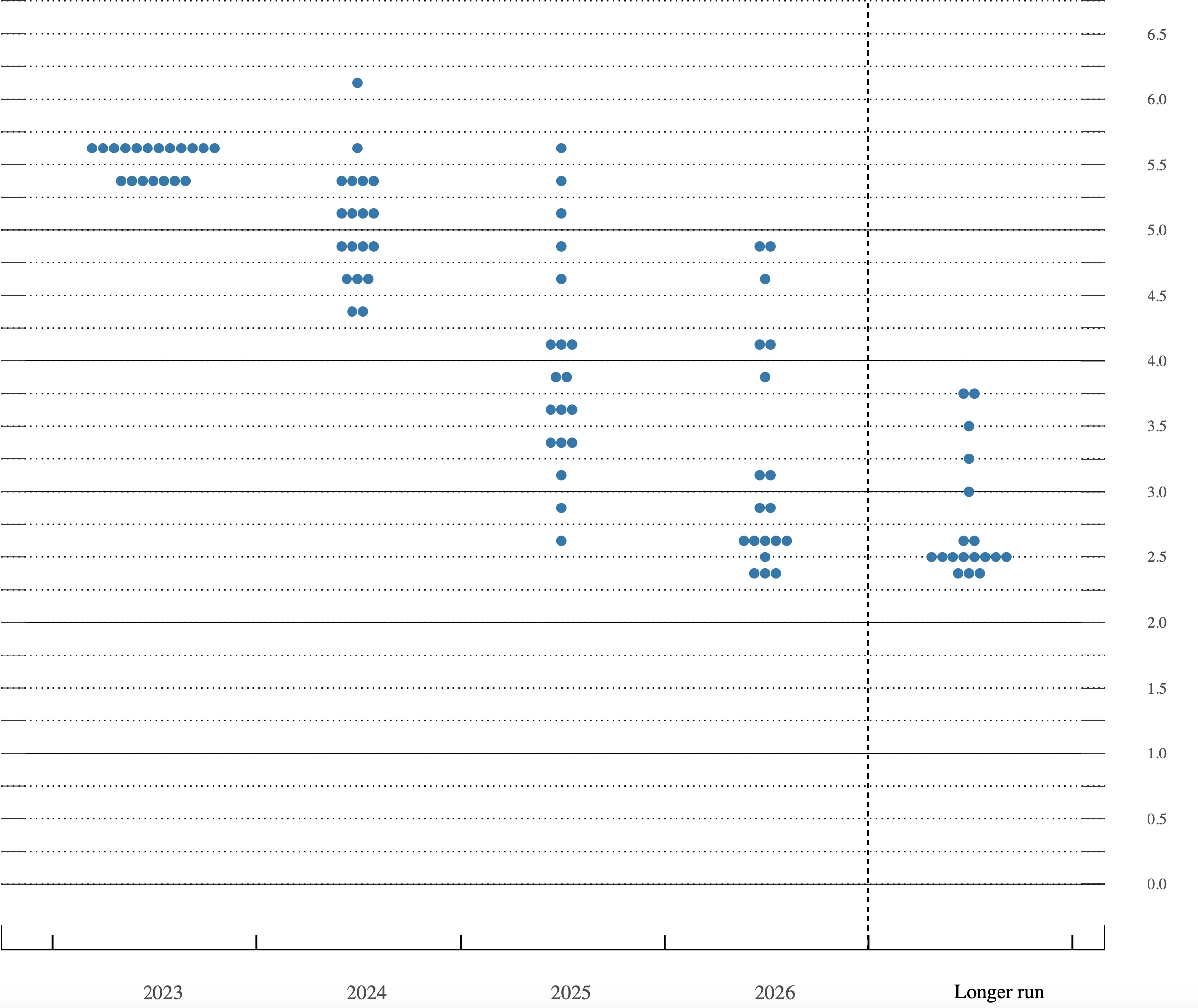
First, let’s recap the FOMC meeting.  The term hawkish pause had been used prior to the meeting as an expectation, and I guess that was a pretty apt description.  While they left policy on hold, as expected, the change in the dot plots, as seen below, indicate that even the doves on the Fed see fewer rate cuts next year, with just two now priced in from four priced in June.

Source: Fedreserve.gov

A quick reading shows that a majority of members expect one more hike this year, and now the median expectation for the end of 2024 has moved up to 5.125%, so 50bps lower than the median expectation for the end of 2023 and 50bps higher than the June plot.  To me, what is truly fascinating is the dispersion of expectations in 2025 and 2026, where there are clearly many opinions.  And finally, the longer run expectation has risen to 2.5% with many more members thinking it should be even higher than that.  The so-called neutral rate estimations seem to be creeping higher.  If you think about it, that makes some sense.  After all, given the ongoing forecasts for continued labor market tightness due to demographic concerns, and add in the massive budget deficits leading to significantly higher Treasury debt issuance, there is going to be pressure on rates to find a higher level.

The market response was quite negative, albeit not immediately, only after Powell started speaking.  But in the end, equity markets fell across the board in the US, with the NASDAQ taking the news the hardest, down -1.5%, as its similarity to long duration bonds was made evident.  Asian markets all fell overnight as well, with most tumbling more than -1.0% and European bourses are all under similar pressure, down -1.0% or so as well.  The one exception in Europe is Switzerland, where the SNB surprised the market and left rates on hold resulting in a weaker CHF and a very modest gain in their equity market.

However, the bigger market response was arguably in bonds, where yields rose to new highs for the move with the 2yr at 5.15% and the 10yr at 4.43%.  Once again, I point to the significant increase in debt that will be forthcoming from the US Treasury as they need to fund those budget deficits.  I have been making the case that a bear steepener would be the more likely outcome for the US yield curve.  That is where long-term rates rise more quickly than short-term rates due to the US fiscal policy and shrinking demand for US debt by key players, notably the Fed, but also China and Japan.  Nothing has changed that view.

Then early this morning, up north
Both Sweden and Norway brought forth
A quarter point hike
To act as a dike
Preventing price rises henceforth

After the Fed’s hawkish pause, we turn our attention to Europe, where the early movers, Sweden and Norway, both hiked twenty-five basis points, as expected, while both hinted that further hikes are not out of the question.  Inflation remains higher than target in both nations and in both cases, the currency has been relatively weak overall.  Switzerland left rates on hold, pointing to the fact that for the past three months, inflation has been within their target range, and they are beginning to see downward pressure on economic activity which they believe will keep that trend intact.

And lastly, from London we’ve learned
Another rate hike has been spurned
Though voting was tight
They said they’re alright
With waiting to see if things turned

As to the bigger story, the UK, expectations were split on a hike after yesterday’s tamer than expected CPI report while the pound fell ahead of the news.  And the change in expectations was appropriate as in a 5-4 vote, the BOE opted to remain on hold for the first time in two years.  They see that inflation may be easing more rapidly than previously expected, and they are concerned about overtightening.  While I have a hard time understanding how a 5.15% Base rate is tight compared to CPI running at 6.7% and core at 6.2%, I am clearly not a central banker.  At any rate, the pound fell further on the news and is now at its lowest level since March, while the FTSE 100 rallied back and is close to flat on the day from down nearly -1.0% before the announcement.  Gilt yields, however, are moving higher as the bond market there doesn’t seem to believe that the BOE is serious about fighting inflation.

And really, those are today’s key stories.  Late yesterday, Banco Central do Brazil cut the SELIC rate by 0.50%, as expected, and at the same time the BOE announced, the Central Bank of Turkey raised their refinancing rate by 5 full percentage points, to 30.0%, exactly as expected.  And to think, we get concerned over rates at 5%!

As to the rest of the day, there is a bunch of US data as follows: Philly Fed (exp -0.7), Initial claims (225K), Continuing Claims (1695K), Existing Home Sales (4.1M) and Leading Indicators (-0.5%).  As is typical, there are no Fed speakers scheduled the day after the FOMC meeting, but we will start to hear from them again tomorrow.

Putting it all together tells me that the Fed is not nearly ready to back off their current stance and will need to see substantial weakness in economic activity before changing their mind.  Meanwhile, last week’s ECB meeting and this morning’s BOE meeting tell me that the pain of higher interest rates in Europe is becoming palpable and the central banks are leaning more toward inflation as an outcome despite their mandates.  This continues to bode well for the dollar as the US remains the place with the highest available returns in the G10.

Tonight, we hear from the BOJ, where no change is expected.  I would contend, though, that the risk is there is some level of hawkishness that comes from that meeting as being more dovish seems an impossibility.  As such, there is a risk that the yen could see some short-term strength.  Keep that in mind as you look for your hedging levels.  

Good luck

Adf

Dreamlike

The ECB hiked twenty-five
But Madame Lagarde tried to drive
The idea they’d hike
Again was dreamlike
And so, euro-dollar did dive

Then last night some Chinese reports
Showed there was some growth there, of sorts
The PBOC’s
Continuous squeeze
Of rates, too, has hammered yuan shorts

Starting with a quick recap of the ECB meeting, as I had believed, they hiked rates by 25bps which takes the Deposit rate to 4.00%, the highest level since the euro was created in 1999.  It seems Madame Lagarde’s rationale was similar to my own, which was essentially, this was the last chance to raise rates before the recession in Europe really gets going at which point further rate hikes will be incredibly difficult politically.  However, by essentially explaining they were done, with inflation running well above both the current interest rate structure as well as their 2.0% target, Lagarde undermined any support for the single currency which fell sharply yesterday after the announcement and has been unable to show any signs of life since then.  Current market pricing shows a 38% probability of another hike this year before an eventual reduction in the rate structure by the middle of 2024.  However, my take is that if the recession spreads further, the ECB will be quick to cut rates.  Ultimately, I continue to believe the euro is going to have a very difficult time going forward.

Turning our attention east, the Chinese monthly data dump was released last night and virtually every single measure beat expectations, even the property investment.  None of the beats were very large, but I guess the question has become are analysts and investors overly bearish on China (or perhaps the question is can we trust Chinese data)?  For instance, IP rose 4.5% Y/Y, vs. 3.9% expected; Retail Sales rose 4.6% Y/Y vs. 3.0% expected; Property Investment fell -8.8% Y/Y vs. -8.9% expected and the Unemployment Rate fell to 5.2% rather than remaining unchanged at 5.3%.  The only outlier was Fixed Asset Investments which rose 3.2% rather than the 3.3% expected.  The market response to this was quite interesting.  The yuan was little changed, although it remains well above its recent lows with USDCNY hovering around 7.2800.  The CFETS fixing continues to be pushed toward a lower dollar, although the spread between the fixing and the onshore market has narrowed slightly to 1.4% from its recent levels above 1.9%.

As I mentioned yesterday, the Chinese cut their RRR by 0.25% trying to inject more liquidity into the economy and they have also been pushing up offshore CNY interest rates which are now equal to USD interest rates so there is no carry benefit in shorting the CNY offshore.  This, too, will help eliminate some of the downward pressure on the yuan.  In fact, it appears that much of the recent policy focus has been to prevent the yuan from weakening much further.  I guess if you are trying to convince other countries that they can use the yuan for payments and holding it is safe, it really cannot be seen falling sharply.  I suspect that the PBOC will be doing everything they can to support the currency going forward.  In a bit of a surprise, Chinese shares were the worst performers overnight, with all the main indices there in the red while markets elsewhere in Asia (Nikkei +1.1%, Hang Seng +0.75%, ASX 200 +1.3%) and Europe (DAX +1.0%, CAC +1.6%, FTSE 100 +0.8%) are all higher.  As it happens, US futures are little changed this morning after a strong equity performance yesterday.  So, all in all, I would say risk is in favor today.

This risk attitude is evident in bond yields as well as they are rising with investors moving from bonds to stocks.  Treasury yields are higher by 3.5bps, while in Europe, yields are all higher at least 6bps with Italian BTPs seeing the most selling and a rise of 7.5bps.  Arguably, if the ECB has finished its tightening cycle, which it seems to have done, and inflation remains as high as it is, the value of bonds should decline.  This movement is logical based on what appears to be the new narrative. 

A quick aside on Japan, where you may recall that on Monday, the yen strengthened and JGB yields rose after comments from BOJ Governor Ueda regarding the possibility that they would have enough information to potentially end ZIRP there.  It turns out that was not Ueda-san’s intention, and rather he thought his comments were benign.  It seems there is no intention to adjust policy anytime soon.  The market response was seen in FX where the yen fell -0.3% and is now pressing to 148.  I suspect 150 is coming soon, although further intervention at that level cannot be ruled out.

Turning to commodities, oil (+0.5%) continues to rally and is now solidly above $90/bbl.  The other gainer today is gold (+0.4%) but base metals are softer.  A possible train of thought here is that rising oil prices will both force interest rates higher through the inflation channel as well as undermine economic growth, so the industrial sector is getting double-whammied in the short-term.  As with energy, the long-term prospects remain quite positive for base metals as production is just not going to be able to keep up with demand given the lack of investment in the sector since the ESG movement began a decade ago.  Even if it is recognized that this must change, it will take years before new production can come online which should continue to be supportive of the sector overall.

Finally, the dollar is mixed this morning, with the EMG bloc seeing half gainers and half laggards although the largest movement is less than 0.2%.  In other words, nothing is going on here.  Similarly, in the G10, other than the yen mentioned above, movement has been mixed with no real substance in either direction.  Given the FOMC meeting next week, it appears that traders are unwilling to position themselves too much in either direction.  Net, this week, the dollar did fall a bit, but remains well above its recent lows.

Yesterday’s Retail Sales data was once again quite hot, rising 0.6% for headline and ex-autos, which just goes to show that there is a lot of money still sloshing around the system.  As well, the Claims data was solid again with 220K Initial Claims, less than forecast and certainly not showing any weakness in the labor market.  Today brings a bunch of secondary data with Empire Manufacturing (exp -10.0), IP (0.1%), Capacity Utilization (79.3%) and Michigan Sentiment (69.0).  The Citi Surprise Index continues to push higher which continues to indicate that economic activity in the US remains solid.  While a recession is clearly going to arrive at some point, for now, it remains a distant prospect.  With that in mind, do not think that the Fed is going to go soft anytime soon and that ongoing higher for longer is very likely to help support the dollar overall.

Good luck and good weekend

Adf

Still Avante-Garde

As always, when Chairman Jay speaks
Each hawk and each dove caref’lly seeks
The words that best suit
Their story, and mute
All others with varied techniques

Every hawk in the market heard these words, right at the beginning of Powell’s speech Friday morning and rejoiced [emphasis added], “we are prepared to raise rates further if appropriate, and intend to hold policy at a restrictive level until we are confident that inflation is moving sustainably down toward our objective.”

However, the doves didn’t need to wait long to find their counterpoint, with Powell giving them fodder in the very next paragraph, [emphasis added], given how far we have come, at upcoming meetings we are in a position to proceed carefully as we assess the incoming data and the evolving outlook and risks.

So, which is it?  Here is the link to the speech, so you can make up your own mind if you so choose but be prepared, if you listen to the punditry, you will hear both sides and likely no clear decision.  With that in mind, my take is that there is still far more hawkishness than dovishness around the table at the Eccles building.  Much of the speech focused on the fact that while things were certainly better than the peak inflation period last year, there is still a long way to go before they feel confident they have achieved their goal.  And one other thing, Powell made it clear that the goal remains 2%.  All this talk of raising the target seems like it will get no hearing at all for the time being.

A quick look at equity markets on Friday shows that the initial impression of the speech was the hawkish view as stocks fell pretty sharply right away.  However, after falling about 0.7% in the first hour, buyers returned, and the major indices all closed nicely higher on the day.  Of course, the irony of that outcome is higher equity prices beget easier financial conditions which implies even more tightening by the Fed.  But whatever.

Then later, said Madame Lagarde
This job that we have is so hard
The future’s unclear
And though we’re sincere
We’re clueless, though still avant-garde

Much later Friday, Madame Lagarde explained her updated framework for how the ECB is going to be handling things in the future.  The very best thing she said was that they would act with humility as they proceed.  And while it would be great if that were to be the case, my 40 years of experience tells me it is unlikely to work out that way.

The essence of her speech was to identify that the world has changed and that old economic relationships may no longer be viable.  As I have written many times about all the central banks, each of them has a series of econometric models by which they steer their course.  The problem is those models have over time been proven to be completely worthless.  And more disturbingly, anytime someone with a different viewpoint has a chance to be nominated to enter the club, they are shot down immediately.  There is virtually zero willingness to truly think outside of the box of their making.  While Lagarde preaches that they will be humble going forward, it seems highly unlikely they will consider anything that is not completely orthodox, even as a thought experiment.  And to my mind, that is the exact opposite of humility.

At any rate, Lagarde’s speech was very late in the market day and did not seem to have much impact at all.  Thus concludes the recap from Friday’s activity.  Now let’s turn to this morning.

In China, old President Xi
Keeps trying to force, by decree
A rally in stocks
By banning sales blocks
And halving the transaction fee

While it is getting tiresome to have to write about China yet again, it remains the other major story in the markets.  Last night, the government unveiled yet another set of measures to try to support the stock market there with only marginally more success than seen last week.  (As an aside, does it seem strange to anyone else that a communist country with state control over most aspects of life is keen to support the bastion of capitalism that is a stock market?).  

The latest effort included three steps; a 50% cut in the transaction tax, down to 0.05%; a limit on new listings (to prevent more supply); and a ban on sales by controlling shareholders if those companies have not paid dividends in the past three years or are trading below their IPO price.  These were announced before the market opened and the initial response was a 5.5% jump compared to Friday’s closing levels in the CSI 300.  Alas, it was a very short-lived gain with half that evaporating in the first 10 minutes of trading and the end result a gain of only about 1% on the day.  Certainly, better than a decline, but clearly not what President Xi had in mind.

Ultimately, the problems in China go far beyond the level of stamp duty on stock trades.  There are fundamental problems in the economy’s structure as well as the demographic and debt overhangs that exist there.  Despite the much ballyhooed efforts by Xi to adjust the Chinese economy away from its mercantilist economic model, that is still the predominant process there.  It is with this in mind that I continue to look for a much weaker renminbi going forward, and an eventual move to 7.50 and beyond.  

As to the rest of the equity markets, currently everything is in the green, with Japan having a great day (+1.7%) and all of Europe higher by between 0.50% and 1.00%.  US futures, too, are firmer this morning, although only just at this hour (7:20), about 0.2% across the board.  As there is a ton of data to come this week, I suspect that traders will be waiting for more information before making their next big bets.

In the bond market, things are quite benign with no major government market having seen a yield change of even 1 basis point this morning.  There are some gainers and some losers, but for all intents and purposes, bonds are unchanged on the day.  The one thing to note, though, is that the US Treasury curve inversion is growing again, back to -86bps, after having traded to as low as -65bps less than two weeks ago.  I feel like this movement simply adds to the confusion over the imminence of a recession, although I definitely believe one is coming by early next year.  Of course, we will learn far more about the economy this week given the data to be released.

In the commodity space, oil is marginally softer this morning, back just below $80/bbl, although there seems to be an increasing effort by OPEC+ to continue to restrict supply as they fear a recession coming.  Metals prices are generally little changed this morning, again, with market behaviors driven by the uncertainty over the week’s upcoming news.

Finally, the dollar is also mixed this morning, with a nice mix of gainers and losers across both the G10 and EMG blocs.  I feel the bias will be for a stronger dollar given my take on Powell’s comments as being hawkish, but as I explained, there was plenty of fodder for both arguments.

Turning to the data, there is a lot this week as follows:

TodayDallas Fed Manufacturing-19.0
TuesdayCase Shiller Home Prices-1.65%
 JOLTS Job Openings9450K
 Consumer Confidence116.2
WednesdayADP Employment 198K
 Advance Goods Trade Balance-$90.0B
 GDP Q22.40%
ThursdayInitial Claims235K
 Continuing Claims1705K
 Personal Income0.30%
 Personal Spending0.70%
 Core PCE Deflator0.2% (4.2% Y/Y)
 Chicago PMI44.1
FridayNonfarm Payrolls168K
 Private Payrolls150K
 Manufacturing Payrolls3K
 Unemployment Rate3.50%
 Average Hourly Earnings0.3% (4.3% Y/Y)
 Average Weekly Hours34.3
 Participation Rate62.60%
 Construction Spending0.50%
 ISM Manufacturing47.0
 ISM Prices Paid44.0

Source: Bloomberg

So, as can be seen there is a ton of stuff to digest this week.  On top of that, we do hear from a few Fed speakers, but I think that given we just got Powell’s views, the data will be far more important than anything from a few regional bank presidents.  While obviously, Core PCE is critical, as it is their key inflation metric, I continue to look at the payroll data as the key for Powell to believe that he has not broken anything yet.  Once that data starts to fade, we can look for a change in tone from the Fed.  But until then, higher for longer remains the key, and the dollar should continue to benefit.

Good luck

Adf

Much Wronger

There once was a theory on rates
Explaining, that, here in the States
Recession would cause
Chair Powell to pause
And end all soft-landing debates

But data of late has been stronger
Encouraging ‘higher for longer’
At this point it seems
Recessionist dreams
Could not have been very much wronger

Which leads to today’s NFP
The data point all want to see
If once more it’s high
Look for yields to fly
If low, look for stocks filled with glee

Recently, the US data releases have been anything but benign as they show continued economic strength in the face of many headwinds.  Yesterday’s numbers were overwhelmingly positive with the ADP Employment Change +497K, more than twice expectations and the highest since February 2022.  There is certainly no indication from this data series that companies are cutting back on their hiring.  As well, the ISM Services results were firmer than expected, with the headline jumping to 53.9, up nearly 3 points on the month and more than 2 points higher than forecast.  But more impressively, both the Employment and New Orders readings were much higher than last month indicating a more robust economy than many had been both describing and expecting.


But this is all simply a leadup to today’s NFP report, the data point upon which I have been most highly focused as the key for understanding the Fed’s reaction function.  As I have consistently highlighted, if NFP continues to grow and the Unemployment rate remains low, the Fed has ample cover to continue to tighten policy via both higher interest rates and balance sheet reduction (QT) without concern over political blowback.  After all, if jobs remain plentiful and wages continue to grow, complaints of overtightening will have no credibility.


Heading into the number, here are the latest consensus forecasts according to Bloomberg:


Nonfarm Payrolls

230K

Private Payrolls

200K

Manufacturing Payrolls

5K

Average Hourly Earnings

0.3% (4.2% Y/Y)

Average Weekly Hours

34.3

Participation Rate

62.6%


While the headline is, of course, just that, the number that will get the most press, it is worthwhile watching the Weekly Hours data which, as can be seen in the below Bloomberg chart, has been declining steadily since early 2021.  The key, though, is to recognize that the only time we have been below 34.3 is during the past two recessions, so a continuation lower in the recent trend may bode ill for future economic activity.  The thesis here is that companies will reduce the hours of their staff before actually firing them given the expense of bringing on and training new staff in the next up cycle.


In the meantime, investors and traders are taking their cues from the data already seen and are increasingly accepting of the higher for longer thesis the Fed has promulgated for the past year.  Yesterday’s price action was dramatic with Treasury yields surging through 4.0% in the 10-year and 5.0% in the 2-year.  This morning that trend continues with yields higher by another 3bps and you can be sure that if the overall employment report is strong, they will go higher still.


At the same time, equity markets are starting to feel a little pressure after what has been a remarkable rally in the first half of 2023, as the 4.0% level in 10-year Treasury yields has led to the breakage of things consistently during this cycle.  It started with the UK pension problems and Gilt market collapse in September 2022, was followed by the BOJ being forced to intervene to prevent the yen’s collapse in October 2022, then the FTX collapse in November 2022 and finally Silicon Valley Bank’s demise in March 2023.  In each of these cases, the 10-year yield traded above 4.0% ahead of the problem and was taken back down in the wake of the outcome.  This chart from the Gryning Times makes the case eloquently:

As such, it should be no surprise that equity markets fell yesterday in the US and overnight in Asia as we are clearly reaching a pain point in the market.


Of course, the question is, will this time be different?  Have investors priced in higher yields already and still comfortable paying extremely high multiples for stocks?  History has shown that this time is never different when it comes to investor behavior.  Euphoric predictions are followed by reality setting in and eventually prices adjust lower, reverting to long-term means, especially with respect to earnings mulitples.  But that is not to say things will be unable to defy gravity for longer.  As Keynes famously told us all, markets can remain irrational longer than you can remain solvent.


Based on all the data we have seen recently, there is no reason to believe that today’s NFP number is going to be weak, nor that the Unemployment Rate is going to rise sharply.  Rather, a higher than consensus number seems quite viable as a baseline expectation.


Remember, too, that the Fed continues to hammer home its message of higher for longer with Dallas Fed President Lorie Logan the latest to say so yesterday, “I remain very concerned about whether inflation will return to target in a sustainable and timely way.  I think more restrictive monetary policy will be needed to achieve the Federal Open Market Committee’s goals of stable prices and maximum employment.”  There is nothing ambiguous about that language, that is for sure.


Perhaps the most surprising thing about markets this morning is the fact that despite the rise in Treasury yields, the dollar is mixed at best, and arguably slightly lower.  Certainly, versus its G10 counterparts, it is broadly softer with the yen the biggest gainer, 0.5%.  This behavior is somewhat incongruous given the close relationship the dollar has had to US yields.  The dollar-yield relationship is much clearer in the EMG bloc where the greenback is stronger vs. virtually the entire segment.  And I expect that we are going to see a continuation of the dollar gains if US yields continue higher. 


But for now, all we can do is sit back and await the data.


Good luck and good weekend

Adf

On the Spot

This morning, it’s Core PCE

That markets are waiting to see

If it keeps on falling

More folks will be calling

For rate cuts ere end ‘Twenty-three

But what if the data is hot

That could put the Fed on the spot

Instead of a pause

That reading may cause

At least one more hike than was thought

As we head into the Memorial Day weekend, the market is awaiting some more key data points for the Fed’s calculus on inflation.  Today brings a plethora of things as follows (median expectations from Bloomberg):

  • Personal Income (exp 0.4%)
  • Personal Spending (0.5%)
  • Core PCE Deflator (0.3%, 4.6% Y/Y)
  • Durable Goods (-1.0%)
  • -ex Transport (-0.1%)
  • Michigan Sentiment (58.0)

Given the Fed’s preference for the Core PCE as their key inflation indicator, this data point is always a critical feature of the monthly slate.  However, since the FOMC Minutes were released on Wednesday, the market has already adjusted its views on the Fed’s future path.  Since the release, the market has removed another full 25bp cut from the medium-term outlook, with pricing for January 2024 rising from 4.50% to 4.735%.  It appears that the market is truly beginning to believe the Fed that it is going to remain higher for longer.

So, let’s look at the consequences of that policy stance and the market’s grudging acceptance.  Over the course of the past 3 weeks, 10-year Treasury yields have risen from 3.38% to 3.78% after giving up 3bps this morning. Meanwhile, 2-year Treasury yields have risen from 3.89% to 4.49%, increasing the curve inversion again, and highlighting the market view that a recession remains in the not-too-distant future.

Generally speaking, the combination of higher interest rates and recessionary indicators tends to undermine the equity market, but that picture is more nuanced these days as the incredibly narrow breadth of the price leaders has been able to overcome a more general malaise.  For instance, yesterday’s S&P 500 gain of 0.88% was largely the result of just three key tech names, NVDA, MSFT and AVGO, with the rest of the group mostly thrashing around.  This continues the trend of a handful of companies driving the value of the “broad” market indices, a situation that cannot go on forever, but for now, it seems fine.  Of course, the NASDAQ is even doing better since all those high performers are NASDAQ names.

However, one needs to ask, if the Fed continues to tighten policy further, and the market is now pricing a one-third probability that they hike another 25bps next month, and the result is a further slowdown in the economy, can these companies continue to perform?  Maybe they can, but history is not on their side.

Other markets, too, have been impacted by the slow realization that the Fed means what they have been saying all along, higher for longer.  While oil prices (+0.5%) are edging higher today, they have been significant underperformers along with base metals as concerns over future economic growth weigh on the sector.  Both copper and oil have been falling for the last several months as the largest importer of both, China, seems to find itself with its own economic malaise.  This is merely another input into the recession story.

Weakening growth in China and higher interest rates in the West to fight still too-high inflation do not bode well for economic activity for now.  Add to these factors the potential outcome from the debt ceiling negotiations, reduced Federal spending in the US, and you have a trifecta of reasons for a negative equity and risk market outlook.

Speaking of the debt ceiling, this morning’s headlines indicate that the two sides are getting closer, but that spending cuts are part of the process.  Naturally, this is controversial on the left side of the aisle, but the fact that not all the spending cuts included in the bill already passed by the House are going to be seen is controversial on the right side of the aisle.  If anything, this sounds like an excellent outcome, where neither side is happy, but both agree something must be done.  It is certainly no surprise to me that they are getting closer to agreement as this all has been part of the Congressional Kabuki that we regularly see on critical issues.  Remember, though, avoiding a debt default is not a huge positive sign, it is merely the absence of a negative one.

Where does this leave us?  Overall, the data remains mixed at best, with manufacturing indicators weakening, service indicators holding up, inflation remaining stickily high and the Fed continuing to pound its one main tool, the hammer of interest rate hikes on the economy.  Perhaps the most interesting data situation is that of Initial Claims, which yesterday printed at a much lower than expected 229K.  The fairly steady increases in layoffs that had been seen since the beginning of the year seem to be abating now.  In fact, the 4-week moving average of claims data has fallen back sharply to 231.8K, an indicator that the trend higher may be ending.  If this is the case, and the NFP data going forward remains robust, the Fed will have every reason to continue to tighten policy further, much further than is currently priced into the market.  As I have written in the past, I continue to believe that NFP is the most important data point.  As long as Unemployment remains low and jobs are created, the Fed will have all the cover it needs to maintain tight monetary policy.  Just be prepared for some other things to break, à la SVB and First Republic.

Finally, a word about the dollar, which while modestly softer today remains in a clear uptrend off the lows seen early in the month.  As long as the Fed maintains its current policy stance, one which is still being priced into the market, the dollar has further to rally.  Although other central banks have been tightening policy as well, notably the ECB and BOE, the Fed remains the leader of the pack.  Until the Fed finally halts, those two will lag and the dollar should remain strong.  It is only when the Fed finally reverses course, which may not be until the middle of next year on current pace, when we should see any substantial dollar weakness.  I would not hold my breath.

In the end, it all comes back to inflation.  Until the central banks believe that they have defeated inflation’s threats, barring a calamitous economic collapse, I would look for bond yields around the world to continue to drift higher, for equity markets to struggle, although further gains cannot be ruled out, and for the dollar to maintain its overall strength.

Good luck and good weekend

Adf