Left For Dead

Takaichi’s learned
Her chalice contained poison
Thus, her yen weakens


If one needed proof that interest rates are not the only determining factor in FX markets, look no further than Japan these days where JGB yields across the board, from 2yr to 40yr are trading at decade plus highs while the yen continues to decline on a regular basis.  This morning, the yen has traded through 155.00 vs. the dollar, and through 180.00 vs. the euro with the latter being a record low for the yen vs. the single currency since the euro was formed in 1999.
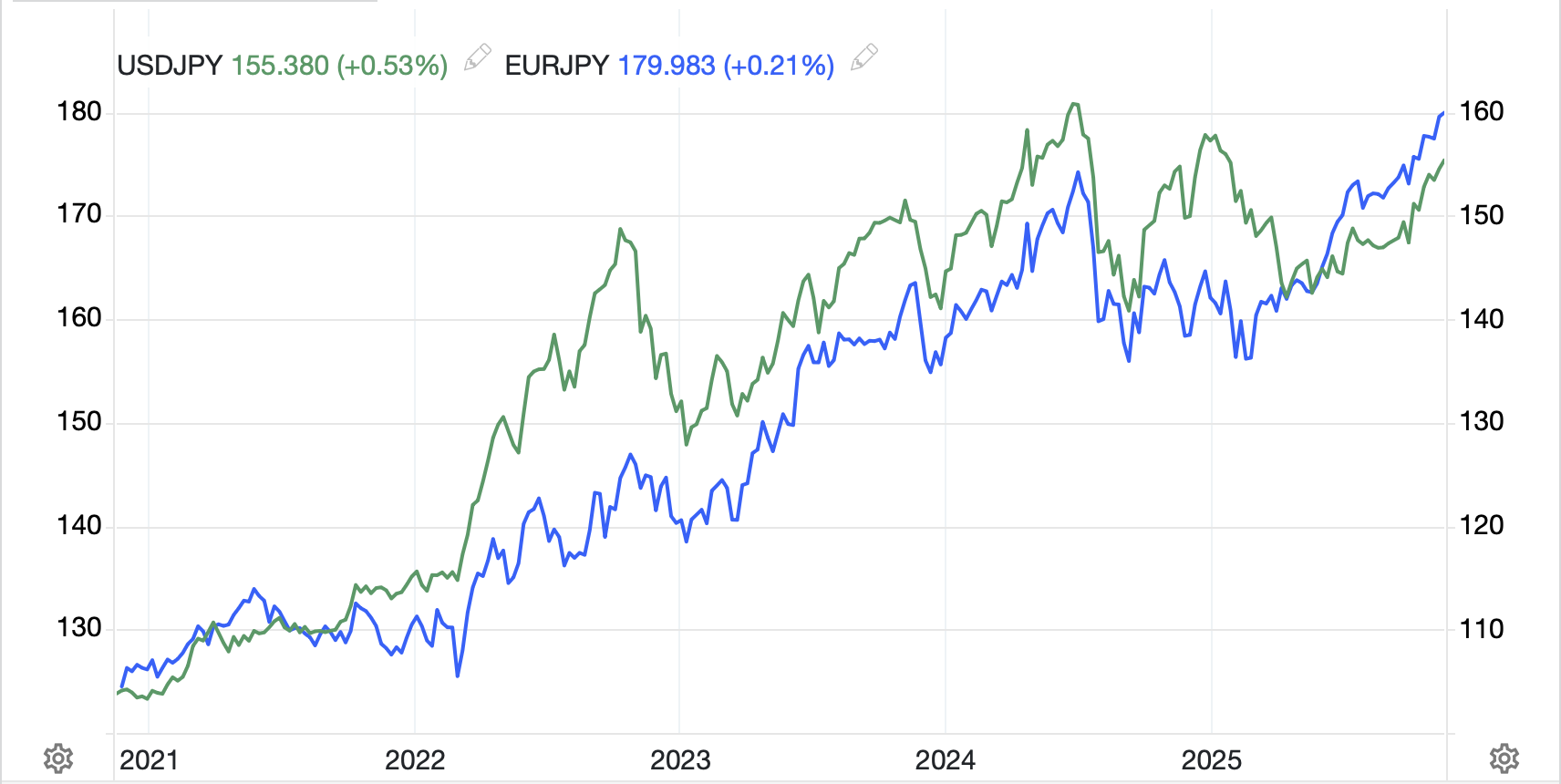
Source: tradingeconomics.com

Meanwhile, JGB yields continue to rise unabated on the back of growing concerns that Takaichi-san’s government is going to be issuing still more unfunded debt to pay for a massive new supplementary fiscal package rumored to be ¥17 trillion (~$109 billion).  While we may have many fiscal problems in the US, it is clear Japan should not be our fiscal role model.

Source: tradingeconomics.com

This market movement has led to the second step of the seven-step program of verbal intervention by Japanese FinMins and their subordinates.  Last night, FinMin Satsuki Katayama explained [emphasis added], “I’m seeing extremely one-sided and rapid movements in the currency market. I’m deeply concerned about the situation.”  Rapid and one-sided are the key words to note here.  History has shown the Japanese are not yet ready to intervene, but they are warming to the task.  My sense is we will need to see 160 trade again before they enter the market.  However, while that will have a short-term impact, it will not change the relative fiscal realities between the US and Japan, so any retreat is likely to be a dollar (or euro) buying opportunity.

As to the BOJ, after a highly anticipated meeting between Takaichi-san and Ueda-san, the BOJ Governor told a press conference, “The mechanism for inflation and wages to grow together is recovering. Given this, I told the prime minister that we are in the process of making gradual adjustments to the degree of monetary easing.”   Alas for the yen, I don’t think it will be enough to halt the slide.  That is a fiscal issue, and one not likely to be addressed anytime soon.

The screens everywhere have turned red
As folks have lost faith that the Fed,
Next month, will cut rates
Thus, leave to the fates
A stock market now left for dead

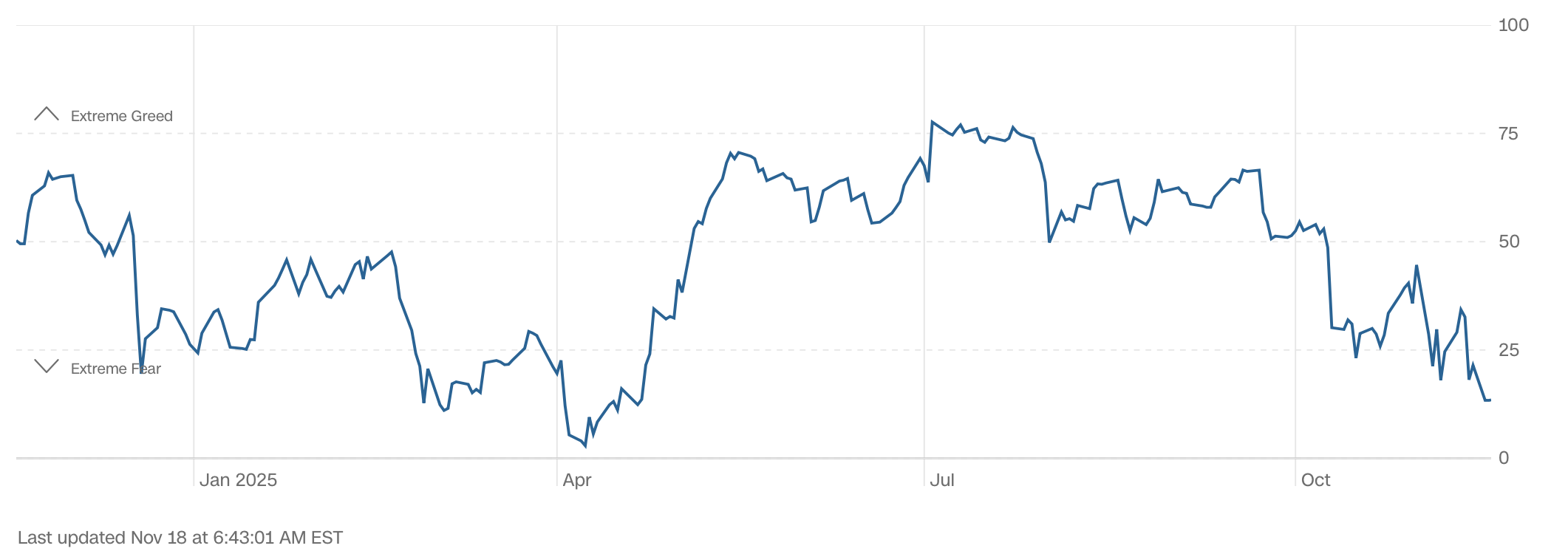
Yesterday, I showed the Fear & Greed Index and marveled at how it was pointing to so much fear despite equity markets trading within a few percentage points of all time highs.  Well, today it’s even worse!  This morning the index has fallen from 22 to 13 and is now pushing toward the lows seen last April when it reached 4 just ahead of Liberation Day.
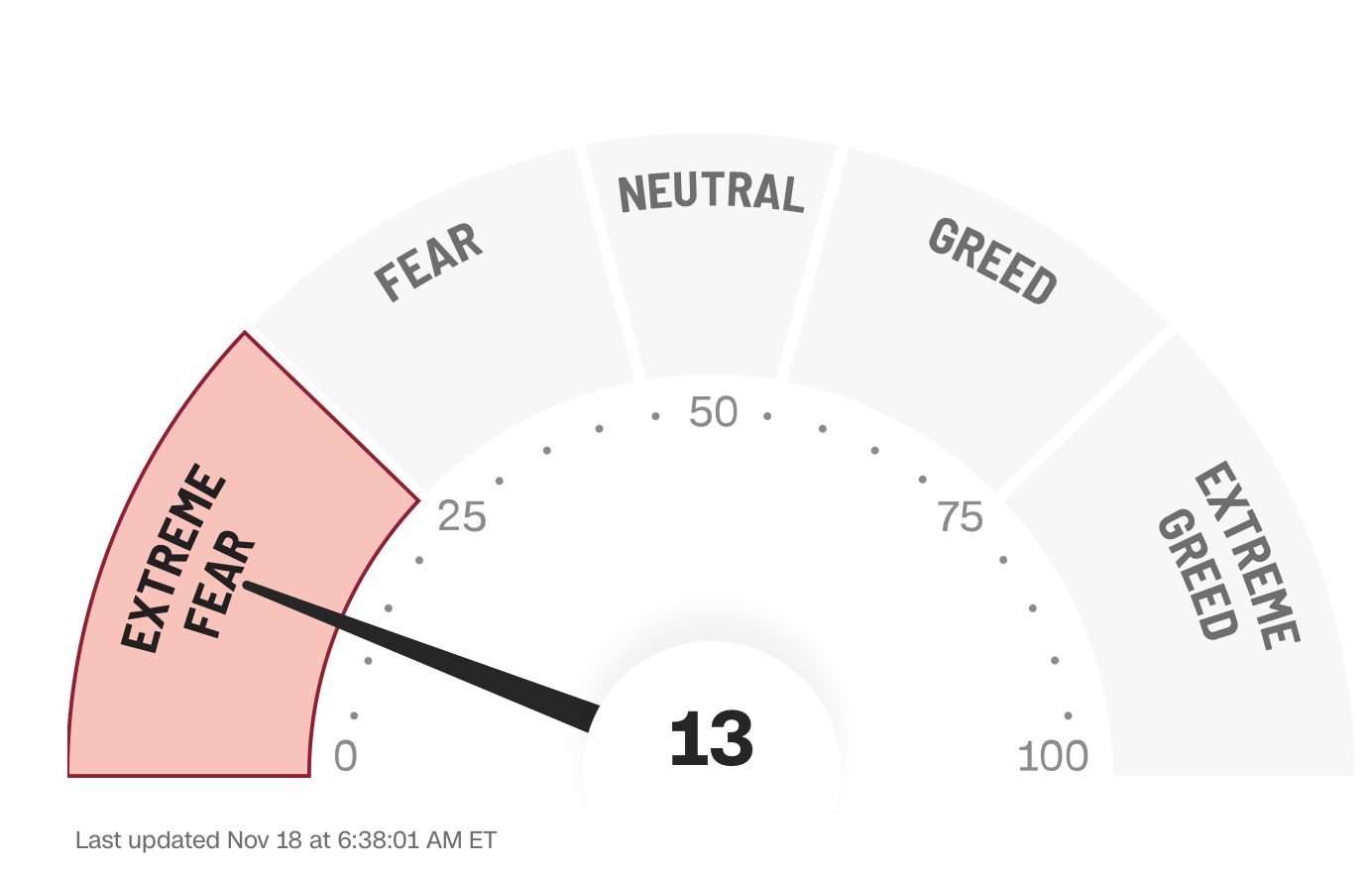
In fact, it is worthwhile looking at a history of this index over the past year and remembering what happened in the wake of that all-time low reading.
Source: cnn.com

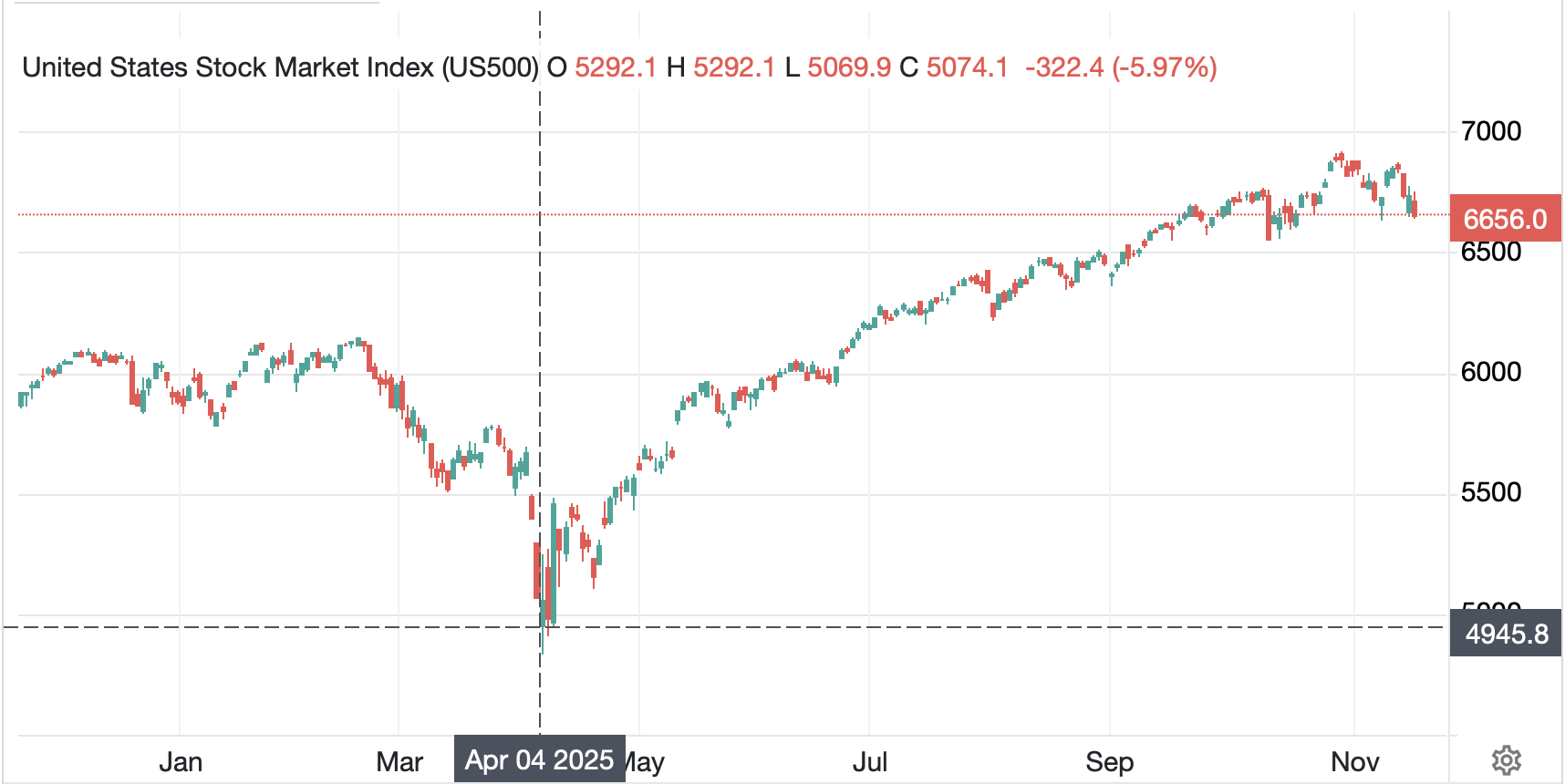
Now look at the S&P500 over the same timeline and see if you notice any similarities.
Source: tradingeconomics.com

It is certainly not a perfect match, but the dramatic rise in both indices from the bottom and through June is no coincidence.  The other interesting thing is that the fear index managed to decline so sharply despite the current pretty modest equity market decline.  After all, from the top, even after yesterday’s decline, we are less than 4% from record highs in the S&P 500.

Analysts discuss the ‘wall of worry’ when equity markets rise despite negative narratives.  Too, historically, when the fear index falls to current levels, it tends to presage a rally.  Yet, if we have only fallen 4% from the peak, it would appear that positions remain relatively robust in sizing.  In fact, BoA indicated that cash positions by investors have fallen to just 3.7%, the lowest level in the past 15 years.  So, everyone is fully invested, yet everyone is terrified.  Something’s gotta give!  In this poet’s eyes, the likely direction of travel in the short run is lower for equities, and a correction of 10% or so in total makes sense.  But at that point, especially if bonds are under pressure as well, I would look for the Fed to step in and not only cut rates but start expanding its balance sheet once again.  QT was nice while it lasted, but its time has passed.  One poet’s view.

Ok, following the sharp decline in US equity markets yesterday on weak tech shares, the bottom really fell out in Asia and Europe.  Japan (-3.2%) got crushed between worries about fiscal profligacy discussed above and the tech selloff.  China (-0.65%) and HK (-1.7%) followed suit as did every market in Asia (Korea -3.3%, Taiwan -2.5%, India -0.3%, Australia -1.9%).  You get the idea.  In Europe, the picture is no brighter, although the damage is less dramatic given the complete lack of tech companies based on the continent.  But Germany (-1.2%), France (-1.3%), Spain (-1.6%), Italy (-1.7%) and the UK (-1.3%) have led the way lower where all indices are in the red.  US futures, at this hour (7:15) are also pointing lower, although on the order of -0.5% right now.

In the bond market, Treasury yields, after edging higher yesterday are lower by -4bps this morning, and back at 4.10%, their ‘home’ for the past two months as per the below chart from tradingeconomics.com.

As to European sovereigns, they are not getting quite as much love with some yields unchanged (UK, Italy) and some slipping slightly, down -2bps (Germany, Netherlands), and that covers the entire movement today.  We’ve already discussed JGBs above.

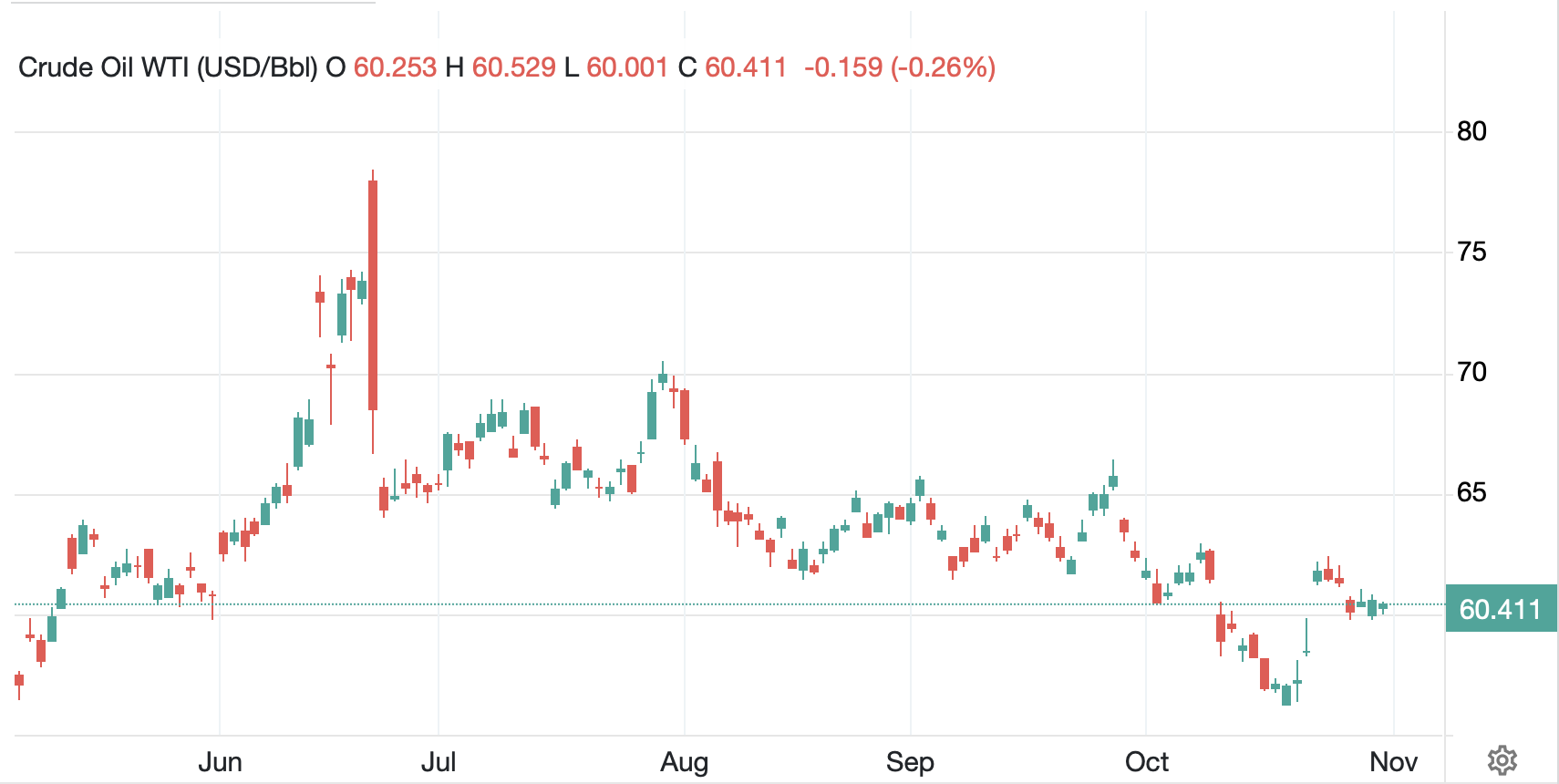
In the commodity space, oil (-0.2%) continues to trade either side of $60/bbl and it remains unclear what type of catalyst is required to move us away from this level.  Interestingly, precious metals have lost a bit of their luster despite the fear with gold (-0.25%), silver (-0.2%) and platinum (-0.2%) all treading water rather than being the recipient of flows based on fear.  Granted, compared to the crypto realm, where BTC (-1.0%, -16% in the past month) has suffered far more dramatically, this isn’t too bad.  But you have to ask, if investors are bailing on risk assets like equities, and bonds are not rallying sharply, while gold is slipping a bit, where is the money going?

Perhaps a look at the currency market will help us answer that question.  Alas, I don’t think that is the case as while the dollar had a good day yesterday, and is holding those gains this morning, if investors around the world are buying dollars, where are they putting them?  I suppose money market funds are going to be the main recipient of the funds taken out of longer-term investments.  One thing we have learned, though, is that the yen appears to have lost its haven status given its continued weakening (-3.0% in the past month) despite growing fears around the world.  

On the data front, yesterday saw Empire State Manufacturing print a very solid 18.7 and, weirdly, this morning at 5am the BLS released the Initial Claims data from October 18th at 232K, although there is not much context for that given the absence of other weeks’ data around it.  Later this morning we are due the ADP Weekly number, Factory Orders (exp 1.4%) and another Fed speaker, Governor Barr.  Yesterday’s Fed speakers left us with several calling for a cut in December, and several calling for no move with the former (Waller, Bowman and Miran) focused on the tenuous employment situation while the latter (Williams, Jeffereson, Kashkari and Logan) worried about inflation.  Personally, I’m with the latter group as the correct policy, but futures are still a coin toss and there is too much time before the next meeting to take a strong stand in either direction.

The world appears more confusing than usual right now, perhaps why that Fear index is so low.  With that in mind, regarding the dollar, despite all the troubles extant in the US, it is hard to look around and find someplace else with better prospects right now.  I still like it in the medium and long term.

Good luck

Adf

A Strong Sense of Urgency

Katayama said
“A strong sense of urgency”
Informs our views now


Source: tradingeconomics.com

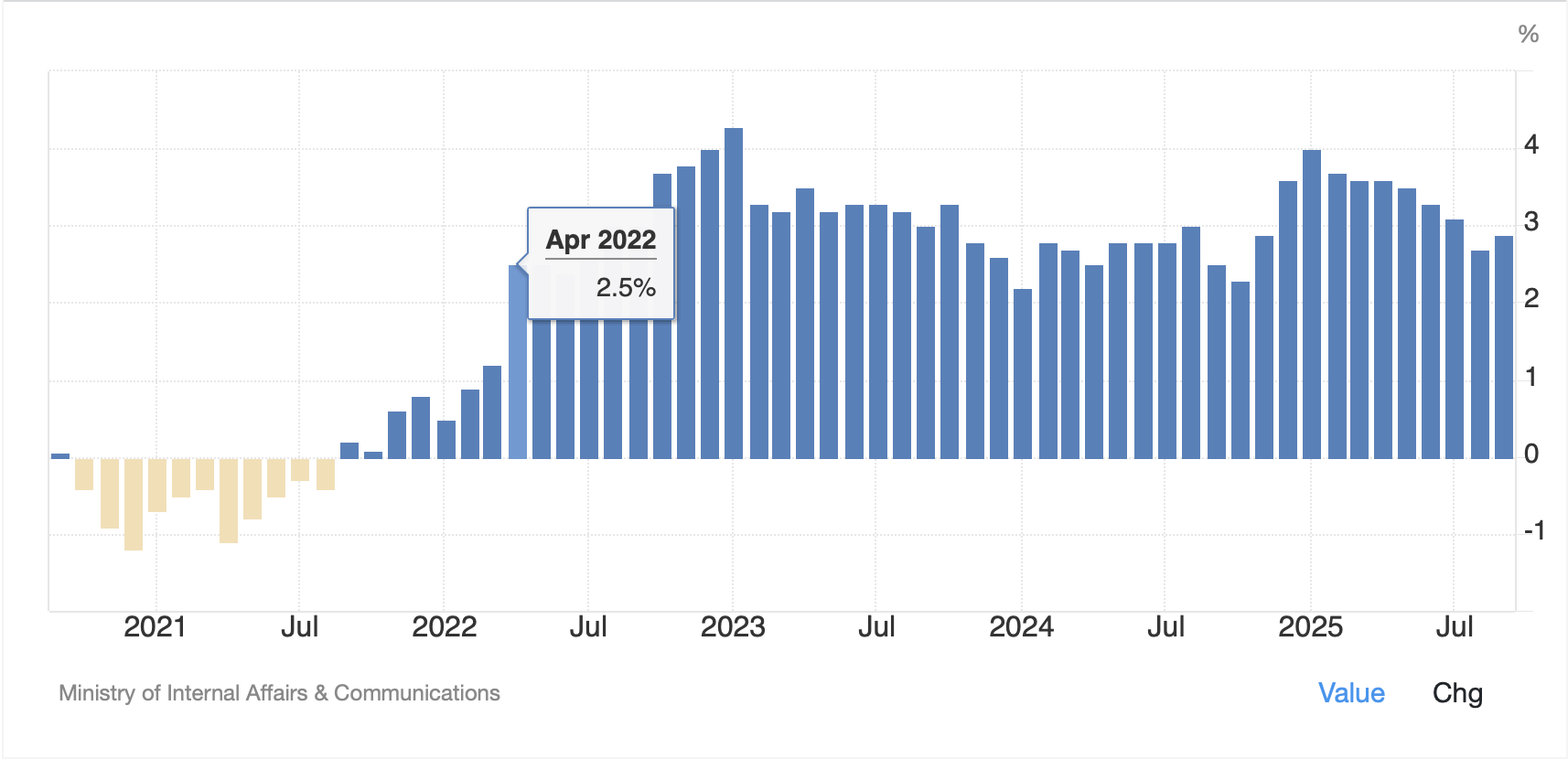
But this is the first step in their typical seven step plan before intervention.  And I get it, the combination of Chairman Powell suddenly sounding hawkish on Wednesday afternoon, telling us a December rate cut was not a foregone conclusion and the BOJ continuing to sit on its hands despite inflation running at 2.9%, the 42nd consecutive month (see below) that it has been above their 2.0% target (sound familiar?), indicates that the current policy stances will likely lead to further dollar strength vs. the yen.  

Source: tradingeconomics.com

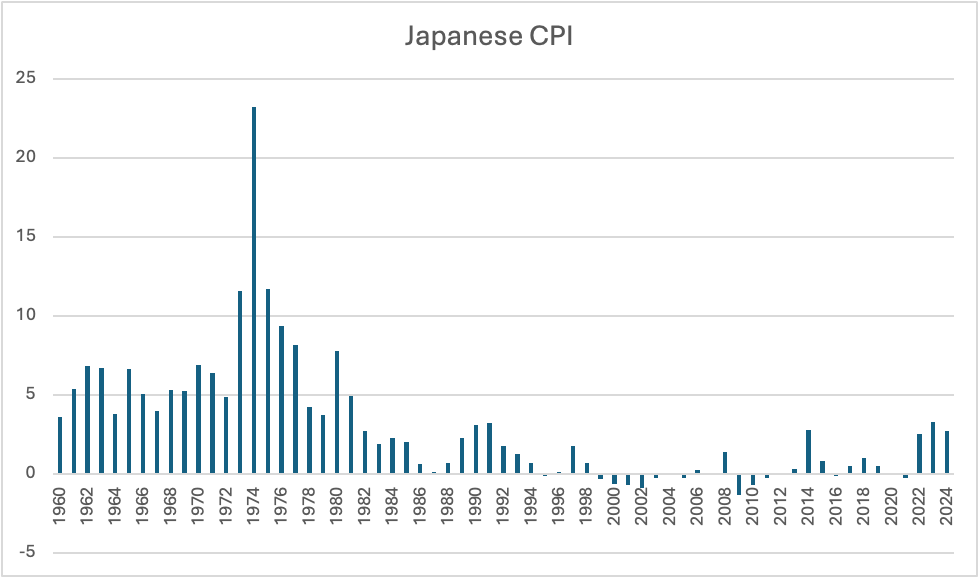
There is something of an irony in the current situation in Japan.  Recall that for years, the Japanese economy was in a major funk, with deflation the norm, not inflation, as government after government issued massive amounts of debt to try to spend their way to growth.  In fact, Shinzo Abe was elected in 2012, his second stint as PM, based on his three arrows plan to reinflate the economy because things were perceived so poorly.  If you look at the chart below, which takes a longer-term view of Japanese inflation, prior to 2022, the two positive spikes between 1992 and 2022 were the result of a hike in the Japanese VAT (they call it the Goods and Services Tax) which raised prices.  In fact, during that 30-year period, the average annual CPI was 0.25%.  And the Japanese government was desperate to raise that inflation rate.  Of course, we know what HL Mencken warned us; be careful what you wish for, you just may get it…good and hard.  I have a sense the Japanese government understands that warning now.

Data source: worldbank.org

Net, it is hard to make a case that the yen is going to reverse course soon.  For receivables/asset hedgers, keep that in mind.  At least the points are in your favor!

So, now that a trade deal’s agreed
Can China reverse from stall speed?
The data last night
Sure gave Xi a fright
More stimulus is what they need!

The other noteworthy macro story was Chinese PMI data coming in weaker than expected with the Manufacturing number falling to 49.0, vs 49.8 last month, with all the subcategories (foreign sales, new orders, employment and selling prices) contracting as well.  The Chinese mercantilist model continues to struggle amid widespread efforts by most developed nations to prevent the Chinese from dumping goods into their own economies via tariffs and restrictions.  The result is that Chinese companies are fighting on price, hence the deflationary situation there as too many goods are chasing not enough demand (money).  

There have been many stories lately about how the Chinese have the upper hand in their negotiations with the US, and several news outlets had stories this morning about how the US got the worst of the deal just agreed between Trump and Xi.  As well, this poet has not been to China for a very long time, so my observations are from afar.  However, things in China do not appear to be going swimmingly.  While there continues to be talk, and hope, that the government there is going to stimulate domestic consumer spending, that has been the story for the past 3 or 4 years and it has yet to occur in any effective manner.  The structural imbalances in China remain problematic as so many people relied upon their real estate investments as their nest egg and the real estate bubble continues to deflate 3 years after the initial shock.  Chinese debt remains extremely high and is growing, and while they certainly produce a lot of stuff, if other nations are reluctant to buy that stuff, that production is not very efficient for economic growth.

Many analysts continue to describe the US-China situation as China is playing chess while the US is playing checkers, implying the Chinese are thinking years ahead.  If that is so, please explain the one-child policy and the decimation of their demographics.  Just sayin.

Ok, let’s look at markets overnight.  While yesterday’s US markets were blah, at best, strong earnings from Amazon and Apple has futures rocking this morning with NASDAQ higher by 1.3% at this hour (7:40).  Those earnings, plus the euphoria over the Trade deal with the US sent Japanese shares (+2.1%) to another new all-time high which dragged along Korea (+0.5%) and New Zealand (+0.6%) but that was all.  The rest of Asia was under pressure as the weak Chinese PMI data weighed on both HK (-1.4%) and mainland (-1.5%) indices and that bled to virtually every other market. Meanwhile, European bourses are all somewhat lower as well, albeit not dramatically so, as the tech euphoria doesn’t really apply here.  So, declines between -0.1% (Spain) and -0.4% (UK) are the order of the day.

In the bond markets, yields have essentially been unchanged since the FOMC response with treasury yields edging 1bp higher this morning, now at 4.10%, while European sovereign yields are either unchanged or 1bp higher.  The ECB was a nothingburger, as expected, and going forward, all eyes will be on the data to see if any stances need change.

The commodity markets continue to be the place of most excitement with choppiness the rule.  Oil (-0.25%) is a touch softer this morning but continues to hover around the $60/bbl level.  I’m not sure what will get it moving, but right now, neither war nor peace seems to matter.  Regime change in Venezuela maybe?

Source: tradingeconomics.com

In the metals markets, volatility is still the norm with gold (-0.45%) lower this morning after a nice rebound yesterday and currently trading just above $4000/oz.  Silver and copper are unchanged this morning with platinum (-0.9%) following gold.  However, regardless of the recent market chop, the charts for all these metals remain distinctly bullish and the theme of debased fiat currencies is still alive.  Run it hot is still the US playbook, and that is going to support all commodity prices.

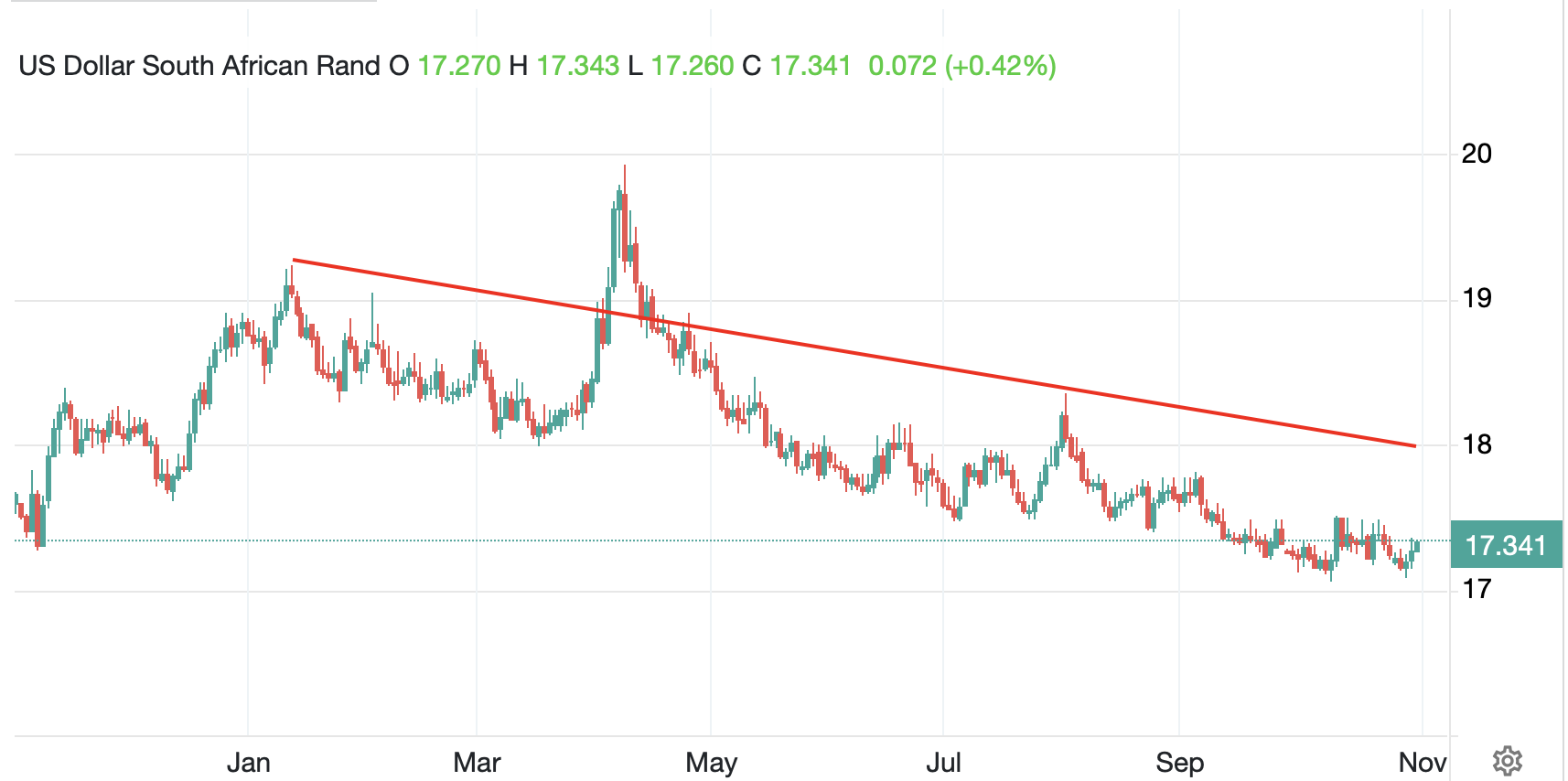
Finally, the dollar, after another step higher yesterday, is little changed this morning.  Both the euro and yen are unchanged and the rest of the G10 has slipped by between -0.1% and -0.2%.  In truth, today’s outlier is ZAR (-0.4%).  Now, let’s look at two ZAR charts, the past year and the long term, which tell very different stories.  In fact, it is important to remember that this is often the case, not merely a rand situation.  First, the past year shows the rand with a strengthening trend as per the below from tradingeconomics.com.  That spike was the response to Liberation Day.

But now, let’s look at a longer-term chart of the rand, showing the past 21 years.

Source: finance.yahoo.com

Like most emerging market currencies, the rand has been steadily depreciating vs. the dollar for decades.  It’s not that we haven’t seen a few periods of modest strength, but always remember that in the big picture, most EMG currency’s slide over time.  This is merely one example, and it is a BRICS currency.  The demise of the dollar remains a long way into the future.

On the data front, Chicago PMI (exp 42.3) is the only release, and we hear from three more Fed speakers.  It appears every FOMC member wants to get their view into the press as quickly as possible since there seem to be so many differing views.  In the end, I continue to think the Fed cuts in December, and nothing has changed.  But for now, there is less certainty as this morning, the probability of a cut is down to 66%.  I guess we’ll see.  But regardless, I still like the dollar for now.

Good luck and good weekend

Adf

Eyes Like a Bat

The new Mr Yen
Is watching for excess moves
With eyes like a bat


While every day of this Trump presidency is filled with remarkable activity at the US government level, financial markets are starting to tune out the noise.  Yes, each pronouncement may well be important to some part of the market structure, but the sheer volume of activity is overwhelming investment views.  The result is that while markets are still trading, there seem to be fewer specific drivers of activity.  Consider the fact that tariffs have been on everyone’s mind since Trump’s inauguration, but nobody, yet, has any idea how they will impact the global macro situation.  Are they inflationary?  Will sellers reduce margins?  Will there be a strong backlash by the US consumer?  None of this is known and so trading the commentary is virtually impossible.

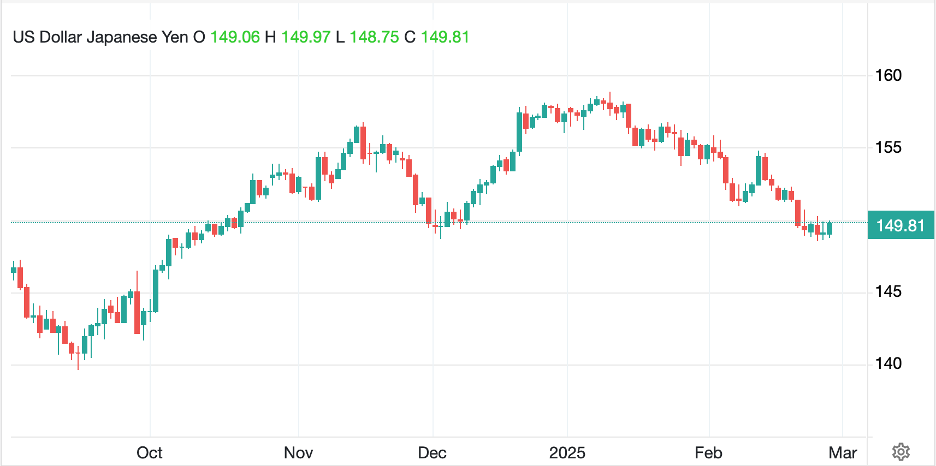
With that in mind, it is worth turning our attention this morning to Japan, where the yen (-0.4%) has been steadily climbing in value, although not this morning, since the beginning of the year as you can see from the chart below.

Source: tradingeconomics.com

Amongst G10 currencies, the yen is the top performer thus far year-to-date, rising about 5%.  Arguably, the key driver here has been the ongoing narrative that the BOJ is going to continue to tighten monetary policy while the Fed, as discussed yesterday, is still assumed to be cutting rates later in the year.  

Let’s consider both sides of that equation.  Starting with the Fed, just yesterday Atlanta Fed president Bostic explained to a housing conference, “we need to stay where we are.  We need to be in a restrictive posture.”  Now, I cannot believe the folks at the conference were thrilled with that message as the housing market has been desperate for lower rates amid slowing sales and building activity.  But back to the FX perspective, what if the Fed is not going to cut this year?  It strikes me that will have an impact on the narrative, and by extension, on market pricing.

Meanwhile, Atsushi Mimura, the vice finance minister for international affairs (a position known colloquially to the market as Mr Yen) explained, when asked about the current market narrative regarding the BOJ’s recent comments and their impact on the yen, said, “there is no gap with my view.  Amid high uncertainty, we have to keep watching the impact of any speculative trading on, not only the exchange market, but also financial markets overall.”  

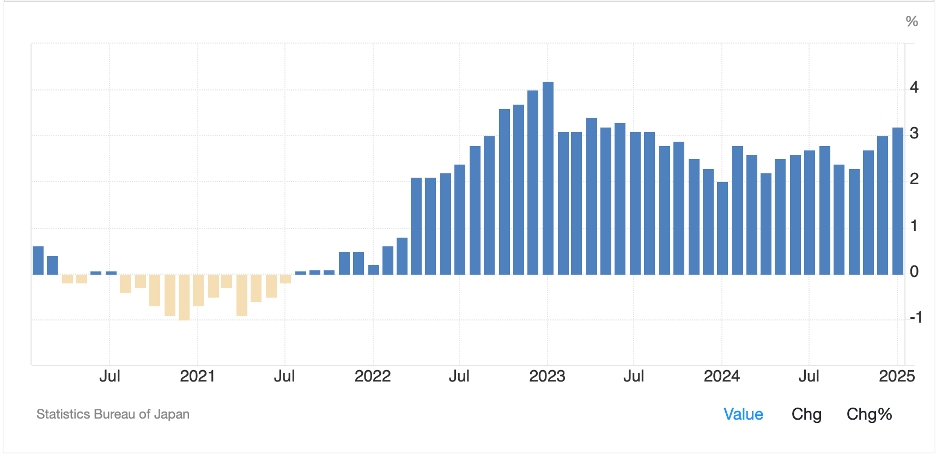
If I were to try to describe the current market narrative on the yen, it would be that further yen strength is likely based on the assumed future narrowing of interest rate differentials between the US and Japan.  That has been reinforced by Ueda-san’s comments that they expect to continue to ‘normalize’ policy rates, i.e. raise them, if the economy continues to perform well and if inflation remains stably at or above their 2% target.  With that in mind, a look at the below chart of Japanese core inflation shows that it has been above 2.0% since April 2022.  That seems pretty stable to me, but then I am just a poet.

Source: tradingecomnomics.com

Adding it all up, I feel far better about the Japanese continuing to slowly tighten monetary policy as they have a solid macro backdrop with inflation clearly too high and looking like it may be trending a bit higher.  However, the other side of the equation is far more suspect, as while the market is pricing in rate cuts this year, recent Fed commentary continues to maintain that the current level of rates is necessary to wring the last drops of inflation out of the economy.

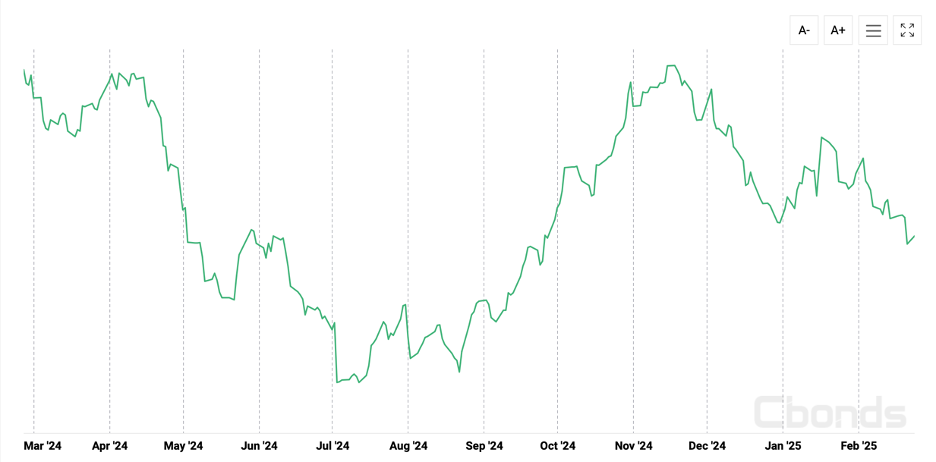
There is a caveat to this, though, and that is the gathering concern that the US economy is getting set to fall off a cliff.  While that may be a bit hyperbolic, I do continue to read pundits who are making the case that the data is starting to slip and if the Fed is not going to be cutting rates, things could get worse.  In fairness to that viewpoint, the Citi Surprise Index is pointing lower and has been declining since the beginning of December, meaning that the data releases in the US have underperformed expectations for the past two months. (see below)

Source: cbonds.com

However, a look at the Atlanta Fed’s GDPNow estimate shows that Q1 is still on track for growth of 2.3%, not gangbusters, but still quite solid and a long way from recession.  I think we will need to see substantially weaker data than we have to date to get the Fed to change their wait-and-see mode, and remember, employment is a lagging indicator, so waiting for that to rise will take even longer.  For now, I think marginal further yen strength is the most likely outcome as we will need a big change in the US to alter current Fed policy.

Ok, let’s see how markets have behaved overnight.  Yesterday saw a reversal of recent US equity performance with the DJIA slipping while the NASDAQ rallied, although neither moved that far.  In Asia, the Nikkei (+0.3%) edged higher as did the CSI 300 (+0.2%) although the Hang Seng (-0.3%) gave back a small portion of yesterday’s outsized gains.  The rest of the region, though, was under more significant pressure with Korea, Taiwan, Indonesia and Thailand all seeing their main indices decline by more than -1.0%.  In Europe, red is the most common color on the screen with one exception, the UK (+0.35%) where there is talk of resurrecting free trade talks between the US and UK.  But otherwise, weakness is the theme amid mediocre secondary data and growing concern over US tariffs.  Finally, US futures are nicely higher this morning after Nvidia’s earnings were quite solid.

In the bond market, Treasury yields (+4bps) have backed up off their recent lows but remain in their recent downtrend.  Traders keep trying to ascertain the impacts of Trump’s policies and whether DOGE will be able to find substantial budget cuts or not with opinions on both sides of the debate widely espoused.  European sovereign yields have edged higher this morning, up 2bps pretty much across the board, arguably responding to the growing recognition that Europe will be issuing far more debt going forward to fund their own defensive needs.  And JGB yields (+4bps) rose after the commentary above.

In the commodity markets, oil (+1.1%) is bouncing after a multi-day decline although it remains below that $70/bbl level.  The latest news is that Trump is reversing his stance on Venezuela as the nation refuses to take back its criminal aliens.  Meanwhile, gold (-1.1%) is in the midst of its first serious correction in the past two months, down a bit more than 2% from its recent highs, and trading quite poorly.  There continue to be questions regarding tariffs and whether gold imports will be subject to them, as well as the ongoing arbitrage story between NY and London markets.  However, the underlying driver of the barbarous relic remains a growing concern over increased riskiness in markets and rising inflation amid the ongoing deglobalization we are observing.

Finally, the dollar is modestly firmer overall vs. its G10 counterparts, with the yen decline the biggest in the bloc.  However, we are seeing EMG currency weakness with most of the major currencies in this bloc lower by -0.3% to -0.5% on the session.  In this case, I think the growing understanding that the Fed is not cutting rates soon, as well as concerns over tariff implementation, is going to keep pressure on this entire group of currencies.

On the data front, we see the weekly Initial (exp 221K) and Continuing (1870K) Claims as well as Durable Goods (2.0%, 0.3% ex Transport) and finally the second look at Q4 GDP (2.3%) along with the Real Consumer Spending piece (4.2%).  Four Fed speakers are on the calendar, Barr, Bostic, Hammack and Harker, but again, as we heard from Mr Bostic above, they seem pretty comfortable watching and waiting for now.

While I continue to believe the yen will grind slowly higher, the rest of the currency world seems likely to have a much tougher time unless we see something like a Mar-a Lago Accord designed to weaken the dollar overall.  Absent that, it is hard to see organic weakness of any magnitude, although that doesn’t mean the dollar will rise.  We could simply chop around on headlines until the next important shift in policy is evident.

Good luck

Adf

Japanese Tao

Japanese prices
Are rising ever higher
Probably nothing!
 
Meanwhile Ueda
Explained QE can still be
The Japanese Tao


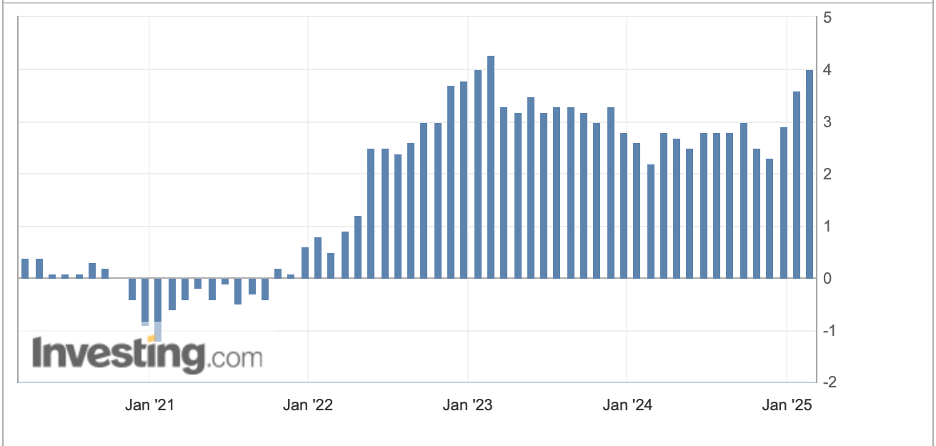
Japanese inflation data was released last night, and the picture was not very pretty.  In fact, let me show you.  The first chart shows the monthly readings of annual inflation for the past 5 years.  Last night’s 4.0% reading was not the highest in that period, (that distinction belongs to Feb 2023 at 4.3%), but it is pretty clear that any sense of declining inflation is beginning to dissipate and has been doing so for the past year.  PS, remember, Japanese interest rates range from 0.5% in the overnight to 1.425% in the 10-year, so real rates remain highly negative regardless of your timeframe.

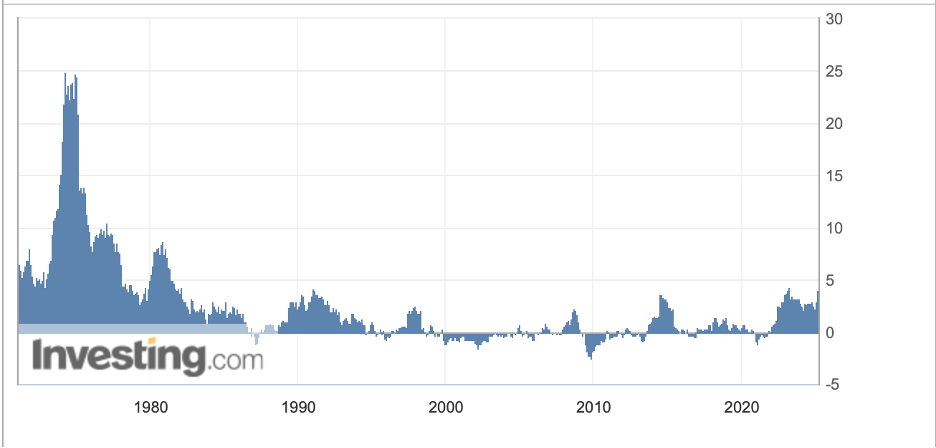
The second picture takes a longer-term perspective to help us better understand the long history of inflation in Japan.  While a decade ago, inflation showed an uptick of nearly the recent magnitude, that was driven specifically by the government raising the GST (goods and services tax) which was Japan’s answer to a VAT.  It was highly controversial at the time but was also understood to have a truly transitory impact as it was a one-off rise in prices.  However, beyond that period, the Japanese have been living with inflation somewhere between -2.2% in the wake of the GFC and 2.0% since the turn of the century.  In fact, going back to the 1990’s, inflation didn’t reach current levels, and one must head back to 1981 to see significant inflation in Japan.  This means there are two generations of people who have basically never seen prices rise in the current manner.

So, what do you think the central bank is considering?  Let me give you Ueda-san’s own words, [emphasis added] “In exceptional cases where long-term interest rates rise sharply in a way somewhat different from normal movements, we will flexibly increase purchases of government bonds to promote stable formation of interest rates in the market.”  You read that correctly inflation is rising sharply, JGB yields are rising in sync and the BOJ’s response is to BUY MORE BONDS!!!  You cannot make this stuff up.  I guess old habits die hard.

The market response to this was as you might expect.  JGB yields dipped 2bps, Japanese equities managed a modest rally (+0.3%) as they seem caught between lower rates and higher inflation, and the yen ( -0.5%) weakened.  In essence, it appears the combination of a strengthening yen and rising interest rates has the potential to wreck the Japanese government’s budget, and the BOJ went back to form and discussed more QE as a response.  This is simply more proof that there isn’t a central bank in the world that truly cares about inflation.  While stable inflation may be a mandate, it is the last of their concerns.

Inflation is, however, not the last of our concerns, at least as we try to live day to day.  This is what has me concerned about Chairman Powell and his minions at the Fed, they continue to believe that the current interest rate structure is restrictive and despite the fact there is virtually no evidence prices are ever going to get back to their target of 2.0%, let alone true stability, still see cuts as the way forward.  Perhaps I am mistaken to believe that the Fed will see the light and maintain current policy levels or even tighten as inflation rebounds.  If that is the case, my entire dollar thesis is going to come under a lot of pressure!

Ok, away from the Japanese antics overnight, a brief word about China.  Last night, Premier Li Qiang explained that China will look to “vigorously” improve the services sector of the economy, specifically education, health care, culture and sports, as they once again try to adjust the balance of economic activity to a more domestic focus rather than their historical mercantilist process.  Earlier this week the PBOC reiterated their support for the property market, although for both these efforts, this is not the first time they have been discussed, and the evidence thus far is all their efforts have been fruitless.  But for one day, at least, these comments have been embraced as the Hang Seng (+4.0%) and CSI 300 (+1.3%) both rallied sharply on the news of more domestic support for the Chinese economy.  The Chinese are set to hold a key economic confab as they try to plan how to shake things up a bit, and these comments, as well as a seeming promise the PBOC is going to cut rates again, are all of a piece.  Maybe they will be successful this time, but I am not holding my breath.

Otherwise, the only other noteworthy economic news came from the Flash PMI’s across Europe which were soggy at best, certainly not indicative of significant growth coming soon.  With that in mind, let’s look at the rest of the markets’ overnight performance.  The rest of Asia’s equity markets were mixed with Taiwan’s the best performer and several modest declines elsewhere including India, Australia and New Zealand.  In Europe, though, despite those modest PMI outcomes, most markets are higher led by the CAC (+0.5%).  Perhaps, the view is the ongoing weakness will force the ECB to cut rates more quickly, and we have heard several ECB members indicate further cuts are coming.  However, counter to that, Isabel Schnabel, one of the more hawkish members, mentioned this morning that she believed they were already at neutral, and more cuts may not be necessary.  While that is not the consensus view yet, it is worth remembering.  As to the US futures market, at this hour (7:00), all three major indices are basically unchanged.

In the bond market, yields have fallen across the board with Treasuries, after sliding yesterday, down another 2bps this morning and back below 4.50% for the first time in a week.  In a Bloomberg interview yesterday, Secretary Bessent explained that although his goal is to reduce the issuance of T-bills and term out debt, given the situation which he inherited from the previous administration, that process will take longer than some had considered previously.  In other words, there won’t be a large increase in 10-year issuance any time soon. European sovereign yields are also much softer, down between -3bps and -5bps on those further rate cut hopes, or perhaps the lackluster PMI data.

In the commodity markets, oil (-0.8%) is backing off its recent rally highs, but remains quiet overall and well within its ever-tightening trading range.  It seems traders don’t know how to handicap the constant discussions from the Trump administration and whether Russian sanctions will end or not, as well as how quickly OPEC may ramp up production and what is happening to demand.  While none of these things are ever certain, right now they seem particularly fraught.  In the metals space, gold (-0.4%) is backing off from yesterday’s latest all-time highs, and taking both silver and copper with it, but the uptrend in all three of these metals remains quite strong.

Finally, the dollar is higher this morning gaining ground against all its G10 counterparts with the yen being the worst performer, but also against all its EMG counterparts with HUF (-1.0%) the true laggard although the entire CE4 are under pressure, arguably responding to the mayhem over how the Ukraine situation plays out.  After all, they are the closest in proximity and likely to be the most impacted.

On the data front, this morning brings Flash PMI data (exp manufacturing 51.5. Services 53.0), Existing Home Sales 4.12M) and Michigan Sentiment (67.8).  We also hear from two more Fed speakers, Jefferson and Daly, but again, caution and stasis are the story until further notice, and that notice is not coming from Mary Daly but rather from Jay Powell.

Perhaps the most interesting thing happening right now is that although tariffs remain a major economic force and are clearly on the table, they are not even the 4th most important topic in the market.  Back to my earlier comments, I sincerely hope that the BOJ’s overwhelming dovish stance is not a harbinger of things to come here in the States.  Right now, I don’t think so, but I am far less confident than I was earlier this week.

Good luck and good weekend

Adf