The Fools

In April, it starts with the Fools
But two days thereafter the rules
For importing cars
To where Stars and Bars
Fly will change with tariffs as tools
 
For Europe, the pain will be keen
At least that’s what most have foreseen
And poor crypto bros
Will find their Lambos
May soon cost a price quite obscene


While the political set continues to harp on the “Signal” story, markets really don’t care about political infighting between the parties.  Rather, their focus is keenly attuned to President Trump’s confirmation that starting on April 3rd, there will be a 25% tariff imposed on all imported autos from everywhere in the world.  This is particularly difficult for European auto manufacturers as they produce a far smaller proportion (VW 21%, BMW 36%, Mercedes 41%) of their vehicles in the US than do the Japanese (Honda 73%, Toyota 50%, Nissan 52%), although the Koreans will be impacted as well (Hyundai/Kia 33%).  Ironically, according to Grok, where I got all this information, GM only produces about 54% of their vehicles sold in the US, in the US, with the rest coming from Canada and Mexico.  As an aside, Tesla produces all their vehicles in the US.

Particularly hard hit are the specialty manufacturers like Porsche, Ferrari and Lamborghini, which produce none of their vehicles in the US.  Of course, given the price points of these vehicles, my sense is it may not really hurt their sales as if you are spending $250k on a car, you can likely afford to spend $312.5k as well.  In fact, in a funny way, these tariffs may enhance the Veblen effect where people will brag about paying the higher price as it puts it out of reach of more people.

Nonetheless, the action merely confirms that President Trump is very serious with respect to changing the world’s trading model.  I saw something interesting this morning in that Paul Krugman, who made his name, and won his Nobel Prize, based on work regarding international trade and was the prototypical free trader, has adjusted his views after recognizing that nations need to maintain some manufacturing capabilities for security reasons.  I assure you, if Krugman, who has been a vocal liberal critic of every Republican idea for the past twenty years, agrees with this policy, it will be very difficult for anyone to reject it.

In a perfect world (globo economicus?) free trade accrues benefits to all.  But we don’t live in that world and national priorities often supersede these issues.  The pandemic highlighted the weaknesses that the US had developed in its ability to manufacture key items necessary for its continued economic and defense survival. And remember this, for the world at large, their idea of free trade is they should be able to sell whatever they grow/manufacture into the US with no barriers, but US manufacturers need to be subject to barriers in order to protect other nations’ favored industries and companies.  That world is now history with new rules being written every day and most of them by Donald Trump.

So how have markets responded to this tariff confirmation?  Not terribly well.  Yesterday’s US equity selloff was pretty significant led by the NASDAQ’s -2.0% decline.  In Asia, the Nikkei (-0.6%) also sold off as did Korea (-1.4%), Taiwan (-1.4%) and Australia (-0.4%).  On the other hand, both China (+0.3%) and Hong Kong (+0.4%) managed a better session, seemingly as a rebound against declines in the previous session with the only news showing that Chinese industrial profits fell by -0.3% compared to a Y/Y decline of -3.3% in December.  However, a quick look at a chart of this data for the past five years tells me they need to seasonally adjust it in order to get something meaningful, so I don’t think it really impacted markets.

Source: tradingeconomics.com

As to European shares, it should be no surprise that the tariff announcements have negatively impacted shares there with declines of between -0.2% (Spain) and -0.7% (Germany).  US futures though, at this hour (7:00) are little changed on the session.

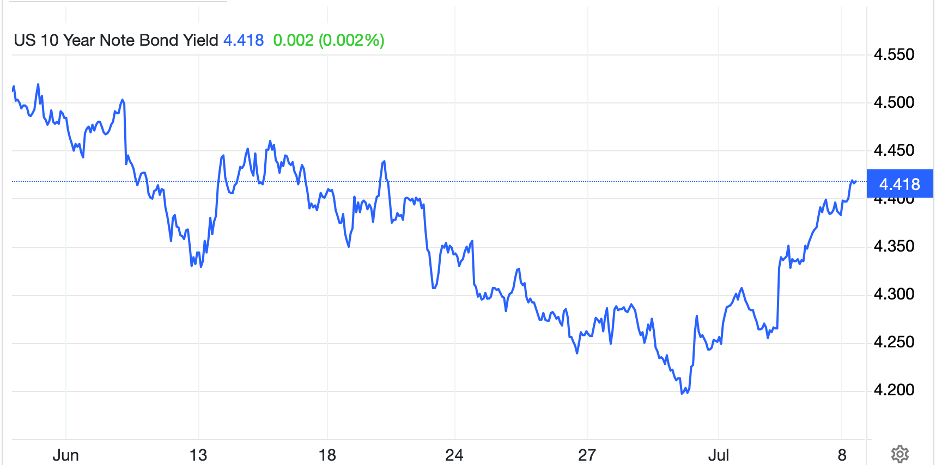
In the bond market, Treasury yields continue to creep higher, up another 3bps this morning and back to levels last seen a month ago.  This cannot be helping Secretary Bessent’s blood pressure, although he very clearly has a plan in mind.  There is much stagflation discussion in the markets by the punditry as they assume tariffs will slow growth and raise prices and bonds are not the favored investment in that scenario.  Meanwhile, European sovereign yields are all sliding this morning, largely down -2bps, amid growth concerns on the back of the tariff announcements.  The one exception here is UK Gilts (+7bps) as the UK Budget announcement indicated slightly more gilt issuance would be necessary to fund the government’s spending plans.  However, there is a growing concern over the financial management of the Starmer government overall.

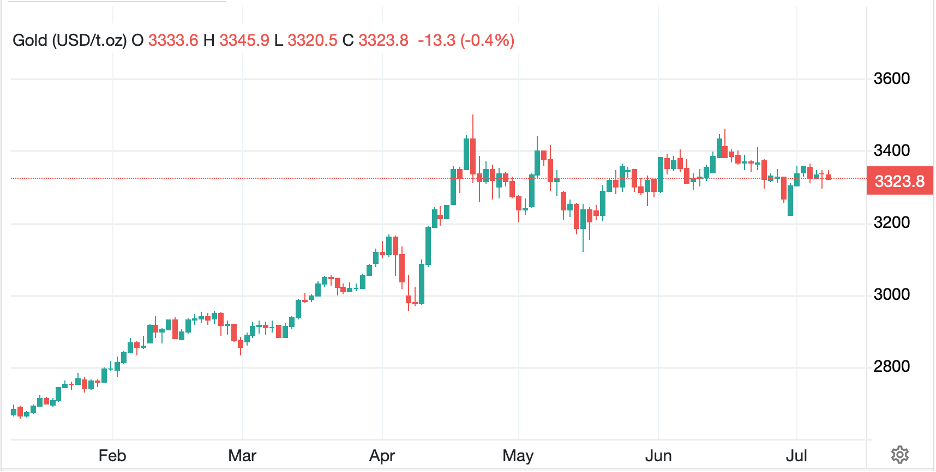
In the commodity markets, oil (-0.35%) is slipping from yesterday’s closing levels and continues to flirt with the $70/bbl level but has not been able to breech it since late February.  Apparently, there are questions as to whether the auto tariffs will reduce demand.  Personally, I would think it is the opposite as more older, less fuel efficient cars will remain on the road here.  As to gold (+1.0%) after a several day pause, it appears that it is resuming its very strong trend higher.  You know what we haven’t heard about lately?  Ft Knox auditing.  I wonder if that is getting arranged or is now so old a story nobody cares.  Silver (+1.0%) is along for the ride although copper (-0.4%) is taking a breather after a breathtaking run to new all-time highs this year.  Look at the slope of the copper chart and you can see why it is pausing, at the very least.

Source: tradingeconomics.com’

Finally, the dollar is broadly softer this morning, with the euro, pound and Aussie all gaining on the order of 0.3%.  As well, NOK (+0.3%) is firmer after the Norgesbank surprised some and left rates on hold with a relatively hawkish message about the future.  But there is weakness vs. the greenback around with JPY (-0.3%), MXN (-0.3%) and INR (-0.2%) all leaning the other way.  Another tariff related story is that India is planning to cut its tariffs in half for the US, a very clear victory for President Trump. 

On the data front, this morning brings the weekly Initial (exp 225K) and Continuing (1890K) Claims data as well as the third and final look at Q4 GDP (2.3%).  Part of the GDP data is Real Final Sales (4.2%) which is a key indicator for what happens here given consumption represents ~70% of the economy.  We do hear from Richmond Fed president Barkin this afternoon, but right now, Fed speakers are speaking into the void.

International statecraft continues to be the underlying thesis of global relations and President Trump’s goals of reshoring significant amounts of manufacturing and jobs along with it is still the primary driver.  There has been far less talk of the Mar-a-Lago Accord as that seems to be losing its luster.  If countries adjust their trade policies, Trump will continue in this direction.  While that may include short-term economic weakness and some pain, for both the economy and the stock markets, there is no indication, yet, he is anywhere near blinking.  One thing to keep in mind is that an overvalued stock market can correct by prices falling sharply, but also by prices stagnating for a long time while earnings catch up and multiples compress.  We may very well be looking at the latter scenario, so no large gains nor losses, just choppy markets going forward.  As to the dollar, lower still seems the direction of travel overall from current levels, but probably in a very gradual manner.

Good luck

Adf

Another Broadside

Investors don’t know where to hide
As Trump lands another broadside
Last night he did roil
All those who buy oil
From Vene, with tariffs applied
 
But yesterday, too, he amended
How tariffs would soon be extended
The lesson to learn
Is you’ll ne’er discern
His methods, so don’t be offended


Once again, the tariff game changed yesterday, although this time in two directions.  The first, and newest idea is that the US will impose “secondary” tariffs on all nations that buy oil from Venezuela.  The idea is to pressure Venezuela to concede to US demands by reducing the market for their one exportable commodity, at least the only one in demand (Tren de Aragua gang members, while a key export, have limited demand it seems).  This decision is being described as a new tool of statecraft, but it strikes me this is no different than previous international efforts like the apartheid movement, by isolating a nation for its behaviors.  Regardless, this was seen as bullish for oil prices.  The reason, as eloquently explained by Ole Hanson, Saxo Bank’s Head of Commodity Strategy, as per the below, is that Venezuelan and Iranian oil production has risen significantly over the past 4 years, offsetting the production cuts of the rest of OPEC+.  Take that oil out, and the demand/supply balance tips toward more demand.

It remains to be seen how this impacts specific countries, but apparently, China is the largest importer of sanctioned crude, so obviously, not a positive for President Xi.  Alas for Chevron, the deal they cut with the Biden administration to restart activity in Venezuela is looking shakier by the day.

But that is only one of the tariff stories.  The other was that there may be changes to previously expected actions come April 2nd, with imposition of tariffs being a bit more gradual nor as widespread as initially feared.  Recall, the idea of the reciprocal tariffs was almost every other nation charges higher tariffs on US goods than the US charges on their goods, so simply raising US tariffs to their levels would be effective.  The next step was focusing on the so-called “Dirty 15” nations that run the major trade surpluses with the US, but now he has indicated that some nations will get breaks.  I particularly loved this comment, “I may give a lot of countries breaks. They’ve charged us so much that I’m embarrassed to charge them what they’ve charged us, but it’ll be substantial, and you’ll be hearing about that on April 2.”

In any event, Trump’s specialty is his ability to think outside the box, or perhaps more accurately, break the box and move to a different container.  There is much consternation amongst business managers, and understandably, since planning is much more difficult in this environment.  However, as I have repeatedly written, the one thing on which we can count is continued higher volatility across all markets.  That condition requires a robust hedging plan for all those who have exposures, that is your only realistic protection.

Other than the tariff story, though, we have not seen much new information so let’s take a look at how markets have handled the latest tariff saga.  Yesterday’s broad US equity rally, on the back of a reduced tariff outlook, was followed by less positive price action in Asia.  While the Nikkei (+0.5%) rallied, potentially on the yen’s recent weakness, Hong Kong (-2.4%) was under great pressure on a weaker tech sector as earnings there were disappointing last quarter.  However, the CSI 300 (0.0%) which has far less tech in its makeup, didn’t budge.  As to the rest of the region, there were more gainers (Taiwan, Malaysia, New Zealand, Indonesia) than losers (Korea, Philippines, Thailand), so arguably the US rally and tariff story helped a bit.

In Europe, though, things are looking solid this morning with green everywhere on the screen and generally substantially so.  The DAX (+0.9%), CAC (+1.2%) and IBEX (+1.1%) are all having solid sessions after German Ifo Expectations data was released a touch better than expected at 87.7, but as importantly, 2 points better than last month.  However, a look at the history of this index shows that while recent data has turned mildly positive, compared to its long-term history, things in Germany remain in lousy shape.

Source: tradingeconomics.com

As to US futures, at this hour (7:10), they are little changed on the day as traders await the next pronouncements with great uncertainty.

In the bond market, though, yields have been climbing everywhere with Treasury yields higher by 2bps this morning after jumping 5bps yesterday.  In fact, we are back at the highest levels in a month, although still well below the peaks seen in early January or last spring.  But this move has dragged European sovereign yields along for the ride with across-the-board gains of 4bps-5bps and similar movement in JGBs overnight.  One of the alleged reasons for this bond weakness were hawkish comments from two ECB members, Slovakia’s Kazimir and Estonia’s Müller.  However, dovish comments from Greece’s Stournaras and Italy’s Cipollone would have seemed to offset that, and did so in the FX markets, but not in the bond market.

Turning to commodities, oil (+0.4%) continues to climb and is once again approaching $70/bbl.  In fact, since that fateful day, March 11th, it has rallied consistently as can be seen below.  I still don’t understand why that date seemed to offer a change of view, but there you go.

Source: tradingeconomics.com

In the metals markets, this morning is once again seeing a bullish tone with both precious and industrial metals in demand.  Gold (+0.5%) continues to be one of the best performing assets around, although so far this year silver (+1.5%) and copper (+1.15%) have been amongst the few things to beat it.  I believe this trend has legs.

Finally, the dollar is softer this morning, falling against both its G10 and EMG counterparts almost universally.  SEK (+0.9%) is the leader in the clubhouse, although we have seen solid gains from AUD (+0.5%) and NZD (+0.6%) with both the euro (+0.2%) and pound (+0.2%) lagging the pace but in the same direction.  JPY (+0.4%) which has suffered a bit lately, is following the broad dollar move this morning.  in the EMG bloc, the CE4 (+0.4% across all of them) is setting the tone with ZAR (+0.4%) right there.  Otherwise, the movement has been a bit more modest (MXN +0.2%, KRW +0.15%), but still putting pressure on the dollar.

Turning to the data, as I never got to show the week ahead, here we go:

TodayCase-Shiller Home Prices4.8%
 Consumer Confidence94
 New Home Sales680K
WednesdayDurable Goods-1.0%
 -ex Transport0.2%
ThursdayInitial Claims225K
 Continuing Claims1890K
 GDP Q4 Final2.3%
 GDP Final Sales Q43.2%
 Goods Trade Balance-$134.6B
FridayPersonal Income0.4%
 Personal Spending0.5%
 PCE0.3% (2.5% Y/Y)
 Core PCE0.3% (2.7% Y/Y)
 Michigan Sentiment57.9

Source: tradingeconomics.com

Obviously, the PCE data Friday will be the most interesting piece of data released, although we cannot ignore Case-Shiller today.  I keep looking at prices rising there at nearly 5% and wondering why economists expect inflation to fall.  If home prices are rising 5% per year, and they represent one-third of the CPI, it doesn’t leave much room for other prices to rise to achieve 2.0%.  Just sayin’.  In addition, we hear from seven different Fed speakers this week.  Now, I have been making a big deal about how Fedspeak doesn’t seem to matter as much anymore.  Perhaps this week, given the overall uncertainty across markets, it will matter.  However, the Fed funds futures market continues to price a bit more than two rate cuts for the rest of the year, which has not changed very much at all in the past month.  I still don’t think the Fed speakers matter right now.

Markets are highly attuned to whatever Trump says about tariffs.  Absent a new war, and maybe even if one starts, I suspect traders (or algos) will focus on that exclusively.  But despite all this, nothing has altered my longer-term view that the dollar will weaken, and commodities remain strong going forward.

Good luck

Adf

Tripping Off Tongues

Recession is tripping off tongues
And pundits ain’t twiddling their thumbs
Political shades
Are driving tirades
And screams at the top of their lungs
 
But are we that likely to see
A minus in our ‘conomy?
We certainly could
And probably should
But life doesn’t always agree


The major discussion point over the weekend has been recession, and how likely we are to see one in the US in the coming months.  Of course, this matters to the punditry not because of any concern over the negative impacts a recession has on the population, but ‘more importantly’ because recessions tend to result in sharp declines in equity values.  And let’s face it, do you honestly believe that the editors of the New York Times or the Wall Street Journal are remotely interested in the condition of the majority of the population?  Me neither. 

However, if they can call out something that they believe can impede President Trump, or detract from his current high ratings, they will play that over and over and over.  Funnily enough, when I went to Google Trends, I looked up “recession” over the past 90 days with the result below:

That peak was on March 11 although there was no data of note that day compared to a reading of 9 today. Looking at the news of that day, even CNN had a hard time finding bad news with the four top stories being 1) the Continuing Resolution vote in the House being passed, 2) the Department of Education announcing a 50% RIF, 3) 25% tariffs on steel and aluminum being imposed and 4) Ukraine accepting terms for a 30-day ceasefire.  From an economic perspective, the tariffs clearly will have an impact, but it seems a leap that the average American can go from 25% tariffs on imported steel and aluminum to recession in one step.  And based on the positive responses that continue to be seen regarding President Trump’s efforts to reduce the size of government, I doubt the DOE cuts were seen as the beginning of the end of the economy.  

And yet, recession was the talk of the punditry this weekend.  To try to better understand why this is the case, I created the following table of several major economic indicators and their evolution since December, prior to President Trump’s inauguration.

Key indicatorsDecJanFeb
NFP323125151
Unemployment Rate4.10%4.00%4.10%
CPI2.90%3.00%2.80%
Core CPI3.20%3.30%3.10%
PCE2.60%2.50% 
Core PCE2.90%2.60% 
IP1.10%0.30%0.70%
Capacity Utilization77.60%77.70%78.10%
ISM Mfg49.250.950.3
ISM Services5452.853.5
Retail Sales0.70%-1.20%0.20%

Source: tradingeconomics.com

Once again, while I am certainly no PhD economist, this table doesn’t strike me as one demonstrating a clear trend in worsening data, certainly not on an across-the-board basis.  Rather, while you might say January was soft, the February data has largely rebounded.  My point is that despite ABC, NBC, Bloomberg, the BBC and CNN all publishing articles or interviews on the topic this weekend, I’m not yet convinced that is the obvious outcome.

My good friend the Inflation Guy™, Mike Ashton, made an excellent point in a recent podcast of his that is very well worth remembering.   The breadth of the US economy is extraordinarily wide and covers areas from manufacturing to agriculture to finance to energy and technology along with the necessary housing markets as well as the entire population consuming both goods and services.  Added to the private sector, the government sector is also huge, although President Trump and Elon Musk are trying hard to shrink it.  But the point is that it is not merely possible, but likely, that while some areas of the economy may go through weak patches, that doesn’t mean the entire economy is going to sink into the abyss.

If we think back to the last two recessions, the most recent was Covid inspired, which resulted from the government literally shutting down the economy for a period of several months, while giving out money.  Net, things weakened, but even then, there were stronger parts and weaker parts.  Go back to the GFC and the housing bubble popped and dragged banks along with it.  That was the problem because banking weakness inhibits the free flow of money and that will impact everyone.

The question to be asked now, I would suggest is, are we likely to see another catalyst that will have such widespread impacts?  Higher tariffs are not going to do the trick.  Shrinking government, although I believe it is critical for a better long-term trajectory for the economy, will have a short-term impact, but it is not clear to me that it will negatively impact the economy writ large.  Certainly, the Washington DC area, but will it impact the Rocky Mountain area?  Or Texas and Florida?  

Now, a recession could well be on the way.  Running 7% budget deficits was capable of papering over many holes in the economy and pumping lots of liquidity into it as well.  If those deficits shrink, meaning spending shrinks, the pace of activity will slow.  But negative?  It seems a stretch to me, at least based on what we have seen so far.  One last thing here, is how might this potential weakening economic growth impact inflation? Now, we all ‘know’ that a recession causes inflation to decline, don’t we?  Hmmm. While that makes intuitive sense, and we hear it a lot, perhaps the Inflation Guy™ can help here as well.  Back in February he wrote a very good explanation about how that is not really the case at all, at least based on the macroeconomic data.  The truth is economic growth and inflation have very little correlation at all.

Of course, perhaps the most critical issue for the punditry is, will a recession drive stock prices lower?  Here the news is far less sanguine if you are a shareholder and believe there is going to be a recession.  As you can see from the below chart of the S&P 500, pretty much every recession for the last 100 years has resulted in a decline in stock market indices.

Source: macrotrends.net

This is a log chart so some of those dips don’t seem that large, but the average downturn during a recession is about 30%, although that number can vary widely.  To sum it up, while the data doesn’t scream recession to me, it cannot be ruled out.  As well, both President Trump and Secretary Bessent have indicated that weakness is likely going to be a result of their early actions, although the idea is to pave the way for a more stable economic performance ahead.  As I have written repeatedly, volatility is likely the only thing of which we can be certain as all these changes occur.  Hedge your exposures!

Ok, let’s look at the overnight activity.

The rumor is Trump may delay
His tariffs as he tries to weigh
How much he should charge
And how much, writ large,
These nations are going to pay

Equity futures in the US are higher this morning as the big story is that President Trump is considering narrowing the scope of nations who will have tariffs imposed on April 2nd.  Apparently, his administration has identified the “dirty fifteen” nations with the largest bilateral imbalances and they will be first addressed.  The telling comment in the WSJ article I read was when Trump said, “Once you give exemptions for one company, you have to do that for all. The word flexibility is an important word. Sometimes there’s flexibility, there’ll be flexibility.”  To my ear, the final plans are not in place, but my sense is he will impose then remove tariffs, rather than avoid them initially.  Interestingly, that story was written last night, yet Asian equity markets were not that ebullient.  Japan (-0.2%) saw no benefit although Chinese shares (HK +0.9%, CSI 300 +0.5%) fared better. Things elsewhere in the region were mixed with both gainers (India, Thailand) and laggards (Korea, Taiwan, Indonesia) with many bourses little changed overall.

In Europe, green is the predominant color this morning but movement is modest with Spain’s IBEX (+0.4%) the leader and lesser gains elsewhere.  While US futures are all higher by about 1% or more at this hour (6:45) apparently the Europeans aren’t as excited at the tariff delay process.

In the bond market, yields have backed up virtually across the board with Treasuries (+4bps) leading the way higher and most European sovereigns showing yields rising by 1bp or 2bps.  It’s interesting, while there has been much discussion regarding German yields having traded substantially higher in the wake of the effective end of the debt brake and anticipation of much further issuance, a look at the chart below tells me that after that gap higher on the news, concerns over German finances have not deteriorated at all.  And after all, the difference is about 25bps higher, hardly the end of the world.

Source: tradingeconomics.com

In the commodity markets, oil (+0.7%) is continuing its gradual rebound from the lows seen on, ironically, March 11th.  Arguably, what this tells us is that despite the weekend barrage of recession focused articles, the market doesn’t really see that outcome.  In the metals, strength is the word, again, with copper (+1.25%) making new all-time highs on the back of China’s stated goals of growing its strategic stockpile.  Not surprisingly, both gold (+0.2%) and silver (+0.6%) are also climbing this morning alongside copper as commodities remain in greater demand than a recession would indicate.

Finally, the dollar is a bit softer despite rising Treasury yields with both the euro (+0.3%) and pound (+0.4%) bouncing after last week’s modest declines.  And this is despite lackluster Flash PMI readings this morning out of Europe.  The biggest winner is NOK (+0.6%) which given the dollar’s broad weakness and oil’s rebound makes perfect sense.  Otherwise, while the dollar’s weakness is broad, it is no deeper than the aforementioned currencies.

Given the length of this note already (my apologies) and the dearth of data to be released, with only the Chicago Fed National Activity Index (exp +0.08), I will cover data tomorrow as we do end the week with GDP and PCE data.

Headline bingo remains the key concern for all market participants, but ultimately, my altered view of a softer dollar and higher commodities remains intact.

Good luck

Adf

Starting to Fret

In DC, they’re starting to fret
That Trump will make good on his threat
If government closes
The risk that it poses
Is markets become quite upset


There is yet another budget showdown in Washington as the Biden administration never passed the bills necessary to fund the government for the rest of this fiscal year ending on September 30th.  The previous continuing resolution (CR) expires at midnight on Saturday and if a new funding law is not enacted, then a government “shutdown” occurs.  Now, a government shutdown is not like a company that runs out of money shutting down.  Rather roles the President deems essential continue to operate, along with the military, but other roles see the people furloughed until new legislation is passed.  Everybody gets paid back wages when things go back to normal.

The situation is that the House of Representatives did pass a CR to fund the government at almost the exact same levels as last year and sent it to the Senate.  However, in the Senate, it needs to beat a filibuster, so needs 60 votes to pass and get to President Trump’s desk.  However, last night, Senate Minority Leader Shumer declared the Democrats would not support the bill, so would rather have the government shut down.  This is a big change from the previous 3 times that there were government shutdowns, because each of those was blamed on Republican intransigence.  

In the end, whatever the politics, the market impact has been negative for stocks while bonds held up, even rallied.  Of course, previous shutdowns all were amidst very different economic environments as inflation was quiescent and bull markets in both stocks and bonds were extant.  As such, arguably, the momentum behind the market was sufficient to offset any concern over the shutdown.  But this time markets are already under pressure going into the potential shutdown.  I fear that market dislocation, at least in the equity markets, could be far more severe if this one occurs.  Something to keep in mind.

The history shows the US
Has long done all things to excess
But now, as they try
With less, to get by
The pundits complain of regress

Reading the WSJ this morning, I couldn’t help but think of the George Costanza opposite day episode of Seinfeld when reading the Heard on the Street column decrying the fact that the Trump administration is seeking to rein in fiscal excess.  Of course, this is an issue that has been fodder for the punditry for a long time, how the US was living beyond its means and borrowing too much money.  But now, this article is concerned about the opposite.  The key concern is that if the US government doesn’t continue to run massive deficits, the economy will slow and corporate profits will fall dramatically, resulting in falling equity prices.

Arguably, this would always be the case if a change of this nature were to be made.  And remember, the punditry was all in on making these changes.  However, now, they point to Germany and the DAX, which has outperformed US markets over the past several weeks as the model.  (chart below from WSJ)

And what is Germany doing so well?  Why, they are talking about borrowing an extra €500 billion, eliminating their debt brake that ensures budget deficits remain below 0.35% of GDP, and funding a huge buildup in defense spending.  Germany, which has long been seen as the only source of fiscal rectitude is now being lionized for getting rid of that trait.  As I said, opposite day!

The lesson, if you haven’t learned it yet, is that the ascendance of Donald Trump to the presidency is going to continuously change many long-held beliefs in governments around the world, as well as in the punditry, who may find that things which seemed great in theory may have consequences previously unconsidered.  From a market perspective, this means volatility will continue to be the best estimate for the future.

Ok, let’s turn our attention to markets and see how things performed overnight.  After yesterday’s mixed session in the US, where the DJIA could not manage a gain despite cooler than expected CPI readings, overnight saw a mixed picture as well.  Japan was either side of unchanged while both Hong Kong (-0.6%) and China (-0.4%) slipped as did most other Asian markets with Malaysia (+1.7%) the true exception.  In Europe, though, screens are green as excess government spending is rewarded, although the gains are modest, 0.3% or so.  

On the topic of excess spending regarding Germany, I read yesterday that the plan to alter the constitution may have serious problems (meaning that spending may not materialize) because about 50 Bundestag members in the old parliament lost their seats in the election, so it is not clear they will be willing to vote to overturn the constitution during the current lame duck session and allow the debt brake to be set aside for defense purposes.  As I said when the story first arose, we are still a long way from Germany paying their own way defensively.  US futures, meanwhile, are slightly softer at this hour (7:15).

In the bond market, yesterday saw yields climb a few bps and this morning those trends remain with Treasury yields (+2bps) not climbing as much as European sovereigns (+3bps to 4bps) as there appears to still be a level of confidence that all the extra defense spending will happen.  One story that should have Europeans concerned is that the European Commission, in their effort to find funding for their newly found defensive aggressiveness, have spied the €10 trillion in savings that European citizens hold.  Frau von der Leyen, the European Commission President was quoted as saying, ”we’ll turn private savings into much needed investment.” 

Call me crazy but my economics classes taught me the identity that Savings º Investment, so I am not sure why those savings aren’t already being invested.  Perhaps European citizens are not investing where Frau von der Leyen wants and that is the problem.  At any rate, I suppose even if Germany fails to overcome its constitutional debt brake, the EU will get there anyway.

In the commodity markets, oil (-0.3%) is edging lower after a nice run for the past several days as it bounced off the bottom of its trading range.  Yesterday’s EIA data showed a large draw in gasoline, but I am given to understand that is a seasonal thing (H/T Alyosha).  Meanwhile, nothing has dissuaded investors that gold (+0.25%) is a good thing to hold as it rallied further after yesterday’s gains, although both silver (-0.3%) and copper (-0.4%) are a touch softer this morning.

Finally, the dollar is somewhat firmer this morning, albeit not dramatically so.  Of course, it has been under significant pressure during the past week+, so this trading response ought be no surprise.  SEK (-0.8%) is the laggard in the G10, but you must remember that it has been the leading gainer over the past month.  Meanwhile, AUD (-0.5%) and NZD (-0.45%) are also under a bit of pressure this morning, but the rest of this bloc has seen far less movement.  In the emerging markets, HUF (-0.6%) is the laggard with the rest of the bloc seeing declines on the order of -0.3% or less.  As I said, nothing dramatic here to see.

Yes, yesterday’s CPI data was a bit cooler than anticipated, but as my friend The Inflation Guy™, Mike Ashton, explained here, I wouldn’t get too excited that inflation is collapsing back to the Fed’s 2% target.  This morning brings the weekly Initial (exp 225K) and Continuing (1900K) Claims data as well as PPI (headline 0.3%, 3.3% Y/Y; core 0.3%, 3.5% Y/Y). However, given CPI is already out, I don’t think it will have much impact.  Rather, as we have observed lately, politics remains the key driver of all market reactions.  The unfolding government shutdown in the US and the German debt drama are the two most noteworthy issues right now, but Ukraine and the Middle East are still out there to offer surprises.

Once again, volatility is the only thing about which we can be sure.  That said, my confidence is growing that the dollar will decline over time.

Good luck

Adf

In a Trice

The calendar’s not e’en turned twice
Since Trump, with JD as his Vice
Have taken the reins
And beat up on Keynes
While weeding out waste in a trice
 
For markets, the problem, it seems
Is rallies are now merely dreams
So, equity buyers
Are putting out fires
While thinking up pump and dump schemes
 
For bondholders, it’s not so clear
If salvation truly is near
But one thing seems sure
The buck will endure
Much weakness throughout this whole year


We have not even reached 50 days of a Trump presidency as of this morning and nobody would fault you if you estimated we had three years of policies enacted to date.  The pace of changes has been blistering and clearly most politicians, let alone investors, have not been prepared for all that has occurred.

One of the things that I read regularly is that Trump is destroying the Rules Based Order (RBO) which was underpinned by the Pax Americana of the US essentially being the world’s policeman.  This is cast as a distinct negative under the premise that things were going great and now, he is upsetting the applecart for his own personal reasons.  Of course, market participants had grown quite accustomed to this framework, had built all sorts of models to profit from it and with the Fed’s help of monetization of debt, were able to gain significantly at the expense of those without market linked assets.  Hence, the K-shaped recovery.

But while that is a lovely narrative, is it really an accurate representation of the way of the world?  If the US was truly the world’s policeman, and we certainly spend enough on defense to earn that title, perhaps it was time for the US to be fired from that role anyway.  After all, there is currently raging military conflict in Ukraine, Lebanon, Syria, Congo, Sudan and the ongoing tensions in Gaza.  That’s a pretty long list of wars to claim that things were going great.

Secondly, the question of financing all this conflagration, as well as other economic goals, notably the alleged transition to net zero carbon energy production, appears to be reaching the end of the line.  While the US can still borrow as needed, (assuming the debt ceiling is raised), the reality is that the US gross national debt outstanding is greater than $36,000,000,000,000 relative to GDP that is a touch under $28,000,000,000,000.  On a global basis, total (not just government) debt is in excess of $300,000,000,000,000 while global GDP clocks in somewhere just north of $100,000,000,000,000.  Arguably, on a credit metric basis, the world is BB- or B+, a clear indication that all that debt is unlikely to be repaid.

If we consider things considering this information, perhaps the RBO had outlived its usefulness.  Arguably, the loudest complaints are coming from those who benefitted most greatly and are quite unhappy to see things change against them.  But as evidenced by the polls taken after President Trump’s speech last Tuesday evening, the bulk of the American public is still strongly supporting this agenda.  The idea that the president and his Treasury secretary are seeking to engineer a short-term recession early, blame it on fixing Biden’s mess, and having things revert to stronger growth in time for the 2026 mid-term elections is not crazy.  In fact, there have been several comments from both men that short-term pain would be necessary to achieve a stabler, long-term gain.

So, what does this mean for the markets?  You have no doubt already recognized that volatility is the main event in every market, and I don’t see that changing anytime soon.  But some of the themes that follow this agenda would be for US equities to suffer relative to other markets, as the last decade plus of American exceptionalism, led by massive deficit spending and borrowing, would reverse under this new thesis.  Add to this the sudden realization that other nations are going to be investing significantly more in their own defense, and money will be flowing out of the US into Europe, Japan and emerging markets around the world.

Bonds are a tougher call as a weaker economy would ordinarily mean lower yields, but the question of tariff impacts on prices, as well as reshoring, which, by definition, will raise prices, could mean we see the yield curve steepen with the Fed cutting rates more aggressively than currently priced, but 10-year and 30-year yields staying right where they are now.

I believe this will be a strong period for commodities as all that foreign capex will be a driver, as will the fact that, as I will discuss shortly, the dollar is likely to underperform significantly.  Gold will retain its haven characteristics as well as remain in demand for foreign central banks, while industrial metals should hold their own.  As to oil, my take is lower initially, as OPEC returns its production and slowing GDP weighs on demand, at least for a while, although eventually, I suspect it will rebound along with economic activity.

Finally, the dollar will remain under significant pressure across the board.  Clearly, Trump is seeking a weaker dollar to help the export industries, as well as discourage imports.  Add to this the potential for lower yields, lower short-term rates, and an exit of equity investors as US stocks underperform, and you have the making of at least another 15% decline in the greenback this year.

With this as backdrop, we need to touch on three key stories this morning.  First, Friday’s NFP report was pretty much in line with expectations at the headline level but seemed a bit weaker in some of the underlying bits, specifically in the Household Survey where a total of 588K jobs were lost and there was a large increase in the number of part-time workers doing so for economic reasons.  Basically, that means they wanted full-time work but couldn’t find a job.  Markets gyrated after the release, with yields initially sliding but then rebounding to close higher on the day.  Equities, too, closed higher on the day although that had the earmarks of a relief rally after a lousy week overall.  The thing about this report is that it did not include any of the government changes that have been in the press, so next month may offer more information regarding the impact of DOGE and their cuts.

The second story comes from north of the border where Mark Carney, former BOC and BOE head, was elected to lead the Labour Party in Canada and replace Justin Trudeau.  As is always the case, when there is new leadership, there is excitement and he said he will call for a general election in the next several weeks, ostensibly to take advantage of this new momentum.  It seems that President Trump’s derision of not only Trudeau, but Canada as well in many Canadian’s eyes, will play a large role with the two lead candidates, Carney and Poilievre, fighting to explain that they are each better placed to go toe-to-toe with Trump on critical issues.

Here’s the thing, though.  Despite much angst about the US-Canada relationship on the Canadian side of the border, the market viewpoint is nothing has really changed.  a look at the chart below shows that after a bout of weakness for the Loonie in the wake of the US election and leading up to Trump’s tariff announcements, USDCAD is basically unchanged since mid-December, with one day showing a spike and reversal in early February.  My point is that the market has not, at least not yet, determined that the Canadian PM matters very much.

Source: tradingecoomics.com

The last story to discuss is Chinese inflation data which was released Saturday evening in the US and showed deflation in February (-0.7% Y/Y) for CPI and continuing deflation in PPI (-2.2%).  In fact, as you can see from the below chart, PPI in China has been in deflation for several years now.  Recently there have been several articles explaining this offers President Xi a great opportunity for significant stimulus because no matter how much the government spends and how much debt they monetize, inflation won’t be a problem for a long time to come.  I would counter that given deflation has been the norm for several years, they have had this opportunity for quite a while and done nothing with it.  Why will this time be different?  Ultimately, the default result in China is when things are not looking like they will achieve the targeted growth of “about 5%”, you can be sure there will be more investment to build things up adding still more downward pressure on prices as production facilities increase.  

Source: tradingeconomics.com

The renminbi’s response to this news has been modest, at best, with a tiny decline overnight of -0.25%.  And a look at the chart there shows it is remarkably similar to the CAD, with steady weakness through December and then no real movement since then.  Given the dollar’s recent weakness overall, this seems unusual.  Although, we also know that China prefers a weaker currency to help support their export industries, so perhaps this in not unusual at all.

Source: tradingeconomics.com

Ok, this note is already overly long, so will end it here.  We do have important data later this week with both CPI and Retail Sales coming.  As well, the consensus from the Fedspeak is that they are pretty happy right here and not planning to do anything for a while.

The big picture is best summarized, I believe, by the idea that we are at the beginnings of a regime change in markets as discussed above.  Volatility continues to be the driving force, so hedging remains crucial for those with natural exposures.

Good luckAdf

Things Are Creaking

Before Mr Trump started speaking
The Chinese explained things are creaking
As growth there is slow
So now they will blow
More funds to achieve what they’re seeking


The Chinese government has outlined a very active agenda for 2025 as the current pace of growth in their economy remains sluggish at best.  They continue to focus on a 5% headline GDP target and have promised to increase the budget deficit by a similar amount, so the idea of organic growth seems to be dead.  They reiterated their plan to recapitalize the big banks with CNY 500 billion and are looking to raise defense spending by 7.2%.  Long term debt issuance will increase with CNY 1.3 trillion planned for this year and they talk about adding 12 million urban jobs.  It all sounds fantastic.
 
But will it work?  Of course, there is no way to know yet, but if history is any guide, the mercantilist structure of the Chinese economy remains extremely difficult to overcome and replace with a more consumer-focused economy.  The property market there remains in terrible shape and that continues to be a drag on the overall economy as individuals, who had been encouraged to invest in property as a means of creating a retirement nest egg find themselves with much less disposable income and an illiquid and depreciating asset.
 
President Trump’s tariffs are not going to help them at all, but it is unclear if they will be significantly detrimental.  While I would not bet against China reporting 5% GDP growth in 2025, given the questionable reliability of their data, it is not clear it will be reflective of the state of the nation.
 
My take on market impacts are as follows: Chinese yields will climb as more debt is issued while growth will allegedly increase, Chinese equities should benefit If they are successful at getting things moving, but the yuan will have a harder time in my view, as capital flows to the nation remain stunted.  Of course, much will also depend on the evolution of US policy, which has been erratic, to say the least.

Said Trump, It’s a “new golden age”
As finally, we turn the page
On four years of waste
And so, we’ll make haste
With changes despite Dem outrage

Of course, the other big news was last night’s speech by President Trump to a joint session of Congress where he outlined both the many things he has accomplished in the first 6 weeks of his presidency, but also his plans for the rest of the time.  While many are still reeling from the speed with which changes are being made, there was no indication that his pace is going to slow.

Mr Trump did acknowledge that there may be some short-term pain as the economy adjusts to the changes he has wrought, but he remains focused on the long-term and how to achieve a strong economy with a far better balance sheet and a smaller government.  The implication is that he is still the avatar of volatility, and that aspect will not be changing.

Let us, though, take a step back and look at a much bigger picture.  For the past seventeen years, the US economy was the clear leader in global growth with massive government spending and budget deficits incurred to drive the process.  Meanwhile, while most of the rest of the world exited the pandemic with a burst of reopening growth, they have all lagged the US.  The chart below shows the ratio of the MSCI US index / MSCI World index and demonstrates that investment into the US, following that leading growth profile, has been historic in its effects.

Source: longtermtrends.net

But that situation seems to be changing.  President Trump is openly seeking to reduce the size of the US government and withdraw spending on many foreign adventures while the rest of the world is doing the opposite.  As per the above, China has just announced significant new stimulus.  As well, Europe, now that they need to become more responsible for their own defense, has also announced a major spending plan to rearm themselves.  This is the real sea change, I think, and the one that is going to have the biggest medium and long-term impacts on markets everywhere.  Changes in the level of capital flows and changes in trade patterns are going to significantly impact the value of the dollar as well as stocks, bonds and commodities.  It is a brave new world, so attention must be paid.

In the meantime, let’s see the markets’ initial response to the recent spate of news.  The tariff news has served to undermine US equities for the past two sessions and is still dragging on some markets, but the new spending promises are the new drivers.  So, in Asia, while the Nikkei (+0.2%) managed only a modest rally, the Hang Seng (+2.8%) exploded higher on the Chinese stimulus story although surprisingly, the CSI 300 (+0.5%) did not do nearly as well.  But elsewhere in the region, it was mostly large gains with Korea, India, Taiwan, Indonesia and Thailand all rallying more than 1%.  The laggards were Australia and New Zealand, which seemed to focus on the negatives of tariffs.

In Europe, Germany’s DAX (+3.4%) is the beneficiary of most of the mooted defense spending as not only are there quite a few defense focused firms, but rumors are that the government is going to coopt the auto manufacturers into building defense equipment (shades of WWII).  As well, the rest of the continent is flying (CAC +1.9%, IBEX +1.6%) and even the UK (+0.45%) is benefitting although there is growing concern that the BOE is not going to be aggressively cutting rates to support the economy because of still sticky inflation.  As to US futures, they are bouncing this morning and higher by 0.4% at this hour (7:00).

In the bond market, while Treasury yields rebounded from their recent lows yesterday, gaining 9bps on the day, this morning they are unchanged.  However, a look at European sovereigns tells the story of investors anticipation of a big uptick in new issuance to fund that defense spending.  The picture below is that of German yields, as an example, showing its 20bp rise this morning, but the entire continent has seen yields rise by at least 16bps!

Source: tradingeconomics.com

The market clearly believes the Europeans are going to move forward!

In the commodity markets, oil (-1.6%) remains under pressure as despite the mooted fiscal stimulus, there continues to be more concern over excess supply than newly created demand.  The below chart is quite interesting as a history of long-term price activity in oil with the interpretation that if we are near the supply destruction level, the future for prices is likely to be bullish.  Something to keep in mind. (as an aside, Josh_Young_1 is an excellent follow on X for oil ideas and information.)

As to the metals markets, gold is little changed but copper (+4.7%) has clearly gotten excited over the Chinese stimulus as well as the European defense spending, where copper will be an important piece of the puzzle.

Finally, the dollar is under substantial pressure this morning vs. both G10 and EMG currencies.  Given the yield changes, and my view that 10-year yields have become the FX driver, rather than short-term rates, it should be no surprise that the euro (+0.6%) is rallying to levels not seen since November.  The pound (+0.3%) is following suit, also making 5-month highs.  But the really impressive moves are in the peripheral European currencies with SEK (+1.1%) and PLN (+1.1%) both trading back to levels not seen since September.  On the tariff front, both MXN (+0.25%) and CAD (+0.1%) are lagging the main move but still managing a very modest rally v. the greenback.

In this brave new world, where the US is not the fiscal profligacy leader, but that role is assumed by others, my sense is that the dollar may well have topped for a much longer-term period.  While at the beginning of the year I was confident that the dollar would outperform, the policy changes we have seen since then have altered my views.  While volatility will still be rampant, I believe the broad direction will be a lower dollar going forward.

On the data front, this morning brings ADP Employment (exp 140K) as well as ISM Services (52.6) and Factory Orders (1.6%).  Then we see the EIA oil inventories where a small draw is expected and at 2:00pm, the Fed’s Beige book.  Perhaps the best thing about the changing world order is that central banks are losing some of their market power.  As I wrote yesterday, perhaps US rates are destined to fall as both the president and Chair Powell are keen to see that happen.

At this point, I think the dollar may have seen its highs for quite a while.  Remember, FX trends tend to be very long-term in nature.  For those of you who are payables hedgers, keep that in mind going forward.

Good luck

Adf

Recession in Sight

There once was a policy view
That tariffs, we all should eschew
But President Trump
Explained on the stump
To this idea, he wouldn’t hew
 
And so, as the clock struck midnight
Trump’s tariffs once more saw the light
Most analysts say
The tariffs will weigh
On growth, with recession in sight


By now you are all aware that as of 12:01 EST this morning, 25% tariffs have been imposed on all imports from both Canada and Mexico except energy products, which have seen 10% tariffs imposed.  As well, all Chinese imports have been hit with an additional 10% tariff.  Once again, President Trump has proven to be a man of his word, promising these tariffs during his election campaign and imposing them now.

The mainstream view is that these tariffs are a disaster and will send the economy into a recession.  In fact, the International Chamber of Commerce said a depression was likely.  As well, there is much concern that inflation will rise during the recession, which for Keynesians must be a very difficult concept to grasp given their strongly held belief that a recession will result in declining inflation.

Now remember, I am just a poet, so please take that into account when I offer my views here.  First, we have no idea how things will play out.  The one thing about which I am extremely confident is that there will be numerous behavioral changes by everyone because of these tariffs.  The first question is who will absorb the cost of the tariffs.  Remember, essentially the definition of a recession is that demand is declining.  Will companies be able to pass through the higher costs?  In some instances, they likely will, but in others probably not.  Anecdotally, there was a story in the WSJ that Chipotle will see its costs rise because of the tariff on avocados from Mexico but will not change their prices to account for that.  I’m confident they are not the only company who will absorb those costs.

However, there will certainly be companies that believe they can raise prices and maintain their sales and will try to do that.  My point is each company will evaluate the environment under which they operate and respond in the profit-maximizing manner, but each company’s scenario will be different.

Second, let’s consider the reason that President Trump is such a strong believer in tariffs.  He sees them as the stick to achieve his goals.  I would argue there are two goals in sight.  With Canada and Mexico, he is still unsatisfied with their efforts on the border and with fentanyl smuggling and is very keen to push that to completion.  However, the broader goal is to return manufacturing to America from its decampment overseas, mostly to Southeast Asia, during the past forty years.  And remember, he is seeking to implement a carrot as well, looking to cut corporate taxes to 15% going forward, which would put the US in the lowest quartile of corporate tax rates in the world.  While this morning the headlines are all about the tariffs and their potential destruction, just yesterday, Taiwan Semiconductor announced they would be investing $100 billion to build new fabrication plants in Arizona.  That is exactly the response Trump is seeking.

We all recognize that the world today is very different than it was even two months ago as President Trump has taken an extraordinary number of steps to implement the ideas upon which he was elected.  Interestingly, a large majority of the public remains strongly in his camp with approval ratings for many of his policies well above 60% and as high as 80%.  While markets are clearly unhappy as they have no idea how things will play out, and companies are now faced with far more uncertainty as they attempt to plan for their future, there is no reason to believe this process is going to change anytime soon.  

Keep one other thing in mind, unlike Trump’s first term in office, where he was constantly touting the strength of the stock market as a vote of confidence, this time around he and Treasury Secretary Bessent have been entirely focused on the 10-year yield and getting that rate down.  After a 7bp decline yesterday, he has been successful there. (see chart below) I would be surprised if Trump speaks about the stock market much at all for a while.

Source: tradingeconomics.com

With that in mind, let’s see how markets have been handling the tariff imposition.  After yesterday’s rout in the US, where a higher open morphed into a sharply lower close on the day, we saw red throughout Asia (Nikkei -1.2%, Hang Seng -0.3%, CSI 300 -0.1%) and Europe (DAX -2.1%, CAC -1.2%, IBEX -2.3%).  In fact, it is far harder to find a market that has rallied at all, although US futures at this hour (6:40) are pointing slightly higher.  However, after the sharp declines, an early bounce is not uncommon though not necessarily a harbinger of activity for the day.  All of this makes sense as public companies are likely going to see impacts on their profitability either because of reduced sales or reduced margins, or both, with tariffs now in place.  (Well, private companies are going to feel the same pressures, but there are no markets for them to worry about.). The worry for investors is given the extremely high price multiples that currently exist across so many companies, margin pressures can be problematic for stock prices.  For the near term, it is easy to make the case that equities have further to fall.

In the bond market, after yesterday’s Treasury yield decline, there has been a modest 1bp bounce, although as per the above chart, the trend remains lower.  In Europe, the news just hit the tape that the Eurozone is creating a plan to rearm the continent allowing for European countries to exceed debt restrictions to enable them to borrow and spend the money on this task.  The mooted amount is €800 billion, meaning that markets can expect that much new debt issuance across the continent in the coming months and years.  However, it appears investors are viewing the situation overall and are far more concerned with potential slowing growth than on increased issuance as yields have slipped one or two basis points across all nations in Europe.  Perhaps that is a signal that there is little belief in the likelihood of this new plan coming to fruition.

In the commodity markets, oil (-1.4%) continues its slide as a combination of worries over future growth due to the US tariffs and the OPEC+ announcement that they would start to bring production back online beginning in April (just 138K bbl/day, but the signal is quite clear that more is on the way) has traders unnerved.  Certainly, this is part of what President Trump is seeking, lower oil prices to help keep a lid on inflation, and there is no doubt he has pressured OPEC+ on the issue.  Remember, too, that if gasoline prices fall at the pump, that is a key driver of inflation perceptions for everyone.  As to the metals markets, we are seeing a split this morning with precious (Au +1.0%, Ag +0.65%) rallying on uncertainty and fear while copper (-1.2%) seems to be suffering on recession fears.

Finally, the dollar is lower again this morning with the DXY breaking back below 106 for the first time since early December as a signal of the broad trend.  This is interesting as the textbooks claim that if the US imposes tariffs, the dollar will strengthen, or more accurately other currencies will weaken, to offset those tariffs, and yet this morning CNY (+0.55%) and CAD (+0.45%) are bucking that trend although MXN (-0.2%) is behaving as most would expect.  But the dollar’s weakness is broad based, and my take is given the movement in interest rates, which are suddenly declining far more rapidly than anticipated just a week ago (Fed funds futures are now pricing in 75bps of cuts this year with a 11% probability of a cut in March, up from 2% last week) the dollar bull case is under real pressure.  I have maintained all along that if the Fed reignited their easing policy, the dollar would suffer.  Funnily enough, despite any angst between Chairman Powell (remember him?) and President Trump, they both may see lower rates as their preferred outcome.  In that case, the dollar has further to fall.

There is no hard data set to be released today although we do hear from NY Fed President Williams this afternoon.  This could be the first hint that the Fed’s caution is abating, and further rate cuts are in store.  Of course, with Powell on the calendar for Friday, if there is a change in tone, most market participants will be waiting to hear it from him.

The watchword has shifted from caution to uncertainty.  The tariffs have thrown sand into the gears of the economy and markets.  It remains to be seen how much impact they will have, but for now, fear is rising although the dollar is not following suit.  I think Trump must be happy, but I’m not sure how many in the markets are.

Good luck

Adf

Balling Their Fists

The world is no longer the same
Since Trump put Zelenskiy to shame
Now Europe insists
They’re balling their fists
And this time it isn’t a game
 
But markets just don’t seem to care
That, anymore, war’s in the air
Instead, what’s decisive
Is that the new price of
All cryptos has answered their prayer


Last Friday’s remarkable live TV meeting between Presidents Trump and Zelenskiy in the Oval Office has rocked the entire world, or certainly the entire Western World.  The unwillingness of Zelenskiy to consider a ceasefire and Trump’s dismissal of him from the White House, even before lunch, has clearly changed a lot of views of how things are going to evolve from here.

The most noteworthy result is the sudden realization by the EU and NATO that the US is committed to ending the war and is not interested in spending much, if any, more money on the subject.  The response by the EU, an emergency meeting in London yesterday where every nation committed to a strong defense of Ukraine, including boots on the ground, is remarkable.  My fear is that if they proceed along these lines, and French or British soldiers are attacked/shot during the conflict, NATO will seek to invoke Article 5 and drag the US into the conflict.  Certainly, that appears to be Zelenskiy’s goal, to get the US to fight Russia on their behalf.  (Although, there are those who might say the Biden administration was using Ukraine to fight Russia on their behalf, so this is justified not surprising.). In the end, I believe this path is terrifying as that would result in two nuclear powers meeting on the battlefield, perhaps a cogent definition of WWIII.

However, there is little evidence that market participants are terribly concerned about this situation.  Perhaps they are confident that this is all bluster and ultimately President Trump’s plan of increasing US economic interests in Ukraine will be enacted and a sufficient deterrent to prevent that outcome.  Or perhaps this is a YOLO moment, where the belief is, if nuclear war destroys the world, I can’t stop it, so I better make as much money as possible now.  I recognize geopolitical risk is tough to price, but I would have expected a lot more flight to safety than so far seen.

In fact, in markets, the true story of the weekend was the announcement of a cryptocurrency reserve to be created by the US although no specific size was revealed.  While I don’t typically write on the topic, that is because the crypto space has not yet, in my view, become enough of an influence on the macro world to matter.  However, this could change that.  

Source: tradingeconomics.com

One cannot be surprised that crypto currency prices have rallied dramatically on the back of the announcement, which almost seemed timed to arrest what had been a very sharp decline in those prices recently.  It is too early to really determine if this will draw cryptocurrencies closer to mainstream economic and financial discussion, but I would argue it is closer now than it has ever been before.

In Europe, the scoop on inflation
Does not seem ripe for celebration
While CPI slipped
Most forecasts, it pipped
So, slower but not near cessation

Eurozone CPI data was released this morning and the response to the outcome is quite interesting.  The data showed that headline fell from 2.5% to 2.4%, while core fell from 2.7% to 2.6%.  Obviously, that is a step in the right direction.  Alas, analysts’ forecasts were looking for a 0.2% decline in both readings, so while the data was good, it was worse than expectations.  In a perfect encapsulation of how narrative writing is so critical, both the WSJ and Bloomberg wrote articles explaining how the declines had set the table for the ECB to cut rates at their meeting this Thursday with neither one discussing market forecasts.

Now, a look at the market response shows that European sovereign yields have all risen between 6bps and 9bps, hardly the response one would expect in a lower inflation world.  As well, with Treasury yields higher only by 5bps this morning, as they bounce from their recent declines, the euro (+0.7%) has rallied sharply on the day.  

Much has been made of the European’s new commitments to increase defense spending, especially in the wake of yesterday’s meeting discussed above, and the requisite increases in defense spending that would accompany this new stance.  However, increased European defense spending has been a story for the past many weeks as President Trump has been railing against European members of NATO for not holding up their end of the bargain.  I guess the meeting added a greater sense of urgency, but remember, not an additional dime has been spent yet, nor even legislated.  Talk is cheap!

But there you have it.  Despite what appears to be a giant step closer to a major global conflagration, the market response has been a more classic risk-on result, with bond yields rising, the dollar falling and most equity indices doing fine.  Some days, things don’t make much sense.

Time for a quick recap of overnight markets then.  Friday’s strong US equity rally was followed by strength in Tokyo (+1.7%) and Australia (+0.9%) although both Hong Kong and China were little changed in the session. It appears Chinese traders are awaiting the news from Wednesday’s NPC meeting where the government will define their economic growth targets for the current year and how they might achieve them.  In Europe, Spain (-0.1%) is the laggard with the rest of the continent doing well, led by Germany (+1.1%).  It seems there are more defense companies there to benefit from all this mooted spending than elsewhere, hence the rally. Lastly, US futures are higher by 0.35% or so at this hour (7:00).

We have already discussed bonds, where yields are higher everywhere, including Japan (+4bps) as all the war talk has investors convinced there will be a lot more government borrowing everywhere in the world going forward.

In the commodity markets, oil (+0.25%) has been trading either side of unchanged in the overnight session but seems to be consolidating after last week’s declines.  I continue to believe that if the Ukraine war does end (and I believe that will be the outcome regardless of Europe’s hawkish turn), oil prices are likely to slide further as one of the likely outcomes will be the end of sanctions against Russian oil and Russian oil transports.  Meanwhile, gold (+0.6%) which had a rough week last week, is bouncing and dragging the entire metals complex higher with it.  If war is truly in the air, gold and silver seem likely to rally further.

Finally, the dollar is under great pressure this morning across the board.  Not only is the euro higher, but only JPY (-0.4%) is weaker vs. the dollar in the G10 as this seems a very risk-on initiative.  SEK (+1.3%) is the leader, perhaps because it is on the front lines of the potential war?  Seriously, I have no explanation there.  But EMG currencies are also rallying with HUF (+2.1%) the big winner, although the entire CE4 is stronger.  Again, this makes little sense to me if the politics is pushing toward war as all those nations are on the front lines.  Meanwhile, MXN (+0.4%) is managing to rally despite the ongoing threat of tariffs to be imposed tonight at midnight.  I continue to read numerous stories on the potential impacts of tariffs with dramatically different takes.  In the end, it appears that at least some things will go up in price, although fears of widespread massive price rises seem a bit overdone.

On the data front, along with Thursday’s ECB meeting, Friday brings the payroll report and there is plenty of stuff between now and then.

TodayISM Manufacturing50.5
 ISM Prices Paid56.2
WednesdayADP Employment 140K
 ISM Services52.9
 Factory Orders1.6%
 -ex Transport0.3%
 Fed’s Beige Book 
ThursdayECB Rate Decision2.75% (current 3.00%)
 Trade Balance-$93.1B
 Initial Claims340K
 Continuing Claims1870K
 Nonfarm Productivity1.2%
 Unit Labor Costs3.0%
FridayNonfarm Payrolls153K
 Private Payrolls138K
 Manufacturing Payrolls5K
 Unemployment Rate4.0%
 Average Hourly Earnings0.3% (4.1% Y/Y)
 Average Weekly Hours34.2
 Participation Rate62.6%
 Consumer Credit$15.5B

Source: tradingeconomics.com

In addition to this, we hear from 7 more Fed speakers at 9 venues including Chairman Powell Friday afternoon at 12:30.  Now, I have made a big deal about the fact that the Fed has lost much of its sway in the market to President Trump.  I believe that Powell’s speech will tell us much about whether they are unhappy about this, or whether they will be quite comfortable sinking into the background.  Given Powell’s previous antagonistic relationship with President Trump, I would think it would be the latter.  But every central banker seems drawn to the limelight like moths to a flame, so I would not be surprised to see something more dramatic.

As things currently stand, I see the ongoing efforts to cut government spending as a critical piece of the US fiscal puzzle.  The more success that DOGE and the administration has in this process, the better the potential outcomes for the US, tariffs or not.  This could increase private sector activity and reduce the deficit, thus slowing the debt issuance, and perhaps, weighing on inflation.  However, this is a longer-term process, not something that will happen in weeks, but over quarters.  In the meantime, I cannot get past the Ukraine situation as the biggest potential risk factors around, and if escalation is in the cards, I would expect Treasury yields to decline amid growing demand while the dollar rallies along with the yen as a haven.  Hopefully not but be prepared.

Good luck

Adf

As It’s Been Wrote

Though China would have you believe
Their goals, they are set to achieve
Their banks are in trouble
From their housing bubble
So capital, now, they’ll receive
 
Meanwhile, with Ukraine there’s a deal
For mineral wealth that’s a steal
This will help the peace
If war there does cease
And so, it has broader appeal
 
But really, the thing to denote
Is everything is anecdote
The data don’t matter
Unless it can flatter
The narrative as it’s been wrote


Confusion continues to be the watchword in financial markets as it is very difficult to keep up with the constant changes in the narrative and announcements on any number of subjects.  And traders are at a loss to make sense of the situation.  This is evidenced by the breakdown in previously strong correlations between different markets and ostensibly critical data for those markets.  

For example, inflation expectations continue to rise, at least as per the University of Michigan surveys, with last week’s result coming in at 4.3% for one year and 3.5% for 5 years.  And yet, Treasury yields continue to fall in the back end of the curve, with 10-year Treasury yields lower by nearly 15bps since that report was released on Friday.  So, which is it?  Is the data a better reflection of things?  Or is market pricing foretelling the future?

Source: tradingeconomics.com

At the same time, the Fed funds futures market is now pricing in 55bps of cuts this year, up from just 29bps a few weeks ago.  Is this reflective of concerns over economic growth?  And how does this jibe with the rising inflation expectations?  

Source: cmegroup.com

If risk is a concern, why is the price of gold declining?  

Source: cnn.com

My point is right now, at least, many of the relationships that markets and investors have relied upon in the past seem to be broken.  They could revert to form, or perhaps this is a new paradigm.  In fact, that is the point, there is no clear pathway.

Sometimes a better way to view these things is to look at policy actions at the country level as they reflect a government’s major concerns.  I couldn’t help but notice in Bloomberg this morning the story that the Chinese government is going to be injecting at least $55 billion of equity into their large banks.  Now, government capital injections are hardly a sign of a strong industry, regardless of the spin.  This highlights the fact that Chinese banks remain in difficult straits from the ongoing property market woes and so, are clearly not lending to industry in the manner that the government would like to see.  I’m not sure how injecting capital into large banks that lend to SOE’s is helping the consumer in China, which allegedly has been one of their goals, but regardless, actions speak louder than words.  Clearly the Chinese remain concerned over the health of their economy and are doing more things to support it.  As it happens, this helped equity markets there last night with the Hang Seng (+3.3%) ripping higher with mainland shares (+0.9%) following along as well.  Will it last?  Great question.

Another interesting story that seems at odds with what the narrative, or at least quite a few headlines, proclaimed, is that the US and Ukraine have reached a deal for the US to have access to Ukrainian rare earth minerals once the fighting stops.  The terms of this deal are unclear, but despite President Zelensky’s constant protests that he will not partake in peace talks, it appears that this is one of the steps necessary for the US to let him into the conversation.  Now, is peace a benefit for the markets?  Arguably, it is beneficial for lowering inflation as the one thing we know about war is it is inflationary.  If peace is coming soon, how much will that help the Eurozone economy, which remains in the doldrums, and the euro?  Will it lower energy prices as sanctions on Russian oil and gas disappear?  Or will keeping the peace become a huge expense for Europe and not allow them to focus on their domestic issues?

Again, my point is that there are far more things happening that add little clarity to market narratives, and in some cases, result in price action that is not consistent with previous relationships.  With this I return to my preaching that the only thing we can truly anticipate is increased volatility across markets.

With that in mind, let’s consider what happened overnight.  First, US markets had another weak session, with the NASDAQ particularly under pressure.  (I half expect the Fed to put forth an emergency rate cut to support the stock market.)  As to Asian markets, that Chinese news was well received almost everywhere except Japan (Nikkei -0.25%) as most other markets gained on the idea that Chinese stimulus would help their economies.  As such, we saw gains virtually across the board in Asia.  Similarly, European bourses are all feeling terrific this morning with the UK (+0.6%) the laggard and virtually every continental exchange higher by more than 1%.  Apparently, the Ukraine/US mineral rights deal has traders and investors bidding up shares for the peace dividend.  Too, US futures are higher at this hour, about 0.5% or so across the board.

As to bond yields, after a sharp decline in Treasury yields over the past two sessions, this morning, the 10-year is higher by 1bp, consolidating that move.  Meanwhile, European sovereign yields are all slipping between -2bps and -4bps as the peace dividend gets priced in there as well.  While European governments may be miffed they have not been part of the peace talks, clearly investors are happy.  Also, JGB yields, which didn’t move overnight, need to be noted as having fallen nearly 10bps in the past week as the narrative of ever tighter BOJ policy starts to slip a bit.  While the yen has held its own, and USDJPY remains just below 150, it appears that for now, the market is taking a respite.

In the commodity markets, oil (-0.25% today, -2.0% yesterday) has convincingly broken below the $70/bbl level as this market clearly expects more Russian oil to freely be available.  OPEC+ had discussed reducing their cuts in H2 this year, but if the price of oil continues to slide, I expect that will be changed as well.  Certainly, declining oil prices will be a driver for lower inflation, arguably one of the reasons that Treasury yields are falling.  So, some things still make some sense.  As to the metals markets, gold (-0.2%) still has a hangover from yesterday’s sharp sell-off, although there have been myriad reasons put forth for that movement.  Less global risk with Ukraine peace or falling inflation on the back of oil prices or suddenly less concern over the status of the gold in Ft Knox, pick your poison.  Silver is little changed this morning but copper, which had been following gold closely, has jumped 2.7% this morning after President Trump turned his attention to the red metal for tariff treatment.

Finally, the dollar is firmer this morning, recouping most of yesterday’s losses.  G10 currencies are lower by between -0.1% (GBP) and -0.5% (AUD) with the entire bloc under pressure.  In the EMG space, only CLP (+0.45%) is managing any strength based on its tight correlation to the copper price.  But otherwise, most of these currencies have slipped in the -0.1% to -0.3% range.

On the data front, New Home Sales (exp 680K) is the only hard data although we do see the EIA oil inventory numbers with a small build expected.  Richmond Fed president Barkin speaks again, but as we have seen lately, the Fed’s comments have ceased to be market moving.  President Trump’s policy announcements are clearly the primary market mover these days.

Quite frankly, it is very difficult to observe the ongoing situation and have a strong market view in either direction.  There are too many variables or perhaps, as Donald Rumsfeld once explained, too many unknown unknowns.  Who can say what Trump’s next target will be and how that will impact any particular market.  In fact, this points back to my strong support for consistent hedging programs to help reduce volatility in one’s financial reporting.

Good luck

Adf

Confusion

Confusion continues to reign
O’er markets though pundits will feign
That they understand
The movements at hand
Despite a quite rocky terrain
 
The speed with which Trump changes views
Can even, the algos, confuse
The pluses, I think
Are traders must shrink
Positions, elsewise pay high dues


For the longest time I believed that the algos were going to usurp all trading activity as their ability to respond to news was so much faster than any human.  Certainly, this has been the key to success for major trading firms like Citadel and Virtu Financial.  And they have been very successful.  I think part of their success has been that we have been in an environment where both implied and actual volatility has declined in a secular manner, so not only could they respond quickly, but they could lever up their positions with impunity as the probability of a large reversal was relatively less.

However, I believe that the algos and their owners may have met their match in Donald Trump.  Never before has someone been so powerful and yet so chaotic in his approach to very important things.  Many pundits complain that even he doesn’t have a plan when he announces a new policy.  But I think that’s his secret, keep everyone else off balance and then he has free reign.  Chaos is the goal.

The market impact of this is that basically, for the past three months since shortly after his election, the major asset classes of stocks, bonds and the dollar, have chopped around a lot, but not moved anywhere at all.  How can they as nobody seems willing to believe that the end game he has explained; reduced deficits, reduced trade balance, lower inflation and a strong military presence throughout the Western Hemisphere, is going to result from his actions.  And in fairness, some of the actions do have a random quality to them.  But if we have learned nothing from President Trump’s time in office, including his first term, it is that he is very willing to tell us what he is going to do.  It just seems that most folks don’t believe he can do it so don’t take it seriously.

So, let’s look at how markets have behaved in the past three months.  The noteworthy result is that the net movement over that period has been virtually nil.  Look at the charts below from tradingeconomics.com:

S&P 500

10-Year Treasury

EUR/USD

While all these markets have moved higher and lower in the intervening period, they have not gone anywhere at all.  The biggest mover over this time is the euro, which has rallied 0.54% with the other major markets showing far less movement than that.

One interesting phenomenon of this price action is that despite significant uncertainty over policy actions by the President and the implications they may have on markets, and even though recent price action can best be described as choppy rather than trend like, the VIX Index remains in the lowest quartile of its long-term range. Certainly, it has risen slightly over the past few weeks, but to my eye, it looks like it is underpricing the chaos yet to come.  

Source Bloomberg.com

While I have no clearer idea how things will unfold than anyone else, other than I have a certain amount of faith that the President will achieve many of his goals in one way or another, I am definitely of the belief that volatility is going to be the coin of the realm for quite a while going forward.  We have spent the past many years with numerous strategies created to enhance returns via selling volatility, either shorting options or levering up, and that is the trend that seems likely to change going forward.  The implication for hedgers is that maintaining hedge ratios while having a plan in place is going to be more important than any time in the past decade or more.

Ok, let’s take a look at how markets did move overnight.  Yesterday’s net negative session in the US was followed by similar price action in Asia.  Tokyo (-1.4%), Hong Kong (-1.35) and China (-1.1%) all suffered on stories about tariffs and extra efforts by the Trump administration to tighten up export controls on semiconductors.  It should be no surprise that virtually every index in Asia followed suit with losses between -0.3% (Singapore) and -2.4% (Indonesia) and everywhere in between.  Meanwhile, in Europe, the picture is not as dour as there are a few winners (Spain +0.9% and Italy +0.5%) although the rest of the continent is struggling to break even.  The data point that is receiving the most press is Eurozone Negotiated Wage Growth (+4.12%) which rose less than in Q3 and has encouraged many to believe the ECB will be cutting rates next week.  Interestingly, Joachim Nagel, Bundesbank president was on the tape telling the rest of the ECB to shut up about their expectations of future rate moves as there is still far too much uncertainty and decisions need to be made on a meeting-by-meeting basis.  Apparently, oversharing is a general central bank affliction, not merely a Fed problem.  As to US stocks, at this hour (6:50) they are little changed.

In the bond market, yields continue to slide, at least in the US, with Treasury yields down -6bps this morning and back to levels last seen in December.  Apparently, some investors are beginning to believe Secretary Bessent regarding his goal to drive yields lower.  As well, he has reconfirmed that there will be no major increase in the issuance of long-dated paper for now.  European sovereigns, though, are little changed this morning with only UK gilts (-3bps) showing any movement after the CBI Trades report printed at -23, a bit less bad than expected.

In the commodity markets, oil (-0.15%) is little changed this morning after a very modest rally yesterday.  But the reality here is that oil, like other markets, has been in a trading range rather than trending, although my take is that the longer-term view could be a bit lower.  Gold (-0.35%), though lower this morning, is the one market that has shown a trend since Trump’s election, and truthfully since well before that as you can see in the chart below.

Source: tradingeconomics.com

Finally, the dollar is a touch softer this morning, with both the euro and pound rising 0.3% alongside the CHF (+0.3%) and JPY (+0.2%). Commodity currencies, though, are less robust with very minor losses seen in MXN, ZAR and CLP.  Given the decline in 10-year yields, I am not that surprised at the dollar’s weakness although it is in opposition to the gut reaction that tariffs mean a higher dollar.  This is of interest because yesterday President Trump confirmed that the 25% tariffs on Canada and Mexico were going into effect next week.  As I explained above, it is very difficult to get a sense of short-term price action here although given the clear intent of the president to improve the competitiveness of US exporters, he would certainly like to see the dollar decline further.  

It is very interesting to watch this president reduce the power of the Fed with words and not even have to attack the Chairman like he did in his first term.  It will be very interesting to see how Chair Powell responds to the ongoing machinations.

On the data front, this morning brings only the Case-Shiller Home Price Index (exp +4.4%) and Consumer Confidence (102.5).  We do hear from two Fed speakers, Barr and Barkin, but as I keep explaining, their words matter less each day. (It must be driving them crazy!)

It is hard to get excited about markets here.  There is no directional bias right now and the lack of critical data adds to the lack of information.  As well, given the mercurial nature of President Trump’s activities, we are always one tape bomb away from a complete reversal.  While I don’t see the dollar collapsing, perhaps the next short-term wave is for further dollar weakness.  

Good luck

Adf