Scapegoated

The people of Germany voted
With Friedrich Merz, at last, promoted
The nation, to lead
Though sure to misread
The sitch, with the Right still scapegoated


The result of the German Federal elections was very much as expected, the CDU/CSU won 28.5% of the votes and the largest share while AfD garnered 20.8%, the SPD just 16.4% (it’s worst showing in modern times) and the Greens gaining 11.6%.  A tail of other mostly very left-leaning parties made up the balance.  However, one cannot look at a map of the distribution of votes without noticing that the part of the country that was East Germany prior to the fall of the Berlin Wall, still sees things very differently than the rest of the nation.

Source: Reuters.com

Regardless of the distribution, however, the outcome will result in some sort of coalition government, almost certainly to be a combination of the CDU and SPD.  On the surface, it would seem this left-right coalition will be doomed to failure, and that could well be the case, but because the consensus amongst the ‘right-thinking’ people in politics is that AfD is the devil incarnate, or perhaps more accurately, Hitler incarnate, Herr Merz will not be able to rule with a sure majority of conservative voters.

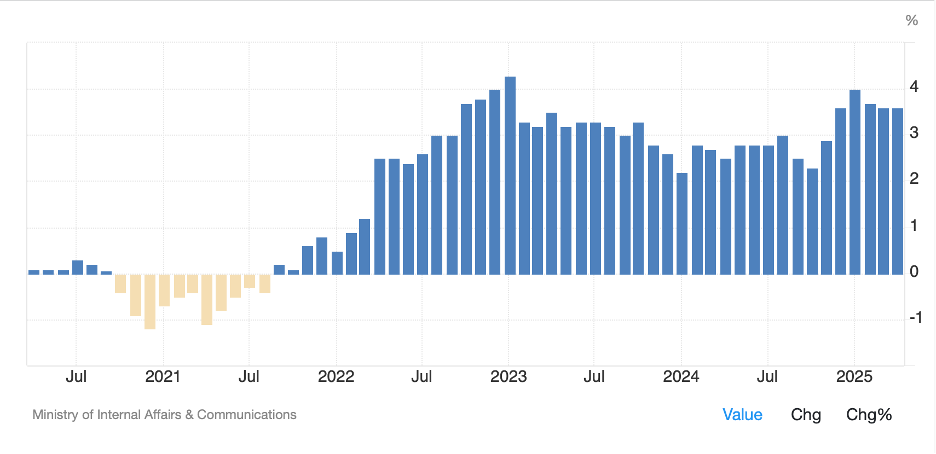
As with virtually every election, the economy is a top priority of the voters, especially since GDP growth, as measured, has essentially been zero for the past three years as per the below chart, and is mooted to stay there on present policies.

Source: tradingeconomics.com

One of the key issues that is currently under discussion there is the constitutionally enshrined ‘debt-brake’ which prevents the German government from running deficits of greater than 0.35% of GDP in any fiscal year.  In order to change the constitution, there needs to be a 2/3’s approval in the Bundestag, but AfD holds a blocking minority and one of their policy platforms has been fiscal prudence.

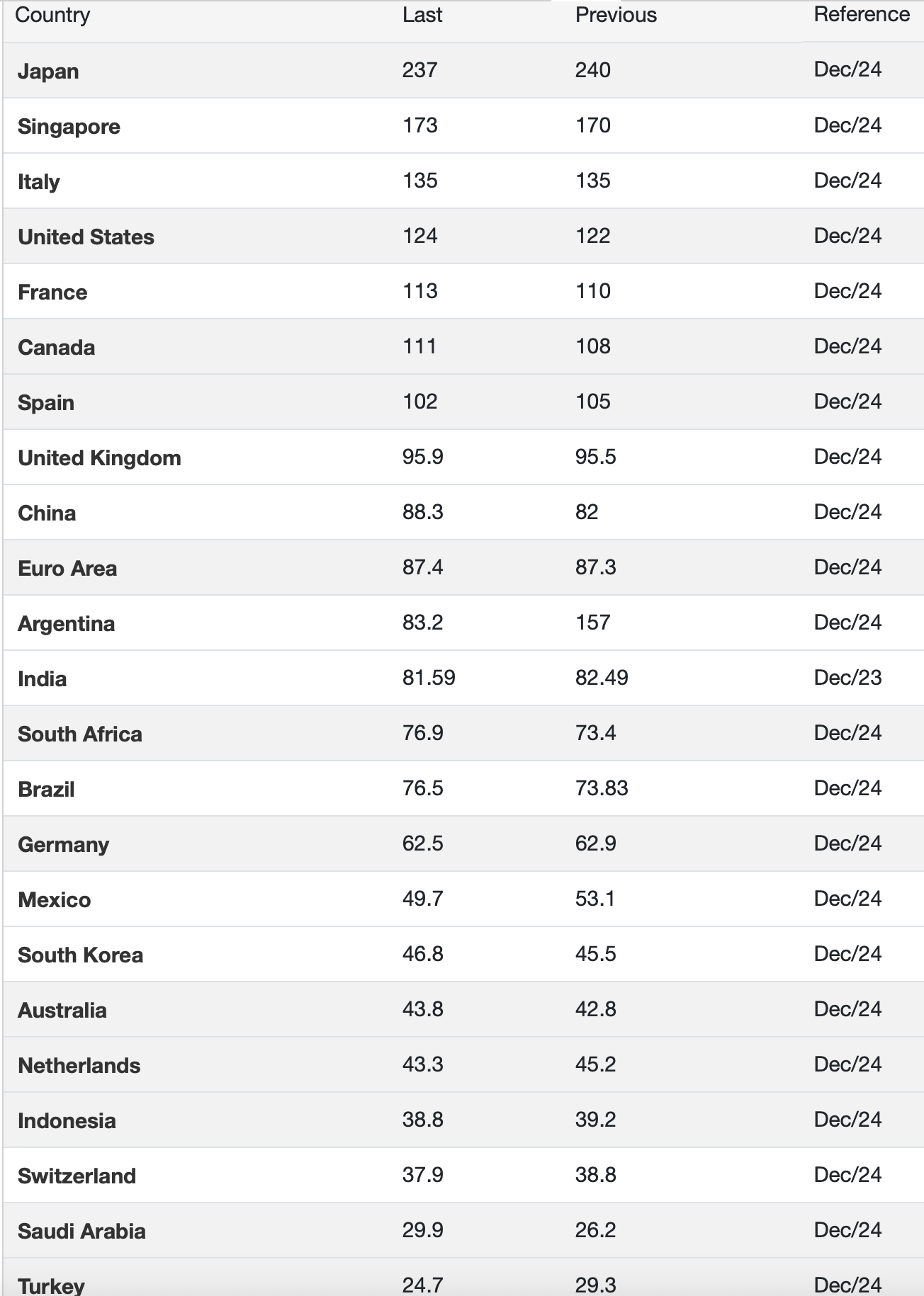
Arguably, this begs a larger question, what exactly constitutes economic growth?  For instance, if government debt is rising more quickly than economic output, is that actually a growing economy?  And is that process sustainable going forward?  It is quite interesting to look at the government debt dynamics of different nations and ask that question, especially since Germany’s situation really stands out.  

Perhaps, after looking at this group of charts, it is worth reevaluating exactly how much actual growth has been occurring and how much economic activity has simply been government borrowing recycled into the economy across all these nations.  Of course, this process has not been restricted to G-7 nations, it is a global phenomenon, with China doing exactly the same thing as are virtually all nations.  In fact, Germany is unique amongst large nations for bucking the trend.

The reason this issue matters is there is a limit to how far a government can increase its leverage ratio.  At some point, investors will stop buying debt which will force the central bank to buy the debt.  Of course, they will do so by printing more money and devaluing the currency.  We know this because we have seen it happen before many times throughout history with Germany’s Weimar Republic in 1923, Argentina in the 1980’s and Zimbabwe in 2007-2008 as just the most recent examples.  In fact, the reason the Germans have the debt brake is that there is a national memory of that hyperinflation from a century ago.

Circling back to the growth question, what is it that constitutes economic growth?  If you remember your college macroeconomics classes, this is the equation that is used to calculate economic activity in an economy:

            Y = C + I + G + NX

Where:

Y = GDP

C = Consumption

I = Investment

G = Government spending

NX = Net Exports

This equation is taken as gospel in the economics and political worlds.  However, it is not often recalled that it was created in the 1930’s by John Maynard Keynes.  It is not a law of nature, but merely was Keynes’ way of expressing something that had not been effectively measured previously.  Nearly 100 years later, though, perhaps it is time to reevaluate the process.  Remember, economies grew prior to Keynes creating this equation when government activity was a much smaller proportion of the economy.  But as we can see by the dramatic rise in government debt, that is no longer the case.  Perhaps Germany is a peek behind the GDP curtain that shows absent constantly increasing government borrowing, economic growth is stagnant.  Neil Howe’s Fourth Turning could well be the conclusion of this period of government excess, where things will be extremely volatile during the change, but less government will be the norm on the other side, at least for a few generations!

Ok, sorry for the history and theoretical discussion, but that chart of German government debt vs. the rest of the world was really eye-opening.  Let’s turn to markets from the overnight session.

After Friday’s sharp downward movement in the US, the picture in Asia was far more mixed.  Japan (+0.25%) managed a small gain while Hong Kong (-0.6%) and China (-0.2%) both lagged.  Elsewhere in the region, New Zealand (-1.8%) stood out for its weakness, although Korea, India and Taiwan were all softer in the session as well.  Ironically, it seems that better than expected Retail Sales data in NZ hurt sentiment for further policy ease by the RBNZ and concerns over trade with China given US pronouncements is also hurting the situation there, at least for today.

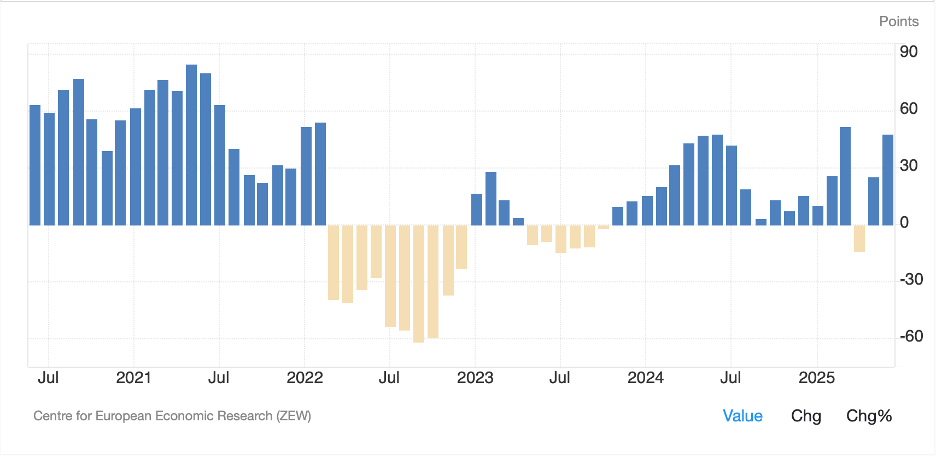
In Europe, Germany’s DAX (+0.9%) is leading the way higher after IfO Expectation data was released a touch better than forecast at 85.4.  However, it is important to remember that while this was a positive outcome, the average reading prior to Covid was between 95 and 103.  As to the rest of Europe, there are more gainers than laggards but little of real note absent any other data.  US futures at this hour (7:00) are pointing higher by at least 0.5% across the board.

In the bond market, Friday saw a very sharp decline in yields, -10bps in Treasuries, after weak readings in the Flash PMI data, especially services at 49.7, Existing Home Sales and Michigan sentiment.  That helped bring global yields lower.  This morning, Treasuries have bounced just 1bp and we are seeing similar rises in most of Europe.  JGB yields are also unchanged and have continued to consolidate near recent highs.

In the commodity markets, after a sharp sell-off on Friday on the back of stories about increased supply from Kurdistan, oil (0.0%) is unchanged this morning.  Meanwhile gold (+0.5%) is rebounding from its regular Friday sell-off, almost as though there were efforts by some to depress the price at the end of every week.  It will be interesting to see what happens this Friday which is month end as well.  As to silver and copper, they are little changed and dull this morning.

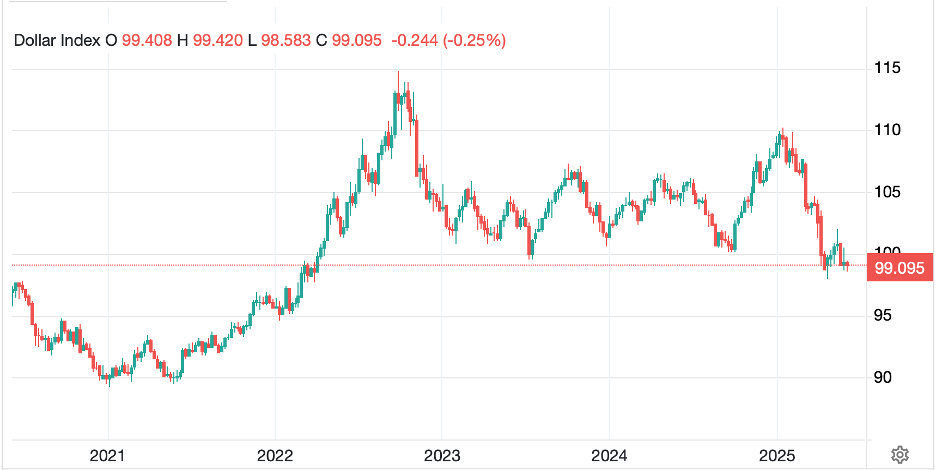
Finally, the dollar is asleep this morning, with very limited movement vs. almost any of its counterparts.  USDJPY remains below 150, but the yen has actually fallen -0.3% on the session, while the biggest movers are in Eastern Europe (CZK +0.8%, HUF +0.4%, PLN +0.35%), perhaps on the back of the German election results offering hope for a more useful German government.  We shall see about that.  Otherwise, nobody is concerned over the dollar right now.

On the data front this week, it is a quiet one with PCE data the highlight on Friday.

TodayChicago Fed Natl Activity0.21
TuesdayCase Shiller Home Prices4.4%
 Consumer Confidence103.0
WednesdayNew Home Sales680K
ThursdayInitial Claims220K
 Continuing Claims1874K
 Q4 GDP (2nd look)2.3%
 Real Consumer Spending4.2%
 Durable Goods2.5%
 -ex Transport0.3%
FridayPersonal Income0.3%
 Personal Spending0.2%
 PCE0.3% (2.5% Y/Y)
 Core PCE0.3% (2.6% Y/Y)
 Chicago PMI41.5

Source: tradingeconomics.com

In addition to the data, we also hear from seven Fed speakers over 9 venues, but again, are they really going to change the cautious approach at this stage?  And does it even matter?  For now, financial markets are far more focused on President Trump and his cabinet’s activities than interest rate policy which seems set to remain in place for a while.

When it comes to the dollar, nothing has changed my perspective on relative interest rates in the front end, with US rates likely to be far stickier at current levels than others, but the back end has a potentially different outcome.  Recall that Bessent and Trump are focused on the 10-year yield and getting that lower and seem far less concerned over the Fed for now.  To achieve that they will need to demonstrate the ability to reduce spending and the deficit situation.  While a promising start has been seen with DOGE, we are still a long way from a balanced budget.  My take is the dollar, writ large, is going to take its cues from the 10-year yield for now, so bonds are the market to watch.  If we see yields head back toward 4.0%, the dollar will decline and any significant move higher in yields will likely see the dollar climb as well.

Good luck

Adf

Having a Fit

Seems Europe is having a fit
‘Cause Putin and Trump may submit
A plan for the peace
Where there’s an increase
In spending the Euros commit
 
Remarkably, though peace would seem
The basis of many a dream
Seems many despise
The fact that these guys
Don’t care Europe can’t stand this scheme


Here’s the thing about President Trump, you never know what he is going to do and how it is going to impact market behavior.  A case in point is the growing momentum for further peace negotiations between the US and Russia, with Ukraine basically going to be told how things are going to wind up.  On the one hand, you can understand Ukraine’s discomfort as they don’t feel like they are getting much say in the matter.  On the other hand, it seemed increasingly clear that the end game, if there is no US intervention of this nature, would be for Russia to bleed Ukraine of its fighting age population while systematically destroying its infrastructure.

The thing I find most remarkable is the number of pundits who hate this outcome despite the end result of the cessation of the fighting and destruction.  After three years of conflict, and with other nations willing to allow Ukrainians to die on the front lines while they preened about saving democracy, there was no serious push to find a solution.  I have no strong opinion on the terms that have been floated thus far, and I don’t believe rewarding a nation for aggressive action is the best outcome, but Russia has proven throughout history that they are willing to sacrifice millions of their own citizens in warfare, and the case for a Ukrainian victory seemed remote at best.  As experienced traders well understand, sometimes you have to cut your position so you can focus on something else.  Seems like a good time to cut the positions here.

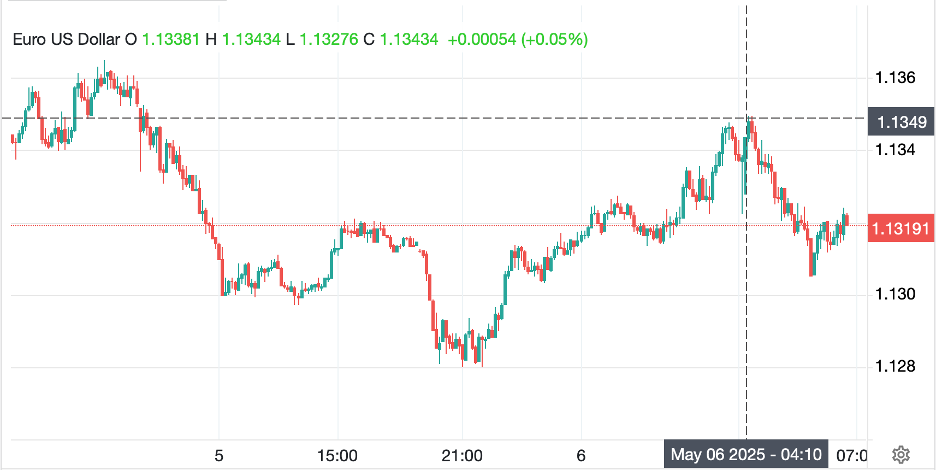
Speaking of positions, let us consider what peace in Europe may mean for financial markets.  Yesterday I discussed how European NatGas prices have more than doubled since the war began.  If they return to their pre-war levels, that dramatically enhances Europe’s economic prospects, despite their ongoing climate policies.  Clearly, the FX market got that memo as the euro has rallied back to its highest level since December 2024 save for a one-day spike just after Trump’s inauguration.  In fact, it is not hard to look at the chart below and see a bottom forming in the single currency.  While the moving average I have included is only a short-term, 5-day version, you have to start somewhere.  While the fundamentals still seem to point to further downside in the single currency, between the Fed’s pause and more hawkish stance opposite the ECB’s ongoing policy ease, the medium-term picture could be far better for the Europeans.  If the war truly does end, it would likely see a significant uptick in investment and economic activity as they seek to rebuild Ukraine, and we could see substantial capital flows into the European economies.

Source: tradingeconomics.com

As well, oil prices, continue to trade near the bottom of their recent trading range as the working assumption seems to be that with a peace treaty, Russian oil would no longer be sanctioned, enhancing global supplies.  A look at the trend line in the chart below seems to indicate that is the direction of the future.

Source: tradingeconomics.com

The other remarkable thing is the decline in yields, where yesterday, despite a very hot PPI number, which followed Wednesday’s hot CPI number, Treasury yields fell back 7bps.  While there are likely some other aspects to this move, notably the ongoing story regarding DOGE and the attack on waste and fraud in the US, yesterday’s move was not indicative of fear, rather I read it as a positive sign that investors are betting on a chance that President Trump can be successful with respect to reducing the massive overspending by the government.  Clearly, this is early days regarding President Trump’s ability to get a handle on spending, and it could all blow up as legislative compromises may significantly water down any benefits, but I contend the market is showing hope right now, not fear.

And that, I would contend, is the big underlying driver of markets right now.  The prospects for peace and the potential impacts are the focus.  While tariffs are still a big deal, and yesterday’s talk about reciprocal tariffs is simply the latest in a long line of these discussions and pronouncements, the market seems to be getting tired of that conversation.  If we recap the current situation, central bank activities have lost their importance amid a huge uptick in governmental actions, both fiscal and geopolitical.  In many ways, I think this is great, the less central bank, the better.

Ok, let’s see how markets continue to absorb these daily haymakers from President Trump and the responses from other governments.  Clearly, the US equity market remains far more fixated on Trump’s actions than on higher inflation potentially forcing the Fed to raise rates.  In fact, despite the hot PPI print, the futures market has actually increased its expectation for rate cuts this year to 35bps.  That doesn’t make sense to me, but I’m just an FX poet. 

If we turn to Asian markets, Hong Kong (+3.7%) was the big winner overnight as a combination of growing expectations for more Chinese government stimulus to be announced soon, along with the ongoing tech positivity in the wake of the DeepSeek announcement got investors excited.  On the mainland, shares (CSI 300 +0.9%) were also higher, but not as frothy.  Meanwhile, the weaker dollar hindered the Nikkei (-0.8%) as the yen has gained 1.3% since the CPI data on Wednesday.  In Europe, the picture is mixed with the CAC (+0.4%) the best performer and the DAX (-0.4%) the worst performer.  Eurozone GDP surprised on the upside in Q4, growing…0.1%!! Talk about an explosive economy.  However, that was better than forecast and helped avoid a recession.  The interesting thing about European equity markets, though, is that despite a dismal economic backdrop, most major markets are trading at or near all-time highs.  Further proof that the market is not the economy.  As to US futures, ahead of this morning’s Retail Sales data, they are flat.

After several days of substantial movement in the bond market, it seems that traders have taken a long weekend given the virtual absence of movement here.  Treasury yields are unchanged on the day and European sovereign yields are higher by 1bp.  

In the commodity markets, on the day, oil prices are unchanged, although as per the above chart, it appears the trend is lower.  US NatGas (+1.8%) is rallying on forecasts for another cold spell, but European NatGas (-4.85%) continues to fall as prospects for peace indicate new supplies, or perhaps, renewed supplies.  In the metals markets, gold (+0.15%) is continuing its positive momentum but the big mover today is silver (+2.7%) which seems to be responding to some large option expirations in the SLV ETF (h/t Alyosha) which seem set to drive substantial demand for delivery.  

Finally, the dollar remains under pressure overall, although the movement has generally not been that large today.  The big outlier in the G10 is NZD (+0.9%) which has responded to the delay in the reciprocal tariff implementation until April.  Elsewhere in this bloc, gains are universal, but modest with movement between just 0.1% and 0.2%.  In the EMG bloc, the dollar is also under pressure with ZAR (+0.65%) a major gainer as precious metals continue to be in demand.  CLP (+1.15%) is also continuing to benefit from copper’s ongoing rally.  The exception to this movement has been Asia where most regional currencies are modestly softer this morning, KRW, TWD, INR, as the tariff talks still seem to be the driving force in these markets.

On the data front, we finish the week with Retail Sales (exp -0.1%, +0.3% ex autos), then IP (0.3%) and Capacity Utilization (77.7%).  Yesterday’s PPI data was several ticks hotter than forecast and seems to put paid to the idea that inflation is heading back to the Fed’s target.  This afternoon we hear from Dallas Fed president Lorrie Logan, but again, it is hard to make the case that the Fed is the driver of anything right now.

Fundamentals still point to dollar strength, I would argue, but the market is not paying attention. Rather peace and the peace dividend are now the driver in the FX markets and to me, that implies we are set to see the dollar give back some of its gains from the past 6 months.

Good luck and good weekend

Adf

Norms to Eschew

For market practitioners, Trump
Is more than a modest speed bump
His willingness to
Most norms to eschew
Can force long-term views to go bump
 
Meanwhile, as the markets prepare
For Powell to sit in his chair
In front of the Senate
A popular tenet
Is more rate cuts he will foreswear


It is very difficult to keep up with the news these days as President Trump really does address so many disparate issues in such short order, it is hard to know which ones will potentially impact markets and which will simply be headline fodder.  Obviously, the tariff discussions remain front and center, but even those plans seem to be evolving at a very fast pace, and while yesterday he did invoke 25% tariffs on steel and aluminum imports, that has literally become old news already.  The next question is what will occur with the latest idea of reciprocal tariffs, where the US will charge the same tariff on imports from other nations as those nations charge on imports from the US.

Generally speaking, US tariffs are the lowest overall around the world, which arguably is exactly what Trump wants to address.  I am not going to argue the merits or detractions of tariffs, that is pointless.  The only thing to consider is if they are implemented, what are the potential impacts.  One of the key things to remember about the effectiveness of tariffs is the price elasticity of the products being tariffed.  If, for instance, a product has substantial competition and is easily replaced, the nation being tariffed is likely going to absorb the bulk of the pain.  Consider Colombia and how quickly they caved regarding the deportations.  While I am not a coffee drinker, and I am sure there are those who believe Colombian coffee is the best, coffee also comes from Brazil, Vietnam, Hawaii and Indonesia, and as none of those nations (and obviously Hawaii) were subject to tariffs, Colombia would have paid the freight had they been implemented.

But, for a product like solar panels, where there are few suppliers other than the Chinese, to the extent the demand remained in place, the purchaser would see higher prices.  Turning to steel and aluminum, the below graphic shows the top 10 global steel producing nations and how much they produced in 2024.  This graphic says all you need to know about why President Trump is unhappy with China and their trade policies.  (well, this and the next one)

Source: worldsteel.org

And while this is not an exact apples-to-apples comparison, the below chart shows forecasts for steed demand in 2023 and 2024.  The mismatches are clear as China, South Korea and Japan have a significant surplus to export while the US and India need imports.

Source: mrssteel.com.vn

The point is President Trump is seeking to address that imbalance and is of the mind that the US would be better off if we make our own steel.  In fact, this is simply part of his entire philosophy to reshore US manufacturing capabilities.

Now, steel is a traded commodity, although in financial markets, not so much.  But changes in the flows of imports and exports will have an impact on FX markets, while tariffs could well also impact investment flows. In fact, it is not hard to see why Nippon Steel wants to buy US Steel.  if they own a steel manufacturer in the US, they can increase production with no concerns over tariffs.

Remember, too, this issue is merely a microcosm of the potential chaos that will be seen across industries and nations, both of which will impact financial markets.  Once again, I harp on the idea that a robust hedging program is a necessity these days.

Turning to today’s activities, Chairman Powell will be testifying before the Senate Banking Committee this morning.  On the one hand, I wonder if he is upset by the fact that virtually nobody is concerned about what he says these days as Trump continues to dominate every conversation.  For someone who has become quite accustomed to being the center of attention with respect to markets, this may well be a blow to his vanity and ego.  On the other hand, it is also quite possible that maintaining a low profile is precisely his strategy here, and if that is the case, I expect we will not learn anything new at all.  The Fed mantra is currently that they will be cautious before implementing any further rate cuts.  Remember, CPI is released tomorrow as well, so when he goes before the House, they will have that information in hand.  But to Powell’s benefit, Treasury Secretary Bessent made clear he and President Trump are far more concerned about the 10-year yield than Fed funds.  This may be the most amazing transformation of all, a Fed chair who becomes a wallflower!

Ok, after yesterday’s US equity rally, the story in Asia was far less positive.  Japan and Australia were unchanged while the Hang Seng (-1.1%) and CSI 300 (-0.5%) both suffered, perhaps on the tariff impositions.  Elsewhere in the region, Taiwan and South Korea both had solid sessions while weakness was evident in Indonesia, India and the Philippines.  In fact, all three of those markets have been declining steadily since October, with declines between 15% and 20% as prospects in those economies seem concerning, especially with Trump’s tariff mania.  In Europe, virtually every market is unchanged this morning as the EU quickly explained they would retaliate against any US tariffs.  Of course, that is what makes Trump’s reciprocal tariff structure so interesting.  How can Europe complain that other nations impose the same level of tariffs they do?  Meanwhile, at this hour (7:05), US futures are pointing slightly lower, about -0.25%.

In the bond market, yields are climbing with Treasuries higher by 3bps, now 12bps above the lows seen early last week, while in Europe, yields are substantially higher, with France (+10bps) leading the way, but the rest of the continent showing rises of between 4bps and 6bps.  Part of this move on the continent is driven by a catch up to yesterday afternoon’s US yield rally.  As to the French, seemingly their Unemployment Report, which showed a much better than expected 7.3%, may have investors concerned about quickening growth and inflation.  That feels like a lot, but there are no real explanations I have seen.

In the commodity markets, oil (+1.5%) is continuing to rebound off its recent lows, although still looks like it is in the middle of its trading range.  Gold (-0.7%) and silver (-1.2%) are both finally retracing some of the extraordinary rally that we have been witnessing for the past two months.  Copper (-2.7%), too, is under pressure this morning, unwinding some of its recent spectacular gains.

Finally, the dollar is very modestly softer, but not universally so.  For instance, the euro (+0.2%) and yen (-0.2%) seem to offset each other while most other G10 currencies have moved even less.  In the EMG bloc, though, INR (+0.9%) is the biggest gainer as the RBI has been intervening to address what had been an acceleration in the rupees decline in the past few weeks (see below).

Source: tradingeconomics.com

Elsewhere in the space, gains are less impressive, with moves on the order of +0.4% (PLN and HUF) or smaller.

On the data front, the NFIB Small Business Optimism Index was released at a softer than expected 102.8 as it seems the Trumpian chaos is having an effect for now.  Otherwise, the only thing is Powell and three other Fed speakers, but again, given the relative lack of discussion regarding Powell, the other three will get even less press in my view.

It is difficult to claim nothing has changed lately, but perhaps more accurately, there is no clear directional change at this point.  We need to start seeing some consistency in the policy impacts and that is likely to take months.  Until then, volatility is the watchword across all markets.

Good luck

Adf

Rate Cuts Have Slowed

The story that’s driving the news
Is one on which most have strong views
Both neighbors have claimed
Their borders are tamed
So, tariffs, the Prez, will not use
 
Meanwhile, data yesterday showed
That managers are in growth mode
The ISM rose
And Fed speakers chose
To validate rate cuts have slowed


The major economic story is, of course, the news that both Canada and Mexico have altered their behavior in order to prevent the imposition of 25% tariffs on their exports to the US.  Both nations have now promised to police the border between themselves and the US more tightly, and it also seems that the US now has operational control, via military overflights, of the Mexican border.  While there are many pundits who believe all this activity was merely theater and could have been accomplished without tariff threats, none of them are in a position of power.  In the end, I think it is very difficult to conclude anything other than Trump got what he wanted and achieved it via his preferred means.

The market response was very much what you might expect.  The early sharp declines in the CAD and MXN were reversed and the day ended with both currencies at basically the same levels they closed on Friday.  However, as you can see from the chart below, there was clearly some excitement and panic during the session, with back and forth 2% movements.

Source: tradingeconomics.com

Here’s the thing, I think you all need to be prepared for this type of activity on a regular basis for the next four years.  Certainly, there is nothing to suggest that President Trump is going to change his style and as long as he is successful in achieving his aims in this manner, he will continue with these activities.  Consider this as well, no national leader wants to appear weak, especially to their electorate, and so when President Trump turns his focus to a smaller nation, those leaders are very likely to try to stand up to the pressure, at least in public.  But in the end, most nations are far more reliant on the US market to buy their stuff than the other way around.  After all, the US is basically the consumer of last resort globally.  As such, very few nations can truthfully withstand an onslaught of this magnitude.

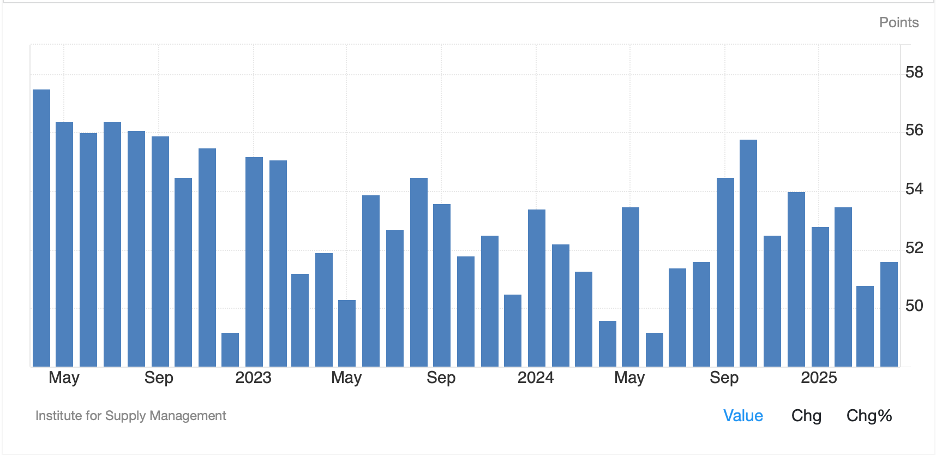
Now, turning to the state of the US economy, President Trump got some very positive news from the ISM data which printed at 50.9, its highest level since September 2022 and far higher than forecasts.  In fact, it is not hard to look at the recent trend in this data series and believe we are going to see positive economic growth going forward

Source: tradingeconomics.com

However, the downside here was that the Prices Paid portion of the index also rose, back to 54.9, implying that inflation pressures remain extant within the economy.  Now, you and I both know that is the case as we all deal with these prices on a daily basis, but until the data starts to become more obvious, it appears the Fed is always the last to know.

Speaking of the Fed, while only one speaker was on the schedule, Atlanta Fed President Bostic, we heard from three of them anyway as it remains clear to me there is a strong belief in the Marriner Eccles building that a key part of their job is to never shut up constantly pitch their narrative to try to keep markets in line.  So, as well as Bostic, we heard from Chicago’s Goolsbee and Boston’s Collins and they all basically said the same thing, perhaps best stated by Ms Collins, “There’s no urgency for making additional adjustments.  The data is going to have to tell us.  At some point I certainly would see additional normalization in terms of what the policy stance is.”  The last part of her comment refers to the idea that she, and truthfully all three, believe that further rate cuts remain appropriate despite the ongoing growth and continued stickiness of prices.  And to think, some people believe that Trump and the Fed are not on the same page.   They all want lower rates!

Ok, let’s turn to markets and see how they have behaved overnight.  Yesterday, after a pretty horrible opening on the basis of tariffs, tariffs everywhere, the news that they would be postponed saw US markets rebound, although still close lower on the session.  In Asia, Japan (+0.7%) rallied as so far, Japan remains out of the tariff sightlines, and Hong Kong (+2.8%) traded much higher in its first post-holiday session although mainland Chinese share trading doesn’t reopen until tonight.  Elsewhere in Asia, the screens were largely green, perhaps on the thesis that tariffs are just a negotiating tactic.  In Europe, the picture is more mixed with the UK (-0.2%) lagging while Spain’s IBEX (+0.8%) is the leading gainer.  The rest of the continent, though, is seeing gains on the order of just 0.2%, so not much love.  And at this hour (7:10) US futures are little changed.

In the bond market, Treasury yields, after edging higher by a few bps yesterday, are up another 2bps this morning and pushing back to 4.60%.  In Europe, sovereign yields are also firmer this morning, up between 2bps and 4bps across the board, although this is after sharply lower yields yesterday on still weak PMI data from the continent.  As well, Mr Trump is hinting that he is going to turn his tariff sights on Europe soon, so there has to be some trepidation there.  After all, Europe, which is already a basket case due to self-inflicted energy-based wounds, really cannot afford a trade fight with the US, especially since they have a net trade surplus on the order of $200 billion with the US.  Finally, JGB yields rose 3bps and are now at their highest level since May 2010 and look for all the world like the trend remains strongly intact as per the below chart.

Source: tradingeconomics.com

In the commodity markets, confusion in energy reigns as yesterday’s initial rally on Canadian tariff news has been completely reversed with oil (-2.1%) and NatGas (-4.2%) both falling sharply today.  But what is not falling is gold (+0.1%) which made yet another new all-time high yesterday and continues to defy gravity.  This has helped the entire metals complex with both silver and copper higher by 0.5% this morning.

Finally, the dollar continues its general winning ways this morning.  Yesterday saw early gains, also on the tariff story, which as evidenced by the chart at the beginning of the note, reversed.  But in the other currencies, the euro and pound remain under modest pressure along with Aussie, as all three are softer by about -0.3% today, with the yen (-0.4%) along for the ride.  In the EMG bloc, MXN (-0.6%), BRL (-1.2%) and ZAR (-0.3%) are also under pressure as though the immediate tariff threat seems to have abated, fear remains the driving force in the space.  Add to the tariff fears the fact that the US economy continues to outperform its peers, and the Fed has basically put the kibosh on any rate cuts anytime soon and it is easy to understand why money is flowing this way.

On the data front, JOLTS Job Openings (exp 8.0M) and Factory Orders (-0.7%, +0.6% ex Transport) are today’s information, and we hear from more Fed speakers.  It seems clear, so far, that the Fed mantra is wait and see as things evolve under President Trump.  Unless one of these speakers (Bostic, Daly, Jefferson) offers a different view, which seems unlikely, then I suspect the dollar will continue to find more support than resistance for now.

Good luck

Adf

Run Amok

The price level, sadly, will jump
According to President Trump
Will Canada shrink?
Will Mexico blink?
As tariffs cause things to go thump
 
The first thing that moved was the buck
While stock markets were thunderstruck
So, who will blink first?
And who will hurt worst?
No matter, things have run amok


Whatever you think of the man, you must admit that President Trump knows how to maintain the spotlight on himself and his policies to the exclusion of virtually everything else in the news.  And so, in the wake of two terrible aviation disasters in short order, pretty much all eyes are now focused on the tariffs that Trump imposed this weekend on Canada, Mexico and China.  While there had been a large school of thought that the tariff talk was a cudgel to be used during negotiations but would never actually be imposed as they would be too damaging, that thesis has been destroyed.  It appears that President Trump believes his long-term goals of reshoring significant parts of US industry and leveling the playing field with trade partners is achievable via tariff policy and will more than offset any short-term pain that may come.  We shall see if he is correct, but certainly, the short-term pain is beginning to arrive.

The early movement in equity markets was uniform around the world, and it was not pretty.  The below snapshot of equity futures markets, taken at 6:00am this morning shows that the only two markets that have not fallen are China and Hong Kong, and that is only because they remain closed for the Chinese New Year holidays.  But there is plenty of fear all around the world, especially considering that markets throughout Europe and Japan, as well as other nations that have not been named targets of tariffs, have also fallen sharply.

Source: tradingeconomics.com

Too, the FX markets have also responded dramatically, with the dollar exploding higher vs. virtually all its counterpart currencies this morning as 1% gains are the norm.

Source: tradingeconomics.com

A special shoutout to ZAR (-1.55%) which while not directly impacted by tariffs, caught Trump’s ire by their recently enacted legislation to confiscate property as they deem fit, oftentimes without compensation.  While South African officials have claimed it is akin to eminent domain rules in the US, those require compensation at all times, a not insubstantial difference.  

So, what’s a hedger to do?  Well, this is why you maintain a hedge program in the first place.  Lots of things happen in the world, most of which are beyond any individual or companies’ control, yet the impacts are real.  Some of what I have read this morning highlights the idea that Canada and Europe and Mexico are going to stick together to fight these tariffs.  However, at the end of the day, the US economy, and by extension its market, is the largest by far, and losing the US as an export destination will be a very difficult pill for those nations and their economies to swallow.  

My sense is that Trump, especially if he continues to address the immigration and government waste issues, will have far more runway than most other nations, especially given the precarious situation of many ruling parties right now.   But the other thing to consider is that there is no going back to the way things were in the past.  Alliances and treaties are going to come under much greater scrutiny by all sides as governments everywhere re-evaluate what they are trying to achieve with various policies and how they can partner with other nations to work together.  In fact, I suspect that the EU is going to continue to come under even greater pressure as it becomes more evident that while many countries believe in the trade benefits of the EU, the recent focus by Brussels on other issues like climate activism and immigration run counter to some members’ views.  No matter what, the world is changing dramatically, and my take is the change is going to come faster than many will have anticipated.

OK, there are a thousand stories on how the tariffs are going to impact the US, with initial calculations regarding the negative impact on GDP and how much they are going to raise inflation, so I’m not going to go there.  Needless to say, the universal belief is things will get worse on those metrics.  But here’s something else to consider.  On Friday, the BLS will be revising the 2024 jobs data, including their population estimates and the birth/death model that describes the number of new businesses that are formed, net, each month. Early estimates show that the number of jobs created is going to fall by nearly 1 million while population, now taking into account more immigration, is going to rise.  I have seen estimates that the Unemployment Rate may rise, or be revised, to 4.5% or 4.6%.  If that is the case, it will certainly call into question exactly what the Fed has been doing.  It will also, almost certainly, result in a Trumpian tirade about how the BLS is political and was cooking the books to burnish Biden’s economic record.  I suspect it will not help equity markets if that is the case, but also probably hurt the dollar as the Fed will be right back onto their rate cutting discussions.

As I’ve already shown the equity and FX markets above, a look at bonds shows that Treasury yields are unchanged this morning, as they seem to be caught between concerns of slower growth and higher inflation due to the tariffs.  Remember, too, that Wednesday, the Treasury will issue its Quarterly Borrowing Estimate with all eyes on the mix that new Treasury Secretary Bessent will be seeking as things go forward.  Remember, he was quite vocal, before he took the job, as to the mistakes that Yellen made in not terming out more Treasury debt when rates were at extremely low levels.  Meanwhile, European sovereign yields are all lower this morning, between -2bps (Italy) and -6bps (Germany) as PMI data released showed that though things were better than last month, they remain well below the key 50.0 level.  However, on the inflation front, both Eurozone and Italian data printed higher than expected, clearly not what Madame Lagarde wants to see.

Finally, commodity markets have seen oil prices (+2.6%) rise sharply as the US will be imposing 10% tariffs on imports of Canadian oil products, while NatGas prices have jumped by 9.0% on concerns over supply disruptions from those tariffs.  Like I said, the world is a different place today!  In the metals markets, both gold and silver are little changed this morning although copper (-0.9%) prices are slipping, perhaps on the idea that these tariffs are going to slow economic activity.  And that is one of the key belief sets amongst economists.

As to the data this week, it is reasonably busy, but all eyes will be on Friday’s NFP report, especially with the rumors of a major revision.

TodayISM Manufacturing49.8
 ISM Prices Paid52.6
TuesdayJOLTS Job Openings8.0M
 Factory Orders-0.8%
 -ex Transport+0.6%
WednesdayADP Employment150K
 Trade Balance-$96.5B
 ISM Services54.2
ThursdayInitial Claims215K
 Continuing Claims1855K
 Nonfarm Productivity1.7%
 Unit Labor Costs3.5%
FridayNonfarm Payrolls170K
 Private Payrolls140K
 Manufacturing Payrolls-2K
 Unemployment Rate4.1%
 Average Hourly Earnings 0.3%(3.8% Y/Y)
 Average Weekly Hours34.3
 Participation Rate62.5%
 Michigan Sentiment70.9
 Consumer Credit$10.5B

Source: tradingeconomics.com

In addition to all of this, we will hear from nine different Fed speakers, at least, over 13 different venues this week.  Now, things could get quite interesting here given Chairman Powell did not speak to tariffs as they were not yet implemented when he delivered the FOMC news last week, but all of these speakers will have an opinion.  I wonder if there will be a unified set of talking points or if each one will truly give their own views.  Of course, given that each is a neo-Keynesian economist, I suspect their views will all be aligned anyway.

One other thing from last week that didn’t get much press is that the BOC, after cutting the base rate by 25bps as widely expected, has indicated they will be ending their QT program and, in fact, restarting their QE program over the next several months in order to grow their balance sheet in line with the economy.  Do not be surprised if we see other major central banks go down this road as well, regardless of sticky inflation.  

Summing it all up, the world is very different this morning compared to Friday morning.  Trade and economic disruptions are going to become evident and there is still a great deal of vitriol to be vented at Trump by others, while Trump will continue to decry other nations efforts to weaken the US.  As I have written in the past, volatility will be the main underlying thesis this year.  Meanwhile, the beauty of a good hedge program is it helps through all market conditions.  Do NOT slow things down waiting for a better entry point, be consistent, as that better entry point may not materialize for a long time.  My strongest cue will be the bond market as if yields start to decline in anticipation of a significant economic slump, I expect the dollar will suffer, but if they hold up, then there is nothing to stop the dollar from testing and breaking its recent highs.

Good luck

Adf

Forked Tongue

The major discussion today
Is tariffs and if they’re in play
While Trump thinks they’re great
Economists hate
Their impact and watch with dismay
 
Meanwhile it has not been a week
And questions are rife ‘bout DeepSeek
The most recent questions
Are making suggestions
That China, with forked tongue, did speak


President Trump has promised to impose 25% tariffs tomorrow on all Canadian and Mexican exports to the US if those nations do not agree to further efforts to tighten border security regarding the movement of both immigrants and drugs across the borders.  Even within his administration, there are many who do not want to see them imposed given the potential disruption they would cause in supply chains throughout the nation.  And of course, economists abhor tariffs as a pure deadweight loss to the economy.  But Trump sees the world through very different eyes, that much is clear, and as evidenced by the very short-term row with Colombia last weekend, believes they can be useful tools to achieve strategic, non-economic outcomes.

This poet is not fool enough to try to anticipate what will actually happen as the mercurial nature of President Trump’s actions is far beyond my ability to forecast.  However, if history is any guide, we will see both Mexico and Canada make some additional concessions and an announcement that because of that, the tariffs will be delayed until negotiations can be completed by some new deadline.  (Well, maybe I am fool enough 🤣)

From our perspective observing market reactions, the only consistent view is that US tariffs will drive the dollar higher, or more accurately, other currencies lower, as the FX market adjusts to compensate for the tariffs.  If we look back at Trump’s first term, the first tariffs were imposed on China in early 2018 on solar panels and washing machines and a few other things.  A look at the chart below shows that the yuan (the green line) did, in fact, weaken substantially following those tariffs, with the dollar rising from 6.25 to 6.95 over the course of the ensuing six months.  However, if we broaden our horizons beyond the renminbi to the dollar writ large, as seen by the Dollar Index (the blue line), which rose from 88 to 96 over the same period, the renminbi’s price action was directly in line with the dollar overall.  There was only limited additional impact to CNY.  Remember, too, that in 2018, the US equity market was performing quite well, and funds were flowing into the US, thus driving the dollar higher, not dissimilar to what we have seen over the past year.  The point is that while the tariffs may have some impact, it is also likely that the dollar will move based on its traditional drivers of interest rate differentials and capital flows regardless.

Source: tradingeconomics.com

Away from the tariff talk, though, there is precious little other market related news, at least on a macro basis.  Yesterday’s data showed that GDP grew a tick less than anticipated at 2.3% in Q4, but Real Consumer Spending, which is a critical part of the economic picture, rose at 4.2%, a very solid performance and an indication that things in the economy are still ticking along just fine.  (The difference between that number and the GDP number is due to inventory adjustments, which are seen to wash out over time.). In fact, arguably, that solid growth was a key reason that the equity markets in the US had another strong session yesterday, with gains across the board.

Well, there is one other thing on many people’s minds, and that is the veracity of the claims about DeepSeek.  You may recall I highlighted the question of all those Nvidia sales to Singapore earlier in the week as somewhat strange.  Well, I was not the only one asking that question and this morning in Bloomberg, there is an exclusive story about a US government investigation into whether China actually got the most advanced H100 chips via Singapore after all.  If that is the case, then perhaps the DeepSeek claims are not as impressive as they were initially made out.  I suspect if this turns out to be the case, that worries over the need for AI to no longer utilize the most advanced chips will dissipate and the tech rally will regain momentum.

So, let’s look at markets now.  China and Hong Kong remain closed for their New Year celebrations.  Japan (+0.15%) had a modest gain and the truth is that only two Asian bourses had strong sessions, Singapore (+1.45%) and India (+1.0%) with the rest of the region mostly a touch firmer.  In Europe, all markets are slightly stronger this morning, on the order of 0.3% or so, as the combination of yesterday’s ECB rate cut and hints at future cuts by Madame Lagarde, seem to be underpinning the markets.  Certainly, today’s Eurozone data, showing German Unemployment climbing a tick to 6.2% while Retail Sales there fell -1.6% in December don’t seem like a rationale to buy equities.  In the US futures market, though, we are seeing solid performance, 0.5% or more, as I believe many are jumping back on the AI bandwagon.

In the bond market, Treasury yields have edged higher by 1bp, and remain just north of 4.50% as the tension between solid growth and slowing inflation dreams keeps the market quiet.  In Europe, though, yields are continuing their decline from yesterday, with sovereign yields down by between -3bps and -4bps as investors look for further easing from the ECB as the Eurozone sinks slowly toward recession.  However, in Japan, JGB yields rose 3bps as data overnight showed inflation remains above target and expectations for another rate hike in the first half of the year rise.

In the commodity markets, oil (-0.35%) continues to chop around in the middle of its trading range with no strong directional impulse (see chart below).

Source: tradingeconomics.com

It is very difficult to know how to view this market in the short run given the potential for disruptions by tariffs and even more sanctions, but nothing has changed my long-term view that there is plenty of oil around and prices will remain here or decline.  In the metals markets, both gold and silver are little changed on the morning although both have been in the midst of a strong rally with gold making new all-time highs in the cash market yesterday.  Copper (-0.7%) is offered this morning but is still much higher than at the beginning of the month/year.

As to the dollar, it is modestly firmer this morning rallying against most of its G10 counterparts, but not by very much, 0.3% (JPY) at most.  Versus its EMG counterparts, though, there is more strength with PLN (-0.6%) and ZAR (-0.4%) both under a bit of pressure.  The latter is responding to ESKOM, the national electrical utility, announcing that they may need to impose rolling blackouts to help repair parts of the grid.

On the data front, this morning brings Personal Income (exp 0.4%) and Spending (0.5%) but of more importance it brings PCE (0.3%, 2.6% Y/Y) and core PCE (0.2%, 2.8% Y/Y) along with the Chicago PMI (40.0) release at 9:45.  We also hear our first post-meeting Fed speaker, Governor Bowman, this morning but it would be shocking if she said anything other than they are going to be patient to watch inflation slowly move toward their target, almost as if by magic.

Once again, tape bombs are the biggest risk, as they will be for the next four years, but I imagine all eyes will be on Trump and the tariffs as the key driver.  For now, nothing has dissuaded me from my view the dollar is more likely to rise than fall, but we need to see how things evolve.

Good luck and good weekend

Adf

Cha-Ching

It wasn’t all that long ago
When data would headline the show
As traders would wait
For each release date
And then recount trades blow-by-blow
 
But now there is only one thing
That matters, Trump’s latest cha-ching
He speaks off the cuff
Which makes it quite tough
To plan from Berlin to Beijing


As the morning of the third day of President Trump’s second term dawns, it is nigh on impossible to keep up with all the things he is doing and their actual and potential impacts on markets going forward.  Arguably, the main FX market driver continues to be the tariff discussion and the question of if, and when, he may be imposing said tariffs. You will recall that on Monday, the mere absence of his reaffirmation that tariffs were coming resulted in a major dollar decline, which was subsequently reversed when he finally mentioned them in the evening.

Of course, those were aimed at Canada and Mexico with China, significantly, left out of the mix.  Last night he remedied that situation declaring that China and Europe were also in his sights for tariffs, although he mooted a 10% initial level, far below the 60% he discussed during the election campaign.  Once again, I would argue it is not possible at this point to make any serious market prognostications based on the lack of information as to the products to be impacted, the exact timing and what he is seeking in return for a reduction or elimination of those threats. 

At the same time, I find the strait-laced approach that ‘tariffs are bad and a tax on Americans which will lead to inflation’ which continues to be promulgated by orthodox academic economists, typically from a left-leaning lens, to be almost comical at this point.  We all should remember that during his first term, he imposed many tariffs, especially on China, and yet inflation was quiescent, with CPI averaging 1.9% during the entire term.  This is not to say things will be identical in 2024 and beyond, just that in fairness, his record demonstrates that tariffs are not necessarily inflationary.  Below is a chart of the monthly readings showing only 8 of the 48 months he was in office that headline CPI rose more than 0.3%, implying the rest of the time it was at or below that level.  Those were the days.

Source: tradingeconomics.com

Beyond the tariff discussion, the bulk of his time currently seems to be focused on the size of the government workforce, which is certainly due to shrink, and the border and immigration.  What will market impacts of these issues be like?  For the former, I would suggest that less government employees will lead to less government interference in the workplace, and arguably, be beneficial for productivity if nothing else.  As to the latter, it is a much more difficult problem to solve as there will likely be reductions in both labor supply but also demand for services like housing.  It seems quite possible that there will be a reordering of the economy, although it is unclear if that will lead to a net positive or negative from an overall growth perspective, or at least an inflation perspective.  Growth, of course, is the product of the size of the workforce * productivity, so a smaller workforce, if that is the outcome, will weigh on topline GDP, but not necessarily on per capita GDP.  As I mentioned above, there are far more unknowns than knowns at this time, so forecasting the future is a mug’s game.

As we keep in mind that nobody knows anything about the future, let’s take a look at what happened overnight amid all the knee-jerk reactions to the latest Trump comments.

Yesterday saw US equity markets continue in their winning ways seemingly trying to achieve new highs.  In Asia, the follow on was broad with Japan (+1.6%), Korea (+1.2%) and India (+0.75%) all nicely higher although Chinese shares suffered.  This should be no surprise now that Trump has squarely put China on the tariff map again, but there are other things happening here as well.  Perhaps the most confusing is the word that financial workers would be seeing pay cuts of up to 50% as President Xi no longer sees them as critical workers for the nation.  I’m sure this will help rebalance the consumption-production equation…not!  So, it should be no real surprise that both mainland (-0.9%) and Hong Kong (-1.6%) shares were under pressure.

Not so the case in Europe where the DAX (+1.2%) is leading the way higher although gains are universal, after comments from several ECB bankers that rate cuts were coming next week and likely will continue during the year.  While inflation remains the sole ECB mandate, the weak economic situation plus the threat of tariffs certainly has Madame Lagarde under pressure to do something to support the economy there.  Finally, it should be no surprise that US futures are nicely higher this morning with the NASDAQ (+0.9%) leading the way at this hour (7:15).

In the bond market, yields have stabilized after their recent 20bp decline in the past week and have edged higher by 1bp this morning.  The same price action has been seen in Europe where sovereign yields are little changed to higher by 2bps across the continent.  As to JGB yields, they, too, were unchanged on the session despite an increase in chatter that the BOJ is set to hike rates on Friday.

In the commodity space, gold continues to rally and is now within 1% of its all-time highs set back in late October.  This has dragged silver along for the ride, and copper, in truth, although today copper is ceding -0.6%.  however, a look at the price movement over the past month shows all three metals nicely higher (Au +5.3%, Ag +3.7%, Cu +6.2%).  Oil (0.0%) is flat today as it consolidates its recent retracement.  Recall, for the first two weeks of the year, it rallied sharply, up nearly $10/bbl, although it seems that may have been more of a short squeeze than a fundamental shift in thinking.  Since then, it has given back about $4/bbl as market participants try to decide if the theorized Trumpian demand increase will offset the supply increase of drill, baby, drill.

Finally, the dollar is little changed this morning overall.  That said, net over the past week, it has given back about 1.5% although that was from recent highs.  This price movement feels far more like consolidation than a change in view especially given that the tariff story remains front and center.  Now, it is possible that the market pushed the dollar higher ahead of the inauguration on a ‘buy the rumor’ idea and is now selling the news, but it remains difficult to see what has changed in the US economy relative to its counterparts that would encourage a change in rate expectations.  As to today’s movement, there are more gainers than laggards vs. the dollar, but nothing of any real significance.

On the data front, the only US data is the Leading Indicators (exp 0.0%) so traders will continue to look at corporate earnings and listen to the president for the next pronouncement.  I assure you; I have no idea what that will entail.  Once again, I am a strong proponent of being hedged because the one thing we have learned lately is that markets can turn on a dime.

Good luck

adf
A Trump Trope

For one day the markets expected
That tariffs were roundly rejected
But late yesterday
Trump said the delay
Was short with two nations affected
 
The upshot is all of that hope
That saw the buck slide down a slope
Has largely reversed
As dollar shorts cursed
That tariffs are not a Trump trope


This poet feels vindicated in not trying to anticipate what President Trump is going to do that might impact markets after yesterday’s events.  Early in the day there was a story that tariffs would be delayed and were seen as negotiating tools, not punishment.  FX traders (mis)read the room and sold the dollar aggressively, with the greenback suffering declines of more than 1% against some currencies, notably MXN.  Then, Mr Trump was inaugurated, made a speech, where he promised to make many changes within the operating system of the US, signed a load of Executive Orders and mentioned in a press conference much later in the evening that 25% tariffs on Mexico and Canada would be coming on February 1st.  The chart of USDMXN below shows the price action with the peso having given back the bulk of yesterday’s gains.

Source: tradingeconomics.com

Once again, if we learned nothing from Trump’s first term, it is that anticipation of his moves is a very fraught and dangerous way to manage market risk.  Now, will those tariffs actually be implemented?  Will they be universal if they are?  Or does he anticipate changes from behavior by both nations in the next 10 days?  The answer is, nobody knows, probably not even Trump.  The upshot is if you have financial market risk, hedging is critical to maintaining acceptable outcomes.  And, oh by the way, look for implied volatility of all financial products to rise as market makers also have no idea what is going to happen so will require hedgers to pay up for protection.

In Davos, the world’s glitterati
Are meeting, and though they are haughty
They’re losing their splendor
And edicts they render
Are sinking in value like zloty

While there is a great deal more that President Trump has promised to do immediately, the bulk of it seems likely to only have potential longer-term impacts on financial markets.  Meanwhile, in Davos, the World Economic Forum is under way and the main message that I can discern from what I’ve read is that, the members really liked it when everybody listened to what they said and are now really unhappy that President Trump is essentially raining on their parade and devaluing their views and comments.  With Trump withdrawing from the Paris Climate Accords and the WHO, key global initiatives are severely hamstrung, which means the WEF is less important.  And all their pronouncements regarding the need free trade and global cooperation has far less impact if the US has decided to focus on itself rather than the world at large.  My forecast is that by the end of Mr Trump’s term, the WEF will be a sideshow, not a headline event.

And really, at this point, that is pretty much what is happening.  Yes, UK Unemployment rose to 4.4% while wages rose 5.6%, but this has simply put the BOE in a tougher spot.  The Old Lady has only an inflation mandate, but if Unemployment is rising, they cannot ignore that, and the market is now far more convinced (82% probability) that they will be cutting the base rate by 25bps at their meeting the first week of February.  While the pound (-0.8%) is lower this morning, that seems much more about the dollar’s overall strength than this weaker than expected data point as since the release, the pound has fallen only another 0.2%.

So, let’s look around the world and see how markets responded to Trump 2.0.  Equity markets in Asia were largely in the green as neither Japan nor China were mentioned on the immediate tariff list, although the late-night proclamation regarding Canada and Mexico implies that this story has not yet been completed.  Nonetheless, gains in Japan (+0.3%), Hong Kong (+0.9%) and China (+0.1%) showed the way for most of the region with only India (-1.6%) really suffering during the session on a variety of fears regarding tariffs and interest rates despite no mentions by Trump.  In Europe, only Spain’s IBEX (-0.5%) is showing any movement of note and that appears to be specific to some slightly softer than expected corporate earnings results.  Surprisingly, Germany and the rest of the continent are little changed, as is the UK.  As to US futures, at this hour (7:10) they are pointing higher by about 0.4% in anticipation of more earnings reports today and a generally positive attitude from the new president.

In the bond market, Treasury yields have fallen 5bps overnight, seemingly on the idea that because Trump announced the government would do all it can to reduce prices, and therefore inflation, it would magically work.  While I am optimistic things will get better, that is a heavy lift in my opinion and the Fed will need to be far more emphatic on its inflation fighting actions to see this through.  In Europe, yields are basically unchanged across the board and similarly, there was no movement in Asia overnight.  Once again, the world is looking toward the US for directional cues.

In the commodity markets, oil (-1.3%) is sliding back as Trump’s promise to open up more drilling spaces on federal land as well as his overall encouragement of ‘drill, baby, drill’ has traders concerned that supply is going to come around more quickly than demand.  Last January I wrote about my view that there is plenty of oil and it is merely political will that prevents it from being accessed.  I have a feeling that is what we are going to begin to see, a change in that political will which means potentially lower prices and increased demand accordingly.  In the metals markets, gold (+0.5%) is continuing to climb as we approach month end.  There are many in this market who believe the technical picture (see chart below) is pointing to a break to new all-time highs soon.  However another, and perhaps more accurate narrative, is that there is an arbitrage between the NY, London and Shanghai exchanges for physical metal and metal is flowing into NY for delivery which begins next Friday. (H/T Alyosha)

Source: tradingeconomics.com

As to the other metals, they are little changed this morning.

Finally, as mentioned at the top, the dollar is much firmer across the board this morning with the peso and NOK (-1.0%) leading the way lower although most currencies seem to be down by at least -0.5%.  (Yes, PLN is weaker by -0.6%).  This is all dollar-driven with no other idiosyncrasies of note right now.  We shall see how this evolves over time.

On the data front, the rest of the week looks like the following:

WednesdayLeading Indicators0.0%
ThursdayInitial Claims218K
 Continuing Claims1860K
FridayFlash Manufacturing PMI49.6
 Flash Services PMI56.6
 Existing Home Sales4.16M
 Michigan Sentiment73.2

Source: tradingeconomics.com

The Fed is in its quiet period so with the lack of data, I suspect that markets will have heightened awareness to every Trump pronouncement with volatility the new normal.  Remember, consistency is not his strong suit, at least when it comes to commentary about how he may respond to things.

From the market’s perspective, as long as tariffs are still seen as the likely outcome, look for the dollar to remain well bid while equities will see a mixed performance depending on the nature of the company/industry with importers likely suffering.  

Good luck

Adf

No Reprieve

The scuttlebutt had it correct
Trudeau hit the button, eject
But he’s yet to leave
And there’s no reprieve
His legacy will be neglect


Those reports from yesterday morning were spot on as around 11:00am, PM Trudeau announced that he would, in fact, be stepping down.  There is a somewhat convoluted process involved which sees the Canadian Parliament prorogued until late March, while the ruling Liberal party seeks a new leader.  At that point, Parliament will be called back into session, and it seems likely a vote of no confidence will be held.  Assuming that vote goes against the new leader, an election will be called.  No matter how long the Liberals delay this process, and you can bet they will hang on for as long as possible, by October, an election is required.  As well, currently all things point to the Conservative party led by Pierre Poilievre winning that election and taking power with a significant majority.  Obviously, Poilievre would like the election to happen sooner, rather than later, but it seems hard to believe now, regardless of the new Liberal leader, that the Conservatives will fail to win.

The market impact of this news needs to be separated from the broader drivers, but as I showed yesterday, CAD had been weakening more quickly than the dollar writ large, and now it seems to be moving back into line with the general movement as per the below chart showing the movements between the DXY and USDCAD right on top of each other. 

Source: tradingeconomics.com

My sense is that Canada has now had its day in the sun and will soon retreat to the background of most market consciousness going forward.  After all, despite it being our largest trading counterparty, it has a small population and small economy with limited impact on the global situation.

Certification’s complete
And Trump, in two weeks, takes his seat
Between now and then
Again and again
Prepare for a surfeit of Tweet(s)

In truth, aside from the Canadian story, the bulk of the discussion in both financial and political circles is focused on exactly what President Trump will do when he is inaugurated on the 20th.  The biggest financial discussion revolves around tariffs and exactly how he plans to utilize them going forward.  For the surface thinkers, tariffs are an unadulterated bad policy with significant negative consequences.  As well, the idea that tariffs = higher dollar is axiomatic to these people.  In fact, yesterday’s reversal in the dollar’s recent substantial gains was based entirely on a story that despite some campaign rhetoric of large tariffs imposed on Day 1 of the new Trump administration, in fact things would be far more nuanced.

While I understand the economic case behind tariffs driving the dollar higher (nations hit with tariffs will devalue their currency sufficiently to offset the tariff and allow their exports to remain competitive in the US), I have always been suspect of that theory and logic.  First, we can look at Trump’s first term and see how things played out.  The chart below of USDMXN, a tariff target, shows that, in fact, initially the peso strengthened upon Trump’s inauguration and range traded for the bulk of his term, only weakening substantially during the Covid market dislocations.

Source: tradingeconomics.com

We can look at USDCNY as well and see that over Trump’s first term, there were several large ebbs and flows in the yuan but that, in fact, CNY was stronger vs. the dollar at the end of his term than at the beginning.  Again, this assumption the dollar will appreciate strongly because of tariffs is a talking point, not an empirical reality.

Source: tradingeconomics.com

The other thing to remember about Trump (although it is not clear how you can forget it) is that he is a businessman, not a politician.  He is very transactional and wants to make deals.  I am a strong proponent of the idea that Trump sees tariffs as a negotiating tool and while he is a man of great bluster in his public pronouncements, his ultimate goal remains clearly to achieve his sense of fairness in trade relations.  If his belief is that a nation is maintaining a weak currency to enhance its mercantilist model, Trump will respond aggressively.  Ultimately, I believe a large part of the angst that is evident in governments around the world is that Trump will not behave in a diplomatic manner and will call out all the problems he sees or believes.  And other governments are uncomfortable with their own dirty laundry left to air dry.  While I continue to believe that inflation remains far stickier than the Fed is willing to admit now, nothing has changed my view that the Fed will not cut again and may be forced to raise rates before the year ends.  And that will support the dollar!

Ok, let’s turn to the overnight session.  After a mixed Wall Street performance, where the Mag7 continue to shine, but not so much else, we saw the Nikkei (+2.0%) rally sharply as well, following the NASDAQ.  Chinese shares (CSI 300 +0.7%, Hang Seng -1.2%) were split with the former benefitting from the reduced tariff story while the Hang Seng suffered largely on the back of Tencent Holdings being named a military contractor by the US DOD with its shares tumbling 8% in the US and HK.  Elsewhere in the region, there were both gainers and laggards but nothing of any note in either direction.  In Europe, UK shares (-0.3%) are under pressure as 30yr Gilt yields have risen to their highest level since 1998, an indication that investors are becoming concerned over the UK’s future path.  For context, current levels are 50bps above those which triggered the October 2022 gilt crisis and spelled the end of PM Liz Truss’s time in office.  Meanwhile, continental bourses are modestly higher led by the CAC (+0.6%) which seems to be benefitting from both the lower tariff story as well as hopes that Chinese stimulus will support the luxury goods sector.  As to US futures, at this hour (7:05) they are essentially unchanged.

In the bond market, yields are continuing to edge higher everywhere with Treasuries up 1bp and European sovereign yields higher by between 2bps and 4bps across the board.  Asian government bond markets continue to sell off as well, with yields there climbing in Japan and Australia and even Chinese 10yr yields edging higher by 1bp.  As long as central banks around the world insist that rate cuts are the future (and most of them do) look for bond yields to continue to climb.

In the commodity space, oil (+0.8%) continues to hold its own as trading activity remains modest and hopes are pinned on Chinese stimulus.  NatGas (-3.2%) is backing off its highs as the winter storm has passed (although it is still really cold here!) while the metals markets are performing well.  Gold (+0.5%) continues to trade either side of $2650/oz as speculators await the next major leg.  However, silver (+1.1%) and copper (+0.5%) have both bounced nicely from recent lows as specs look for another breakout higher.

Finally, the dollar is under modest pressure this morning compared to yesterday’s closing levels but is actually slightly firmer than when I wrote yesterday morning.  My point is that while it has been selling off from its peak late last week, there is no collapse coming and all eyes will be turning toward the data later this week to see if the Fed will have room to ease further, or if the NFP report will once again show strength and push any further rate cuts off in time.  The leading gainer in the G10 is NZD (+0.65%) which is benefitting from a combination of higher commodity prices, hopes for more Chinese stim and the tariff reduction story.  But for the rest of the market, 0.2% gains are the norm with only JPY (-0.15%) bucking the trend.

On the data front, this morning brings the Trade Balance (exp -$78.0B) as well as ISM Services (53.3) and JOLTS Job Openings (7.70M).  Yesterday’s PMI data while solid was softer than forecast and Factory Orders, too, were a tick lower than expected at -0.4%.  First thing this morning we will hear from Richmond Fed president Barkin who has been on the more hawkish side lately.  After the weekend chorus that cuts needed to be deliberate, I expect more of the same here.

For now, the broad themes remain unchanged, higher US yields on the back of inflation concerns forcing the Fed to reverse course this year.  But on a day-to-day basis, it would not be surprising to see the dollar continue to give back some of its recent gains given the significant size and speed with which they were attained.  I still like hedgers picking levels and leaving orders to buy dollars a bit cheaper from here.

Good luck

Adf

Think More Than Twice

The verdict, as best I can tell
Is Trump and his new personnel
Are being embraced
So, buy risk, post-haste
Lest owners all choose not to sell!
 
And yet there seems always a price
Where owners will sell in a trice
But if it’s that high
It just might imply
It’s worth it to think more than twice


Euphoria is one way to describe what we have seen in markets over the past several sessions, with substantial gains across both equity and bond markets while havens like gold and the dollar have been discarded. Insanity may be a better way to do so.  Regardless of your description, the facts are that risk assets have been consistently higher since the election results and there is a palpable excitement about how the future, at least for markets, will unfold.  I hope all this excitement is not misplaced, but it is still early days.  Just remember, that whatever ideas are currently being bandied about regarding Trumpian policies, it is almost certain that the reality will not quite live up to the hype.

Consider, too, for a moment just how different the impact will be on different markets.  The obvious first thought is China, where we have seen a significant divergence between the S&P 500 and the CSI 300 over the past week as seen in the chart below.  

Source: tradingeconomics.com

My point is all that euphoria is very country specific.  After all, yesterday’s comments by President-elect Trump that on day one he will impose tariffs of 25% on all imports from both Mexico and Canada had the expected impact on their currencies, weakening both substantially.  In fact, it is quite interesting to look at a longer-term chart of USDCAD and see that this is the third time in the past decade the exchange rate has traded above 1.40.  The previous two times were the beginnings of Covid, amid massive risk-off trading…and in 2016 when Mr Trump was previously elected president.

Source: tradingeconomics.com

I assure you that whatever China decides to do, and they have many inherent strengths as well as weaknesses, both Mexico and Canada are going to ultimately concede to whatever Trump wants as they cannot afford to ignore it.  In fact, my take is that the reason so many political leaders around the world are distraught is because they recognize that they are going to have to change their policies to keep in Trump’s good graces.  To me, the implication is that we are due for much more volatility as markets respond to all the changes that are coming.

And that should be our watchword going forward, volatility.  We live in a time where previous theories that led to previous policies are being questioned and upended.  We are also living through what appears to be the end of the Pax Americana era, where the US is turning its focus inward rather than concerning itself with pushing its brand globally.  These realignments are going to be ongoing for quite a while, and as new models will need to be developed and implemented, in both the public and private sectors, outcomes are going to remain quite uncertain for a while.  It is this that will drive all the volatility.  Once again, I urge hedgers to keep this in mind and maintain robust hedging programs as risk mitigation is going to be critical for future performance.

Ok, so let’s look at how things turned out overnight.  While the rally in the US equity market continues, especially in value and small-cap stocks, the story in Asia was far less positive with declines in Japan (-0.9%), China (-0.2%) and Australia (-0.7%) and almost every regional exchange in the red overnight.  This seems a direct response to the resurgence of tariff talk from Trump and I expect may be the guiding force for a while yet, perhaps even until the Inauguration.  Of course, we could also see some nations capitulating quickly in an effort to gain favor and I would expect those markets to reflect a more positive stance in that situation.  Neither is Europe immune from tariff talk as every bourse on the continent is weaker this morning amid concerns that tariffs are coming for them as well.  In addition, Trump has made it clear he is uninterested in supporting the Ukraine effort which means that either Europe will need to spend more money, or the map is going to change in an uncomfortable manner.  As to US futures, at this hour (7:20) they are modestly firmer.

In the bond market, yesterday saw the largest rally (-14bps) since the July NFP report showed Unemployment jumped to 4.3% in early August and triggered all sorts of claims that recession had started.  Yesterday’s catalyst was far more ambitious, ascribing success to Treasury Secretary selection Scott Bessent’s ability to rein in the fiscal deficit.  That bond rally dragged European sovereign yields lower, although a much smaller amount, 3bps-5bps, and this morning things are back to more normal trading with Treasury yields unchanged while Europeans are generally trading with yields lower by -2bps.  Certainly, if fiscal issues are successfully addressed, the opportunity for bond yields to decline exists, but this seems like a lot of hope right now.

In the commodity markets, gold had its worst day in forever, falling $110/oz although it is rebounding a bit this morning, up $21/oz or 0.8%.  That move seemed entirely driven by this same euphoria that has been underpinning both stocks and bonds, namely the future is bright, and havens are no longer needed.  Silver, too, had a rough day yesterday and is rebounding this morning, +1.4%, while copper sits the whole move out.  Oil (+0.8%) sold off yesterday amid the same risk thoughts as well as the news that an Israeli/Hezbollah ceasefire may be coming soon, reducing Middle East risk.  In the short-term, the day-to-day vicissitudes of oil’s price are inscrutable to all but the most connected traders, but nothing has changed my longer term view, which has only been enhanced by Trump’s drill, baby, drill thesis, that there is plenty of oil around and sharp price rises are unlikely going forward.

Finally, the dollar seems to have put in a top last Friday and has been selling off since the Bessent announcement.  I’m not sure I understand the logic here as Bessent is seeking to increase real GDP growth while reducing the deficit, both of which strike me as dollar positives.  Perhaps the idea is interest rates will be able to be lower in that situation, thus undermining the dollar, but again, on a relative basis, it seems quite clear that the US remains in far better macroeconomic condition than virtually every other nation.  So, if the US is cutting rates, others will be cutting even faster.  However, that is where we are this morning, with both the euro (+0.5%) and pound (+0.4%) climbing alongside the yen (+0.7%).  Offsetting that is the Loonie (-0.7%) and MXN (-0.8%) as both are the initial targets of those potential tariffs.  It strikes me that we are likely to see a number of previous relationships break down as the tariff talk adjusts views on different national outcomes.  Once again, volatility seems the watchword.

On the data front, this morning brings Case-Shiller Home Prices (exp 4.8%), Consumer Confidence (111.3) and New Home Sales (730K) and then the FOMC Minutes are released at 2:00.  All eyes will be there as things have so obviously changed since the meeting earlier this month, including Chairman Powell’s downshifting on the rate cutting cycle.  You remember, he is no longer in a hurry to do so.  Interestingly, as of this morning, the futures market is pricing in a 60% chance of a cut next month, up from 52% yesterday morning.  Perhaps that is a result of yesterday’s Chicago Fed National Activity Index, a meta index looking at numerous other indicators, which printed at -0.40, much worse than the expected -0.20, and as can be seen below, has shown a consistent trend that growth may not be what some of the headline data implies.

Source: tradingeconomics.com

Remember, too, with the holiday on Thursday, tomorrow brings a huge data dump so macro models will be waiting to respond.  As well, given the holiday, liquidity is likely to be less robust than normal meaning price dislocations are quite possible.

My sense is the dollar’s decline is more of a profit taking exercise (recall it rallied more than 7% in a few months) than a change in the long-term fundamentals.  But it is always possible that the new administration’s policies will be focused on pushing the dollar down, although funnily enough I don’t think Trump really cares about that this time.  My take is he is far less concerned about growing exports than reducing imports and bringing production home.  We shall see.

Good luck

Adf