Money to Burn

If Covid is back on the rise
It’s likely it will compromise
The mooted return
Of money to burn
Instead, growth it will tranquilize

For the past two or three months, market behavior has been driven by the belief that a V-shaped recovery was in the offing as a combination of massive fiscal and monetary stimulus alongside a flatter infection curve and the reopening of economies would bring everything back close to where it was prior to the outbreak of Covid-19. However, since last Thursday, that narrative has lost more than a few adherents with the growing concern that the dreaded second wave of infections was starting to crest and would force economies, that were just starting to reopen, back into hibernation.

The most recent piece of evidence for the new storyline comes from Beijing, where the weekend saw the reporting of 100 new infections after several weeks of, allegedly, zero infections in the country. This has resulted in the Chinese government re-imposing some restrictions as well as massively increasing testing again. Chinese data last night showed that the economy remains under significant pressure, although analysts fell on both sides of the bullish-bearish spectrum. The four key data points are Retail Sales (-13.5% YTD, up from April’s -16.2% and right on the economic estimates); IP (-2.8% YTD, up from -4.9% and slightly better than -3.0% expected); Fixed Asset Investment (-6.3% YTD vs. -10.3% last month and -6.0% expected); and the Jobless Rate (5.9%, as expected and down from 6.0% last month). My read is that the Chinese economy remains quite troubled, although arguably it has left the worst behind it. The PBOC continues to inject liquidity into the market and the Chinese government continues to add fiscal support. Unfortunately for President Xi, China remains an export led economy and given the complete demand destruction that has occurred everywhere else in the world, the near-term prospects for Chinese growth would seem to be muted at best.

For political leaders everywhere, this is not the story that they want to tell. Rather, the narrative of the V-shaped recovery was crucial to maintaining some level of confidence for their populations as well as for their own popularity. Remember, at the government level, everything is political, so crafting a story that people believe accept is just as important, if not more so, than actually implementing policies that work to address the problems.

Another chink in the narrative’s armor is the fact that despite the approach of the summer solstice, and the northern hemisphere warming that accompanies it, infection levels are growing in many different places; not only Beijing, but Korea, Japan, California, Texas and Florida, all locations that had begun to reopen their respective economies due to reduced infections. Remember, a key part of the narrative has been that the virus, like the ordinary flu, thrives in cold weather, and warmth would be a natural disinfectant, if you will. While it remains too early to claim this is not the case, the recent flare-ups are not helping that storyline.

Ultimately, what is abundantly clear is we still don’t know that much about the virus and its potential and weaknesses. While we will certainly see more businesses reopen over the next weeks, it is unclear how long it will take for actual economic activity to start to revert to any semblance of normal. Equity markets have been wearing rose-colored glasses for at least two months. Beware of those slipping off and haven assets regaining their bid quite quickly.

So, a quick look at markets this morning simply reinforces the changing narrative, with equity markets lower around the world, bond markets rallying and the dollar reasserting itself. Overnight, Asian markets all fell pretty sharply, led by the Nikkei’s 3.5% decline, but also seeing weakness in the Hang Seng (-2.2%) and Shanghai (-1.0%). European indices are also bleeding this morning, with the DAX (-0.9%) and CAC (-0.8%) slipping on increasing concerns over the growth of the second wave. US futures will not miss this party, with all three indices sharply lower, between 1.5% and 2.0%.

In the bond market, Treasury yields are sliding, down 3 basis points, as haven assets are in demand. We are seeing increased demand across European bond markets as well, surprisingly even in the PIGS, although that seems more in anticipation of the almost certain increase in the pace of ECB QE. What is clear, however, is that we are seeing a rotation from stocks to bonds this morning.

Finally, the dollar is feeling its oats this morning, rallying against the high-beta G10 currencies with AUD the leading decliner (-0.9%) followed by NOK (-0.6%) and CAD (-0.5%). The latter two are clearly feeling the pressure from oil’s declining price, down 1.75% as I type, although it had been even lower earlier in the session. While we do see both JPY and CHF slightly firmer, the emphasis is on slightly, with both less than 0.1% higher than Friday’s closing levels. Meanwhile the euro and pound are both slightly softer, also less than 0.1% off Friday’s levels, which simply implies a great deal of uncertainty over the next big move. This is corroborated by price action in the option market, where implied volatility continues to climb, as 1mo EURUSD volatility is up 1.3 points in the past week. Of perhaps more interest is the fact that the 1mo risk reversal has flipped from 0.5 for euro calls to 0.35 for euro puts in the same time frame. Clearly, concern is growing that all is not right with the world.

As to the EMG bloc, one would not be surprised to see the Mexican peso as the biggest laggard this morning, down 1.5% as the combination of declining oil prices, increasing infections and risk reduction all play into the move. Asian currencies did not have a good evening, led by KRW (-1.0%) which suffered from a combination of concern over the US-Korean alliance (as the US withdrew some troops unexpectedly and continues to demand more payment for protection) as well as some warmongering from the North. But we have also seen weakness across the rest of the region, with declines in the 0.2%-0.5% range nearly universal. Too, the rand is under pressure this morning, falling 1.0%, on what appears to be broad-based risk reduction as there are no specific stories to note there.

Data this week is on the light side with Retail Sales tomorrow likely to garner the most attention.

Today Empire Manufacturing -30.0
Tuesday Retail Sales 8.0%
  -ex autos 5.3%
  IP 3.0%
  Capacity Utilization 66.9%
Wednesday Housing Starts 1100K
  Building Permits 1250K
Thursday Initial Claims 1.29M
  Continuing Claims 19.65M
  Philly Fed -25.0
  Leading Indicators 2.4%

Source: Bloomberg

We also hear from six Fed speakers in addition to the Chairman’s congressional testimony on Tuesday and Wednesday. Clearly, it will be the latter that keeps everyone most interested. There are those who complain that Powell should have done more last week, starting YCC or adding more stimulus, but that remains a slight minority view. Most mainstream economists seem to believe that we are fast approaching the point where excessive central bank largesse is going to create much bigger problems down the road. In fact, ironically, I believe that is one of the reasons we are in risk-off mode overall, growing concerns that the future is not as bright as markets have priced to date.

My sense is that the dollar is set to end its slide overall and start to regain traction as the reality that the V-shaped recovery is not coming begins to hit home. Hedgers beware, and don’t miss these opportunities.

Good luck and stay safe
Adf

Jay Was Thinking

If anyone thought Jay was thinking
‘Bout raising rates while growth was sinking
The chairman was clear
That long past next year
Their balance sheet will not be shrinking

The money quote: “We’re not thinking about raising rates. We’re not even thinking about thinking about raising rates,” said Mr. Powell.  And this pretty much sums up the Fed stance for the time being.  While there are those who are disappointed that the Fed did not add to any programs or announce something like YCC or, perhaps, more targeted forward guidance, arguably the above quote is even more powerful than one of those choices.  Frequently it is the uncertainty over a policy’s duration that is useful, not the policy itself.  Uncertainty prevents investors from anticipating a change and moving markets contrary to policymakers’ goals.  So, for now, there is no realistic way to anticipate the timing of the next rate hike.  Perhaps the proper question is as follows: is timing the next hike impossible because of the lack of clear targets?  Or is it impossible because there will never be another rate hike?

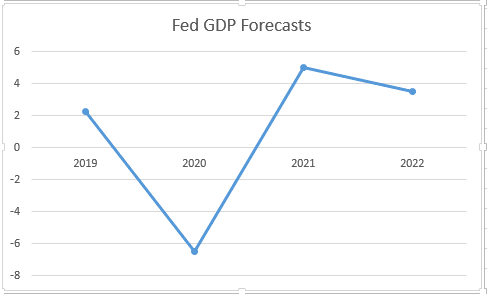
What the Fed did tell us (via the dot plot) is that only two of the seventeen FOMC members believe interest rates will be above 0.0% in 2022 (my money is on Esther and Mester, the two most hawkish members), but mercifully, not a single dot in the dot plot was in negative territory.  They also expressed a pretty dour view of the economy as follows:


  2020 2021 2022
Real GDP -6.5% 5.0% 3.5%
Core PCE 1.0% 1.5% 1.7%
Unemployment 9.3% 6.5% 5.5%

Source: Bloomberg

It is, of course, the 11.5% gain from 2020 to 2021 that encourages the concept of the V-shaped recovery as evidenced by simply plotting the numbers (including 2019’s 2.3% to start).

Screen Shot 2020-06-11 at 9.30.05 AM

So, perhaps the bulls are correct, perhaps the stock market is a screaming buy as growth will soon return and interest rates will remain zero for as far as the eye can see.  There is, however, a caveat to this view, the fact that the Fed is notoriously bad at forecasting GDP growth over time.  In fact, they are amongst the worst when compared with Wall Street in general.  But hey, at least we understand the thesis.

Another interesting outcome of the meeting was the tone of the press conference, where Chairman Jay sounded anything but ebullient over the current economic situation, especially the employment situation.  And it is this takeaway that had the biggest market impact.  After the press conference, equity markets in the US sold off from earlier highs (the NASDAQ set another all-time high intraday) and Treasuries rallied with yields falling again.  In other words, despite the prospect of Forever ZIRP (FZ), equity investors seemed to lose a bit of their bullishness.  This price action has been in place ever since with Asian equity markets all falling (Nikkei -2.8%, Hang Seng -2.3%, Shanghai – 0.8%) and Europe definitely under pressure (DAX -2.1%, CAC -2.2%, FTSE 100 -2.0%).  US futures are also lower with the Dow (-1.9%) currently the laggard, but even NASDAQ futures are lower by 1.1% at this hour.

It should be no surprise that bond markets around the world are rallying in sync with these equity declines as the combination of risk-off and the prospect for FZ lead to the inevitable conclusion that lower long term rates are in our future.  This also highlights the fact that the Fed’s concern over the second part of its mandate, stable prices, has essentially been set aside for another era.  The belief that inflation will remain extremely low forever is clearly a part of the current mindset.  Yesterday’s CPI (0.1%, 1.2% core) was simply further evidence that the Fed will ignore prices going forward.  So, 10-year Treasury yields are back to 0.7% this morning, 20 basis points below last Friday’s closing levels.  In other words, the impact of last Friday’s NFP number has been erased in four sessions.  But we are seeing investors rotate from stocks to bonds around the world, perhaps getting a bit nervous about the frothiness of the recent rallies.  (Even Hertz, the darling of the Robinhooders, is looking like Icarus.)

With risk clearly being jettisoned around the world, it should be no surprise that the dollar has stopped falling, and in fact is beginning to rally against almost all its counterparts.  While haven assets like CHF (+0.2%) and JPY (+0.1%) are modestly higher, NOK (-0.9%) and AUD (-0.85%) are leading the bulk of the G10 lower.  Norway is suffering on, not only broad dollar strength, but oil’s weakness this morning, with WTI -3.1% on the session.  As to Aussie, the combination of weaker commodity prices, the strong dollar, and market technicals as it once again failed to hold the 0.70 level, have led to today’s decline.

Emerging market activity is also what you would expect in a risk-off session, with MXN (-1.6%), ZAR (-1.1%) and RUB (-0.7%) leading the way lower.  Obviously, oil is driving both MXN and RUB, while ZAR is suffering from the weakness in the rest of the commodity complex.  I think the reason that the peso has fallen so much further than the ruble is that MXN has seen remarkable gains over the past month, more than 13% at its peak, and so seems overdue for a correction.  One notable exception to this price action today is THB, which is higher by 0.65% on a combination of reports of a fourth stimulus package and a breach of the 200-day moving average which got technicians excited.

This morning’s data brings the latest Initial Claims data (exp 1.55M), as well as Continuing Claims (20.0M) and PPI (-1.2%, 0.4% core).  While nobody will care about the latter, there will be ongoing intense scrutiny on the former as Chairman Jay made it abundantly clear that employment is the only thing the Fed is focused on for now.  With the FOMC meeting behind us, we can expect to start to hear from its members again, but on the schedule, nothing happens until next week.

It is not hard to make the case that both the euro and pound have been a bit toppish at recent levels, and with risk decidedly off today, further declines there seem quite viable.


Good luck and stay safe

Adf

Unless Lowered Instead

All eyes have now turned to the Fed
As pundits expect Jay will spread
The message that rates,
Until future dates,
Are fixed, unless lowered instead

Most market activity is muted this morning as traders and investors await the latest words of wisdom from Chairman Jay and his compadres. The key questions in the air are:

1. What will the Fed’s new forecasts describe?
2. What will the dot plot (remember that?) look like?
3. Will there be any change in current forward guidance?
4. Will there be any mention of yield curve control (YCC)?

Let’s quickly try to unpack these and see what they mean.

1. The Fed ordinarily updates its economic forecasts quarterly, but wisely, in my view, skipped March’s update given the incredible uncertainty that existed due to the beginnings of the Covid-19 impact. Three months later, the breadth of economic destruction has become clearer, but it will be interesting to learn their current views on the topic. For comparison, last week the ECB forecast a central scenario of Eurozone GDP as follows: 2020 -8.7%, 2021 +5.2%, 2022 +3.3%. The OECD forecast global GDP at -6.0% this year and US GDP at -7.3% this year assuming no second wave of infections. Those numbers fall to -7.6% and -8.5% respectively if there is a second wave of Covid infections. No matter how you slice it, 2020 is set to report negative GDP growth, but the question is, will the Fed demonstrate relative optimism or not?

2. The dot plot, as you may recall, was the biggest issue for a long time, as it was the Fed’s non-verbal way of offering forward guidance. The idea was that each FOMC member would offer his/her own views of the future level of rates and the median forecast was seen as a proxy of the Fed’s views. While it is abundantly clear that the view for 2020 will remain 0.00%, the real question is what the timeline anticipated by the FOMC will be as to when rates can start to rise again. It strikes me that while there will be some divergence, as always, we are likely to see only very gradual increases expressed, with a real possibility that 2021’s median will also be 0.00% and rates only beginning to rise in 2022. This begs the question…

3. How will they proffer their forward guidance? Current language is as follows: “The Committee expects to maintain this target (0.00%-0.25%) until it is confident that the economy has weathered recent events and is on track to achieve its maximum employment and price stability goals.” Current thoughts are they could become more specific with respect to the timeline, (e.g. saying rates would remain at current levels until the end of 2022) or with respect to data (e.g. until Unemployment is at 5.0% and Inflation is back to 2.0%). Of course, the lesson from Chairman Bernanke is that if they go the latter route, they can easily change the level as they see fit. But for now, the longer the timeline, the more confidence that would seem to be imparted. At least, that’s the theory.

4. Finally, there has been a great deal of discussion regarding YCC and whether the Fed will announce a program akin to the BOJ (10-year) or RBA (3-year) where they target a rate on a specific maturity of the Treasury curve. Most analysts, as well as Cleveland Fed President Mester, believe it is too early to make a pronouncement on this subject, but there are those who believe that despite the equity market’s recent frothiness, they may want to step harder on the gas pedal to make sure they keep up what little momentum seems to have started. To me, this is the biggest story of the afternoon, and the one with the opportunity for the most market impact. It is not fully priced in, by any means, and so would likely see a huge rally in both bonds and stocks as the dollar fell sharply if they were to announce a program like this. I like gold on this move as well.

So, plenty to look forward to this afternoon, which explains why market activity has been so limited overall so far today. Equity markets in Asia were barely changed, although in the past few hours we have seen European bourses start to decline from early modest gains. At this point the DAX (-0.8% and CAC (-0.6%) are fully representative of the entire Eurozone space. At the same time, US futures have turned mixed from earlier modest gains with Dow e-minis down 0.3% although NASAAQ futures are actually higher by a similar amount.

Bond markets are generally anticipating something from the Fed as the 10-year has rallied and yields declined a further 3bps which now takes the decline since Friday’s close to 10bps. Bunds and Gilts are both firmer as well, with modestly lower yields while the PIGS are mixed as Greek yields have tumbled 9bps while Spain (+3bps) and Portugal (+4.5bps) see rising yields instead.

And finally, the dollar is definitely on its back foot this morning. In fact, it is lower vs. the entire G10 bloc with Aussie and Kiwi leading the way with 0.5% gains. Right now, the Aussie story looks more technical than fundamental, as it approaches, but cannot really hold 0.70, its highest point in almost a year. But overall, what is interesting about this movement is that despite yesterday’s desultory equity performance and this morning’s modest one as well, the dollar is behaving in a risk-on manner. Something else is afoot, but I have not yet been able to suss it out. I will though!

In the EMG space, the dollar is lower against virtually all its counterparts with IDR as the major exception. The rupiah fell 0.65% last night, actually recouping larger earlier losses at the end of the session, after the central bank explained they would be capping any strength in an effort to help Indonesian exporters. On the plus side is a range of currencies from all three blocs, which is evidence of pure dollar weakness rather than specific positive currency stories.

On the data front, overnight we learned that Chinese PPI was weaker than expected, reflecting weakness in its export markets and not boding well for that elusive V-shaped recovery. We also saw horrific April French IP data (-34.2% Y/Y), but that was pretty much as expected. This morning we get the latest CPI data from the US (exp 0.3%, 1.3% ex food & energy), but inflation remains a secondary concern to the Fed for now. Rather, there is far more focus on the employment data at the Mariner Eccles Building, so really, for now it is all about waiting for the Fed. If pressed, I think they will be more likely to offer some new, more dovish, guidance as it appears they will not want to lose any positive momentum. That means the dollar should remain under pressure for a little while longer.

Good luck and stay safe
Adf

Buy With More Zeal

The stimulus story is clear
Expect more throughout the whole year
C bankers are scared
And war they’ve declared
On bears, who now all live in fear

Thus, Wednesday the Fed will reveal
They’ll not stop til they hear the squeal
Of covering shorts
While Powell exhorts
Investors to buy with more zeal!

The market is biding its time as traders and investors await Wednesday’s FOMC statement and the press conference from Chairman Powell that follows. Patterns that we have seen over the past week are continuing, albeit on a more modest path. This means that the dollar is softer, but certainly not collapsing; treasury yields are higher, and those bonds almost seem like they are collapsing; commodity prices continue to mostly move higher; and equity markets are mixed, with pockets of strength and weakness. This is all part and parcel of the V-shaped recovery story which has completely dominated the narrative, at least in financial markets.

Friday’s payroll report was truly surprising as the NFP number was more than 10 million jobs higher than estimated. This led to a surprisingly better than expected, although still awful, Unemployment Rate of 13.3%. However, this report sowed its own controversy when the Labor Department happened to mention, at the bottom of the release, that there was a little problem with the count whereby 4.9 million respondents were misclassified as still working and temporarily absent rather than unemployed. Had these people been accounted for properly, the results would have been an NFP outcome of -2.4 million while the Unemployment rate would have been about 3% higher. Of course, this immediately raised questions about the propriety of all government statistics and whether the administration is trying to cook the books. However, Occam’s Razor would point you in another direction, that it is simply really difficult to collect accurate data during the current pan(dem)ic.

What is, perhaps, more interesting is that the financial press has largely ignored the story. It seems the press is far more interested in fostering the bullish case and this number was a perfect rebuttal to all the bears who continue to highlight things like the coming wave of bankruptcies that are almost certain to crest as soon as the Fed (and other central banks) stop adding money to the pot every day. Of course, perhaps the central banking community will never stop adding money to the pot thus permanently supporting higher equity valuations. Alas, that is the precise recipe for fiat currency devaluation, perhaps not against every other fiat currency, but against real stuff, like gold, real estate, and even food. So, while FX rates may all stay bounded, inflation would become a much greater problem for us all.

At this point, the universal central bank view is that deflation remains the primary concern, and inflation is easily tamed if it should appear. But ask yourself this, if central banks have spent trillions of dollars to drive rates lower to support the economy, how much appetite will they have to raise rates to fight inflation at the risk of slowing the economy? Exactly.

So, let’s take a look at today’s markets. After Friday’s blowout performance by US equities, which helped drive the dollar lower and Treasury yields higher, Asia was actually very quiet with only the Nikkei (+1.4%) showing any life at all. And that came after a surprisingly good Q1 GDP report showing Japan shrank only 2.2% in Q1, not the -3.4% originally reported. This also represents a data controversy as Capex data appeared far more robust than originally estimated. However, this too, seems to be a case of the government having a difficult time getting accurate data with most economists expecting the GDP result to be revised lower. But the rest of Asia was basically flat in equity space.

Meanwhile, European bourses are mixed with the DAX (-0.4%) and CAC (-0.5%) leading the way lower although we continue to see strength in Spain (+0.7%) and Italy (+0.2%). The ongoing belief that the largest portion of ECB stimulus will be used to support the latter two nations remains a powerful incentive for investors to keep buying into their markets.

On the bond front, Treasury yields, after having risen 25bps last week, in the 10-year, are higher by a further 2bps this morning. 30-year yields are rising even faster, up 3.5bps so far today. This, too, is all part of the same narrative; the V-shaped recovery means that lower rates will no longer be the norm going forward. This is setting up quite the confrontation with the Fed and is seen as a key reason that yield-curve control (YCC) is on the horizon. The last thing the Fed wants is for the market to undermine all their efforts at economic recovery by anticipating their success and driving yields higher. Thus, YCC could be the perfect means for the Fed to stop that price action in its tracks.

As to the dollar, it is having a more mixed performance today as opposed to the broad-based weakness we saw last week. In the G10, SEK and NOK (+0.4% each) are the best performers although we are seeing modest 0.15%-0.2% gains across the Commonwealth currencies as well as the yen. NOK is clearly following oil prices higher, while SEK continues to benefit from the fact that its rising yields are attracting more investment after reporting positive Q1 growth last week. On the downside, the pound is the leading decliner, -0.25%, although the euro is weakening by 0.15% as well. While the pound started the session firmer on the back of easing lockdown restrictions, it has since turned tail amid concerns that this dollar decline is reaching its limits.

In the EMG bloc, RUB (+0.65%) is the clear leader today, also on oil’s ongoing rally, although there are a number of currencies that have seen very modest gains as well. On the downside, TRY and PHP (-0.25% each) are the leading decliners, but here, too, there is a list of currencies that have small losses. As I said, overall, there is no real trend here.

While this week brings us the FOMC meeting, there is actually very little other data to note:

Tuesday NFIB Small Biz Sentiment 92.2
  JPLT’s Job Openings 5.75M
Wednesday CPI 0.0% (0.3% Y/Y)
  -ex food & energy 0.0% (1.3% Y/Y)
  FOMC Rate Decision  0.25%
Thursday Initial Claims 1.55M
  Continuing Claims 20.6M
  PPI 0.1% (-1.3% Y/Y)
  -ex food & energy -0.1% (0.5% Y/Y)
Friday Michigan Sentiment 75.0

Source: Bloomberg

While we can be pretty sure the Fed will not feel compelled to change policy at this meeting, you can expect that there will be many questions in the press conference regarding the future, whether about forward guidance or YCC. As they continue to reduce their daily QE injections, down to just $4 billion/day, I fear the equity market may start to feel a bit overdone up here, and a short-term reversal seems quite realistic. For now, risk is still on, but don’t be surprised if it stumbles for a while going forward. And that means the dollar is likely to show some strength.

Good luck and stay safe
Adf

Patience is Needed

Mnuchin said patience is needed
While Powell said growth must be seeded
As both testified
And each justified
Their views, which both said must be heeded

Two months into the response to Covid-19, differences in policy views between the Fed and the Administration are starting to appear. In Senate testimony yesterday, Treasury Secretary Mnuchin indicated the belief that sufficient fiscal support has been authorized and its implementation is all that is needed, alongside the relaxation of lockdown rules around the country, for the economy to rebound sharply. The Administration’s base case remains a V-shaped recovery, with Q3 and Q4 showing substantial growth after what everyone agrees will be a devastatingly awful Q2 result.

Meanwhile, the Fed, via Chairman Powell, took the view that we remain in a critical period and that further stimulus may well be necessary to prevent permanent long-term damage to the economy. He continued to focus on the idea that until people feel safe with personal interactions, any rebound in the economy will be substandard. Of course, to date, of the $454 billion that Congress authorized for the Treasury to use as seed money underlying Fed lending schemes, less than $75 billion has been utilized. It seems that if Chairman Powell was truly that concerned, he would be ramping up the use of those funds more quickly. While part of the problem is the normal bureaucratic delays that come with implementing any new program, it is also true that the Fed is not well suited to support small businesses and individuals. Programs of that nature tend to require more fiscal than monetary support, at least as currently defined and implemented in today’s world. Remember, the Fed is not able to take losses according to its charter, which is why all the corporate bond buying and main street lending programs are already on shaky legal grounds.

The interesting thing about the dueling testimonies was just how little of an impact they had on market behavior yesterday. In fact, the late day equity market sell-off was almost certainly driven by the concern that yesterday’s media darling, the biotech firm Moderna, Inc., may not actually have a viable vaccine ready this year. Remember, it was the prospect that a vaccine was imminent and so lockdowns could be lifted that was critical in investor minds yesterday. If the vaccine story is no longer on track, it is much harder to justify paying over the top for equities. At any rate, that late day move set the tone for a much more subdued session in both Asia and Europe overnight.

Looking at markets, last night saw a mixed equity picture in Asia (Nikkei +0.8%, Shanghai -0.5%) and a very modest positive light in Europe (DAX +0.6%, CAC 0.0%, FTSE 100 +0.2%). More positively, US futures are pointing higher as I type, with all three indices looking at a 1% gain on the open if things hold. Bond markets are similarly uninspired this morning, with Treasury yields higher by less than 1bp while German bund yields are down by the same. In fact, looking across the European market, half are slightly higher, and half are slightly lower. Again, nothing of interest here.

Commodity markets show that oil continues to rebound sharply, up another 1% this morning and now above $32/bbl for WTI. Remember, it was less than a month ago that the May futures contract settled at -$37/bbl as storage was nowhere to be found. Certainly, any look at commodity markets would indicate that economic growth was making a return. But it sure doesn’t feel like that yet.

Finally, FX markets continue to see the dollar cede some recent gains as fears over USD funding by global counterparts continue to ebb on the back of Fed lending programs. In fact, this is exactly where the Fed can do the most good, helping to ensure that central banks around the world have the ability to access USD liquidity for their local markets.

A tour of the G10 shows that today’s biggest winner is NZD (+0.65%) followed by AUD and CHF, both higher by about 0.4%. The Kiwi dollar was supported by central bank comments about NIRP remaining a distant prospect, at best, with many hurdles to be jumped before it would make sense. Aussie seems to have benefitted from Japanese investment flows into their government bond markets, which are now relatively attractive vs. US Treasuries. Finally, after a short-lived decline yesterday afternoon, apparently driven by some options activity, the Swiss franc is simply returning to its previous levels. The other seven currencies are within a few bps of yesterday’s closing levels with only the background story of the Franco-German détente on EU economic support even getting press in the group.

In the EMG space, ZAR is today’s runaway leader, currently higher by 1.75% as a combination of continued strength in the price of gold and a major technical break have helped the rand. It must be remembered that the rand, even after today’s sharp rally, has been the third worst performing currency over the past three months having fallen more than 16%. This morning, the technicians are all agog as the spot rate traded back through its 50-day moving average, a strong technical signal to buy the currency. While economic prospects continue to be dim overall there and there is no evidence that the rate of infection is slowing, technical algorithms will continue to support the currency for the time being.

Otherwise, it is RUB (+1.1%) and MXN (+0.9%) that are trailing only the rand higher this morning, with both clearly benefitting from the ongoing rebound in oil and, more importantly, in the broad sentiment in the future for oil. Last month it appeared that oil was never going to matter again. That is not so much the case anymore. On the downside today, KRW (-0.4%) is the leading, and only, decliner in the space as the BOK creates a 10 trillion won (~$8 billion) SPV to inaugurate a QE program.

On the data front, yesterday’s housing data was pretty much as expected, with both Starts and Permits falling sharply. Today the only news of note comes at 2:00 when the FOMC Minutes are released. But given how much we have heard from Powell and the rest of the committee, will this really have that big an impact? I would be surprised.

The dollar continues under pressure for the time being and will stay that way as long as USD funding pressures overseas remain in check. While there are no obvious drivers in the near term, I continue to look at the pending change of heart in Europe regarding fiscal support and see an opportunity for a more structural case for dollar weakness over time.

Good luck and stay safe
Adf


Our Fears

Said Powell, it may take two years
Ere Covid’s impact finally clears
All central banks pleaded
More spending is needed
But really, it’s down to our fears

Fed Chairman Powell continues to be the face of the global response to the Covid-19 economic disruption. Last night, in a 60 Minutes interview broadcast nationwide, he said, “Assuming there’s not a second wave of the coronavirus, I think you’ll see the economy recover steadily through the second half of this year. For the economy to fully recover, people will have to be fully confident, and that may have to await the arrival of a vaccine.” He also explained that the Fed still has plenty of ammunition to continue supporting the economy, although he was clear that fiscal policy had a hugely important role to play and would welcome further efforts by the government on that score. Tomorrow, he will be testifying before the Senate Banking Committee where the Republican leadership has indicated they would prefer to wait and watch to see how the CARES act has fared before opting to double down.

In the meantime, it does appear that the spread of the virus has slowed more substantially. In addition, we continue to see more state governors reopening parts of their local economies on an ad hoc basis. And globally, restrictions are being lifted throughout Europe and parts of Asia as the infection curve truly seems to be in decline. It is this latter aspect that seems to be the current theory as to why there will be a V-shaped recovery which is supporting equity markets globally.

But when considering the prospects of a V, it is critical to remember this important feature of the math behind investing. A 10% decline requires an 11.1% recovery just to return to the previous level. And as the decline grows in size, the size of the recovery needs to be that much larger. For instance, the Atlanta Fed’s latest GDPNow forecast is calling for a, very precise, 42.81% contraction in Q2. If that were to come to pass, it means that a recovery to the previous level will require a 74.8% rebound! While the down leg of this economic contraction is clearly shaped like the left-hand side of a V, it seems highly unlikely that the speed of the recovery will approach the same pace. The final math lesson is that if Q3 were to rebound 42.81%, it would still leave the economy at just under 82% of its previous level. In other words, still in depression.

However, math is clearly not the strong suit of the investment community these days, as once again this morning, we continue to see a strong equity market performance. In fact, we have seen a strong performance in equities, bonds, gold, oil, and virtually everything else that can be bought. One explanation for this behavior would be that investors are concerned that the current QE Infinity programs across nations are going to debase currencies everywhere and so the best solution is to own assets with a chance for appreciation. While historically, the flaw in that theory would be the bond market, which should be selling off dramatically on this sentiment, it seems that the knowledge that central banks are going to continue to mop up all the excess issuance is seen as reason enough to continue to hold fixed income. With that in mind, I would have to characterize today’s session is a risk grab-a-thon.

The Brits and the EU have met
With no progress really made yet
The British are striving
To just keep trade thriving
The EU’s a different mindset

Meanwhile, remember Brexit? With all the focus on Covid, it is not surprising that this issue had moved to the back of the market’s collective consciousness. It has not, however, disappeared. If you recall, the terms of the UK exit were that a deal needs to be reached by the end of this year and that if there is to be another extension, that must be agreed by the end of June. Well, it seems that Boris is sticking to his guns that he will not countenance an extension and has instructed his negotiators to focus on a trade deal only. The EU, however, apparently still doesn’t accept that Brexit occurred and is seeking a deal that essentially requires the UK to remain beholden to the European Court of Justice as well as to adhere to all EU conditions on issues like the environment and diversity. The result is that the negotiations have become a game of chicken with a very real, and growing, probability that we will still have the feared hard Brexit come December. In a funny way, Covid could be a blessing for PM Johnson’s Brexit strategy, because given the negative impact already in play, at the margin, Brexit is not likely to make a significant difference. Arguably, it is the growing realization that a hard Brexit is back on the table that has undermined the pound’s performance lately. Despite a marginal 0.1% gain this morning, the pound is the worst performing G10 currency this month, down about 4.0%. At this time, I see no reason for the pound to reverse these losses barring a change in the tone of the negotiations.

As to this morning’s session, the overall bullish tone to most markets has left the dollar on the sidelines. It is firmer against some currencies, weaker vs. others with no clear patterns, and in truth, most movement has been limited. The biggest gainer today has been RUB, which has rallied 1.0% on the strength of oil’s 8% rally. In fact, oil is back over $30/bbl for the first time in two months. Not surprisingly we are seeing strength in MXN (+0.75%) and ZAR (+0.65%) as well on the same commodity rally story. On the flipside, APAC currencies were the main losers with MYR (-0.5%) and INR (-0.45%) the worst of the bunch as Covid infections are making a comeback in the area. In the G10 bloc, NOK (+0.75%) and AUD (+0.7%) are the leaders as they, too, benefit most from commodity strength.

On the data front, last night saw Japanese GDP print at -3.4% annualized, confirming the technical recession that has begun there. (Remember, Q4 was a disaster, -7.3%, because of the imposition of the national sales tax increase.) Otherwise, there were no hard data points from Europe at all. Looking ahead to this week, it is a muted schedule focused on housing.

Tuesday Housing Starts 923K
  Building Permits 1000K
Wednesday FOMC Minutes  
Thursday Initial Claims 2.425M
  Continuing Claims 23.5M
  Philly Fed -40.0
  Leading Indicators -5.7%
  Existing Home Sales 4.30M

Source: Bloomberg

In truth, with the market still reacting to Powell’s recent comments, and his testimony on Tuesday, as well as comments from another six Fed members, I would argue that this week is all about them. For now, the V-shaped rebound narrative continues to be the driver. If the Fed speakers start to sound a bit less optimistic, that could bode ill for the bulls, but likely bode well for the dollar. If not, I imagine the dollar will remain under a bit of pressure for now.

Good luck and stay safe
Adf

Enough Wherewithal

The Chairman explained to us all
The Fed has enough wherewithal
To counter the outbreak
But, too, Congress must take
More actions to halt the shortfall

The US equity markets led global stocks lower after selling off in the wake of comments from Chairman Powell yesterday morning. In what was a surprisingly realistic, and therefore, downbeat assessment, he explained that while the Fed still had plenty of monetary ammunition, further fiscal spending was necessary to prevent an even worse economic and humanitarian crisis. He also explained that any recovery would take time, and that the greatest risk was the erosion of skills that would occur as a huge swathe of the population is out of work. It cannot be a surprise that the equity markets sold off in the wake of those comments, with a weak session ending on its lows. It is also not surprising that Asian markets overnight followed US indices lower (Nikkei -1.75%, Hang Seng -1.45%, Shanghai -1.0%), nor that European markets are all in the red this morning (DAX -1.6%, CAC -1.7%, FTSE 100 -2.2%). What is a bit surprising is that US futures, at least as I type, are mixed, with the NASDAQ actually a touch higher, while both the Dow and S&P 500 see losses of just 0.2%. However, overall, risk is definitely on its back foot this morning.

But the Chairman raised excellent points regarding the timeline for any recovery and the potential negative impacts on economic activity going forward. The inherent conflict between the strategy of social distance and shelter in place vs. the required social interactions of so much economic activity is not a problem easily solved. At what point do government rules preventing businesses from operating have a greater negative impact than the marginal next case of Covid-19? What we have learned since January, when this all began in Wuhan, China, is that the greater the ability of a government to control the movement of its population, the more success that government has had preventing the spread of the disease. Alas, from that perspective, the inherent freedoms built into the US, and much of the Western World, are at extreme odds with those government controls/demands. As I have mentioned in the past, I do not envy policymakers their current role, as no matter the decision, it will be called into question by a large segment of the population.

What, though, are we now to discern about the future? Despite significant fiscal stimulus already enacted by many nations around the world, it is clearly insufficient to replace the breadth of lost activity. Central banks remain the most efficient way to add stimulus, alas they have demonstrated a great deal of difficulty applying it to those most in need. And so, despite marginally positive news regarding the slowing growth rate of infections, the global economy is not merely distraught, but seems unlikely to rebound in a sharp fashion in the near future. Q2 has already been written off by analysts, and markets, but the question that seems to be open is what will happen in Q3 and beyond. While we have seen equity weakness over the past two sessions, broadly speaking equity markets are telling us that things are going to be improving greatly while bond markets continue to point to a virtual lack of growth. Reading between the lines of the Chairman’s comments, he seems to be siding with the bond market for now.

Into this mix, we must now look at the dollar, and its behavior of late. This morning had seen modest movement until about 6:30, when the dollar started to rally vs. most of its G10 counterparts. As I type, NOK, SEK and AUD are all lower by 0.5% or so. The Aussie story is quite straightforward as the employment report saw the loss of nearly 600K jobs, a larger number than expected, with the consequences for the economy seen as potentially dire. While restrictions are beginning to be eased there, the situation remains one of a largely closed economy relying on central bank and government largesse for any semblance of economic activity. As to the Nordic currencies, SEK fell after a weaker than expected CPI report encouraged investors to believe that the Riksbank, which had fought so hard to get their financing rate back to 0.00% from several years in negative territory, may be forced back below zero. NOK, however, is a bit more confusing as there was no data to see, no comments of note, and the other big key, oil, is actually higher this morning by more than 4%. Sometimes, however, FX movement is not easily explained on the surface. It is entirely possible that we are seeing a large order go through the market. Remember, too, that while the krone is the worst performing G10 currency thus far in 2020, it has managed to rally more than 7% since late April, and so we are more likely seeing some ordinary back and forth in the markets.

One other comment of note in the G10 space was from BOE Governor Andrew Bailey, who reiterated that negative interest rates currently have no place in the BOE toolkit and are not necessary. While the comments didn’t impact the pound, which is lower by 0.25% as I type, it continues to be an important distinction as along with Chairman Powell, the US and the UK are the only two G10 nations that refuse to countenance the idea of NIRP, at least so far.

In the emerging markets, what had been a mixed and quiet session earlier has turned into a pretty strong USD performance overall. The worst performer is ZAR, currently down 0.9% the South African yield curve bear-steepens amid continued unloading of 10-year bonds by investors. But it is not just the rand falling this morning, we are seeing weakness in the CE4 (CZK -0.7%, HUF -0.5%, PLN -0.4%) and once again the Mexican peso is finding itself under strain. While the CE4 appear to simply be following the lead of the euro (-0.35%), perhaps with a bit more exuberance, I think the peso continues to be one of the more interesting stories out there.

Both MXN and BRL have been dire performers all year, with the two currencies being the worst two performers in the past three months and having fallen more than 20% each. Both currencies continue to be extremely volatile, with daily ranges averaging in excess of 2% for the past two months. The biggest difference is that BRL has seen a significant amount of direct intervention by the BCB to prevent further weakness, while MXN continues to be a 100% free float. The other thing to recall is that MXN is frequently seen as a proxy for all LATAM because of its relatively better liquidity and availability. The point is, further problems in Brazil (and they are legion as President Bolsonaro struggles to rule amid political fractures and Covid-19) may well result in a much weaker Mexican peso. This is so even if oil prices rebound substantially.

Turning to data, we see the weekly Initial Claims number (exp 2.5M) and Continuing Claims (25.12M), but otherwise that’s really it. While we have three more Fed speakers, Kashkari, Bostic and Kaplan, on the calendar, I think after yesterday’s Powell comments, the market may be happier not to hear their views. All the evidence points to an overbought risk atmosphere that needs to correct at some point. As that occurs, the dollar should retain its bid overall.

Good luck and stay safe
Adf

They’re Trying

The Kiwis have doubled QE
The Brits saw collapsed GDP
The Fed keeps on buying
More bonds as they’re trying
To preempt a debt jubilee

The RBNZ was the leading economic story overnight as at their meeting, though they left interest rates unchanged at 0.25%, they virtually doubled the amount of QE purchases they will be executing, taking it up to NZ$60 billion. Not only that, they promised to consider even lower interest rates if deemed necessary. Of course, with rates already near zero, that means we could be looking at the next nation to head through the interest rate looking glass. It should be no surprise that NZD fell on the release, and it is currently lower by 0.9%, the worst performing currency of the day.

Meanwhile, the UK released a raft of data early this morning, all of which was unequivocally awful. Before I highlight the numbers, remember that the UK was already suffering from its Brexit hangover, so looking at slow 2020 growth in any case. GDP data showed that the economy shrank 5.8% in March and 2.0% in Q1 overall. The frightening thing is that the UK didn’t really implement any lockdown measures until the last week of March. This bodes particularly ill for the April and Q2 data. IP fell 4.2% and Consumption fell 1.7%. Thus, what we know is that the UK economy is quite weak.

There is, however, a different way to view the data. Virtually every release was “better” than the median forecast. One of the truly consistent features of analysts’ forecasts about any economy is that they are far more volatile than the actual outcome. The pattern is generally one where analysts understate a large move because their models are not well equipped for exogenous events. Then, once an event occurs, those models extrapolate out at the initial rate of change, which typically overstates the negative news. For example, if you recall, the early prognostications for the US employment data in March called for a loss of 100K jobs, which ultimately printed at -713K. By last week’s release of the April data, the analyst community had gone completely the other way, anticipating more than 22M job losses, with the -20.5M number seeming better by comparison. So, we are now firmly in the overshooting phase of economic forecasts. The thing about the current situation though, is that there is so much uncertainty over the next steps by governments, that current forecasts still have enormous error bars. In other words, they are unlikely to be even remotely accurate on a consistent basis, regardless of who is forecasting. Keep that in mind when looking at the data.

In fact, the one truism is that on an absolute basis, the economic situation is currently horrendous. A payroll report of -20.5M instead of -22.0M is not a triumph of policymaking, it is a humanitarian disaster. And it is this consideration, that regardless of data outcomes vs. forecasts, the data is awful, that informs the view that equity markets are unrealistically priced. Thus, the battle continues between those who look at the economy and see significant concerns and those who look at the central bank support and see blue skies ahead. This author is in the former camp but would certainly love to be wrong. Regardless, please remember that data that beats a terrible forecast by being a little less terrible is not the solution to the current crisis. I fear it will be many months before we see actual positive data.

Turning to this morning’s session, the modest risk aversion seen in equity (DAX -1.5%, CAC -1.7%) and bond (Treasuries -1bp, Bunds -2bps) markets is less clear in the FX world. In fact, other than the NZD, the rest of the G10 is firmer this morning led by NOK (+0.7%) on the strength of the continuing rebound in the oil market. Saudi Arabia’s announcement that they will unilaterally cut output by a further 1 million bpd starting in June has helped support crude. In addition, another thesis is making the rounds, that mass transit will have lost its appeal for many people in the wake of Covid-19, thus those folks will be returning to their private vehicles and using more gasoline, not less. This should also bode well for the Big 3 auto manufacturers and their supply chains if it does describe the post-covid reality. It should be no surprise that in the G10, the second-best performer is CAD (+0.4%) nor that in the EMG bloc, it is MXN (+1.0%) and RUB (+0.5%) atop the leaderboard.

Other than the oil linked currencies, though, there has been very little movement overall, with more gainers than losers, but most movement less than 0.25%. the one exception to this is HUF, which has fallen 0.5%, after news that President Orban is changing the tax rules regarding city governments (which coincidentally are controlled by his opponents) and pushing tax revenues to the county level (which happen to be controlled by his own party). This nakedly political maneuvering is not seen as a positive for the forint. But other than that, there is little else to tell.

On the data front, this morning brings PPI data (exp -0.4%, 0.8% ex food & energy) but given we already saw CPI yesterday, and more importantly, inflation issues are not even on the Fed’s agenda right now, this is likely irrelevant. Of more importance will be the 9:00 comments from Chairman Powell as market participants will want to hear about his views on the economy and of likely future activity. Will there be more focused forward guidance? Are negative rates possible? What other assets might they consider buying? While all of these are critical questions, it does seem unlikely he will go there today. Instead, I would look for platitudes about the Fed doing everything they can, and that they have plenty of capacity, and willpower, to do more.

And that’s really it for what is starting as a quiet day. The dollar is under modest pressure but remains much closer to recent highs than recent lows. As long as investors continue to accept that the Fed and its central bank brethren are on top of the situation, I imagine that we can see further gains in equity markets and further weakness in the dollar. I just don’t think it can go on that much longer.

Good luck and stay safe
Adf


Riven By Obstinacy

Said Jay, in this challenging time
Our toolkit is truly sublime
It is our desire
More bonds to acquire
And alter the Fed’s paradigm

In contrast, the poor ECB
Is riven by obstinacy
Of Germans and Dutch
Who both won’t do much
To help save Spain or Italy

Is anybody else confused by the current market activity? Every day reveals yet another data point in the economic devastation wrought by government efforts to control the spread of Covid-19, and every day sees equity prices rally further as though the future is bright. In fairness, the future is bright, just not the immediate future. Equity markets have traditionally been described as looking forward between six months and one year. Based on anything I can see; it is going to take far more than one year to get global economies back to any semblance of what they were like prior to the spread of the virus. And yet, the S&P is only down 9% this year and less than 13% from its all-time highs set in mid-February. As has been said elsewhere, the economy is more than 13% screwed up!

Chairman Powell seems to have a pretty good understanding that this is going to be a long, slow road to recovery, especially given that we have not yet taken our first steps in that direction. This was evidenced by the following comment in the FOMC Statement, “The ongoing public health crisis will weigh heavily on economic activity, employment and inflation in the near term, and poses considerable risks to the economic outlook over the medium term.” (My emphasis.) And yet, we continue to see equity investors scrambling to buy stocks amid a great wave of FOMO. History has shown that bear markets do not end in one month’s time and I see no reason to believe that this time will be different. I don’t envy Powell or the Fed the tasks they have ahead of them.

So, let’s look at some of the early data as to just how devastating the response to Covid-19 has been around the world. By now, you are all aware that US GDP fell at a 4.8% annualized rate in Q1, its sharpest decline since Q4 2008, the beginning of the GFC. But in truth, compared to the European data released this morning, that was a fantastic performance. French Q1 GDP fell 5.8%, which if annualized like the US reports the data, was -21.0%. Spanish Q1 GDP was -5.2% (-19.0% annualized), while Italy seemed to have the best performance of the lot, falling only 4.8% (-17% annualized) in Q1. German data is not released until the middle of May, but the Eurozone, as a whole, printed at -3.8% Q1 GDP. Meanwhile, German Unemployment spiked by 373K, far more than forecast and the highest print in the history of the series back to 1990. While these were the highlights (lowlights?), the story is uniformly awful throughout the continent.

With this in mind, the ECB meets today and is trying to determine what to do. Last month they created the PEPP, a €750 billion QE program, to support the Eurozone economy by keeping member interest rates in check. But that is not nearly large enough. After all, the Fed and BOJ are at unlimited QE while the BOE has explicitly agreed to monetize £200 billion of debt. In contrast, the ECB’s actions have been wholly unsatisfactory. Perhaps the best news for Madame Lagarde is the German employment report, as Herr Weidmann and Frau Merkel may finally recognize that the situation is really much worse than they expected and that more needs to be done to support the economy. Remember, too, that Germany has been the euro’s biggest beneficiary by virtue of the currency clearly being weaker than the Deutschemark would have been on its own and giving their export industries an important boost. (I am not the first to notice that the euro’s demise could well come from Germany, Austria and the Netherlands deciding to exit in order to shed all responsibility for the fiscal problems of the PIGS. But that is a discussion for another day.)

The consensus is that the ECB will not make any changes today, despite a desperate need to do more. One of the things holding them back is an expected ruling by the German Constitutional Court regarding the legality of the ECB’s QE programs. This has been a bone of contention since Signor Draghi rammed them through in 2012, and it is not something the Germans have ever forgiven. With debt mutualization off the table as the Teutonic trio won’t even consider it, QE is all they have left. Arguably, the ECB should increase the PEPP by €1 trillion or more in order to have a truly positive impact. But thus far, Madame Lagarde has not proven up to the task of forcing convincing her colleagues of the necessity of bold action. We shall see what today brings.

Leading up to the ECB announcement and the ensuing press briefing, Asian equity markets followed yesterday’s US rally higher, although early gains from Europe have faded since the release of the sobering GDP data. US futures have also given back early gains and remain marginally higher at best. Bond markets are generally edging higher, with yields across the board (save Italy) sliding a few bps, and oil prices continue their recent rebound, although despite some impressive percentage moves lately, WTI is trading only at $17.60/bbl, still miles from where it was at the beginning of March.

The dollar, in the meantime, remains under pressure overall with most G10 counterparts somewhat firmer this morning. The leaders are NOK (+0.45%) on the strength of oil’s rally, and SEK (+0.4%) which seems to simply be continuing its recent rebound from the dog days of March. Both Aussie and Kiwi are modestly softer this morning, but both of those have put in stellar performances the past few days, so this, too, looks like position adjustments.

In the EMG bloc, IDR was the overnight star, rallying 2.8% alongside a powerful equity rally there, as investors who had been quick to dump their holdings are back to hunting for yield and appreciation opportunities. As markets worldwide continue to demonstrate a willingness to look past the virus’s impact, there are many emerging markets that could well see strength in both their currencies and stock markets. The next best performers were MYR (+1.0%) and INR (+0.75%), both of which also responded to a more robust risk appetite. As LATAM has not yet opened, a quick look at yesterday’s price action shows BRL having continued its impressive rebound, higher by 3.0%, but strength too in CLP (+2.9%), COP (+1.2%) and MXN (2.5%).

We get more US data this morning, led by Initial Claims (exp 3.5M), Continuing Claims (19.476M), Personal Income (-1.5%), Personal Spending (-5.0%) and Core PCE (1.6%) all at 8:30. Then, at 9:45 Chicago PMI (37.7) is due to print. As can be seen, there is no sign that things are doing anything but descending yet. I think Chairman Powell is correct, and there is still a long way to go before things get better. While holding risk seems comfortable today, look for this to turn around in the next few weeks.

Good luck and stay safe
Adf


Until Covid-19 Is Dead

To those who had thought that the Fed
Was finished, Chair Powell just said
There’s nothing that we
Won’t do by decree
Until Covid-19 is dead

Small Caps? Check. Munis? Check. Junk bonds Fallen angels? Check. These are the latest segments in the credit market where the Fed has created new support based on yesterday’s stunning announcements. All told, the Fed has committed up to $2.3 trillion to support these areas, as well as the trillions of dollars they had already spent and committed to support the Treasury market, mortgage market, and ensure that bank finances remained sufficient for their continued operation and provision of loans and services to the economy.

While the breadth of programs the Fed has announced and implemented thus far is stunning, based on the CARES act passed last week, there is still plenty more ammunition available for the Fed to continue to be creative. Of course, the market reaction was highly positive to these announcements and served to cap off a week where the S&P 500 rose more than 12% from last Friday’s closing levels. In fact, a cynic might suggest that the Fed’s sole purpose is to prop up the equity market, but given the extraordinary events ongoing, I suppose that is merely a happy side effect. At any rate, there is no doubt that the Fed has taken its role as the world’s central bank seriously. Between swap lines and repo facilities for other central banks and purchase programs for virtually every type of domestic asset, Chairman Powell will never be able to be accused of fiddling while the economy burned. And while government programs are notoriously difficult to remove once enacted, based on the ongoing economic indicators, like yesterday’s second consecutive 6.6 million print in the Initial Claims data, it is evident that the Fed is being as aggressive as possible.

There will almost certainly be numerous longer-term negative consequences of all this activity and books will be written about all the ways the Fed overstepped its bounds, but right now, the vast majority of people around the world are hugely in favor of their actions. Anything that supports the economy and population through this period of mandated shutdown is appreciated. While they don’t run polls for popularity of central bank chiefs, I’m pretty confident Chairman Jay would be riding high these days.

In the meantime, there were two other noteworthy stories in the past 24 hours with market impact. The first was that the OPEC+ meeting did not come to agreement yesterday for production cuts totaling 10 million bbl/day as Mexico was the lone holdout, insisting that it would only cut 100,000 bbl/day of production, not the 400,000 bbl/day needed. After 16 hours of video conferencing, the energy leaders postponed any decision and decided to allow today’s G20 FinMin video conference to go forward and help try to break the impasse. It strikes me that Mexico will cave soon on this issue, but for now, nothing is agreed. It is hard to determine how oil markets have responded given essentially all cash and futures markets are closed today for the Good Friday holiday. However, oil futures had not fallen on Thursday afternoon which indicates they, too, believe a deal will be done.

And finally, the EU finally came up with a financing package to address the economic impact of the virus on its members. As was to be expected, it was significantly less than initially mooted and the construct of the deal indicates that there has not yet been any agreement by the Teutonic trio of Germany, Austria and the Netherlands to fund the PIGS. A brief overview of the deal shows the headline figure to be €540 billion made up of three pieces; a joint employment insurance fund (€100B), an EIB supported package designed to provide liquidity to impacted companies (€200B) and a ESM credit line (€240B) to backstop national spending. The problem with the latter is that the European Stability Mechanism is anathema to those nations that need it most like Spain and Italy, because it imposes fiscal conditions on the use of the funds. It is an ECB creation from the Eurobond crisis years by Mario Draghi, but it has never been used. Essentially, the rest of Europe has said to Germany, we may need your money, but we will not become your vassal. And this is exactly why the EU, and its subgroup the Eurozone, will remain dysfunctional going forward.

Thus, when compiling the newest information, the one thing that becomes clear is that the US continues to be the nation most willing to increase spending and liquidity to support its economy. And in the end, it cannot be surprising that the dollar will suffer in that scenario. Back in January, my view was the dollar would decline this year as the US was the economy with the most room to ease policy and that eventually, those much easier conditions would result in a weaker dollar. Well, that is exactly what we are seeing occur right now, as the Fed has upped the ante regarding monetary policy easing relative to the rest of the world at the same time that the broad narrative seems to be evolving into ‘the infection peak has passed and things are going to be better in the future than in the recent past’. Hence, the need to hold dollars as a haven has diminished, and the dollar has responded. For instance, this week AUD has rallied 5.7% while NOK is higher by 3.9%. Clearly both have been buoyed by the rise in oil prices as well as the generally better tone on risk. But the entire G10 bloc is higher, although the yen has gained just 0.1% on the week.

In the EMG space, we see a similar picture with MXN the leader, rallying 6.3%, followed closely by ZAR (5.6%) and HUF (5.2%) as virtually the entire bloc has gained vs. the dollar this week. And the story is identical throughout, a better risk tone and more available USD liquidity relieving pressure on USD borrowers throughout the world.

For the time being, this is very likely to remain the trend, but do not dismiss the fact that the global economy is currently in a very severe recession, and that it will take a long time to recover. During the Great Depression in 1929-1932, after a very sharp initial fall in equity markets, there was a powerful rally that ultimately gave way to a nearly 90% decline. We are currently witnessing a powerful rally, but another decline seems likely given the economic damage that will take years to fix. Meanwhile, the dollar, while under pressure right now, is likely to see renewed demand in the next wave.

Good luck, stay safe and have a good holiday weekend
Adf

PS. FX Poetry will return on Wednesday, April 15.